




UP Board Class 10 Mathematics Question Paper 2025 PDF (Code 822 BV) with Answer Key and Solutions PDF is available for download here. UP Board Class 10 exams were conducted between February 24th to March 12th 2025. The total marks for the theory paper were 70. Students reported the paper to be easy to moderate.
UP Board Class 10 Mathematics Question Paper 2025 (Code 822 BV) with Solutions
| UP Board Class 10 Mathematics (822 BV) Question Paper with Answer Key |  Download Download |
Check Solutions |
The sum of a rational number and an irrational number will be:
The prime factorization of the number 156 will be:
If \(\frac{3x + 5y}{3x - 5y} = \frac{7}{3}\), then the value of \(x : y\) will be:
The discriminant of the equation \(3x^2 - 2x + \frac{1}{3} = 0\) will be:
The mean of the following table will be:
Class-Interval & 2 -- 4 & 4 -- 6 & 6 -- 8 & 8 -- 10 & 10 -- 12
Frequency & 2 & 4 & 7 & 3 & 4
In \(\triangle ABC\), \(DE \parallel BC\) such that \(AD = 1.5\) cm, \(DB = 3\) cm and \(AE = 2\) cm. The measure of \(AC\) will be:
The distance between the points (2, 3) and (4, 1) will be:
If the roots of the quadratic equation \(3x^2 - 12x + m = 0\) are equal, then the value of m will be:
The HCF of 15 and 25 is 5, so their LCM will be:
For the A.P. 3, 1, -1, -3, ..., the common difference will be:
The median class of the following table will be:
Class-Interval & 0 -- 5 & 5 -- 10 & 10 -- 15 & 15 -- 20 & 20 -- 25
Frequency & 2 & 7 & 3 & 10 & 4
If \(\tan A = 1\), then the value of \(2 \sin A \cos A\) will be:
From a point Q, 25 cm away from the center of a circle, the length of the tangent to the circle is 24 cm. The radius of the circle will be:
The height of a tower is 20 m. The length of its shadow formed on the ground is \(20\sqrt{3}\) m; the value of the angle of elevation will be:
An arc of a circle of radius 14 cm subtends an angle of \(30^\circ\) at its center. The area of the corresponding sector will be:
The shape of a joker's cap is:
The assumed mean method and the step-deviation method are simplified forms of:
View Solution
Step 1: Understanding the Concept:
This question is about understanding the relationship between the different methods of calculating the mean of grouped data.
There are three main methods for calculating the mean: the direct method, the assumed mean method, and the step-deviation method.
Step 2: Detailed Explanation:
Direct Method (\(\bar{x} = \frac{\sum f_i x_i}{\sum f_i}\)): This is the basic method of calculating the mean. However, when the values of \(x_i\) and \(f_i\) are large, the calculation becomes complex.
Assumed Mean Method (\(\bar{x} = a + \frac{\sum f_i d_i}{\sum f_i}\)): This is a simplified form of the direct method. In it, we choose an assumed mean ('a') and use deviations (\(d_i = x_i - a\)) to make the calculation easier.
Step-Deviation Method (\(\bar{x} = a + h\left(\frac{\sum f_i u_i}{\sum f_i}\right)\)): This is an even more simplified form of the assumed mean method, used when the class size ('h') is uniform. It further simplifies the calculation by dividing the deviations by the class size (\(u_i = d_i/h\)).
Thus, both the assumed mean and step-deviation methods are ways to simplify the calculations of the basic Direct Method. They are simplified forms of the direct method.
Step 3: Final Answer:
The assumed mean method and the step-deviation method are simplified forms of the direct method.
Therefore, option (B) is correct.
Quick Tip: Think of the three methods as a progression: the direct method is the original, the assumed mean method simplifies it, and the step-deviation method simplifies it even further (when the class size is uniform).
If the mean of some observations is 15 and the median is 24, then the mode will be:
When a die is thrown once, the probability of getting an even number will be:
From a well-shuffled deck of 52 cards, if one card is drawn at random, the probability of the card being a queen will be:
The height and the diameter of the base of a right circular cone are 48 cm and 28 cm respectively. Find the volume of the cone.
View Solution
Step 1: Understanding the Concept:
This question requires the calculation of the volume of a right circular cone using the given height and diameter.
Step 2: Key Formula or Approach:
The formula for the volume (V) of a cone is:
\[ V = \frac{1}{3} \pi r^2 h \]
where \(r\) is the radius of the base and \(h\) is the height of the cone.
Step 3: Detailed Explanation:
First, we need to find the radius from the given diameter.
Given:
Height (\(h\)) = 48 cm
Diameter = 28 cm
The radius (\(r\)) is half of the diameter:
\[ r = \frac{Diameter}{2} = \frac{28}{2} = 14 cm \]
Now, substitute the values of \(r\) and \(h\) into the volume formula (using \(\pi = \frac{22}{7}\)):
\[ V = \frac{1}{3} \times \frac{22}{7} \times (14)^2 \times 48 \] \[ V = \frac{1}{3} \times \frac{22}{7} \times 14 \times 14 \times 48 \]
To simplify the calculation, we can cancel the terms:
\[ V = \frac{1}{3} \times 22 \times ( \frac{14}{7} \times 14 ) \times 48 \] \[ V = \frac{1}{3} \times 22 \times (2 \times 14) \times 48 \] \[ V = 22 \times 28 \times (\frac{48}{3}) \] \[ V = 22 \times 28 \times 16 \] \[ V = 616 \times 16 \] \[ V = 9856 cm^3 \]
Step 4: Final Answer:
The volume of the cone is 9856 cm\(^3\).
Quick Tip: Always double-check if the question provides the radius or the diameter. A common mistake is to use the diameter value directly in the formula instead of the radius.
Find the HCF of the 96 \& 404 by the prime factorization method.
View Solution
Step 1: Understanding the Concept:
The HCF (Highest Common Factor) of two numbers is the largest number that divides both of them. The prime factorization method involves breaking down each number into a product of its prime factors.
Step 2: Key Formula or Approach:
1. Find the prime factorization of each number.
2. Identify the common prime factors.
3. The HCF is the product of the lowest powers of these common prime factors.
Step 3: Detailed Explanation:
First, find the prime factorization of 96:
\[ 96 = 2 \times 48 = 2 \times 2 \times 24 = 2 \times 2 \times 2 \times 12 = 2 \times 2 \times 2 \times 2 \times 6 = 2 \times 2 \times 2 \times 2 \times 2 \times 3 \] \[ 96 = 2^5 \times 3^1 \]
Next, find the prime factorization of 404:
\[ 404 = 2 \times 202 = 2 \times 2 \times 101 \] \[ 404 = 2^2 \times 101^1 \]
(Note: 101 is a prime number).
Now, identify the common prime factors and their lowest powers:
The only common prime factor is 2.
The lowest power of 2 in both factorizations is \(2^2\).
Therefore, the HCF is the product of these lowest powers:
\[ HCF(96, 404) = 2^2 = 4 \]
Step 4: Final Answer:
The HCF of 96 and 404 is 4.
Quick Tip: To find the HCF, take the lowest power of common factors. To find the LCM (Lowest Common Multiple), take the highest power of all factors.
Find the co-ordinates of the point dividing the line segment joining the points (–1, 7) and (4, –3) in the ratio 2 : 3.
If \(\sin \alpha = \frac{1}{2}\) and \(\cos \beta = \frac{1}{2}\), then find the value of \((\alpha + \beta)\).
Find the distance of point P (–6, 8) from the origin.
Prove : \(\frac{\cot A - \cos A}{\cot A + \cos A} = \frac{\csc A - 1}{\csc A + 1}\)
View Solution
Step 1: Understanding the Concept:
This question requires proving a trigonometric identity by manipulating one side of the equation (usually the more complex one) to show it is equivalent to the other side.
Step 2: Key Formula or Approach:
We will start with the Left Hand Side (LHS) and use the following fundamental identities:
1. \(\cot A = \frac{\cos A}{\sin A}\)
2. \(\csc A = \frac{1}{\sin A}\)
Step 3: Detailed Explanation:
Starting with the LHS:
\[ LHS = \frac{\cot A - \cos A}{\cot A + \cos A} \]
Substitute \(\cot A = \frac{\cos A}{\sin A}\) into the expression:
\[ LHS = \frac{\frac{\cos A}{\sin A} - \cos A}{\frac{\cos A}{\sin A} + \cos A} \]
Factor out \(\cos A\) from the numerator and the denominator:
\[ LHS = \frac{\cos A \left( \frac{1}{\sin A} - 1 \right)}{\cos A \left( \frac{1}{\sin A} + 1 \right)} \]
Cancel the common factor \(\cos A\):
\[ LHS = \frac{\frac{1}{\sin A} - 1}{\frac{1}{\sin A} + 1} \]
Now, substitute \(\csc A = \frac{1}{\sin A}\):
\[ LHS = \frac{\csc A - 1}{\csc A + 1} \]
This is equal to the Right Hand Side (RHS).
\[ LHS = RHS \]
Hence, proved.
Step 4: Final Answer:
The identity \(\frac{\cot A - \cos A}{\cot A + \cos A} = \frac{\csc A - 1}{\csc A + 1}\) is successfully proven by expressing \(\cot A\) in terms of \(\sin A\) and \(\cos A\) and simplifying.
Quick Tip: When proving trigonometric identities, a good strategy is often to express all terms in the form of \(\sin\) and \(\cos\). Then, use algebraic simplification and other identities to reach the desired expression.
The 17\(^{th}\) term of an A.P. exceeds its 10\(^{th}\) term by 7. Find the common difference.
Find the roots of the equation \(\sqrt{2}x^2 + 7x + 5\sqrt{2} = 0\).
D is a point on the side BC of a triangle ABC such that \(\angle ADC = \angle BAC\). Prove that \(CA^2 = CB \times CD\).
A quadrilateral ABCD is drawn to circumscribe a circle. Prove that \(AB + CD = AD + BC\).
If the median of given frequency distribution is 28.5, then find the value of ‘x’ and ‘y’. (Given n = 60)
Class interval & 0 -- 10 & 10 -- 20 & 20 -- 30 & 30 -- 40 & 40 -- 50 & 50 -- 60
Frequency & 5 & x & 20 & 15 & y & 5
12 defective pens are accidentally mixed with 132 good ones. It is not possible to just look at a pen and tell whether it is defective or not. One pen is taken out at random from this lot. Determine the probability that the pen taken out is a good one.
View Solution
Step 1: Understanding the Concept:
This is a basic probability problem. Probability is the ratio of the number of favorable outcomes to the total number of possible outcomes.
Step 2: Key Formula or Approach:
The formula for probability of an event (E) is:
\[ P(E) = \frac{Number of favorable outcomes}{Total number of possible outcomes} \]
Step 3: Detailed Explanation:
First, we determine the total number of pens.
Number of defective pens = 12
Number of good pens = 132
Total number of pens = Number of defective pens + Number of good pens
\[ Total number of pens = 12 + 132 = 144 \]
This is the total number of possible outcomes.
Next, we determine the number of favorable outcomes.
The event is "the pen taken out is a good one".
Number of good pens = 132
This is the number of favorable outcomes.
Now, calculate the probability:
\[ P(good pen) = \frac{Number of good pens}{Total number of pens} = \frac{132}{144} \]
Simplify the fraction. Both numbers are divisible by 12.
\[ P(good pen) = \frac{132 \div 12}{144 \div 12} = \frac{11}{12} \]
Step 4: Final Answer:
The probability that the pen taken out is a good one is \(\frac{11}{12}\).
Quick Tip: In probability questions, always start by identifying two key numbers: the total number of possible outcomes (the denominator) and the number of outcomes that satisfy the event's condition (the numerator).
A fraction becomes \(\frac{1}{3}\) when 1 is subtracted from the numerator and it becomes \(\frac{1}{4}\) when 8 is added to its denominator. Find the fraction.
View Solution
Step 1: Understanding the Concept:
This is a word problem that can be solved by setting up a pair of linear equations in two variables representing the numerator and the denominator of the fraction.
Step 2: Key Formula or Approach:
Let the fraction be \(\frac{x}{y}\), where \(x\) is the numerator and \(y\) is the denominator.
We will translate the two given conditions into two separate linear equations.
Step 3: Detailed Explanation:
Condition 1: "A fraction becomes \(\frac{1}{3}\) when 1 is subtracted from the numerator."
This gives us the equation:
\[ \frac{x-1}{y} = \frac{1}{3} \]
Cross-multiplying, we get:
\[ 3(x-1) = y \] \[ 3x - 3 = y \] \[ 3x - y = 3 \] --- (Equation 1)
Condition 2: "it becomes \(\frac{1}{4}\) when 8 is added to its denominator."
This gives us the equation:
\[ \frac{x}{y+8} = \frac{1}{4} \]
Cross-multiplying, we get:
\[ 4x = y+8 \] \[ 4x - y = 8 \] --- (Equation 2)
Now we have a system of two linear equations:
1) \(3x - y = 3\)
2) \(4x - y = 8\)
To solve this, we can subtract Equation 1 from Equation 2:
\[ (4x - y) - (3x - y) = 8 - 3 \] \[ 4x - y - 3x + y = 5 \] \[ x = 5 \]
Now, substitute the value of \(x=5\) into Equation 1 to find \(y\):
\[ 3(5) - y = 3 \] \[ 15 - y = 3 \] \[ y = 15 - 3 = 12 \]
So, the numerator is 5 and the denominator is 12.
Step 4: Final Answer:
The required fraction is \(\frac{5}{12}\).
Quick Tip: Always check your answer by substituting the values back into the original conditions.
Condition 1: \(\frac{5-1}{12} = \frac{4}{12} = \frac{1}{3}\) (Correct).
Condition 2: \(\frac{5}{12+8} = \frac{5}{20} = \frac{1}{4}\) (Correct).
A plane left 30 minutes later than the scheduled time and in order to reach its destination 1500 km away on time, it has to increase its speed 250 km/hr from its usual speed. Find the usual speed of the plane.
View Solution
Step 1: Understanding the Concept:
This problem relates distance, speed, and time. We will form a quadratic equation based on the relationship \( Time = \frac{Distance}{Speed} \). The key is that the difference in the time taken at the usual speed and the increased speed is 30 minutes.
Step 2: Key Formula or Approach:
Let the usual speed of the plane be \(x\) km/hr.
Let the distance be \(D = 1500\) km.
Usual time taken (\(T_1\)) = \(\frac{1500}{x}\) hours.
Increased speed = \((x + 250)\) km/hr.
New time taken (\(T_2\)) = \(\frac{1500}{x+250}\) hours.
The plane is late by 30 minutes, which is \(\frac{30}{60} = \frac{1}{2}\) hour.
This means the usual time is longer than the new time by \(\frac{1}{2}\) hour.
So, the equation is: \(T_1 - T_2 = \frac{1}{2}\).
Step 3: Detailed Explanation:
Set up the equation based on the time difference:
\[ \frac{1500}{x} - \frac{1500}{x+250} = \frac{1}{2} \]
Factor out 1500:
\[ 1500 \left( \frac{1}{x} - \frac{1}{x+250} \right) = \frac{1}{2} \] \[ 1500 \left( \frac{(x+250) - x}{x(x+250)} \right) = \frac{1}{2} \] \[ 1500 \left( \frac{250}{x^2 + 250x} \right) = \frac{1}{2} \]
Cross-multiply:
\[ 1500 \times 250 \times 2 = x^2 + 250x \] \[ 750000 = x^2 + 250x \]
Rearrange into a standard quadratic equation:
\[ x^2 + 250x - 750000 = 0 \]
We can solve this by factoring. We need two numbers that multiply to -750000 and have a difference of 250. These numbers are 1000 and -750.
\[ x^2 + 1000x - 750x - 750000 = 0 \] \[ x(x+1000) - 750(x+1000) = 0 \] \[ (x-750)(x+1000) = 0 \]
This gives two possible values for \(x\): \(x = 750\) or \(x = -1000\).
Since speed cannot be negative, we discard \(x = -1000\).
Step 4: Final Answer:
The usual speed of the plane is 750 km/hr.
Quick Tip: In time-speed-distance problems, ensure all units are consistent. If speed is in km/hr, time must be in hours. Convert minutes to hours (e.g., 30 minutes = 0.5 hours) before setting up the equation.
Two poles of same height are standing on either side of the road, which is 80 m wide. From a point between them on the road, the angles of elevation of the top of the poles are 60\(^\circ\) and 30\(^\circ\) respectively. Find the height of the poles and distance of the point from the poles.
From a point on the ground, the angles of elevation of the bottom and the top of the tower fixed on a 20 m high building are 45\(^\circ\) and 60\(^\circ\) respectively. Find the height of the tower.
View Solution
Step 1: Understanding the Concept:
This is another problem on heights and distances. We have a building with a tower on top. We will use the tangent ratio for two different right-angled triangles to find the required height.
Step 2: Key Formula or Approach:
Let BC be the building and CD be the tower on top. Let A be the point on the ground.
Height of the building, BC = 20 m.
Let the height of the tower, CD = \(h\) m.
Let the distance of the point A from the base of the building, AB = \(x\) m.
The angle of elevation of the bottom of the tower is \(\angle CAB = 45^\circ\).
The angle of elevation of the top of the tower is \(\angle DAB = 60^\circ\).
We will use \(\tan \theta = \frac{Perpendicular}{Base}\).
Step 3: Detailed Explanation:
From the right-angled \(\triangle ABC\):
\[ \tan 45^\circ = \frac{BC}{AB} = \frac{20}{x} \]
Since \(\tan 45^\circ = 1\):
\[ 1 = \frac{20}{x} \implies x = 20 m \] --- (Equation 1)
From the right-angled \(\triangle ABD\):
The total height of the perpendicular is BD = BC + CD = \(20 + h\).
\[ \tan 60^\circ = \frac{BD}{AB} = \frac{20+h}{x} \]
Since \(\tan 60^\circ = \sqrt{3}\):
\[ \sqrt{3} = \frac{20+h}{x} \] \[ x\sqrt{3} = 20+h \] --- (Equation 2)
Now, substitute the value of \(x=20\) from Equation 1 into Equation 2:
\[ 20\sqrt{3} = 20+h \]
Solve for \(h\):
\[ h = 20\sqrt{3} - 20 \] \[ h = 20(\sqrt{3} - 1) m \]
We can use the value \(\sqrt{3} \approx 1.732\):
\[ h = 20(1.732 - 1) = 20(0.732) = 14.64 m \]
Step 4: Final Answer:
The height of the tower is 20(\(\sqrt{3}\) - 1) m, which is approximately 14.64 m.
Quick Tip: In problems with two angles of elevation from the same point, you will always get two right-angled triangles sharing a common base or height. Use this common side to equate the two equations you form.
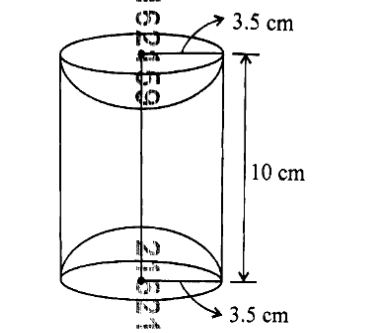
A wooden toy was made by scooping out a hemisphere from each end of a solid cylinder as shown in the figure. If the height of the cylinder is 10 cm and its base is of radius 3.5 cm, find the total surface area of the toy. (Use \(\pi = \frac{22}{7}\))
A solid is in the shape of a cone standing on a hemisphere, the radii of the cone and hemisphere are equal and its measure is 3 cm. If the height of the solid is 6 cm, then find the volume of the solid.



Comments