




UP Board Class 10 Sanskrit Question Paper 2025 PDF (Code 818 BP) with Answer Key and Solutions PDF is available for download here. UP Board Class 10 exams were conducted between February 24th to March 12th 2025. The total marks for the theory paper were 70. Students reported the paper to be easy to moderate.
UP Board Class 10 Sanskrit Question Paper 2025 (Code 818 BP) with Solutions
| UP Board Class 10 Sanskrit 818 BP Question Paper with Answer Key |  Download Download |
Check Solutions |
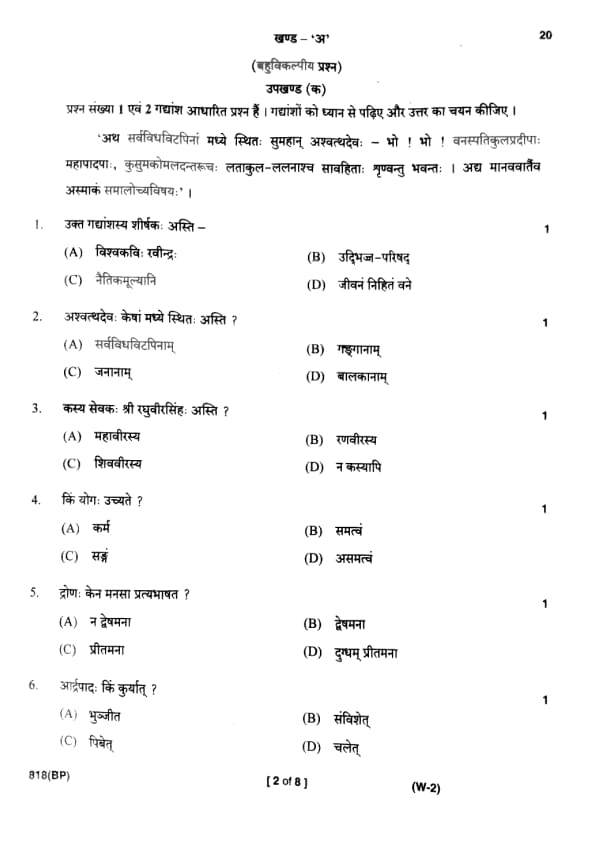
उक्त गद्यांशस्य शीर्षकः अस्ति -
View Solution
Step 1: Understanding the Passage:
The given Sanskrit passage describes a scene where a great Ashwattha tree (अश्वत्थदेवः), situated among all other trees, addresses them.
He calls out to the great trees ('महापादपाः') and the creepers ('लताकुल-ललनाश्च') to listen carefully.
He announces that the topic of discussion for the day is human affairs ('मानववार्ता').
Step 2: Analyzing the Options:
(A) विश्वकविः रवीन्द्रः: This means "World-poet Rabindranath". The passage does not mention him.
(B) उद्भिज्ज-परिषद्: This translates to "Council of Plants/Trees". 'उद्भिज्ज' means that which sprouts from the ground (i.e., plants), and 'परिषद्' means council or assembly. This title is very appropriate as the passage depicts an assembly of plants discussing a topic.
(C) नैतिकमूल्यानि: This means "Moral Values". While the discussion might eventually touch upon moral values, the direct theme is a meeting of trees.
(D) जीवनं निहितं वने: This means "Life is hidden in the forest". This is a general statement and not a specific title for the scene described.
Step 3: Final Answer:
Based on the analysis, the most suitable title for the passage is "उद्भिज्ज-परिषद्" because it accurately reflects the gathering of plants for a discussion.
Quick Tip: When asked for a title of a passage, look for the central theme or the main subject being discussed. The title should encapsulate the essence of the entire passage, not just a single detail. Here, the key elements are the assembly of trees ('परिषद्') and their nature as plants ('उद्भिज्ज').
अश्वत्थदेवः केषां मध्ये स्थितः अस्ति ?
View Solution
Step 1: Locating the Information in the Passage:
The question asks where the Ashwattha Deva is situated. The very first line of the passage provides the answer directly.
The line is: 'अथ सर्वविधविटपिनां मध्ये स्थितः सुमहान् अश्वत्थदेवः...'
Step 2: Understanding the Key Phrase:
- सर्वविधविटपिनाम्: This means "of all kinds of trees". ('विटपिन्' means tree).
- मध्ये: This means "in the middle of" or "among".
- स्थितः: This means "situated" or "standing".
So, the phrase means "situated among all kinds of trees".
Step 3: Final Answer:
The passage clearly states that the Ashwattha Deva is located among all types of trees. Therefore, option (A) is the correct answer. The other options, "गङ्गानाम्" (of rivers), "जनानाम्" (of people), and "बालकानाम्" (of children), are not mentioned in the text.
Quick Tip: For direct questions based on a passage, always scan the text for keywords from the question. The answer is often explicitly stated in the first few lines or near the subject mentioned in the question.
कस्य सेवकः श्री रघुवीरसिंहः अस्ति ?
View Solution
Step 1: Understanding the Concept:
This question is based on the Sanskrit prose work ' शिवराजविजयः' (Shivrajvijayah) written by Ambikadatta Vyasa. It requires knowledge of the characters from this text.
Step 2: Detailed Explanation:
In the story of 'शिवराजविजयः', the main protagonist is Shivaji Maharaj, who is referred to by several names, including 'शिववीरः' (Shivaveera).
रघुवीरसिंह (Raghuveer Singh) is a prominent and loyal warrior and servant in the army of Shivaveera (Shivaji).
Therefore, Shri Raghuveer Singh is the servant of Shivaveera.
Step 3: Final Answer:
Based on the character relationships in 'शिवराजविजयः', Raghuveer Singh is a servant of Shivaveera. Thus, option (C) is correct.
Quick Tip: Questions about specific characters are common in literature sections. It's helpful to remember the main characters and their relationships from key prescribed texts like 'शिवराजविजयः' or 'कादम्बरी'.
किं योगः उच्यते ?
View Solution
Step 1: Understanding the Concept:
This question asks for the definition of 'Yoga' according to a famous philosophical concept, primarily from the Bhagavad Gita.
Step 2: Detailed Explanation:
The Bhagavad Gita, in Chapter 2, Verse 48, provides a clear definition of Yoga. The verse is:
योगस्थः कुरु कर्माणि सङ्गं त्यक्त्वा धनञ्जय ।
सिद्ध्यसिद्ध्योः समो भूत्वा समत्वं योग उच्यते ॥
This means: "O Dhananjaya (Arjuna), perform your duty established in yoga, abandoning attachment, and being equal in success and failure. Such equanimity is called Yoga."
Therefore, Yoga is defined as 'समत्वं' (samatvam), which means equanimity, evenness of mind, or balance.
Step 3: Final Answer:
According to the authoritative definition from the Bhagavad Gita, Yoga is 'समत्वं'. Thus, option (B) is the correct answer.
Quick Tip: Remember key verses and definitions from important texts like the Bhagavad Gita. The phrase "समत्वं योग उच्यते" is a very famous and frequently tested concept in exams.
द्रोणः केन मनसा प्रत्यभाषत ?
View Solution
Step 1: Understanding the Context:
This question refers to the mental state of Dronacharya when he replied. This is likely from the "लक्ष्यवेधपरीक्षा" (Target-shooting Test) episode from the Mahabharata, a common story in Sanskrit textbooks.
Step 2: Detailed Explanation:
In the "लक्ष्यवेधपरीक्षा" story, Dronacharya tests his students (the Pandavas and Kauravas) by asking them what they see when aiming at a bird on a tree.
All students, except Arjuna, describe seeing the tree, branches, the bird, and other things. Dronacharya is displeased with their lack of focus.
However, when Arjuna's turn comes, he replies that he sees only the eye of the bird. Hearing this answer, Dronacharya is extremely pleased with Arjuna's concentration.
The text often describes Drona as 'प्रीतमना' (with a pleased mind) at this moment. He then joyfully permits Arjuna to shoot.
Step 3: Final Answer:
In the context of Arjuna's correct answer during the test, Dronacharya replied with a pleased mind ('प्रीतमना'). Thus, option (C) is the correct choice. Option (D) appears to be a typographical error.
Quick Tip: When answering character-based questions, try to recall the specific event or context. A character's emotion can change depending on the situation. Here, Drona's pleasure is specifically linked to Arjuna's success.
आर्द्रपादः किं कुर्यात् ?
View Solution
Step 1: Understanding the Concept:
This question is based on a well-known Sanskrit maxim (सुभाषितम्) related to health and daily conduct, often derived from Ayurvedic or Dharmashastra texts.
Step 2: Detailed Explanation:
The complete maxim is: "आर्द्रपादस्तु भुञ्जीत न तु आर्द्रपादस्तु संविशेत्।"
This translates to: "One should eat with wet feet (आर्द्रपादः भुञ्जीत), but one should not sleep with wet feet (आर्द्रपादः न संविशेत्)."
- आर्द्रपादः: One with wet feet.
- भुञ्जीत: Should eat (from root भुज्, in विधिलिङ् लकार).
- संविशेत्: Should sleep/lie down.
The question asks what a person with wet feet should do. According to the maxim, they should eat.
Step 3: Final Answer:
Based on the maxim, one should eat with wet feet. Therefore, option (A) 'भुञ्जीत' is the correct answer.
Quick Tip: Familiarize yourself with common Sanskrit maxims (Subhashitas) related to daily life, ethics, and health. They are a frequent source of questions in competitive exams.
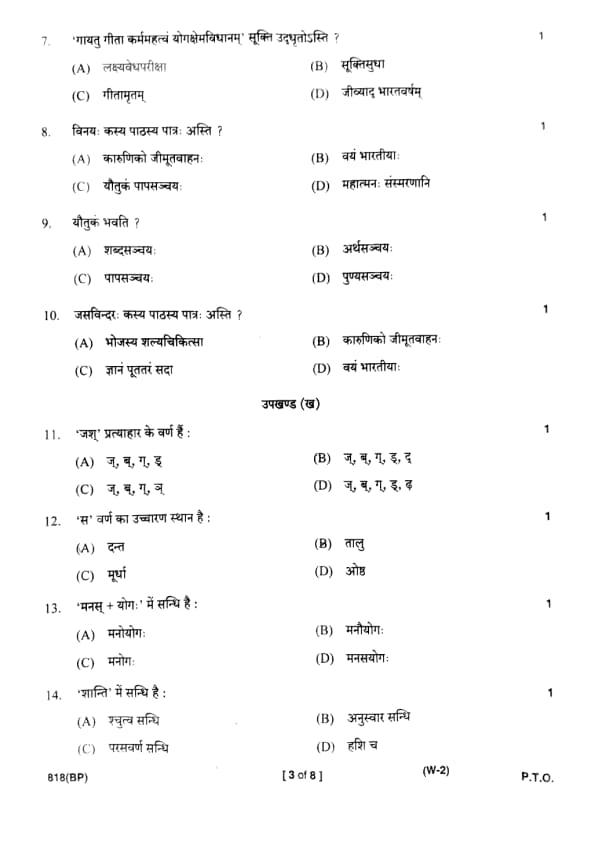
'गायतु गीता कर्ममहत्वं योगक्षेमविधानम्' सूक्ति उद्धृतोऽस्ति ?
View Solution
Step 1: Understanding the Quote:
The quote is "गायतु गीता कर्ममहत्वं योगक्षेमविधानम्". It means "[Let India/Indians] sing the Gita, the importance of Karma, and the principles of Yoga-Kshema (well-being and prosperity)". This line has a patriotic and cultural tone, praising the core teachings of Indian philosophy.
Step 2: Identifying the Source:
This line is a part of a song or poem that glorifies India. We need to identify which of the given lessons contains this theme.
(A) लक्ष्यवेधपरीक्षा: This is about Drona's archery test.
(B) सूक्तिसुधा: This would be a collection of various wise sayings.
(C) गीतामृतम्: This would be focused on the teachings of the Gita.
(D) जीव्याद् भारतवर्षम्: This translates to "Long Live India". This title perfectly matches the patriotic and cultural theme of the quote. This line is indeed from the lesson/poem titled "जीव्याद् भारतवर्षम्".
Step 3: Final Answer:
The quote is from the text 'जीव्याद् भारतवर्षम्', which is a patriotic composition celebrating Indian culture and knowledge. Therefore, (D) is the correct answer.
Quick Tip: Pay attention to the tone and theme of a given quote. A patriotic quote is likely from a lesson with a patriotic title. Matching the theme can help you identify the source even if you don't remember the exact line.
विनयः कस्य पाठस्य पात्रः अस्ति ?
View Solution
Step 1: Understanding the Question:
The question asks to identify the lesson or text in which 'Vinay' (विनयः) is a character. This requires knowledge of the content of specific Sanskrit textbook lessons.
Step 2: Identifying the Character's Source:
The character Vinay (विनयः) appears in the lesson titled "वयं भारतीयाः" (We are Indians). This lesson typically involves a conversation among different characters, like Vinay and Jaswinder (see Q.10), who discuss the unity and diversity of India.
The other options are incorrect:
- 'कारुणिको जीमूतवाहनः' is a story about the compassionate prince Jimutavahana.
- 'यौतुकं पापसञ्चयः' is a lesson about the social evil of dowry.
- 'महात्मनः संस्मरणानि' is about the memories of Mahatma Gandhi.
Step 3: Final Answer:
Vinay is a character from the lesson "वयं भारतीयाः". Therefore, option (B) is the correct answer.
Quick Tip: When preparing for exams based on textbooks, create a simple list of main characters and the titles of the lessons they belong to. This makes answering such direct recall questions much easier.
यौतुकं भवति ?
View Solution
Step 1: Understanding the Concept:
The question asks for the nature of 'यौतुकम्' (Yautukam), which means dowry. The answer is based on the moral and social perspective often presented in modern Sanskrit literature and textbooks.
Step 2: Detailed Explanation:
The practice of dowry is widely condemned as a social evil. In many educational texts, it is described not merely as an exchange of wealth ('अर्थसञ्चयः') but as an immoral act that leads to suffering and injustice.
Therefore, from an ethical standpoint, dowry is considered an accumulation of sin ('पापसञ्चयः'). In fact, one of the lesson titles mentioned in the previous question is "यौतुकं पापसञ्चयः", which directly translates to "Dowry is an accumulation of sin". This confirms the intended answer.
- शब्दसञ्चयः: Accumulation of words.
- अर्थसञ्चयः: Accumulation of wealth.
- पापसञ्चयः: Accumulation of sin.
- पुण्यसञ्चयः: Accumulation of merit.
Step 3: Final Answer:
Dowry is considered an accumulation of sin. Hence, option (C) is the correct answer.
Quick Tip: Some questions test your understanding of social and ethical messages conveyed in the curriculum. The titles of lessons themselves can often be a direct clue to the answer.
जसविन्दरः कस्य पाठस्य पात्रः अस्ति ?
View Solution
Step 1: Understanding the Question:
This question, similar to question 8, asks to identify the lesson to which the character 'Jaswinder' (जसविन्दरः) belongs.
Step 2: Identifying the Character's Source:
The character Jaswinder appears alongside Vinay in the lesson titled "वयं भारतीयाः" (We are Indians). This lesson emphasizes national integration by showing characters from different parts of India interacting harmoniously.
The other options are incorrect as they deal with different stories and themes.
Step 3: Final Answer:
Jaswinder is a character from the lesson "वयं भारतीयाः". Therefore, option (D) is the correct answer.
Quick Tip: Character identification questions are straightforward recall tests. Linking character names (like Vinay and Jaswinder) to their corresponding lesson ("वयं भारतीयाः") during study is an effective strategy.
'जश्' प्रत्याहार के वर्ण हैं :
View Solution
Step 1: Understanding the Concept:
This question is about 'प्रत्याहार' (Pratyahara) from Paninian grammar, which is a method of abbreviating a series of sounds from the Maheshvara Sutras. A pratyahara is formed by taking the first sound of a sequence and the last 'इत्' (marker) sound of the sequence.
Step 2: Key Formula or Approach:
The 'जश्' (Jaś) pratyahara starts with the letter 'ज्' (j) from the sutra 'जबगडदश्' and ends with the marker 'श्' (ś) from the same sutra.
The Maheshvara Sutra involved is: ज ब ग ड द श् (jabagaḍadaś)
To form the pratyahara, we list all the letters starting from 'ज' up to, but not including, the final marker 'श्'.
The letters are: ज (j), ब (b), ग (g), ड (ḍ), द (d).
Step 3: Detailed Explanation:
Let's analyze the options:
(A) ज्, ब्, ग्, ड - This is incomplete as it misses 'द'.
(B) ज्, ब्, ग्, ङ, द - This is incorrect as it includes 'ङ' instead of 'ड'.
(C) ज्, ब्, ग्, ञ् - This is incorrect.
(D) ज्, ब्, ग्, ड, द - This list exactly matches the letters of the 'जश्' pratyahara. These are the voiced, unaspirated consonants, which are the third letters of the five consonant classes (वर्ग).
Step 4: Final Answer:
The letters of the 'जश्' pratyahara are ज्, ब्, ग्, ड, द. Therefore, option (D) is correct.
Quick Tip: Memorizing the 14 Maheshvara Sutras is essential for solving any question related to pratyaharas. The 'जश्' pratyahara is particularly important as it is frequently used in sandhi rules, such as in 'जश्त्व सन्धि'.
'स' वर्ण का उच्चारण स्थान है :
View Solution
Step 1: Understanding the Concept:
This question asks for the 'उच्चारण स्थान' (uchcharana sthana), or the point of articulation, for the Sanskrit letter 'स' (sa). This is a fundamental concept in Sanskrit phonetics (शिक्षा).
Step 2: Key Formula or Approach:
The points of articulation are defined by specific sutras in Paninian grammar. The sutra relevant to the letter 'स' is:
"लृतुलसानां दन्ताः" (lṛtulasānāṃ dantāḥ)
Step 3: Detailed Explanation:
Let's break down the sutra:
- लृ (lṛ): The vowel लृ.
- तु (tu): Represents the entire dental class (त वर्ग), which includes त्, थ्, द्, ध्, न् (t, th, d, dh, n).
- ल (la): The consonant ल.
- स (sa): The consonant स.
The sutra states that all these sounds have 'दन्ताः' (the teeth) as their point of articulation. They are dental sounds.
The other options are:
- तालु (Palate): For sounds like इ, च वर्ग, य, श ("इचुयशानां तालु").
- मूर्धा (Retroflex): For sounds like ऋ, ट वर्ग, र, ष ("ऋटुरषाणां मूर्धा").
- ओष्ठ (Lips): For sounds like उ, प वर्ग ("उपूपध्मानीयानामोष्ठौ").
Step 4: Final Answer:
According to the sutra "लृतुलसानां दन्ताः", the letter 'स' is a dental consonant. Therefore, option (A) is correct.
Quick Tip: Memorize the key sutras for the points of articulation. They provide a systematic way to remember the pronunciation of all Sanskrit sounds. Grouping sounds like (श, ष, स) and remembering their places (तालु, मूर्धा, दन्त) is very helpful.
'मनस् + योगः' में सन्धि है :
View Solution
Step 1: Understanding the Concept:
This question requires applying the rules of Visarga Sandhi (specifically, the rules that apply when a final 'स्' is treated like a visarga) to combine the words 'मनस्' and 'योगः'.
Step 2: Key Formula or Approach:
The process involves a sequence of Paninian sutras:
1. ससजुषो रुः (sasajuṣo ruḥ): The final 'स्' (s) of a 'pada' (word) and the 'ष्' of 'सजुष्' are replaced by 'रु' (r).
\[ मनस् + योगः \rightarrow मनर् + योगः \]
2. हशि च (haśi ca): The 'रु' (which is technically 'र्' here) that comes from 'स्', and is preceded by 'अ' (a), is replaced by 'उ' (u) when followed by a 'हश्' pratyahara letter (soft consonants). The letter 'य्' (y) of 'योगः' is a 'हश्' letter.
\[ मनर् + योगः \rightarrow मनउ + योगः \]
3. आद्गुणः (ādguṇaḥ): The Guna Sandhi rule applies. When 'अ' or 'आ' is followed by 'इ', 'उ', 'ऋ', 'लृ', they are replaced by their Guna equivalents ('ए', 'ओ', 'अर्', 'अल्'). Here, 'अ' (in मन) + 'उ' combine to form 'ओ' (o).
\[ मन्(अ + उ) + योगः \rightarrow मनो + योगः \rightarrow मनोयोगः \]
Step 3: Final Answer:
Following the rules of sandhi, 'मनस् + योगः' combines to form 'मनोयोगः'. Therefore, option (A) is correct.
Quick Tip: This sandhi pattern (अः/अस् + soft consonant = ओ) is very common. Examples include नमः + नमः → नमो नमः, यशः + दा → यशोदा, मनः + रथः → मनोरथः. Recognizing this pattern can save time.
'शान्ति' में सन्धि है :
View Solution
Step 1: Understanding the Concept:
The question asks to identify the type of sandhi in the word 'शान्तिः'. The formation of this word involves the root 'शम्' and the suffix 'क्तिन्' (which effectively leaves 'ति'). The combination is शम् + ति.
Step 2: Key Formula or Approach:
Two sandhi rules are applied in sequence:
1. मोऽनुस्वारः (mo'nusvāraḥ): This rule states that a final 'म्' (m) at the end of a 'pada' (word), when followed by any consonant, is replaced by an 'अनुस्वार' (anusvāra), represented by a dot (ं).
\[ शम् + ति \rightarrow शां + ति \]
At this stage, it appears to be Anusvara Sandhi. However, a subsequent rule applies.
2. अनुस्वारस्य ययि परसवर्णः (anusvārasya yayi parasavarṇaḥ): This rule states that an 'अनुस्वार', when followed by a consonant of the 'यय्' pratyahara (all consonants except ś, ṣ, s, h), is optionally replaced by the nasal consonant of the same class (varga) as the following consonant.
- Here, the अनुस्वार (ं) is followed by 'त्' (t).
- 'त्' belongs to the 'त-वर्ग' (t-varga): त, थ, द, ध, न.
- The nasal of the 'त-वर्ग' is 'न्' (n).
- Therefore, the अनुस्वार (ं) changes to 'न्' (n).
\[ शां + ति \rightarrow शान् + ति \rightarrow शान्ति \]
Step 3: Final Answer:
The final form 'शान्ति' is achieved through the Parasarvana Sandhi rule, which means "changing to the sound of the following class". Although Anusvara Sandhi is an intermediate step, the defining and final sandhi is Parasarvana. Therefore, option (C) is the most accurate answer.
Quick Tip: When multiple sandhi rules apply, the name of the sandhi is usually determined by the final, most specific rule that gives the word its form. Remember that Parasarvana Sandhi is the rule that changes 'ं' into one of the class nasals (ङ, ञ, ण, न, म).
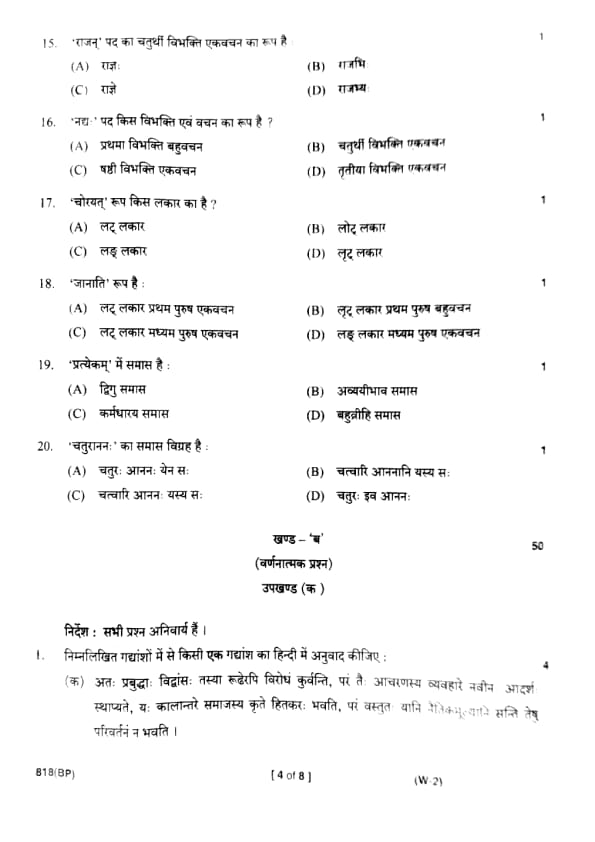
'राजन्' पद का चतुर्थी विभक्ति एकवचन का रूप है :
View Solution
Step 1: Understanding the Concept:
This question tests the knowledge of noun declension ('शब्द-रूप') in Sanskrit, specifically for the masculine noun 'राजन्' (king), which ends in 'अन्'.
Step 2: Detailed Explanation:
We need to find the form for the fourth case (चतुर्थी विभक्ति - Dative case), singular number (एकवचन). Let's look at the declension of 'राजन्' in the singular:
- प्रथमा (Nominative): राजा
- द्वितीया (Accusative): राजानम्
- तृतीया (Instrumental): राज्ञा
- चतुर्थी (Dative): राज्ञे
- पञ्चमी (Ablative): राज्ञः
- षष्ठी (Genitive): राज्ञः
- सप्तमी (Locative): राज्ञि / राजनि
Step 3: Analyzing the Options:
- (A) राज्ञः: This is the form for both Panchami (Ablative) and Shasthi (Genitive) singular.
- (B) राजभिः: This is the form for Trutiya (Instrumental) plural.
- (C) राज्ञे: This is the correct form for Chaturthi (Dative) singular.
- (D) राजभ्यः: This is the form for both Chaturthi (Dative) and Panchami (Ablative) plural.
Step 4: Final Answer:
The Dative singular form of 'राजन्' is 'राज्ञे'. Therefore, option (C) is correct.
Quick Tip: Mastering the declensions of common and irregular nouns like राजन्, पितृ, आत्मन्, and सरित् is crucial for scoring well in Sanskrit grammar. Pay special attention to the changes in the stem (e.g., राजन् becomes राज्ञ्) in different cases.
'नद्यः' पद किस विभक्ति एवं वचन का रूप है ?
View Solution
Step 1: Understanding the Concept:
This question tests the knowledge of the declension of the feminine noun 'नदी' (river), which ends in a long 'ई'.
Step 2: Detailed Explanation:
We need to identify the case (विभक्ति) and number (वचन) for the word 'नद्यः'. Let's look at the declension of 'नदी':
\begin{tabular{|l|l|l|l|
\hline
विभक्ति & एकवचन & द्विवचन & बहुवचन
\hline
प्रथमा & नदी & नद्यौ & नद्यः
द्वितीया & नदीम् & नद्यौ & नद्यः
\hline
\end{tabular
As we can see from the table, the form 'नद्यः' occurs in two places:
1. प्रथमा विभक्ति, बहुवचन (Nominative Plural) - "the rivers" (as subject)
2. द्वितीया विभक्ति, बहुवचन (Accusative Plural) - "the rivers" (as object)
Step 3: Analyzing the Options:
Let's check which of these possibilities is listed in the options.
- (A) प्रथमा विभक्ति बहुवचन: This matches our finding.
- (B) चतुर्थी विभक्ति एकवचन: The form is 'नद्यै'.
- (C) षष्ठी विभक्ति एकवचन: The form is 'नद्याः'.
- (D) तृतीया विभक्ति एकवचन: The form is 'नद्या'.
Step 4: Final Answer:
Since 'नद्यः' is the form for the Nominative Plural and this is given as an option, (A) is the correct answer.
Quick Tip: For nouns ending in long vowels like 'नदी' (ई) or 'वधू' (ऊ), be aware of the forms where vowel sandhi (यण् सन्धि) occurs, such as in नद्यौ, नद्यः, वध्वः etc. These are frequently tested.
'चोरयत्' रूप किस लकार का है ?
View Solution
Step 1: Understanding the Concept:
This question asks to identify the 'लकार' (Lakar - tense/mood) of the verb form 'चोरयत्'. The root is 'चुर्' (to steal), which belongs to the 10th conjugation (चुरादिगण), so it takes the 'अय' infix, becoming 'चोरय'.
Step 2: Analyzing the Verb Form:
Let's conjugate 'चोरय' in different Lakars (प्रथम पुरुष, एकवचन):
- लट् लकार (Present): चोरयति
- लोट् लकार (Imperative): चोरयतु
- लङ् लकार (Past Imperfect): अचोरयत् (Note the 'अ' augment)
- विधिलिङ् लकार (Potential): चोरयेत्
- लृट् लकार (Future): चोरयिष्यति
Step 3: Detailed Explanation:
The given form is 'चोरयत्'. This form, ending in 'त्' without an 'इ' or 'उ', is characteristic of the लङ् लकार (Past Tense), प्रथम पुरुष, एकवचन.
However, the standard form in लङ् लकार requires an 'अ' prefix (called an augment or 'आगम'). The correct form is 'अचोरयत्'.
It is highly likely that 'चोरयत्' is a common exam question format where the augment 'अ' is omitted, and the student is expected to recognize the core past tense form. In certain poetic or specific grammatical contexts (e.g., with the prohibitive particle 'मा'), the augment is dropped ('मा चोरयत्' - let him not steal). Given the options, लङ् लकार is the only plausible choice.
Step 4: Final Answer:
Assuming the omission of the standard 'अ' augment, the form 'चोरयत्' belongs to the लङ् लकार. Therefore, option (C) is the correct answer.
Quick Tip: In verb identification questions, the ending of the verb is the primary clue for person and number, while prefixes like 'अ' are strong indicators of the Lakar (specifically, लङ्). Be prepared for questions that might omit this augment to test your knowledge of the verb stem and ending.
'जानाति' रूप है :
View Solution
Step 1: Understanding the Concept:
The question asks for a complete grammatical analysis (Lakar, Purusha, Vachan) of the verb form 'जानाति'.
Step 2: Analyzing the Verb Form:
- Verb Root (धातु): The root is 'ज्ञा' (to know), which belongs to the 9th conjugation (क्र्यादिगण). In this conjugation, the infix 'ना' is added to the root before the endings. So, ज्ञा becomes जाना-.
- Tense/Mood (लकार): The form 'जानाति' does not have a past tense augment ('अ') or a future tense marker ('स्य'/'इष्य'). It is the basic present tense form. Therefore, it is in लट् लकार (Present Tense).
- Person (पुरुष) and Number (वचन): The ending is '-ति'. The '-ति' ending in the active voice (परस्मैपद) signifies 'प्रथम पुरुष' (Third Person) and 'एकवचन' (Singular Number).
Step 3: Final Answer:
Combining the analysis:
- Lakar: लट् लकार
- Purusha: प्रथम पुरुष
- Vachan: एकवचन
This matches option (A).
Quick Tip: Memorize the basic verb endings for different Lakars, especially लट्, लङ्, and लृट्. The ending '-ति' is a definitive marker for the third person singular in the present tense (लट् लकार, परस्मैपद).
'प्रत्येकम्' में समास है :
View Solution
Step 1: Understanding the Concept:
The question asks to identify the type of compound ('समास') in the word 'प्रत्येकम्'.
Step 2: Detailed Explanation:
- Compound Word: प्रत्येकम् (pratyekam)
- Dissolution (विग्रह): The word is dissolved as "एकम् एकम् प्रति" (ekam ekam prati), which means "towards each one" or "one by one".
- Analysis of the Compound: The compound is formed from 'प्रति' + 'एकम्'.
- The first part, 'प्रति' (prati), is an 'अव्यय' (avyaya - an indeclinable or adverb).
- In this compound, the meaning of the 'अव्यय' ('प्रति') is predominant.
- Definition of Avyayibhava Samasa: An 'अव्ययीभाव समास' is a compound where the first member is an indeclinable (अव्यय) and its meaning is principal. The entire compound word then functions as an indeclinable (though it can take a neuter singular ending like '-अम्').
Step 3: Final Answer:
Since 'प्रत्येकम्' has an indeclinable ('प्रति') as its first and principal member, it is an example of an अव्ययीभाव समास. Therefore, option (B) is correct.
Quick Tip: Look for a prefix that is an 'अव्यय' (like प्रति, यथा, उप, अनु, निर्) at the beginning of a compound word. Its presence is a strong indicator of an Avyayibhava Samasa. The dissolution often involves repeating the second word, as in "एकम् एकम् प्रति".
'चतुराननः' का समास विग्रह है :
View Solution
Step 1: Understanding the Concept:
The question asks for the correct dissolution ('समास विग्रह') of the compound word 'चतुराननः'.
- Compound Word: चतुराननः (caturānanaḥ), which means "the four-faced one", a name for Lord Brahma.
- Type of Samasa: Since the word refers to a specific person (Brahma) who is different from the components ('four' and 'faces'), it is a बहुव्रीहि समास (Bahuvrihi Samasa). The dissolution of a Bahuvrihi compound often ends with 'यस्य सः' (he whose...).
Step 2: Grammatical Analysis of the Dissolution:
The components are 'चतुर्' (four) and 'आनन' (face).
- The noun 'आनन' (face) is of neuter gender. Its plural form is 'आननानि' (ānanāni).
- The number 'चतुर्' (four) has different forms for different genders. For the neuter gender, the form is 'चत्वारि' (catvāri).
- Therefore, the phrase "four faces" should be grammatically written as "चत्वारि आननानि".
Step 3: Evaluating the Options:
(A) चतुरः आननः येन सः: Incorrect. 'चतुरः' is masculine, and 'आननः' is singular.
(B) चत्वारि आननानि यस्य सः: Correct. "He whose faces are four". Both 'चत्वारि' and 'आननानि' are in the correct neuter plural form and agree with each other.
(C) चत्वारि आननः यस्य सः: Incorrect. 'आननः' is singular and does not agree with the plural 'चत्वारि'.
(D) चतुरः इव आननः: Incorrect. This means "face like a clever person" and would form a different type of compound (कर्मधारय).
Step 4: Final Answer:
The only grammatically and semantically correct dissolution for the Bahuvrihi compound 'चतुराननः' is "चत्वारि आननानि यस्य सः". Option (B) is the correct answer.
Quick Tip: When dissolving a Bahuvrihi compound, pay close attention to the gender and number agreement between the components. For compounds with a number, ensure you use the correct gender form of the numeral (e.g., चत्वारः (m.), चतस्रः (f.), चत्वारि (n.)).
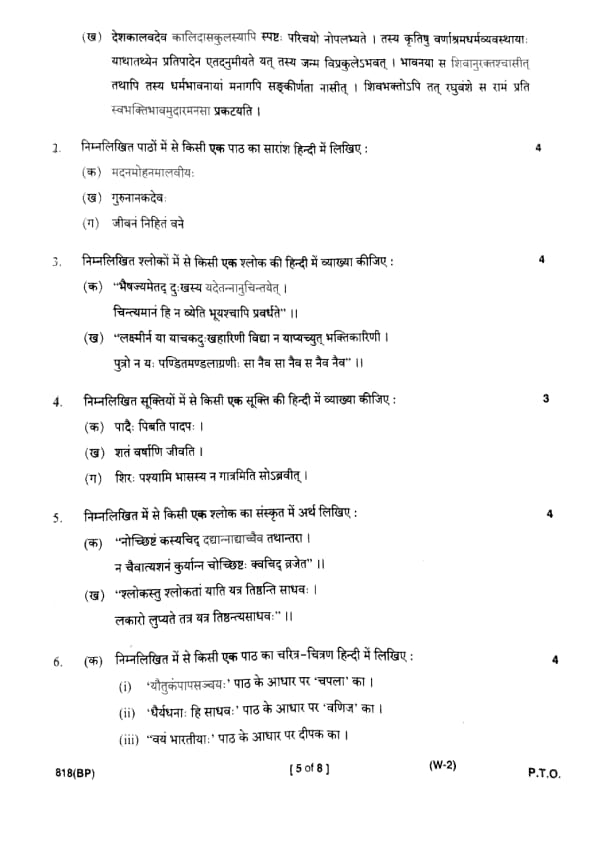
निम्नलिखित गद्यांश का हिन्दी में अनुवाद कीजिए:
अतः प्रबुद्धाः विद्वांसः तस्या रूढेरपि विरोधं कुर्वन्ति, परं तैः आचरणस्य व्यवहारे नवीनः आदर्शः स्थाप्यते, यः कालान्तरे समाजस्य कृते हितकरः भवति, परं वस्तुतः यानि नैतिकमूल्यानि सन्ति तेषु परिवर्तनं न भवति।
View Solution
Step 1: Understanding the Task:
The task is to translate the given Sanskrit passage into clear and accurate Hindi, maintaining the original meaning.
Step 2: Detailed Phrase-by-Phrase Analysis:
- अतः प्रबुद्धाः विद्वांसः - इसलिए, जागे हुए (प्रबुद्ध) विद्वान।
- तस्या रूढेरपि विरोधं कुर्वन्ति - उस रूढ़ि (परंपरा) का भी विरोध करते हैं। (रूढेः + अपि = रूढेरपि, Visarga Sandhi)।
- परं तैः आचरणस्य व्यवहारे - परंतु, उनके द्वारा आचरण के व्यवहार में।
- नवीनः आदर्शः स्थाप्यते - नया आदर्श स्थापित किया जाता है। (Passive voice)।
- यः कालान्तरे समाजस्य कृते हितकरः भवति - जो समय बीतने पर (भविष्य में) समाज के लिए कल्याणकारी होता है।
- परं वस्तुतः - परंतु वास्तव में।
- यानि नैतिकमूल्यानि सन्ति - जो नैतिक मूल्य हैं।
- तेषु परिवर्तनं न भवति - उनमें परिवर्तन नहीं होता है।
Step 3: Final Polished Translation:
Combining the analysis of these phrases, we get the complete translation:
"इसलिए, प्रबुद्ध विद्वान उस रूढ़ि (परंपरा) का भी विरोध करते हैं, परंतु उनके द्वारा आचरण और व्यवहार में एक नया आदर्श स्थापित किया जाता है, जो समय के साथ समाज के लिए हितकर होता है। परन्तु, वास्तव में जो नैतिक मूल्य हैं, उनमें परिवर्तन नहीं होता है।"
Quick Tip: When translating from Sanskrit, first identify the main subject (कर्ता) and the main verb (क्रिया) to understand the core sentence. Here, 'विद्वांसः' (विद्वान) is the subject and 'कुर्वन्ति' (करते हैं) is the verb. This helps in structuring the rest of the sentence correctly.
निम्नलिखित गद्यांश का हिन्दी में अनुवाद कीजिए:
देशकालवदेव कालिदासकुलस्यापि स्पष्टः परिचयो नोपलभ्यते। तस्य कृतिषु वर्णाश्रमधर्मव्यवस्थायाः यथातथ्येन प्रतिपादनेन एतदनुमीयते यत् तस्य जन्म विप्रकुलेऽभवत्। भावनया स शिवानु रक्तश्चासीत् तथापि तस्य धर्मभावनायां मनागपि सङ्कीर्णता नासीत्। शिवभक्तोऽपि तत् रघुवंशे स रामं प्रति स्वभक्तिभावमुदारमनसा प्रकटयति।
View Solution
Step 1: Understanding the Task:
The task is to translate this passage about the poet Kalidasa into comprehensible Hindi.
Step 2: Detailed Phrase-by-Phrase Analysis:
- देशकालवदेव - देश और काल की ही तरह। (देश + कालवत् + एव)।
- कालिदासकुलस्यापि स्पष्टः परिचयो नोपलभ्यते - कालिदास के कुल का भी स्पष्ट परिचय नहीं मिलता है। (कुलस्य + अपि; परिचयः + न + उपलभ्यते)।
- तस्य कृतिषु वर्णाश्रमधर्मव्यवस्थायाः यथातथ्येन प्रतिपादनेन - उनकी रचनाओं में वर्णाश्रम धर्म व्यवस्था के यथार्थ रूप से प्रतिपादन (वर्णन) के द्वारा।
- एतदनुमीयते यत् - यह अनुमान लगाया जाता है कि। (एतत् + अनुमीयते)।
- तस्य जन्म विप्रकुलेऽभवत् - उनका जन्म ब्राह्मण कुल में हुआ था। (विप्रकुले + अभवत् - Langa Lakar, Past Tense)।
- भावनया स शिवानु रक्तश्चासीत् - भावना से वे शिव के भक्त थे। (शिव + अनुरक्तः + च + आसीत्)।
- तथापि तस्य धर्मभावनायां मनागपि सङ्कीर्णता नासीत् - फिर भी उनकी धर्म-भावना में थोड़ी सी भी संकीर्णता (तंगदिली) नहीं थी। (मनाक् + अपि)।
- शिवभक्तोऽपि - शिवभक्त होते हुए भी। (शिवभक्तः + अपि)।
- तत् रघुवंशे स रामं प्रति - वह रघुवंश (महाकाव्य) में राम के प्रति।
- स्वभक्तिभावमुदारमनसा प्रकटयति - अपने भक्ति-भाव को उदार मन से प्रकट करते हैं। (स्वभक्तिभावम् + उदारमनसा)।
Step 3: Final Polished Translation:
Assembling these parts leads to the final translation:
"देश और काल (समय) की ही तरह कालिदास के कुल का भी स्पष्ट परिचय नहीं मिलता है। उनकी रचनाओं में वर्णाश्रम धर्म व्यवस्था के यथार्थ चित्रण से यह अनुमान लगाया जाता है कि उनका जन्म विप्र (ब्राह्मण) कुल में हुआ था। भावना से वे शिव के भक्त थे, फिर भी उनकी धार्मिक भावना में थोड़ी भी संकीर्णता नहीं थी। शिवभक्त होते हुए भी, वह अपने (महाकाव्य) रघुवंश में राम के प्रति अपनी भक्ति-भावना को उदार मन से प्रकट करते हैं।"
Quick Tip: Sanskrit often uses long compound words (समास). To translate them, break them down into their constituent parts. For example, 'वर्णाश्रमधर्मव्यवस्थायाः' can be broken into 'वर्ण', 'आश्रम', 'धर्म', and 'व्यवस्था' to understand it means "of the system of the dharma of varna and ashrama".
निम्नलिखित पाठों में से किसी एक पाठ का सारांश हिन्दी में लिखिए : मदनमोहनमालवीयः
View Solution
Step 1: Understanding the Task:
The task is to write a summary of the life and contributions of Madan Mohan Malaviya in Hindi.
Step 2: Identifying Key Points:
- परिचय (Introduction): महान देशभक्त, शिक्षाविद् और समाज सुधारक।
- जन्म (Birth): 1861, प्रयागराज।
- मुख्य योगदान (Main Contribution): बनारस हिन्दू विश्वविद्यालय (BHU) की स्थापना (1916)।
- अन्य कार्य (Other Works): पत्रकारिता (अभ्युदय, लीडर), समाज सुधार (अस्पृश्यता का विरोध)।
- विचारधारा (Ideology): सनातन धर्म के समर्थक, सर्व-धर्म समभाव।
- सम्मान (Honors): 'महामना' की उपाधि, 'भारत रत्न' (मरणोपरांत)।
Step 3: Structuring the Summary:
The summary is structured by first introducing him, then highlighting his most significant achievement (BHU), followed by his other contributions in journalism and social reform, and concluding with the honors he received and his legacy. This provides a comprehensive yet concise overview.
Quick Tip: सारांश लिखते समय, व्यक्ति के जीवन की सबसे महत्वपूर्ण घटनाओं और योगदानों पर ध्यान केंद्रित करें। बनारस हिन्दू विश्वविद्यालय की स्थापना मदन मोहन मालवीय के जीवन का केंद्रीय स्तंभ है, इसलिए इसका उल्लेख अवश्य करें।
निम्नलिखित पाठों में से किसी एक पाठ का सारांश हिन्दी में लिखिए : गुरुनानकदेवः
View Solution
Step 1: Understanding the Task:
The task is to write a summary of the life and teachings of Guru Nanak Dev in Hindi.
Step 2: Identifying Key Points:
- परिचय (Introduction): सिख धर्म के संस्थापक और प्रथम गुरु।
- जन्म (Birth): 1469, तलवंडी (ननकाना साहिब)।
- मुख्य शिक्षाएं (Core Teachings): 'इक ओंकार' (ईश्वर एक है), अंधविश्वास और जाति-प्रथा का विरोध।
- जीवन का सिद्धांत (Principle of Life): नाम जपो, किरत करो, वंड छको।
- कार्य (Work): समाज सुधार के लिए यात्राएं ('उदासियां')।
- विरासत (Legacy): उनकी शिक्षाएं 'गुरु ग्रंथ साहिब' में संकलित हैं।
Step 3: Structuring the Summary:
The summary begins with his identity, then moves to his core philosophical teachings, his practical advice for life, his actions to spread his message, and finally his lasting legacy in the form of the holy scripture. This logical flow creates an effective summary.
Quick Tip: किसी भी दार्शनिक या गुरु का सारांश लिखते समय, उनकी सबसे प्रमुख शिक्षा या सिद्धांत (जैसे गुरु नानक के लिए 'इक ओंकार') को केंद्र में रखें। यह उनके पूरे जीवन-दर्शन को समझने की कुंजी होती है।
निम्नलिखित पाठों में से किसी एक पाठ का सारांश हिन्दी में लिखिए : जीवनं निहितं वने
View Solution
Step 1: Understanding the Topic:
The topic is "जीवनं निहितं वने" (Life is contained in the forest). The task requires writing a summary explaining this concept.
Step 2: Identifying Key Arguments:
- ऑक्सीजन का स्रोत (Source of Oxygen): वन हमें सांस लेने के लिए ऑक्सीजन देते हैं।
- जैव-विविधता (Biodiversity): वे लाखों प्रजातियों का आश्रय स्थल हैं।
- मानव उपयोगिता (Utility for Humans): भोजन, औषधि, लकड़ी आदि प्रदान करते हैं।
- पर्यावरण संतुलन (Ecological Balance): जलवायु नियंत्रण, बाढ़ और मिट्टी के कटाव की रोकथाम।
- सांस्कृतिक महत्व (Cultural Importance): भारतीय संस्कृति में वनों का स्थान।
- आधुनिक समस्या (Modern Problem): वनों की कटाई और उसके परिणाम।
- निष्कर्ष (Conclusion): वनों का संरक्षण जीवन के लिए अनिवार्य है।
Step 3: Structuring the Summary:
The summary starts by explaining the title's meaning. It then lists the scientific, economic, ecological, and cultural importance of forests. Finally, it addresses the modern threat of deforestation and concludes with the necessity of conservation, thus covering all aspects of the topic.
Quick Tip: जब किसी विषय पर सारांश लिखना हो, तो उसे विभिन्न दृष्टिकोणों से देखें—जैसे वैज्ञानिक, सामाजिक, आर्थिक और सांस्कृतिक। इससे आपका सारांश अधिक व्यापक और प्रभावशाली बनता है।
निम्नलिखित श्लोकों में से किसी एक श्लोक की हिन्दी में व्याख्या कीजिए :
“भैषज्यमेतद् दुःखस्य यदेतन्नानुचिन्तयेत् ।
चिन्त्यमानं हि न व्येति भूयश्चापि प्रवर्धते” ।।
View Solution
Step 1: Understanding the Shloka:
The shloka offers a practical solution for dealing with sorrow (दुःख). It identifies what the "medicine" (भैषज्यम्) for sorrow is.
Step 2: Word-by-Word Analysis:
- भैषज्यम् एतत् दुःखस्य - This is the medicine of sorrow.
- यत् एतत् न अनुचिन्तयेत् - That one should not think about it.
- चिन्त्यमानं हि - Because by being thought about.
- न व्येति - It does not go away/perish.
- भूयः च अपि प्रवर्धते - And, on the contrary, it grows even more.
Step 3: Structuring the Explanation (व्याख्या):
1. संदर्भ (Context): State that the verse is from didactic literature (नीति साहित्य).
2. अनुवाद (Translation): Provide a clear and literal translation of the verse.
3. व्याख्या (Explanation): Elaborate on the central idea. Explain the psychological principle that dwelling on negative thoughts amplifies them. Use an analogy (like fire and ghee) to make the point clearer. Conclude by summarizing the practical advice given in the shloka.
Quick Tip: श्लोक की व्याख्या करते समय, केवल अनुवाद तक सीमित न रहें। उसके गहरे अर्थ, उसमें छिपे संदेश और आज के जीवन में उसकी प्रासंगिकता पर भी प्रकाश डालें। इससे आपकी व्याख्या अधिक प्रभावशाली होगी।
निम्नलिखित सूक्तियों में से किसी एक सूक्ति की हिन्दी में व्याख्या कीजिए :
शिरः पश्यामि भासस्य न गात्रमिति सोऽब्रवीत् ।
View Solution
Step 1: Understanding the Sukti:
The line is a direct quote. The key is to identify who said it and in what context. The words 'शिरः' (head), 'भासस्य' (of the vulture/bird), and 'न गात्रम्' (not the body) point to the famous archery test episode.
Step 2: Breaking Down the Sentence:
- शिरः पश्यामि भासस्य - I see the head of the bird.
- न गात्रम् - Not the body.
- इति सः अब्रवीत् - Thus he said.
Step 3: Structuring the Explanation (व्याख्या):
1. संदर्भ (Context): Explain the source (Mahabharata) and the specific event (Dronacharya's archery test).
2. अनुवाद (Translation): Provide a clear translation of the quote.
3. व्याख्या (Explanation): Narrate the story briefly to set the scene. Explain what other disciples saw versus what Arjuna saw. Emphasize the core message of the sukti: the importance of focus (एकाग्रता) on the target (लक्ष्य). Connect this ancient wisdom to modern life and its relevance for achieving goals.
Quick Tip: जब कोई सूक्ति किसी कथा या प्रसंग से ली गई हो, तो उसकी व्याख्या में उस कथा का संक्षिप्त उल्लेख अवश्य करें। इससे पाठक सूक्ति के अर्थ और महत्व को बेहतर ढंग से समझ पाता है।
निम्नलिखित में से किसी एक श्लोक का संस्कृत में अर्थ लिखिए :
“नोच्छिषं कस्यचिद् दद्यान्नाद्याच्चैव तथान्तरा ।
न चैवात्यशनं कुर्यान्न चोच्छिष्टः क्वचिद् व्रजेत्” ।।
View Solution
Step 1: Understanding the Shloka:
This verse from Manusmriti outlines four rules of etiquette related to eating. The task is to explain these rules in simple Sanskrit.
Step 2: Breaking Down the Rules:
1. नोच्छिषं कस्यचिद् दद्यात् - (न उच्छिष्टं कस्यचित् दद्यात्) - Do not give leftovers to anyone.
2. नाद्याच्चैव तथान्तरा - (न अद्यात् च एव तथा अन्तरा) - And do not eat in between (or, alternately, don't leave in the middle of a meal). The second interpretation is more common.
3. न चैवात्यशनं कुर्यात् - (न च एव अत्यशनं कुर्यात्) - Do not overeat.
4. न चोच्छिष्टः क्वचिद् व्रजेत् - (न च उच्छिष्टः क्वचित् व्रजेत्) - And do not go anywhere while 'ucchishta' (with unwashed hands and mouth after eating).
Step 3: Formulating the Sanskrit Meaning:
- First, write the अन्वयः (Anvaya - reordering the words into prose form) to clarify the sentence structure.
- Then, write the सरलार्थः (Simple Meaning). Explain each of the four rules using simpler Sanskrit words. For example, replace 'उच्छिष्टम्' with 'स्वभुक्तशेषम् अन्नं', 'अत्यशनम्' with 'आवश्यकतायाः अधिकं भोजनं', and 'उच्छिष्टः व्रजेत्' with 'उच्छिष्टमुखेन कुत्रापि न गन्तव्यम्'. Start with a sentence introducing the topic, like "अस्य श्लोकस्य भावार्थः अस्ति यत्..." (The meaning of this shloka is that...).
Quick Tip: संस्कृत में अर्थ लिखते समय, क्लिष्ट शब्दों को सरल पर्यायवाची शब्दों में बदलें। वाक्य रचना को सीधा और सरल रखें। अन्वय लिखने से अर्थ स्पष्ट करने में सहायता मिलती है।
निम्नलिखित में से किसी एक पाठ का चरित्र-चित्रण हिन्दी में लिखिए :
'यौतुकं पापसञ्चयः' पाठ के आधार पर 'चपला' का ।
View Solution
Step 1: Understanding the Task:
The task is to write a character sketch of 'Chapla' based on the lesson 'Yautukam Papasanchayah' (Dowry is an accumulation of sin).
Step 2: Identifying Character Traits:
Based on the story, the key traits of Chapla are:
- She is a victim of the dowry system.
- She is tortured by her in-laws (especially her father-in-law, Dinanath).
- Unlike a passive victim, she is brave and vocal against injustice.
- She has self-respect and decides to fight for her rights.
- She seeks justice through legal means.
Step 3: Structuring the Character Sketch:
The sketch is structured by first introducing Chapla and her situation. Then, specific traits like being a victim of dowry, her courage, self-respect, and love for justice are presented as separate points with brief explanations. The conclusion summarizes her role as a representative of the modern, empowered woman.
Quick Tip: चरित्र-चित्रण लिखते समय, पात्र के केवल बाहरी गुणों का ही नहीं, बल्कि उसके आंतरिक गुणों, जैसे- साहस, स्वाभिमान, और विचारों का भी वर्णन करें। कहानी की घटनाओं का उदाहरण देकर अपने बिंदुओं को प्रमाणित करें।
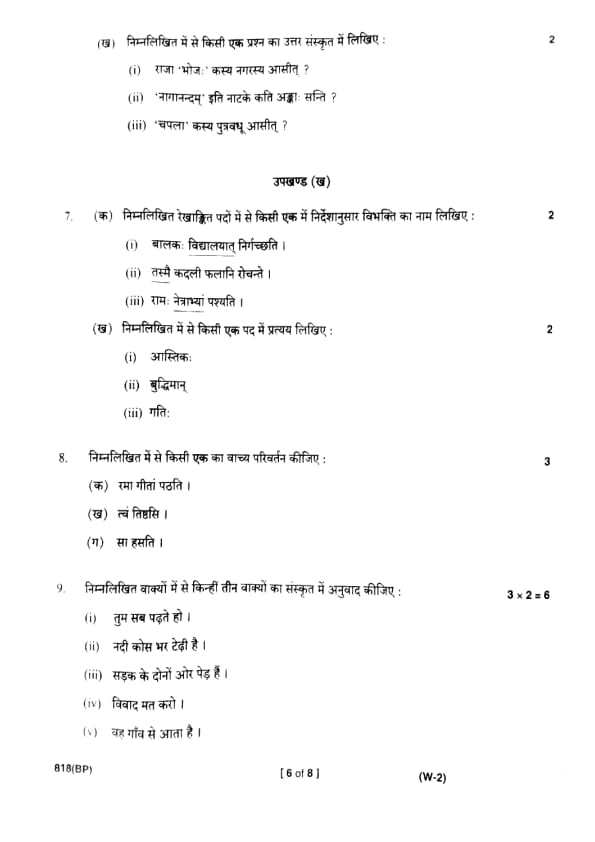
निम्नलिखित में से किसी एक प्रश्न का उत्तर संस्कृत में लिखिए :
राजा 'भोजः' कस्य नगरस्य आसीत् ?
राजा 'भोजः' धारा-नगरस्य शासकः आसीत्।
View Solution
Step 1: Understanding the Question:
The question asks: "राजा 'भोजः' कस्य नगरस्य आसीत् ?" which translates to "King 'Bhoja' was of which city?". The interrogative pronoun 'कस्य' (of which) needs to be replaced with the name of the city in the genitive case (षष्ठी विभक्ति).
Step 2: Providing the Answer:
- The historical answer is that King Bhoja was the ruler of Dhara Nagari (धारानगरी).
- The genitive singular (षष्ठी विभक्ति, एकवचन) of 'धारानगरी' is 'धारानगरस्य'.
- So, 'कस्य' is replaced by 'धारानगरस्य'.
Step 3: Final Answer in Sanskrit:
The complete sentence is formed by replacing the question word with the answer: "राजा 'भोजः' धारानगरस्य आसीत्।"
Quick Tip: संस्कृत में प्रश्न का उत्तर देते समय, प्रश्नवाचक शब्द (किम्, कुत्र, कदा, कस्य) को उचित उत्तर वाले शब्द से बदलें और शेष वाक्य को प्रश्न के अनुसार ही रखें। विभक्ति और वचन का ध्यान रखना अत्यंत महत्वपूर्ण है।
निम्नलिखित रेखाङ्कित पदों में से किसी एक में निर्देशानुसार विभक्ति का नाम लिखिए :
बालकः विद्यालयात् निर्गच्छति ।
विभक्ति:} पञ्चमी विभक्ति
सूत्र:} 'ध्रुवमपायेऽपादानम्' इति सूत्रानुसारम् अपादानकारके पञ्चमी विभक्तिः भवति।
View Solution
Step 1: Understanding the Sentence:
The sentence "बालकः विद्यालयात् निर्गच्छति" means "The boy goes out from the school". The action is 'separation' from the school.
Step 2: Identifying the Rule (सूत्र):
- The rule for separation is 'ध्रुवमपायेऽपादानम्'.
- ध्रुवम् means the fixed point from which separation occurs (here, the school - विद्यालय).
- अपाये means in the act of separation.
- अपादानम् means the fixed point is given the designation of 'Apadana'.
- Another rule, 'अपादाने पञ्चमी', states that the 'Apadana' case takes the fifth case ending (पञ्चमी विभक्ति).
Step 3: Final Answer:
In the sentence, the school ('विद्यालय') is the fixed point from which the boy is separating. Therefore, 'विद्यालय' is the Apadana कारक, and it takes the पञ्चमी विभक्ति, becoming 'विद्यालयात्'.
Quick Tip: 'से' (अलग होने के अर्थ में) का भाव आने पर हमेशा अपादान कारक और पञ्चमी विभक्ति का प्रयोग होता है। 'विश्लेष' या 'पृथक् होने' की क्रिया पर ध्यान दें।
निम्नलिखित रेखाङ्कित पदों में से किसी एक में निर्देशानुसार विभक्ति का नाम लिखिए :
तस्मै कदली फलानि रोचन्ते ।
विभक्ति:} चतुर्थी विभक्ति
सूत्र:} 'रुच्यर्थानां प्रीयमाणः' इति सूत्रानुसारम् 'रुच्' धातोः योगे प्रीयमाणः (प्रसन्न होने वाले) संज्ञे चतुर्थी विभक्तिः भवति।
View Solution
Step 1: Understanding the Sentence:
The sentence "तस्मै कदली फलानि रोचन्ते" means "He likes bananas". The key verb here is 'रोचन्ते' from the root 'रुच्' (to like).
Step 2: Identifying the Rule (सूत्र):
- The relevant Paninian sutra is 'रुच्यर्थानां प्रीयमाणः'.
- रुच्यर्थानाम् means "in the context of verbs with the meaning of 'रुच्' (to like)".
- प्रीयमाणः means "the one who is pleased" (the person who likes something).
- This sutra states that the person who is pleased receives the designation of 'Sampradana'.
- The rule 'सम्प्रदाने चतुर्थी' then applies, which states that the 'Sampradana' case takes the fourth case ending (चतुर्थी विभक्ति).
Step 3: Final Answer:
In the sentence, 'तस्मै' (to him) refers to the person who is pleased by the bananas. Therefore, due to the presence of the verb 'रोचन्ते', 'तस्मै' is in the चतुर्थी विभक्ति।
Quick Tip: 'रुच्' (अच्छा लगना) धातु के योग में, जिसे वस्तु अच्छी लगती है, उस व्यक्ति या संज्ञा में हमेशा चतुर्थी विभक्ति का प्रयोग होता है, न कि कर्म कारक (द्वितीया विभक्ति) का।
निम्नलिखित में से किसी एक पद में प्रत्यय लिखिए :
बुद्धिमान्
पद:} बुद्धिमान्
प्रकृति (Base):} बुद्धि
प्रत्यय (Suffix):} मतुप्
View Solution
Step 1: Understanding the Task:
The task is to identify the base word (प्रकृति) and the suffix (प्रत्यय) in the word 'बुद्धिमान्'.
Step 2: Analyzing the Word:
- The word 'बुद्धिमान्' means "one who possesses intelligence".
- The base noun is clearly 'बुद्धि' (intelligence).
- The suffix used to denote possession (" वाला" or "युक्त") is 'मतुप्' (matup).
- The 'मतुप्' प्रत्यय becomes 'मत्' or 'वत्'. When the preceding noun ends in 'अ' or 'आ', it usually becomes 'वत्' (e.g., धन + मतुप् = धनवान्). For other vowels (like 'इ' in बुद्धि), it becomes 'मत्'.
- So, बुद्धि + मतुप् = बुद्धिमत्।
- The nominative singular masculine form (प्रथमा विभक्ति, एकवचन) of the stem 'बुद्धिमत्' is 'बुद्धिमान्'।
Step 3: Final Answer:
The base word is 'बुद्धि' and the suffix is 'मतुप्'.
Quick Tip: 'मतुप्' प्रत्यय का प्रयोग 'वाला' या 'युक्त' के अर्थ में होता है। इससे बने शब्द विशेषण होते हैं। याद रखें कि यदि शब्द के अंत में 'मान' या 'वान' आये, तो उसमें 'मतुप्' प्रत्यय होने की प्रबल संभावना होती है।
निम्नलिखित में से किसी एक का वाच्य परिवर्तन कीजिए :
रमा गीतां पठति ।
कर्मवाच्य:} रमया गीतं पठ्यते ।
View Solution
Step 1: Understanding the Task:
The task is to change the voice (वाच्य परिवर्तन) of the sentence "रमा गीतां पठति ।".
Step 2: Analyzing the Original Sentence (कर्तृवाच्य):
- कर्ता (Subject): रमा (प्रथमा विभक्ति)
- कर्म (Object): गीताम् (द्वितीया विभक्ति)
- क्रिया (Verb): पठति (कर्ता 'रमा' के अनुसार, परस्मैपद)
This is an active voice (कर्तृवाच्य) sentence. It needs to be changed to passive voice (कर्मवाच्य).
Step 3: Rules for Changing to कर्मवाच्य:
1. The subject (कर्ता) is changed from प्रथमा to तृतीया विभक्ति।
\[ रमा \rightarrow रमया \]
2. The object (कर्म) is changed from द्वितीया to प्रथमा विभक्ति।
\[ गीताम् \rightarrow गीतम् (The word 'गीत' is neuter, so its प्रथमा and द्वितीया forms are the same) \]
3. The verb's root (धातु) takes the 'य' affix and is conjugated in आत्मनेपद. The new verb agrees with the new subject (which is the original object) in person and number.
\[ धातु: \ पठ् \rightarrow \ पठ् + य = पठ्य \]
\[ The new verb will agree with 'गीतम्' (प्रथम पुरुष, एकवचन). \rightarrow पठ्यते \]
Step 4: Constructing the Final Sentence:
Combining the transformed parts: रमया गीतं पठ्यते ।
Quick Tip: वाच्य परिवर्तन का नियम याद रखें: कर्ता (1) \(\rightarrow\) (3), कर्म (2) \(\rightarrow\) (1), और क्रिया कर्म के अनुसार (आत्मनेपद में) होती है। इस 1-2-1 नियम से आप आसानी से कर्तृवाच्य को कर्मवाच्य में बदल सकते हैं।
निम्नलिखित वाक्यों में से किन्हीं तीन वाक्यों का संस्कृत में अनुवाद कीजिए :
तुम सब पढ़ते हो ।
View Solution
Step 1: Identify Subject and Verb:
- कर्ता (Subject): 'तुम सब' (You all) ।
- क्रिया (Verb): 'पढ़ते हो' (read) ।
Step 2: Translate Subject and Conjugate Verb:
- 'तुम सब' के लिए संस्कृत सर्वनाम 'युष्मद्' का प्रथमा विभक्ति, बहुवचन रूप 'यूयम्' होता है।
- कर्ता 'यूयम्' मध्यम पुरुष, बहुवचन है। अतः क्रिया (पठ् धातु, लट् लकार) भी मध्यम पुरुष, बहुवचन की होगी।
- पठ् धातु का लट् लकार, मध्यम पुरुष, बहुवचन रूप 'पठथ' होता है।
Step 3: Combine to Form the Sentence:
Combining the subject and the verb, we get the sentence: यूयं पठथ ।
Quick Tip: संस्कृत में कर्ता और क्रिया के पुरुष और वचन का मेल होना अनिवार्य है। 'अहम्/आवाम्/वयम्' के साथ उत्तम पुरुष, 'त्वम्/युवाम्/यूयम्' के साथ मध्यम पुरुष और अन्य सभी के साथ प्रथम पुरुष की क्रिया लगती है।
निम्नलिखित वाक्यों में से किन्हीं तीन वाक्यों का संस्कृत में अनुवाद कीजिए :
नदी कोस भर टेढ़ी है ।
View Solution
Step 1: Identify the components of the sentence:
- Subject: नदी (River) \(\rightarrow\) नदी (प्रथमा एकवचन)
- Adjective: टेढ़ी (crooked) \(\rightarrow\) कुटिला (नदी का विशेषण, स्त्रीलिंग)
- Distance: कोस भर (for a krosa)
- Verb: है (is) \(\rightarrow\) अस्ति (प्रथम पुरुष एकवचन)
Step 2: Apply the relevant grammar rule:
- 'कालाध्वनोरत्यन्तसंयोगे' सूत्र के अनुसार, जब कोई क्रिया या गुण किसी निश्चित दूरी (अध्वन्) या समय (काल) तक लगातार बना रहता है, तो उस दूरी या समय वाचक शब्द में द्वितीया विभक्ति होती है।
- यहाँ 'टेढ़ापन' (कुटिलता) का गुण 'कोस भर' तक व्याप्त है, इसलिए 'क्रोश' शब्द में द्वितीया विभक्ति लगाकर 'क्रोशम्' बनेगा।
Step 3: Combine to Form the Sentence:
The complete sentence becomes: नदी क्रोशं कुटिला अस्ति ।
Quick Tip: 'तक' या 'भर' के अर्थ में जब दूरी या समय का निरंतर बोध हो, तो द्वितीया विभक्ति का प्रयोग करें। जैसे- 'मासं व्याकरणम् अपठत्' (महीने भर व्याकरण पढ़ा)।
निम्नलिखित वाक्यों में से किन्हीं तीन वाक्यों का संस्कृत में अनुवाद कीजिए :
सड़क के दोनों ओर पेड़ हैं ।
View Solution
Step 1: Identify the components:
- Main elements: सड़क (road), दोनों ओर (on both sides), पेड़ (trees), हैं (are)
Step 2: Apply the relevant grammar rule (Upapada Vibhakti):
- 'अभितः परितः समया निकषा हा प्रतियोगेऽपि' वार्तिक के अनुसार, 'उभयतः' (दोनों ओर), 'अभितः' (दोनों ओर), 'परितः' (चारों ओर) जैसे अव्ययों के योग में द्वितीया विभक्ति होती है।
- इसलिए, 'सड़क के' में षष्ठी विभक्ति न होकर 'सड़क' (मार्ग) शब्द में द्वितीया विभक्ति होगी, जिससे 'मार्गम्' बनेगा।
- 'पेड़' बहुवचन में है, अतः 'वृक्षः' का प्रथमा बहुवचन 'वृक्षाः' होगा।
- क्रिया भी कर्ता 'वृक्षाः' के अनुसार बहुवचन में होगी: 'सन्ति' (अस् धातु, प्रथम पुरुष, बहुवचन)।
Step 3: Combine to Form the Sentence:
The final translation is: मार्गम् उभयतः वृक्षाः सन्ति ।
Quick Tip: कुछ विशेष शब्दों (उपपद) के साथ निश्चित विभक्ति का ही प्रयोग होता है, चाहे हिन्दी में कारक चिह्न कुछ भी हो। 'उभयतः' (दोनों ओर), 'परितः' (चारों ओर), 'प्रति' (की ओर) के साथ हमेशा द्वितीया विभक्ति लगाएँ।
निम्नलिखित वाक्यों में से किन्हीं तीन वाक्यों का संस्कृत में अनुवाद कीजिए :
विवाद मत करो ।
View Solution
Step 1: Identify the components:
- Action: विवाद (quarrel) \(\rightarrow\) विवादम् (कर्म, द्वितीया)
- Prohibition: मत (don't) \(\rightarrow\) मा (अव्यय)
- Verb: करो (do) \(\rightarrow\) कुरु (कृ धातु, लोट् लकार, मध्यम पुरुष, एकवचन)
Step 2: Apply the relevant grammar rule:
- 'मत' के अर्थ में निषेध (prohibition) के लिए 'मा' अव्यय का प्रयोग होता है।
- 'मा' के योग में सामान्यतः लोट् लकार (Imperative mood) का प्रयोग होता है, हालांकि लङ् लकार (Past Imperfect) का भी प्रयोग ('मा' के साथ 'अ' आगम के बिना) संभव है।
- 'करो' आज्ञा या उपदेश है, जो मध्यम पुरुष एकवचन (त्वम् कर्ता छिपा है) को संबोधित है। इसलिए कृ धातु का लोट् लकार, मध्यम पुरुष, एकवचन रूप 'कुरु' लगेगा।
Step 3: Combine to Form the Sentence:
The final translation is: विवादं मा कुरु ।
Quick Tip: निषेध या 'मत करो' के भाव के लिए संस्कृत में 'मा' का प्रयोग करें और उसके साथ क्रिया को लोट् लकार (आज्ञार्थक) में रखें। जैसे- कोलाहलं मा कुरु (शोर मत करो)।
निम्नलिखित वाक्यों में से किन्हीं तीन वाक्यों का संस्कृत में अनुवाद कीजिए :
वह गाँव से आता है ।
View Solution
Step 1: Identify the components:
- कर्ता (Subject): वह (He) \(\rightarrow\) सः (तत् सर्वनाम, पुल्लिंग, प्रथमा एकवचन)
- Place of Separation: गाँव से (from the village)
- क्रिया (Verb): आता है (comes) \(\rightarrow\) आगच्छति (आ + गम् धातु, लट् लकार, प्रथम पुरुष, एकवचन)
Step 2: Apply the relevant grammar rule:
- 'ध्रुवमपायेऽपादानम्' सूत्र के अनुसार, जब किसी वस्तु या व्यक्ति का किसी स्थान से अलगाव (separation) होता है, तो उस स्थिर स्थान (ध्रुव) की अपादान संज्ञा होती है।
- 'अपादाने पञ्चमी' सूत्र से अपादान कारक में पञ्चमी विभक्ति का प्रयोग होता है।
- यहाँ 'वह' का 'गाँव' से अलगाव हो रहा है, अतः 'ग्राम' शब्द में पञ्चमी विभक्ति लगाकर 'ग्रामात्' बनेगा।
Step 3: Combine to Form the Sentence:
The final translation is: सः ग्रामात् आगच्छति ।
Quick Tip: 'से' (अलग होने के अर्थ में) का भाव आने पर हमेशा अपादान कारक और पञ्चमी विभक्ति का प्रयोग होता है। जैसे - वृक्षात् पत्रं पतति (पेड़ से पत्ता गिरता है)।
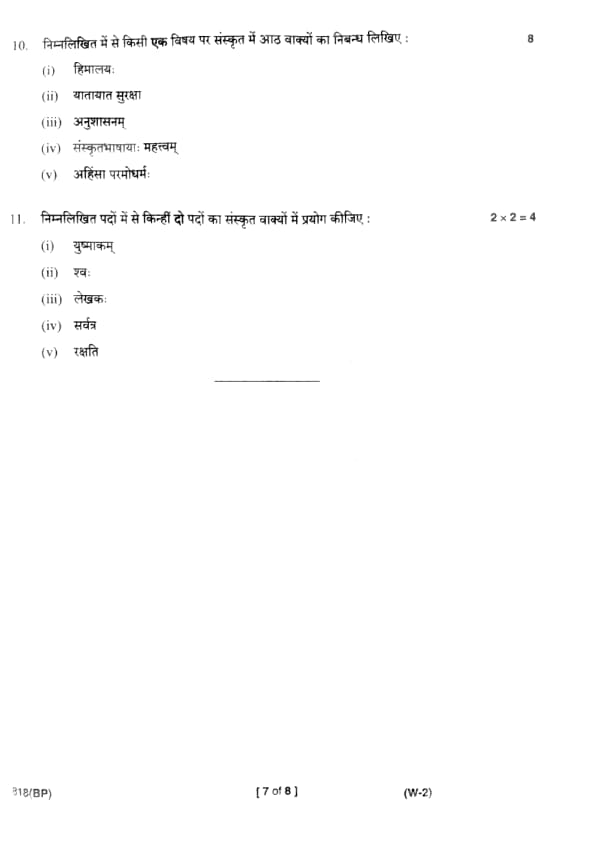
निम्नलिखित में से किसी एक विषय पर संस्कृत में आठ वाक्यों का निबन्ध लिखिए :
हिमालयः
View Solution
Step 1: Brainstorming Key Ideas:
The essay requires eight sentences about the Himalayas. Key ideas include: its location, its nickname (king of mountains), the reason for its name (snow), its highest peak, the rivers originating from it, pilgrimage sites, its role as a protector, and a concluding metaphorical description.
Step 2: Composing Simple Sanskrit Sentences:
- Sentence 1 (Location): हिमालय भारत की उत्तर दिशा में है। \(\rightarrow\) हिमालयः भारतस्य उत्तरस्यां दिशि स्थितः अस्ति।
- Sentence 2 (Nickname): यह पर्वतों का राजा कहलाता है। \(\rightarrow\) अयं पर्वतानां नृपः इति कथ्यते।
- Sentence 3 (Name's Meaning): इसकी चोटियाँ बर्फ से ढकी रहती हैं। \(\rightarrow\) अस्य शिखराणि हिमेन आच्छादितानि सन्ति।
- Sentence 4 (Highest Peak): विश्व की सबसे ऊँची चोटी यहाँ है। \(\rightarrow\) विश्वस्य सर्वोच्चं शिखरं 'माउन्ट एवरेस्ट' अत्रैव स्थितम् अस्ति।
- Sentence 5 (Rivers): इससे गंगा, यमुना आदि नदियाँ निकलती हैं। \(\rightarrow\) अस्मात् गङ्गा, यमुना इत्यादयः नद्यः निःसरन्ति।
- Sentence 6 (Pilgrimage): यहाँ बहुत से तीर्थ स्थान हैं। \(\rightarrow\) अत्र बहूनि तीर्थस्थानानि सन्ति।
- Sentence 7 (Protector): यह भारत का रक्षक है। \(\rightarrow\) हिमालयः भारतस्य प्रहरी इव अस्मान् रक्षति।
- Sentence 8 (Metaphor): यह भारत का मुकुट है। \(\rightarrow\) अयं भारतस्य मुकुटमणिः इव शोभते।
These sentences are structured logically, starting from geographical facts and moving to cultural and metaphorical significance.
Quick Tip: निबंध लिखते समय, सरल और छोटे वाक्यों का प्रयोग करें। एक विचार को एक वाक्य में व्यक्त करें। वाक्यों को तार्किक क्रम में रखें ताकि निबंध का प्रवाह बना रहे।
निम्नलिखित में से किसी एक विषय पर संस्कृत में आठ वाक्यों का निबन्ध लिखिए :
यातायात सुरक्षा
View Solution
Step 1: Brainstorming Key Ideas:
The essay is about 'Traffic Safety'. Key ideas are: its importance, following rules, walking on the left, using a helmet, not using a mobile phone, using the zebra crossing, prevention of accidents, and a concluding proverb.
Step 2: Composing Simple Sanskrit Sentences:
- 1. Importance: यातायात सुरक्षा महत्वपूर्ण है। \(\rightarrow\) यातायात-सुरक्षायाः अतीव महत्त्वम् अस्ति।
- 2. Follow rules: हमें यातायात नियमों का पालन करना चाहिए। \(\rightarrow\) वयं यातायात-नियमान् पालयेम।
- 3. Walk left: हमेशा बाईं ओर चलना चाहिए। \(\rightarrow\) सदैव मार्गे वामतः चलेयुः।
- 4. Helmet: हेलमेट का प्रयोग अनिवार्य है। \(\rightarrow\) शिरस्त्राणस्य प्रयोगः अनिवार्यः अस्ति।
- 5. No mobile: गाड़ी चलाते समय मोबाइल का प्रयोग न करें। \(\rightarrow\) वाहनं चालयन् चलदूरभाषयन्त्रस्य प्रयोगः न करणीयः।
- 6. Zebra Crossing: पैदल चलने वालों को ज़ेबरा क्रॉसिंग का उपयोग करना चाहिए। \(\rightarrow\) पादचारिभिः पदातिपथस्य उपयोगः करणीयः।
- 7. Accident prevention: नियमों के पालन से दुर्घटनाओं से बच सकते हैं। \(\rightarrow\) नियमानां पालनेन वयम् दुर्घटनाभ्यः आत्मानं रक्षितुं शक्नुमः।
- 8. Proverb: देर भली, दुर्घटना से। \(\rightarrow\) 'दुर्घटनातः विलम्बः श्रेयस्करः' इति ध्यातव्यम्।
Quick Tip: किसी समसामयिक विषय पर निबंध लिखते समय, सरल उपदेशात्मक वाक्यों (जैसे 'करणीयम्', 'पालयेम') का प्रयोग करें। इससे निबंध प्रभावशाली बनता है।
निम्नलिखित में से किसी एक विषय पर संस्कृत में आठ वाक्यों का निबन्ध लिखिए :
अनुशासनम्
View Solution
Step 1: Brainstorming Key Ideas:
The essay on 'Discipline' requires eight sentences. Key points can be: definition, importance in human life, importance for students, result of discipline, discipline in nature, need in society, and a concluding remark.
Step 2: Composing Simple Sanskrit Sentences:
- 1. Definition: नियमानां पालनम् अनुशासनम्। (Following rules is discipline.)
- 2. Importance: जीवने अनुशासनस्य महत्त्वम् अस्ति। (Discipline is important in life.)
- 3. For Students: छात्रजीवने सफलतायै अनुशासनम् आवश्यकम्। (Discipline is necessary for success in student life.)
- 4. Result: अनुशासितः जनः सफलं भवति। (A disciplined person becomes successful.)
- 5. In Nature: प्रकृतौ अनुशासनं पश्यामः। (We see discipline in nature.)
- 6. Example from Nature: सूर्यः समये उदयति। (The sun rises on time.)
- 7. In Society: समाजे शान्तये अनुशासनम् अनिवार्यम्। (Discipline is essential for peace in society.)
- 8. Conclusion: वयं अनुशासनं पालयेम। (We should follow discipline.)
These points create a logical flow from definition to conclusion.
Quick Tip: एक अच्छे निबंध के लिए, विषय को विभिन्न पहलुओं से देखें - व्यक्तिगत, सामाजिक, और प्राकृतिक। प्रत्येक पहलू पर एक या दो सरल वाक्य बनाने से निबंध व्यापक और सुगठित बनता है।
निम्नलिखित में से किसी एक विषय पर संस्कृत में आठ वाक्यों का निबन्ध लिखिए :
संस्कृतभाषायाः महत्त्वम्
View Solution
Step 1: Brainstorming Key Ideas:
The essay is on the 'Importance of the Sanskrit Language'. Key points are: its antiquity, its role as the mother of Indian languages, its literature, its sacred texts, its scientific grammar, its qualities (sweetness), its connection to Indian culture, and a concluding call to action.
Step 2: Composing Simple Sanskrit Sentences:
- 1. Ancient: संस्कृत सबसे प्राचीन भाषा है। \(\rightarrow\) संस्कृतभाषा विश्वस्य प्राचीना भाषा अस्ति।
- 2. Mother of languages: यह भारतीय भाषाओं की जननी है। \(\rightarrow\) इयं भारतीयाणाम् भाषाणां जननी अस्ति।
- 3. Literature: इसका साहित्य प्रसिद्ध है। \(\rightarrow\) अस्याः साहित्यं विश्वे प्रसिद्धम् अस्ति।
- 4. Texts: वेद, पुराण संस्कृत में हैं। \(\rightarrow\) वेदाः, पुराणानि च संस्कृते एव लिखितानि सन्ति।
- 5. Grammar: इसका व्याकरण वैज्ञानिक है। \(\rightarrow\) अस्याः व्याकरणं वैज्ञानिकम् अस्ति।
- 6. Qualities: यह मधुर भाषा है। \(\rightarrow\) इयं मधुरा भाषा अस्ति।
- 7. Culture: भारतीय संस्कृति के ज्ञान के लिए यह आवश्यक है। \(\rightarrow\) भारतीयसंस्कृतेः ज्ञानार्थं संस्कृतस्य ज्ञानम् आवश्यकम्।
- 8. Conclusion: हमें संस्कृत पढ़नी चाहिए। \(\rightarrow\) अस्माभिः संस्कृतभाषा पठनीया।
Quick Tip: 'महत्त्वम्' विषय पर निबंध लिखते समय, उस विषय की विशेषताओं को क्रमबद्ध रूप से प्रस्तुत करें। 'अस्ति', 'भवति', 'कथ्यते' जैसी सरल क्रियाओं का प्रयोग करें।
निम्नलिखित में से किसी एक विषय पर संस्कृत में आठ वाक्यों का निबन्ध लिखिए :
अहिंसा परमो धर्मः
View Solution
Step 1: Brainstorming Key Ideas:
The topic is 'Non-violence is the highest virtue'. Key ideas are: the origin of the saying, definition of non-violence, its importance in all religions, its greatest proponent (Mahatma Gandhi), its power (India's independence), its effect on society, the feeling of compassion, and a concluding resolution.
Step 2: Composing Simple Sanskrit Sentences:
- 1. Origin: यह हमारे शास्त्रों का वचन है। \(\rightarrow\) 'अहिंसा परमो धर्मः' इति शास्त्रेषु उक्तम्।
- 2. Definition: किसी को पीड़ा न देना अहिंसा है। \(\rightarrow\) कस्यापि पीडनम् न करणम् एव अहिंसा अस्ति।
- 3. Importance: यह श्रेष्ठ धर्म है। \(\rightarrow\) अहिंसायाः पालनं श्रेष्ठं मन्यते।
- 4. Proponent: महात्मा गांधी अहिंसा के पुजारी थे। \(\rightarrow\) महात्मा गान्धी अहिंसायाः पुजारी आसीत्।
- 5. Power: उन्होंने अहिंसा से भारत को स्वतंत्र कराया। \(\rightarrow\) सः अहिंसा-बलेन भारतं स्वतन्त्रम् अकारयत्।
- 6. Effect: इससे समाज में शांति बढ़ती है। \(\rightarrow\) अहिंसायाः पालनेन समाजे शान्तिः वर्धते।
- 7. Compassion: हमें सभी जीवों पर दया करनी चाहिए। \(\rightarrow\) सर्वेषां जीवानां प्रति दयाभावः भवेत्।
- 8. Conclusion: हमें अहिंसा का पालन करना चाहिए। \(\rightarrow\) वयं सर्वे अहिंसा-धर्मस्य पालनं कुर्याम।
Quick Tip: किसी सूक्ति पर निबंध लिखते समय, पहले उस सूक्ति का अर्थ स्पष्ट करें, फिर इतिहास या प्रसिद्ध व्यक्तियों से उदाहरण दें, और अंत में उसके सामाजिक और व्यक्तिगत लाभों पर प्रकाश डालें।
निम्नलिखित पदों में से किन्हीं दो पदों का संस्कृत वाक्यों में प्रयोग कीजिए :
युष्माकम्
View Solution
Step 1: Understand the Word:
- युष्माकम् 'युष्मद्' (तुम) सर्वनाम का षष्ठी विभक्ति, बहुवचन रूप है।
- इसका अर्थ है - 'तुम सबका', 'तुम सबकी', 'तुम सबके' (your, of you all)। यह संबंध दर्शाता है।
Step 2: Form a Simple Sentence:
- A simple and common use is to ask about possession or relation.
- Let's form the sentence: "Where is your (all of your) house?"
- 'तुम सबका' \(\rightarrow\) युष्माकम्
- 'घर' \(\rightarrow\) गृहम्
- 'कहाँ' \(\rightarrow\) कुत्र
- 'है' \(\rightarrow\) अस्ति
- Combining these: युष्माकं गृहम् कुत्र अस्ति? Another simple sentence could be: युष्माकं किं नाम अस्ति? (What are your names?)
Quick Tip: षष्ठी विभक्ति का प्रयोग मुख्य रूप से संबंध बताने के लिए होता है। किसी भी पद का वाक्य प्रयोग करते समय, पहले उसका अर्थ और विभक्ति समझें, फिर उससे संबंधित एक सरल प्रश्न या कथन बनाएँ।
निम्नलिखित पदों में से किन्हीं दो पदों का संस्कृत वाक्यों में प्रयोग कीजिए :
श्वः
View Solution
Step 1: Understand the Word:
- श्वः एक अव्यय (indeclinable) है।
- इसका अर्थ है - 'आने वाला कल' (tomorrow)।
Step 2: Form a Simple Sentence:
- 'श्वः' का प्रयोग हमेशा भविष्य काल (लृट् लकार) की क्रिया के साथ होता है।
- Let's form the sentence: "Tomorrow I will go to school."
- 'कल' \(\rightarrow\) श्वः
- 'मैं' \(\rightarrow\) अहम्
- 'विद्यालय' \(\rightarrow\) विद्यालयम् (कर्म, द्वितीया विभक्ति)
- 'जाऊँगा' \(\rightarrow\) गम् धातु, लृट् लकार, उत्तम पुरुष, एकवचन \(\rightarrow\) गमिष्यामि
- Combining these: श्वः अहं विद्यालयं गमिष्यामि।
Quick Tip: तीन काल-सूचक अव्ययों को हमेशा याद रखें: 'अद्य' (आज - लट् लकार), 'ह्यः' (बीता हुआ कल - लङ् लकार), और 'श्वः' (आने वाला कल - लृट् लकार)। इनके साथ हमेशा सही लकार का प्रयोग करें।
निम्नलिखित पदों में से किन्हीं दो पदों का संस्कृत वाक्यों में प्रयोग कीजिए :
लेखकः
View Solution
Step 1: Understand the Word:
- लेखकः एक पुल्लिंग संज्ञा है, जिसका अर्थ है 'writer'। यह प्रथमा विभक्ति, एकवचन में है।
Step 2: Form a Simple Sentence:
- We need to use 'लेखकः' as the subject complement or subject of a sentence. A very famous example is Kalidasa.
- Let's form the sentence: "Kalidasa was a great writer."
- 'कालिदास' \(\rightarrow\) कालिदासः
- 'एक' \(\rightarrow\) एकः
- 'महान' \(\rightarrow\) महान्
- 'लेखक' \(\rightarrow\) लेखकः
- 'था' \(\rightarrow\) आसीत्
- Combining these: कालिदासः एकः महान् लेखकः आसीत्।
Quick Tip: किसी संज्ञा पद का वाक्य प्रयोग करते समय, उसे कर्ता (Subject) के रूप में प्रयोग करना सबसे सरल होता है। जैसे - 'लेखकः' पुस्तकं लिखति। (लेखक पुस्तक लिखता है।)
निम्नलिखित पदों में से किन्हीं दो पदों का संस्कृत वाक्यों में प्रयोग कीजिए :
सर्वत्र
View Solution
Step 1: Understand the Word:
- सर्वत्र एक अव्यय (indeclinable) है।
- इसका अर्थ है 'सब जगह' या 'everywhere'। अव्यय होने के कारण इसका रूप किसी भी लिंग, वचन या विभक्ति में नहीं बदलता है।
Step 2: Form a Simple Sentence:
- A common philosophical concept is that God is everywhere.
- Let's form the sentence: "God lives everywhere."
- 'ईश्वर' \(\rightarrow\) ईश्वरः (कर्ता, प्रथमा एकवचन)
- 'सब जगह' \(\rightarrow\) सर्वत्र
- 'रहते हैं' \(\rightarrow\) निवसति (नि + वस् धातु, लट् लकार, प्रथम पुरुष, एकवचन)
- Combining these: ईश्वरः सर्वत्र निवसति। Another simple sentence: वायुः सर्वत्र अस्ति। (Air is everywhere.)
Quick Tip: अव्यय पदों का वाक्य प्रयोग करना बहुत सरल होता है क्योंकि उनके रूप नहीं बदलते हैं। बस उनका अर्थ जानें और उन्हें वाक्य में उचित स्थान पर रख दें।
निम्नलिखित पदों में से किन्हीं दो पदों का संस्कृत वाक्यों में प्रयोग कीजिए :
रक्षति
View Solution
Step 1: Understand the Word:
- रक्षति एक क्रियापद (verb) है।
- यह 'रक्ष्' धातु (to protect) का लट् लकार, प्रथम पुरुष, एकवचन का रूप है। इसका अर्थ है 'रक्षा करता है'।
Step 2: Form a Simple Sentence:
- Since the verb is in the third person singular (प्रथम पुरुष, एकवचन), we need a singular subject.
- Let's form the sentence: "The soldier protects the country."
- 'सैनिक' (कर्ता) \(\rightarrow\) सैनिकः (प्रथमा एकवचन)
- 'देश को' (कर्म) \(\rightarrow\) देशम् (द्वितीया एकवचन)
- 'रक्षा करता है' (क्रिया) \(\rightarrow\) रक्षति
- Combining these: सैनिकः देशं रक्षति। Another simple sentence: पिता पुत्रं रक्षति। (The father protects the son.)
Quick Tip: जब किसी क्रियापद का वाक्य प्रयोग करना हो, तो सबसे पहले उसका पुरुष और वचन देखें। फिर उसी पुरुष और वचन के अनुसार कर्ता (Subject) चुनें।



Comments