




UP Board Class 10 Science Question Paper 2024 PDF (Code 824 IJ) is available for download here. The Science exam was conducted on February 29, 2024 in the Morning Shift from 8:30 AM to 11:45 AM. The total marks for the theory paper are 70. Students reported the paper to be moderate.
UP Board Class 10 Science Question Paper 2024 (Code 824 IJ) with Solutions
| UP Board Class 10 Science Question Paper With Answer Key |  Download Download |
Check Solution |
Up Board Class 10 Science Question Paper With Solution
Part–A
(Sub-Section 1)
Multiple Choice Type Questions
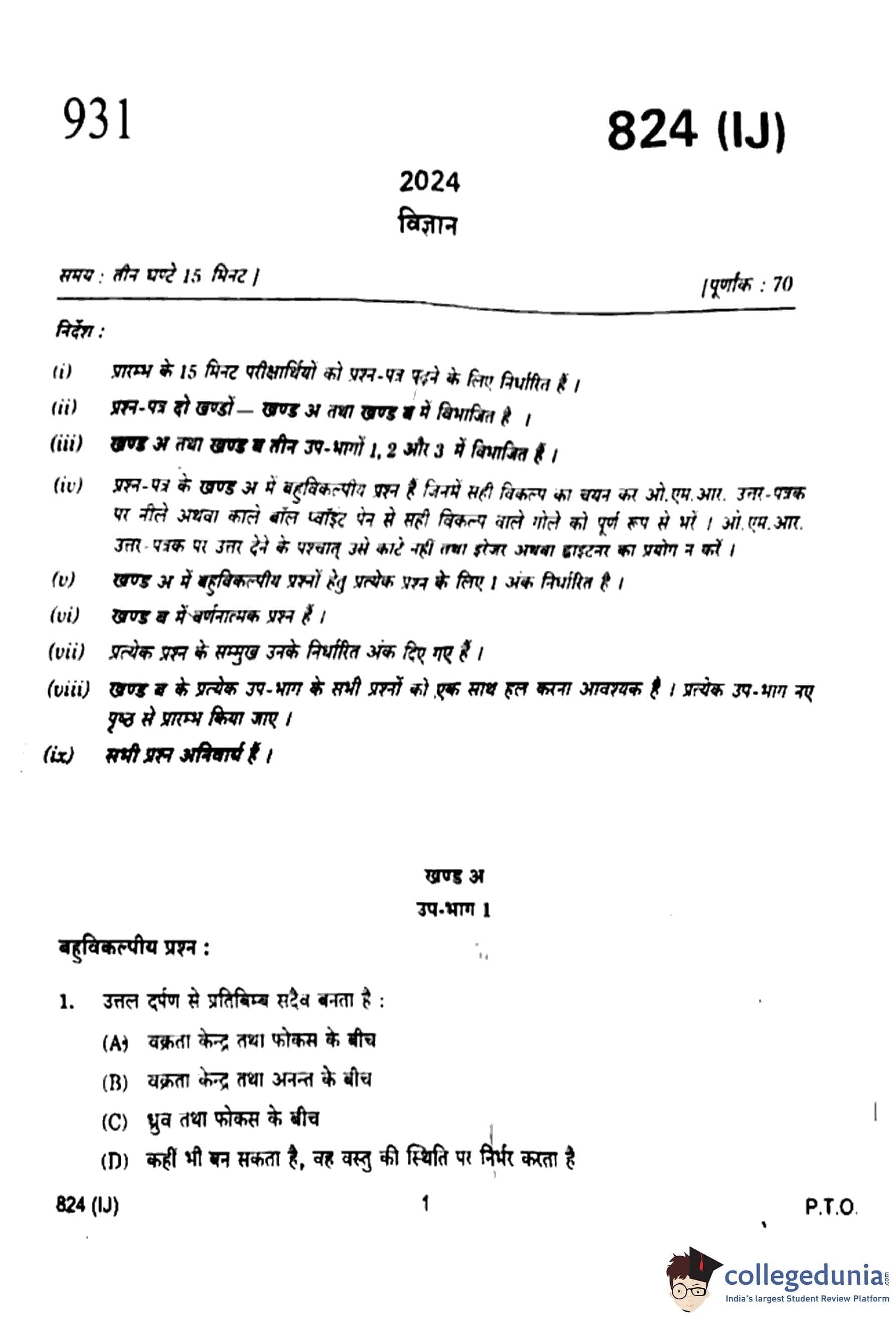
Question 1:
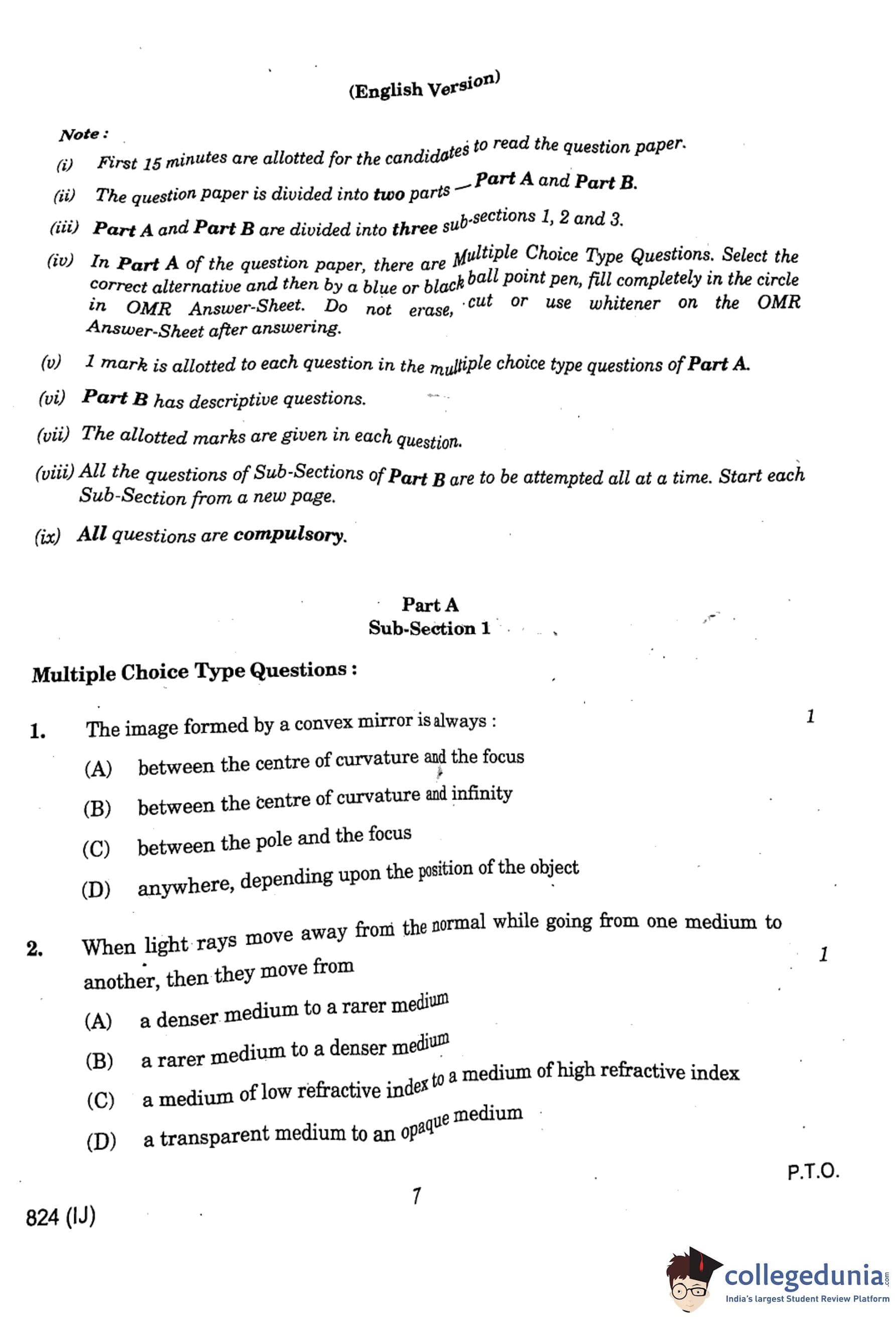
The image formed by a convex mirror is always:
View Solution
A convex mirror consistently produces an image that is virtual, upright, and smaller. The image is always formed between the pole and the focus, irrespective of the object's position. This characteristic makes convex mirrors ideal for use as rear-view mirrors in vehicles, as they offer an expanded field of vision.
Quick Tip: Convex mirrors always form virtual, erect, and diminished images, making them useful for safety and surveillance.
When light rays move away from the normal while going from one medium to another, then they move from:
View Solution
When light transitions from a denser medium to a rarer medium, it accelerates and bends away from the normal due to the reduction in refractive index. This process is governed by Snell’s Law and is responsible for phenomena such as total internal reflection.
Quick Tip: Light bends \textbf{towards the normal} when moving to a denser medium and \textbf{away from the normal} when moving to a rarer medium.
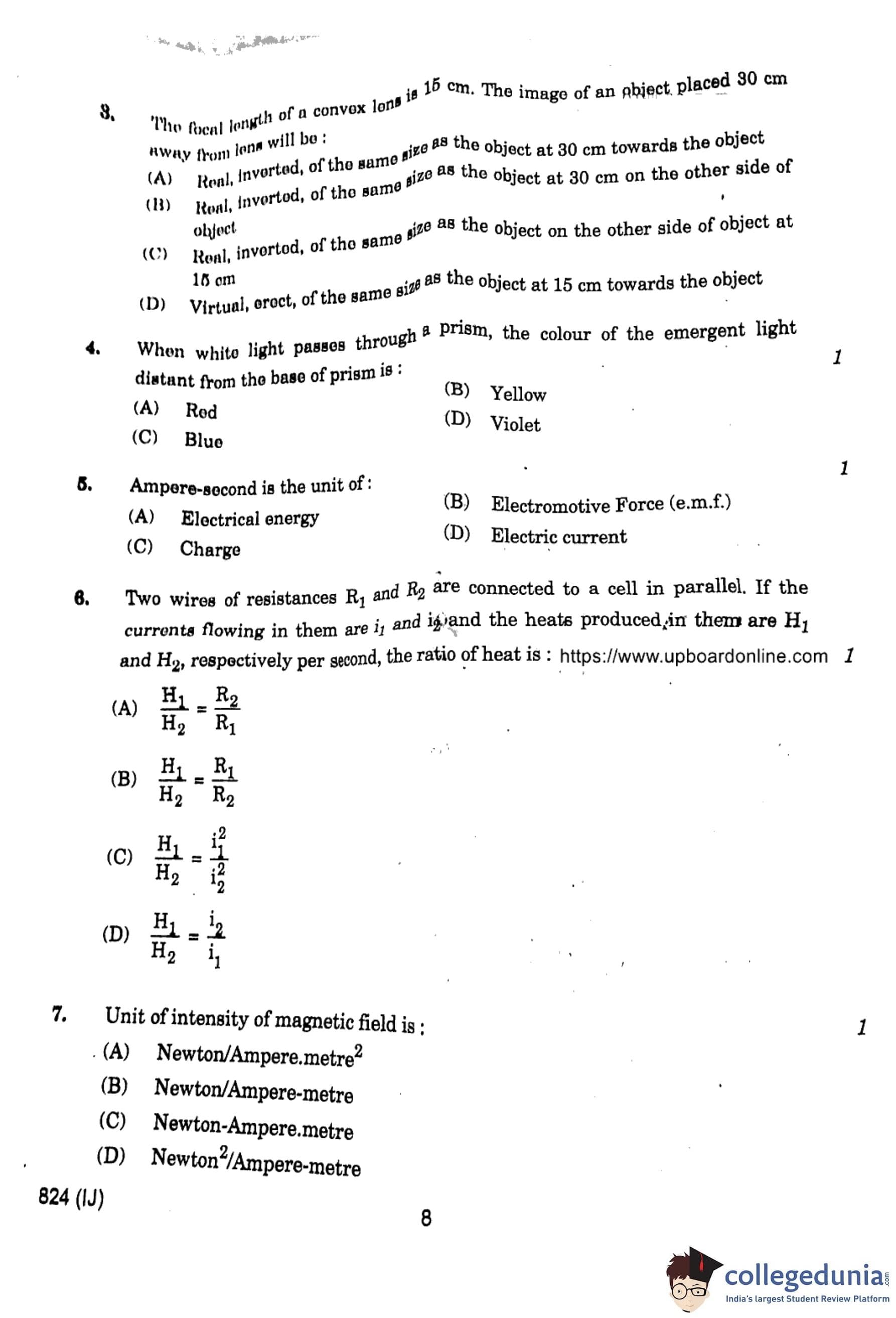
The focal length of a convex lens is 15 cm. The image of an object placed 30 cm away from the lens will be:
View Solution
For a convex lens, when an object is positioned at twice the focal length (2F), the resulting image is real, inverted, and has the same size as the object. The image is formed at 2F on the opposite side. Since 2F=30 cm, this confirms the result.
Quick Tip: For a convex lens, an object at \textbf{twice the focal length} forms an image of the \textbf{same size at twice the focal length on the other side}.
When white light passes through a prism, the colour of the emergent light distant from the base of the prism is:
View Solution
When white light passes through a prism, it splits into a spectrum of colors. Red light is deviated the least because of its longest wavelength and lowest refractive index, causing it to appear farthest from the base of the prism.
Quick Tip: The \textbf{longer the wavelength}, the \textbf{lesser the deviation} in a prism. Red bends the least, and violet bends the most.
Ampere-second is the unit of:
View Solution
Ampere-second (\( A \times s \)) is the unit of electric charge, as charge (\( Q \)) is given by \( Q = I \times t \), where \( I \) is current in amperes and \( t \) is time in seconds.
Quick Tip: Remember: \textbf{Charge (Coulomb) = Current (Ampere) × Time (Seconds)}.
Two wires of resistances \( R_1 \) and \( R_2 \) are connected to a cell in parallel. If the currents flowing in them are \( i_1 \) and \( i_2 \), and the heats produced in them are \( H_1 \) and \( H_2 \), respectively, per second, the ratio of heat is:
View Solution
According to Joule’s Law of Heating, the heat produced in a conductor is given by \( H = I^2 R t \). Since the resistances are connected in parallel, the potential difference across each resistor is the same. Using the relation between current and resistance in a parallel circuit, we know that \( I = \frac{V}{R} \). Therefore, the heat produced is directly proportional to the resistance when the current is constant.
Thus, the ratio of the heats produced in the two wires is: \[ \frac{H_1}{H_2} = \frac{R_2}{R_1} \] Quick Tip: In a parallel circuit, heat produced is directly proportional to the \textbf{resistance} when the voltage is constant. Use Joule’s law \( H = I^2 R t \) for calculations.
Unit of intensity of magnetic field is:
View Solution
The intensity of the magnetic field, or magnetic field strength (\( H \)), is measured in Newton per Ampere-metre (N/A·m). This unit is derived from the relationship: \[ H = \frac{F}{I \cdot L} \]
where \( F \) is force, \( I \) is current, and \( L \) is length.
Quick Tip: The unit of magnetic field intensity is derived from \textbf{force per unit current per unit length}.
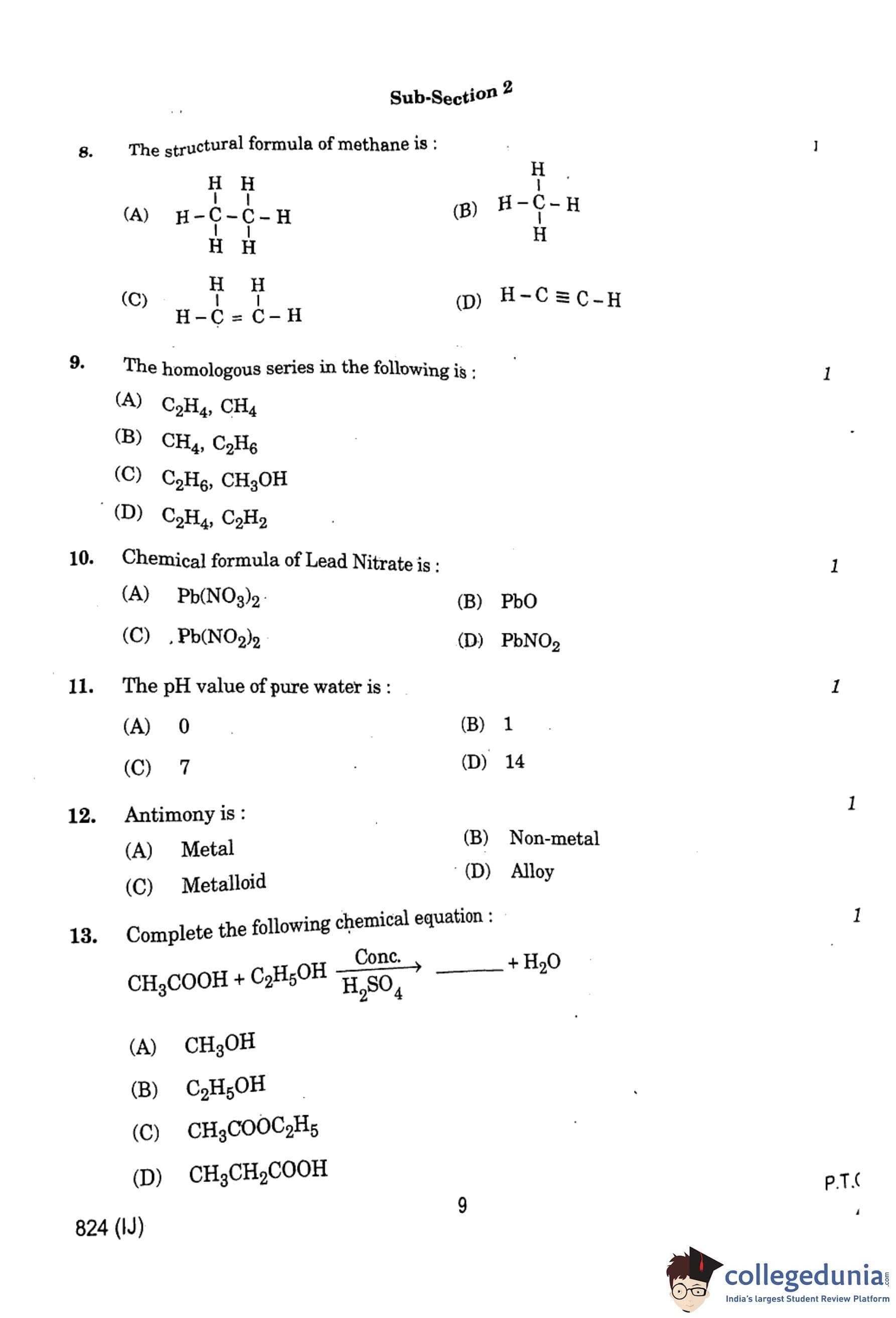
The structural formula of methane is:
|
H - C - H
|
H \end{array} \]
View Solution
Methane (\( CH_4 \)) has a tetrahedral structure where carbon forms four single bonds with hydrogen atoms. It follows the octet rule and represents a simple hydrocarbon in the alkane series.
Quick Tip: Methane is a \textbf{saturated hydrocarbon} with a \textbf{tetrahedral shape}.
The homologous series in the following is:
View Solution
A homologous series is a group of compounds with the same functional group and general formula. Methane (\( CH_4 \)) and Ethane (\( C_2H_6 \)) belong to the alkane series, differing by a \( CH_2 \) group.
Quick Tip: Alkanes follow the general formula \textbf{\( C_nH_{2n+2} \)}.
Chemical formula of Lead Nitrate is:
View Solution
Lead Nitrate is an ionic compound with the formula \( Pb(NO_3)_2 \), containing one lead (\( Pb^{2+} \)) ion and two nitrate (\( NO_3^- \)) ions. It is widely used in chemical analysis and pyrotechnics.
Quick Tip: The \textbf{nitrate ion} has the formula \( NO_3^- \) and combines with metals in salt formation.
The pH value of pure water is:
View Solution
Pure water has a neutral pH of 7 at room temperature (\( 25^\circ C \)). This means it has equal concentrations of H\(^+\) and OH\(^-\) ions, making it neither acidic nor basic.
Quick Tip: pH scale ranges from \textbf{0 to 14}, where \textbf{7 is neutral}, below 7 is acidic, and above 7 is basic.
Antimony is:
View Solution
Antimony (Sb) is considered a metalloid because it exhibits characteristics of both metals and non-metals. It is brittle, can conduct electricity under specific conditions, and is commonly used in semiconductors and alloys.
Quick Tip: Metalloids have properties of both metals and non-metals; examples include \textbf{Boron, Silicon, and Antimony}.
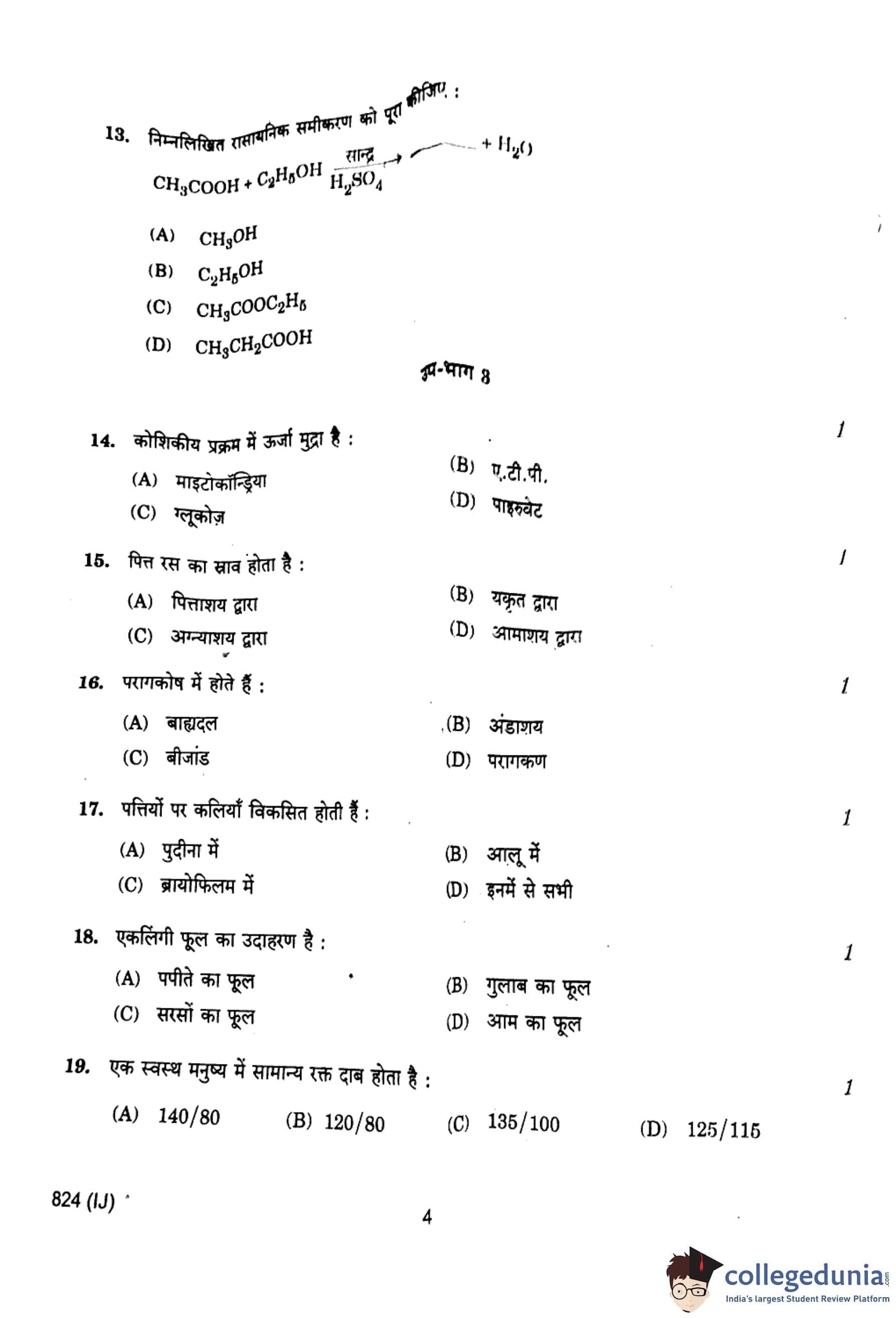
Complete the following chemical equation:
\[ CH_3COOH + C_2H_5OH \xrightarrow{Conc. H_2SO_4} \quad \_\_\_\_\_ + H_2O \]
View Solution
This reaction is an example of esterification, where acetic acid (\( CH_3COOH \)) reacts with ethanol (\( C_2H_5OH \)) in the presence of concentrated sulfuric acid (\( H_2SO_4 \)) to form ethyl ethanoate (\( CH_3COOC_2H_5 \)) and water.
Quick Tip: Esterification is a reaction between \textbf{a carboxylic acid and an alcohol} to form an \textbf{ester and water}.
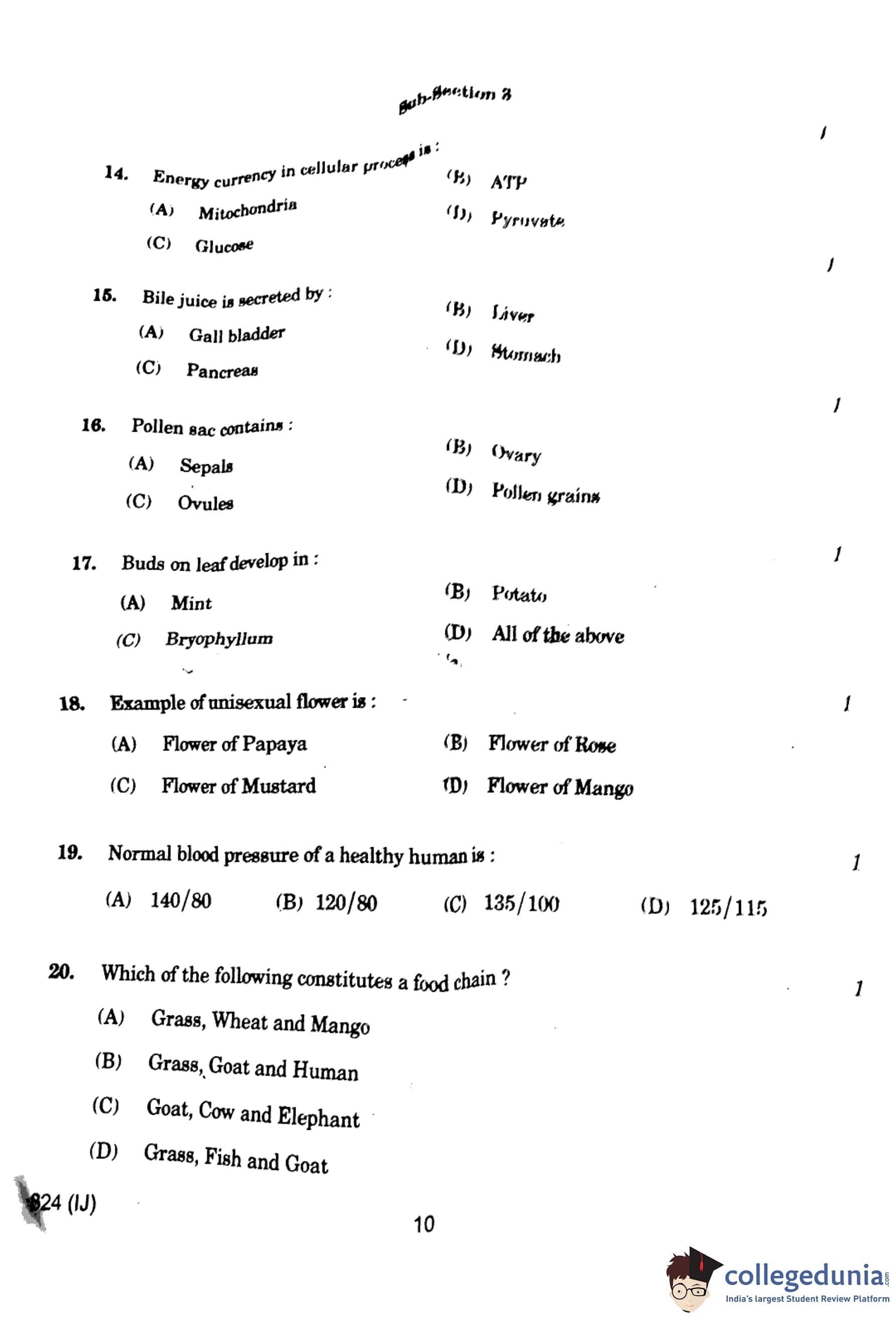
Energy currency in cellular process is:
View Solution
Adenosine Triphosphate (ATP) is referred to as the cellular energy currency. It stores and transfers chemical energy within cells, fueling metabolic activities such as muscle contraction and biosynthesis.
Quick Tip: ATP is produced in the \textbf{mitochondria} through cellular respiration.
Bile juice is secreted by:
View Solution
Bile juice is produced by the liver and stored in the gall bladder. It plays a crucial role in the digestion and emulsification of fats by breaking down large fat droplets into smaller ones, thereby enhancing the effectiveness of enzymes.
Quick Tip: Bile juice contains \textbf{bile salts} and \textbf{bile pigments}, which help in \textbf{fat digestion}.
Pollen sac contains:
View Solution
The pollen sac, located in the anther of a flower, houses pollen grains. These grains contain the male gametes necessary for fertilization in plants.
Quick Tip: Pollen grains develop inside the \textbf{anther} of a flower and play a role in \textbf{sexual reproduction}.
Buds on leaf develop in:
View Solution
Vegetative propagation takes place in plants such as Mint, Potato, and Bryophyllum. However, only Bryophyllum reproduces via buds on its leaves, while Potato propagates through tubers, and Mint spreads through runners.
Quick Tip: \textbf{Vegetative propagation} allows plants to reproduce \textbf{asexually} using leaves, stems, or roots.
Example of unisexual flower is:
View Solution
Unisexual flowers have only one type of reproductive organ, either male (stamens) or female (carpels), but not both. Examples of unisexual flowers include papaya and watermelon, whereas rose and mustard are examples of bisexual flowers.
Quick Tip: \textbf{Unisexual flowers} have either \textbf{stamens} or \textbf{carpels}, while \textbf{bisexual flowers} contain both.
Normal blood pressure of a healthy human is:
View Solution
The normal blood pressure for a healthy adult is 120/80 mmHg, where 120 mmHg indicates the systolic pressure (when the heart contracts) and 80 mmHg represents the diastolic pressure (when the heart relaxes).
Quick Tip: \textbf{Hypertension} occurs when blood pressure is consistently above \textbf{140/90 mmHg}.
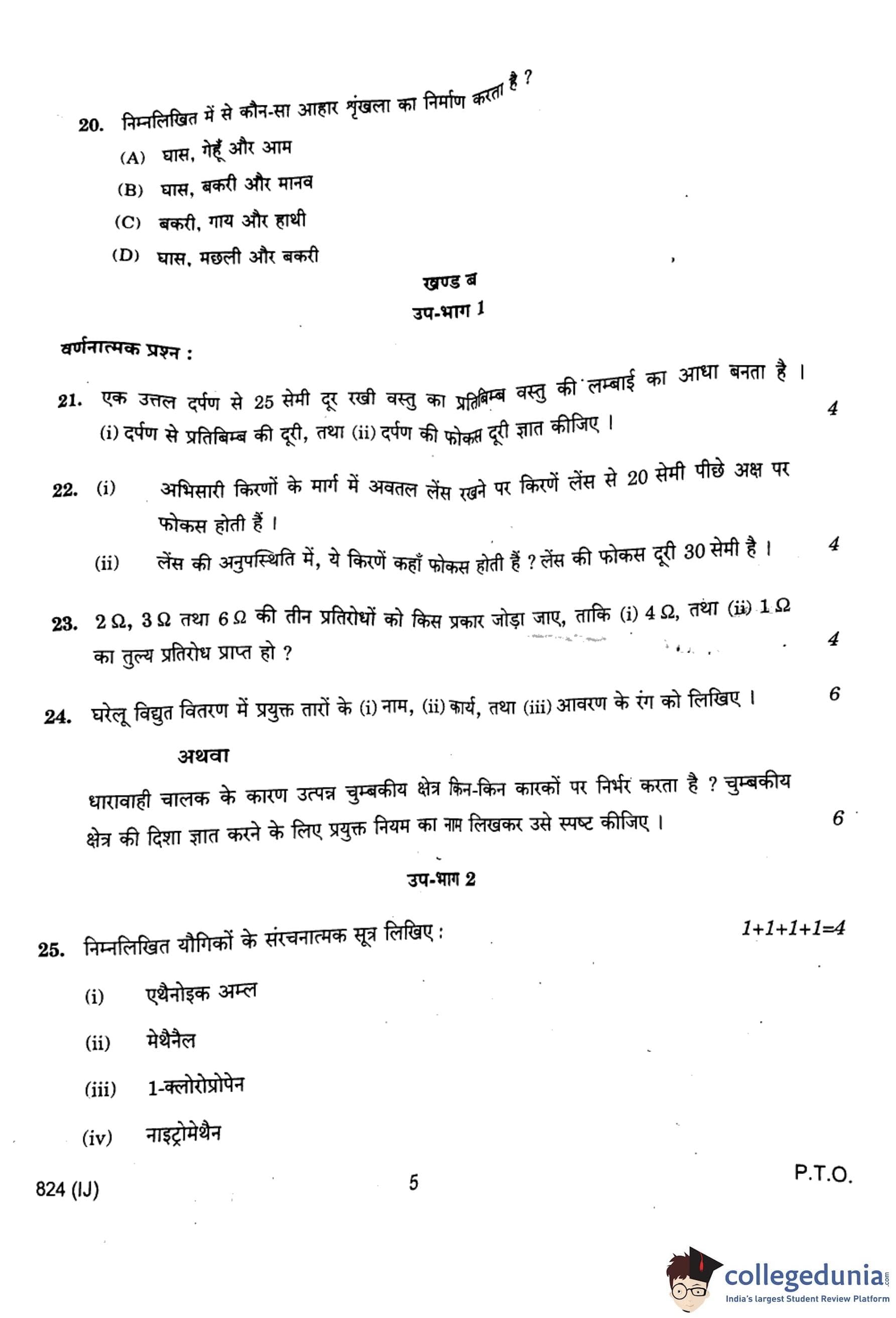
Which of the following constitutes a food chain?
View Solution
A food chain illustrates the transfer of energy from producers (plants) to primary consumers (herbivores) and subsequently to secondary consumers (carnivores/omnivores). For example, Grass → Goat → Human represents a valid food chain.
Quick Tip: A \textbf{food chain} always begins with \textbf{plants (producers)} and ends with \textbf{top consumers}.
Part -B
(Sub Section1)
Descriptive Questions
Question 21:
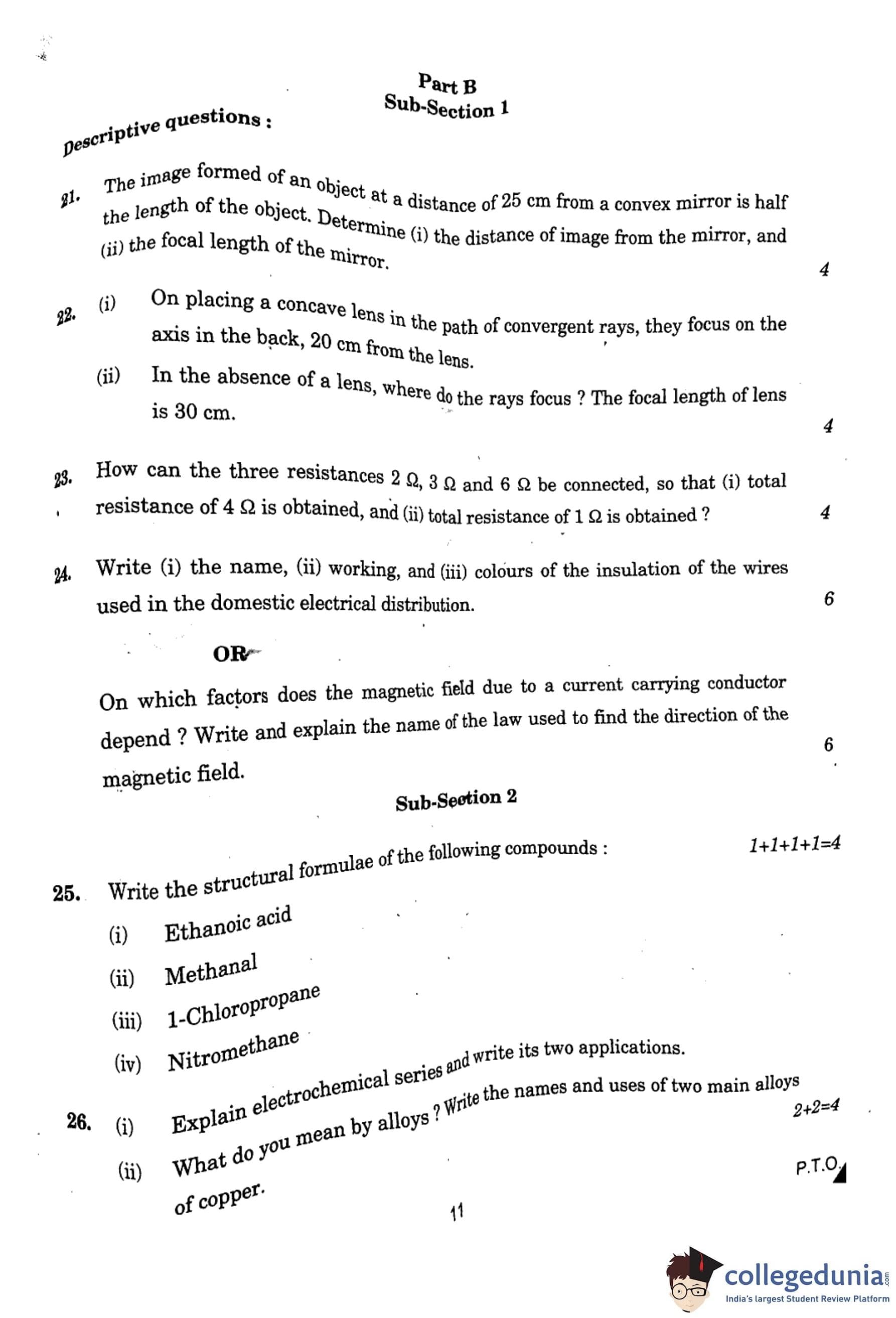
The image formed of an object at a distance of 25 cm from a convex mirror is half the length of the object. Determine (i) the distance of the image from the mirror, and (ii) the focal length of the mirror.
View Solution
Using the mirror formula: \[ \frac{1}{f} = \frac{1}{v} - \frac{1}{u} \]
Given that the object distance \( u = -25 \) cm, and the magnification \( m = \frac{-v}{u} = \frac{1}{2} \), we can find \( v \) and then solve for \( f \).
From magnification formula: \[ m = \frac{-v}{u} = \frac{1}{2} \Rightarrow v = \frac{-u}{2} = \frac{-(-25)}{2} = 12.5 \, cm \]
Now, using the mirror formula with \( u = -25 \) cm and \( v = 12.5 \) cm: \[ \frac{1}{f} = \frac{1}{v} - \frac{1}{u} = \frac{1}{12.5} - \frac{1}{-25} \]
Solving for \( f \), we get: \[ \frac{1}{f} = \frac{1}{12.5} + \frac{1}{25} = \frac{2}{25} \Rightarrow f = 25 \, cm \]
Thus, the answers are:
(i) \( v = 12.5 \, cm \)
(ii) \( f = 25 \, cm \) Quick Tip: The mirror formula \(\frac{1}{f} = \frac{1}{v} - \frac{1}{u} \) is used to determine focal length and image distance. For convex mirrors, both \( v \) and \( f \) are positive.
(i) On placing a concave lens in the path of convergent rays, they focus on the axis in the back, 20 cm from the lens.
(ii) In the absence of a lens, where do the rays focus? The focal length of the lens is 30 cm.
View Solution
The lens formula: \[ \frac{1}{f} = \frac{1}{v} - \frac{1}{u} \]
Given \( f = -30 \) cm (since it's a concave lens, the focal length is negative), and the image distance \( v = -20 \) cm (since the image is formed on the same side as the object in a concave lens), we can substitute these values into the lens formula to find the object distance \( u \).
Using the lens formula: \[ \frac{1}{-30} = \frac{1}{-20} - \frac{1}{u} \]
Solving for \( u \): \[ \frac{1}{u} = \frac{1}{-20} - \frac{1}{-30} = -\frac{1}{60} \]
Thus, the object distance is \( u = -60 \, cm \).
So, the answers are:
(i) The object distance is \( u = -60 \, cm \) (since the object is placed at a distance of 60 cm in front of the concave lens).
(ii) In the absence of the lens, the rays would focus at the focal point of the lens, which is \( f = 25 \, cm \), since the focal length of the lens is 30 cm. Quick Tip: Concave lenses always produce \textbf{virtual, upright, and diminished} images, and they have a \textbf{negative focal length}.
How can the three resistances 2 Ω, 3 Ω, and 6 Ω be connected, so that (i) total resistance of 4 Ω is obtained, and (ii) total resistance of 1 Ω is obtained?
View Solution
(i) To obtain 4 Ω, we arrange \( 3Ω \) and \( 6Ω \) in parallel: \[ \frac{1}{R_p} = \frac{1}{3} + \frac{1}{6} = \frac{2}{6} + \frac{1}{6} = \frac{1}{2} \]
So, \( R_p = 2Ω \). Adding \( 2Ω \) in series gives \( 4Ω \).
(ii) To obtain 1 Ω, we connect all resistances in parallel: \[ \frac{1}{R} = \frac{1}{2} + \frac{1}{3} + \frac{1}{6} = \frac{3}{6} + \frac{2}{6} + \frac{1}{6} = \frac{6}{6} = 1 \]
Thus, \( R = 1Ω \).
Quick Tip: Use the formula for series and parallel resistances: \(\textbf{Series: } R = R_1 + R_2\), \(\textbf{Parallel: } \frac{1}{R} = \frac{1}{R_1} + \frac{1}{R_2} \).
(i) Write the name, (ii) working, and (iii) colours of the insulation of the wires used in the domestic electrical distribution.
View Solution
(i) The main wires used in domestic electrical distribution are Live wire, Neutral wire, and Earth wire.
(ii) Working:
- The Live wire carries current from the main supply to the appliance.
- The Neutral wire provides the return path for the current.
- The Earth wire prevents electric shocks by directing leakage currents safely to the ground.
(iii) Colours of Insulation:
- Live wire: Red or Brown
- Neutral wire: Black or Blue
- Earth wire: Green or Yellow-green
Quick Tip: In domestic wiring, the \textbf{live wire} carries current, the \textbf{neutral wire} completes the circuit, and the \textbf{earth wire} provides safety.
(ii) On which factors does the magnetic field due to a current-carrying conductor depend? Write and explain the name of the law used to find the direction of the magnetic field.
View Solution
The magnetic field produced by a current-carrying conductor depends on:
1. Current (I): A higher current produces a stronger magnetic field.
2. Distance (r): The magnetic field decreases as the distance from the conductor increases.
3. Medium: The nature of the surrounding medium affects the magnetic field strength.
The law used to determine the direction of the magnetic field is Right-Hand Thumb Rule:
- If we hold a current-carrying conductor with the right hand, such that the thumb points in the direction of current, then the fingers curl in the direction of the magnetic field.
Quick Tip: The \textbf{Right-Hand Thumb Rule} helps determine the magnetic field direction around a current-carrying conductor.
Write the structural formulae of the following compounds:
(i) Ethanoic acid
(ii) Methanal
(iii) 1-Chloropropane
(iv) Nitromethane
View Solution
The structural formulae of the given compounds are:
1. Ethanoic acid (Acetic acid) - CH\textsubscript{3}COOH \[ H - C - C = O \] \[ \mid \quad \quad \quad \mid \] \[ H \quad \quad O - H \]
2. Methanal (Formaldehyde) - HCHO \[ H - C = O \] \[ \mid \] \[ H \]
3. 1-Chloropropane - C\textsubscript{3}H\textsubscript{7}Cl \[ CH_3 - CH_2 - CH_2 - Cl \]
4. Nitromethane - CH\textsubscript{3}NO\textsubscript{2} \[ CH_3 - NO_2 \] Quick Tip: \textbf{Structural formulae} represent the exact arrangement of atoms in a molecule. \textbf{Ethanoic acid} is a carboxylic acid, \textbf{methanal} is the simplest aldehyde, and \textbf{1-chloropropane} is a halogenated hydrocarbon.
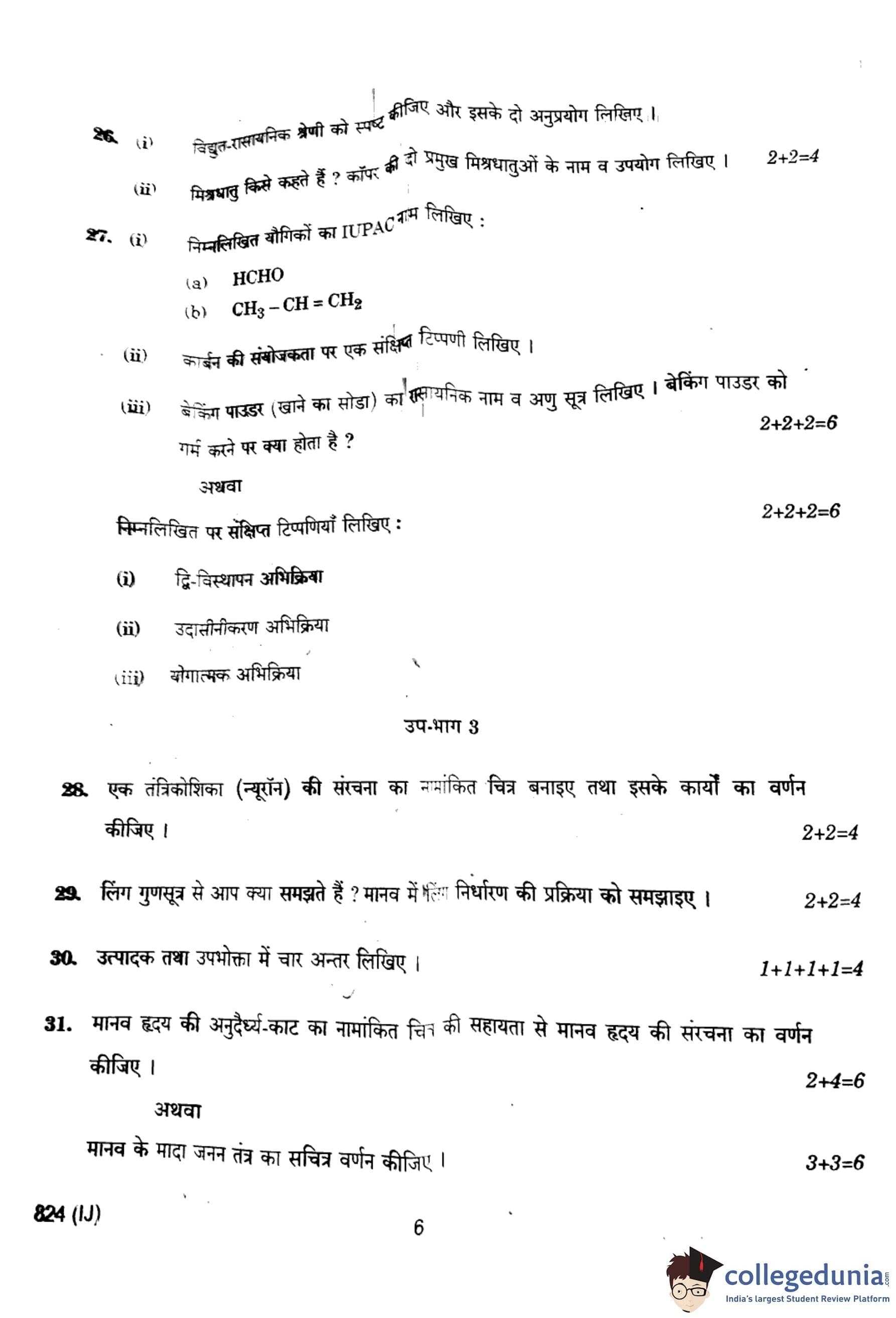
(i) Explain electrochemical series and write its two applications.
View Solution
The Electrochemical Series is a list of elements arranged in the order of their standard electrode potentials. It helps determine the ability of a metal to lose or gain electrons.
Applications:
1. Helps predict the feasibility of redox reactions.
2. Used to determine the strength of oxidizing and reducing agents. Quick Tip: \textbf{Metals higher in the electrochemical series} are more reactive, while those lower are less reactive.
(ii) What do you mean by alloys? Write the names and uses of two main alloys of copper.
View Solution
An alloy is a homogeneous mixture of two or more metals or a metal with a non-metal to improve properties like strength and corrosion resistance.
Main Alloys of Copper \& Their Uses:
1. Bronze (Copper + Tin) - Used in statues, medals, and coins.
2. Brass (Copper + Zinc) - Used in musical instruments, electrical fittings, and plumbing. Quick Tip: \textbf{Alloys} enhance the \textbf{mechanical and chemical properties} of metals, making them more durable.
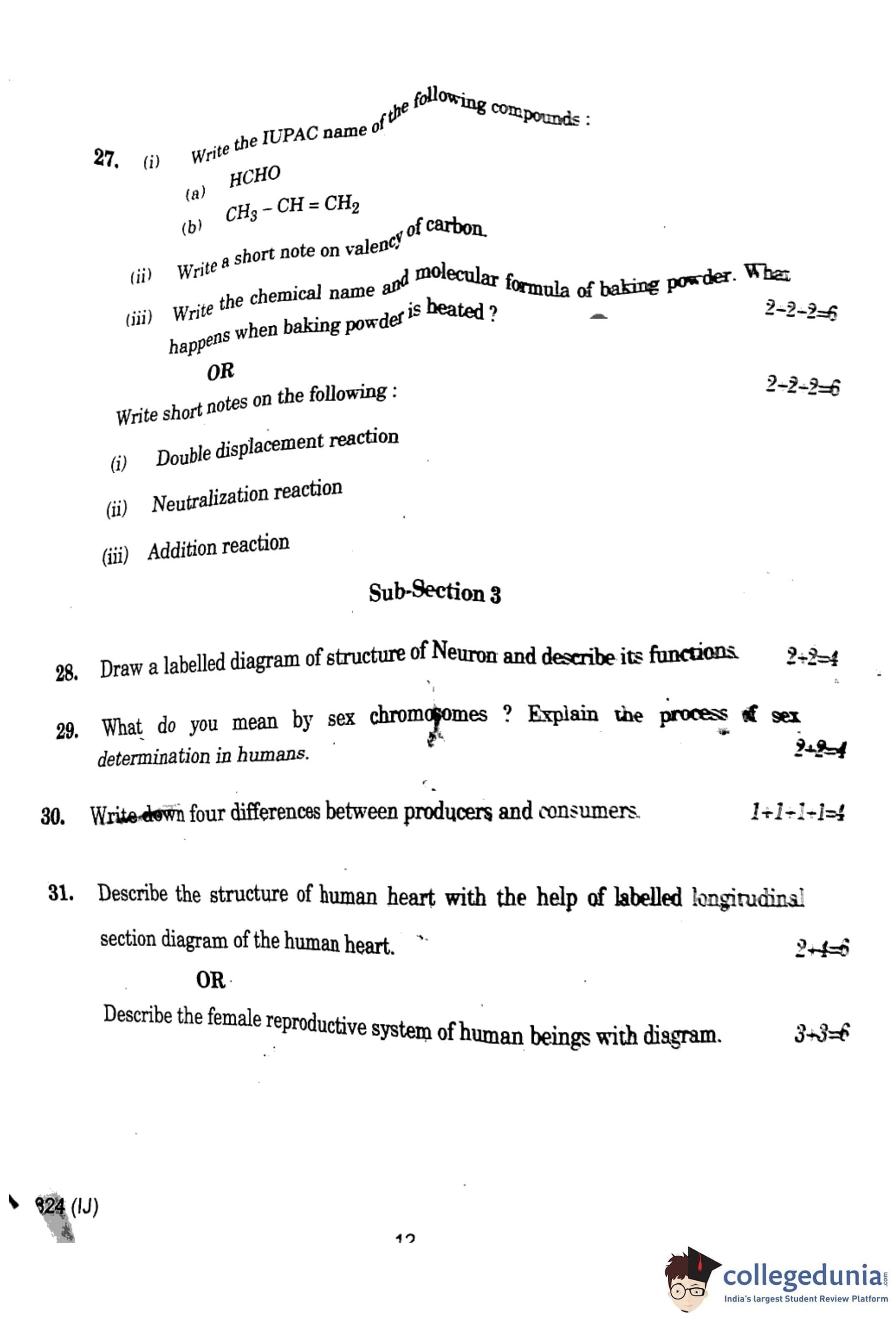
(i) Write the IUPAC name of the following compounds:
(a) HCHO
(b) CH\textsubscript{3 - CH = CH\textsubscript{2
View Solution
The IUPAC names of the given compounds are:
1. HCHO - Methanal (Formaldehyde)
2. CH\textsubscript{3} - CH = CH\textsubscript{2} - Propene Quick Tip: The IUPAC nomenclature follows the longest carbon chain rule and the functional group priority.
(ii) Write a short note on valency of carbon.
View Solution
Valency of Carbon refers to its ability to form bonds with other atoms. Carbon has four valence electrons, allowing it to form four covalent bonds with other atoms like hydrogen, oxygen, nitrogen, and itself, leading to a vast range of organic compounds. Quick Tip: Carbon’s valency of four leads to the formation of single, double, and triple bonds, enabling organic diversity.
(iii) Write the chemical name and molecular formula of baking powder. What happens when baking powder is heated?
View Solution
Chemical Name: Sodium Hydrogen Carbonate
Molecular Formula: NaHCO\textsubscript{3
When heated:
Baking powder decomposes to produce carbon dioxide gas, which helps in rising of dough in baking. \[ 2 NaHCO_3 \rightarrow Na_2CO_3 + H_2O + CO_2 \] Quick Tip: The release of \textbf{CO\textsubscript{2}} during baking makes food fluffy and light.
Sub-Section 3
Question 28:
Draw a labelled diagram of structure of Neuron and describe its functions.
View Solution
\caption{Structure of a Neuron
\label{fig:enter-Typical Structure of a neuron
A Neuron is the structural and functional unit of the nervous system. It consists of three main parts:
1. Cell body (Soma) – Contains the nucleus and cytoplasm.
2. Dendrites – Receive signals from other neurons.
3. Axon – Transmits impulses away from the cell body.
Functions of Neuron:
- It receives and transmits electrical and chemical signals.
- It helps in reflex actions and voluntary movements.
- It enables communication between different body parts and the brain.
\begin{quicktipbox
The neuron transmits signals via electrical impulses and neurotransmitters.
\end{quicktipbox Quick Tip: The neuron transmits signals via electrical impulses and neurotransmitters.
What do you mean by sex chromosomes? Explain the process of sex determination in humans.
View Solution
Sex chromosomes determine the biological sex of an individual. In humans, there are two types:
- X chromosome
- Y chromosome
Sex Determination Process:
- Males have XY chromosomes, and females have XX.
- The sex of the child depends on the type of sperm (X or Y) fertilizing the egg.
- If an X-sperm fertilizes the egg, a female (XX) is formed.
- If a Y-sperm fertilizes the egg, a male (XY) is formed.
\begin{quicktipbox
Sex determination follows Mendelian genetics and is controlled by the father’s sperm.
\end{quicktipbox Quick Tip: Sex determination follows Mendelian genetics and is controlled by the father’s sperm.
Write down four differences between producers and consumers.
View Solution
Producers vs. Consumers
\begin{tabular{|c|c|
\hline
Producers & Consumers
\hline
Synthesize their own food via photosynthesis & Depend on others for food
\hline
Examples: Plants, Algae & Examples: Humans, Animals
\hline
Autotrophic organisms & Heterotrophic organisms
\hline
Occupy the first trophic level in food chains & Occupy higher trophic levels
\hline
\end{tabular
\begin{quicktipbox
Producers convert solar energy into chemical energy, while consumers rely on it for survival.
\end{quicktipbox Quick Tip: Producers convert solar energy into chemical energy, while consumers rely on it for survival.
Describe the structure of the human heart with the help of a labelled longitudinal section diagram of the human heart.
View Solution
\caption{Structure of Human heart with labelled sections
The human heart is a four-chambered muscular organ that pumps blood throughout the body. It consists of:
- Right Atrium and Right Ventricle: Receive deoxygenated blood from the body and pump it to the lungs.
- Left Atrium and Left Ventricle: Receive oxygenated blood from the lungs and pump it to the rest of the body.
- Valves (Tricuspid, Bicuspid, Aortic, and Pulmonary Valves): Prevent backflow of blood.
- Major Blood Vessels: Aorta, Pulmonary Artery, Pulmonary Vein, and Vena Cava assist in circulation.
Function:
The heart ensures continuous circulation of oxygenated and deoxygenated blood, maintaining homeostasis. A labelled diagram of the heart helps visualize its structure.
\begin{quicktipbox
The heart functions through the coordinated contraction of its chambers, regulated by electrical impulses.
\end{quicktipbox Quick Tip: The heart functions through the coordinated contraction of its chambers, regulated by electrical impulses.
OR Describe the female reproductive system of human beings with a diagram.
View Solution
The female reproductive system consists of the following main organs:
- Uterus: Supports fetal development during pregnancy.
- Ovary: Produces eggs (ova) and hormones like estrogen and progesterone.
- Endometrium: The inner lining of the uterus, which thickens during the menstrual cycle to support embryo implantation.
- Cervix: A narrow passage between the uterus and vagina that allows the passage of sperm and menstrual blood.
- Vagina: Serves as the birth canal and receives sperm during reproduction.
Function:
The female reproductive system plays a crucial role in reproduction, including egg production, fertilization, fetal development, and childbirth. A labelled diagram helps in understanding its structure.
\begin{quicktipbox
The menstrual cycle and hormonal regulation play a crucial role in female reproductive health.
\end{quicktipbox Quick Tip: The menstrual cycle and hormonal regulation play a crucial role in female reproductive health.





Comments