




UP Board Class 10 Science Question Paper 2024 PDF (Code 824 IL) is available for download here. The Science exam was conducted on February 29, 2024 in the Morning Shift from 8:30 AM to 11:45 AM. The total marks for the theory paper are 70. Students reported the paper to be moderate.
UP Board Class 10 Science Question Paper 2024 (Code 824 IL) with Solutions
| UP Board Class 10 Science Question Paper With Answer Key |  Download Download |
Check Solution |

UP Board Class 10 Science Question Paper With Solution
Part–A
(Sub-Section 1)
Multiple Choice Type Questions
Question 1:
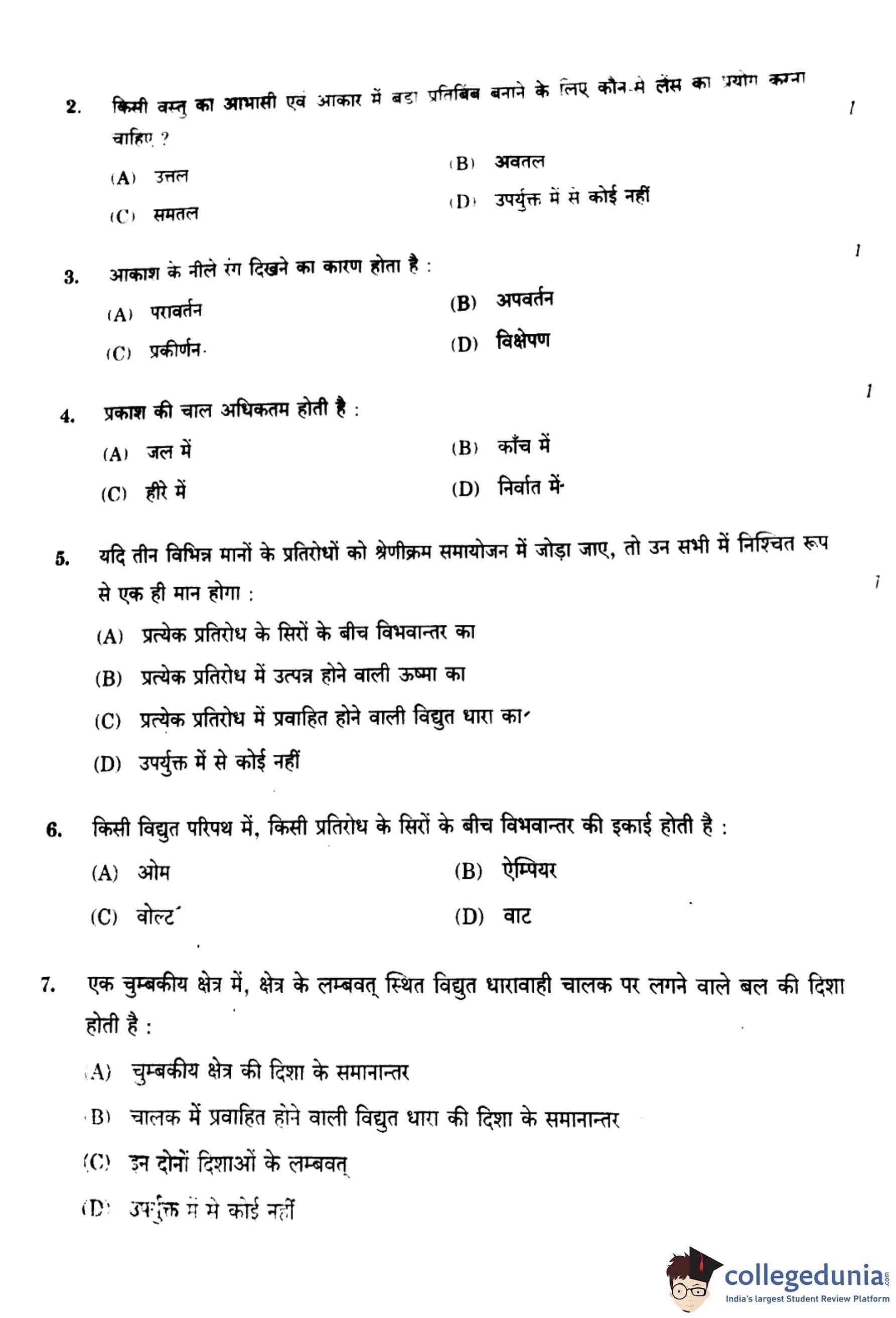
Which mirror should be used to form an apparent and enlarged image of an object?
View Solution
Concave mirrors are used to produce a magnified and virtual image of an object. A concave mirror can create an enlarged image when the object is positioned between the focal point and the mirror's surface.
Quick Tip: Concave mirrors are commonly used in magnifying glasses and makeup mirrors.
Which lens should be used to form an apparent and enlarged image of an object?
View Solution
Convex lenses are used to create a magnified and virtual image of an object. These lenses focus light to form an enlarged image, which is commonly utilized in magnifying glasses.
Quick Tip: Convex lenses are often used for corrective eyewear and magnifying tools.
The reason for the blue colour of the sky is:
View Solution
The blue color of the sky results from the scattering of light. Blue light, with its shorter wavelength, is scattered more by the molecules and particles in the Earth's atmosphere, causing the sky to appear blue.
Quick Tip: Rayleigh scattering explains why shorter wavelengths like blue are scattered more than longer wavelengths like red.
The speed of light is maximum in:
View Solution
The speed of light is highest in a vacuum. This occurs because light moves more slowly through materials like glass, water, or diamond, which have refractive indices greater than 1. In a vacuum, where the refractive index is 1, light travels at its fastest speed.
Quick Tip: The speed of light in a vacuum is approximately \(3 \times 10^8\) meters per second.
If three resistors of different values of resistance are connected in a series combination, then all of them will definitely have the same value of:
View Solution
In a series circuit, the electric current is the same throughout all components. The potential difference across each resistor varies depending on its resistance, as per Ohm's law. Therefore, the current flowing through each resistor in a series combination remains the same.
Quick Tip: In a series circuit, current is the same through all components, but the potential difference varies across each component.
In an electrical circuit, the unit of potential difference between the ends of a resistance is:
View Solution
The unit of potential difference, also known as voltage, is the Volt (V). It is defined as the work done per unit charge in transferring a charge between two points. The unit of resistance is the Ohm, and the unit of current is the Ampere.
Quick Tip: The potential difference (Voltage) across a resistor is calculated by Ohm's law: \(V = IR\), where \(I\) is the current, and \(R\) is the resistance.
In a magnetic field, the direction of the force acting on a current-carrying conductor perpendicular to the field is:
View Solution
The direction of the force on a current-carrying conductor in a magnetic field is determined by Fleming's Left Hand Rule. This rule states that the force is perpendicular to both the magnetic field and the direction of current flow.
Quick Tip: To apply Fleming's Left Hand Rule, stretch the thumb, index, and middle fingers of the left hand such that they are perpendicular to each other. The index finger gives the direction of the magnetic field, the middle finger gives the direction of the current, and the thumb gives the direction of the force.
General formula of alkanes is:
View Solution
The general formula for alkanes, which are saturated hydrocarbons, is \(C_nH_{2n+2}\), where \(n\) denotes the number of carbon atoms. Alkanes adhere to this formula, with examples including methane (\(CH_4\)), ethane (\(C_2H_6\)), and propane (\(C_3H_8\)).
Quick Tip: Alkanes are also known as paraffins, and they are characterized by having only single bonds between carbon atoms.
Homologous series in the following are :
(i) \(C_2H_4\) and \(C_3H_6\)
(ii) \(CH_3OH\) and \(CH_3CHO\)
(iii) \(HCHO\) and \(CH_3CHO\)
The correct option in context of the above is :
View Solution
N/A Quick Tip: Homologous series are groups of organic compounds that differ by a constant structural unit, such as a CH_2 group.
Which of the following metal forms hydrogen gas with cold water?
View Solution
Potassium reacts vigorously with cold water to produce hydrogen gas and potassium hydroxide. This is a characteristic reaction of alkali metals with water. The reaction can be represented as: \[ 2K + 2H_2O \rightarrow 2KOH + H_2 \]
Copper and gold do not react with cold water, while aluminium reacts very slowly in cold water but reacts readily in hot water.
Quick Tip: Alkali metals such as potassium and sodium react vigorously with cold water to produce hydrogen gas and metal hydroxides.
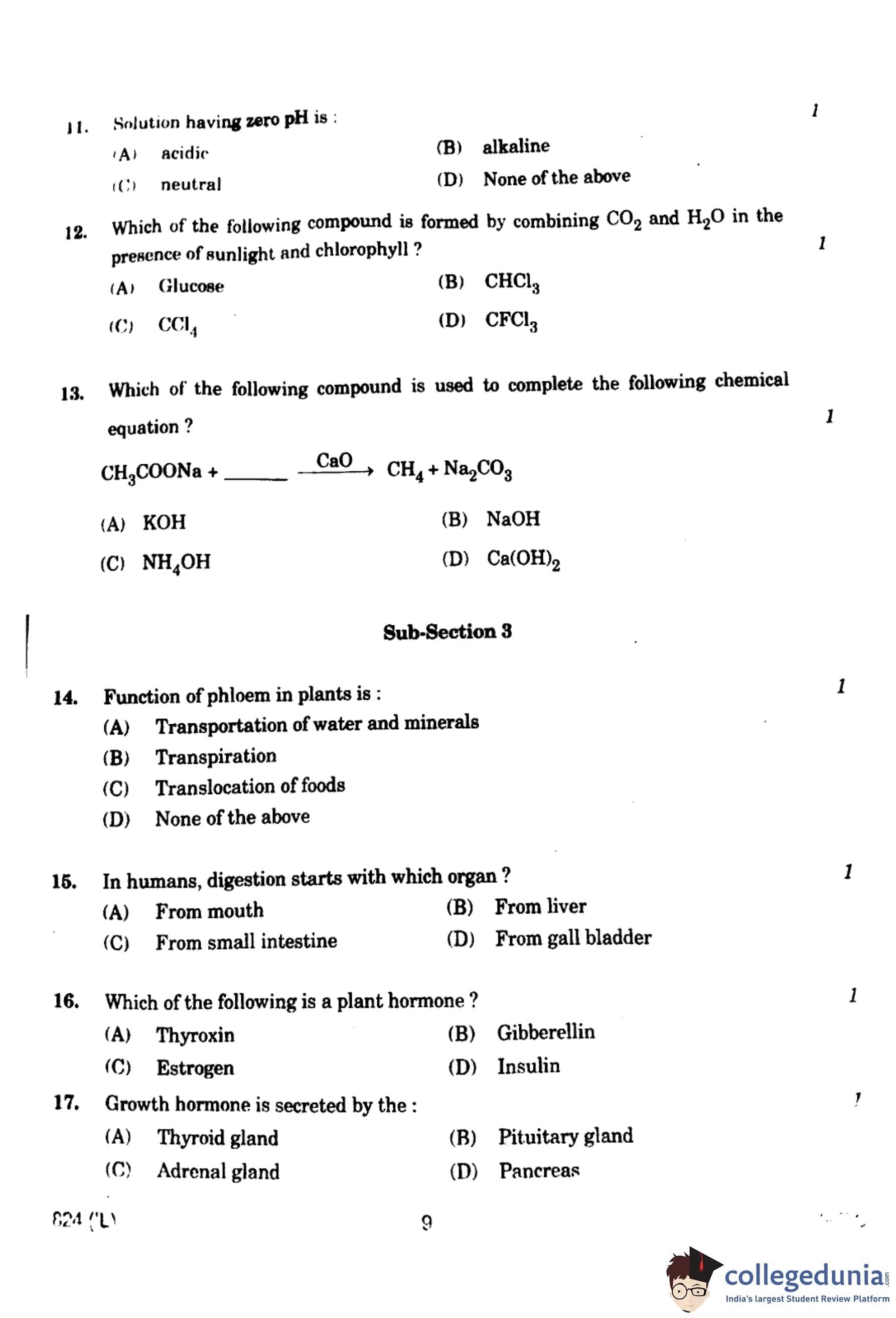
Solution having zero pH is:
View Solution
A solution with a pH of zero is highly acidic, like concentrated strong hydrochloric acid (HCl). A pH of zero indicates that the concentration of hydrogen ions \([H^+]\) is extremely high.
Quick Tip: Strong acids like HCl can have a pH close to 0, which is extremely acidic.
Which of the following compound is formed by combining \(CO_2\) and \(H_2O\) in the presence of sunlight and chlorophyll?
View Solution
Photosynthesis in plants involves the combination of \(CO_2\) and \(H_2O\) in the presence of sunlight and chlorophyll to produce glucose (\(C_6H_{12}O_6\)) and oxygen. This process is essential for plant life and provides energy to plants.
Quick Tip: Photosynthesis is essential for producing glucose, which plants use as an energy source.
Which of the following compound is used to complete the following chemical equation?
\[ CH_3COONa + \_\_\_\_\_\_ \ \xrightarrow{CaO} CH_4 + Na_2CO_3 \]
View Solution
The chemical reaction illustrates the formation of methane (\(CH_4\)) and sodium carbonate (\(Na_2CO_3\)) from sodium acetate (\(CH_3COONa\)) and calcium oxide (\(CaO\)). Sodium hydroxide (\(NaOH\)) is used to complete the reaction and plays a role in the formation of methane.
Quick Tip: In reactions involving sodium acetate and calcium oxide, sodium hydroxide is often required to complete the reaction.
Function of phloem in plants is:
View Solution
The phloem in plants is responsible for transporting food, particularly the sugars produced during photosynthesis, from the leaves to other parts of the plant. It is the vascular tissue that facilitates the movement of nutrients, such as glucose, throughout the plant.
Quick Tip: Remember that xylem carries water and minerals, while phloem carries food throughout the plant.
In humans, digestion starts with which organ?
View Solution
In humans, digestion begins in the mouth, where food is mechanically broken down by chewing and mixed with saliva. Saliva contains enzymes such as amylase, which initiate the digestion of carbohydrates.
Quick Tip: The mouth plays a critical role in digestion by starting the breakdown of carbohydrates and preparing food for further digestion in the stomach and intestines.
Which of the following is a plant hormone?
View Solution
Gibberellins are plant hormones that control growth and developmental processes, including seed germination, stem elongation, and flowering. In contrast, thyroxin, estrogen, and insulin are animal hormones, not plant hormones.
Quick Tip: Gibberellins help in the growth and elongation of plants, especially in seed germination and sprouting.
Growth hormone is secreted by the:
View Solution
The growth hormone, or somatotropin, is produced by the pituitary gland. It is essential for stimulating growth and regulating various metabolic processes in the body. The thyroid gland secretes thyroid hormones, the adrenal gland produces adrenaline, and the pancreas releases insulin.
Quick Tip: The pituitary gland is often referred to as the "master gland" because it secretes hormones that regulate many bodily functions, including growth.
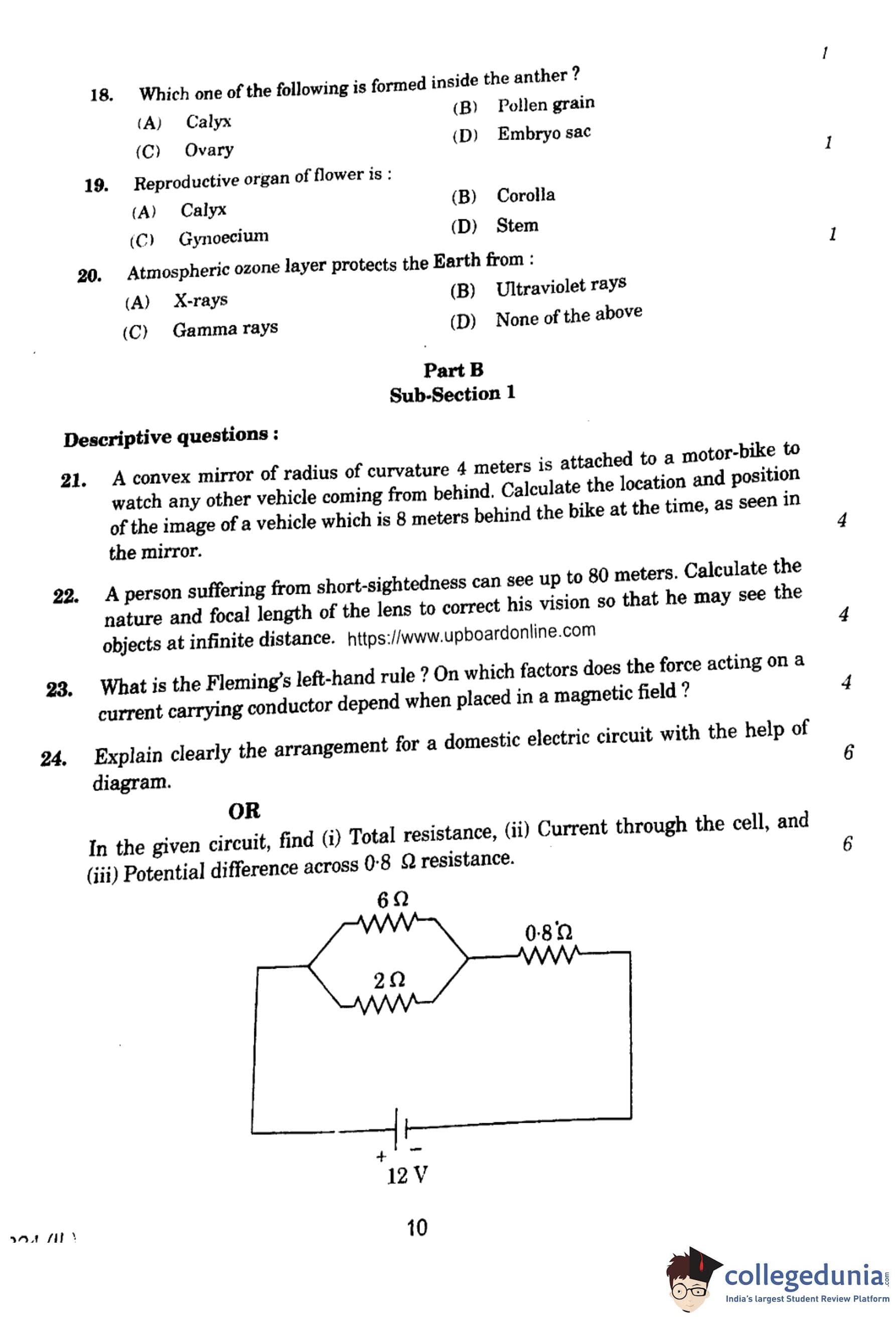
Which one of the following is formed inside the anther?
View Solution
Pollen grains are formed within the anther of a flower. The anther, which is part of the male reproductive organ (stamen), contains pollen sacs where the pollen grains mature. The other options are not related to the process occurring inside the anther.
Quick Tip: Remember that pollen grains are essential for the fertilization process in plants. They carry male gametes.
Reproductive organ of flower is:
View Solution
The gynoecium is the female reproductive organ of a flower, made up of one or more carpels. Each carpel contains the ovary, style, and stigma. The calyx and corolla are non-reproductive structures of the flower.
Quick Tip: The gynoecium contains the ovary where ovules are produced and eventually fertilized.
Atmospheric ozone layer protects the Earth from:
View Solution
The ozone layer in the Earth's stratosphere absorbs and shields most of the harmful ultraviolet (UV) radiation from the Sun, especially UV-B rays, which are linked to skin cancer and other health problems. However, X-rays and gamma rays are not effectively blocked by the ozone layer.
Quick Tip: Protecting the ozone layer is crucial for safeguarding life on Earth from harmful UV radiation.
A convex mirror of radius of curvature 4 meters is attached to a motor-bike to watch any other vehicle coming from behind. Calculate the location and position of the image of a vehicle which is 8 meters behind the bike at the time, as seen in the mirror.
View Solution
The radius of curvature \( R = 4 \, m \), so the focal length \( f = \frac{R}{2} = 2 \, m \).
The object distance \( u = -8 \, m \) (since the object is behind the mirror).
Using the mirror formula: \[ \frac{1}{f} = \frac{1}{v} + \frac{1}{u} \]
Substitute the values: \[ \frac{1}{2} = \frac{1}{v} - \frac{1}{8} \]
Solving for \( v \) (image distance): \[ \frac{1}{v} = \frac{1}{2} + \frac{1}{8} = \frac{5}{8} \] \[ v = \frac{8}{5} = 1.6 \, m \]
Thus, the image will be formed at a distance of \( 1.6 \, m \) behind the mirror (virtual image).
Quick Tip: In convex mirrors, the image is always virtual, erect, and diminished regardless of the object position.
A person suffering from short-sightedness can see up to 80 meters. Calculate the nature and focal length of the lens to correct his vision so that he may see the objects at infinite distance.
View Solution
The far point of the person is \( 80 \, m \), and the person needs a lens that can focus at infinity.
For short-sightedness, a diverging lens (concave lens) is required. The formula for the focal length of a lens is: \[ \frac{1}{f} = \frac{1}{v} - \frac{1}{u} \]
where \( v = \infty \) and \( u = -80 \, m \) (since the far point is 80 meters).
Substituting the values: \[ \frac{1}{f} = \frac{1}{\infty} - \frac{1}{-80} = \frac{1}{80} \]
Thus, the focal length \( f = -80 \, m \). This means a concave lens of focal length \( 80 \, m \) is needed.
Quick Tip: For short-sightedness, use a concave lens to diverge the light rays and bring the focus to the far point.
What is the Fleming's left-hand rule? On which factors does the force acting on a current-carrying conductor depend when placed in a magnetic field?
View Solution
Fleming's left-hand rule states that if the left hand is held with the thumb, index finger, and middle finger mutually perpendicular to each other, then:
- The thumb points in the direction of motion (force),
- The index finger points in the direction of the magnetic field,
- The middle finger points in the direction of the current.
The force acting on a current-carrying conductor in a magnetic field depends on the following factors:
1. The strength of the magnetic field (\( B \)).
2. The magnitude of the current (\( I \)) passing through the conductor.
3. The length of the conductor (\( l \)) that is within the magnetic field.
The force is given by: \[ F = B \cdot I \cdot l \]
where \( F \) is the force, \( B \) is the magnetic field strength, \( I \) is the current, and \( l \) is the length of the conductor in the field.
Quick Tip: Use the left-hand rule to predict the direction of the force when a current-carrying conductor is placed in a magnetic field.
Explain clearly the arrangement for a domestic electric circuit with the help of a diagram.
View Solution
A domestic electric circuit includes various electrical appliances connected to the main supply. The main circuit is linked to the fuse box, which serves as a safety measure to prevent overloads. A meter is used to measure the total energy consumed by the household. In a typical circuit, multiple devices, such as lights, fans, and other appliances, are connected in parallel, ensuring each device receives the same voltage. The connections are safeguarded by circuit breakers or fuses, which disconnect the power supply in the event of an overload. The live wire carries the current, while the neutral wire completes the circuit. The earth wire provides a safe path for the current in case of a fault.
The diagram for a simple domestic electric circuit is as follows:
Quick Tip: In a parallel circuit, all devices get the same voltage, and each device operates independently.
In the given circuit, find:
(i) Total resistance
(ii) Current through the cell, and
(iii) Potential difference across 0.8 \(\Omega\) resistance.
View Solution
In this circuit, we have resistances of \(6 \, \Omega\), \(2 \, \Omega\), and \(0.8 \, \Omega\) connected. To solve, we will first find the total resistance using the formula for resistors in series and parallel.
First, the resistances \(6 \, \Omega\) and \(2 \, \Omega\) are in series: \[ R_{total1} = 6 + 2 = 8 \, \Omega \]
Now, this \(8 \, \Omega\) is in parallel with \(0.8 \, \Omega\), so the total resistance is: \[ \frac{1}{R_{total}} = \frac{1}{8} + \frac{1}{0.8} = 0.125 + 1.25 = 1.375 \] \[ R_{total} = \frac{1}{1.375} \approx 0.727 \, \Omega \]
Next, using Ohm's Law (\(V = IR\)), where the voltage is \(12 \, V\), we can find the current through the cell: \[ I = \frac{V}{R_{total}} = \frac{12}{0.727} \approx 16.5 \, A \]
Now, for the potential difference across the \(0.8 \, \Omega\) resistance, we use Ohm's Law again: \[ V_{0.8 \, \Omega} = I \times 0.8 = 16.5 \times 0.8 \approx 13.2 \, V \] Quick Tip: For resistors in series, the total resistance is the sum of individual resistances, and for resistors in parallel, the total resistance is the reciprocal of the sum of reciprocals of individual resistances.
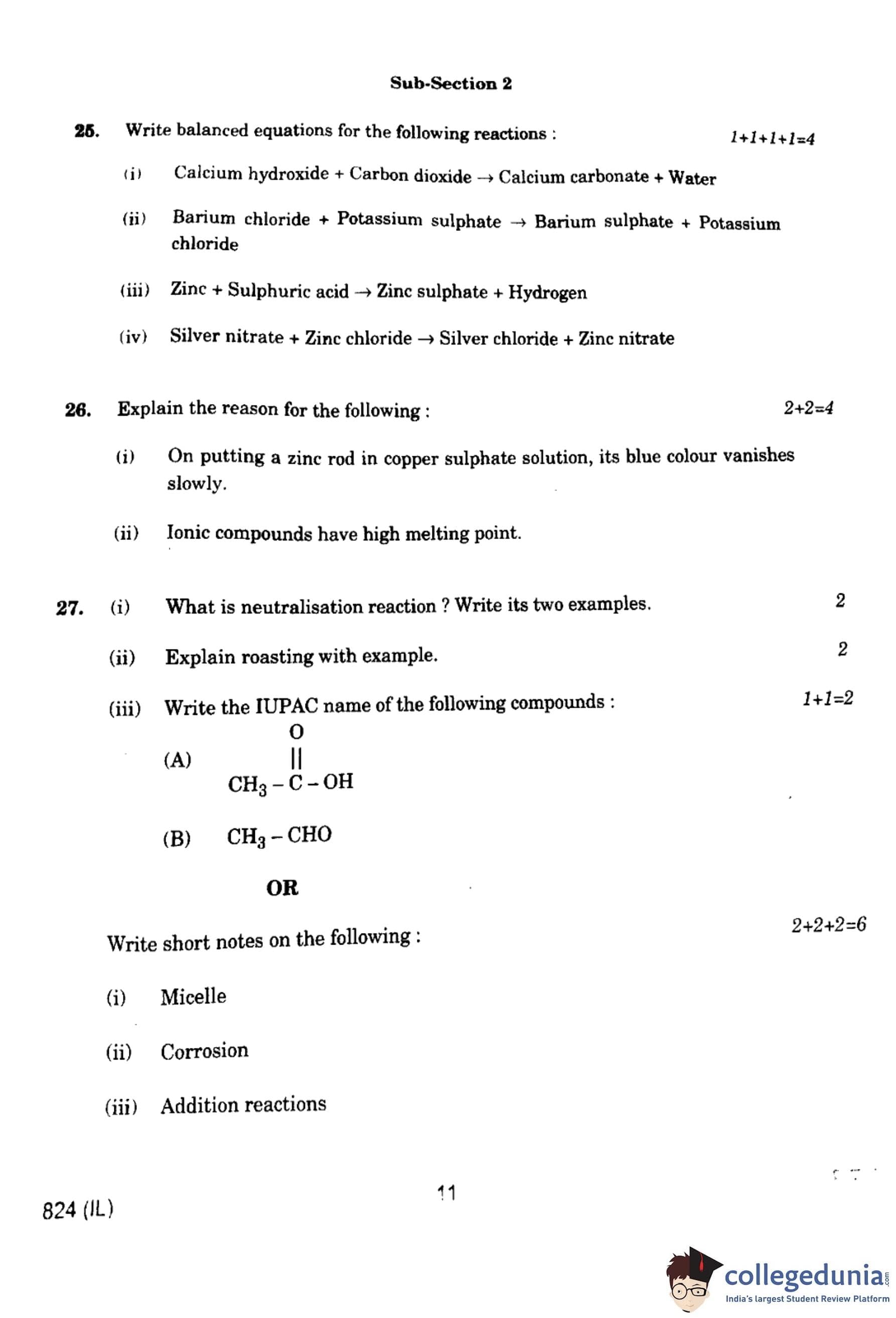
Write balanced equations for the following reactions:
View Solution
(i) Calcium hydroxide + Carbon dioxide \(\to\) Calcium carbonate + Water
\[ Ca(OH)_2 + CO_2 \to CaCO_3 + H_2O \]
(ii) Barium chloride + Potassium sulphate \(\to\) Barium sulphate + Potassium chloride
\[ BaCl_2 + K_2SO_4 \to BaSO_4 + 2KCl \]
(iii) Zinc + Sulphuric acid \(\to\) Zinc sulphate + Hydrogen
\[ Zn + H_2SO_4 \to ZnSO_4 + H_2 \]
(iv) Silver nitrate + Zinc chloride \(\to\) Silver chloride + Zinc nitrate
\[ AgNO_3 + ZnCl_2 \to AgCl + Zn(NO_3)_2 \] Quick Tip: For reactions involving ions, always balance both the mass and charge on both sides of the equation.
Explain the reason for the following:
View Solution
(i) On putting a zinc rod in copper sulphate solution, its blue colour vanishes slowly.
The blue color of copper sulphate is due to the presence of copper ions (\( Cu^{2+} \)). When zinc is placed in copper sulphate solution, zinc displaces copper from the solution, forming zinc sulphate and leaving behind the colorless zinc ions. This is a redox displacement reaction.
\[ Zn + CuSO_4 \to ZnSO_4 + Cu \]
(ii) Ionic compounds have high melting points.
Ionic compounds have high melting points due to the strong electrostatic forces between positively and negatively charged ions. These forces require a significant amount of energy to break, resulting in high melting points for ionic solids. Quick Tip: The stronger the electrostatic attraction between ions, the higher the melting and boiling points of ionic compounds.
(i) What is a neutralisation reaction? Write its two examples.
View Solution
A neutralization reaction is a chemical reaction in which an acid and a base react to form a salt and water. The general equation for neutralization is: \[ Acid + Base \to Salt + Water \]
Examples:
1. \(HCl + NaOH \to NaCl + H_2O\) (Hydrochloric acid and sodium hydroxide)
2. \(H_2SO_4 + KOH \to K_2SO_4 + H_2O\) (Sulfuric acid and potassium hydroxide)
(ii) Explain roasting with an example.
Roasting is the process of heating an ore in the presence of oxygen to extract the metal. The process involves the reaction of the ore with oxygen, removing impurities like sulfur and carbon. Example: Roasting of \(ZnS\) (Zinc sulfide) to form zinc oxide: \[ 2ZnS + 3O_2 \to 2ZnO + 2SO_2 \]
(iii) Write the IUPAC name of the following compounds:
(A) \(CH_3COOH\) - Ethanoic acid
(B) \(CH_3CH_2OH\) - Ethanol
(C) \(CH_3CHO\) - Ethanal Quick Tip: For naming organic compounds, remember the longest carbon chain and the functional group to determine the IUPAC name.
Write short notes on the following:
View Solution
(i) Micelle:
A micelle is an aggregate of surfactant molecules in a liquid. Micelles are formed when amphiphilic molecules (which have both hydrophobic and hydrophilic parts) are added to water. The hydrophilic part of the surfactant faces the water, while the hydrophobic part faces inward, forming a spherical structure. Micelles are important in processes like soap cleaning, where the hydrophobic part traps oils and dirt.
(ii) Corrosion:
Corrosion is the gradual destruction or deterioration of materials (typically metals) due to chemical reactions with their environment. A common example is the rusting of iron, which occurs when iron reacts with oxygen and moisture to form iron oxide. This process leads to the weakening of the metal.
The general equation for the rusting of iron is: \[ 4Fe + 3O_2 + 6H_2O \to 4Fe(OH)_3 \]
(iii) Addition reactions:
An addition reaction is a type of chemical reaction where two or more molecules combine to form a larger product. This is common in organic chemistry, especially with alkenes and alkynes. In an addition reaction, the double or triple bonds are broken, and new atoms or groups are added to the molecules. A typical example is the addition of hydrogen to ethene to form ethane: \[ C_2H_4 + H_2 \to C_2H_6 \] Quick Tip: Micelles are crucial in the formation of emulsions, where two immiscible liquids are mixed.
Describe Regeneration and Budding with diagram.
View Solution
(i) Regeneration: It is the process by which certain organisms can regrow or replace lost or damaged parts of their body. Examples include starfish regrowing lost arms.
(ii) Budding: It is a type of asexual reproduction where a new organism grows from a bud on the parent organism. The bud detaches when fully developed. An example is in hydra.
Quick Tip: Regeneration is a form of asexual reproduction, while budding involves the growth of a new organism from the parent.
Describe sex determination process in human beings with diagram.
View Solution
Sex determination in humans is based on the presence of sex chromosomes. Females have two X chromosomes (XX), while males have one X and one Y chromosome (XY). The presence of the Y chromosome determines maleness, while its absence results in femaleness. The sex chromosome from the father determines the sex of the offspring.
Quick Tip: In humans, the presence of the Y chromosome results in a male offspring, while the absence of Y chromosome results in a female offspring.
Define Phototropism and Geotropism with the help of suitable diagrams.
View Solution
(i) Phototropism: It is the growth response of plants to light. Plants move toward light (positive phototropism) or away from light (negative phototropism). An example is the bending of plants towards a light source.
(ii) Geotropism: It is the response of a plant to gravity. Roots exhibit positive geotropism as they grow downward into the soil, while stems exhibit negative geotropism as they grow upward.
Quick Tip: Phototropism occurs due to light, while geotropism is the plant's response to gravity.
What do you mean by endocrine glands? Describe the functions of hormones secreted by any four endocrine glands in humans.
View Solution
Endocrine glands are glands that secrete hormones directly into the bloodstream, which regulate various physiological functions in the body.
Four major endocrine glands are:
Thyroid Gland: Secretes thyroxine, which regulates metabolism.
Pituitary Gland: Secretes growth hormone, which regulates growth and development.
Adrenal Glands: Secrete adrenaline, which helps in the body’s fight-or-flight response.
Pancreas: Secretes insulin, which regulates blood sugar levels.
Quick Tip: Endocrine glands control important body functions such as metabolism, growth, and stress response.
Define ecosystem and describe its various biotic components with examples.
View Solution
An ecosystem is a community of living organisms interacting with their physical environment. It includes both biotic (living) and abiotic (non-living) components. The major biotic components of an ecosystem are:
(i) Producers: Organisms that produce food, primarily plants and algae. Example: Grass.
(ii) Consumers: Organisms that consume other organisms for food. Example: Herbivores, Carnivores.
(iii) Decomposers: Organisms that break down dead organisms. Example: Fungi and bacteria.
Quick Tip: An ecosystem relies on interactions between producers, consumers, and decomposers to function properly.







Comments