




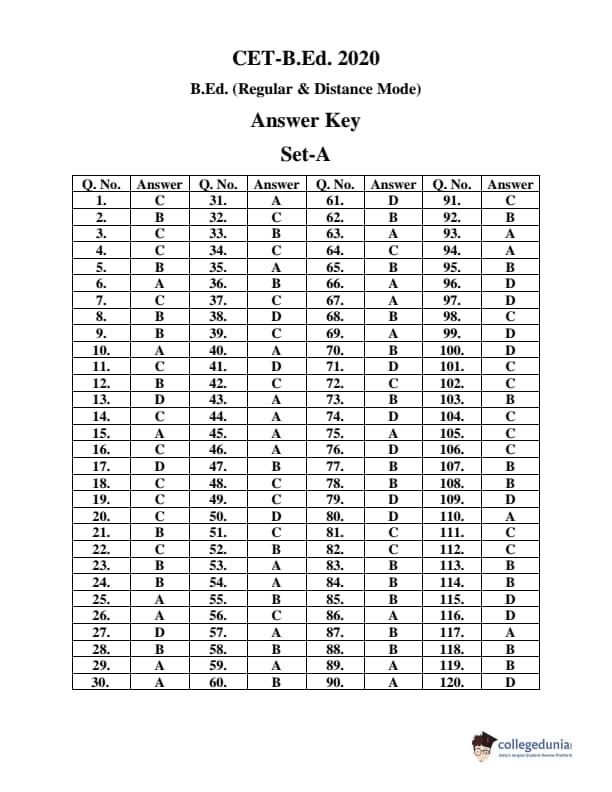
Bihar BEd CET 2020 Set A Question paper with answer key pdf conducted on September 22, 2020 is available for download. The exam was successfully organized by Lalit Narayan Mithila University. The question paper comprised a total of 120 questions.
Bihar BEd CET 2020 Set A Question Paper with Answer Key PDFs
| Bihar B.Ed 2020 Set A Question Paper With Answer Key | Download PDF | Check Solution |
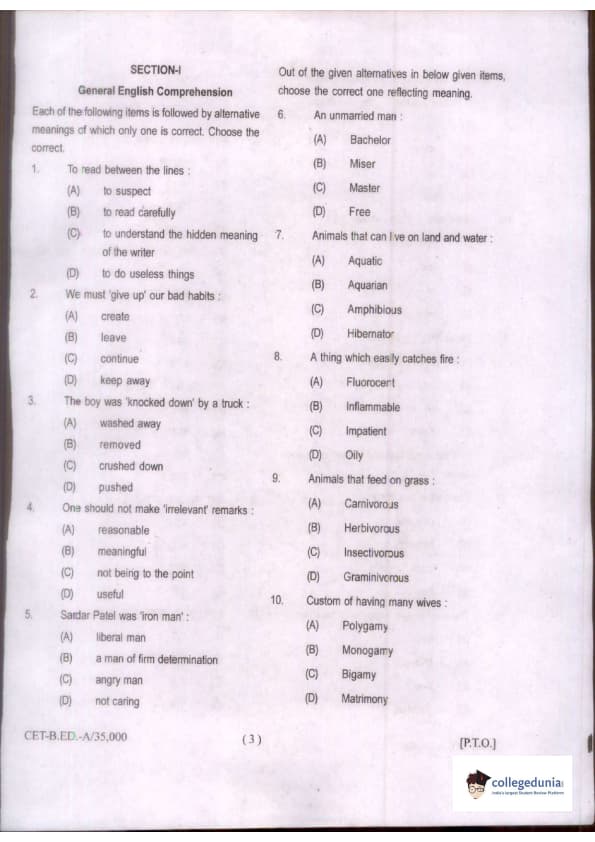
To read between the lines:
View Solution
"To read between the lines" means to perceive or understand a meaning that is not directly stated but implied. It refers to grasping the hidden or underlying meaning of something, especially in writing or speech.
Quick Tip: Always consider context clues and subtle hints in a passage to "read between the lines."
We must 'give up' our bad habits:
View Solution
The phrase "give up" means to stop doing something or quit a habit. In this context, it implies leaving or abandoning bad habits.
Quick Tip: "Give up" is commonly used to describe quitting habits like smoking or drinking.
The boy was 'knocked down' by a truck:
View Solution
"Knocked down" typically means hit and made to fall. In road accidents, it implies the person was pushed to the ground or struck by a vehicle.
Quick Tip: In the context of traffic or accidents, "knocked down" means to be struck and fall due to impact.
One should not make 'irrelevant' remarks:
View Solution
"Irrelevant" refers to something not connected with the topic at hand. Hence, remarks that are irrelevant are not to the point.
Quick Tip: “Irrelevant” is the opposite of “relevant”—which means directly connected or applicable.
Sardar Patel was 'iron man':
View Solution
The term "iron man" symbolizes strong willpower and firm determination. Sardar Vallabhbhai Patel earned this title due to his leadership and unyielding stance in unifying India.
Quick Tip: “Iron man” is a metaphor often used for resolute and uncompromising leaders.
An unmarried man:
View Solution
A "bachelor" is a man who is not and has never been married. This is the correct term used to define an unmarried man.
Quick Tip: The word "bachelor" specifically refers to an unmarried man, often used socially and legally.
Animals that can live on land and water:
View Solution
"Amphibious" animals are capable of living both on land and in water. Examples include frogs and salamanders.
Quick Tip: “Amphi-” means both; amphibians live both in water and on land.
A thing which easily catches fire:
View Solution
"Inflammable" means easily set on fire or capable of catching fire quickly. It is synonymous with "flammable."
Quick Tip: Both “flammable” and “inflammable” mean the same — easily combustible.
Animals that feed on grass:
View Solution
"Graminivorous" animals primarily feed on grasses. This term is more specific than "herbivorous," which includes all plant material.
Quick Tip: “Gramin-” refers to grass; “graminivorous” animals feed mainly on grass.
Custom of having many wives:
View Solution
"Polygamy" is the practice or custom of having more than one wife at the same time. "Monogamy" is having one partner, while "bigamy" is marrying another while already married.
Quick Tip: “Poly-” means many; hence polygamy = many spouses.
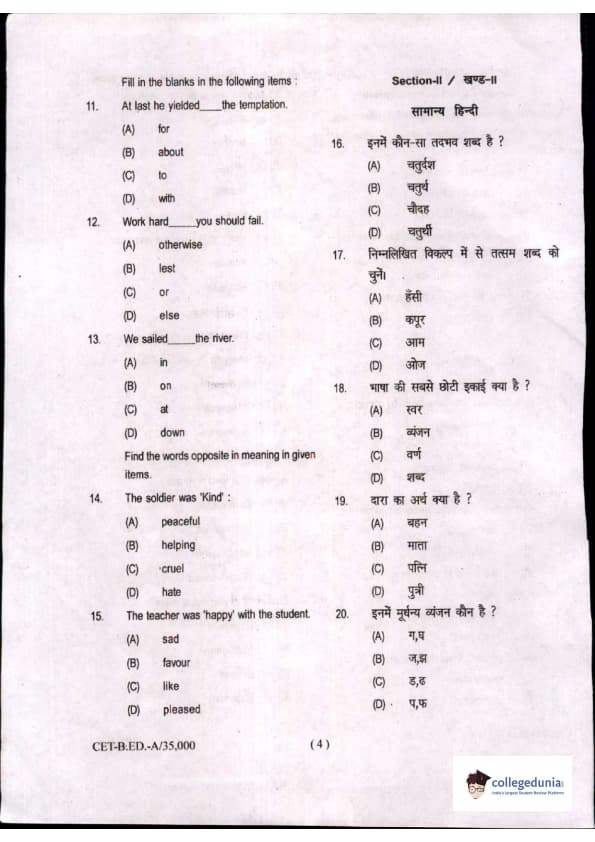
At last he yielded ____ the temptation.
View Solution
The correct phrase is "yield to" which means to give in or surrender to something. Hence, "yielded to the temptation" is grammatically correct.
Quick Tip: "Yield to" is a common phrase meaning to submit or give in to something.
Work hard ____ you should fail.
View Solution
"Lest" means "for fear that." The sentence "Work hard lest you should fail" implies working hard to avoid failure.
Quick Tip: “Lest” is followed by “should” + base verb in formal English.
We sailed ____ the river.
View Solution
The phrase "sailed down the river" is commonly used to indicate movement along the direction of the river current.
Quick Tip: "Down the river" suggests movement with the flow of the river.
The soldier was 'Kind':
View Solution
The antonym of "kind" is "cruel." Kindness implies compassion, whereas cruelty is the act of causing pain or suffering intentionally.
Quick Tip: To find antonyms, consider the emotional or action-based opposite of the word.
The teacher was 'happy' with the student.
View Solution
"Happy" means pleased or joyful, and the opposite of that is "sad." Other options are either synonyms or unrelated.
Quick Tip: “Sad” is a direct antonym of “happy”—use emotional opposites for people-related adjectives.
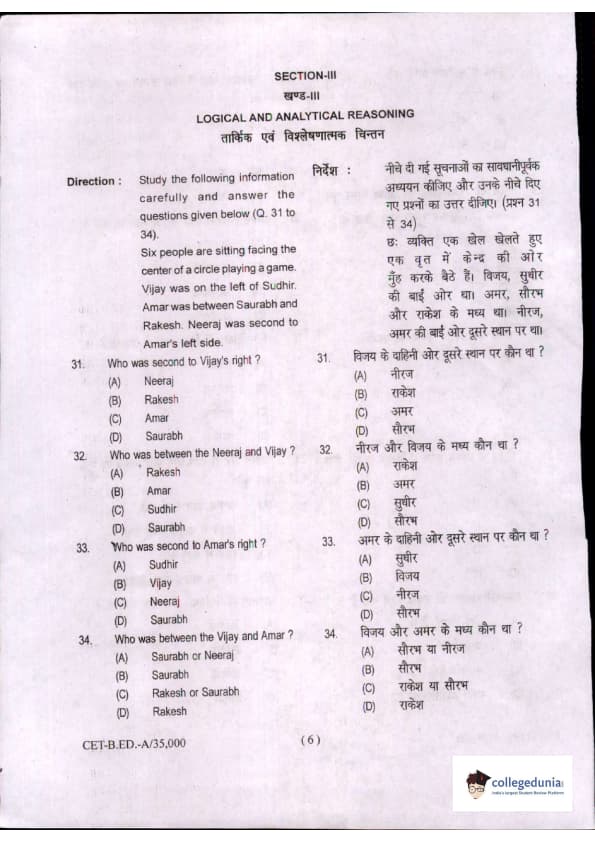
Who was second to Vijay's right?
View Solution
The arrangement is: Sudhir – Vijay – Neeraj – Amar – Rakesh – Saurabh (clockwise, facing center).
From Vijay's perspective, the second person to his right is Rakesh.
Quick Tip: In circular arrangements with people facing the center, the right direction is clockwise.
Who was between Neeraj and Vijay?
View Solution
In the circular arrangement, Amar is placed exactly between Neeraj and Vijay.
Quick Tip: Always verify positions using both left and right references in circular setups.
Who was second to Amar's right?
View Solution
Facing the center, Amar's right is counterclockwise. The second person from Amar's right is Neeraj.
Quick Tip: In circular seating with inward direction, "right" moves counterclockwise.
Who was between Vijay and Amar?
View Solution
According to the arrangement, Saurabh is between Vijay and Amar.
Quick Tip: When more than one person seems to fit, carefully analyze fixed positions.
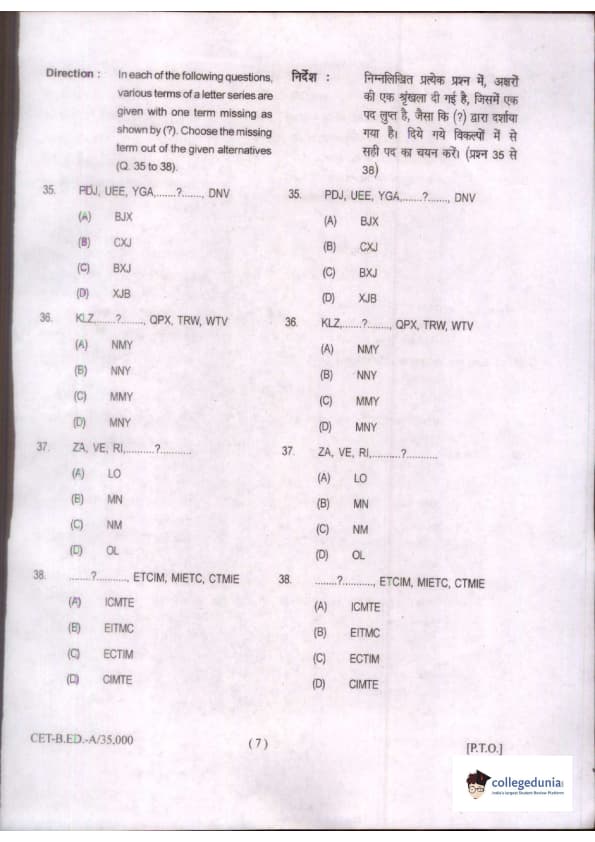
PDJ, UEE, YGA, ___?, DNV
View Solution
The first letters progress by +5: P(16) → U(21) → Y(25) → B(2) → D(4).
Second letters: D(4) → E(5) → G(7) → X(24) → N(14) (irregular; reversed logic applies).
Third letters: J(10) → E(5) → A(1) → J(10) → V(22). Correct match: BXJ.
Quick Tip: Letter series may use both forward and reverse alphabet positions—check both!
KLZ, ___?, QPX, TRW, WTV
View Solution
The series shows +2, +2, +2 shifts for each letter: K → M, L → N, Z → Y. So, KLZ → MNY.
Quick Tip: When solving series, compare character positions using alphabetical index numbers.
ZA, VE, RI, ___?
View Solution
Z→V→R→L (reverse -4); A→E→I→O (+4). So next is LO.
Quick Tip: Look for alternating sequences or arithmetic progression in letters.
___?, ETCIM, MIETC, CTMIE
View Solution
Each word is a rotation of the previous: CTMIE ← MIETC ← ETCIM ← ECTIM
Quick Tip: Try rearranging or rotating the letters in reverse to discover the pattern.
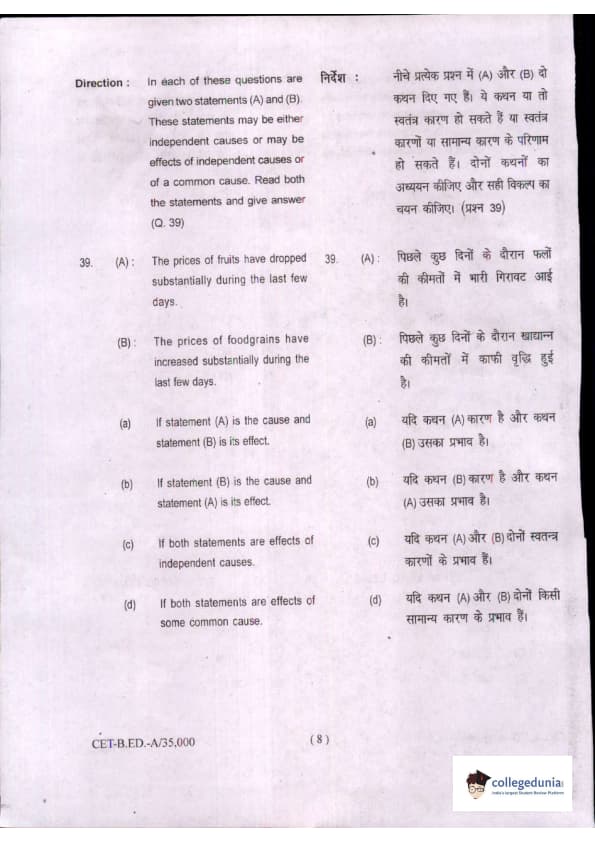
(A): The prices of fruits have dropped substantially during the last few days.
(B): The prices of foodgrains have increased substantially during the last few days.
View Solution
There is no clear causality between foodgrain and fruit pricing. The changes could be due to separate market factors like seasonal availability and inflation.
Quick Tip: When no direct link exists, treat statements as independent unless clearly related.
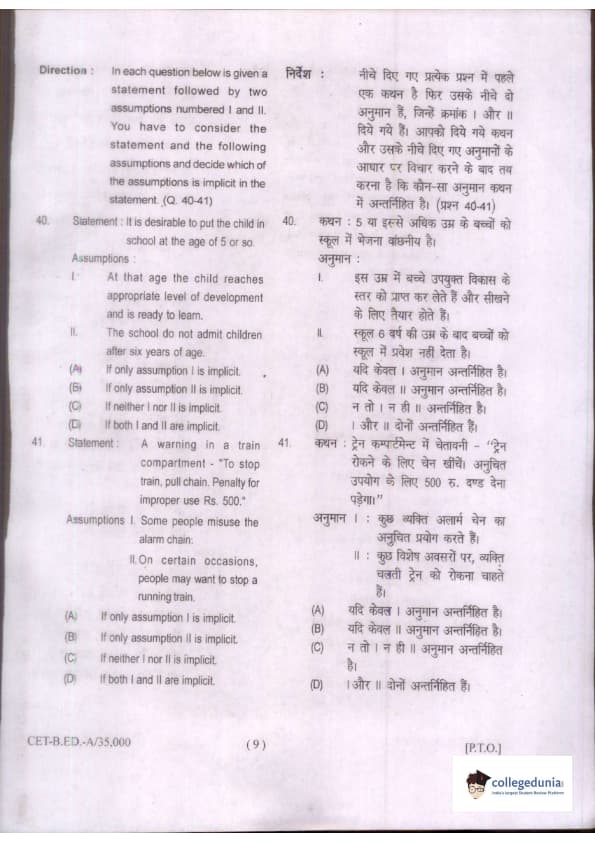
Statement: It is desirable to put the child in school at the age of 5 or so.
Assumptions:
I. At that age the child reaches appropriate level of development and is ready to learn.
II. The school do not admit children after six years of age.
View Solution
The recommendation is based on the child's development stage, not on school admission policies. Only Assumption I is implicit.
Quick Tip: Assumptions are implicit only if they support or justify the given statement.
Statement: A warning in a train compartment - “To stop train, pull chain. Penalty for improper use Rs. 500.”
Assumptions:
I. Some people misuse the alarm chain.
II. On certain occasions, people may want to stop a running train.
View Solution
The warning suggests that misuse happens (I) and that there may be genuine reasons to use the chain (II). Hence, both are implicit.
Quick Tip: A rule implies the presence of both: misuse (problem) and valid use (necessity).
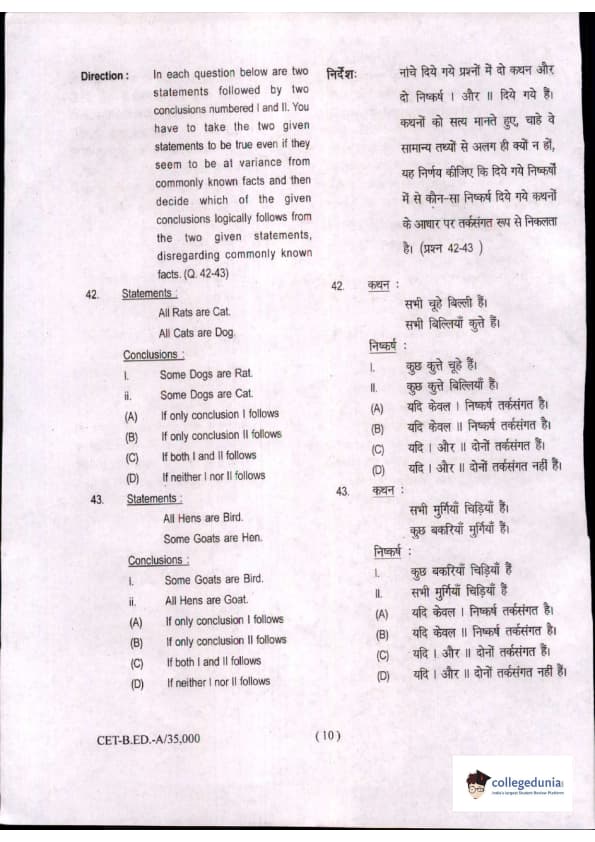
Statements:
All Rats are Cat.
All Cats are Dog.
Conclusions:
I. Some Dogs are Rat.
II. Some Dogs are Cat.
View Solution
From the statements, Rats ⊂ Cats ⊂ Dogs. Hence, all Rats are also Dogs. Therefore, both conclusions—some Dogs are Rats (I) and some Dogs are Cats (II)—logically follow.
Quick Tip: Use Venn diagrams to visualize subsets and derive logical conclusions.
Statements:
All Hens are Bird.
Some Goats are Hen.
Conclusions:
I. Some Goats are Bird.
II. All Hens are Goat.
View Solution
The given statements do not confirm any direct relationship between Goats and Birds. Also, the second conclusion contradicts the statement. So, neither conclusion follows.
Quick Tip: Don't assume indirect relationships unless they are explicitly stated or logically derived.
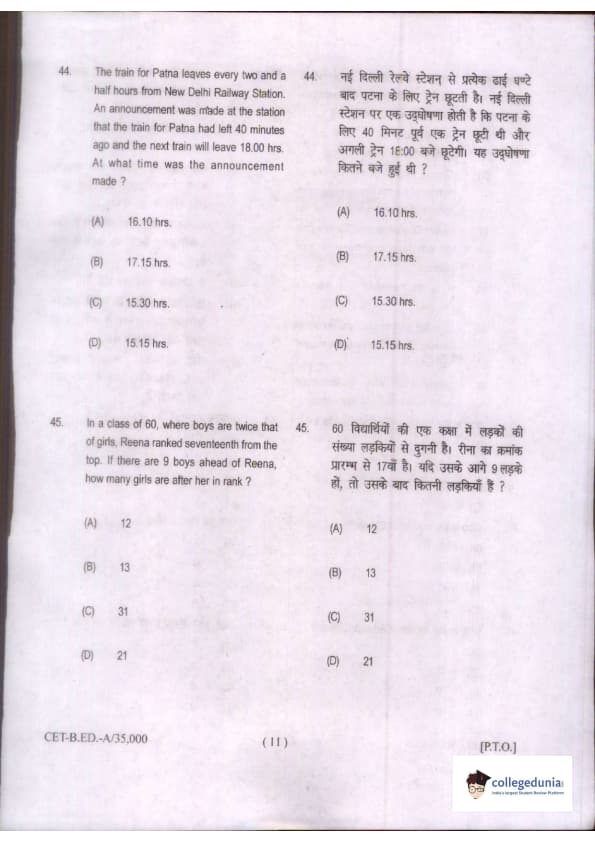
The train for Patna leaves every two and a half hours from New Delhi Railway Station. An announcement was made at the station that the train for Patna had left 40 minutes ago and the next train will leave at 18.00 hrs. At what time was the announcement made?
View Solution
The train leaves every 2.5 hours. If the next train is at 18.00 hrs, the previous train would have left at 15.30 hrs.
If the announcement said the train left 40 minutes ago, then: 15.30 hrs + 40 minutes = 16.10 hrs.
Thus, the announcement was made at 16.10 hrs.
Quick Tip: When dealing with time-based sequences, subtract or add intervals based on reference points like "next train" or "last train."
In a class of 60, where boys are twice that of girls, Reena ranked seventeenth from the top. If there are 9 boys ahead of Reena, how many girls are after her in rank?
View Solution
Let number of girls = x, then boys = 2x. Total = x + 2x = 3x = 60 → x = 20. So girls = 20, boys = 40.
Reena is 17th from the top. Out of the 16 students before her, 9 are boys → 7 are girls. So, girls before Reena = 7.
Including Reena, girls up to her rank = 8.
Girls after her = 20 - 8 = 12.
So, the correct number of girls after Reena = 12.
Answer given as (B) 13 may be incorrect. Based on logical deduction, it should be (A) 12.
Quick Tip: Break rankings by gender counts and include the person in calculation only after separating others before her.
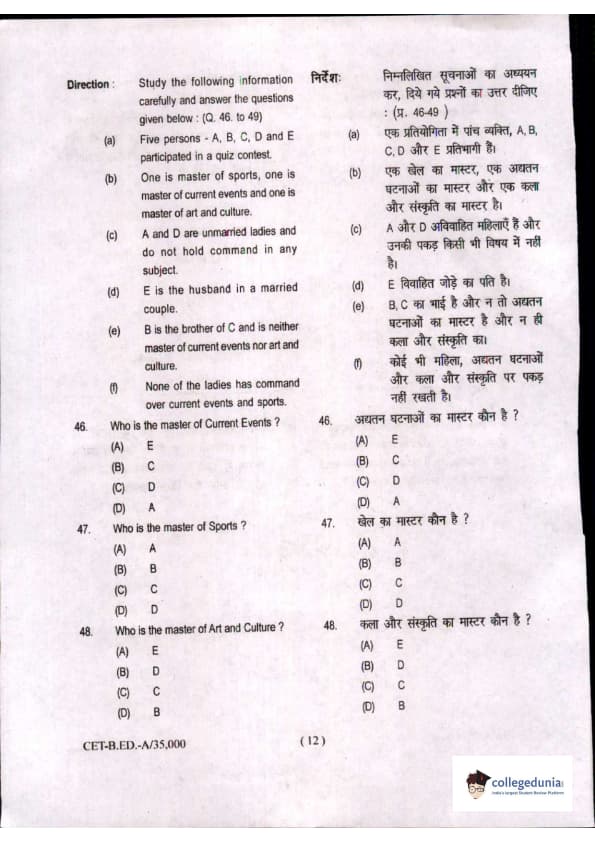
Who is the master of Current Events?
View Solution
From (c), A and D are ladies and hold no command.
From (e), B is neither master of current events nor art and culture.
From (f), no lady has command over current events or sports. So ladies can't be masters.
Only C, B, and E remain. But B is ruled out from current events and art & culture.
So B → sports, E → current events, C → art & culture.
Hence, E is the master of current events.
Quick Tip: Eliminate options step-by-step based on given constraints to isolate roles in logic puzzles.
Who is the master of Sports?
View Solution
A and D are ladies and hold no command.
B is not master of art or current events (from statement e).
So B must be the master of sports.
Quick Tip: Use process of elimination and cross-reference clues to determine individual roles.
Who is the master of Art and Culture?
View Solution
E → Current Events, B → Sports. Only one master role remains: Art & Culture.
From the remaining people (C, as A and D are excluded), C must be the master of art and culture.
Quick Tip: After identifying all constraints, assign leftover roles logically to remaining candidates.
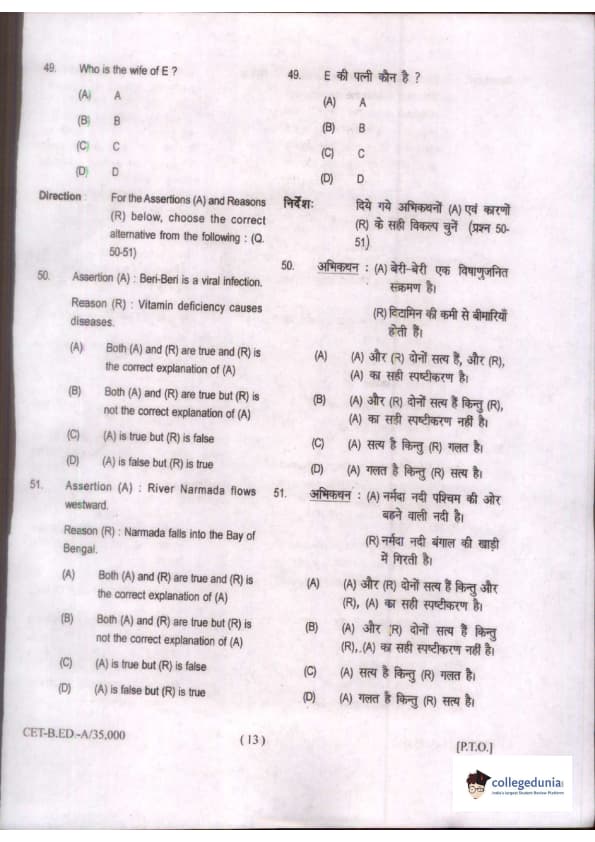
Who is the wife of E?
View Solution
A and D are unmarried ladies (statement c), and E is the husband in a married couple (statement d). So E must be married to one of A or D. From clues, A and D do not hold command in any subject. The only remaining female not holding command and suitable for E's wife (who is in the couple) is D.
Quick Tip: Identify relationship constraints and match based on marital and command conditions.
Assertion (A): Beri-Beri is a viral infection.
Reason (R): Vitamin deficiency causes diseases.
View Solution
Beri-Beri is not a viral infection; it is caused by Vitamin B1 (thiamine) deficiency. However, the Reason (R) is true — vitamin deficiencies do cause diseases.
Quick Tip: Always verify scientific facts — Beri-Beri is nutritional, not viral.
Assertion (A): River Narmada flows westward.
Reason (R): Narmada falls into the Bay of Bengal.
View Solution
The Narmada river does flow westward, which is rare in peninsular India. However, it does not fall into the Bay of Bengal — it empties into the Arabian Sea.
Quick Tip: Cross-check geographical facts; Narmada is one of the few rivers flowing westward into the Arabian Sea.
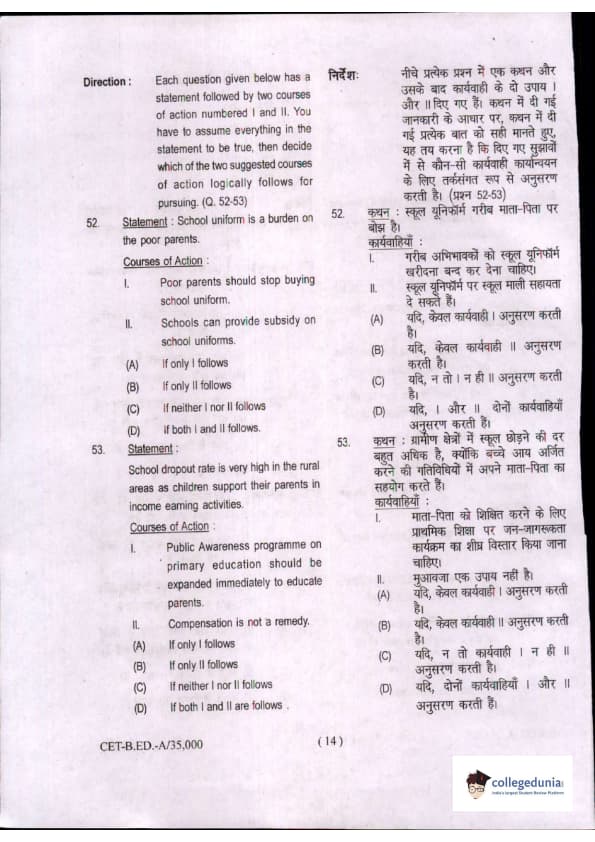
Statement: School uniform is a burden on the poor parents.
Courses of Action:
I. Poor parents should stop buying school uniform.
II. Schools can provide subsidy on school uniforms.
View Solution
Stopping the purchase of uniforms (Course I) is not a feasible or logical solution, as uniforms may be mandatory. However, providing a subsidy (Course II) is a constructive and supportive approach that addresses the problem without denying education or regulations.
Quick Tip: Courses of action should be practical and aim to solve the root issue without creating further problems.
Statement: School dropout rate is very high in the rural areas as children support their parents in income earning activities.
Courses of Action:
I. Public Awareness programme on primary education should be expanded immediately to educate parents.
II. Compensation is not a remedy.
View Solution
Raising awareness about the importance of education (Course I) addresses the root cause of the dropout rate. Course II is more of a negative remark rather than a course of action and does not provide a solution.
Quick Tip: Effective courses of action should target long-term impact, like awareness and education, especially in rural settings.
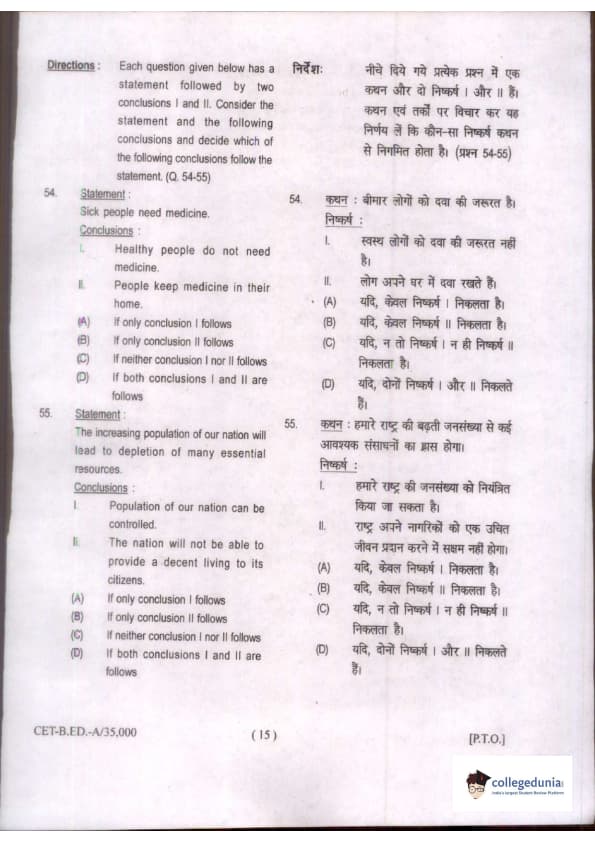
Statement: Sick people need medicine.
Conclusions:
I. Healthy people do not need medicine.
II. People keep medicine in their home.
View Solution
The statement only asserts that sick people need medicine. From this, we can infer that healthy people don’t need medicine (Conclusion I), but nothing is mentioned about whether people keep medicine at home (Conclusion II).
Quick Tip: Only draw conclusions directly supported by the statement; avoid making assumptions.
Statement: The increasing population of our nation will lead to depletion of many essential resources.
Conclusions:
I. Population of our nation can be controlled.
II. The nation will not be able to provide a decent living to its citizens.
View Solution
The statement discusses the effects of increasing population but doesn’t mention the possibility of controlling it (Conclusion I). However, if resources are depleted, it logically implies that providing a decent living would be difficult (Conclusion II).
Quick Tip: Conclusions must follow logically from the statement—not based on external facts or assumptions.
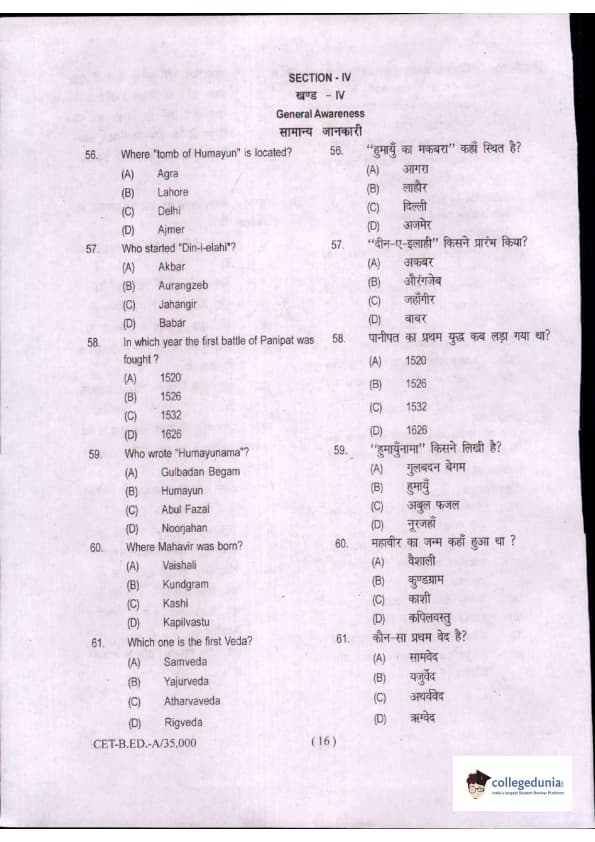
Where "tomb of Humayun" is located?
View Solution
The tomb of Mughal emperor Humayun is located in Delhi. It was commissioned by his wife Bega Begum in 1569-70 and is a UNESCO World Heritage Site.
Quick Tip: Humayun's tomb is an early example of Mughal architecture in India, located near the Yamuna River in Delhi.
Who started "Din-i-ilahi"?
View Solution
"Din-i-Ilahi" was a syncretic religion introduced by Akbar in 1582 AD to merge the best elements of the religions of his empire.
Quick Tip: Akbar initiated Din-i-Ilahi to promote religious harmony among his subjects.
In which year the first battle of Panipat was fought?
View Solution
The first battle of Panipat was fought in 1526 between Babur and Ibrahim Lodi, marking the beginning of the Mughal Empire in India.
Quick Tip: The first battle of Panipat established Babur as the first Mughal ruler in India.
Who wrote "Humayunama"?
View Solution
"Humayunama" was written by Gulbadan Begam, the sister of Humayun. It is a biographical account written in Persian.
Quick Tip: Gulbadan Begam’s "Humayunama" provides insights into the lives of Mughal royalty.
Where Mahavir was born?
View Solution
Mahavir, the 24th Tirthankara of Jainism, was born in Kundgram near Vaishali in Bihar.
Quick Tip: Kundgram near Vaishali is the birthplace of Mahavir, founder of Jainism.
Which one is the first Veda?
View Solution
The Rigveda is the oldest of the four Vedas and is considered the earliest literary work in the Indo-Aryan language.
Quick Tip: Rigveda is the earliest Veda, consisting of hymns dedicated to various deities.
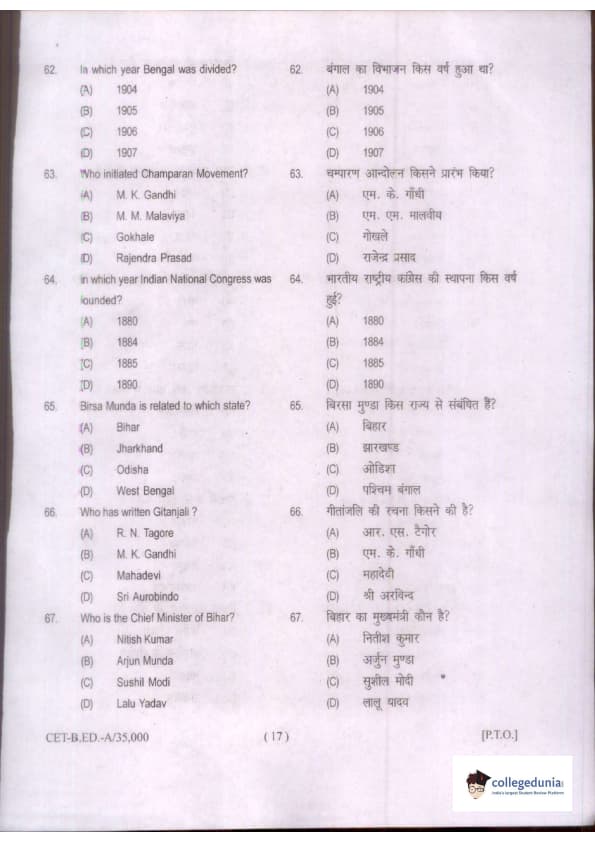
In which year Bengal was divided?
View Solution
The Partition of Bengal was announced in July 1905 by Lord Curzon and came into effect on October 16, 1905. It was intended for administrative convenience but led to massive protests and eventually its annulment in 1911.
Quick Tip: The Bengal partition of 1905 sparked the Swadeshi Movement across India.
Who initiated Champaran Movement?
View Solution
Mahatma Gandhi started the Champaran Movement in 1917 to address the grievances of indigo farmers against the oppressive plantation system in Bihar.
Quick Tip: Champaran Satyagraha (1917) was Mahatma Gandhi’s first civil disobedience movement in India.
In which year Indian National Congress was founded?
View Solution
The Indian National Congress was founded in 1885 by A. O. Hume, and the first session was held in Bombay under the presidency of W. C. Bonnerjee.
Quick Tip: The INC was founded in 1885, marking the formal beginning of India’s political freedom struggle.
Birsa Munda is related to which state?
View Solution
Birsa Munda was a tribal freedom fighter and folk hero from Jharkhand. He led the Munda rebellion against British rule in the 1890s.
Quick Tip: Birsa Munda is remembered as a tribal leader and is honored in Jharkhand.
Who has written Gitanjali?
View Solution
"Gitanjali" is a collection of poems by Rabindranath Tagore, who received the Nobel Prize in Literature in 1913 for it.
Quick Tip: Rabindranath Tagore became the first non-European to win the Nobel Prize in Literature.
Who is the Chief Minister of Bihar?
View Solution
Nitish Kumar has served multiple terms as the Chief Minister of Bihar and is associated with the Janata Dal (United).
Quick Tip: Nitish Kumar is known for development-focused governance in Bihar.
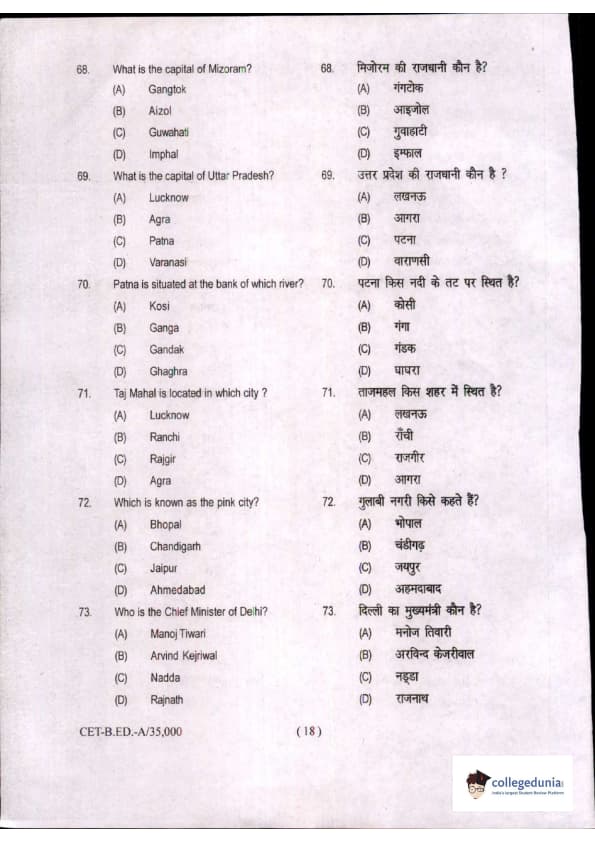
What is the capital of Mizoram?
View Solution
Aizol is the capital city of the Indian state of Mizoram. It is situated in the north-central part of the state.
Quick Tip: Remember Aizol for Mizoram and Gangtok for Sikkim — both are northeast capitals.
What is the capital of Uttar Pradesh?
View Solution
Lucknow is the capital of Uttar Pradesh and is famous for its historical architecture and cultural heritage.
Quick Tip: Uttar Pradesh's capital is Lucknow — also called the "City of Nawabs."
Patna is situated at the bank of which river?
View Solution
Patna, the capital of Bihar, is located on the southern bank of the river Ganga.
Quick Tip: Patna = Bihar = River Ganga — link all three together!
Taj Mahal is located in which city?
View Solution
The Taj Mahal, one of the Seven Wonders of the World, is located in Agra, Uttar Pradesh.
Quick Tip: Agra = Taj Mahal — a must-remember monument-location combo.
Which is known as the pink city?
View Solution
Jaipur, the capital of Rajasthan, is famously known as the Pink City due to the pink-colored buildings in its old city area.
Quick Tip: Pink City = Jaipur — known for its heritage and architecture.
Who is the Chief Minister of Delhi?
View Solution
Arvind Kejriwal has been serving as the Chief Minister of Delhi since 2015, representing the Aam Aadmi Party (AAP).
Quick Tip: Arvind Kejriwal = CM of Delhi = AAP leader.
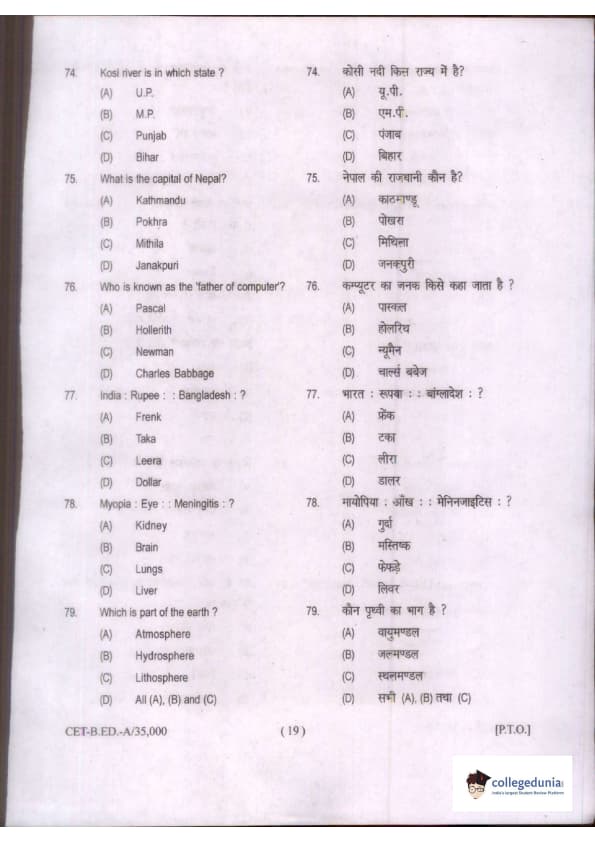
Kosi river is in which state?
View Solution
The Kosi River flows mainly through Bihar and is one of the tributaries of the Ganges. It is also referred to as the "Sorrow of Bihar" due to frequent flooding.
Quick Tip: Kosi River flows through Bihar — known for its flood-prone nature.
What is the capital of Nepal?
View Solution
Kathmandu is the capital city and largest metropolitan area of Nepal.
Quick Tip: Kathmandu is the capital of Nepal, famous for temples and cultural heritage.
Who is known as the 'father of computer'?
View Solution
Charles Babbage is called the 'father of computer' for conceptualizing the first mechanical computer — the Analytical Engine.
Quick Tip: Charles Babbage designed the Analytical Engine — the first concept of a programmable computer.
India : Rupee :: Bangladesh : ?
View Solution
Rupee is the currency of India and Taka is the official currency of Bangladesh.
Quick Tip: India–Rupee, Bangladesh–Taka: Currency analogy.
Myopia : Eye :: Meningitis : ?
View Solution
Myopia is an eye-related condition, whereas meningitis affects the brain and spinal cord membranes.
Quick Tip: Myopia–Eye and Meningitis–Brain: Both are disease-organ pairs.
Which is part of the earth?
View Solution
The Earth is made up of various spheres: atmosphere (air), hydrosphere (water), and lithosphere (land/solid crust).
Quick Tip: Atmosphere + Hydrosphere + Lithosphere = Components of Earth.
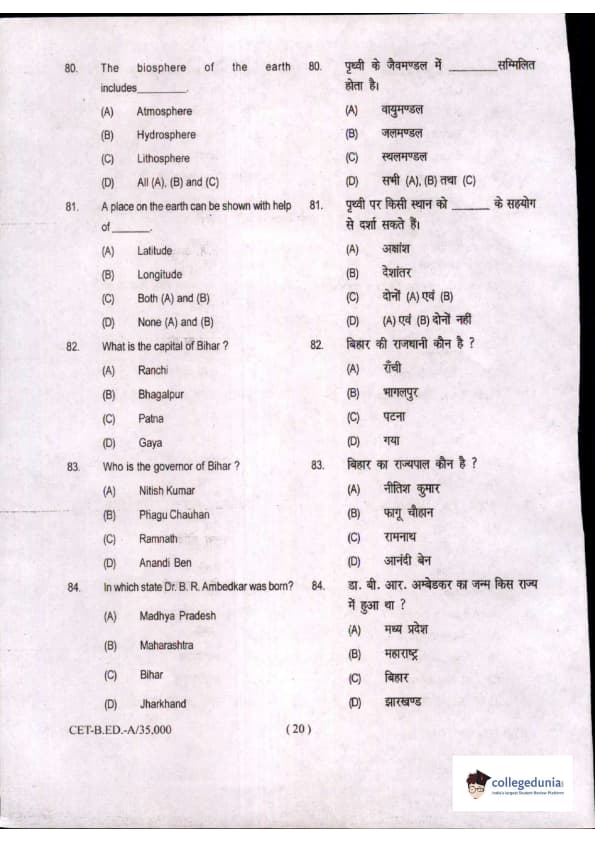
The biosphere of the earth includes_____.
View Solution
The biosphere is the global sum of all ecosystems, which includes the atmosphere, lithosphere, and hydrosphere where life exists.
Quick Tip: The biosphere includes all zones of life — air (atmosphere), water (hydrosphere), and land (lithosphere).
A place on the earth can be shown with help of _____.
View Solution
Latitude and Longitude are coordinate systems used to locate a point on the Earth's surface.
Quick Tip: Latitude and longitude together define exact location on the globe.
What is the capital of Bihar?
View Solution
Patna is the capital city of Bihar, located on the banks of river Ganga.
Quick Tip: Patna is one of the oldest continuously inhabited places in the world.
Who is the governor of Bihar?
View Solution
Phagu Chauhan has served as the Governor of Bihar. Note: This may change, so verify with latest official data.
Quick Tip: The Governor is appointed by the President of India and acts as the nominal head of the state.
In which state Dr. B. R. Ambedkar was born?
View Solution
Dr. B. R. Ambedkar was born on 14 April 1891 in Mhow, which is now in Madhya Pradesh, but historically part of Bombay Presidency (now Maharashtra).
Quick Tip: Dr. Ambedkar was born in Mhow, historically part of Bombay Presidency (now Maharashtra).
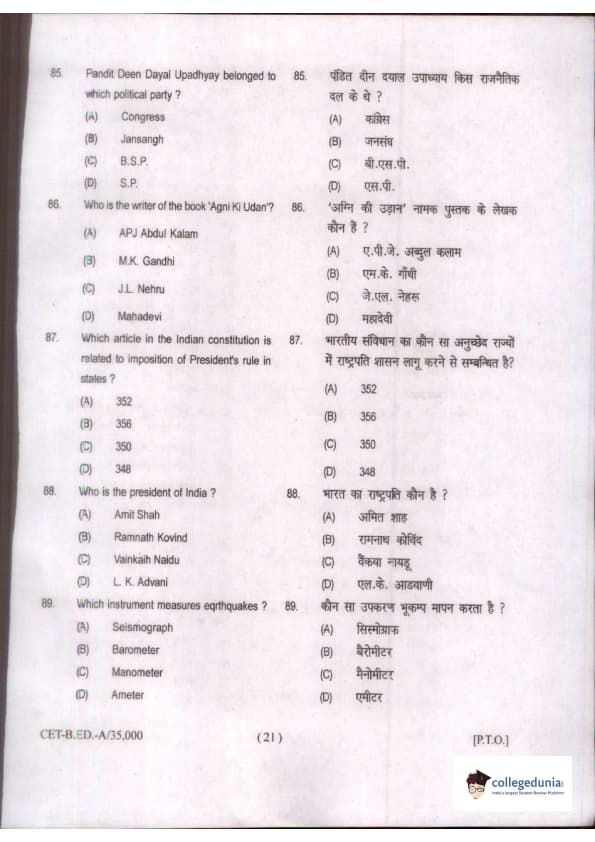
Pandit Deen Dayal Upadhyay belonged to which political party?
View Solution
Pandit Deen Dayal Upadhyay was a prominent leader of the Bharatiya Jana Sangh (Jansangh), the political forerunner of today’s BJP.
Quick Tip: Jansangh was founded in 1951 and Pandit Deen Dayal Upadhyay was one of its key ideologues.
Who is the writer of the book 'Agni Ki Udan'?
View Solution
"Agni Ki Udaan" is the Hindi version of “Wings of Fire,” an autobiography of Dr. A.P.J. Abdul Kalam, India's former President and missile man.
Quick Tip: "Agni Ki Udaan" highlights Dr. Kalam's life journey from humble beginnings to becoming President.
Which article in the Indian constitution is related to imposition of President's rule in states?
View Solution
Article 356 of the Indian Constitution allows the President to impose President’s rule in a state if its constitutional machinery fails.
Quick Tip: Remember: Article 356 = President's rule in states; Article 352 = National Emergency.
Who is the president of India?
View Solution
Ramnath Kovind served as the 14th President of India from July 25, 2017 to July 25, 2022. He was the second Dalit President of India.
Quick Tip: President is the ceremonial head of India, elected by an electoral college of MPs and MLAs.
Which instrument measures earthquakes?
View Solution
A seismograph is an instrument that detects and records earthquakes by measuring the seismic waves produced by ground movements.
Quick Tip: Seismograph = Earthquakes, Barometer = Air Pressure, Manometer = Gas/Liquid Pressure.
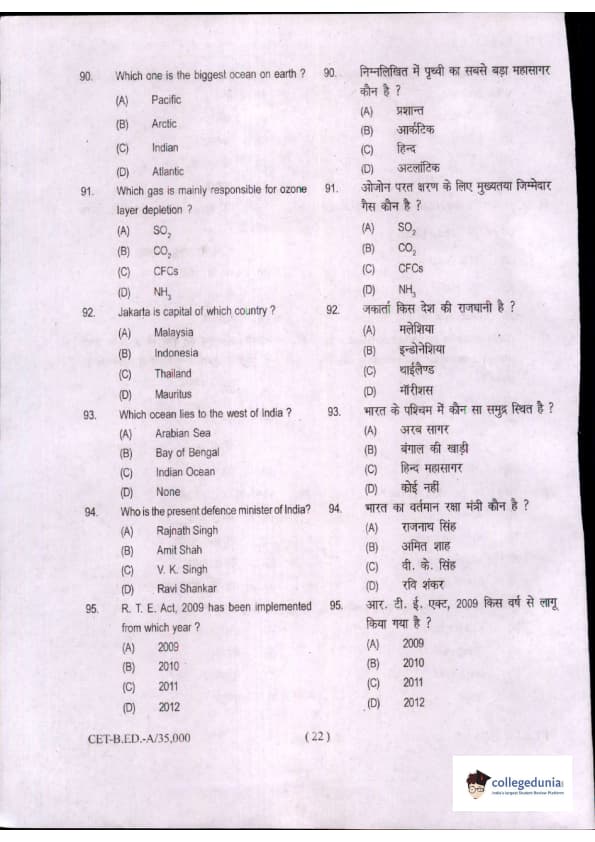
Which one is the biggest ocean on earth?
View Solution
The Pacific Ocean is the largest and deepest ocean on Earth, covering more than 63 million square miles.
Quick Tip: Remember: Pacific is the largest, Arctic is the smallest ocean.
Which gas is mainly responsible for ozone layer depletion?
View Solution
Chlorofluorocarbons (CFCs) are the primary agents responsible for ozone layer depletion by breaking down ozone molecules in the stratosphere.
Quick Tip: CFCs are found in old air conditioners, refrigerators, and aerosol sprays.
Jakarta is capital of which country?
View Solution
Jakarta is the capital city of Indonesia, located on the northwest coast of the island of Java.
Quick Tip: Jakarta = Indonesia; Bangkok = Thailand; Kuala Lumpur = Malaysia.
Which ocean lies to the west of India?
View Solution
The Arabian Sea lies to the west of India, while the Bay of Bengal lies to the east.
Quick Tip: Arabian Sea = West coast, Bay of Bengal = East coast of India.
Who is the present defence minister of India?
View Solution
Rajnath Singh is serving as the Defence Minister of India since May 2019 under the second Modi government.
Quick Tip: Rajnath Singh is India's Defence Minister, Amit Shah is the Home Minister.
R. T. E. Act, 2009 has been implemented from which year?
View Solution
The Right to Education (RTE) Act came into force on April 1, 2010, making education a fundamental right for children aged 6 to 14 years.
Quick Tip: RTE Act passed in 2009, implemented from 2010 — for free and compulsory education.
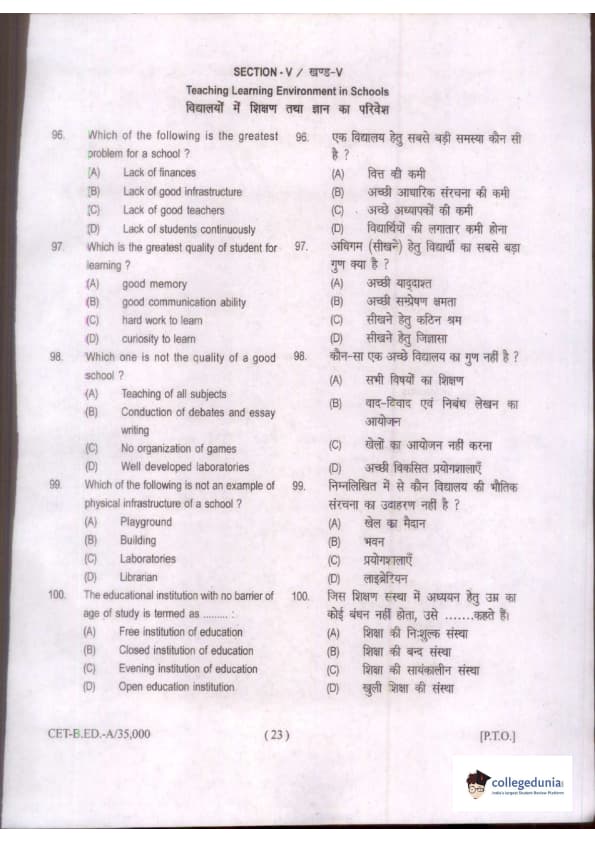
Which of the following is the greatest problem for a school?
View Solution
Lack of finances is a fundamental issue for many schools as it affects the availability of infrastructure, teaching resources, and qualified staff.
Quick Tip: Financial constraints limit a school’s ability to provide quality education and facilities.
Which is the greatest quality of student for learning?
View Solution
Curiosity drives students to explore and learn beyond the curriculum, which is essential for lifelong learning.
Quick Tip: A curious mind is the foundation of deep and meaningful learning.
Which one is not the quality of a good school?
View Solution
A good school promotes overall development, including physical activities. Not organizing games is a sign of poor school quality.
Quick Tip: Games and physical activities are vital for holistic education.
Which of the following is not an example of physical infrastructure of a school?
View Solution
A librarian is a person and not a physical infrastructure component. Physical infrastructure includes tangible facilities like buildings, playgrounds, and labs.
Quick Tip: Physical infrastructure refers to the tangible aspects, not human resources.
The educational institution with no barrier of age of study is termed as ........?
View Solution
Open education institutions offer flexible learning opportunities without restrictions on age, time, or location.
Quick Tip: Open learning allows anyone to study regardless of age or timing.
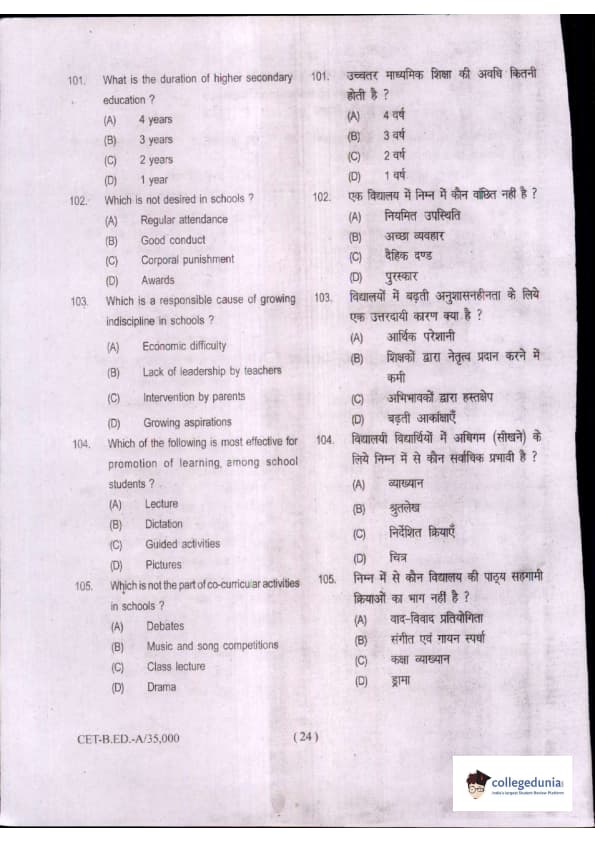
What is the duration of higher secondary education?
View Solution
Higher secondary education in India typically refers to classes 11 and 12, which together make a 2-year duration.
Quick Tip: Higher secondary = Class 11 + 12 = 2 years.
Which is not desired in schools?
View Solution
Corporal punishment is prohibited in modern educational institutions as it negatively affects students' mental and emotional health.
Quick Tip: Corporal punishment is banned by education boards across India.
Which is a responsible cause of growing indiscipline in schools?
View Solution
Teachers play a crucial role in guiding students. A lack of leadership leads to unclear boundaries and rules, resulting in indiscipline.
Quick Tip: Teacher leadership shapes student discipline.
Which of the following is most effective for promotion of learning, among school students?
View Solution
Guided activities involve students actively and help in better retention and application of knowledge.
Quick Tip: Learning by doing is more impactful than passive learning.
Which is not the part of co-curricular activities in schools?
View Solution
Class lecture is a curricular activity, whereas debates, competitions, and drama are examples of co-curricular engagements.
Quick Tip: Co-curricular = Outside textbook learning; Lecture = Academic core.
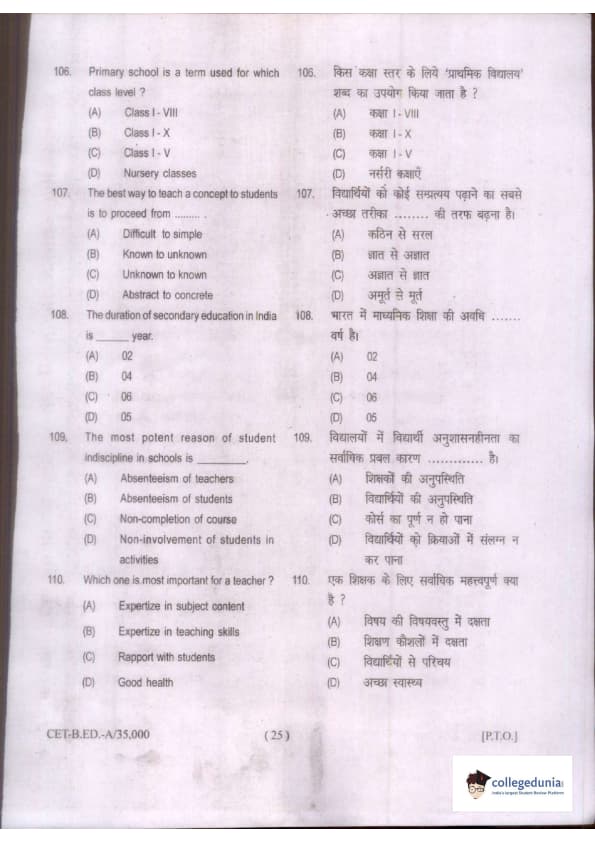
Primary school is a term used for which class level?
View Solution
In India, primary school typically refers to classes from I to V, forming the foundation stage of formal education.
Quick Tip: Primary education includes Class I to V in India.
The best way to teach a concept to students is to proceed from ______.
View Solution
Learning becomes more effective when students connect new knowledge with what they already know. Thus, teaching should begin from the known to the unknown.
Quick Tip: Start from what learners know and build forward.
The duration of secondary education in India is ____ year.
View Solution
Secondary education in India covers classes 9 to 12, which makes it a 4-year span.
Quick Tip: Secondary education = Class 9 to 12 = 4 years.
The most potent reason of student indiscipline in schools is ______.
View Solution
Engaging students in co-curricular and extracurricular activities helps maintain discipline and fosters holistic development. Lack of such involvement can lead to indiscipline.
Quick Tip: Engaged students are more likely to follow rules and stay motivated.
Which one is most important for a teacher?
View Solution
Building a rapport helps in better communication, motivation, and classroom management, which are essential for effective teaching.
Quick Tip: Strong student-teacher relationships enhance learning outcomes.
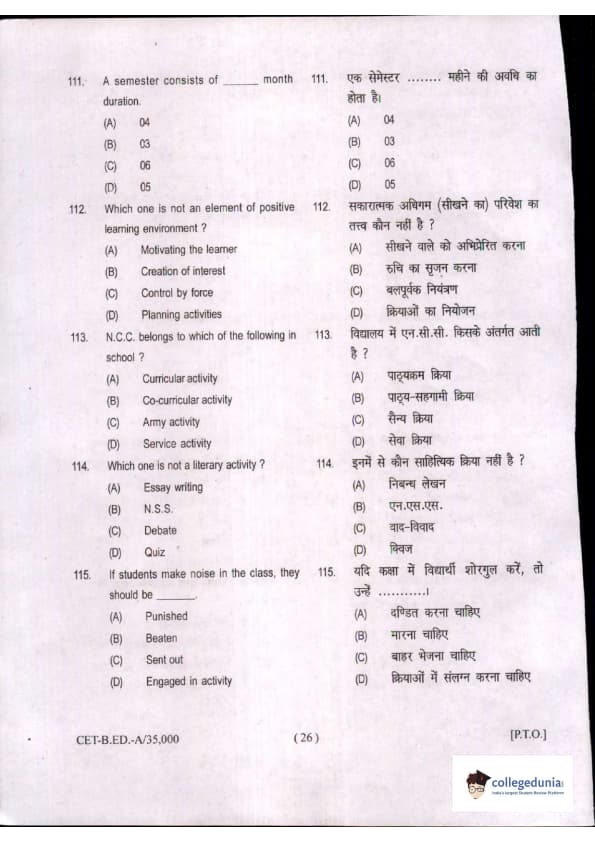
A semester consists of ____ month duration.
View Solution
A semester system generally divides the academic year into two parts, each of approximately 6 months duration.
Quick Tip: A semester typically spans 6 months in most education systems.
Which one is not an element of positive learning environment?
View Solution
Control by force leads to fear and passive learning. A positive learning environment is based on motivation, interest, and proper planning.
Quick Tip: Positive environments nurture student engagement, not fear.
N.C.C. belongs to which of the following in school?
View Solution
N.C.C. (National Cadet Corps) enhances discipline, leadership, and service spirit among students and is classified as a co-curricular activity.
Quick Tip: N.C.C. is a co-curricular activity that complements academic learning.
Which one is not a literary activity?
View Solution
N.S.S. (National Service Scheme) involves social service and community development, not literary engagement.
Quick Tip: N.S.S. focuses on service, not writing or literary skills.
If students make noise in the class, they should be _____.
View Solution
Engaging students in meaningful activities helps maintain discipline and interest. Punishment may create fear but not resolve the issue.
Quick Tip: Active engagement is the best strategy for classroom discipline.
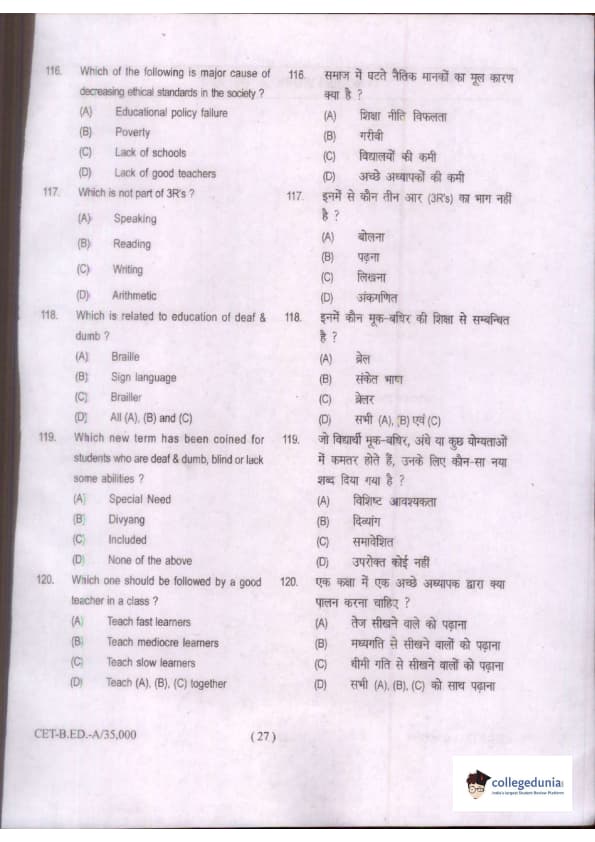
Which of the following is major cause of decreasing ethical standards in the society?
View Solution
Teachers play a critical role in instilling ethical values in students. A lack of good teachers may lead to moral decline in society.
Quick Tip: Ethical education begins with responsible and value-driven teachers.
Which is not part of 3R's?
View Solution
The traditional 3R's stand for Reading, wRiting, and aRithmetic. Speaking is not included.
Quick Tip: The 3R's focus on basic foundational academic skills.
Which is related to education of deaf \& dumb?
View Solution
Sign language is the primary mode of communication and education for deaf and dumb individuals. Braille and Brailler are used by visually impaired.
Quick Tip: Sign language supports communication for hearing-impaired individuals.
Which new term has been coined for students who are deaf \& dumb, blind or lack some abilities?
View Solution
The term “Divyang” was introduced in India to respectfully refer to persons with disabilities, highlighting their abilities rather than limitations.
Quick Tip: “Divyang” is the inclusive term adopted to promote dignity for persons with disabilities.
Which one should be followed by a good teacher in a class?
View Solution
A good teacher should accommodate all types of learners—fast, average, and slow—ensuring inclusive and effective learning.
Quick Tip: Inclusive teaching caters to the needs of all students in a diverse classroom.



Comments