




Assam Board is conducting the Class 12 Physics Board Exam 2026 on March 5, 2026. Class 12 Physics Question Paper with Solution PDF is available here for download.
The Assam Board Class 12 Physics paper covered key topics from mechanics, electricity, optics, and modern physics. The MCQ section was mostly straightforward and tested basic conceptual understanding. The short and long descriptive questions required clear explanations, correct numerical steps, and proper diagrams. To score well, students should focus on formula application, accurate calculations, and labeled diagrams. The official question paper of Assam Board Class 12 Physics Board Exam 2026 is provided below. Students can download the official paper in PDF format for reference.
Assam Board Class 12, 2026 Physics Question Paper with Solution PDF
| Assam Board Class 12 Physics Question Paper 2026 with Solution PDF | Download PDF | Check Solution |
In a full-wave rectifier, the current in each of the diodes flows for:
(iii) In a full-wave rectifier:
Ten capacitors, each of capacitance \(1\,\mu F\), are connected in parallel to a source of \(100\,V\). The total energy stored in the system is equal to:
A loop carrying a current I clockwise is placed in x - y plane, in a uniform magnetic field directed along z-axis. The tendency of the loop will be to:
A galvanometer of resistance \(G\,\Omega\) is converted into an ammeter of range \(0\) to \(1\,A\). If the current through the galvanometer is \(0.1%\) of \(1\,A\), the resistance of the ammeter is:
The transition of electron that gives rise to the formation of the second spectral line of the Balmer series in the spectrum of hydrogen atom corresponds to:
The waves associated with a moving electron and a moving proton have the same wavelength \( \lambda \). It implies that they have the same :
Ge is doped with As. Due to doping,
In the four regions, I, II, III and IV, the electric fields are described as:
Region I : \(E_x = E_0 \sin (kz - \omega t)\)
Region II : \(E_x = E_0\)
Region III : \(E_x = E_0 \sin kz\)
Region IV : \(E_x = E_0 \cos kz\)
The displacement current will exist in the region:
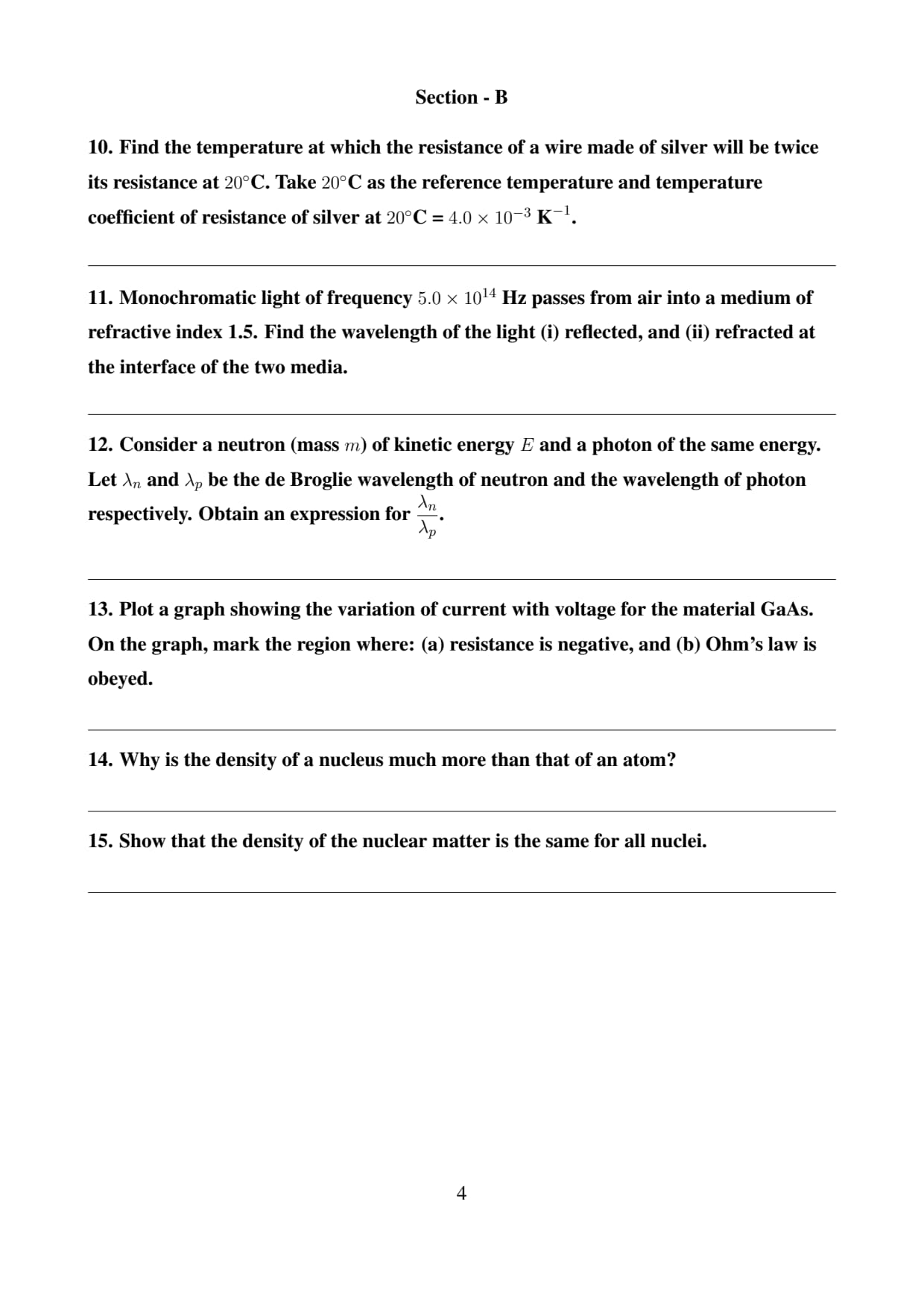
Find the temperature at which the resistance of a wire made of silver will be twice its resistance at \(20^\circ\)C. Take \(20^\circ\)C as the reference temperature and temperature coefficient of resistance of silver at \(20^\circ\)C = \(4.0 \times 10^{-3}\ K^{-1}\).
Monochromatic light of frequency \(5.0 \times 10^{14}\) Hz passes from air into a medium of refractive index 1.5. Find the wavelength of the light (i) reflected, and (ii) refracted at the interface of the two media.
Consider a neutron (mass \(m\)) of kinetic energy \(E\) and a photon of the same energy. Let \(\lambda_n\) and \(\lambda_p\) be the de Broglie wavelength of neutron and the wavelength of photon respectively. Obtain an expression for \(\dfrac{\lambda_n}{\lambda_p}\).
Plot a graph showing the variation of current with voltage for the material GaAs. On the graph, mark the region where: (a) resistance is negative, and (b) Ohm's law is obeyed.
Why is the density of a nucleus much more than that of an atom?
Show that the density of the nuclear matter is the same for all nuclei.
Complete PHYSICS In 5 days ll PHYSICS MASTER PLAN to score 70/100 in 5 days ll AHSEC , HS 2026 ll



Comments