



Education Journalist | Study Abroad Strategy Lead | Updated On - Apr 5, 2026
Australia is now processing student visas in a median of 33 days — the fastest turnaround in three years, but Indian applicants face a catch that the headline number does not reveal. Since January 8, 2026, India has been classified at Evidence Level 3 (EL3) under Australia's Simplified Student Visa Framework, the highest-risk category, which triggers additional document scrutiny and can push individual processing times well beyond the published median. For the estimated 1,00,000+ Indian students applying for the July 2026 intake, understanding the gap between Australia's official 33-day figure and the reality for EL3 applicants is now the most important planning decision of the season.
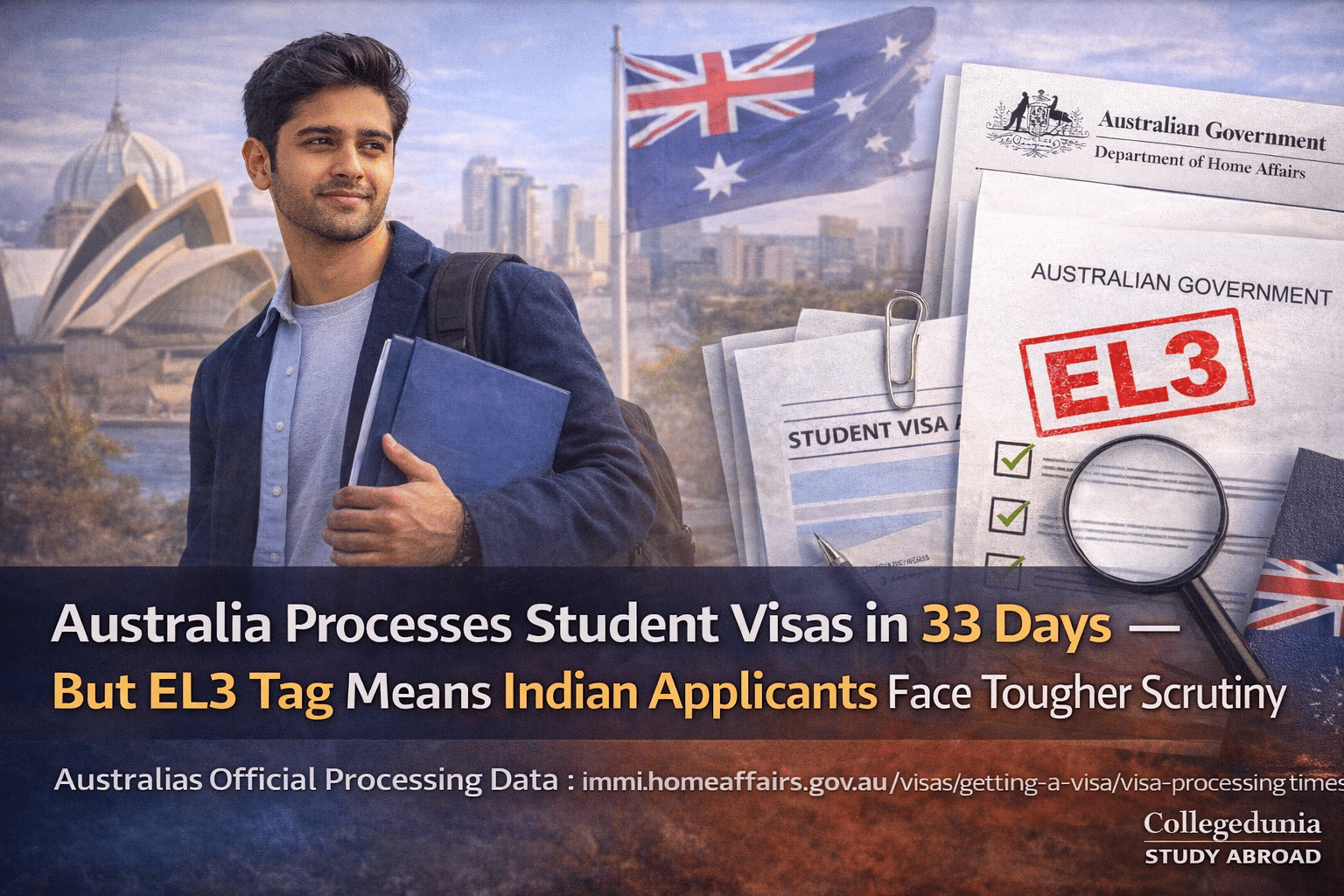
Australia's Official Processing Data: What the Numbers Actually Say
The Department of Home Affairs (DHA) published its February 2026 median processing times on March 23, 2026. The data shows a sharp divergence between temporary and permanent visa categories:
| Visa Category | Median Processing Time (Feb 2026) | Direction |
|---|---|---|
| Student (Subclass 500) | 33 days | Faster |
| Visitor (Subclass 600/601/651) | Less than 1 day | Faster |
| Working Holiday Maker | 2 days | Faster |
| Skilled Temporary (Subclass 482) | 87 days | Stable |
| Skilled Permanent | 9 months | Slower |
| Partner (Provisional/Temporary) | 17 months | Slower |
Source: Department of Home Affairs — immi.homeaffairs.gov.au/visas/getting-a-visa/visa-processing-times (February 2026 data)
The 33-day student visa median represents a significant improvement from the 8–14 week processing times that were standard through much of 2024 and early 2025. The improvement is driven by two factors: the March 25, 2026 system upgrade that automated initial application review, and Ministerial Direction 115 (effective November 14, 2025), which restructured how student visa applications are prioritised and processed.
The Contradiction: Faster Processing, Stricter Approvals
Here is what makes Australia's current student visa environment genuinely unusual — and why the 33-day median can be misleading for Indian applicants.
Ministerial Direction 115, which came into force on November 14, 2025, did two things simultaneously:
- Streamlined processing — applications are now assessed in a more structured sequence, reducing administrative backlogs
- Tightened approval criteria — the Direction introduced stricter assessment of genuine temporary entrant (GTE) requirements, financial capacity, and academic progression
The result: Australia is making decisions faster, but those decisions are increasingly likely to be refusals for applications that do not meet the tightened criteria. A faster "no" is not the same as a faster "yes."
For Indian students specifically, this contradiction is compounded by the EL3 classification. Under the Simplified Student Visa Framework (SSVF):
- EL1 and EL2 applicants (lower-risk countries): Standard document requirements, processed at the published median
- EL3 applicants (India, since January 8, 2026): Additional financial documentation required, more detailed GTE assessment, higher likelihood of requests for further information (RFIs) — each of which pauses the processing clock
An RFI can add 2–6 weeks to an individual application's timeline, meaning an EL3 Indian student's actual processing time could be 6–10 weeks even while the published median sits at 33 days.
What EL3 Means in Practice: The Indian Student's Document Checklist
Under EL3, Indian student visa applicants must provide a higher standard of evidence across three areas:
1. Financial capacity (stricter than EL2):
- Minimum AUD $29,710 for living expenses (12 months) — must be in a bank account for at least 3 months
- Full tuition fees for the first year — must be documented, not just enrolled
- Return airfare (AUD 2,000–3,000) — must be evidenced separately
- Total minimum funds to document: AUD 55,000–65,000 (approximately ₹30–35 lakh)
2. Genuine Temporary Entrant (GTE) assessment:
- A detailed personal statement explaining why you intend to return to India after your course
- Evidence of ties to India (family, property, employment prospects)
- Academic justification for the specific course and institution chosen
3. Academic documentation:
- All previous academic transcripts (certified)
- English proficiency test results (IELTS/PTE/TOEFL)
- Explanation of any academic gaps exceeding 6 months
Incomplete documentation under EL3 does not just slow processing — under the new 48-hour AI-assisted review system introduced in March 2026, incomplete applications can be flagged for refusal within 2 business days of lodgement.
How Australia Compares: Processing Times Across Major Destinations
For Indian students weighing destinations for July/September 2026, here is how Australia's 33-day median compares with current processing times at other major study destinations:
| Destination | Current Median Processing | India-Specific Factor | Effective Timeline for Indians |
|---|---|---|---|
| Australia | 33 days | EL3 scrutiny + possible RFI | 6–10 weeks |
| Canada | 8–20 weeks | Study permit cap (94,000 in 2025) | 10–20 weeks |
| UK | 3 weeks | Standard processing, no India-specific risk tier | 3–4 weeks |
| Germany | 6–12 weeks | Blocked account (€11,208/year) required | 8–12 weeks |
Sources: DHA Australia (March 2026); IRCC Canada processing times; UKVI processing standards; German embassy processing data
Key takeaway: Australia's 33-day median makes it the second-fastest major destination after the UK — but only if the application is complete and EL3 requirements are fully met on first submission. A single missing document can push the effective timeline past Canada's.
Strategy: When Indian Students Should Apply for July 2026
Given the 33-day median and the EL3 caveat, here is the optimal application strategy for Indian students targeting the July 2026 intake:
Ideal application window: Now — April 5 to April 30, 2026
| If you apply by | Expected decision by | Buffer before July intake |
|---|---|---|
| April 5 | ~May 8 (33 days) | 7–8 weeks buffer |
| April 30 | ~June 2 (33 days) | 4–5 weeks buffer |
| May 31 | ~July 3 (33 days) | Borderline — risky for EL3 |
| June 15+ | ~July 18+ | Too late for most July start dates |
The EL3 risk adjustment: Add 3–4 weeks to each of the above if your application triggers an RFI. This means Indian students should treat April 30 as the practical deadline for July 2026 applications — not the technical last date.
Five steps to avoid an RFI and stay within the 33-day median:
- Submit all financial documents upfront — bank statements (3+ months), tuition fee receipts, and airfare evidence. Do not wait to be asked.
- Write a strong GTE statement — specific, personal, and tied to your career plan in India. Generic statements are the leading cause of RFIs for Indian applicants.
- Apply online via ImmiAccount — paper applications are not eligible for the automated fast-track system.
- Do not apply to multiple institutions simultaneously — this raises GTE concerns and can trigger manual review.
- Check your university's CRICOS registration — only courses at CRICOS-registered providers qualify. Verify at cricos.teqsa.gov.au before applying.
The Bigger Picture: Why Australia Is Speeding Up While Tightening
The combination of faster processing and stricter approvals is not contradictory — it is deliberate policy. Australia's government has been explicit: it wants to reduce the total number of international students (the cap on new student commencements was tightened in 2025) while processing the applications it does receive more efficiently.
The practical effect for Indian students is a narrower but faster pathway. Australia is not closing its doors — it processed over 4,00,000 student visa applications in 2025 — but it is raising the bar for who gets through. The 33-day median is real, but it belongs to applicants who submit complete, well-documented applications that meet EL3 standards on first lodgement.
For Indian students who do that, Australia remains one of the fastest student visa decisions in the world. For those who do not, the 33-day promise becomes a 10-week ordeal — or a refusal.

















Comments