



Education Journalist | Study Abroad Strategy Lead | Updated On - Mar 23, 2026
If you’re planning to study in Canada in 2026, here’s the most important update you need to know:
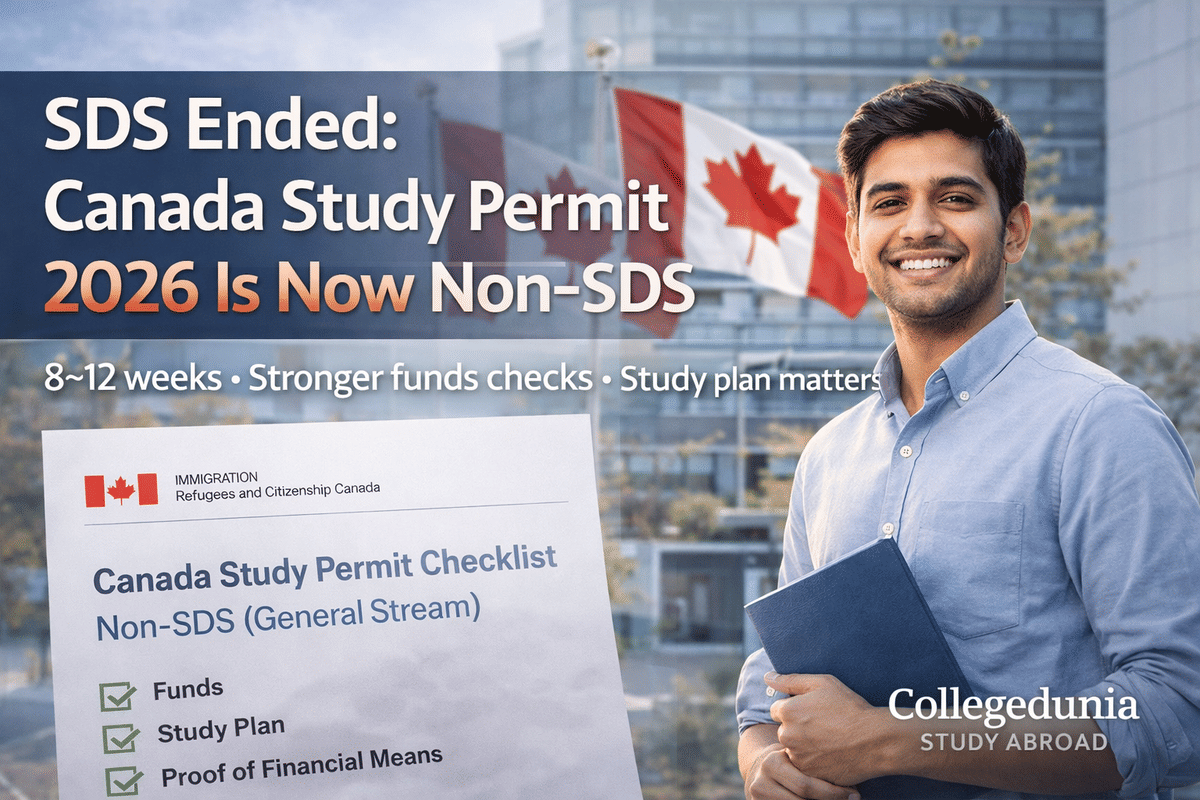
The SDS (Student Direct Stream) no longer exists.
Since November 8, 2024, all Indian students must apply through the non-SDS study permit process, where approvals depend on a much more detailed evaluation of your profile.
This means:
- Longer processing times (8–12 weeks)
- Stricter financial verification
- Greater focus on your study plan and future intent
Many students are still approaching their applications with an “SDS mindset”—and getting rejected. The non-SDS system is different. And to succeed, your application needs to be built differently.
In this guide, you’ll find everything you need to apply with confidence in 2026—from document requirements and proof of funds to expert-backed strategies that improve your chances of approval.
If you’re new to the process, start with our complete Canada Study Permit guide
- What is the Non-SDS Study Permit?
- Why Did SDS End? What Changed for Indian Students?
- 2026 IRCC Rule Updates
- Non-SDS Eligibility Requirements
- Complete Documents Checklist
- Proof of Funds — Exact Requirements for 2026
- The PAL/TAL System — Who Needs It, Who Is Exempt
- How to Write a Study Plan That Gets Approved
- Step-by-Step Non-SDS Application Process
- Processing Times & Fees
- 7 Reasons Non-SDS Applications Are Rejected — And How to Fix Each
- Work Rights During and After Study
- Non-SDS vs SDS — Key Differences at a Glance
- FAQs
What is the Non-SDS Study Permit?
The non-SDS study permit — also called the general stream or regular stream — is the standard Canadian study permit application process managed by Immigration, Refugees and Citizenship Canada (IRCC). It is now the only pathway available for Indian students and for all international students worldwide applying to study in Canada.
A Canadian study permit is a document issued by IRCC that authorises a foreign national to study at a Designated Learning Institution (DLI) in Canada. It is not a visa — it is a permit. Most Indian students also need a Temporary Resident Visa (TRV), which is typically issued alongside the study permit in the same application.
What the Study Permit Allows You to Do
| Right | Details |
|---|---|
| Study | At the specific DLI named on your permit |
| Work on campus | Unlimited hours — no separate work permit needed |
| Work off campus | Up to 24 hours/week during academic sessions; full-time during scheduled breaks |
| Bring spouse/partner | Eligible for an Open Work Permit if you are in a master's, PhD, or bachelor's program at a public DLI |
| Travel | In and out of Canada while permit is valid |
| Change programs | Possible — but may require a new permit or PAL |
Why Did SDS End? What Changed for Indian Students?
The Student Direct Stream (SDS) was permanently discontinued on November 8, 2024, along with the Nigeria Student Express (NSE) program. The announcement was made by Canada's Minister of Immigration with immediate effect — no transition period, no grandfather clause for pending applications.
Why Was SDS Shut Down?
The Canadian government cited two primary reasons:
- Unsustainable growth in international student numbers: Canada's temporary resident population had grown to over 1 million study permit holders by January 2024 — creating significant pressure on housing, healthcare, and social services in cities like Toronto, Vancouver, and Brampton.
- Fraud and misrepresentation concerns: SDS's streamlined process — which relied heavily on upfront GIC and IELTS scores — was found to be vulnerable to document fraud, particularly from certain high-volume source countries.
What This Means for Indian Students
| Feature | Under SDS (Pre-Nov 2024) | Under Non-SDS (Now — Only Option) |
|---|---|---|
| Processing time | ~20 days | 8–12 weeks |
| GIC requirement | Mandatory (CAD $10,000) | Optional (but strongly recommended) |
| IELTS requirement | Mandatory (6.0 each band) | Flexible — multiple tests accepted |
| Financial scrutiny | Lower (GIC + tuition = sufficient) | Higher — full financial history reviewed |
| Study Plan scrutiny | Lower | Higher — genuine intent assessed in detail |
| Approval predictability | Higher | More variable — officer discretion plays larger role |
| Available to Indians? | No longer exists | Yes — only option now |
The honest reality: non-SDS requires more preparation than SDS did. But it is entirely navigable — and this guide gives you the exact framework to do it successfully.
Every 2026 IRCC Rule Update
Update 1: Study Permit Cap Reduced to 155,000 New Arrivals (2026)
What changed: IRCC has set a target of 155,000 new study permits for 2026 — down from 305,900 in 2025 and 485,000 in 2024. This is a 49% reduction from 2025 levels.
What this means: Competition for study permit spaces is significantly higher. The PAL/TAL system controls how many applications each province accepts. Once a province's allocation is exhausted, no new PAL/TALs are issued — meaning your DLI may not be able to issue you a PAL even if you have a valid Letter of Acceptance. Applying early is no longer optional — it is essential.
Update 2: Master's and PhD Students Exempt from Cap and PAL/TAL (January 1, 2026)
What changed: From January 1, 2026, master's and doctoral students enrolled at public Designated Learning Institutions (DLIs) are:
- Exempt from the national study permit cap — their applications do not count toward the 155,000 limit
- Exempt from the PAL/TAL requirement — they do not need a Provincial Attestation Letter
- Eligible for 2-week fast-track processing for doctoral applicants once the Letter of Acceptance is verified
What this means for Indian students: If you are applying for a master's or PhD at a public Canadian university, your application is significantly less restricted than undergraduate applications. This is the single most important policy change for Indian graduate students in 2026.
Update 3: Joint Program Students Need Only One PAL/TAL (February 6, 2026)
What changed: Students enrolled in joint programs involving multiple DLIs or multiple provinces now only need a single PAL/TAL — not one from each institution or province.
Update 4: Proof of Funds Updated to CAD $22,895 (September 1, 2025)
What changed: The minimum living expense requirement for a single applicant (excluding tuition and transportation) increased to CAD 22,895 per year for applications submitted on or after September 1, 2025. This is up from CAD 20,635.
Update 5: PGWP Eligible Fields of Study List Frozen for 2026
What changed: IRCC confirmed in January 2026 that the list of PGWP-eligible fields of study will not change in 2026. The list (920 eligible fields) remains as established in June 2025. Students who applied for a study permit before June 25, 2025, are not subject to the field-of-study requirement for PGWP.
Non-SDS Eligibility Requirements
To be eligible for a Canadian study permit under the non-SDS (general) stream, you must meet all of the following:
| Requirement | Details |
|---|---|
| Letter of Acceptance | From a valid Designated Learning Institution (DLI) |
| Proof of financial support | Sufficient funds for tuition + living expenses + transportation |
| PAL/TAL | Required for most undergraduate applicants; exempt for master's/PhD at public DLIs |
| English language proficiency | Approved test with required scores |
| Valid passport | Must cover full intended period of study |
| No criminal record | Police clearance may be required |
| Good health | Medical examination may be required |
| Genuine temporary resident | Must demonstrate intent to study and return home after graduation |
| Outside Canada | Must apply from outside Canada (in most cases) |
Complete Documents Checklist
Mandatory Documents (All Applicants)
| Document | Details |
|---|---|
| Valid passport | All pages; must cover full study period |
| Letter of Acceptance (LOA) | From your DLI — current and unconditional (or conditions met) |
| Provincial Attestation Letter (PAL/TAL) | Required for most undergrad applicants; exempt for master's/PhD at public DLIs |
| Proof of financial support | Bank statements, GIC, scholarship letters, loan documents |
| Study Plan / Letter of Explanation | Explaining why you chose Canada, your program, and post-graduation plans |
| Passport-size photographs | As per IRCC specifications |
| IMM 1294 application form | Completed online via IRCC portal |
| Biometrics fee receipt | CAD 85individual/CAD170 family |
| English language test results | IELTS, TOEFL iBT, PTE Academic, or Duolingo |
| Study permit fee payment | CAD $150 |
Academic Documents
| Document | Details |
|---|---|
| Class 10 marksheets and certificate | Certified copies |
| Class 12 marksheets and certificate | Certified copies |
| All undergraduate semester marksheets | If applying for master's/PhD |
| Bachelor's degree certificate | If applying for master's/PhD |
| Consolidated transcripts | From your university |
| Master's degree certificate | If applying for PhD |
| CV / Resume | Highlighting academic and professional background |
Financial Documents
| Document | Details |
|---|---|
| Bank statements | Last 4–6 months; consistent balance; in applicant's or sponsor's name |
| Fixed deposit receipts | If applicable |
| GIC certificate | Optional for non-SDS but strongly recommended |
| Scholarship / funding letter | If applicable — must specify amount and duration |
| Sponsor's employment proof | Salary slips, ITR, employment letter (if parents/sponsor are funding) |
| Sponsor's bank statements | Last 4–6 months |
| Proof of tuition payment | First-year tuition paid or payment receipt |
| Education loan sanction letter | If applicable — must be sanctioned, not just applied for |
Supporting Documents
| Document | Details |
|---|---|
| Ties to India evidence | Property documents, family business records, employment offer post-graduation |
| Gap year explanation letter | If any gap between studies — honest, documented explanation |
| Police clearance certificate | If required by IRCC |
| Medical examination results | If required by IRCC |
Proof of Funds — Exact Requirements for 2026
This is the most scrutinised part of a non-SDS application. Under SDS, a GIC plus tuition payment was sufficient. Under non-SDS, IRCC officers conduct a full financial assessment of your entire financial profile — including the source of funds, consistency of balances, and your family's financial capacity to sustain you for the full program duration.
Minimum Living Expense Requirement (Effective September 1, 2025)
| Family Members Coming to Canada | Annual Living Expenses Required (CAD) | Annual Living Expenses Required (INR approx.) |
|---|---|---|
| 1 (applicant only) | $22,895 | ~₹14.1 Lakhs |
| 2 | $28,502 | ~₹17.6 Lakhs |
| 3 | $35,040 | ~₹21.6 Lakhs |
| 4 | $42,543 | ~₹26.2 Lakhs |
| 5 | $48,252 | ~₹29.7 Lakhs |
These amounts are for living expenses only — they do NOT include tuition or transportation costs.
INR conversion at CAD 1 = ₹61.60 (March 2026).
Total Funds Required — Practical Calculation
For a single Indian student applying for a 2-year master's program in Ontario:
| Cost Component | Amount (CAD) | Amount (INR approx.) |
|---|---|---|
| Annual tuition (average master's) | 25,000–35,000 | ₹15.4–21.6 Lakhs |
| Living expenses (Year 1) | $22,895 | ₹14.1 Lakhs |
| Transportation (return flights) | 2,000–3,000 | ₹1.2–1.8 Lakhs |
| Minimum total to demonstrate (Year 1) | ~50,000–60,000 | ~₹30.8–37.0 Lakhs |
What Financial Documents Are Accepted
| Document Type | Accepted? | Notes |
|---|---|---|
| Bank statements (4–6 months) | Yes | Must show consistent balance — sudden large deposits are a red flag |
| Fixed deposits / term deposits | Yes | Must be easily liquidatable |
| GIC from Canadian bank | Yes | Strongly recommended even though not mandatory |
| Education loan from bank | Yes | Must be sanctioned, not just applied for |
| Scholarship letter | Yes | Must specify amount and duration |
| Sponsor's financial documents | Yes | Must include sponsor's bank statements + income proof |
| Property documents | Supporting | Shows assets but not liquid funds — use as supplement only |
| Sudden large deposits | Red flag | Deposits made just before application are scrutinised heavily |
Should You Get a GIC for Non-SDS?
A Guaranteed Investment Certificate (GIC) from a participating Canadian financial institution (CIBC, Scotiabank, RBC, TD, BMO, ICICI Bank Canada) is not mandatory for non-SDS. However, it is strongly recommended because:
- It demonstrates genuine intent to study in Canada — you have already transferred money to a Canadian bank
- It provides a clear, verifiable proof of funds that IRCC officers can confirm directly
- It shows financial planning and commitment to the program
- The minimum GIC amount is CAD $10,000 — this counts toward your living expense requirement
Important: A GIC alone is not sufficient for non-SDS. You must also show tuition payment or tuition funds, and demonstrate how you will fund subsequent years of study.
The PAL/TAL System — Who Needs It, Who Is Exempt
The Provincial Attestation Letter (PAL) or Territorial Attestation Letter (TAL) is a document issued by a Canadian province or territory confirming that your study permit application falls within their allocated quota for the year.
Without a PAL/TAL (if required), your application will be returned unprocessed and your fees refunded.
Who Needs a PAL/TAL in 2026?
| Applicant Type | PAL/TAL Required? |
|---|---|
| Undergraduate students at any DLI | Yes — mandatory |
| College diploma/certificate students | Yes — mandatory |
| Master's students at public DLIs | Exempt from January 1, 2026 |
| PhD students at public DLIs | Exempt from January 1, 2026 |
| Primary/secondary (K–12) students | Exempt |
| Exchange students (under 6 months) | Exempt |
| Visiting graduate students | Yes — required (does not qualify for exchange exemption) |
| Students renewing permit at same DLI, same level | Not required |
| Students applying for restoration of status | Yes — new PAL/TAL required |
| Joint program students (multiple DLIs/provinces) | Yes — but only one PAL/TAL needed (February 2026 update) |
| Quebec students | CAQ (Quebec Acceptance Certificate) satisfies the requirement |
How to Get a PAL/TAL?
You do not apply for a PAL/TAL directly — your DLI applies on your behalf once you have accepted their offer of admission:
- Accept your offer of admission and pay the deposit
- Your DLI submits a PAL/TAL request to the provincial government on your behalf
- The province issues the PAL/TAL to your DLI
- Your DLI sends you the PAL/TAL document
- You include the PAL/TAL in your study permit application
Key risk: If your province's annual allocation is exhausted before your DLI submits your PAL/TAL request, you will not receive one — and cannot apply for a study permit for that intake. This is why applying early and accepting your offer quickly is critical for undergraduate applicants.
2026 Provincial Allocations (PAL/TAL-Required Applicants)
| Province/Territory | 2026 Study Permit Target | 2026 PAL/TAL Allocation |
|---|---|---|
| Ontario | 70,074 | 104,780 |
| Quebec | 39,474 | 93,069 |
| British Columbia | 24,786 | 32,596 |
| Alberta | 21,582 | 32,271 |
| Saskatchewan | 5,436 | 11,349 |
| Manitoba | 6,534 | 11,196 |
| Nova Scotia | 4,680 | 8,480 |
| New Brunswick | 3,726 | 8,004 |
| Newfoundland and Labrador | 2,358 | 5,507 |
| Prince Edward Island | 774 | 1,376 |
| Northwest Territories | 198 | 785 |
| Yukon | 198 | 257 |
| Nunavut | 180 | 0 |
| Total | 180,000 | 309,670 |
How to Write a Study Plan That Gets Approved
The Study Plan (also called Letter of Explanation) is the single most important document in a non-SDS application. Under SDS, it was a formality. Under non-SDS, it is the primary tool IRCC officers use to assess genuine student intent — the core question every officer is trying to answer: Is this person a genuine student who will return home, or are they using a study permit as a backdoor immigration route?
A weak Study Plan is the #1 reason non-SDS applications are rejected. Here is exactly what a strong Study Plan must cover:
The 6 Elements of a Strong Non-SDS Study Plan
Element 1: Why This Program
Explain specifically why you chose this program — not generic reasons ("Canada has good education") but specific ones: the curriculum, faculty, research opportunities, industry connections, or specialisations that align with your career goals.
Weak: "I want to study Computer Science because it has good job prospects."
Strong: "I chose the Master of Applied Computing at the University of Toronto because its specialisation in distributed systems directly builds on my undergraduate thesis in cloud architecture at VIT Vellore, and the program's co-op component provides direct industry exposure with Canadian tech firms — experience I cannot replicate in India at this stage of my career."
Element 2: Why This Institution
Show you have researched the specific university — rankings, faculty, labs, alumni outcomes, industry partnerships. Generic praise ("it is a world-class university") is a red flag that signals you have not genuinely researched the institution.
Element 3: Why Canada
Explain why Canada specifically — not just "it's a good country." Reference specific advantages: the program is not available in India at this level, the research environment, the industry ecosystem, or specific professors whose work aligns with your research interests.
Element 4: Your Academic and Professional Background
Connect your past education and work experience to the program you are applying for. Show a logical progression. If there is a gap between your studies or work, explain it clearly and honestly — do not leave gaps unexplained.
Element 5: Your Career Goals After Graduation — And Why You Will Return
This is the most critical element. Explain specifically what you plan to do after completing your studies — and why returning to India makes sense for your career.
Weak: "I plan to return to India after my studies."
Strong: "After completing my master's, I plan to return to Pune to join my family's manufacturing business, where I will apply my specialisation in industrial automation to modernise our production processes. My father has already identified specific machinery upgrades that require the technical expertise I will gain in this program. I have a property, family, and professional network in India that I am committed to returning to."
Element 6: Financial Plan
Briefly explain how you are funding your studies — who is sponsoring you, what the source of funds is, and how you will cover costs for the full duration of the program. This must be consistent with your financial documents.
Study Plan Format Guidelines
| Element | Guideline |
|---|---|
| Length | 1–2 pages (400–800 words) |
| Tone | Formal, clear, honest — not flowery or generic |
| Language | Simple, natural English — avoid complex vocabulary that sounds unnatural |
| Specificity | Every claim should be specific and verifiable |
| Consistency | Must be consistent with all other documents in your application |
| Honesty | Never fabricate or exaggerate — misrepresentation leads to 5-year bans and permanent record flags |
Step-by-Step Non-SDS Application Process
Step 1: Get Your Letter of Acceptance (LOA)
Apply to and receive an unconditional (or condition-met) Letter of Acceptance from a Canadian DLI. Verify the DLI is on the official IRCC designated learning institutions list at canada.ca.
Step 2: Get Your PAL/TAL (if required)
Contact your DLI's international admissions office to initiate the PAL/TAL process immediately after accepting your offer. Pay your tuition deposit to trigger the PAL/TAL request. Do not delay this step — provincial allocations are limited and distributed on a first-come, first-served basis.
Step 3: Open a GIC (Strongly Recommended)
Open a GIC with a participating Canadian financial institution. This typically takes 2–4 weeks. Providers include CIBC, Scotiabank, RBC, TD, BMO, and ICICI Bank Canada. The minimum amount is CAD $10,000.
Step 4: Gather All Documents
Compile your complete documents package as per the checklist above. Ensure all financial documents show a consistent, credible financial history — no sudden large deposits, no inconsistencies between documents.
Step 5: Write Your Study Plan
Draft your Study Plan following the 6-element framework above. Have it reviewed for clarity and consistency with your other documents before submitting.
Step 6: Create an IRCC Account and Complete the Application
Create an account at ircc.canada.ca. Complete the online application form (IMM 1294). Upload all documents. Pay the study permit application fee (CAD 150) and biometrics fee (CAD 85 individual).
Step 7: Submit Biometrics
After submitting your application, you will receive a Biometric Collection Letter. Visit a designated Visa Application Centre (VAC) in India to submit your fingerprints and photograph. Book your VAC appointment as early as possible — appointments can take 2–4 weeks to schedule in major Indian cities.
Step 8: Medical Examination (if required)
IRCC will notify you if a medical examination is required. Complete it with a panel physician approved by IRCC. A list of approved panel physicians in India is available at canada.ca.
Step 9: Wait for Decision
IRCC will notify you of the decision via your IRCC account. If approved, you will receive a Port of Entry (POE) Letter of Introduction — this is not the study permit itself. The actual study permit is issued at the Canadian border when you arrive.
Step 10: Travel to Canada
Arrive in Canada before the start date of your program. Present your POE Letter of Introduction, passport, and LOA at the border. The border officer will issue your study permit.
Processing Times & Fees
Processing Times (2026)
| Application Type | Processing Time |
|---|---|
| Non-SDS (general stream) — undergraduate | 8–12 weeks |
| Non-SDS (general stream) — master's | 8–12 weeks (PAL-exempt; faster in practice) |
| PhD applicants (fast-track) | ~2 weeks once LOA is verified |
| Biometrics appointment (India) | 2–4 weeks to schedule |
| Medical examination (if required) | 1–2 weeks |
| Total timeline (application to decision) | 10–16 weeks for most applicants |
Practical advice for September 2026 intake: Apply no later than May 2026 to allow sufficient processing time. For January 2027 intake, apply no later than September 2026.
Application Fees
| Fee | Amount (CAD) | Amount (INR approx.) |
|---|---|---|
| Study permit application fee | $150 | ~₹9,240 |
| Biometrics fee (individual) | $85 | ~₹5,236 |
| Biometrics fee (family) | $170 | ~₹10,472 |
| Medical examination (if required) | 200–350 | ~₹12,320–₹21,560 |
| Temporary Resident Visa (TRV) | Included with study permit | — |
| Total (individual, no medical) | ~$235 | ~₹14,476 |
INR conversion at CAD 1 = ₹61.60 (March 2026).
7 Reasons Non-SDS Applications Are Rejected — And How to Fix Each
Rejection Reason 1: Weak or Generic Study Plan
The problem: The Study Plan does not convincingly explain why the applicant chose this specific program, institution, and country — or fails to demonstrate genuine intent to return to India after graduation.
The fix: Follow the 6-element Study Plan framework above. Be specific about the program, the institution, and your post-graduation plans in India. Name specific professors, courses, or research labs. Explain what you will do with your Canadian education when you return home — and make it believable.
Rejection Reason 2: Insufficient or Inconsistent Financial Documents
The problem: Bank statements show a balance that suddenly spiked just before the application, or the total funds shown are insufficient to cover tuition + living expenses for the full program duration.
The fix:
- Maintain a consistent bank balance for at least 4–6 months before applying
- Show funds that cover tuition + CAD $22,895 living expenses + transportation for at least Year 1
- Explain how you will fund subsequent years (scholarship, employment income, family support)
- Avoid large, unexplained deposits in the months before application
- Include a GIC — it signals genuine financial commitment
Rejection Reason 3: No Demonstrated Ties to Home Country
The problem: The officer is not convinced the applicant will return to India after graduation. This is especially common for young, single applicants with no property, family dependants, or employment prospects in India.
The fix: Actively document your ties to India in your Study Plan and supporting documents:
- Family property or business ownership (include documents)
- Dependent family members (parents, siblings)
- Employment offer or business opportunity waiting in India post-graduation
- Professional network and career prospects in India in your field
- Community or social ties
Rejection Reason 4: Program Inconsistent with Academic/Professional Background
The problem: The officer cannot see a logical connection between your past education and the program you are applying for — raising doubts about genuine academic intent.
The fix: In your Study Plan, explicitly connect your past education and work experience to the program. If you are changing fields, explain why — what gap in your knowledge does this program fill, and how does it serve your career goals? A career change is acceptable; an unexplained career change is a red flag.
Rejection Reason 5: Misrepresentation or Inconsistencies Across Documents
The problem: Information in the Study Plan contradicts information in academic documents, financial documents, or the application form. Even minor inconsistencies — different graduation dates, different institution names — trigger scrutiny.
The consequence: Misrepresentation findings result in a 5-year ban from all Canadian immigration applications. This is not a rejection — it is a permanent record flag.
The fix: Review every document in your application for consistency before submitting. Dates, institution names, program names, and financial figures must match exactly across all documents. If there is a legitimate discrepancy (e.g., a name spelling difference), explain it proactively in a cover letter.
Rejection Reason 6: Missing PAL/TAL (for Undergraduate Applicants)
The problem: The application is submitted without a PAL/TAL, or with an expired/invalid PAL/TAL.
The consequence: The application is returned unprocessed and fees are refunded — but you lose weeks of processing time and may miss your intake deadline.
The fix: Confirm with your DLI that your PAL/TAL has been issued before submitting your application. Check the validity date on the PAL/TAL document. For Quebec students, ensure your CAQ is current.
Rejection Reason 7: Choosing a Program Below Your Qualification Level
The problem: An applicant with a master's degree applies for a bachelor's program, or an applicant with a bachelor's degree applies for a diploma program. Officers view this as a downgrade that suggests immigration intent rather than genuine academic purpose.
The fix: Apply for programs at or above your current qualification level. If you genuinely need a lower-level program for a specific reason (e.g., a professional certification, a bridging program, or a career pivot), explain this clearly and convincingly in your Study Plan. The explanation must be specific and credible — not generic.
Work Rights During and After Study
Working While Studying in Canada
| Work Type | Hours Allowed | Conditions |
|---|---|---|
| On-campus work | Unlimited hours | No separate work permit needed; must be enrolled full-time |
| Off-campus work | Up to 24 hours/week during academic sessions | Study permit must explicitly allow off-campus work |
| Off-campus work during scheduled breaks | Full-time (unlimited) | Applies to summer, winter, and spring breaks |
| Co-op / internship (mandatory) | Full-time | Requires a separate co-op work permit; must be a mandatory part of your program |
Important: Your study permit must include the condition "may work off-campus." Most study permits issued to full-time students at DLIs automatically include this condition — but verify yours before starting work.
Post-Graduation Work Permit (PGWP)
The Post-Graduation Work Permit (PGWP) is an open work permit that allows you to work in Canada for any employer after completing your studies. It is one of the most valuable benefits of studying in Canada — and a key stepping stone toward Canadian permanent residency.
PGWP Eligibility Requirements (2026)
| Requirement | Details |
|---|---|
| Graduated from a DLI | Must be a public DLI or eligible private DLI |
| Full-time student status | Must have maintained full-time status throughout your program (with limited exceptions) |
| Program duration | Program must be at least 8 months long |
| Field of study | For programs below bachelor's level — must be in a PGWP-eligible field (list frozen for 2026 at 920 fields) |
| Apply within 180 days | Must apply for PGWP within 180 days of receiving your final marks/transcript |
| Valid study permit | Must have had a valid study permit when you graduated |
PGWP Duration
| Program Duration | PGWP Duration |
|---|---|
| 8 months to less than 2 years | PGWP = same length as program |
| 2 years or more | PGWP = 3 years (maximum) |
| PhD program (any duration) | PGWP = 3 years |
For Indian students: A 2-year master's program at a Canadian public university qualifies you for a 3-year PGWP — giving you 3 years of open work rights in Canada to build experience toward permanent residency.
Field of Study Requirement for PGWP (2026)
The field-of-study requirement generally applies to programs below the bachelor's level (certificates, diplomas). Bachelor's, master's, and PhD graduates are not subject to the field-of-study restriction for PGWP eligibility.
For college diploma and certificate programs, your field of study must be linked to an occupation facing long-term labour shortages in Canada. The eligible fields list (920 fields) is frozen for 2026 — no additions or removals.
Spousal Open Work Permit (OWP)
Your spouse or common-law partner may be eligible for an Open Work Permit while you study in Canada:
| Your Program | Spouse OWP Eligible? |
|---|---|
| Master's degree (16+ months) | Yes |
| Doctoral (PhD) degree | Yes |
| Bachelor's degree at public DLI | Yes |
| College diploma/certificate | No (as of 2024 policy change) |
Non-SDS vs SDS — Key Differences at a Glance
| Feature | SDS (Discontinued Nov 2024) | Non-SDS (Current — Only Option) |
|---|---|---|
| Available to Indian students? | No longer exists | Yes — only option |
| Processing time | ~20 days | 8–12 weeks |
| GIC | Mandatory (CAD $10,000) | Optional (strongly recommended) |
| IELTS | Mandatory (6.0 each band) | Flexible — IELTS, TOEFL, PTE, Duolingo accepted |
| Tuition payment upfront | Full first-year tuition required | Partial payment often accepted |
| Financial scrutiny | Lower | Higher — full history reviewed |
| Study Plan scrutiny | Lower | Higher — genuine intent assessed |
| PAL/TAL required? | Yes (for undergrad) | Yes (for undergrad); exempt for master's/PhD at public DLIs |
| Approval predictability | Higher | More variable — officer discretion |
| Program cap | Subject to cap | Master's/PhD exempt from cap; undergrad subject to cap |
FAQs
Ques. What is the non-SDS study permit for Canada?
Ans. The non-SDS study permit is the standard (general stream) Canadian study permit application process managed by IRCC. Since the SDS (Student Direct Stream) was permanently discontinued on November 8, 2024, the non-SDS route is now the only pathway for all international students — including Indian students — applying to study in Canada. It involves a more thorough assessment of financial documents, Study Plan, and genuine student intent compared to the former SDS process. Processing typically takes 8–12 weeks.
Ques. Is SDS still available for Indian students in 2026?
Ans. No. The Student Direct Stream (SDS) was permanently discontinued on November 8, 2024, with immediate effect. There is no transition period and no grandfather clause. All Indian students applying for a Canadian study permit in 2026 must apply through the non-SDS (general stream) process. There is no fast-track equivalent to SDS currently available for Indian students, except for PhD applicants who qualify for 2-week processing under the 2026 graduate student exemption.
Ques. Is a GIC mandatory for non-SDS Canada study permit? A
ns. No — a Guaranteed Investment Certificate (GIC) is not mandatory for non-SDS applications. However, it is strongly recommended. A GIC from a participating Canadian financial institution (CIBC, Scotiabank, RBC, TD, BMO, ICICI Bank Canada) demonstrates genuine intent to study in Canada, provides verifiable proof of funds, and counts toward your living expense requirement. The minimum GIC amount is CAD $10,000. A GIC alone is not sufficient — you must also show tuition funds and a plan for subsequent years.
Ques. Can I work while studying in Canada on a non-SDS study permit?
Ans. Yes. Most full-time students at Canadian DLIs can work up to 24 hours per week off-campus during academic sessions, and full-time during scheduled breaks (summer, winter, spring). On-campus work is unlimited and does not require a separate work permit. Your study permit must include the condition "may work off-campus" — verify this on your permit. Co-op and mandatory internship placements require a separate co-op work permit.











Comments