



Education Journalist | Study Abroad Strategy Lead | Updated On - Mar 21, 2026
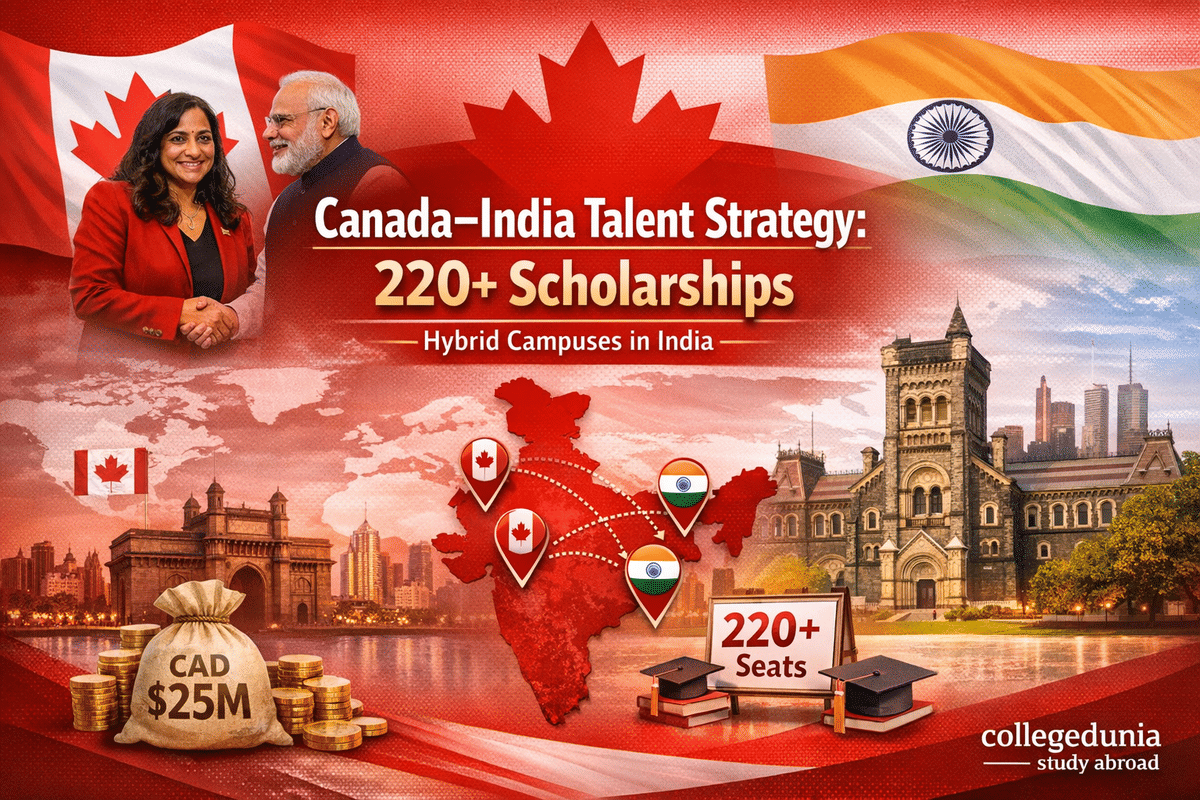
Canada announced a sweeping new education strategy with India on March 2, 2026, signalling a deliberate effort to rebuild its appeal to Indian students after two years of study permit caps, visa backlogs, and rising costs. The Canada–India Talent and Innovation Strategy, launched by Foreign Affairs Minister Anita Anand during a visit to Mumbai, includes CAD $25 million in scholarship funding from the University of Toronto for more than 220 Indian students, three new hybrid study campuses in India, and 13 signed MOUs between Canadian and Indian universities.
The announcement comes at a pivotal moment. Canada remains the top study-abroad destination for Indian students by volume — but Indian student numbers have been under pressure since Ottawa introduced study permit caps in 2024. This strategy is Canada's most structured response yet: not just more scholarships, but a new model that lets Indian students begin part of their programme in India before completing it in Canada.
Check out top universities to study in Canada for Indian Students
What Canada Has Actually Announced
The Canada–India Talent and Innovation Strategy was formally launched on February 28, 2026, by Minister Anand in Mumbai, and further detailed by PM Mark Carney's office on March 2, 2026. The confirmed components are:
| Component | Detail |
|---|---|
| Scholarship funding | CAD $25 million from the University of Toronto |
| Scholarships for Indian students | 220+ funded seats in Canada |
| Funded research positions | 300 additional positions for Indian students (U of T) |
| Hybrid study campuses in India | 3 new locations (see below) |
| University MOUs signed | 13 new partnerships between Canadian and Indian institutions |
| Creative industries MOU | India–Canada collaboration in performing arts, music, entertainment tech |
CAD 25 million in INR: (At CAD 1 = ₹68.27), this equals approximately ₹170.7 crore — a significant bilateral commitment, though more targeted than the $100 million figure that circulated in early reports.
The Hybrid Study Model: What It Actually Means?
The most structurally novel element of this strategy is the introduction of three hybrid study locations in India — joint academic centres where Indian students can begin coursework in India before transitioning to Canada. This directly addresses two barriers that have grown sharply since 2024: the cost of relocating to Canada upfront, and the uncertainty of obtaining a study permit before starting a programme.
The three hybrid campuses announced:
- Dalhousie University + IIT Tirupati + IISER Tirupati — An innovation campus combining Canadian and Indian institutional expertise, focused on science and technology research
- University of Toronto Centre of Excellence — An AI-focused research hub in India, linked to U of T's Temerty Centre for AI Research and Education in Medicine
- McGill University Centre of Excellence — An AI research and development centre directing Indian and Canadian talent toward joint R&D
All three are positioned as research and innovation hubs, not just teaching centres. The AI focus across two of the three campuses reflects the bilateral priority areas identified in the strategy: health, clean technology, and digital technologies.
What the hybrid model means for Indian students:
- Begin coursework or research in India at a Canadian-affiliated centre
- Lower initial cost — no Canada relocation required in Year 1
- Build academic relationship with Canadian institution before applying for study permit
- Pathway to completing degree or research programme in Canada
The 13 University Partnerships: Who Signed What
The 13 MOUs span a wide range of disciplines and institution types — from research-intensive universities to pathway-focused colleges:
| Canadian University | Indian Partner | Key Focus |
|---|---|---|
| University of British Columbia | O.P. Jindal Global University | Student/faculty exchange, research |
| Simon Fraser University | O.P. Jindal Global University | Joint programming, transnational education |
| University of the Fraser Valley | Panjab University | Cohort-based student mobility |
| Algoma University | Parul University | CS/Engineering pathway to Algoma programmes |
| Algoma University | Chandigarh University | Psychology, CS, management pathways |
| Dalhousie University | SRM Institute of Science & Technology | Nursing Dual Degree (25 supernumerary seats, clinical experience in Canada) |
| Dalhousie University | Indian Council of Agricultural Research | Digital/climate agriculture, aquaculture |
| University of Guelph | O.P. Jindal Global University | Student/faculty mobility for research |
| Brock University | O.P. Jindal Global University | Public health, sports management, business |
| Royal Roads University | O.P. Jindal Global University | Faculty and student exchange |
| Simon Fraser University | Hydrogen Association of India | Clean energy, hydrogen R&D |
| University of Toronto | Indian Institute of Science | AI research and education (Temerty Centre) |
| University of Toronto | Jio Institute | AI, management, student/faculty exchange |
Source: Global Affairs Canada backgrounder, February 28, 2026
Why Canada Is Doing This Now?
The timing is not coincidental. Canada's study permit cap — introduced in January 2024 and extended through 2025 — reduced the total number of new international study permits issued by approximately 35%. Indian students, who represent the largest single source country for Canadian universities, bore a disproportionate share of that reduction.
At the same time, competing destinations have accelerated their own India-specific strategies: Japan targeting 5,000 Indian students with full scholarships (January 2026), South Korea's K-STAR visa offering PR in 3 years, Taiwan's new open work rights and shortened PR timelines, and Germany's continued ₹0 tuition advantage.
Canada's response is strategic rather than reactive. The four pillars of the Talent and Innovation Strategy — embedding Canadian capability in India's priority sectors, translating knowledge into economic outcomes, rebalancing the talent relationship, and demonstrating credibility through delivery — signal a shift from volume-based recruitment to quality-based partnership.
The February 2026 visit of more than 20 Canadian university presidents to India — described by Global Affairs Canada as "Canada's largest academic delegation ever to the country" — underscores the institutional seriousness behind this strategy.
What This Means for Indian Students?
Who benefits most:
- Research students (MS/PhD) in AI, health, clean technology, and engineering — the 300 funded U of T research positions and the AI Centres of Excellence are directly relevant
- Nursing students — the Dalhousie–SRM Dual Degree Programme offers 25 supernumerary seats with dual credentials and embedded clinical experience in Canada, plus a potential pathway to nursing practice in Nova Scotia
- Students at Chandigarh University, Panjab University, Parul University — direct pathway agreements to Algoma University and University of the Fraser Valley programmes are now formalised
- Students who want a Canadian degree but cannot afford to relocate immediately — the hybrid campus model offers a lower-cost entry point
What has not changed:
- Canada's study permit cap remains in effect for 2026 — this strategy does not override it
- Students still need to apply for and obtain a study permit to complete their degree in Canada
- The 220 U of T scholarships are competitive — eligibility criteria and application process are yet to be fully published
What Students Should Do Now?
- Monitor the University of Toronto scholarship portal — the 220+ funded seats and 300 research positions will have a formal application process. Track updates at utoronto.ca and the U of T India office.
- Check your university's MOU status — if you are at Chandigarh University, Panjab University, Parul University, SRM, IISc, or Jio Institute, contact your international office about the new pathway agreements.
- Research the hybrid campus programmes — the Dalhousie–IIT Tirupati innovation campus and the U of T and McGill AI Centres of Excellence will publish intake details. These are early-stage; watch for formal announcements in mid-2026.
- Do not delay your study permit application — the hybrid model and MOUs are new pathways, but Canada's study permit cap is still active. If you plan to study in Canada for Fall 2026 or Winter 2027, apply through standard IRCC channels now.
- **Treat the 25Mfigureastheverifiednumber∗∗—severalsourcesstillcite100 million. The corrected, verified figure from the University of Toronto and CIC News is CAD $25 million (≈ ₹170.7 crore). Plan accordingly.
















Comments