



Education Journalist | Study Abroad Strategy Lead
Ascomycetes belong to the phylum Ascomycota, which is the largest phylum of kingdom Fungi with more than 64,000 species. Ascomycetes are commonly known as sac-fungi as they are produced in a sac-like structure known as ascus. Inside the ascus, non-motile microscopic sexual spores are formed which a defining feature of this kingdom. Though some species of ascomycota are asexual, they do not have a sexual cycle and do not form ascopores or asci. Some of the ascomycetes are edible and even used in medicines, bakery and brewing industries.
Read More: Difference between Algae and Fungi
| Table of Content |
Key Terms: Fungi, Ascomycetes, Sexual Reproduction, Asexual Reproduction, Spores, Ascocarp, Gametes, Zygote, Meiosis, Habitat, Conidia, Plasmogamy, Karyogamy
What are Ascomycetes?
[Click Here for Sample Questions]
Fungus is a microorganism that includes microorganisms like yeast and moulds to mushrooms that we find everywhere around us. Their anatomy and working differs not only as per their physical features but also as per their living and food habitats.
Ascomycete is also a type of fungus that is not only useful to modern medicine but also to bakery and brewing industries. Phylum Ascomycota together with Basidiomycota forms the subkingdom Dikarya. This group possesses a sexual structure which is called ascopores, produced in a sac like structures called as ascus. Penicillium, Candida, Neurospora are some of the most useful organisms of this group.
Read More:
Characteristics of Ascomycetes
[Click Here for Previous Year Questions]
Some of the most important characteristics of ascomycetes are:
- Ascomycetes have a very diverse living and feeding habitat. While some ascomycetes are edible such as mushrooms, some live as lichens.
- Some of the ascomycetes are saprophytes while some are pathogens.
- The presence of a reproductive structure called ascus is the most common characteristic among these groups.
- The cell walls in these groups are composed of chitin or glucans.
- The mycelium is commonly made of septate hyphae.
- As they are morphologically diverse in nature we can find unicellular yeast to complex multicellular fungi in the group.
- Generally all ascomycetes are terrestrial, parasitic or coprophilous. Though some ascomycetes have adapted to the freshwater or marine environments.
- The septal walls provide cytoplasmic continuity, due to presence of septal pores, throughout the individual hyphae.
- The formation of conidia exogenously on conidiophores is the process by which asexual reproduction is done in these groups.
- In Ascomycetes, sexual reproduction is by conjugation between two gametangia. Now, they are either homothallic or heterothallic.
- The fruiting body, in ascomycetes, is called ascocarp. There are four types of ascocarp present - cleistothecium, perithecium, apothecium and ascostroma.
Read More: Difference between Bacteria and Virus
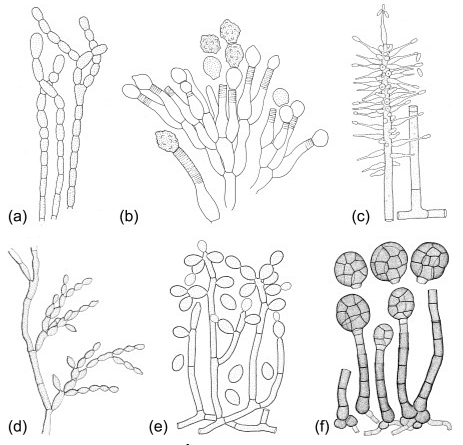
Ascomycetes
Examples of Ascomycetes
[Click Here for Sample Questions]
Some of the significant members of the species ascomycetes are:
- Baker's Yeast
- Cup Fungi
- Brewer's Yeast
- Dead Man's Finger
- Morales
- Truffles
- Aspergillus
- Cladonia
- Claviceps
- Penicillium
- Candida
- Neurospora
Ascocarp
[Click Here for Previous Year Questions]
Ascocarp refers to a fruiting structure of fungi.The plural form is called ascomata. There are four types of ascocarp as mentioned below:
- Cleistothecium: It is glubose structured meaning it is completely closed with no openings.
- Perithecium: It is a flasked shaped fruity body with an opening in a form of pore.
- Apothecium: It is a fleshy fruiting body with a wide saucer shaped or cup shaped opening.
- Pseudothecium: It is similar to Perithecium. It is double wall structured and expands to take water.

Ascocarp
Reproduction in Ascomycetes
[Click Here for Sample Questions]
Ascomycetes reproduce by both sexual and asexual methods. Mentioned below are the details:
- Asexual Reproduction: The process of asexual reproduction in ascomycetes is very similar to fungi and is done by budding or formation of multinucleated conidia. This process of asexual reproduction allows fungus to multiply far quickly than through sexual reproduction. Conidia are formed by the cells formed at the tip of modified hyphae and are called conidiogenous cells.
- Sexual Reproduction: Ascus is the place where in all the sexual process occurs and thus sexual reproduction in ascomycetes occurs only in those with ascii. Mentioned below is the process:
- In sexaul reproduction, two different gametes combine. In some species, the second gamete comes from another fungi.
- After the fusion of gametes, plasmogamy takes place followed by karyogamy.
- The fused structure contains dikaryon. The new hyphae is formed by these dikaryotic cells.
- After this karyogamy occurs forming a diploid zygote.
- The diploid zygote undergoes meiosis and forms 4 haploid nuclei and then 8 haploid nuclei.
- Cytoplasm accumulates in each of these nuclei and a thick cell wall surrounds it. These are known as Ascospores.
- Now these ascospores are released from asci which under favourable conditions germinate to form new mycelia.

Schematic Representation of Ascus and Ascospore

Life Cycle of Ascomycetes
Economic Importance of Ascomycetes
[Click Here for Previous Year Questions]
Because of their diverse habitat, ascomycetes provide us with many useful products like food, medicine and chemical products. Some of the facts indicating economic importance of ascomycetes are:
- Baking and brewing industry entirely depends on yeast for fermentation.
- Many enzymes and organic acids are produced by ascomycetes, like gluconic acid, citric acid etc.
- Ascomycetes are also used in the preparation of different types of cheese using different penicillium species like brie, camembert etc.
- Soya sauce is prepared using aspergillus. It is also used in making other alcoholic beverages.
- Penicillin is also made through penicillium chrysogenum.
Read More: Micropropagation
Things to Remember
[Click Here for Sample Questions]
- Ascomycetes or sac fungi are members of phylum Ascomycota.
- Ascomycota (along with Basidiomycota) forms the subkingdom Dikarya and is the largest phylum of fungi, with over 64000 known species.
- Ascus refers to a sexual pore bearing cell and is a defining characteristic of ascomycetes.
- Ascomycetes have diverse living and food habitats. While some are saprophytes there are some which are pathogens.
- We may also find unicellular yeast to complex multicellular fungi in the group due to its morphologically diverse nature.
- Asexual reproduction in ascomycetes are done by budding or formation of conidia.
- Sexual reproduction in ascomycetes occurs with the combination of two gametes. In this, plasmogamy followed by karyogamy takes place, forming diploid zygotes.
- Ascomycetes have many uses in our daily life as well as in industries thus having great economic importance.
- Baking and brewing industries completely depend on yeast for fermentation.
- Gluconic acid, citric acid and many more organic acids and enzymes are produced by ascomycetes.
- Penicillin got its name from Penicillium chrysogenum fungi.
Also Read:
Previous Years Questions
- The imperfect fungi which are decomposers of litter … (NEET 2015)
- Cell wall of fungi is composed of …
- Identify the odd one out … (KCET 2021)
- A hyphae which is multinucleated and asptate is known as … (WBJEE 1999)
- Puccinia forms uredia and … (NEET 1998)
- A clone is ......… [KCET 2011]
- Animals which possess cleidoic eggs exhibit….[KCET 2011]
- Which among these is not a post fertilization event ?...[KCET 2016]
- Type of asexual reproduction found in Hydra is..[KEAM]
- Which of the following is having longitudinal binary fission ?….[KEAM]
- In grafting, the stock and scion should be joined….
- The mode of asexual reproduction in Euglena is….[CUCET 2010]
- Archaebacteria differ from eubacteria in...(NEET 2014)
- Azotobacter and Bacillus polymyxa are the examples of...(NEET 1996)
- Apomixis in plant means development of a plant… [BHU UET 2008]
- Which one of the following plants reproduces vegetatively by epiphyllous buds?
Sample Questions
Ques. Why are ascomycetes economically important? (3 marks)
Ans. Ascomycetes refers to the fungi which belong to the phylum Ascomycota. They form the subkingdom Dikarya along with the Basidiomycota and is a largest phylum of fungi. Because of their diverse habitat, ascomycetes provide us with many useful products like food, medicine and chemical products and thus are of great economic as well as of daily importance to us. Some of the uses of ascomycetes are:
- The yeast ferments sugar to produce alcohol and also carbon dioxide. Baking and brewing industries are built around this yeast.
- Some species of penicillium are used to produce cheese and citric acid as well as organic acids.
- A type of ascomycete (claviceps purpurea) is used to make Ergot. It helps during childbirth.
- Production of penicillin is done using Penicillium notatum and P. Chrysogenum.
Ques. Describe asexual reproduction in ascomycetes. (2 marks)
Ans. Asexual reproduction is the dominant form of reproduction in these fungi and is responsible for their rapid spread. It occurs through conidia, a vegetative reproductive spore.
Conidia is formed by the cells formed at the tip of modified hyphae and are called conidiogenous cells. These conidiospores, generally, contain one nucleus. They are also called mitospores as they are the result of mitotic cell division.
Ques. Describe sexual reproduction in ascomycetes. (3 marks)
Ans. Ascus is the result of sexual reproduction in Ascomycota. It's a tube shaped vessel containing ascospores.Ascus distinguishes it from other fungal phyla. Ascus is the place where in all the process occurs and thus sexual reproduction in ascomycetes occurs only in those with ascii. In sexual reproduction in ascomycetes, two different gametes combines. In some species, the second gamete comes from another fungi. The fused structure contains dikaryon. The new hyphae is formed by these dikaryotic cells. After this karyogamy occurs forming diploid zygotes. The diploid zygote undergoes meiosis and ascospores are formed. These ascospores, under favourable conditions, germinate to form new mycelia.
Ques. Is yeast an ascomycetes? (2 marks)
Ans. Yes yeast is classified as ascomycetes. They are non motile single cell and also have chitinous cell walls, and thus are classified as fungi. Yeast also reproduces sexually which results in the production of ascus, which makes them fall under ascomycetes.
Ques. What role does ascomycetes play in our diet and in medicine? (5 marks)
Ans. Some of the major roles played by ascomycetes in our day to day life are:
- Ascomycetes in food: Most popular group of ascomycetes used in our food is yeast. It is used to make alcohol and also to make bread. As morel mushrooms they are directly edible. Ascomycetes are also used to make cheese and citric acids. However the most common way they are edible are truffles. There are several types used for flavouring.
- Ascomycetes in medicine: Penicillin is the most famous antibiotic produced from Penicillium notatum and P. Chrysogenum. Aspergillus is also used to produce various antibiotics.
- Ascomycetes is also used to produce Flavacin, another antibiotic. Ergot, used to reduce bleeding during menopause, menstrual cycles, miscarriages, and in childbirth is produces by Claviceps puprpurea.
Ques. What are the negative aspects of ascomycetes? (3 marks)
Ans. The negative aspects of ascomycetes are mostly disease related. Some of them are:
- Nematospora causes diseases in crops like cotton and also in vegetables like tomato and beans.
- Penicillium expansum is responsible for spoilage of grapes, apples and peas.
- Claviceps purpurea is used to produce Ergot, a life saving drug, but can also cause problems in wheat and grass crops.
- If consumed in excessive amounts it can also cause restrictions in blood flow which can result in loss of limbs. Candida species causes candidiasis.
Ques. What is the difference between Ascomycetes and Basidiomycetes? (3 marks)
Ans. Tabulated below is the difference between Ascomycetes and Basidiomycetes:
| Ascomycetes | Basidiomycetes |
|---|---|
| The spores are produced internally by Ascomycetes. | The spores are produced externally by Basidiomycetes. |
| Spores are produced inside sac-like structures called ascus. | Spores are produced on the end of specialised cells called basidia. |
| Each ascus contains 8 spores. | Each basidia contains 4 spores. |
Also Check Out:





Comments