



Education Journalist | Study Abroad Strategy Lead
Catalase enzymes are known to be found in the liver of mammals. It constitutes an important part of various chemical reactions inside one’s body, where it helps in the process of catalysis. Catalase enzymes help in easing the process of decomposition of hydrogen peroxide. This decomposition further leads to the formation of oxygen and water. The phenomenon of balancing the free and the unstable radicals like atoms and molecules is one of the main characteristics of the catalase enzyme.This enzyme functions as an antioxidant and works as a preventive agent against oxidative actions. The catalase enzyme is also found in a plant, mainly in the chloroplast or mitochondria. The plants possess this enzyme to assist in food formation and other aerobic activities. Further, in this article, we will discuss the functions and the nature of the catalase enzyme and the associated chemical reactions.
| Table of Contents |
Key Takeaways: Catalase, catalase enzyme, antioxidant, decomposition, oxygen, water
What is Catalase Enzyme?
[Click Here for Sample Questions]
Catalase enzyme is one of the most significant enzymes which is found in almost all living organisms. This enzyme helps in the process of catalysis of any reaction and accompanies the breakdown or decomposition of hydroperoxide into oxygen and water. The contribution of catalase in reducing the accumulation of the cellular organelles makes it very important as it further helps in safeguarding the organelles from any kind of destruction. It also plays a vital role in protecting the cells from oxidative damage. As in the chances for this oxidative damage remains very high by the reactive oxygen species. Therefore, the catalase enzymes mostly function as antioxidant enzymes in the species.
Structure of catalase enzyme
Moreover, these catalase enzymes are also found in the cellular organs (chloroplast, mitochondria, cytosol) of plants. Apart from this, the catalase isozymes also exist in multicellular plants, which prove to be the indicator of plant versatility. For instance, the structural genes, such as Cat 1, Cat 2, and Cat 3, encode for catalase isozymes as CAT-1, CAT-2, CAT-3, respectively. And this expression indicates species, time, and stress specificity.
Also read: Difference Between Cytosol and Cytoplasm
Chemical Nature of Catalase Enzyme
[Click Here for Sample Questions]
The chemical nature of the catalase enzyme states that it is a tetramer of four polypeptide chains. And each polypeptide chain is known to possess more than 500 amino acids. At the same time, it is known for containing 4 haem groups with iron. These haem groups remain the key for enabling it to react with hydrogen peroxide. The optimal pH level for human catalase is nearly 7. Generally, the optimal pH levels for other catalases fluctuate between 4 and 11, varying from species to species. However, it remains at around 7 in the case of human catalase.
Also read: Hydrogen
Functions of Catalase Enzyme
[Click Here for Sample Questions]
Every organism that undergoes aerobic activities tends to produce atoms and molecules. The consumption of oxygen for survival releases free radicals, which are sometimes unstable. These unstable atoms and molecules subsequently cause potential damage to the cell membranes, proteins, and DNA. However, the levels of damage may vary as per the type of instability caused. But sometimes, this instability reaches a level where permanent cellular and tissue damages occur. And this could further result in multiple severe diseases like depressed immunity systems, heart diseases, respiratory problems, etc.
Now, this is where the functions of the catalase enzymes come up and contribute immensely in preventing the damages. It has enough potential to fight against the free radicals by converting the toxic superoxide radicals into hydrogen peroxides leading to the further decomposition of peroxide into the hydrogen and water.
Also read: Immunity
Catalase Enzyme Reaction
[Click Here for Sample Questions]
2H2O2 → 2H2O + O2
The reaction of the catalase enzyme is simple, easy and can be noted after adding the hydrogen peroxide in the tissue or the microbial sample containing catalase. The reaction also involves the formation of the bubble at one stage, which signifies the release of oxygen. This reaction is also easily visible to the naked eyes because the catalase is known to have a very high specific activity generating an evident response. Moreover, another important by-product is a gas, which makes the test even easier to perform and view the result.
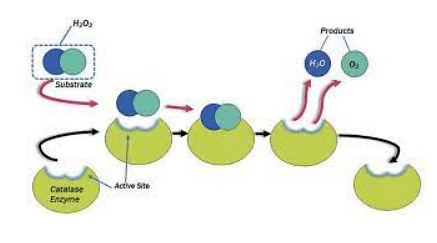
Enzymatic activity of catalase
Also read: Applications of enzymes
Things to Remember
- Enzymes serve as the basic functional unit in the body of living organisms. These are the proteins that help in the breakdown of the complex nutrients into simple ones and ease the metabolic processes and other chemical activities.
- It has been found that the very first prokaryotic catalase was purified in 1948. This purification was done by an anaerobic bacterium known as the Micrococcus lysodeikticus. This bacterium mainly functions to assess lysozyme separation.
- Scientists do the gene coding for catalase enzymes in the form of the CAT gene. For instance, the structural genes Cat 1, Cat 2, and Cat 3 can be encoded into catalase isozymes as CAT-1, CAT-2, CAT-3, respectively. This gene is mainly positioned on chromosome 11 in human beings.
- Catalase enzyme is one of the most important antioxidants, which is known to reduce oxidative stress in organisms undergoing aerobic processes. The oxidative stress is reduced or mitigated by decomposing the hydrogen peroxide into simple oxygen and water by maintaining the overall balance.
- The catalase deficiency can be attributed to multiple age-associated degenerative diseases. These diseases can be listed as anemia, vitiligo, schizophrenia, cancer, etc. Doctors find it quite difficult to overcome the deficiency due to the age factor.
Sample Questions
Ques. Explain the role of catalase in cells. (3 marks)
Ans. Catalase is an antioxidant enzyme that helps in settling down the harmful impacts of the free radicals in the human body. Every organism which undergoes aerobic processes produces oxygen. As a result of this oxidation, several free radicals in the form of atoms and molecules are produced, which carry the potential of damaging the tissues and the cells. Thus, catalase helps by decomposing the hydrogen peroxides and reducing them to hydrogen and water. This leads to disease mitigation by preventing damage to the cellular membrane.
Ques. Define enzymes. Give examples. (2 marks)
Ans. Enzymes are an important part of the human body and are responsible for conducting various chemical and metabolic activities. These are the proteins that are known to act as the biological catalyst and speed up the rate of metabolism. Enzymes are found in almost all living organisms and function intrinsically to a living body. Some of the examples of enzymes include pepsin, trypsin, amylase, pancreatic lipase, etc.
Ques. Does catalase have any clinical significance? If yes, give reasons for justification. (4 marks)
Ans. Yes, catalase is an antioxidant enzyme that is naturally found in all organisms and helps deal with the free radicals produced through oxidation. It has multiple clinical significance, such as it contributes to the processing of milk into cheese by reducing hydrogen peroxide. Further, it also combats oxidation which has the potential of adversely impacting the food. Not only the food industry gains the benefit of catalase, but also the textile industry prefers peroxide-free cloth. At the same time, this catalase is also used as a disinfectant for clearing the contact lenses.
Ques. What is the role of catalase in reducing the rate of having gray hair in humans? (2 marks)
Ans. It has been found that the more the level of hydrogen peroxide is present in the body, maybe in the case of catalase deficiency, the more it interferes with the production of the pigment melanin. Thus, it causes the hair to gray. So, more levels of catalase help in maintaining the levels of melanin in the body.
Ques. How is the catalase produced? (2 marks)
Ans. The catalase enzyme is mainly produced by the bacteria that respire using oxygen. It then protects them from the toxic free radicals, which are the products of oxygen metabolism. Strict aerobes and facultative anaerobes both are included in the catalase-positive bacteria.
Ques. Mention the names of the four types of catalases. (2 marks)
Ans. The catalases are mainly found in three groups such as monofunctional haem, haem peroxidases, and manganese. However, amongst all, the maximum studied group is of monofunctional catalases.
Ques. Briefly discuss catalase deficiency. (3 marks)
Ans. Catalase deficiency is also known as acatalasemia or acatalasia. It is mainly a catalase deficiency disorder which is a kind of congenital disorder. This disorder is known to be caused by the mutations in the CAT gene. In simple words, the disorder involves the severe deficiency of an enzyme called catalase. However, multiple treatments help in recovering through the deficiency, but its severity might lead to problems like heart disease or schizophrenia, which is a severe mental disability.
Ques. Explain the functions of the catalase enzyme. (5 marks)
Ans. The functions of the catalase enzymes are as follows.
- Since every organism that undergoes aerobic activities produces atoms and molecules. Additionally, the consumption of oxygen for survival also releases the free radicals, which are sometimes unstable.
- Therefore, these unstable atoms and molecules are known to cause potential damage to the cell membranes, proteins, and DNA, and this level of damage varies as per the type of instability caused.
- Sometimes, this instability reaches a level where permanent cellular and tissue damage occurs, leading to diseases like depressed immunity systems, heart diseases, respiratory problems, etc.
- So, the function of the catalase enzymes is to contribute to the prevention of tissue damages.
- Catalase carries the potential to fight against the free radicals by converting the toxic superoxide radicals into hydrogen peroxides, causing the further decomposition of peroxide into hydrogen and water.
Ques. What is the main function of an enzyme? (3 marks)
Ans. Enzymes are the proteins found inside the body of living organisms. All the chemical reactions which take place inside one’s body are facilitated by enzymes. Different body organs have different types of enzymes with their functional specializations, such as amylase is produced in the mouth, pepsin in the stomach, and so on. So, enzymes perform the functions of healing, breathing, digestion, reproduction, growth, and so on.
Ques. Why do we need catalase? (2 marks)
Ans. All humans, animals and plants require an adequate amount of catalase in their bodies as catalase is an enzyme that is an antioxidant and helps in fighting against the entire process of oxidation. Through the functioning of this enzyme, the living cells of the organisms are protected from oxidative damage, which is very frequent to occur in any of the bodies, especially in the presence of oxygen.
Read Also:




Comments