



Content Curator
A convex lens is a kind of lens that converges rays of light and stays parallel to the principal axis (converging the incident rays towards the principal axis). Convex Lenses are mostly thin at the lower and upper sides, while thick in the middle if compared with a Concave lens. A Convex Lens has the edges curved outward, not inward. The formula of Convex lens is:
\(\frac{1}{f} = \frac{1}{v} + \frac{1}{u}\)
Where,
- f = Focal length
- v = Separation of the image from the optical center
- u = Separation between the optical center and the object
An optical lens is composed of two spherical surfaces. If the spherical surface is bent outwards, the lens is known as a biconvex or convex lens. A convex lens is generally used as a magnifying glass since it produces a virtually enlarged image of the object when brought within the focal length.
Read Also: Dispersion of Light by Prism
| Table of Content |
Key Terms: Convex Lens, Principle Axis, Rays, Light, Biconvex Lens, Simple Lens, Focal Length, Hypermetropia, Concave Lens
Structure of Convex Lens
[Click Here for Sample Questions]
A convex lens is typically larger at the center and narrows at the edges.
- The visible lens is usually composed of two circular areas.
- If those areas are curved outward, the lens is called a biconvex lens or just a convex lens.
- A convex lens can help converge a beam of parallel rays on the other side of the lens. Thus, this point is known as the focus of the lens and its distance from the optical center is known as the focal length.
- However, if one of the areas is full and the other is convex, it is called a plano-convex lens.
- In the spherical surfaces, the radius of curvatures R1 and R2 and the focal length “f” can be connected via an approximate equation:
| \(\frac{1}{f} = (n-1) (\frac{1}{R_1} \frac{1}{R_2})\) |
Here,
- n = Refractive index
- R1 and R2 = Radii of the curvature
Note: R1 is represented as the surface close to the light source and R2 as the surface far from the source of light.
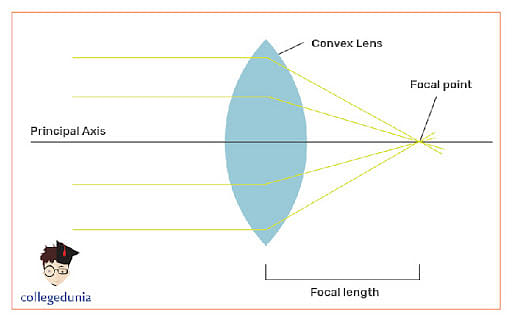
Structure of the Convex Lens
Focal Length
The distance between the centre point of the convex lens and the convergence point of the parallel rays is called the Focal Length.
- The Focal Length of a convex lens is always positive.
- This is because the parallel rays of light, when passed via the convex lens, is seen to converge on the right side.
- Therefore, the focus is typically on the right side of the lens.
- As per the sign convention of lenses, the focal length can be measured in the direction of the incident ray, thus making it positive.
Principal Axis
Principal Axis is the line that passes through the centre of the lens and the centres of curvature of all segments of the lens.
- The principal axis of a convex lens is its main axis.
- When drawing an optical system with a lens, the lens is drawn is first, followed by a line or ray that passes via the center of lens, undeviated.
- This line is further used in the form of a measurement system in an optical system.
- The distances which are measured upward from the optical axis are assumed positive, while the ones below the axis are assumed negative.
- Thus, this axis is known as the principal axis.
Read More:
Uses of Convex Lens
[Click Here for Sample Questions]
Convex Lens is used for a variety of purposes in our daily lives.
- The lens of the human eye is a prime example. One of the most common uses of convex lens is that it helps us see.
- Another common example of the use of this type of lens is a magnifying glass. When an object is placed in front of it a short distance from the length of the lens, it produces an enlarged image and the shape of the object on the same side as the object itself.
- It is used to correct Hypermetropia or long-term vision.
- It is used in cameras because it focuses on light and produces a clear and pleasant image.
- These are usually used on various devices such as magnifying devices like the ones in microscopes and telescopes.
- The simplest version of this lens can focus on the light into an image, but that image will not be high quality. With distorted fixes, combining both types of lenses is best.
Real Image and Virtual Image
The real and virtual image for Convex lens can be represented as:
- Real Image: A convex lens can yield a real image if the given object is placed at a position of more than one focal length from the lens. Thus, the image herein is projected in front of the lens, further captured on the screen. It is also utilized in movie theaters, projectors, and more.
- Virtual Image: A convex lens can generate a virtual image in case the object is situated in front of the focal point. This application is used in eyeglasses to obtain clear images.
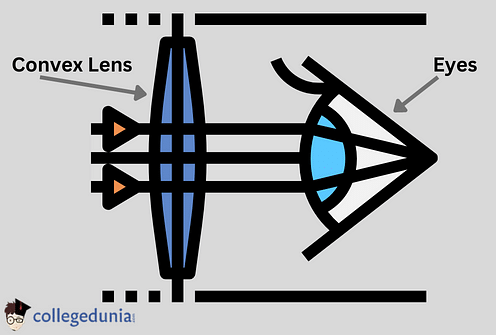
Convex Lens
Convex Lens Types
[Click Here for Sample Questions]
There are three types of lenses:
- Plano-convex Lens
- Double Convex lens
- Concave-convex lens
Plano-convex Lens
The plano-convex lens turns outward from one side to the other.
- Plano-Convex lenses work best for focusing parallel rays of light to a single point.
- Plano-convex lenses can be used in order to focus, collect and collimate light.
- In fact, the asymmetry present in these lenses helps minimize spherical aberration in the events where the object and image are situated at an unequal distance from the given lens.
- The elements of good focal length have a round face and a single flat surface.
- The design of these lenses is an unlimited use of the same light in non-sensitive applications.
Double Convex Lens
A double convex lens is a double lens that turns outwards from both sides.
- We also refer to it as a biconvex or convex lens.
- Convex lenses have shorter focal lengths than plano-convex lenses with equal width and upper surface.
- Since most optical devices require long wavelengths, two convex lenses could be the best choice.
Concave-Convex Lens
A concave-convex lens turns inward from one side and outward from the other side.
- A Concave-convex lens is used to measure the flexibility caused by other lenses.
- In addition, we also use it to control the laser beam.
- It is a combination of one convex lens and one concave lens, known as a Concave-convex lens or Meniscus.
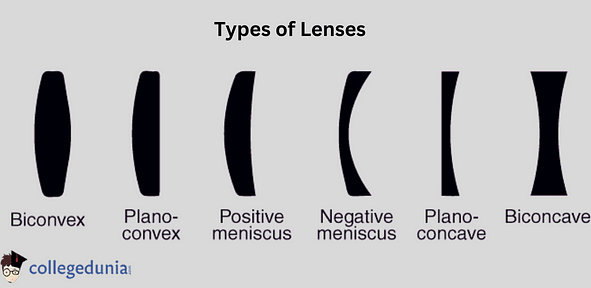
Convex Lens Types
Read Also: Refraction Through a Prism
Functions of Convex Lens
[Click Here for Sample Questions]
Here are some of the functions of convex lenses:
- When an object is in infinity, a convex lens forms the image at focus. Herein the image formed is real and inverted.
- When an object is beyond the given imaginary point, the image thus formed can be seen between the Focal point and an imaginary point. The image herein is real, inverted, and diminished.
- When an object is placed at the imaginary point, the image thus formed is at an imaginary point. Herein, the image is real, inverted, and of similar size.
- When an object is located at the Focal point and the imaginary point, the imagethus formed is beyond an imaginary point. The image here is real, inverted, and magnified.
- When at the Focal point, the image can be found at infinity. It is real, inverted, and magnified.
- When an oject is found between the Focal point and the Centre of curvature, the image thus formed will be beyond the imaginary point and behind the object. Herein, the image formed is virtual and magnified.
Read More: Value of “c”
Why is Convex Lens Also Called a Converging Lens?A convex lens is also known as a converging lens due to the fact that it converges a parallel beam of light on a point termed as the principal focus. What is the Magnification of Convex Lens?The magnification of a convex lens is the ratio between the image height and object height. A magnification of 2 denoted that the image is actually twice the size of the object. While, a magnification of 1 denotes that the image size is equal to the object size. Assuming that the magnification is positive, the image is thus upright as opposed to the object (virtual image). However, assuming that the magnification is negative, the image thus formed is inverted as opposed to the object (real image). |
Difference between Concave and Convex Lens
[Click Here for Sample Questions]
The difference between convex and concave lens are:
| Concave Lens | Convex Lens |
|---|---|
| Concave lenses behave as diverging lens, meaning that it scatters light rays around. | Convex lenses act as converging lensmeaningng that it merges the light rays at a specific point. |
| Concave lenses are used to correct Myopia. | Convex lenses are used to correct Hypermetropia. |
| Concave lenses have a negative focal length. | Convex lenses have a positive focal length. |
| It is responsible to form a virtual, erect, and magnified image. | It is responsible to form a real and inverted image. |
| Concave lenses make objects appear smaller in size, and farther from where they are. | Convex lenses make objects appear closer and larger in size. |
Images Formed By Convex Lens
In a convex lens, the image formed is always at a point where at least two refracted light rays tend to meet.
Here are the rules to acquire an image by a convex lens:
- Rule 1: A ray of light needs to pass via the focus after refraction occurs via the lens. The ray of light should be parallel to the principal axis.
- Rule 2: A ray of light passing via the optical center of a convex lens appears straight; thus, not it does not bend after the refraction occurs. And a ray of light going on the way of the given principal axis follows a straight direction; not deviating either.
- Rule 3: A ray of light becomes parallel to the principal axis of a convex lens following refraction occurring via the lens when it passes through the focus.
Check Out:
Things to Remember
- Convex Lens is a type of lens that is narrow on the lower edges and broader from the middle.
- The lens of the human eye is a prime example for the use of Convex Lens. It is because of the Complex Lens that it helps us see.
- Convex Lens is also called the Converging Lens.
- There are three types of lenses, namely the plano-convex lens, the convex lens, and finally, the concave-convex lens.
- Concave Lens has a negative focal length whereas convex lens has a positive focal length.
Sample Questions on Convex Lens
Ques: What is another name for a Converging lens? (1 Mark)
Ans: We refer convex lens as a converging lens as it merges light rays at one single point.
Ques: What are the types of lenses? (1 Mark)
Ans: There are three types of lenses, namely the plano-convex lens, the double convex lens, and finally, the concave-convex lens.
Ques: State one difference between Concave Lens and Convex Lens. (1 Mark)
Ans: Concave lens disperses the light rays around hitting the lens, Convex Lens merges the light rays
Ques: In the case of a concave lens, what is the image of an object like? (1 Mark)
Ans: In case of a concave lens, the image of an object is real, inverted and the same size as the object when it lies between the centre of curvature and focus.
Ques: What is the reason behind the occurrence of a mirage? (1 Mark)
Ans: The mirage is formed on the ground because of the total internal reflection by layers of air.
Ques: The human eye is like a camera, what kind of lens does the eye lens form? (1 Mark)
Ans: The kind of image formed by the human eye lens is an inverted, and a real image of the object on the retina.
Ques: What kind of mirror is used in anti-shop-lifting-devices? (1 Mark)
Ans: Convex Lens is used in anti-shop-lifting-devices.
Ques: Due to which phenomena the stick is immersed in water appears to be bent? (1 Mark)
Ans: It is because of the phenomena of the law of refraction due to which the stick immersed in water appears to be bent.
Ques: What is the power of Convex Lens? (1 Mark)
Ans: The power of convex lenses is positive.
Ques: A 2 cm height An object of 2 cm height has been located about 16 cm away from a concave mirror, producing a true image of 3 cm high. What is the mirror's focal length? (3 Marks)
Ans: The object's size, O = 2 cm
u = -16 cm.
I = -3 cm is the imaanti-shop-lifting devices
Thus, we can say,
-v/u = I/O = m,
or
-v/-16 = -3/2,
oanti-shop-lifting devices
= -24 cm
Hence, the mirror’s focal length is -24 cm.
Ques: A 6-cm high object has been located about 6 cm from an 18-cm focal length. Thus determine the image distance, magnification, and the image height. (5 marks)
Ans: As per the question, The foa cal length (f) = 18cm
Since the focal length is positive, it is a convex lens. Thus, the focal point is real.
Object height (ho) = 6 cm
Object distance (do) = 6 cm
Thus, to determine the formation of an Image by the Convex Lens:
The Image Distance (di), thus:
1/di = 1/f – 1/do = 1/18 – 1/6 = 1/18 – 3/18 = -2/18
di = -18/2
= -9 cm
The negative sign here represents that the image is virtual, or that the rays do not pass via the image.
Magnification of Image (m):
m = – di / do
= -(-9)/6
= 9/6
= 1.5
The positive sign represents that it is an upright image.
The Image Height (hi):
m = hi / ho
hi = m ho
= (1.5)6
= 9cm
The positive sign represents that the image is upright.
Also Read:



Comments