


Define the principal focus of a concave mirror.

Collegedunia Team logo

Collegedunia Team

Content Curator

The point on the principal axis of a concave mirror where the rays of light coming from infinity or parallel to the principal axis meet after reflection from the mirror is called the principal focus of a concave mirror.

  • It is denoted by the symbol F.
  • The principal focus is also referred to as simply focus or focal point.
  • The principal focus of a concave mirror lies in front of the mirror.
  • The distance between the pole and the principal focus of the concave mirror is called the focal length.
  • A line passing through the principal focus and perpendicular to the principal axis on which the rays of light coming from a distant object making different angles with the principal axis converge or diverge is known as a focal plane.
  • A concave mirror is also known as a convergent mirror.
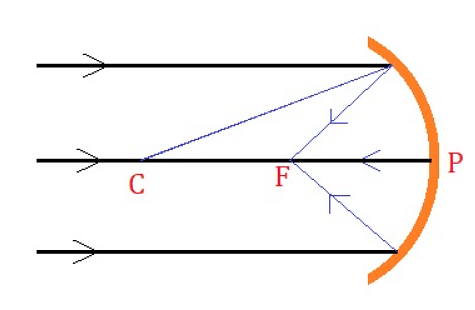
Location of principal focus of the concave mirror

Location of principal focus of the concave mirror


Read More: 

CBSE X Related Questions

  • 1.
    Paddy fields require a large amount of water. The pesticides and chemical fertilizers used are washed down into the soil or waterbodies. How do these chemicals reach our bodies? What is this phenomenon known as?


      • 2.
        Assertion : In human beings, the respiratory pigment is haemoglobin present in red blood cells.
        Reason (R) : Haemoglobin has a very high affinity for carbon dioxide.

          • Both, Assertion (A) and Reason (R) are true and Reason (R) is the correct explanation of the Assertion (A).
          • Both, Assertion (A) and Reason (R) are true, but Reason (R) is not the correct explanation of the Assertion (A).
          • Assertion (A) is true, but Reason (R) is false.
          • Assertion (A) is false, but Reason (R) is true.

        • 3.
          Show the formation of ionic compound CaO with electron dot structure.


            • 4.
              Yeast multiplies by which of the following methods?

                • Fragmentation
                • Binary Fission
                • Multiple Fission
                • Budding

              • 5.
                Assertion (A): Reflex actions do not involve thinking.
                Reason (R): Most reflex actions are controlled by the spinal cord.

                  • Both Assertion (A) and Reason (R) are true and Reason (R) is the correct explanation of the Assertion (A).
                  • Both Assertion (A) and Reason (R) are true, but Reason (R) is not the correct explanation of the Assertion (A).
                  • Assertion (A) is true, but Reason (R) is false.
                  • Assertion (A) is false, but Reason (R) is true.

                • 6.
                  State two differences between pollination and fertilization.

                    Comments


                    No Comments To Show

