



Content Curator
Equinox and Solstice both are season-specific, astronomical events. It takes place in our earth’s planetary system. It is due to the earth revolving around the sun in an elliptical path. Equinox is where there are 2 days in an earth year when a full day consists of equal duration of day and night i.e nearly 12 hours of daytime and 12 hours of nighttime. On the other hand, Solstice is where twice a year, there comes a full day when either the daytime is the longest or the lowest depending on the hemisphere.
| Table of Content |
Read Also: Planer Motion
Key Terms: Equinox, Vernal and Autumnal Equinox, Seasons, Hemisphere, Equator, Summer and Winter Solstice,
What is Equinox?
[Click Here for Sample Questions]
There are 2 days in an earth year when a full day consists of an equal duration of day and night i.e nearly 12 hours of daytime and 12 hours of nighttime. These days are called Equinox. The word Equinox is derived from the Latin word ‘Aequinoctium’. ‘Aequus’ is referred to as equal and ‘noctis’ or ‘nox’ means night.

Equal Duration of Day and Night
The event occurs when the sun is above the equator. It is neither tilted towards the sun nor away from the sun. The earth revolves at a perpendicular position when faced with sunlight on the day of the equinox.

Equinox occurs when sun is above Equator
However, the sunlight gets bent by the earth’s surface and it deviates by approx 37 miles, which creates a difference of ½ oC angle. Therefore, on equinox days, one hemisphere enjoys a little more daylight than the other part.
The 2 days of Equinox are:
- Vernal Equinox occurs on March 20 (also known as spring equinox)
- Autumnal Equinox occurs on September 22
Vernal Equinox
In the season of spring, the earth comes across an astronomical day when the equinox happens. This spring equinox is the vernal equinox. The 20th of March is the day for the vernal equinox. It indicates the start of the spring season.
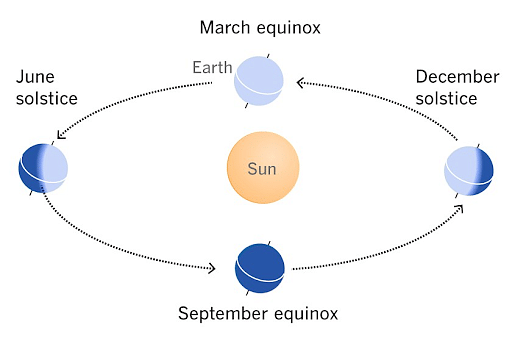
Equinoxes in March and September
Autumnal Equinox
In Autumn, the same event takes place. The earth faces the sun perpendicularly and the equinox or a day of 12 hours of the day and 12 hours of the night happens. This autumnal event is known as Autumnal equinox. 22nd September is the day. This indicates the start of fall season.
Also Read:
| Related Articles | ||
|---|---|---|
| Earth Satellite | Central Force | Aristotle Fallacy |
| Infrared Radiation | Black Body Radiation | Dual nature of radiation and matter |
What is Solstice?
[Click Here for Sample Questions]
Twice a year, there comes a full day when either the daytime is the longest or the lowest depending on the hemisphere. This astronomical event is known as Solstice. A solstice occurs when the earth is tilted at an angle of +23.27 degrees with the equator of the earth during the revolution around the sun.
2 solstice days are as follows:
- Summer Solstice occurs on 21 June
- Winter Solstice occurs on 21 December

Summer Solstice
On 21st June, the northern hemisphere of the earth comes across a day when the daytime is the longest in the whole season. This day is referred to as the summer solstice. During the summer solstice, the night is the shortest. This day remarks an opposite event in the southern hemisphere, in which 21st June is the shortest day with low intensity of sunlight.

Equinox and Solstice
Winter Solstice
In the northern hemisphere, the day 21st December is referred to as the Winter Solstice. This day holds the shortest daytime in the season of winter. In the southern hemisphere, the winter solstice on the 21st of December is the longest day.
Difference between Equinox and Solstice
[Click Here for Sample Questions]
The key differences between Equinox and Solstice are tabulated below.
| Point of difference | Equinox | Solstice |
|---|---|---|
| Definition | The astronomical event when a full day consists of equal daytime and nighttime. | The astronomical event when a full day either has the daytime which is longest or shortest is known as Solstice. |
| Number of days | Equinox takes place twice a year. | Solstice also occurs twice a year. |
| Northern hemisphere | The 20th march Vernal equinox and 22nd September autumnal equinox, both of the days have the same daytime and nighttime in the northern hemisphere. | The 21st June solstice summer equinox has the longest daytime in the northern hemisphere. 21st December known as the winter equinox has the longest night time in the northern hemisphere. |
| Southern hemisphere | The 20th March and 22nd September autumnal equinox, both days have the same daytime and night time in the southern hemisphere. | The 21st June solstice summer equinox has the longest nighttime in the southern hemisphere. 21st December known as the winter equinox has the longest daytime in the southern hemisphere. |
| The angle between the sun and equator | The sun makes an angle of 90 degrees with the equator. | The sun makes an angle of 23.27 degrees with the earth’s equator. |
Things to Remember
- Equinox and Solstice are astronomical events.
- Equinox is when a day has approx. 12 hours of daytime and nighttime each.
- Spring Equinox occurs on 20th March.
- Autumnal Equinox occurs on 22nd September.
- Solstice is when a day either has the longest or the daytime.
- Depending on the hemisphere, summer and winter Solstice occurs.
- Earth revolves around the sun and rotation around itself is the reason behind these astronomical events.
Also Read:
Sample Questions
Ques. Write down the difference between the summer solstice and winter solstice. [3 marks]
Ans:
| Summer Solstice | Winter Solstice |
|---|---|
| 21 June is referred to as the Summer Solstice on earth. | 21 December is referred to as the winter Solstice on earth. |
| In the Summer Solstice, the Northern hemisphere notices the longest daytime and shortest nighttime. | In the Northern hemisphere, it is a day of shortest daytime and longest nighttime. |
| On that day, the Southern hemisphere has the longest night and shortest daytime. | In the Southern hemisphere, the winter solstice has the longest daytime and shortest nighttime. |
Ques. What is Equinox? Write down 2 days when the equinox occurs? [2 marks]
Ans: The astronomical event, for which most parts of the earth observe a whole day of nearly equal day and night. This day is considered Equinox. Earth has 2 equinoxes.
- March or vernal equinox- 20 March
- Autumnal equinox- 22 September
Ques: Why is there a difference between the summer solstice and winter solstice in the northern and southern hemispheres? [3 marks]
Ans: Summer solstice in the Northern hemisphere is the longest day and shortest night due to the sun’s presence with an angle of 23.27 from the equator of the earth. And the opposite occurs in the southern hemisphere where night is the longest on 21 June.
In winter Solstice, in the Northern hemisphere has the longest night and the southern hemisphere observes the longest day of the season.
Ques: State 2 difference between vernal equinox and autumnal equinox? [2 marks]
Ans:
| Vernal Equinox | Autumnal Equinox |
|---|---|
| March 20th is known as the vernal equinox. | September 22th is known as the Autumnal equinox. |
| Vernal equinox hints at the start of the spring season. | Autumnal equinox hints at the start of autumn. |
Ques: Explain the occurrence of leap year. [3 marks]
Ans: Earth takes approx. 365.25 days to revolve one whole orbit of the sun. But to make it easy for calculation, it is considered to have 365 days a year. Hence, every year 6 hours remain uncounted. These uncounted 6 hours add up to 24 hours in a 4-year cycle. Therefore, these 24 hours make a day in the last of February which is 29 February. The year with this extra one day is called a leap year.
Ques: Why do the north or south pole have six months of days and nights? [3 marks]
Ans: The Northern hemisphere is mostly tilted towards the sun. So, the north pole remains toward the sun making a whole day with daylight. The tilted position remained the same from 21st March to 23rd September.
Similarly, on the opposite side, the Southern hemisphere’s south pole experiences no sunlight and so there are 6 months of nights. From 23rd September to 21st March, the southern hemisphere remains tilted towards the sun. Hence, the cycle reverses.
Ques: What is circle illumination? What is the obliquity angle? [2 marks]
Ans: Over the earth, the observed division between day and night is called the circle of illumination. The angle between the rotational axis and orbital axis of the earth is called the obliquity angle. The tilts of the earth's axis is an obliquity angle.
Ques. Explain how you can locate the Pole star with the help of Ursa Major. [2 marks]
Ans. Pole stars can be located with the help of two stars at the end of Ursa Major. Imagine a straight line passing through these stars. Extend the imaginary line in the North direction. This line is about five times the distance between two stars. A star is seen in this direction which is called a Pole star.
Ques. Why is the distance between stars expressed in light years? What do you understand by the statement that a star is eight light-years away from the Earth? [2 marks]
Ans. The stars are very far away from the Earth and it is not convenient to express such distances in kilometres. Thus, such large distances are expressed in a unit known as light year. If we say that a star is eight light-years away from Earth, it means that the light from the star will reach the Earth in eight years.
Ques. Observe the moon continuously for several nights, preferably from one full moon to the next. Make a sketch of the moon every night in your notebook and note the day from the day of the full moon. Also, note every day the part of the sky (east or west) in which the moon is seen. [2 marks]
Ans. We find that there is a change in the shape of the moon every day and the moon appears to be perfectly round on the full moon day. On the fifteenth day of the month, we see that the moon is not visible even if the sky is clear.
Thus, the moon goes on increasing every day, till on the fifteenth day and the full face of the moon is visible. After the full moon the bright part of the moon goes on decreasing every night and by another fifteen days again the new moon is formed.
Ques. Give the differences between galaxy and constellation. [2 marks]
Ans. A galaxy is a collection of stars and planets that are in numbers of millions and billions.
A constellation is a group of a few stars whose arrangement can be compared to the figure of some animal or any other known thing.
Ques. What is the difference between meteors and meteorites? [2 marks]
Ans.
| Meteors | Meteorites |
|---|---|
| Meteors are pieces of rocks floating in space that get heated upon entering the earth’s atmosphere. | Meteorites are meteors that do not burn in the earth’s atmosphere and reach the surface of Earth. |
Also Read:




Comments