



Education Journalist | Study Abroad Strategy Lead
In the modern periodic table, p-block elements are placed on the right-hand side in groups from 13 to 18. Generally, p-block elements are no-metals but Group 15 has two non-metals, two metalloids and one metal. The electronic configuration of Group 15 elements is ns2np3 in their outer shell, where n is equal is the principal quantum number.
| Table of Content |
Key Terms: Group 15 Elements, Modern Periodic Table, Electrons, Atoms, Electronic Configuration, Nitrogen, Metals, p-block Elements
Group 15 Elements
[Click Here for Sample Questions]
Group 15 elements consist of:
- Nitrogen (N)
- Phosphorus (P)
- Arsenic (As)
- Antimony (Sb)
- Bismuth (Bi)
Group 15 elements are also known as the Nitrogen family as they start with Nitrogen. As we move down the group, a transition from non-metallic to metallic nature can be observed. Nitrogen and Phosphorus are non-metals, Arsenic and Antimony are metalloids and Bismuth is a metal. Except for Bismuth, all the other elements of Group 15 exhibit allotropy.
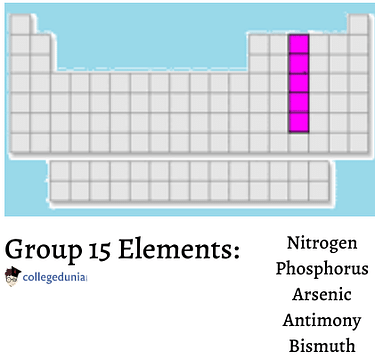
Group 15 elements
Rules on Electronic Configuration of Group 15 Elements
[Click Here for Previous Year Questions]
Electronic configuration is defined as the arrangement of electrons of an element in its subshells and orbital shells. The electronic configuration of an element also tells us whether the element is in a stable form or not. Atoms which have a complete octet in their outermost shell are considered to be stable.
Note:
- If the outermost shell of an atom does not possess the complete set of electrons, it is considered to be reactive.
- The chemical properties of an element are also influenced by the electrons in its outer shell and have been found similar to the elements having the same number of electrons in their outer shell.
There are three rules associated with the electron configuration of elements. These rules are described below.
Pauli’s Exclusion Principle
Pauli’s exclusion principle states that the electrons of an atom should not possess the same n, m, and l simultaneously. Where,
- n is the Quantum Number
- m is the Azimuthal Quantum Number and
- l is the Principal Quantum Number
For example, let that n, m, and l for an electron in the same orbital path are the same. Then their magnetic quantum number will be the same as well, and they will have opposite integer spins, i.e. ½ and -½.
Pauli's exclusion principle does not hold for bosons as they’re able to hold the same quantum state.
Hund’s Rule
Hund’s rule states that
- Each orbital in a sublevel is singly occupied before being occupied doubly.
- All the electrons in singly occupied orbitals have the same spin to maximize the total spin.
Aufbau’s Principle
Aufbau’s principle states that orbitals must always be filled with electrons from the lowest energy level to the highest energy level. The order in which the orbitals are filled with electrons is: 1s, 2s, 2p, 3s, 3p, 4s, 3d, 4p, 5s, 4d, 5p, 6s, 4f, 5d, 6p, 7s, 5f, 6d, 7p, and so on.
Electronic Configuration of Group 15 Elements
[Click Here for Sample Questions]
The group 15 elements have five valence electrons. The electronic configuration of nitrogen, phosphorus, arsenic, antimony, and bismuth are separately discussed below.
Electronic Configuration of Nitrogen
Nitrogen, one of the group 15 elements, is a non-metal with the atomic number 7. It is denoted by the symbol N and has an s-orbital with two electrons and a p-subshell with three electrons. Its electronic configuration is as follows-
[He]2s22p3
Electronic Configuration of Phosphorus
Phosphorus is another non-metal in group 15 elements whose atomic number is 15, and symbol is P. The electronic configuration of Phosphorus is as follows-
[Ne]3s23p3
Electronic Configuration of Arsenic
Arsenic is the third element in the group 15 elements and is a metalloid. It has an atomic number of 33, and the symbol As. Its electronic configuration is as follows-
[Ar]3d104s24p3
Electronic Configuration of Antimony
Antimony, the fourth element in the group 15 elements, is also a metalloid. Its atomic number is 51, and it is denoted by the symbol Sb. Its electronic configuration is as follows-
[Kr]4d105s25p3
Electronic Configuration of Bismuth
Bismuth, the last element in the group 15 elements, is a metal. Its atomic number is 83, and its symbol is Bi. Its electronic configuration is as follows-
[Xe]4f145d106s26p3
Also Read:
| Related Topics | ||
|---|---|---|
| Oxidation State of Group 15 Elements | The d-block Elements | Electronegativity |
| Modern Periodic Table | Periodic Properties of Elements | Noble Gases |
Previous Year Questions
- The catalyst used in Ostwalds method nitric acid preparation, is:..
- When lead nitrate is heated, it gives…
- Yellow phosphorus is kept in…
- An organic compound ′A′ is oxidized with… [JEE Main 2019]
- The correct order of the oxidation states of nitrogen in… [JEE Main 2019]
- The colourless gas that turns brown in air is… [JKCET 2010]
- The nitrogen oxide(s) that contain(s)... [JEE Advance 2009]
- In the following reaction…
- Which one of the following species acts as both Bronsted acid… [MHT CET 2008]
- Group 15 elements have more electron gain enthalpy than group… [VITEEE 2016]
Things to Remember
- The Group 15 elements are a part of p-block elements which consists of Group 13 to 18.
- The Group 15 elements have an electronic configuration of ns2np3 in their outer shell.
- The Group 15 elements consist of Nitrogen, Phosphorus, Arsenic, Antimony, and Bismuth.
- Since the Group 15 elements start with Nitrogen, they are also known as the Nitrogen family.
- Moving down the group, a transition from non-metallic to metallic nature can be observed.
Sample Questions
Ques: What is allotropy? Do Group 15 elements exhibit it? Give names. [2 marks]
Ans: The property of a few elements being able to exist in two or more different forms in the same physical state, is known as allotropy. In Group 15 elements except for Bismuth, all elements have allotropes.
Nitrogen→ α-nitrogen and β-nitrogen
Phosphorus →White, Red and Black
Arsenic →Yellow and Grey
Antimony →White, Yellow and Black
Ques: Explain the octet principle. [2 marks]
Ans: The octet rule states that the main group elements tend to bond in such a way that each atom has eight electrons in its valence shell, the same as the electronic configuration of a noble gas.
Ques: What is the significance of group 15 elements? [2 marks]
Ans: The group 15 elements are widely used for commercial purposes due to the unique properties they possess. They have 5 electrons in their valence shell and are capable of forming a single bond, double bonds, and even triple bonds.
Ques: What is the other name of group 15 elements? [1 mark]
Ans: Group 15 elements are also known as the Nitrogen family or pnictogens.
Ques: How many electrons are present in group 15 elements? [1 mark]
Ans: Group 15 elements have 5 valance electrons and thus they can lose five electrons or gain three electrons to attain stability.
Ques: What is the melting point of group 15 elements? [1 mark]
Ans: The melting point of group 15 elements rises from Nitrogen to Arsenic but then falls to Antimony and Bismuth.
Ques: What is the acidic and basic characteristic of group 15 elements? [1 mark]
Ans: Down the group, the acidic character of oxides of group 15 elements decreases and basicity increases.
Ques: What is Pauli’s exclusion principle? [2 marks]
Ans: Pauli’s exclusion principle states that the electrons of an atom should not possess the same quantum number, azimuthal quantum number and principal quantum number.
Also Read:



Comments