



Exams Prep Master
The group 16 elements (oxygen group elements) of the periodic classification are also known as chalcogens because most of the copper ores have copper in the form of oxides and sulphides. The word chalcogen means “ore formation” which is derived from the Greek word “Chalcos” (Ore) and “gen” (formation).
The oxygen group element, any of the six chemical elements form the Group 16 of the periodic table- namely, oxygen (O), sulfur (S), selenium (Se), tellurium (Te), polonium (Po) and livermorium (Lv).
Read Also About Dioxygen
Key Terms: Interhalogen Compounds, Electron, Halogen, Group 16 Elements, Sulphur, atoms
Elements of Group 16
[Click Here for Sample Questions]
There are 5 elements that come under Group 16 of the Modern Periodic Table namely Oxygen, Sulphur, Selenium, Tellurium and Polonium. As discussed earlier, they are also called Chalcogens. Among these, oxygen and sulphur can be obtained in pure form, and the rest occur as ions in metal ores.
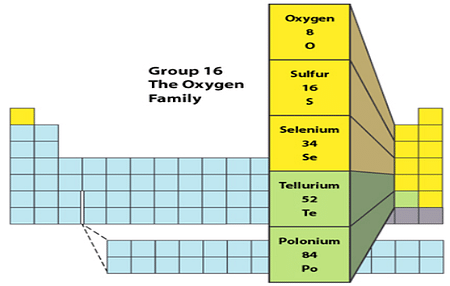
Group 16 Oxygen Family
- Oxygen: We all know what oxygen is, an odourless and colourless gas vital for sustenance. It is represented by O. It can react with many other elements and form oxides.
- Sulphur: Sulphur is a nonmetal that is represented by the letter S. Sulphur exists both in the free state as well as combined. In the form of sulphates, sulphur occupies 0.09% of seawater.
- Selenium: Selenium is very rare and exists in a combined state with heavy metals. It can also be found in the free state. The most stable existence of selenium is in grey metallic form.
- Tellurium: Tellurium shows properties that are between metals and non-metals. While it can be found in a free state, it is also shown to be in compounds with lead, copper, silver and gold.
- Polonium: Polonium is the rarest out of the Group 16 elements and is also radioactive. It is used in scientific applications for alpha radiation.
Read More: Oxoacids of Sulphur
Electronic Configuration of Group 16 Elements
[Click Here for Sample Questions]
For the elements of Group 16, the outermost shell shows ns2np4 as the general configuration. The electronic configuration of each member is shown in the table below:
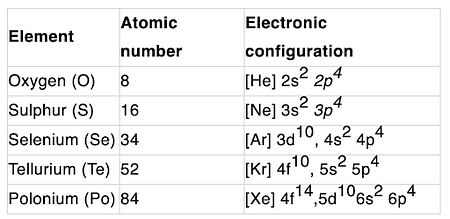
Electronic configuration
Also Read:
| Related Articles | ||
|---|---|---|
| p Block Elements Ncert Solutions | The p-Block Elements Important Questions | P-Block Elements MCQ |
Size of Group 16 Elements
[Click Here for Sample Questions]
As we move along the group vertically, the atomic and ionic size increases. This is because the number of shells also increases as we move down. A peculiar fact to note is that the oxygen atom is extraordinarily small.

Ionisation Enthalpy of Group 16 Elements
[Click Here for Sample Questions]
When you go from top to bottom, the ionisation enthalpy decreases. This happens because the size increases when going down the group. In comparison to the elements in Group 15, the elements of Group 16 in the corresponding periods have lower ionisation enthalpy. This occurs due to Group 15 Elements having half-filled p orbital electron configurations which are extra stable.
Read More: Organometallic Compounds
Electron Gain Enthalpy of Group 16 Elements
[Click Here for Sample Questions]
Oxygen is compact in nature and has less negative electron gain enthalpy than sulphur. But if you look at the rest of the group, the electron gain enthalpy becomes negative as you go down.
Additionally, the electronegativity decreases in proportion to the incense in atomic number. It can be further said that when moving from oxygen to polonium, the metallic character increases.
Read More: Sulphuric Acid
Physical Properties of Group 16 Elements
[Click Here for Sample Questions]
When looking at elements of Group 16, here are a few points to note:
- The non-metals of the group are oxygen and sulphur.
- There are two metalloids namely selenium and tellurium.
- The radioactive element polonium is a metal and is also short-lived.
- These elements exhibit what is called allotropy i.e they have two or more forms.
- The melting and boiling points increase moving vertically down the group.
Read Also: Inner Transition Metals

Table showing Physical Properties of Group 16 Elements
Chemical Properties of Group 16 Elements
[Click Here for Sample Questions]
- Reactivity with Hydrogen: The elements belonging to Group 16 react with hydrogen to form hydrides. The formula is H2E where E can be O, S, Se, Te or Po.

Chemical Properties of Group 16 Elements
- Reactivity with Oxygen: These elements for oxides with type EO3 or EO2. As mentioned earlier, E can be O, S, Se, Te or Po. Among the oxides, ozone and Sulphur Dioxide exist as gases while selenium dioxide is shown to be solid.
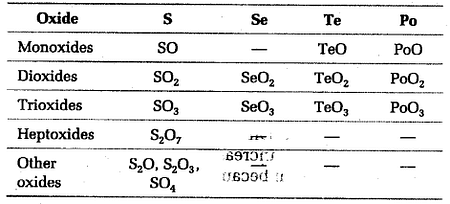
Reactivity with oxygen
- Reactivity towards halogens: Halides can be formed with types EX6, EX4, and EX2. E denotes a lament of Group 16 while X represents a halogen.
Read Also: Group 18 Elements
Things to Remember
- The topic “Group 16 Elements” is covered in p-Block Elements. This comes under Unit 7.
- The entire unit will carry around 5-6 marks in the board exam.
- The Group 16 elements are Oxygen, Sulphur, Selenium, Tellurium and Polonium.
- The atomic size increases from oxygen to Polonium.
- The metallic character decreases down the group.
- They chemically form hydrides, oxides and halides.
- Among Group 16 elements, Oxygen shows anomalous behaviour.
Read Also: Isomerism in Coordination Compounds
Sample Questions
Ques. Explain the occurrence of Group 16 elements. (3 marks)
Ans. When looking at the elements of Group 16, it is obvious that the most abundant would be oxygen which constitutes 46.6% of the earth’s crust. If we look at oxygen by volume of dry air, it is about 20.946%. For sulphur, the range is between 0.03-0.1% and is found in volcanoes as sulphides, organic materials such as hair, mustard, wood etc and as sulphates like gypsum, epsom, baryte etc. Selenium and tellurium are in metal selenides and tellurides while polonium occurs as one of the decay products of uranium and thorium.
Ques. Oxygen shows anomalous behaviour. Elucidate. (2 marks)
Ans. Oxygen shows anomalous behaviour due to its size, which is small. Another contributing factor is its high electronegativity. Take H2O which shows strong hydrogen bonding which is not found in H2S.
Ques. How can dioxygen be prepared? (4 marks)
Ans. There are different methods to obtain dioxygen as shown below:
- When you heat salts that contain oxygen such as nitrates, chlorates and permanganates.

- From the thermal decomposition of oxides of metals low in electrochemical series as well as higher oxides of some other metals.
- Using catalysts like finely divided metals and magnesium dioxide in the decomposition of hydrogen peroxide into water and dioxygen.
- Electrolysis of water
Ques. What is Ozone? (2 marks)
Ans. Ozone is a compound found in the upper layer of the atmosphere. It is an important compound that safeguards the crust from excessive UV radiation. Ozone is also an allotrope of oxygen. In pure form, ozone is a pale blue gas, in liquid form, it is dark blue and a violet-black solid. The ozone layer faces a threat from CFCs such as freons, aerosols and refrigerants.
Ques. What are chalcogens? (2 marks)
Ans. Wilhelm Blitz and Werner Fisher are credited with first using the term chalcogen. They referred to group 16 of elements as such in 1932. The compounds of the oxygen family are thus called chalcogenides.
Ques: What are the chemical properties of group 16 elements? (3 marks)
Ans. The chemical properties of group 16 elements are:
- Reactivity with Hydrogen: The elements belonging to Group 16 react with hydrogen to form hydrides. The formula is H2E where E can be O, S, Se, Te or Po.
- Reactivity with Oxygen: These elements for oxides with type EO3 or EO2. As mentioned earlier, E can be O, S, Se, Te or Po. Among the oxides, ozone and sulphur dioxide exist as gases while selenium dioxide is shown to be solid.
- Reactivity towards halogens: Halides can be formed with types EX6, EX4, and EX2. E denotes a lament of Group 16 while X represents a halogen.
Ques: State the physical properties of group 16 elements. (3 marks)
Ans. The physical properties of the group 16 elements are as follows:
- The non-metals of the group are oxygen and sulphur.
- There are two metalloids namely selenium and tellurium.
- The radioactive element polonium is a metal and is also short-lived.
- These elements exhibit what is called allotropy i.e they have two or more forms.
Ques: Oxygen is a gas but sulphur is a solid. Give reasons. (1 mark)
Ans. Due to the formation of Pπ-Pπ oxygen exists as O=O molecule, while sulphur exists as S8.
Ques: Sulphur has greater tendency for catenation than oxygen in the same group. Give reasons. (1 mark)
Ans. Due to the larger atomic size of sulphur (S), less repulsion in S-S bond than O-O bond, sulphur has greater tendency for catenation than oxygen in the same group.
Ques: Why does Oxygen have less electron gain enthalpy with negative sign than sulphur? (2 marks)
Ans. Electron gain enthalpy of oxygen = -141 kJ/mol
Electron gain enthalpy of sulphur = -200 kJ/mol
Therefore, electron gain enthalpy of sulphur is more than oxygen due to greater inter electronic repulsion in O than S which leads to the smaller size of O than S.
Ques: Arrange the hydrides of group 16 in increasing order based on their acidic character. Justify your answer.
Draw structure of XeOF4. (Comptt. Delhi 2017)
Ans. a. H2O < H2S < H2Se < H2Te
As we move down the group, the bond dissociation enthalpy decreases because of the increase in bond length and size of the central atom.

Square pyramidal
Ques: Why the elements of Group 16 generally show lower value of first ionization enthalpy compared to the corresponding periods of Group 15.
What happens when:
(i) Concentrated H2SO4 is added to CaF2?
(ii) In the presence of charcoal, sulphur dioxide reacts with chlorine?
(iii) Ammonium chloride is treated with Ca(OH)2? (Comptt. All India 2015)
Ans. a. The elements of group 16, i.e., oxygen family have general electronic configuration of ns2np4 whereas elements of group 15, i.e., nitrogen family has a general electronic configuration of ns2np3 and this is a relatively stable half-filled configuration with high exchange energy and thus requires more ionization energy in order to release electrons from this stable configuration.

For Latest Updates on Upcoming Board Exams, Click Here: https://t.me/class_10_12_board_updates
Check-Out:




Comments