



Arts and Board Exam Specialist | Updated On - Dec 11, 2025
Metabolites are the intermediates and end products of all metabolic processes. It is the sum of all biochemical operations performed during an organism's metabolic cycle. Metabolites are the end products and intermediates produced by metabolic activities.
- They are classified as biomolecules that are formed during metabolism.
- There are three types of metabolites, namely plants, humans and microbial metabolites.
- They are essential for the growth of plants and microorganisms.
- Plants produce two types of metabolites, primary and secondary metabolites.
Related Links:
What are Metabolites?
Metabolites are small organic molecules produced during various biochemical reactions in living organisms. They may act as:
- Intermediates (e.g., glucose–6–phoshate)
- End Products (e.g., lactic acid).
- Precursors for synthesis(e.g., acetyl-CoA).
These molecules are the functional output of metabolism, reflecting the real-time biochemical status of a cell, tissue, or organism.
Primary, Secondary, & Human Metabolites Video Explanation
Major Types of Metabolites
There are three types of major metabolites, namely Primary Metabolites, Secondary Metabolites and Human Metabolites, which are discussed in detail below:
Primary Metabolites
Primary Metabolites play an important role in the organism's growth, development, and reproduction. They are created as a result of energy metabolism during the growth phase. Here are some important roles of primary metabolites in living beings:
- Essential for growth, development, and survival
- Produced in large quantities
- Act as intermediate products in anabolic metabolism
- Also used in the pharmaceutical and cosmetic industries
Examples:
Amino acids, nucleotides, chlorophyll precursors, and ethanol (in yeast). Vitamins.
Secondary Metabolites
Secondary metabolites are organic substances that are created by altering primary metabolite synthases. Unlike primary metabolites, they do not play a role in growth, development, or reproduction. Here are some important roles of secondary metabolites in living beings:
- Created at the end of or near the stationary period of growth
- Not essential for survival, but it helps in ecological interactions
- Often species-specific
- Used widely in medicine, agriculture & biotechnology
Examples:
Alkaloids (morphine, codeine), terpenoids, flavonoids, essential oils, and antibiotics (penicillin).
Difference between Primary and Secondary Metabolites
The difference between primary and secondary metabolites is as follows:
| Primary Metabolites | Secondary Metabolites |
|---|---|
| Primary Metabolites are formed during the growth phase. | Secondary Metabolites are formed during the stationary phase. |
| They are used for the growth and development of cells. | They are not involved in the growth and development of cells. |
| These metabolites are necessary for the survival and growth of organisms. | These metabolites are necessary for specialised functions. |
| Examples include carbohydrates and ethanol. | Examples include phenolics and pigments. |
Human Metabolites
Human metabolites are a type of metabolites found as end products during the body’s normal chemical processes. A total of 2500 biomolecules have been identified in humans. Metabolites involved in human physiology, including:
- Energy metabolites: glucose, pyruvate, lactate
- Lipid metabolites: fatty acids, cholesterol derivatives
- Amino acid metabolites: urea, creatinine
- Hormonal metabolites: cortisol metabolites, thyroid hormone derivatives
- Gut microbiome metabolites: SCFAs(butyrate), TMAO,indoles
Also Read:
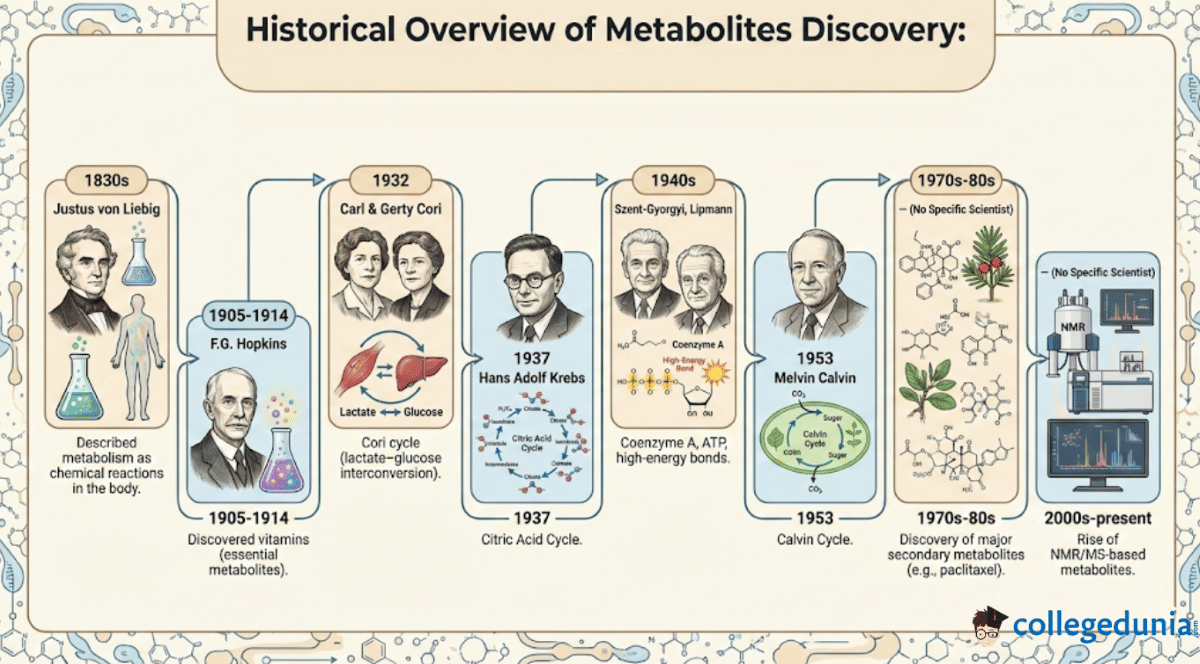
Historical Overview of Metabolites Discovery
The discovery of Metabolites dates back a long history beginning from the 1830s. The contributions of different scientists led to the discovery of all types of metabolites that are in use for various purposes, such as biochemical processes, pharmaceuticals, and large-scale industries.
| Year | Scientist(S) | Contribution |
|---|---|---|
| 1830s | Justus von Liebig | Described metabolism as chemical reactions in the body |
| 1905-1914 | F.G.Hopkins | Discovered vitamins (essential metabolites) |
| 1932 | Carl & Gerty Cori | Cori cycle (lactate–glucose interconversion) |
| 1937 | Hans Adolf Krebs | Citric Acid Cycle |
| 1940s | Szent-Gyorgyi, Lipmann | Coenzyme A, ATP, high-energy bonds |
| 1953 | Melvin Calvin | Calvin Cycle |
| 1970s-80s | — | Discovery of major secondary metabolites (e.g., paclitaxel) |
| 2000s-present | — | Rise of NMR/MS-based metabolites |
Also Check:
Why Metabolites in Biology Matter for NEET & PCB Aspirants?
Direct questions appear from the Biomolecules, Plant Secondary Metabolites, and Human Physiology chapters. Important for Plant Physiology (photosynthesis), Respiration, Digestive System, and Microbes in Human Welfare.
Importance of Metabolites in Modern Biology
Metabolomics (2025 Perspective)
- Study of complete metabolite sets
- Most accurate indicator of phenotype
- Used in early disease detection & personalised medicine
Medical Diagnostics
- Diabetes – altered glucose, ketone bodies
- Cancer — oncometabolites (2- 2-hydroxyglutarate)
- Newborn screening — PKU (high phenylalanine)
Drug Discovery
- –70% of antibiotics & – 60% anticancer drugs originate from secondary metabolites (paclitaxel, penicillin, doxorubicin)
Gut Microbiome
Microbial metabolites affect:
- Immunity
- Brain function
- Heart health
- Glucose homeostasis
Agriculture & Biotechnology
- Golden Rice (β-carotene)
- Plant metabolites for stress tolerance & pest resistance
Important MCQs on Metabolites: Primary, Secondary & Human Metabolites
- Which of the following is a primary metabolite?
- Morphine
- Codeine
- Lactic acid
- Nicotine
Answer: C
2. Penicillin is produced by:
- Virus
- Fungus
- Bacteria
- Protist
Answer: B
3. Which metabolite accumulates in PKU?
- Tyrosine
- Phenylalanine
- Tryptophan
- Methionine
Answer: B
4. Golden rice is enriched in which metabolite?
- Anthocyanins
- Flavonols
- β-Carotene
- Lycopene
Answer: C
5. Which one is NOT a secondary metabolite?
- Terpenoids
- Flavonoids
- Amino acids
- Essential oils
Answer: C
6. Oncometabolite found in IDH-mutant gliomas:
- Fumarate
- 2-hydroxyglutarate
- Citrate
- Acetyl-CoA
Answer: B
7. SCFAs like butyrate are produced by:
- Plant cells
- Human liver
- Gut bacteria
- Muscle cells
Answer: C
Short-Answer Type Questions (2 Marks)
Ques. What are secondary metabolites? Give two examples.
Ans. Non-essential molecules involved in ecological interactions; species-specific.
Examples: Alkaloids (morphine), terpenoids, flavonoids.
Ques. How is metabolomics helpful in medicine?
Ans. Here are some of the important aspects of metabolomics in the field of medicine, given below:
- Identifies disease-specific metabolites
- Helps in early diagnosis (e.g., cancer oncometabolites)
- Predicts drug response (pharmacometabolomics)
Ques: What happens when milk is converted into curd or yoghurt, from your understanding of proteins?
Ans: Milk is converted into curd or yoghurt due to the denaturation of proteins. In denaturation, disruption of bonds that maintain secondary and tertiary structure leads to the conversion of globular proteins into fibrous proteins. This involves a change in the physical, chemical and biological properties of protein molecules.
Ques: Why are biomolecules called metabolites?
Ans: Metabolites are a specific category of biomolecules involved in metabolism. Metabolism is the complex network of biochemical reactions that occur within cells, converting food into energy and other cellular components. These biomolecules play a role in functions such as energy production, stimulation, inhibition, and defence, among humans, plants, and other organisms.
Long-Answer Type Questions (3 Marks)
Ques: Describe the major classes of secondary metabolites and their significance.
Ans: Secondary metabolites include:
- Alkaloids: morphine, nicotine — medicinal & defensive
- Terpenoids: taxol, menthol — antimicrobial, aromatic
- Phenolics: flavonoids — antioxidants
- Essential oils: aroma compounds
Significance: defence, signalling, pollinator attraction, and drug discovery.
Ques: Explain the role of microbial metabolites in human health.
Ans: Gut microbes produce SCFAs ( butyrate, acetate), vitamins, TMAO & indoles. These influences:
- Gut immunity
- Glucose metabolism
- Brain function
- Cardiovascular health
Dysregulation causes metabolic disorders.
Ques: How can you determine the purity or homogeneity of a protein if you are given a method to determine which amino acid is at either of its two termini (ends)?
Ans: There are several methods provided by several scientists to find out the sequence of amino acids. Frederick Sanger proposed Sanger’s reagent to determine the amino acid sequence in a polypeptide chain.
- Sanger used 1-fluoro-2, 4-dinitrobenzene (FDNB) to determine insulin structure.
- FDNB specifically binds with the N-terminal amino acid to form a dinitrophenyl (DNP) derivative of the peptide.
- This DNP-derivative peptide can be identified by chromatography.
- The identified sequence of amino acids shows the homogeneity of a protein molecule.
Ques: What is meant by the tertiary structure of proteins?
Ans: The helical polypeptide molecule may fold on itself and assume a complex but specific form-spherical, rod-like or any form in between these. These geometrical shapes are known as tertiary (3°) structures of protein molecules.
- The coils and folds of the polypeptide molecules are so arranged as to hide the non-polar amino acid chains inside and to expose the polar side chains.
- The tertiary structure of a protein brings distant amino acid side chains nearer to form active sites of enzymatic proteins.
- It is maintained by weak bonds such as hydrogen, ionic, disulphide and hydrophilic – hydrophobic bonds, formed between one part of a polypeptide and another.
- This structure is easily disrupted by pH, temperature and chemicals stopping the function of proteins.
Ques: How can you build models of biomolecules using commercially available atomic models (Ball and stick models)?
Ans: Yes, models of biomolecules can be prepared using commercially available atomic models.Ball and stick models and space-filling models are 3D or spatial molecular models which serve to display the structure of chemical products and substances or biomolecules.
- With ball and stick models, the centres of the atoms are connected by straight lines which represent the covalent bonds.
- Double and triple bonds are often represented by springs which form curved connections between the balls.
- The bond angles and bond lengths reflect the actual relationships, while the space occupied by the atoms is either not represented at all or only denoted essentially by the relative sizes of the spheres.




Comments