



Education Content Expert
Soil is the uppermost layer of the earth’s crust made up of rocks, organic matter, water, gases, and air. It is formed as a result of weathering. Soil is one of the most important natural resources as it helps in the production of crops. It also provides all the necessary nutrients to the plants required for photosynthesis. It is a natural habitat of many living organisms.
There are various types of soil depending upon the climate, landscape, and vegetation of a particular place. The type of soil is also affected by the time of its formation. Clayey Soil, Loamy Soil, Sandy Soil, Black Soil, and Red Soil are the most common types of soil used for crop production and agriculture.
Read More: NCERT Solutions for Class 7 Science Soil
Key Terms: Soil, Crops, Soil Formation, Weathering, Clayey Soil, Loamy Soil, Sandy Soil, Climate, Crop Production
What is Soil?
[Click Here for Sample Questions]
Soil is defined as a mixture of organic and inorganic materials on the surface of the earth that provides a suitable medium for the growth of plants and crops. It contains minerals, organic matter, gases, and living organisms. In simpler terms, it refers to any loose sediment. The type of crop that would be grown on a particular type of soil is determined by the components of the soil and the climate of the particular region.

Soil
Soil Formation
[Click Here for Sample Questions]
Soil Formation is a very long natural process. Soil is formed by the weathering of the rocks into small fragments. The parent rock is exposed to the atmosphere during the physical and chemical decomposition process and breaks down to form soil. Thus, the properties of soil are determined by parent rock and the phase of soil formation.
Factors Affecting Soil Formation
Some factors that affect the process of soil formation are:
- Topography
- Climate
- Parent Materials
- Organisms
- Time
Read More: Rock Cycle
Functions of Soil
[Click Here for Sample Questions]
Soil is a very important natural resource essential for the survival of all living beings. It plays a significant role in life on Earth. It performs various important functions such as
- Soil provides a growth medium for plants and essential crops.
- It acts as a modifier of the earth’s (climate) atmosphere.
- It helps to store, purify and provide water.
- It provides a natural habitat for living organisms such as microbes.
- It provides the basis for the survival of life.
Types of Soil
[Click Here for Sample Questions]
Soil can be classified into various types depending upon the process of its formation and the properties of the parent material (usually rocks). Every type of soil has unique characteristics and is ideal for growing only certain types of crops.
Soil can be classified based on two major characteristics:
- Based on Size of Particles
- Based on Color and Other Attributes
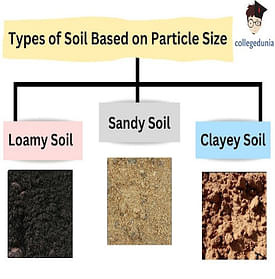
Types of Soil Based on Particle Size
Types of Soil Based on Size of Particles
Given below is a tabular representation of the various types of soil based on the particle size along with the crops that are grown in that particular soil:
| Types of Soil | Properties / Characteristics | Suitable Crops |
|---|---|---|
| Loamy Soil | Consists of sand, clay, and silt. | Wheat, Sugarcane, Cotton, Jute, Pulses, Oilseeds, and Vegetables. |
| Contains good content humus. | ||
| Has a good water-holding capacity with sufficient aeration. | ||
| Sandy Soil | Contains more than 60% sand and clay. | This soil is not good for plants. Melon and coconut can be grown in sandy soil. Cactus also grows in this soil. |
| Porous as there is very little clay and silt. | ||
| Water building capacity is very poor. | ||
| Lot of air is present in sandy soil. | ||
| Clayey Soil | Consists of very fine particles of clay. | Good for crops requiring lots of water like paddy. Also used to make toys, pots, etc. |
| Water holding capacity is very high. | ||
| Has very little air and is rich in organic matter. |
Read More: Crop Production and Management
Types of Soil Based on Color & Other Attributes
There are different types of soil that can be further classified on the basis of their color, texture, and other characteristics such as alluvial soil, red soil, black soil, etc.

Types of Soil Based on Color & Other Attributes
The types of soil based on color and other characteristics are listed below along with the crops grown:
| Types of Soil | Properties / Characteristics | Suitable Crops |
|---|---|---|
| Alluvial Soil | Composed of clay and (loam) sand. | Tobacco, Cotton, Rice, Wheat, Bajra, Jowar, Pea, Pigeon Pea, Chickpea, Black Gram, Green Gram, Soya, Groundnut, Mustard, Barley, Jute, Maize, Oilseeds, Vegetables, and Fruits. |
| Rich in nutrients such as phosphoric acid and organic matter (humus). | ||
| Low in both nitrogen and potash. | ||
| Appears to be more sandy and drains properly faster than other soils. | ||
| Black Soil | Formed from lava rocks and is black in color. | Cotton, Sugar Cane, Wheat, Jowar, Linseed, Sunflower, Cereal Crops, Citrus Fruits, Tomatoes, Tobacco, Groundnut, and Oilseeds. |
| Also known as Back Lava Soil and is rich in clay. | ||
| Rich in aluminum, iron, lime, and magnesium. | ||
| Poor in phosphorus, nitrogen, and humus (organic matter). Becomes sticky on wetting and develops large cracks during the dry season. | ||
| Laterite Soil | This soil is acidic. | Cotton, Rice, Rubber, Coconut, Wheat, Pulses, Tea, Coffee, and Cashews. Used to make bricks also. |
| Low in humus, phosphorus, nitrogen, and calcium. | ||
| Are highly rich in iron. | ||
| Red Soil | Formed due to weathering of metamorphic rocks. | Rice, Wheat, Sugarcane, Maize, Groundnut, Ragi, Potato, Oilseeds, Pulses, Millet, Fruit (Mango, Orange, Citrus), and Vegetables. |
| Red in appearance due to the presence of iron oxide. | ||
| The soil is sandy and mildly acidic, and potash-rich. | ||
| Very low in lime, phosphorus, phosphorous, magnesium, and organic matter. | ||
| Forest & Mountain Soil | Rich in organic matter. | Tea, Spices, Wheat, Maize, Barley, Coffee And Tropical Fruits, and Temperate Fruit Cultivation. |
| Low in nutrients like potash, phosphorus, and lime. | ||
| Are acidic in nature. | ||
| Need the addition of the right fertilizers. |
Soil Erosion
[Click Here for Sample Questions]
Soil erosion refers to the exploitation or washing out of the top layer of soil comprising more nutrients and organic matter (humus) to sustain the ecosystem.
- Various factors be it natural or man-made can cause soil erosion.
- Heavy floods, ice production, and landslides are some natural factors causing soil erosion.
- Man-made causes include plowing, crop shifting, deforestation, and overgrazing. The following results in soil erosion.
- Soil erosion reduces the water holding capacity of soil and leads to loss of nutrients.
Things to Remember
- Soil is the loose surface material that covers the topmost layer of the earth’s crust.
- It is made up of gravel, sand, silt, clay particles, and organic matter.
- Soil Formation refers to the process by which soil is formed through weathering.
- On the basis of the particle size and texture, the soil has three types namely Loamy Soil, Clayey Soil, and Sandy Soil.
- On the basis of color and other characteristics, soil can be classified into Alluvial Soil, Black Soil, Red Soil, Laterite Soil, etc.
- Soil helps in the production of crops, is a source of water and nutrients, and acts as a natural habitat for living organisms.
Sample Questions
Ques. What are the types of soil? (3 Marks)
Ans. Soil can be classified into various types depending upon its particle size, color, and other characteristics.
Types of Soil Based on Particle Size/Texture
- Sandy Soil
- Clayey Soil
- Loamy Soil
Types of Soil Based on Colour and Other Attributes
- Red and Yellow Soil
- Black Soil
- Alluvial Soil
- Laterite Soil
- Arid Soil
- Mountain and Forest Soil
- Desert Soil
Ques. What is Alluvial soil? Where is it found in India? (3 Marks)
Ans. Alluvial soil is considered to be the most fertile soil that can be used to grow crops. It is rich in nutrients such as phosphoric acid and organic matter. It is a blend of clay and sand.
Alluvial soils are found mainly in the northern Indian delta areas such as Uttar Pradesh, Punjab, Haryana, etc, They cover over 35 percent of India’s total land. Crops like cotton, rice, wheat, bajra, chickpea, black gram, green gram, soya, groundnut, mustard, linseed, sesame, vegetables, and fruits can be grown in this soil.
Ques. What are the various minerals present in the soil? (3 Marks)
Ans. Soil is very rich in minerals that are essential in growing crops and for the living organisms present in it. The soil consists of primary minerals and secondary minerals.
- Primary Minerals: Calcium, Sodium, Aluminium, Magnesium, and Iron.
- Secondary Minerals: Clay and Mineral Oxides.
Ques. What are the impacts of soil erosion? (3 Marks)
Ans. The impacts of soil erosion are:
- It reduces the water holding capacity of the soil.
- It leads to the loss of nutrients.
- Soil erosion reduces the water infiltration process.
- The topsoil is not removed uniformly during erosion and it becomes difficult to apply fertilizers and chemicals.
Ques. What is Soil Testing? (3 Marks)
Ans. Soil Testing is a process that involves the analysis of soil samples to assess nutrient content, structure, and other characteristics such as acidity or pH level. It is usually adapted by commercial crop growers before beginning a plantation. It allows them to determine the deficiencies in nutrients and micro-nutrients and the farmers could add these nutrients accordingly to make the soil fertile. It helps in better crop production and yield.
Ques. List any five crops grown in the following soils: (3 Marks)
(1) Loamy Soil
(2) Black Soil
(3) Red Soil
(4)Sandy Soil
(5) Clayey Soil
Ans. The crops grown in the particular soils are
- Loamy Soil: Wheat, Gram, Sugarcane, Jute, Vegetables
- Black Soil: Cotton, Sugarcane, Tobacco, Wheat, Oilseeds
- Red Soil: Groundnuts, Pulses, Millet, Cotton, Tobacco
- Sandy Soil: Cactus, Melon, Coconut, Millets, Barley
- Clayey Soil: Wheat, gram, Paddy, Lentils, Pulses
Ques. Explain soil profile and horizons. (3 Marks)
Ans. Soil is composed of various layers known as “Horizons”. These layers form a soil profile. Soil profile shows the full history and ingredients of soil formation. There are typically 6 horizons in a soil profile:
- O (Organic Matter or Humus)
- A (Top Soil)
- E (Eluviated layer)
- B (Subsoil)
- C (Parent Material)
- R (Bedrock)
Ques. What are the inorganic components of soil? (3 Marks)
Ans. Inorganic material is one of the major components of soil. It comprises mineral particles with specific physical and chemical properties that depend on the parent material and conditions under which the soil was formed. Soil’s physical properties such as texture are determined by the inorganic fraction of soils and they have a large effect on structure, density, and water retention.
Ques. Name the best type of Soil for Agriculture. (2 Marks)
Ans. The best type of soil for agriculture considered to be effective for crop production is loamy soil. Loamy soil is a mixture of silt, clay and sand. It offers a lot of benefits to the crop with higher nutrient availability, water holding potential and excessive organic count for their greater growth.
Ques. What is meant by weathering? (1 Mark)
Ans. Weathering refers to the breakdown of rocks, minerals or soil when they come in contact with biological organisms, atmospheric gasses and water on the surface of earth.
Check-Out:



Comments