



Education Journalist | Study Abroad Strategy Lead
Static friction is mainly concerned with the frictional force applied on a body or an object and acts as a resistive force that is responsible for keeping the object at rest. It is known as a self-regulating force. The value of the static friction ranges between zero and the smallest value of force that is needed by the body to start the motion. The static friction formula is the product of the coefficient of static friction and the normal force. In this article, we will read about the static friction formula, and look at some related solved examples.
Read More: Types of Friction
| Table of Contents |
Key Takeaways: Static Friction, Coefficient of static friction, Friction, Formula, frictional force, resistive force, normal force.
What is Static Friction?
[Click Here for Sample Questions]
A type of frictional force that is resistive in nature, which after being applied on a body or an object at rest, is characterized as static friction.
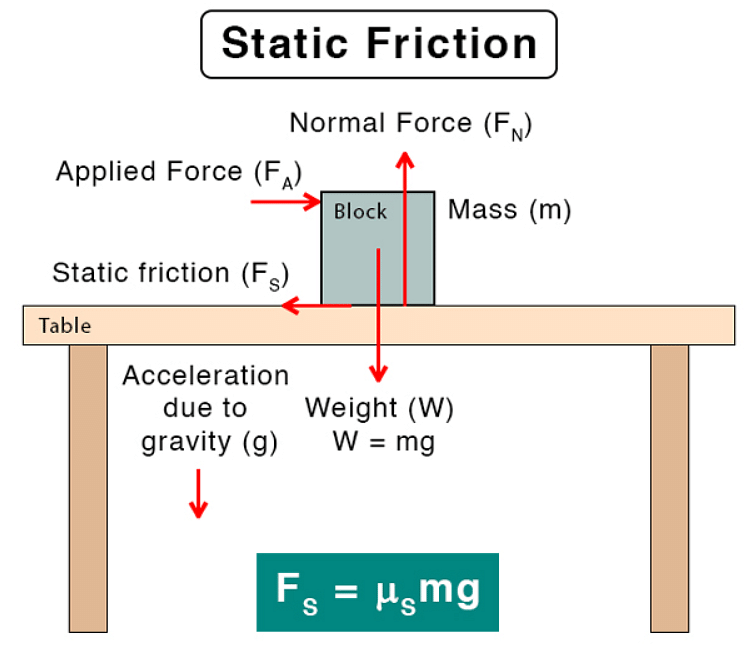
Static friction
Read More: Coefficient of Static friction
Static Friction Formula
[Click Here for Sample Questions]
The formula of the static friction mainly helps in calculating the frictional force and its coefficient. The formula for the same can be written as the following.
Fs = μs × Fn
Here,
Fs refers to the static friction
μs refers to the coefficient of static friction
Fn refers to the normal force
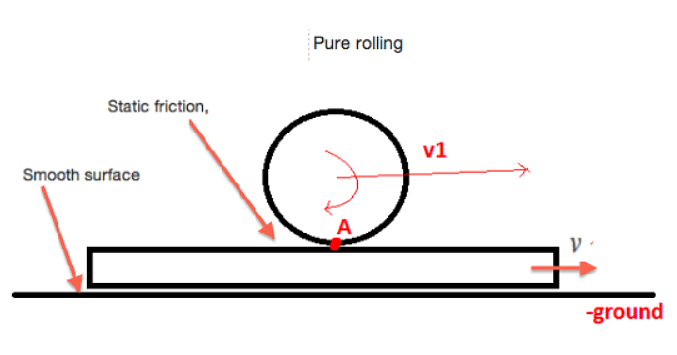
Work done by static friction
Read More About
Static frictionWhat is the Coefficient of the Friction?
[Click Here for Sample Questions]
The amount of friction generated is mainly based on the nature of the objects or the bodies in contact with one another. For instance, the denser and the concrete objects are known for generating a greater amount of frictional force.
Therefore, the coefficient of friction majorly measures that how easily one object or body moves with respect to another. This shall be understood via the value of the coefficient of the friction, such as, if the value of the coefficient of friction is high, then the amount of friction between the objects is greater. However, the coefficient of friction does not represent any absolute unitary value.
Also Read:
Solved Examples
[Click Here for Sample Questions]
Let us now look at some solved examples related to the static friction formula:
Example 1: Calculate the static friction if the actual force acting upon some car of 100kg is 200 N. However, the car remains in the static position. Given is the coefficient of friction, that is, 0.2.
Solution. Given: Normal force, Fn = 200N,
Coefficient of friction, μs = 0.2,
Therefore, Static friction shall be
Fs = μs × Fn
= 0. 2 × 200N
= 40 N
So, the static friction will be 40 N.
Example 2: Calculate the static friction if the coefficient of friction is given as 0.2. And the force of 300 N is acting on a TV box of 2 kg lying still on the floor.
Solution. Given: Fn (Normal force) = 300 N,
μs (Coefficient of friction) = 0.2,
Static friction is given by Fs = μsFn
= 0.2 × 300 N
Fs = 60 N.
Things to Remember
- The frictional force works completely against the movement of the body.
- In general, force is responsible for the movement of any body in rest, but static friction is a kind of resistive force that prevents movement.
- The formula of the static friction mainly helps in calculating the frictional force and its coefficient.
- The formula for the static friction can be written as Fs= μs × Fn
- The coefficient of friction measures that how easily one object or body moves with respect to another.
Sample Questions
Ques. Calculate the static friction if the actual force acting upon some box of 5kg is 300 N. However, the box remains in the static position. Given is the coefficient of friction, that is, 0.3. (3 marks)
Ans. Given: Normal force, Fn = 300N,
Coefficient of friction, μs = 0.3,
Therefore, Static friction shall be
Fs = μs × Fn
= 0.3 × 300N
= 90 N
So, the static friction will be 90 N.
Ques. Calculate the friction coefficient if 100 N is the value of the static frictional force. And a toy car of mass 4 kg is being pushed by a person but it remains at the static position. (5 marks)
Ans. Given: Mass, m = 4 kg,
Static frictional force, Fs = 100N,
Normal force, Fn = m × g
Fn = 5 × 10, now for acceleration due to gravity,
G = 10 ms−2
Hence, Fn = 50N
Now, Formula is,
Fs = μs × Fn
After rearranging it,
μs = Fs x Fn
On Putting the values,
μs =100/50
μs =2
Therefore, the friction coefficient is 2.
Ques. Calculate the static friction if the coefficient of friction is given as 0.3. And the force of 200 N is acting on a snack box of 5 kg lying still on the floor. (3 marks)
Ans. Given: Fn (Normal force) = 200 N,
μs (Coefficient of friction) = 0.3,
Static friction, Fs = μsFn
= 0.3 × 200 N
Fs = 60 N
Ques. Calculate the friction coefficient when Amy is hauling a toy car of mass 4 kg which was at rest earlier on the floor. And if the given value of the static frictional force is 50 N. (2 marks)
Ans. Given: m (Mass) = 4 kg,
Fs (static frictional force) = 50 N,
Fn (Normal force) = mg
= 4 Kg × 9.8 m/s2
Fn = 39 N
μs = Fs/Fn
μs = 50/39
μs = 1.282
Ques. If a conveyor is dumping sand onto a cone-shaped pile. Find the maximum angle θ if the given coefficient of static friction between the sand grains is μs. (3 marks)
Ans. Given, the maximum sliding angle = θ
The acting force of gravity on the block is F1 = Mgsinθ
The maximum friction force that is opposing the sliding force is F2 = Mgcosθμs.
At some angle θ, the block will eventually be on the verge of sliding off.
This is the maximum angle θ and this will happen when F1 = F2.
Therefore, the θmax = a tan(μs)
Ques. If the shear strength of each bolt is 5000 lbs of the two boards that are bolted together with two bolts. And the squeeze force between the boards is 500 lbs. The coefficient of static friction between the boards is μs = 0.5, what is the maximum force F that can be applied to the boards and not pull them apart? Find the static friction. (3 marks)
Ans. In order to pull the boards apart, the shear strength the bolts have and the friction force between the boards must exceed. Therefore, the maximum pull force must be of value below the force needed to do this.
Hence, Fmax = 2 × 5000 + 500 × 0. 5.
Fmax = 10250 lbs
Also Read:



Comments