



Content Curator
Types of plastics are broadly classified into thermoplastics and thermosetting plastics. Plastic is a polymer that can be molded when it is soft and hardened to hold a particular shape. A plastic is an organic compound with a higher molecular weight. Due to its non-reactive properties and durability, it is the most used polymer worldwide. There are different types of plastics, for example- polythene, Nylon and many more. Based on the applications, plastics can be further classified as commodity, engineering and high-performing plastics.
The first plastic was made in the year 1869 in a New York firm by John Wesley Hyatt. Hyatt provided a substitute for the ivory being used on the billiards by treating cellulose, derived from cotton fiber, with camphor. The product obtained could be molded into a variety of shapes and was capable of imitating natural substances like tortoiseshell, horn, linen, and ivory.
Read More: Synthetic polymers
| Table of Content |
Key Terms: Plastic, Polymer, Carbon Chain, Organic Compound, Thermoplastic, Thermosetting Plastic
What is Plastic?
[Click Here for Sample Questions]
Plastic can be defined as a synthetic material made from a wide range of organic polymers such as polyethylene, PVC, nylon, etc.. The key characteristic of plastics is that it can be molded into shape while soft, and then set into a rigid or slightly elastic form.
- Plastic is a polymer that can be colored, reused, molded as per requirements.
- It carries a long chain of carbon as its core structure.

Long Carbon Chain in Plastics
Read More:
| Concepts Related to Plastics | ||
|---|---|---|
| Polymers | Polymerization | Monomers |
| Biopolymers | Condensation Polymerization | Synthetic Fiber |
Types of Plastic
[Click Here for Sample Questions]
Plastic can be divided in two categories-
- Thermoplastic
- Thermosetting Plastic
Thermoplastic
Thermoplastics are those types of plastics that can be easily molded at a certain temperature. It is also called Thermosoft Plastic. These plastics can be further divided into seven types-
Polyethylene Terephthalate
Polyethylene Terephthalate can be considered as a wrinkle-free plastic that is also known as PET.
- PET can be characterized as an aliphatic polyester.
- It is recyclable and can be reused.
- As PET has a unique ability to prevent Oxygen to get past it, it is hugely used in the packaging and textile industry.
- It is also used in packaging carbonated drinks as it stops Carbon dioxide from getting out of the bottle.
- PET is very light-weight and semi-crystalline in its stable form.
- Chemical Formula of PET is (C10H8O4)n
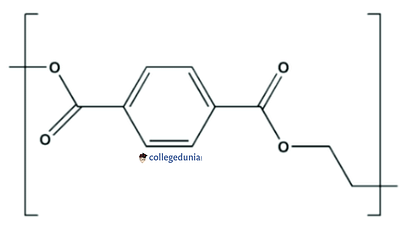
Structure of PET
Polyvinyl Chloride
Polyvinyl Chloride is one of the most economical and versatile thermoplastic polymers world-wide that is also known as PVC or Vinyl.
- German chemist Eugen Baumann incidentally invented PVC in 1872.
- There are two categories of PVC- Rigid PVC and Flexible PVC.
- Rigid PVC is the type of plastic mostly used in making doors, and windows. Flexible PVC is normally used in making pipes for plumbing.
- It is also used in the electrical industry.
- PVC has a melting point of 200-260 degrees celsius.

Structure of PVC
Polyethylene
Polyethylene, simply known as Polythene is the most used type of plastic. It is made by the process of polymerization of ethylene monomers.
- It is used in industries like- clear food packaging, shopping bags, detergent bottles as well as automobile fuel tanks.
- There are four types of Polythene- Low-density polyethylene, Medium-density polyethylene, High-density polyethylene, and Ultra-high molecular weight polyethylene.
- The melting point of polythene is between 115 degrees Celsius to 135 degrees Celsius.
- Density of Polythene varies between - 0.88 grams to 0.96 grams per cubic centimeter.
- Chemical Formula of Polythene is- (C₂H₄)ₙ

Structure of Polythene
Polypropylene
Polypropylene is defined as a type of plastic or synthetic resin that can be created as the result of polymerization of propylene. Therefore, propylene can be considered as the monomer of Polypropylene.
- It is non-polar.
- It has a melting point of 130-170 degrees celsius.
- Polypropylene is used in machinery industries as it is the key element of making plastic parts for the instruments.
- It is semi-crystalline.
- Rigidity is one of the prominent characteristics of Polypropylene.
- Chemical formula- (C3H6)n

Structure of Polypropylene
Polystyrene
Polystyrene is defined as a polymer that is created from a monomer called styrene. Styrene is a liquid hydrocarbon that is made from petroleum.
- This type of plastic is harmful for human beings and the environment.
- Polystyrene is made from three monomers- Acrylonitrile, Styrene, and Butadiene.
- The density varies between 1.06 to 1.08 grams.
- Polystyrene is hard and transparent, hence, it is used in the food-service industry.
- It is used in making containers, disposable eating utensils, and foamed cups, plates, bowls etc.
- Chemical formula- (C8H8)n

Structure of Polystyrene
Nylon
Nylon is a silk-like synthetic polymer made from polyamides that have high molecular weight.
- Nylon is known for its strong and elastic characteristics.
- Oil or other chemical particles have very little effect on Nylon.
- This type of plastic is of four types- Nylon 6, Nylon 510, Nylon 1,6 and Nylon 66.
- As it does not absorb water, it dries pretty quickly.
- It is wrinkle-proof.
- Mostly used in the fabric industry.

Structure of Nylon
Others
There are other type of plastics like polycarbonate (PC) which is also known as Lexan, Makrolon, and Makroclear. As PC is a toxic compound it is banned from use as the basic elements for making baby bottles, food can liners, ketchup containers etc. in many countries.
Thermosetting Plastic
Thermosetting Plastics are those type of plastics that can not be molded more than once. These are also known as thermosetting polymers.
- Bakelite, Cyanate esters, Duroplast, Epoxy resin, Fiberglass, Melamine are examples of Thermosetting Plastics.
- Once heated, it becomes very rigid.
- Thermosetting Plastics are mostly used in the manufacturing of construction equipment panels, insulators, and agricultural equipment.
- Once molded it these type of plastics rarely reacts with other chemicals.

Types of Plastics
Read More: Plant Fibers
Types of Plastic based on Application
[Click Here for Sample Questions]
The plastics can be mainly divided into three categories based on their usage as well-
Commodity Plastics
The Commodity Plastics do not show any special properties and have lower price rates. These type of plastics are mainly used in packaging industries. Polyethylene, Polypropylene, PVC etc are examples for this type of plastics.
Engineering Plastics
Due to their extraordinary thermal or mechanical properties these type of plastics are extensively used in engineering industries. Nylon is a perfect example of this category of Plastics.
High-Performance Plastics
These are the most expensive type of plastics as they are non-reactive to any chemical reactions. They are known for their strong, rigid and temperature-resistant properties. Polytetrafluoroethylene, Silicone, etc. are the most well-known examples of this category.
Read More: Thermosetting Polymers
Things to Remember
- Plastics can be divided into two categories- Thermoplastic and Thermosetting Plastic.
- The most important element of plastic is an organic compound with a higher molecular weight.
- Plastic is a polymer that can be colored, reused, and molded as per requirements.
- Thermoplastics are those plastics that can be easily molded at a certain temperature.
- Thermosetting Plastics are those type of plastics that can not be molded more than once.
Read More:
| Additional Concepts Related to Plastics | ||
|---|---|---|
| History of Clothing Material | Polyamides | Polytetrafluoroethylene (Teflon) |
| Fibre to Fabric | Yarn to Fabric | Cotton Cultivation |
| Wool | Cotton | Copolymer |
Sample Questions
Ques. What is Plastic? (2 Marks)
Ans. Plastic is basically a polymer that can be colored, reused, molded as per requirements. It is a polymer that can be molded when it is soft and hardened to hold a particular shape. Plastic contains long carbon chains as their core structure.
Examples- Polyethylene, Polypropylene, PVC, Nylon etc.
Ques. What are the basic characteristics of Plastics? (3 Marks)
Ans. Here are the basic characteristics of Plastics-
- Plastic is light weighted.
- They are durable due to their properties of lower chemical reactions.
- Plastics can be molded if a certain amount of heat is applied.
- They need low maintenance.
- Plastics can be in various shapes and qualities.
Ques. What are the types of Plastics? (1 Mark)
Ans. Plastic is defined as a synthetic polymer which can be shaped as per requirements. It can also be colored and reused as per application. It is categorized in two types- Thermoplastic and Thermosetting Plastic.
Ques. What is Nylon? (2 Marks)
Ans. Nylon is a type of Thermoplastic. It is a silk-like synthetic polymer that can be described as a type of plastic material made from polyamides that have high molecular weight. Nylon is known for its strong and elastic characteristics.Oil or other chemical particles have very little effect on Nylon. As it does not absorb water, it dries pretty quickly. It is wrinkle-proof and mostly used in the fabric industry.
Nylons are mostly four types- Nylon 6, Nylon 510, Nylon 1,6 and Nylon 66.
Ques. What is Polythene? (3 Marks)
Ans. Polythene, also known as Polyethylene is the most used Plastic. It is made by the process of polymerization of ethylene monomers. Yearly more than 100 millions tonnes of Polythene is made world wide. It is used in almost every industry like- clear food packaging, shopping bags, detergent bottles as well as automobile fuel tanks.
There are four types of Polythene- Low-density polyethylene, Medium-density polyethylene, High-density polyethylene, and Ultra-high molecular weight polyethylene.
- The melting point of polythene is between 115 degrees Celsius to 135 degrees Celsius.
- Density of Polythene varies between- 0.88 grams to 0.96 grams per cubic centimeter.
- Chemical Formula of Polythene is- (C₂H₄)ₙ
Ques. Define Thermoplastic and Thermosetting Plastic. (2 Marks)
Ans. Thermoplastics, also known as Thermosoft Plastics, are those plastics that can be easily molded at a certain temperature. For example, Polyethylene, Polypropylene, PVC, Nylon etc.
Thermosetting Plastics, also known as Thermosetting Polymers, are those plastics that can not be molded more than once. For example, Bakelite, Cyanate esters, Duroplast, Epoxy resin, Fiberglass.
Ques. What are the main differences between Thermoplastic and Thermosetting Plastics? (3 Marks)
Ans. Plastic is categorized in two types- Thermoplastic and Thermosetting Plastic. Thermoplastics, also known as Thermosoft Plastics, are those plastics that can be easily molded at a certain temperature. For example, Polyethylene, Polypropylene, PVC, Nylon etc. Whereas, Thermosetting Plastics, also known as Thermosetting Polymers, are those plastics that can not be molded more than once. For example, Bakelite, Cyanate esters, Duroplast, Epoxy resin, Fiberglass.
Here are the basic differences between these two types of plastics-
Ques. What are the three types of plastics based on their uses? (3 Marks)
Ans. Here are the three types of plastics based on their uses-
- Types of Commodity Plastics (Polyethylene, Polypropylene, PVC etc.)
- Types of Engineering Plastics (Nylon)
- Types of High-Performance Plastics (Polytetrafluoroethylene, Silicone)
Check Out:



Comments