



Content Curator
Zeroth Law of Thermodynamics states that if two bodies are present and each of them is in thermal equilibrium with a third body, they are said to be in equilibrium with each other. This law was so named because the other two laws of thermodynamics were observed and named before this law. However, after obtaining this law it was found to be more basic than the other two laws and hence named as Zeroth Law of Thermodynamics.
Read More: NCERT Solutions Class 11 Physics Chapter 12 Thermodynamics
| Table of Content |
Key Terms: Thermodynamics, Equilibrium, Temperature, Adiabatic Processes, Laws of Thermodynamics
What is Zeroth Law Of Thermodynamics?
[Click Here for Previous Year Questions]
Zeroth Law of Thermodynamics is an observation made when all the bodies are present in the same temperature. When there are two bodies, heat flows from the body having higher temperature to the body having lower temperature. When both the bodies come to a similar temperature the heat stops flowing and this state is known as thermal equilibrium.
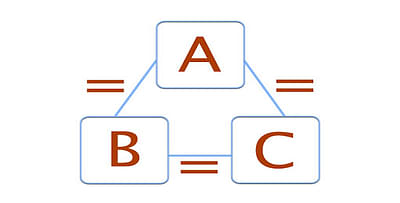
Zeroth law of thermodynamics
| Example of Zeroth Law of Thermodynamics: Consider that there are three bodies, A, B and C. When body A is in equilibrium with body B, and also separately in equilibrium with body C, then B and C will also be in thermal equilibrium with one another. This explanation clearly defines the zeroth law of thermodynamics. |
Check Important Notes: First Law of Thermodynamics
Explanation with Respect to Temperature
[Click Here for Sample Questions]
Temperature is the measure of a body's heat. Here, Temperature (T) is said to be the thermodynamic variable whose value is the same for two systems in thermal equilibrium.
For example,
| If TA = TB and TA = TC, then TB = TC |
- Consider two conducting substances that are kept side by side and have an adiabatic border. The wall between these two bodies, on the other hand, is a conducting or diathermic wall.
- Assume that the temperature of body A is higher than that of body B (TA > TB), and that heat is transferred from the hot body to the cold body. It can be seen that this is what happens when two conducting substances of different temperatures are maintained in touch with each other.
- Now, these two bodies are not in thermal equilibrium; what occurs is that the molecules of body A vibrate a lot more than the molecules of body B due to higher kinetic energy, and the molecules of both bodies interact with each other.
- Heat transfer occurs when molecules with high kinetic energy collide with molecules with lower kinetic energy and transmit their energy to them.
- Now is the moment for their kinetic energy to equalize. This also indicates that the temperature equalizes, i.e. TA = TB. Heat transmission has now stopped.
- In the adiabatic boundary, the states of two bodies A and B stay constant. They do, however, arrive in thermal equilibrium.
Read More:
Application of Zeroth Law Of Thermodynamics
If one desires to accurately measure temperature, one would need a reference body and a feature of that body that varies with temperature. The change in that feature might be interpreted as a temperature change. This feature is mentioned as a thermodynamic property.
- The thermometer is the most common applicator of the Zeroth law of thermodynamics. Using a simple thermometer with mercury in a tube, we may witness the Zeroth law operational. Because the area of the tube always remains constant, and as the temperature rises, the mercury expands. The height has risen as a result of this development. Now, the variation within the height of the mercury label indicates temperature changes and, in essence, aids us in measuring it.
- Another illustration of the zeroth law of thermodynamics can be seen by using two glasses of water. One glass is going to be crammed with hot water, while the opposite is going to be crammed with cold water. Eventually, they will achieve thermal equilibrium with the room's temperature.
Previous Year Questions
- For a gas …
- If the heat of 110J is added to a gaseous system …
- A perfect gas is found to obey the relation …
- A cyclic process is shown in the figure …
- For a gas undergoing an adiabatic process …
- Heat is supplied to a diatomic gas at constant pressure …
- If the temperature of a black body increased …
- In an isothermal process, there is …
- The shown p- V diagram represents the thermodynamic cycle … [JEE Mains 2013]
- Consider a spherical shell of radius … [JEE Mains 2015]
- Consider an ideal gas confined in an isolated closed chamber … [JEE Mains 2015]
- A solid body of constant heat capacity … [JEE Mains 2015]
- ′n′ moles of an ideal gas undergoes a process A→B … [JEE Mains 2016]
- Cp and Cv are specific heats at constant pressure and constant volume … [JEE Mains 2017]
- A rigid diatomic ideal gas undergoes an adiabatic process at room temperature … [JEE Mains 2019]
- A thermodynamic cycle xyzx … [JEE Mains 2020]
- An ideal gas at atmospheric pressure is adiabatically compressed … [JEE Mains 2019]
Things to Remember
- Zeroth Law of Thermodynamics states that if two bodies are present and each of them is in thermal equilibrium with a third body, then they are in equilibrium with each other.
- When both the bodies come into a similar temperature the heat stops flowing and this state is known as thermal equilibrium.
- One of the most common example of Zeroth law of thermodynamics is Thermometer.
- Temperature is the measure of a body's heat. Here, Temperature (T) is said to be the thermodynamic variable whose value is the same for two systems in thermal equilibrium.
Also Check: Reversible and irreversible processes
Sample Questions
Ques. What are the 4 laws of thermodynamics? (2 marks)
Ans. The four laws of thermodynamics are:
- Zeroth law
- First Law
- Second Law
- Third law
Ques. To prepare coffee, three ingredients are combined in a mug: 65°C coffee, 65°C milk, and 65°C sugar, which is in thermal equilibrium with the coffee. Describe the sugar's thermal condition. (1 mark)
Ans. Based on the zeroth law of thermodynamics, the sugar and the milk are in equilibrium.
Ques. Who formulated the Zeroth Law? (1 mark)
Ans. One of the four thermodynamic laws is the zeroth law of thermodynamics. Ralph H. Fowler is acknowledged for proposing the law.
Ques. Imagine a coffee cup having a temperature of 50° C is kept open on a table. If the surrounding air of the room has a temperature of 20 °C, then what will be the temperature of the coffee after 6 hours? (1 mark)
Ans. The temperature of the coffee after 6 hours will be 20 °C. The initial temperature of the coffee cup meets the surrounding and tries to equalize the temperature
Ques. Consider three bodies A, B and C having temperature 30 °C, 40 °C and 50 °C respectively which are kept in contact with each other. Determine the direction of flow of heat among them?
a) A to B to C
b) C to B to A
c) C to A and then B
d) B to C and then A (1 mark)
Ans: b) C to B to A
Ques. What is Thermal Equilibrium? (1 mark)
Ans. If two bodies that are in contact are at the same temperature then they are said to be in thermal equilibrium.
Ques. What is Internal Energy? (1 mark)
Ans. Internal energy of a system is the sum of kinetic energies of the respective particles of the system.
Ques. What is the significance of Zeroth Law of Thermodynamics? (1 mark)
Ans. The Zeroth Law of Thermodynamics is responsible to define the temperature and is the basis for the first and second law of thermodynamics.
Also Check:
Also Read:



Comments