

.png?h=90&w=90&mode=stretch)
University of Bonn Courses and Fees 2026


The University of Bonn offers over 25+ programs across bachelor’s and master’s, making it a popular choice among international students. Some of the preferred courses include MS Computer Science, MS Physics, and BS Computer Science.
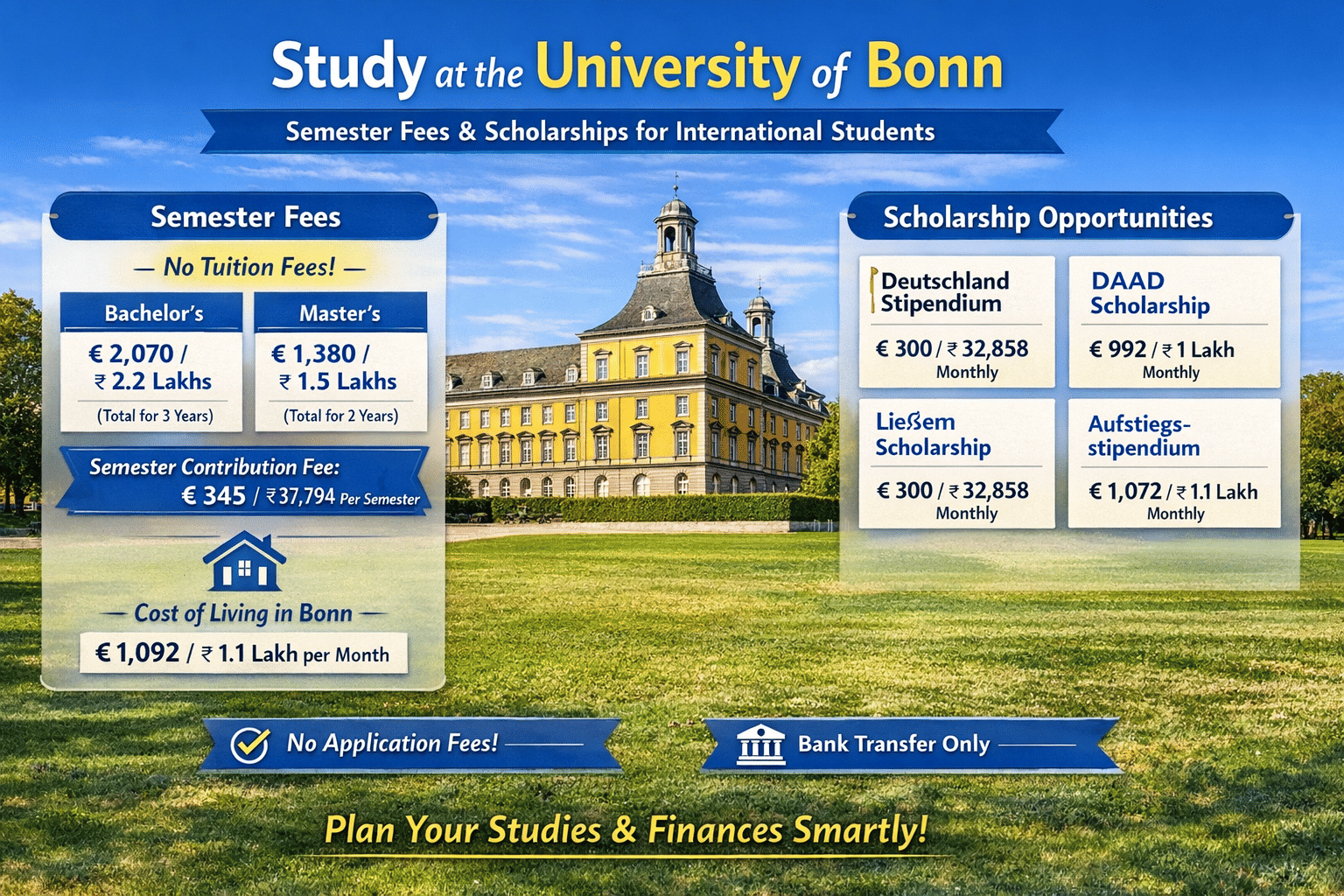
One of the biggest advantages of studying at the University of Bonn is that it does not charge tuition fees to either domestic or international students. However, students are required to pay a semester contribution fee, which is approximately €345.07 / ₹37,794 per semester. This fee covers essential student services, administrative costs, a public transport ticket, and others. Approximately total (whole duration of the programs) semester cost at the university is estimated to be:
- Bachelors (3 years): € 1,380 / ₹ 1.5 Lakhs
- Masters (2 years): € 2,070 / ₹ 2.2 Lakhs
In addition to tuition-free education, the cost of living in Bonn is estimated to be € 1,092 / ₹ 1.1 Lakhs per month. To support students financially, there are several scholarship opportunities available at the University of Bonn, such as the Deutschland stipendium and DAAD scholarships, which can provide funding of around € 300-1,072 / ₹ 32,858-1.1 Lakhs per month or more, depending on eligibility.
Also check: University of Bonn Rankings.
Conversion rate of € 1 = ₹ 109.12 as on 17 April is used in this article.
University of Bonn Semester Fees
At the University of Bonn, international students are not required to pay tuition fees. However, all students must pay a semester contribution fee per semester.
- This fee is not for academic instruction but covers essential student services and benefits, including campus facilities, student union activities, and a public transport ticket.
- The semester contribution ensures that students have access to key resources that support both their academic and daily lives in Germany.
(Source: Semester fees page of the University of Bonn).
| Particulars | In Euros (€) | In INR (₹) | Notes |
|---|---|---|---|
| Student self-administration | € 14 | ₹ 1,533 | Supports student elections, events, and services |
| Social services for students | € 0.5 | ₹ 54 | Covers social support programs |
| Allowance for student councils | € 2.25 | ₹ 246 | Helps organise academic support, events, and peer guidance |
| Support fund for students in need | € 0.01 | ₹ 1 | Emergency financial help for students facing unexpected hardship |
| University Sports | € 0.8 | ₹ 87 | Provides access to sports facilities, gyms, and courses |
| Culture pass | € 3 | ₹ 328 | Provides discounts/free entry to cultural events |
| Deutschland Semesterticket | € 208.8 | ₹ 22,869 | Public transport ticket across Germany |
| Special account for mobility fee refunds | € 0.01 | ₹ 1 | Refund system for students who cannot use the transport |
| Contribution to the Studierendenwerk | € 115 | ₹ 12,595 | Cafeterias, Counselling and support services |
| Total | € 345.07 | ₹ 37,794 | Total amount to be payable |
The table below provides an estimated total contribution fees over different study durations:
- The semester contribution fee for international students at the University of Bonn is payable every semester.
- While the exact amount may vary slightly each term, it is typically around €345.07 / ₹ 37,794 per semester.
| Semesters | Notes | Contribution Fees in Euros (€) | Contribution Fees in INR (₹) |
|---|---|---|---|
| 1 Semester | To be paid per semester | € 345.07 | ₹ 37,794 |
| 2 Semester | Annual fees | € 690 | ₹ 75,294 |
| 4 Semesters | Generally, for Master's programs (Total 2-year fees) | € 1,380 | ₹ 1.5 Lakhs |
| 6 Semesters | Generally, for Bachelor's programs (Total 3-year fees) | € 2,070 | ₹ 2.2 Lakhs |
Know more about the application process, check: University of Bonn Admission.
University of Bonn Popular Program Fees
The table below presents the estimated total (Full program duration) semester contribution fees for some popular bachelor’s and master’s programs:
- At the University of Bonn, the total cost of studying varies based on the duration and semesters of the program.
- Since there are no tuition fees, the overall cost depends on how many semesters a program lasts.
| Popular Programs | Duration | Total Duration Fees in Euros (€) | Total Duration Fees in INR (₹) |
|---|---|---|---|
| MS Computer Science | 2 years | € 1,380 | ₹ 1.5 Lakhs |
| MS Physics | 2 years | € 1,380 | ₹ 1.5 Lakhs |
| MS Molecular Biology and Biotechnology | 2 years | € 1,380 | ₹ 1.5 Lakhs |
| MS Agricultural and Food Science | 2 years | € 1,380 | ₹ 1.5 Lakhs |
| MS Economics | 2 years | € 1,380 | ₹ 1.5 Lakhs |
| MS Astrophysics | 2 years | € 1,380 | ₹ 1.5 Lakhs |
| MS Microbiology | 2 years | € 1,380 | ₹ 1.5 Lakhs |
| MS Immunology | 2 years | € 1,380 | ₹ 1.5 Lakhs |
| BS Cybersecurity | 3 years | € 2,070 | ₹ 2.2 Lakhs |
| BS Computer Science | 3 years | € 2,070 | ₹ 2.2 Lakhs |
Note: The University of Bonn does not charge application fees to international students to apply for admission.
University of Bonn Payment Method
International students can check details regarding the semester contribution fees from the official website of the University of Bonn. Details for it are mentioned below:
- International students are allowed to make payment only by Bank transfer (no debit/credit cards are allowed).
- Students need to check the bank account details of the University of Bonn to pay the fees.
- The bank account details of the university are:
- Payment recipient: Universität Bonn
- IBAN: DE 20 3701 0050 0010 9335 02
- BIC: PBNKDEFF
- Students can check their current semester fees and other payment-related information on the official university portal: BASIS.
- Students are required to add their correct payment reference details as provided by the University of Bonn, or else payment might be declined or taken to reflect on the portal.
- IBAN: It is an International Bank Account Number. It indicates where to send the money.
- BIC: It is the Bank Identifier Code. It helps in finding the exact bank name and branch.
Cost of Living in Bonn
The table below mentions the monthly living expenses for international students studying at the University of Bonn. It is estimated to be € 1,092 / ₹ 1.1 Lakhs per month.
(Source: Living expenses page of the University of Bonn).
| Expenses | In Euros (€) | In INR (₹) |
|---|---|---|
| Rent | € 410 | ₹ 44,906 |
| Food | € 198 | ₹ 21,686 |
| Clothing | € 46 | ₹ 5,038 |
| Transportation | Car: € 89 | Car: ₹ 9,747 |
| Public Transport: Covered under Semester fees | Public Transport: Covered under Semester fees | |
| Health Care Costs | € 100 | ₹ 10,952 |
| Communication | € 31 | ₹ 3,395 |
| Leisure (Entertainment) | € 65 | ₹ 7,119 |
| Learning Materials (Books) | € 31 | ₹ 3,395 |
| Health Insurance | € 135 | ₹ 14,786 |
| Radio and Television License Fees (Rundfunkbeitrag) | € 18.36 | ₹ 2,010 |
Also check: Cost of Living in Germany for Indian students.
Important Note:
- International students need to show at least € 992 / ₹ 1 Lakh per month or € 11,904 / ₹ 13 Lakhs per year in their bank account.
- Students may need to create a Germany-blocked account for it.
- It is required for a German student visa.
- For more details, check: Blocked Account for international students in Germany.
Budget Management Tips for Students in Bonn
International students looking to save money can utilise the following University of Bonn facilities provided to students:
- Hungry for lunch → use canteen services (Mensa).
- For books → University library or City library.
- Want to work out → University sport (Hochschulsport).
- Need software packages → HRZ (Hochschulrechenzentrum).
- Need a bike → get a used bike at Gebrauchtfahrradmarkt.
(Source: Financial Matters pdf of the University of Bonn).
University of Bonn Scholarships
The University of Bonn offers a wide range of scholarships to support international students financially during their studies. These scholarships are typically awarded based on academic performance and other factors.
(Source: Financing and Support page of the University of Bonn).
| Scholarships | Eligibility | Amount |
|---|---|---|
| Deutschland Stipendium | Students enrolled in any UG or graduate program with good academic grades. | € 300 / ₹ 32,858 per month |
| Ließem scholarship | Students must be less than 27 years old, have stayed in the Bonn/Rhein-Sieg region for at least 5 years, and need financial assistance. | € 300 / ₹ 32,858 per month |
| DAAD Scholarship | Students enrolled in any graduate or doctoral programs with good academic grades. | € 992 / ₹ 1 Lakh per month |
| Aufstiegsstipendium | Students with at least 2 years of work experience. | € 1,072 / ₹ 1.1 Lakhs per month |
Explore: Scholarships for Indian students to study in Germany.
International students should review the University of Bonn's semester fee structure and scholarship options before applying to ease their funding and financial expenses in Germany.
Top Subjects:
Course Finder - Search from 50K+ courses
Popular Streams:
University of Bonn Reviews
7 Reviews Found
Likes
- The quality of education and the professors was really good. The facilities in the university and student accommodation was also great.
Dislikes
- Not many extracurricular activities, and chance to socialize.
Course Curriculum
- The syllabus is advanced, updated, and relevant. Students can choose from a range of courses depending on their interests. The choices are flexible.
- Internships are possible in all fields and are recommended. Students can gain direct lab experience, and industry as well,l depending on their interests.
- The course load is meant to be for 40 hours a week. This includes classes, time for assignments, and self-study. But students have the flexibility to choose their courses and the number of courses. Students can also choose to extend studies by spreading the courses over extra semesters. Classes happen between 8 am and 6 pm.
- The compulsory course in my batch had about 60 students, at least half of that international students. But there were fewer students in other specialization courses. Theoretical courses typically had 20-30 students, and experimental/applied courses had 30-50 students.
Fees
- No tuition fees in Germany at public universities. Only costs paid to the university is a semester fees, which give students access to libraries and other facilities, and also free public transport tickets in the whole state (NRW) for the semester.
- This was about 300 euros per semester in 2021. Other costs include accommodation costs, reduced cost if student accommodation. It was 220 euros per month in 2021. Health insurance for students was about 120 euros.
Likes
- I received good reviews from my seniors at the university and also because for the scope of research and how cost effective the education was in Germany.
- Located in a quaint little city, It offered a pleasant living experience with multicultural and enriching academic environment. Many master's a programs at the University of Bonn are offered in English, increasing accessibility for international students like me. I found it really helpful that the university provided support services like orientation programs, language courses, and assistance with administrative processes when I started. The research institutes are well funded and the Professors are very approachable and supportive. The city is well connected with transport system and it was easier to commute.
Dislikes
- Majority of university related news will be communicated in German only. That was a little hard for me especially at the beginning. Germany itself is not very digital oriented. So still the university uses fax and paper communication which I found very taxing and time consuming.
Course Curriculum
The curriculum was very diverse and covered many topics. As for techniques, many modern technologies could have been included especially in the labs. Students are free to apply for internships and I had opportunities to work in different research labs.
Fees
There was no tuition fees as its common in German public universities. I paid semester fees of approximately 250-300 euros twice a year.
Likes
- The course was a perfect fit because I was planning to enter and shift from wet-lab to computational field. It mostly focuses on computer science, AI and ML. I went through the module catalog of the program and understood which courses will be taught.
- "- International group and support from the community - Organized and student friendly department/professors - Straight-forward application process (without need of application fee) - Public Transportation facility for entire state within student ID"
Dislikes
- "- Less support during the pandemic - Slow/rigid decisions on conduction of online-classes during pandemic - Hard housing crisis and no support from university in this regard. Students have to find their own accommodation in a new city/country without uni's help."
Course Curriculum
- Course Syllabus is pretty relevant and updated. It is important to understand what the program will focus on during the program. For example, my course focused more on ""Chemo informatics"" part of bioinformatics. But not ""Genomic analysis"" part. But this aligned with my research interests. - As someone who simultaneously worked in an industry, the course is pretty industry relevant also. Although there is no particular exposure/ hands-on in the course to bridge the gap to industry.
Fees
Tuition fee is zero. But there is semester fee, contribution fee of about 325 euro/semester. This includes public transport fee for entire state.
Likes
- The course was a perfect fit because I was planning to enter and shift from wet-lab to computational field. It mostly focuses on computer science, AI and ML. I went through the module catalog of the program and understood which courses will be taught.
- International group and support from the community.
- Organized and student friendly department/professors.
Dislikes
- Less support during the pandemic.
- Slow/rigid decisions on conduction of online-classes during pandemic.
- Hard housing crisis and no support from university in this regard.
Course Curriculum
Course Syllabus is pretty relevant and updated. It is important to understand what the program will focus on during the program. For example, my course focused more on ""Chemo informatics"" part of bioinformatics. But not ""Genomic analysis"" part. But this aligned with my research interest. As someone who simultaneously worked in an industry, the course is pretty industry relevant also. Although there is no particular exposure/ hands-on in the course to bridge the gap to industry.
Fees
Tuition fee is zero. But there is semester fee, contribution fee of about 325 euro/semester. This includes public transport fee for entire state.
Likes
- Considering the fact that Germany is one of the best country for high quality education and research with very less expenses. Also UniBonn has a very good reputation and stands among top 100-150 universities in the world.
Course Curriculum
The course curriculum is great and I love it. The course and concepts are taught by professors who are actively doing research in that particular fields and they share insights into what has happened in the past and what current scenario is. There are a plenty of research opportunities in and around the university.
Fees
I have a semester fee of 310€, which would be 27000 rupees based on current exchange rates. The semester fee also includes transport throughout the state. Yes that's true you don't have to pay for public transport in and around Bonn and inside the NRW state.
Likes
- "It is one of top universities for the department. I was impressed with course work and the faculty and how widespread it was. Germany has loads of public universities with good coursework and minimal fees. "
- The course work is very course intensive. It brings some discipline to your life. Which would be required to get everything done. The professors are top of the field. Since it is a collection of various institutions, a wide exposure in the field is provided
Dislikes
- The course is so intensive that it might get a little difficult to keep up sometimes, specially for people from non computer backgrounds. It gets very difficult to question the authority of professors or administration. Specially if you are not an EU citizen.
Course Curriculum
The course work is very updated and the professors are working real time in the field so we are provided with very recent updates. We have plenty of research opportunities during the course and thesis, as institutions are readily looking for assistants and TAs.
Fees
Its ~370 euros per semester. Since the public unis are free. This is just the semester fee.
Course Curriculum
If I remember correctly, the course was of 120 credits. There were probably around 50 students in the class. Classes were conducted by the teachers via presentations or the blackboard. Also, the presentations were uploaded by the professors on the University portal after the class for referring later. There were weekly assignments given which were graded, and a less than 50% score overall debarred you from sitting for the semester exams.
Fees
Fees for the course were paid at the student secretariat. There was no tuition fee, but there was a semester feee to be paid for student servises and a travel card/I-card. The I-card allowed us to travel without cost on trains, trams and buses throughout the state of North-Rhine Westphalia. Library services were also included.
SUBSCRIBE TO OUR NEWS LETTER



Comments