



.png?h=35&w=35&mode=stretch)
Symbiosis International University (SIU) conducted SLAT 2026 Test 1 on December 20, 2025, as a computer-based test at designated centres across the country. The exam serves as the gateway for admission to the 5‑year integrated law programs (BA LLB & BBA LLB) offered at Symbiosis Law School (SLS) Pune, Noida, Hyderabad, and Nagpur.
Overall, students rated the Test 1 paper as easy to moderate, with a few time‑consuming questions in Analytical and Logical Reasoning.
Key Summary
- The SLAT Test 1 was easy to moderate with a familiar pattern and no major surprises in the question distribution.
- Most students were able to attempt a majority of the 60 questions, but a few found Logical and Analytical Reasoning slightly lengthier compared to other sections.
- For many aspirants, 48–52 serious attempts with high accuracy may be considered a strong performance in Test 1.
SLAT 2026 Test 1 analysis
| Section | Key question themes | Difficulty level |
|---|---|---|
| Reading Comprehension | AI/technology passages, direct fact‑based questions | Easy |
| Analytical Reasoning | TSD, arithmetic‑logic, slightly tricky framing | Moderate |
| Legal Reasoning | Principle–Fact, basic legal knowledge, no maxims | Easy |
| Logical Reasoning | Blood relations, number & alphabetical series, no syllogisms | Moderate to difficult |
| General Knowledge | More static GK, limited current affairs, some 2024 facts | Moderate |
SLAT 2026 Test 1: Section-wise difficulty and question trends
Reading Comprehension
- Difficulty: Easy
- Question Nature: Most questions were direct and fact-based. They were picked straight from the passages, making this section scoring for prepared students.
- Highlight: The passages were mainly based on technology and AI-related topics. However, the language was easy to understand and not very technical.
Analytical Reasoning
- Difficulty: Moderate
- Focus Areas: More questions were asked from Time, Speed & Distance and other arithmetic-logic topics. Some questions were slightly tricky.
- Highlight: Students felt the questions were manageable but required careful reading and calculation. This increased the time taken per question.
Legal Reasoning
- Difficulty: Easy
- Question Type: The section mainly had Principle–Fact questions along with basic legal knowledge. Students with a strong grasp of fundamentals had an advantage.
- Highlight: No legal maxims were asked. This reduced the memorisation burden and made the section more application-based.
Logical Reasoning
- Difficulty: Moderate to difficult
- Key Topics: Questions were asked from blood relations, number series, and alphabetical series. No syllogism questions were seen in this slot.
- Highlight: Some series and puzzle-based questions were time-consuming. Many students found this section to be the toughest.
General Knowledge
- Difficulty: Moderate
- Question Type: The section was mostly based on static GK, with only a few current affairs questions. Around 2–3 questions were from events of 2024.
- Highlight: Students who prepared only current affairs found some static questions unexpected. Those with balanced static GK preparation found the section easier.
Ques: Is SLAT 2026 tougher than last year?
Ans: No, SLAT 2026 Test 1 is broadly similar or slightly easier than SLAT 2025, with an overall easy–moderate level.
Ques: What is a safe score for SLS Pune?
Ans: A safe score for SLS Pune in SLAT 2026 is around 48–52 out of 60 for general category aspirants.
Ques: Can I rely only on Test 2 if Test 1 didn’t go well?
Ans: Yes, you can, because SLAT uses the best of the two scores; the higher score from Test 1 and Test 2 is considered for admission.
SLAT 2026 Test 1: Student reactions
Outside test centres, many students described the paper as “balanced” and “similar to mocks”, with RC and Legal Reasoning being labelled as the most scoring sections.
- A section of aspirants felt that Logical and Analytical Reasoning demanded better time management, as a few puzzles and series‑based questions required extra reading and analysis.
- Test‑takers who prepared thoroughly for static GK appeared more comfortable, while those relying mainly on last‑minute current affairs revision found the GK section moderately challenging.
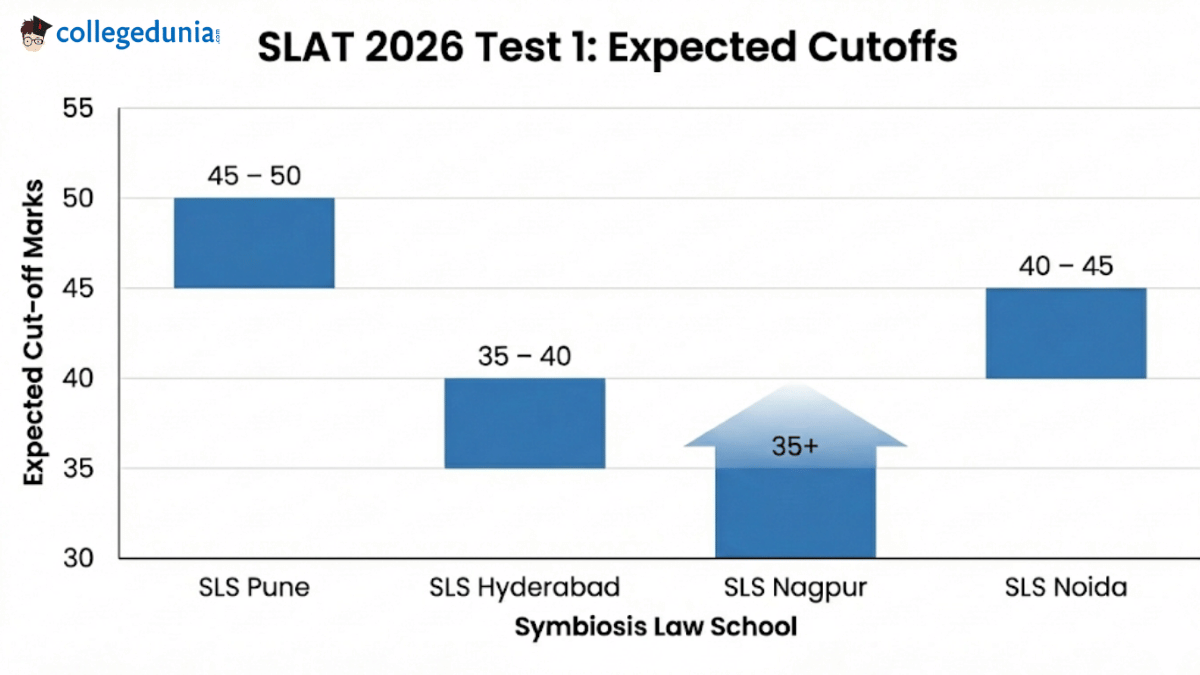
SLAT 2026 Test 1: Expected Cutoffs
The following expected cutoffs are indicative and may slightly vary once Test 2 is conducted and score normalisation, if any, is applied by SIU. These ranges are aligned with the overall easy–moderate nature of the paper.
| Symbiosis Law School | Expected SLAT 2026 cut‑off (marks) |
|---|---|
| SLS Pune | 45 – 50 |
| SLS Hyderabad | 35 – 40 |
| SLS Nagpur | 35+ |
| SLS Noida | 40 – 45 |
- For SLS Pune, a score closer to the upper band (around 48–50) is likely to be safer for the general category, given the relatively student‑friendly paper.
- For SLS Noida, Hyderabad, and Nagpur, performance in Logical/Analytical Reasoning and GK is expected to be a major differentiator among candidates scoring in the mid‑range.
SLAT 2026: What's Next for Test 2
SLAT 2026 Test 2 is scheduled for December 28, 2025. Students should focus on the following sections while preparing.
- LR & AR: Practice blood relations, number and alphabet series, and arithmetic-logic sets. These topics were time-consuming in Test 1.
- RC & Legal Reasoning: Continue practising passages on technology/social issues and basic Principle–Fact legal reasoning; these are likely to remain scoring sections.
- GK: Prepare both static GK and current affairs. Focus on polity, geography, important organisations, constitutional basics, and major events of 2025.



Comments