



Education Journalist | Study Abroad Strategy Lead | Updated On - Apr 14, 2026
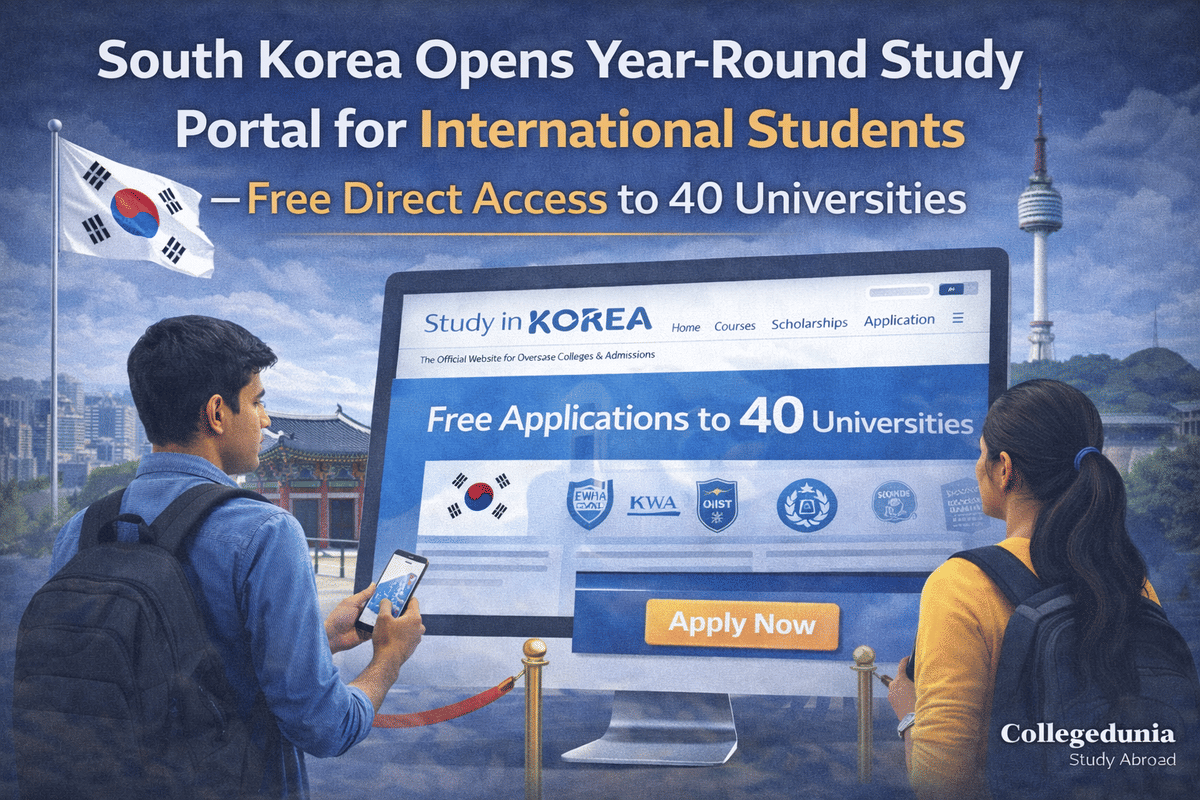
South Korea's Ministry of Education and the National Institute for International Education (NIIED) launched a permanent online hub for prospective international students on April 13, 2026, replacing a system that previously ran for just 10 days a year. The upgraded Study in Korea portal (studyinkorea.go.kr) now provides year-round access to university programmes, scholarship information, visa guidance, and post-graduation employment pathways in one government-run platform. Alongside the hub, NIIED is running a live webinar-based admissions fair featuring 40 universities through April 19 — giving Indian students a direct window into South Korean universities this week.
The launch is part of South Korea's broader push to position itself as a top-five global study destination. The Study in Korea portal already draws approximately 12 million visits annually. Making it a permanent, continuously updated hub — rather than a seasonal event — signals a structural shift in how South Korea is competing for international students at a moment when the US, UK, and Canada are all tightening their intake.
Read in Detail: Study in South Korea for Indian Students
What the New Hub Offers — Four Sections, One Platform
The upgraded portal is organised into four distinct sections, each targeting a different student profile:
| Section | What It Covers | Who It's For |
|---|---|---|
| Korean Language Training | Intensive language programmes at universities and language institutes | Students starting from scratch or building proficiency before a degree |
| English-Taught Degree Programmes | Full Bachelor's and Master's programmes taught in English | Indian students who do not speak Korean |
| Vocational Junior College Programmes | Technical and applied programmes at 2–3 year colleges | Students seeking shorter, career-focused pathways |
| Regional Government Initiatives | Region-specific scholarships, visa support, and settlement assistance | Students open to cities outside Seoul |
The regional section is particularly significant for Indian students. Several South Korean provincial governments — including those of Busan, Incheon, and Gyeonggi — offer their own scholarship and support packages to attract international students to universities outside the capital. These are rarely covered by education agents and have historically been difficult to discover without direct research.
The Live Webinars — How to Join Before April 19
NIIED's 2026 Study in Korea Online Education Fair is running from April 8 to April 19, 2026. The fair features:
- 40 participating universities offering live counselling sessions
- University-specific Q&A boards where students can post questions directly to admissions teams
- Recorded sessions available for students in different time zones — including India (IST is UTC+5:30, meaning most live sessions run in Indian evening hours)
- Last year's equivalent event drew approximately 70,000 student participants globally
How to access:
- Visit studyinkorea.go.kr directly
- Navigate to the Education Fair section for the live webinar schedule
- No registration fee — the platform is free to use
- NIIED contact for queries: niied.go.kr
Indian students considering South Korea for 2026–27 intake have a narrow window — the live counselling sessions close April 19. Recorded sessions will remain available after that date, but the direct Q&A access to admissions teams ends this week.
Why South Korea Is Scaling International Recruitment Now
South Korea's push to attract international students is driven by a demographic reality: the country's university-age population is shrinking sharply due to one of the world's lowest birth rates. South Korean universities — including several ranked in the QS World Top 100 — face falling domestic enrolment and are actively filling seats with international students.
The government's Study Korea 300K Project, launched in 2023, set a target of 300,000 international students by 2027. As of 2025, South Korea hosts approximately 180,000 international students. The permanent hub and live webinar infrastructure are direct tools to close that gap.
For Indian students, the timing aligns with a broader reassessment of study destinations. With US F-1 visa rejections at 41% for Indian applicants in 2025, Canada's permit cap still in place, and UK compliance rules tightening university recruitment capacity from June 2026, South Korea offers an increasingly rare combination: affordable tuition, English-taught programmes, a structured post-study work pathway, and a government actively reducing friction in the application process.
What South Korea Costs — INR Breakdown for Indian Students
(Exchange rate: 1 KRW = ₹0.062 as of April 13, 2026)
| Cost Component | Annual Cost (KRW) | Annual Cost (INR) |
|---|---|---|
| Tuition — national universities | ₩3,000,000–₩5,000,000 | ₹1.86–3.1 lakh |
| Tuition — private universities | ₩6,000,000–₩10,000,000 | ₹3.72–6.2 lakh |
| Living costs (Seoul) | ₩8,000,000–₩12,000,000 | ₹4.96–7.44 lakh |
| Living costs (outside Seoul) | ₩5,000,000–₩8,000,000 | ₹3.1–4.96 lakh |
| Total annual cost (national university, outside Seoul) | — | ₹5–8 lakh |
| Total annual cost (private university, Seoul) | — | ₹8.7–13.6 lakh |
By comparison, a UK Master's programme costs ₹25–45 lakh per year and a US programme ₹35–60 lakh. South Korea's national universities — including Seoul National University, KAIST, and POSTECH — offer globally competitive STEM programmes at a fraction of those costs.
The GKS Scholarship — The Fully Funded Route
The Global Korea Scholarship (GKS), administered by NIIED, remains one of the most comprehensive fully funded scholarships available to Indian students. For 2026–27:
- Coverage: Full tuition, monthly stipend of ₩900,000 (~₹55,800/month), airfare, settlement allowance, Korean language training
- Eligibility: Bachelor's, Master's, and PhD applicants; Indian nationals under 25 (UG) or under 40 (PG/PhD)
- Application: Through the Embassy of Korea in India or directly through a Korean university
- 2026 deadline: Most GKS embassy track applications closed in March 2026 — but the university track deadline varies by institution and may still be open for some programmes
Indian students who missed the 2026 GKS cycle should use the new portal's webinar sessions to confirm 2027 deadlines directly with participating universities — the live Q&A boards are the fastest way to get institution-specific scholarship timelines.










Comments