



Education Journalist | Study Abroad Strategy Lead | Updated On - Mar 3, 2026
The Russell Group is an association of 24 research-intensive universities in the United Kingdom, known for academic excellence, global research impact, and strong graduate outcomes. Its members include leading institutions such as the University of Oxford, University of Cambridge, Imperial College London, UCL, LSE, University of Manchester, and others.
If you’re looking for the complete list of all 24 Russell Group universities in 2026, you’ll find the full list below, along with rankings and key details.
Quick Facts (2026)
- How many Russell Group universities are there? 24
- What is the Russell Group? An association of research-intensive UK universities
- Are all top UK universities in the Russell Group? No (for example, the University of St Andrews is not a member)
- How do you apply? Through UCAS, the central admissions system for UK undergraduate programs
- What is the Russell Group of Universities UK?
- How many Russell Group Universities are there?
- Russell Group of Universities in UK List
- Russell Group Universities Ranking 2026
- Russell Group Universities in London
- Russell Group Universities in Scotland, Wales, and Northern Ireland
- Russell Group Universities for International and Indian Students
- Are Russell Group Universities Hard to Get Into?
- FAQs
What is the “Russell Group in UK”?
The Russell Group is an association of 24 public research-intensive universities in the United Kingdom. It was established in 1994 to represent the shared interests of leading UK universities in research funding, academic policy, and higher education strategy.
Although Russell Group universities represent a minority of UK higher education institutions, they account for a significant proportion of the country’s research output and postgraduate research degrees. The group includes universities such as the University of Oxford, University of Cambridge, Imperial College London, UCL, LSE, University of Manchester, and University of Edinburgh.
The Russell Group is often compared to the Ivy League in the United States. However, unlike the Ivy League, it is not an athletic conference and does not standardize admissions criteria across member institutions.
Note: The Russell Group was formed in 1994 when 17 universities united to represent their shared interests to government. It was named after the Hotel Russell in London, where the university leaders met. The group became an official organisation in 2007 and has since expanded with seven additional members.

Related Resources: UK University List; Check all top UK universities for Indian Students
How many Russell Group Universities are there?
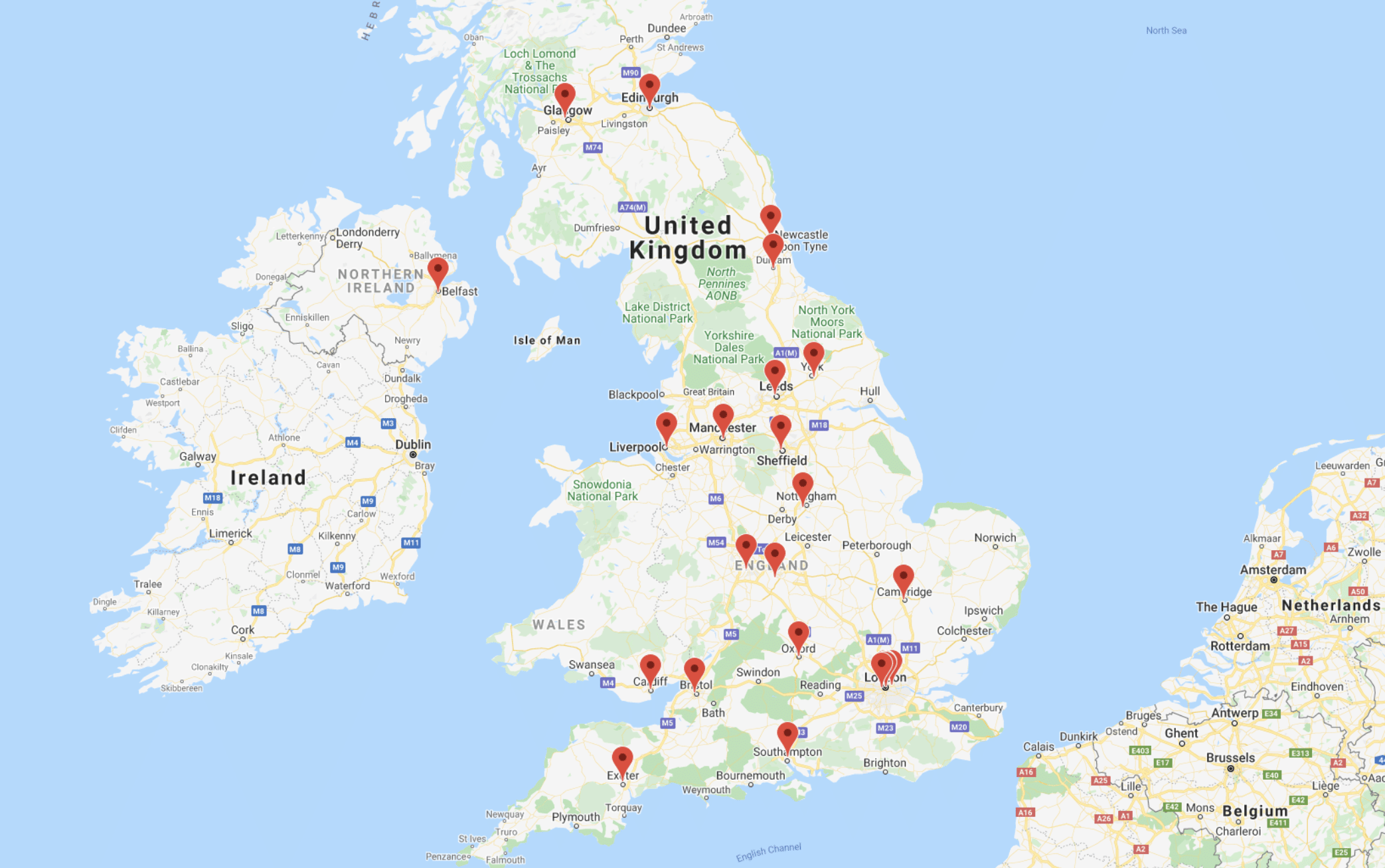
There are 24 Russell Group universities in the UK.
The membership includes universities across all parts of the UK:
- England: Majority of members
- Scotland: University of Edinburgh, University of Glasgow
- Wales: Cardiff University
- Northern Ireland: Queen’s University Belfast
The number of member universities has remained at 24 since the last expansion of the group.
Why Are Russell Group Universities So Prestigious?
Russell Group universities are known for:
- High research intensity and funding
- Strong global rankings
- Competitive admissions at many member institutions
- High levels of graduate employability
- Extensive alumni networks across government, business, science, and technology
Many of these universities consistently rank among the top institutions globally in rankings such as QS and Times Higher Education.
Complete List of Russell Group Universities in the UK (2026)
Below is the complete list of all 24 Russell Group universities in the UK for 2026, along with their indicative tuition fee ranges for international students.
| University | Location | Popular Courses | Tuition Fee Range (INR) |
|---|---|---|---|
| University of Birmingham | Birmingham, England | Tech, Physiotherapy | ₹23.5L – ₹39.4L |
| University of Bristol | Bristol, England | Engineering, Social Science | ₹22.7L – ₹53.1L |
| University of Cambridge | Cambridge, England | Maths, Science, Economics | ₹16.3L – ₹88.0L |
| Cardiff University | Cardiff, Wales | Journalism, Bioscience | ₹9.8L – ₹48.0L |
| Durham University | Durham, England | Law, Humanities, MBA | ₹24.7L – ₹38.5L |
| University of Edinburgh | Edinburgh, Scotland | Informatics, AI, History | ₹28.3L – ₹56.5L |
| University of Exeter | Exeter, England | Mining, Business, Geography | ₹16.5L – ₹50.2L |
| University of Glasgow | Glasgow, Scotland | Medicine, Vet Science | ₹11.7L – ₹62.1L |
| Imperial College London | London, England | Engineering, AI, Medicine | ₹5.2L – ₹74.3L |
| King's College London | London, England | Health Sciences, Politics | ₹24.6L – ₹64.3L |
| University of Leeds | Leeds, England | Media, Business, Textile | ₹14.8L – ₹59.9L |
| University of Liverpool | Liverpool, England | Veterinary, Architecture, Sports | ₹24.6L – ₹49.0L |
| London School of Economics (LSE) | London, England | Economics, Finance, IR | ₹30.2L – ₹49.4L |
| University of Manchester | Manchester, England | Engineering, Management | ₹7.7L – ₹62.7L |
| Newcastle University | Newcastle, England | Biomedical Science, Tech | ₹17.2L – ₹35.6L |
| University of Nottingham | Nottingham, England | Pharmacy, Agriculture | ₹23.6L – ₹48.4L |
| University of Oxford | Oxford, England | MBA, Law, Philosophy | ₹25.9L – ₹92.1L |
| Queen Mary University of London | London, England | Law, Dentistry, Finance | ₹12.2L – ₹62.8L |
| Queen's University Belfast | Belfast, Northern Ireland | Cybersecurity, Pharmacy | ₹21.0L – ₹31.5L |
| University of Sheffield | Sheffield, England | Architecture, Engineering | ₹24.9L – ₹35.5L |
| University of Southampton | Southampton, England | Aerospace, Marine Biology | ₹13.3L – ₹36.8L |
| University College London (UCL) | London, England | Computer Science, Architecture, Medicine | ₹9.5L – ₹68.0L |
| University of Warwick | Coventry, England | Business, Data Science | ₹20.6L – ₹59.1L |
| University of York | York, England | Psychology, Social Policy | ₹13.1L – ₹35.4L |
All 24 universities listed above are full members of the Russell Group. Membership is based primarily on research intensity and institutional collaboration rather than league table position alone.
Tuition fees vary by course and level of study. For the most accurate and updated fee structure, applicants should refer to the official university website.
You can click on any university name above to explore detailed admission requirements, acceptance rates, scholarships, and course-specific information.
Russell Group Universities Ranking 2026
Russell Group universities consistently perform strongly in global university rankings. Below is a comparison of member institutions based on the QS World University Rankings 2026.
Rankings vary by methodology, subject strengths, and research output, so students should review multiple ranking systems before making a decision.
QS World University Rankings 2026 – Russell Group Members
| University | QS 2026 Rank |
|---|---|
| Imperial College London | 2 |
| University of Oxford | 4 |
| University of Cambridge | 6 |
| University College London (UCL) | 9 |
| University of Edinburgh | 34 |
| University of Manchester | 35 |
| King’s College London | 31 |
| University of Bristol | 51 |
| London School of Economics (LSE) | 56 |
| University of Warwick | 74 |
| University of Birmingham | 76 |
| University of Glasgow | 79 |
| University of Southampton | 87 |
| University of Leeds | 86 |
| University of Sheffield | 92 |
| Durham University | 94 |
| University of Nottingham | 97 |
| Queen Mary University of London | 110 |
| Newcastle University | 137 |
| University of Liverpool | 147 |
| University of Exeter | 155 |
| University of York | 169 |
| Cardiff University | 181 |
| Queen’s University Belfast | 199 |
Top 10 Russell Group Universities (QS 2026)
Based on QS 2026 rankings, the highest-ranked Russell Group universities are:
- Imperial College London
- University of Oxford
- University of Cambridge
- University College London (UCL)
- King’s College London
- University of Edinburgh
- University of Manchester
- University of Bristol
- London School of Economics (LSE)
- University of Warwick
These universities consistently rank among the best in the world across multiple disciplines, particularly in engineering, medicine, economics, business, and social sciences.
Russell Group Universities in London
There are five Russell Group universities located in London:
- Imperial College London
- King’s College London
- London School of Economics and Political Science (LSE)
- University College London (UCL)
- Queen Mary University of London
These universities benefit from London’s global business ecosystem, access to multinational employers, research partnerships, and proximity to government institutions.
Check all universities located in London
London-based Russell Group universities are particularly strong in:
- Finance and Economics (LSE, UCL)
- Engineering and STEM (Imperial)
- Law and Public Policy (King’s, LSE)
- Medicine and Health Sciences (UCL, King’s, Imperial)
However, tuition fees and cost of living in London are typically higher compared to Russell Group universities located in cities such as Manchester, Leeds, Birmingham, or Glasgow.
Students prioritizing industry exposure and networking may prefer London, while those focused on lower living costs may consider Russell Group universities outside London.
Check out the top student cities in UK
Russell Group Universities in Scotland, Wales, and Northern Ireland
While most Russell Group universities are located in England, four member institutions are based outside England.
Scotland
There are two Russell Group universities in Scotland:
- University of Edinburgh
- University of Glasgow
Both universities are globally recognized for research in medicine, informatics, life sciences, and humanities. Scotland also follows a slightly different undergraduate degree structure (typically four years instead of three).
Wales
There is one Russell Group university in Wales:
-
Cardiff University
Cardiff is known for strengths in journalism, biosciences, engineering, and architecture. Tuition fees and living costs are generally lower compared to London-based universities.
Northern Ireland
There is one Russell Group university in Northern Ireland:
-
Queen’s University Belfast
Queen’s University Belfast is recognized for cybersecurity, pharmacy, and engineering. It is often considered one of the more accessible Russell Group universities in terms of admission competitiveness.
Together with the five London-based members and other universities across England, these institutions complete the full list of 24 Russell Group universities in the UK.
Russell Group Universities for International and Indian Students
Russell Group universities attract a large number of international students each year due to their global rankings, research reputation, and employer recognition.
For Indian students in particular, these universities are popular for fields such as:
- Engineering and Computer Science
- Finance and Economics
- Medicine and Health Sciences
- Business and Management
International students apply through the same UCAS (undergraduate) or direct university application process (postgraduate).
Most Russell Group universities also offer UK scholarships for international students, though availability and award amounts vary by institution.
Graduates may be eligible for the UK Graduate Route visa, which currently allows students to remain in the UK for up to 2 years after completing a degree (3 years for doctoral graduates), subject to government policy.
Are Russell Group Universities Hard to Get Into?
Acceptance rates at Russell Group universities are highly competitive, especially for international applicants. For Indian students, rates are often slightly lower due to high application volumes in popular courses (CS, Business, Engineering).
- Highly Competitive: LSE, Oxford, Warwick (Business).
- Competitive: Imperial, UCL, Cambridge, King’s College.
- Accessible: University of Manchester, Cardiff, Queen's Belfast.
Check in Detail: Acceptance Rate of Russell Group of Universities
How to Choose the Right Russell Group University
Rather than focusing only on overall rankings, students should consider:
- Course-specific reputation
- Research strengths in their subject area
- Location and cost of living
- Internship and employer connections
- Graduate outcomes
For example:
- Finance and Economics: LSE, Warwick, and Oxford are widely recognized.
- Engineering and STEM: Imperial, Manchester, and Sheffield have strong research output.
- Medicine and Health Sciences: UCL, King’s College London, and Edinburgh are highly regarded.
Choosing the right university depends on career goals, academic background, and personal preferences rather than ranking position alone.
Also check:
By now, you’re already familiar with the Russell Group's 24 universities. Unlike the US Ivy League, which consists of private institutions, Russell Group universities are publicly funded. They focus heavily on PhDs and breakthroughs. While Ivy League schools vary significantly in quality, all Russell Group members maintain a high standard of teaching, as regulated by the government (TEF Framework).
FAQs
Ques. Is Durham a Russell Group university?
Ans. Yes. Durham University is a full member of the Russell Group and is known for its strengths in law, humanities, and business.
Ques. Is UCL a Russell Group university?
Ans: Yes. University College London (UCL) is a founding member of the Russell Group and consistently ranks among the top universities in the UK and globally.
Ques. Is LSE part of the Russell Group?
Ans: Yes. The London School of Economics and Political Science (LSE) is a Russell Group member and is particularly well known for economics, finance, and social sciences.
Ques. Is St Andrews a Russell Group university?
Ans. No. The University of St Andrews is not a member of the Russell Group, although it is highly ranked globally.
Ques. Is the University of Manchester a Russell Group university?
Ans. Yes. The University of Manchester is a Russell Group member and one of the largest research-intensive universities in the UK.
Ques. What is the Russell Group?
Ans. The Russell Group is an association of 24 research-intensive public universities in the United Kingdom, established in 1994 to represent research and higher education interests.
Ques. Are all Russell Group universities located in England?
Ans. No. While most are based in England, the group also includes:
- 2 in Scotland (Edinburgh and Glasgow)
- 1 in Wales (Cardiff)
- 1 in Northern Ireland (Queen’s University Belfast)









1690986098.png?tr=w-305,h-145,c-force?h=175&w=350&mode=stretch)





Comments