




ISC Class 12 English (Paper 1) Question Paper 2026 is available for download here. Council For The Indian School Certificate Examinations (CISCE) is conducting ISC Class 12 English exam on February 13, 2026 from 2 PM to 5 PM. ISC Class 12 English (Paper 1) is divided into four sections: Composition Writing, Directed writing, Proposal Writing, Short-answer questions on grammar and Comprehension. The Theory paper will have a total of 80 Marks while Project Work is of 20 Marks.
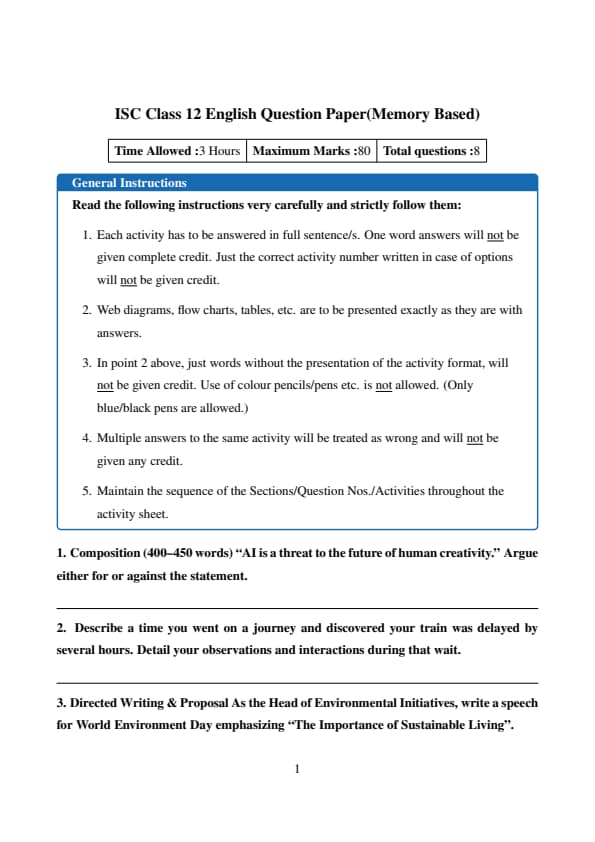
ISC Class 12 English (Paper 1) Question Paper 2026 – Memory Based
| ISC Class 12 English (Paper 1) Question Paper 2026 | Download PDF | Check Solutions |

Composition (400--450 words)
``AI is a threat to the future of human creativity.'' Argue either for or against the statement.
View Solution
Concept:
This is an argumentative composition. The answer should clearly take a position (for or against), present logical arguments, include examples, and end with a strong conclusion.
Composition (Against the Statement):
Artificial Intelligence (AI) has rapidly transformed the modern world, influencing fields such as education, healthcare, business, and the arts. While some people argue that AI is a threat to the future of human creativity, this fear is largely exaggerated. In reality, AI is not replacing creativity but reshaping and expanding it.
Creativity has always evolved with technology. From the invention of the printing press to the rise of digital tools, every technological advancement initially sparked fear but eventually enhanced human expression. AI follows the same pattern. Instead of destroying creativity, it provides new tools that enable people to experiment, innovate, and produce ideas more efficiently.
One of the strongest arguments against the claim is that AI itself is not truly creative. It does not possess emotions, personal experiences, or imagination. AI generates content based on patterns in existing data. True creativity, however, comes from human consciousness, emotions, and unique perspectives. A poem written by a human reflects lived experiences, while AI merely imitates style. Thus, creativity still originates from humans.
Moreover, AI can act as a powerful collaborator. Artists, writers, designers, and musicians now use AI tools to brainstorm ideas, overcome creative blocks, and explore new possibilities. For example, a writer can use AI to generate plot ideas, but the storytelling depth still depends on human insight. Similarly, musicians use AI-generated sounds but compose meaningful music themselves.
Another important point is that AI democratizes creativity. Earlier, access to creative tools required expensive training or equipment. Today, AI-powered platforms allow beginners to design, write, and compose with ease. This inclusivity encourages more people to express themselves creatively, ultimately expanding the creative landscape rather than shrinking it.
However, concerns about overdependence on AI are valid. If individuals rely entirely on AI, they may risk losing originality and critical thinking skills. Therefore, the key lies in balance. AI should be treated as a tool, not a replacement. When used responsibly, it can amplify human imagination rather than suppress it.
In conclusion, AI is not a threat to the future of human creativity. Instead, it is a transformative tool that enhances creative potential and opens new avenues for expression. Human creativity is deeply rooted in emotions, experiences, and individuality—qualities that machines cannot replicate. Rather than fearing AI, society should focus on using it wisely to enrich and expand the horizons of human creativity. Quick Tip: In argumentative essays, clearly choose a side, present 3--4 logical points with examples, and end with a balanced and thoughtful conclusion.
Describe a time you went on a journey and discovered your train was delayed by several hours. Detail your observations and interactions during that wait.
View Solution
Concept:
This is a narrative composition. The answer should include a clear setting, personal observations, sensory details, interactions with people, and a reflective conclusion.
Composition:
Last winter, I had planned a long-awaited train journey to visit my grandparents during the holidays. I reached the railway station early in the morning, excited and full of anticipation. However, as I glanced at the electronic display board, my excitement faded. The train I was supposed to board was delayed by nearly five hours due to heavy fog.
At first, I felt frustrated and restless. The platform was crowded with passengers carrying luggage, blankets, and thermos flasks. Some people sighed in disappointment, while others immediately called their families to inform them about the delay. The cold morning air and the distant whistle of passing trains added to the sense of waiting and uncertainty.
As time passed, I began observing the world around me more closely. A tea vendor moved along the platform, calling out cheerfully, offering steaming cups of chai. The warmth of the tea brought comfort not just physically but emotionally. Nearby, a group of children played with a plastic ball, laughing loudly and turning the dull wait into a moment of joy. Their carefree energy was contagious, and I found myself smiling despite the delay.
I also struck up a conversation with an elderly man sitting beside me. He told me stories of how train journeys used to be slower but more memorable in the past. He spoke about friendships formed during travel and how delays often led to unexpected connections. Listening to him made me realize that travel was not only about reaching a destination but also about experiences along the way.
Later, I met a college student who was traveling for an entrance exam. Though he was anxious about the delay, he remained optimistic and used the time to revise his notes. His determination inspired me to use the waiting time productively. I took out a book from my bag and started reading, something I rarely found time for in my busy routine.
By the time the train finally arrived, the platform that once felt dull had transformed into a space filled with stories, laughter, and shared patience. What initially seemed like wasted time turned into a meaningful experience of observation and human connection.
Looking back, that delayed train journey taught me an important lesson: sometimes, life’s pauses are opportunities in disguise. The hours of waiting allowed me to slow down, observe life closely, and connect with strangers in ways I never expected. Quick Tip: In narrative writing, include emotions, surroundings, and small interactions. These details make the story vivid and engaging.
Directed Writing \& Proposal
As the Head of Environmental Initiatives, write a speech for World Environment Day emphasizing ``The Importance of Sustainable Living''.
View Solution
Concept:
This is a speech-writing task. The answer should include a formal opening, clear structure (introduction, key points, call to action), persuasive tone, and a memorable conclusion.
Speech:
Good morning respected teachers, distinguished guests, and my dear friends,
It is an honour to stand before you today as the Head of Environmental Initiatives on the occasion of World Environment Day. This day reminds us of a simple yet powerful truth — the Earth is our only home, and it is our responsibility to protect it. Today, I would like to speak about a topic that affects every one of us: \textit{The Importance of Sustainable Living.
Sustainable living means making choices that meet our present needs without compromising the ability of future generations to meet theirs. In today’s fast-paced world, we consume resources at an alarming rate. From excessive plastic usage to energy wastage, our daily habits are silently harming the planet. Climate change, deforestation, pollution, and loss of biodiversity are not distant threats anymore — they are realities we are already facing.
However, the good news is that change begins with small steps. Sustainable living does not demand drastic sacrifices; it requires mindful decisions. Simple actions like reducing plastic use, conserving water, switching off unnecessary lights, recycling waste, and choosing eco-friendly products can make a significant difference. When multiplied across millions of people, these small efforts create a powerful impact.
Another important aspect of sustainable living is awareness. We must educate ourselves and others about environmental challenges. Schools, communities, and organizations play a crucial role in spreading this awareness. By planting trees, organizing clean-up drives, and promoting green practices, we can inspire collective responsibility.
Moreover, sustainable living is not just an environmental choice — it is an ethical one. It reflects respect for nature and compassion for future generations. The lifestyle we adopt today will determine the world our children inherit tomorrow. A cleaner, greener planet is not a luxury; it is a necessity.
As young individuals and responsible citizens, we hold the power to shape the future. Let us pledge to adopt sustainable habits in our daily lives. Let us choose reuse over waste, conservation over convenience, and responsibility over neglect. Remember, we do not inherit the Earth from our ancestors; we borrow it from our children.
In conclusion, sustainable living is not a trend but a lifelong commitment. On this World Environment Day, let us promise ourselves that we will not only celebrate nature but also protect it. Together, through awareness, action, and unity, we can build a sustainable and hopeful future for our planet.
Thank you, and let us all be the change our Earth truly needs. Quick Tip: In speeches, use a strong opening, clear structure, inclusive language (``we'', ``us''), and end with a memorable call to action.
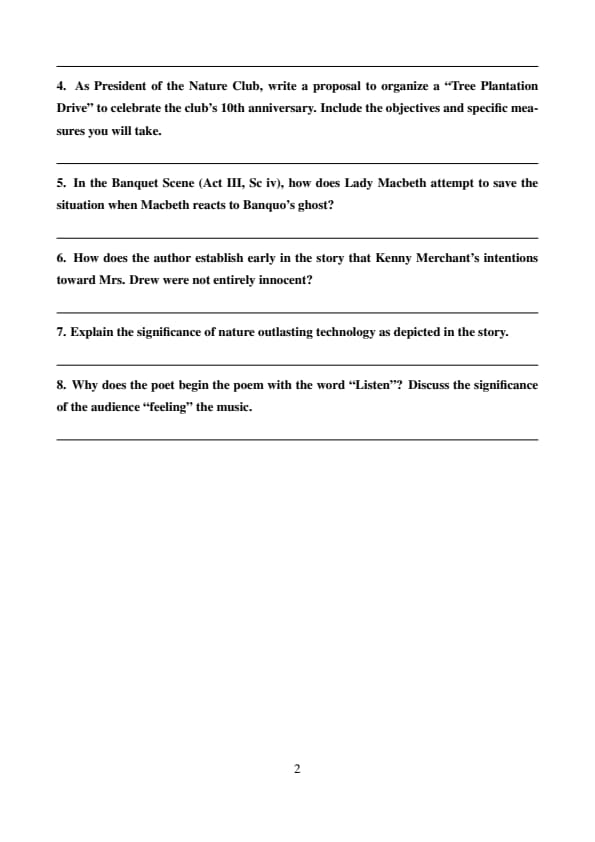
As President of the Nature Club, write a proposal to organize a ``Tree Plantation Drive'' to celebrate the club's 10th anniversary. Include the objectives and specific measures you will take.
View Solution
Concept:
A proposal should be formal and structured. It must include a title, purpose, objectives, plan of action, and expected outcomes. The tone should be clear, practical, and solution-oriented.
Proposal:
Title: Proposal for Organizing a Tree Plantation Drive on the Occasion of the Nature Club’s 10th Anniversary
Submitted by: President, Nature Club
Occasion: 10th Anniversary Celebration
Introduction:
To commemorate the 10th anniversary of the Nature Club, I propose organizing a Tree Plantation Drive. This initiative will not only celebrate our journey but also reinforce our commitment to environmental conservation and sustainable living.
Objectives:
To promote environmental awareness among students and the community.
To contribute to increasing green cover in and around the campus.
To encourage students to take responsibility for nature conservation.
To mark the club’s milestone with a meaningful and lasting initiative.
Proposed Plan of Action:
Selection of Venue:
Identify suitable locations such as the school campus, nearby parks, and community spaces in collaboration with local authorities.
Selection of Saplings:
Choose native and eco-friendly plant species that are suitable for the local climate and require minimal maintenance.
Collaboration:
Partner with local environmental organizations and the forest department for saplings, technical guidance, and support.
Participation:
Encourage participation from students, teachers, parents, and alumni. Each participant can adopt a sapling and take responsibility for its care.
Awareness Campaign:
Conduct a short awareness session or pledge ceremony highlighting the importance of trees and sustainable practices.
Maintenance Plan:
Form student teams to ensure regular watering, protection, and monitoring of planted saplings to ensure long-term survival.
Expected Outcomes:
Increased greenery and improved environmental quality.
Enhanced awareness and active participation in conservation efforts.
Strengthened community bonding through a shared environmental cause.
A lasting green legacy to mark the Nature Club’s 10th anniversary.
Conclusion:
This Tree Plantation Drive will serve as a meaningful celebration of our club’s decade-long commitment to nature. It will not only honor our past achievements but also inspire future environmental initiatives. I sincerely request approval and support for the successful execution of this proposal. Quick Tip: In proposal writing, use headings like Objectives, Plan of Action, and Outcomes. Clear structure makes the proposal formal and convincing.
In the Banquet Scene (Act III, Sc iv), how does Lady Macbeth attempt to save the situation when Macbeth reacts to Banquo’s ghost?
View Solution
Concept:
In Shakespeare’s \textit{Macbeth, the banquet scene reveals the psychological breakdown of Macbeth. Lady Macbeth tries to manage the crisis to protect their power and reputation.
Explanation:
In the banquet scene, when Macbeth sees Banquo’s ghost and begins reacting with fear and agitation, Lady Macbeth immediately tries to control the situation and save their public image.
First, she attempts to calm Macbeth by speaking to him privately and urging him to compose himself. She reminds him to behave like a man and not lose control in front of the guests.
Next, she tries to reassure the guests by dismissing Macbeth’s strange behavior as a temporary illness. She tells them that he has been suffering from such fits since childhood and asks them not to be alarmed. This is an attempt to normalize the situation and prevent suspicion.
Lady Macbeth also scolds Macbeth for his lack of courage and self-control. She fears that his outburst might expose their guilt in Banquo’s murder. Despite her efforts, Macbeth continues to speak to the ghost, making the situation worse.
Finally, realizing that she cannot restore normalcy, Lady Macbeth decides to end the banquet abruptly. She dismisses the guests politely, urging them to leave without further questioning. This helps prevent immediate suspicion, though the damage to their reputation has already begun.
Thus, Lady Macbeth tries to save the situation by calming Macbeth, deceiving the guests with excuses, scolding him privately, and ultimately ending the banquet to avoid further embarrassment. Quick Tip: When answering literature questions, focus on actions, motives, and consequences. This helps explain both character behavior and thematic significance.
How does the author establish early in the story that Kenny Merchant's intentions toward Mrs. Drew were not entirely innocent?
View Solution
Concept:
In suspense fiction, authors often use subtle hints and character behavior to foreshadow hidden motives. In the story \textit{“A Horse and Two Goats” by R. K. Narayan, Kenny Merchant’s actions and attitude suggest that his intentions are not entirely innocent.
Explanation:
Early in the story, the author presents Kenny Merchant as a wealthy and curious American tourist who appears friendly on the surface. However, his behavior gradually reveals that he is more interested in acquiring the statue than in genuine interaction with the old villager or respect for local culture.
Kenny shows a strong fascination with the horse statue in Muni’s possession. Instead of trying to understand Muni’s situation or communicate meaningfully, he is focused on obtaining the statue as a collectible item. His persistent attempts to negotiate, despite the clear communication gap, suggest a self-serving motive.
Moreover, Kenny assumes that money can solve everything. He repeatedly offers money without fully understanding whether the statue is even for sale. This reflects a sense of cultural insensitivity and materialistic intent rather than innocent curiosity.
The author also highlights Kenny’s confident and slightly patronizing manner. He behaves as though he can easily acquire the statue simply because he has the financial means. This early portrayal subtly foreshadows that his intentions are driven more by personal desire than by innocence or goodwill.
Thus, through Kenny Merchant’s persistent interest in the statue, his reliance on money, and his culturally insensitive attitude, the author establishes early in the story that his intentions toward the situation are not entirely innocent. Quick Tip: In prose analysis, look for foreshadowing through character actions, tone, and attitude. Early hints often reveal deeper motives later in the story.
Explain the significance of nature outlasting technology as depicted in the story.
View Solution
Concept:
Many science fiction stories explore the relationship between human technology and the natural world. The idea of nature outlasting technology often highlights the limitations of human progress and the enduring power of the natural environment. This theme is clearly reflected in Ray Bradbury’s \textit{“There Will Come Soft Rains.”
Explanation:
In the story, Bradbury presents a fully automated house that continues to function even after humanity has been destroyed by nuclear war. The house represents advanced technology — efficient, intelligent, and self-sustaining. It cooks meals, cleans rooms, and follows daily routines despite the absence of human life.
However, as the story progresses, the fragility of technology becomes evident. A small fire, triggered by a natural cause, gradually destroys the house. Despite all its advanced systems and automated defenses, the house is unable to save itself. Its technological superiority proves powerless against the forces of nature.
This destruction symbolizes the temporary nature of human inventions. While technology may appear dominant and powerful, it is ultimately vulnerable. In contrast, nature continues to exist beyond human control. The sunrise, the wind, and the quiet continuation of the natural world at the end of the story emphasize that nature is eternal, whereas human creations are fleeting.
The significance of this theme lies in its warning. Bradbury suggests that human pride in technological advancement is often misplaced. When humanity ignores the balance between nature and innovation, it risks self-destruction. The story reminds readers that technology should serve life, not replace or dominate it.
Thus, the idea of nature outlasting technology underscores the resilience of the natural world and the vulnerability of human achievements. It serves as a powerful commentary on the consequences of unchecked technological progress and the enduring supremacy of nature. Quick Tip: When explaining themes in literature, connect symbolism (like the house or fire) with the broader message the author wants to convey.
Why does the poet begin the poem with the word ``Listen''? Discuss the significance of the audience ``feeling'' the music.
View Solution
Concept:
Poets often use an imperative word like “Listen” to immediately engage the reader and create an emotional connection. References to “feeling” music usually emphasize that true art goes beyond sound and touches the inner self.
Explanation:
The poet begins the poem with the word “Listen” to capture the reader’s attention and create a sense of immediacy. This opening acts like a direct invitation, drawing the audience into the experience rather than allowing them to remain passive observers. It sets a reflective and immersive tone, suggesting that what follows is not merely to be read but deeply experienced.
The use of “Listen” also emphasizes the importance of awareness. It encourages the reader to pause and become receptive, both physically and emotionally. By doing so, the poet prepares the audience to engage with the deeper meaning of the poem, which likely extends beyond literal sound to symbolic or emotional resonance.
The idea of the audience “feeling” the music is especially significant. It suggests that music is not just an auditory experience but an emotional and spiritual one. When music is felt, it transcends language and logic, reaching the heart directly. This highlights the universal power of art — it can unite people across cultures and backgrounds through shared emotions.
Furthermore, the emphasis on feeling rather than merely hearing underscores the transformative power of music. It can evoke memories, stir emotions, and create a profound inner response. The poet implies that true appreciation of music requires sensitivity and openness, not just physical listening.
Thus, by beginning with “Listen” and stressing the act of “feeling” the music, the poet highlights the depth and emotional richness of artistic experience. The poem invites readers to move beyond surface-level perception and connect with the deeper emotional and spiritual essence of music. Quick Tip: In poetry analysis, pay attention to opening words and sensory imagery. These often reveal the tone and central theme of the poem.



Comments