




The ISC Class 12th exam 2026 is ongoing from February 12 and will conclude on April 06, 2026. The first paper, Psychology, was found to be easy to moderate. According to students' reaction, the case study-based questions in Section B were lengthy and the most difficult part of the paper.
With Psychology, other subjects like Art, Home Science, Accounts, and English Paper-1 & Paper-2 are already done. The 12th ISC exam 2026 will end with a Geography subject on April 06, 2026.
- The next paper, Mass Media & Communication, is scheduled on 21st February in the evening shift (2:00-5:00 PM).
- An additional 15 minutes is allotted for reading the question paper.
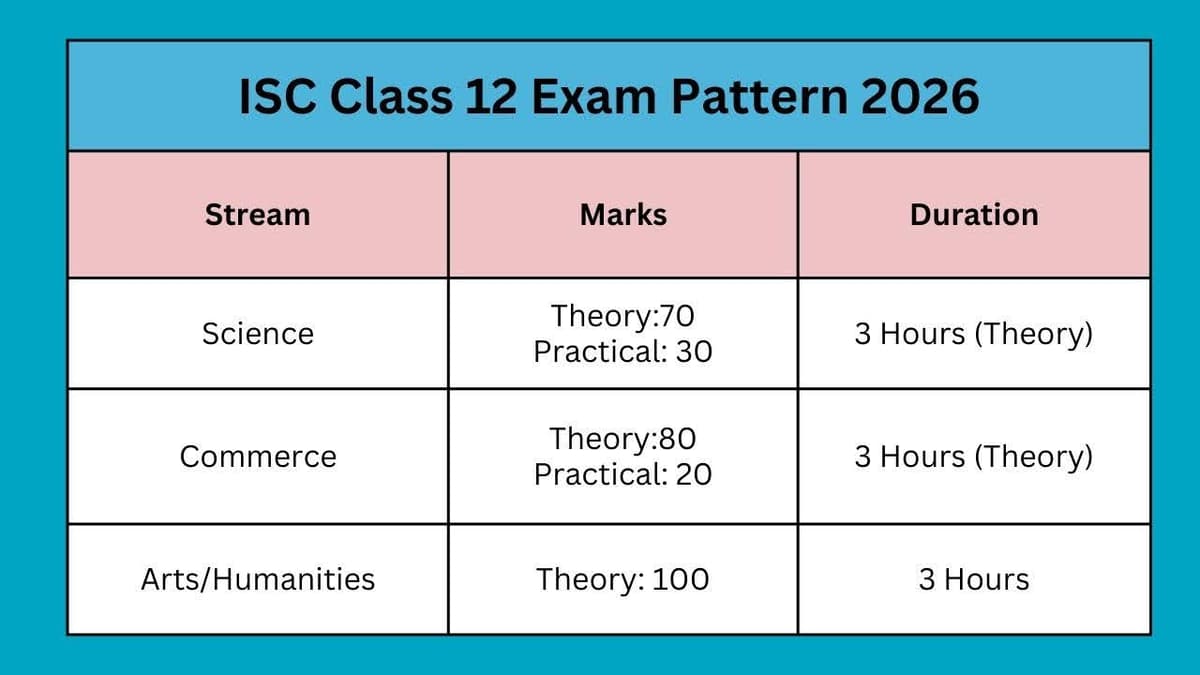
- For most of the subjects in the ISC 12th exam, the duration is 3 hours.
- The question paper will be distributed at 8:45 AM in the 1st shift and at 1:45 PM in the 2nd shift.
The exam pattern of the ISC Class 12th exam 2026 covers various subjects, including Sociology, Psychology, Geography, Physics, Chemistry, etc.
Check: ISC Class 12 Registration
 (6).png?h=112&w=263&mode=stretch)



Comments
Found 5 Comments
Many colleges in India offer admission through board-based entry, meaning selection is based on Class 12 marks. Universities like University of Delhi, Banaras Hindu University, Calcutta University, Mumbai University, and Allahabad University offer merit-based admissions for various undergraduate courses without entrance exams.
In the Council for the Indian School Certificate Examinations (ISC Class 12), you must pass English and at least three other subjects. If you fail in Accounts or Maths but pass four other subjects, including English, you may still be declared a pass. However, you can appear for a compartment/improvement exam to clear the failed subject.
You can check here for the ISC Previous Year Question Papers (Available)- Download Question Paper PDF with Solutions Here
Determining which subject will be the toughest for the Council for the Indian School Certificate Examinations (ISC) Class 12 board exams in 2026 varies by student, but many find Physics more challenging because it involves numerous derivations, numerical problems, and abstract concepts (e.g., wave optics, atomic/ nuclear theory) that require a deeper understanding.
Students who struggle with a strong math background or conceptual application may also find Mathematics difficult, while for others, Chemistry, coordination compounds, electrochemistry, or chemical kinetics pose significant difficulty