



Alternating Current (AC) is an important and high-scoring chapter in Class 12 Physics. AC usually contributes around 6–8 marks, making it one of the most scoring topics in the syllabus.
- AC Current CBSE Weightage: 8–12 marks
- AC Current JEE Main Weightage: 6–8 marks (2–3 questions)
- AC Current JEE Advanced Weightage: 8–12 marks (2–3 questions)
You can find complete revision notes on alternating current class 12 NCERT chapter 7 including all formulas and numerical tips as noted for CBSE boards in the article below.
Collegedunia’s Alternating Current notes are based on NCERT, Reference books like S.L Arora, and previous years’ questions, which will help you not only in Boards but in Competitive exams as well.
Test Your Preparation: Class 12 Physics Chapter 7 Mock Test
Alternating current chapter is conceptual and numerical focussed. Attempting a mock test is one of the most effective ways to assess the tricky topics like series LCR circuits, resonance conditions, and transformers before you sit for the actual board exams.
Attempt Alternating Current Mock TestHow will Collegedunia’s Alternating Current Class 12 Physics Notes help you?
The Alternating Current Class 12 Physics Chapter 7 notes are prepared by subject experts and as per the latest marking scheme and syllabus. The notes cover the complete NCERT and other reference books, making it most suitable for boards and other exams.
- Complex topics like the Phasor diagram and resonance are explained in simple language with clear diagrams.
- Important points or formulas are highlighted for the last-minute revision.
- Numericals are explained step-by-step, along with formulas and derivations used.
- Notes are well structured and cover every topic required for your exam.
Students can save their time and prepare smartly using our Class 12 Physics Chapter 7 Alternating Current Notes.
Alternating Current Class 12 Must-Do Topics for Boards, JEE, and NEET
In Class 12 Physics Chapter 7, Series LCR Resonance, Power in AC Circuits, and Transformers covers around 85-90% of the questions that are asked in the exam.
Here are the important topics from this chapter, along with the formulas and concepts:
Alternating Voltage and Current — Peak and RMS Values
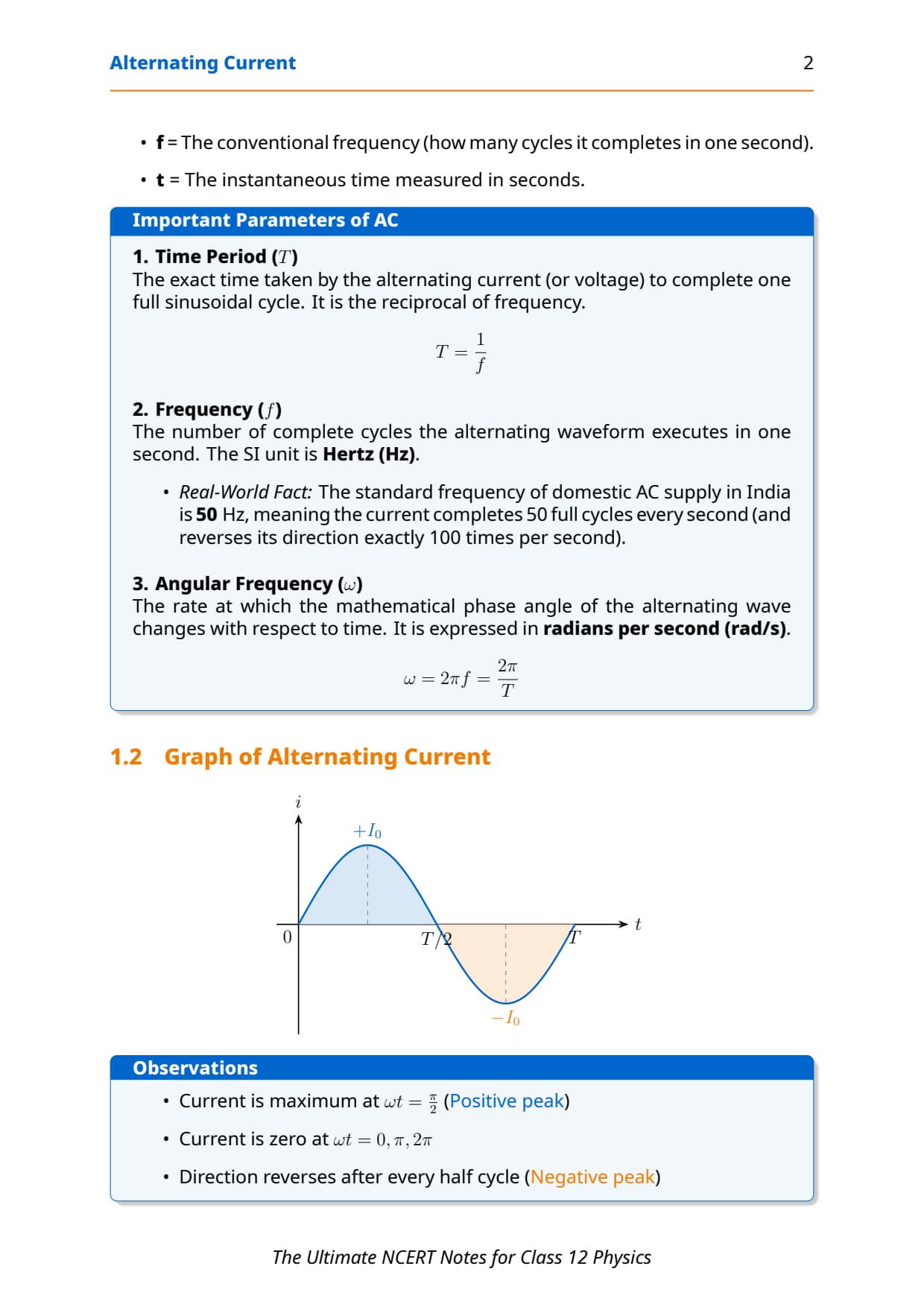
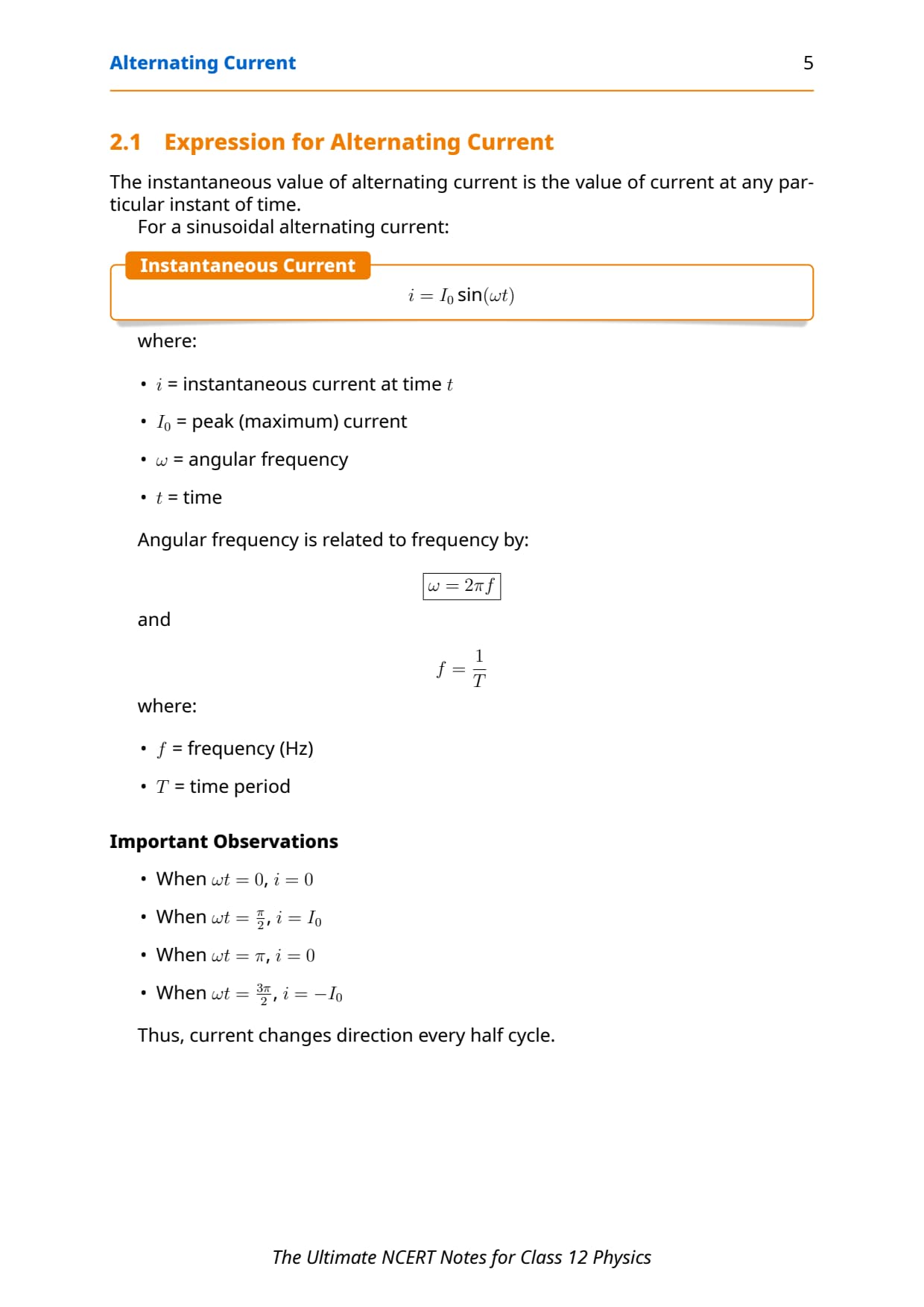
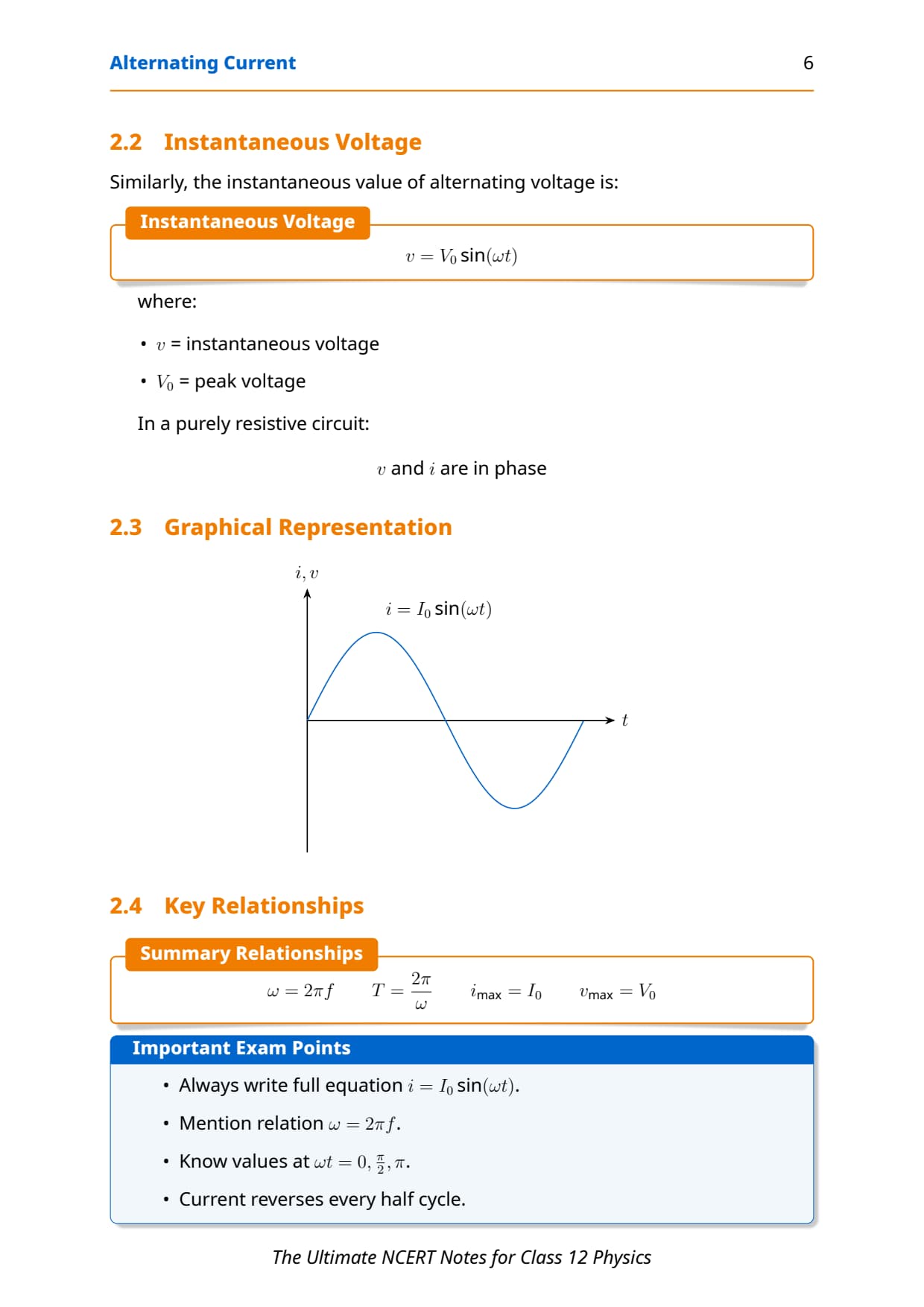
An alternating voltage is expressed as \( v = V_m \sin(\omega t) \) or \( v = V_m \sin(\omega t + \phi) \) where \( V_m \) is peak voltage, \( \omega = 2\pi f \) (angular frequency).
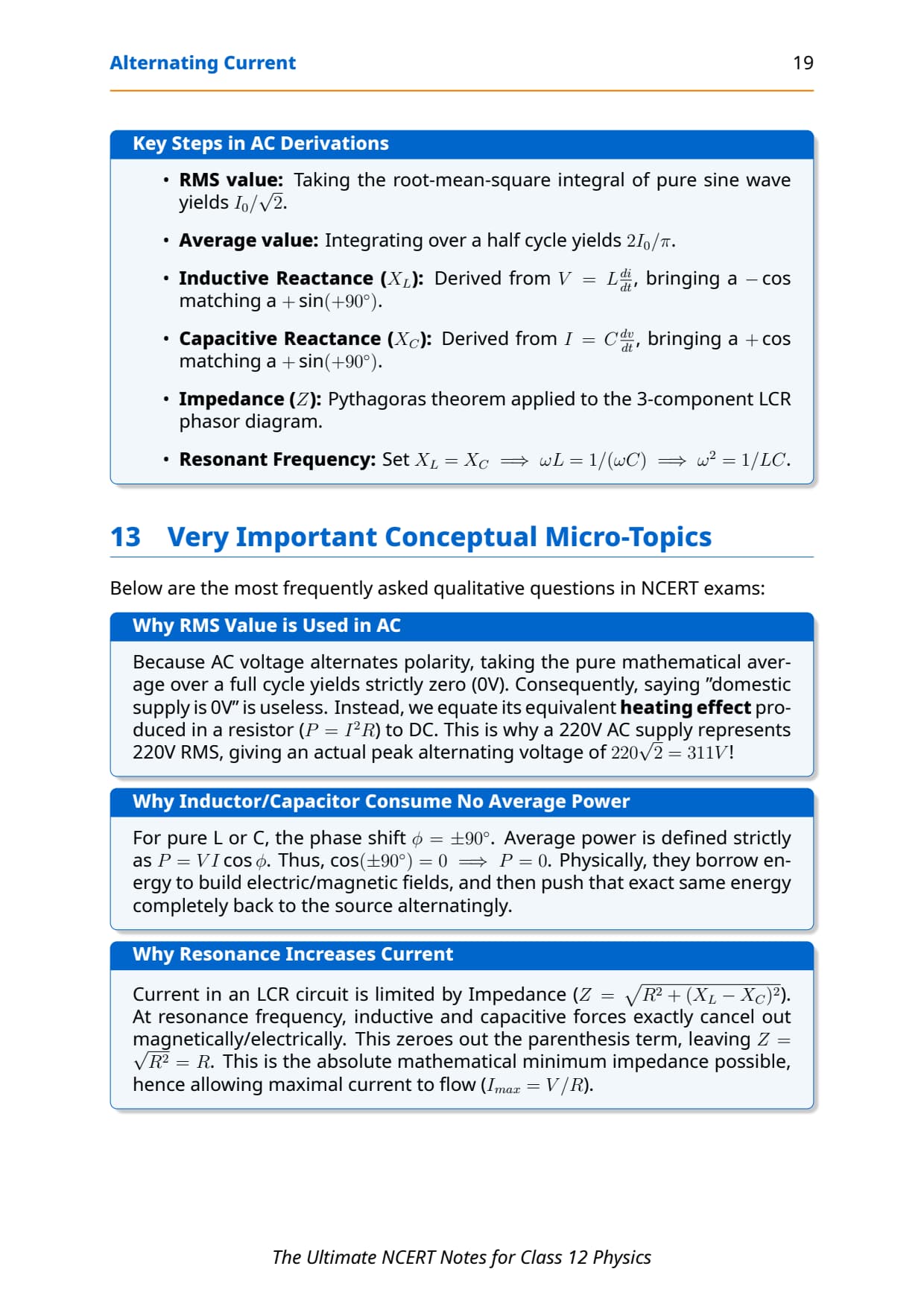
RMS (root mean square) value: \( V_{\text{rms}} = \frac{V_m}{\sqrt{2}} \approx 0.707 V_m \) (same for current \( I_{\text{rms}} = \frac{I_m}{\sqrt{2}} \))
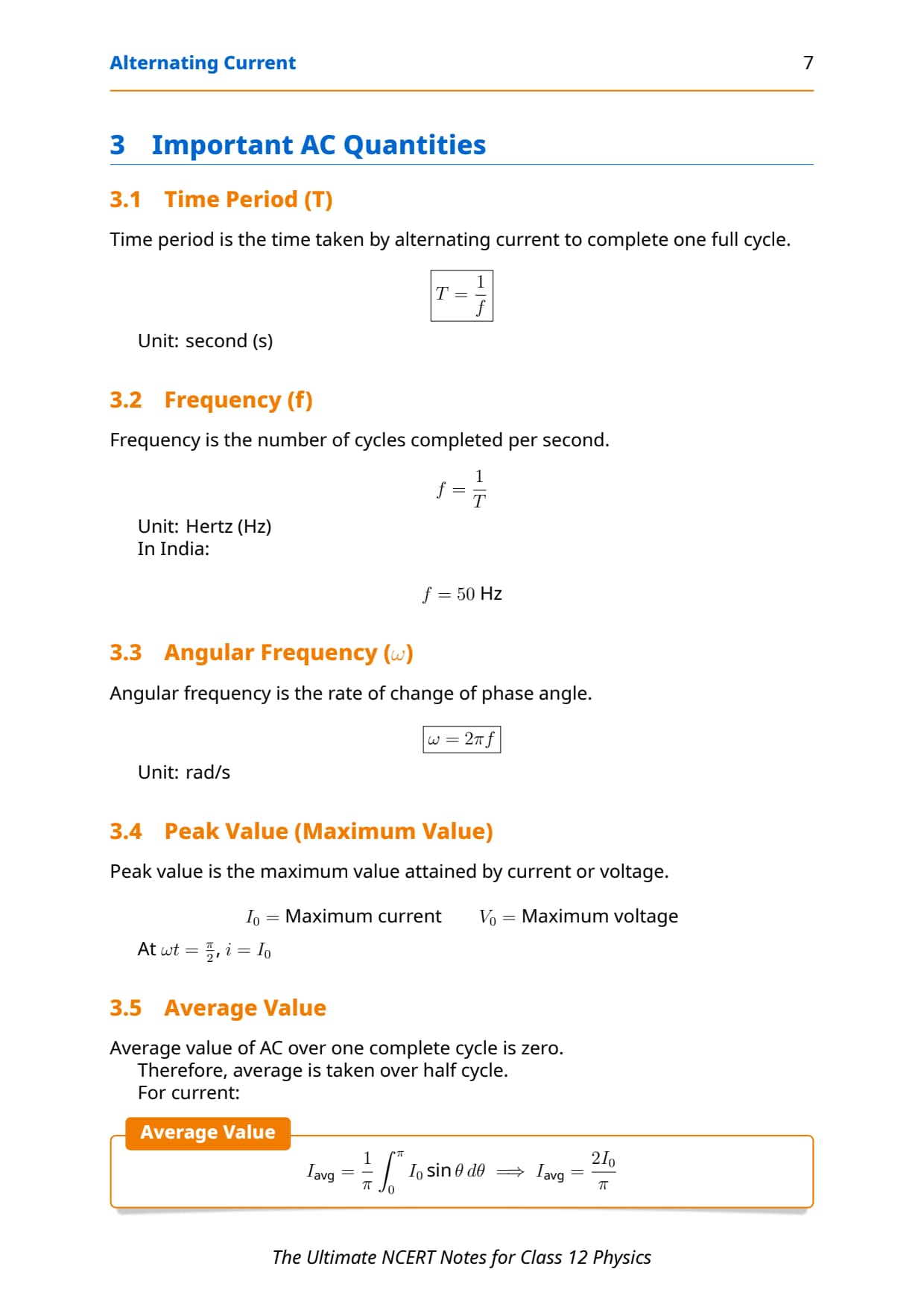
Average value over one cycle is zero (for sinusoidal AC).
Note: All AC meters show RMS values. Average power is calculated using RMS values: \( P_{\text{avg}} = I_{\text{rms}}^2 R \).
AC Voltage Applied to Pure R, L, and C — Reactance and Phase
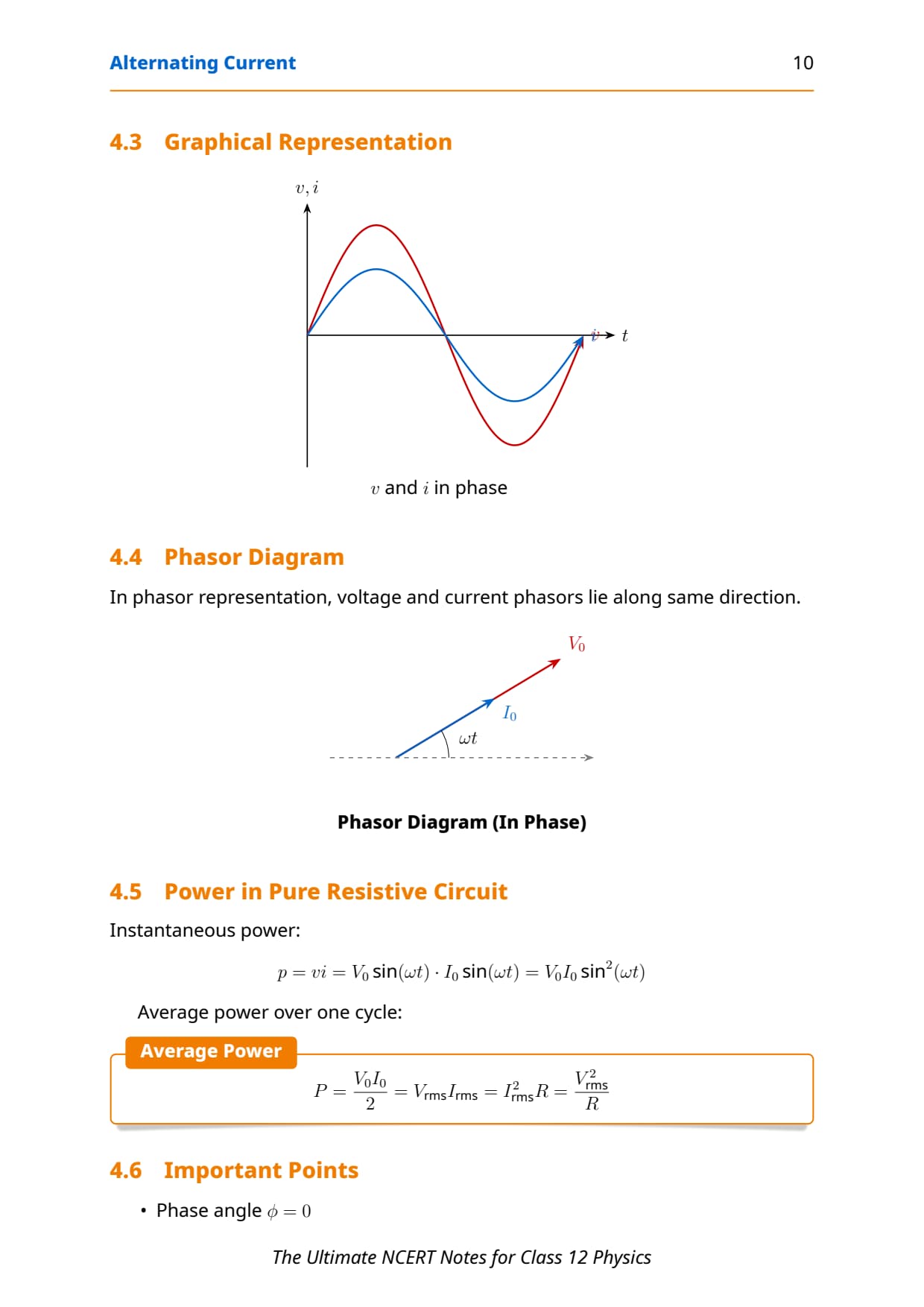
Resistor (R): Current in phase with voltage (\( \phi = 0 \)). Impedance \( Z = R \).
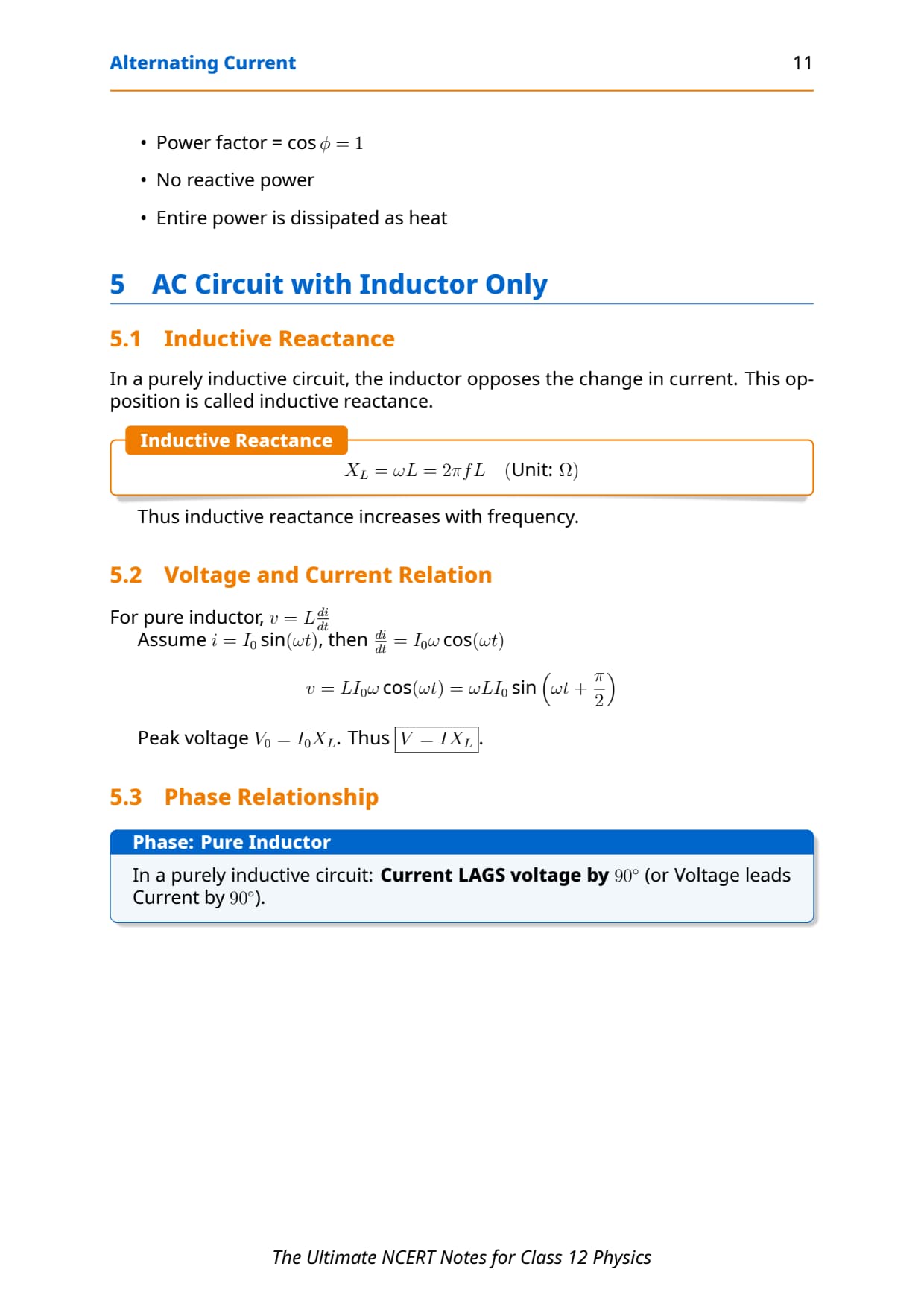
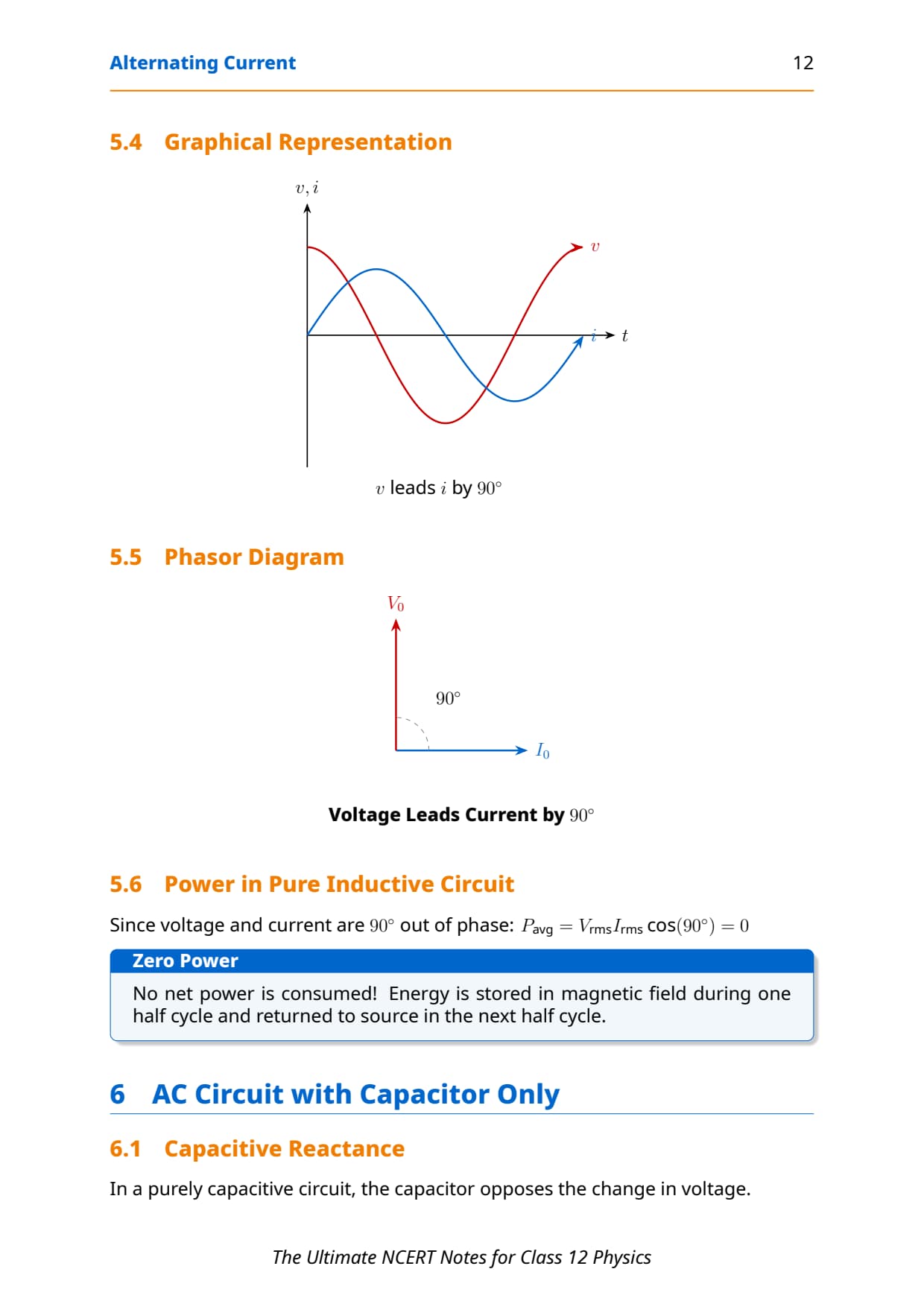
Inductor (L): Current lags voltage by \( \frac{\pi}{2} \). Inductive reactance \( X_L = \omega L = 2\pi f L \). Impedance = \( X_L \). Average power = 0.
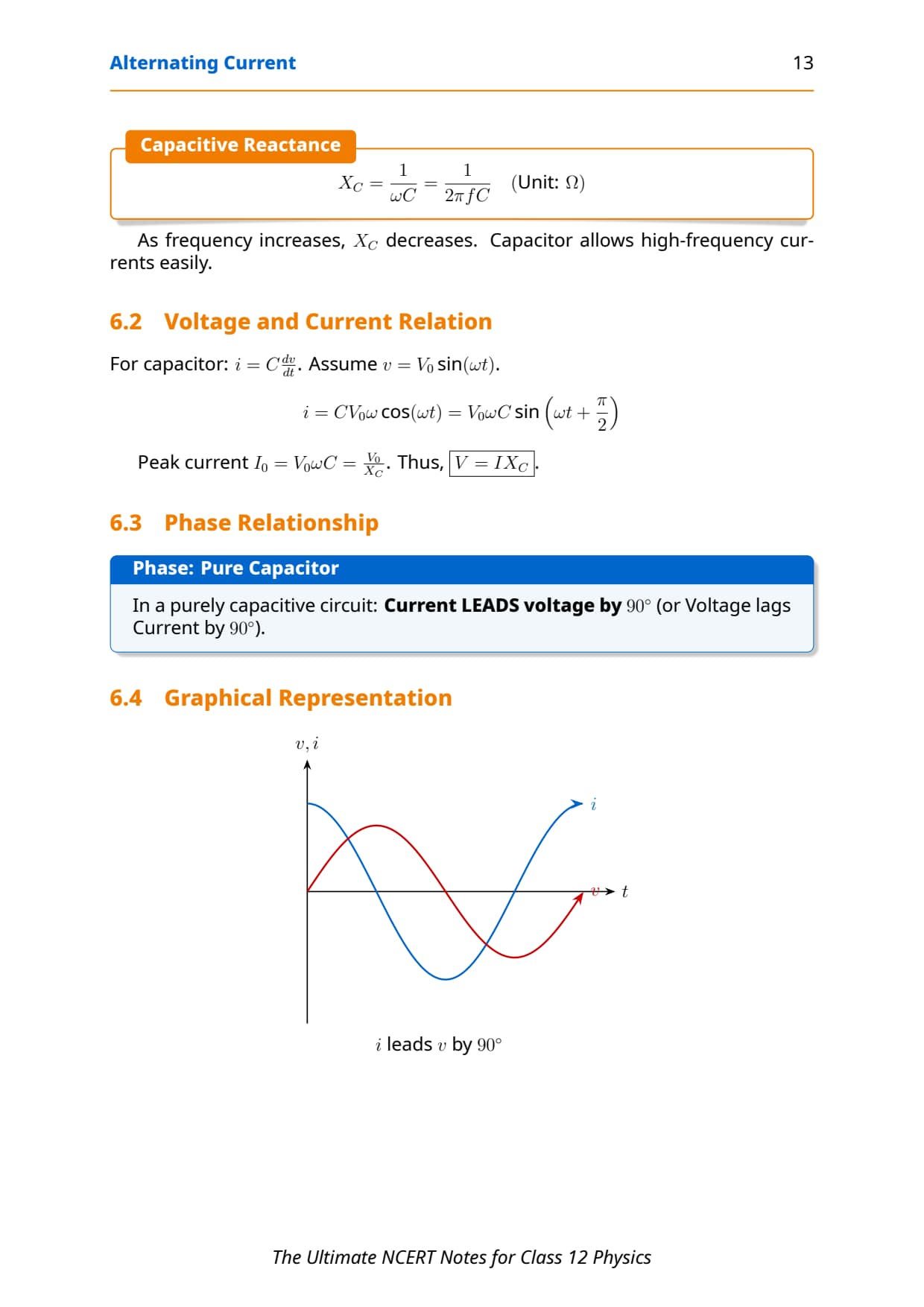
Capacitor (C): Current leads voltage by \( \frac{\pi}{2} \). Capacitive reactance \( X_C = \frac{1}{\omega C} = \frac{1}{2\pi f C} \). Impedance = \( X_C \). Average power = 0.
Easy Tip: \( X_L \) increases with frequency; \( X_C \) decreases with frequency. At high frequency, the inductor behaves like an open circuit; the capacitor behaves like a short circuit.
Power in AC Circuits — Average Power and Power Factor
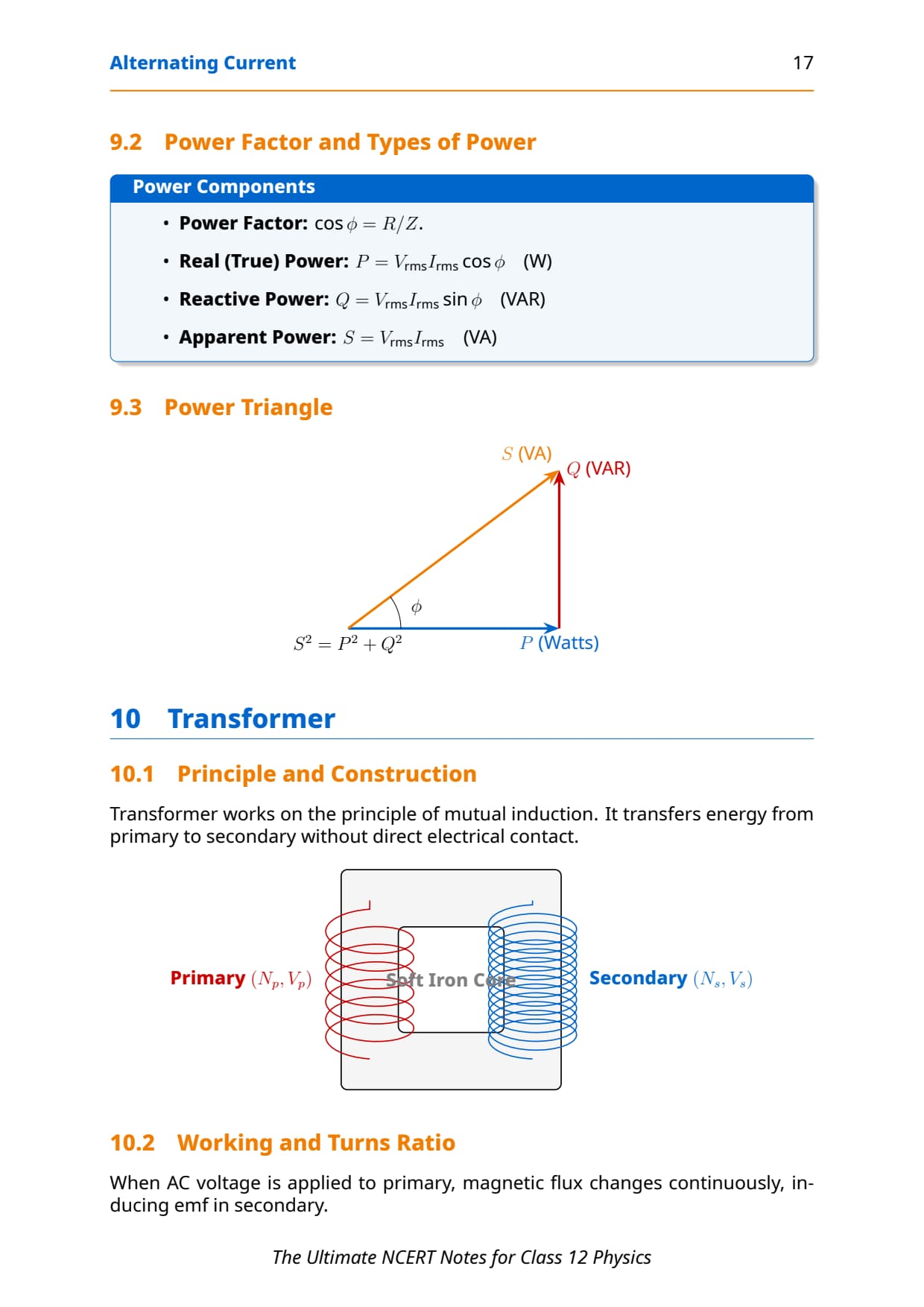
Instantaneous power \( P = VI \). Average power \( P_{\text{avg}} = V_{\text{rms}} I_{\text{rms}} \cos\phi = I_{\text{rms}}^2 R \)
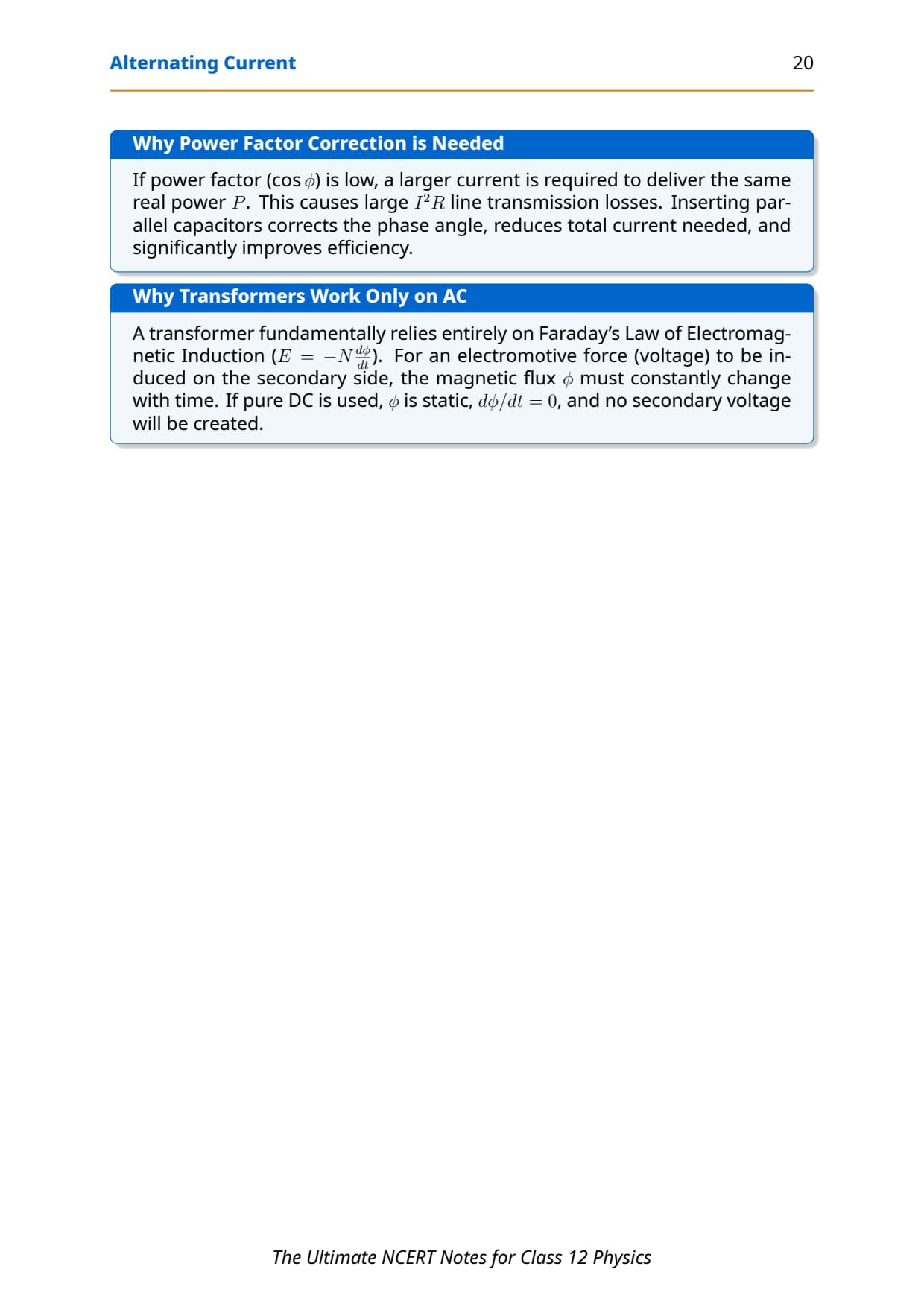
Power factor \( \cos\phi = \frac{R}{Z} \) (ranges from 0 to 1).
- Purely resistive: \( \cos\phi = 1 \)
- Purely inductive/capacitive: \( \cos\phi = 0 \) (wattless current).
Easy Tip: For maximum power transfer in AC, the power factor should be 1 (resonance condition).
LC Oscillations
In an ideal LC circuit, energy oscillates between electric (capacitor) and magnetic (inductor) fields. Angular frequency \( \omega = \frac{1}{\sqrt{LC}} \). Charge on capacitor: \( q = q_0 \cos(\omega t + \phi) \). This is analogous to simple harmonic motion. (Damped oscillations occur in real circuits due to resistance.)
Transformers — Principle, Efficiency, and Losses
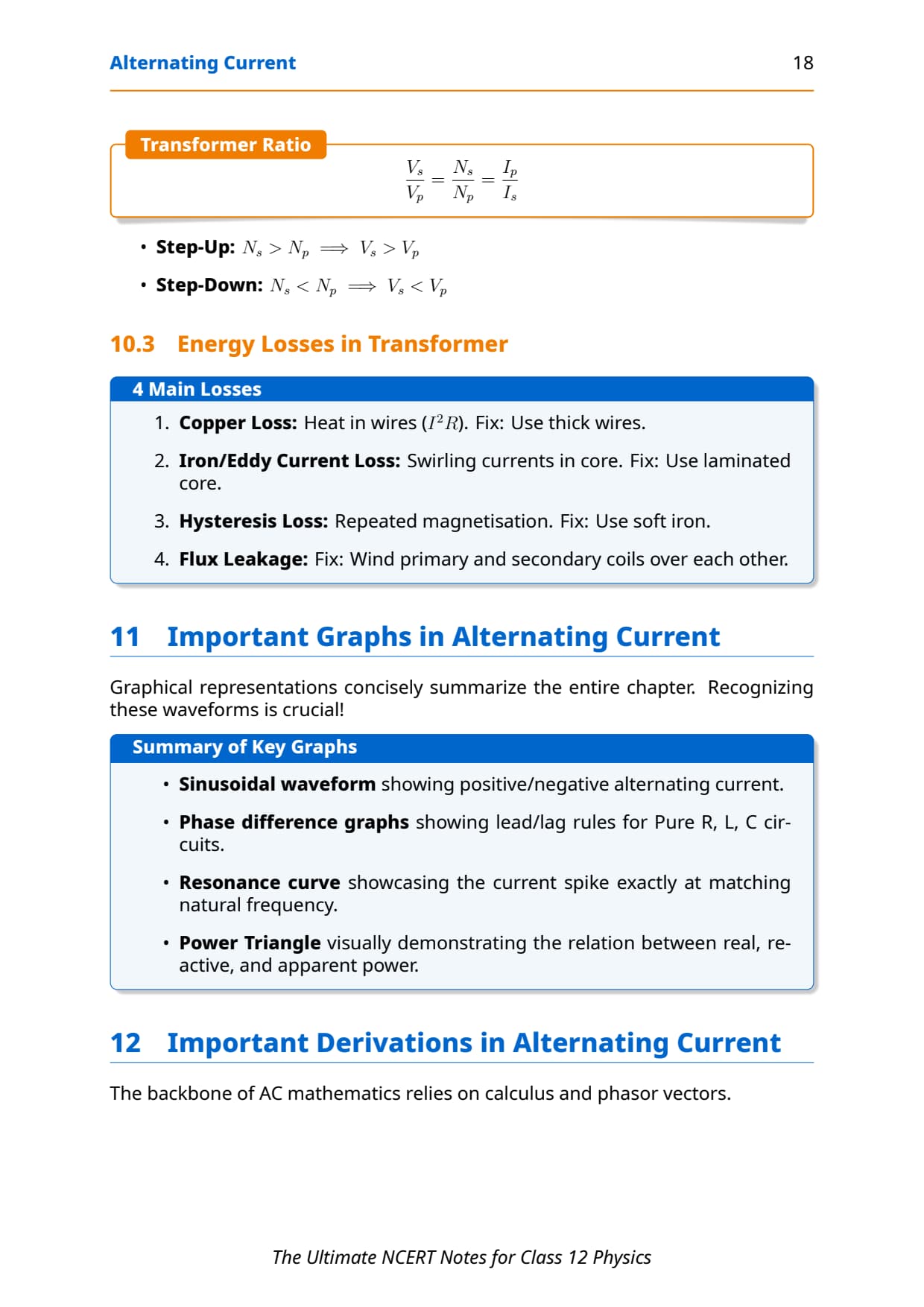
Principle: Mutual induction. For ideal transformer: \( \frac{V_s}{V_p} = \frac{N_s}{N_p} = \frac{I_p}{I_s} \).
Step-up: \( N_s > N_p \) (voltage increases, current decreases).
Step-down: \( N_s < N_p \).
Efficiency \( \eta = \frac{\text{Output Power}}{\text{Input Power}} = \frac{V_s I_s}{V_p I_p} \times 100\% \) (ideal = 100%).
Losses (practical transformer): Copper loss (\( I^2 R \)), eddy current (laminated core reduces), hysteresis (soft iron core), flux leakage. Note: Power is transmitted at high voltage (step-up) to reduce \( I^2 R \) loss.
Ace Your Revision: Class 12 Physics Chapter 7 Handwritten Notes
Perfect for quick, focused revision, these handwritten notes simplify complex derivations, phasor diagrams, and LCR circuits. They provide an easy-to-digest way to lock down key concepts and formulas right before your board exams.
Download Handwritten NotesAlternating Current Class 12 Physics: Key Differences
The difference between RMS and Peak Value, and Ideal and Practical transformers has been repeated multiple times in the CBSE Class 12 Physics paper. Students should properly revise these differences before the exam.
RMS Value vs Peak Value
| Property | Peak Value | RMS Value |
|---|---|---|
| Definition | Maximum Instantaneous Value | Effective DC Equivalent Value |
| Formula | \( V_m \) or \( I_m \) | \( V_{\text{rms}} = \frac{V_m}{\sqrt{2}} \) |
| Used for | Instantaneous Calculation | Power, Heating effect, Meter readings |
| Relation to Power | Not directly used | \( P_{\text{avg}} = I_{\text{rms}}^2 R \) |
NCERT Class 12 Physics Chapter 7: CBSE Board Previous Year Paper Analysis
As per previous year trends and analysis:
- LCR Series Circuit and Resonance appears in 50-60% questions every year.
- Transformer questions are asked almost every year in choice or long-answer type questions, asked repeatedly in recent years, 2024,2023,2020,2017.
- Power factor and wattless current usually form MCQ and short-answer questions.
| Question Type | Marks | Frequently asked topics |
|---|---|---|
| MCQ | 1-2 Marks |
|
| Short Answers | 2 Marks |
|
| Short Answers | 3 Marks |
|
| Long Answers | 3-5 Marks |
|
AC Current Boards Revision Notes Vs JEE Main Revision Notes
Around 80% of the content is common between CBSE and JEE. Students preparing for Boards as well as for competitive exams should also practice additional or exam-specific important topics along with the NCERT. Start by mastering the CBSE syllabus, then layer in the additional JEE material.
| Feature | CBSE Board Focus | JEE Focus | Prep Strategy / Tip |
| Concepts & Phasors | Basic definitions; phasor diagrams for R, L, C, RL, RC, LCR; wattless current. | Transient analysis (RL/RC); sharpness of resonance; power in complex circuits. | Draw all 6 phasors neatly for CBSE; 1-page summary of transients/Q-factor for JEE. |
| Derivations | Full derivations for RMS/avg values, impedance, resonance, and power. | Applications and variations; parallel resonance (rare for boards). | Box derivation results for CBSE; create an "Application Sheet" for JEE variations. |
| Visual Aids | Labeled diagrams (phase \( \phi \), lead/lag) are essential for high marks. | Mental phasors for fast calculation of Z, \( \phi \), and power. | Practice labeled phasors in mocks; use "Impedance Triangle" shortcuts for JEE. |
| Numericals | Simple NCERT types: \( X_L / X_C \), resonance frequency, transformer efficiency. | Multi-step: Varying frequency, max power transfer, Q-factor, RL/RC phase shifts. | 1-page formula sheet for CBSE; 2-page "Tricky Numericals" with graphs for JEE. |
| Transformers | Construction, step-up/down, and 4 energy losses (eddy, etc.). | Efficiency with losses; turns ratio in the power transmission context. | Label transformer diagrams + loss table; one numerical on transmission loss for JEE. |
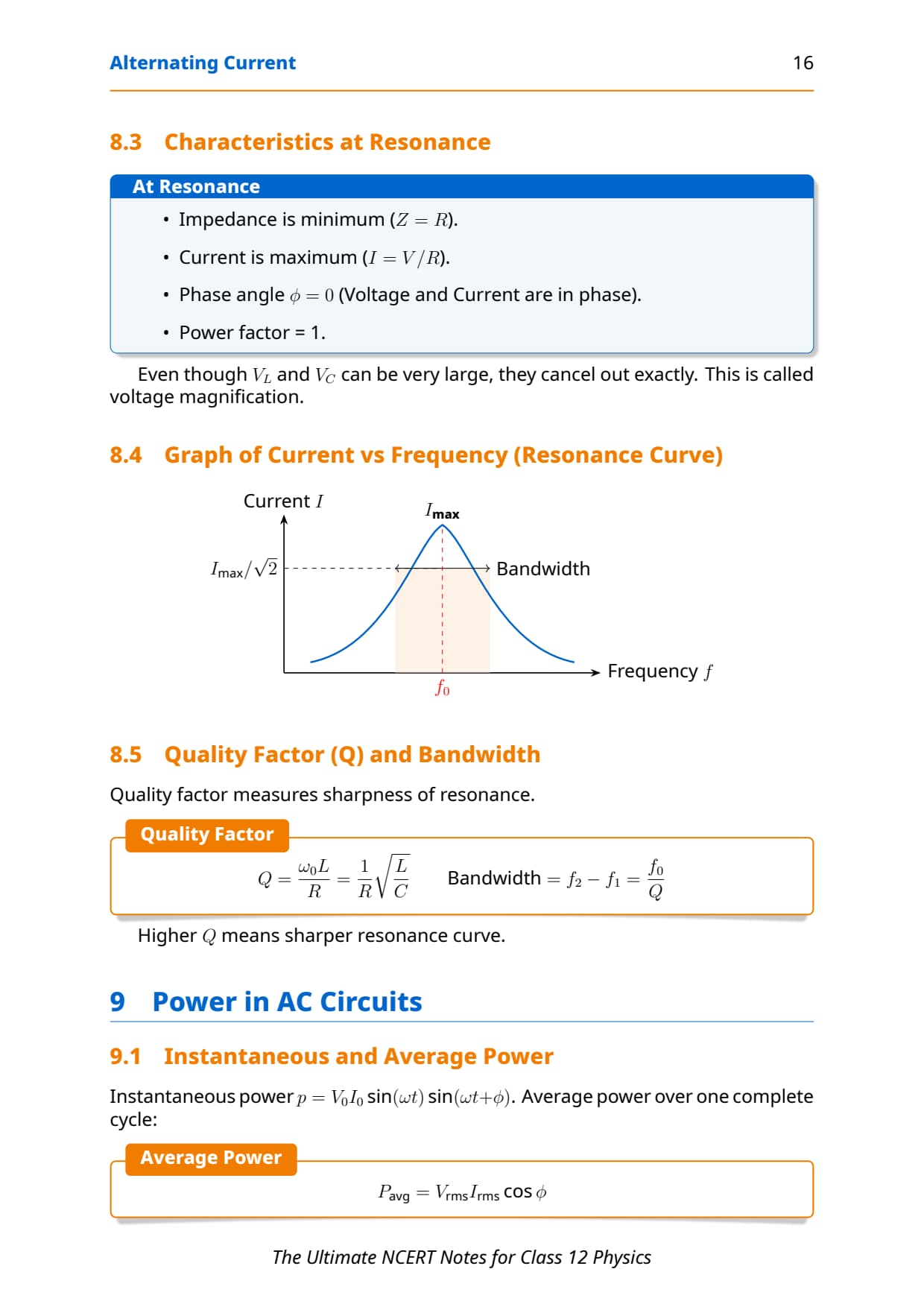
| Resonance | Definitions of frequency, Q-factor, and Power Factor (\( \cos(\phi) \)). | Bandwidth, half-power frequencies, and resonance curve analysis. | Definition boxes for CBSE; draw a resonance curve with marked bandwidth for JEE. |
| Exam Style | Subjective: Explain, derive, and solve (2–5 marks). | Objective: MCQs, conceptual traps, and speed-based numericals. | Write full explanations for CBSE; solve 50 MCQs daily with a timer for JEE. |
| Syllabus Scope | Strictly NCERT (no parallel circuits or transients). | Extensions: LC oscillations, forced oscillations, and AC bridges. | CBSE = Pure NCERT; JEE = Add 1 extra page on LC oscillations/parallel resonance. |
Alternating Current Class 12: Exam Strategy & Last-Minute Tips
Students often lose marks by skipping phasor diagrams or forgetting units. Follow this strategy and remember these points for scoring full marks in the exam:
- Always Draw Phasor Diagrams for L, C, or LCR circuits with voltage and current labelling, even if not asked specifically.
- For numericals, use RMS values for power calculations and clearly show \( \cos\phi = \frac{R}{Z} \).
- In boards, clearly write the formula, symbol representation, and put the final answer in a box.
- For JEE and NEET, Practise mixed LCR problems with varying frequency and power factor questions (highly repeated).
- Revise the difference, relations, and transformer properties before the exam.
FAQs
Ques. Explain the derivation of the RMS value of alternating current and voltage in NCERT Class 12 Physics Chapter 7 with a graphical representation.
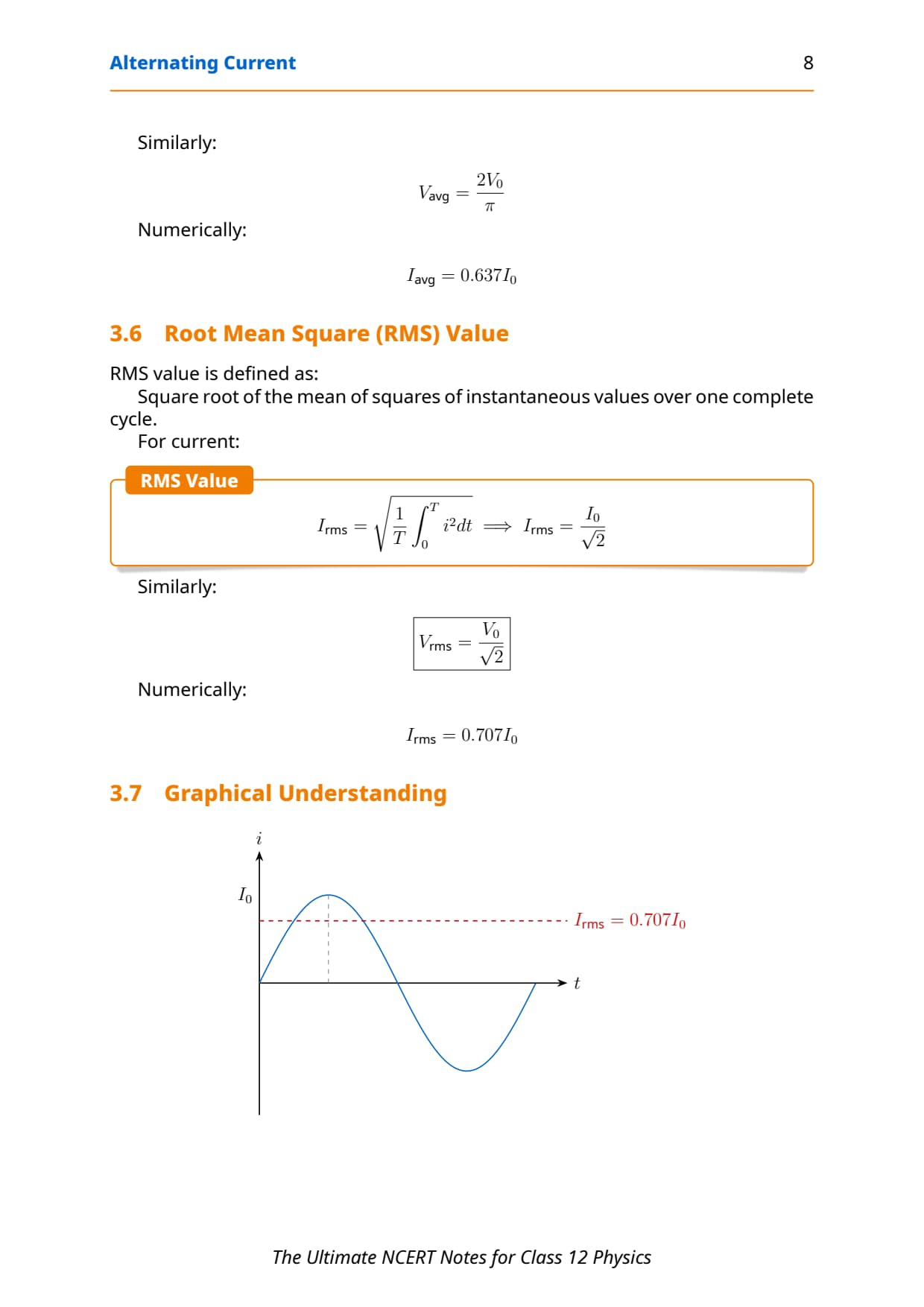
Ans. The RMS value is the effective value of AC that produces the same amount of heat as DC in one complete cycle. Using the fact that the average value of \( \sin^2 \omega t \) in one complete cycle is always \( \frac{1}{2} \), we can find the RMS value of current/voltage.
Instantaneous current: \( i = i_m \sin \omega t \)
Mean Square Value over one period: \( \langle i^2 \rangle = \frac{i_m^2}{2} \) using \( \langle \sin^2 \omega t \rangle = \frac{1}{2} \)
Thus \( I_{\text{rms}} = \frac{i_m}{\sqrt{2}} = 0.707 \, i_m \), similarly \( V_{\text{rms}} = \frac{v_m}{\sqrt{2}} \)
The graph shows that the peak value \( i_m \) is the maximum height of the wave, and the RMS value is slightly higher than the Average value. It confirms that the effective heating current (RMS) is always greater than the average current in a half cycle.
Ques. What is the phase difference between voltage and current in a pure inductive circuit according to NCERT Class 12 AC Current notes, and derive the expression for inductive reactance?
Ans. In a pure inductive circuit, voltage leads the current by 90 degrees. This means that when the voltage reaches its maximum value, the current is still at 0.
Inductive reactance \( X_L \) opposes the change in current and increases with frequency. Using Kirchhoff's law and trigonometric equations, we can derive Inductive reactance.
On applying Kirchhoff's law on alternating voltage \( v = v_m \sin(\omega t) \), we get
$$ v_m \sin(\omega t) = L \frac{di}{dt} $$
On integrating both sides, we get,
$$ i = -\frac{v_m}{\omega L} \cos(\omega t) $$
Applying the trigonometric identity, we get
$$ i = \frac{v_m}{\omega L} \sin\left(\omega t - \frac{\pi}{2}\right) $$
In the above equation, \( \omega L \) behaves exactly like resistance in a DC circuit (it opposes the flow of current); this is called inductive reactance.
\( X_L = \omega L = 2\pi f L \), where \( L \) is inductance and \( f \) is frequency.
Ques. Derive the expression for current in a series LCR circuit in Class 12 NCERT Alternating Current chapter, including impedance, resonance condition, and power factor.
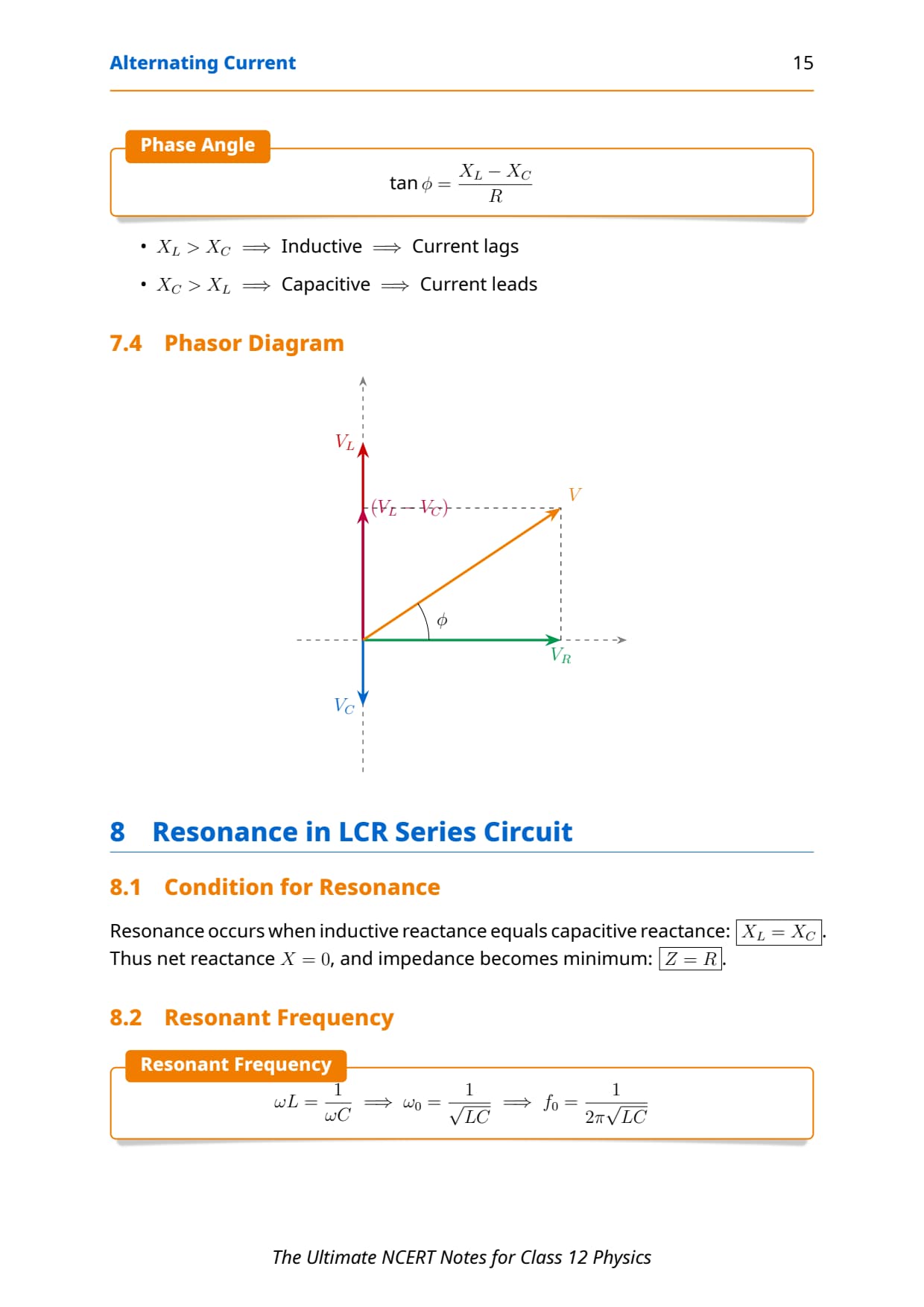
Ans. In the series LCR circuit, the voltages across R, L, and C are not in phase with each other. \( V_R \) is in phase with current \( I \), \( V_L \) leads \( I \) by \( \frac{\pi}{2} \), and \( V_C \) lags \( I \) by \( \frac{\pi}{2} \). The resultant voltage is found using vector addition.
Derivation of LCR circuit using phasor diagram (vector addition):
\( V_R = I_m R \) (along current)
\( V_L = I_m X_L \) (leads current by \( \pi/2 \))
\( V_C = I_m X_C \) (lags current by \( \pi/2 \))
Net voltage amplitude:
$$ v_m = \sqrt{V_R^2 + (V_L - V_C)^2} = I_m \sqrt{R^2 + (X_L - X_C)^2} $$
Therefore, Impedance:
$$ Z = \frac{v_m}{I_m} = \sqrt{R^2 + (X_L - X_C)^2} $$
Instantaneous current:
\( i = i_m \sin(\omega t + \phi) \) where \( \tan \phi = \frac{X_L - X_C}{R} \)
Power Factor: \( \cos \phi = \frac{R}{Z} \)
Ques. How to calculate average power dissipated in an AC circuit with a resistor, inductor, and capacitor as per NCERT Class 12 Physics, with wattless current explanation?
Ans. For calculating the power in an AC circuit, we will consider Average Power, as instantaneous power changes quickly with the direction of current and voltage.
In an LCR circuit, the average power is not \( V \times I \), but it also depends on the phase relationship.
The average power formula:
$$ P_{\text{av}} = V_{\text{rms}} I_{\text{rms}} \cos \phi $$
Where \( V_{\text{rms}} \) and \( I_{\text{rms}} \) are root mean square values of voltage and current, and \( \cos \phi = \frac{R}{Z} \) is the power factor.
(i) With a pure resistor:
\( \phi = 0 \), so \( \cos 0 = 1 \).
Power is maximum: \( P = V_{\text{rms}} I_{\text{rms}} \).
(ii) With an inductor or a capacitor:
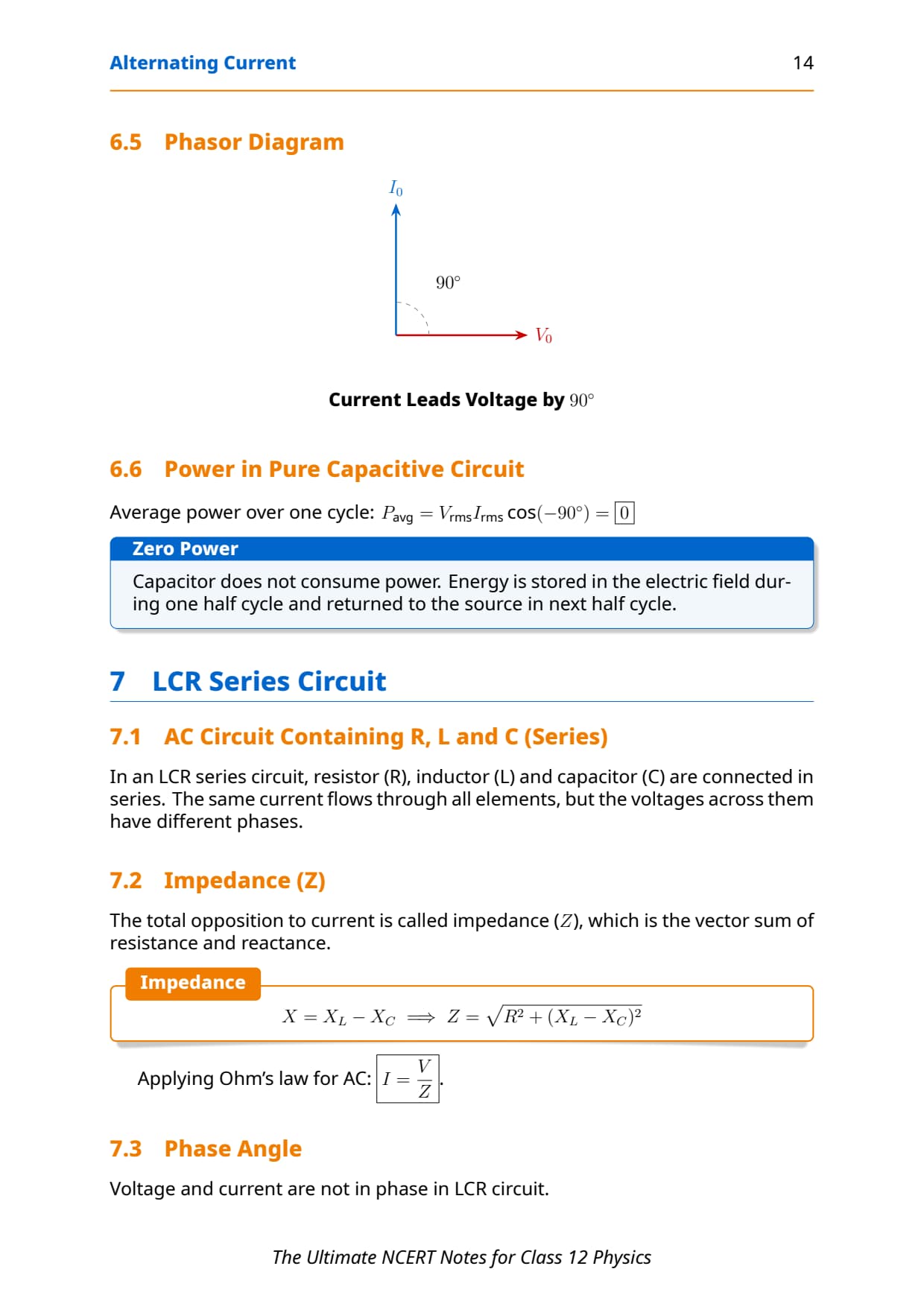
\( \phi = 90° \), so \( \cos 90° = 0 \).
Power dissipated is zero.
Wattless Current
If the circuit contains only a pure inductor or a pure capacitor, then the average power is zero, as the phase difference is \( 90° \), so \( \cos 90° = 0 \).
The current is flowing through the circuit, but the average power dissipated is zero; this is called wattless current.
Ques. Difference between peak value, RMS value, and average value of alternating current with formulas and examples from NCERT Class 12 Physics Chapter 7.
Ans.
Peak Value (\( I_m \)): The maximum value reached by alternating current in either positive or negative direction.
Formula: \( i = I_m \sin(\omega t) \)
Example: If your AC source is labeled as having a peak current of 5A, it means that the current will swing between –5A and +5A during every cycle.
Average Value (\( I_{\text{avg}} \)): As the average value of a sine wave in a full cycle is zero, we calculate the average value using half a cycle (0 to \( T/2 \)). It is a DC current that will transfer the same amount of charges as AC in that cycle.
Formula: \( I_{\text{avg}} = \frac{2 I_m}{\pi} = 0.637 \, I_m \)
Example: For a peak 10 A current, the average value of a half cycle is \( 0.637 \times 10 = 6.37 \) A.
RMS value (\( I_{\text{rms}} \)): Root mean square or effective value is the value of direct current (DC) that will produce the same heating effect in a resistor as the AC.
Formula: \( I_{\text{rms}} = \frac{I_m}{\sqrt{2}} = 0.707 \, I_m \)
Example: The "220V" supply in Indian homes is the RMS voltage. The peak voltage is actually \( 220 \times \sqrt{2} = 311 \) V.



Comments