




BITSAT 2019 Question Paper PDF is available for download. BITSAT 2019 was conducted in online CBT mode by BITS Pilani. BITSAT 2019 Question Paper had 150 questions to be attempted in 3 hours.
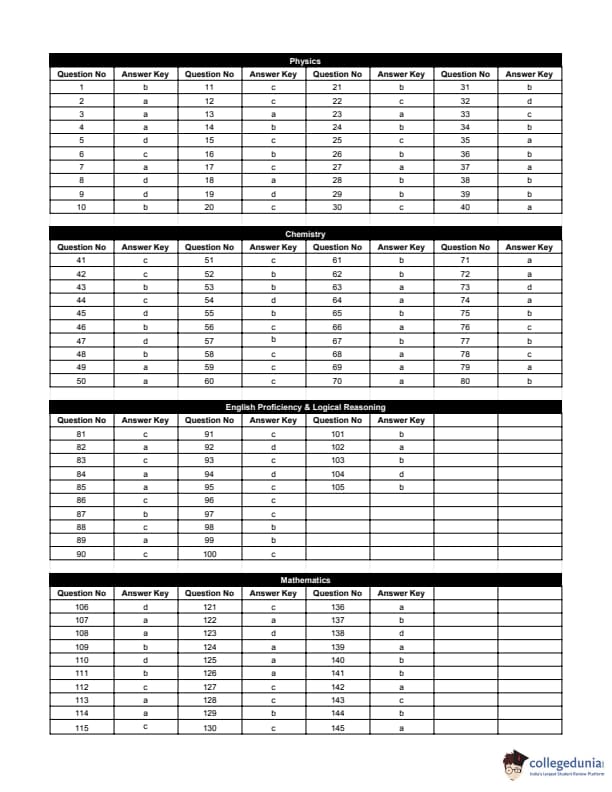
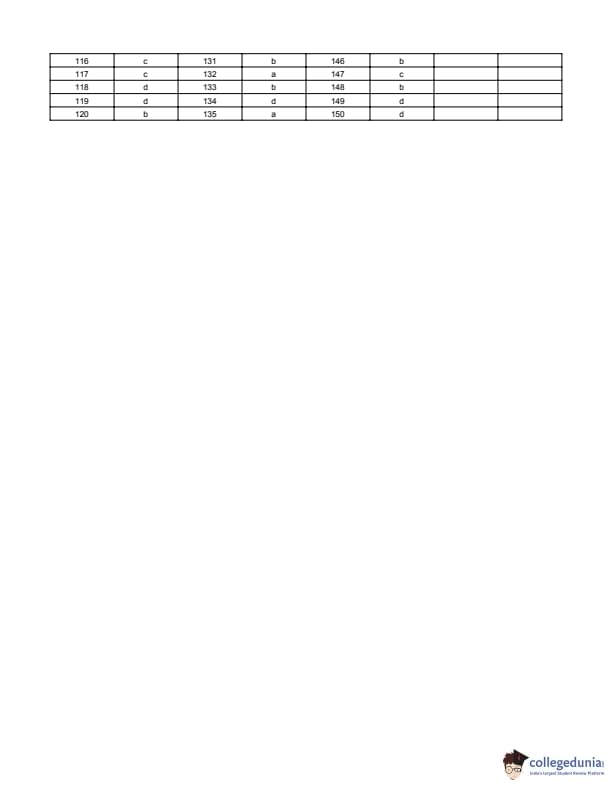
BITSAT 2019 Question Paper with Answer Key PDF
| BITSAT 2019 Question Paper PDF | BITSAT 2019 Answer Key PDF |
|---|---|
| Download PDF | Download PDF |
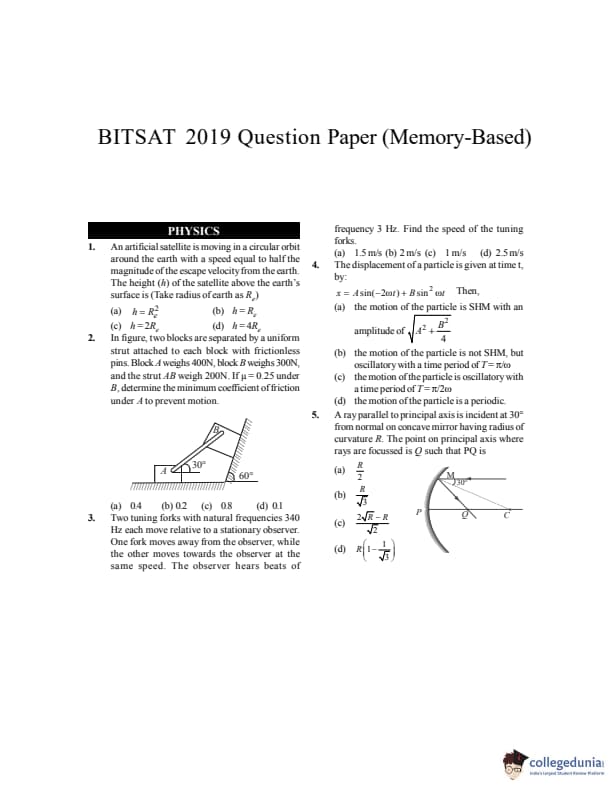
An artificial satellite is moving in a circular orbit around the earth with a speed equal to half the magnitude of the escape velocity from the earth. The height \( h \) of the satellite above the earth’s surface is (Take radius of earth as \( R_e \)):
In the figure, two blocks are separated by a uniform strut attached to each block with frictionless pins. Block A weighs 400 N, block B weighs 300 N, and the strut AB weighs 200 N. If \( \mu = 0.25 \) under block B, determine the minimum coefficient of friction under A to prevent motion.

Two tuning forks with natural frequencies 340 Hz each move relative to a stationary observer. One fork moves away from the observer, while the other moves towards the observer at the same speed. The observer hears beats of frequency 3 Hz. Find the speed of the tuning forks.
The displacement of a particle is given at time \( t \), by: \[ x = A\sin(-2\omega t) + B\sin^2 \omega t \]
Then,
A ray parallel to principal axis is incident at \(30^\circ\) from normal on a concave mirror having radius of curvature \( R \). The point in principal axis where rays are focussed is \( Q \) such that \( PQ \) is

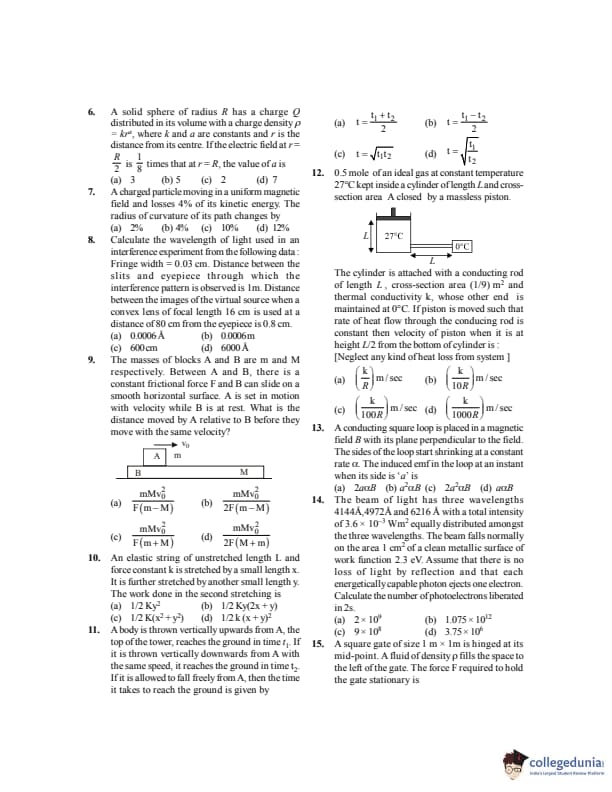
A solid sphere of radius \( R \) has a charge \( Q \) distributed in its volume with a charge density \( \rho = kr^a \), where \( k \) and \( a \) are constants and \( r \) is the distance from centre. If the electric field at \( r = \frac{R}{2} \) is \( \frac{1}{8} \) times that at \( r = R \), the value of \( a \) is
A charged particle moving in a uniform magnetic field loses \(4%\) of its kinetic energy. The radius of curvature of its path changes by
Calculate the wavelength of light used in an interference experiment from the following data:
Fringe width \( = 0.03\,cm \). Distance between the slits and eyepiece through which the interference pattern is observed is \(1\,m\). Distance between the images of the virtual source when a convex lens of focal length \(16\,cm\) is used at a distance of \(80\,cm\) from the eyepiece is \(0.8\,cm\).
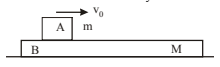
The masses of blocks A and B are \( m \) and \( M \) respectively. Between A and B, there is a constant frictional force \( F \) and B can slide on a smooth horizontal surface. A is set in motion with velocity \( v_0 \) while B is at rest. What is the distance moved by A relative to B before they move with the same velocity?
An elastic string of unstretched length \( L \) and force constant \( k \) is stretched by a small length \( x \). It is further stretched by another small length \( y \). The work done in the second stretching is
A body is thrown vertically upwards from A, the top of a tower, and reaches the ground in time \( t_1 \). If it is thrown vertically downwards from A with the same speed, it reaches the ground in time \( t_2 \). If it is allowed to fall freely from A, then the time taken to reach the ground is
0.5 mole of an ideal gas at constant temperature \(27^\circC\) is kept inside a cylinder of length \( L \) and cross-section area \( A \), closed by a massless piston. The cylinder is attached to a conducting rod of length \( L \), cross-section area \( A/19 \), and thermal conductivity \( k \), whose other end is maintained at \(0^\circC\). The piston is moved such that the rate of heat flow through the rod is constant. The constant velocity of the piston when it is at height \( L/2 \) from the bottom is

A conducting square loop is placed in a magnetic field \( B \) with its plane perpendicular to the field. The sides of the loop start shrinking at a constant rate \( \alpha \). The induced emf in the loop at the instant when its side is \( a \) is
The beam of light has three wavelengths \(4144\AA, 4972\AA, 6216\AA\) with a total intensity of \(3.6\times10^{-3}\,W/m^2\) equally distributed among the three wavelengths. The beam falls normally on a clean metallic surface of work function \(2.3\,eV\). Assuming no loss by reflection and that each photon ejects one photoelectron, calculate the number of photoelectrons liberated in \(2\,s\).
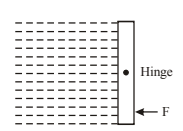
A square gate of size \(1\,m \times 1\,m\) is hinged at its mid-point. A fluid of density \( \rho \) fills the space to the left of the gate. The force \(F\) required to hold the gate stationary is
When \(0.50\,\AA\) X-rays strike a material, photoelectrons from the K shell are observed to move in a circle of radius \(23\,mm\) in a magnetic field of \(2\times10^{-2}\,T\) acting perpendicular to the direction of emission. What is the binding energy of K-shell electrons?
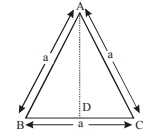
At the corners of an equilateral triangle of side \(a = 1\,m\), three point charges each of \(0.1\,C\) are placed. If the system is supplied energy at the rate of \(1\,kW\), calculate the time required to move one of the mid-point of the line joining the other two.
A vessel of volume \(20\,L\) contains a mixture of hydrogen and helium at temperature \(27^\circC\) and pressure \(2\,atm\). The total mass of the mixture is \(5\,g\). Assuming ideal gases, the ratio of mass of hydrogen to that of helium is
The resistance of a wire is \(R\). It is bent at the middle by \(180^\circ\) and both ends are twisted together to make a short of the new wire. The resistance of the new wire is
The resistance of a wire is \(R\). It is bent at the middle by \(180^\circ\) and both the ends are twisted together to make a shorter wire. The resistance of the new wire is
In a YDSE, the light of wavelength \( \lambda = 5000\,\AA \) is used, which emerges in phase from two slits at distance \( d = 3\times10^{-7}\,m \) apart. A transparent sheet of thickness \( t = 1.5\times10^{-7}\,m \) and refractive index \( \mu = 1.17 \) is placed over one of the slits. What is the new angular position of the central maxima of the interference pattern from the centre of the screen? Find the value of \( y \).

The position of a projectile launched from the origin at \( t = 0 \) is given by \[ \vec r = (40\hat{i} + 50\hat{j})\,m \]
at \( t = 2\,s \). If the projectile was launched at an angle \( \theta \) from the horizontal (take \( g = 10\,m s^{-2} \)), then \( \theta \) is
Water is flowing on a horizontal fixed surface such that its flow velocity varies with \( y \) (vertical direction) as \[ v = k\left(\frac{2y^2}{a^2} - \frac{y^3}{a^3}\right). \]
If coefficient of viscosity for water is \( \eta \), what will be the shear stress between layers of water at \( y = a \)?
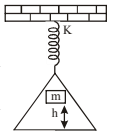
A load of mass \( m \) falls from a height \( h \) onto the scale pan hanging from a spring as shown in the figure. If the spring constant is \( k \), mass of scale pan is zero, and the mass does not bounce relative to the pan, then the amplitude of vibration is
In an ore containing uranium, the ratio of \( \mathrm{U}^{238} \) to \( \mathrm{Pb}^{206} \) is \(3\). Calculate the age of the ore, assuming that all the lead present in the ore is the final stable product of \( \mathrm{U}^{238} \). Take the half-life of \( \mathrm{U}^{238} \) to be \(4.5 \times 10^9\) yr.
A direct current of \(5\,A\) is superposed on an alternating current \( I = 10\sin \omega t \) flowing through a wire. The effective value of the resulting current will be
A planoconvex lens fits exactly into a planoconcave lens. Their planar surfaces are parallel to each other. If the lenses are made of different materials of refractive indices \( \mu_1 \) and \( \mu_2 \) and \( R \) is the radius of curvature of the curved surface, then focal length of the combination is
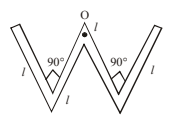
A thin rod of length \(4l\) and mass \(M\) is bent at the points as shown in the figure. What is the moment of inertia of the rod about the axis passing through point \(O\) and perpendicular to the plane of paper?
One of the lines in the emission spectrum of \( \mathrm{Li}^{2+} \) has the same wavelength as that of the 2nd line of the Balmer series in hydrogen spectrum. The electronic transition corresponding to this line is \( n = 12 \rightarrow n = x \). Find the value of \( x \).
Two particles \(X\) and \(Y\) having equal charges, after being accelerated through the same potential difference, enter a region of uniform magnetic field and describe circular paths of radii \(R_1\) and \(R_2\) respectively. The ratio of masses of \(X\) and \(Y\) is
A glass capillary tube of internal radius \( r = 0.25\,mm \) is immersed in water. The top end of the tube is projected by \(2\,cm\) above the surface of the water. At what angle does the liquid meet the tube? Surface tension of water \( = 0.7\,N/m \).
A particle of mass \(2\,m\) is projected at an angle of \(45^\circ\) with the horizontal at a velocity of \(20\sqrt{2}\,m/s\). After \(1\,s\), explosion takes place and the particle is broken into two equal pieces. As a result of explosion, one part comes to rest. The maximum height from the ground attained by the other part is
A 2 m wide truck is moving with a uniform speed \( v_0 = 8\,m/s \) along a straight horizontal road. A pedestrian starts to cross the road with a uniform speed \( v \) when the truck is 4 m away from him. The minimum value of \( v \) so that he can cross the road safely is

A neutron moving with speed \( v \) makes a head-on collision with a hydrogen atom in ground state kept at rest. The minimum kinetic energy of the neutron for which inelastic collision takes place is
Vertical displacement of a plank with a body of mass \( m \) on it is varying according to law \[ y = \sin \omega t + \sqrt{3}\cos \omega t. \]
The minimum value of \( \omega \) for which the mass just breaks contact with the plank and the moment it occurs first after \( t = 0 \), are given by
A parallel plate capacitor of capacitance \(C\) is connected to a battery and is charged to a potential difference \(V\). Another capacitor of capacitance \(2C\) is similarly charged to a potential difference \(2V\). The charging batteries are now disconnected and the capacitors are connected in parallel to each other in such a way that the positive terminal of one is connected to the negative terminal of the other. The final energy of the configuration is
In the circuit shown below, the AC source has voltage \[ V = 20\cos(\omega t)\,V \]
with \( \omega = 2000\,rad/s \). The amplitude of the current will be nearly

A constant voltage is applied between the two ends of a uniform metallic wire. Some heat is developed in it. The heat developed is doubled if
The frequency of a sonometer wire is \(100\,Hz\). When the weights producing the tension are completely immersed in water, the frequency becomes \(80\,Hz\) and on immersing the weights in a certain liquid, the frequency becomes \(60\,Hz\). The specific gravity of the liquid is
A long straight wire along the Z-axis carries a current \(I\) in the negative Z-direction. The magnetic vector field \( \vec{B} \) at a point having coordinates \((x,y)\) in the \(Z=0\) plane is
Which of the following pollutants is the main product of automobile exhaust?
The disease caused due to high concentration of hydrocarbon pollutants in the atmosphere is/are
The element with atomic number 118 will be
Which law of thermodynamics helps in calculating the absolute entropies of various substances at different temperatures?
The color of CoCl\(_3\)\(\cdot\)5NH\(_3\)\(\cdot\)H\(_2\)O is
The metal present in vitamin B\(_{12}\) is
Cobalt (60) isotope is used in the treatment of
Polymer used in bullet proof glass is
What is the correct increasing order of Brønsted bases?
The boiling point of alkyl halides are higher than those of corresponding alkanes because of
Some salts containing two different metallic elements give test for only one of them in solution, such salts are
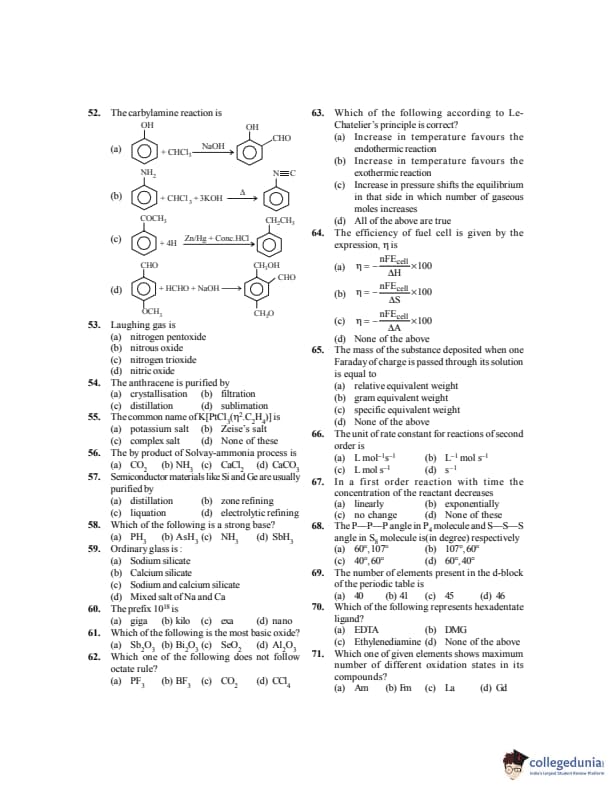
The carbylamine reaction is

Laughing gas is
The anthracene is purified by
The common name of K[PtCl\(_3\)(C\(_2\)H\(_4\))] is
The by-product of Solvay-ammonia process is
Semiconductor materials like Si and Ge are usually purified by
Which of the following is a strong base?
Ordinary glass is
The prefix \(10^{18}\) is
Which of the following is the most basic oxide?
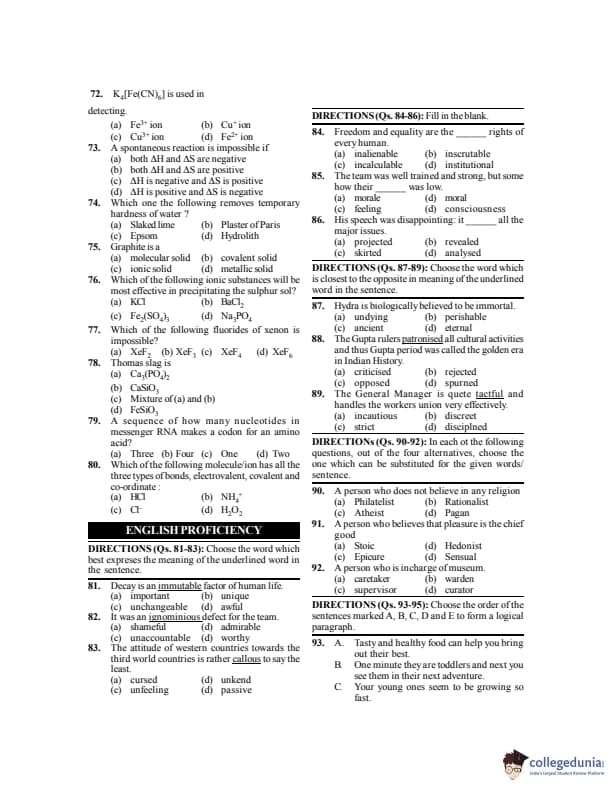
Which one of the following does not follow octet rule?
Which of the following according to Le-Chatelier’s principle is correct?
The efficiency of fuel cell is given by the expression \( \eta \) is
The mass of the substance deposited when one Faraday of charge is passed through its solution is equal to
The unit of rate constant for reactions of second order is
In a first order reaction with time the concentration of the reactant decreases
The P–P–P angle in P\(_4\) molecule and S–S–S angle in S\(_8\) molecule is (in degree) respectively
The number of elements present in the d-block of the periodic table is
Which of the following represents hexadentate ligand?
Which one of the given elements shows maximum number of different oxidation states in its compounds?
K\(_4\)[Fe(CN)\(_6\)] is used in detecting
A spontaneous reaction is impossible if
Which one of the following removes temporary hardness of water?
Graphite is a
Which of the following ionic substances will be most effective in precipitating the sulphur sol?
Which of the following fluorides of xenon is impossible?
Thomas slag is
A sequence of how many nucleotides in messenger RNA makes a codon for an amino acid?
Which of the following molecule/ion has all the three types of bonds: electrovalent, covalent and coordinate?
Decay is an immutable factor of human life.
It was an ignominious defeat for the team.
The attitude of western countries towards the third world countries is rather callous to say the least.
Freedom and equality are the \hspace{1cm} rights of every human.
The team was well trained and strong, but somehow their \hspace{1cm} was low.
His speech was disappointing; it \hspace{1cm} all the major issues.
Hydra is biologically believed to be immortal.
The Gupta rulers patronised all cultural activities and thus Gupta period was called the golden era in Indian History.
The General Manager is quite tactful and handles the workers union very effectively.
A person who does not believe in any religion
A person who believes that pleasure is the chief good
A person who is in charge of a museum
A. Tasty and healthy food can help you bring out their best.
B. One minute they are toddlers and next you see them in their next adventure.
C. Your young ones seem to be growing so fast.
D. Being their loving custodians, you always want to see them doing well.
E. Their eye sparkle with curiosity and endless questions on their tongues
A. It is hoping that overseas friends will bring in big money and lift the morale of the people.
B. But a lot needs to be done to kick start industrial revival.
C. People had big hopes from the new government.
D. So far government has only given an incremental push to existing policies and programmes.
E. Government is to go for big time reforms, which it promised.
A : Forecasting the weather has always been a defficult business.
B : During a period of drought, steams and rivers dried up, the cattle died from thirst and were ruined.
C : Many different things affect the weather and we have to study them carefully to make accurate forecast.
D : Ancient egyptians had no need of weather in the Nille valley hardly ever changes.
E : In early times, when there were no instruments, such as their mometer or the barometer, a man looked for tell tale signs in the sky.
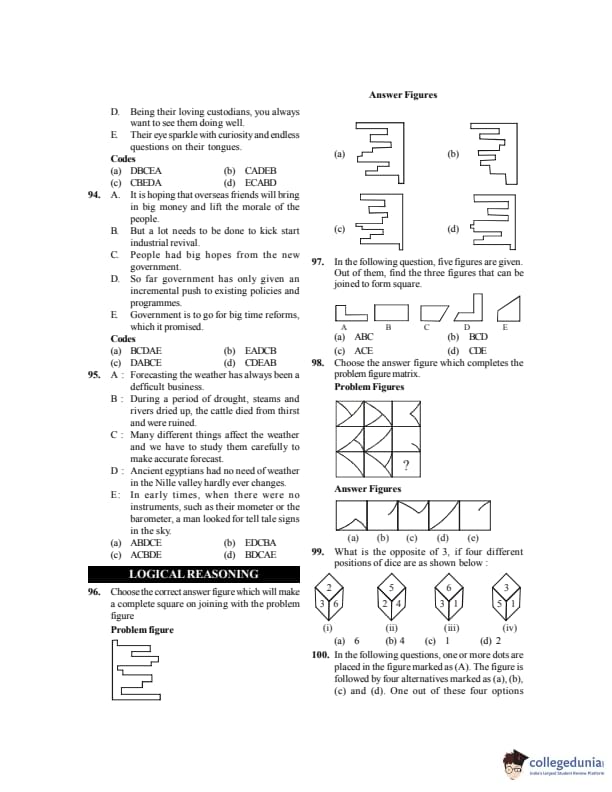
Choose the correct answer figure which will make a complete square on joining with the problem figure.

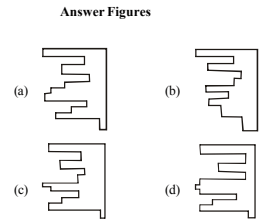
In the following question, five figures are given. Out of them, find the three figures that can be joined to form a square.

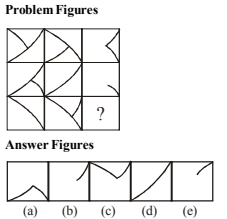
Choose the answer figure which completes the problem figure matrix.
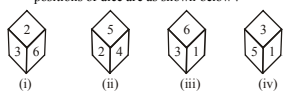
What is the opposite of 3, if four different positions of dice are shown below?
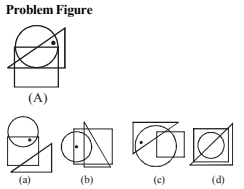
In the following questions, one or more dots are placed in the figure marked as (A). The figure is followed by four alternatives marked as (a), (b), (c) and (d). One out of these four options contains region(s) common to the circle, square and triangle, similar to that marked by the dot in figure (A).
Complete the series by replacing ? mark
G4T, J9R, M20P, P43N, ?
Neeraj starts walking towards South. After walking 15 m, he turns towards North. After walking 20 m, he turns towards East and walks 10 m. He then turns towards South and walks 5 m. How far is he from his original position and in which direction?
The average age of 8 men is increased by 2 years when one of them whose age is 20 yr is replaced by a new man. What is the age of the new man?
Shikha is mother-in-law of Ekta who is sister-in-law of Ankit. Pankaj is father of Sanjay, the only brother of Ankit. How is Shikha related to Ankit?
In a queue of children, Arun is fifth from the left and Suresh is sixth from the right. When they interchange their places, Arun becomes thirteenth from the left. Then, what will be Suresh's position from the right?
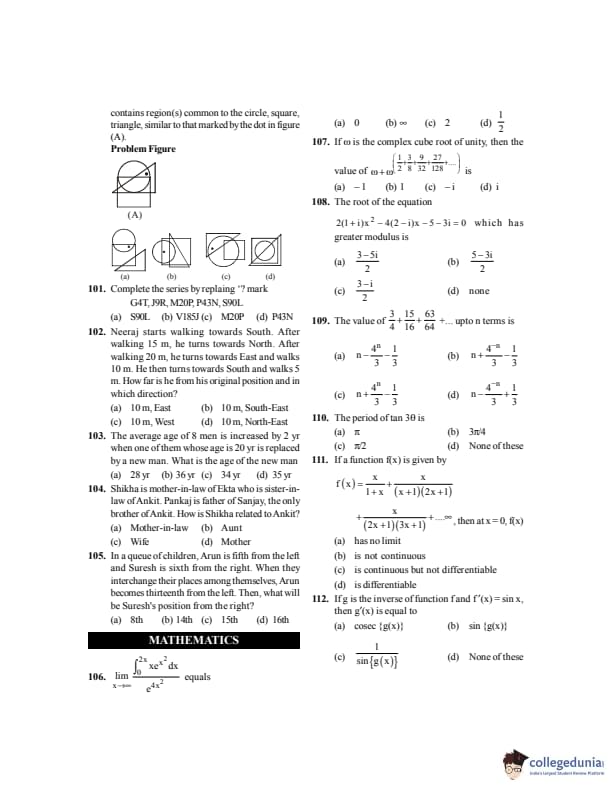
Evaluate \[ \lim_{x\to\infty}\frac{\int_0^{2x} x e^{x^2}\,dx}{e^{4x^2}} \]
View Solution
\[ \int x e^{x^2} dx = \frac{1}{2}e^{x^2} \] \[ \int_0^{2x} x e^{x^2} dx = \frac{1}{2}(e^{4x^2}-1) \] \[ \Rightarrow \lim_{x\to\infty}\frac{\frac12(e^{4x^2}-1)}{e^{4x^2}}=\frac12 \] Quick Tip: Look for substitution-friendly integrals before applying limits.
If \( \omega \) is the complex cube root of unity, then the value of \[ \omega+\omega\left(\frac12+\frac38+\frac{9}{32}+\frac{27}{128}+\cdots\right) \]
is
The root of the equation \[ 2(1+i)x^2-4(2-i)x-5-3i=0 \]
which has greater modulus is
The value of \[ \frac34+\frac{15}{16}+\frac{63}{64}+\cdots \]
up to \(n\) terms is
The period of \( \tan 3\theta \) is
If \[ f(x)=\frac{x}{1+x}+\frac{x}{(x+1)(2x+1)}+\frac{x}{(2x+1)(3x+1)}+\cdots \]
then at \(x=0\), \(f(x)\)
If \(g\) is the inverse of function \(f\) and \(f'(x)=\sin x\), then \(g'(x)\) is equal to
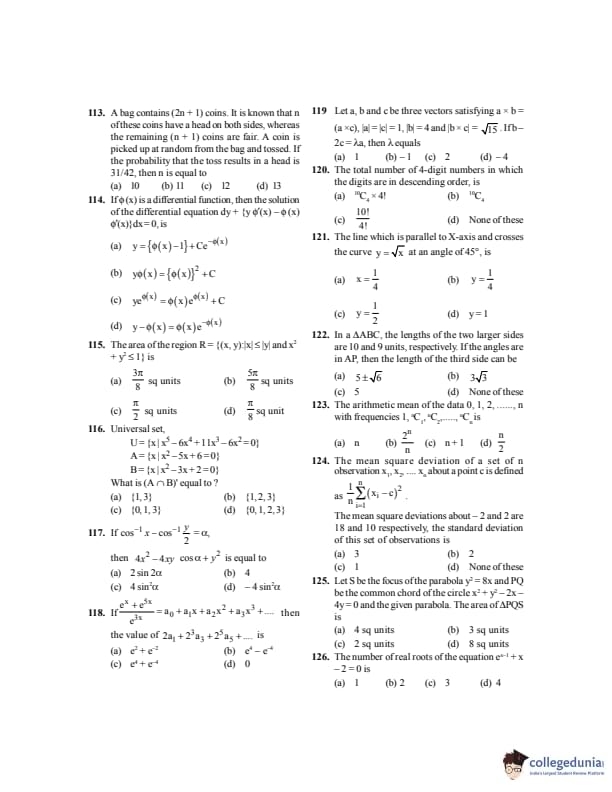
A bag contains \( (2n+1) \) coins. It is known that \( n \) of these coins have a head on both sides, whereas the remaining \( (n+1) \) coins are fair. A coin is picked up at random from the bag and tossed. If the probability that the toss results in a head is \( \frac{31}{42} \), then \( n \) is equal to
If \( \phi(x) \) is a differentiable function, then the solution of the differential equation \[ dy+y\phi'(x)-\phi(x)\phi'(x)\,dx=0 \]
is
The area of the region \[ R=\{(x,y): |x|\le |y| and x^2+y^2\le 1\} \]
is
Universal set, \[ U=\{x\mid x^5-6x^4+11x^3-6x^2=0\} \] \[ A=\{x\mid x^2-5x+6=0\},\quad B=\{x\mid x^2-3x+2=0\} \]
What is \( (A\cap B)' \) equal to?
If \( \cos^{-1}x-\cos^{-1}\dfrac{y}{2}=\alpha \), then \( 4x^2-4xy\cos\alpha+y^2 \) is equal to
If \[ \frac{e^x+e^{5x}}{e^{3x}}=a_0+a_1x+a_2x^2+a_3x^3+\cdots \]
then the value of \(2a_1+2^3a_3+2^5a_5+\cdots\) is
Let \( \vec a, \vec b, \vec c \) be three vectors satisfying \( \vec a \times \vec b = (\vec a \times \vec c) \), \( |\vec a|=|\vec c|=1 \), \( |\vec b|=4 \) and \( |\vec b \times \vec c|=\sqrt{15} \).
If \( \vec a \cdot \vec b = ? \), then \( \lambda \) equals
The total number of 4-digit numbers in which the digits are in descending order, is
The line which is parallel to the X-axis and crosses the curve \( y=\sqrt{x} \) at an angle \(45^\circ\), is
In a \( \triangle ABC \), the lengths of the two larger sides are 10 and 9 units, respectively. If the angles are in A.P., then the length of the third side can be
The arithmetic mean of the data \(0,1,2,\ldots,n\) with frequencies \(1,1,1,\ldots,1\) is
The mean square deviation of a set of \(n\) observations about points \(-2\) and \(2\) are 18 and 10 respectively. The standard deviation of the set is
Let \(S\) be the common focus of the circle \(x^2+y^2-2x-4y=0\) and the parabola \(y^2=8x\).
The area of quadrilateral \(APQS\) is
The number of real roots of the equation \[ e^{x-1}+x-2=0 \]
is
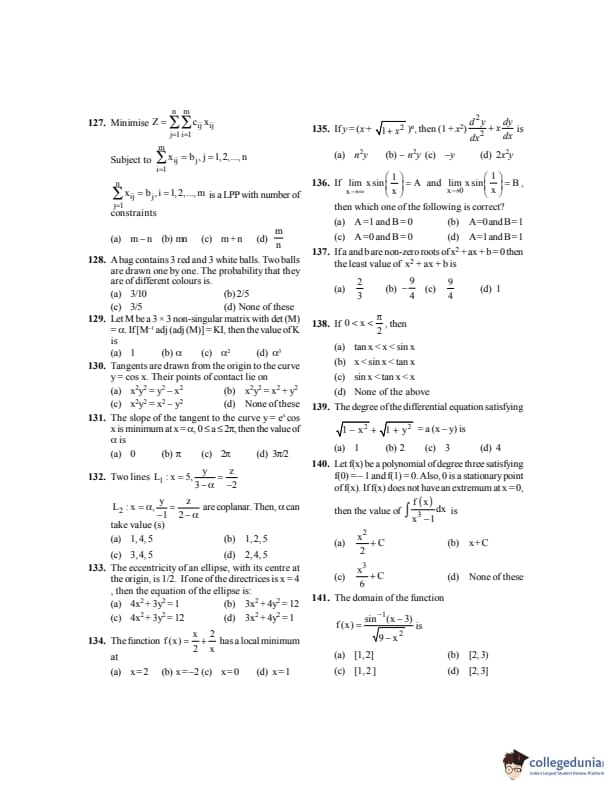
Minimise \( Z=\sum_{i=1}^{n}\sum_{j=1}^{m} c_{ij}x_{ij} \)
Subject to \[ \sum_{i=1}^{n} x_{ij}=b_j,\; j=1,2,\ldots,m \] \[ \sum_{j=1}^{m} x_{ij}=b_i,\; i=1,2,\ldots,n \]
is a LPP with number of constraints
A bag contains 3 red and 3 white balls. Two balls are drawn one by one. The probability that they are of different colours is
Let \(M\) be a \(3\times3\) non-singular matrix with \(\det(M)=\alpha\).
If \(|M^4\operatorname{adj}(M)|=K\), then the value of \(K\) is
Tangents are drawn from the origin to the curve \(y=\cos x\). Their points of contact lie on
The slope of the tangent to the curve \(y=e^x\cos x\) is minimum at \(x=\alpha,\;0\le\alpha\le2\pi\). The value of \(\alpha\) is
Two lines \(L_1:x=5,\; \dfrac{y}{3-\alpha}=\dfrac{z}{-2}\) \(L_2:x=\alpha,\; \dfrac{y}{-1}=\dfrac{z}{2-\alpha}\)
are coplanar. Then \(\alpha\) can take value(s)
The eccentricity of an ellipse, with its centre at the origin, is \( \dfrac12 \).
If one of the directrices is \(x=4\), then the equation of the ellipse is
The function \( f(x)=\dfrac{x}{2}+\dfrac{2}{x} \) has a local minimum at
If \( y=x+\sqrt{1+x^2} \), then \( (1+x^2)\dfrac{d^2y}{dx^2}+x\dfrac{dy}{dx} \) is
If \( \lim_{x\to\infty} x\sin\!\left(\frac{1}{x}\right)=A \) and \( \lim_{x\to0} x\sin\!\left(\frac{1}{x}\right)=B \), then which one of the following is correct?
If \(a,b\) are non-zero roots of \(x^2+ax+b=0\), then the least value of \(x^2+ax+b\) is
If \(0
The degree of the differential equation \(\sqrt{1-x^2}+\sqrt{1+y^2}=a(x-y)\) is
Let \(f(x)\) be a polynomial of degree three satisfying \(f(0)=0,\; f(1)=0\). Also, \(0\) is a stationary point and \(f(x)\) does not have any extremum at \(x=0\).
Then the value of \(\displaystyle\int \frac{f(x)}{x^3-1}\,dx\) is
The domain of the function \[ f(x)=\frac{\sin^{-1}(x-3)}{\sqrt{9-x^2}} \]
is
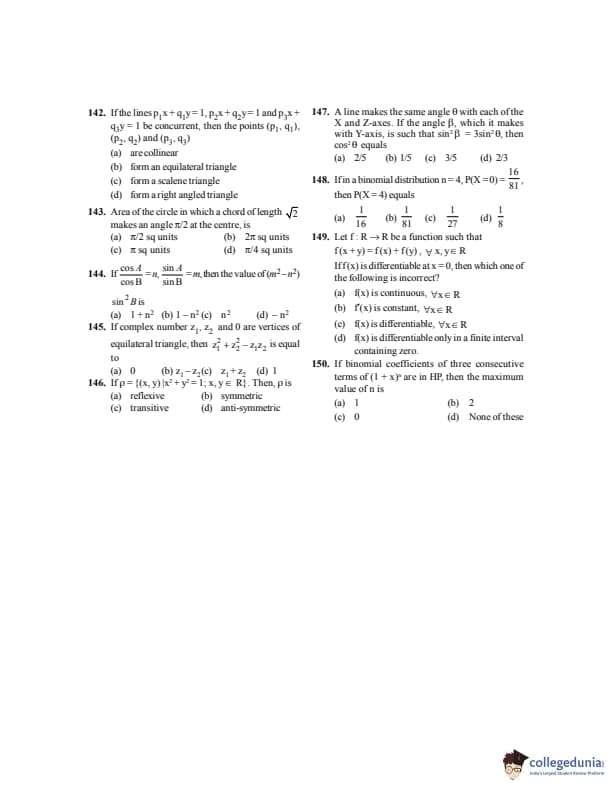
If the lines \(p_1x+q_1y=1,\; p_2x+q_2y=1\) and \(p_3x+q_3y=1\) are concurrent, then the points \((p_1,q_1), (p_2,q_2)\) and \((p_3,q_3)\)
Area of the circle in which a chord of length \(\sqrt{2}\) makes an angle \(\pi/2\) at the centre is
If \(\dfrac{\cos A}{\cos B}=n,\; \dfrac{\sin A}{\sin B}=m\), then the value of \((m^2-n^2)\sin^2 B\) is
If complex numbers \(z_1,z_2,z_3\) are vertices of an equilateral triangle, then \(z_1^2+z_2^2+z_3^2-z_1z_2-z_2z_3-z_3z_1\) is equal to
If \(\rho=\{(x,y)\mid x^2+y^2=1;\; x,y\in\mathbb{R}\}\), then \(\rho\) is
A line makes the same angle \(\theta\) with each of the X and Z-axes. If the angle \(\beta\), which it makes with Y-axis, is such that \(\sin^2\beta=3\sin^2\theta\), then \(\cos^2\theta\) equals
If in a binomial distribution \(n=4\) and \(P(X=0)=\dfrac{16}{81}\), then \(P(X=4)\) equals
Let \(f:\mathbb{R}\to\mathbb{R}\) be a function such that \(f(x+y)=f(x)+f(y)\).
If \(f(x)\) is differentiable at \(x=0\), then which one of the following is incorrect?
If binomial coefficients of three consecutive terms of \((1+x)^n\) are in H.P., then the maximum value of \(n\) is





Comments