




The BITSAT 2026 session 2 registrations will start from April 20 and will last till May 2, 2026, on its official website, admissions.bits-pilani.ac.in. BITS Pilani has already announced the dates for the session 2 exams. The session 2 exams are scheduled from May 24 to May 26, 2026.

Source: BITSAT Official Website
- The BITSAT 2026 Session 2 exam will be conducted for 3 hours in the CBT mode, comprising 130 MCQs and totalling 390 Marks.
- According to the marking scheme, +3 marks will be given for a correct answer, and -1 mark will be deducted.
- The BITSAT Exam is divided into 30 Questions from Physics, 30 from Chemistry, 30 from English & Logical Reasoning and 40 from Mathematics/Biology.
As per the previous year’s data, around 3,00,000 candidates registered, but the seat intake across all 3 campuses is 3,000, indicating high competition.
To be eligible for BITSAT, you should have passed Class 12 in 2025 or 2026, and have secured a minimum of 75% in Physics, Chemistry and Mathematics, with 60% in each subject.
This video by @Collegedunia Exams has the complete guide for BITSAT 2026 exam, including the Eligibility, Exam Pattern, Syllabus, Fees, and placement explained for all aspirants
Related Articles:
BITSAT 2026 Session 1 Shift-Wise Question Paper
Candidates can check the JEE Main official shift-wise question papers in the table given below:
| Date & Shift | Question Paper PDF |
|---|---|
| April 16 Shift 1 | April 16 Shift 1 Question Paper PDF (Available) |
| April 16 Shift 2 | April 16 Shift 2 Question Paper PDF (Available) |
| April 15 Shift 1 | April 15 Shift 1 Question Paper PDF (Available) |
| April 15 Shift 2 | April 15 Shift 2 Question Paper PDF (Available) |
BITSAT 2026 Session 1 Shift-wise Paper Analysis (April 15-16)
Check the shift-wise BITSAT 2026 Session 1 (April 15-16) paper analysis below, with updates after every shift based on students' reactions and feedback.
BITSAT 2026 Session 1 April 16 Shift 2 Paper Analysis
- The paper was moderate in difficulty, slightly easier than JEE Main, but required more speed. Students said that the deleted syllabus and extra topics should also be prepared.
- Physics was formula-based with a focus on Modern Physics and Current Electricity. Questions were more calculative, but doable.
- Chemistry was NCERT-based and relatively easy, with questions asked from Organic chemistry, such as Isomerism.
- Mathematics was lengthy, with around 4 questions asked from Linear Programming, which made time management the key factor.
- Overall, a good attempt was around 105–115 questions with high accuracy.
BITSAT 2026 Session 1 April 16 Shift 1 Paper Analysis
- Based on the early students' reactions, the BITSAT April 16 Shift 1 was moderate in difficulty and was similar to yesterday’s shifts.
- The Physics section was moderate with a balanced mix of both formula-based and theory questions. The questions were asked on topics such as Laws of Motion, Kinematics, Current Electricity, Units and Dimensions, Electromagnetism, Work, Power and Energy, and Thermodynamics.
- There were around 2-3 unusual questions, which most students had not attempted.
- The Chemistry section was moderate with mostly NCERT-level questions. However, the Organic Chemistry weightage was less compared to Physical and Inorganic Chemistry. There were questions from deleted chapters also.
- The questions were asked on topics such as Nomenclature, Biomolecules, States of Matter, Polymers, Chemistry in everyday life, GOC, Periodicity, Chemical Binding, and Coordination Compounds.
- The Maths section was much easier than the JEE Main 2026. There were some lengthy questions due to multi-step calculations. Those candidates who were able to find them and did not attempt were able to focus on other, easier questions.
- The questions were aksed on topics such as Linear Programming, Vector & 3D Geometry, Sequence and Series, Probability, Binomial Theorem, Differential Equation, and Definite Integration.
- The English section was moderate. The vocabulary questions asked in English were good. The questions were of the 10th-class level. However, the questions were doable for candidates with decent practice. The questions were aksed on topics such as Synonyms, Antonyms, Passage-based questions, Homophones and Vocabulary.
- Logical Reasoning was also on the moderate side. The questions were asked from both Verbal and non-verbal reasoning. However, major weightage was given to the verbal reasoning, especially series and chart logic.
BITSAT 2026 Session 1 April 15 Shift 2 Paper Analysis
- Based on the early students' reactions, the overall difficulty of the shift 2 paper was moderate to tough. The paper was tougher than shift 1 in difficulty and also unpredictable.
- The Physics section was overall moderate. However, there were some easy questions as well. The questions were asked on topics such as Optics, Modern Physics, Laws of Motion, Electrodynamics, Rotational Motion, Fluid Mechanics, Work, Power, and Energy. The questions were both concept-based and formula-based. The weightage of the Class 12th questions was more than that of Class 11th.
- The Chemistry section was tricky and moderate compared to Shift 1. The questions were asked on topics such as Coordination Chemistry, p-block, Chemical bonding, s-block, Name Reaction, Solutions, Chemical Kinetics, and Electrochemistry. Questions were asked from all sections, i.e. Physical, Inorganic and Organic chemistry.
- The Maths section was lengthy and tough, and required speed and accuracy. Questions were asked on topics such as Integral Calculus, Differential Calculus, Maxima and Minima, Probability, and P&C.
- English & Logical Reasoning were easy and scoring, helping improve overall attempts. The paper mainly tested speed and accuracy, with a balanced mix of Class 11 & 12 topics.
BITSAT 2026 Session 1 April 15 Shift 1 Paper Analysis
- Based on the early students' reactions, the overall difficulty level of the exam was moderate.
- The Physics section was moderate, with mostly formula-based questions. The questions were asked on topics such as Current Electricity & Circuits, Electrostatics & Capacitors, Kinematics & Laws of Motion, Magnetic effects of Current, Heat and Thermodynamics, Modern Physics and ray optics.
- Around 45% question were from Class 11th and the rest 55% were from Class 12th. The questions were more calculative, where the chances of errors increase.
- The Chemistry section was easy to moderate, with organic chemistry having around 30% share in the questions. The weightage of the 11th and 12th classes was around 43% and 57%, respectively.
- The questions were asked on topics such as GOC & reactions from Organic Chemistry, Carboxylic Acids & Derivatives, Chemical Bonding & Molecular Structure, Chemical Thermodynamics, Electrochemistry, p-block elements and Biomolecules.
- Mathematics was slightly tough and lengthy due to multi-step calculations. The weightage of class 11th and class 12th was around 40% and 60%, respectively.
- The questions were asked on topics such as Calculus (Integration & Differential Equation), Coordinate geometry (circles & conics), Vectors & 3D Geometry, Probability & Statistics, Matrices, Trigonometry and Binomial Theorem.
- The English section was on the easier side, and the Reasoning section was also easy to moderate. However, the Reasoning section was a little tricky and complicated for some students.
BITSAT 2026 College Predictor
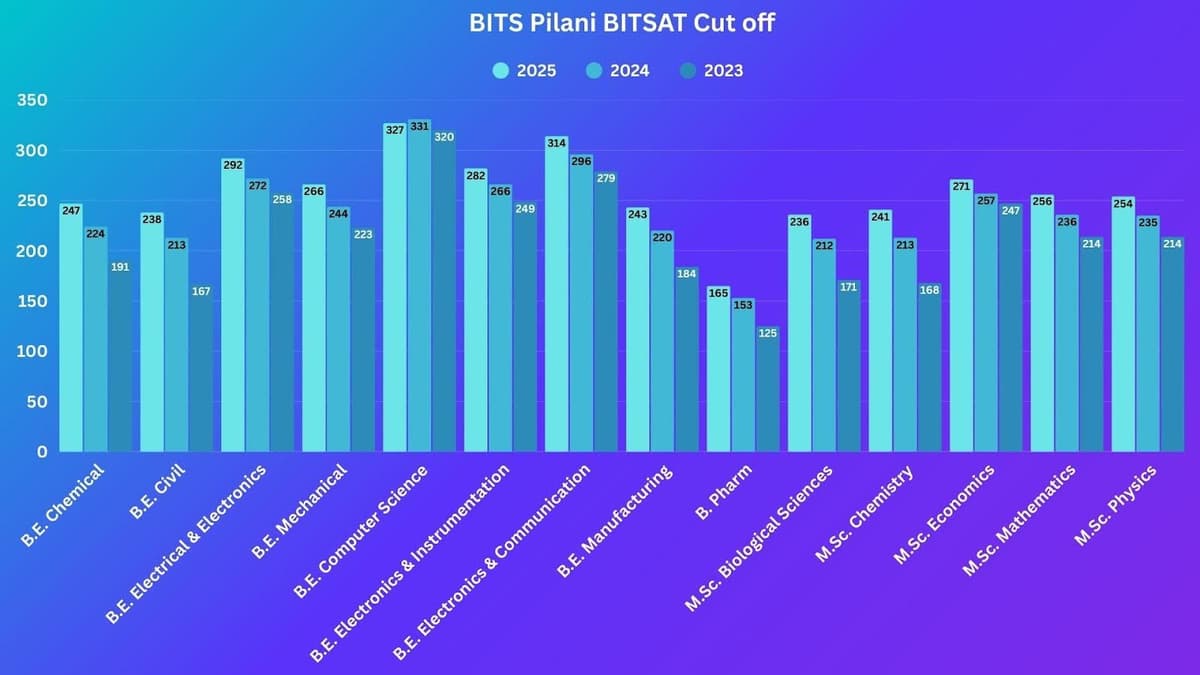
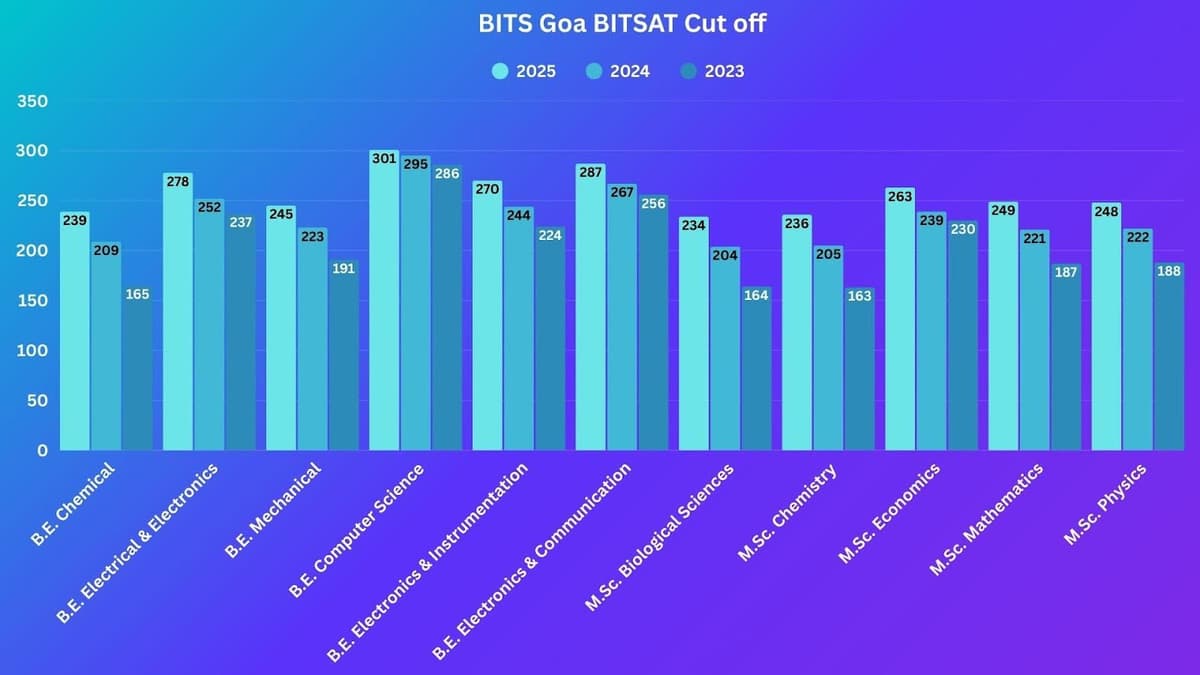
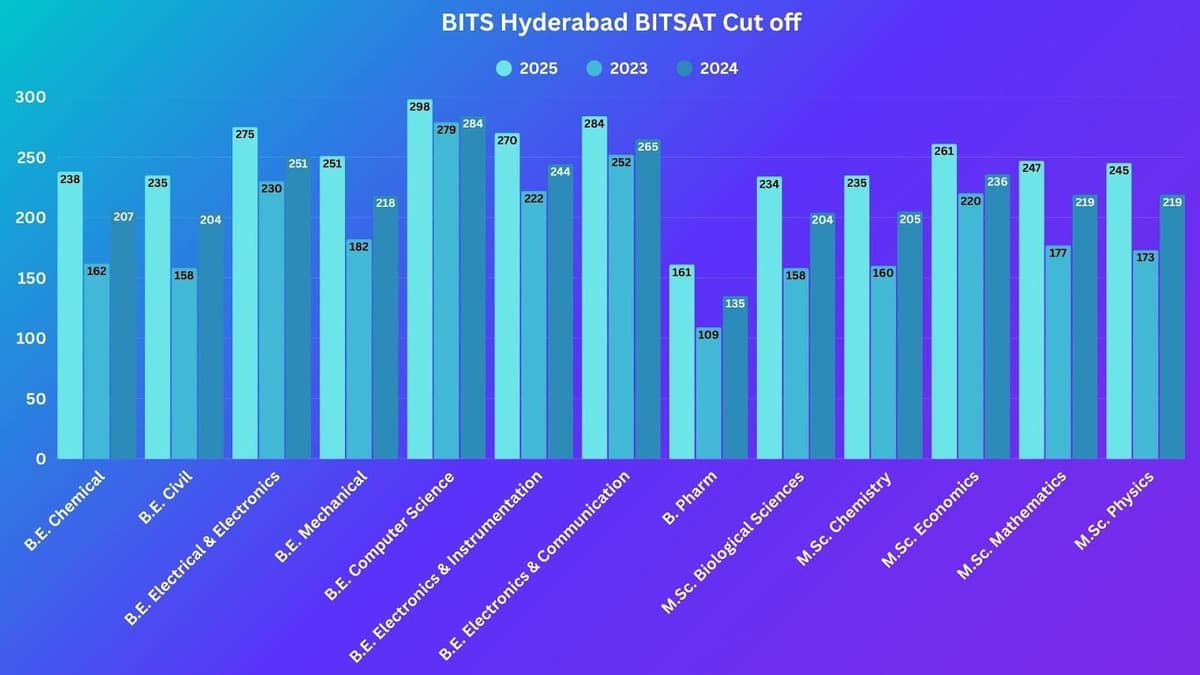
BITSAT 2026 college predictor is a tool designed to assist students in predicting their admission chances to the BITS campuses. You need to enter your marks out of 390 to get the list of colleges and B.E. specialisations you can get based on your scores. The tool provides the most accurate predictions based on the previous year's admission cut-off ranks for each campus and specialisation.
Read More
 (12).jpeg?h=112&w=263&mode=stretch)





Comments