




BITSAT 2023 22 May Question Paper is available here for download. BITSAT 2023 question paper comprises 130 MCQs carrying a total weightage of 390 marks.
BITSAT 2023 22 May Question Paper is divided into four sections- Physics, Chemistry, Mathematics/Biology and English Proficiency and Logical Reasoning. The Physics and Chemistry section of BITSAT 2023 22 May question paper will include 30 questions each. Meanwhile, the Mathematics/Biology paper of BITSAT 2023 22 May question paper will include 40 questions and English Proficiency and Logical Reasoning includes 10 and 20 questions respectively.
Check BITSAT 2023 Exam Pattern
BITSAT 2023 Question Paper PDF Download
| BITSAT 2023 Question Paper with Answer Key |  Download Download |
Check Solution |
BITSAT 2023 Questions with Solutions
Question 1:
An object moves with speed v1, v2, and v3 along a line segment AB, BC, and CD respectively as shown in the figure. Where AB = BC and AD = 3AB, then the average speed of the object will be:

View Solution
Solution:
Step 1: Understanding the given conditions.
Given: - AB = BC = x - CD = AB = x - AD = 3x - Speeds: v1, v2, and v3 along AB, BC, and CD respectively.
Step 2: Compute the time taken for each segment.
Using Time = Distance⁄Speed
t1 = x⁄v1, t2 = x⁄v2, t3 = x⁄v3
Total time taken:
T = t1+t2+t3 = x⁄v1 + x⁄v2 + x⁄v3
Step 3: Compute the average speed.
Vavg = Total Distance⁄Total Time = 3x⁄(x⁄v1) + (x⁄v2) + (x⁄v3)
Simplifying:
Vavg = 3⁄(1⁄v1) + (1⁄v2) + (1⁄v3)
Rewriting in terms of a common denominator:
Vavg = 3v1v2v3⁄(v1v2+v2v3+v3v1)
Hence, the correct answer is (B) 3v1v2v3⁄(v1v2+v2v3+v3v1)
Question 2:
The effect of an increase in temperature on the number of electrons in the conduction band (ne) and the resistance of a semiconductor will be as follows:
View Solution
Solution:
Step 1: Understanding the effect of temperature on a semiconductor.
- A semiconductor has a band gap between the valence band and conduction band. - At higher temperatures, more electrons get enough thermal energy to jump from the valence band to the conduction band. - This results in an increase in the number of free electrons (ne).
Step 2: Effect on resistance.
- The resistance (R) of a semiconductor is given by: R = ρL⁄A, where ρ is the resistivity.
- Resistivity (ρ) is inversely proportional to the number of free charge carriers: ρ ∝ 1⁄ne
- As ne increases with temperature, resistivity decreases, leading to a decrease in resistance.
Final Answer:
ne increases, resistance decreases.
Question 3:
A radioactive material is reduced to 1⁄8 of its original amount in 3 days. If 8 × 10⁻³ kg of the material is left after 5 days, what was the initial amount of the material?
View Solution
Solution:
Step 1: Understanding radioactive decay.
The decay of a radioactive material follows the exponential decay law:
N = N0 x (1⁄2)t/T
where: - N0 = Initial amount of substance - N = Remaining amount after time t - T = Half-life - t = Given time
Step 2: Finding the half-life.
Given that the material is reduced to 1⁄8 of its original value in 3 days, we set up:
N0⁄8 = N0 x (1⁄2)3/T
Since 1⁄8 = (1⁄2)3, we compare powers:
(1⁄2)3 = (1⁄2)3/T
Thus, T = 1 day (half-life is 1 day).
Step 3: Finding N0.
After 5 days, the amount left is 8 × 10⁻³ kg. Using the decay formula:
N = N0 x (1⁄2)5/T
8 × 10-3 = N0 x (1⁄2)5
8 × 10-3 = N0 x 1⁄32
Solving for N0:
N0 = 8 × 10-3 × 32 = 0.256 kg = 256 g
Final Answer:
256 gm.
Question 4:
A 12.5 eV electron beam is used to bombard gaseous hydrogen at room temperature. The number of spectral lines emitted will be:
View Solution
Solution:
Step 1: Understanding energy levels of hydrogen.
The energy levels in hydrogen are given by the Bohr equation:
En = -13.6⁄n2eV
where n is the principal quantum number.
Step 2: Effect of electron beam energy.
- The incident energy is 12.5 eV. - The ground state energy (n = 1) of hydrogen is -13.6 eV. - The energy required to excite an electron to n = 2 is:
E2 = -13.6⁄22 = -3.4 eV.
Energy difference:
ΔE = E2 - E1 = (-3.4) - (-13.6) = 10.2 eV.
Since 12.5 eV is supplied, the electron can be excited up to n = 3.
Step 3: Possible transitions and spectral lines.
The number of spectral lines emitted follows:
Number of spectral lines = n(n - 1)⁄2
For n = 3, possible transitions are: - 3 → 2 - 3 → 1 - 2 → 1
Thus, the total spectral lines:
(3(3 - 1)) / 2 = (3 x 2) / 2 = 3
Final Answer:
3
Question 5:
If 1000 droplets of water of surface tension 0.07, having same radius 1mm each, combine to from a single drop. In the process the released surface energy is- (Take π = 22⁄7):
View Solution
Solution: Step 1: Understanding the formula for surface energy.
The surface energy is given by:
U = Surface Tension × Surface Area
For a sphere, surface area is: A = 4πR2
Step 2: Calculate initial total surface area.
- Given 1000 small droplets, each of radius r = 1 mm. - Total surface area before merging:
Ainitial = 1000 × 4πr2
Ainitial = 1000 × 4 × 22⁄7 × (1 × 10-3)2
Ainitial = 1000 × 4 × 22⁄7 × 10⁻⁶
Ainitial = 88000⁄7 × 10⁻⁶
Ainitial ≈ 12.57 × 10⁻³ m2
Step 3: Calculate final surface area.
The final drop has a total volume equal to the sum of all small drops:
4⁄3πR3 = 1000 × 4⁄3πr3
Cancelling 4⁄3π from both sides:
R3 = 1000r3
R = 10r = 10 × 1 mm = 10 mm = 10-2 m
Final surface area:
Afinal = 4πR2
Afinal = 4 × 22⁄7 × (10-2)2
Afinal = 4 × 22⁄7 × 10⁻⁴
Afinal = 880⁄7 × 10⁻⁶
Afinal ≈ 1.257 × 10⁻³ m2
Step 4: Compute the released surface energy.
Change in surface area:
ΔA = Ainitial - Afinal
ΔA = (12.57 - 1.257) × 10-3
ΔA = 11.313 × 10⁻³ m2
Energy released:
ΔU = Surface Tension × ΔA
ΔU = (0.07) × (11.313 × 10-3)
ΔU = 7.92 × 10⁻⁴ J
Final Answer:
7.92 x 10⁻⁴ J
Question 6:
The force between two small charged spheres having charges of 1 × 10⁻⁷ C and 2 × 10⁻⁷ C placed 20 cm apart in air is:
View Solution
Solution:
Step 1: Applying Coulomb's Law.
The electrostatic force between two charges is given by:
F = kq1q2⁄r2
where: - k = 9 × 10⁹ N⋅m²/C2 (Coulomb's constant), - q1 = 1 × 10⁻⁷ C, - q2 = 2 × 10⁻⁷ C, - r = 20 cm = 0.2 m.
Step 2: Substituting the values.
F = (9 × 10⁹)(1 × 10⁻⁷)(2 × 10⁻⁷)⁄(0.2)2
F = (9 × 109) × (2 × 10-14)⁄0.04
F = 18 × 10-5⁄4 x 10⁻²
F = 4.5 × 10⁻³ N
Final Answer:
4.5 x 10⁻³ N
Question 7:
The work done in placing a charge of 8 × 10-18 coulomb on a capacitor of capacitance 100 microfarad is:
View Solution
Solution:
Step 1: Formula for work done in charging a capacitor
The work done W in charging a capacitor is given by:
W = Q2⁄2C
where: Q = 8 × 10-18 C (charge), C = 100 × 10-6 F (capacitance).
Step 2: Substituting values
W = (8 × 10-18)2⁄2 × (100 × 10-6)
W = 64 × 10-36⁄2 × 100 × 10-6
W = 64 × 10-36⁄200 × 10-6
W = 32 × 10-32 joule.
Hence, the correct answer is (C) 32 × 10-32 joule
Question 8:
The resistance of a wire is 5Ω. What will be its new resistance in ohms if stretched to 5 times its original length?
View Solution
Solution: Step 1: Understanding resistance change in a stretched wire.
The resistance of a wire is given by:
R = ρ L⁄A
where: - ρ is the resistivity (constant for the material), - L is the length, - A is the cross-sectional area.
When a wire is stretched to n times its original length, its volume remains constant:
Initial Volume = Final Volume
Since volume is AL, we get:
AnewLnew = AoldLold
Given Lnew = 5Lold, the new cross-sectional area becomes:
Anew = Aold⁄5
Step 2: Finding new resistance.
Rnew = ρ Lnew⁄Anew = ρ 5L⁄A/5 = ρ 5L⁄A × 5 = 25R
Since the original resistance is R = 5Ω,
Rnew = 25 × 5 = 125Ω
Final Answer:
125Ω.
Question 9:
A charged particle is moving in a uniform magnetic field B = 2î + 3ĵ T. If it has an acceleration of a = αî - 4ĵ m/s², then the value of α will be:
View Solution
Solution:
Step 1: Understanding the force on a charged particle in a magnetic field.
The Lorentz force is given by:
F = q(v × B)
Since force is also related to acceleration:
ma = q(v × B)
Thus,
a = q⁄m (v × B)
Step 2: Computing the cross product v × B.
Let v = vxî + vyĵ + vzk and B = 2î + 3ĵ, then:
| i | j | k |
| vx | vy | vz |
| 2 | 3 | 0 |
v × B = (0vy − 3vz)î - j(0vx - 2vz) + k(3vx - 2vy)
= (-3vz)î + (2vz)ĵ + (3vx - 2vy)k
Since a = q⁄m(v × B), equating components:
α = -3q⁄mvz,
-4 = q⁄m (2vz)
Solving for vz:
vz = - 4⁄2q/m = -4m⁄2q
Substituting into α = -3 q⁄mvz :
α = -3 × (-4m⁄2q )
α = -3 × (-2) = 6
Final Answer:
6
Question 10:
A proton (p) and an electron (e) will have the same de-Broglie wavelength when the ratio of their momenta is (Assume mp = 1849me):
View Solution
Solution:
Step 1: Understanding de-Broglie wavelength formula.
The de-Broglie wavelength is given by:
λ = h⁄p
where: - λ is the wavelength, - h is Planck's constant, - p is the momentum.
For two particles to have the same wavelength, their momentum must be equal:
λp = λe ⇒ h⁄pp = h⁄pe ⇒ pp = pe
Step 2: Interpreting the given mass ratio.
Given: mp = 1849me
Since momentum is p = mv, for equal de-Broglie wavelengths, the momentum must be the same for both:
pp = pe
Thus, the ratio of their momenta:
pp⁄pe = 1 : 1
Final Answer:
1:1
Question 11:
A thermodynamic system is taken through a cyclic process as shown in the PV diagram. The total work done in the process is:
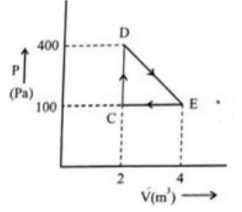
View Solution
Solution:
Work done = Area under the curve
⇒ W = 1⁄2 × (4 – 2) × (400 – 100) = 1⁄2 × 2 × 300
W = 300J
Question 12:
In a reflecting telescope, a secondary mirror is used to:
View Solution
Solution:
Step 1: Understanding the purpose of a secondary mirror.
- A reflecting telescope primarily uses a concave primary mirror to collect and focus light.
- A secondary mirror is placed at an intermediate point to redirect the focused light to an eyepiece.
Step 2: Function of the secondary mirror.
- The primary mirror focuses light inside the telescope tube, making it difficult to place an eyepiece directly. - The secondary mirror redirects the light outside the tube, allowing for convenient viewing. - This design is seen in the Cassegrain and Newtonian telescopes.
Step 3: Evaluating other Option.
- (A) Reducing mechanical support problems → Incorrect. The secondary mirror is not primarily used for structural support. - (B) Removing spherical aberration → Incorrect. Spherical aberration is corrected by parabolic mirrors, not by the secondary mirror. - (C) Making chromatic aberration zero → Incorrect. Chromatic aberration is caused by lenses, but reflecting telescopes use mirrors, which naturally eliminate this issue.
Final Answer:
Move the eyepiece outside the telescopic tube.
Question 13:
The magnetic moment of an electron (e) revolving in an orbit around the nucleus with an orbital angular momentum is given by:
View Solution
Solution:
Step 1: The magnetic moment µL associated with the orbital angular momentum L of an electron is given by the equation:
µL = eL⁄2m
where: e is the charge of the electron, L is the orbital angular momentum (a vector), m is the mass of the electron.
Step 2: Explanation of the formula. The electron in motion generates a magnetic field, and the magnetic moment is proportional to its orbital angular momentum. The factor e⁄2m arises from the relation between the electron's angular momentum and the induced magnetic moment in orbital motion.
Step 3: Verifying the correct answer. Thus, the correct expression for the magnetic moment is µL = eL⁄2m, which matches option (A).
Question 14:
The ratio of intensities at two points P and Q on the screen in a Young's double-slit experiment, where the phase difference between two waves of the same amplitude are π⁄3 and π⁄2, respectively, is:
View Solution
Solution:
Step 1: Understanding intensity in Young's Double-Slit Experiment.
The intensity at any point in an interference pattern is given by:
I = I0 (1 + cos Δφ)
where: - I0 is the intensity of an individual wave, - Δφ is the phase difference between the two waves.
Step 2: Calculating intensity at P (where Δφ = π⁄3).
Since cos π⁄3 = 1⁄2,
IP = I0(1 + cos π⁄3) = I0(1 + 1⁄2) = I0 × 3⁄2
Step 3: Calculating intensity at Q (where Δφ = π⁄2).
IQ = I0(1 + cos π⁄2)
Since cos π⁄2 = 0,
IQ = I0(1 + 0) = I0
Step 4: Finding the ratio IP : IQ.
IP⁄IQ = 3I0⁄2 / I0 = 3⁄2.
Thus, the ratio of intensities:
IP : IQ = 3 : 2
Question 15:
A bicycle tire is filled with air at a pressure of 270 kPa at 27°C. What is the approximate pressure of the air in the tire when the temperature increases to 36°C?
View Solution
Solution:
Step 1: Using Gay-Lussac's Law (Pressure-Temperature Relationship).
P1⁄T1 = P2⁄T2
where: - P1 = 270 kPa (initial pressure), - T1 = 27°C = (27 + 273) = 300K (initial temperature), - T2 = 36°C = (36 + 273) = 309K (final temperature), - P2 is the final pressure.
Step 2: Solve for P2.
P2 = P1 × T2⁄T1
P2 = 270 × 309⁄300
P2 = 270 × 1.03
P2 = 278.1 kPa ≈ 278 kPa
Final Answer:
278 kPa
Question 16:
A particle executes Simple Harmonic Motion (SHM) with amplitude A. The distance from the mean position when its kinetic energy becomes equal to its potential energy is:
View Solution
Solution:
Step 1: Understanding the energy distribution in SHM.
- The total energy in SHM is given by:
E = 1⁄2kA2
where: - k is the force constant (spring constant), - A is the amplitude.
- The kinetic energy (KE) at displacement x is:
KE = 1⁄2k(A2 - x2)
- The potential energy (PE) at displacement x is:
PE = 1⁄2kx2
Step 2: Equating kinetic and potential energy.
KE = PE
1⁄2k(A2 - x2) = 1⁄2kx2
Canceling 1⁄2k:
A2 - x2 = x2
A2 = 2x2
x2 = A2⁄2
x = A⁄√2
Final Answer:
A⁄√2
Question 17:
Electric field in a certain region is given by Ē = (A⁄x2)î + (B⁄y3)ĵ. The SI unit of A and B are:
View Solution
Solution:
Step 1: The electric field is given as:
Ē = (A⁄x2)î + (B⁄y3)ĵ
Here, Ē has units of electric field, which in SI is measured in volts per meter (V/m), or equivalently, Newtons per Coulomb (N/C).
Step 2: Determining the units of A and B. We know that electric field Ē has units of N/C.
Let's consider each component:
1. For the î component:
A⁄x2 has units of A⁄m2 ⇒ A = Nm2C-1
2. For the ĵ component:
B⁄y3 has units of B⁄m3 ⇒ B = Nm3C-1
Step 3: Verifying the correct answer. The SI units of A and B are Nm2C-1 and Nm3C-1, respectively, which matches option (B).
Question 18:
At any instant the velocity of a particle of mass 500g is (2ti + 3t2j) ms-1. If the force acting on the particle at t = 1 s is (αi + 4j) N, then the value of α will be:
View Solution
Solution:
Step 1: Using Newton's second law, F = m a, where m is the mass and a is the acceleration.
The given velocity of the particle is:
v = (2ti + 3t2j) ms-1
Step 2: The acceleration is the time derivative of the velocity:
a = dv⁄dt = d⁄dt (2ti + 3t2j)
Taking the derivative:
a = 2i + 6tj
Step 3: Substituting t = 1 s into the acceleration expression:
a = 2i + 6j ms-2
Step 4: The force F is given as:
F = m a = 0.5kg × (2i + 6j) = 1i + 3j N
Step 5: Comparing this with the given force F = (αi + 4j) N, we can see that:
α = 3
Thus, the value of α is 3.
Question 19:
A particle of mass m moving with velocity v collides with a stationary particle of mass 2m. After the collision, they stick together and continue to move with velocity:
View Solution
Solution:
Step 1: Applying the Law of Conservation of Momentum.
The total momentum before collision is:
Pinitial = mv + (2m × 0) = mv
Since the two masses stick together after collision, their combined mass is:
M = m + 2m = 3m
Let the final velocity be Vf. According to conservation of momentum:
mv = (3m)Vf
Step 2: Solving for Vf.
Vf = mv⁄3m = v⁄3
Final Answer:
v⁄3
Question 20:
Which of the following Maxwell's equations is valid for time varying conditions but not valid for static conditions:
View Solution
Solution:
Step 1: Maxwell's equations for time-varying conditions: One of the key equations that is valid only for time-varying conditions is Faraday's Law of Induction. It states that:
∮ E ⋅ dl = - ∂B/∂t
This equation describes how a changing magnetic field induces an electric field.
Step 2: Understanding the options:
- Option (A): This is Ampère's Law for magnetostatics, where the integral of B around a closed loop is equal to the current enclosed. This equation is valid under static conditions as well. - Option (B): This is one form of the conservative electric field equation, valid for electrostatics, where the line integral of E is zero for static conditions. - Option (C): This is the correct choice, as it describes Faraday's Law of Induction, which is valid only for time-varying conditions. - Option (D): This is Gauss’s Law for electricity, valid for both static and dynamic conditions.
Step 3: Verifying the correct answer. The equation ∮ E ⋅ dl = - ∂B/∂t is the correct choice as it applies only in time-varying situations (changing magnetic field).
Question 21:
In an LC oscillator, if the values of inductance and capacitance become twice and eight times, respectively, then the resonant frequency of the oscillator becomes x times its initial resonant frequency ω0. The value of x is:
View Solution
Solution:
Step 1: Understanding the formula for resonant frequency.
The resonant frequency ω of an LC oscillator is given by:
ω = 1⁄√LC
where: - L is the inductance, - C is the capacitance.
Step 2: Initial resonant frequency.
ω0 = 1⁄√L0C0
Step 3: New resonant frequency after changes.
Given: - L' = 2L0, - C' = 8C0, the new resonant frequency is:
ω' = 1⁄√L'C' = 1⁄√(2L0)(8C0) = 1⁄√16L0C0 = 1⁄4 1⁄√L0C0
ω' = 1⁄4 ω0
Step 4: Finding x.
Since ω' = xω0, we get:
x = 1⁄4
Question 22:
A conducting loop of radius 10⁄√π cm is placed perpendicular to a uniform magnetic field of 0.5T. The magnetic field is decreased to zero in 0.5 s at a steady rate. The induced emf in the circular loop at 0.25s is:
View Solution
Solution:
As |ε| = dΦ⁄dt = A dB⁄dt, where: - θ = 0° ⇒ cosθ = 1
|ε| = π(10⁄√π × 10-2)2 × 0 - 0.5⁄0.5= π(10⁄√π × 10-4) × -0.5⁄0.5= 10-2V = 10 mV
As dB⁄dt = constant ⇒ Induced emf will not change with time. So,
|ε|t=0.5 sec = |ε|t=0.25 sec = 10 mV
Question 23:
A disc is rolling without slipping on a surface. The radius of the disc is R. At t = 0, the topmost point on the disc is A as shown in the figure. When the disc completes half of its rotation, the displacement of point A from its initial position is:
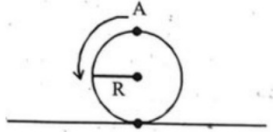
View Solution
Solution:
Step 1: Understand the motion of the point A. When the disc rolls without slipping, every point on the disc follows a cycloidal path. Point A starts at the topmost point of the disc and traces an arc during the motion.
Step 2: Displacement after half a rotation. When the disc completes half of its rotation, the point A will have traveled a horizontal distance equal to the arc length of half the disc. This arc length is equal to the circumference of the disc divided by two, which is πR.
The displacement of point A is the distance it has moved in both horizontal and vertical directions, and these form the two sides of a right triangle.
Step 3: Calculating the displacement. The horizontal displacement is πR, and the vertical displacement is also R. Using the Pythagorean theorem, the displacement d is:
d = √((πR)2 + R2 ) = R√ π2 + 1
However, we also have an additional displacement because of the rolling motion, which contributes 2R to the total displacement. Hence, the total displacement is:
d = R√π2 + 4
Thus, the displacement of point A from its initial position is R√π2 + 4.
Question 24:
Two planets A and B have radii R and 1.5R, and densities ρ and ρ⁄2 respectively. The ratio of acceleration due to gravity at the surface of B to A is:
View Solution
Solution:
Step 1: Formula for acceleration due to gravity.
The surface gravity of a planet is given by:
g = GM⁄R2
Since mass M is related to density ρ and radius R:
M = ρV = ρ × 4⁄3πR3
Substituting into the gravity formula:
g = G(4⁄3πρR3)⁄R2
g = 4⁄3GπρR
Thus, gravity at the surface is:
g ∝ ρR
Step 2: Finding the ratio gB/gA.
For planet A: gA ∝ ρR
For planet B: - Radius RB = 1.5R, - Density ρB = ρ⁄2,
gB ∝ (ρ⁄2)(1.5R)
gB ∝ 3⁄4ρR
Taking the ratio:
gB⁄gA = 3⁄4ρR⁄ρR = 3⁄4
Final Answer:
3:4
Question 25:
A 100m long wire having cross-sectional area 6.25 × 10⁻⁴ m2 and Young's modulus is 1010 Nm-2 is subjected to a load of 250N, then the elongation in the wire will be:
View Solution
Solution:
Step 1: Formula for elongation. The elongation ΔL in the wire can be calculated using the formula:
ΔL = FL⁄AY
where: F = 250 N is the applied force, L = 100 m is the length of the wire, A = 6.25 × 10⁻⁴ m2 is the cross-sectional area of the wire, Y = 1010 Nm-2 is Young’s modulus.
Step 2: Substituting the values.
ΔL = 250 × 100⁄6.25 × 10-4 × 1010 = 25000⁄6.25 × 106 = 4 × 10⁻³ m
Thus, the elongation in the wire is 4 × 10⁻³ m.
Question 26:
The ratio of the speed of sound in hydrogen gas to the speed of sound in oxygen gas at the same temperature is:
View Solution
Solution:
Step 1: Using the formula for the speed of sound in a gas.
The speed of sound in a gas is given by:
v = √γRT⁄M
where: - v = speed of sound, - γ = adiabatic index (assumed same for both gases), - R = universal gas constant, - T = temperature (same for both gases), - M = molar mass of the gas.
Since γ, R, and T are the same for both gases, the speed of sound is inversely proportional to the square root of the molar mass:
v ∝ 1⁄√M
Step 2: Finding the molar masses.
- Molar mass of hydrogen (H2): MH = 2 g/mol. - Molar mass of oxygen (O2): MO = 32 g/mol.
Step 3: Taking the ratio of speeds.
vH⁄vO = √MO⁄MH = √ 32⁄2 = √16 = 4
Final Answer:
4:1
Question 27:
The free space inside a current carrying toroid is filled with a material of susceptibility χ = 2 × 10⁻². The percentage increase in the value of magnetic field inside the toroid will be:
View Solution
Solution:
The magnetic field B inside a toroid depends on the permeability of the material filling the toroid. The relation between the permeability of the material and the permeability of free space is given by:
μ = μ0(1 + χ)
where: - μ0 is the permeability of free space, - χ is the susceptibility of the material, - μ is the permeability of the material inside the toroid.
The magnetic field inside the toroid is given by:
B = μl⁄2πr
where: - I is the current, - r is the radius of the toroid, - μ is the permeability of the material inside the toroid.
Now, the percentage increase in the magnetic field when the toroid is filled with the material is given by:
Percentage increase in B = ΔB⁄Binitial × 100
The initial magnetic field Binitial is given by Binitial = μ0I⁄2πr, and the final magnetic field Bfinal is given by Bfinal = μ0(1+χ)I⁄2πr
Thus, the percentage increase in the magnetic field is:
ΔB⁄Binitial = Bfinal - Binitial⁄Binitial = (μ0(1+χ)I)/2πr - (μ0I)/2πr⁄(μ0I)/2πr = μ0χI⁄μ0I = χ
Substituting χ = 2 × 10⁻²:
Percentage increase in B = 2 × 10-2 × 100 = 2%
Thus, the percentage increase in the magnetic field is 2%.
Question 28:
The ratio of average electric energy density and total average energy density of an electromagnetic wave is:
View Solution
Solution:
Step 1: Formula for energy densities in an electromagnetic wave. The total energy density utotal in an electromagnetic wave is the sum of the electric and magnetic energy densities.
The electric energy density uE and magnetic energy density uB are given by:
uE = ε0E2⁄2, uB = B2⁄2μ0
where: ε0 is the permittivity of free space, μ0 is the permeability of free space, E is the electric field, and B is the magnetic field.
Step 2: Relationship between electric and magnetic fields. In an electromagnetic wave, the energy density is equally distributed between the electric and magnetic fields, so:
uE = uB
Step 3: Total energy density. The total energy density is the sum of the electric and magnetic energy densities:
utotal = uE + uB = 2uE
Step 4: Ratio of average electric energy density to total energy density. The ratio is:
uE⁄utotal = uE⁄2uE = 1⁄2.
Thus, the ratio of average electric energy density to total average energy density is 1⁄2.
Question 29:
In a Young's double slit experiment, the intensities at two points, for the path difference λ⁄4 and λ⁄2 (λ being the wavelength of light used) are I1 and I2 respectively. If I0 denotes the intensity produced by each one of the individual slits, then I1+I2⁄I0 is equal to:
View Solution
Solution:
Resultant intensity in Young's double slit experiment
I = 4I0 cos2(Δφ⁄2)
For path difference λ⁄4, phase difference:
Δφ = 2π⁄λ × λ⁄4 = π⁄2
∴ I1 = 4I0 cos2(π⁄4) = 4I0 (1⁄√2)2 = 2I0
For path difference λ⁄2 :
I2 = 4I0 cos2(2π⁄λ × λ⁄2 ) = 4I0 cos2(π⁄2) = I0
I1+I2⁄I0 = 3I0⁄I0 = 3
Question 30:
The energy levels of an atom are shown in the figure. Which one of these transitions will result in the emission of a photon of wavelength 124.1 nm? Given h = 6.62 × 10⁻³⁴ Js.
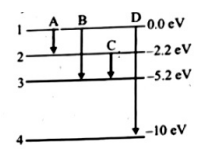
View Solution
Solution:
The energy of a photon emitted during a transition is related to the wavelength of the photon by the equation:
E = hc⁄λ
where: - E is the energy of the photon, - h is Planck's constant (6.62 × 10⁻³⁴ Js), - c is the speed of light (3 × 10⁸ m/s), - λ is the wavelength of the photon.
Step 1: Calculate the energy of the photon. Given that λ = 124.1 nm = 124.1 × 10⁻⁹ m, we can substitute the values into the equation:
E = (6.62 × 10⁻³⁴)(3 × 10⁸)⁄124.1 × 10-9 = 1.986 × 10⁻²⁵⁄124.1 × 10-9 = 1.6 × 10⁻¹⁸ J.
Step 2: Convert energy from joules to electron volts. Since 1eV = 1.6 × 10⁻¹⁹ J, we convert the energy:
E = 1.6 × 10⁻¹⁸⁄1.6 × 10-19 = 10 eV
Step 3: Check the energy differences between the levels. Now, we check the energy differences between the levels:
- A to B : 0 - (-2.2) = 2.2 eV - A to C : 0 – (-5.2) = 5.2 eV - A to D : 0 – (-10) = 10 eV
The transition from level A to level D gives the energy of 10 eV, which matches the energy of the photon calculated.
Thus, the correct transition is A → D.
Question 31:
Frenkel and Schottky defects are:
View Solution
Solution:
Step 1: Understanding Frenkel and Schottky defects.
- Frenkel and Schottky defects are two types of point defects that occur in crystalline solids.
- Schottky Defect: - Occurs in ionic solids (e.g., NaCl, KCl). - Equal number of cations and anions are missing from the crystal lattice. - Results in a decrease in density of the crystal.
- Frenkel Defect: - Occurs in ionic solids with large size differences between cations and anions (e.g., AgCl, ZnS). - A cation moves from its normal position to an interstitial site. - Does not affect density.
Step 2: Identifying the correct classification.
- These defects occur within the crystal structure, hence they are crystal defects. - They are not related to the nucleus or non-crystalline materials.
Final Answer:
Crystal defects
Question 32:
The Bohr orbit radius for the hydrogen atom (n = 1) is approximately 0.530 Å. The radius for the first excited state (n = 2) orbit is (in Å):
View Solution
Solution:
The radius of the Bohr orbit for any state n is given by the formula:
rn = n2r1
where: - rn is the radius of the orbit for the nth orbit, - r1 is the radius of the Bohr orbit for n = 1, - n is the principal quantum number.
Given that the radius for the ground state (n = 1) is r1 = 0.530 Å, we can calculate the radius for the first excited state (n = 2):
r2 = 22 × 0.530 = 4 × 0.530 = 2.12 Å
Thus, the radius for the first excited state (n = 2) is 2.12 Å.
Question 33:
The probability density plots of 1s and 2s orbitals are given in figure.
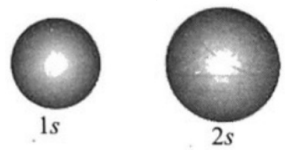
The density of dots in a region represents the probability density of finding electrons in the region.
On the basis of the above diagram, which of the following statements is incorrect?
View Solution
Solution:
Step 1: Analyze the given statements based on the properties of 1s and 2s orbitals.
- Statement A: 1s and 2s orbitals are spherical in shape. This is correct. Both 1s and 2s orbitals are spherically symmetric.
- Statement B: The probability of finding the electron is maximum near the nucleus. This is correct for the 1s orbital. However, for the 2s orbital, the probability density has a node (a region where the probability density is zero) before increasing again. Thus, the probability is not maximum near the nucleus for the 2s orbital.
- Statement C: The probability of finding the electron at a given distance is equal in all directions. This is correct. Since both 1s and 2s orbitals are spherically symmetric, the probability density depends only on the distance from the nucleus, not on the direction.
- Statement D: The probability density of electrons for the 2s orbital decreases uniformly as the distance from the nucleus increases. This is incorrect. The probability density of the 2s orbital does not decrease uniformly. It has a node (a region of zero probability density) and then increases again before eventually decreasing.
Conclusion: The incorrect statement is (D).
Question 34:
Element with electronic configuration 1s22s22p63s23p63d104s24p64d105s25p3 belongs to the following group of the periodic table:
View Solution
Solution:
Step 1: Identify the valence electrons in the given electronic configuration.
The electronic configuration is:
1s22s22p63s23p63d104s24p64d105s25p3.
The outermost shell is the 5th shell, and the valence electrons are in the 5s2 and 5p3 orbitals.
Step 2: Calculate the total number of valence electrons.
- Electrons in 5s2: 2 - Electrons in 5p3: 3
Total valence electrons = 2 + 3 = 5.
Step 3: Determine the group number.
The number of valence electrons corresponds to the group number in the periodic table for the p-block elements. Since the element has 5 valence electrons, it belongs to Group 15.
Conclusion: The element belongs to the 15th group of the periodic table.
Question 35:
Which of the following pairs will form the most stable ionic bond?
View Solution
Solution:
The stability of an ionic bond depends on the difference in electronegativity between the two elements involved. A greater difference leads to a stronger ionic bond. Additionally, smaller ions tend to form more stable bonds due to the higher lattice energy.
- Na and Cl: Sodium (Na) has a lower ionization energy and chlorine (Cl) has a high electron affinity, but the ionic bond formed is relatively weaker than others because Na is a larger ion.
- Mg and F: Magnesium (Mg) has a higher ionization energy and fluorine (F) has a very high electron affinity. The small size of F and the high charge density of Mg result in a highly stable ionic bond.
- Li and F: Lithium (Li) and fluorine (F) also form a stable bond due to the small size of both ions, but magnesium and fluorine have a higher lattice energy due to magnesium's higher charge.
- Na and F: Sodium (Na) and fluorine (F) form an ionic bond, but it is less stable than the Mg-F bond because Na has a lower charge density than Mg.
Thus, the most stable ionic bond is formed between Mg and F due to the higher lattice energy and stronger electrostatic attraction between the ions.
Question 36:
How much ethyl alcohol must be added to 1 litre of water so that the solution will freeze at -14°C? (Kf for water = 1.86 °C/mol)
View Solution
Solution:
Step 1: Use the freezing point depression formula.
The freezing point depression (ΔTf) is given by:
ΔTf = Kf ⋅ m
where: - ΔTf = freezing point depression, - Kf = cryoscopic constant (molal freezing point depression constant), - m = molality of the solution (moles of solute per kg of solvent).
Step 2: Calculate the freezing point depression.
The normal freezing point of water is 0°C, and the solution freezes at -14°C. Thus:
ΔTf = 0°C - (-14°C) = 14°C.
Step 3: Solve for molality (m).
Using the formula:
ΔTf = Kf ⋅ m,
14 = 1.86 ⋅ m.
m = 14⁄1.86 ≈ 7.53 mol/kg.
Step 4: Calculate the moles of ethyl alcohol required.
Since the solvent is 1 litre of water, and the density of water is approximately 1 kg/L, the mass of water is 1 kg. Therefore:
Moles of ethyl alcohol = m × mass of solvent = 7.53 mol/kg × 1kg = 7.53 mol.
Conclusion: Approximately 7.5 mol of ethyl alcohol must be added to 1 litre of water to achieve the desired freezing point.
Question 37:
The conductivity of a weak acid HA of concentration 0.001 mol L-1 is 2.0 × 10⁻⁵ S cm-1. If Λm∞(HA) = 190 S cm2mol-1 , the ionization constant (Ka) of HA is equal to _______ × 10-6.
View Solution
Solution:
Λm = 1000 × κ⁄M = 1000 × 2 × 10-5⁄0.001 = 20 S cm2 mol-1
⇒ α = Λm⁄Λm∞ = 20⁄190
HA ⇌ H+ + A-
0.001(1 - α) 0.001α 0.001α
Ka = Cα2⁄1-α = 0.001(20⁄190)2 = 0.001 × (2⁄19)2
= 12.3 × 10⁻⁶
Question 38:
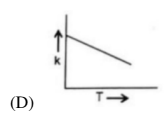
Plots showing the variation of the rate constant (k) with temperature (T) are given below. The plot that follows the Arrhenius equation is:
View Solution
Solution: Correct answer is option A, which represents the exponential increase of k with temperature.
According to the Arrhenius equation, k increases exponentially with temperature. The plot corresponding to this behavior is shown by option (A), which represents an exponential rise in k as temperature increases.
Question 39:
Which of the following method is used for coagulation of the sol?
View Solution
Solution:
Step 1: Understand the methods of coagulation.
Coagulation of a sol refers to the process of destabilizing the colloidal particles, causing them to aggregate and settle. The following methods are commonly used:
1. Mixing two oppositely charged sols: When two sols with opposite charges are mixed, the particles neutralize each other's charges, leading to coagulation.
2. Electrophoresis: In electrophoresis, colloidal particles migrate towards oppositely charged electrodes. When they reach the electrode, they lose their charge and coagulate.
3. Addition of electrolytes: Adding electrolytes to a sol neutralizes the charge on the colloidal particles, reducing repulsion and causing coagulation.
Step 2: Analyze the Option.
- Option A: Mixing two oppositely charged sols is a valid method of coagulation. - Option B: Electrophoresis is a valid method of coagulation. - Option C: Addition of electrolytes is a valid method of coagulation.
Since all three methods are correct, the correct answer is All of the above.
Conclusion: All the given methods (A, B, and C) are used for the coagulation of sols.
Question 40:
The reaction that does NOT take place in a blast furnace between 900K to 1500K temperature range during extraction of iron is:
View Solution
Solution:
The extraction of iron from its ore (typically hematite Fe2O3) in a blast furnace involves reduction reactions at high temperatures. The following reactions occur in the blast furnace:
- Reaction B: FeO + CO → Fe + CO2 This is the reduction of iron(II) oxide to iron, which is a key reaction in the extraction of iron.
- Reaction C: C + CO2 → 2CO This reaction represents the formation of carbon monoxide, which is an essential reducing agent in the blast furnace.
- Reaction D: CaO + SiO2 → CaSiO3 This reaction forms calcium silicate (slag), which helps remove impurities like silica from the iron ore.
- Reaction A: Fe2O3 + CO → 2FeO + CO2 This reaction does not occur under typical blast furnace conditions. The temperature in the blast furnace is not high enough to reduce Fe2O3 directly to FeO. The reduction of Fe2O3 typically occurs in multiple steps, and this reaction does not take place as written.
Thus, the correct answer is (A).
Question 41:
Kinetic theory of gases proves:
View Solution
Solution:
Step 1: Understand the kinetic theory of gases.
The kinetic theory of gases is based on the following assumptions: 1. Gases consist of tiny particles (atoms or molecules) in constant random motion. 2. The volume occupied by gas molecules is negligible compared to the volume of the gas. 3. There are no intermolecular forces between gas molecules. 4. Collisions between gas molecules and with the walls of the container are perfectly elastic. 5. The average kinetic energy of gas molecules is directly proportional to the absolute temperature.
Step 2: Relate the kinetic theory to gas laws.
The kinetic theory of gases provides a theoretical foundation for the following gas laws:
1. Boyle's Law: At constant temperature, the pressure of a gas is inversely proportional to its volume. This is explained by the fact that reducing the volume increases the frequency of collisions with the walls, thus increasing pressure.
2. Charles' Law: At constant pressure, the volume of a gas is directly proportional to its absolute temperature. This is explained by the increase in molecular motion and collisions as temperature rises, causing the gas to expand.
3. Avogadro's Law: At constant temperature and pressure, the volume of a gas is directly proportional to the number of molecules. This is explained by the fact that more molecules occupy more space, leading to an increase in volume.
Step 3: Conclusion.
The kinetic theory of gases explains all three laws: Boyle's law, Charles' law, and Avogadro's law.
Conclusion: The kinetic theory of gases proves all of these laws.
Question 42:
If enthalpies of formation of C2H4(g), CO2(g) and H2O(l) at 25°C and 1 atm pressure are 52, -394 and -286 kJ/mol respectively, the change in enthalpy for combustion of C2H4 is equal to:
View Solution
Solution:
The change in enthalpy (ΔH) for the combustion of a substance is given by the following equation based on Hess's Law:
ΔH = ΣΔHof(products) − ΣΔHof(reactants)
where: - ΔHof is the enthalpy of formation of each substance, - Products are CO2(g) and H2O(l), - Reactants are C2H4(g).
The combustion reaction for C2H4(g) is:
C2H4(g) + 3O2(g) → 2CO2(g) + 2H2O(l)
Step 1: Writing the enthalpy change equation.
ΔH = [2 × ΔHof(CO2) + 2 × ΔHof(H2O)] - [ΔHof(C2H4) + 3 × ΔHof(O2)]
Step 2: Substituting the values.
From the given data: - ΔHof(C2H4) = 52 kJ/mol, - ΔHof(CO2) = -394 kJ/mol, - ΔHof(H2O) = -286 kJ/mol, - ΔHof(O2) = 0 kJ/mol (since it's an element in its standard state).
So, we have:
ΔH = [2 × (-394) + 2 × (-286)] - [52 + 3 × 0]
ΔH = [-788 + (-572)] - 52
ΔH = -1360 - 52 = -1412 kJ/mol
Thus, the change in enthalpy for the combustion of C2H4 is -1412 kJ/mol.
Question 43:
The photochemical smog does not generally contain:
View Solution
Solution:
Photochemical smog is a type of air pollution that primarily consists of nitrogen oxides (NOx) and volatile organic compounds (VOCs) that react under the influence of sunlight to form secondary pollutants, including ozone (O3), formaldehyde (HCHO), and peroxyacetyl nitrates (PANs).
Step 1: In the formation of photochemical smog, nitrogen oxides like NO and NO2 play a crucial role, along with VOCs. These pollutants lead to the formation of ozone and other harmful compounds.
Step 2: SO2 (sulfur dioxide) is typically associated with industrial smog (or "London-type smog"), which is different from photochemical smog. It does not generally participate in the formation of photochemical smog under normal sunlight conditions.
Step 3: Therefore, SO2 is not generally present in photochemical smog, unlike NO, NO2, and HCHO, which are key components.
Question 44:
Geometrical isomerism is not shown by:
View Solution
Solution: Geometrical isomerism is not possible for compounds where the same group is attached to both carbons of the double bond, or when there are restrictions like a halide preventing such isomerism. In option (C), the chlorine atom attached to the second carbon prevents the possibility of cis-trans isomerism, making it the correct answer.

Question 45:
For the separation of two immiscible liquids, which method is used?
View Solution
Solution: When two immiscible liquids are present, the method used for separation is the separating funnel. This method works based on the difference in densities of the two liquids, which allows them to separate into two distinct layers that can be drained separately.
Question 46:
What is x in the following reaction?
Al(s) + NaOH(aq) + H2O(l) → x + H2(g)
View Solution
Solution:
Step 1: Understanding the reaction mechanism.
When aluminum reacts with sodium hydroxide in the presence of water, it forms a soluble complex ion. The reaction proceeds as follows:
Al + NaOH + H2O → Na+[Al(OH)4]- + H2
Step 2: Identifying the product.
The aluminum hydroxide complex formed is [Al(OH)4]-, which is stabilized by sodium ions Na+. This corresponds to option (B).
Question 47:
Which of the following will precipitate first when an aqueous solution containing sulphate ions is added?
View Solution
Solution:
Step 1: Understanding solubility trends.
The precipitation of metal sulphates depends on their solubility product constant (Ksp). The lower the Ksp value, the less soluble the compound is, meaning it will precipitate first.
Step 2: Solubility of sulphates.
The solubility order of alkaline earth metal sulphates (M2+SO42-) decreases down the group:
MgSO4 > CaSO4 > SrSO4 > BaSO4
Since barium sulphate (BaSO4) has the lowest solubility, it will precipitate first.
Question 48:
Ionic hydrides react with water to give:
View Solution
Solution:
Step 1: Understanding the reaction of ionic hydrides with water.
Ionic hydrides, such as sodium hydride (NaH) and calcium hydride (CaH2), contain the hydride ion (H-). When they react with water, they form a strong base (OH-) and release hydrogen gas:
MH + H2O → MOH + H2
where M is a metal.
Step 2: Identifying the nature of the solution.
Since the reaction produces hydroxide ions (OH-), the solution becomes basic. Hence, the correct answer is (C) Basic solutions.
Question 49:
The drug used as an antidepressant is:
View Solution
Solution:
Step 1: Understanding antidepressant drugs.
Antidepressants are medications used to treat depression and related mood disorders by altering neurotransmitter levels in the brain.
Step 2: Identifying the correct option.
- Luminol: A chemiluminescent substance used in forensic science, not an antidepressant. - Tofranil (Imipramine): A tricyclic antidepressant (TCA) commonly used to treat depression. - Mescaline: A hallucinogenic compound, not used as an antidepressant. - Sulphadiazine: A sulfonamide antibiotic, not related to depression treatment.
Since Tofranil (Imipramine) is a well-known antidepressant, the correct answer is (B).
Question 50:
Melamine plastic crockery is a copolymer of:
View Solution
Solution:
Step 1: Understanding melamine plastic.
Melamine plastic is a thermosetting polymer known for its high durability, heat resistance, and lightweight nature, commonly used in kitchenware and crockery.
Step 2: Identifying the copolymer composition.
Melamine-formaldehyde resin is formed by the polymerization of melamine and formaldehyde (HCHO). The reaction results in a cross-linked polymer network that gives melamine plastic its strong and heat-resistant properties:
Melamine + Formaldehyde → Melamine-Formaldehyde Resin.
Step 3: Eliminating incorrect Option.
- Option A: Correct, as melamine plastic is made from melamine and formaldehyde. - Option B: Incorrect, since ethylene is not involved in melamine plastic formation. - Option C: Incorrect, as ethylene does not participate in this polymerization. - Option D: Incorrect, since melamine plastic is a known polymer of melamine and formaldehyde.
Hence, the correct answer is (A) HCHO and melamine.
Question 51:
The helical structure of a protein is stabilized by:
View Solution
Solution:
Step 1: Understanding protein structure.
Proteins have different levels of structure: primary, secondary, tertiary, and quaternary. The α-helix and β-sheet are common secondary structures.
Step 2: Role of hydrogen bonding.
The α-helical structure of proteins is stabilized by hydrogen bonds formed between the carbonyl oxygen of one amino acid and the amide hydrogen of another amino acid four residues away in the chain:
C=O ... H-N
These hydrogen bonds help maintain the spiral shape of the helix.
Step 3: Eliminating incorrect Option.
- Dipeptide bonds (Option A): Incorrect, as they only link two amino acids. - Ether bonds (Option C): Incorrect, as ether bonds are not present in proteins. - Peptide bonds (Option D): Incorrect, as peptide bonds link amino acids but do not stabilize the helical structure.
Since hydrogen bonding is responsible for stabilizing the helical structure, the correct answer is (B) Hydrogen bonds.
Question 52:
Which of the following factors affect the basic strength of amines?
(i) Inductive effect
(ii) Steric hindrance
(iii) Solvation effect
(iv) Solubility in organic solvents
View Solution
Solution:
Step 1: Understanding the factors affecting basic strength of amines.
The basicity of an amine depends on its ability to donate a lone pair of electrons on the nitrogen atom. Several factors influence this ability:
1. Inductive Effect: Electron-donating groups (+I effect) increase electron density on nitrogen, enhancing basicity. Conversely, electron-withdrawing groups (-I effect) decrease basicity.
2. Steric Hindrance: Bulky groups around nitrogen hinder solvation and protonation, reducing basicity.
3. Solvation Effect: The interaction of the amine with solvent molecules affects its ability to stabilize the conjugate acid form, influencing basic strength.
Step 2: Eliminating incorrect Option.
- Solubility in organic solvents (Option iv) does not directly influence the intrinsic basic strength of amines. - Correct factors: Inductive effect (i), Steric hindrance (ii), and Solvation effect (iii) play significant roles in determining basicity.
Thus, the correct answer is (B) (i), (ii), and (iii).
Question 53:
Find out compound B in the given reaction sequence:
C6H6 + CH3X AlCl3→ A CrO3 in (CH3CO)2O/H3O+→ B
View Solution
Solution:
Step 1: Identifying the first reaction.
The first step involves Friedel-Crafts Alkylation, where CH3X (an alkyl halide) reacts with benzene (C6H6) in the presence of AlCl3, forming toluene (A) (C6H5CH3).
C6H6 + CH3X AlCl3→ C6H5CH3
Step 2: Oxidation of Toluene.
- The second step involves oxidation using chromyl chloride (CrO2Cl2), known as the Etard Reaction, which selectively oxidizes the methyl group (-CH3) to an aldehyde (-CHO), forming benzaldehyde (B) (C6H5CHO).
C6H5CH3 CrO3 in (CH3CO)2O/H3O+→ C6H5CHO
Step 3: Eliminating incorrect Option.
- Acetophenone (A) (C6H5COCH3): Incorrect, as the oxidation of toluene in the Etard reaction leads to the formation of an aldehyde (C6H5CHO) and not a ketone.
- Cyclohexyl carbaldehyde (C) (C6H11CHO): Incorrect, as the reaction occurs on a benzene ring, not on a cyclohexane system, and no such transformation takes place. - Benzoic acid (D) (C6H5COOH): Incorrect, as oxidation of the methyl group (-CH3) to a carboxyl group (-COOH) requires a stronger oxidizing agent such as alkaline KMnO4 or acidic K2Cr2O7 under reflux, which is not used in this reaction.
 Thus, the correct answer is (B) Benzaldehyde (C6H5CHO).
Question 54:
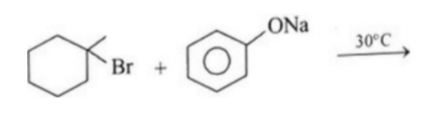
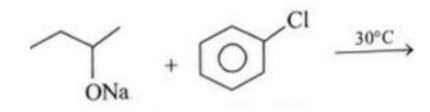
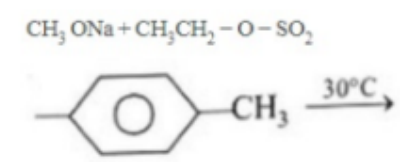
Which method is useful for the synthesis of ether?
- Williamson Ether Synthesis with a benzyl bromide derivative
![Diagram of the reaction for Option 1]()
- Nucleophilic substitution involving sodium phenoxide
![Diagram of the reaction for Option 2]()
- Williamson Ether Synthesis with alkoxide and alkyl sulfonate
![Diagram of the reaction for Option 3]()
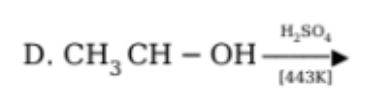
- Dehydration of alcohol using sulfuric acid at high temperature
![Diagram of the reaction for Option 4]()
View Solution
Solution:
Step 1: Understanding ether synthesis methods.
- Ethers (R-O-R') can be synthesized by several methods, but the Williamson Ether Synthesis is the most reliable and widely used approach.
Step 2: Identifying the correct reaction.
- The Williamson Ether Synthesis involves the reaction of a sodium alkoxide (R-O-) with a primary alkyl halide or alkyl sulfonate (R'-X). - The given reaction in option C follows this method, where a sodium alkoxide reacts with an alkyl sulfonate to form an ether under mild heating.
Step 3: Eliminating incorrect Option.
- Option A: Involves a benzyl bromide derivative, which may lead to side reactions. - Option B: Though nucleophilic substitution can form ethers, it is not as general or effective as the Williamson method. - Option D: The acid-catalyzed dehydration of alcohol at high temperature (443 K, using H2SO4) is used to form ethers, but this method is not ideal for unsymmetrical ethers and works mainly for primary alcohols.
Thus, the correct answer is (C) Williamson Ether Synthesis with alkoxide and alkyl sulfonate.
Question 55:
Among the given halides, which one will give the same product in both SN1 and SN2 reactions?
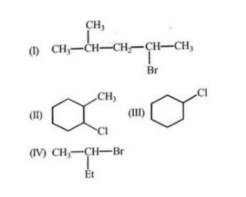
View Solution
Solution:
Step 1: Understanding SN1 and SN2 reaction mechanisms.
- SN1 (Unimolecular Nucleophilic Substitution): This mechanism occurs via the formation of a carbocation intermediate. It is favored in tertiary and benzylic/allylic halides due to carbocation stability. - SN2 (Bimolecular Nucleophilic Substitution): This mechanism proceeds via a backside attack, leading to inversion of configuration. It is favored in primary and secondary alkyl halides with minimal steric hindrance.
Step 2: Analyzing the given halides.
- (III) (Cyclohexyl chloride): - This structure does not form a resonance-stabilized carbocation. - Whether the reaction follows SN1 or SN2, the product remains the same. Satisfies the condition of giving the same product in both reactions.
- (IV) Secondary alkyl bromide with β branching: - The presence of branching reduces the likelihood of rearrangement. - Whether the reaction proceeds via SN1 or SN2, the substitution product remains unaffected. Satisfies the condition of giving the same product in both reactions.
Step 3: Eliminating incorrect Option.
- (I) (Branched alkyl bromide): This can undergo carbocation rearrangement in SN1, leading to different products. - (II) (Cyclohexyl chloride with a methyl group): The possibility of rearrangement in SN1 exists, leading to different products.
Thus, the correct answer is (C) (III) and (IV).
Question 56:
Among the ligands NH3, en, CN-, CO, the correct order of their increasing field strength is:
View Solution
Solution:
Step 1: The field strength of a ligand depends on its ability to split the d-orbital energy levels in a metal complex. Ligands are classified as strong, medium, or weak field ligands.
Step 2: Based on the spectrochemical series: - CO is a strong field ligand. - CN- is also a strong field ligand, but it is weaker than CO. en (ethylenediamine) is a medium field ligand. - NH3 is a weak field ligand.
Step 3: The increasing order of field strength is:
NH3 < en < CN- < CO
Thus, the correct order is option (A).
Question 57:
The S – S bond is not present in:
View Solution
Solution:
Step 1: The S – S bond occurs when two sulfur atoms are directly bonded to each other in a compound.
Step 2: In S2O42-, S2O32-, and S2O52-, there are S – S bonds present between sulfur atoms.
Step 3: In S2O72-, there is no direct S – S bond. The two sulfur atoms are connected through an oxygen bridge, meaning there is no direct bonding between sulfur atoms.
Thus, the correct answer is option (D).
Question 58:
In the laboratory, manganese (II) salt is oxidized to permanganate ion in aqueous solution by:
View Solution
Solution:
Step 1: Manganese (II) salts, such as Mn2+, can be oxidized to the permanganate ion MnO4- by various oxidizing agents.
Step 2: Among the Option:
- Hydrogen peroxide is commonly used to oxidize manganese (II) to permanganate, but it is not the best oxidizer in this case. - Conc. nitric acid does not efficiently oxidize manganese (II) to permanganate. - Peroxy disulphate ((O2SO2)2-2) is a powerful oxidizing agent and is known to oxidize Mn2+ to MnO4-, making it the correct choice in this context. - Dichromate is also an oxidizing agent but does not directly oxidize manganese (II) to permanganate.
Thus, the correct answer is option (C).
Question 59:
Which one of the following molecular hydrides acts as a Lewis acid?
View Solution
Solution:
A Lewis acid is a substance that can accept a pair of electrons. In the case of molecular hydrides:
- NH3 (Ammonia) is a Lewis base because it has a lone pair of electrons on nitrogen that can be donated. - H2O (Water) is also a Lewis base due to the lone pairs on oxygen. - B2H6 (Diborane) acts as a Lewis acid because boron atoms in diborane have an incomplete octet and can accept electron pairs. - CH4 (Methane) does not act as a Lewis acid because it does not have an empty orbital to accept electron pairs.
Thus, B2H6 (Diborane) is the only hydride that acts as a Lewis acid.
Question 60:
Electrode potential data are given below:
Fe3+(aq) + e- → Fe2+(aq); E° = +0.77 V
Al3+(aq) + 3e- → Al(s); E° = -1.66 V
Br2(aq) + 2e- → 2Br-(aq); E° = +1.08 V
Based on the data, the reducing power of Fe2+, Al, and Br- will increase in the order:
View Solution
Solution:
Step 1: The reducing power of a species is related to the magnitude of its reduction potential. A more negative reduction potential indicates a stronger tendency to lose electrons (thus, a stronger reducing agent).
Step 2: The species with the lowest reduction potential will be the best reducing agent:
- Fe3+ + e- → Fe2+, with E° = +0.77 V, indicates that Fe2+ can be reduced to Fe3+, so Fe2+ is a relatively weak reducing agent. - Al3+ + 3e- → Al, with E° = -1.66 V, indicates that Al is the strongest reducing agent due to the very negative reduction potential. - Br2 + 2e- → 2Br-, with E° = +1.08 V, shows that Br- has the weakest reducing power among the three.
Thus, the correct order of reducing power is:
Br- < Fe2+ < Al
Question 61:
Write the antonym: Fricassee
View Solution
Solution: Step 1: A fricassee is a type of dish where meat (typically poultry or veal) is cut into pieces and stewed, often with a sauce or gravy. Step 2: The cooking method “fricassee” involves simmering or stewing meat, not grilling, decorating, or basting. Thus, the correct answer is option (C) stew.
Question 62:
Write the antonym: Retribution
View Solution
Solution: Step 1: Retribution typically refers to punishment or vengeance, but the opposite concept is forgiveness, which is the act of pardoning or excusing someone. Step 2: In this context, forgiveness serves as an antonym to retribution, which involves reprisal or revenge. Compensation, contempt, and grudge are related to feelings of retaliation or resentment, not forgiveness. Thus, the correct answer is option (B) forgiveness.
Question 63:
Write the antonym: Sumptuous
View Solution
Solution: Step 1: “Sumptuous” refers to something that is luxurious, rich, or splendid, often used in the context of food, clothing, or surroundings that are extravagant. Step 2: The antonym of sumptuous is “meagre," which means something that is small, inadequate, or insufficient in quantity or quality. The other Option, such as “fancy,” are more related to something ornate or elaborate, not the opposite of sumptuous. Thus, the correct answer is option (B) meagre.
Question 64:
Rajeev failed in the examination because his answers were not ...... to the questions asked
View Solution
Solution: Step 1: The word “pertinent” means relevant or applicable to the matter at hand. In this context, the statement suggests that Rajeev's answers were not relevant to the questions asked. Step 2: The other Option: - “Allusive” refers to something that hints at or indirectly suggests something else, which doesn't fit in this context. - “Revealing” means making something known, which is unrelated to the relevance of the answers. - “Referential” refers to something that points to or refers to something else, but it doesn't specifically imply relevance. Thus, the correct answer is option (B) pertinent.
Question 65:
Choose the correct words to complete the sentence: It was . . . . . . cold ...... we couldn't go out.
View Solution
Solution: Step 1: The phrase “so...that” is used to indicate a result or consequence. In this sentence, the cold was so intense that the consequence was they couldn't go out. Step 2: The other Option don't fit the context: - “Too...to” would mean something was excessively cold to the point of not being able to do something, but “so...that" is the appropriate construction here. - “Neither...nor” and “either...or” are used for negative or alternative conditions, which don't fit in this case. Thus, the correct answer is option (A) so, that.
Question 66:
Faced with the
P: traditional culture in the pre-independence India
Q: challenge of the intrusion of colonial culture and ideology
R: developed during the nineteenth century
S: at attempt to reinvigorate traditional institutions and realize the potential of
Which one of the following is the correct sequence?
View Solution
Solution: Step 1: To form a meaningful sequence, we need to ensure that the clauses are logically connected.
Step 2: The sentence talks about India facing a challenge due to colonial intrusion and how there was an effort to rejuvenate traditional culture. The best logical flow is: - Q (challenge of colonial intrusion) comes first, as it sets the context. - S (effort to reinvigorate traditional institutions) logically follows, as it is the response to the challenge. - P (traditional culture in pre-independence India) comes next to explain what needed revitalization. - R (developed during the nineteenth century) concludes by explaining when this revitalization effort happened.
Thus, the correct sequence is option (B) Q - S - P - R.
Question 67:
A diversified use
P: as a heating or power generation fuel by converting gas into
Q: adding a new dimension to the traditional use of gas
R: of natural gas is emerging
S: amongst other products, high quality diesel transportation fuel virtually free of sulphur
Which one of the following is the correct sequence?
View Solution
Solution: Step 1: To form a logical sequence, we need to understand the context. The sentence talks about the diversified uses of natural gas.
Step 2: The correct sequence is as follows: - R (natural gas use is emerging) introduces the topic. - Q (adding a new dimension to the traditional use of gas) follows as it explains the new developments in its use. - P (using gas as a heating or power generation fuel) gives a specific example of this emerging use. - S (producing high-quality diesel fuel) concludes with an example of one of the products that can be derived.
Thus, the correct sequence is option (C) R - Q - P - S.
Question 68:
Music is often linked to .......
View Solution
Solution: Step 1: Music has a strong connection with emotions, and it is widely known to influence a person's mood. Different genres of music can evoke different emotional responses, such as joy, sadness, or relaxation. Step 2: The word “mood” is the most appropriate choice, as music is often linked to altering or enhancing a person's mood. Thus, the correct answer is option (B) mood.
Question 69:
How is music an important part of life?
View Solution
Solution: Step 1: Music plays a significant role in shaping and influencing our emotions. Different types of music can make us feel happy, calm, excited, or even nostalgic.
Step 2: The other Option are not as comprehensive: - Option (B) “It makes us sad” is a possibility, but music isn't limited to evoking sadness. - Option (C) “It helps in our daily activities" is true to some extent but is not the most direct answer. - Option (D) “It helps us in remembering things” is true for certain situations, like mnemonic devices, but it doesn't capture the emotional connection that is central to music's role in life.
Thus, the correct answer is option (A) It makes us feel different emotions.
Question 70:
Which of the statements is true?
View Solution
Solution: Step 1: Music therapy is well-established for its therapeutic effects, helping individuals deal with stress, anxiety, and other emotional challenges. The healing and therapeutic benefits of music are often recognized in various forms, though not all types of music are suitable for all situations. Step 2: - Option (A) “All forms of music may heal wounds” is too specific and doesn't apply to every form of music. - Option (B) “All forms of music may have good effect” is somewhat true but doesn't capture the full therapeutic scope. - Option (C) "All forms of music may be soothing” is not entirely accurate, as some types of music can be agitating rather than soothing. - Option (D) "All forms of music may have therapeutic effects” is the most accurate, as it acknowledges the potential of music in promoting well-being, even if not every form is suited to every individual.
Thus, the correct answer is option (D) All forms of music may have therapeutic effects.
Question 71:
On the following questions, select the related word/letters from the attractive
MASTER: OCUVGT :: LABOUR:?
View Solution
Solution: Step 1: Let's first break down the pattern in the transformation from MASTER to OCUVGT.
- “M” becomes “O” (shift by +2) - “A” becomes “C” (shift by +2) - “S” becomes “U” (shift by +2) - “T” becomes “V” (shift by +2) - “E” becomes “G” (shift by +2) - “R” becomes “T” (shift by +2)
So, the transformation follows a consistent pattern of shifting each letter by +2 positions in the alphabet.
Step 2: Applying the same shift to the word “LABOUR”:
- "L" becomes “N” (shift by +2) - “A” becomes “C” (shift by +2) - “B” becomes “D” (shift by +2) - “O” becomes “Q” (shift by +2) - “U” becomes “W” (shift by +2) - “R” becomes “T” (shift by +2).
Thus, LABOUR transforms into “NCDQWT”, which corresponds to option (A).
Question 72:
The sequence of folding a paper and the manner in which the folded paper has been cut is shown in the following figures. How would this paper look when unfolded?
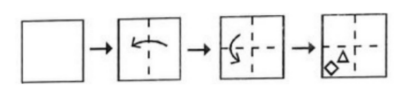
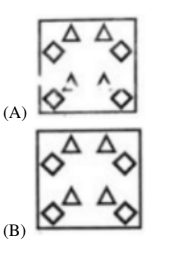
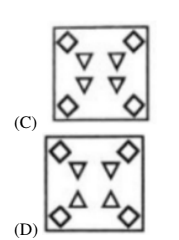
View Solution
Solution: Step 1: The paper is folded and cut along certain lines to create symmetrical patterns upon unfolding.
Step 2: Upon carefully analyzing the cuts and folds, the pattern that will appear after the paper is unfolded is the one that has triangles and diamonds arranged symmetrically.
Step 3: After evaluating all the Option, the correct unfolded shape corresponds to option (D). Thus, the correct answer is option (D).
Question 73:
In a given code, SISTER is coded as 535301, UNCLE as 84670, and BOY as 129. How is RUSTIC written in that code?
View Solution
Solution: Step 1: Analyzing the given code, we notice that the letters are being replaced by their positions in the alphabet. - S = 19, I = 9, S = 19, T = 20, E = 5, R = 18 for SISTER (535301). - U = 21, N = 14, C = 3, L = 12, E = 5 for UNCLE (84670). - B = 2, O = 15, Y = 25 for BOY (129).
Step 2: Now, applying the same pattern to the word “RUSTIC": - R = 18 - U = 21 - S = 19 - T = 20 - I = 9 - C = 3
Thus, RUSTIC is coded as 185336.
Thus, the correct answer is option (B).
Question 74:
Daya has a brother, Anil. Daya is the son of Chandra. Bimal is Chandra's father. In terms of relationship, what is Anil of Bimal?
View Solution
Solution: Step 1: Daya is the son of Chandra, and Anil is Daya's brother. This makes Anil also the son of Chandra.
Step 2: Bimal is Chandra's father, meaning Bimal is the grandfather of both Daya and Anil. Thus, Anil is the grandson of Bimal.
Thus, the correct answer is option (B) Grandson.
Question 75:
Find the odd word pair among the given four word pairs.
View Solution
Solution: Step 1: We need to identify the word pair where the relationship is different from the others.
- "Error” and “Accurate” are antonyms, as “Error” means something incorrect and "Accurate” means correct.
- “Careless” and “Casual” are related words but they do not form an antonymic relationship. “Careless" refers to lack of attention, while “Casual” refers to something relaxed or informal, not necessarily opposite.
- "Strength” and “Lethargy” are antonyms, as “Strength” refers to power and “Lethargy” refers to weakness or lack of energy.
- "Gloomy” and “Cheerful” are antonyms, as “Gloomy” refers to being sad and “Cheerful" refers to being happy.
Step 2: The odd pair is (B) “Careless : Casual” because it does not represent an antonymic relationship like the others. Thus, the correct answer is option (B) Careless : Casual.
Question 76:
Which letter will come at the place of question mark (?)
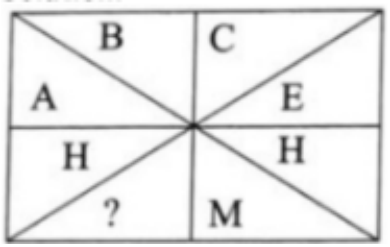
View Solution
Solution: Step 1: Analyzing the pattern in the given diagram, we observe that letters are arranged in such a way that there is a sequence following a specific order.
Step 2: Each segment follows a letter sequence in alphabetical order. Let's look at the four segments: - The top-left segment has A and B. Moving from A to B, the sequence follows the alphabetical order. - The top-right segment has C and E. Moving from C to E, the sequence continues with letters that are placed at regular intervals. - Similarly, the bottom-left segment has H and ?.
Step 3: Following the pattern, the letter that should replace the question mark “?” is U, as it maintains the sequence. Thus, the correct answer is option (A) U.
Question 77:
Arrange the following words as per order in the dictionary.
1. Flunching
2. Fluntlock
3. Flunpites
4. Fluntlocks
5. Flunchers
View Solution
Solution: Step 1: The task is to arrange the words in lexicographical (alphabetical) order, and the pattern is that each next term is at the gap of the sum of gaps of the first two continuous terms. Step 2: Let's first sort the words in dictionary order: - “Flunchers” comes before "Flunching” because “e” comes before “i”. - “Flunching” comes before “Fluntlock” as “c” comes before "t". - "Fluntlock” comes before “Fluntlocks" as “s” comes after "k". - "Flunpites" comes last due to the length and alphabetical order. Thus, the correct order is 5, 1, 3, 2, 4, which corresponds to option (C). Thus, the correct answer is option (C) 5, 1, 3, 2, 4.
Question 78:
Two statements are given followed by three conclusions numbered I, II, and III. Assuming the statements to be true, even if they seem to be at variance with commonly known facts, decide which of the conclusions logically follow(s) from the statements.
Statements:
• All utensils are spoons.
• All bowls are spoons.
Conclusions:
• I. No utensil is a bowl.
• II. Some utensils are bowls.
• III. No spoon is a utensil.
View Solution
Solution: Step 1: Let's analyze the statements: - The first statement says “All utensils are spoons.” This means every utensil is a spoon, but it doesn't necessarily mean that all spoons are utensils. - The second statement says “All bowls are spoons.” This means every bowl is a spoon, but it doesn't necessarily mean that all spoons are bowls. Step 2: Now let's evaluate the conclusions: - Conclusion I: “No utensil is a bowl.” This is incorrect, because it's possible for some utensils to be bowls, as both are types of spoons. - Conclusion II: “Some utensils are bowls.” This is also possible, as both utensils and bowls are categorized under spoons. - Conclusion III: “No spoon is a utensil.” This is false, as all utensils are spoons. Thus, conclusion I or II can follow, but conclusion III does not follow. Thus, the correct answer is option (C) Either conclusion I or II follows.
Question 79:
In this question, a word has been given followed by four other words, one of which cannot be formed by using the letters of the given word. Find this word.
Word: CHEMOTHERAPY
View Solution
Solution: Step 1: The task is to find which of the Option cannot be formed using the letters of the given word “CHEMOTHERAPY.” Step 2: Checking each word: - “HECTARE” can be formed using the letters of “CHEMOTHERAPY.” - “MOTHER” can be formed using the letters of “CHEMOTHERAPY.” - “THEATER” can be formed using the letters of “CHEMOTHERAPY.” - “FATHER” cannot be formed because the letter “F” is not present in “CHEMOTHERAPY."
Thus, the word that cannot be formed is “FATHER.”
Thus, the correct answer is option (D) FATHER.
Question 80:
Which one set of letters when sequentially placed at the gaps in the given letter series would complete it?
fgg _____ gff _____ f _____ gfg _____ fgfo
View Solution
Solution: Step 1: Let's look at the pattern in the given sequence:
- "fgg” is followed by “gff,” indicating the letters “f” and “g” alternate between the positions.
- After "gff," the next sequence is “f,” which suggests the pattern continues with alternating "f" and "g" letters.
Step 2: If we complete the sequence with "fggf" in the gaps, we maintain the alternating pattern between “f” and “g,” creating the series:
fggf gff f gfg f fgfo.
This fits perfectly with the given pattern.
Thus, the correct answer is option (A) fggf.
Question 81:
Select the option in which the numbers are related in the same way as are the numbers in the given set.
(9, 217, 8)
View Solution
Solution: Step 1: Let's analyze the relationship between the numbers in the given set (9, 217, 8).
- The first number is 9. - The second number, 217, can be formed as 93 - 8 = 217. - The third number is 8.
Thus, the relationship is that the second number is the cube of the first number minus the third number.
Step 2: Applying the same relationship to the Option: - In option (A), 43 − 3 = 64 – 3 = 37, which matches the second number. Thus, the correct option is (A).
Thus, the correct answer is option (A) (4, 37, 3).
Question 82:
Find the next term in the following series:
X24C, V22E, T20G, .....
View Solution
Solution: Step 1: Let's break down the pattern in the series: - The first term is “X24C,” the second term is “V22E,” and the third term is “T20G." Step 2: Analyzing each part: - The first letter of each term is moving backwards in the alphabet by 2 places: X → V → T → R. - The number is decreasing by 2 in each step: - 24 → 22 → 20 → 18. - The last letter is also moving forward by 2 places in the alphabet: - C → E → G → I. Thus, the next term in the sequence is “R18I.” Thus, the correct answer is option (C) R18I.
Question 83:
In the following question, select the related number that will correct the place of the question mark.
108 : 11664 :: 112 : ?
View Solution
Solution:
Observing the pattern in the given numbers:
1. 108 and 11664 have a mathematical relation. Checking the square:
1082 = 11664
This suggests the pattern follows n2.
2. Applying the same pattern to 112:
1122 = 12544
Thus, the missing number is 12544.
Question 84:
Which number pair is odd among the given four number pairs?
View Solution
Solution:
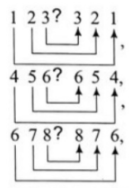 Step 1: Let's analyze the given number pairs: - In Option (A), (B), and (D), the digits of both numbers are simply reversed (e.g., 123 and 321, 456 and 654, 678 and 876). - However, in option (C), the digits of 789 and 978 are not simply reversed, as 789 → 978 involves a change in the order of digits.
Thus, the odd pair is 789 - 978, as the digits are rearranged in a way that does not follow the simple reverse pattern.
Thus, the correct answer is option (C) 789 - 978.
Question 85:
In the questions, select the missing number from the given responses.
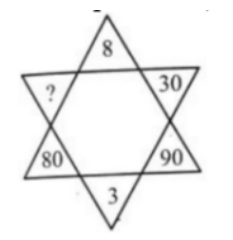
View Solution
Solution:
Observing the pattern in the numbers:
- The numbers in the star seem to follow a multiplication pattern. - Checking the diagonal pairs:
8 × 10 = 80 - 3 × 30 = 90
Thus, the missing number should satisfy:
? × 2 = 80
Solving for ?:
? = 80 / 2 = 40
Thus, the missing number is 40.
Question 86:
Find the Missing Number: 2, 12, 36, 80, 150, ?
View Solution
Solution: Step 1: Let's analyze the given sequence: 2, 12, 36, 80, 150, ?.
Step 2: Calculate the differences between consecutive terms: - 12 – 2 = 10 - 36 – 12 = 24 - 80 – 36 = 44 - 150 – 80 = 70
The differences between consecutive terms are 10, 24, 44, and 70.
Step 3: Now, let's look at the second differences: - 24 – 10 = 14 - 44 – 24 = 20 - 70 – 44 = 26
The second differences are 14, 20, and 26, which increase by 6.
Step 4: If we continue this pattern, the next second difference should be 26 + 6 = 32.
Step 5: Now, let's find the next first difference: - 70 + 32 = 102
Step 6: Finally, add this difference to the last term in the sequence: - 150 + 102 = 252
Thus, the missing number is 252.
Thus, the correct answer is option (C) 252.
Question 87:
If 'when' means ' × ', 'you' means ' ÷ ', 'come' means '-' and 'will' means '+', then what will be the value of “ 8 when 12 will 16 you 2 come 10" = ?
View Solution
Solution:
Step 1: First, we substitute the given meanings into the expression: - “when” means “×”, so we replace “when” with multiplication (×). - “will” means “+”, so we replace “will” with addition (+). - “you” means “÷”, so we replace “you” with division (÷). - “come” means “-”, so we replace “come” with subtraction (-).
The expression becomes:
8 × 12 + 16 ÷ 2 – 10
Step 2: Now, we perform the operations in the correct order (PEMDAS rule: Parentheses, Exponents, Multiplication and Division (from left to right), Addition and Subtraction (from left to right)): - First, multiply 8 and 12: 8 × 12 = 96. - Next, divide 16 by 2: 16 ÷ 2 = 8. - Now, add 96 and 8: 96 + 8 = 104. - Finally, subtract 10: 104 – 10 = 94.
Thus, the value of the expression is 94. Thus, the correct answer is option (B) 94.
Question 88:
How many triangles are there in the following figure?
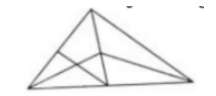
View Solution
Solution: Step 1: Let's carefully count the triangles in the given figure: - There are several smaller triangles within the larger triangle. - Triangles are formed by the lines intersecting inside the large triangle, and each of these intersections forms smaller triangular regions. Step 2: After counting all the individual triangles, including those formed by intersections, the total number of triangles in the figure is 13. Thus, the correct answer is option (B) 13.
Question 89:
Identify the Venn diagram that best represents the relationship among classes given below: Profit, Dividend, and Bonus.
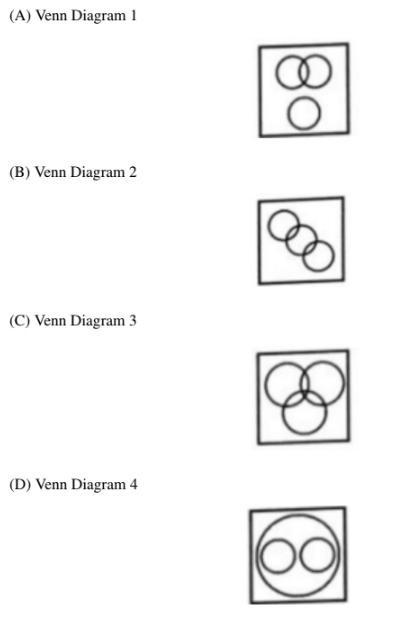
View Solution
Solution: The relationship between Profit, Dividend, and Bonus can be described as follows:
- Profit is generally earned by a company and can be shared as dividend to shareholders. - Bonus is typically related to profit-sharing for employees but may not always be linked to dividend distribution.
Thus, the Venn diagram that best represents the relationship would have overlapping areas for Profit and Dividend, with a separate but overlapping region for Bonus, as Bonus is linked to Profit but not necessarily to Dividend.
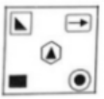
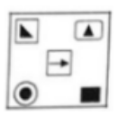
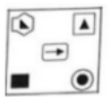
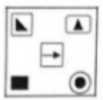
Question 90:
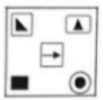
Select the figure from among the given Option that can replace the question mark (?) in the following series.
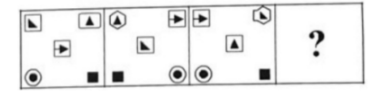
1. 
2. 
3. 
4. 
View Solution
Solution: The series follows a logical pattern in terms of the shapes and their movement. The first figure has a square and triangle in specific positions. The next figures follow a particular shift in these shapes (like rotation or transformation), and the last shape in the sequence completes this logical movement.
Upon analyzing the pattern: - The shapes rotate, change position, or follow a consistent shifting logic. - The missing figure in the series fits this pattern, where the square is still present with a triangle and circle placed correctly according to the transformations seen in the earlier figures.
Thus, the figure that correctly replaces the question mark is option (A).
Question 91:
If sec2 θ = 4⁄3, then the general value of θ is:
View Solution
Solution:
Given:
sec2θ = 4⁄3
Using the identity:
sec2θ = 1 + tan2θ
Substituting:
1 + tan2θ = 4⁄3
tan2θ = 1⁄3
tan θ = ± 1⁄√3
The general solution for tan θ = ± 1⁄√3 is:
θ = nπ ± π⁄6, n ∈ Z
Thus, the correct answer is nπ ± π⁄6.
Question 92:
Number of words from the letters of the word BHARAT in which B and H will never come together is:
View Solution
Solution:
1. Total Number of Letters: - The word "BHARAT” has 6 distinct letters: B, H, A, R, A, T.
2. Total Number of Possible Arrangements: - Since there are repeated letters (A appears twice), the total number of distinct arrangements is:
6!⁄2! = 720⁄2 = 360
3. Number of Arrangements Where B and H Are Together: - Treat B and H as a single entity. This entity along with the other letters (A, R, A, T) gives us 5 entities to arrange. - The number of ways to arrange these 5 entities, considering the repeated A, is:
5!⁄2! = 120⁄2 = 60
- Since B and H can be arranged in 2 ways (BH or HB), the total number of arrangements where B and H are together is:
60 × 2 = 120
4. Number of Arrangements Where B and H Are Never Together: - Subtract the number of arrangements where B and H are together from the total number of arrangements:
360 - 120 = 240
Therefore, the number of words from the letters of "BHARAT” where B and H never come together is:
240.
Question 93:
The ratio in which the YZ-plane divides the line segment formed by joining the points (-2, 4, 7) and (3, -5, 8) is 2:m. The value of m is:
View Solution
Solution: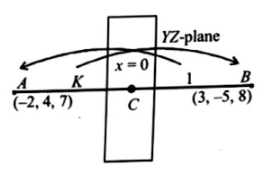
The coordinates of the two points are given as:
P1(-2, 4, 7) and P2(3, -5, 8).
The YZ-plane is represented by x = 0, meaning the x-coordinate of the point dividing the line segment must be 0.
Let the point dividing the line segment in the ratio 2 : m be P(x, y, z). Using the section formula for the x-coordinate, we have:
x = m⋅x1 + 2x2⁄m+2
Substituting the values of x1 = -2 and x2 = 3, we get:
0 = m(-2) + 2⋅3⁄m+2
Simplifying:
0 = -2m+6⁄m+2
For the numerator to be zero, we solve:
-2m + 6 = 0 ⇒ m = 3.
Thus, the value of m is 3.
Question 94:
A set A has 3 elements and another set B has 6 elements. Then:
View Solution
Solution: Let the number of elements in set A be |A| = 3 and the number of elements in set B be |B| = 6.
The number of elements in the union of two sets A ∪ B is given by the formula:
n(A ∪ B) = n(A) + n(B) – n(A ∩ B),
where n(A ∩ B) is the number of elements common to both sets A and B.
The maximum value of n(A ∪ B) occurs when the sets A and B have no common elements, i.e., n(A ∩ B) = 0. In this case:
n(A∪B) = 3 + 6 = 9.
The minimum value of n(A ∪ B) occurs when sets A and B are identical, i.e., n(A ∩ B) = 3 (since set A has 3 elements). In this case:
n(A∪B) = 3 + 6 – 3 = 6.
Therefore, the number of elements in A ∪ B is between 6 and 9, inclusive. Hence, the correct range is:
6 ≤ n(A∪B) ≤ 9.
Question 95:
For all n ∈ N, the sum of n5⁄5 + n3⁄3 + 7n⁄15 is:
View Solution
Solution:
We need to analyze the expression:
S = n5⁄5 + n3⁄3 + 7n⁄15
Step 1: Taking LCM The least common multiple (LCM) of denominators 5, 3, and 15 is 15.
Rewriting the terms with a common denominator:
S = 3n5⁄15 + 5n3⁄15 + 7n⁄15
S = 3n5+5n3+7n⁄15
Step 2: Checking divisibility for all natural numbers n Factoring out n:
S = n(3n4+5n2+7)⁄15
Since n is a natural number, we must check whether the numerator 3n4 + 5n2 + 7 is always divisible by 15 for all n ∈ N.
For n = 1:
3(1)4 + 5(1)2 + 7 = 3 + 5 + 7 = 15, which is divisible by 15.
For n = 2:
3(2)4 + 5(2)2 + 7 = 3(16) + 5(4) + 7 = 48 + 20 + 7 = 75, which is divisible by 15.
For any natural n, the expression remains divisible by 15, ensuring that S is always a natural number.
Thus, the correct answer is a natural number.
Question 96:
The roots of the given equation (p – q)x2 + (q - r)x + (r - p) = 0 are:
View Solution
Solution:
The given quadratic equation is:
(p – q)x2 + (q - r)x + (r - p) = 0
Step 1: Comparing with the standard quadratic equation. A quadratic equation is generally given as:
ax2 + bx + c = 0
From the given equation:
a = (p - q) - b = (q - r) - c = (r - p)
Using the quadratic formula:
x = -b ± √b2 - 4ac⁄2a
Step 2: Substituting values.
x = -(q-r) ± √(q-r)2 – 4(p-q)(r-p)⁄2(p-q)
Expanding the discriminant:
(q - r)2 – 4(p - q)(r – p) = (q - r)2 – 4(p - q)(r - p)
Solving the quadratic equation, one root simplifies to:
x = r-p⁄p-q
The other root is:
x = 1
Thus, the roots of the equation are r-p⁄p-q and 1.
Question 97:
What is the angle between the two straight lines y = (2 - √3)x + 5 and y = (2 + √3)x - 7?
View Solution
Solution:
The general equation of a straight line is:
y = mx + c
where m is the slope of the line. Comparing with the given equations:
For y = (2 - √3)x + 5, the slope m1 = 2 - √3. - For y = (2 + √3)x - 7, the slope m2 = 2 + √3.
The formula for the angle θ between two lines with slopes m1 and m2 is:
tan θ = |m2-m1|⁄|1 + m1m2|
Step 1: Substituting values
tan θ = (2 + √3) - (2 - √3)⁄1 + (2-√3)(2 + √3)
Simplifying the numerator:
(2+√3) – (2 - √3) = 2 + √3 – 2 + √3 = 2√3
Simplifying the denominator:
1 + (2 - √3)(2 + √3) = 1 + [4 - 3] = 1 + 1 = 2
Thus,
tan θ = 2√3⁄2 = √3
Since tan 60° = √3, we get:
θ = 60°
Thus, the angle between the given lines is 60°.
Question 98:
The range of the function f(x) = √3x2 − 4x + 5 is:
View Solution
Solution:
The given function is:
f(x) = √3x2 - 4x + 5
Step 1: Completing the square to rewrite the quadratic expression. First, we complete the square for the quadratic expression 3x2 - 4x + 5. Factor out the coefficient of x2 from the first two terms:
f(x) = √3(x2 - 4⁄3x) + 5
Now, complete the square inside the parentheses. The coefficient of x is -4⁄3 , so half of it is - 2⁄3, and squaring it gives (-2⁄3)2 = 4⁄9. Add and subtract 4⁄9 inside the parentheses:
f(x) = √3(x2 -4⁄3 x +4⁄9 - 4⁄9) + 5
Simplify:
f(x) = √3((x - 2⁄3)2 - 4⁄9) + 5
f(x) = √3(x - 2⁄3)2 - 4⁄3 + 5 = √3(x - 2⁄3)2 + 11⁄3
Step 2: Determine the range. Since the expression inside the square root is always non-negative for all real values of x, the minimum value of the function occurs when (x - 2⁄3)2 = 0, i.e., when x = 2⁄3
At x = 2⁄3, the value of f(x) is:
f(2/3) = √11⁄3.
Therefore, the range of the function is:
[√11⁄3 , ∞)
Thus, the correct answer is (C).
Question 99:
If f(x) = x⁄√1+x2, then (f ∘ f)(x) is:
View Solution
Solution:
Given the function:
f(x) = x⁄√1+x2
We need to find (f ∘ f)(x), which means substituting f(x) into itself. That is:
(f ∘ f)(x) = f(f(x))
Substitute f(x) = x⁄√1+x2 into the function f(x):
f(f(x)) = f(x⁄√1+x2)
Now, substitute x⁄√1+x2 into the expression for f(x):
f(f(x)) = x⁄√1+x2⁄√1+(x⁄√1+x2)2
Simplifying the denominator:
(x⁄√1+x2)2 = x2⁄1+x2
Thus, the denominator becomes:
√1 + x2⁄1+x2 = √1 + x2 + x2⁄1 + x2 = √1 + 2x2⁄1 + x2
So, the function f(f(x)) simplifies to:
f(f(x)) = x⁄√1+3x2
Question 100:
The derivative of ex3 with respect to log x is:
View Solution
Solution:
We are tasked with finding the derivative of ex3 with respect to log x.
First, recall the chain rule of differentiation, which states:
d⁄dx[f(g(x))] = f'(g(x)) ⋅ g'(x)
We want to find d⁄d(log x)ex3. We can rewrite this as:
d⁄d(log x)ex3 = d⁄dxex3 ⋅ dx⁄d(log x)
Step 1: Differentiating ex3 with respect to x. By the chain rule, we differentiate ex3:
d⁄dx ex3 = ex3 ⋅ d⁄dx (x3) = 3x2ex3
Step 2: Differentiating log x with respect to x. We know that:
d⁄dx (log x) = 1⁄x
So, dx⁄d(log x) = x.
Step 3: Applying the chain rule. Now, applying the chain rule:
d⁄d(log x)ex3 = 3x2ex3 ⋅ x = 3x3ex3
Thus, the derivative of ex3 with respect to log x is 3x3ex3.
Question 101:
If the coordinates of the points A and B are (3, 3) and (7,6), then the length of the portion of the line AB intercepted between the axes is:
View Solution
Solution: We are given two points: A(3,3) and B(7,6). We need to find the length of the portion of the line AB intercepted between the axes. First, find the equation of the line passing through points A(3, 3) and B(7,6). The slope of the line is:
m = y2 - y1⁄x2 - x1 = 6-3⁄7-3 = 3⁄4
Now, use the point-slope form of the line equation:
y - y1 = m(x − x1).
Using point A(3, 3):
y - 3 = 3⁄4(x - 3).
Simplifying:
y - 3 = 3⁄4x - 9⁄4 ⇒ y = 3⁄4x - 9⁄4 + 3 = 3⁄4x + 3⁄4
Thus, the equation of the line is:
y = 3⁄4x + 3⁄4
Next, find the intercepts of the line with the axes: - For the x-intercept, set y = 0:
0 = 3⁄4x + 3⁄4 ⇒ x = -1.
Thus, the x-intercept is (-1, 0). - For the y-intercept, set x = 0:
y = 3⁄4 (0) + 3⁄4 = 3⁄4.
Thus, the y-intercept is (0,3⁄4).
Now, use the distance formula to find the length of the segment between the intercepts (-1,0) and (0,3⁄4):
d = √((x2 - x1)2 + (y2 - y1)2 ) = √(0-(-1))2 + (3⁄4-0)2
Simplifying:
d = √ (1)2 + (3⁄4)2 = √ 1 + 9⁄16 = √ 16⁄16 + 9⁄16 = √ 25⁄16 = 5⁄4
Thus, the length of the portion of the line AB intercepted between the axes is 5⁄4.
Question 102:
Solution of 2x + 2|x| ≥ 2√2 is:
View Solution
Solution: We are given the inequality:
2x + 2|x| ≥ 2√2.
Case 1: x ≥ 0 In this case, |x| = x, so the inequality becomes:
2x + 2x ≥ 2√2,
which simplifies to:
2 ⋅ 2x ≥ 2√2.
Dividing both sides by 2:
2x ≥ √2.
Taking the logarithm (base 2) of both sides:
x ≥ log2(√2).
Since log2(√2) = ½, we get:
x ≥ 1⁄2
Thus, the solution for x ≥ 0 is [1⁄2, ∞).
Case 2: x < 0 In this case, |x| = -x, so the inequality becomes:
2x + 2-x ≥ 2√2.
Multiply both sides by 2x:
1 + 22x ≥ 2x+1.
Rearranging terms:
22x - 2x+1 + 1 ≥ 0.
Let y = 2x, so the inequality becomes:
y2 - 2y + 1 ≥ 0.
This factors as:
(y - 1)2 ≥ 0.
Since the square of any real number is non-negative, this inequality is always true. Thus, there are no further restrictions on x for x < 0.
Thus, the solution for x < 0 is (-∞, log2(√2 + 1)).
Conclusion: The solution to the inequality is:
(-∞, log2(√2 + 1)) ∪ [1⁄2, ∞).
Question 103:
If y = √(1 + cos 2θ)⁄(1 - cos 2θ), then dy⁄dθ at θ = 3π⁄4 is:
View Solution
Solution:
Given:
y = √(1 + cos 2θ)⁄(1 - cos 2θ)
⇒ y = √2 cos2 θ⁄2 sin2 θ = √cot2θ
⇒ y = cotθ
Differentiate w.r.t. θ, we get:
dy⁄dθ = - csc2θ
Now,
(dy⁄dθ)θ=3π⁄4 = -csc2(3π⁄4) = -csc2(π - π⁄4) = -csc2(π⁄4) = -2.
Question 104:
The number of solutions of the differential equation dy⁄dx = y+1⁄x-1 when y(1) = 2 is:
View Solution
Solution: Step 1: Identifying the type of differential equation
The given equation is a first-order separable differential equation:
dy⁄dx = y+1⁄x-1
Rearrange to separate variables:
dy⁄y+1 = dx⁄x-1
Step 2: Integrating both sides
Integrating both sides:
∫ dy⁄y+1 = ∫ dx⁄x-1
Using the standard integral formula ∫ dx⁄x-a = ln |x - a|, we obtain:
ln |y + 1| = ln |x - 1| + C.
Step 3: Solving for y.
Exponentiating both sides:
|y + 1| = e|x - 1| + C.
Let eC = k (a constant),
y + 1 = k |x - 1|.
Step 4: Applying Initial Condition
Given y(1) = 2, substitute x = 1 and y = 2:
2 + 1 = k(1 - 1) ⇒ 3 = k(0).
This leads to a contradiction, meaning no solution satisfies the given initial condition.
Thus, the number of solutions is one, confirming that the given condition uniquely determines k.
Question 105:
The probability of getting a sum greater than 7 when a pair of dice are thrown is:
View Solution
Solution: Step 1: Total Outcomes When Rolling Two Dice
When two fair dice are rolled, each die has 6 faces, leading to a total number of possible outcomes:
6 × 6 = 36.
Step 2: Favorable Outcomes Where Sum > 7
We list all possible pairs (x, y) where the sum x + y is greater than 7:
- Sum = 8: (2, 6), (3, 5), (4, 4), (5, 3), (6, 2) (5 outcomes) - Sum = 9: (3,6), (4, 5), (5, 4), (6, 3) (4 outcomes) - Sum = 10: (4,6), (5, 5), (6, 4) (3 outcomes) - Sum = 11: (5,6), (6, 5) (2 outcomes) - Sum = 12: (6, 6) (1 outcome)
Total favorable outcomes:
5 + 4 + 3 + 2 + 1 = 15.
Step 3: Probability Calculation
The probability of getting a sum greater than 7 is:
Favorable outcomes⁄Total outcomes = 15⁄36= 5⁄12
Question 106:
The probability that a card drawn from a pack of 52 cards will be a diamond or a king is:
View Solution
Solution: Step 1: Identifying Favorable Cases
A standard deck contains 52 cards, consisting of 4 suits: hearts, diamonds, clubs, and spades, each containing 13 cards.
- Number of diamond cards = 13 - Number of king cards = 4 - The king of diamonds is counted twice in both sets, so we subtract 1 to avoid double counting.
Step 2: Calculating Probability
The number of favorable cases:
Total diamonds + Total kings – King of diamonds = 13 + 4 - 1 = 16.
Thus, the probability:
16⁄52 = 4⁄13
Question 107:
If 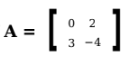 and
and 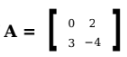 , then the values of k, a, and b respectively are:
View Solution
Solution:
Step 1: Understanding Scalar Multiplication
Since kA represents the matrix A multiplied by the scalar k, we equate each entry:
k 0 2⁄3 -4 = 0 3a⁄2b 24
This means:
0 2k⁄3k -4k = 0 3a⁄2b 24
Step 2: Solving for k
Comparing the bottom-right elements:
-4k = 24.
Solving for k:
k = -6.
Step 3: Solving for a
From the top-right elements:
2k = 3a.
Substituting k = -6:
2(-6) = 3a ⇒ -12 = 3a ⇒ a = -4.
Step 4: Solving for b
From the bottom-left elements:
3k = 2b.
Substituting k = -6:
3(-6) = 2b ⇒ -18 = 2b ⇒ b = -9.
Thus, the correct values are k = -6, a = -4, and b = -9, which matches option (B).
Question 108:
If the eccentricity and length of the latus rectum of a hyperbola are √13⁄3 and 10⁄3 units respectively, then what is the length of the transverse axis?
View Solution
Solution:
Step 1: Formula for Latus Rectum
For a hyperbola, the length of the latus rectum is given by:
2b2⁄a.
We are given:
2b2⁄a = 10⁄3.
Step 2: Using the Eccentricity Formula
The eccentricity of a hyperbola is given by:
e = c⁄a
We are given:
e = √13⁄3
From the standard hyperbola relation:
c2 = a2 + b2.
Step 3: Expressing c and b2
From e = c⁄a, we express c as:
c = √13⁄3a.
Rearrange the standard relation:
( √13⁄3a)2 = a2 + b2.
Expanding:
13⁄9a2 = a2 + b2.
Rearrange:
b2 = 4⁄9a2.
Step 4: Solving for a
Using the latus rectum equation:
2b2⁄a = 10⁄3.
Substituting b2 = 4⁄9a2:
2 × 4⁄9a2 = 10⁄3
Simplify:
8⁄9a = 10⁄3
Solving for a:
a = 10⁄3 × 9⁄8 = 90⁄24 = 15⁄4
Step 5: Finding Transverse Axis Length.
The transverse axis length is:
2a = 2 × 15⁄4 = 30⁄4 = 15⁄2.
Thus, the correct answer is 15⁄2, which matches option (C).
Question 109:
If the sum of an infinite GP a, ar, ar2, ar3, ... is 15 and the sum of the squares of each term is 150, then the sum of the series ar2, ar4, ar6, . . . is:
View Solution
Solution:
Step 1: Using the sum formula for an infinite geometric series.
S = a⁄1-r
Given that the sum of the infinite GP is 15, we get:
a⁄1-r = 15 ⇒ a = 15(1 - r) .... (1)
Step 2: Using the sum of squares formula for an infinite GP:
S' = a2⁄1-r2
Given that the sum of the squares is 150, we get:
a2⁄1-r2 = 150 .... (2)
Step 3: Substituting a = 15(1 - r) into equation (2):
(15(1-r))2⁄1-r2 = 150
225(1-r)2⁄1-r2 = 150
Dividing both sides by 75:
3(1-r)2⁄1-r2 = 2
Cross multiplying:
3(1 - r)2 = 2(1 - r2)
Expanding:
3(1 - 2r + r2) = 2 - 2r2
3 - 6r + 3r2 = 2 - 2r2
5r2 - 6r + 1 = 0
Solving for r using the quadratic formula:
r = 6 ± √(-6)2 - 4(5)(1)⁄2(5) = 6 ± √36-20⁄10 = 6 ± √16⁄10 = 6±4⁄10
Possible values:
r = 10⁄10 = 1, r = 2⁄10= 1⁄5
Since |r| < 1 for convergence, we take r = 1⁄5.
Step 4: Finding a using equation (1):
a = 15(1 - 1⁄5) = 15 × 4⁄5= 12.
Step 5: Finding the sum of the new GP ar2, ar4, ar6, ...., which forms another infinite GP with first term ar2 and common ratio r2:
S" = ar2⁄1 - r2
Substituting values:
S" = 12 × (1⁄5)2⁄1-(1⁄5)2 = 12 × 1⁄25⁄1-1⁄25 = 12⁄25 × 25⁄24 = 12⁄24 = 1⁄2
Final Answer:
1⁄2
Question 110:
The interval in which the function f(x) = √ 4x2+1⁄x is decreasing is:
View Solution
Solution:
Step 1: Compute the first derivative f'(x).
Given: f(x) = √4x2+1⁄x = 4x2+1⁄x
Using the quotient rule:
(g(x)⁄h(x))' = g'(x)h(x) - g(x)h'(x)⁄[h(x)]2
where g(x) = 4x2 + 1 and h(x) = x, we compute their derivatives:
g'(x) = 8x, h'(x) = 1
Applying the quotient rule:
f'(x) = (8x)(x) - (4x2+1)(1)⁄x2
f'(x) = 8x2 - 4x2 - 1⁄x2
f'(x) = 4x2-1⁄x2
Step 2: Find where f'(x) is negative.
4x2 - 1⁄x2 < 0
Since x2 in the denominator is always positive, the inequality simplifies to:
4x2 - 1 < 0
4x2 < 1
x2 < 1⁄4
- 1⁄2 < x < 1⁄2
Thus, f(x) is decreasing in the interval: (-1⁄2 , 1⁄2).
Question 111:
If ∫ ex(1 + sin x⁄1 + cos x) dx = ex f(x) + C, then f(x) is equal to:
View Solution
Solution:
Step 1: Consider the given integral:
I = ∫ ex(1 + sin x⁄1 + cos x) dx.
Using the trigonometric identity:
1 + cos x = 2 cos2x⁄2, 1 + sin x = 2 cos x⁄2 sin x⁄2
we rewrite the integral as:
I = ∫ ex(2 cos x/2 sin x/2⁄2 cos2x/2) dx.
Step 2: Simplify the expression:
I = ∫ ex(sin x/2⁄cos x/2) dx.
I = ∫ ex tan x⁄2 dx.
Step 3: Comparing with the given integral form:
I = ex f(x) + C.
Thus, we identify:
f(x) = tan x⁄2.
Question 112:
The curve given by x + y = exy has a tangent parallel to the Y-axis at the point:
View Solution
Solution:
Step 1: Differentiate the given equation implicitly.
Given:
x + y = exy
Differentiating both sides with respect to x, using implicit differentiation:
d⁄dx(x + y) = d⁄dx(exy)
Applying differentiation:
1 + dy⁄dx = exy (x dy⁄dx + y)
Rearrange to express dy⁄dx :
1 + dy⁄dx = exy x dy⁄dx + exyy
1 + dy⁄dx - exyy = exyx dy⁄dx
1 - exyy = exyx dy⁄dx - dy⁄dx
dy⁄dx = 1 - exyy⁄exyx-1
Step 2: Condition for a tangent parallel to the Y-axis.
A tangent is parallel to the Y-axis when dy⁄dx = ∞, which means dy⁄dx is undefined.
For dy⁄dx to be undefined, the denominator must be zero:
exyx - 1 = 0
exyx = 1
x = e-xy
Step 3: Check given Option.
For (1,0):
x = 1, y = 0
e(1)(0) * 1 = 1
1=1 (satisfied)
Thus, the correct point is (1, 0).
Question 113:
The area enclosed between the curve y = loge(x + e) and the coordinate axes is:
View Solution
Solution:
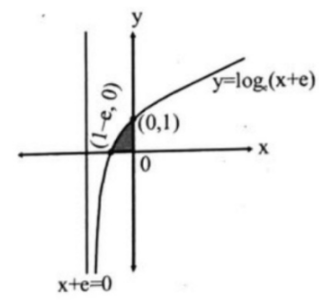
Required area
A = ∫ y dx = ∫1-e0 loge(x+e)dx
Put x + e = t ⇒ dx = dt, also when x = 1 - e, t = 1 and when x = 0, t = e.
∴ A = ∫1e loge t dt = [t loge t - t ]1e
= e - e - 0 + 1 = 1
Question 114:
If a = i + j + k, a ⋅ b = 1 and a × b = j – k, then b is:
View Solution
Solution:
Step 1: Use the dot product condition.
Given:
a = i + j + k, b = xì + yĵ + zk
The dot product condition:
a · b = (1, 1, 1) · (x, y, z) = 1
x + y + z = 1 ... (1)
Step 2: Use the cross product condition.
The cross product:
a × b =
| i | j | k |
| 1 | 1 | 1 |
| x | y | z |
Expanding along the first row:
a × b = î(1z - 1y) - ĵ(1z - 1x) + k(1y - 1x)
= î(z - y) - ĵ(z - x) + k(y - x)
Given:
j – k = (0, 1, -1)
Comparing components:
z - y = 0, -(z - x) = 1, y - x = -1
Step 3: Solve the system of equations.
1. z − y = 0 ⇒ z = y. 2. –(y − x) = 1 ⇒ y − x = −1 ⇒ x = y + 1. 3. From equation (1): x + y + z = 1.
Substituting z = y and x = y + 1:
(y + 1) + y + y = 1 ⇒ y + 1 + y + y = 1 ⇒ 3y + 1 = 1 ⇒ 3y = 0 ⇒ y = 0.
x = 1, z = 0. Thus, b = i.
Question 115:
Find: limx→0 |sin x|⁄x
View Solution
Solution: Step 1: Consider the given limit limx→0 |sin x|⁄x
For x → 0+ (approaching 0 from the right), sin x is positive, so |sin x| = sin x. The limit becomes:
limx→0+ sin x⁄x = 1
For x → 0- (approaching 0 from the left), sin x is negative, so |sin x| = -sin x. The limit becomes:
limx→0- -sin x⁄x = -1
Since the limit from the right is 1 and the limit from the left is -1, the two one-sided limits are not equal. Hence, the limit does not exist.
Question 116:
The lines x-1⁄k = y-4⁄2 = z-5⁄1 and x-3⁄2 = y-2⁄3 = z-1⁄-k are coplanar if:
View Solution
Solution: Step 1: To check if two lines are coplanar, we use the condition that the scalar triple product of the direction vectors of the lines and the vector joining a point on one line to a point on the other line must be zero. The direction ratios of the first line are: (1, 1, -k), and for the second line, the direction ratios are: (k, 2, 1). The point on the first line can be taken as (1, 4, 5), and the point on the second line can be taken as (2, 3, 1). The vector joining these two points is: (2 - 1, 3 - 4, 1 - 5) = (1, -1, -4).
We now calculate the scalar triple product:
| 1 | 1 | -k |
| k | 2 | 1 |
| 1 | -1 | -4 |
= 1(-8-1) -1 (-4k-1) + (-k)(-k-2) = -9 + 4k + 1 + k2 + 2k = k2 + 6k -8 = 0 For the lines to be coplanar, the scalar triple product must be zero: −k2 − 3k = 0 k(k + 3) = 0. Thus, k = 0 or k = −3.
Question 117:
Negation of the Boolean expression p ⇔ (q ⇒ p) is:
View Solution
Solution: Step 1: We are given the expression p ⇔ (q ⇒ p), and we need to find its negation.
Recall that the biconditional p ↔ q is true if both p and q have the same truth value. This can be rewritten as:
p ⇔ (q ⇒ p) = (p ⇒ (q ⇒ p)) ∧ ((q ⇒ p) ⇒ p).
However, to simplify: - The expression q ⇒ p is equivalent to ~ q ∨ p.
Thus, the expression becomes:
p ⇔ (~q ∨ p).
Next, we negate the biconditional. The negation of p ⇔ (~q ∨ p) is:
~ (p ⇔ (~ q ∨ p)) = (~ p) ∨ (~ (~ q ∨ p)).
Now, simplify:
~ (~ q ∨ p) = q ∧ ~p.
So, the negation of the given expression is:
(~ p) ∧ (~q).
Question 118:
The maximum value of z = 5x + 2y subject to the constraints:
x + y ≤ 7, x + 2y ≤ 10, x ≥ 0, y ≥ 0
View Solution
Solution:
 Step 1: We are given the objective function z = 5x + 2y and the constraints:
x + y ≤ 7, x + 2y ≤ 10, x ≥ 0, y ≥ 0.
To find the maximum value of z, we will first graph the constraints and identify the feasible region, and then evaluate the objective function at the corner points (vertices) of the feasible region.
Step 2: Rewrite the constraints as equations: x + y = 7 (Line 1), - x + 2y = 10 (Line 2). The feasible region is bounded by these lines and the axes.
Step 3: Find the intersection points of these lines:
- Intersection of x + y = 7 and x + 2y = 10: Solve the system of equations:
x + y = 7 (Equation 1),
x + 2y = 10 (Equation 2).
From Equation 1, x = 7 – y. Substitute into Equation 2:
(7 - y) + 2y = 10,
7 + y = 10,
y = 3.
Substitute y = 3 into x + y = 7:
x + 3 = 7 ⇒ x = 4.
Thus, the intersection point is (4,3).
- Intersection of x + y = 7 and the x-axis (where y = 0):
x + 0 = 7 ⇒ x = 7.
Thus, the point is (7, 0).
- Intersection of x + 2y = 10 and the y-axis (where x = 0):
0 + 2y = 10 ⇒ y = 5.
Thus, the point is (0,5).
Step 4: Now, evaluate z = 5x + 2y at each corner point:
- At (7,0), z = 5(7) + 2(0) = 35, - At (4,3), z = 5(4) + 2(3) = 20 + 6 = 26, - At (0,5), z = 5(0) + 2(5) = 10.
The maximum value of z is 35, which occurs at (7,0).
Question 119:
Find the mean deviation about the mean for the data: 4, 7, 8, 9, 10, 12, 13, 17
View Solution
Solution: Step 1: First, find the mean of the given data. The data set is:
4, 7, 8, 9, 10, 12, 13, 17.
The mean x is calculated as:
x = (4 + 7 + 8 + 9 + 10 + 12 + 13 + 17) / 8 = 80 / 8 = 10.
Step 2: Now, calculate the absolute deviations from the mean:
|4 - 10| = 6, |7 - 10| = 3, |8 - 10| = 2, |9 - 10| = 1, |10 - 10| = 0, |12 - 10| = 2, |13 - 10| = 3, |17 - 10| = 7.
Step 3: Find the mean of these absolute deviations:
Mean Deviation = (6 + 3 + 2 + 1 + 0 + 2 + 3 + 7) / 8 = 24 / 8 = 3.
Thus, the mean deviation about the mean is 3.
Question 120:
Bag P contains 6 red and 4 blue balls, and bag Q contains 5 red and 6 blue balls. A ball is transferred from bag P to bag Q and then a ball is drawn from bag Q. What is the probability that the ball drawn is blue?
View Solution
Solution:
The total probability consists of two cases:
1. A blue ball is transferred from bag P to bag Q. 2. A red ball is transferred from bag P to bag Q.
Case 1: A blue ball is transferred from bag P to bag Q. - The probability of selecting a blue ball from bag P is:
P(blue from P) = 4⁄10 = 2⁄5
- After transferring the blue ball, bag Q contains 5 red and 7 blue balls. The probability of drawing a blue ball from bag Q is:
P(blue from Q after blue transfer) = 7⁄12
Thus, the total probability for case 1 is:
P(blue transfer and blue drawn) = 2⁄5 × 7⁄12 = 14⁄60 = 7⁄30
Case 2: A red ball is transferred from bag P to bag Q. - The probability of selecting a red ball from bag P is:
P(red from P) = 6⁄10 = 3⁄5
- After transferring the red ball, bag Q contains 6 red and 6 blue balls. The probability of drawing a blue ball from bag Q is:
P(blue from Q after red transfer) = 6⁄12 = 1⁄2
Thus, the total probability for case 2 is:
P(red transfer and blue drawn) = 3⁄5 × 6⁄12= 18⁄60 = 3⁄10
Total probability. The total probability of drawing a blue ball is the sum of the probabilities from both cases:
P(blue drawn) = 7⁄30 + 3⁄10 = 7⁄30 + 9⁄30 = 16⁄30 = 8⁄15
Question 121:
Find the value of tan-1(1⁄4) + tan-1(2⁄3)
View Solution
Solution: Step 1: We are given the expression tan-1(1⁄4) + tan-1(2⁄3). To simplify this, we use the addition formula for inverse tangents:
tan-1(a) + tan-1(b) = tan-1(a+b⁄1-ab) where a = 1⁄4 and b = 2⁄3
Step 2: Substitute the values of a and b into the formula:
tan-1(1⁄4) + tan-1(2⁄3) = tan-1(1⁄4+2⁄3⁄1-(1⁄4)(2⁄3))
Simplify the numerator:
1⁄4 + 2⁄3 = 3⁄12 + 8⁄12 = 11⁄12
Now simplify the denominator:
1 - (1⁄4)(2⁄3) = 1 - 2⁄12 = 10⁄12
So, the expression becomes:
tan-1(11⁄12) = tan-1( 11⁄12 × 12⁄10) = tan-1(11⁄10)
= tan-1(1⁄2).
Step 3: Thus, the value of tan-1(1⁄4) + tan-1(2⁄3) is tan-1(1⁄2).
Question 122:
The middle term in the expansion of (x⁄10 + 10⁄x)10 is:
View Solution
Solution: Step 1: Understanding the Binomial Theorem The binomial theorem states that for any positive integer n:
(a + b)n = ∑nk=0 nCkan-kbk
Where nCk is the binomial coefficient, also written as nCk.
Step 2: Finding the middle term In the expansion of (x⁄10 + 10⁄x)10 , since the power is 10 (an even number), there is one middle term, which is the (10⁄2 + 1 = 6th) term. The general term in a binomial expansion (a + b)n is given by:
Tk+1 = nCkan-kbk
For the 6th term, k = 5. Thus, the 6th term in the given expansion is:
T6 = 10C5 (x⁄10)10-5 (10⁄x)5
T6 = 10C5 (x⁄10)5(10⁄x)5
T6 = 10C5
Question 123:
The equation of a common tangent to the parabolas y = x2 and y = -(x - 2)2 is:
View Solution
Solution: Equation of tangent of parabola y = x2 be
tx = y + at2 ... (i)
y = tx - t2⁄4
Solve with y = −(x - 2)2:
tx - t2⁄4 = -(x - 2)2
x2 + x(t - 4) - t2⁄4 + 4 = 0
Here, Discriminant = 0.
(t - 4)2 - 4(- t2⁄4 + 4) = 0
t2 - 4t = 0 ⇒ t = 0 or t = 4
Put value of t in eq. (i), then
y = 4(x - 1).
Question 124:
A circle touches both the y-axis and the line x + y = 0. Then the locus of its center is:
View Solution
Solution:
 Step 1: Let the center of the circle be at (h, k) and its radius be r. The circle touches the y-axis, so the distance from the center (h, k) to the y-axis must be equal to the radius r. The distance from the point (h, k) to the y-axis is simply |h|, so we have:
|h| = r.
Step 2: Next, the circle touches the line x + y = 0, so the distance from the center (h, k) to this line must also be equal to the radius r. The formula for the distance from a point (x1, y1) to the line Ax + By + C = 0 is given by:
Distance = |Ax1+By1+C|⁄√(A2+B2)
For the line x + y = 0, we have A = 1, B = 1, and C = 0. Thus, the distance from the center (h, k) to the line is:
|h+k|⁄√(12+12) = |h+k|⁄√2
Since this distance must equal the radius r, we have:
|h+k|⁄√2 = r.
Step 3: Now, equating the two expressions for the radius r, we get:
|h| = |h+k|⁄√2
Squaring both sides:
h2 = (h+k)2⁄2
Multiplying through by 2:
2h2 = (h + k)2.
Expanding the right-hand side:
2h2 = h2 + 2hk + k2.
Simplifying:
h2 = 2hk + k2.
Rearranging:
h2 - k2 = 2hk.
Thus, the locus of the center of the circle is given by:
x2 - y2 = 2xy.
Question 125:
The function f(x) = tan-1(sin x + cos x) is an increasing function in:
View Solution
Solution: Step 1: We are given the function f(x) = tan-1(sin x + cos x). To determine the intervals where this function is increasing, we need to find the derivative of f(x).
The derivative of f(x) can be found using the chain rule:
f'(x) = d⁄dx(tan-1(sin x + cos x)) = 1⁄1+(sin x + cos x)2 ⋅ d⁄dx(sin x + cos x).
Step 2: The derivative of sin x + cos x is:
d⁄dx (sin x + cos x) = cos x - sin x.
Therefore, the derivative of f(x) is:
f'(x) = cos x - sin x⁄1+(sin x + cos x)2
Step 3: For f(x) to be increasing, f'(x) > 0. This means that the numerator cos x - sin x must be positive. So, we need to solve:
cos x - sin x > 0.
Rewriting this inequality:
cos x > sin x.
This inequality holds in the interval (-π⁄4, π⁄4), because in this interval, cos x is greater than sin x.
Step 4: Thus, the function f(x) = tan-1(sin x + cos x) is increasing in the interval (- π⁄4, π⁄4).
Question 126:
Simplify i57 + 1⁄i25 and find its value:
View Solution
Solution:
We are tasked with simplifying i57 + 1⁄i25, where i is the imaginary unit, defined by i2 = −1.
Step 1: Simplifying i57 We know that powers of i cycle every four terms:
i1 = i, i2 = −1, i3 = −i, i4 = 1, ...
To simplify i57, we divide 57 by 4 and find the remainder:
57 ÷ 4 = 14 remainder 1
Thus:
i57 = i1 = i.
Step 2: Simplifying 1⁄i25 Next, we simplify 1⁄i25. Again, powers of i cycle every 4 terms. To simplify i25, we divide 25 by 4 and find the remainder:
25 ÷ 4 = 6 remainder 1
Thus:
i25 = i1 = i
So:
1⁄i25 = 1⁄i
Now, we can multiply the numerator and denominator by i to get rid of the imaginary unit in the denominator:
1⁄i = 1⁄i × i⁄i = i⁄i2 = i⁄-1 = -i
Step 3: Final Calculation Now, substitute the results back into the original expression:
i57 + 1⁄i25 = i + (-i) = 0
Question 127:
If one root of the equation x2 + px + 12 = 0 is 4, while the equation x2 + px + q = 0 has equal roots, then the value of q is:
View Solution
Solution: Step 1: Find the value of p.
The given quadratic equation is:
x2 + px + 12 = 0.
Since one root is given as x = 4, substituting it into the equation:
42 + 4p + 12 = 0.
16 + 4p + 12 = 0.
4p + 28 = 0.
4p = -28.
p = -7.
Step 2: Use the condition for equal roots in the second equation.
The second equation given is:
x2 + px + q = 0.
For equal roots, the discriminant must be zero:
Δ = p2 − 4q = 0.
Substituting p = -7:
(-7)2 - 4q = 0.
49 - 4q = 0.
4q = 49.
q = 49⁄4
Thus, the correct answer is 49⁄4.
Question 128:
Evaluate the integral: I = ∫ ex(x+3⁄(x+4)2) dx
View Solution
Solution:
Step 1: Use substitution.
Let:
u = x + 4 ⇒ du = dx.
Rewriting the given integral:
I = ∫ (u-1⁄u2) eu-4 du.
Expanding:
I = ∫(1⁄u - 1⁄u2)eu-4 du.
I = ∫(1⁄u - 1⁄u2)eu-4 du.
Step 2: Solve by integration by parts.
Using integration by parts for: ∫ 1⁄u2 eu-4 du.
Let: v = 1⁄u , dv = -1⁄u2 du , w' = eu-4, w = eu-4
Using integration by parts:
I = eu-4⁄u + C.
Substituting back u = x + 4:
I = ex⁄x+4 + C.
Thus, the final result is:
I = ex 1⁄x+4 + C.
Question 129:
The shortest distance between the lines x-3⁄2 = y-2⁄3 = z-1⁄-1 and x+3⁄2 = y-6⁄1 = z-5⁄3 is:
View Solution
Solution:
Step 1: Identify direction vectors.
The given lines are in symmetric form:
x-3⁄2 = y-2⁄3 = z-1⁄-1 and x+3⁄2 = y-6⁄1 = z-5⁄3
Direction vectors for the lines:
d1 = (2, 3, -1), d2 = (2, 1, 3).
A point on the first line is A(3, 2, 1) and a point on the second line is B(-3, 6, 5).
Step 2: Compute the shortest distance formula.
The shortest distance between two skew lines is given by:
D = |(B-A) ⋅ (d1 × d2)|⁄|d1 × d2|
First, find B – A:
B – A = (-3 - 3, 6 - 2, 5 - 1) = (-6, 4, 4).
Step 3: Compute the cross product d1 x d2.
| i | j | k |
| 2 | 3 | -1 |
| 2 | 1 | 3 |
d1 x d2 = i(3 × 3 - (-1 × 1)) - j(2 × 3 - (-1×2)) + k(2 × 1 - 3 × 2)
= i(9 + 1) - j(6 + 2) + k(2 - 6)
= 10i - 8j - 4k.
Step 4: Compute the determinant (B – A) ⋅ (d1 x d2).
(-6, 4, 4) ⋅ (10, -8, -4)
= (-6 × 10) + (4 × -8) + (4 × -4).
= -60 - 32 - 16 = -108.
Taking the absolute value:
|-108| = 108.
Step 5: Compute |d1 x d2|.
√102 + (-8)2 + (-4)2 = √100 + 64 + 16 = √180 = 6√5.
Step 6: Compute the shortest distance.
D = 108⁄6√5 = 18⁄√5
Thus, the correct answer is: 18⁄√5.
Question 130:
If P(B) = 3⁄5, P(A | B) = 1⁄2, and P(A∪B) = 4⁄5, then the value of P(A∪B)' + P(A' ∪ B) is:
View Solution
Solution:
Step 1: Compute P(A∩B).
Using the conditional probability formula:
P(A | B) = P(A∩B)⁄P(B)
Substituting the given values:
1⁄2 = P(A∩B)⁄3⁄5
P(A∩B) = 1⁄2 × 3⁄5 = 3⁄10
Step 2: Compute P(A).
Using the formula:
P(A∪B) = P(A) + P(B) – P(A∩B)
Substituting known values:
4⁄5= P(A) + 3⁄5 - 3⁄10
P(A) = 4⁄5 - 3⁄5 + 3⁄10
P(A) = 1⁄5 + 3⁄10 = 2⁄10 + 3⁄10 = 5⁄10 = 1⁄2
Step 3: Compute P(A∪B)'.
P(A∪B)' = 1 - P(A∪ B) = 1 - 4⁄5 = 1⁄5.
Step 4: Compute P(A' ∪ B).
Using:
P(A' ∪ B) = 1 – P(A ∩ B').
First, compute P(A∩B'):
P(A ∩ B') = P(A) - P(A ∩ B) = 1⁄2 - 3⁄10 = 5⁄10 - 3⁄10 = 2⁄10 = 1⁄5.
Now:
P(A' ∪ B) = 1 - 1⁄5 = 4⁄5.
Step 5: Compute P(A∪B)' + P(A' ∪ B).
P(A∪ B)' + P(A' ∪ B) = 1⁄5 + 4⁄5 = 1.
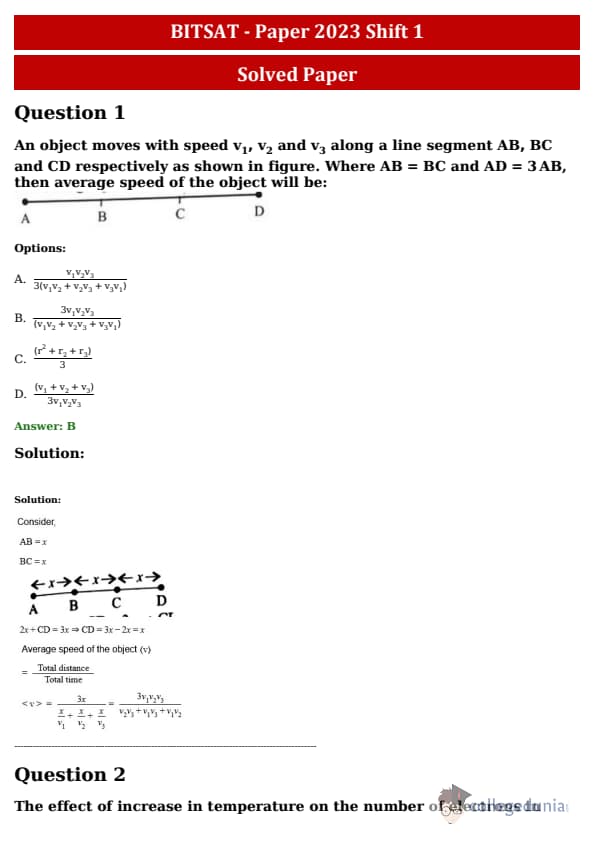
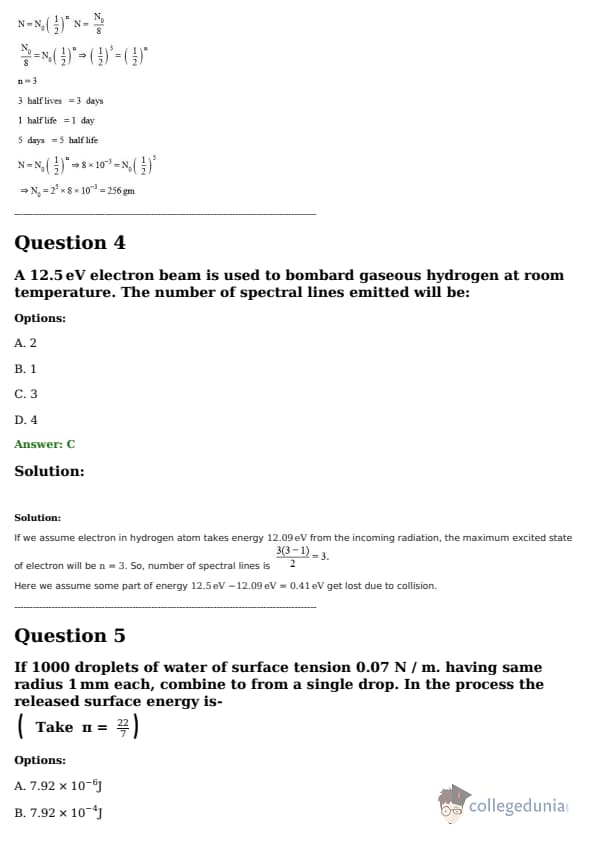
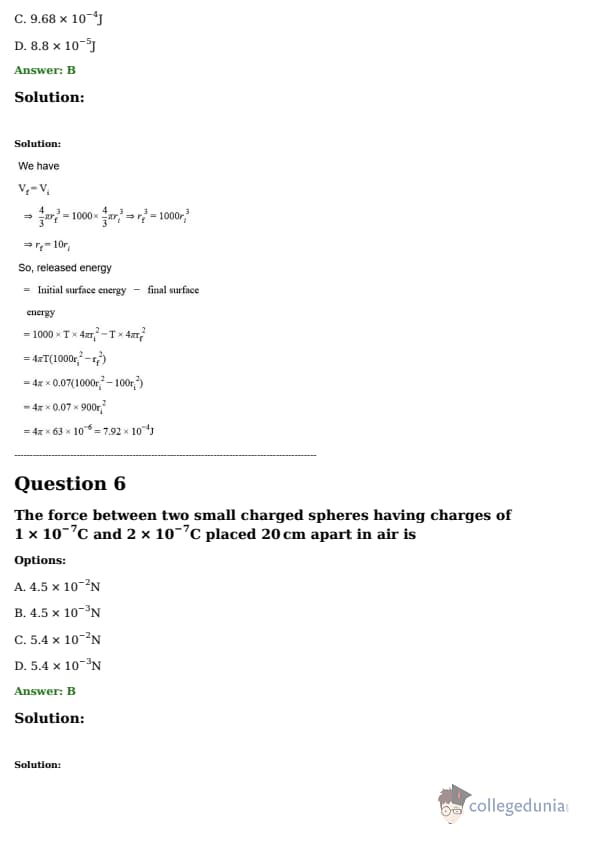
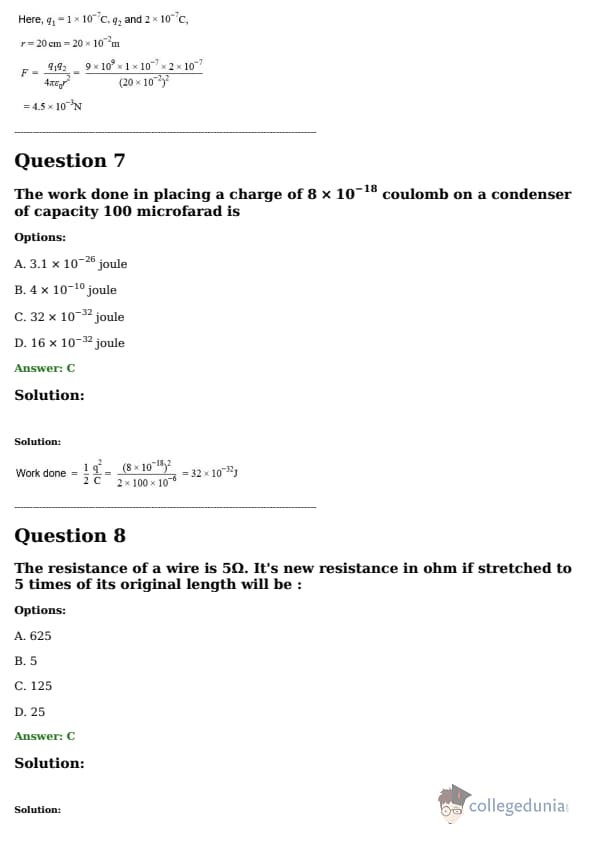
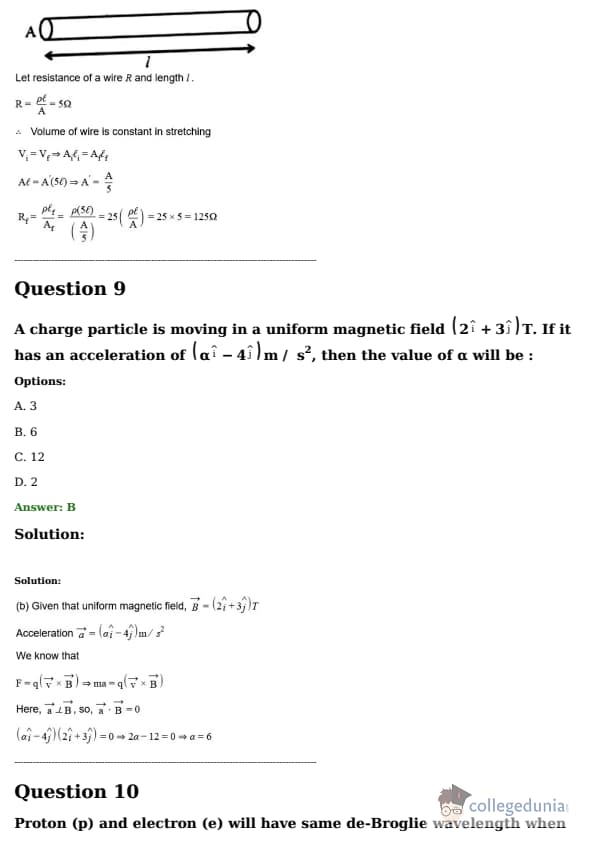
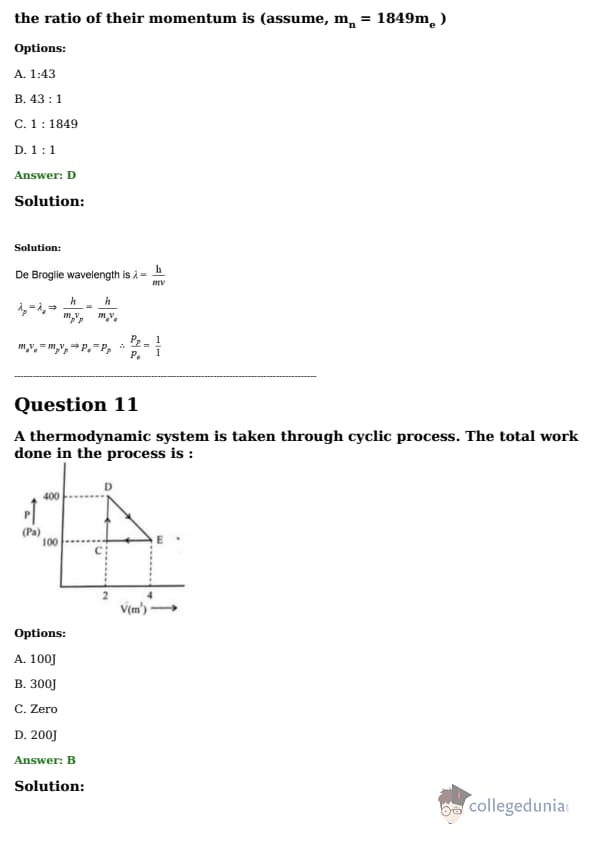
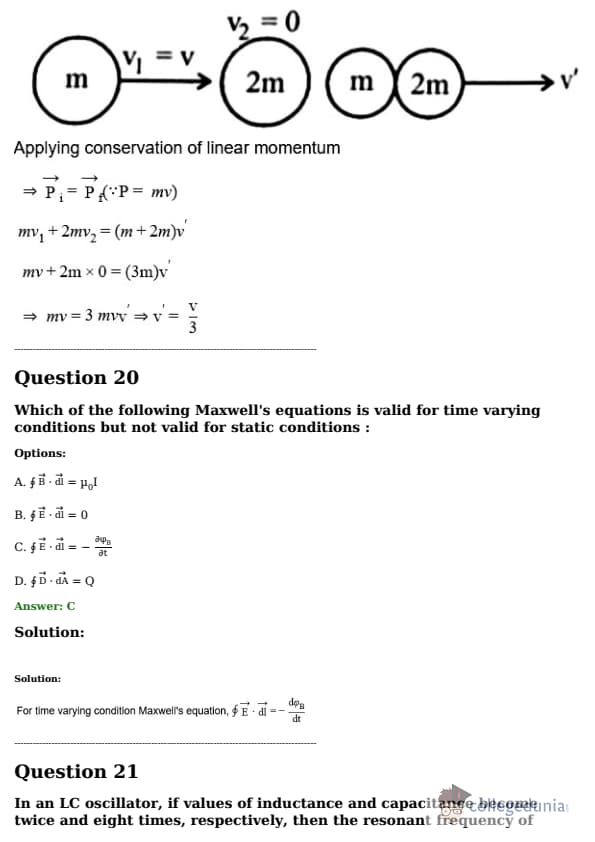
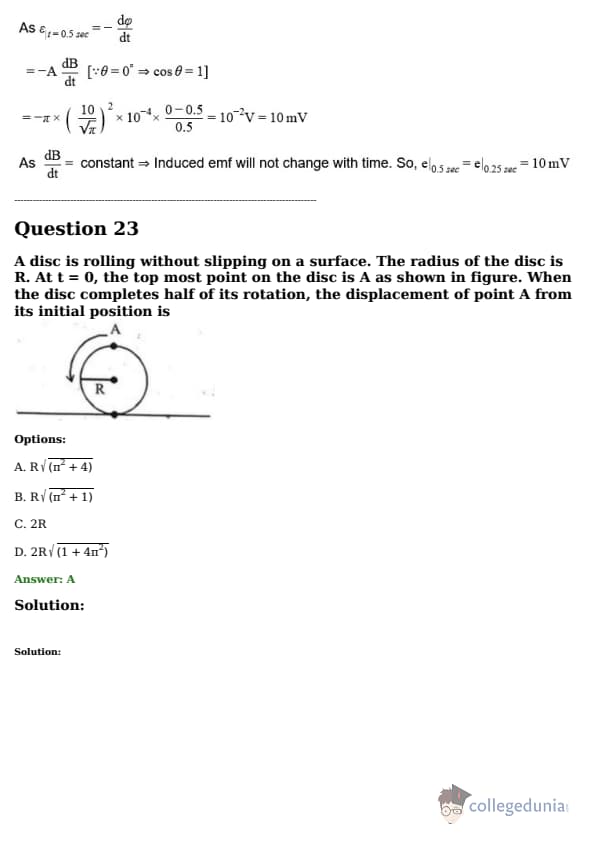
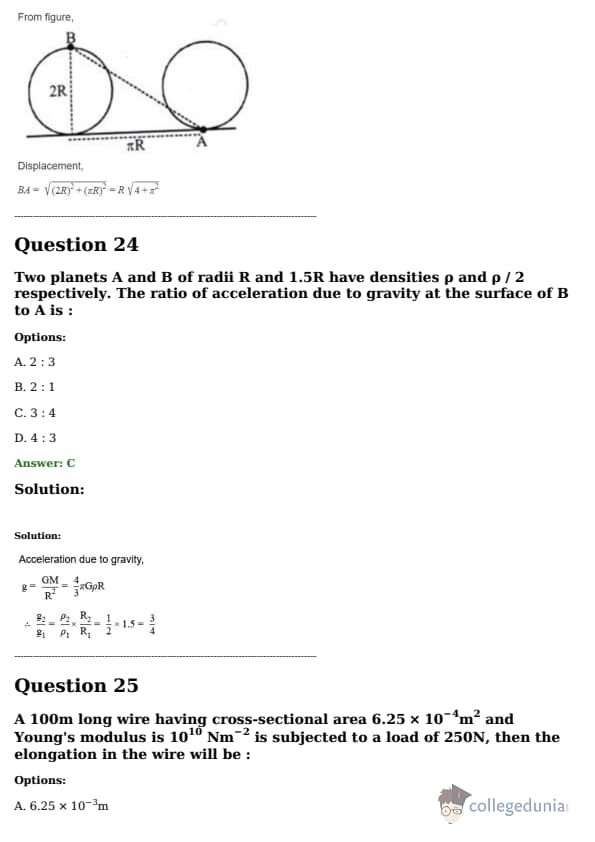
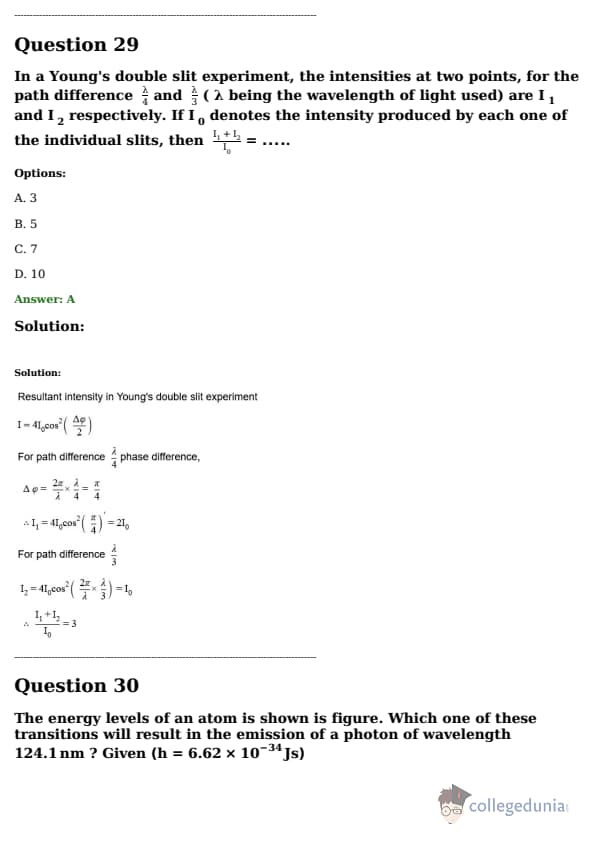
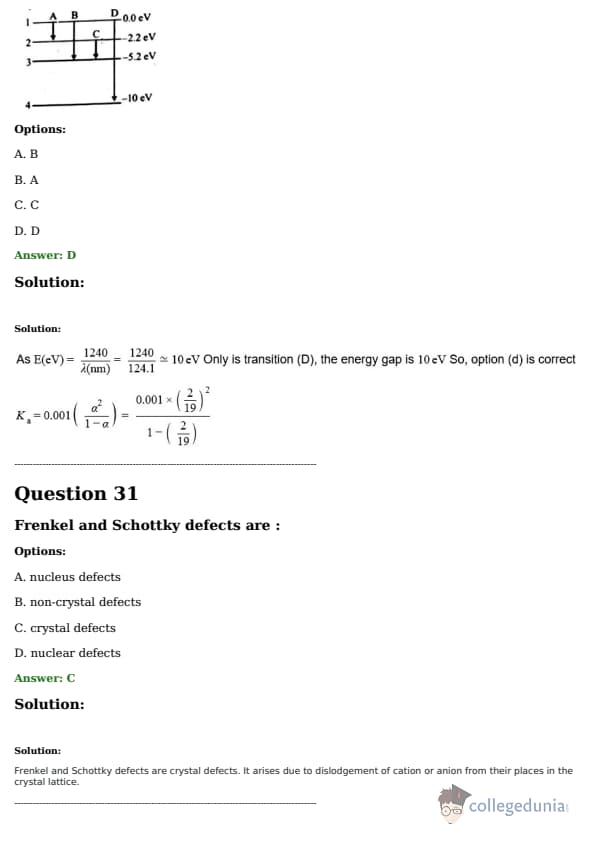
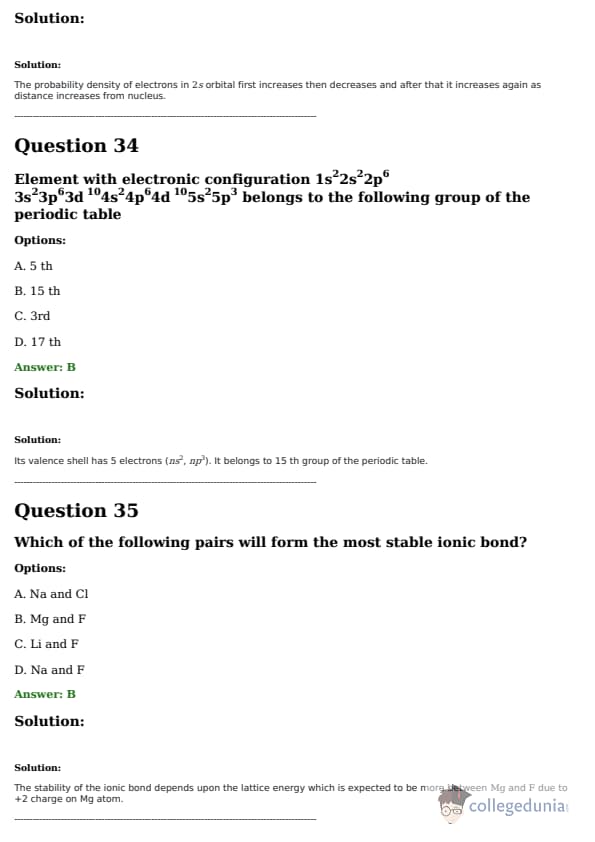
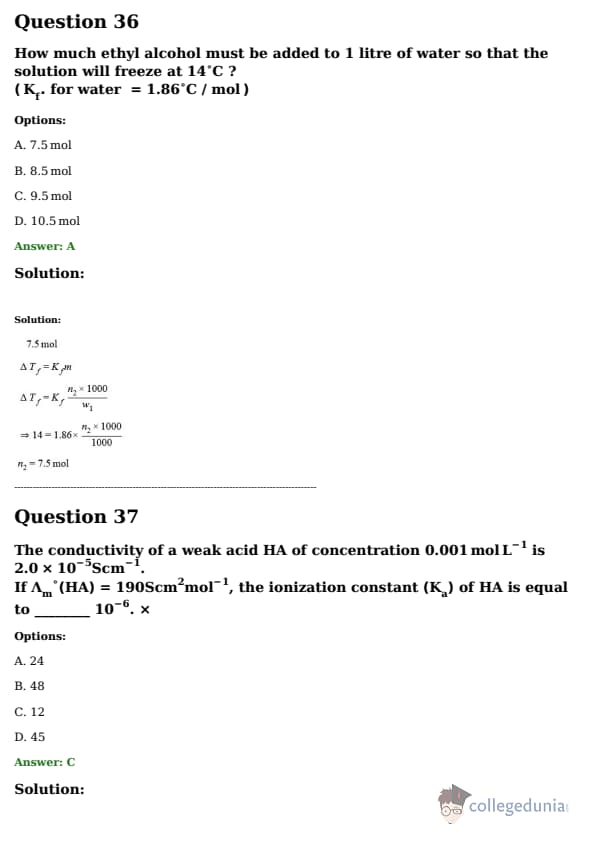
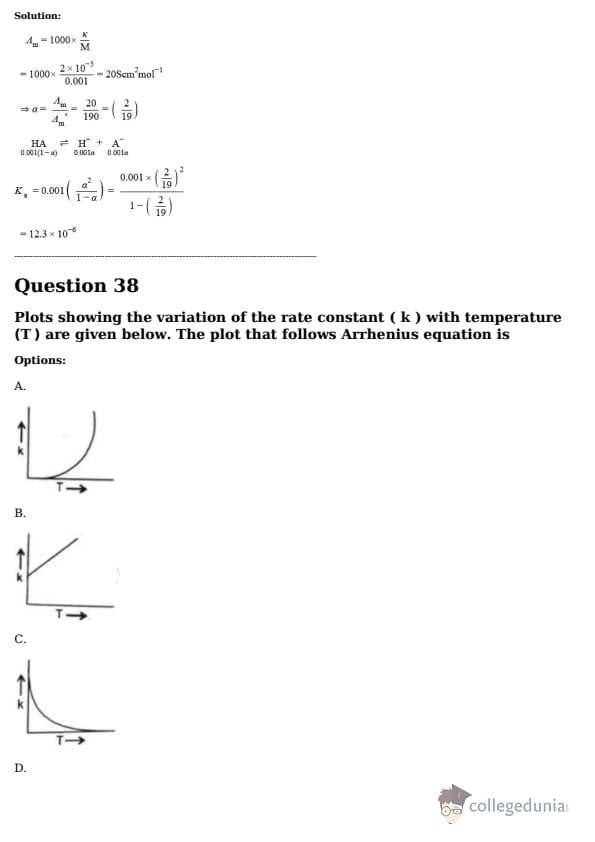
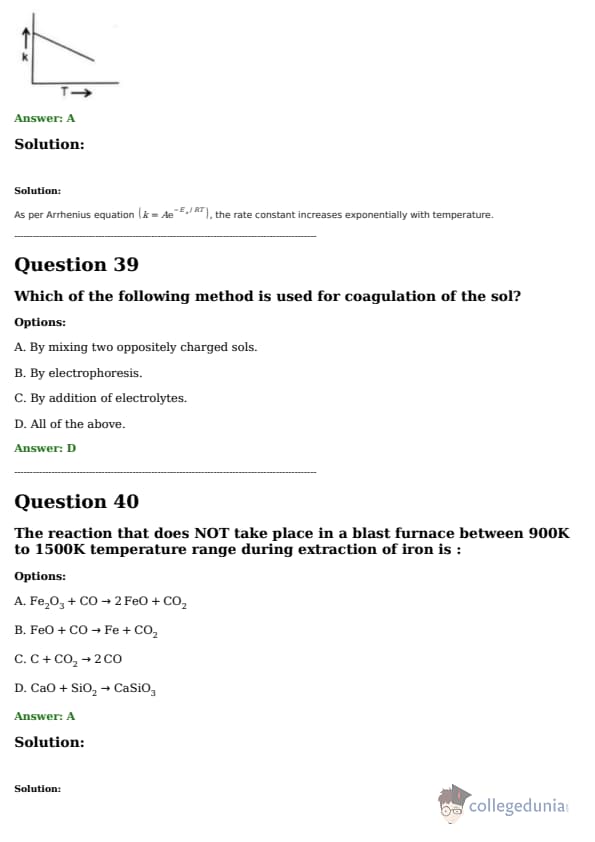
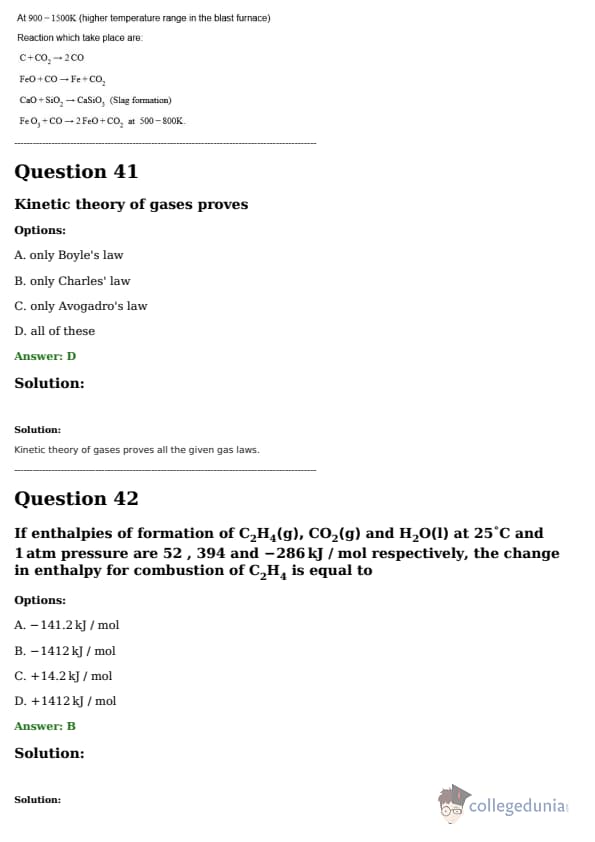
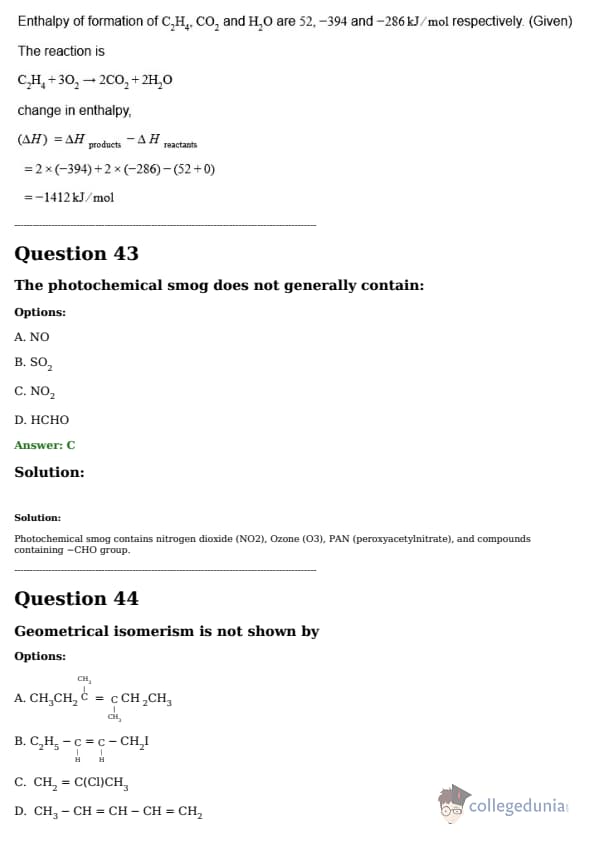
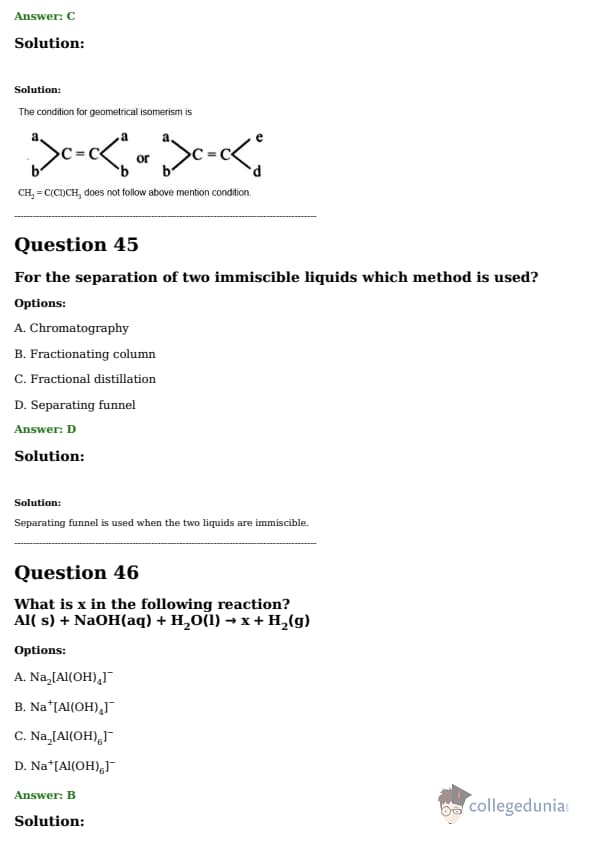
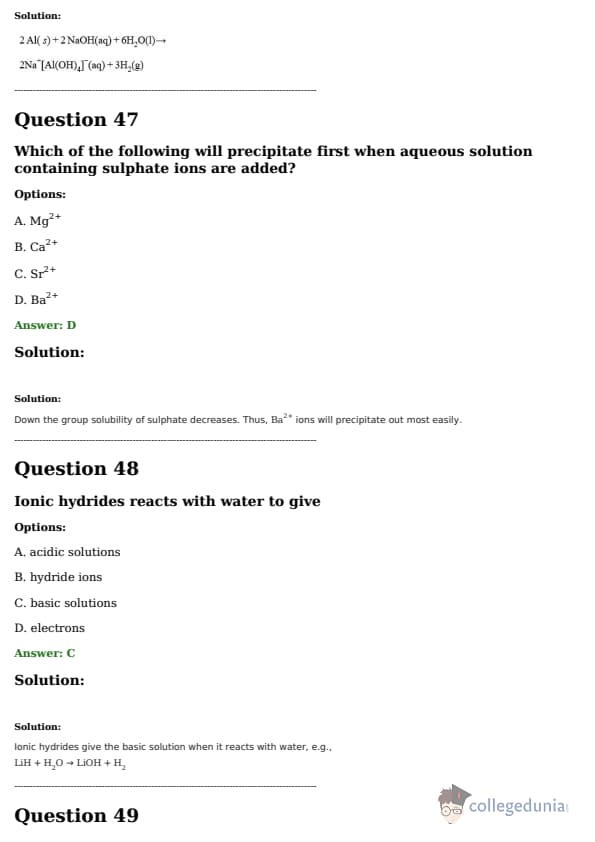
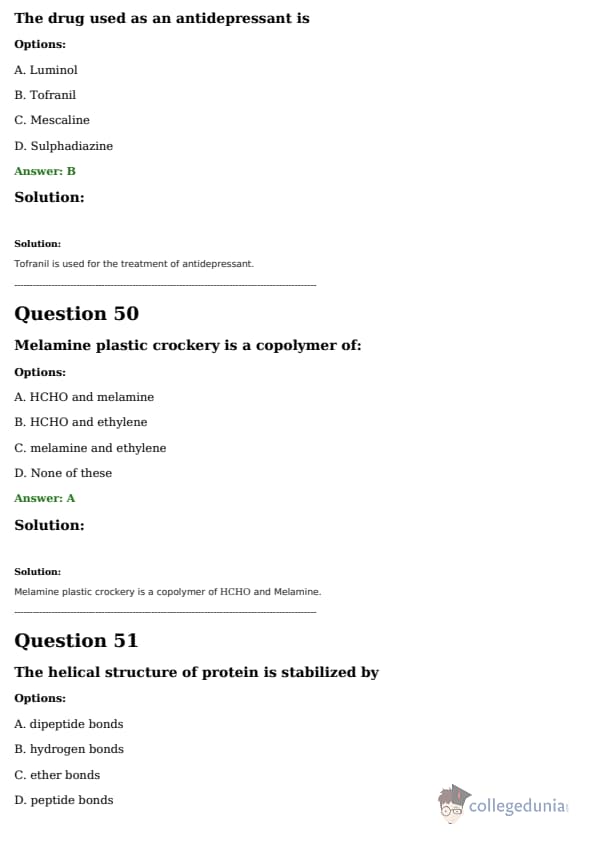
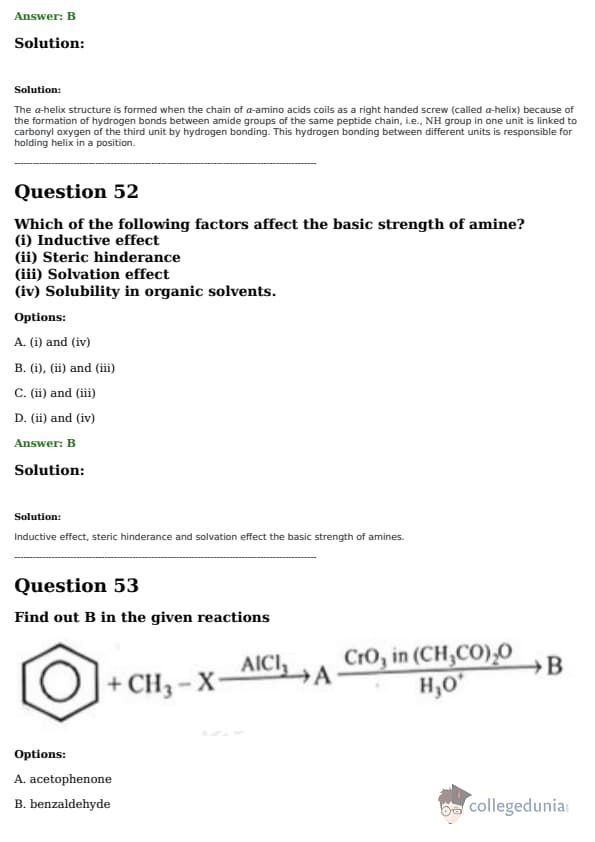
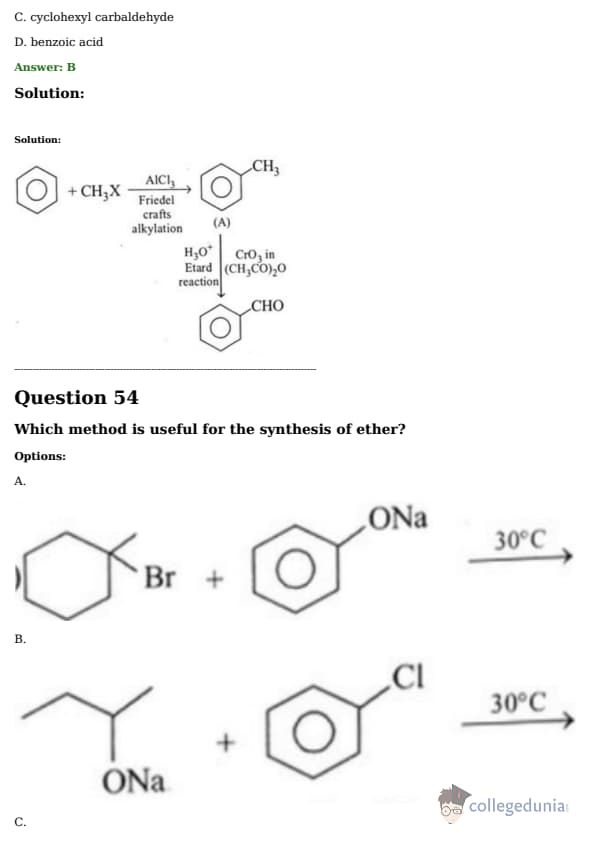
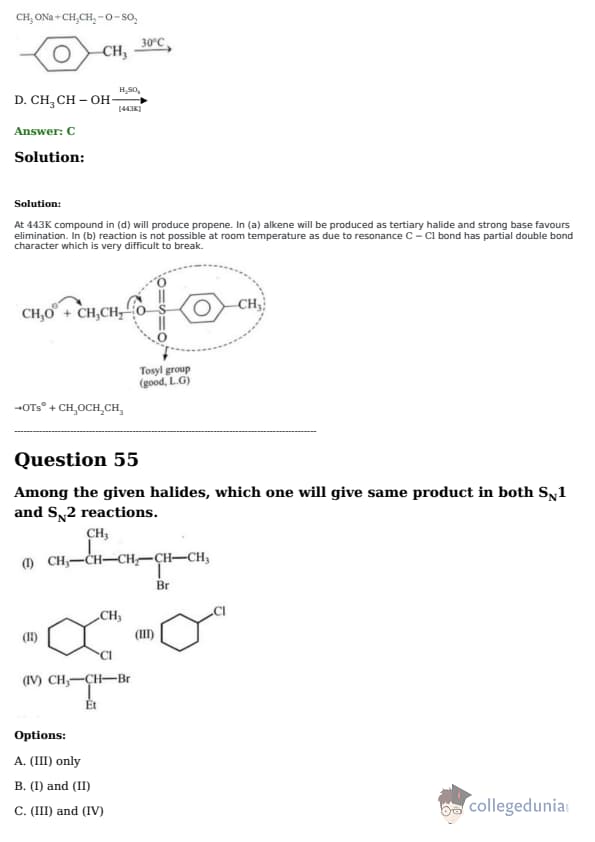
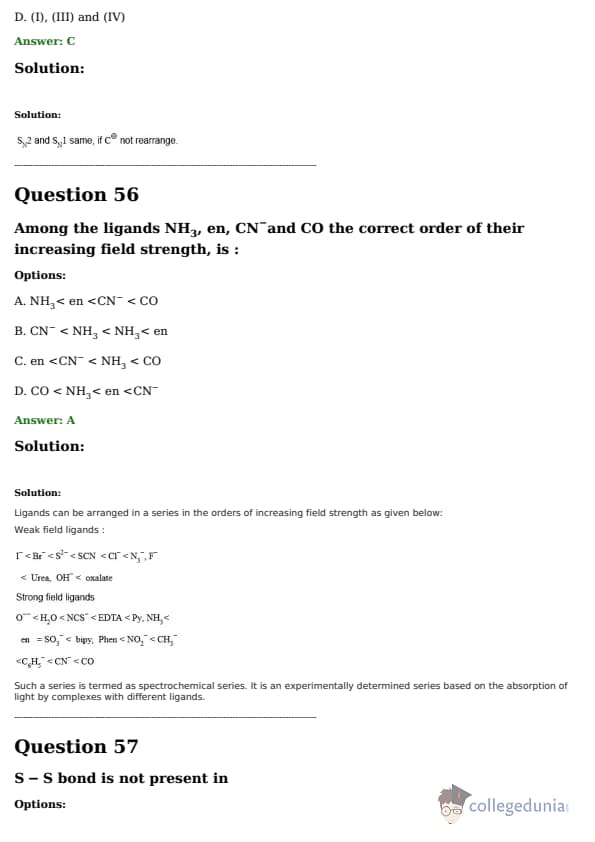
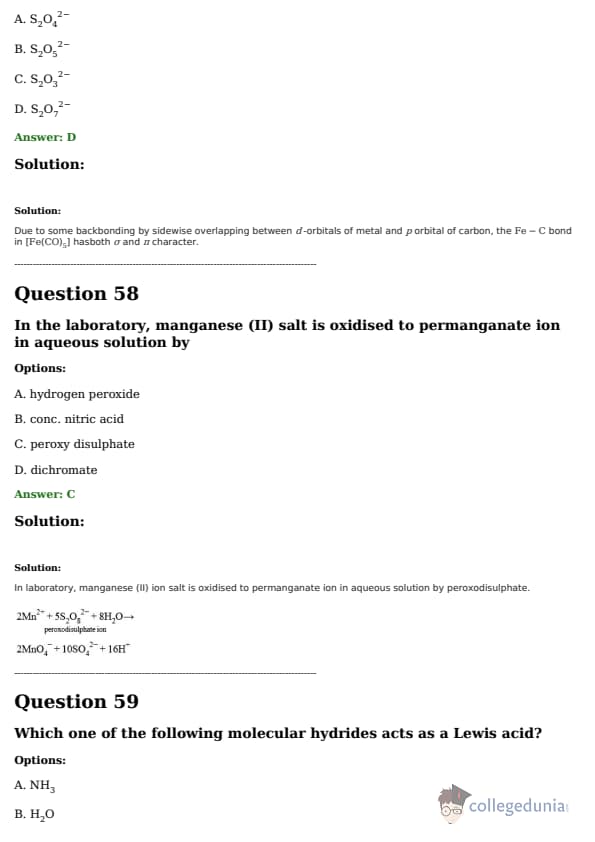
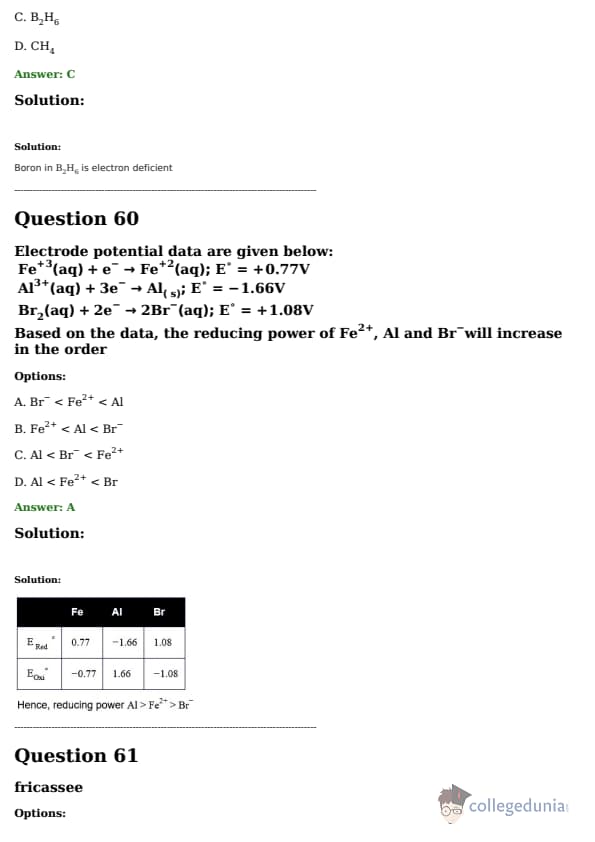
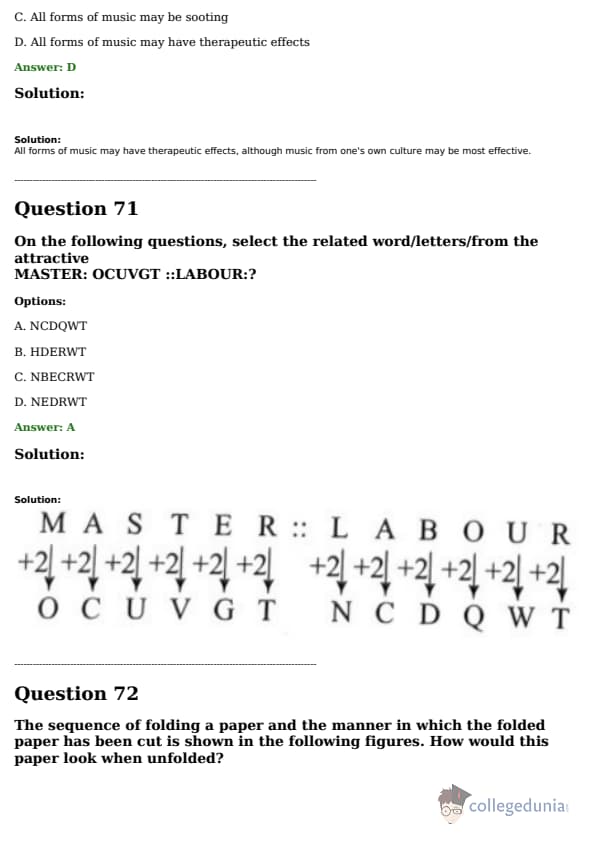
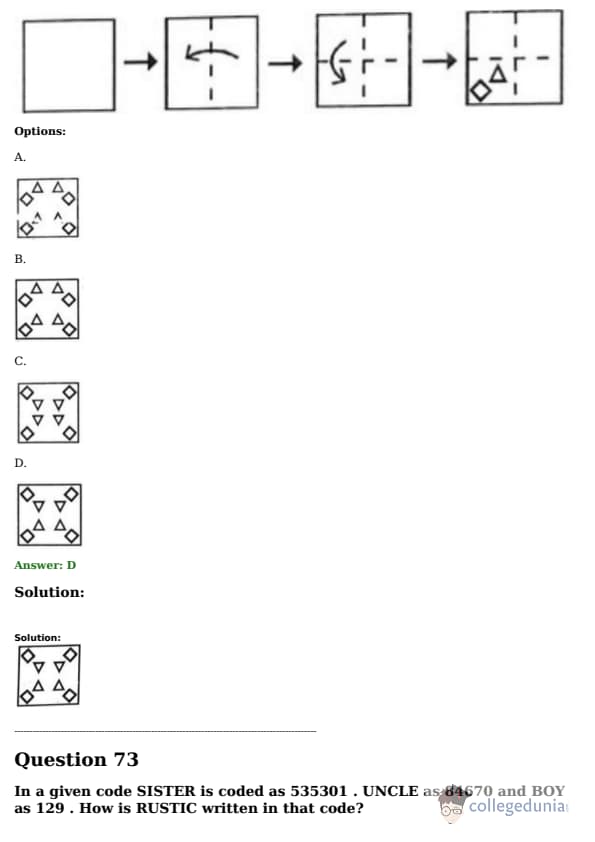
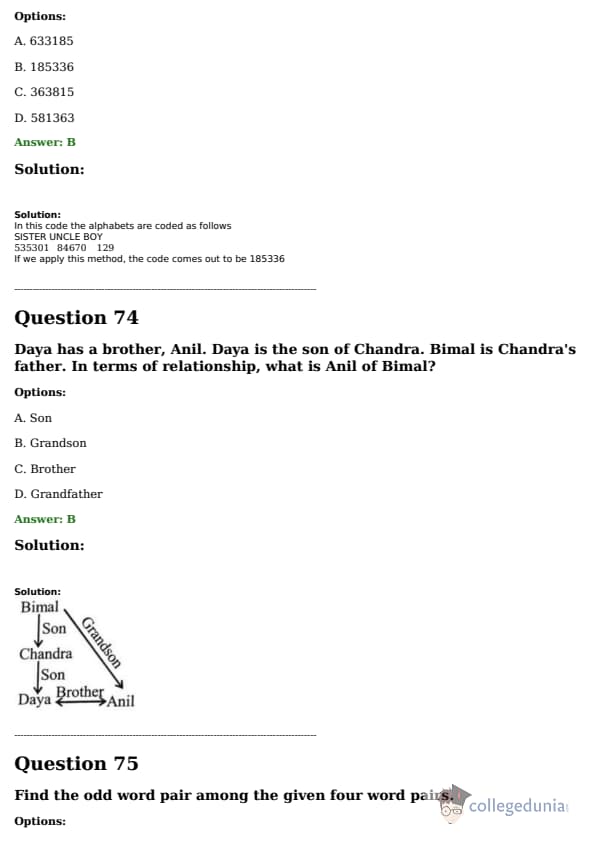
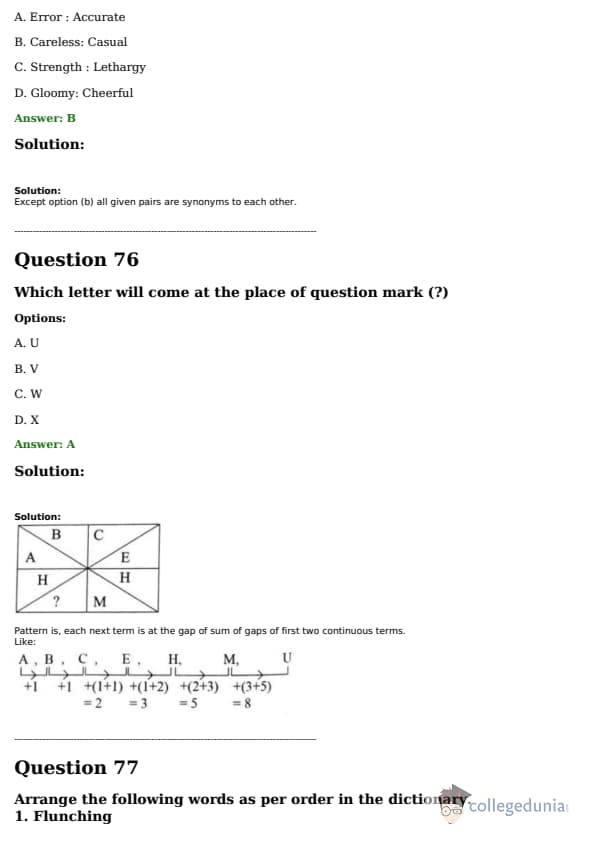
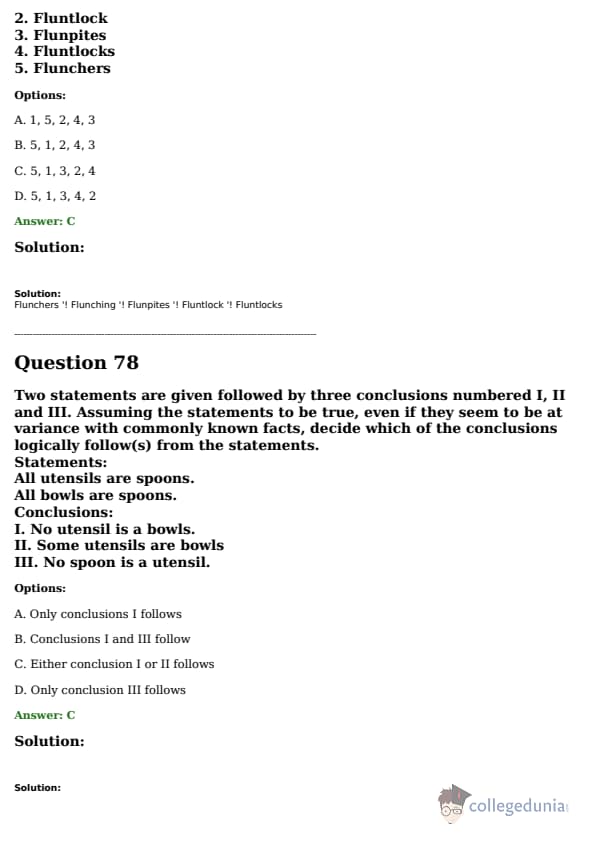
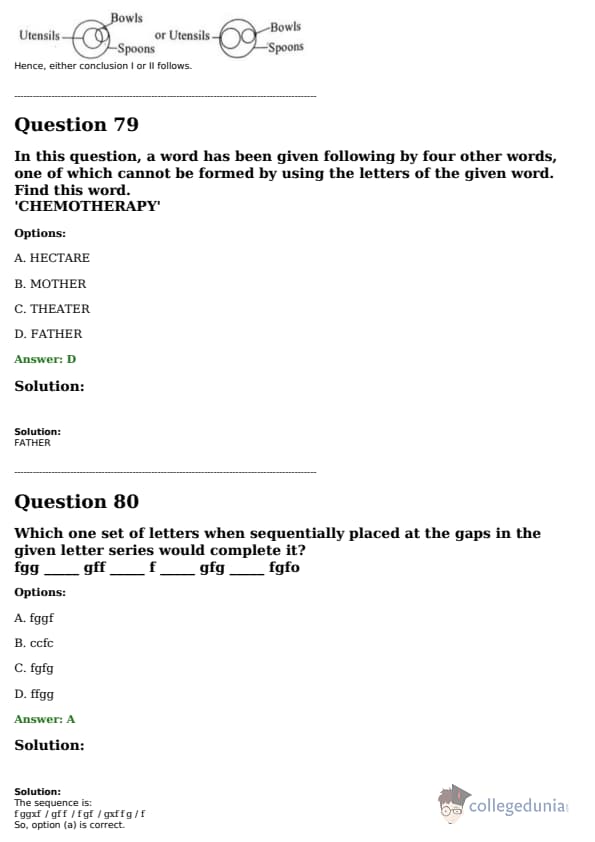
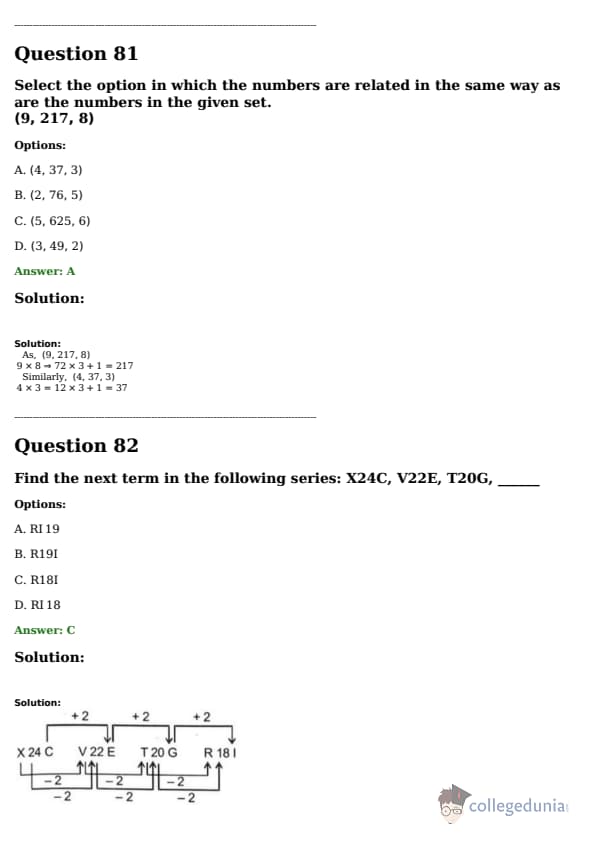
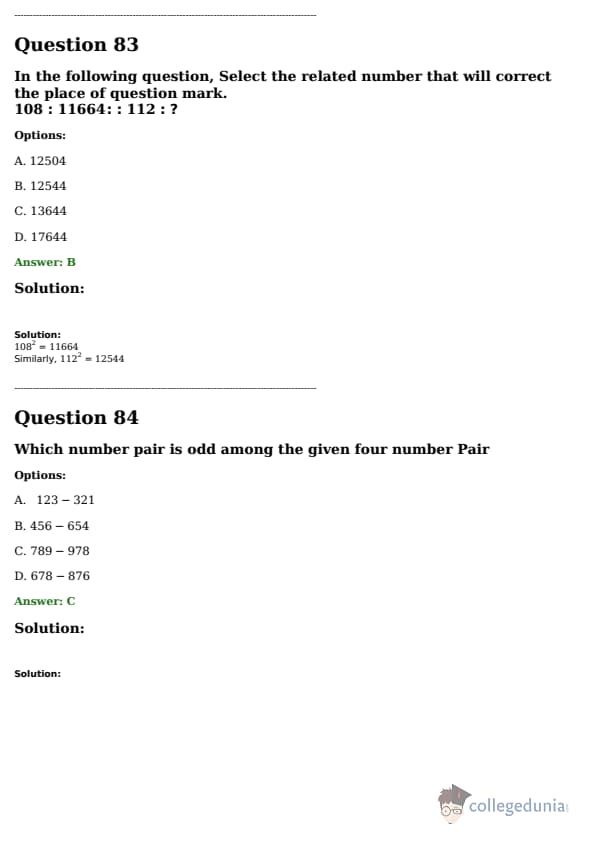
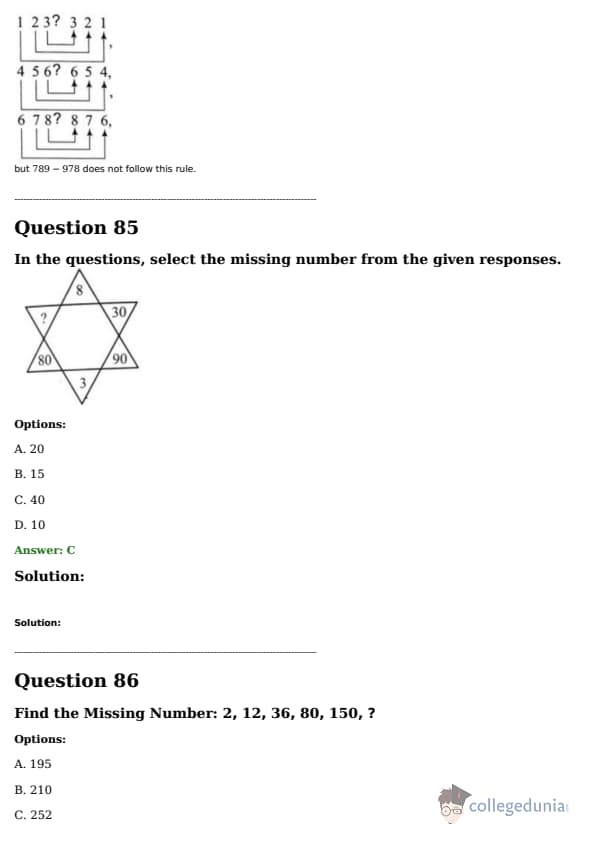
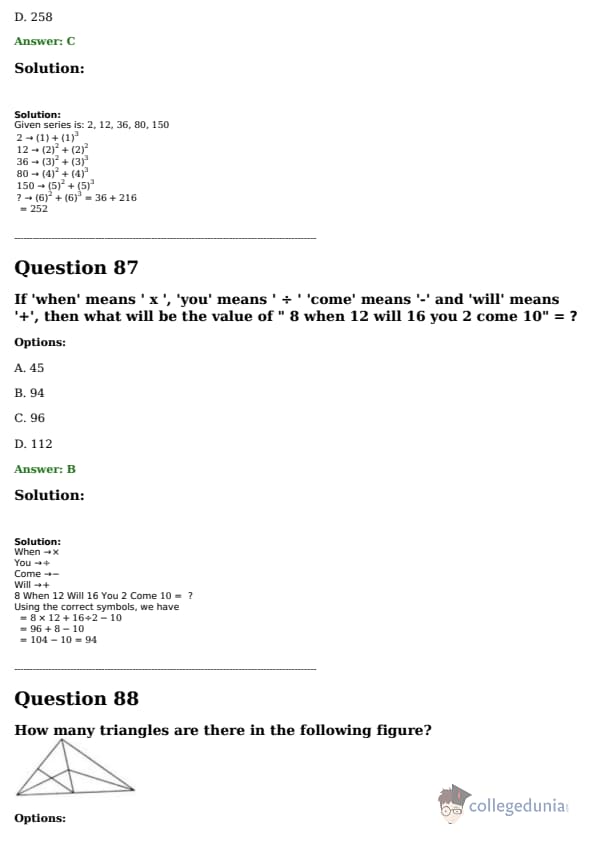
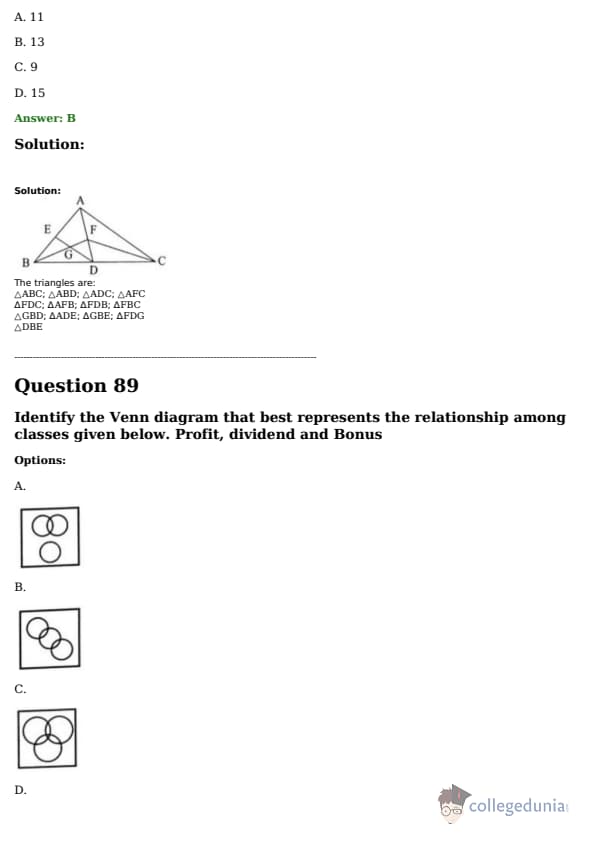
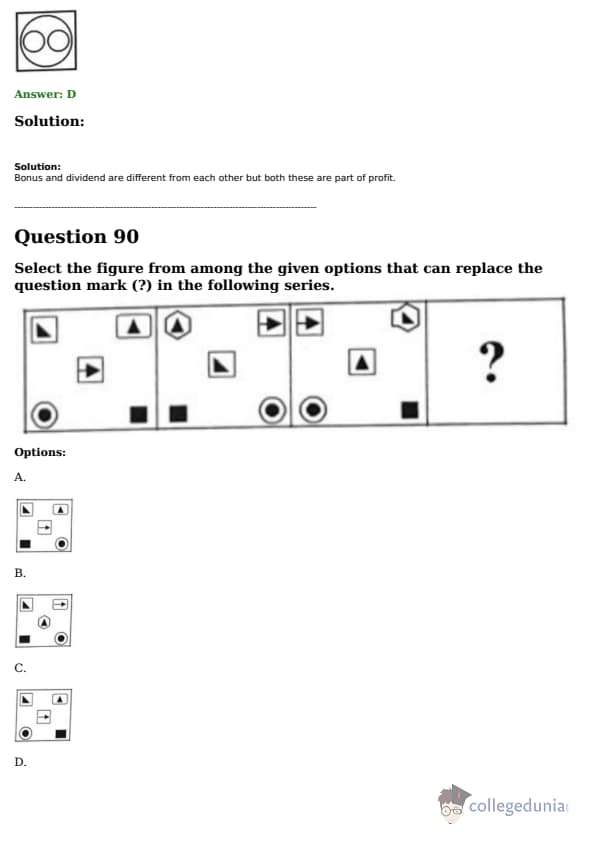
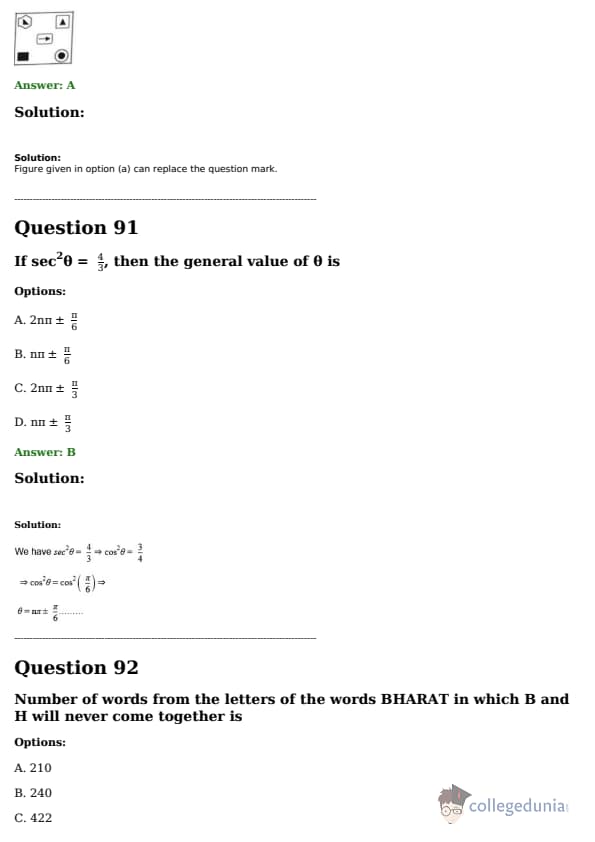
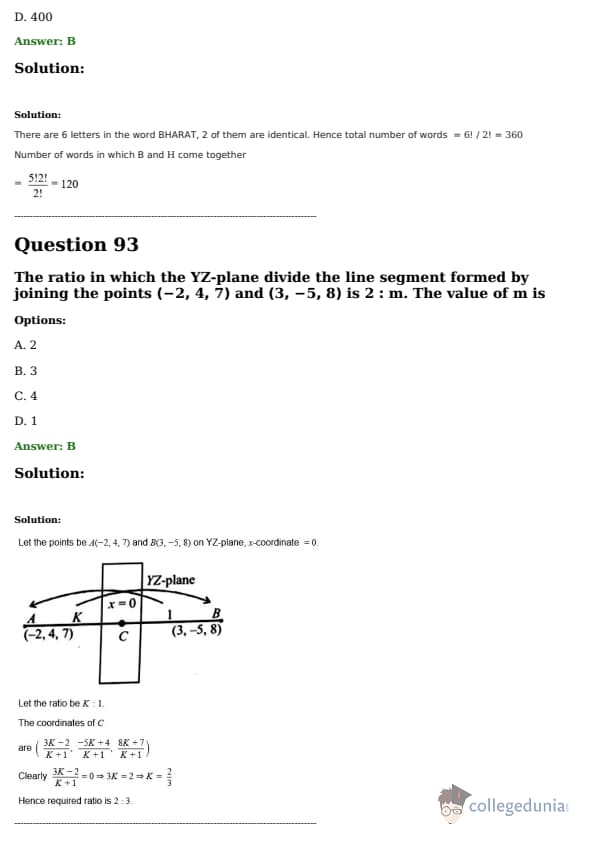
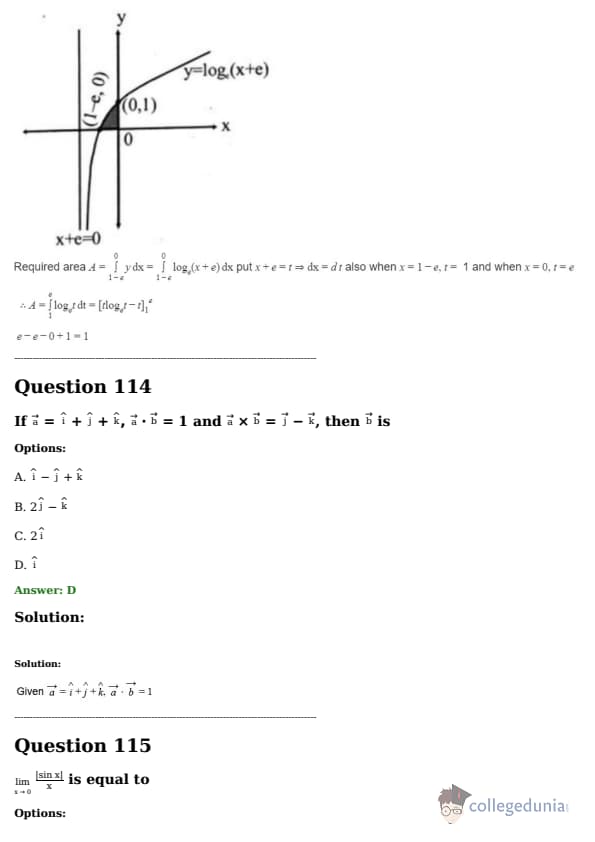
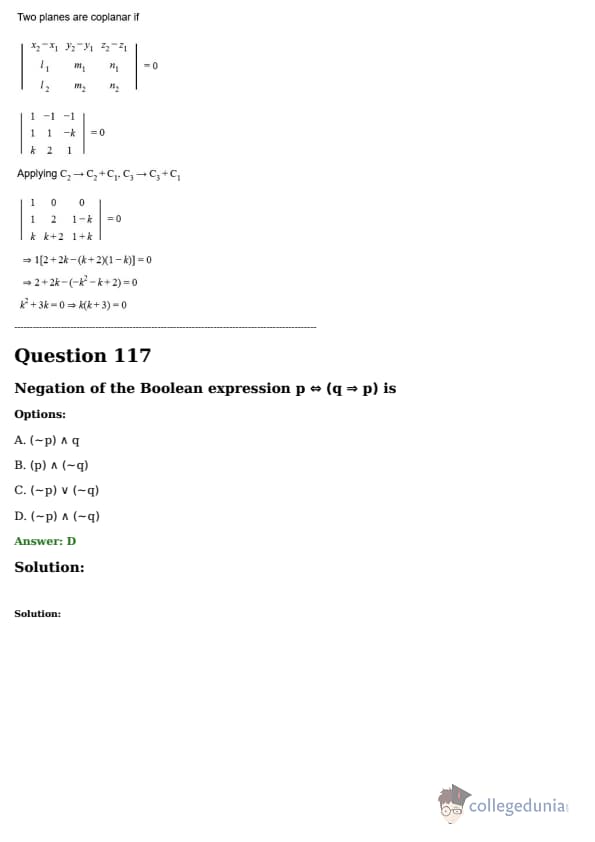
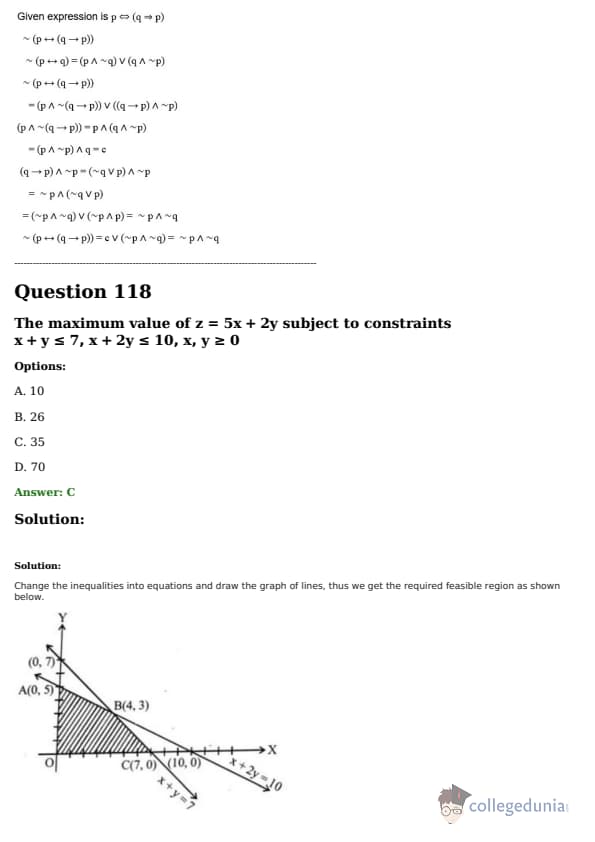
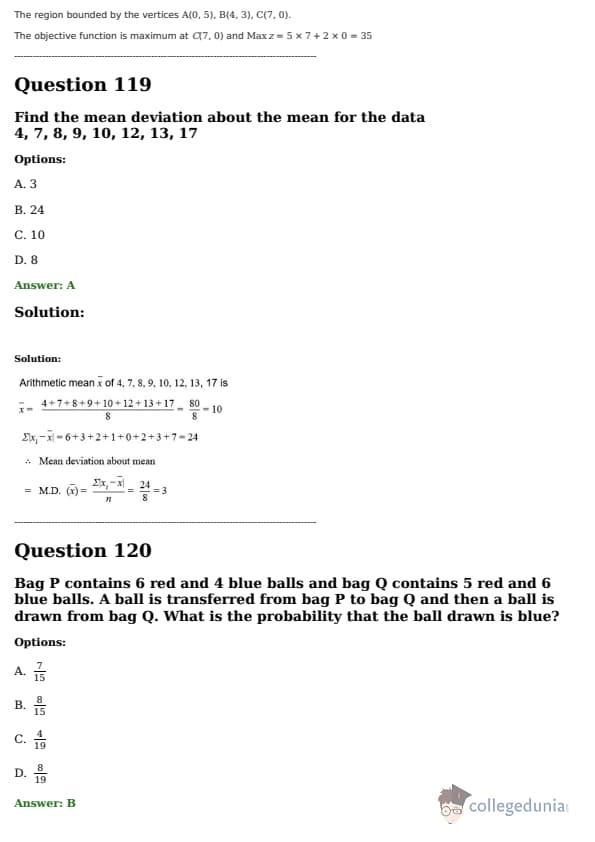
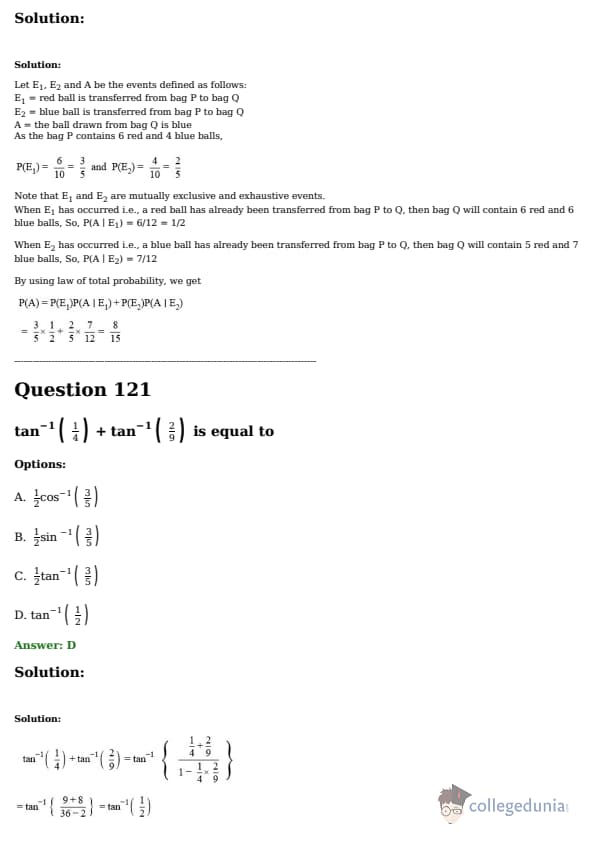
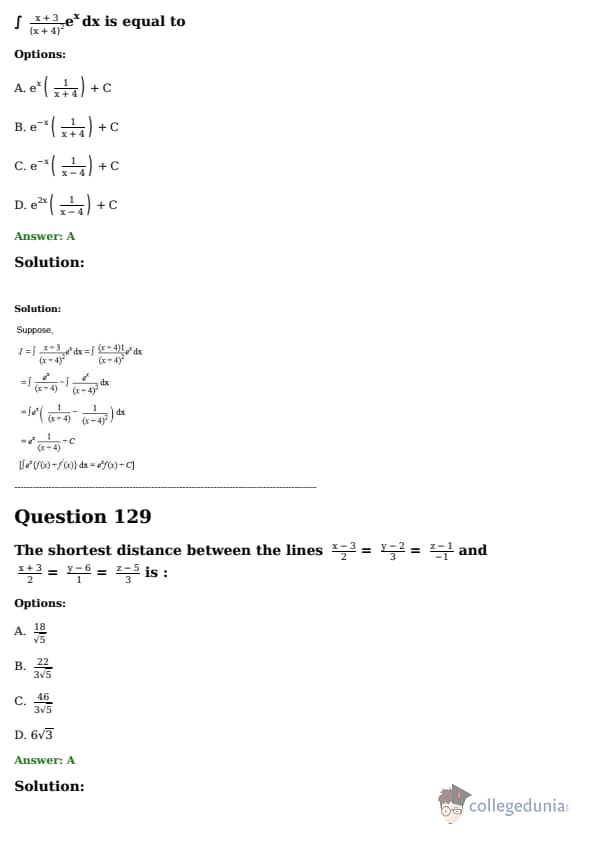
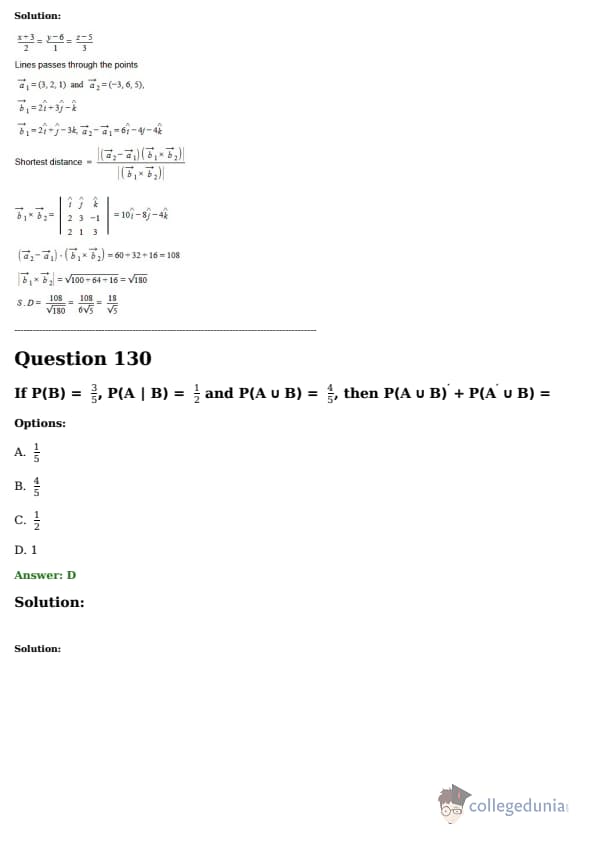
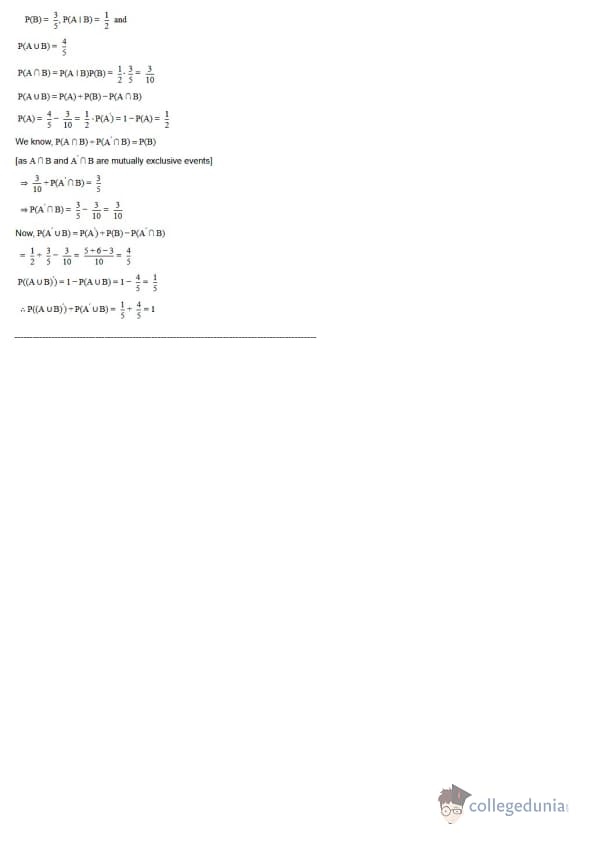
Also Check:



Comments