




BITSAT 2026 Question Paper for April 16 Shift 1 is available here. BITS Pilani conducted BITSAT Session 1 exam on April 16, 2026 in Shift 1 from 9 AM to 12 PM. BITSAT exam is held in a CBT Mode at various exam centres in India and abroad for students to apply for Integrated programs at BITS Campuses in Pilani, Goa and Hyderabad.
- BITSAT question paper contains 130 questions divided into 5 sections- Physics and Chemistry with 30 questions each, English Proficiency with 10 questions, Logical Reasoning with 20 questions and Mathematics or Biology with 40 questions.
- Each correct answer gets you 3 marks while incorrect answer has an negative marking of 1.
The BITSAT 2026 April 16 Shift 1 Question Paper with answer key and solution PDF is available here. Based on initial student reaction, BITSAT 2026 April 16 Shift 1 was of Moderate level.
- Physics was of moderate level with some questions lengthy.
- Chemistry was of easy to moderate level.
- Maths was lengthy and questions were moderate to tough.
BITSAT 2026 April 16 Shift 1 Question Paper with Solution PDF (Memory-Based)
| BITSAT 2026 Question Paper April 16 Shift 1 | Download PDF | Check Solutions |
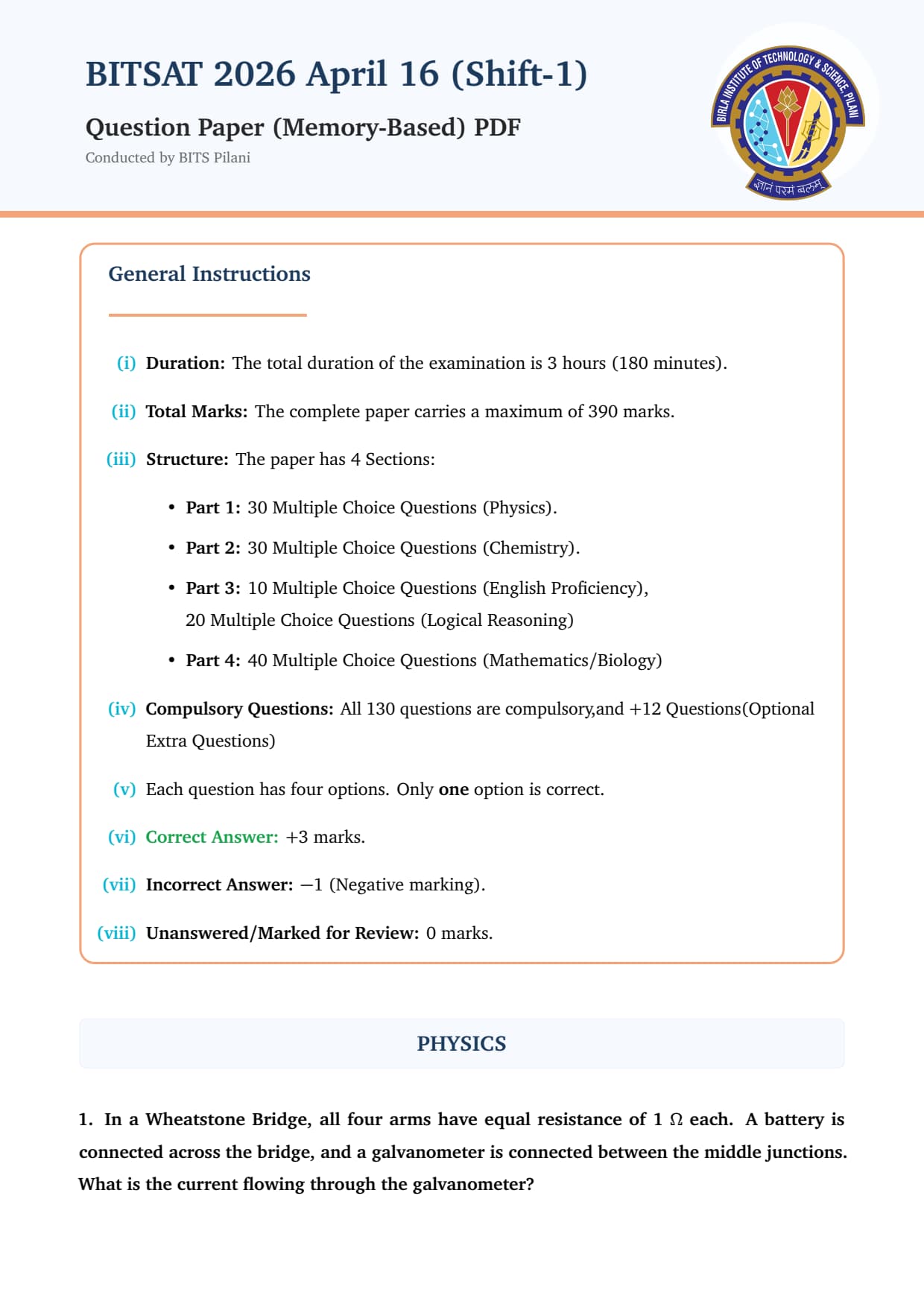
In a Wheatstone Bridge, all four arms have equal resistance of 1 \(\Omega\) each. A battery is connected across the bridge, and a galvanometer is connected between the middle junctions. What is the current flowing through the galvanometer?
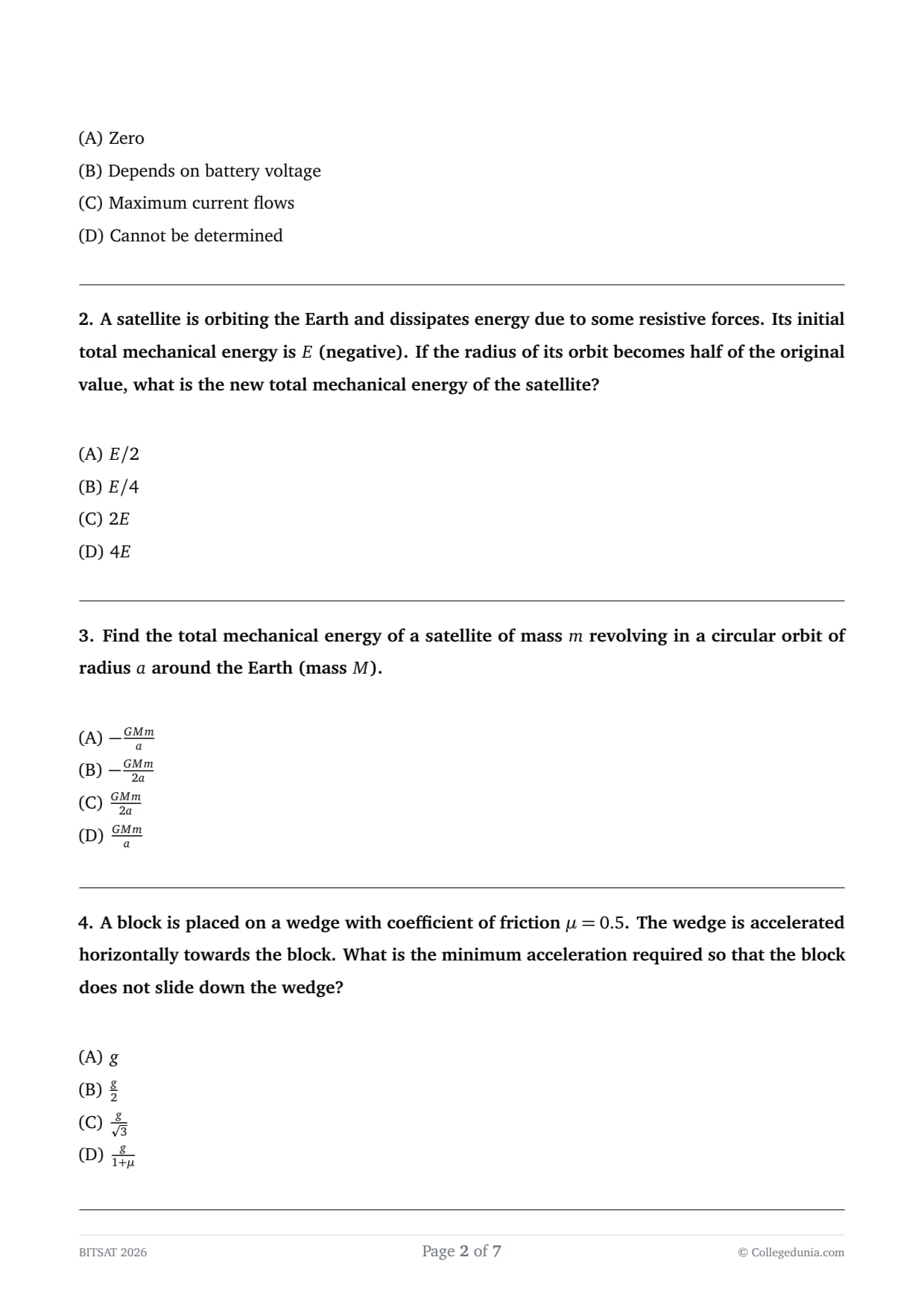
A satellite is orbiting the Earth and dissipates energy due to some resistive forces. Its initial total mechanical energy is \(E\) (negative). If the radius of its orbit becomes half of the original value, what is the new total mechanical energy of the satellite?
Find the total mechanical energy of a satellite of mass \(m\) revolving in a circular orbit of radius \(a\) around the Earth (mass \(M\)).
A block is placed on a wedge with coefficient of friction \(\mu = 0.5\). The wedge is accelerated horizontally towards the block. What is the minimum acceleration required so that the block does not slide down the wedge?
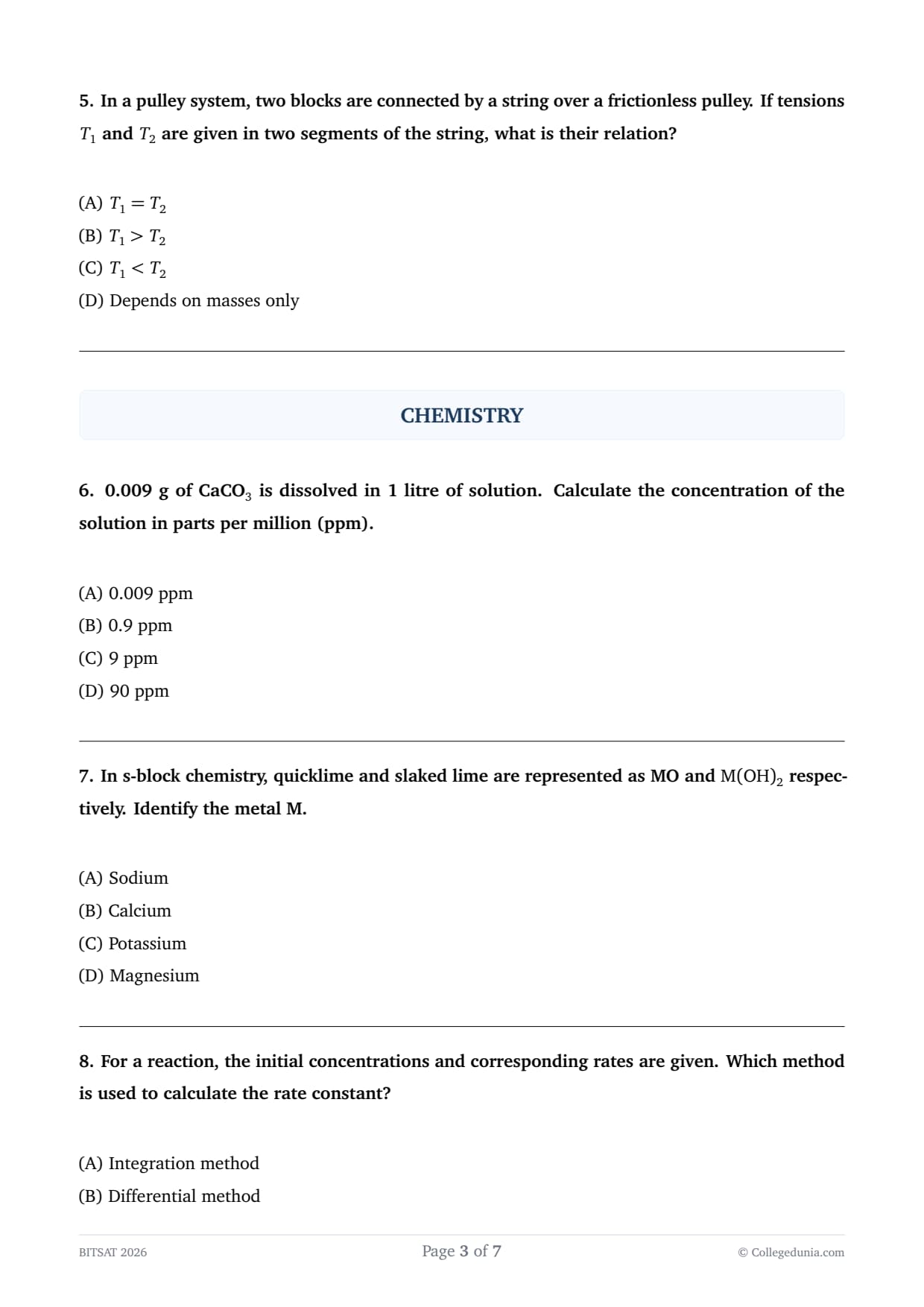
In a pulley system, two blocks are connected by a string over a frictionless pulley. If tensions \(T_1\) and \(T_2\) are given in two segments of the string, what is their relation?
0.009 g of CaCO\(_3\) is dissolved in 1 litre of solution. Calculate the concentration of the solution in parts per million (ppm).
In s-block chemistry, quicklime and slaked lime are represented as MO and \( \mathrm{M(OH)_2} \) respectively. Identify the metal M.
For a reaction, the initial concentrations and corresponding rates are given. Which method is used to calculate the rate constant?
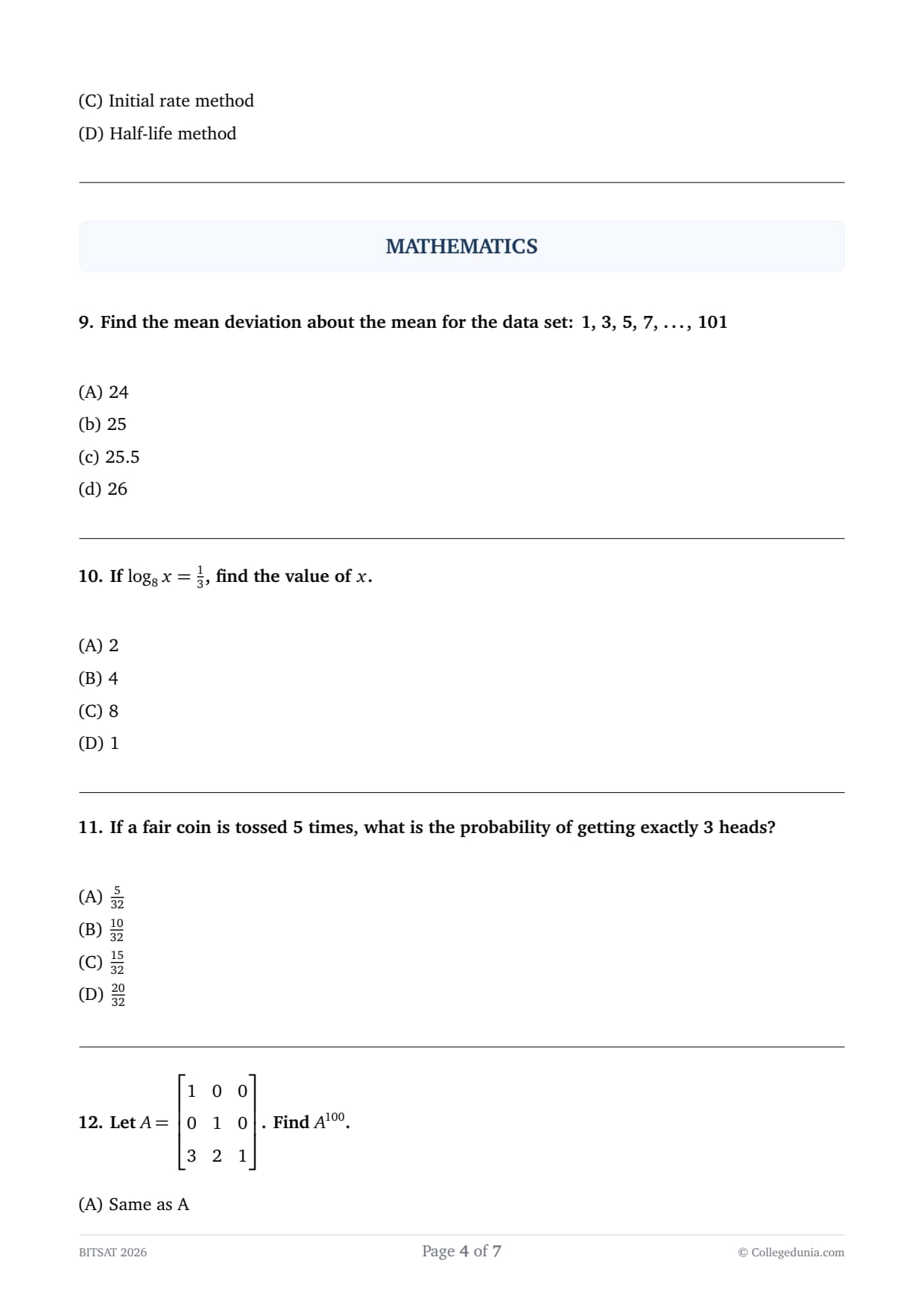
Find the mean deviation about the mean for the data set: 1, 3, 5, 7, \dots, 101
If \(\log_8 x = \frac{1}{3}\), find the value of \(x\).
If a fair coin is tossed 5 times, what is the probability of getting exactly 3 heads?
 . Find \( A^{100} \).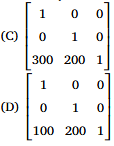
A person travels from Hyderabad to Goa and returns, but does not use the same bus for both journeys. If there are 25 buses available for each direction, how many ways can the round trip be made?
Let \( f : \mathbb{R} \to \mathbb{R} \) and \( g : \mathbb{R} \to \mathbb{R} \) such that \( g(x) \neq 0 \) for all \( x \in \mathbb{R} \), and \( f = f^{-1} \). Which of the following is correct?
Evaluate: \( \int e^{x} \sin x \cos x \, dx \)
Evaluate: \( \cot^{-1}(2) - \cot^{-1}(8) - \cot^{-1}(18) - \dots \)
Find the term independent of \( x \) in the expansion of \( (1 + x)^{n} (1 + 1/x)^{n} \).
In a Linear Programming Problem (LPP), the objective function Z is minimized subject to constraints. Where does the minimum value occur?
The angle between two lines in 3D space can be found using:
The equation of a plane passing through three non-collinear points is determined using:
Find the equation of the normal to a parabola which is perpendicular to a given line. This involves:
Statements:
• Some cashmere jackets are fashionable.
• Some cashmere jackets are not suede jackets.
• No suede jacket is fashionable.
Which of the following conclusions is correct?
BITSAT 2026 Chapter-Wise Weightage
The BITSAT syllabus includes NCERT Class 11 and 12 topics, but some chapters tend to hold more significance due to their conceptual knowledge.
Physics
| Chapter | Expected Weightage (%) |
|---|---|
| Laws of Motion | 8–10% |
| Current Electricity | 7–9% |
| Ray Optics & Wave Optics | 6–8% |
| Thermodynamics | 6–7% |
| Electrostatics | 5–7% |
Chemistry
| Chapter | Expected Weightage (%) |
|---|---|
| Chemical Bonding | 8–10% |
| Organic Chemistry (Basics + Reactions) | 10–12% |
| Coordination Compounds | 6–8% |
| Electrochemistry | 5–7% |
| p-Block Elements | 6–8% |
Mathematics
| Chapter | Expected Weightage (%) |
|---|---|
| Calculus (Limits, Integration, Differentiation) | 12–15% |
| Vectors & 3D Geometry | 8–10% |
| Complex Numbers & Quadratic Equations | 6–8% |
| Probability | 6–8% |
| Coordinate Geometry | 7–9% |



Comments