




The Graduate Pharmacy Aptitude Test (GPAT) 2026 was conducted today, March 7, 2026, across various examination centres. In this live update, we provide the complete GPAT 2026 Question Paper, a comprehensive difficulty analysis, and the expert-verified answer key with solutions PDF.
Initial feedback from pharmacy aspirants suggests the paper was Moderate to Challenging, featuring a significant emphasis on Pharmacology and Pharmaceutics, with a mix of direct factual recalls and analytical multi-statement questions.
GPAT 2026 Question Paper with Solutions PDF
| GPAT 2026 Question Paper with Solutions PDF | Download PDF | Check Solution |

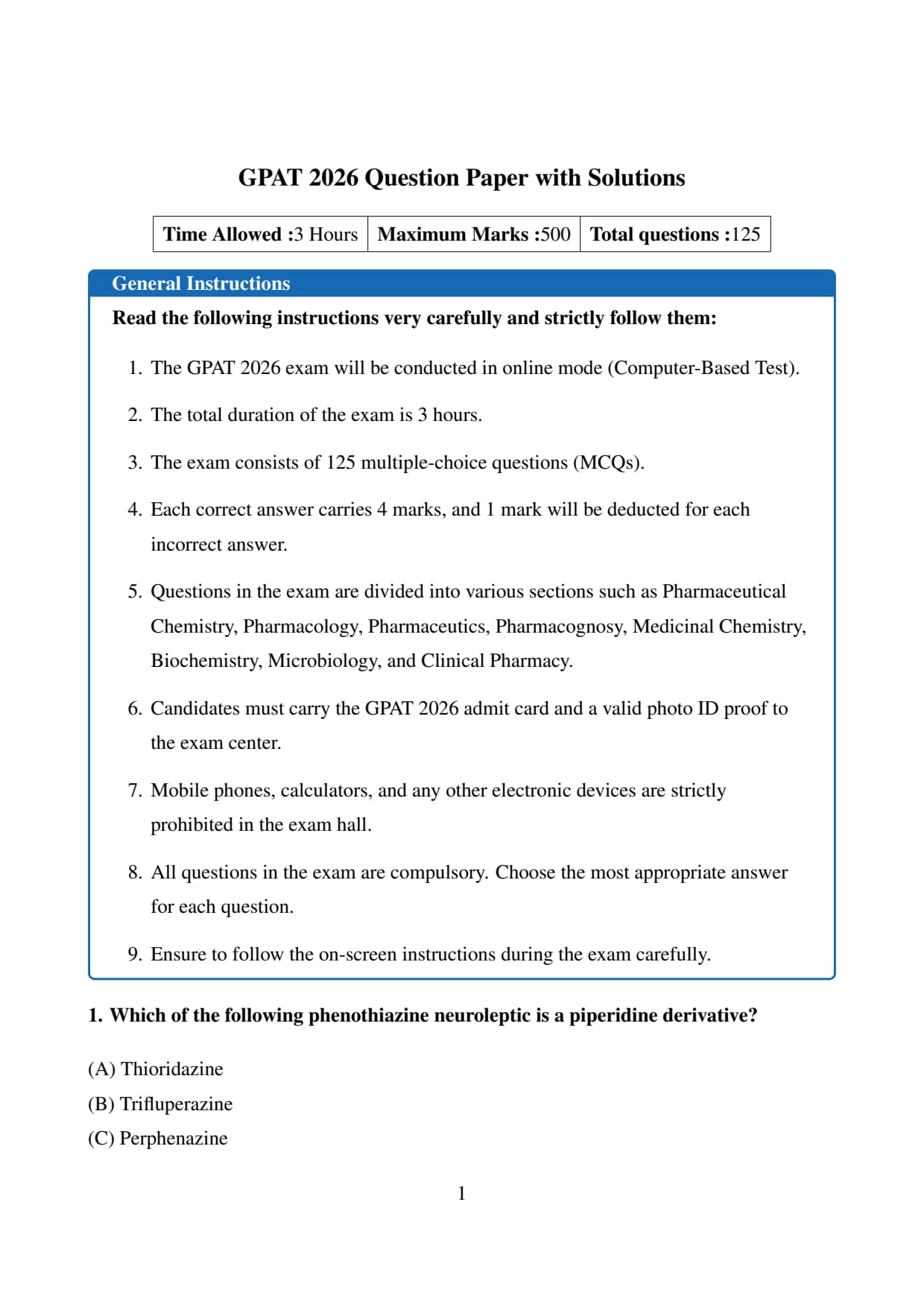
Which of the following phenothiazine neuroleptic is a piperidine derivative?
View Solution
Step 1: Understanding the types of neuroleptics.
Neuroleptics, also known as antipsychotic drugs, are classified based on their chemical structure. The phenothiazines are a class of antipsychotics that contain a phenothiazine nucleus. They are further divided into three categories: aliphatic, piperazine, and piperidine derivatives.
Step 2: Identifying the piperidine derivative.
- (A) Thioridazine: Thioridazine is a phenothiazine neuroleptic that is a piperidine derivative.
- (B) Trifluperazine: Trifluperazine is a piperazine derivative, not a piperidine derivative.
- (C) Perphenazine: Perphenazine is a piperazine derivative, not a piperidine derivative.
- (D) Promazine: Promazine is an aliphatic derivative, not a piperidine derivative.
Step 3: Conclusion.
Thus, the correct answer is (A) Thioridazine, as it is the only piperidine derivative among the options.
Final Answer: (A) Thioridazine.
Quick Tip: When studying neuroleptics, remember that piperidine derivatives are a sub-class of phenothiazines and are used in treating psychotic disorders.
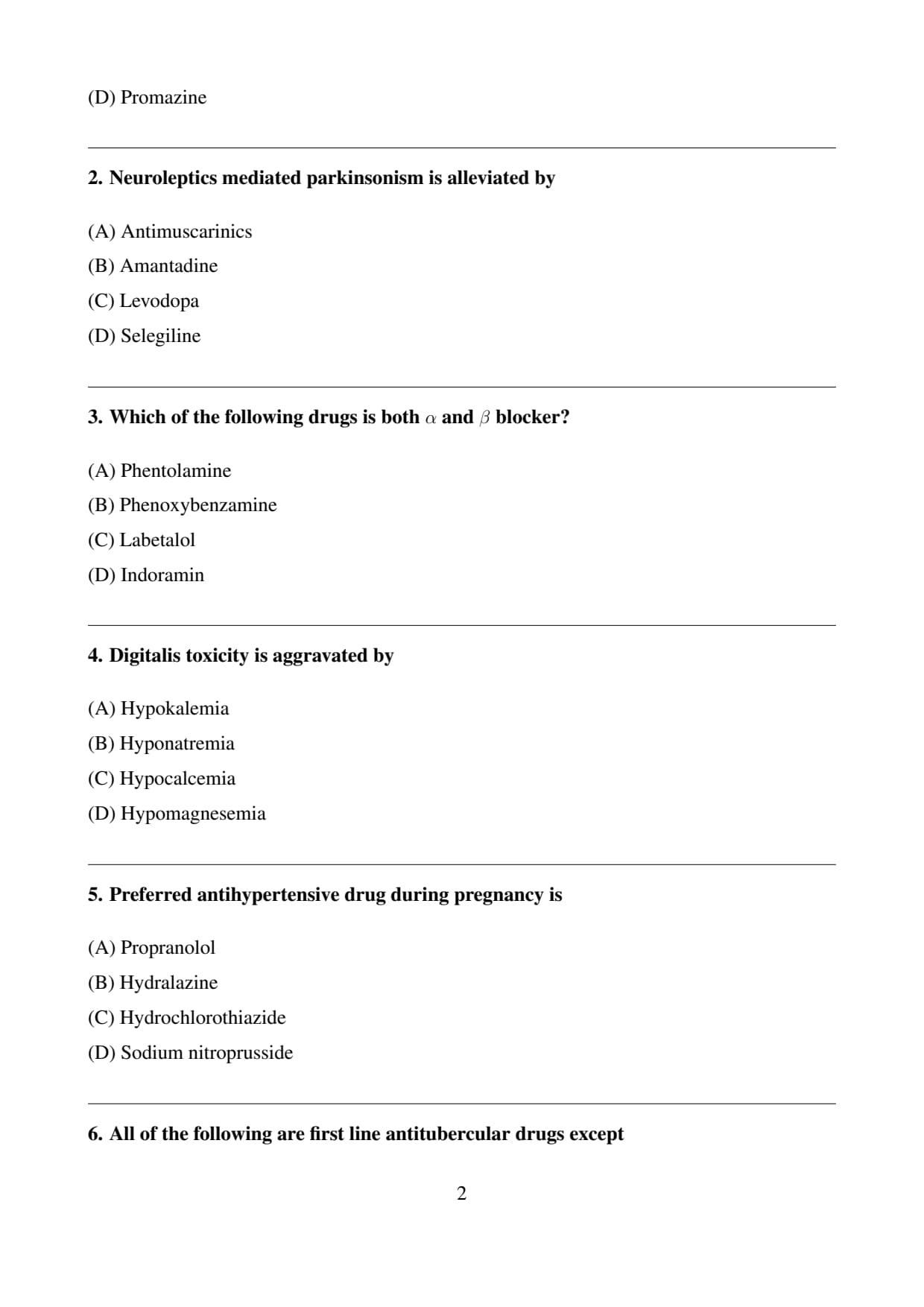
Neuroleptics mediated parkinsonism is alleviated by
View Solution
Step 1: Understanding neuroleptic-induced parkinsonism.
Neuroleptic-induced parkinsonism is a side effect of certain antipsychotic drugs, which block dopamine receptors in the brain. This leads to symptoms resembling Parkinson's disease, such as tremors, rigidity, and bradykinesia.
Step 2: Exploring treatment options.
The treatment for neuroleptic-induced parkinsonism primarily focuses on restoring dopamine function or blocking the effects of dopamine antagonism.
(A) Antimuscarinics: Correct. Antimuscarinic drugs, such as trihexyphenidyl, can help alleviate symptoms by blocking acetylcholine, which balances the dopamine-acetylcholine system in the brain.
(B) Amantadine: Incorrect. Amantadine is used in treating Parkinson's disease but is less effective for neuroleptic-induced parkinsonism. It works by increasing dopamine release and blocking NMDA receptors.
(C) Levodopa: Incorrect. Levodopa is used in Parkinson's disease to replenish dopamine, but it is not typically used for neuroleptic-induced parkinsonism.
(D) Selegiline: Incorrect. Selegiline is a monoamine oxidase B inhibitor used to treat Parkinson's disease, but it is not typically used for neuroleptic-induced parkinsonism.
Step 3: Conclusion.
The most effective treatment for neuroleptic-induced parkinsonism is the use of antimuscarinics, which help restore the balance between dopamine and acetylcholine in the brain.
Final Answer: Antimuscarinics. Quick Tip: In neuroleptic-induced parkinsonism, antimuscarinics are used to balance dopamine and acetylcholine, whereas other drugs like levodopa are more suited for idiopathic Parkinson's disease.
Which of the following drugs is both \(\alpha\) and \(\beta\) blocker?
View Solution
Step 1: Understanding \(\alpha\) and \(\beta\) blockers.
\(\alpha\) and \(\beta\) blockers are medications that inhibit the action of adrenergic receptors, \(\alpha\) and \(\beta\) receptors, respectively, which play a crucial role in regulating heart rate and blood pressure.
Step 2: Analyzing the options.
(A) Phentolamine: Incorrect. Phentolamine is a non-selective \(\alpha\)-adrenergic blocker, but it does not block \(\beta\) receptors.
(B) Phenoxybenzamine: Incorrect. Phenoxybenzamine is also a non-selective \(\alpha\)-adrenergic blocker and does not block \(\beta\) receptors.
(C) Labetalol: Correct. Labetalol is both an \(\alpha\)- and \(\beta\)-adrenergic blocker, used to manage high blood pressure.
(D) Indoramin: Incorrect. Indoramin is primarily an \(\alpha\)-adrenergic blocker and does not block \(\beta\) receptors.
Step 3: Conclusion.
Labetalol is the only drug in this list that works as both an \(\alpha\) and \(\beta\) blocker, making it the correct answer.
Final Answer: Labetalol. Quick Tip: Labetalol is often used to treat hypertension and works by blocking both \(\alpha\) and \(\beta\) receptors, which helps to lower blood pressure.
Digitalis toxicity is aggravated by
View Solution
Step 1: Understanding Digitalis toxicity.
Digitalis toxicity occurs when there is too much digitalis (a drug used to treat heart conditions) in the body. It can cause arrhythmias and other serious heart problems.
Step 2: Analyzing the options.
(A) Hypokalemia: Correct. Low potassium levels (hypokalemia) can increase the effects of digitalis and increase the risk of toxicity. Potassium competes with digitalis for binding to the Na+/K+ ATPase pump, so low potassium increases the likelihood of toxicity.
(B) Hyponatremia: Incorrect. While sodium levels are important for heart function, hyponatremia does not significantly aggravate digitalis toxicity.
(C) Hypocalcemia: Incorrect. While calcium levels affect cardiac function, hypocalcemia does not directly increase the risk of digitalis toxicity.
(D) Hypomagnesemia: Incorrect. Low magnesium levels can affect the heart, but hypomagnesemia does not significantly worsen digitalis toxicity compared to hypokalemia.
Step 3: Conclusion.
Hypokalemia is the most important electrolyte imbalance that worsens digitalis toxicity, making it the correct answer.
Final Answer: Hypokalemia. Quick Tip: When treating digitalis toxicity, correcting hypokalemia is a priority, as it can exacerbate the toxicity and increase the risk of life-threatening arrhythmias.
Preferred antihypertensive drug during pregnancy is
View Solution
Step 1: Understanding antihypertensive drugs in pregnancy.
Hypertension during pregnancy can cause complications such as preeclampsia and premature delivery. The choice of antihypertensive drugs in pregnancy is crucial for the health of both mother and fetus.
Step 2: Analyzing the options.
(A) Propranolol: Incorrect. Propranolol is a non-selective \(\beta\)-blocker, but it is not the first choice for managing hypertension during pregnancy due to potential fetal risks.
(B) Hydralazine: Correct. Hydralazine is a vasodilator commonly used for the management of hypertension during pregnancy, especially in cases of preeclampsia.
(C) Hydrochlorothiazide: Incorrect. Hydrochlorothiazide is a diuretic, but it is generally avoided during pregnancy due to the risk of electrolyte imbalance and fetal dehydration.
(D) Sodium nitroprusside: Incorrect. Sodium nitroprusside is a potent vasodilator, but it is not recommended during pregnancy due to the potential for cyanide toxicity.
Step 3: Conclusion.
Hydralazine is the preferred antihypertensive drug during pregnancy due to its safety profile and effectiveness in controlling blood pressure.
Final Answer: Hydralazine. Quick Tip: Hydralazine is the drug of choice for managing hypertension during pregnancy, especially in cases of preeclampsia, due to its safety and efficacy.
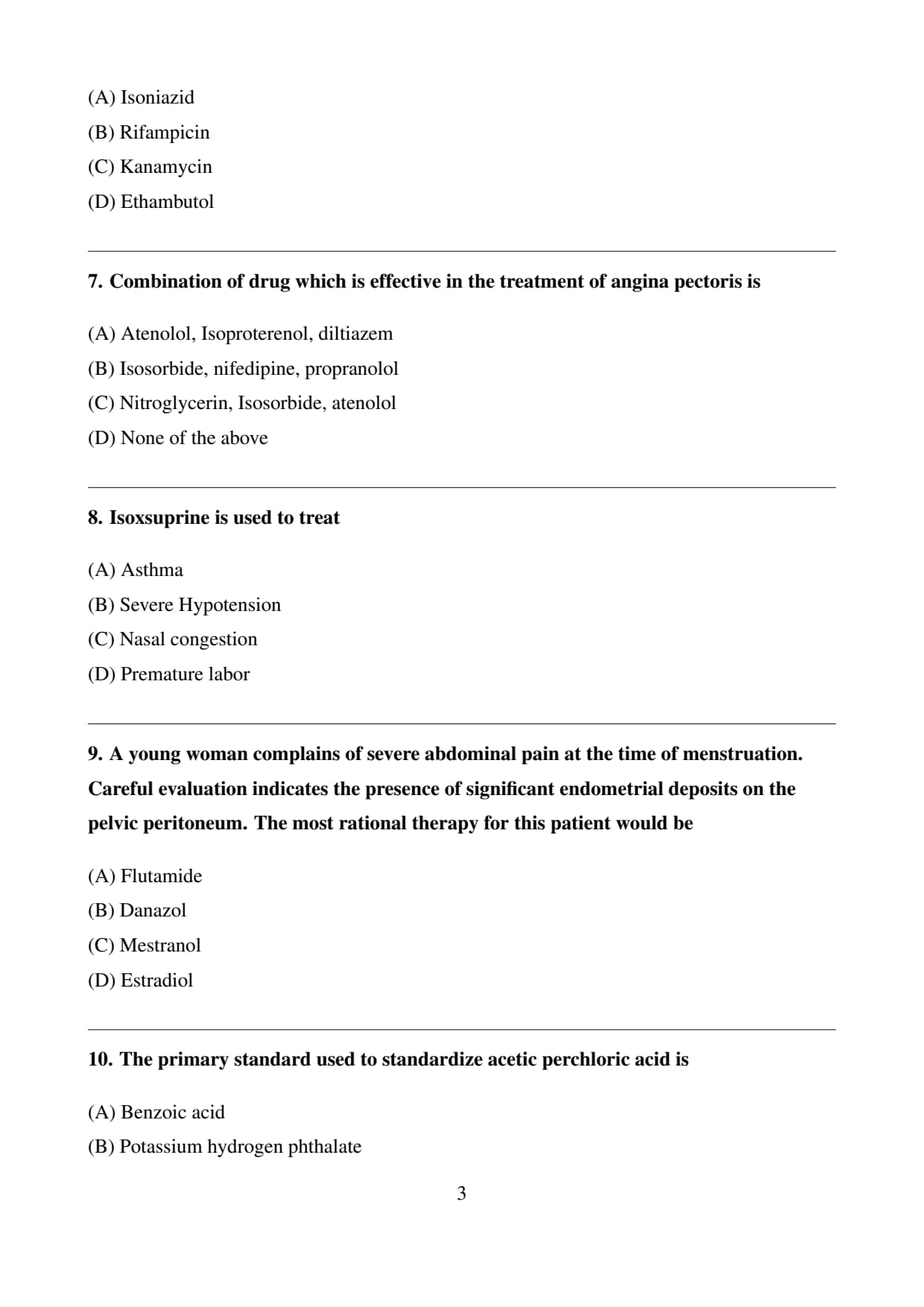
All of the following are first line antitubercular drugs except
View Solution
Step 1: Understanding first-line antitubercular drugs.
First-line antitubercular drugs are the core medications used to treat active tuberculosis. These include a combination of drugs that work synergistically to kill the Mycobacterium tuberculosis bacteria.
Step 2: Analyzing the options.
(A) Isoniazid: Correct. Isoniazid is one of the first-line drugs for tuberculosis, used to inhibit the synthesis of mycolic acids in the bacterial cell wall.
(B) Rifampicin: Correct. Rifampicin is another first-line drug that inhibits bacterial RNA synthesis, and it is essential in the treatment regimen for tuberculosis.
(C) Kanamycin: Incorrect. Kanamycin is an aminoglycoside used as a second-line drug for multidrug-resistant tuberculosis, not a first-line treatment.
(D) Ethambutol: Correct. Ethambutol is used as a first-line drug to inhibit the synthesis of the bacterial cell wall.
Step 3: Conclusion.
Kanamycin is not a first-line antitubercular drug, as it is used for resistant strains of tuberculosis and is part of second-line treatment.
Final Answer: Kanamycin. Quick Tip: The first-line antitubercular drugs include Isoniazid, Rifampicin, Ethambutol, and Pyrazinamide. Kanamycin is a second-line drug used for multidrug-resistant tuberculosis.
Combination of drug which is effective in the treatment of angina pectoris is
View Solution
Step 1: Understanding angina pectoris treatment.
Angina pectoris is chest pain caused by reduced blood flow to the heart muscles. The treatment involves drugs that relieve pain and improve blood flow, such as nitrates, beta-blockers, and calcium channel blockers.
Step 2: Analyzing the options.
(A) Atenolol, Isoproterenol, diltiazem: Incorrect. This combination is not typically used for treating angina pectoris. Isoproterenol is a beta-agonist, which can exacerbate angina.
(B) Isosorbide, nifedipine, propranolol: Incorrect. Although isosorbide and propranolol are used in angina treatment, nifedipine is not the preferred choice in combination for this condition.
(C) Nitroglycerin, Isosorbide, atenolol: Correct. This combination is effective as nitroglycerin and isosorbide are nitrates that dilate blood vessels, while atenolol is a beta-blocker that reduces the heart's oxygen demand.
(D) None of the above: Incorrect. Option (C) provides the correct combination for angina pectoris.
Step 3: Conclusion.
The combination of nitroglycerin, isosorbide, and atenolol is the most effective in the treatment of angina pectoris.
Final Answer: Nitroglycerin, Isosorbide, atenolol. Quick Tip: In the treatment of angina pectoris, nitrates like nitroglycerin and isosorbide are used to relieve pain, while beta-blockers like atenolol help reduce the heart's oxygen demand.
Isoxsuprine is used to treat
View Solution
Step 1: Understanding isoxsuprine's uses.
Isoxsuprine is a medication used primarily as a vasodilator. It is used in obstetrics to relax the uterine muscles and prevent premature labor.
Step 2: Analyzing the options.
(A) Asthma: Incorrect. Isoxsuprine is not used in the treatment of asthma. Bronchodilators like albuterol are typically used for asthma.
(B) Severe Hypotension: Incorrect. Isoxsuprine is not used to treat severe hypotension. It is a vasodilator, but not in the context of treating hypotension.
(C) Nasal congestion: Incorrect. Isoxsuprine is not used to treat nasal congestion. Nasal decongestants like pseudoephedrine are used for that purpose.
(D) Premature labor: Correct. Isoxsuprine is used to treat premature labor by relaxing the uterine muscles and reducing the frequency of contractions.
Step 3: Conclusion.
Isoxsuprine is primarily used to treat premature labor by acting as a uterine relaxant.
Final Answer: Premature labor. Quick Tip: Isoxsuprine is used in obstetrics to prevent premature labor by relaxing the uterine muscles, making it an effective treatment for this condition.
A young woman complains of severe abdominal pain at the time of menstruation. Careful evaluation indicates the presence of significant endometrial deposits on the pelvic peritoneum. The most rational therapy for this patient would be
View Solution
Step 1: Understanding endometriosis.
Endometriosis is a condition where tissue similar to the lining of the uterus grows outside of it, causing severe abdominal pain, especially during menstruation. It is typically treated with hormonal therapies that suppress the growth of endometrial tissue.
Step 2: Analyzing the options.
(A) Flutamide: Incorrect. Flutamide is an anti-androgen used primarily for prostate cancer treatment and is not effective for endometriosis.
(B) Danazol: Correct. Danazol is a synthetic androgen that suppresses ovarian function, reducing estrogen production, which helps shrink endometrial tissue.
(C) Mestranol: Incorrect. Mestranol is an estrogenic compound, which could worsen endometriosis by stimulating the growth of endometrial tissue.
(D) Estradiol: Incorrect. Estradiol is a form of estrogen and would exacerbate endometriosis by promoting the growth of endometrial deposits.
Step 3: Conclusion.
Danazol is the most rational therapy for this patient as it works by suppressing the hormonal environment that fosters endometrial growth.
Final Answer: Danazol. Quick Tip: Danazol is often used for endometriosis because it reduces estrogen levels, which helps manage the growth of endometrial tissue and alleviates symptoms like abdominal pain.
The primary standard used to standardize acetic perchloric acid is
View Solution
Step 1: Understanding acid-base titration standards.
In acid-base titrations, it is important to use a primary standard to determine the exact concentration of the titrant. Potassium hydrogen phthalate is commonly used for this purpose in the standardization of acetic perchloric acid.
Step 2: Analyzing the options.
(A) Benzoic acid: Incorrect. Benzoic acid is not commonly used for standardizing acetic perchloric acid.
(B) Potassium hydrogen phthalate: Correct. Potassium hydrogen phthalate is a well-known primary standard used to standardize solutions of strong acids like acetic perchloric acid.
(C) Oxalic acid: Incorrect. Oxalic acid is used in certain titrations but is not commonly used for standardizing acetic perchloric acid.
(D) Sodium carbonate: Incorrect. Sodium carbonate is used as a primary standard for some bases but not typically for standardizing acetic perchloric acid.
Step 3: Conclusion.
Potassium hydrogen phthalate is the primary standard used for the accurate standardization of acetic perchloric acid.
Final Answer: Potassium hydrogen phthalate. Quick Tip: Potassium hydrogen phthalate (KHP) is widely used as a primary standard for acid-base titrations due to its stability and known purity.
Which of the following is used to damask zinc from the zinc-cyanide complex?
View Solution
Step 1: Understanding damasking in zinc cyanide complex.
Damasking is a process used to remove or release zinc from a zinc-cyanide complex. This process typically involves a chemical reagent that can break the bond between zinc and cyanide.
Step 2: Analyzing the options.
(A) Tiron: Correct. Tiron is an effective reagent that can remove zinc from its complex with cyanide, making it the correct choice for this process.
(B) Potassium iodide: Incorrect. Potassium iodide is not used for damasking zinc from the zinc-cyanide complex.
(C) Chloral hydrate: Incorrect. Chloral hydrate is not typically involved in the process of damasking zinc.
(D) Triethanolamine: Incorrect. Triethanolamine is not a reagent used for damasking zinc from the zinc-cyanide complex.
Step 3: Conclusion.
Tiron is the most effective reagent for damasking zinc from the zinc-cyanide complex.
Final Answer: Tiron. Quick Tip: Tiron is commonly used in chemical processes to release zinc from its complexes, making it an essential reagent in damasking procedures.
The IR detector which consists of a small metal cylinder closed by a blackened metal plate on one end and a flexible metalized diaphragm on the other is
View Solution
Step 1: Understanding IR detectors.
Infrared (IR) detectors are devices used to measure infrared radiation. They typically use a change in physical properties like resistance or thermal expansion to detect IR radiation.
Step 2: Analyzing the options.
(A) Bolometer: Incorrect. A bolometer is an IR detector that measures the temperature change caused by absorbed infrared radiation, but it does not have the specific design described in the question.
(B) Thermistor: Incorrect. A thermistor is a type of resistor that changes its resistance with temperature, but it does not fit the description of the IR detector with the diaphragm and blackened metal plate.
(C) Golay cell: Correct. The Golay cell consists of a small metal cylinder closed at one end with a blackened metal plate and a flexible diaphragm, making it the correct IR detector described in the question.
(D) Pyroelectric detectors: Incorrect. Pyroelectric detectors measure the change in polarization of a material when exposed to infrared radiation, but they do not have the structure described in the question.
Step 3: Conclusion.
The Golay cell is the correct IR detector, as it matches the description given in the question.
Final Answer: Golay cell. Quick Tip: Golay cells are used to measure infrared radiation by detecting the expansion and contraction of a diaphragm caused by changes in temperature due to absorbed IR radiation.
The Henderson's equation states that
View Solution
Step 1: Understanding the Henderson-Hasselbalch equation.
The Henderson-Hasselbalch equation is used to calculate the pH of a buffer solution. It relates the pH of the solution to the pKa of the acid and the ratio of the concentrations of the salt (conjugate base) and acid.
Step 2: Analyzing the options.
(A) pH = pKa + log \left[\frac{[salt]}{[acid]}\right]: Correct. This is the correct form of the Henderson-Hasselbalch equation, where the pH is related to the ratio of salt and acid concentrations.
(B) pH = pKa - log \left[\frac{[salt]}{[acid]}\right]: Incorrect. This equation has the wrong sign in front of the logarithmic term.
(C) pH = pKa - log \left[\frac{[acid]}{[salt]}\right]: Incorrect. This equation has the wrong ratio for the salt and acid.
(D) pH = pKa + log \left[\frac{[acid]}{[salt]}\right]: Incorrect. This equation has the wrong ratio for the acid and salt.
Step 3: Conclusion.
The correct form of the Henderson-Hasselbalch equation is option (A), where pH is related to the ratio of salt to acid.
Final Answer: pH = pKa + log \left[\frac{[salt]{[acid]\right]. Quick Tip: The Henderson-Hasselbalch equation is a useful tool for calculating the pH of buffer solutions based on the pKa of the acid and the ratio of concentrations of the conjugate base (salt) and the acid.
The standard redox potential of MnO4– / Mn+2 systems is
View Solution
Step 1: Understanding redox potentials.
Redox potentials measure the tendency of a chemical species to gain electrons and be reduced. The standard redox potential is a constant for a given reaction under standard conditions.
Step 2: Analyzing the options.
(A) +1.52 V: Incorrect. This is a high redox potential, but it does not correspond to the MnO4– / Mn+2 system.
(B) -0.51 V: Incorrect. A negative value indicates a tendency to lose electrons, which is not typical for the MnO4– / Mn+2 system.
(C) +0.77 V: Correct. The standard redox potential for the MnO4– / Mn+2 system is +0.77 V, indicating a moderate tendency for reduction.
(D) -0.06 V: Incorrect. This value is too low and does not correspond to the MnO4– / Mn+2 system.
Step 3: Conclusion.
The standard redox potential of the MnO4– / Mn+2 system is +0.77 V, making option (C) the correct answer.
Final Answer: +0.77 V. Quick Tip: The standard redox potential of a reaction indicates the strength of the species as an oxidizing or reducing agent. Higher values suggest a stronger oxidizing agent.
Which of the following is not true for Eddy diffusion in chromatography?
View Solution
Step 1: Understanding Eddy diffusion.
Eddy diffusion refers to the spreading of solute particles in chromatography due to the differences in the flow paths taken by the particles in the mobile phase. This process leads to the broadening of the eluted band.
Step 2: Analyzing the options.
(A) it is related to particle size, geometry and tightness of packing of the stationary phase: Correct. Eddy diffusion is strongly influenced by the physical properties of the stationary phase, such as particle size and packing geometry.
(B) it results in the broadening of the eluted band: Correct. Eddy diffusion causes spreading of the solute molecules, which results in the broadening of the eluted band.
(C) it is independent of flow rate: Incorrect. Eddy diffusion is dependent on the flow rate. Higher flow rates can cause more significant spreading and band broadening.
(D) it results from the tendency of the molecules to migrate from the concentrated center part of the band towards more dilute regions on either side: Correct. This is the basic mechanism of diffusion that contributes to band broadening.
Step 3: Conclusion.
Eddy diffusion is not independent of flow rate. Therefore, option (C) is the correct answer, as it is not true.
Final Answer: it is independent of flow rate. Quick Tip: Eddy diffusion is influenced by flow rate, particle size, and the packing of the stationary phase. Higher flow rates lead to more band broadening due to increased turbulence in the mobile phase.


GPAT 2026 Question Paper & Exam Pattern Overview
| Feature | Details |
| Exam Name | Graduate Pharmacy Aptitude Test (GPAT) 2026 |
| Conducting Body | National Testing Agency (NTA) / NBEMS |
| Exam Date | Expected May/June 2026 |
| Paper Type | Previous Year Question Paper with Solutions |
| Format | PDF Download |
| Total Questions | 125 Multiple Choice Questions (MCQs) |
| Marking Scheme | +4 for Correct; -1 for Incorrect |
| Total Marks | 500 Marks |
| Subject Categories | Pharmaceutics, Pharmacology, Chemistry, Pharmacognosy, etc. |



Comments