The BCECE B.Sc. Nursing 2024 Question paper with Solution PDF is available here for download. The BCECE B.Sc. Nursing exam is an offline (pen and paper) test with three sections: Physics, Chemistry, and Biology, each containing 100 multiple-choice questions. The total marks are 1200, with a duration of 4.5 hours, as per the BCECE marking scheme, 4 marks will be awarded for each correct answer and, and 1 mark will be deducted for each incorrect answer.
Related Links:
BCECE B.Sc Nursing 2024 Question Paper with Solution PDF
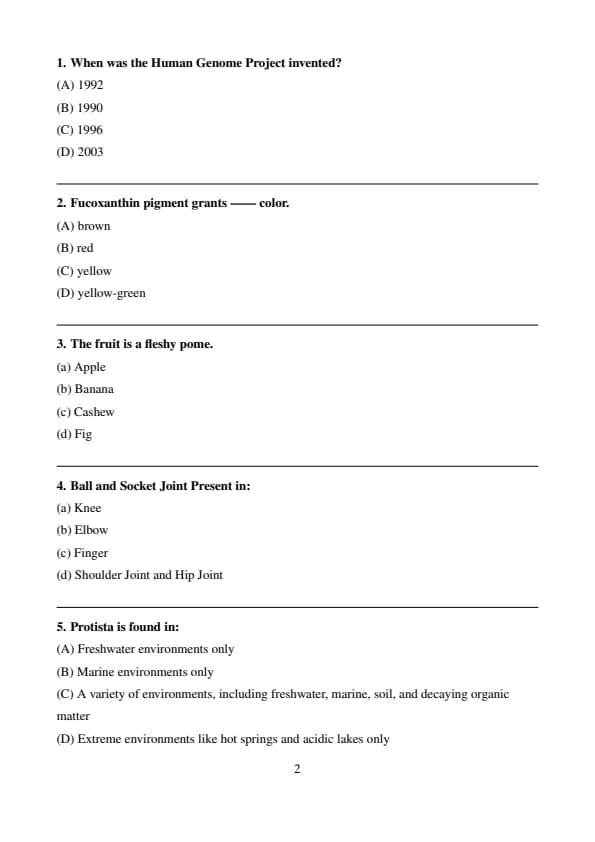
Question 1:
When was the Human Genome Project invented?
- (A) 1992
- (B) 1990
- (C) 1996
- (D) 2003
Question 2:
Fucoxanthin pigment grants ------ color.
- (A) brown
- (B) red
- (C) yellow
- (D) yellow-green
Question 3:
The fruit is a fleshy pome.
- (a) Apple
- (b) Banana
- (c) Cashew
- (d) Fig
Question 4:
Ball and Socket Joint Present in:
- (a) Knee
- (b) Elbow
- (c) Finger
- (d) Shoulder Joint and Hip Joint
Question 5:
Protista is found in:
- (A) Freshwater environments only
- (B) Marine environments only
- (C) A variety of environments, including freshwater, marine, soil, and decaying organic matter
- (D) Extreme environments like hot springs and acidic lakes only
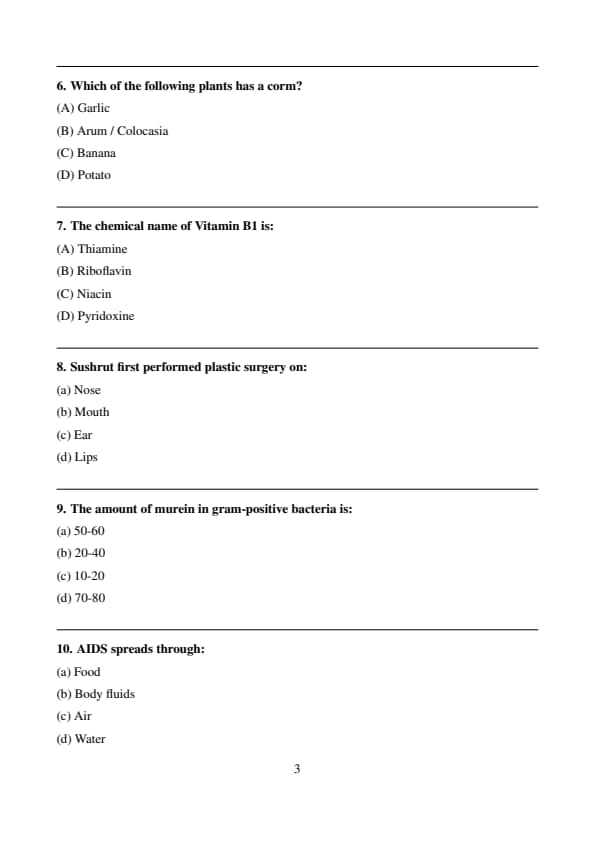
Question 6:
Which of the following plants has a corm?
- (A) Garlic
- (B) Arum / Colocasia
- (C) Banana
- (D) Potato
Question 7:
The chemical name of Vitamin B1 is:
- (A) Thiamine
- (B) Riboflavin
- (C) Niacin
- (D) Pyridoxine
Question 8:
Sushrut first performed plastic surgery on:
- (a) Nose
- (b) Mouth
- (c) Ear
- (d) Lips
Question 9:
The amount of murein in gram-positive bacteria is:
- (a) 50-60
- (b) 20-40
- (c) 10-20
- (d) 70-80
Question 10:
AIDS spreads through:
- (a) Food
- (b) Body fluids
- (c) Air
- (d) Water
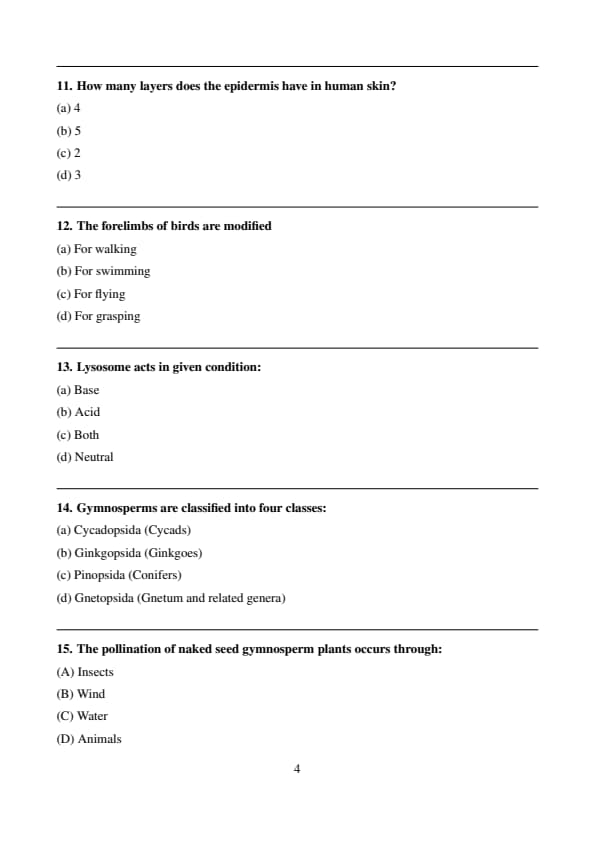
Question 11:
How many layers does the epidermis have in human skin?
Question 12:
The forelimbs of birds are modified
- (a) For walking
- (b) For swimming
- (c) For flying
- (d) For grasping
Question 13:
Lysosome acts in given condition:
- (a) Base
- (b) Acid
- (c) Both
- (d) Neutral
Question 14:
Gymnosperms are classified into four classes:
- (a) Cycadopsida (Cycads)
- (b) Ginkgopsida (Ginkgoes)
- (c) Pinopsida (Conifers)
- (d) Gnetopsida (Gnetum and related genera)
Question 15:
The pollination of naked seed gymnosperm plants occurs through:
- (A) Insects
- (B) Wind
- (C) Water
- (D) Animals
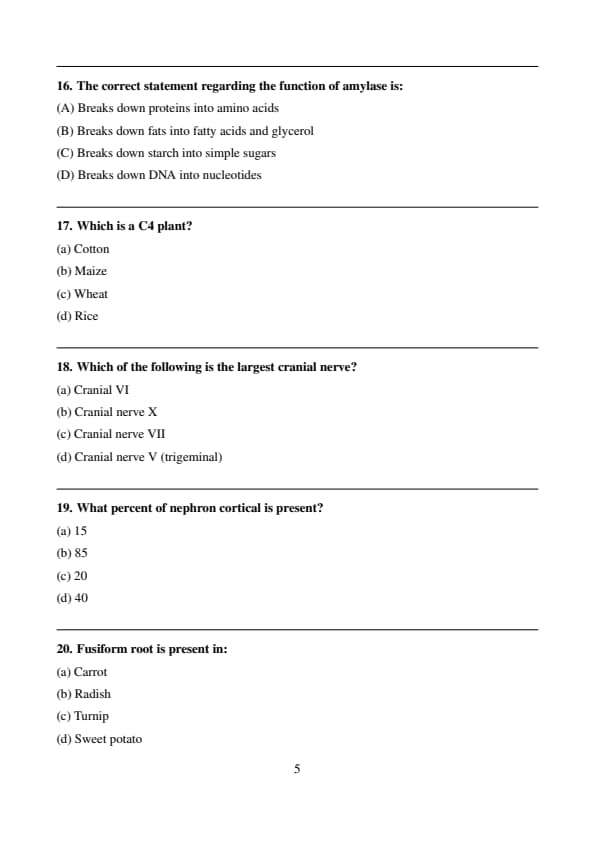
Question 16:
The correct statement regarding the function of amylase is:
- (A) Breaks down proteins into amino acids
- (B) Breaks down fats into fatty acids and glycerol
- (C) Breaks down starch into simple sugars
- (D) Breaks down DNA into nucleotides
Question 17:
Which is a C4 plant?
- (a) Cotton
- (b) Maize
- (c) Wheat
- (d) Rice
Question 18:
Which of the following is the largest cranial nerve?
- (a) Cranial VI
- (b) Cranial nerve X
- (c) Cranial nerve VII
- (d) Cranial nerve V (trigeminal)
Question 19:
What percent of nephron cortical is present?
- (a) 15
- (b) 85
- (c) 20
- (d) 40
Question 20:
Fusiform root is present in:
- (a) Carrot
- (b) Radish
- (c) Turnip
- (d) Sweet potato
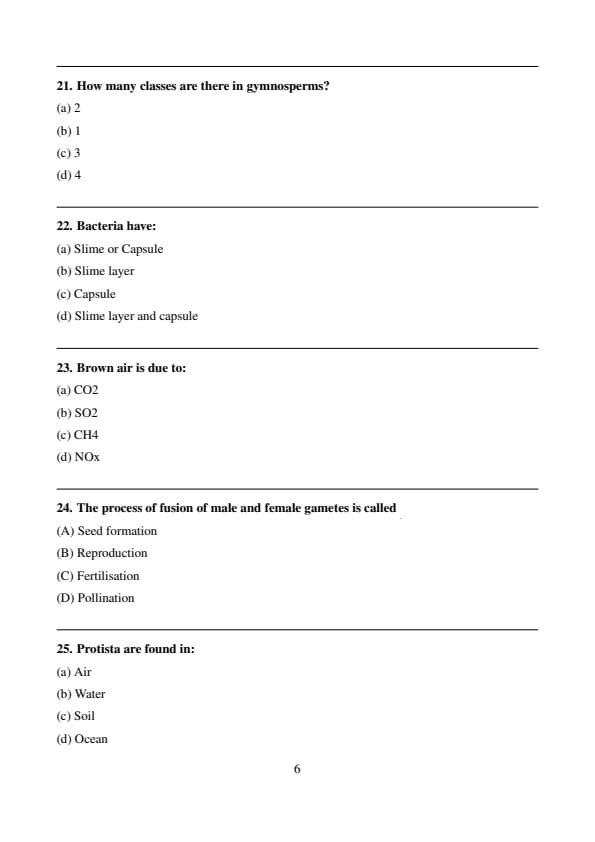
Question 21:
How many classes are there in gymnosperms?
Question 22:
Bacteria have:
- (a) Slime or Capsule
- (b) Slime layer
- (c) Capsule
- (d) Slime layer and capsule
Question 23:
Brown air is due to:
- (a) CO2
- (b) SO2
- (c) CH4
- (d) NOx
Question 24:
The process of fusion of male and female gametes is called ______.
- (A) Seed formation
- (B) Reproduction
- (C) Fertilisation
- (D) Pollination
Question 25:
Protista are found in:
- (a) Air
- (b) Water
- (c) Soil
- (d) Ocean
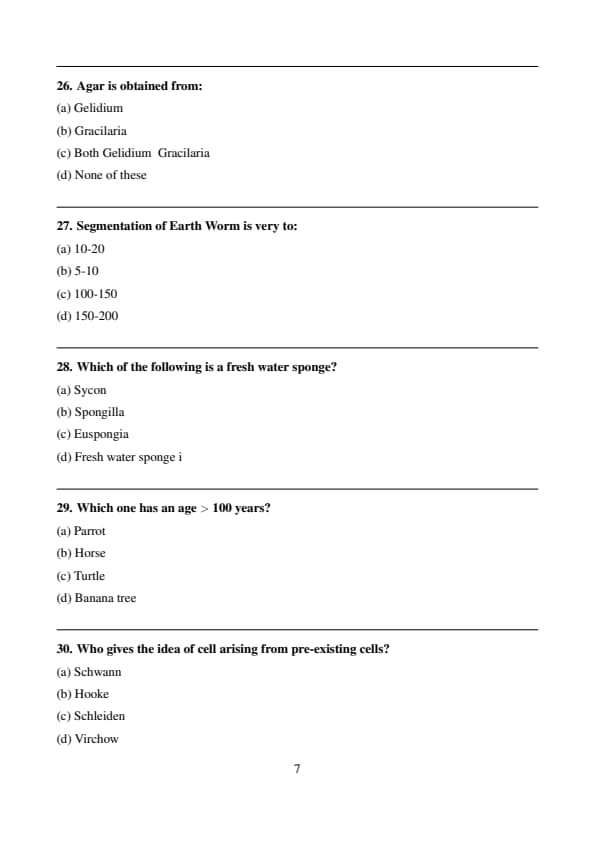
Question 26:
Agar is obtained from:
- (a) Gelidium
- (b) Gracilaria
- (c) Both Gelidium & Gracilaria
- (d) None of these
Question 27:
Segmentation of Earth Worm is very to:
- (a) 10-20
- (b) 5-10
- (c) 100-150
- (d) 150-200
Question 28:
Which of the following is a fresh water sponge?
- (a) Sycon
- (b) Spongilla
- (c) Euspongia
- (d) Fresh water sponge i
Question 29:
Which one has an age \(>\) 100 years?
- (a) Parrot
- (b) Horse
- (c) Turtle
- (d) Banana tree
Question 30:
Who gives the idea of cell arising from pre-existing cells?
- (a) Schwann
- (b) Hooke
- (c) Schleiden
- (d) Virchow
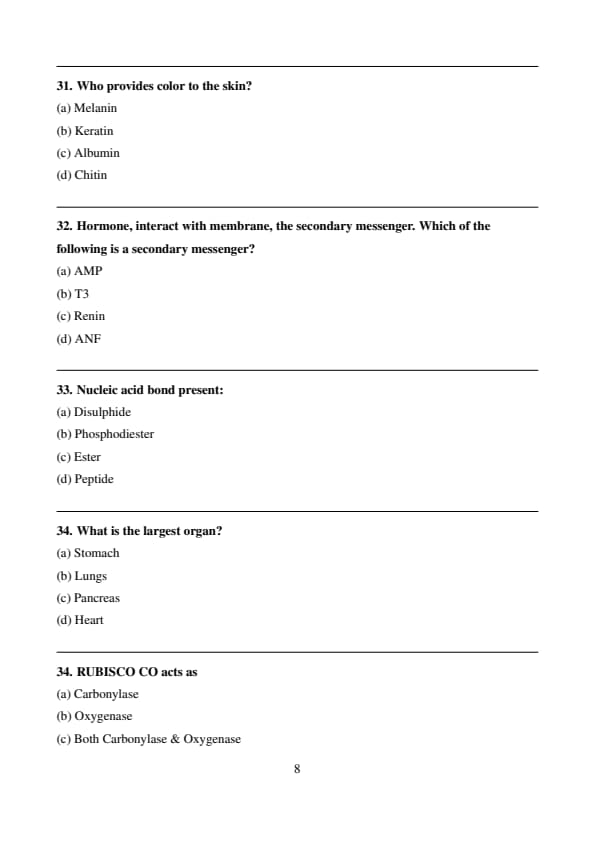
Question 31:
Who provides color to the skin?
- (a) Melanin
- (b) Keratin
- (c) Albumin
- (d) Chitin
Question 32:
Hormone, interact with membrane, the secondary messenger. Which of the following is a secondary messenger?
- (a) AMP
- (b) T3
- (c) Renin
- (d) ANF
Question 33:
Nucleic acid bond present:
- (a) Disulphide
- (b) Phosphodiester
- (c) Ester
- (d) Peptide
Question 34:
What is the largest organ?
- (a) Stomach
- (b) Lungs
- (c) Pancreas
- (d) Heart
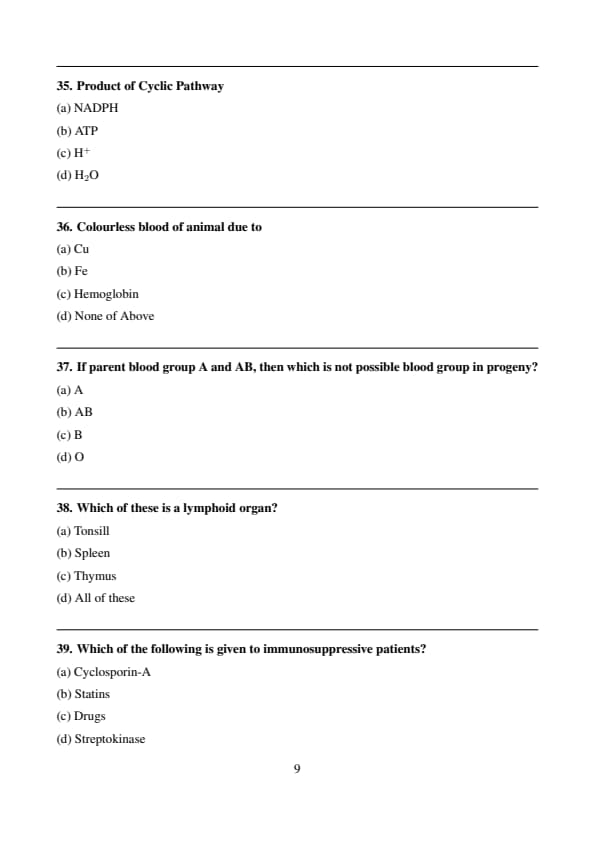
Question 35:
RUBISCO CO acts as
- (a) Carbonylase
- (b) Oxygenase
- (c) Both Carbonylase \& Oxygenase
Question 36:
Product of Cyclic Pathway
- (a) NADPH
- (b) ATP
- (c) H\(^+\)
- (d) H\(_2\)O
Question 37:
Colourless blood of animal due to
- (a) Cu
- (b) Fe
- (c) Hemoglobin
- (d) None of Above
Question 38:
If parent blood group A and AB, then which is not possible blood group in progeny?
Question 39:
Which of these is a lymphoid organ?
- (a) Tonsill
- (b) Spleen
- (c) Thymus
- (d) All of these
Question 40:
Which of the following is given to immunosuppressive patients?
- (a) Cyclosporin-A
- (b) Statins
- (c) Drugs
- (d) Streptokinase
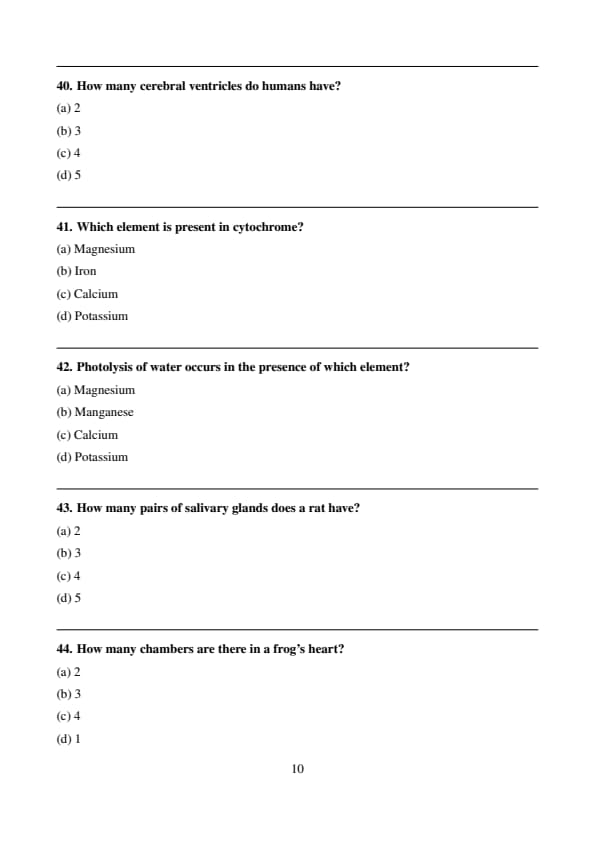
Question 41:
How many cerebral ventricles do humans have?
Question 42:
Which element is present in cytochrome?
- (a) Magnesium
- (b) Iron
- (c) Calcium
- (d) Potassium
Question 43:
Photolysis of water occurs in the presence of which element?
- (a) Magnesium
- (b) Manganese
- (c) Calcium
- (d) Potassium
Question 44:
How many pairs of salivary glands does a rat have?
Question 45:
How many chambers are there in a frog's heart?
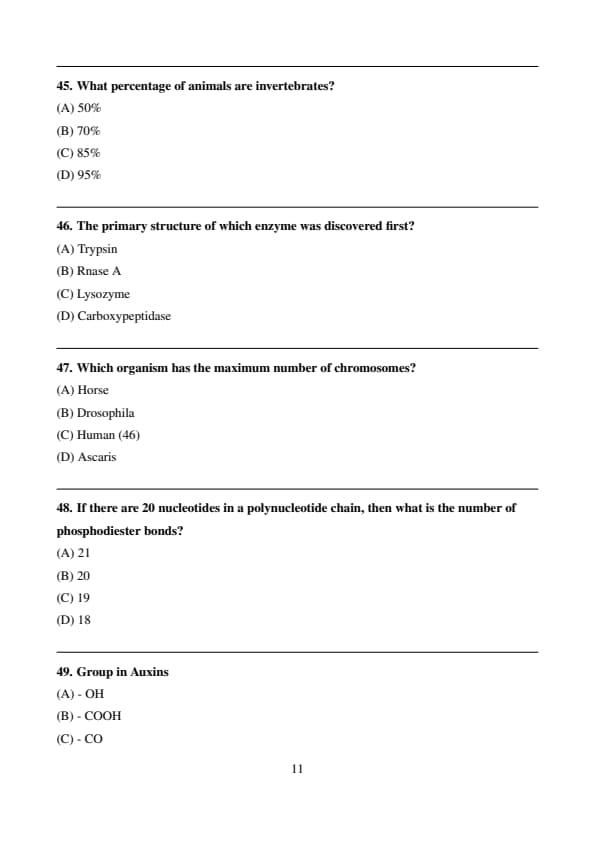
Question 46:
What percentage of animals are invertebrates?
- (A) 50%
- (B) 70%
- (C) 85%
- (D) 95%
Question 47:
The primary structure of which enzyme was discovered first?
- (A) Trypsin
- (B) Rnase A
- (C) Lysozyme
- (D) Carboxypeptidase
Question 48:
Which organism has the maximum number of chromosomes?
- (A) Horse
- (B) Drosophila
- (C) Human (46)
- (D) Ascaris
Question 49:
If there are 20 nucleotides in a polynucleotide chain, then what is the number of phosphodiester bonds?
- (A) 21
- (B) 20
- (C) 19
- (D) 18
Question 50:
Group in Auxins
- (A) - OH
- (B) - COOH
- (C) - CO
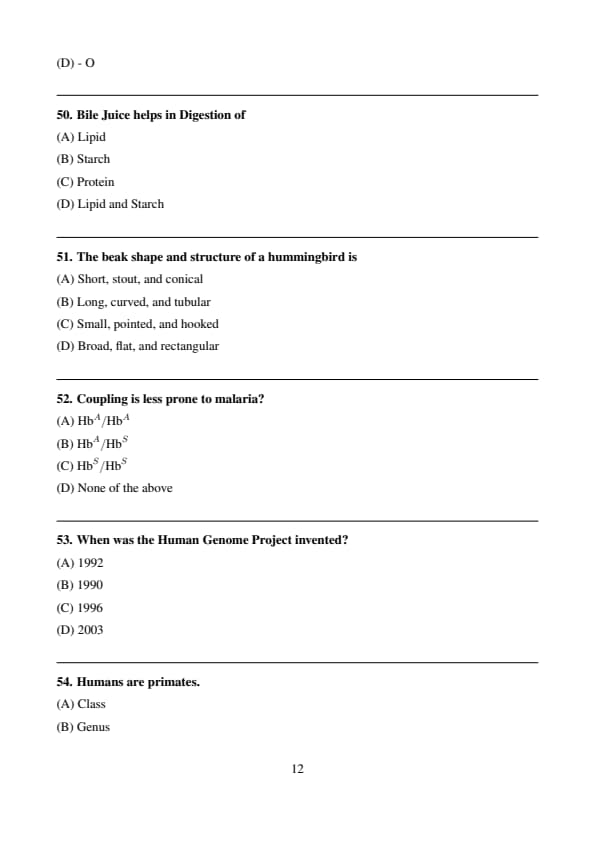
- (D) - O
Question 51:
Bile Juice helps in Digestion of
- (A) Lipid
- (B) Starch
- (C) Protein
- (D) Lipid and Starch
Question 52:
The beak shape and structure of a hummingbird is
- (A) Short, stout, and conical
- (B) Long, curved, and tubular
- (C) Small, pointed, and hooked
- (D) Broad, flat, and rectangular
Question 53:
Coupling is less prone to malaria?
- (A) \( Hb^A / Hb^A \)
- (B) \( Hb^A / Hb^S \)
- (C) \( Hb^S / Hb^S \)
- (D) None of the above
Question 54:
When was the Human Genome Project invented?
- (A) 1992
- (B) 1990
- (C) 1996
- (D) 2003
Question 55:
Humans are primates.
- (A) Class
- (B) Genus
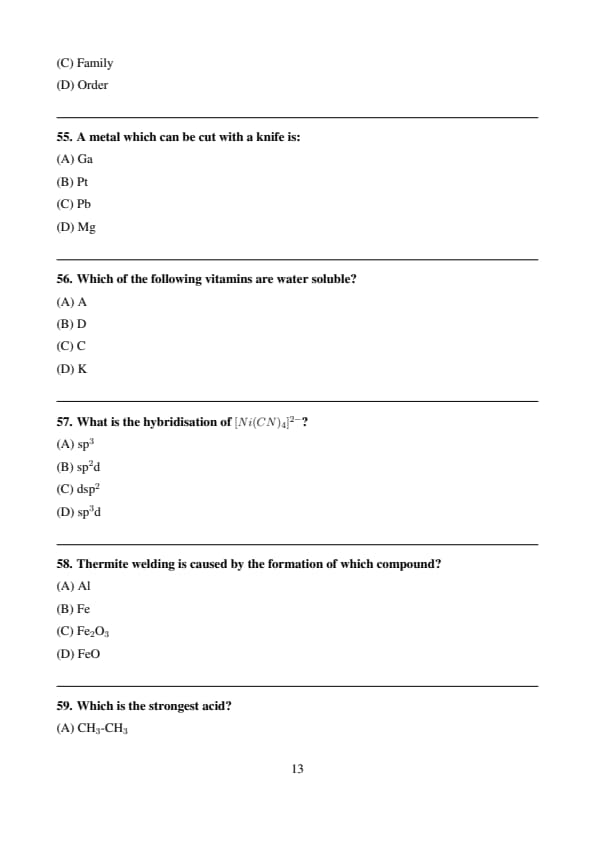
- (C) Family
- (D) Order
Question 56:
A metal which can be cut with a knife is:
- (A) Ga
- (B) Pt
- (C) Pb
- (D) Mg
Question 57:
Which of the following vitamins are water soluble?
Question 58:
What is the hybridisation of \([Ni(CN)_4]^{2-}\)?
- (A) sp\(^3\)
- (B) sp\(^2\)d
- (C) dsp\(^2\)
- (D) sp\(^3\)d
Question 59:
Thermite welding is caused by the formation of which compound?
- (A) Al
- (B) Fe
- (C) Fe\(_2\)O\(_3\)
- (D) FeO
Question 60:
Which is the strongest acid?
- (A) CH\(_3\)-CH\(_3\)
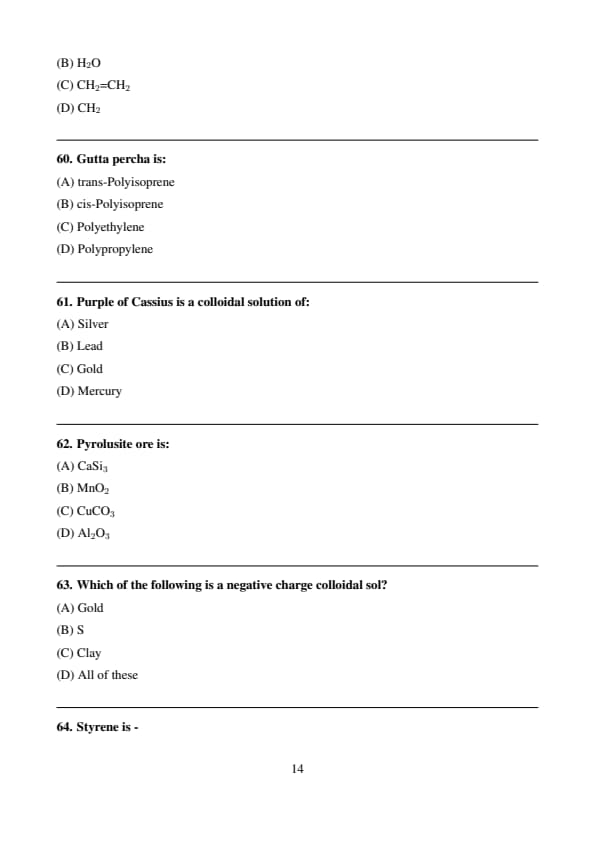
- (B) H\(_2\)O
- (C) CH\(_2\)=CH\(_2\)
- (D) CH\(_2\)
Question 61:
Gutta percha is:
- (A) trans-Polyisoprene
- (B) cis-Polyisoprene
- (C) Polyethylene
- (D) Polypropylene
Question 62:
Purple of Cassius is a colloidal solution of:
- (A) Silver
- (B) Lead
- (C) Gold
- (D) Mercury
Question 63:
Pyrolusite ore is:
- (A) CaSi\(_3\)
- (B) MnO\(_2\)
- (C) CuCO\(_3\)
- (D) Al\(_2\)O\(_3\)
Question 64:
Which of the following is a negative charge colloidal sol?
- (A) Gold
- (B) S
- (C) Clay
- (D) All of these
Question 65:
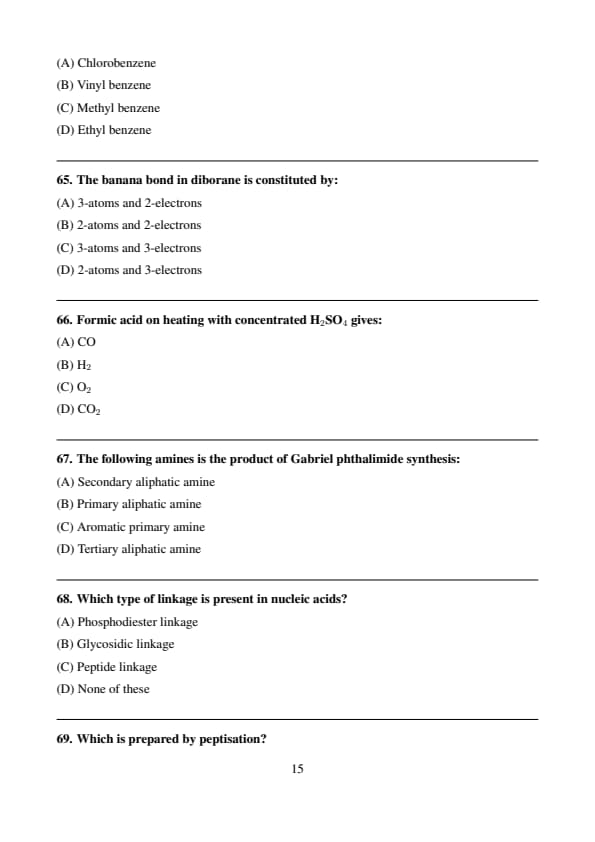
Styrene is -
- (A) Chlorobenzene
- (B) Vinyl benzene
- (C) Methyl benzene
- (D) Ethyl benzene
Question 66:
The banana bond in diborane is constituted by:
- (A) 3-atoms and 2-electrons
- (B) 2-atoms and 2-electrons
- (C) 3-atoms and 3-electrons
- (D) 2-atoms and 3-electrons
Question 67:
Formic acid on heating with concentrated H\(_2\)SO\(_4\) gives:
- (A) CO
- (B) H\(_2\)
- (C) O\(_2\)
- (D) CO\(_2\)
Question 68:
The following amines is the product of Gabriel phthalimide synthesis:
- (A) Secondary aliphatic amine
- (B) Primary aliphatic amine
- (C) Aromatic primary amine
- (D) Tertiary aliphatic amine
Question 69:
Which type of linkage is present in nucleic acids?
- (A) Phosphodiester linkage
- (B) Glycosidic linkage
- (C) Peptide linkage
- (D) None of these
Question 70:
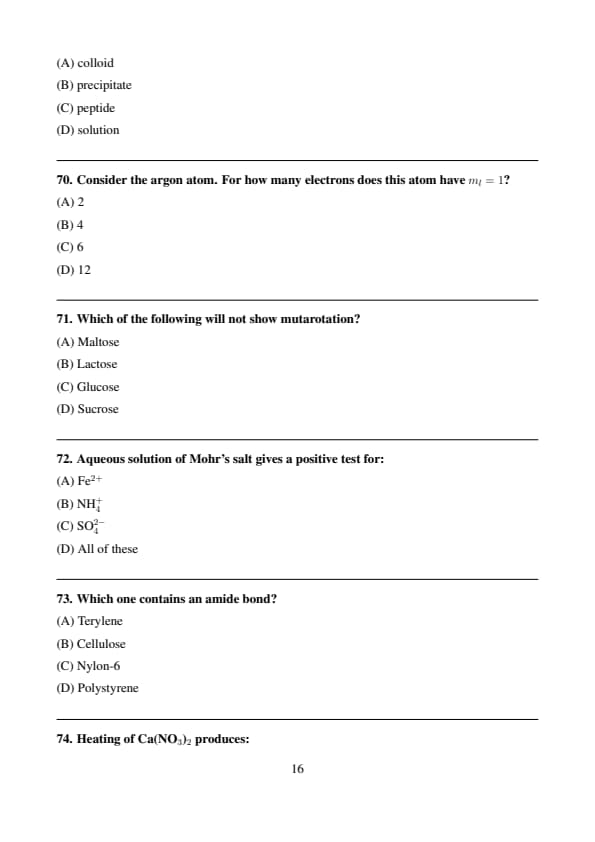
Which is prepared by peptisation?
- (A) colloid
- (B) precipitate
- (C) peptide
- (D) solution
Question 71:
Consider the argon atom. For how many electrons does this atom have \( m_l = 1 \)?
Question 72:
Which of the following will not show mutarotation?
- (A) Maltose
- (B) Lactose
- (C) Glucose
- (D) Sucrose
Question 73:
Aqueous solution of Mohr's salt gives a positive test for:
- (A) Fe\(^{2+}\)
- (B) NH\(_4^+\)
- (C) SO\(_4^{2-}\)
- (D) All of these
Question 74:
Which one contains an amide bond?
- (A) Terylene
- (B) Cellulose
- (C) Nylon-6
- (D) Polystyrene
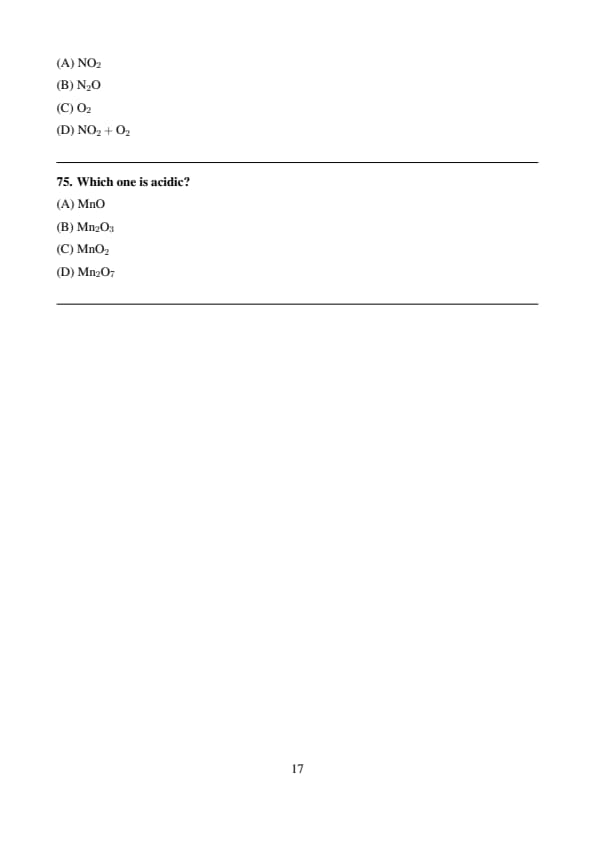
Question 75:
Heating of \( Ca(NO_3)_2 \) produces:
- (A) \( NO_2 \)
- (B) \( N_2O \)
- (C) \( O_2 \)
- (D) \( NO_2 + O_2 \)
Question 76:
Which one is acidic?
- (A) \( MnO \)
- (B) \( Mn_2O_3 \)
- (C) \( MnO_2 \)
- (D) \( Mn_2O_7 \)









Comments