




TG EDCET (Telangana State Education Common Entrance Test) is a state-level entrance exam conducted by Osmania University, Hyderabad on behalf of the Telangana State Council of Higher Education (TSCHE). It is the gateway for admission into 2-year B.Ed. (Bachelor of Education) regular courses in colleges of education across Telangana.
The TG EDCET 2025 exam consists of 150 multiple-choice questions divided into three parts—General English (25 marks), General Knowledge & Teaching Aptitude (25 marks), and Subject-Specific Content (100 marks)—with a total duration of 2 hours in online mode.
TS EDCET 2025 Question Paper with Answer Key PDF Shift 2
| TS EDCET 2025 Question Paper with Answer Key June 1 Shift 2 | Download PDF | Check Solutions |

Mathematics
Question 1:
If \( 2 \log 5 + \frac{1}{2} \log 9 - \log 3 = \log x \), then the value of \( x \) is:
View Solution
We are given: \[ 2 \log 5 + \frac{1}{2} \log 9 - \log 3 = \log x \]
Step 1: Simplify the logarithmic terms.
The first term can be simplified as:
\[ 2 \log 5 = \log 5^2 = \log 25 \]
The second term simplifies as:
\[ \frac{1}{2} \log 9 = \log 9^{1/2} = \log 3 \]
The third term is already \( \log 3 \).
Thus, the equation becomes: \[ \log 25 + \log 3 - \log 3 = \log x \]
Step 2: Simplify further.
Since \( \log 3 - \log 3 = 0 \), we have: \[ \log 25 = \log x \]
Step 3: Equate the terms.
Since \( \log 25 = \log x \), it follows that: \[ x = 25 \] Quick Tip: For logarithmic equations, use the properties of logarithms to combine terms. Remember, \( \log a + \log b = \log(ab) \) and \( \log a - \log b = \log\left(\frac{a}{b}\right) \).
Evaluate \( \sqrt[3]{21952} + \sqrt{2025} \):
View Solution
We are given the expression \( \sqrt[3]{21952} + \sqrt{2025} \).
Step 1: Calculate \( \sqrt[3]{21952} \).
We know that \( 21952 = 28^3 \), so \( \sqrt[3]{21952} = 28 \).
Step 2: Calculate \( \sqrt{2025} \).
We know that \( \sqrt{2025} = 45 \).
Step 3: Add the two results: \[ 28 + 45 = 73 \]
Thus, the correct answer is \( 73 \). Quick Tip: For cube roots and square roots, make sure to check perfect cubes or squares to simplify calculations.
If \( a, b, c \) elements are in geometric progression, then \( \log a, \log b, \log c \) will be in:
View Solution
Step 1: Condition of Geometric Progression
Since \( a, b, c \) are in geometric progression, by the definition of geometric progression, we know that the ratio between consecutive terms is constant. Therefore: \[ \frac{b}{a} = \frac{c}{b} \quad \Rightarrow \quad b^2 = ac. \quad \cdots (1) \]
Step 2: Taking Logarithms
Now, let's take the logarithm of both sides of equation (1): \[ \log b^2 = \log (ac). \]
Using the logarithmic property \( \log(xy) = \log x + \log y \), we get: \[ 2 \log b = \log a + \log c. \quad \cdots (2) \]
This equation shows that the logarithms of the terms, \( \log a, \log b, \log c \), satisfy the condition for being in an arithmetic progression, because in an arithmetic progression, the middle term is the average of the first and third terms.
Step 3: Verifying Arithmetic Progression
For terms to be in arithmetic progression, the middle term should satisfy: \[ 2 \log b = \log a + \log c. \]
This is exactly what we obtained in step 2, confirming that \( \log a, \log b, \log c \) are in arithmetic progression. Quick Tip: For geometric progressions, the logarithms of the terms form an arithmetic progression. Always check the relation between the terms before concluding.
Among the following expressions, the one that is a polynomial is:
View Solution
A polynomial is a mathematical expression involving a sum of powers of a variable with coefficients that are real or complex numbers. The powers must be non-negative integers (i.e., \( 0, 1, 2, 3, \ldots \)).
Let’s evaluate each option:
(1) \( x + \frac{1}{x} \): This is \(\mathbf{not}\) a polynomial because \( \frac{1}{x} \) has a negative exponent \( x^{-1} \). A polynomial cannot have negative exponents. Hence, option (1) is not a polynomial.
(2) 9: This is a constant. Constants are considered polynomials of degree 0. A constant can be written as \( 9x^0 \), where the exponent is \( 0 \), which is a valid non-negative integer. Hence, option (2) is a polynomial.
(3) \( \sqrt{x} + x^2 \): The term \( \sqrt{x} \) can be written as \( x^{\frac{1}{2}} \), which is not a non-negative integer exponent. Since polynomials only allow non-negative integer exponents, option (3) is not a polynomial.
(4) \( 5x^{-2} + 7 \): The term \( 5x^{-2} \) contains a negative exponent \( x^{-2} \), which violates the condition for being a polynomial. Hence, option (4) is also not a polynomial.
Thus, the correct answer is (2) 9. Quick Tip: Polynomials can only have non-negative integer powers of \( x \), and constants are also considered polynomials.
If \( A : B : C = 2 : 3 : 4 \), then find the value of \( \frac{A}{B} \div \frac{B}{C} \div \frac{C}{A} \):
View Solution
We are given that \( A : B : C = 2 : 3 : 4 \), i.e., \[ \frac{A}{B} = \frac{2}{3}, \quad \frac{B}{C} = \frac{3}{4}, \quad \frac{C}{A} = \frac{4}{2} = 2. \]
We need to solve for the value of \( \frac{A}{B} \div \frac{B}{C} \div \frac{C}{A} \).
Step 1: Express the terms: \[ \frac{A}{B} = \frac{2}{3}, \quad \frac{B}{C} = \frac{3}{4}, \quad \frac{C}{A} = 2. \]
Step 2: Apply the division rule for fractions (dividing by a fraction is equivalent to multiplying by its reciprocal): \[ \frac{A}{B} \div \frac{B}{C} \div \frac{C}{A} = \frac{2}{3} \div \frac{3}{4} \div 2. \]
Step 3: Simplify step-by-step: \[ \frac{2}{3} \div \frac{3}{4} = \frac{2}{3} \times \frac{4}{3} = \frac{8}{9}. \]
Now, divide by 2: \[ \frac{8}{9} \div 2 = \frac{8}{9} \times \frac{1}{2} = \frac{8}{18} = \frac{4}{9}. \]
So, the value of the expression is \( 8 : 9 : 24 \). Quick Tip: When dealing with ratios, ensure to handle division by inverting and multiplying for simpler calculations.
Calculate the compound interest on Rs. 1000 for a period of one year at the rate of 10% per annum, if interest is compounded quarterly.
View Solution
We are given:
Principal amount \( P = 1000 \)
Rate of interest \( r = 10% \) per annum
Time \( t = 1 \) year
The interest is compounded quarterly, so the number of compounding periods per year \( n = 4 \)
Step 1: The formula for compound interest is: \[ A = P \left( 1 + \frac{r}{100n} \right)^{nt} \]
where:
\( P \) is the principal amount,
\( r \) is the annual rate of interest,
\( n \) is the number of times interest is compounded per year,
\( t \) is the number of years.
Step 2: Substitute the known values: \[ A = 1000 \left( 1 + \frac{10}{100 \times 4} \right)^{4 \times 1} = 1000 \left( 1 + 0.025 \right)^4 = 1000 \left( 1.025 \right)^4. \]
Step 3: Calculate \( (1.025)^4 \): \[ (1.025)^4 = 1.103812. \]
Step 4: Now, calculate \( A \): \[ A = 1000 \times 1.103812 = 1103.812. \]
Step 5: The compound interest is given by: \[ Compound Interest = A - P = 1103.812 - 1000 = 103.812. \] Quick Tip: For compound interest, remember to adjust the rate and time based on the frequency of compounding periods (quarterly, monthly, etc.).
Calculate the compound interest on Rs.1000 for a period of one year at the rate 10% per annum, if interest is compounded quarterly?
View Solution
We are given the following:
Principal (\( P \)) = Rs.1000
Rate of interest (\( r \)) = 10% per annum
Time (\( t \)) = 1 year
Interest is compounded quarterly, so the number of times interest is compounded per year (\( n \)) = 4
We will use the compound interest formula: \[ A = P \left( 1 + \frac{r}{100n} \right)^{nt} \]
Step 1: Substitute the given values into the formula.
Substitute \( P = 1000 \), \( r = 10% \), \( n = 4 \) (quarterly compounding), and \( t = 1 \) year into the formula: \[ A = 1000 \left( 1 + \frac{10}{100 \times 4} \right)^{4 \times 1} \]
Simplifying the expression: \[ A = 1000 \left( 1 + \frac{1}{40} \right)^4 = 1000 \left( \frac{41}{40} \right)^4 \]
Step 2: Calculate the value of \( \left( \frac{41}{40} \right)^4 \).
Now, calculate \( \left( \frac{41}{40} \right)^4 \): \[ \left( \frac{41}{40} \right)^4 \approx 1.103812 \]
Step 3: Find the amount \( A \).
Now, multiply by 1000 to find \( A \): \[ A = 1000 \times 1.103812 = 1103.81 \]
Step 4: Calculate the compound interest.
The compound interest \( CI \) is the difference between the total amount \( A \) and the principal \( P \): \[ CI = A - P = 1103.81 - 1000 = Rs.103.81 \]
Thus, the compound interest is Rs.103.81. Quick Tip: For compound interest, always use the formula \( A = P \left(1 + \frac{r}{100n}\right)^{nt} \) and ensure you use the correct values for the number of periods per year when compounding is more frequent than annually.
If the price of a book including 10% G.S.T. is Rs.880, then the original price of the book without G.S.T. is:
View Solution
We are given:
Price including G.S.T. = Rs.880
G.S.T. rate = 10%
Let the original price of the book (excluding G.S.T.) be \( x \).
Since the price includes G.S.T., the price with G.S.T. is: \[ Price including G.S.T. = x + 0.10x = 1.10x \]
Step 1: Set up the equation.
We know that the price including G.S.T. is Rs.880, so: \[ 1.10x = 880 \]
Step 2: Solve for \( x \).
To find \( x \), divide both sides of the equation by 1.10:
\(x = \frac{880}{1.10} = Rs 800\)
Thus, the original price of the book (without G.S.T.) is Rs.800. Quick Tip: To find the original price before G.S.T., divide the final price by \( 1 + \frac{G.S.T. rate}{100} \). For a 10% G.S.T., divide by 1.10.
If \( A(2, 3) \) and \( B(4, 5) \) are the end points of a straight line AB, then the slope of straight line AB is:
View Solution
Step 1: Formula for the Slope of a Line
The slope \( m \) of a straight line passing through two points \( (x_1, y_1) \) and \( (x_2, y_2) \) is given by: \[ m = \frac{y_2 - y_1}{x_2 - x_1} \]
Step 2: Substitute the Coordinates of Points A and B
We are given the points \( A(2, 3) \) and \( B(4, 5) \). So, \( x_1 = 2 \), \( y_1 = 3 \), \( x_2 = 4 \), and \( y_2 = 5 \).
Substituting these values into the slope formula: \[ m = \frac{5 - 3}{4 - 2} = \frac{2}{2} = 1 \]
Step 3: Conclusion
Therefore, the slope of the line AB is \( 1 \). Quick Tip: The slope of a line can be calculated using the formula \( m = \frac{y_2 - y_1}{x_2 - x_1} \), where \( (x_1, y_1) \) and \( (x_2, y_2) \) are the coordinates of two points on the line.
In a triangle, if the three angles are in the ratio \( 2 : 5 : 8 \), then the values of those three angles are:
View Solution
Step 1: Let the Angles be Proportional to a Variable
We are told that the angles of the triangle are in the ratio \( 2 : 5 : 8 \). Let the angles be \( 2x, 5x, 8x \) where \( x \) is a common factor.
Step 2: Sum of Angles in a Triangle
We know that the sum of the angles in any triangle is \( 180^\circ \). Therefore, we write: \[ 2x + 5x + 8x = 180^\circ \]
Simplifying this: \[ 15x = 180^\circ \]
Solving for \( x \): \[ x = \frac{180^\circ}{15} = 12^\circ \]
Step 3: Find the Angles
Now that we know \( x = 12^\circ \), we can find the three angles by multiplying \( x \) with the respective ratios:
The first angle is \( 2x = 2 \times 12^\circ = 24^\circ \),
The second angle is \( 5x = 5 \times 12^\circ = 60^\circ \),
The third angle is \( 8x = 8 \times 12^\circ = 96^\circ \).
Step 4: Conclusion
Therefore, the angles of the triangle are \( 24^\circ, 60^\circ, 96^\circ \). Quick Tip: When the angles of a triangle are given in a ratio, use the property that the sum of angles in a triangle is always \( 180^\circ \) to find the angles.
Solve: \( 3 + \frac{1}{2 + \frac{1}{5 + \frac{1}{4}}} \)
View Solution
We need to simplify the given expression step by step: \[ 3 + \frac{1}{2 + \frac{1}{5 + \frac{1}{4}}} \]
Step 1: Start from the innermost fraction. \[ 5 + \frac{1}{4} = \frac{20}{4} + \frac{1}{4} = \frac{21}{4} \]
Step 2: Substitute this into the next fraction. \[ 2 + \frac{1}{\frac{21}{4}} = 2 + \frac{4}{21} = \frac{42}{21} + \frac{4}{21} = \frac{46}{21} \]
Step 3: Now substitute this back into the original expression. \[ 3 + \frac{1}{\frac{46}{21}} = 3 + \frac{21}{46} = \frac{138}{46} + \frac{21}{46} = \frac{159}{46} \]
Thus, the simplified answer is \( \frac{159}{46} \). Quick Tip: When simplifying complex fractions, always start with the innermost fraction and work outward.
The area of the rectangular park whose length is 7 meters more than its breadth is 260 sq meters. For fencing the entire boundary of the park if Rs.9000 is spent, then the cost of fencing per meter is (in Rs.):
View Solution
Let the breadth of the park be \( x \) meters. Then the length of the park is \( x + 7 \) meters.
The area of the rectangular park is given as 260 sq meters: \[ Area = Length \times Breadth = (x + 7) \times x = 260 \]
Expanding and solving for \( x \): \[ x^2 + 7x = 260 \] \[ x^2 + 7x - 260 = 0 \]
Solving this quadratic equation using the quadratic formula: \[ x = \frac{-7 \pm \sqrt{7^2 - 4(1)(-260)}}{2(1)} = \frac{-7 \pm \sqrt{49 + 1040}}{2} = \frac{-7 \pm \sqrt{1089}}{2} = \frac{-7 \pm 33}{2} \]
Thus, \( x = \frac{-7 + 33}{2} = 13 \) or \( x = \frac{-7 - 33}{2} = -20 \) (discarding the negative value as the breadth cannot be negative).
So, the breadth is 13 meters, and the length is \( 13 + 7 = 20 \) meters.
Step 1: The perimeter of the park is: \[ Perimeter = 2 \times (Length + Breadth) = 2 \times (20 + 13) = 66 meters \]
Step 2: The total cost of fencing is Rs.9000, so the cost per meter is: \[ Cost per meter = \frac{9000}{66} = 136.36 \] Quick Tip: In problems involving area and perimeter of rectangles, always use the quadratic formula when setting up the equations for length and breadth.
Among the following, identify the pair of triangles that are NOT similar.
- (1)
![]()
- (2)
![]()
- (3)
![]()
- (4)
![]()


View Solution
We know that for two triangles to be similar, the following conditions must hold:
1. Corresponding angles of the two triangles must be equal.
2. The sides of the triangles must be proportional.
Let us analyze each option:
Option (1):
Triangle \( \triangle ABC \) and triangle \( \triangle PQR \) have angles \( 70^\circ, 60^\circ \) and \( 70^\circ, 50^\circ \) respectively.
The corresponding angles of both triangles are equal, and hence, they are similar.
Option (2):
Triangle \( \triangle ABC \) has sides \( 6 \), \( 5 \), and \( 4 \), and triangle \( \triangle PQR \) has sides \( 4.5 \), \( 6 \), and \( 4.5 \).
Since the ratios of corresponding sides are not equal, these triangles are not similar.
Option (3):
Triangle \( \triangle ABC \) and triangle \( \triangle PQR \) have angles \( 90^\circ, 60^\circ \) and \( 90^\circ, 80^\circ \), respectively.
The corresponding angles are not equal, hence these triangles are not similar.
Option (4):
Triangle \( \triangle ABC \) and triangle \( \triangle PQR \) both have angles \( 60^\circ, 60^\circ \), and the third angle in both triangles is \( 60^\circ \).
Since the angles are equal, the triangles are similar.
Thus, the pair of triangles that are not similar is option (3). Quick Tip: For similarity of triangles, always check if corresponding angles are equal and sides are proportional.
Evaluate \( \sin 210^\circ \cdot \cos 240^\circ \cdot \tan 150^\circ \):
View Solution
We need to evaluate \( \sin 210^\circ \cdot \cos 240^\circ \cdot \tan 150^\circ \).
Step 1:
\( \sin 210^\circ = -\dfrac{1}{2} \) because 210° lies in the third quadrant.
Step 2:
\( \cos 240^\circ = -\dfrac{1}{2} \) because 240° lies in the third quadrant.
Step 3:
\( \tan 150^\circ = -\dfrac{1}{\sqrt{3}} \) because 150° lies in the second quadrant.
\[ \sin 210^\circ \cdot \cos 240^\circ \cdot \tan 150^\circ = \left(-\dfrac{1}{2}\right) \cdot \left(-\dfrac{1}{2}\right) \cdot \left(-\dfrac{1}{\sqrt{3}}\right) = \dfrac{-1}{4\sqrt{3}} \] Quick Tip: Remember the signs of trigonometric functions in different quadrants: - In Quadrant I: all positive. - In Quadrant II: sine is positive, others negative. - In Quadrant III: tangent is positive, others negative. - In Quadrant IV: cosine is positive, others negative.
Find the volume of the cuboid if length is 12 cm, breadth is 8 cm and height is 10 cm? (in cubic cm)
View Solution
We are given the three dimensions of a cuboid:
Length (\( l \)) = 12 cm
Breadth (\( b \)) = 8 cm
Height (\( h \)) = 10 cm
The volume \( V \) of a cuboid is given by the formula: \[ V = l \times b \times h \]
Substitute the given values: \[ V = 12 \times 8 \times 10 \]
First, multiply length and breadth: \[ 12 \times 8 = 96 \]
Now multiply the result with height: \[ 96 \times 10 = 960 \]
So, the volume of the cuboid is: \[ \boxed{960 \, cm^3} \] Quick Tip: Always use the formula for the volume of a cuboid: \( Volume = length \times breadth \times height \). Multiply step-by-step and ensure units are in cm to get volume in cubic cm.
Evaluate: \[ \sqrt{\sin^4 x + 4\cos^2 x} - \sqrt{\cos^4 x + 4\sin^2 x} = ? \]
View Solution
We are asked to simplify the following expression: \[ \sqrt{\sin^4 x + 4\cos^2 x} - \sqrt{\cos^4 x + 4\sin^2 x} \]
Let us first observe that: \[ \sin^4 x = (\sin^2 x)^2, \quad \cos^4 x = (\cos^2 x)^2 \]
Start simplifying the first square root: \[ \sqrt{\sin^4 x + 4\cos^2 x} = \sqrt{(\sin^2 x)^2 + 4\cos^2 x} \]
Now try substituting \( \sin^2 x = 1 - \cos^2 x \) and vice versa in the respective expressions:
First term: \[ \sqrt{(1 - \cos^2 x)^2 + 4\cos^2 x} = \sqrt{1 - 2\cos^2 x + \cos^4 x + 4\cos^2 x} \] \[ = \sqrt{1 + 2\cos^2 x + \cos^4 x} \]
Second term: \[ \sqrt{\cos^4 x + 4\sin^2 x} = \sqrt{(\cos^2 x)^2 + 4(1 - \cos^2 x)} = \sqrt{\cos^4 x + 4 - 4\cos^2 x} \] \[ = \sqrt{\cos^4 x - 4\cos^2 x + 4} \]
Now simplify both: \[ First term: \sqrt{\cos^4 x + 2\cos^2 x + 1} = \sqrt{(\cos^2 x + 1)^2} = \cos^2 x + 1 \] \[ Second term: \sqrt{\cos^4 x - 4\cos^2 x + 4} = \sqrt{(\cos^2 x - 2)^2} = | \cos^2 x - 2 | \]
Now, since \( 0 \leq \cos^2 x \leq 1 \Rightarrow \cos^2 x - 2 \leq 0 \Rightarrow | \cos^2 x - 2 | = 2 - \cos^2 x \)
So: \[ Expression = (\cos^2 x + 1) - (2 - \cos^2 x) = \cos^2 x + 1 - 2 + \cos^2 x = 2\cos^2 x -1 \]
Recall the identity: \[ \cos 2x = 2\cos^2 x - 1 \]
Thus: \[ \sqrt{\sin^4 x + 4\cos^2 x} - \sqrt{\cos^4 x + 4\sin^2 x} = \cos 2x \] Quick Tip: Use trigonometric identities such as \( \cos 2x = 2\cos^2 x - 1 \) and square root simplifications to break complex expressions into standard forms.
How many spherical balls can be made out of a solid cube of iron whose edge measures 44 cm and each ball being 4 cm in diameter? (Take \( \pi = \frac{22}{7} \))
View Solution
Step 1: Calculate the Volume of the Cube
The volume \( V \) of a cube is given by: \[ V = side^3 \]
Here, the side of the cube is 44 cm, so the volume of the cube is: \[ V = 44^3 = 44 \times 44 \times 44 = 85184 \, cm^3 \]
Step 2: Calculate the Volume of One Sphere
The formula for the volume \( V \) of a sphere is: \[ V = \frac{4}{3} \pi r^3 \]
Given the diameter of each ball is 4 cm, the radius \( r \) is: \[ r = \frac{4}{2} = 2 \, cm \]
Substitute the values into the formula: \[ V = \frac{4}{3} \times \frac{22}{7} \times 2^3 = \frac{4}{3} \times \frac{22}{7} \times 8 = \frac{704}{21} \approx 33.52 \, cm^3 \]
Step 3: Find the Number of Spherical Balls
To find the number of spherical balls, divide the volume of the cube by the volume of one sphere: \[ Number of balls = \frac{85184}{33.52} \approx 2541 \]
Step 4: Conclusion
Therefore, the number of spherical balls that can be made is \( 2541 \). Quick Tip: To calculate the number of spherical balls that can be made from a cube, divide the volume of the cube by the volume of one ball. Ensure to use the correct formula for the volume of a sphere and take appropriate values of \( \pi \) and the radius.
Among the following, the correct picture representation of the number of school teachers in Delhi is:

- (1)
![]()
- (2)
![]()
- (3)
![]()
- (4)
![]()


View Solution
In the given pictograph, the number of school teachers is represented by each symbol.
The number of teachers in Hyderabad is 4200, represented by 7 symbols.
The number of teachers in Chennai is 3000, represented by 5 symbols.
To find the correct number of symbols for Delhi, we need to determine the ratio between the symbols and the actual number of teachers.
Each symbol represents: \[ Value of each symbol = \frac{4200}{7} = 600 \]
Now, for Delhi, the total number of teachers is 2400. The number of symbols required is: \[ Number of symbols for Delhi = \frac{2400}{600} = 4 \]
Therefore, the correct representation of the number of teachers in Delhi is 4 symbols, which corresponds to option (1). Quick Tip: When solving pictograph problems, calculate the value represented by each symbol and then determine the number of symbols required for the given number of items.
Let \( E' \) denote the complementary event of \( E \). If \( P(E) = \frac{1}{13} \), then \( P(E') \) is:
View Solution
Let’s break down the solution step by step:
Step 1:
The sum of probabilities of an event and its complementary event is 1. Therefore, \[ P(E') = 1 - P(E) = 1 - \frac{1}{13} = \frac{13}{13} - \frac{1}{13} = \frac{12}{13} \]
Thus, the correct answer is \( \frac{12}{13} \).
Step 2:
Conclusion:
Since the probability of the complementary event is \( \frac{12}{13} \), the correct answer is (1) \( \frac{12}{13} \). Quick Tip: The probability of the complementary event is simply \( 1 - P(E) \).
If two six-sided similar dice are rolled, then the probability that the sum of the numbers on the two dice is not equal to 7 is:
View Solution
Let’s break down the solution step by step:
Step 1:
The total possible outcomes when two dice are rolled is \( 6 \times 6 = 36 \).
The number of favorable outcomes where the sum is 7 (i.e., the pairs (1, 6), (2, 5), (3, 4), (4, 3), (5, 2), and (6, 1)) is 6.
Thus, the number of outcomes where the sum is not equal to 7 is \( 36 - 6 = 30 \).
Therefore, the probability is: \[ P(sum is not 7) = \frac{30}{36} = \frac{5}{6} \]
Step 2:
Conclusion:
Since the probability of the sum not being 7 is \( \frac{5}{6} \), the correct answer is (3) \( \frac{5}{6} \). Quick Tip: To find the probability that the sum is not 7, subtract the probability of getting a sum of 7 from 1.
Physical Science
Question 21:
A force acting on an object of mass 500 g changes its velocity from 200 cm/s to 0.2 m/s. The change in momentum
View Solution
Let’s break down the solution step by step:
Step 1:
We are given:
Mass of the object \( m = 500 g = 0.5 kg \)
Initial velocity \( u = 200 cm/s = 2 m/s \)
Final velocity \( v = 0.2 m/s \)
Step 2:
The change in momentum \( \Delta p \) is calculated as: \[ \Delta p = m(v - u) = 0.5 \times (0.2 - 2) = 0.5 \times (-1.8) = -0.9 \, kg m/s \]
Step 3:
Thus, the momentum decreases by 0.90 kg m/s. Therefore, the correct answer is (4). Quick Tip: Remember, momentum is the product of mass and velocity. A decrease in velocity leads to a decrease in momentum.
A displacement-time graph shown below represents

View Solution
Let’s break down the solution step by step:
Step 1:
In a displacement-time graph, the slope represents the velocity of the object. A horizontal line (no slope) indicates that the displacement is constant over time.
Step 2:
Since the displacement-time graph is horizontal, this means the object is at rest, as there is no change in displacement.
Step 3:
Thus, the correct answer is (2) Object at rest. Quick Tip: A horizontal displacement-time graph represents an object at rest, as displacement does not change over time.
A person can hear a sound of frequency
View Solution
Let’s break down the solution step by step:
Step 1:
The range of audible sound frequencies for humans is typically from 20 Hz to 20,000 Hz (20 kHz).
Step 2:
1 Hz is too low, as it falls below the audible range.
1000 Hz is within the human hearing range.
200 KHz and 5 MHz are both too high and fall outside the audible range.
Step 3:
Thus, the correct answer is (2) 1000 Hz. Quick Tip: Humans can typically hear sounds between 20 Hz and 20 kHz. Sounds outside this range are either infrasonic or ultrasonic.
Which of the following statements are correct?
(i) Velocity of sound waves is greater in solids than liquids.
(ii) Velocity of sound waves in vacuum is 330 m/s.
(iii) Sound waves are longitudinal waves.
(iv) Velocity of sound waves in vacuum is zero.
View Solution
Let’s break down the solution step by step:
Step 1:
(i) Velocity of sound waves is greater in solids than liquids.
This is true because sound waves travel faster in solids compared to liquids due to the denser packing of molecules in solids.
Thus, the first statement is correct.
Step 2:
(ii) Velocity of sound waves in vacuum is 330 m/s.
This statement is incorrect. Sound waves cannot travel through a vacuum because there are no particles to vibrate.
Thus, the second statement is incorrect.
Step 3:
(iii) Sound waves are longitudinal waves.
This is correct. Sound waves are longitudinal waves, meaning that the particle displacement is parallel to the direction of wave propagation.
Thus, the third statement is correct.
Step 4:
(iv) Velocity of sound waves in vacuum is zero.
This is correct because sound waves cannot propagate in a vacuum, as there are no particles to transmit the sound energy.
Thus, the fourth statement is correct.
Step 5:
Conclusion:
The correct answer is (3) (i), (iii) & (iv) because statements (i), (iii), and (iv) are correct. Quick Tip: Remember, sound cannot travel in a vacuum because it requires a medium like air, water, or solids to propagate.
Which planet's rotation is different from the earth’s rotation?
View Solution
Let’s break down the solution step by step:
Step 1:
Mercury's rotation is similar to Earth's in that it rotates on its axis in a prograde direction (in the same direction as its orbit).
Thus, Mercury is not the correct answer.
Step 2:
Venus is unique in that it rotates in the opposite direction (retrograde) to its orbit.
It has a very slow rotation, taking about 243 Earth days to complete one rotation, while its orbit around the Sun takes only about 225 Earth days.
Thus, Venus has a different rotational pattern compared to Earth.
Step 3:
Mars rotates similarly to Earth, with a 24.6-hour day, so it is not the correct answer.
Step 4:
Jupiter's rotation is also similar to Earth's, with a day length of about 10 hours, so it is not the correct answer.
Step 5:
Conclusion:
The correct answer is (2) Venus, because Venus has a retrograde rotation, unlike Earth's prograde rotation. Quick Tip: Venus's rotation is different from Earth’s because it rotates in the opposite direction (retrograde), while most planets, including Earth, rotate in a prograde direction.
According to Bohr model, the maximum number of electrons occupying M-shell will be
View Solution
Step 1: Recall that the Bohr model describes electron arrangement in shells, where the maximum number of electrons that can occupy a given shell is given by the formula: \[ Maximum number of electrons = 2n^2 \]
where \(n\) is the shell number.
Step 2: For the M-shell, which is the third shell (\(n = 3\)): \[ Maximum number of electrons = 2 \times 3^2 = 2 \times 9 = 18 \]
Step 3: Therefore, the maximum number of electrons in the M-shell is 18.
Step 4: Since the M-shell can hold a maximum of 18 electrons, the correct answer is (4) 18. Quick Tip: The formula \(2n^2\) helps you quickly determine the maximum number of electrons a shell can hold. For the M-shell (\(n=3\)), the result is 18.
Which of the following is a set of homogeneous mixtures?
Air
Mist
Sugar solution
Milk
View Solution
Step 1: Understand the definition of homogeneous and heterogeneous mixtures.
A homogeneous mixture is a mixture where the components are uniformly distributed and cannot be distinguished from each other.
A heterogeneous mixture has components that are not uniformly distributed and can be physically distinguished.
Step 2: Analyze each option:
(i) Air – Air is a mixture of gases that is uniformly distributed, so it is homogeneous.
(ii) Mist – Mist consists of tiny water droplets suspended in air, so it is a heterogeneous mixture.
(iii) Sugar solution – A sugar solution is formed when sugar dissolves completely in water, creating a uniform mixture, so it is homogeneous.
(iv) Milk – Milk is a colloidal mixture and is heterogeneous.
Step 3: From the analysis, only option (i) \& (iii) are homogeneous mixtures. Thus, the correct answer is (3) (i) \& (iii). Quick Tip: Homogeneous mixtures are uniform throughout, while heterogeneous mixtures have visibly distinct components.
In any electrical circuit, the direction of flow of current is
View Solution
Step 1: Define electric current.
Electric current is defined as the flow of positive charge. By convention, current is considered to flow from the positive terminal to the negative terminal of a battery.
Step 2: Understand electron flow.
Electrons are negatively charged particles, and they actually flow from the negative terminal to the positive terminal of the battery.
Step 3: The current (flow of positive charge) is opposite to the flow of electrons (which is the flow of negative charge).
Step 4: Therefore, the direction of the current is opposite to the flow of electrons, and the correct answer is (2) opposite to the flow of electrons. Quick Tip: The direction of current is defined by the flow of positive charge, which is opposite to the flow of negatively charged electrons.
Match the following:

View Solution
Let’s break down the matching step by step:
Step 1:
Quantum theory is associated with Max Planck as he is regarded as the father of quantum theory. Hence, 1 matches with B.
Step 2:
Stationary orbits refer to Niels Bohr’s model of the atom, where electrons revolve in stable orbits without radiating energy. Hence, 2 matches with A.
Step 3:
Quantum mechanical model of an atom is closely related to Erwin Schrödinger, who developed the wave equation that describes the quantum state of an electron. Hence, 3 matches with D.
Step 4:
The Pauli Exclusion Principle, which states that no two electrons can have the same set of four quantum numbers, is associated with Wolfgang Pauli. Hence, 4 matches with C.
Step 5:
Conclusion:
The correct answer is (3) 1-B, 2-A, 3-D, 4-C, as each concept is correctly matched to its corresponding scientist. Quick Tip: Quantum theory, stationary orbits, and quantum mechanical models were groundbreaking ideas in physics, introduced by Planck, Bohr, and Schrödinger, respectively. The Pauli Exclusion Principle is essential for understanding electron configuration in atoms.
If a solid cube of 7 kg having an edge of length 10 cm floats in water, then the volume of the cube outside of the water is (let the density of the water 1000 kg/m³.)
View Solution
Let’s break down the solution step by step:
Step 1:
Given data:
Mass of the cube, \( m = 7 kg \)
Edge of the cube, \( a = 10 cm = 0.1 m \)
Density of water, \( \rho_{water} = 1000 kg/m^3 \)
Volume of the cube, \( V_{cube} = a^3 = 0.1^3 = 0.001 m^3 = 1000 cm^3 \)
Step 2:
The buoyant force equals the weight of the water displaced, and the fraction of the cube submerged is equal to the density ratio between the cube and water.
\[ Fraction submerged = \frac{Density of the cube}{Density of water} = \frac{m}{\rho_{water} \cdot V_{cube}} = \frac{7}{1000 \times 1000} = 0.007 \]
Step 3:
The volume of the cube submerged in water is:
\[ V_{submerged} = 0.007 \times 1000 = 7 cm^3 \]
Step 4:
Therefore, the volume of the cube outside the water is:
\[ V_{outside} = V_{cube} - V_{submerged} = 1000 - 700 = 300 cm^3 \]
Step 5:
Conclusion:
The volume of the cube outside the water is 300 cm³. Quick Tip: In floating objects, the volume submerged in water depends on the ratio of the densities. The buoyant force equals the weight of the displaced water, keeping the object afloat.
Biological Science
Question 31:
This vitamin is essential for the health of the eye.
View Solution
Step 1: Understand the role of vitamins for eye health.
Vitamin A is known for its essential role in maintaining the health of the eyes. It is a fat-soluble vitamin that contributes to the production of rhodopsin, a pigment in the retina that is crucial for vision in low light.
Step 2: Recognize the importance of Vitamin A for vision.
Vitamin A helps maintain the normal functioning of the cornea (the eye's outer surface) and the conjunctival membranes, preventing dry eyes and night blindness.
Step 3: Identify the foods rich in Vitamin A.
Vitamin A can be found in foods like carrots, sweet potatoes, spinach, and other yellow or green vegetables, as well as animal-based foods such as liver.
Step 4: Conclude that Vitamin A is the most essential for eye health.
Thus, Vitamin A is the correct answer as it plays a key role in maintaining the health of the eye.
Quick Tip: Vitamin A deficiency can lead to serious vision problems like night blindness, which can be reversed with proper intake of Vitamin A.
In the process of food preservation, the main purpose of refrigerating food is
View Solution
Step 1: Understand the process of refrigeration in food preservation.
Refrigeration is a method used to slow down the activity of microorganisms, including bacteria and fungi, which are responsible for the spoilage of food. The cool temperature does not kill the microorganisms, but it significantly reduces their growth rate.
Step 2: Understand the effect of refrigeration on microorganisms.
By lowering the temperature, microorganisms are less active and are unable to multiply rapidly, extending the shelf life of perishable food items. However, refrigeration does not kill them completely, which is why food still has a limited shelf life even when refrigerated.
Step 3: Recognize what refrigeration does not do.
Refrigeration does not kill viruses or bacteria, nor does it remove moisture from food. It does not necessarily make the food taste better either. The main purpose is to slow down the growth of microorganisms.
Quick Tip: Refrigeration helps preserve the texture, flavor, and nutritional value of food while minimizing spoilage caused by microbial growth.
Identify the CORRECT sequence of subphases given below in the prophase of Meiosis I.
View Solution
Step 1: Understand the phases of prophase I in meiosis.
Prophase I is a critical phase in meiosis, and it is subdivided into five stages:
Leptotene: The chromosomes start to condense, becoming visible under a microscope.
Zygotene: Homologous chromosomes begin to pair up through a process known as synapsis.
Pachytene: During this phase, crossing over occurs, where segments of chromosomes are exchanged between homologous chromosomes.
Diplotene: The paired chromosomes begin to separate but remain attached at points called chiasmata, where crossing over occurred.
Diakinesis: This is the final phase where the chromosomes fully condense, and the nuclear envelope starts to break down, preparing for the next stage of meiosis.
Step 2: Identify the correct sequence.
The correct order in Prophase I is:
Leptotene → Zygotene → Pachytene → Diplotene → Diakinesis. Therefore, the correct option is Option 2.
Quick Tip: The key event in Pachytene is crossing over, where homologous chromosomes exchange genetic material, contributing to genetic diversity.
Match the following characteristics with their respective animal Phyla.

View Solution
Step 1: Identify the characteristic of each phylum.
(i) Pseudocoelom – Nemathelminthes (roundworms) possess a pseudocoelom.
(ii) Complete metamerism – Annelida (earthworms, leeches) exhibit complete metamerism, where the body is divided into segments.
(iii) Torsion – Mollusca (snails) exhibit torsion, a process where the body twists during development.
(iv) Marine animals with tube feet – Echinodermata (starfish) have tube feet that help them move and feed.
Step 2: Match the characteristics with the correct phyla.
The correct matching is:
(i) Pseudocoelom – Nemathelminthes
(ii) Complete metamerism – Annelida
(iii) Torsion – Mollusca
(iv) Marine animals with tube feet – Echinodermata
Thus, the correct option is (1). Quick Tip: A pseudocoelom is a body cavity that is not completely lined with mesoderm, found in Nemathelminthes. Metamerism refers to body segmentation, a feature of Annelida.
In humans, the urea synthesis occurs in
View Solution
Step 1: Understand the process of urea synthesis.
Urea synthesis is part of the urea cycle, which converts ammonia (toxic) into urea for excretion.
Step 2: Identify where urea synthesis takes place.
In humans, urea synthesis occurs primarily in the liver. The liver converts ammonia into urea.
Step 3: Confirm the correct answer.
The correct answer is (3) Liver, where urea is synthesized. Quick Tip: The liver plays a central role in detoxifying ammonia by converting it into urea, which is then excreted by the kidneys.
Which deficiency in diet is responsible for accumulation of water in the body?
View Solution
Step 1: Understand the role of proteins in the body.
Proteins are essential for maintaining osmotic balance in the body. Deficiency in proteins can lead to the accumulation of water in tissues, causing edema.
Step 2: Identify the effects of protein deficiency.
When there is a lack of proteins in the body, the osmotic pressure in blood decreases, causing fluid retention in the tissues, leading to water accumulation.
Step 3: Confirm the correct answer.
The correct answer is (1) Proteins, which are responsible for maintaining proper fluid balance. Quick Tip: Protein deficiency leads to a condition known as edema, where excess fluid accumulates in tissues due to improper osmotic balance.
When energy flows from one trophic level to the other, then its quantity
View Solution
Step 1: Understand energy transfer in ecosystems.
In an ecosystem, energy is transferred from one trophic level to the next (e.g., from producers to consumers).
Step 2: Identify the nature of energy loss.
During this transfer, a significant amount of energy is lost as heat due to metabolic processes, making the quantity of energy available at higher trophic levels lower.
Step 3: Confirm the correct answer.
Energy decreases as it flows from one trophic level to the next due to energy loss in the form of heat. Therefore, the correct answer is (1). Quick Tip: According to the 10% rule of energy transfer, only about 10% of the energy is passed to the next trophic level, with the rest being lost as heat.
Identify the ecological pyramid which is generally inverted in a marine ecosystem is
View Solution
Step 1: Understand ecological pyramids.
In ecosystems, ecological pyramids represent the distribution of biomass, energy, or numbers at each trophic level.
Step 2: Determine the structure in marine ecosystems.
In marine ecosystems, the pyramid of biomass is often inverted. This is because a large number of small organisms (like plankton) supports a smaller number of larger organisms (like fish).
Step 3: Confirm the correct answer.
The biomass pyramid in marine ecosystems is usually inverted, as it’s the quantity of biomass that decreases as you move up the trophic levels. Therefore, the correct answer is (3). Quick Tip: In marine ecosystems, producers (like plankton) have a lower biomass than primary consumers (like small fish), causing the biomass pyramid to be inverted.
Removal of toxic heavy metals from contaminated soils by using fungi is known as
View Solution
Step 1: Understand soil remediation techniques.
Soil remediation refers to the process of removing contaminants or pollutants from the soil to restore its health.
Step 2: Identify the role of fungi in remediation.
Mycoremediation uses fungi to absorb or break down harmful substances, such as heavy metals, from contaminated soils. Fungi have a natural ability to degrade or absorb these pollutants.
Step 3: Confirm the correct answer.
The process of using fungi to clean up toxic heavy metals from soils is called mycoremediation. Therefore, the correct answer is (4). Quick Tip: Mycoremediation is an eco-friendly method of soil cleanup using fungi to degrade pollutants like heavy metals.
Which one of the following is an abiotic component of an ecosystem?
View Solution
Step 1: Understand biotic and abiotic components.
In an ecosystem, biotic components are the living organisms, while abiotic components are the non-living factors like temperature, water, and minerals.
Step 2: Identify the abiotic component.
Water is an essential abiotic component, as it is not a living organism but plays a vital role in sustaining life by providing hydration for organisms in the ecosystem.
Step 3: Confirm the correct answer.
Water is an abiotic component because it is a non-living factor in the ecosystem. Therefore, the correct answer is (2). Quick Tip: Abiotic components include non-living factors like water, air, sunlight, and minerals that help sustain life in an ecosystem.
Geography
Question 41:
The oldest mountain range of India is
View Solution
Step 1: Understanding the question.
The question asks to identify the oldest mountain range in India.
Step 2: Analyzing the options.
The Himalayas: These are young fold mountains, formed by the collision of the Indian and Eurasian plates. They are one of the youngest mountain ranges in the world.
Aravalli mountains: The Aravalli Range is one of the oldest fold mountain ranges in the world, stretching across Rajasthan, Haryana, Delhi, and Gujarat in India. Its formation dates back to the Proterozoic Eon.
Vindhya mountains: The Vindhya Range is a discontinuous chain of mountain ridges, hill ranges, highlands and plateaus in west-central India. They are older than the Himalayas but not as old as the Aravallis.
Western Ghats: The Western Ghats are a mountain range that runs parallel to the western coast of the Indian peninsula. They are fault-block mountains, formed during the break-up of the supercontinent Gondwana. They are not the oldest.
Step 3: Concluding the answer.
Based on geological history, the Aravalli mountains are indeed the oldest mountain range in India. Quick Tip: The Aravalli Range is known as one of the world's oldest fold mountain systems, having undergone significant erosion over millions of years.
In which Glacier, the river Brahmaputra is getting birth ?
View Solution
Step 1: Identify the origin of the Brahmaputra River.
The Brahmaputra River originates in the Angsi Glacier, located on the northern side of the Himalayas in Burang County of Tibet.
Step 2: Relate the origin to the given options.
The Chema Yung Dung (also transliterated as Chemayungdung) Glacier is often identified as the source of the Brahmaputra River, particularly in earlier geographical texts. While more recent findings point to the Angsi Glacier as the exact source, Chema Yung Dung remains a commonly accepted and cited origin point in many contexts, especially in general knowledge and competitive exams. Manasa Sarovar is a lake near the origin, but not the glacier itself. Dibang and Lohit are tributaries of the Brahmaputra, not its source glacier.
Step 3: Conclude the correct option.
Based on the common understanding and available options, the Chema Yung Dung Glacier is considered the birthplace of the Brahmaputra River among the given choices. Quick Tip: The Brahmaputra River originates in the Himalayas. While Angsi Glacier is considered the precise source by some modern researchers, Chema Yung Dung Glacier is widely accepted as its origin.
Arrange the following countries from east to west with their code
1) Austria
2) Spain
3) Ukraine
4) France
View Solution
Step 1: Identify the geographical location (longitude) of each country.
To arrange countries from east to west, we need to consider their approximate longitudes.
Ukraine (3): Located in Eastern Europe, primarily between \(22^\circ\)E and \(40^\circ\)E longitude.
Austria (1): Located in Central Europe, primarily between \(9^\circ\)E and \(17^\circ\)E longitude.
France (4): Located in Western Europe, primarily between \(5^\circ\)W and \(8^\circ\)E longitude.
Spain (2): Located in Southwestern Europe, primarily between \(9^\circ\)W and \(3^\circ\)E longitude.
Step 2: Arrange the countries from east to west based on their longitudes.
Starting from the easternmost country and moving westward:
Ukraine (approx. \(30^\circ\)E)
Austria (approx. \(15^\circ\)E)
France (spans both east and west longitudes, but generally more eastern than Spain, with its capital Paris at about \(2^\circ\)E)
Spain (spans both east and west longitudes, but its westernmost point is further west than France, with its capital Madrid at about \(3^\circ\)W)
Step 3: Formulate the sequence using the given codes.
The order from east to west is Ukraine (3), Austria (1), France (4), Spain (2).
Thus, the sequence is 3, 1, 4, 2. Quick Tip: Remember that countries located further east have higher positive longitudes, while countries further west have lower positive longitudes or negative longitudes (for west of the Prime Meridian).
If the time on Greenwich Meridian is 10.00 am, the time on \(66^\circ\) east longitude is
View Solution
Step 1: Determine the time difference per degree of longitude.
The Earth completes one full rotation (\(360^\circ\)) in 24 hours.
Therefore, for every \(1^\circ\) of longitude, the time difference is: \[ \frac{24 hours}{360^\circ} = \frac{1}{15} hours/degree \]
Convert this to minutes: \[ \frac{1}{15} hours/degree \times 60 minutes/hour = 4 minutes/degree. \]
Step 2: Calculate the total time difference for \(66^\circ\) East longitude.
For \(66^\circ\) East longitude, the time will be ahead of the Greenwich Mean Time (GMT) because it is to the east.
Total time difference = \(66^\circ \times 4 minutes/degree = 264 minutes\).
Step 3: Convert the time difference to hours and minutes.
264 minutes = \(\frac{264}{60}\) hours = 4 hours and 24 minutes.
Step 4: Calculate the time at \(66^\circ\) East longitude.
Given time at Greenwich Meridian (GMT) = 10:00 am.
Time at \(66^\circ\) East longitude = 10:00 am + 4 hours 24 minutes
Time at \(66^\circ\) East longitude = 2:24 pm. Quick Tip: For every \(1^\circ\) of longitude, the time changes by 4 minutes. If moving east, add the time difference; if moving west, subtract it.
Radio waves transmitted from the earth are reflected back to the earth from this layer of the atmosphere
View Solution
Step 1: Understand the question about radio wave reflection.
The question asks which layer of the atmosphere is responsible for reflecting radio waves back to Earth. This phenomenon is crucial for long-distance radio communication.
Step 2: Recall the characteristics of atmospheric layers relevant to radio waves.
Exosphere: The outermost layer, where the atmosphere thins out into space. It has very few particles and is not primarily known for reflecting radio waves.
Mesosphere: Located above the stratosphere and below the thermosphere. While some ionization occurs here, it's not the primary layer for consistent radio wave reflection.
Stratosphere: Located above the troposphere, containing the ozone layer. It does not play a significant role in reflecting radio waves.
Thermosphere: This layer contains a region called the Ionosphere. The ionosphere is characterized by a high concentration of free electrons and ions, which are produced by solar radiation. These charged particles are capable of reflecting radio waves of certain frequencies back to Earth, allowing for long-distance radio communication.
Step 3: Conclude the correct atmospheric layer.
The ionosphere, which is a part of the thermosphere, is the primary layer responsible for reflecting radio waves back to Earth. Quick Tip: The Ionosphere, a region within the thermosphere, is crucial for radio communication due to its ability to reflect radio waves, enabling signals to travel beyond the line of sight.
History
Question 46:
The religion that is also called as the ‘Great Middle Path’ is
View Solution
Step 1: Understand the concept of 'Middle Path'.
The 'Middle Path' or 'Middle Way' is a fundamental principle taught by Siddhartha Gautama, the Buddha. It refers to a path of moderation, avoiding the extremes of sensual indulgence and severe asceticism. It is central to Buddhist doctrine and practice.
Step 2: Relate the 'Middle Path' to the given religions.
Jainism emphasizes extreme asceticism and non-violence.
Hinduism has diverse philosophical schools, but 'Middle Path' is not its central descriptive term.
Islam follows a comprehensive code of life, but 'Middle Path' is not its defining characteristic.
Buddhism explicitly teaches the 'Middle Path' as the way to attain Nirvana, steering clear of both extremes of self-indulgence and self-mortification.
Step 3: Conclude the correct option.
Based on the foundational teachings of the religions, Buddhism is the religion famously known for its 'Great Middle Path'. Quick Tip: The 'Middle Path' (or Majjhima Patipada in Pali) is a core concept in Buddhism, guiding followers to avoid extremes in their pursuit of enlightenment.
During the Mughals period, the land cultivated by Zamindars was called as a
View Solution
Step 1: Understand the land tenure system during the Mughal period.
During the Mughal era, various land categories existed, particularly concerning cultivation and revenue collection. Zamindars were intermediaries who collected revenue from peasants on behalf of the state. They also often held personal land.
Step 2: Define the given options in the context of Mughal land administration.
Sarf-e-khas: This term referred to crown lands, the income from which went directly to the imperial treasury.
Khudkhashat (or Khud Kasht): This referred to the land cultivated by the zamindars themselves, with the help of hired labor or their own family members. The term literally means "self-cultivated."
Zameen: This is a general term for land. While zamindars owned land, 'zameen' itself isn't the specific term for land cultivated by them.
Banjar: This term referred to barren or uncultivated land.
Step 3: Conclude the correct option.
The specific term for land cultivated by Zamindars for their personal use, as opposed to land from which they collected revenue, was Khudkhashat. Quick Tip: In the Mughal agrarian system, 'Khudkhashat' represented the personal demesne of the zamindars, directly cultivated by them, distinguishing it from the land from which they collected taxes.
Abdur Razzaq, the Persian traveller visited Vijayanagara during the reign of
View Solution
Step 1: Identify Abdur Razzaq and his historical context.
Abdur Razzaq Samarqandi was a Persian Islamic scholar and chronicler who served as an ambassador for the Timurid ruler Shah Rukh. He is known for his detailed accounts of his travels.
Step 2: Determine the period of Abdur Razzaq's visit to Vijayanagara.
Abdur Razzaq visited the Vijayanagara Empire in 1442-1443 CE.
Step 3: Identify the ruler of Vijayanagara during that period.
Bukka Raya-I reigned from c. 1356 to 1377 CE.
Deva Raya-II (also known as Praudha Deva Raya) reigned from c. 1424 to 1446 CE. His reign perfectly overlaps with Abdur Razzaq's visit.
Sri Krishna Deva Raya reigned from c. 1509 to 1529 CE, a much later period.
Sada Siva Raya reigned from c. 1542 to 1570 CE, also a much later period.
Step 4: Conclude the correct option.
Abdur Razzaq's visit to the Vijayanagara Empire falls squarely within the reign of Deva Raya-II. His accounts provide valuable insights into the glory of the Vijayanagara Empire during this period. Quick Tip: Many foreign travellers visited the Vijayanagara Empire and left valuable accounts. Remembering which traveller visited during whose reign is crucial for understanding the political and social conditions of the time. Abdur Razzaq's visit is notable for his vivid descriptions of the city.
Kotilingala was the capital of this Mahajanapada
View Solution
Step 1: Understand the term "Mahajanapada" and the question's context.
The Mahajanapadas were sixteen great kingdoms or republics that existed in ancient India from the sixth to fourth centuries BCE. Each had a significant city or region as its capital. The question asks to identify the Mahajanapada whose capital was Kotilingala.
Step 2: Recall the capitals of the given Mahajanapadas.
Avanti: Its capital was Ujjain (or Mahishmati), located in present-day Madhya Pradesh.
Magadha: Its initial capital was Rajagriha (modern Rajgir), later shifted to Pataliputra (modern Patna). It was one of the most powerful Mahajanapadas.
Asmaka (or Assaka): This was the only Mahajanapada located in South India, on the banks of the river Godavari. Its capital cities were Potana or Potali. Historical and archaeological evidence suggests that Kotilingala, a site on the banks of the Godavari in Telangana, served as an important early capital or a significant urban center for the Asmaka Mahajanapada, especially during the early Satavahana period who rose from this region.
Panchala: This Mahajanapada had two capitals: Ahichchhatra for Northern Panchala and Kampilya for Southern Panchala, located in present-day Uttar Pradesh.
Step 3: Conclude the correct Mahajanapada.
Based on historical information, Kotilingala is associated with the Asmaka (Assaka) Mahajanapada. Quick Tip: The Mahajanapadas represent a significant period of urbanization and political consolidation in ancient India. Knowing their capitals is essential for understanding their geographical and historical context. Asmaka is unique for being the only Mahajanapada south of the Vindhyas.
Identify the false statement related to the unification of Germany.
View Solution
Step 1: Analyze each statement for its historical accuracy regarding the unification of Germany.
(1) Bismarck manipulated the content of the telegram sent by the Prussian King.
This refers to the Ems Dispatch (1870). Otto von Bismarck, the Prussian Minister-President, deliberately edited a telegram from King William I to make it appear as if the King had insulted the French ambassador. This manipulation was intended to provoke France into declaring war on Prussia, leading to the Franco-Prussian War, which was the final stage of German unification. This statement is TRUE.
(2) Bismarck requested Napoleon of France to remain neutral during the Prussian war with Denmark.
The Prussian war with Denmark (Second Schleswig War) occurred in 1864. While Bismarck engaged in complex diplomacy to isolate opponents, his primary diplomatic efforts regarding Napoleon III's neutrality were more prominently focused on the Austro-Prussian War (1866), where French neutrality was crucial for Prussian success, and the lead-up to the Franco-Prussian War (1870-71), where he aimed to provoke France into war, not secure its neutrality. There isn't significant historical evidence to suggest a prominent or defining request for French neutrality specifically during the Danish war (1864) as a major strategic diplomatic move. Thus, this statement is FALSE.
(3) The formation of Zollverein was the first step enrouted to political unity and unification of Germany.
The Zollverein (German Customs Union) was formed in 1834. It abolished internal customs barriers between many German states, fostering economic integration and a common market. This economic unity laid a significant foundation for future political unity by creating a sense of shared interest and reducing fragmentation. This statement is TRUE.
(4) William-I was the first united German emperor.
After Prussia's victory in the Franco-Prussian War, King William I of Prussia was proclaimed the German Emperor (Kaiser) on January 18, 1871, in the Hall of Mirrors at the Palace of Versailles. This event officially marked the creation of the unified German Empire. This statement is TRUE.
Step 3: Identify the false statement.
Based on the analysis, statement (2) is the false one. Quick Tip: The unification of Germany under Otto von Bismarck involved a series of strategic wars (Danish, Austro-Prussian, Franco-Prussian) and masterful diplomacy, including the calculated use of the Ems Dispatch and securing neutrality or provoking enemies as needed.
Political Science
Question 51:
NDRF stands for
View Solution
Step 1: Understand the nature of the question.
The question asks for the full form of the acronym "NDRF". This is a knowledge-based question related to common governmental or organizational acronyms.
Step 2: Identify the correct full form.
NDRF stands for National Disaster Response Force. It is an Indian specialized force constituted for the purpose of specialist response to a threatening disaster situation or disaster for the purpose of saving lives and having the ability to perform first response in a disaster situation.
Step 3: Verify with the options.
(1) National Disaster Response Force: This is the correct full form.
(2) National Democratic Representative Forum: Incorrect.
(3) New Democracy Reforms Formulation: Incorrect.
(4) Nation department of Rural Finance: Incorrect. Quick Tip: Acronyms are common in government and public services. Knowing the full forms of important organizations like NDRF is crucial for general knowledge.
Which of the following five year plan relates to the slogan "Banish Poverty (Garibi Hatao)"
View Solution
Step 1: Understand the question about India's Five-Year Plans and their associated slogans.
The question asks to link the famous slogan "Garibi Hatao" (Banish Poverty) with the correct Five-Year Plan in India's economic history.
Step 2: Recall the context and key features of India's Five-Year Plans.
The "Garibi Hatao Desh Bachao" (Abolish Poverty, Save the Country) slogan was given by Indira Gandhi during her election campaign in 1971. This slogan and its underlying objectives became a central theme of a particular Five-Year Plan.
4th Five-Year Plan (1969-1974): Its main objectives were growth with stability and progressive achievement of self-reliance. While poverty reduction was a goal, "Garibi Hatao" wasn't its defining slogan.
5th Five-Year Plan (1974-1979): This plan was prepared during the period of high inflation due to the oil crisis. Its main objectives were "Garibi Hatao" (removal of poverty) and "Atma Nirbharata" (self-reliance). It aimed to achieve self-reliance and reduce poverty through various programs. This plan emphasized employment, poverty alleviation, and justice.
6th Five-Year Plan (1980-1985): This plan focused on economic liberalization and increasing investment.
7th Five-Year Plan (1985-1990): This plan aimed for rapid growth in food grain production, increased employment opportunities, and productivity.
Step 3: Conclude the correct Five-Year Plan.
The slogan "Garibi Hatao" was a key feature and objective of the 5th Five-Year Plan. Quick Tip: Many of India's Five-Year Plans are associated with specific goals or slogans. "Garibi Hatao" is strongly linked to Indira Gandhi's political agenda and was operationalized during the 5th Five-Year Plan.
The first country that has given voting right to all the sections of the people is
View Solution
Step 1: Understand the concept of "voting right to all sections of the people."
This phrase generally refers to universal adult suffrage, meaning the right to vote for all adult citizens, regardless of gender, race, religion, or economic status. Historically, many countries granted voting rights incrementally, often starting with property-owning men, then extending it to all men, and much later to women.
Step 2: Evaluate the historical context of voting rights in the given countries.
United States of America: While the US granted voting rights to all adult males regardless of race after the Civil War (15th Amendment, 1870), women's suffrage was only achieved nationally in 1920 (19th Amendment). Therefore, it was not the first to grant voting rights to "all sections of the people" comprehensively.
Soviet Russia: After the October Revolution in 1917, the Soviet Union introduced universal adult suffrage (including women's right to vote) relatively early. However, this was after New Zealand.
New Zealand: New Zealand became the first self-governing country in the world to grant all adult women the right to vote in parliamentary elections in 1893. At that time, men already had voting rights without property qualifications. This effectively made New Zealand the first country to grant universal adult suffrage to all its adult citizens.
India: India adopted universal adult suffrage from the very beginning of its constitution in 1950, which was a significant achievement for a newly independent nation, but it was much later than New Zealand.
Step 3: Conclude the first country based on historical facts.
New Zealand was the first self-governing country to grant universal adult suffrage, including women's voting rights, in 1893. Quick Tip: New Zealand holds the distinction of being the first nation to grant universal suffrage, including women's voting rights, in 1893, making it a pioneer in democratic reforms.
The constitutional article that deals with Right to Education is
View Solution
Step 1: Recall the constitutional provisions related to education in India.
The Right to Education is a fundamental right enshrined in the Constitution of India. It ensures that every child has the right to free and compulsory education.
Step 2: Identify the specific article related to the Right to Education.
The 86th Constitutional Amendment Act of 2002 inserted Article 21-A into the Constitution of India. This article declares that "The State shall provide free and compulsory education to all children of the age of six to fourteen years in such manner as the State may, by law, determine."
Step 3: Conclude the correct option.
Based on the amendment, Article 21-A explicitly deals with the Right to Education, making it a fundamental right. Quick Tip: Article 21-A was added by the 86th Constitutional Amendment Act of 2002, making education a fundamental right for children between 6 and 14 years of age. This is a crucial amendment in the context of social welfare and human rights in India.
The main reason for America's interference into the internal affairs of Libya is
View Solution
Step 1: Understand the context of US involvement in Libya.
The major US and NATO involvement in Libya occurred in 2011, during the Libyan Civil War, which aimed to overthrow Muammar Gaddafi's regime. This intervention was officially justified under the UN Security Council Resolution 1973, which authorized a no-fly zone and "all necessary measures" to protect civilians.
Step 2: Evaluate the given options in light of historical and geopolitical analysis.
(1) Supporting the Gaddafi rule: This is incorrect. The US and NATO actively sought to remove Gaddafi from power, not support him.
(2) Suppression of rebels: This is incorrect. The intervention was primarily aimed at protecting civilians from Gaddafi's forces and, in effect, assisting the rebels, not suppressing them.
(3) Desire to control the large oil reserves: Libya possesses Africa's largest proven oil reserves. Geopolitical analysts and critics often argue that control or influence over these strategic resources, coupled with the desire to maintain regional stability favorable to Western interests, played a significant underlying role in the intervention, beyond humanitarian concerns. While not the publicly stated reason, it is widely considered a major strategic interest.
(4) Stopping United Nations Organisation's intervention: This is incorrect. The US intervention (along with NATO) was conducted under a UN Security Council resolution, meaning it was a UN-authorized intervention, not an action to stop UN intervention.
Step 3: Conclude the most plausible main reason.
While humanitarian concerns were the stated reason for intervention, the strategic importance of Libya's vast oil reserves is widely considered by geopolitical analysts to be a primary underlying reason for the significant interest and involvement of the United States and other Western powers in Libya's internal affairs. Quick Tip: When analyzing geopolitical interventions, it's essential to consider both publicly stated reasons (e.g., humanitarian intervention) and underlying strategic interests (e.g., control of resources, regional influence). Libya's significant oil wealth makes it a geostrategic asset.
Economics
Question 56:
Which of the following does not belong to public, social and personal services is
View Solution
Step 1: Understand the classification of "public, social, and personal services."
This category typically encompasses services that cater directly to the public, contribute to social well-being, or provide individual-oriented services. These often include sectors related to information, culture, community support, and direct consumer services.
Step 2: Analyze each option based on this classification.
(1) Media: Media (e.g., newspapers, television, radio) provides information, education, and entertainment to the public. It serves a crucial social function by disseminating news and shaping public opinion. Thus, it falls under public/social services.
(2) Archives: Archives are institutions that preserve historical records, documents, and other materials for public and academic research. They serve a public and social function by safeguarding cultural heritage and facilitating access to information. Thus, they fall under public/social services.
(3) Building construction companies: These companies are primarily involved in the construction industry, which deals with the physical creation of infrastructure and buildings. While they provide a service (construction), their primary classification is as part of the manufacturing/construction sector, distinct from what is typically categorized as "public, social, and personal services" in economic classifications (which often refer to healthcare, education, social work, cultural activities, etc.).
(4) Museums: Museums are institutions that acquire, conserve, research, communicate, and exhibit the tangible and intangible heritage of humanity and its environment for the purposes of education, study, and enjoyment. They are a clear example of public and social services.
Step 3: Identify the outlier.
Building construction companies belong to the construction sector, which is distinct from the public, social, and personal services sector that the other options represent. Quick Tip: Economic activities are often categorized into primary, secondary, and tertiary (service) sectors. Within services, there are further distinctions. Public, social, and personal services generally refer to areas like health, education, culture, and community support, rather than heavy industry like construction.
The city in which the first cement factory was established in India is
View Solution
Step 1: Understand the question.
The question asks for the location of the first cement factory established in India. This is a factual question related to the history of industry in India.
Step 2: Recall historical facts about the Indian cement industry.
The first cement manufacturing plant in India was set up in Chennai (then Madras) in 1904. It was established by the Madras Cement Company (though some sources might refer to it as "South India Industrials Ltd."). While it produced cement, large-scale commercial production in India really took off a bit later, particularly with the establishment of Indian Cement Company Ltd. in Porbandar, Gujarat, in 1914. However, for the establishment of the very first factory, Chennai holds the distinction.
Step 3: Compare with the given options.
(1) Aurangabad: Not associated with the first cement factory.
(2) Chennai: Historically recognized as the location of India's first cement factory.
(3) Vishakapatnam: Not associated with the first cement factory.
(4) Ludhiana: Not associated with the first cement factory. Quick Tip: Many pioneering industries in India had their genesis in port cities or major industrial centers. Knowing such specific historical firsts is important for general knowledge about India's economic development.
NABARD facilitates
View Solution
Step 1: Understand the role and mandate of NABARD.
NABARD stands for the National Bank for Agriculture and Rural Development. It was established in 1982 as an apex development bank in India. Its primary role is to facilitate credit for the promotion and development of agriculture, small-scale industries, cottage and village industries, and other rural crafts, with a view to promoting integrated rural development and securing prosperity of rural areas.
Step 2: Analyze how NABARD fulfills its mandate.
NABARD primarily provides refinance facilities to institutions that extend credit directly to farmers and rural enterprises. These institutions are part of the formal financial system.
It refinances Commercial Banks, Regional Rural Banks (RRBs), and Cooperative Banks for their lending to the agricultural and rural sectors.
It does not directly deal with individual borrowers or informal credit providers (like moneylenders).
Its focus is exclusively on rural development, not urban areas.
Step 3: Evaluate the given options.
(1) Formal credit organisations in rural India: This aligns perfectly with NABARD's mandate to support and strengthen formal financial institutions (banks, cooperatives) that provide credit in rural areas.
(2) Formal credit organisations in urban India: NABARD's mandate is rural development, not urban.
(3) Informal credit organisations in rural India: NABARD operates within the formal financial system and aims to reduce reliance on informal credit sources.
(4) Informal credit organisations in urban India: This is outside NABARD's scope.
Step 4: Conclude the correct option.
NABARD primarily facilitates formal credit organisations in rural India. Quick Tip: NABARD's core mission is to promote sustainable and equitable agriculture and rural prosperity by providing refinance to formal financial institutions operating in rural areas. Its focus is strictly on the formal sector and rural development.
Which of the following does not come under the four-fold classification of factors of production in Economics?
View Solution
Step 1: Understand the four-fold classification of factors of production.
In Economics, the factors of production are the resources used to produce goods and services. Traditionally, these are categorized into four main types.
Step 2: List and define the four factors of production.
The four generally accepted factors of production are:
Land: This includes all natural resources used in production, such as raw materials, land for farming, mineral deposits, forests, etc. The reward for land is rent.
Labour: This refers to the human effort (physical and mental) used in production. The reward for labour is wages.
Capital: This refers to man-made resources used in production, such as machinery, tools, buildings, factories, infrastructure, etc. The reward for capital is interest.
Entrepreneurship (or Enterprise): This refers to the ability to organize the other factors of production, take risks, and innovate to create goods and services. The reward for entrepreneurship is profit.
Step 3: Compare the options with the factors of production.
Land: Is a factor of production.
Labour: Is a factor of production.
Capital: Is a factor of production.
Goods: Goods are the output of the production process, not a factor (input) used in production.
Step 4: Conclude the correct option.
Therefore, 'Goods' do not come under the four-fold classification of factors of production. Quick Tip: Remember the distinction: Factors of production are the \textit{inputs (resources) used to create products, while goods (and services) are the outputs of that process.
What does the Consumer Price Index (CPI) primarily measure?
View Solution
Step 1: Define the Consumer Price Index (CPI).
The Consumer Price Index (CPI) is a measure that examines the weighted average of prices of a basket of consumer goods and services, such as transportation, food, and medical care.
Step 2: Understand the purpose of CPI.
CPI is used to track changes in the price level of consumer goods and services over time. Its primary purpose is to gauge inflation and the impact of price changes on the purchasing power of consumers.
Step 3: Evaluate the given options.
(1) Prices of goods at the wholesale level: This is typically measured by the Wholesale Price Index (WPI), not CPI. CPI focuses on retail prices paid by consumers.
(2) Changes in the cost of living for consumers: This is the main function of the CPI. By tracking the prices of goods and services that consumers typically buy, it reflects how much it costs to maintain a certain standard of living.
(3) National income of a country: National income (e.g., GDP, GNP) measures the total value of goods and services produced in a country, not primarily price changes or cost of living.
(4) Interest rates set by the Reserve Bank of India: Interest rates are set by the central bank as part of monetary policy and are not directly measured by price indices like CPI.
Step 4: Conclude the correct option.
The Consumer Price Index (CPI) primarily measures changes in the cost of living for consumers by tracking the prices of a basket of goods and services. Quick Tip: CPI is a key indicator of inflation and is crucial for understanding how price changes affect household budgets and purchasing power. It directly reflects the cost of living for an average consumer.
Teaching Aptitude
Question 61:
By which way students learn fast and maximum?
View Solution
Step 1: Understand the question about effective learning methods.
The question seeks to identify the most effective method for students to learn both quickly and thoroughly (maximum retention). This delves into principles of pedagogy and learning psychology.
Step 2: Evaluate each learning method.
(1) Seeing: Visual learning is important, but merely observing (e.g., watching a demonstration) is a passive form of learning. While it aids understanding, it often doesn't lead to the fastest or maximum retention on its own.
(2) Reading: Reading is a fundamental method for acquiring information. However, like seeing, it is largely a passive input method. Retention can be good, but it's often enhanced when combined with active techniques.
(3) Listening: Auditory learning is also a passive input method. Listening to lectures or explanations can provide information, but for deep understanding and long-term retention, it is less effective than active engagement.
(4) Doing by themselves: This refers to active learning methods such as hands-on practice, problem-solving, applying concepts, experimenting, teaching others, or engaging in projects. Research in educational psychology consistently shows that active participation and practical application lead to deeper understanding, faster learning, and significantly higher retention rates. This aligns with theories like experiential learning and "learning by doing."
Step 3: Conclude the most effective learning method.
Active engagement, or "doing by themselves," is widely recognized as the most effective method for students to learn fast and achieve maximum understanding and retention. Quick Tip: The "Learning Pyramid" (or Cone of Experience) illustrates that passive methods like lectures and reading result in lower retention rates, while active methods such as practice by doing and teaching others lead to significantly higher retention.
Which of the following is the noble profession?
View Solution
Step 1: Understand the meaning of "noble profession."
A "noble profession" typically refers to a calling that is highly esteemed for its ethical principles, dedication to public welfare, and profound positive impact on society, often beyond monetary gain. It implies a selfless commitment to human betterment and the foundational development of society.
Step 2: Evaluate each profession based on this definition.
(1) Medical: The medical profession (doctors) is highly respected for its role in preserving life and health. It involves immense responsibility and dedication. It is often referred to as a "healing profession" or "life-saving profession."
(2) Teaching: Teaching is frequently referred to as the "noble profession" or the "mother of all professions." This is because teachers are instrumental in shaping minds, imparting knowledge, fostering critical thinking, and developing the future generation of citizens, leaders, and professionals. Their impact is foundational to all other professions and societal progress.
(3) Nursing: The nursing profession is deeply compassionate and involves direct care for the sick and vulnerable. It is a highly respected and vital profession, often lauded for its empathy and dedication.
(4) Law: The legal profession upholds justice, maintains order, and protects rights within society. Lawyers play a crucial role in the functioning of the legal system and ensuring fairness.
Step 3: Conclude the profession most commonly referred to as "noble."
While all listed professions are vital and highly respected, the term "noble profession" is most commonly and widely associated with Teaching due to its foundational role in building human capital and shaping society. Quick Tip: The nobility of a profession is often judged by its impact on human development and societal well-being. Teaching, by shaping future generations, is widely regarded as a profession that builds the very foundation of society.
What is your attitude towards students with learning difficulties.
View Solution
Step 1: Understand the nature of the question and the context of learning difficulties.
The question asks about the appropriate attitude one should adopt towards students who face learning difficulties. These students require special attention and support to overcome their challenges.
Step 2: Evaluate each proposed attitude.
(1) Be strict: While discipline is important in education, being overly strict with students who have genuine learning difficulties can be counterproductive. It might increase their anxiety, demotivate them, and make learning even harder, as their struggles are often due to cognitive or neurological differences, not a lack of effort or discipline.
(2) Being intolerant: Intolerance towards students with learning difficulties is an inappropriate and harmful attitude. It demonstrates a lack of understanding and empathy, creating a hostile learning environment and potentially leading to emotional distress for the student.
(3) Be kind: Kindness encompasses patience, empathy, understanding, and a willingness to provide support. Students with learning difficulties often struggle with self-esteem and frustration. A kind and supportive attitude helps build trust, reduces anxiety, encourages effort, and creates a safe space for them to learn and ask for help. This is the most constructive and ethical approach.
(4) Being aggressive: Aggression is an entirely unacceptable and detrimental attitude towards any student, especially those facing challenges. It would lead to fear, resentment, and a complete breakdown of the learning process.
Step 3: Conclude the most appropriate attitude.
The most appropriate and effective attitude towards students with learning difficulties is to Be kind, which includes being patient, empathetic, and supportive. Quick Tip: Effective education for students with learning difficulties emphasizes individualized support, patience, and a positive, encouraging environment. Empathy and understanding are key to helping them succeed.
To reduce absenteeism in the class, the teacher
View Solution
Step 1: Analyze the problem of absenteeism.
Absenteeism can stem from various reasons, including lack of interest, personal issues, academic difficulties, or external factors. An effective approach requires addressing the root causes and fostering a positive learning environment.
Step 2: Evaluate the given options for effectiveness in reducing absenteeism.
(1) should punish the students: Punishment might deter some students temporarily, but it doesn't address the underlying reasons for absenteeism and can create a negative association with school, potentially increasing long-term absenteeism.
(2) should ignore absenteeism: Ignoring the problem will not solve it and may even signal to students that attendance is not important, leading to increased absenteeism.
(3) should inform the parents: While informing parents is a necessary step, especially for chronic absenteeism, it's often a reactive measure. It might lead to parental intervention, but it doesn't directly address the student's motivation or engagement in the classroom. It's part of a comprehensive strategy, but not the primary proactive measure by the teacher.
(4) should motivate the students: Motivation is a proactive and effective strategy. A motivated student is more likely to attend class regularly. Teachers can motivate students by making lessons engaging, relevant, providing positive reinforcement, creating a supportive classroom atmosphere, and addressing individual learning needs. This approach focuses on making school a desirable place to be.
Step 3: Conclude the most effective primary action for a teacher.
The most effective and proactive step a teacher can take to reduce absenteeism is to motivate students, making the learning experience engaging and worthwhile, thereby encouraging regular attendance. Quick Tip: Effective teaching strategies focus on positive reinforcement and engagement. Addressing the root causes of absenteeism often involves making learning enjoyable and relevant, thereby intrinsically motivating students to attend.
While selecting learning experiences for curriculum development, the most important factor to be considered is _____.
View Solution
Step 1: Understand the goal of curriculum development.
Curriculum development aims to design learning experiences that are effective, relevant, and engaging for the students, ultimately leading to meaningful learning outcomes.
Step 2: Evaluate the importance of each factor in curriculum development.
(1) Teacher's interest: While a teacher's interest can enhance lesson delivery, curriculum should not be primarily based on it. Teachers can adapt their teaching styles, but the core curriculum should serve the learners.
(2) Learner's interest: This is paramount. Learning is most effective when students are engaged and interested in the material. Considering learners' interests helps make the curriculum relevant, increases motivation, and promotes deeper understanding and retention. It aligns with child-centered education principles.
(3) Political interest: Political interests can influence curriculum (e.g., national values, specific historical narratives), but they should not be the \textit{most important factor. Over-reliance on political interest can lead to indoctrination rather than genuine education.
(4) Parental interest: Parental input is valuable, especially regarding educational goals and concerns. However, it cannot be the sole or most important guiding factor, as parents may not always have the expertise in pedagogical design or the broader educational objectives for a diverse student population.
Step 3: Conclude the most important factor.
For effective and meaningful learning, the curriculum must be developed keeping the learners at its core. Therefore, the learner's interest is the most important factor. Quick Tip: Modern educational philosophy emphasizes child-centered or learner-centered approaches. Curriculum design that considers the learner's needs, interests, and developmental stages leads to more effective and sustainable learning.
Teaching is
View Solution
Step 1: Analyze teaching as an art.
Teaching involves creativity, intuition, empathy, and the ability to connect with students on a personal level. A skilled teacher uses their personality, communication style, and improvisation to make learning engaging and effective. This aspect of teaching is subjective and often developed through experience, similar to an art form.
Step 2: Analyze teaching as a science.
Teaching also involves systematic knowledge, research-based methodologies, pedagogical principles, and objective evaluation. Educational psychology, cognitive science, and curriculum theories provide scientific frameworks for effective instruction. Teachers apply specific strategies, assess outcomes, and adjust based on data, much like a scientist.
Step 3: Combine both perspectives.
Effective teaching seamlessly integrates both artistic and scientific elements. The science provides the foundational knowledge and evidence-based practices (e.g., how people learn, effective instructional strategies). The art allows for flexible application of these principles, adapting to individual student needs, classroom dynamics, and unexpected situations with creativity and personal touch.
Step 4: Conclude the correct option.
Given that teaching requires both structured knowledge and creative application, it is best described as both an art and a science. Quick Tip: The "science" of teaching involves pedagogical theories and research-backed methods, while the "art" of teaching involves the teacher's personality, creativity, and ability to inspire and manage a classroom effectively. Both are indispensable for successful teaching.
Effective teaching results in
View Solution
Step 1: Define "Effective Teaching."
Effective teaching is pedagogical practice designed to maximize student learning, engagement, and understanding. Its ultimate goal is to facilitate profound and lasting knowledge acquisition and skill development in students.
Step 2: Evaluate each option as a result of effective teaching.
(1) making students to learn and understand better: This is the core purpose and most direct result of effective teaching. When teaching is effective, students grasp concepts more easily, retain information, and develop a deeper understanding of the subject matter.
(2) enforced discipline: While a well-managed classroom contributes to learning, "enforced discipline" is a means of classroom management, not the primary result of effective teaching itself. Effective teaching often reduces the need for strict enforcement by engaging students naturally.
(3) increase in the teacher's salary: This is an administrative or policy outcome related to compensation, not a direct pedagogical result of the teaching process in the classroom.
(4) scoring good marks in the examination: While good marks are a desirable outcome and often a consequence of effective teaching and better learning, they are a measurement of learning, not the fundamental result of the teaching process. The true result is the learning and understanding itself, which then reflects in performance.
Step 3: Conclude the most accurate result.
The most fundamental and direct result of effective teaching is that students learn and understand the subject matter better. Quick Tip: Effective teaching is student-centric, focusing on how students acquire knowledge and skills. Its success is primarily measured by the depth of student learning and understanding, rather than solely by external metrics like test scores or disciplinary control.
Which of the following statement is correct with regard to the relationship between syllabus and curriculum?
View Solution
Step 1: Define "Curriculum" and "Syllabus" in an educational context.
Curriculum: This is a broader term that encompasses the entire learning experience provided to students. It includes not just the content or subjects taught, but also the learning objectives, teaching methods, learning experiences, assessments, philosophy of education, and even the learning environment. It answers the questions: What do we want students to learn? How will they learn it? How will we know if they have learned it?
Syllabus: This is a more specific document for a particular course or subject. It outlines the specific topics to be covered within that course, the reading materials, assignments, assessment schedule, and learning outcomes for that specific subject. It serves as a guide for both the instructor and the students for a defined period (e.g., a semester).
Step 2: Determine the relationship between the two.
The curriculum is the overarching framework that guides an entire educational program or system. A syllabus is a detailed outline of a specific course or subject that exists within that broader curriculum. Therefore, a syllabus is a component or a part of the larger curriculum.
Step 3: Evaluate the given statements.
(1) Curriculum is a part of syllabus: This is incorrect. The curriculum is the broader concept.
(2) Syllabus is a part of curriculum: This is correct. The syllabus details one specific course within the comprehensive educational plan (curriculum).
(3) Syllabus is an annexure to the curriculum: While a syllabus provides detailed information related to the curriculum, calling it merely an "annexure" (something added to a main document) might undervalue its integral role. "Part of" is a more accurate description of its relationship within the educational design.
(4) Curriculum is an annexure to the syllabus: This is incorrect, as the curriculum is the broader concept. Quick Tip: Think of curriculum as the entire meal plan for a school year or program, outlining all subjects, activities, and goals. The syllabus is then the detailed recipe for a single dish (course) within that meal plan.
The education provided to children who are outside the school system is known as
View Solution
Step 1: Define the different types of education systems.
Education can be broadly categorized into three types based on structure, location, and intent:
Formal Education: This is typically provided by schools, colleges, and universities. It is structured, hierarchical, chronologically graded, and leads to recognized qualifications and certificates. It is delivered within the established "school system."
Non-formal Education: This is organized, systematic, and intentional, but takes place outside the traditional formal school system. It is often flexible, learner-centered, and designed to meet specific learning needs of particular groups, such as children who have dropped out of school or have never been enrolled. Examples include literacy programs, vocational training, community education centers.
Informal Education: This is a lifelong process of learning from daily experiences, interactions, and environmental influences. It is unstructured, unplanned, and often unintentional (e.g., learning from family, friends, media, daily activities).
Adult Education: This specifically refers to educational programs and learning opportunities designed for adults, typically those beyond compulsory schooling age.
Step 2: Apply the definitions to the question.
The question refers to "education provided to children who are outside the school system."
Formal education is by definition within the school system.
Informal education is unstructured and unintentional, whereas the question implies an "education provided," suggesting some level of organization.
Adult education is for adults, not primarily for children.
Non-formal education specifically addresses organized learning opportunities for those outside the traditional formal schooling structure, which perfectly fits the description of children outside the school system.
Step 3: Conclude the correct type of education.
The education provided to children who are outside the school system is known as non-formal education. Quick Tip: Distinguish between formal, non-formal, and informal education by their structure and context. Formal is structured and within the school system, non-formal is structured but outside it, and informal is unstructured and spontaneous.
A teacher should be committed to
View Solution
Step 1: Understand the core responsibility of a teacher.
A teacher's role is fundamentally centered around education and the development of students. Their professional commitment defines where their primary loyalty and dedication should lie within their pedagogical duties.
Step 2: Evaluate each option in the context of a teacher's professional commitment.
(1) political ideology: A teacher, as a professional, should maintain neutrality regarding political ideologies within the classroom. Their role is to educate students in a balanced manner, encourage critical thinking, and provide diverse perspectives, rather than imposing any specific political viewpoint. Their commitment is to academic integrity and intellectual freedom, not to a political agenda.
(2) the learner: This is the most appropriate answer. A teacher's primary and ultimate commitment is to the students. This commitment involves fostering their intellectual, social, emotional, and ethical development; ensuring a safe and conducive learning environment; providing effective instruction; and supporting their overall well-being and growth. All aspects of teaching revolve around the learner's needs and progress.
(3) the family: While teachers collaborate with families and acknowledge the important role families play in a child's education, a teacher's direct professional commitment is to the individual student within the educational setting, not primarily to the family unit itself. Collaboration serves the best interest of the learner.
(4) the government: Teachers work within an educational system often governed by government policies and curricula. They are expected to adhere to laws and regulations. However, their ultimate professional commitment is not to the political entity of the government, but to the ethical principles of education and the welfare of the students, which the government's educational framework is supposed to serve.
Step 3: Conclude the primary commitment of a teacher.
The foundational commitment of a teacher, underpinning all their professional responsibilities and actions, is to the learner. Quick Tip: The ethical framework of the teaching profession universally places the well-being and learning of the student at its core. A teacher's actions and decisions should always prioritize the best interests of their learners.
‘Coordinated Development of Quality Teacher Education’ in the country is the mandate of
View Solution
Step 1: Understand the roles of various educational bodies in India.
India has several statutory and autonomous bodies responsible for regulating and promoting different aspects of education.
Step 2: Identify the specific mandate of each option.
UGC (University Grants Commission): Responsible for coordination, determination, and maintenance of standards of university education.
AICTE (All India Council for Technical Education): Responsible for planning, formulation, and maintenance of norms and standards, quality assurance through accreditation, funding in priority areas, monitoring and evaluation, etc., in technical education.
NCERT (National Council of Educational Research and Training): An autonomous organization that advises central and state governments on policies and programs for qualitative improvement in school education, develops curriculum and textbooks, conducts research, etc.
NCTE (National Council for Teacher Education): A statutory body established under the National Council for Teacher Education Act, 1993. Its main objective is to achieve planned and coordinated development of the teacher education system throughout the country, and the regulation and proper maintenance of norms and standards in the teacher education system.
Step 3: Conclude the correct option.
The mandate for the coordinated development of quality teacher education specifically belongs to the National Council for Teacher Education (NCTE). Quick Tip: Remember the specific regulatory bodies for different sectors of education in India: UGC for universities, AICTE for technical education, and NCTE specifically for teacher education.
The more appropriate evaluation procedure to evaluate a student at the end of the year is
View Solution
Step 1: Understand different types of educational evaluation.
Evaluation in education serves various purposes throughout a learning period.
Step 2: Define and distinguish the given evaluation procedures.
Formative evaluation: Conducted during the learning process to monitor student learning, provide ongoing feedback, and improve teaching and learning. Examples: quizzes, classroom discussions, homework.
Summative evaluation: Conducted \textit{at the end of an instructional unit, course, or academic year to assess student learning outcomes against a standard. It provides a summary of what students have learned. Examples: final exams, end-of-year assessments, standardized tests.
Diagnostic evaluation: Conducted \textit{before instruction or at any point to identify individual student's strengths, weaknesses, prior knowledge, and learning difficulties to guide instructional planning or remedial teaching.
Test and retest method: This is a method used to assess the \textit{reliability of a test or measurement tool, not a type of student evaluation procedure for learning outcomes. It involves giving the same test to the same group at two different times.
Step 3: Conclude the appropriate evaluation for the end of the year.
Since the question asks for evaluation at the \textit{end of the year, Summative evaluation is the most appropriate procedure as it aims to summarize overall learning and achievement after a period of instruction. Quick Tip: Remember the timing and purpose: Formative is \textit{for learning (ongoing), Summative is of learning (final assessment), and Diagnostic is before learning (identifying needs).
Excessive use of technology in teaching will make a learner
View Solution
Step 1: Consider the potential impacts of technology in education.
Technology can be a powerful tool to enhance learning, providing access to information, interactive experiences, and new ways to collaborate. However, like any tool, its excessive or uncritical use can have negative consequences.
Step 2: Analyze the implications of 'excessive' technology use on learners.
Excessive reliance on technology in teaching can lead to:
Reduced critical thinking and problem-solving skills: If technology always provides answers or automates thinking processes, learners may not develop their own analytical and critical abilities.
Decreased creativity and independent thought: Over-reliance on predefined technological solutions can stifle originality and imaginative thinking.
Passive consumption of information: If technology is used primarily for content delivery without active engagement, learners might become passive recipients rather than active participants.
Lack of human interaction and social skills: Excessive screen time and digital interaction might reduce face-to-face communication and collaborative learning.
Dependence and inability to function without technology: Learners might struggle with tasks that require manual effort, abstract thinking, or non-digital solutions. This can lead to a state where the learner merely executes pre-programmed instructions or relies entirely on technology for answers, much like a robot.
Step 3: Evaluate the given options in this context.
(1) creative: Excessive use often \textit{reduces creativity, as learners might follow pre-programmed paths.
(2) rational: While technology can aid rational thought, excessive reliance might bypass the internal reasoning process, making the learner less independently rational.
(3) robot: This option best captures the idea of a learner becoming overly reliant on technology to provide answers and dictate actions, losing their own critical thinking, creativity, and independent problem-solving skills, essentially behaving like an automated machine.
(4) alternative: This term is too vague and doesn't describe a negative outcome of excessive technology use in this context.
Step 4: Conclude the most fitting description.
Excessive use of technology in teaching can make a learner dependent and mechanistic, similar to a robot, by hindering the development of independent thought, critical thinking, and creativity. Quick Tip: While technology is valuable, balance is key. Over-reliance can lead to rote learning and dependence, hindering higher-order thinking skills and genuine understanding. The goal is to use technology as a tool to enhance, not replace, human cognitive processes.
Teaching is considered to be an effective process only it results in achieving
View Solution
Step 1: Define "effective teaching" in terms of its primary outcome.
Effective teaching is fundamentally about enabling students to understand and master subject matter. The most direct and profound indicator of this mastery is not just rote memorization or compliance, but genuine understanding.
Step 2: Evaluate each option as a primary result of effective teaching.
(1) securing good marks: While good marks are often a desirable outcome and a measure of learning, they are not the sole or primary result that defines teaching as effective. Students might get good marks through memorization without deep understanding. Effective teaching aims for genuine learning, which then leads to good performance.
(2) making the student discipline: Discipline is an important aspect of classroom management, which supports learning. However, effective teaching's core purpose is not merely to enforce discipline but to facilitate learning. Engagement stemming from effective teaching can naturally lead to better student behavior.
(3) developing leadership qualities: Developing leadership qualities is a valuable outcome of holistic education and can be fostered through good teaching practices. However, it is a broader developmental goal and not the primary or sole result that determines if the teaching of a specific subject matter was effective.
(4) Achieve conceptual clarity: This is the most crucial and fundamental result of effective teaching. When students achieve conceptual clarity, it means they truly understand the underlying principles, relationships, and applications of the material. This deep understanding enables them to apply knowledge, solve problems, and retain information, making the teaching process genuinely effective.
Step 3: Conclude the primary result.
Effective teaching fundamentally aims for and results in students achieving conceptual clarity, which signifies genuine understanding and mastery of the subject matter. Quick Tip: The ultimate goal of teaching is not just information delivery but fostering deep understanding. Conceptual clarity ensures that students grasp why something works and can apply it, not just what it is.
If the teaching results in realizing the intended learning out comes,
View Solution
Step 1: Analyze the given conditional statement.
The statement sets a condition: "If the teaching results in realizing the intended learning outcomes..." and asks for the logical conclusion that follows from this condition.
Step 2: Evaluate each option as a logical consequence.
(1) learner should be motivated: Learner motivation is a crucial factor that contributes to achieving learning outcomes, but it is not the conclusion drawn if outcomes are already achieved. It's a prerequisite or a contributing element, not a direct logical consequence of successful outcome realization.
(2) teaching should be effective: If the teaching process successfully leads to the desired learning outcomes, it directly implies that the teaching methods, strategies, and overall process were successful or "effective." This is the most direct and logical conclusion.
(3) teacher should be highly qualified: A highly qualified teacher is more likely to deliver effective teaching and achieve learning outcomes. However, qualification is a characteristic of the teacher, not a direct logical conclusion of the outcomes themselves being realized. Sometimes, less qualified teachers might achieve outcomes, and highly qualified ones might face challenges.
(4) teacher should be away from his/her family: This statement is irrelevant to the effectiveness of teaching or the realization of learning outcomes. There is no logical connection between a teacher's family life and the achievement of learning objectives.
Step 3: Conclude the most logical consequence.
If the intended learning outcomes are realized, it directly and logically means that the teaching process that led to these outcomes was effective. Quick Tip: The success of teaching is primarily measured by whether students achieve the planned learning goals. The realization of intended learning outcomes is the definitive evidence of effective teaching.
The best way to motivate students to learn is by:
View Solution
Step 1: Understand the concept of student motivation in learning.
Motivation is crucial for effective learning. It refers to the internal or external factors that stimulate desire and energy in people to be continually interested and committed to a role, job, or subject. The question asks for the "best way" to foster this motivation.
Step 2: Evaluate each option as a motivational strategy.
(1) giving them frequent punishments: Punishments generally lead to fear and avoidance, not genuine motivation to learn. They can suppress undesirable behavior temporarily but do not foster a love for learning or deep understanding.
(2) providing external rewards only: External rewards (extrinsic motivators like grades, prizes, praise) can be effective in the short term. However, relying only on external rewards can undermine intrinsic motivation, making students learn for the reward rather than for the inherent value of knowledge. The word "only" makes this option less ideal for best motivation.
(3) creating an engaging learning environment: An engaging learning environment fosters intrinsic motivation. This involves making learning relevant, interactive, challenging but achievable, providing opportunities for choice and autonomy, encouraging collaboration, and fostering a sense of accomplishment. When students are engaged, they are curious, participate actively, and find joy in the learning process, which leads to deeper and more sustainable motivation.
(4) forcing them to memorize concepts: Forcing rote memorization without understanding often leads to superficial learning and quickly forgotten information. It can be highly demotivating as it lacks intellectual stimulation and personal relevance.
Step 3: Conclude the best motivational strategy.
Creating an engaging learning environment is considered the best way to motivate students to learn because it taps into their intrinsic motivation, making the learning process itself rewarding and meaningful. Quick Tip: Intrinsic motivation, driven by interest and enjoyment in the learning process itself, is more powerful and sustainable than extrinsic motivation. An engaging learning environment fosters this intrinsic drive.
The type of communication that the teacher has in the classroom is termed as
View Solution
Step 1: Understand different types of communication.
Communication can be classified based on the number of participants and the nature of interaction.
Step 2: Analyze the classroom communication scenario.
In a typical classroom setting, a teacher communicates with a group of students. While there might be elements of face-to-face and interpersonal interactions, the overarching communication type is with the entire class or smaller subgroups within it.
Step 3: Evaluate the given options in the context of a classroom.
(1) Face to face communication: While communication in a classroom is often face-to-face, this term describes the \textit{mode of communication (physical presence) rather than the \textit{type in terms of the number of participants. A one-on-one conversation is also face-to-face.
(2) Group communication: This refers to communication that takes place within a group of people, where individuals interact and share information with each other. A classroom, consisting of a teacher and multiple students, functions as a group, making 'group communication' the most appropriate term for the overall communication dynamic.
(3) Mass communication: This involves transmitting a message to a very large, diverse, and often anonymous audience through mass media (e.g., television, radio, newspapers). This is not applicable to a typical classroom.
(4) Inter-personal communication: This typically refers to communication between two individuals. While a teacher might have individual interactions with students, the general communication in a classroom setting, involving multiple students, is broader than just interpersonal.
Step 4: Conclude the correct option.
The primary mode of communication by a teacher in a classroom, addressing multiple students simultaneously, falls under the category of group communication. Quick Tip: Classroom communication is often a mix, but the dominant mode involves the teacher addressing and interacting with the collective students as a group, making it group communication.
If majority of students in your class are slow in learning, as a teacher what will you do?
View Solution
Step 1: Understand the principles of effective teaching.
Effective teaching is learner-centered, adapting to the diverse needs and learning styles of students to maximize their understanding and progress.
Step 2: Evaluate each option's suitability for slow learners.
(1) I teach as I teach: This indicates a rigid, teacher-centered approach that ignores student diversity. If students are slow learners, a standard teaching method is unlikely to be effective.
(2) I teach as per the learner's needs: This is the cornerstone of inclusive and effective teaching. For slow learners, this might involve using different teaching methods, providing more individualized attention, breaking down concepts into smaller steps, using visual aids, allowing more practice time, or offering remedial support. This approach focuses on adapting instruction to meet the students where they are.
(3) I teach as per the text book: While textbooks are resources, rigidly adhering to them without considering student comprehension is not effective, especially for slow learners who might need alternative explanations or supplementary materials.
(4) I teach as I was taught by my teacher: This is an outdated and ineffective approach. Teaching methods evolve, and what worked for one person or in one context might not be suitable for another, particularly for students with specific learning challenges.
Step 3: Conclude the most appropriate action for a teacher.
The most appropriate action for a teacher when faced with a majority of slow learners is to differentiate instruction and adapt their teaching methods to cater to the specific needs of these learners. Quick Tip: A key principle of modern pedagogy is differentiation – adjusting teaching strategies, content, and assessments to meet the diverse learning needs of all students, especially those who learn at a different pace.
In a teaching-learning process, the role of a teacher in a classroom
View Solution
Step 1: Understand the evolving role of a teacher in modern education.
Traditionally, teachers were seen as sole knowledge providers. However, contemporary educational philosophies emphasize a more dynamic and student-centered approach.
Step 2: Analyze the implications of each proposed role.
(1) is chairperson: A chairperson primarily presides over meetings. While a teacher manages a classroom, this term doesn't fully capture the pedagogical and guiding role.
(2) is an umpire: An umpire enforces rules and makes judgments. While discipline is part of teaching, the core role is not just about enforcing rules but about guiding learning.
(3) is a facilitator: A facilitator guides and supports learners in their own discovery and construction of knowledge. They create an environment conducive to learning, provide resources, ask probing questions, and help students overcome obstacles, enabling them to learn actively. This aligns with modern learner-centered approaches.
(4) is one among them: While building rapport is good, suggesting a teacher is 'one among them' implies a lack of authority, expertise, or responsibility for guiding the learning process, which is not accurate. A teacher has a distinct and crucial role.
Step 3: Conclude the most appropriate role.
In a teaching-learning process, the teacher's most appropriate and effective role is that of a facilitator, who enables and supports students' learning rather than simply dispensing information. Quick Tip: The shift from a teacher-centered to a learner-centered paradigm highlights the teacher's role as a facilitator who creates conditions for learning, guides exploration, and supports student autonomy.
The most important challenge for a teacher is
View Solution
Step 1: Identify the overarching goal of teaching.
The ultimate goal of teaching is not just information transfer, but to foster genuine learning, engagement, and a lifelong love for learning.
Step 2: Evaluate each option as a challenge for a teacher.
(1) to make the students to do their home work: While ensuring homework completion is a daily task, it's a specific aspect of managing student responsibility, not the most overarching or fundamental challenge of teaching itself.
(2) to make the teaching-learning process joyful: This is a profound and encompassing challenge. If learning is joyful, students are intrinsically motivated, engaged, and less likely to be absent or disruptive. A joyful process naturally helps with homework, discipline, and even syllabus completion as students are more receptive. This requires creativity, empathy, pedagogical skill, and deep understanding of students.
(3) to maintain discipline in the classroom: Discipline is important for a conducive learning environment, but it's often a consequence of an engaging and well-managed classroom. If students are motivated and learning is joyful, discipline issues tend to decrease.
(4) to complete the syllabus: Syllabus completion is a curriculum requirement, but it's a means to an end, not the end itself. Rushing through a syllabus without ensuring understanding or engagement is not effective teaching. The challenge lies in completing it meaningfully.
Step 3: Conclude the most important challenge.
Making the teaching-learning process joyful addresses the core of student engagement and motivation, which in turn facilitates other aspects like discipline, homework, and meaningful syllabus completion. This makes it the most important and fundamental challenge. Quick Tip: The most effective teaching goes beyond mere instruction to inspire and engage students. Creating a joyful and meaningful learning experience fosters intrinsic motivation, which is the key to sustained learning and positive classroom dynamics.
General English
Read the following passage and answer the questions:
Young children’s engagement with print and the importance of good literature cannot be
undermined. Children’s meaningful engagement with reading can be initiated and
strengthened by providing them with opportunities to read books according to their age,
context and interests. When children enter school, a good collection of literature in their
classroom shall convey that reading is valued an essential component of the process in the
classroom. It should offer a space that is inviting and engaging into a world of interesting
pictures, stories, books and other reading material. For teachers a reading corner in the
classroom gives a platform where they can support and facilitate children to make meaning
while reading. Teachers can transform the physical space of the classroom to create a
conducive, lively and inviting space.
Question 81:
When children enter school, _____
View Solution
Step 1: Refer to the provided passage for context on children entering school and reading.
The passage states, "Children’s meaningful engagement with reading can be initiated and strengthened by providing them with opportunities to read books according to their age, context and interests. When children enter school, a good collection of literature in their classroom shall convey that reading is valued an essential component of the process in the classroom."
Step 2: Evaluate the options based on the passage's emphasis.
(1) they must be given an opportunity to read books: This aligns directly with the passage, which highlights the importance of providing opportunities to read books for meaningful engagement with reading when children enter school.
(2) they must be given an opportunity to bunk the classes: The passage emphasizes engaging children in learning and reading, not encouraging absenteeism. This option contradicts the purpose of schooling.
(3) they must be given an opportunity to use mobiles: The passage focuses on traditional literature and reading materials, not mobile use.
(4) they must be given an opportunity to play games only: While play is important, the passage specifically discusses reading and literature as essential components when children enter school, not games as the sole focus.
Step 3: Conclude the correct option.
The passage clearly states that when children enter school, they should be provided with opportunities to read books, indicating that reading is an essential component. Quick Tip: The early school years are crucial for developing foundational literacy skills. Providing access to diverse and age-appropriate reading materials helps foster a love for reading and strengthens engagement with literature.
According to the passage, which of the following makes an essential component of classroom teaching?
View Solution
Step 1: Locate relevant information in the passage about essential components of classroom teaching.
The passage states: "When children enter school, a good collection of literature in their classroom shall convey that reading is valued an essential component of the process in the classroom."
Step 2: Compare the options with the information found in the passage.
The passage explicitly mentions "reading is valued an essential component of the process in the classroom".
(1) writing: The passage does not explicitly state writing as an essential component of classroom teaching in this context.
(2) enjoying: While enjoying learning is beneficial, the passage does not explicitly state "enjoying" as an essential component of classroom teaching.
(3) reading: The passage clearly states that "reading is valued an essential component of the process in the classroom".
(4) listening: The passage does not explicitly state listening as an essential component of classroom teaching in this context.
Step 3: Conclude the correct option.
Based on the direct statement in the passage, reading is an essential component of classroom teaching. Quick Tip: For questions based on a passage, always look for direct statements or clear inferences within the provided text.
Children should be exposed to reading books
View Solution
Step 1: Locate relevant information in the passage about exposing children to reading books.
The passage states: "Children’s meaningful engagement with reading can be initiated and strengthened by providing them with opportunities to read books according to their age, context and interests."
Step 2: Compare the options with the information found in the passage.
(1) according to their age and interest: This directly matches the phrase "according to their age, context and interests" from the passage.
(2) irrespective of their age and interest: This contradicts the passage's emphasis on age and interests.
(3) according to the interest of the teachers: The passage focuses on children's interests, not solely teachers' interests, in providing reading opportunities.
(4) of a higher standard: The passage mentions "a good collection of literature", but emphasizes age and interests over simply a "higher standard," which might not be appropriate for all children.
Step 3: Conclude the correct option.
The passage explicitly states that opportunities to read books should be provided "according to their age, context and interests." Quick Tip: Tailoring reading materials to a child's age and interests significantly enhances their engagement and comprehension, fostering a more positive reading experience.
Teachers can make the classroom lively by introducing the students
View Solution
Step 1: Locate relevant information in the passage about making the classroom lively.
The passage states: "It should offer a space that is inviting and engaging into a world of interesting pictures, stories, books and other reading material. ... Teachers can transform the physical space of the classroom to create a conducive, lively and inviting space."
Step 2: Connect the idea of a lively classroom with the means mentioned in the passage.
The passage suggests that a classroom space should be "inviting and engaging into a world of interesting pictures, stories, books and other reading material." This directly relates to making the classroom lively.
Step 3: Evaluate the options based on the passage.
(1) to a world of games: The passage does not mention games as a primary means to make the classroom lively in this context.
(2) to a world of cinemas: The passage does not mention cinemas.
(3) to a world of interesting pictures and books: This aligns perfectly with the passage's description of an "inviting and engaging into a world of interesting pictures, stories, books and other reading material."
(4) to a world of politics: The passage does not mention politics as a way to make the classroom lively.
Step 4: Conclude the correct option.
According to the passage, teachers can make the classroom lively and inviting by introducing students to a world of interesting pictures, stories, and books. Quick Tip: An engaging and stimulating learning environment, rich with visual and textual resources, plays a significant role in making the classroom lively and inviting for young learners.
Find out the synonym of the word ‘conducive.
View Solution
Step 1: Understand the meaning of the word 'conducive'.
The word 'conducive' means making a certain situation or outcome likely or possible. It implies that something is helpful, advantageous, or favorable to a particular result. In the passage, it's used as "create a conducive, lively and inviting space".
Step 2: Evaluate the given options for their meaning relative to 'conducive'.
(1) unfavourable: This means not favorable or disadvantageous, which is the opposite of conducive.
(2) opposite: This describes a relationship of being contrary, not a synonym.
(3) favourable: This means providing good conditions for something to happen or succeed; advantageous. This aligns perfectly with the meaning of 'conducive'.
(4) unhelpful: This means not providing help or assistance, which is similar to unfavorable and the opposite of conducive.
Step 3: Conclude the correct synonym.
The synonym of 'conducive' among the given options is 'favourable'. Quick Tip: To find a synonym, think about the word's core meaning. 'Conducive' suggests creating conditions that are helpful or lead to a positive outcome.
Find out the antonym of the word ‘lively’
View Solution
Step 1: Understand the meaning of the word 'lively'.
The word 'lively' means full of life and energy; active and outgoing. It can also mean bright, vivid, or stimulating.
Step 2: Evaluate the given options for their meaning relative to 'lively'.
(1) exciting: This means causing great enthusiasm and eagerness. It is a synonym or near-synonym of lively, not an antonym.
(2) buoyant: This means able to float easily; or cheerful and optimistic. It implies a light, energetic quality, making it a synonym or near-synonym.
(3) vibrant: This means full of energy and enthusiasm; or bright and striking. It is a strong synonym of lively.
(4) dull: This means lacking interest or excitement; not lively; or lacking brightness. This is the direct opposite of 'lively'.
Step 3: Conclude the correct antonym.
The antonym of 'lively' among the given options is 'dull'. Quick Tip: When looking for an antonym, think of a word that means the exact opposite of the given word. Words like 'exciting', 'buoyant', and 'vibrant' are all associated with energy and life, whereas 'dull' implies a lack of these qualities.
Choose the correct verb form.
By the end of next year, I _____ in this company for five years.
View Solution
Step 1: Analyze the time phrase in the sentence.
The phrase "By the end of next year" indicates a future point in time. It also implies that an action will be completed or a state will have continued up to that future point.
Step 2: Determine the appropriate tense for an action completed by a future point.
The Future Perfect tense is used to describe an action that will be completed by a specific time in the future. Its structure is "will have + past participle" (or "shall have + past participle" for 'I'/'we' in traditional grammar). The phrase "for five years" reinforces the idea of a duration leading up to that future point.
Step 3: Evaluate the given options.
(1) shall have worked: This is the Future Perfect tense. It correctly indicates that by the end of next year, the action of working for five years will have been completed.
(2) shall be worked: This is the Future Simple Passive tense and does not fit the context of the sentence, which implies an active action performed by 'I'.
(3) worked: This is the Simple Past tense, referring to an action completed in the past. It does not align with the future time frame ("By the end of next year").
(4) am working: This is the Present Continuous tense, indicating an action happening now or around now. It does not align with the future time frame.
Step 4: Conclude the correct verb form.
The correct verb form that fits the future perfect context of the sentence is 'shall have worked'. Quick Tip: The Future Perfect tense (will/shall have + past participle) is used when you want to express an action that will be finished before a specific time in the future. Look for time indicators like "by next [time period]" or "by the time".
Fill in the blank with suitable article if necessary.
Benerjee is _____ honest man.
View Solution
Step 1: Understand the rules for using indefinite articles ('a' and 'an').
The choice between 'a' and 'an' depends on the sound of the first letter of the word immediately following the article.
Use 'a' before words that begin with a consonant sound.
Use 'an' before words that begin with a vowel sound.
Step 2: Determine the sound of the word 'honest'.
The word \textit{honest begins with a silent \textit{h. The first sound is the vowel sound /ɒ/ (as in \textit{ऑट in Hindi, or \textit{o in \textit{orange).
Step 3: Apply the rule to the blank.
Since 'honest' begins with a vowel sound, the indefinite article 'an' should be used.
"Benerjee is an honest man."
Step 4: Evaluate the given options.
(1) a: Incorrect, as 'honest' starts with a vowel sound.
(2) an: Correct, as 'honest' begins with a vowel sound due to the silent 'h'.
(3) the: 'The' is a definite article. Here, we are referring to 'an' honest man in general, not a specific honest man.
(4) no article: Incorrect, as an article is required before a singular countable noun ('man') modified by an adjective ('honest').
Step 5: Conclude the correct option.
The correct article to fill the blank is 'an'. Quick Tip: Pay attention to words where the initial letter (like 'h' in 'honest' or 'hour') is silent, as the article choice then depends on the sound of the next letter.
Fill in the blank with correct article:
“I saw _____ eagle flying in the sky.”
View Solution
Step 1: Understand the rules for using indefinite articles ('a' and 'an').
The choice between 'a' and 'an' depends on the sound of the first letter of the word immediately following the article, not necessarily the letter itself.
Use 'a' before words that start with a consonant sound.
Use 'an' before words that start with a vowel sound.
Step 2: Determine the sound of the word 'eagle'.
The word 'eagle' starts with the vowel sound /iː/.
Step 3: Apply the rule to the blank.
Since 'eagle' starts with a vowel sound, the indefinite article 'an' should be used.
"I saw an eagle flying in the sky."
Step 4: Evaluate the given options.
(1) a: Incorrect, as 'eagle' starts with a vowel sound.
(2) the: 'The' is a definite article used for specific nouns. Here, it refers to an unspecified eagle, so an indefinite article is needed.
(3) an: Correct, as 'eagle' begins with a vowel sound.
(4) no article: Incorrect, as an article is required before a singular countable noun like 'eagle' in this context.
Step 5: Conclude the correct option.
The correct article to fill the blank is 'an'. Quick Tip: Remember to listen for the sound of the first letter of the word, not just whether it's a vowel or a consonant letter, when deciding between 'a' and 'an'. For example, 'an hour' (silent 'h'), 'a university' ('u' sounds like 'y').
Choose the correct passive form of the given sentence:
‘Shut the door’
View Solution
Step 1: Understand how to transform imperative sentences into passive voice.
Imperative sentences (commands or requests) typically begin with a verb. When transforming them into the passive voice, the structure "Let + object + be + past participle" is commonly used. Alternatively, phrases like "You are ordered to" or "You are requested to" can be used, but "Let" is often the most direct transformation for simple commands.
Step 2: Apply the rule to the given sentence 'Shut the door'.
Here, "the door" is the object, and "shut" is the verb.
Using the "Let + object + be + past participle" structure:
Let + the door + be + shut.
Step 3: Evaluate the given options.
(1) Let the door be shut: This correctly follows the passive voice transformation rule for imperative sentences.
(2) Let us shut the door: This is an active voice suggestion, not a passive voice transformation of the command.
(3) The door may be shut: This uses a modal verb and suggests possibility, altering the meaning from a direct command. It is not the correct passive transformation.
(4) You shut the door: This is an active voice command, not a passive transformation. The implied subject 'You' is made explicit, but the voice remains active.
Step 4: Conclude the correct option.
The correct passive form of 'Shut the door' is 'Let the door be shut.' Quick Tip: For imperative sentences, the passive voice often uses "Let + object + be + past participle" to express the command indirectly.
Choose the correct reported speech for the following sentence:
He said to me, "how many brothers have you?"
View Solution
Step 1: Understand the rules for converting direct interrogative speech to reported speech.
When converting an interrogative sentence (a question) from direct to reported speech, several changes occur:
The reporting verb "said to me" changes to "asked me" or "enquired of me".
The inverted commas (quotation marks) are removed.
If the direct speech begins with a 'wh-word' (who, what, when, where, why, how), that word is retained in the reported speech.
The interrogative sentence structure changes to an assertive (statement) structure. This means the subject comes before the verb, and auxiliary verbs like 'do/did' are not used in the reported clause.
Tenses are usually backshifted. "Have you" (present perfect) becomes "I had" (past perfect).
Pronouns are changed to reflect the new speaker's perspective. "You" referring to "me" becomes "I".
Step 2: Apply the rules to the given sentence.
Original sentence: "He said to me, "how many brothers have you?""
"He said to me" changes to "He asked me".
The 'wh-word' "how many brothers" is retained.
"have you" (interrogative, present perfect) changes to "I had" (assertive, past perfect, with pronoun change).
Step 3: Evaluate the given options.
(1) He said how many brothers you had. Incorrect. "said" is wrong; "you" is wrong.
(2) He asked me how many brothers I had. Correct. All rules applied correctly.
(3) He asked how many brothers did I have. Incorrect. "did I have" retains an interrogative structure.
(4) He asked how many brothers I have had. Incorrect. Tense "have had" is not the correct backshift for "have you". Quick Tip: Remember to always backshift tenses and change pronouns appropriately when converting direct speech to reported speech. For questions, retain the interrogative word and convert the clause to an assertive structure.
Choose the synonym of the word 'fragile'
View Solution
Step 1: Understand the meaning of the word 'fragile'.
The word 'fragile' means something that is easily broken or damaged.
Step 2: Examine each option to find its meaning and determine if it is a synonym.
(1) sturdy: Means strong, robust, and not easily broken. This is an antonym of 'fragile'.
(2) solid: Means firm and stable in shape; not liquid or fluid. This is generally the opposite of fragile or not directly related to its brittleness.
(3) delicate: Means easily broken or damaged; fragile. This is a direct synonym of 'fragile'.
(4) heavy: Means of great weight; difficult to lift or move. This word describes weight, not fragility.
Step 3: Conclude the correct synonym.
Based on the meanings, 'delicate' is the synonym of 'fragile'. Quick Tip: When looking for synonyms, always consider the core meaning of the word and how it describes a characteristic. 'Fragile' and 'delicate' both convey the idea of something that needs careful handling to avoid breakage.
Find out the appropriate antonym of the word, 'callous'
View Solution
To determine the antonym of "callous," let's first define the word:
Step 1: "Callous" refers to being emotionally insensitive or showing a lack of empathy or concern for others. It describes a person who is indifferent or unfeeling.
Step 2: The opposite of being emotionally insensitive or indifferent would be being sensitive, which means showing concern, empathy, or understanding towards others' feelings.
Step 3: Let's review the options:
(1) Sensitive: This is the opposite of "callous," as it refers to someone who is empathetic and considerate.
(2) Insensitive: This is actually a synonym of "callous," not an antonym.
(3) Careless: This refers to a lack of attention or concern, but it's not directly related to emotional insensitivity.
(4) Cold-blooded: This refers to being cruel or unemotional, which is similar to "callous" but doesn't fully capture the opposite meaning.
Thus, the correct answer is sensitive. Quick Tip: When finding antonyms, focus on the emotional or contextual meaning of the word. In this case, "callous" refers to a lack of empathy, so its antonym would relate to being empathetic or caring.
Identify the correct pair of homonyms.
View Solution
Step 1: Define "homonyms."
Homonyms are words that share the same spelling or pronunciation but have different meanings. More specifically, they can be categorized into:
Homophones: Words that sound the same but are spelled differently and have different meanings (e.g., to, too, two).
Homographs: Words that are spelled the same but have different meanings and sometimes different pronunciations (e.g., bow (to bend) and bow (a weapon)).
In common usage for multiple-choice questions, "homonyms" often broadly refers to homophones.
Step 2: Evaluate each pair of words.
(1) high, why: These words are pronounced differently and have different meanings. ('high' /haɪ/, 'why' /waɪ/).
(2) mine, thine: These words are pronounced differently and have different meanings. ('mine' /maɪn/, 'thine' /ðaɪn/).
(3) night, knight: Both words are pronounced identically as /naɪt/. However, they are spelled differently and have distinct meanings ('night' is the period of darkness; 'knight' is a medieval warrior). This is a classic example of homophones, which fall under the broader category of homonyms.
(4) bright, shine: These words are pronounced differently and have different meanings. ('bright' /braɪt/, 'shine' /ʃaɪn/).
Step 3: Conclude the correct pair of homonyms.
The pair 'night, knight' fits the definition of homonyms (specifically homophones) as they sound alike but have different spellings and meanings. Quick Tip: To identify homonyms, check if the words sound exactly the same (homophones) or are spelled exactly the same (homographs), while always having different meanings.
Identify the grammatically correct sentence:
View Solution
Step 1: Analyze the grammatical structure and tense usage of each sentence.
(1) How long have you been working in this organisation? This sentence uses the present perfect continuous tense ("have been working"). This tense is correctly used to ask about the duration of an action that started in the past and is still continuing up to the present moment. "How long" is the appropriate interrogative phrase for duration. This sentence is grammatically correct.
(2) When did you worked in this organisation? This sentence is grammatically incorrect. When the auxiliary verb "did" is used in a simple past interrogative sentence, the main verb should be in its base form (infinitive without 'to'). The correct form would be "When did you \textit{work in this organisation?"
(3) How long are you working in this organisation? This sentence uses the present continuous tense ("are working"). While "how long" can sometimes be used with the present continuous for temporary situations, it is less common and less precise than the present perfect continuous when inquiring about a continuous activity over a period leading up to the present. The present perfect continuous (as in option 1) is generally preferred for expressing duration.
(4) When you have worked this organisation? This sentence is grammatically incorrect. It lacks the correct interrogative structure (the auxiliary verb should precede the subject for a question) and the preposition "in" or "for" is missing before "this organisation." Additionally, "When" typically asks for a point in time, while "have worked" (present perfect) refers to an action completed at an unspecified past time or continuing from the past to the present, making "How long" more suitable for duration.
Step 2: Conclude the most grammatically correct sentence.
Based on the analysis, option (1) is the only grammatically correct and appropriately structured sentence among the given choices. Quick Tip: Remember that "how long" is typically used with perfect continuous tenses (e.g., present perfect continuous) to inquire about the duration of an ongoing action. "When" is used for a specific point in time. Also, ensure the main verb is in its base form after "do/does/did" in questions.
Fill the blank with correct preposition.
He swam ______ the river boldly.
View Solution
Step 1: Understand the context of the sentence and the act of swimming a river.
The sentence describes someone swimming "the river." This implies traversing its width, moving from one bank to the opposite bank.
Step 2: Analyze the meaning of each preposition in the context of movement and location.
(1) over: 'Over' typically implies movement above something, or from one side to the other, potentially clearing an obstacle. For a river, "swam over" would generally mean swimming above the water, or perhaps swimming over a very small stream. It doesn't convey swimming through the water from one bank to another.
(2) on: 'On' refers to a position on the surface of something. While one might float on the river, "swam on the river" doesn't accurately describe the act of swimming across its width.
(3) across: 'Across' signifies movement from one side of something to the other. "Swam across the river" perfectly describes the action of swimming from one bank of the river to the other bank, traversing its entire width.
(4) into: 'Into' indicates movement from outside to inside something. "Swam into the river" would mean entering the river from the bank, but it doesn't convey the completion of the journey to the other side.
Step 3: Conclude the most appropriate preposition.
Based on the meaning of the prepositions and the context of swimming a river, 'across' is the most suitable preposition to indicate movement from one side of the river to the other. Quick Tip: 'Across' is used for movement from one side to the opposite side of a flat surface or a body of water like a river or road.
The advocate asked Ram, 'Can you give an example pertinent ______ the case?
View Solution
Step 1: Understand the meaning of 'pertinent' and common prepositions used with it.
The word 'pertinent' means directly relating to the subject or matter in hand; relevant. It usually takes a specific preposition to form a correct idiomatic phrase.
Step 2: Evaluate each preposition in the context of the sentence.
(1) with: "Pertinent with" is not a standard or grammatically correct construction. While one might say "relevant with," 'pertinent' typically does not pair with 'with' in this context.
(2) for: "Pertinent for" is generally not used. While something can be "relevant for" a purpose, 'pertinent' usually describes direct relevance to a specific item or situation, using 'to'.
(3) on: "Pertinent on" is grammatically incorrect and does not convey the intended meaning of relevance.
(4) to: The phrase "pertinent to" is the correct and widely accepted idiomatic expression meaning relevant to or applicable to something. For example, "The data is pertinent to the research question."
Step 3: Conclude the most appropriate preposition.
The correct preposition to complete the phrase "pertinent ______ the case" is 'to', forming "pertinent to the case." Quick Tip: Certain adjectives and verbs are consistently paired with specific prepositions to form idiomatic expressions. "Pertinent to" is one such common pairing, signifying direct relevance or applicability.
Choose the wrongly spelt word.
View Solution
Step 1: Examine each word for correct spelling.
(1) rendezvous: This word is spelled correctly. It means a meeting at an agreed time and place.
(2) rendezvous: This is a repetition of the first option and is also spelled correctly.
(3) genine: This word is misspelled. The correct spelling is 'genuine', meaning truly what something is said to be; authentic.
(4) courageous: This word is spelled correctly. It means showing courage.
Step 2: Identify the word with incorrect spelling.
Upon reviewing all options, "genine" is clearly the word with a spelling error. Quick Tip: To identify misspelled words, silently pronounce each word and recall its common spelling. Pay attention to common errors like missing letters or incorrect vowel/consonant combinations.
Ravi has hired a full-time nurse to ______ his aged parents.
View Solution
Step 1: Understand the context and the meaning of the sentence.
The sentence describes Ravi hiring a nurse for his aged parents, implying the nurse's role is to provide care and support. We need to choose the phrasal verb that conveys this meaning.
Step 2: Evaluate each phrasal verb's meaning.
(1) look up: This phrasal verb has several meanings, such as to search for information (e.g., "look up a word in a dictionary") or to improve (e.g., "things are looking up"). Neither meaning fits the context of caring for parents.
(2) look after: This phrasal verb means to take care of, to be responsible for, or to provide care for someone or something. This meaning perfectly fits the role of a nurse hired to care for aged parents.
(3) look out: This phrasal verb means to be careful or vigilant (e.g., "Look out! A car is coming!"). It does not convey the act of providing care.
(4) look into: This phrasal verb means to investigate or examine something (e.g., "The police are looking into the matter"). It is not related to providing care.
Step 3: Conclude the most appropriate phrasal verb.
The phrasal verb that best completes the sentence and aligns with the role of a nurse for aged parents is 'look after'. Quick Tip: Phrasal verbs are verb-preposition combinations with meanings often different from the individual words. Understanding their specific meanings is crucial for correct usage. 'Look after' is a common phrasal verb for caregiving.
General Knowledge
Question 100:
Sachin Tendulkar was the best batsman of Indian cricket team ______ many years.
View Solution
Step 1: Understand the context of the sentence and the need for a preposition indicating duration.
The sentence states that Sachin Tendulkar "was" (simple past tense) the best batsman, followed by "many years," indicating a period of time during which this was true. We need a preposition that correctly expresses this duration.
Step 2: Evaluate each preposition for its usage with time expressions.
(1) from: 'From' is typically used to indicate a starting point in time (e.g., "from 1990," "from dawn till dusk"). It does not correctly express a duration like "many years."
(2) since: 'Since' is used to indicate a starting point in time when an action or state has continued up to the present (e.g., "He has been living here since 2005"). It is usually used with perfect tenses (present perfect, present perfect continuous). Since the sentence uses "was" (simple past), 'since' is not appropriate here.
(3) for: 'For' is commonly used to express a duration or a period of time (e.g., "for five hours," "for a week," "for many years"). This perfectly fits the context of describing the length of time Sachin Tendulkar held the status of the best batsman.
(4) in: 'In' is used for specific periods (e.g., "in 2000," "in the summer," "in the past"). It is not used to express a duration like "many years."
Step 3: Conclude the most appropriate preposition.
The preposition 'for' correctly indicates the duration "many years" in the given sentence. Quick Tip: 'For' is used to state the length of a period of time (duration), while 'since' indicates the starting point of a period that continues to the present. 'From' also indicates a starting point but is often paired with 'to' or 'till' for a complete range.
Satish Dhawan Space Centre (SDSC) is located at
View Solution
Step 1: Identify the institution mentioned in the question.
The question asks for the location of the Satish Dhawan Space Centre (SDSC). SDSC is a well-known spaceport and rocket launch centre operated by the Indian Space Research Organisation (ISRO).
Step 2: Evaluate each option based on known locations of Indian space facilities.
(1) Thiruvananthapuram: This city is home to the Vikram Sarabhai Space Centre (VSSC), which is a major space research centre of ISRO, but not the Satish Dhawan Space Centre.
(2) Srihari Kota: Srihari Kota is an island located off the coast of Andhra Pradesh. It is the primary orbital launch site of the Indian Space Research Organisation (ISRO) and is officially known as the Satish Dhawan Space Centre. This is the correct location for SDSC.
(3) Mehendragiri: Mahendragiri, located in Tamil Nadu, is known for the ISRO Propulsion Complex (IPRC), which is a test facility for liquid propulsion stages and engines, but not the launch centre itself.
(4) Manali: Manali is a popular hill station in Himachal Pradesh and has no connection to India's space research facilities.
Step 3: Conclude the correct location.
Based on the known facts about ISRO's facilities, the Satish Dhawan Space Centre (SDSC) is located at Srihari Kota. Quick Tip: Remember the key locations of major ISRO facilities: Srihari Kota for launch operations (SDSC), Thiruvananthapuram for rocket development (VSSC), and Mahendragiri for propulsion testing (IPRC).
Who is known as 'Praja Kavi' (Peoples poet) of Telangana?
View Solution
Step 1: Understand the term 'Praja Kavi' and its significance in Telangana literature.
'Praja Kavi' translates to 'People's Poet', signifying a poet who connects deeply with the common people, reflects their aspirations, struggles, and voices their concerns through their poetry. This title is usually associated with a specific, highly regarded literary figure in a region.
Step 2: Evaluate each option in the context of their contributions to Telugu literature and their popular epithets.
(1) Kalooji Narayana Rao: Kaloji Narayana Rao (often known simply as Kaloji) was a celebrated Indian poet, freedom fighter, and political activist from Telangana. His works were known for their simplicity, directness, and strong advocacy for social justice and the rights of the common people. He is widely and affectionately known as 'Praja Kavi' of Telangana.
(2) C. Narayana Reddy: Cingireddy Narayana Reddy, popularly known as CiNaRe, was an eminent Telugu poet, writer, and lyricist. He was a recipient of the Jnanpith Award, India's highest literary honor. While highly influential, 'Praja Kavi' is not his primary recognized title.
(3) Dasarathi Krishnamacharyulu: Dasarathi Krishnamacharyulu was a revolutionary Telugu poet and writer. He was known for his powerful, fiery poetry, particularly against the Nizam's rule in Hyderabad State. His title is often associated with his revolutionary spirit, but not specifically 'Praja Kavi'.
(4) Gorati Venkanna: Gorati Venkanna is a contemporary Telugu folk singer and poet known for his songs depicting rural life and issues. While he is a poet of the people, the historical title 'Praja Kavi' specifically refers to Kaloji Narayana Rao.
Step 3: Conclude the correct personality.
Kalooji Narayana Rao is widely recognized and revered as 'Praja Kavi' (People's Poet) of Telangana due to his profound connection with the masses and his impactful poetry. Quick Tip: Many regions and languages have specific titles for their most influential poets. For Telangana, 'Praja Kavi' is synonymous with Kaloji Narayana Rao due to his accessible and socially conscious poetry.
The Central Tribal University in Mulugu is named
View Solution
Step 1: Identify the subject of the question.
The question asks for the specific name of the Central Tribal University that is to be established or located in Mulugu, Telangana.
Step 2: Recall or research the established name of the Central Tribal University in Mulugu.
The Central Tribal University, which has been approved for establishment in Mulugu district of Telangana, is named after the revered tribal goddesses Sammakka and Sarakka. These goddesses are central figures in the Medaram Jathara, one of the largest tribal festivals in the world, celebrated in Telangana.
Step 3: Evaluate the given options against this information.
(1) Komaram Bheem Tribal University: While Komaram Bheem is a significant tribal leader from Telangana, the Central Tribal University in Mulugu is not named after him.
(2) Telangana Central Tribal University: This is a generic name for a central tribal university in Telangana, but it is not the specific official name chosen for the university in Mulugu.
(3) Chakali Ailamma Central Tribal University: Chakali Ailamma was a Telangana armed struggle fighter, but the university is not named after her.
(4) Sammakka Sarakka Central Tribal University: This is the officially designated name for the Central Tribal University in Mulugu, honoring the popular tribal deities Sammakka and Sarakka.
Step 4: Conclude the correct name.
The Central Tribal University in Mulugu is named Sammakka Sarakka Central Tribal University. Quick Tip: Knowledge of regional cultural and historical figures, especially those deeply revered by tribal communities, can be key to answering questions about institutions named in their honor.
The Nobel Prize in Physics 2024 was awarded jointly to
View Solution
Step 1: Identify the specific Nobel Prize and year mentioned.
The question asks about the recipients of the Nobel Prize in Physics for the year 2024.
Step 2: Recall or verify the Nobel Prize winners for Physics in 2024.
The Nobel Prize in Physics 2024 was awarded to John J. Hopfield and Geoffery Hinton for their fundamental contributions to the understanding of neural networks.
Step 3: Evaluate the given options against the verified information.
(1) Victor Ambros and Gary Ruvkun: These individuals were jointly awarded the Nobel Prize in Physiology or Medicine in 2024 for their discovery of microRNA and its role in post-transcriptional gene regulation. This is not the Physics prize.
(2) Han Kang and Nihon Hidankyo: Han Kang is a South Korean novelist, and Nihon Hidankyo is an organization of atomic bomb survivors. Nihon Hidankyo was awarded the Nobel Peace Prize in 2024. This option does not pertain to the Physics prize.
(3) John J. Hopfield and Geoffery Hinton: These two scientists were indeed awarded the Nobel Prize in Physics in 2024 for their groundbreaking work related to neural networks.
Step 4: Conclude the correct recipients.
Based on the official announcements of the Nobel Prizes, John J. Hopfield and Geoffery Hinton were awarded the Nobel Prize in Physics in 2024. Quick Tip: Keep abreast of major international awards like the Nobel Prizes, as the laureates are typically announced annually in October. Always ensure to differentiate between the different categories (Physics, Chemistry, Medicine, Literature, Peace, Economic Sciences).
The Narmada Bachao Andolan aimed to oppose
View Solution
Step 1: Understanding the context of the Narmada Bachao Andolan (NBA)
The Narmada Bachao Andolan was a social movement in India initiated in the 1980s. It protested against the construction of large dams on the Narmada River, such as the Sardar Sarovar Dam.
Step 2: Identifying the core issue addressed by NBA
The construction of these dams was expected to submerge a large number of villages, displacing thousands of people, including indigenous communities and farmers.
Step 3: Analyzing the options
Option (1): Industrial development was not the primary target.
Option (2): Correct. The movement opposed the large-scale displacement of local populations.
Option (3): Though some land was submerged, the core issue was not just the loss of irrigated land.
Option (4): The movement was not centered on forest department control.
Step 4: Conclusion
Hence, the correct answer is (2) Large scale displacement of the local people.
Quick Tip: The Narmada Bachao Andolan focused on the human cost—displacement of communities—caused by the construction of dams, not industrial or forest-related issues.
Asian Women’s Kabaddi Championship–2025 won by
View Solution
Step 1: Understanding the Championship
The Asian Women’s Kabaddi Championship is a prestigious tournament involving top teams from Asia. The 2025 edition continued this tradition.
Step 2: India's historical performance
India has been a dominant force in Kabaddi, consistently winning major international tournaments, including Asian Games and regional championships.
Step 3: Result of the 2025 championship
In the 2025 edition, India maintained its dominance and emerged as the champion. The final match performance and overall team strength contributed to this win.
Step 4: Conclusion
Given India’s past performances and confirmed win in the 2025 tournament, the correct answer is (1) India.
Quick Tip: India has an excellent track record in Kabaddi and is often the favorite in international tournaments, especially in the women's category.
The Union Council of Ministers is collectively responsible to
View Solution
Step 1: Understand the concept of collective responsibility in a parliamentary system.
In a parliamentary democracy, the principle of collective responsibility means that the Council of Ministers, as a body, is accountable to the elected representatives of the people. This implies that they stand or fall together.
Step 2: Identify the specific body to which the Union Council of Ministers is collectively responsible under the Indian Constitution.
Article 75(3) of the Indian Constitution explicitly states: "The Council of Ministers shall be collectively responsible to the House of the People." The 'House of the People' is the Lok Sabha.
Step 3: Evaluate each option based on this constitutional provision.
(1) President of India: Ministers are appointed by the President on the advice of the Prime Minister, but collective responsibility is not to the President.
(2) Prime Minister: The Prime Minister is the head of the Council of Ministers, and ministers are individually responsible to the Prime Minister. However, the collective responsibility of the entire council is to the legislature.
(3) Lok Sabha: The Lok Sabha (House of the People) is the lower house of the Indian Parliament, and it is to this body that the Council of Ministers is collectively responsible. If a no-confidence motion is passed against the Council of Ministers in the Lok Sabha, the entire council must resign.
(4) Rajya Sabha: The Rajya Sabha (Council of States) is the upper house of the Indian Parliament. While it plays a significant role in legislation, the Council of Ministers is not collectively responsible to the Rajya Sabha.
Step 4: Conclude the correct answer.
Therefore, the Union Council of Ministers is collectively responsible to the Lok Sabha. Quick Tip: Collective responsibility is a cornerstone of parliamentary democracy, ensuring accountability of the executive to the directly elected house of the legislature. In India's context, this is the Lok Sabha.
The planet which is known as 'Red Planet'
View Solution
Step 1: Identify the characteristic asked in the question.
The question asks to identify the planet known as the 'Red Planet'.
Step 2: Recall the distinct features and common nicknames of planets in our solar system.
(1) Venus: Venus is often called Earth's "sister planet" due to its similar size and mass, and it is known for its extremely hot surface and thick, toxic atmosphere. It is also known as the "Morning Star" or "Evening Star".
(2) Jupiter: Jupiter is the largest planet in our solar system, famous for its Great Red Spot, which is a giant storm, but the planet itself is not primarily referred to as the "Red Planet."
(3) Saturn: Saturn is distinctive for its prominent ring system.
(4) Mars: Mars has a distinct reddish-orange appearance due to the widespread presence of iron oxide (rust) on its surface. For this reason, it is commonly known as the 'Red Planet'.
Step 3: Conclude the correct planet.
Based on its characteristic reddish color, Mars is known as the 'Red Planet'. Quick Tip: Each planet in our solar system has unique characteristics and often nicknames. Associating these nicknames with the correct planet is a common general knowledge fact.
Study of weather and atmospheric conditions is called
View Solution
Step 1: Understand the core subject of the question.
The question asks for the specific scientific field dedicated to the "Study of weather and atmospheric conditions".
Step 2: Evaluate each option based on its definition in science.
(1) Astronomy: This is the scientific study of celestial objects and phenomena that originate outside the Earth's atmosphere, such as stars, planets, galaxies, and the universe. This does not match the study of weather.
(2) Meteorology: This is the branch of science concerned with the processes and phenomena of the atmosphere, especially as a means of forecasting the weather. This perfectly matches the description in the question.
(3) Climatology: This is the scientific study of climate, which includes the statistical study of weather over long periods and its typical patterns. While related to weather, it focuses on long-term trends and averages, not the immediate "weather and atmospheric conditions" directly.
(4) Oceanology: This is the study of oceans and marine life, which is a branch of Earth science. This is unrelated to weather.
Step 3: Conclude the correct term.
Based on the definitions, "Meteorology" is the accurate term for the study of weather and atmospheric conditions. Quick Tip: Distinguish between related fields: Meteorology focuses on short-term weather phenomena, while Climatology deals with long-term climate patterns.
The first Indian origin traveller to space
View Solution
Step 1: Understand the specific criteria in the question.
The question asks for the "first Indian origin traveller to space". This implies a person who is of Indian heritage and was the first among them to travel to space.
Step 2: Evaluate each option based on their historical roles in space travel or the Indian space program.
(1) Rakesh Sharma: Wing Commander Rakesh Sharma was the first Indian citizen to travel to space. He flew aboard the Soviet Soyuz T-11 spacecraft as part of the Interkosmos programme in April 1984. This fits the description of the first Indian origin traveller to space.
(2) Kalpana Chawla: Kalpana Chawla was the first woman of Indian origin to go to space. She was an American astronaut and engineer who was part of the Space Shuttle Columbia STS-87 mission in 1997. She traveled to space after Rakesh Sharma.
(3) Sunita Williams: Sunita Williams is an American astronaut of Indian descent. She made her first spaceflight in 2006. She also traveled to space after Rakesh Sharma.
(4) Vikram Sarabai: Vikram Sarabhai is widely regarded as the Father of the Indian Space Program. He was a scientist and innovator, but he was not an astronaut or a space traveler.
Step 3: Conclude the correct individual.
Based on historical records, Rakesh Sharma was the first person of Indian origin to travel to space. Quick Tip: When answering questions about "firsts" in space or other fields, it's crucial to differentiate between nationality, origin, gender, and specific roles (e.g., traveler vs. program founder).
Educational Issues
Question 111:
Which article deals with the mother-tongue instruction at primary school level?
View Solution
Step 1: Understand the core subject of the question.
The question asks to identify the article of the Indian Constitution that pertains to providing instruction in the mother tongue at the primary school level.
Step 2: Recall or research the provisions of the Indian Constitution related to education and language.
(1) Article 341: This article of the Indian Constitution deals with the definition and inclusion of 'Scheduled Castes' in different states and union territories. It is not related to mother-tongue instruction.
(2) Article 370: This article granted special autonomous status to the state of Jammu and Kashmir. It has since been abrogated. It is not related to mother-tongue instruction.
(3) Article 250A: There is no such article as 250A in the Indian Constitution.
(4) Article 350A: This article, titled "Facilities for instruction in mother-tongue at primary stage," states: "It shall be the endeavour of every State and of every local authority within the State to provide adequate facilities for instruction in the mother-tongue at the primary stage of education to children belonging to linguistic minority groups; and the President may issue such directions to any State as he considers necessary or proper for securing the provision of such facilities." This directly addresses the question.
Step 3: Conclude the correct article.
Article 350A of the Indian Constitution specifically deals with provisions for mother-tongue instruction at the primary school level. Quick Tip: Articles 343 to 351 of the Indian Constitution deal with Official Language. Specifically, Articles 350A and 350B address linguistic minorities and their rights to mother-tongue instruction.
'Beti Bachao Beti Padhao Abhiyaan' was launched in the year
View Solution
Step 1: Understand the subject of the question.
The question asks for the launch year of the 'Beti Bachao Beti Padhao Abhiyaan'. This is a well-known social scheme by the Government of India.
Step 2: Recall or research the launch details of the 'Beti Bachao Beti Padhao' scheme.
The 'Beti Bachao Beti Padhao' (BBBP) scheme was launched by Prime Minister Narendra Modi. Its primary objective is to address the issue of declining Child Sex Ratio (CSR) and related issues of empowerment of women through gender-equal education.
Step 3: Verify the launch year from reliable sources.
The 'Beti Bachao Beti Padhao' scheme was launched on January 22, 2015, from Panipat, Haryana.
Step 4: Conclude the correct launch year.
Therefore, the 'Beti Bachao Beti Padhao Abhiyaan' was launched in the year 2015. Quick Tip: For government schemes and initiatives, it's often important to remember their launch year and key objectives. 'Beti Bachao Beti Padhao' is a significant scheme aimed at gender equality and the protection/education of girls.
The exclusive college of teacher education for tribal students in Telangana is located at
View Solution
Step 1: Understand the specific nature of the question.
The question asks for the location of a particular educational institution: "The exclusive college of teacher education for tribal students in Telangana". This is a factual question about a specific institution in the state of Telangana.
Step 2: Recall or research the location of this specialized college.
In Telangana, efforts have been made to establish dedicated educational facilities for tribal communities. The exclusive college for teacher education catering specifically to tribal students is indeed located in Bhadrachalam. This institution aims to empower tribal youth by providing them with opportunities in the teaching profession.
Step 3: Evaluate the given options.
(1) Nagar Kurnool: While an important district in Telangana, it is not the location of this specific college.
(2) Bodhan: A town in Nizamabad district, not known for this specific tribal teacher education college.
(3) Bhadrachalam: This town in Bhadradri Kothagudem district is known for its tribal population and is the correct location for the exclusive college of teacher education for tribal students in Telangana.
(4) Mulugu: This district is home to the proposed Sammakka Sarakka Central Tribal University, but not the exclusive teacher education college for tribal students.
Step 4: Conclude the correct location.
The exclusive college of teacher education for tribal students in Telangana is located at Bhadrachalam. Quick Tip: For questions about specific educational institutions or government initiatives, direct factual knowledge about their establishment and location is key.
The national body which prescribes qualifications for school teachers in the Republic of India.
View Solution
Step 1: Understand the role asked in the question.
The question asks for the national body responsible for prescribing qualifications for school teachers in India. This implies a regulatory and standard-setting authority.
Step 2: Evaluate each option based on their respective roles in the Indian education system.
(1) UGC (University Grants Commission): The UGC is a statutory body that oversees university education in India. Its primary role is to coordinate, determine, and maintain standards of higher education. While it impacts teacher education at the university level, it does not directly prescribe qualifications for all school teachers.
(2) CTE (College of Teacher Education): A College of Teacher Education (CTE) is an institution that provides teacher training programs. It is a type of college, not a national regulatory body.
(3) NUEPA (National University of Educational Planning and Administration): Now known as NIEPA (National Institute of Educational Planning and Administration), it is a premier organization involved in capacity building and research in educational planning and administration. It is not a regulatory body for teacher qualifications.
(4) NCTE (National Council for Teacher Education): The NCTE is a statutory body established under the National Council for Teacher Education Act, 1993. Its main objective is to achieve planned and coordinated development of the teacher education system throughout the country, and it lays down norms and standards for various teacher education courses, including prescribing qualifications for school teachers. This perfectly aligns with the question.
Step 3: Conclude the correct national body.
The National Council for Teacher Education (NCTE) is the national body responsible for prescribing qualifications for school teachers in the Republic of India. Quick Tip: Recognize the specific mandates of key educational bodies in India: UGC for university standards, AICTE for technical education, and NCTE for teacher education standards and qualifications.
'Ek Bharat Shrestha Bharat' is a government of India initiative to
View Solution
Step 1: Understand the purpose of the 'Ek Bharat Shrestha Bharat' initiative.
'Ek Bharat Shrestha Bharat' (One India, Great India) is an initiative launched by the Government of India. The core idea behind this initiative is to foster national integration by promoting understanding and bonding among the people of various states and Union Territories of India.
Step 2: Examine the main objective of the scheme.
The initiative aims to showcase the rich heritage and culture, customs, and traditions of one state to another, enabling people to understand and appreciate the diversity of India. This exchange primarily focuses on cultural aspects to strengthen the unity and integrity of India.
Step 3: Evaluate the given options.
(1) promote cultural connectivity among the states: This aligns perfectly with the stated objective of 'Ek Bharat Shrestha Bharat', which emphasizes cultural exchange and mutual understanding.
(2) promote political connectivity among the states: While unity is a political goal, the primary method of this scheme is not political connectivity.
(3) promote economic connectivity among the states: The scheme's focus is not primarily economic.
(4) promote educational connectivity among the states: While education might be a medium, the overarching goal is cultural integration rather than solely educational connectivity.
Step 4: Conclude the correct answer.
Therefore, the initiative 'Ek Bharat Shrestha Bharat' is primarily meant to promote cultural connectivity among the states. Quick Tip: Government initiatives often have clear and distinct objectives. Understanding the core aim of a scheme like 'Ek Bharat Shrestha Bharat' (which is cultural integration) is crucial.
National curriculum framework 2005 is meant for
View Solution
Step 1: Identify the subject of the question.
The question asks about the primary focus or purpose of the "National Curriculum Framework 2005".
Step 2: Understand the role of National Curriculum Frameworks (NCFs) in India.
The National Curriculum Framework (NCF) is a document published by the National Council of Educational Research and Training (NCERT) in India. These frameworks serve as guidelines for designing syllabi, textbooks, and teaching practices in the Indian education system.
Step 3: Determine the specific area covered by NCF 2005.
The NCF 2005 is one of the most prominent frameworks and it provided the guidelines for curriculum development for school education across India. It was developed based on the recommendations of the National Policy on Education 1986 and the report 'Learning Without Burden' (1993).
Step 4: Evaluate the given options against this understanding.
(1) University Education: University education in India is primarily governed by guidelines from the University Grants Commission (UGC) and other higher education bodies, not directly by NCF 2005.
(2) School Education: The National Curriculum Framework 2005 is explicitly designed to guide the curriculum, textbooks, and pedagogical practices for school education in India.
(3) Teacher Education: While teacher education is related to school education, the specific framework for teacher education is generally addressed by bodies like the National Council for Teacher Education (NCTE). NCF 2005 broadly impacts it but is not exclusively for it.
(4) Technical Education: Technical education is regulated by bodies like the All India Council for Technical Education (AICTE), which has its own set of guidelines and curriculum frameworks.
Step 5: Conclude the correct area.
Therefore, the National Curriculum Framework 2005 is primarily meant for School Education. Quick Tip: Remember that different national bodies and frameworks govern different levels of education in India. NCFs are specific to school-level curriculum development.
The Book 'Democracy and Education' authored by
View Solution
Step 1: Identify the subject of the question.
The question asks for the author of the philosophical work titled 'Democracy and Education'.
Step 2: Recall or research the authorship of this specific book.
'Democracy and Education: An Introduction to the Philosophy of Education' is a seminal work in educational philosophy. It was published in 1916 by a prominent American philosopher, psychologist, and educational reformer.
Step 3: Evaluate the given options against this information.
(1) Russeau (Jean-Jacques Rousseau): A Genevan philosopher, writer, and composer. His influential work on education is 'Emile, or On Education'.
(2) Plato: An ancient Greek philosopher. His educational ideas are primarily found in 'The Republic'.
(3) John Dewey: John Dewey is widely recognized as the author of 'Democracy and Education'. His ideas significantly influenced progressive education.
(4) J. S. Mill (John Stuart Mill): An English philosopher, economist, and political theorist. His works include 'On Liberty' and 'Utilitarianism', but not 'Democracy and Education'.
Step 4: Conclude the correct author.
Based on the authorship, John Dewey is the author of the book 'Democracy and Education'. Quick Tip: Familiarity with key works and their authors in fields like philosophy, literature, and education is essential for such factual questions.
The 'Nalanda University' was founded during the regime of
View Solution
Step 1: Identify the subject of the question.
The question asks about the ruler during whose reign the ancient Nalanda University was founded.
Step 2: Recall or research the historical foundation of Nalanda University.
Nalanda was a renowned Buddhist monastery and a great center of learning in ancient Magadha (modern-day Bihar), India. Historical evidence, particularly from the accounts of Chinese pilgrims like Xuanzang, indicates its establishment during the Gupta period.
Step 3: Identify the specific ruler associated with its founding.
According to historical and archaeological findings, the famous Nalanda Mahavihara (University) was founded in the 5th century CE, during the reign of the Gupta emperor Kumaragupta I.
Step 4: Evaluate the given options.
(1) Kumara Gupta: Kumaragupta I (c. 415–455 CE) is widely credited with founding Nalanda University.
(2) Skanda Gupta: Skandagupta (c. 455–467 CE) was a later Gupta emperor who continued to patronize Nalanda, but he did not found it.
(3) Harshavardhana: Harshavardhana (c. 590–647 CE) was a powerful emperor who greatly patronized Nalanda and made significant endowments to it, but he ruled much later than its founding.
(4) Krishna Gupta: Krishna Gupta was an early Gupta ruler, but not the one associated with the founding of Nalanda.
Step 5: Conclude the correct ruler.
Therefore, Nalanda University was founded during the regime of Kumara Gupta I. Quick Tip: Knowledge of key historical periods and the rulers associated with significant ancient institutions is important for history questions.
How many languages are recognised under 8th schedule of the Indian Constitution?
View Solution
Step 1: Understanding the 8th Schedule
The 8th Schedule of the Indian Constitution lists the official languages recognized by the Constitution of India. These languages are given constitutional status and support from the government.
Step 2: Original and Current Number of Languages
Originally, when the Constitution was adopted in 1950, the 8th Schedule included 14 languages.
Over time, through various constitutional amendments, more languages were added.
Step 3: Key Amendments
The 21st Amendment Act, 1967: Added Sindhi.
The 71st Amendment Act, 1992: Added Konkani, Manipuri, and Nepali.
The 92nd Amendment Act, 2003: Added Bodo, Dogri, Maithili, and Santhali.
Step 4: Total Count
Currently, there are a total of 22 languages listed under the 8th Schedule.
Step 5: Conclusion
Thus, the correct answer is (2) 22.
Quick Tip: Remember: There are 22 officially recognized languages under the 8th Schedule of the Indian Constitution as of now.
The first exclusive university for teacher education was established in
View Solution
Step 1: Understanding the context of the question
The question is about the first exclusive university in India that was established specifically for teacher education, rather than general education or other disciplines.
Step 2: Identifying the correct state
The first exclusive university for teacher education in India is the Tamil Nadu Teachers Education University (TNTEU).
It was established in the year 2008 by the Government of Tamil Nadu to promote excellence in teacher education and conduct research in this field.
Step 3: Analyzing the other options
Hariyana, Madhya Pradesh, and Kerala have teacher education institutions, but not the first exclusive university dedicated solely to teacher education.
Step 4: Conclusion
Since Tamil Nadu established the first exclusive university focused on teacher education, the correct answer is (4) Tamil Nadu.
Quick Tip: Tamil Nadu is home to TNTEU, the first state to establish a university exclusively for teacher education in India.
The university which telecasts interactive educational programs through its own channel in India is
View Solution
Step 1: Understanding the question
The question asks for the name of the university in India that uses its own dedicated television channel to broadcast interactive educational content.
Step 2: Identifying the correct university
Indira Gandhi National Open University (IGNOU), Delhi, is a pioneer in distance education and is known for leveraging mass media to reach learners across the country.
Step 3: About IGNOU's educational broadcasting
IGNOU runs its own television channel called Gyan Darshan, launched in collaboration with Prasar Bharati, ISRO, and the Ministry of Education.
It also operates Gyan Vani, an educational FM radio channel.
These initiatives are part of IGNOU’s effort to make quality education accessible to remote learners.
Step 4: Conclusion
Hence, the correct answer is (3) Indira Gandhi National Open University, Delhi.
Quick Tip: IGNOU uses Gyan Darshan and Gyan Vani to deliver televised and radio-based education to learners nationwide.
The chairperson of NEP 2020 drafting committee
View Solution
Step 1: Understanding the background of NEP 2020
The National Education Policy (NEP) 2020 is a significant overhaul of India’s education system and aims to make education more holistic, flexible, and multidisciplinary.
Step 2: Formation of the drafting committee
To draft this policy, the Ministry of Human Resource Development (now Ministry of Education) set up a committee in 2017.
Step 3: Identifying the chairperson
The drafting committee was chaired by Dr. K. Kasturirangan, a renowned scientist and former ISRO Chairman.
The committee submitted its report in May 2019, which formed the basis of the NEP 2020 approved by the Union Cabinet.
Step 4: Conclusion
Therefore, the correct answer is (2) K. Kasturirangan.
Quick Tip: Dr. K. Kasturirangan, an eminent space scientist, led the drafting of India’s National Education Policy 2020.
The NEP 2020 suggests foundational stage in school ladder for the children in the age group of
View Solution
Step 1: Understanding the NEP 2020 structure
The National Education Policy (NEP) 2020 introduces a new curricular structure known as the 5+3+3+4 model, replacing the old 10+2 model.
Step 2: Foundational Stage Definition
The first phase in this new structure is the Foundational Stage, which covers children from age 3 to 8 years.
This stage includes:
3 years of pre-school/Anganwadi
Classes 1 and 2 of primary school
Step 3: Conclusion
Therefore, the correct age group for the foundational stage as per NEP 2020 is 3 to 8 years.
Quick Tip: The foundational stage in NEP 2020 spans 3 to 8 years, combining pre-school and early primary classes to build a strong educational base.
The ‘Samagra Shiksha Abhiyan’ aims at
View Solution
Step 1: Understanding the scheme
Samagra Shiksha Abhiyan is a flagship integrated scheme for school education initiated by the Ministry of Education (formerly MHRD), Government of India.
Step 2: Objectives of the scheme
The primary objective is to ensure inclusive and equitable quality education at all levels from pre-primary to senior secondary.
It brings together the elements of three earlier schemes: Sarva Shiksha Abhiyan (SSA), Rashtriya Madhyamik Shiksha Abhiyan (RMSA), and Teacher Education (TE).
Step 3: Features of the program
Focus on improving school infrastructure, quality of education, digital learning, inclusive education, and vocational training.
Emphasis on strengthening teacher training and learning outcomes.
Step 4: Elimination of wrong options
Option (1): Though support exists, the scheme focuses more on systemic quality rather than direct financial aid.
Option (3) and (4): These are not the central goals of the scheme.
Step 5: Conclusion
Hence, the aim of the scheme is best described by Option (2): Improving the quality of education and ensuring inclusive education.
Quick Tip: Samagra Shiksha Abhiyan merges earlier school education schemes to focus on quality and inclusivity across all levels.
The committee recommended to reduce the weight of a school bag was headed by
View Solution
Step 1: Understanding the background
The issue of heavy school bags has long been a concern in India due to its impact on children's physical health.
Step 2: The Yashpal Committee
In 1993, the Ministry of Human Resource Development (now Ministry of Education) appointed a committee under Prof. Yashpal.
The committee was tasked with examining the growing academic burden on students.
Step 3: Key recommendations
The report titled “Learning Without Burden” emphasized reducing curriculum load.
It recommended reducing the number of textbooks and the weight of school bags.
Step 4: Conclusion
Since the committee that focused on the issue of school bag weight was chaired by Prof. Yashpal, the correct answer is (3) Prof. Yashpal.
Quick Tip: Remember: The Yashpal Committee (1993) is known for the “Learning Without Burden” report addressing school bag weight and curriculum load.
The UNO adopted the Sustainable Development Goals (SDG’s) one of which aims at quality education?
View Solution
Step 1: Understanding SDGs
The Sustainable Development Goals (SDGs) were adopted by the United Nations in 2015 as a global blueprint to achieve a better and more sustainable future by 2030. There are 17 SDGs in total.
Step 2: Identifying SDG-4
SDG-4 specifically focuses on education.
It aims to “Ensure inclusive and equitable quality education and promote lifelong learning opportunities for all.”
Step 3: Elimination of other options
SDG-1: No poverty
SDG-2: Zero hunger
SDG-3: Good health and well-being
Step 4: Conclusion
Thus, SDG-4 is the correct goal that targets quality education.
Quick Tip: SDG-4 is directly related to education and aims at making quality learning accessible and inclusive for all.
‘Truth, Peace and Non-violence’ come under
View Solution
Step 1: Understanding the concept of values
Values are principles or standards that guide human behavior. They can be classified into different types, such as individual, societal, universal, and economic.
Step 2: Understanding Universal values
Universal values are those that are recognized and upheld across all cultures, religions, and nations.
Examples include truth, peace, non-violence, justice, and compassion.
Step 3: Application to the given values
Truth (Satya), Peace (Shanti), and Non-violence (Ahimsa) are not confined to individual or cultural preferences.
These are timeless and globally respected ethical principles.
Step 4: Conclusion
Hence, the correct classification for these is Universal values.
Quick Tip: Universal values like truth and non-violence are shared across all human societies and form the basis for global ethical conduct.
Whose philosophy is the basis for Socially Useful Productive Work (SUPW)
View Solution
Step 1: What is SUPW?
SUPW stands for Socially Useful Productive Work. It is a curricular activity introduced into the Indian school education system to promote the dignity of labour and integrate productive work into the learning process.
Step 2: Philosophical roots of SUPW
The philosophy behind SUPW is drawn directly from the ideas of Mahatma Gandhi. Gandhi believed in 'Nai Talim' or Basic Education, where education is imparted through craft-centered learning. He emphasized that education should combine learning with productive work so that students develop a sense of dignity of labour, self-sufficiency, and moral development.
Step 3: Role of Gandhian principles
Gandhi's educational philosophy focused on manual work, vocational training, and socially beneficial activities as essential components of education. SUPW embodies these ideals by encouraging students to participate in socially useful, hands-on tasks.
Step 4: Conclusion
Since SUPW is directly inspired by the Gandhian ideology of 'learning by doing' and 'education through craft', the correct answer is (4) M.K. Gandhi.
Quick Tip: SUPW encourages students to engage in real-world, useful tasks, reflecting Gandhi's belief in work-based education.
The committee constituted by government of India to review and propose reforms for teacher education was headed by
View Solution
Step 1: Background of the committee
In response to growing concerns about the quality of teacher education in India, the Ministry of Human Resource Development (now Ministry of Education) constituted a high-level committee to review existing systems and recommend reforms.
Step 2: Leadership of the committee
This committee, formed in 2012, was headed by Justice J.S. Verma, a former Chief Justice of India. The objective was to evaluate the regulatory framework, curriculum, and quality of teacher training institutions.
Step 3: Recommendations and significance
The Justice Verma Committee submitted a landmark report that highlighted the need for stringent norms in teacher education, shutting down of substandard teacher education colleges, and improvement of infrastructure and pedagogy. These reforms played a pivotal role in shaping the current framework.
Step 4: Conclusion
Justice J.S. Verma played a key role in teacher education reform, making (2) Justice J.S. Varma the correct answer.
Quick Tip: Justice J.S. Verma chaired the 2012 committee that transformed teacher education policy in India.
NEP 2020 recommends the introduction of vocational education from
View Solution
Step 1: Understanding NEP 2020 framework
NEP 2020 divides school education into four stages:
Foundational Stage (3–8 years) — Pre-school to Grade 2
Preparatory Stage (8–11 years) — Grades 3 to 5
Middle Stage (11–14 years) — Grades 6 to 8
Secondary Stage (14–18 years) — Grades 9 to 12
Step 2: Role of vocational education
The policy aims to bridge the gap between academic learning and practical life skills by integrating vocational education. It recommends that this integration should begin from Grade 6, which is part of the Middle Stage.
Step 3: Implementation goals
The goal is to expose students early to different vocations and build skills like carpentry, gardening, coding, and more — promoting experiential learning and employability.
Step 4: Conclusion
Since vocational education starts from Grade 6 (Middle Stage), the correct answer is (3) Middle stage.
Quick Tip: NEP 2020 begins vocational training from Grade 6, part of the Middle stage, to make students skill-ready.
Computer Awareness
Question 131:
Which type of memory is non-volatile and retains data even when the computer is turned off, making it essential for storing firmware and booting instructions?
View Solution
Step 1: Understanding the term 'non-volatile'
Non-volatile memory is a type of memory that retains stored data even when the power supply is turned off.
Step 2: Role of ROM
ROM (Read-Only Memory) is non-volatile in nature.
It stores firmware, which includes permanent instructions for booting up the computer and initiating hardware components.
Step 3: Why not the other options?
RAM is volatile and loses data when power is off.
Cache is a small, fast memory located close to the CPU but is volatile.
Registers are part of the CPU and store temporary data; they are also volatile.
Step 4: Conclusion
Since only ROM retains data without power and is used for booting instructions, the correct answer is (2) ROM.
Quick Tip: ROM is non-volatile memory used to store firmware that helps start up your computer even after it's powered off.
The smallest unit of data in computer is
View Solution
Step 1: Understanding data units in computing
Data in computers is stored in binary format (0s and 1s).
Step 2: Defining the bit
A 'bit' (short for binary digit) is the smallest unit of data.
It can hold only one of two values: 0 or 1.
Step 3: Larger units
1 Nibble = 4 bits
1 Byte = 8 bits
1 KB (Kilobyte) = 1024 Bytes
Step 4: Conclusion
As bit is the base unit of data, the correct answer is (1) Bit.
Quick Tip: Always remember: Bit is the smallest unit of data in computing and forms the basis of all digital information.
Which of the following is not an operating system?
View Solution
Step 1: Understanding Operating Systems (OS)
An Operating System is system software that manages computer hardware and software resources and provides common services for computer programs. Examples include Windows, MacOS, Linux, etc.
Step 2: Identifying the options
Microsoft Windows: A widely used operating system developed by Microsoft.
Apple MacOS: The operating system for Apple computers.
Linux: An open-source OS kernel used in various distributions like Ubuntu, Fedora.
Microsoft Azure: Not an OS. It is a cloud computing platform and service offered by Microsoft. It provides infrastructure as a service (IaaS), platform as a service (PaaS), and more.
Step 3: Conclusion
Among the given options, Microsoft Azure is not an operating system. It is a cloud platform.
Quick Tip: Operating Systems manage hardware and applications; Azure is a cloud service platform, not an OS.
The ascending order of memory sizes
View Solution
Step 1: Understanding memory units
Memory sizes in computing follow a binary multiple system. The common memory units in increasing order are:
Kilobyte (KB) = \(2^{10}\) bytes
Megabyte (MB) = \(2^{20}\) bytes
Gigabyte (GB) = \(2^{30}\) bytes
Terabyte (TB) = \(2^{40}\) bytes
Step 2: Evaluate the options
Option (1) presents the correct ascending order: KB < MB < GB < TB.
Other options mix up the order incorrectly.
Step 3: Conclusion
The correct increasing order of memory sizes is: KB, MB, GB, TB.
Quick Tip: Remember: KB < MB < GB < TB. Memory units increase by powers of 1024.
Which of the following type of databases, data is organised in a tree-like structure?
View Solution
Step 1: Understand the Structure of Database Models
Databases use different models to organize data:
Relational Database: Uses tables (rows and columns), and relationships are defined using keys.
Network Database: Represents complex many-to-many relationships using a graph-like structure.
Hierarchical Database: Organizes data in a tree-like structure where each record has a single parent (except the root).
Distributed Database: Data is stored across different physical locations.
Step 2: Key Characteristics of Hierarchical Databases
A hierarchical database uses a parent-child relationship, where:
Each parent can have multiple children.
Each child has exactly one parent.
It resembles an inverted tree with a root node and branches.
Examples: IBM's Information Management System (IMS).
Step 3: Conclusion
Only the hierarchical database arranges data in a strict tree structure, making option (3) the correct answer.
Quick Tip: A hierarchical database arranges data like a family tree—each child linked to one parent.
Which programming language is used for web development?
View Solution
Step 1: Identify the nature of each language
COBOL: A high-level language developed for business data processing applications.
Assembly: A low-level language used to communicate directly with hardware.
FORTRAN: A scientific programming language mainly used in numerical and engineering computations.
HTML (HyperText Markup Language): A standard markup language used for creating and designing web pages.
Step 2: Purpose of HTML in Web Development
HTML is not a programming language but a markup language that defines the structure of web content. It organizes content into elements like headings, paragraphs, lists, links, images, tables, and more. It is the backbone of all websites.
Step 3: Conclusion
Among the options, only HTML is directly used for web development, making option (2) the correct answer.
Quick Tip: HTML is the foundation of web pages—it tells the browser what to show and how to organize it.
MS-PowerPoint is a _______.
View Solution
Step 1: Understanding the categories of software
Software is broadly classified into two categories:
System software: Helps run the computer hardware and system.
Application software: Designed to perform specific tasks for users.
Step 2: What is MS PowerPoint?
MS PowerPoint is part of the Microsoft Office suite.
It is specifically designed to create slideshows and presentations.
Step 3: Classification
Since PowerPoint is used to perform a user-specific task (presentations), it falls under application software.
Step 4: Conclusion
Hence, MS PowerPoint is an example of (3) Application software.
Quick Tip: Application software like MS PowerPoint is designed for specific tasks like creating presentations, unlike system or utility software.
MS-Excel includes built-in functions to perform calculations. Which of the following functions calculates the mean of numeric values entered into a range of cells?
View Solution
Step 1: Understanding the task
The question is asking for the Excel function that calculates the mean (average) of values in selected cells.
Step 2: Evaluating the options
=SUM(): Adds all numbers but doesn’t calculate mean.
=MEAN(): This is not a valid Excel function.
=ADD(): Also invalid in Excel.
=AVERAGE(): Correct function used in Excel to compute the mean.
Step 3: Function use
=AVERAGE(A1:A5) would calculate the average of values in cells A1 to A5.
Step 4: Conclusion
Hence, the correct answer is (4) =AVERAGE().
Quick Tip: In Excel, use =AVERAGE(range)} to compute the mean of a group of numbers. Avoid invalid functions like =MEAN().
Which short key is used to open a new document in Microsoft Word?
View Solution
Step 1: Understanding Microsoft Word shortcut keys
Microsoft Word provides various keyboard shortcuts to increase productivity. Each shortcut performs a specific action:
Ctrl + N: Opens a new blank document.
Ctrl + S: Saves the current document.
Ctrl + O: Opens an existing document.
Ctrl + P: Opens the print dialog box.
Step 2: Applying the correct shortcut
Since the question asks for the shortcut to open a new document, the correct shortcut is Ctrl + N.
Step 3: Conclusion
Ctrl + N is the correct key combination used to open a new document in Microsoft Word.
Quick Tip: Use Ctrl + N to quickly create a new document in Microsoft Word.
Which component of the MS-Excel window is used to display the contents of the active cell, including text, numbers, and formulae entered by the user?
View Solution
Step 1: Understanding MS Excel window components
Microsoft Excel includes several interface components:
Title Bar: Displays the file name and application title.
Menu Bar: Contains menus like File, Edit, View, etc.
Task Pane: Shows additional tools and options for tasks.
Formula Bar: Shows the data or formula stored in the active cell.
Step 2: Role of Formula Bar
The Formula Bar is located above the worksheet and is used to:
View and edit contents of the selected (active) cell.
Enter or correct formulas and data.
Step 3: Conclusion
The Formula Bar is the correct component that displays the contents of the active cell.
Quick Tip: The Formula Bar in Excel shows the actual content (including formulas) of the currently selected cell.
Which of the following file formats is used to save a Microsoft Word document?
View Solution
Step 1: Understanding file extensions
Each application saves files with a specific extension to indicate the type of content and associated software.
Step 2: Microsoft Word document extension
Microsoft Word uses the \texttt{.docx extension for documents.
This format was introduced with Word 2007 and is based on XML for better compatibility and smaller file size.
Step 3: Eliminate incorrect options
.pptx: Used for Microsoft PowerPoint presentations.
.xlsx: Used for Microsoft Excel spreadsheets.
.exe: Executable files for running programs, not documents.
Step 4: Conclusion
Thus, .docx is the correct extension used for saving Word documents.
Quick Tip: Use .docx} to save Microsoft Word documents. Other formats like .pptx and .xlsx belong to PowerPoint and Excel respectively.
How can add the effects to text, pictures, shapes and other objects in PowerPoint presentation?
View Solution
Step 1: Understanding PowerPoint effects
In PowerPoint, users can apply visual effects to text, images, shapes, and other objects to enhance presentations.
Step 2: Function of the Animation Pane
The Animation Pane allows users to manage all applied animations.
It shows the order, type, and timing of each effect applied.
Step 3: Eliminate incorrect options
Orientation Pane: Used for adjusting page or slide orientation, not for animations.
Graphics Pane: Not a standard feature in PowerPoint.
3D Pane: Used for managing 3D models, not animations.
Step 4: Conclusion
Hence, effects are added and managed using the (4) Animation Pane.
Quick Tip: To manage visual effects in PowerPoint, use the Animation Pane—it controls timing and order of animations for all slide elements.
The option from clipboard that is used to move data from one place to another place in a document is _____.
View Solution
Step 1: Understanding clipboard operations
The clipboard is a temporary storage area used to transfer text or data between locations in a document or between applications.
Step 2: Distinguishing between copy-paste and cut-paste
Copy & Paste: Duplicates the data; original remains unchanged.
Cut & Paste: Removes the original data and places it in a new location — used when moving data.
Step 3: Elimination of incorrect options
Bold: A formatting option, not related to moving text.
Justify: A paragraph alignment option.
Step 4: Conclusion
Since moving data requires removing it from its original location, the correct answer is (3) Cut \& paste.
Quick Tip: Use "Cut & Paste" to move data from one location to another. "Copy \& Paste" is for duplicating content.
Which of the following is a search engine?
View Solution
Step 1: Definition of a search engine
A search engine is a software system designed to carry out web searches, i.e., to search the World Wide Web in a systematic way for particular information.
Step 2: Identifying the correct option
Bing is a search engine developed by Microsoft, used to search websites, images, news, etc.
Step 3: Elimination of other options
Excel, PowerPoint, and Word are part of Microsoft Office Suite and are productivity applications, not search engines.
Step 4: Conclusion
Thus, the correct answer is (1) Bing.
Quick Tip: Bing is a Microsoft-powered search engine. Excel, PowerPoint, and Word are productivity tools.
Transition in PowerPoint is _________.
View Solution
Step 1: What is a transition in PowerPoint?
In Microsoft PowerPoint, a transition refers to the animation or visual effect that appears when one slide changes to another during a presentation. These transitions enhance the visual appeal and flow of a slideshow.
Step 2: Clarifying incorrect options
Option (2) — Background color is not a transition but a design element.
Option (3) — Printing is a function unrelated to slide animations.
Option (4) — Font style deals with text formatting, not slide changes.
Step 3: Conclusion
Since transitions deal with how slides change using animations or effects, the correct answer is (1) A visual effect between slides.
Quick Tip: Transitions in PowerPoint are animations between slides—not to be confused with text or background effects.
Which of the following is a type of machine learning?
View Solution
Step 1: Understanding types of machine learning
Machine Learning is broadly classified into:
Supervised learning: Trained with labeled data.
Unsupervised learning: Uses unlabeled data to find patterns or clusters.
Reinforcement learning: Learns through rewards and penalties.
Step 2: Option analysis
(1) Structured learning — Not a standard category.
(2) Unsupervised learning — Correct. It's a core branch of ML.
(3) Compiled learning — Not a valid ML category.
(4) Pattern learning — Refers to a concept but not a recognized type of ML.
Step 3: Conclusion
The correct and recognized category among the options is (2) Unsupervised learning.
Quick Tip: Unsupervised learning helps find patterns in unlabeled data — like grouping similar customers or products.
Which of the following is NOT a malware?
View Solution
Step 1: Understanding Malware
Malware (malicious software) is a program specifically designed to disrupt, damage, or gain unauthorized access to a computer system. Common types include:
Virus: Attaches itself to a program/file and spreads when executed.
Worm: Self-replicating malware that spreads across networks.
Trojan: Disguised as legitimate software but performs malicious actions in the background.
Step 2: Identifying Notepad.exe
Notepad.exe is a legitimate system file in Windows operating systems. It is a text editor provided by Microsoft and is not designed to harm or manipulate system data.
Step 3: Conclusion
Only Notepad.exe is not a malware program, making option (4) the correct answer.
Quick Tip: Malware is designed to harm systems. Notepad.exe is a trusted Windows utility and not malicious.
Which of the following is NOT an application of Artificial Intelligence?
View Solution
Step 1: Understanding AI Applications
Artificial Intelligence (AI) is used in applications where decision-making, learning, and automation are involved. Common real-world applications include:
Chatbots: Respond to user queries using natural language processing.
Self-driving cars: Use AI for decision-making, navigation, and control.
Voice Assistants (e.g., Alexa, Siri): Understand and respond to voice commands using AI.
Step 2: What is DBMS?
A Database Management System (DBMS) is software that stores and manages data. It provides CRUD operations (Create, Read, Update, Delete) but does not involve learning or intelligent decision-making by default.
Step 3: Conclusion
DBMS is not an application of AI. It is a data storage and retrieval system. Therefore, option (4) is correct.
Quick Tip: AI involves learning and automation. DBMS simply stores and retrieves data — it doesn't "think."
What is the purpose of Machine learning?
View Solution
Step 1: Understanding machine learning (ML)
Machine learning is a subset of artificial intelligence (AI) that enables systems to learn from data and make decisions or predictions without being explicitly programmed for each specific task.
Step 2: Core objective
The main purpose of ML is to build systems that can analyze vast amounts of data, identify patterns, and make informed decisions or predictions.
Step 3: Elimination of incorrect options
Manually coding each task defeats the automation goal of ML.
ML is not a storage system, so options (3) and (4) are not suitable.
Step 4: Conclusion
Hence, the correct answer is (2) Analysing data and making decisions.
Quick Tip: Machine learning automates decision-making by learning from data—no need for manual coding for each task.
Which printer uses toner powder to print?
View Solution
Step 1: Understanding toner-based printing
Toner powder is a dry, powdered substance used in laser printing to form printed text and images on paper.
Step 2: Function of a laser printer
Laser printers use a laser beam to produce an image on a drum.
The drum then attracts toner, which is fused onto the paper using heat.
Step 3: Elimination of incorrect options
Dot Matrix Printer uses ink-soaked ribbons.
Inkjet Printer sprays liquid ink.
Thermal Printer uses heat-sensitive paper, not toner.
Step 4: Conclusion
Only the Laser Printer uses toner powder, making option (2) correct.
Quick Tip: Laser printers use toner powder and heat to produce high-quality prints—unlike inkjet or thermal printers.
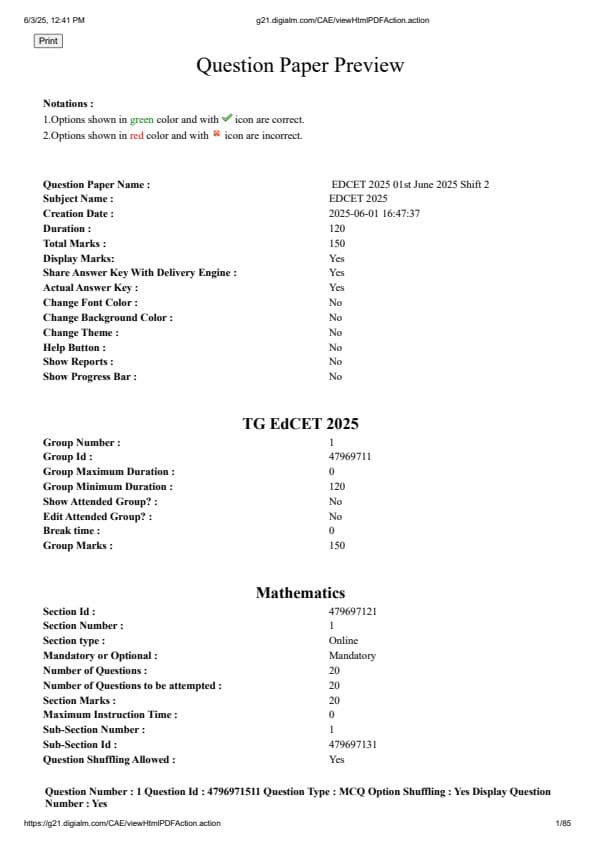
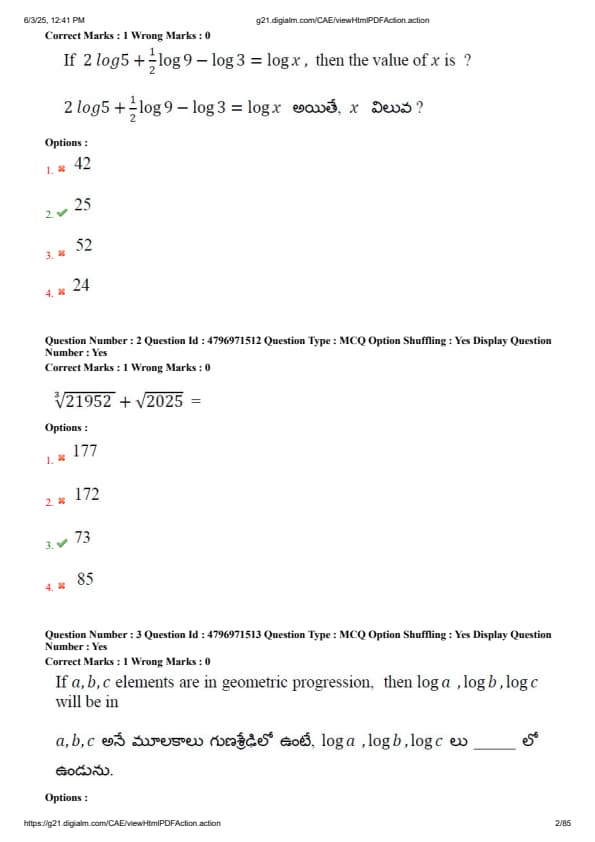
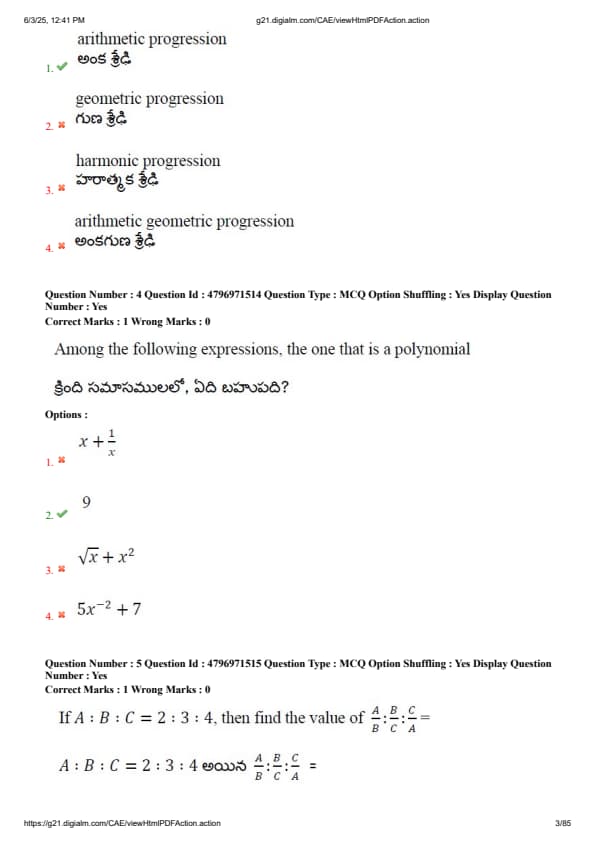
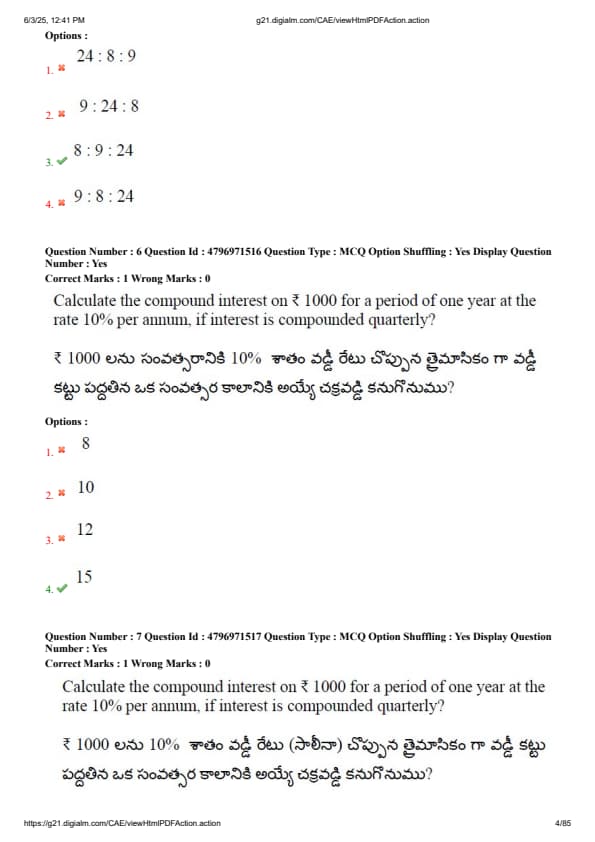
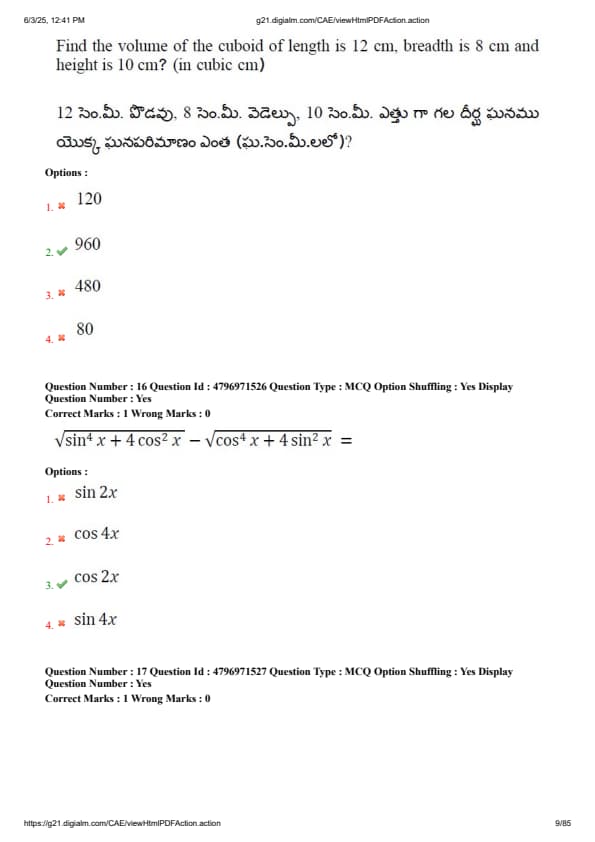
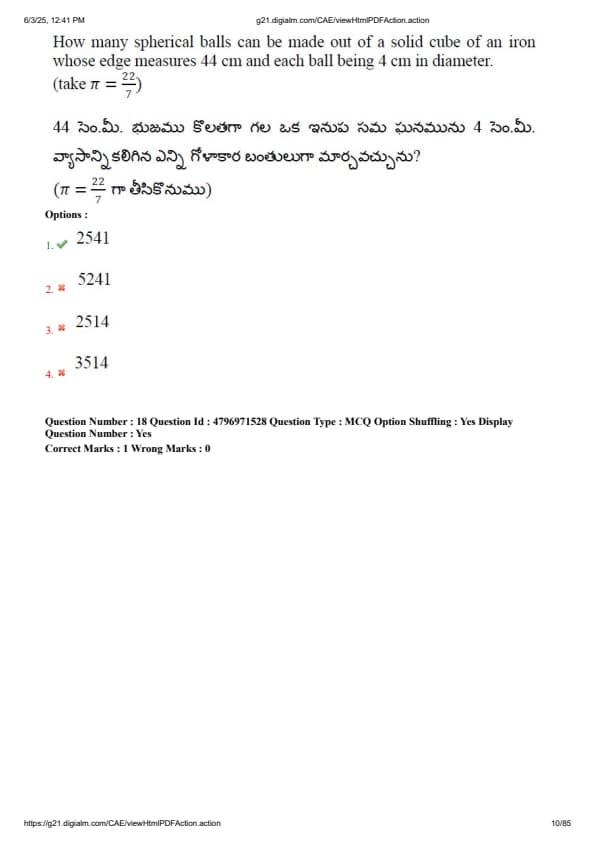
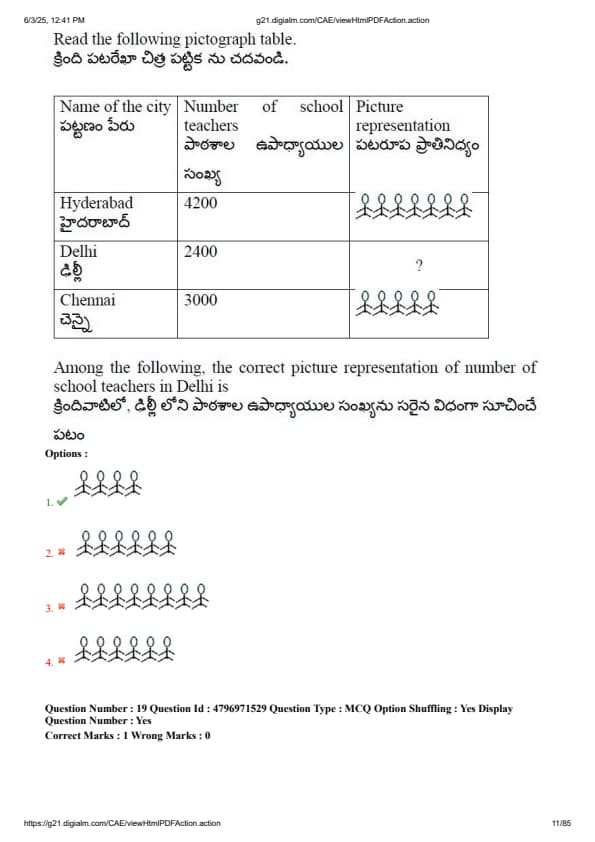
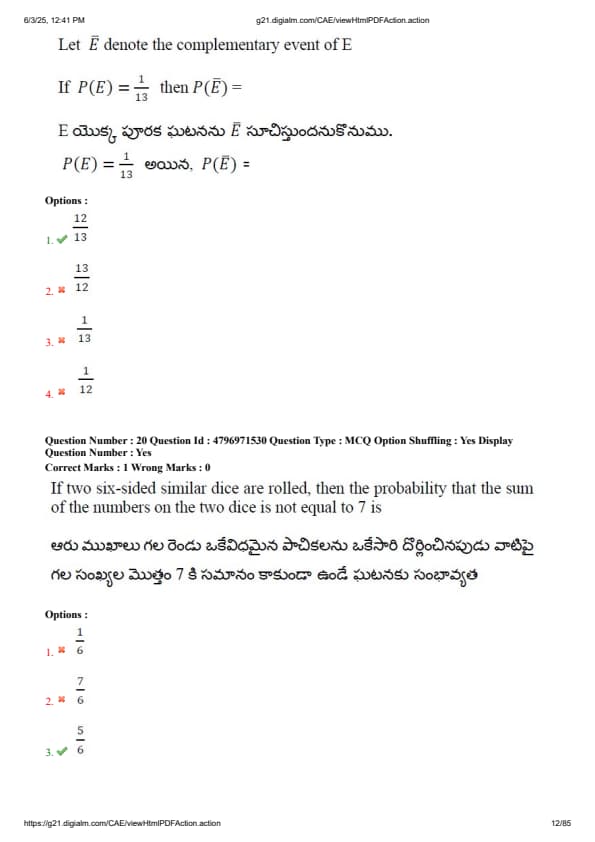
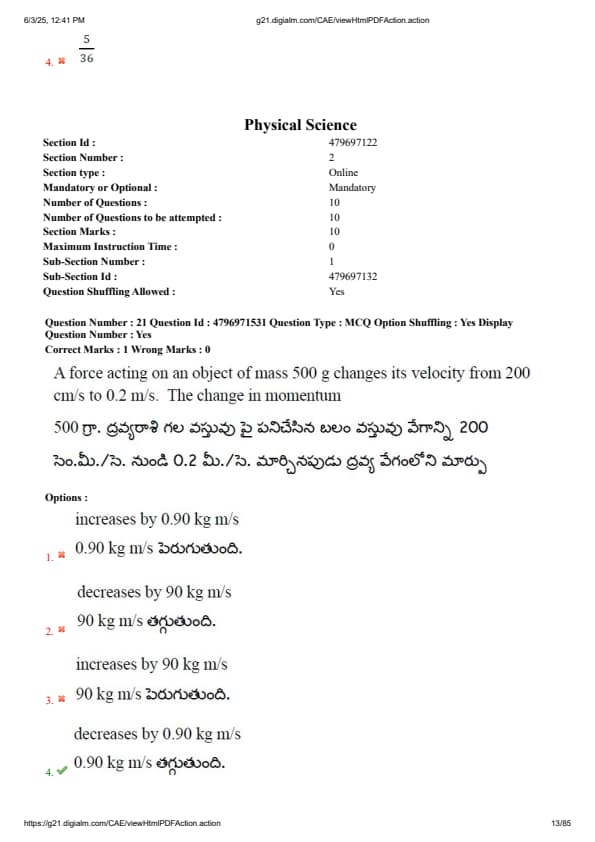
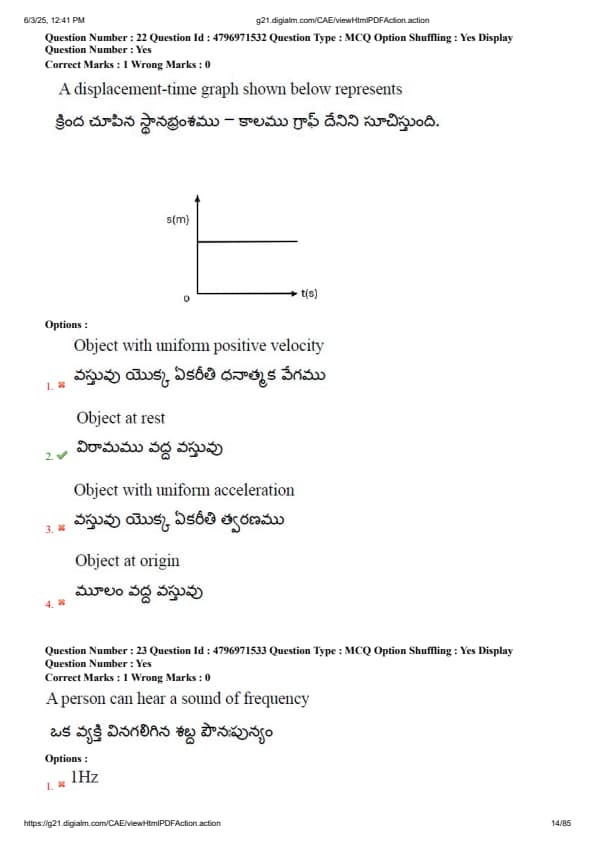
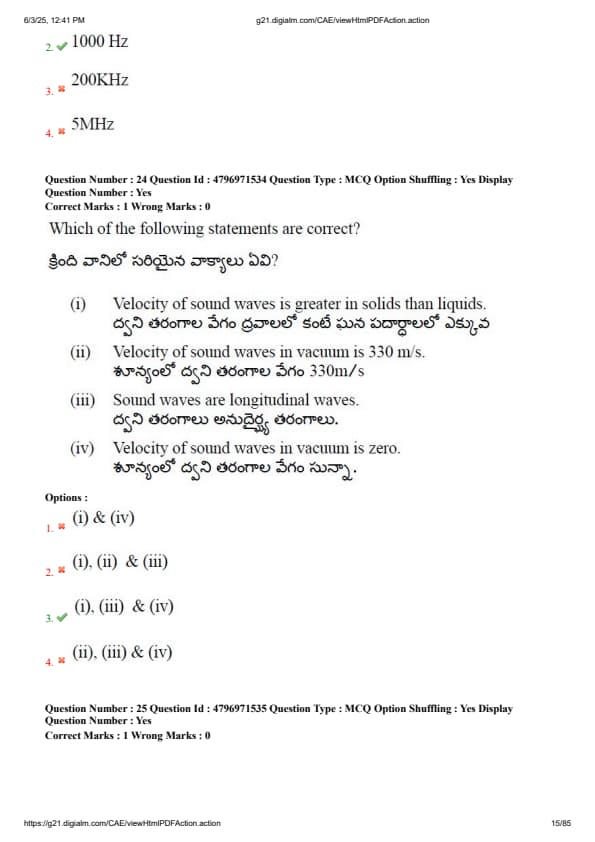
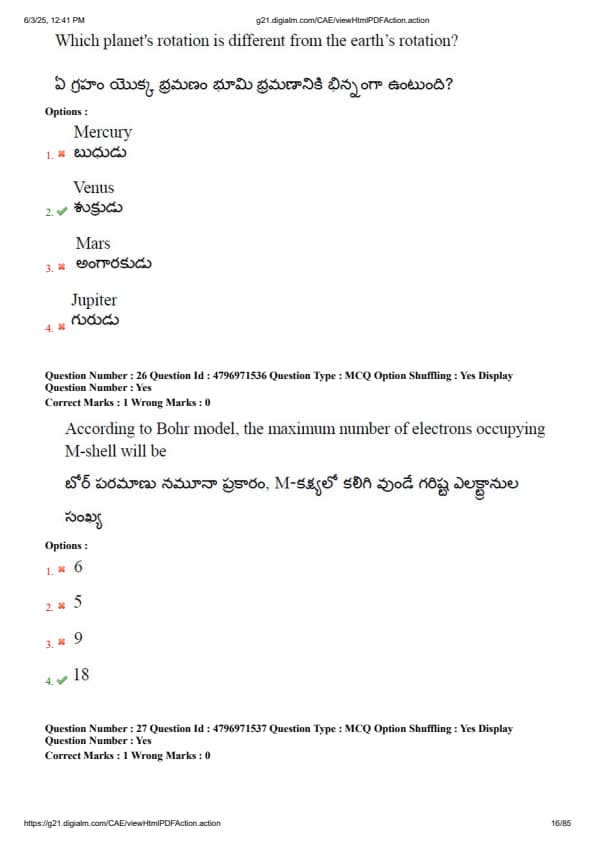
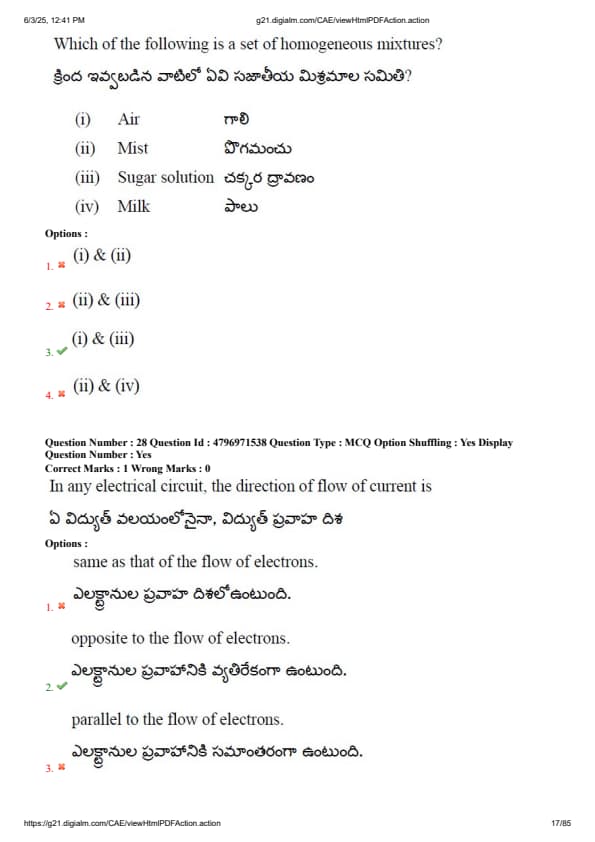
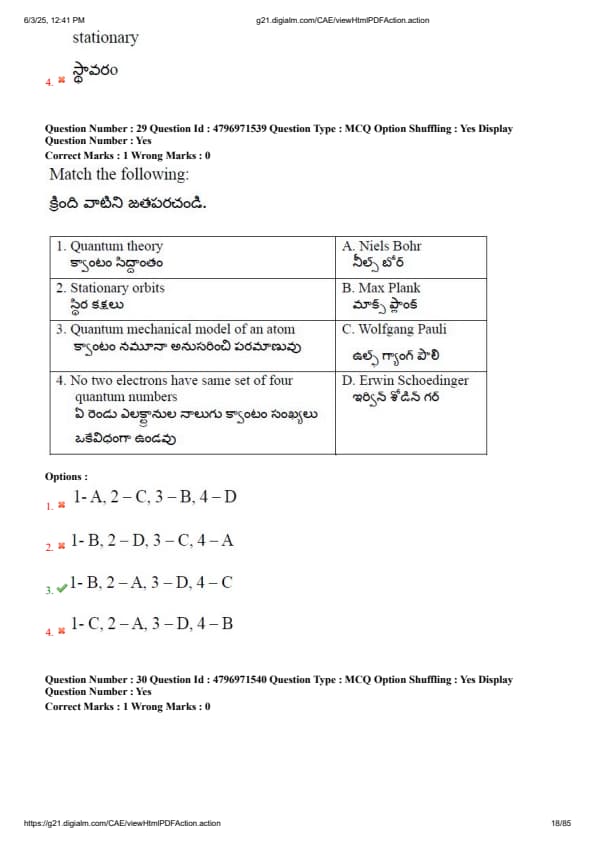
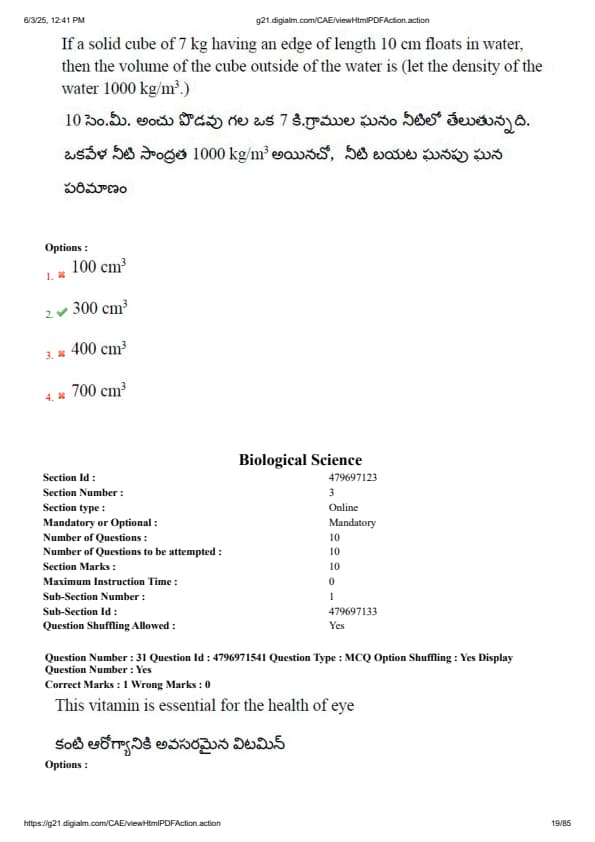
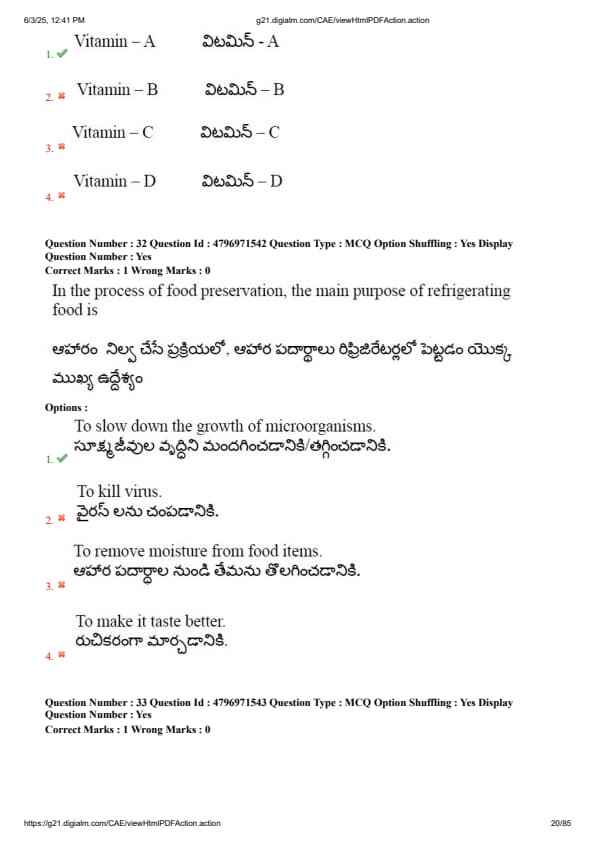
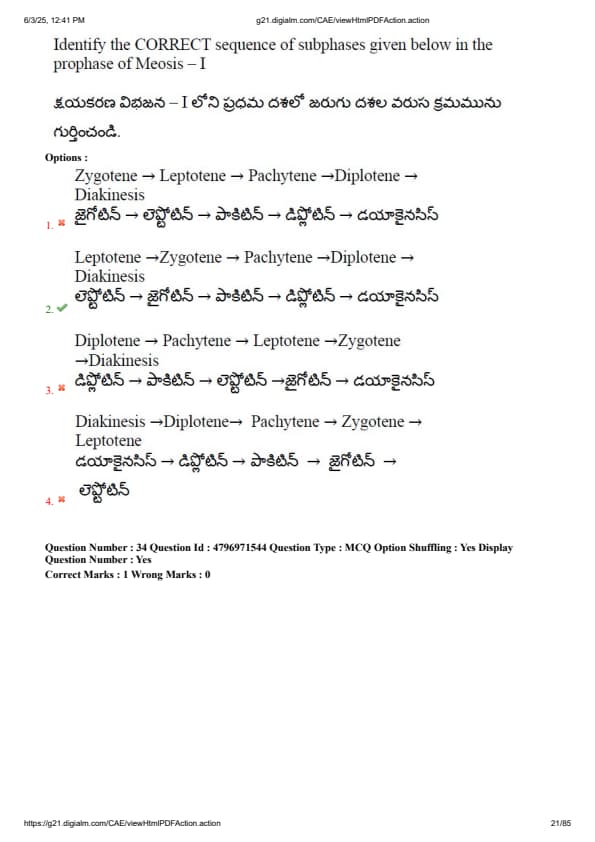
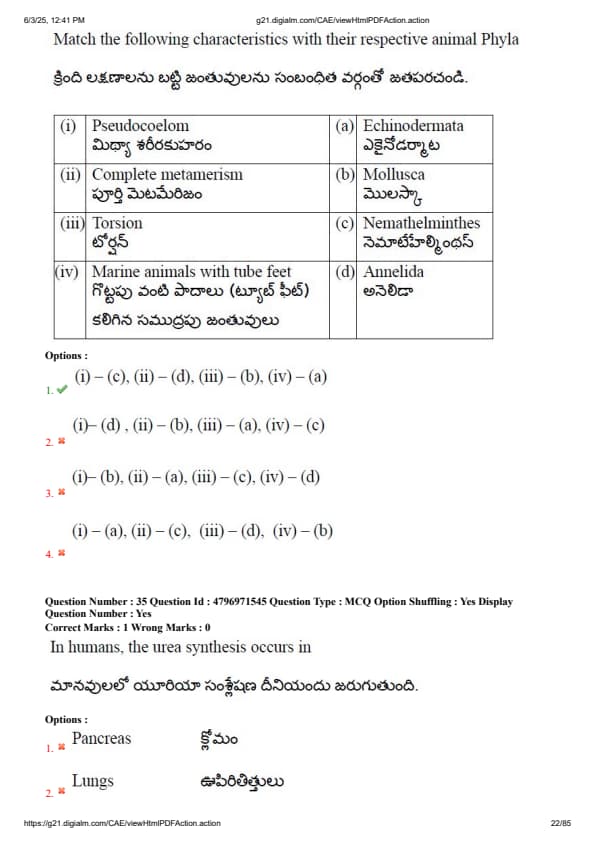
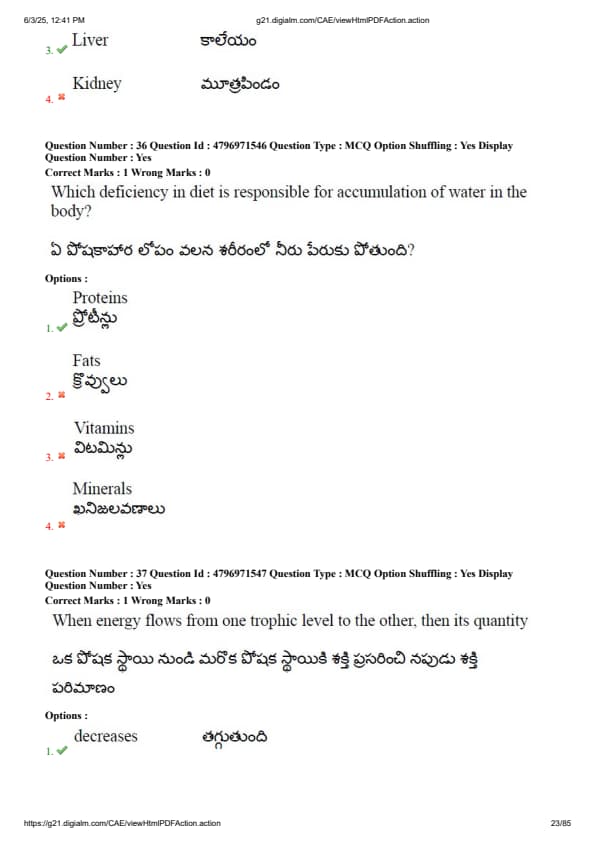
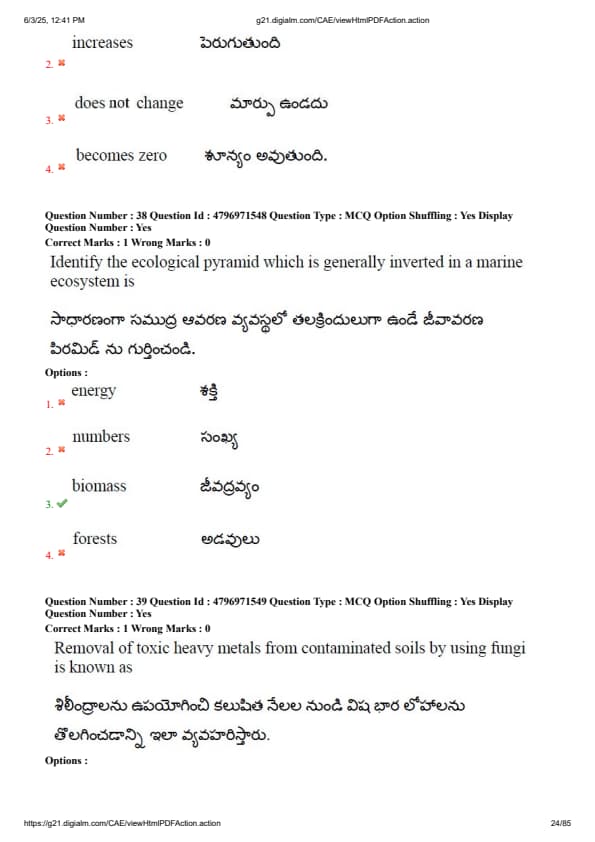
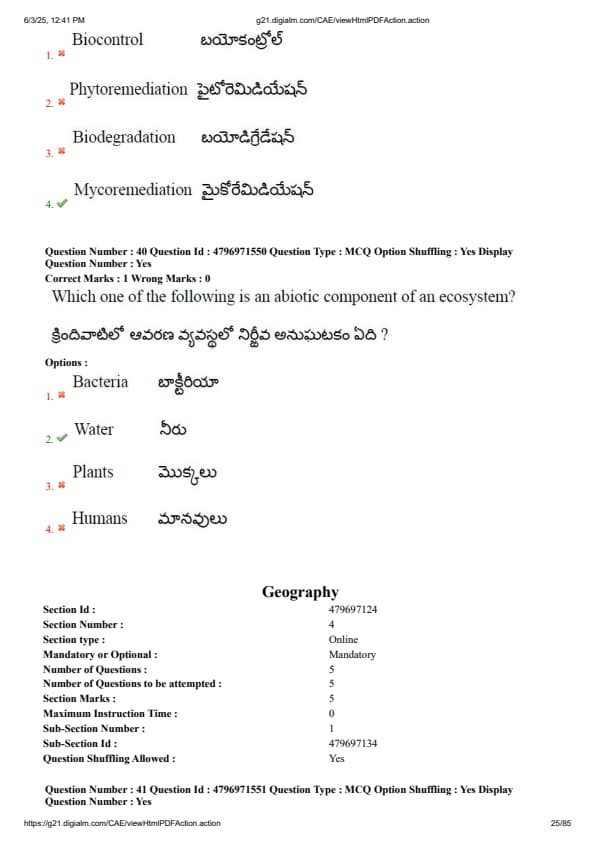
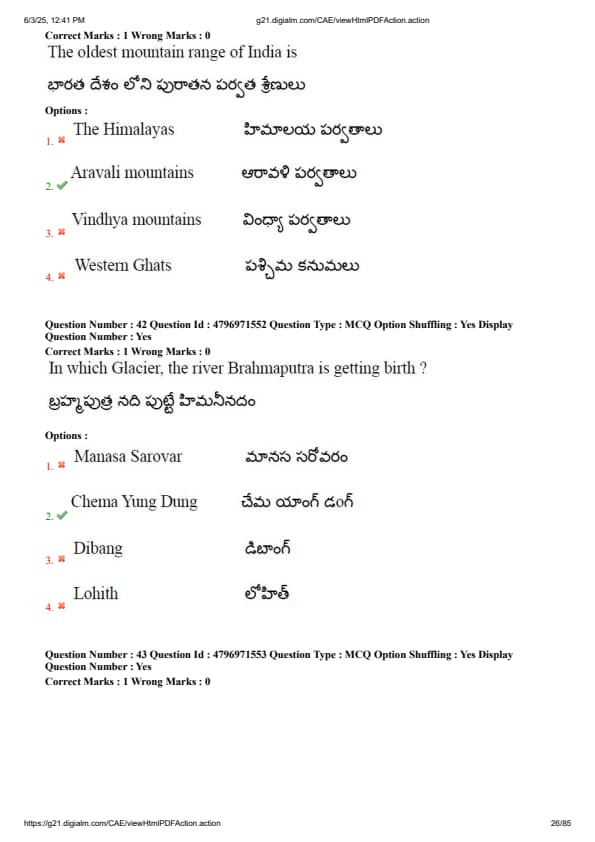
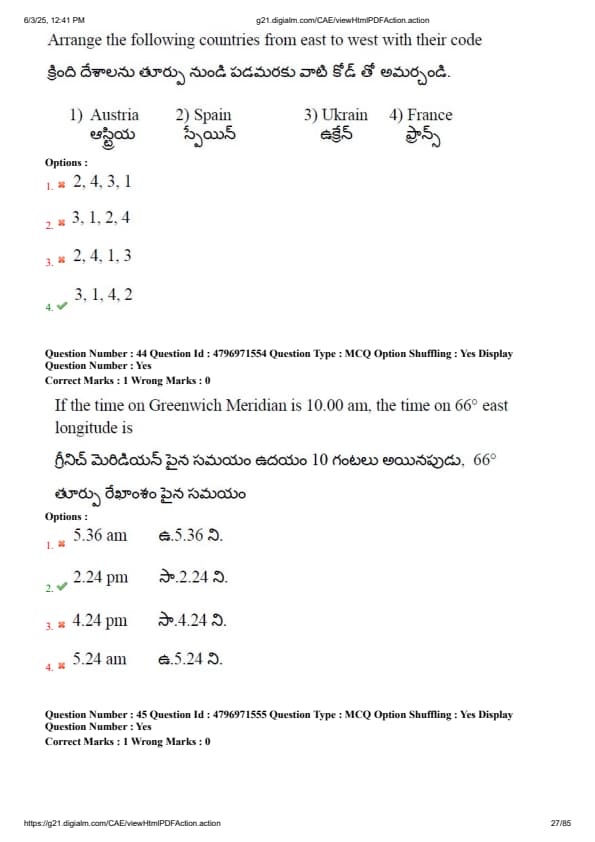
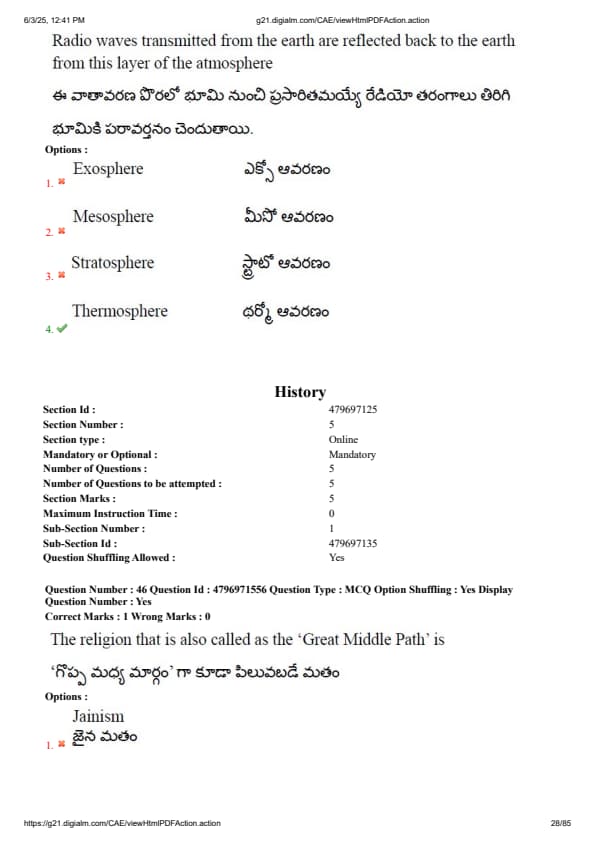
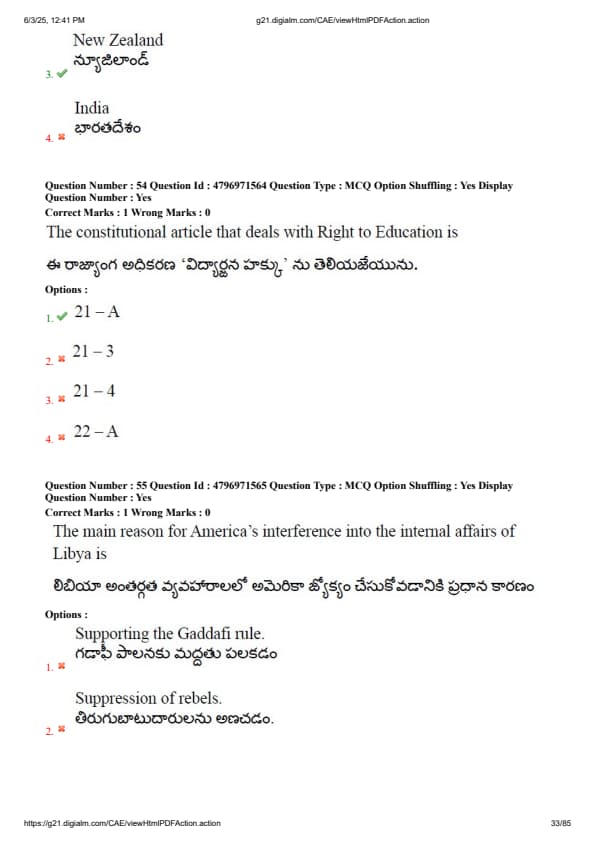
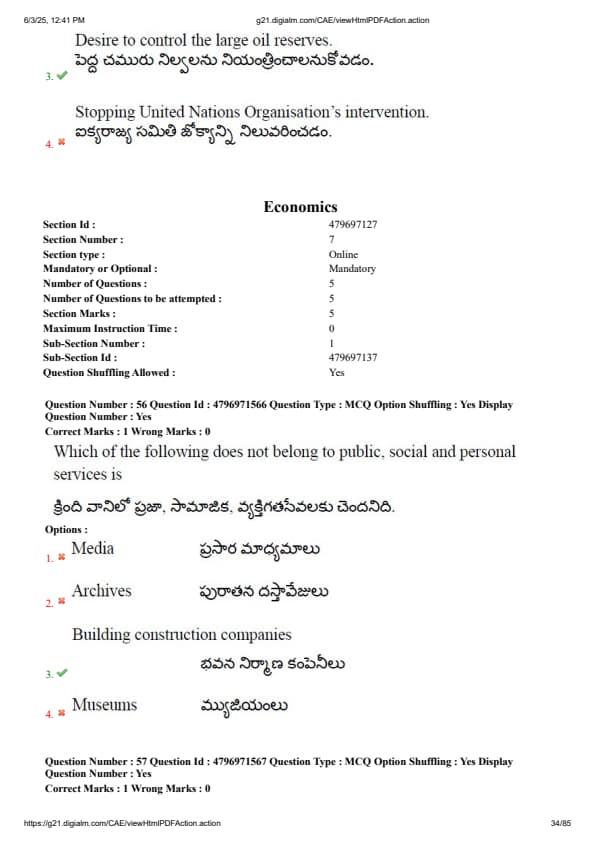
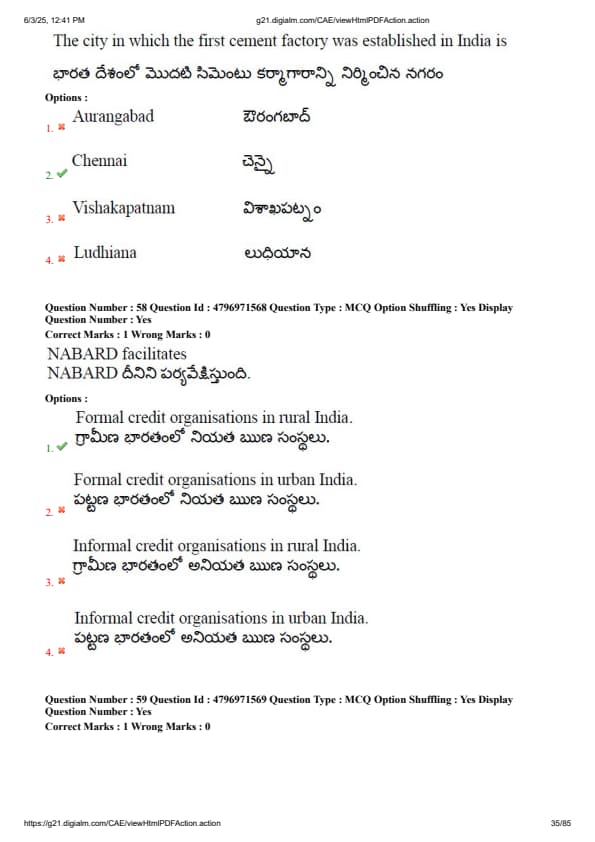
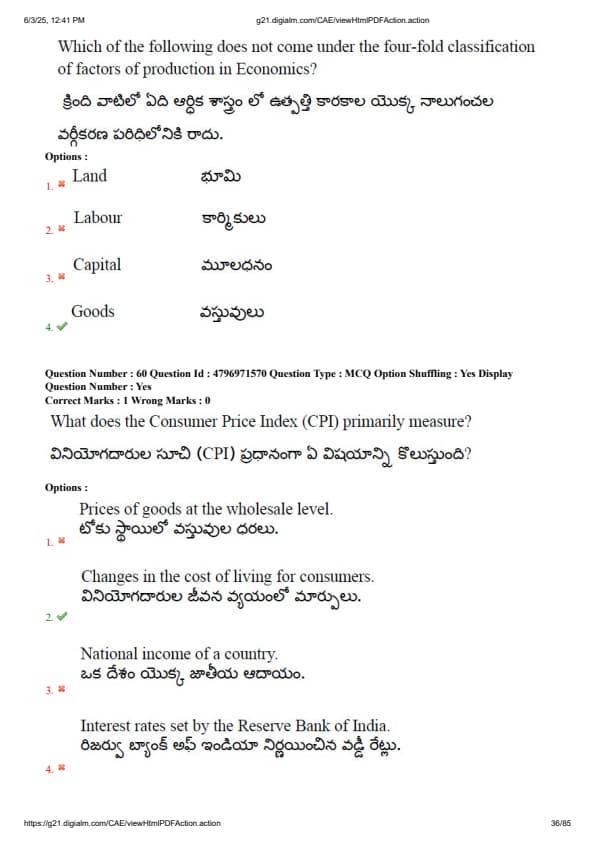
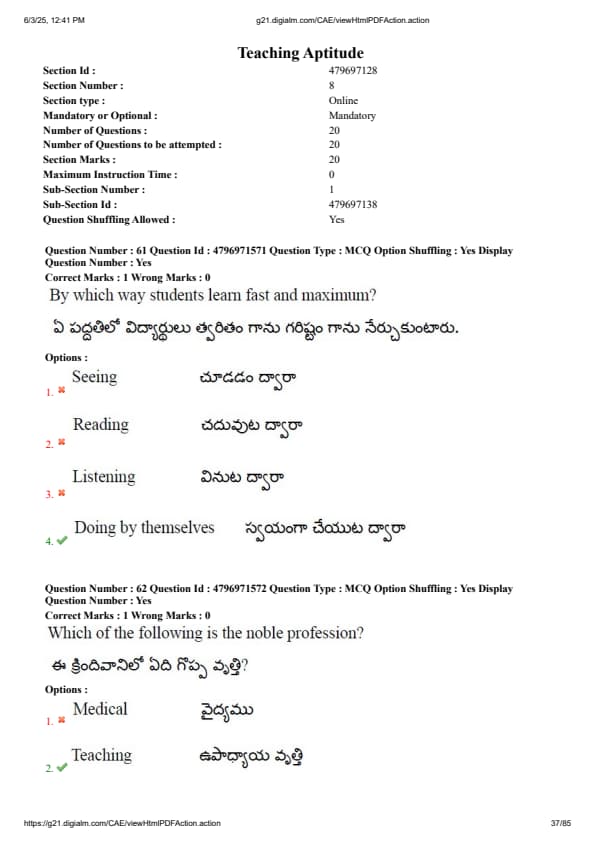
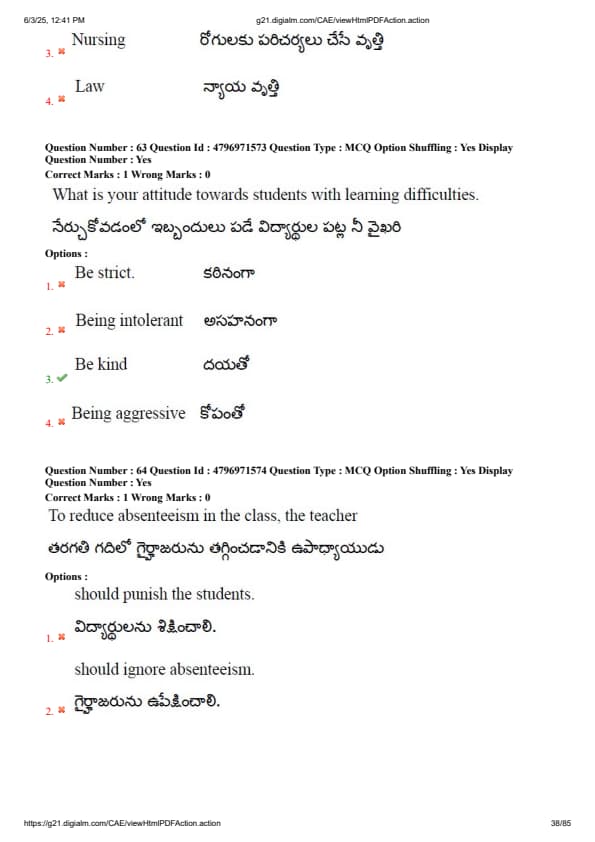
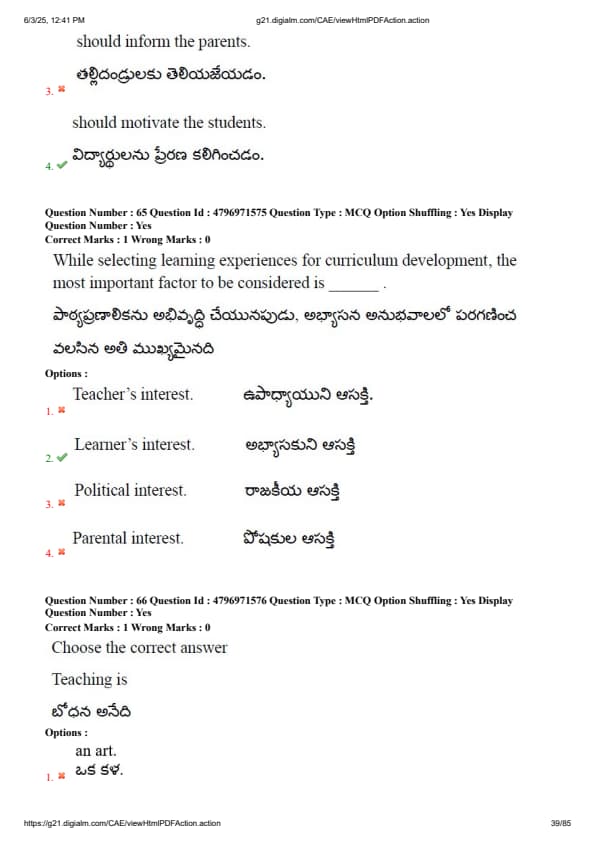
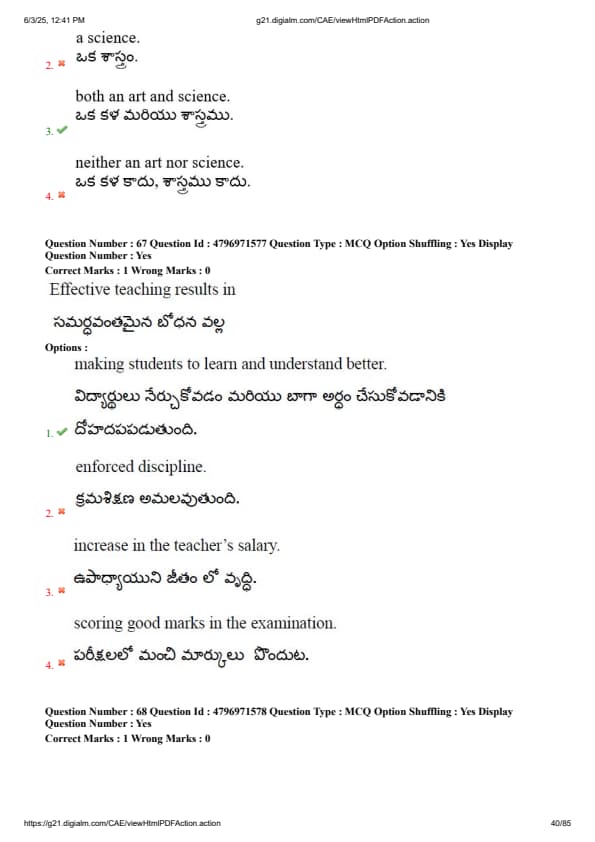





Comments