




Preparing for GATE Civil Engineering 2025 entails much more than determination; that also needs to be coupled with the right study material. More than 120,000 registered every year look forward to rank topping. Recent data insights reveal that Structural Analysis, Geotechnical Engineering, and Environmental Engineering together amount to almost half of the weightage on the exam, so the right kind of study material should be focused upon accordingly. We will take a high-yield reference book, an online platform, and some data-driven insights so you can focus on those topics that matter the most.
- The number of books, notes, and online study materials that should be referred to while preparing for an exam can become a confusing maze.
- Even with one great study material, you will be able to simplify the processes and maximize your preparation efficiency.
- In the article, we will give you the list of best books but also include data-driven insights based on analysis done with previous years and widely referred study resources.
Why Choosing the Right Study Material Matters
The emphasis of the GATE CE exam can be summarized as conceptual clarity, problem-solving ability, and proper time management. The cream applicants generally attribute their success to getting a good mix of textbooks, solved papers, and practice questions. Since each subject carries a different weightage in the exam, a study material according to your needs will help focus on the areas that matter most.
Related Articles:
- GATE Civil Engineering Syllabus Weightage
- Preparation Tips: GATE Civil Engineering 2025
- The Role of Soft Skills in Civil Engineering-2025
Subject Weightage Breakdown for GATE Civil Engineering
Suggested Article: GATE Civil Engineering Syllabus: Checkout Syllabus and Weightage, Valuable preparation tips
Here’s an overview of the approximate subject weightage in the GATE CE exam based on the past five years of papers:
| Subject | Approx. Weightage (%) |
|---|---|
| Geotechnical Engineering | 15-17% |
| Environmental Engineering | 12-14% |
| Structural Analysis | 8-10% |
| Fluid Mechanics & Hydraulics | 8-10% |
| Transportation Engineering | 6-8% |
| Engineering Mathematics | 12-15% |
Best Books for GATE Civil Engineering 2025 (Subject-Wise)
Suggested Article: GATE Civil Engineering 2025: Books
Here is a subject-wise breakdown of the best study materials and books, tailored according to the weightage and specific needs of GATE Civil Engineering aspirants.
Geotechnical Engineering (15-17%)
Geotechnical Engineering is the heaviest subject with a weightage of 15-17% for GATE CE. Books that provide clarity in concepts and ample numerical practice are essential.
| Book | Author/Publisher | Strength | Rating (Out of 5) |
|---|---|---|---|
| Principles of Geotechnical Engineering | B. M. Das | Clear explanations and numerous solved examples | 4.7 |
| Soil Mechanics and Foundations | B. C. Punmia | Comprehensive, with a focus on basic principles and practice | 4.5 |
| Basic and Applied Soil Mechanics | Gopal Ranjan, A. S. R. Rao | Conceptual clarity and detailed explanations | 4.6 |
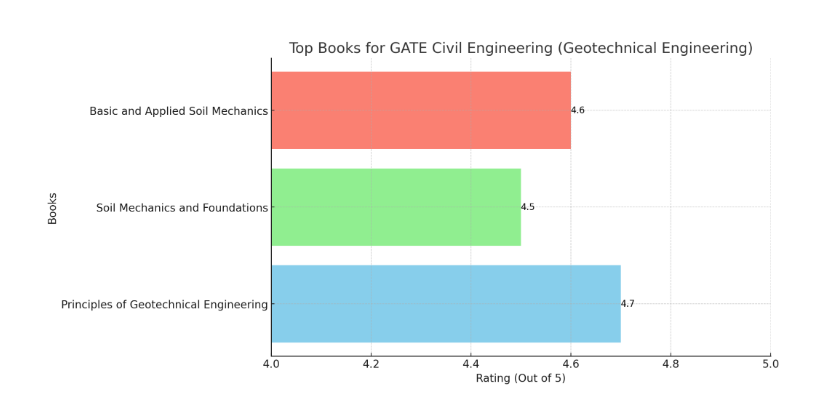
It is estimated from past trends in the pattern of the exam that 65-70% of questions related to geotechnicals are numerical. So, B. M. Das's Principles of Geotechnical Engineering has been highly recommended from the view of solutions to numerical problems.
Environmental Engineering (12-14%)
Environmental Engineering comprises about 12-14% of the GATE CE examination and only deals with water and wastewater engineering and air pollution. Hence, an exhaustive book that covers all aspects of theory and practice is very much needed.
| Book | Author/Publisher | Strength | Rating (Out of 5) |
|---|---|---|---|
| Environmental Engineering – Vol. 1 & 2 | B. C. Punmia, Ashok Jain | Detailed and conceptually strong, covers both theory and numerical problems | 4.6 |
| Environmental Engineering | S. K. Garg | Easy-to-understand and concise, well-structured explanations | 4.5 |
| Water Supply Engineering | S. K. Garg | Strong focus on water treatment processes and practical problems | 4.4 |
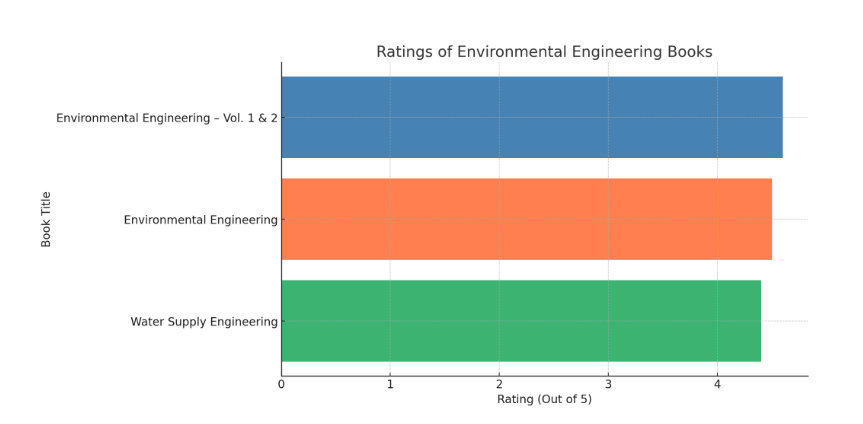
Approximately half of the problems in Environmental Engineering, the remaining half are numerical problems, such as BOD, COD, and water treatment efficiency calculation problems. B. C. Punmia's series is the best balanced one both in terms of theory and numerical questions.
Structural Analysis (8-10%)
Structural Analysis forms 8-10% of the exam. To approach this section a book with an emphasis on problem-solving techniques and a complete explanation of concepts is needed.
| Book | Author/Publisher | Strength | Rating (Out of 5) |
|---|---|---|---|
| Theory of Structures | S. Ramamrutham | Clear, concise explanations and ample solved examples | 4.7 |
| Structural Analysis | R. C. Hibbeler | Internationally acclaimed for detailed conceptual clarity | 4.6 |
| Basic Structural Analysis | C. S. Reddy | Good balance between theory and practical problems | 4.5 |
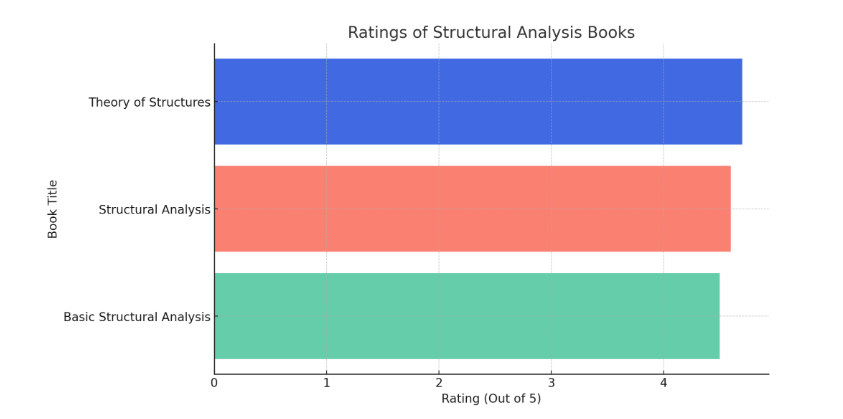
60% of the Structural Analysis questions are number problems, and Theory of Structures by S. Ramamrutham is recommended because it has good problem sets that fit the GATE pattern.
Fluid Mechanics & Hydraulics (8-10%)
Fluid mechanics hydraulics is about 8-10% on the exam. And a good understanding of flow dynamics, fluid properties, and hydraulic machines.
| Book | Author/Publisher | Strength | Rating (Out of 5) |
|---|---|---|---|
| Fluid Mechanics | R. K. Bansal | Easy to understand with numerous solved problems | 4.8 |
| Hydraulics and Fluid Mechanics Including Hydraulics Machines | P. N. Modi, S. M. Seth | Comprehensive with a focus on numerical problem-solving | 4.7 |
| Engineering Fluid Mechanics | K. L. Kumar | Covers all fundamental concepts thoroughly | 4.5 |
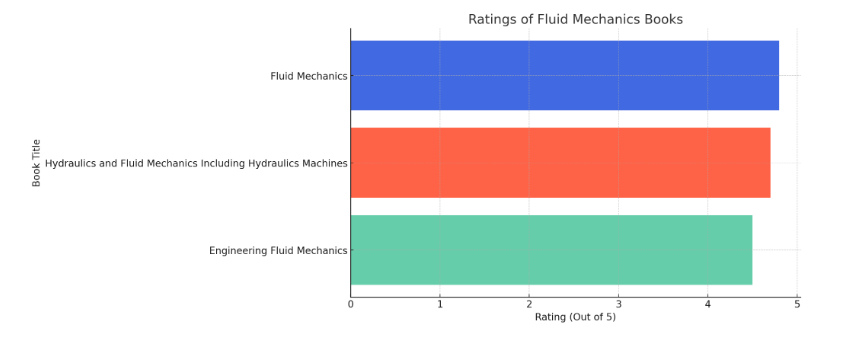
65-70% of Fluid Mechanics Hydraulics questions are numerical. R K Bansal's fluid mechanics is good because it has a lot of numerical and explains things well.
Transportation Engineering (6-8%)
Transportation Engineering constitutes around 6-8% of the total questions, and topics like pavement design, geometric design, and traffic engineering are vital.
| Book | Author/Publisher | Strength | Rating (Out of 5) |
|---|---|---|---|
| Highway Engineering | S. K. Khanna, C. E. G. Justo | Comprehensive coverage of geometric design and pavement design | 4.7 |
| Traffic Engineering & Transport Planning | L. R. Kadiyali | In-depth coverage of traffic characteristics and design | 4.5 |
70% of the questions in Transportation Engineering are theory, and the other 30% is numerical. S. K. Khanna's Highway Engineering is the most widely used because it covers both design and construction in great detail.
Engineering Mathematics (12-15%)
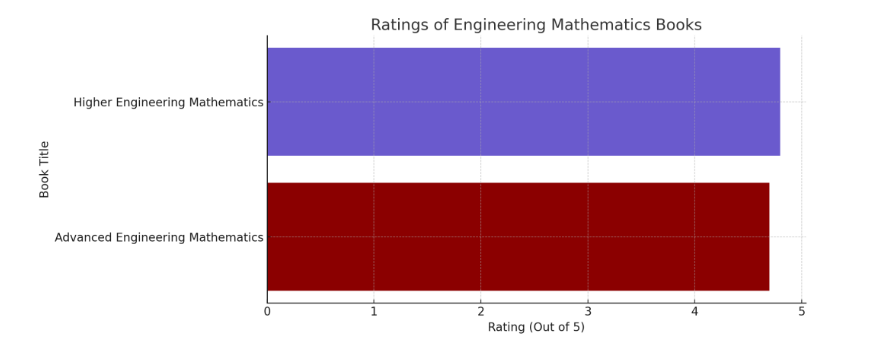
Engineering Mathematics is an important subject in GATE CE which takes 12-15% of the exam. It's mainly formula-based questions, so a good book with plenty of problems to practice is a must.
| Book | Author/Publisher | Strength | Rating (Out of 5) |
|---|---|---|---|
| Higher Engineering Mathematics | B. S. Grewal | Comprehensive, with a wide variety of solved problems | 4.8 |
| Advanced Engineering Mathematics | Erwin Kreyszig | Conceptual clarity with a strong focus on problem-solving | 4.7 |
Data Insight: Engineering Mathematics is very numerical, and Higher Engineering Mathematics by B. S. Grewal is very good because it has a lot of solving problems that are similar to the GATE pattern.
Comparison of Books Based on Weightage
To help you prioritize your study material according to subject weightage, here’s a quick reference chart:
| Subject | Weightage | Best Book/Material | Strengths |
|---|---|---|---|
| Geotechnical Engineering | 15-17% | Soil Mechanics and Foundations by B.C. Punmia | In-depth coverage of both theory and numerical problems. |
| Environmental Engineering | 12-14% | Environmental Engineering by Peavy & Rowe | Comprehensive for both theory and numerical, especially for water and wastewater treatment. |
| Structural Analysis | 8-10% | Theory of Structures by S. Ramamrutham | Best for solving complex indeterminate structures and influence lines. |
| Fluid Mechanics & Hydraulics | 8-10% | Fluid Mechanics by Yunus A. Cengel | Combines theory with practical applications, ideal for GATE-level numerical problems. |
| Transportation Engineering | 6-8% | Highway Engineering by S.K. Khanna | Perfect for highway design, traffic engineering, and pavement analysis. |
| Engineering Mathematics | 12-15% | Higher Engineering Mathematics by B.S. Grewal | Contains a wide range of problems, from simple to complex, making it perfect for scoring high. |
To prioritize your study material effectively for GATE Civil Engineering based on subject weightage, do read the following reference chart.
- The weightage is as high as 15-17% on Geotechnical Engineering, which Soil Mechanics and Foundations by B.C can better cover. Punmia. It gives greater insight into knowledge and numerical applications related to theoretical concepts.
- Very close to this is Environmental Engineering (12-14%), where Environmental Engineering by Peavy & Rowe is recommended for good coverage of water and wastewater treatment topics. Structural Analysis follows with a proportion of 8-10% and Theory of Structures by S. Ramamrutham is good as it is a strong book that can be used in the solution of complex indeterminate structures and influence lines.
- Fluid Mechanics and Hydraulics, contributing 8-10% can be studied using Fluid Mechanics by Yunus A. Cengel, which blends theoretical concepts with practical use oriented toward GATE-level numerical problems very efficiently.
- Transportation Engineering 6-8% weightage calls for focusing on the book Highway Engineering by S.K. Khanna, which discusses highway design, traffic engineering, and pavement analysis.
Finally, for Engineering Mathematics, with a content share of 12-15%, an apt approach will be the book Higher Engineering Mathematics by B.S. Grewal - comprising of a wide range of problems such that this would ideally suffice for varied ranges in which candidates can score well in this subject.
Comparison of Book Effectiveness for GATE Civil Engineering
| Subject | Top Recommended Book | Ease of Understanding | Conceptual Clarity | Problem-Solving | Overall Rating |
|---|---|---|---|---|---|
| Geotechnical Engineering | Principles of Geotechnical Engineering (Das) | 4.6 | 4.8 | 4.7 | 4.7 |
| Environmental Engineering | Environmental Engineering – Vol. 1 & 2 (Punmia) | 4.5 | 4.6 | 4.6 | 4.6 |
| Structural Analysis | Theory of Structures (Ramamrutham) | 4.7 | 4.7 | 4.6 | 4.7 |
| Fluid Mechanics & Hydraulics | Fluid Mechanics (Bansal) | 4.8 | 4.6 | 4.8 | 4.8 |
| Transportation Engineering | Highway Engineering (Khanna, Justo) | 4.7 | 4.6 | 4.6 | 4.7 |
| Engineering Mathematics | Higher Engineering Mathematics (Grewal) | 4.8 | 4.8 | 4.8 | 4.8 |
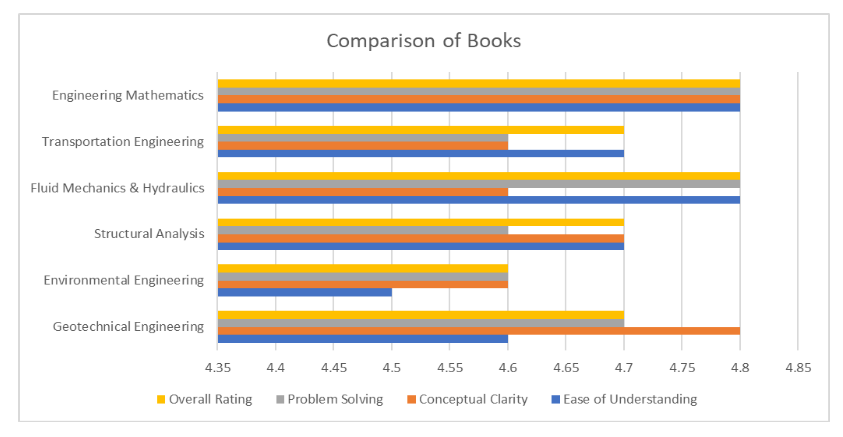
Here's a point-by-point comparison of book effectiveness for GATE Civil Engineering according to the table and the graph:
- Geotechnical Engineering: Principles of Geotechnical Engineering by B.M. Das carries an excellent score of 4.7 overall. Here, it has excelled in conceptual clarity and problem-solving with an excellent score of 4.8 and 4.7, respectively.
- Environmental Engineering: Environmental Engineering – Vol. 1 & 2 by B.C. Punmia has a good reputation overall with a rating of 4.6. The book is said to be easy to understand, thereby having good conceptual clarity, which allows the main environmental-related concepts to be learned by students.
- Structural Analysis: The book Theory of Structures by S. Ramamrutham has a rating of 4.7 in general, indicating that it is doing very well across all the categories put in place. It scores full with a 4.7 for understanding and does well with a 4.7 in conceptual clarity as well. So, it should be pretty effective for solving structural problems of complexity.
- Fluid Mechanics & Hydraulics: Fluid Mechanics by R.K. Bansal has the highest overall rating at 4.8. It has very good skills in problem-solving skills (4.8) and ease of understanding the concept (4.8), hence standing out for a student wishing to know the practical applications of fluid mechanics.
- Transportation Engineering: S.K. Khanna and C.E.G. Justo: Highway Engineering: Maintains a good performance with an average rating of 4.7. Relatively easy to understand with a proper grasp of intricate concepts for students.
- Engineering Mathematics: Higher Engineering Mathematics by B.S. Grewal - Has an aggregate rating of 4.8. It does extremely well in all dimensions that concern ease of understanding, conceptual clarity, and problem-solving ability, which is what makes it an impossibility to miss it for any student looking to score top grades in this area of study.
Overall, the comparison brings out the fact that these recommended books are based not only on sound theoretical findings but also on ease of understanding and efficiency in problem-solving. This type of evaluation will be pretty helpful for taking the GATE Civil Engineering exam.
GATE CE Toppers’: Recommended Study Material
The recommended study material for GATE Civil Engineering (CE) 2025 is based on insights from previous years' toppers:
| Subject | Recommended Books | Author/Publisher | Notes |
| Engineering Mathematics | Higher Engineering Mathematics | B.S. Grewal | Comprehensive coverage with solved examples. |
| Advanced Engineering Mathematics | R.K. Jain | Focus on engineering applications and concepts. | |
| Structural Engineering | Structural Analysis | R.C. Hibbeler | Detailed explanations and problems for practice. |
| Design of Reinforced Concrete Structures | A. K. Jain | Focuses on design principles with examples. | |
| Design of Steel Structures | A. Bhavikatti | Clear illustrations and design examples. | |
| Geotechnical Engineering | Principles of Geotechnical Engineering | Braja M. Das | Excellent for understanding basic concepts. |
| Soil Mechanics | V.N. S. Murthy | In-depth coverage of soil properties and mechanics. | |
| Water Resources Engineering | Irrigation and Water Resources Engineering | A. M. Michael | Covers irrigation design and management. |
| Hydrology | H. M. Raghunath | Comprehensive hydrology concepts and case studies. | |
| Environmental Engineering | Environmental Engineering: A Design Approach | Howard S. Peavy | Practical approach to environmental problems. |
| Wastewater Engineering | Metcalf & Eddy | Detailed design guidelines and calculations. | |
| Transportation Engineering | Transportation Engineering: An Introduction | C.S. Papacostas | Great for foundational concepts in transportation. |
| Traffic Engineering | Paul H. Wright | Focus on traffic flow theories and applications. | |
| Surveying | Surveying Theory and Practice | Barry Kavanagh | Comprehensive coverage with practical applications. |
| A Textbook of Surveying | A. N. Chandra | Suitable for beginners, clear illustrations. | |
| Construction Management | Construction Project Management | Harold Kerzner | Excellent for understanding project management skills. |
| Construction Management: Principles and Practice | Paul Netscher | Offers practical insights into managing construction. | |
| General Aptitude | Quantitative Aptitude for Competitive Examinations | R.S. Aggarwal | Strong focus on quantitative skills and problem-solving. |
| Verbal and Non-Verbal Reasoning | R.S. Aggarwal | Essential for enhancing reasoning abilities. |
Quick Links:
- GATE 2024 Civil Engineering Question Paper PDF- Download Here
- GATE 2024 Civil Engineering (CE) Paper Analysis (out), Difficulty Level, Weightage of Topics
- GATE Civil Engineering Preparation Strategy for 2025: Detailed subject-wise preparation tips
In short, the right study material is important to crack the GATE Civil Engineering exam. The paper mentions that with weightage of the subject customized it gives the idea of the best available book. Further reflection on texts widely reviewed with a focus on conceptual clarity and practical problem-solving will enhance the efficiency of preparation for aspirants. The points uncovered through these data insights make it important to focus study, and candidates can concentrate more on high-weightage subjects like Geotechnical and Environmental Engineering. Proper resourceful planning may well help aspirants for GATE confidently ride over the complexities of this exam and pave the way for their postgraduation aspirations or coveted positions within public sector units.



Comments