




GATE 2021 Aerospace Engineering (AE) Question Paper was conducted on Feb 6 in the afternoon session time of 3 – 6PM IST. Students ca download GATE AE 2021 question paper with answer key PDF from website now. GATE AE 2021 question paper with answer key PDF was release by IIT Bombay. Overall difficulty level of the exam was found between easy to moderate. The subject specific areas were separated into six divisions, each of which has been broken into two categories: Core Topics and Special Topics. The question paper contained 90% of the questions on Core Topics and 10% on Special Topics.
Students preparing for GATE AE 2021 should get acquainted with the previous papers so that they can have thorough understanding of paper pattern and syllabus and students can contribute well in the exams.
GATE 2021 Aerospace Engineering (AE) Question Paper with Solutions
| GATE 2021 Aerospace Engineering (AE) Question Paper |  Download Download |
Check Solutions |
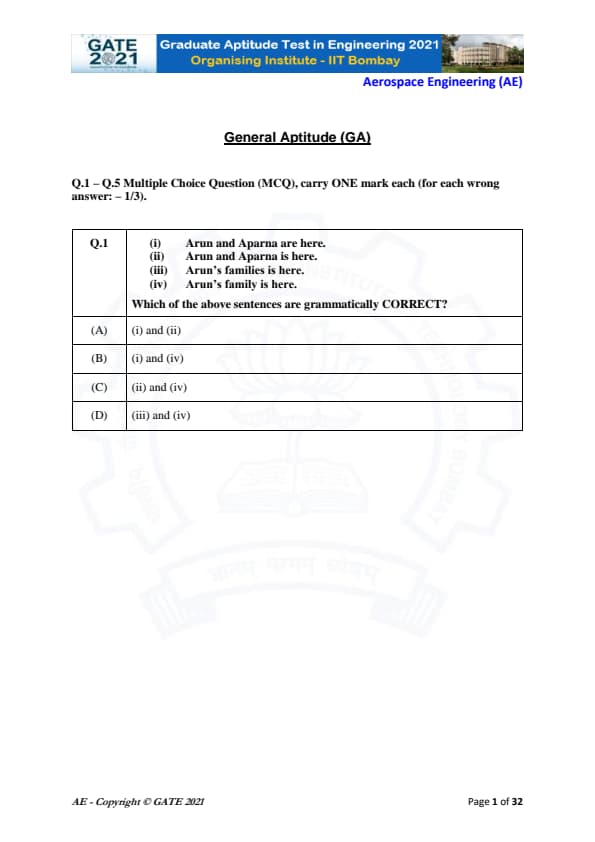
Which of the following sentences are grammatically CORRECT?
(i) Arun and Aparna are here.
(ii) Arun and Aparna is here.
(iii) Arun's families is here.
(iv) Arun's family is here.
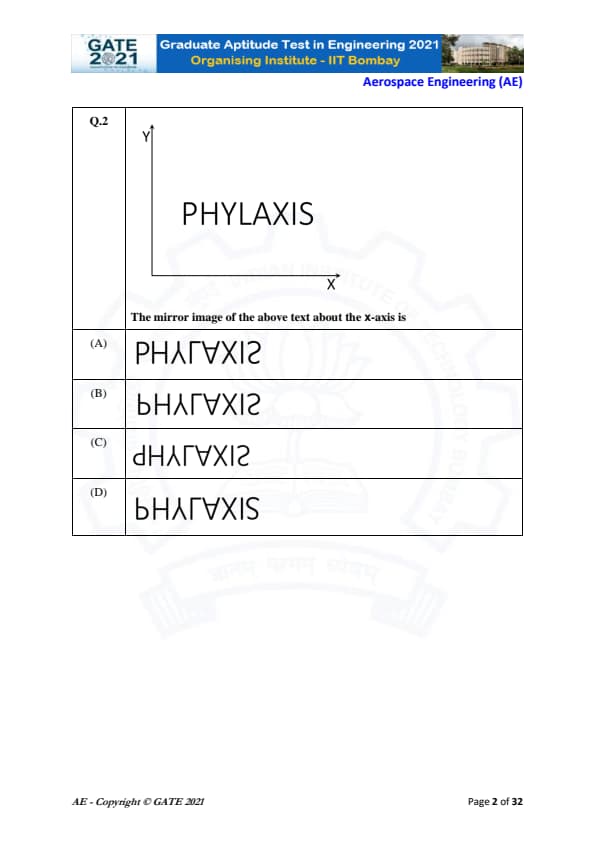
The mirror image of the above text about the x-axis is


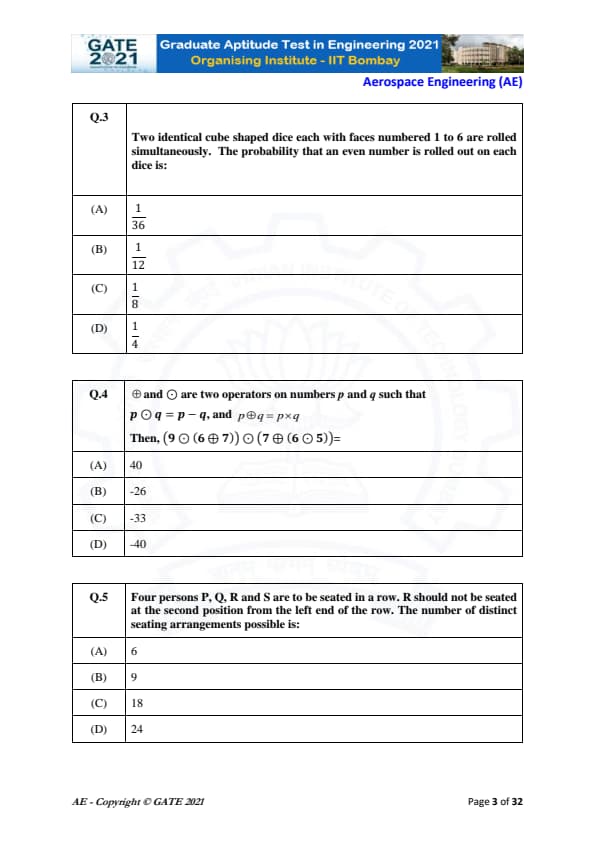
Two identical cube-shaped dice each with faces numbered 1 to 6 are rolled simultaneously. The probability that an even number is rolled out on each dice is:
\(\oplus\) and \(\odot\) are two operators on numbers \(p\) and \(q\) such that \(p \odot q = p - q\) and \(p \oplus q = p \times q\). Find the value of \((9 \odot (6 \oplus 7)) \odot (7 \oplus (6 \odot 5))\).
Four persons P, Q, R and S are to be seated in a row. R should not be seated at the second position from the left end. The number of distinct seating arrangements possible is:
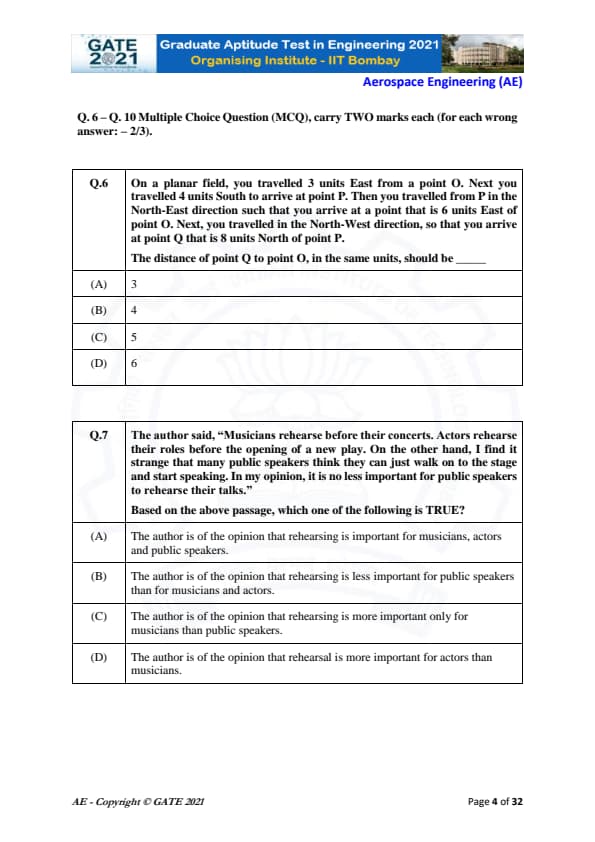
On a planar field, you travelled 3 units East from a point O. Next you travelled 4 units South to arrive at point P. Then you travelled from P in the North-East direction such that you arrive at a point that is 6 units East of point O. Next, you travelled in the North-West direction, so that you arrive at point Q that is 8 units North of point P. The distance of point Q to point O, in the same units, should be ________
Based on the author's statement about musicians, actors and public speakers rehearsing, which one of the following is TRUE?
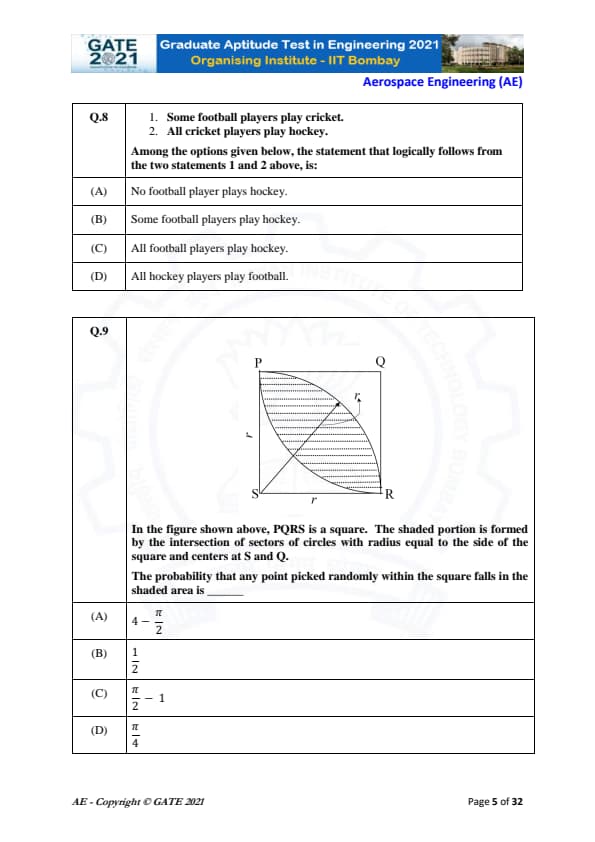
1. Some football players play cricket.
2. All cricket players play hockey.
Among the options given below, the statement that logically follows from the two statements 1 and 2 above, is:
In the figure, PQRS is a square. The shaded part is formed by the intersection of sectors of two circles of radius equal to the side of the square and centers at S and Q.
The probability that a random point inside the square lies in the shaded region is:

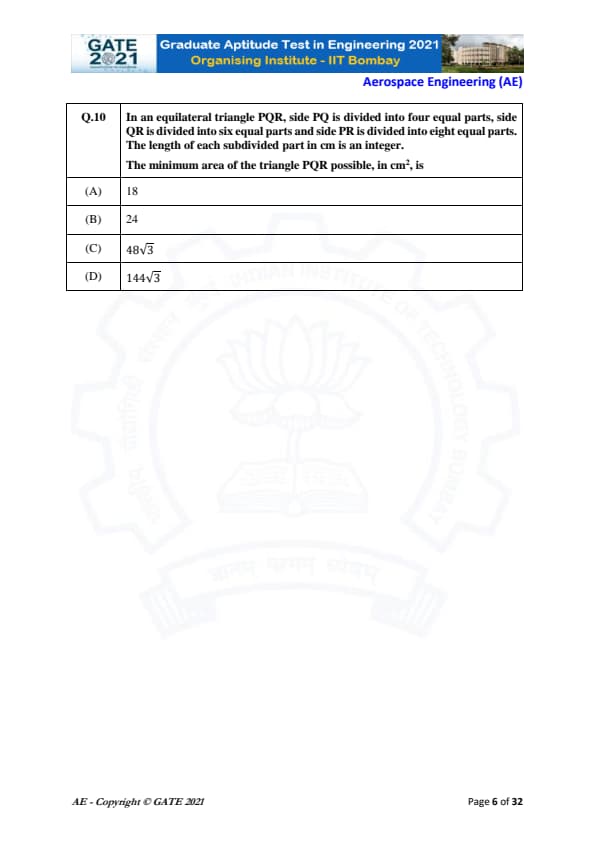
In an equilateral triangle PQR, side PQ is divided into four equal parts, side QR is divided into six equal parts and side PR is divided into eight equal parts.
The length of each subdivided part in cm is an integer.
The minimum area of the triangle PQR possible, in cm\(^2\), is:
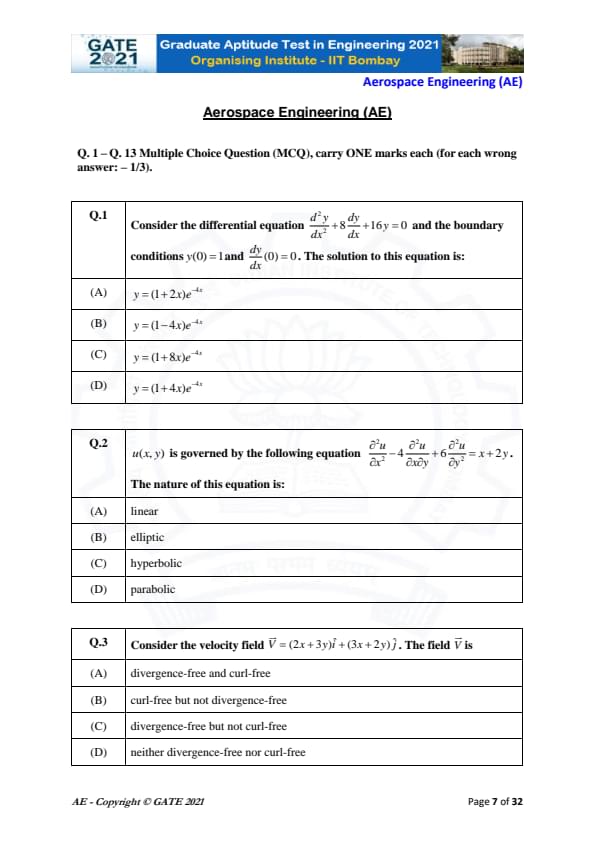
Consider the differential equation \[ \frac{d^{2}y}{dx^{2}} + 8\frac{dy}{dx} + 16y = 0 \]
and the boundary conditions \( y(0) = 1 \) and \( \frac{dy}{dx}(0) = 0 \).
The solution to this equation is:
The PDE \[ \frac{\partial^{2}u}{\partial x^{2}} - 4\frac{\partial^{2}u}{\partial x \partial y} + 6\frac{\partial^{2}u}{\partial y^{2}} = x + 2y \]
The nature of this equation is:
Consider the velocity field \[ \vec{V} = (2x + 3y)\hat{i} + (3x + 2y)\hat{j}. \]
The field \( \vec{V} \) is:
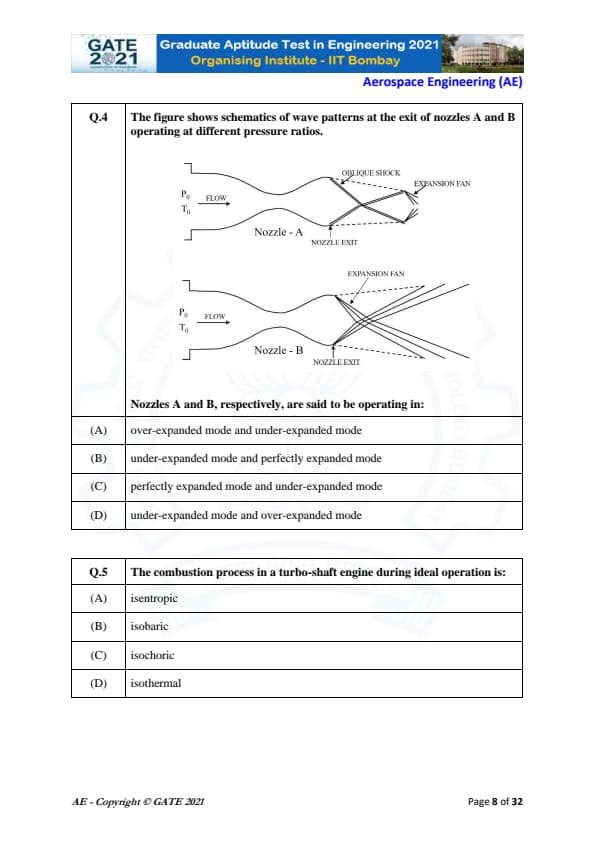
The figure shows schematics of wave patterns at the exit of nozzles A and B operating at different pressure ratios.

Nozzles A and B, respectively, are said to be operating in:
The combustion process in a turbo-shaft engine during ideal operation is:
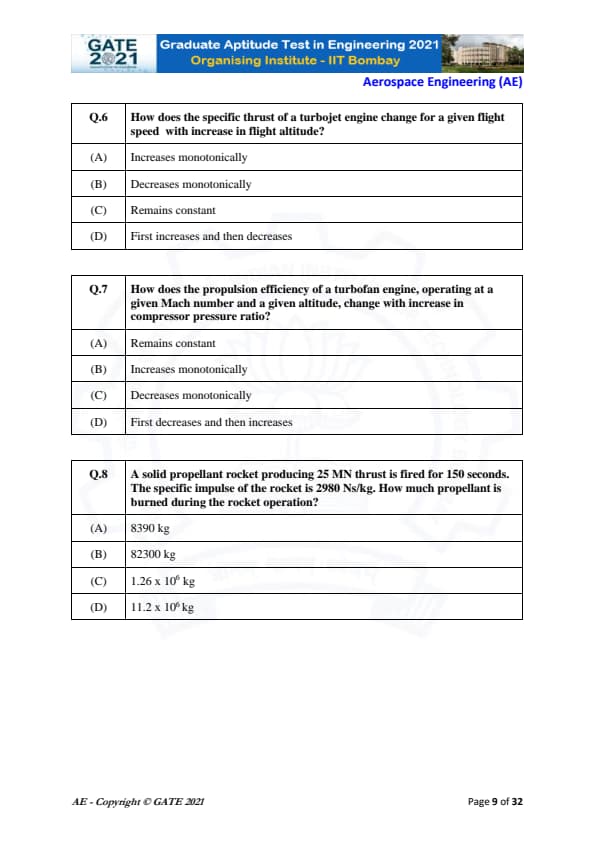
How does the specific thrust of a turbojet engine change for a given flight speed with increase in flight altitude?
How does the propulsion efficiency of a turbofan engine, operating at a given Mach number and altitude, change with increase in compressor pressure ratio?
A solid propellant rocket producing 25 MN thrust is fired for 150 seconds. The specific impulse of the rocket is 2980 Ns/kg. How much propellant is burned during the rocket operation?
The shape of a supersonic diffuser that slows down a supersonic flow to subsonic flow is
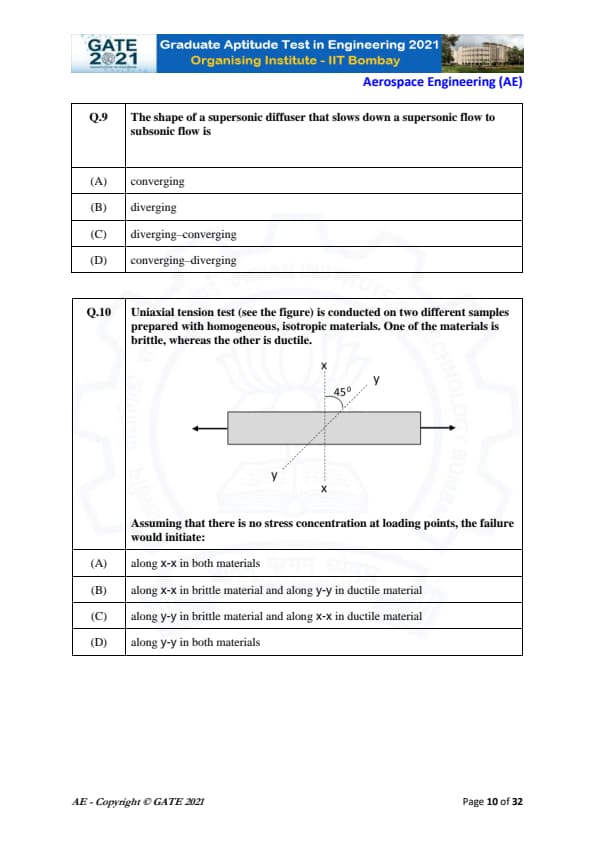
In a uniaxial tension test on two homogeneous, isotropic samples (one brittle, one ductile), the failure would initiate along which planes?

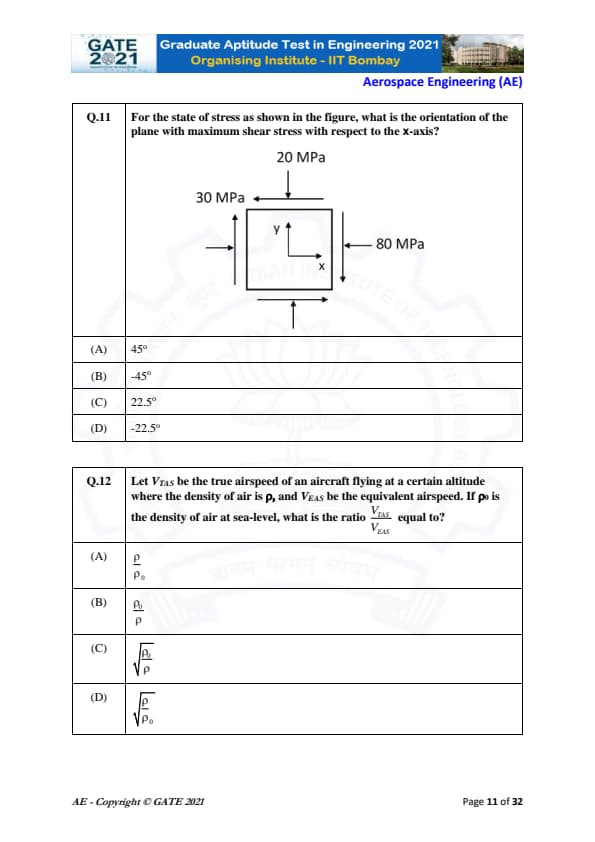
For the state of stress as shown in the figure, what is the orientation of the plane with maximum shear stress with respect to the x-axis?

Let \(V_{TAS}\) be the true airspeed of an aircraft flying at a certain altitude where the density of air is \(\rho\), and \(V_{EAS}\) be the equivalent airspeed. If \(\rho_0\) is the density of air at sea-level, what is the ratio \(\frac{V_{TAS}}{V_{EAS}}\) equal to?
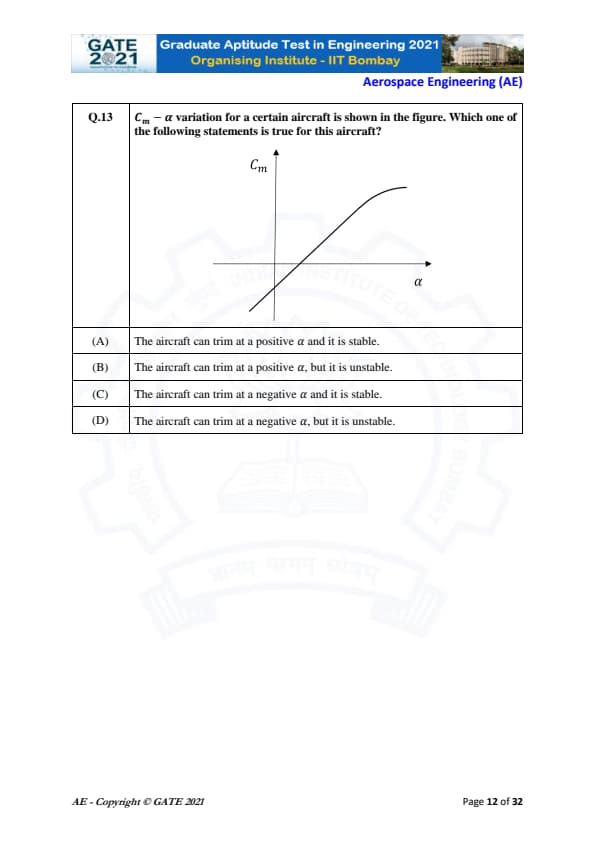
\(C_m - \alpha\) variation for a certain aircraft is shown in the figure. Which one of the following statements is true for this aircraft?

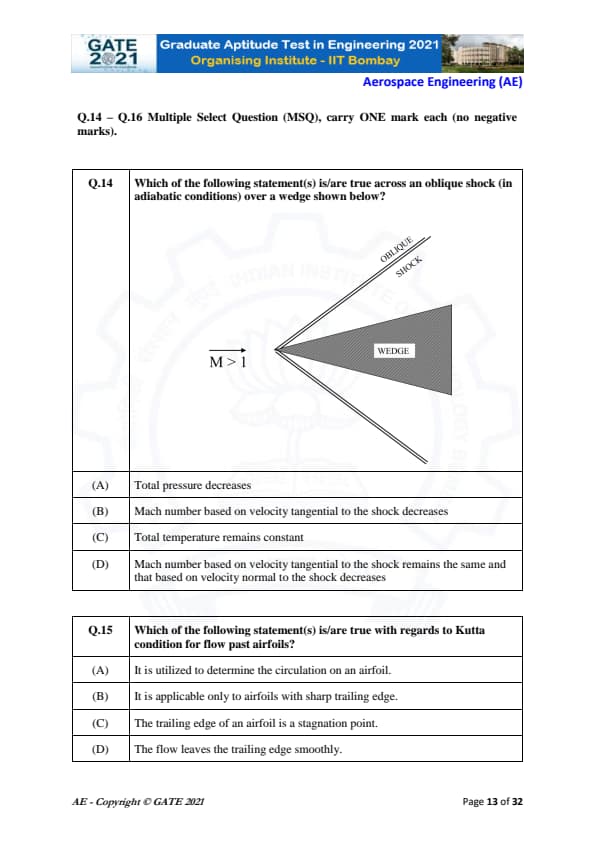
Which of the following statement(s) is/are true across an oblique shock (in adiabatic conditions) over a wedge shown below?

Which of the following statement(s) is/are true with regards to Kutta condition for flow past airfoils?
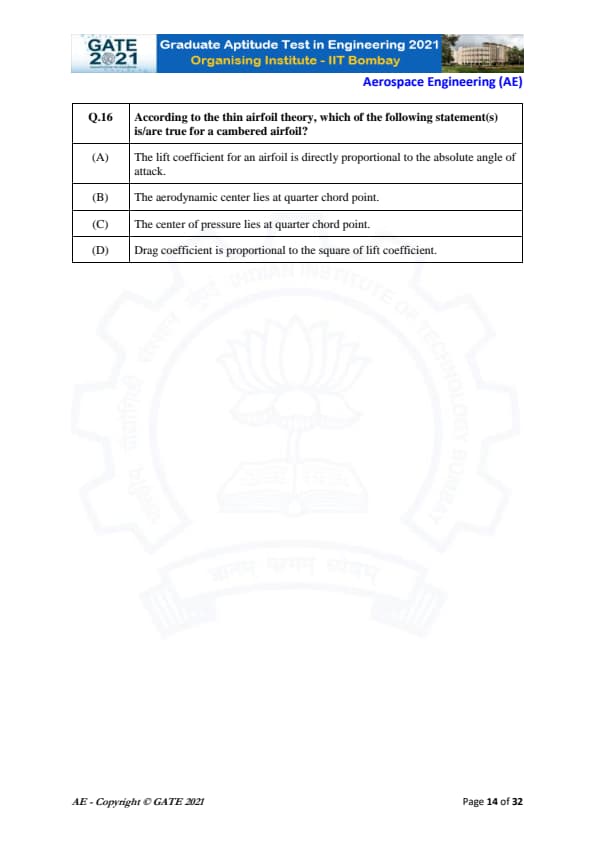
According to the thin airfoil theory, which of the following statement(s) is/are true for a cambered airfoil?
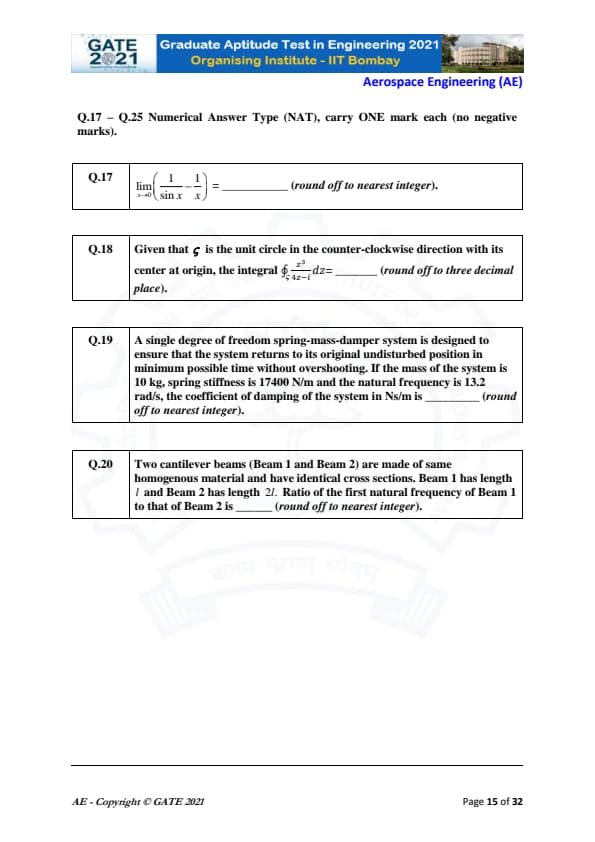
Evaluate the limit:
\[ \lim_{x \to 0} \left( \frac{1}{\sin x} - \frac{1}{x} \right) = \_\_\_\_\_\_\_\_ (round off to nearest integer). \]
Given that \(\zeta\) is the unit circle in counter-clockwise direction, evaluate:
\[ \oint_{\zeta} \frac{z^3}{4z - i} \, dz \]
(round off to three decimal places).
A spring-mass-damper system (m = 10 kg, k = 17400 N/m) has natural frequency 13.2 rad/s. Find the damping coefficient \(c\) for critical damping (round off to nearest integer).
Two cantilever beams of same material & cross-section have lengths \(l\) and \(2l\). Find the ratio of their first natural frequencies (round off to nearest integer).
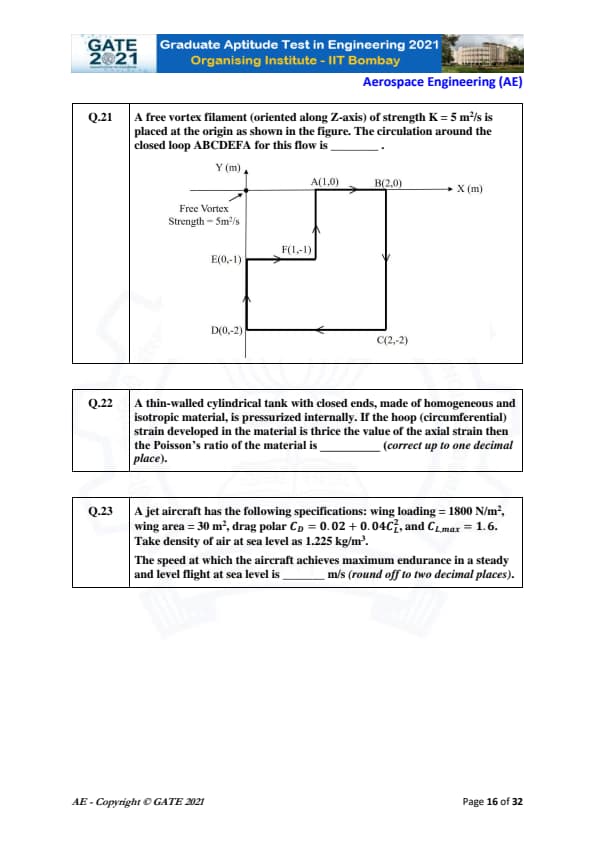
A free vortex filament (oriented along Z–axis) of strength \(K = 5 \, m^2/s\) is placed at the origin. The circulation around the closed loop ABCDEFA is ______.

A thin-walled cylindrical tank is internally pressurized. If the hoop strain is thrice the axial strain, the Poisson's ratio of the material is ______ (correct to one decimal place).
For the jet aircraft data provided, the speed for maximum endurance in steady level flight is ______ m/s (round off to two decimal places).
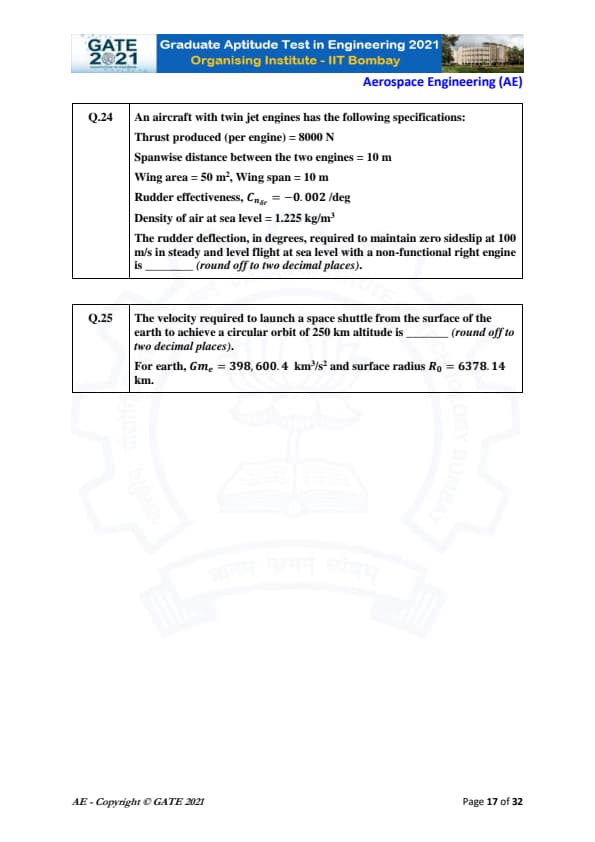
An aircraft with twin jet engines has:
Thrust per engine = 8000 N
Spanwise distance between engines = 10 m
Wing area = 50 m\(^2\), Wing span = 10 m
Rudder effectiveness: \( C_{n_{\delta r}} = -0.002/deg \)
Air density at sea level: \( \rho = 1.225 \, kg/m^3 \)
Find rudder deflection at 100 m/s with right engine failed (round off to 2 decimals).
Compute the velocity required from Earth's surface to reach a circular orbit at 250 km altitude (round off to two decimals).
Earth data: \( GM_e = 398600.4 \, km^3/s^2 \), \( R_0 = 6378.14 \, km \)
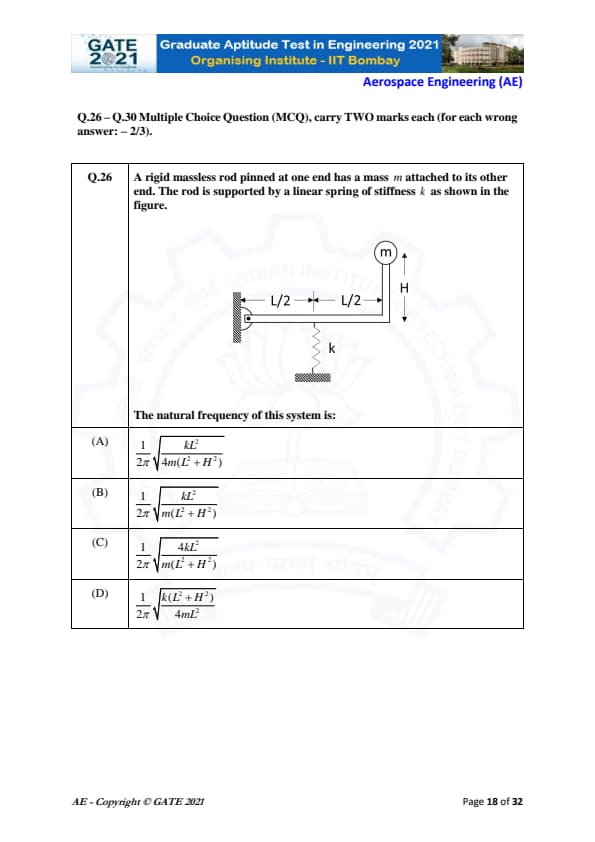
A rigid massless rod pinned at one end has a mass \(m\) attached to its other end. The rod is supported by a linear spring of stiffness \(k\) as shown in the figure. The natural frequency of this system is:

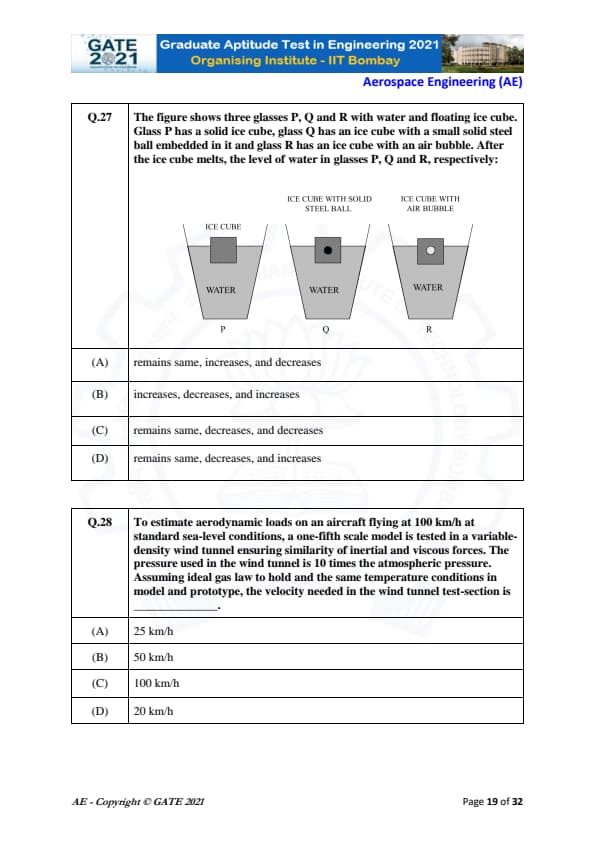
After the ice cube melts, the level of water in glasses P, Q and R, respectively, is:

The velocity needed in the wind tunnel test-section is ________.
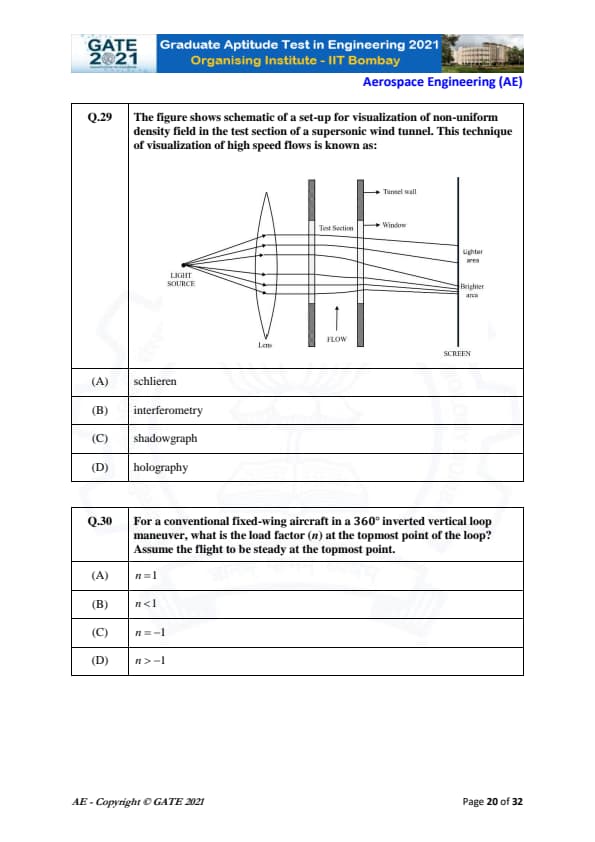
The figure shows schematic of a set-up for visualization of non-uniform density field in the test section of a supersonic wind tunnel. This technique of visualization of high speed flows is known as:

For a conventional fixed-wing aircraft in a 360\(^\circ\) inverted vertical loop maneuver, what is the load factor (\(n\)) at the topmost point of the loop? Assume the flight to be steady at the topmost point.
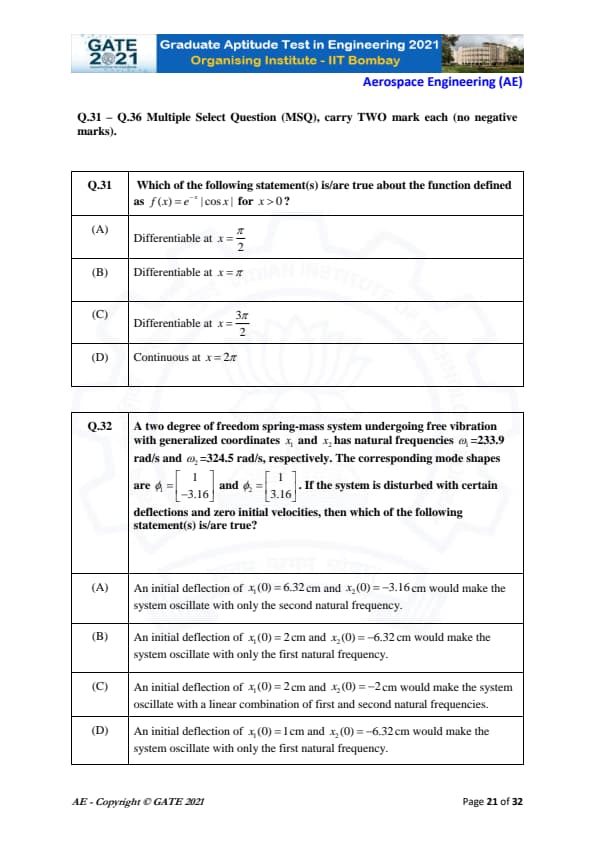
Which of the following statement(s) is/are true about the function defined as \( f(x)= e^{-x} \lvert \cos x \rvert \) for \( x>0 \)?
A two degree of freedom spring–mass system undergoes free vibration with natural frequencies \( \omega_1 = 233.9 \,rad/s \) and \( \omega_2 = 324.5 \,rad/s \). The mode shapes are \[ \phi_1 = \begin{bmatrix} 1
-3.16 \end{bmatrix}, \qquad \phi_2 = \begin{bmatrix} 1
3.16 \end{bmatrix}. \]
Given zero initial velocities, identify which initial deflections produce pure or mixed mode oscillations.
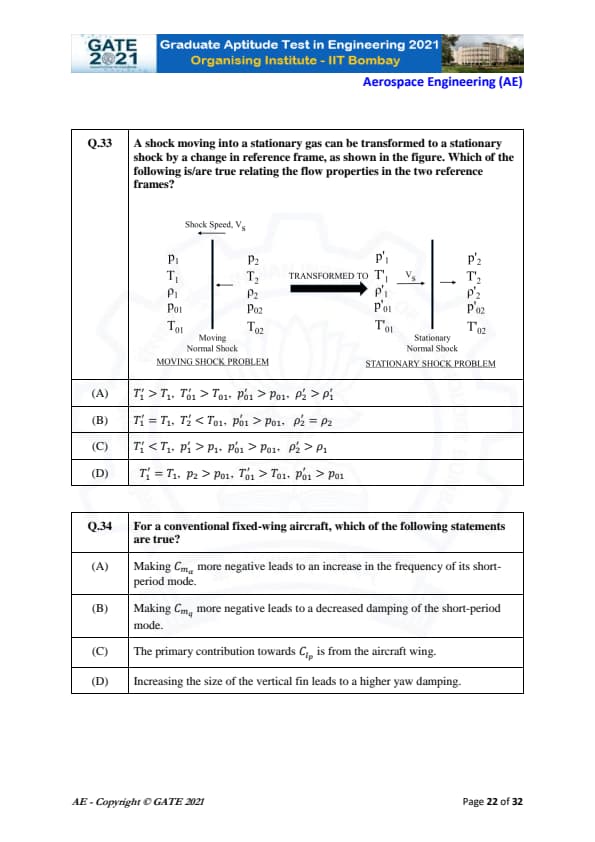
A shock moving into a stationary gas can be transformed to a stationary shock by a change in reference frame, as shown in the figure. Which of the following is/are true relating the flow properties in the two reference frames?

For a conventional fixed-wing aircraft, which of the following statements are true?
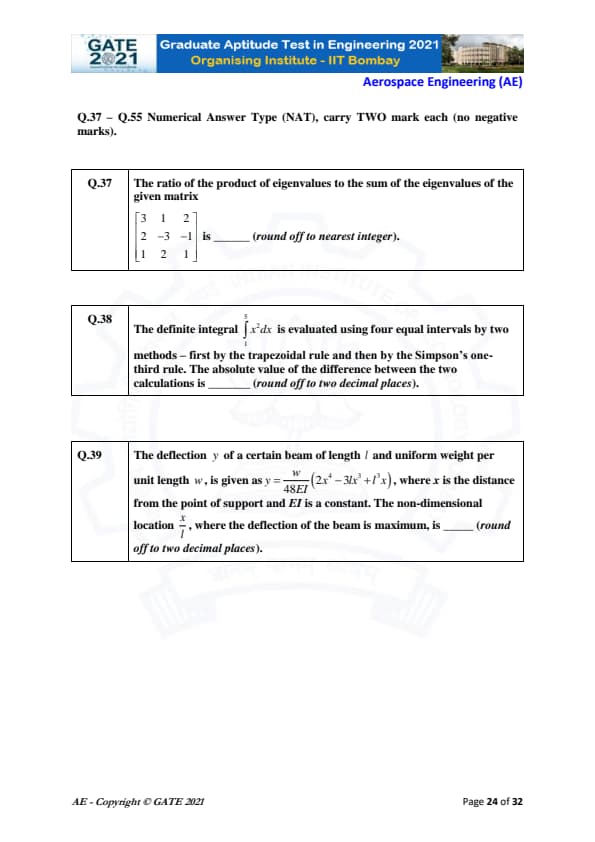
For the matrix
\[ \begin{bmatrix} 3 & 1 & 2 \\
2 & -3 & -1 \\
1 & 2 & 1 \end{bmatrix} \]
find the ratio of the product of eigenvalues to the sum of eigenvalues (round off to nearest integer).
Evaluate \(\int_{1}^{5} x^2 dx\) using 4 equal intervals by trapezoidal rule and Simpson’s 1/3 rule, and compute the absolute difference (round to 2 decimals).
For a beam with deflection
\[ y = \frac{w}{48EI} (2x^4 - 3lx^3 + l^3x) \]
find the non-dimensional location \(x/l\) at which deflection is maximum (round to 2 decimals).
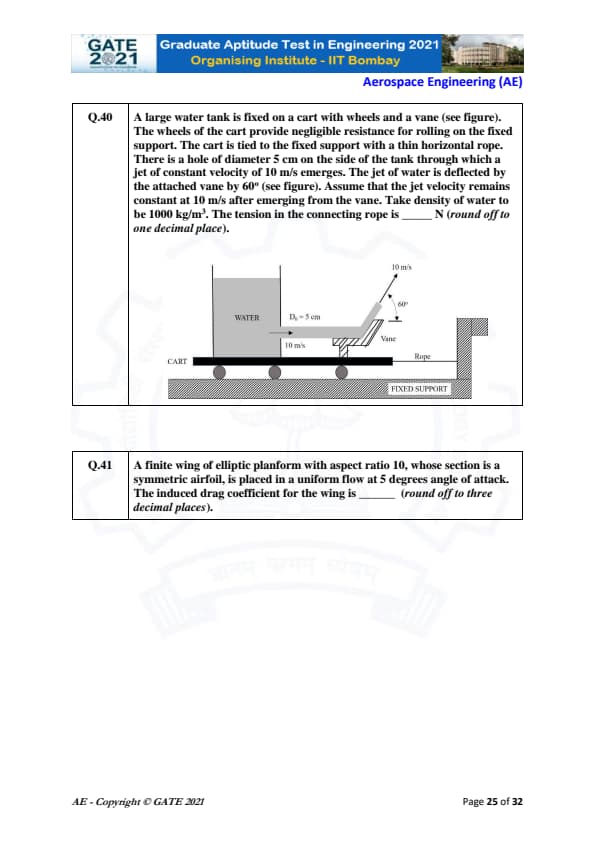
A large water tank is fixed on a cart with wheels and a vane. The cart is tied to a fixed support with a rope. Water exits through a 5 cm diameter hole as a 10 m/s jet which is deflected by the vane by \(60^\circ\). The velocity of the jet after deflection remains 10 m/s. Density of water is \(1000\ kg/m^3\). The tension in the rope is _____ N (round off to one decimal place).

A finite wing of elliptic planform with aspect ratio 10 and symmetric airfoil operates at \(5^\circ\) angle of attack in uniform flow. The induced drag coefficient is _____ (round off to three decimal places).
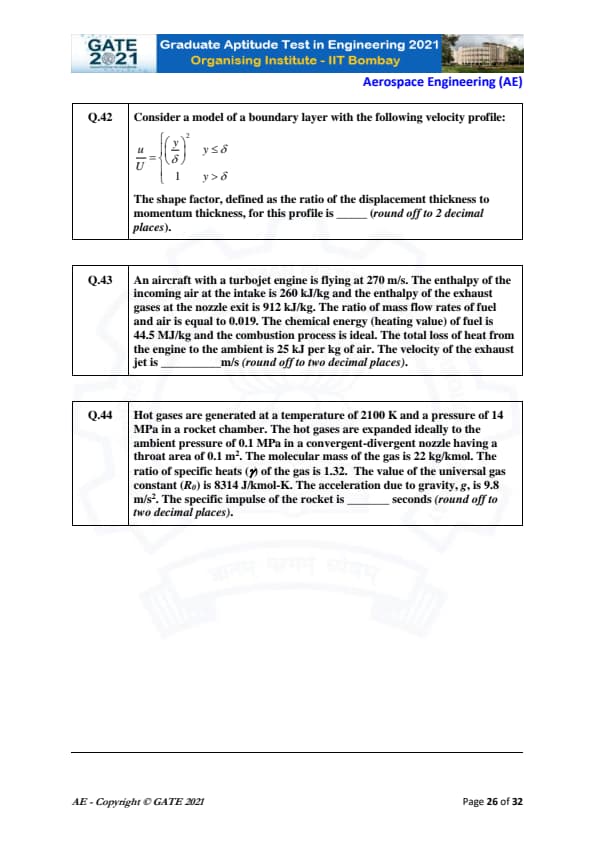
Consider a boundary-layer velocity profile:
\[ \frac{u}{U} = \begin{cases} \left( \frac{y}{\delta} \right)^2 & y \le \delta
1 & y > \delta \end{cases} \]
The shape factor (ratio of displacement thickness to momentum thickness) is ________ (round off to 2 decimal places).
An aircraft with a turbojet engine flies at 270 m/s. Enthalpies:
Incoming air: 260 kJ/kg, Exit gas: 912 kJ/kg.
Fuel–air mass-flow ratio: 0.019.
Fuel heating value: 44.5 MJ/kg.
Heat loss: 25 kJ/kg of air.
Find the exhaust jet velocity (round off to 2 decimals).
Hot gases at 2100 K and 14 MPa expand ideally to 0.1 MPa through a rocket nozzle.
Molecular mass = 22 kg/kmol, heat-capacity ratio \(\gamma = 1.32\),
Universal gas constant = 8314 J/kmol-K, \(g = 9.8\,m/s^2\).
Throat area = \(0.1\ m^2\).
Find the specific impulse (round off to 2 decimals).
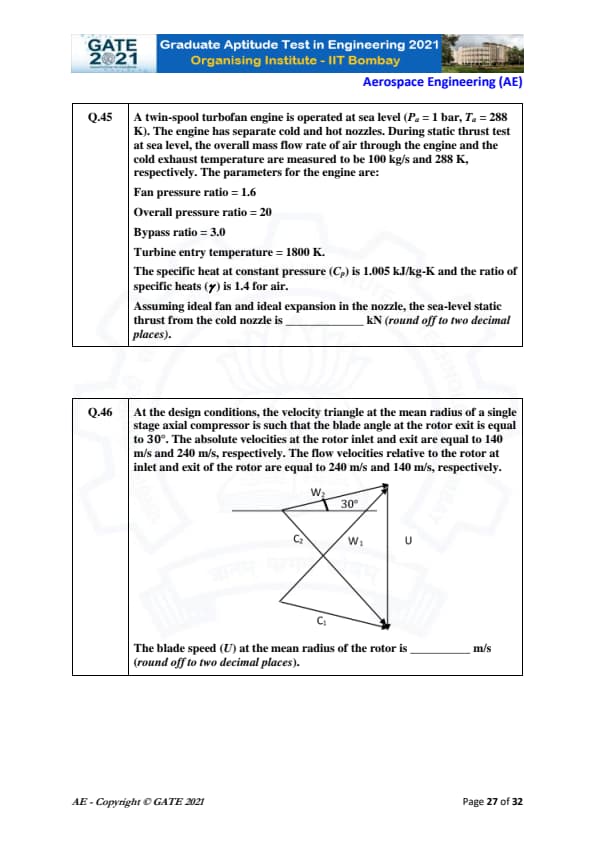
A twin-spool turbofan engine at sea level (\(P_a = 1\ bar,\ T_a = 288\ K\)) has separate cold and hot nozzles. During static thrust test, the total air mass flow rate is 100 kg/s and the cold exhaust temperature is 288 K. Given:
Fan pressure ratio = 1.6
Overall pressure ratio = 20
Bypass ratio = 3.0
Turbine entry temperature = 1800 K
\(C_p = 1.005\ kJ/kg-K\), \(\gamma = 1.4\).
Find the static thrust from the cold nozzle (ideal fan and ideal expansion), in kN (round to two decimals).
At the design conditions of a single-stage axial compressor, the blade angle at rotor exit is \(30^\circ\). The absolute velocities at rotor inlet and exit are 140 m/s and 240 m/s, respectively. The relative flow velocities at rotor inlet and exit are 240 m/s and 140 m/s, respectively. Find the blade speed \(U\) at the mean radius (round off to two decimal places).

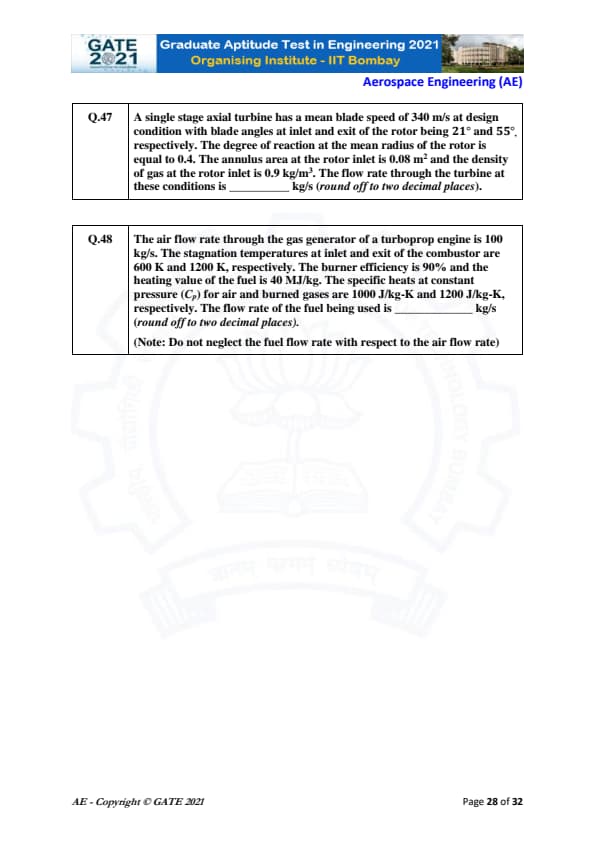
A single-stage axial turbine has a mean blade speed of 340 m/s. Rotor inlet and exit blade angles are 21° and 55°, respectively. Density at rotor inlet is 0.9 kg/m³, annulus area = 0.08 m², degree of reaction = 0.4. Find the mass flow rate (round off to 2 decimals).
Air flow rate = 100 kg/s. Stagnation temperatures:
\(T_{t1} = 600\ K\), \(T_{t2} = 1200\ K\).
Burner efficiency = 0.9. Fuel heating value = 40 MJ/kg.
Specific heats: \(C_{p,a} = 1000\), \(C_{p,g} = 1200\ J/kg·K\).
Find the fuel flow rate (round off to 2 decimals).
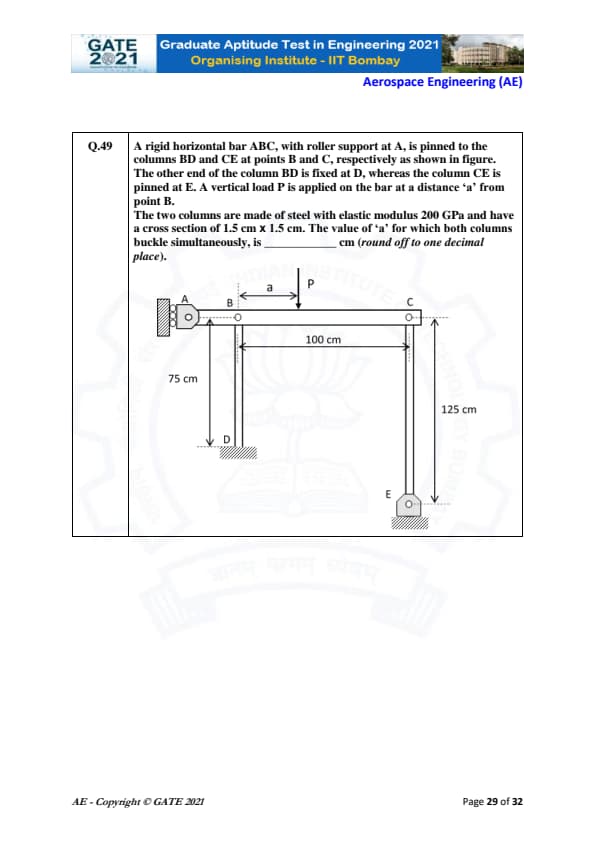
A rigid horizontal bar ABC is supported by two columns BD and CE. BD is fixed at D, CE is pinned at E. A load \(P\) is applied at distance \(a\) from \(B\). The columns are steel with \(E = 200\) GPa and cross-section \(1.5 cm \times 1.5 cm\). The lengths are: BD = 75 cm, CE = 125 cm. The value of \(a\) for which both columns buckle simultaneously is ________ cm (round off to one decimal place).

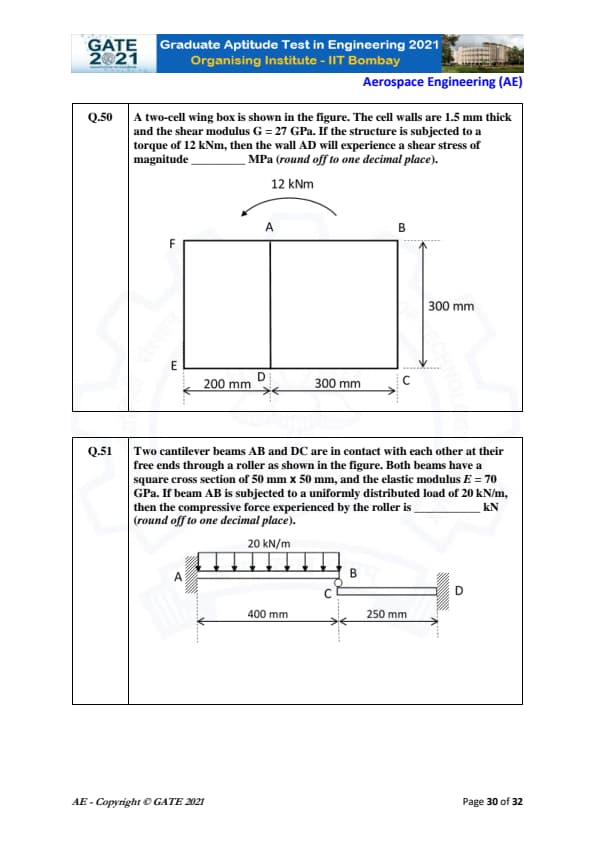
A two-cell wing box has wall thickness 1.5 mm and shear modulus \(G = 27\ GPa\). A torque of 12 kNm is applied. Determine the shear stress in wall AD (round off to one decimal place).
Two cantilever beams AB and DC touch at their free ends through a roller. Both beams have a 50 mm × 50 mm square cross section and modulus \(E = 70\ GPa\). Beam AB carries a UDL of 20 kN/m. Determine the compressive force at the roller (round off to one decimal place).

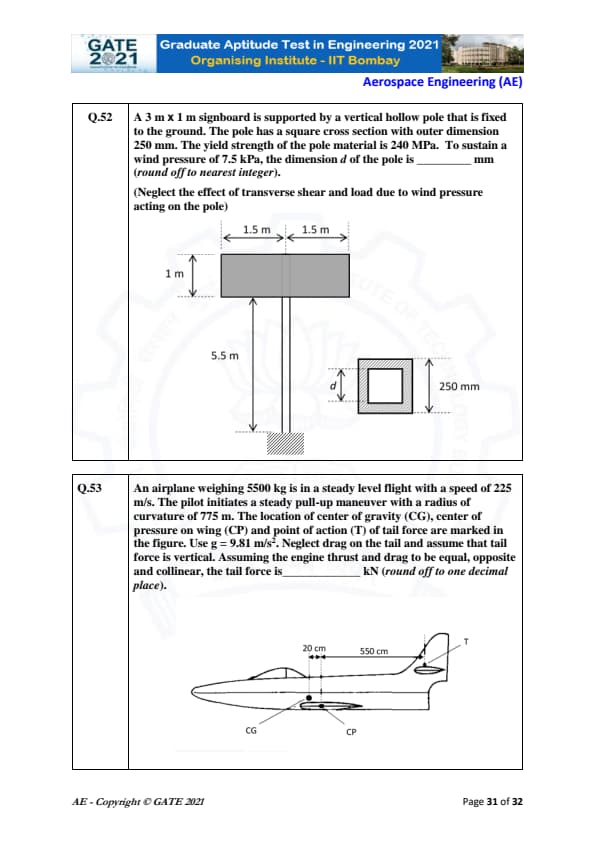
A 3 m × 1 m signboard is subjected to a wind pressure of 7.5 kPa. It is supported by a hollow square pole of outer dimension 250 mm and inner dimension \(d\) (unknown). The yield strength is 240 MPa. Find \(d\) (round off to nearest integer).

An airplane (5500 kg) initiates a pull-up at 225 m/s with curvature radius 775 m. CG, CP, and tail point T are shown. Thrust and drag cancel. Tail force is vertical. Find the tail force (round to one decimal place).

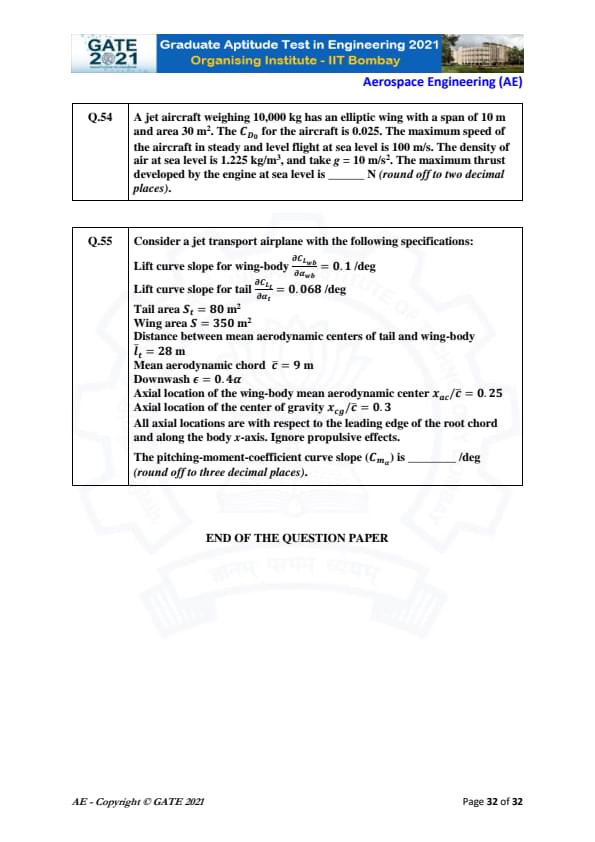
A jet aircraft weighs 10,000 kg, has an elliptic wing of span 10 m and area 30 m\(^2\). The zero-lift drag coefficient is \(C_{D0} = 0.025\). The maximum steady level-flight speed at sea level is 100 m/s. Density of air is 1.225 kg/m\(^3\), and \(g = 10\ m/s^2\). Determine the maximum thrust developed by the engine (round off to two decimals).
A jet transport airplane has the following data:
Lift-curve slope of wing-body: \(\frac{\partial C_{Lwb}}{\partial \alpha_{wb}} = 0.1/\deg\)
Lift-curve slope of tail: \(\frac{\partial C_{Lt}}{\partial \alpha_t} = 0.068/\deg\)
Tail area \(S_t = 80\ m^2\), wing area \(S = 350\ m^2\)
Tail moment arm \(\ell_t = 28\ m\)
Mean aerodynamic chord \(\bar{c} = 9\ m\)
Downwash: \(\epsilon = 0.4\alpha\)
Wing-body aerodynamic center: \(x_{ac}/\bar{c} = 0.25\)
CG location: \(x_{cg}/\bar{c} = 0.3\)
Determine the pitching-moment coefficient slope \(C_{m_\alpha}\) (round off to three decimals).
Quick Links:
GATE 2021 AE Paper Analysis
- GATE AE 2021 consist of 65 question worth 100 marks out of which 55 question are subject related and 10 question were related to General aptitude.
- Difficulty level of general aptitude was considered easy.
- Difficulty level of subject-specific topic was considered moderate.
- Average number of good attempts were around 40+
- The good score expected by students for GATE AE 2021 was 70-75
- Some of the question were found to be lengthy in nature.
- General Aptitude section consisted 15 Marks, Engineering Mathematics consisted 13 Marks and Subject Question were 72 Marks which makes Total of 100 Marks
- Topics for GATE AE 2021 are as follows:
| Subject | Topics |
|---|---|
| Subject-Specific | Section 1: Engineering Mathematics Section 2: Flight Mechanics Section 3: Space Dynamics Section 4: Aerodynamics Section 5: Structures Section 6: Propulsion |
| General Aptitude |
|
Also Check:
GATE Previous Year Question Papers:
| GATE 2022 Question Papers | GATE 2021 Question Papers | GATE 2020 Question Papers |
| GATE 2019 Question Papers | GATE 2018 Question Papers | GATE 2017 Question Papers |





Comments