




GATE 2021 Agriculture Engineering (AG) Question Paper with Solutions PDFs is now available. GATE AG 2021 paper was held on Feb 7 in forenoon session between 9:30 AM to 12:30 PM. Overall difficulty level of the exam Moderate to Difficult. GATE AG Question Paper consists of 10 questions from General Aptitude and 55 questions from core discipline- Agriculture Engineering.
Candidates interested in taking the GATE Exam in the future can download the GATE AG 2021 question paper with answer keys in PDF format to obtain a better sense of the types of questions that will be asked.
GATE 2021 Agriculture Engineering (AG) Question Paper with Solutions
| GATE 2021 Agriculture Engineering (AG) Question Paper |  Download Download |
Check Solutions |

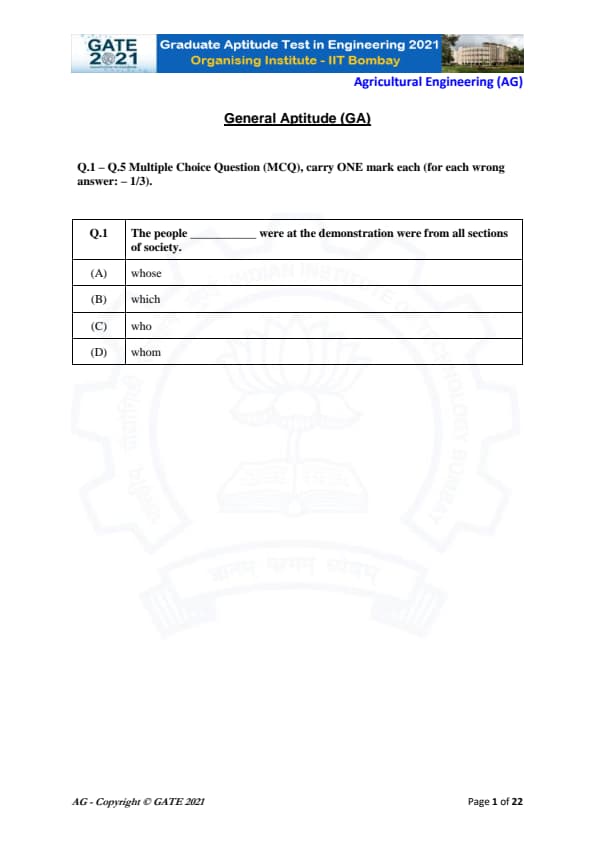
The people _______ were at the demonstration were from all sections of society.
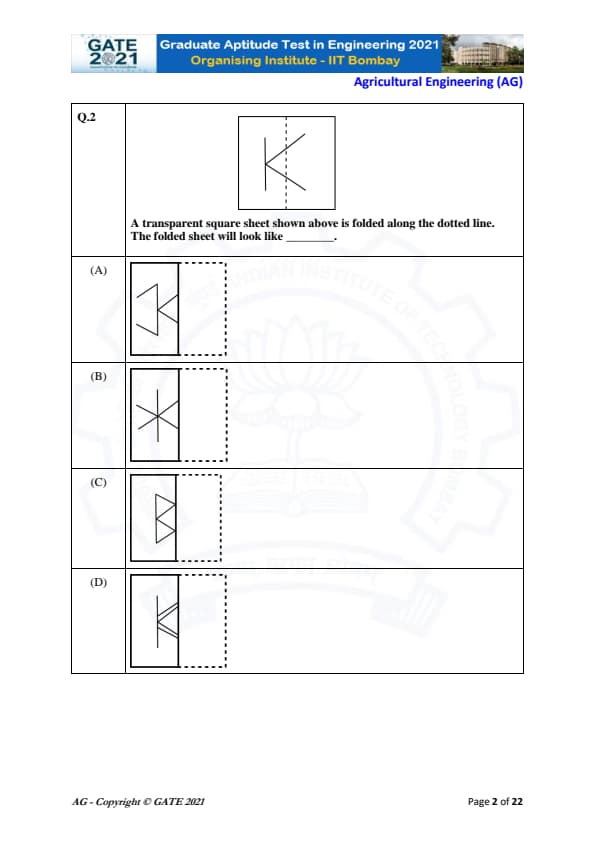
A transparent square sheet shown above is folded along the dotted line. The folded sheet will look like _______.
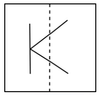
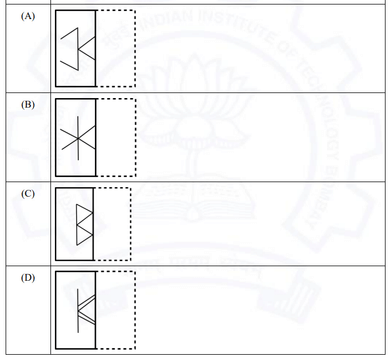
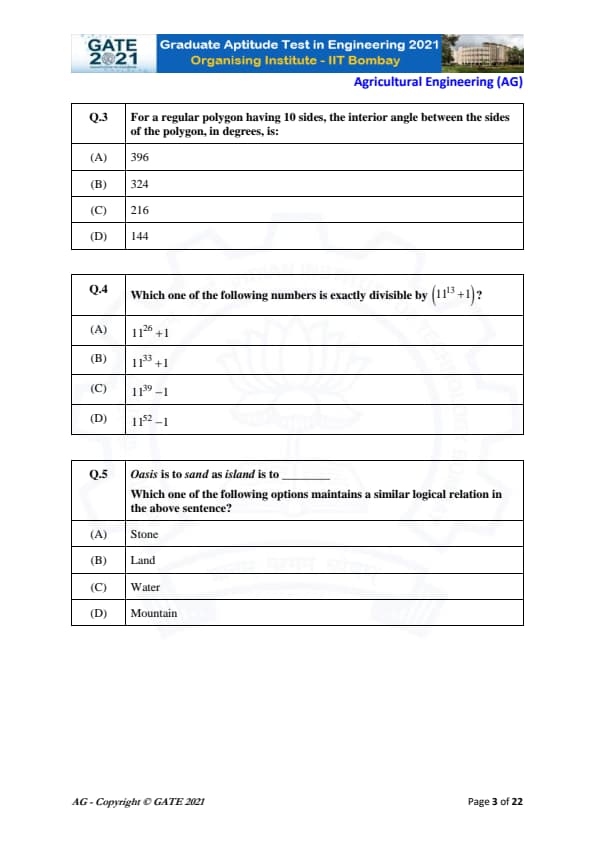
For a regular polygon having 10 sides, the interior angle between the sides of the polygon, in degrees, is:
Which one of the following numbers is exactly divisible by \(\left(11^{13}+1\right)\)?
Oasis is to sand as island is to _____. Which one of the following options maintains a similar logical relation in the above sentence?
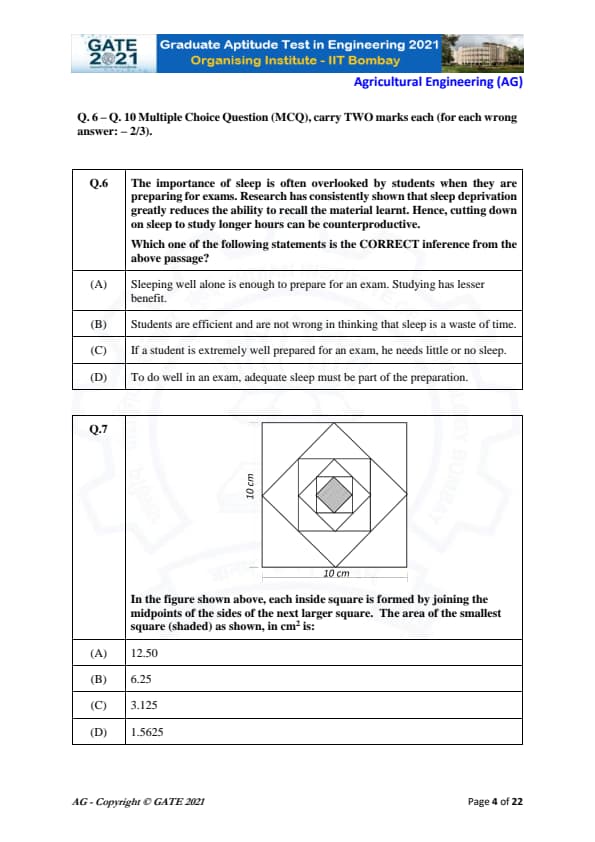
The importance of sleep is often overlooked by students when they are preparing for exams. Research has consistently shown that sleep deprivation greatly reduces the ability to recall the material learnt. Hence, cutting down on sleep to study longer hours can be counterproductive.
Which one of the following statements is the CORRECT inference from the above passage?
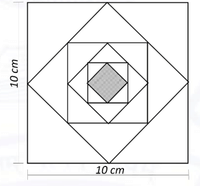
In the figure, each inside square is formed by joining the midpoints of the sides of the next larger square. The area of the smallest shaded square is to be found. The outermost square has a side length of 10 cm.
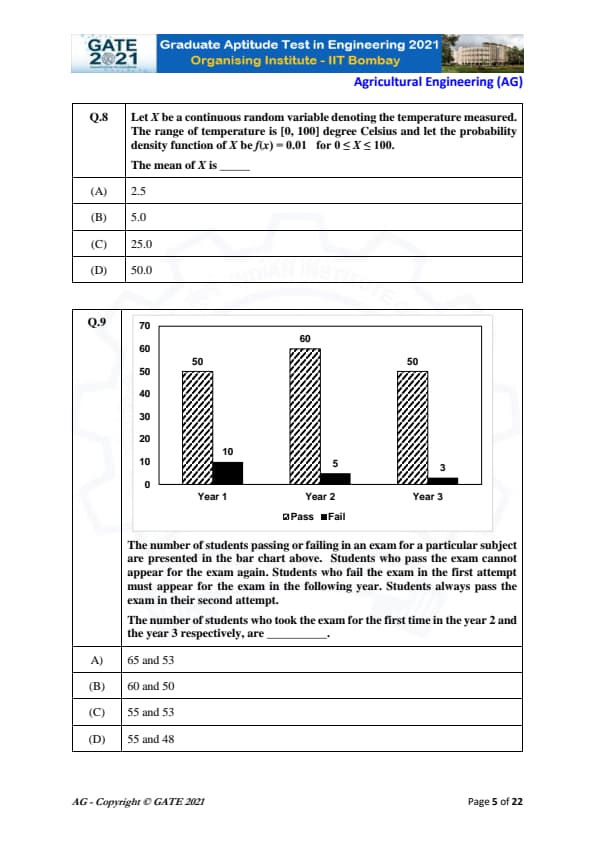
Let \(X\) be a continuous random variable denoting the temperature measured.
The range of temperature is \([0, 100]\) degree Celsius and the probability density function of \(X\) be \(f(x) = 0.01\) for \(0 \le X \le 100\).
The mean of \(X\) is _______
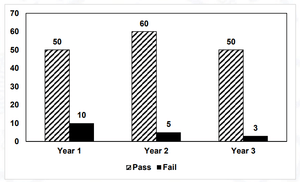
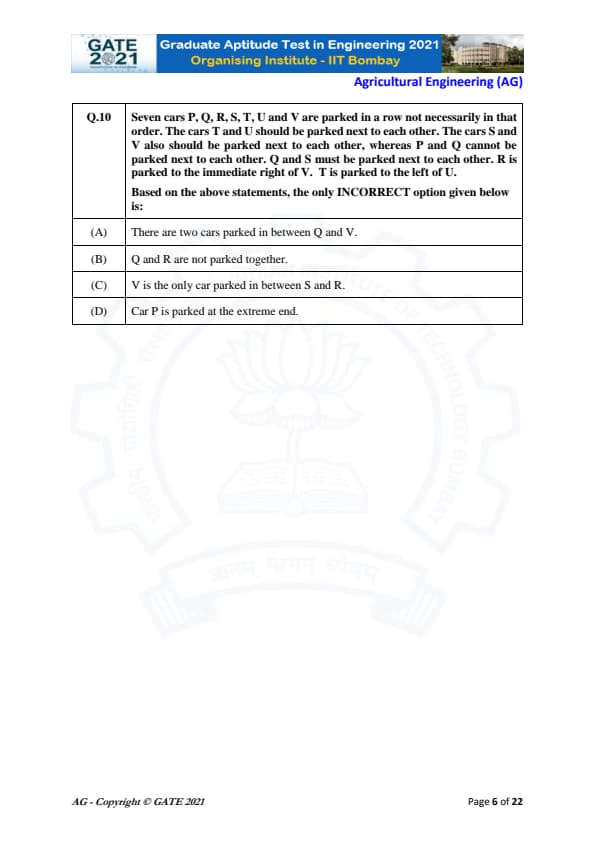
The number of students passing or failing in an exam are shown in the bar chart.
Students who pass do not appear again.
Students who fail must reappear the next year and always pass in their second attempt.
Find the number of students who took the exam for the first time in Year 2 and Year 3.
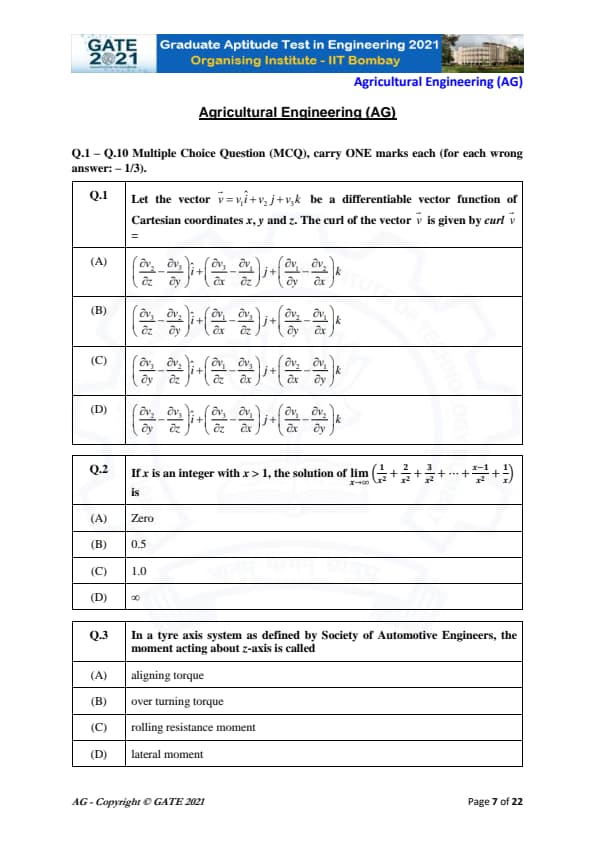
Seven cars P, Q, R, S, T, U and V are parked in a row not necessarily in that order.
The cars T and U should be parked next to each other.
The cars S and V also should be parked next to each other, whereas P and Q cannot be parked next to each other.
Q and S must be parked next to each other.
R is parked to the immediate right of V.
T is parked to the left of U.
Based on the above statements, the only INCORRECT option is:
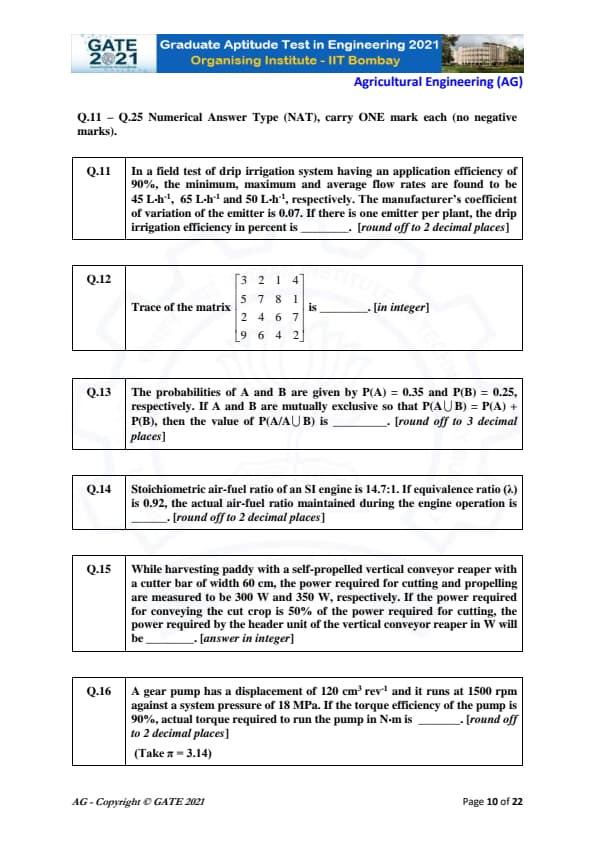
In a field test of a drip irrigation system:
Min = 45 L/h, Max = 65 L/h, Avg = 50 L/h.
Application efficiency = 90%.
Emitter coefficient of variation = 0.07.
One emitter per plant.
Find the drip irrigation efficiency (round off to 2 decimals).
Trace the matrix
\[ \begin{bmatrix} 3 & 2 & 1 & 4 \\
5 & 7 & 8 & 1 \\
2 & 4 & 6 & 7 \\
9 & 6 & 4 & 2 \end{bmatrix} \]
(answer in integer).
Given: P(A) = 0.35, P(B) = 0.25.
A and B are mutually exclusive.
Find P(A ∪ B) (round to 3 decimals).
Stoichiometric air–fuel ratio = 14.7:1. Equivalence ratio λ = 0.92.
Find actual air–fuel ratio (round to 2 decimals).
Cutting power = 300 W, propelling = 350 W.
Conveying power = 50% of cutting power.
Find total header unit power (answer in integer).
Gear pump displacement = 120 cm\(^3\)/rev, speed = 1500 rpm,
pressure = 18 MPa, torque efficiency = 90%.
Find actual torque (Nm) (round to 2 decimals).
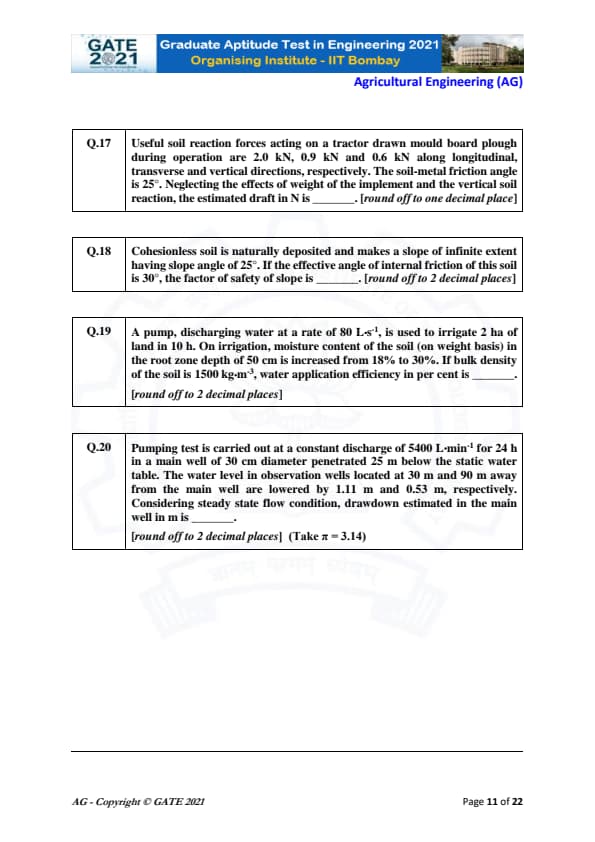
Useful soil reaction forces on a tractor–drawn mould board plough are 2.0 kN (longitudinal), 0.9 kN (transverse), and 0.6 kN (vertical). Soil–metal friction angle is \(25^\circ\). Neglecting implement weight and vertical soil reaction, estimate the draft (round off to one decimal place).
A cohesionless soil forms a natural infinite slope at \(25^\circ\). If the effective friction angle is \(30^\circ\), determine the factor of safety (round off to 2 decimals).
A pump delivering 80 L/s irrigates 2 ha in 10 h. Soil moisture increases from 18% to 30% in a 50 cm root zone. Soil bulk density is 1500 kg/m\(^3\). Compute water application efficiency (round off to two decimals).
A pumping test pumps 5400 L/min for 24 h from a well. Observation wells at 30 m and 90 m show drawdowns of 1.11 m and 0.53 m. Well diameter = 30 cm. Estimate drawdown in the pumped well (round off to 2 decimals), using steady–state flow and \(\pi = 3.14\).
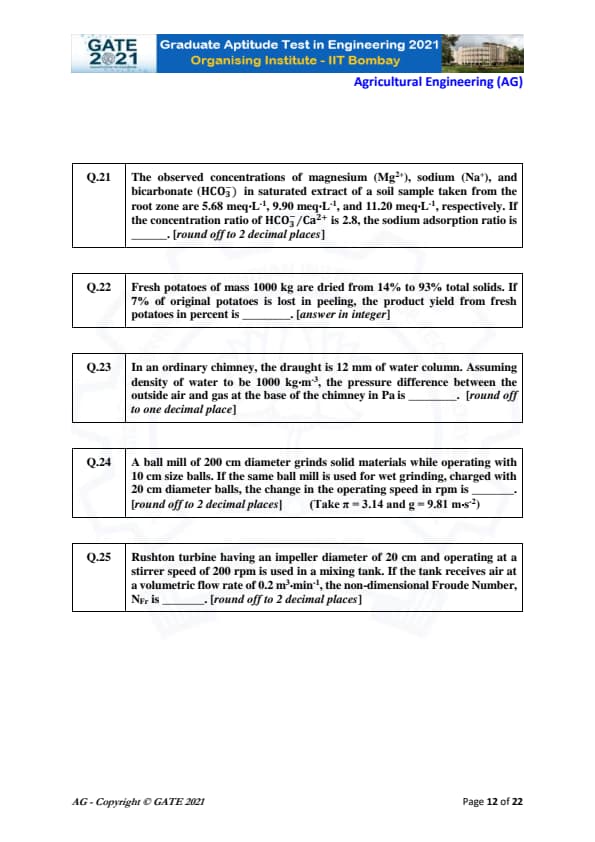
Given: Mg\(^{2+}\)=5.68 meq/L, Na\(^{+}\)=9.90 meq/L, HCO\(_3^{-}\)=11.20 meq/L. \[ \frac{HCO_3^-}{Ca^{2+}}=2.8 \]
Find Sodium Adsorption Ratio (SAR).
Fresh potatoes = 1000 kg, initial solids = 14%, final solids = 93%.
Loss in peeling = 7%.
Find product yield percent (integer).
Draught = 12 mm water column.
Density of water = 1000 kg/m\(^3\).
Find pressure difference in Pa (round to 1 decimal).
Ball mill diameter = 200 cm.
Ball sizes: 10 cm (dry), 20 cm (wet).
Find change in operating speed (rpm) (round to 2 decimals).
(Take π = 3.14, g = 9.81)
Rushton turbine, impeller diameter = 20 cm.
Speed = 200 rpm.
Flow rate = 0.2 m\(^3\)/min.
Find the Froude number \(N_{Fr}\) (round to 2 decimals).
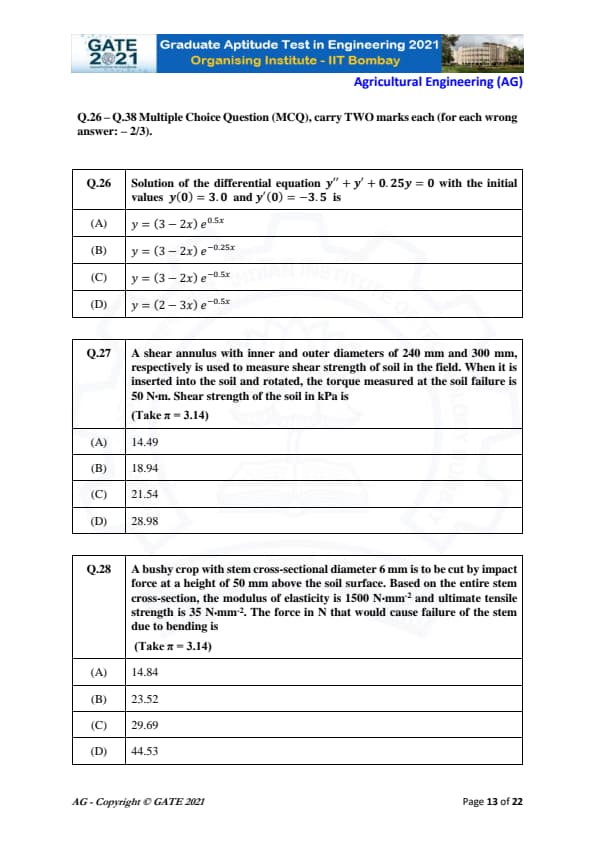
Solution of the differential equation \(y'' + y' + 0.25y = 0\) with the initial values \(y(0)=3.0\) and \(y'(0)=-3.5\) is
A shear annulus with inner and outer diameters of 240 mm and 300 mm is used to measure soil shear strength. The torque at failure is 50 N·m. Shear strength of soil in kPa is (Take \(\pi = 3.14\))
A bushy crop stem of diameter 6 mm is cut by bending. Modulus of elasticity = 1500 N·mm\(^{-2}\), ultimate tensile strength = 35 N·mm\(^{-2}\). Determine force causing failure at 50 mm height. (Take \(\pi = 3.14\))
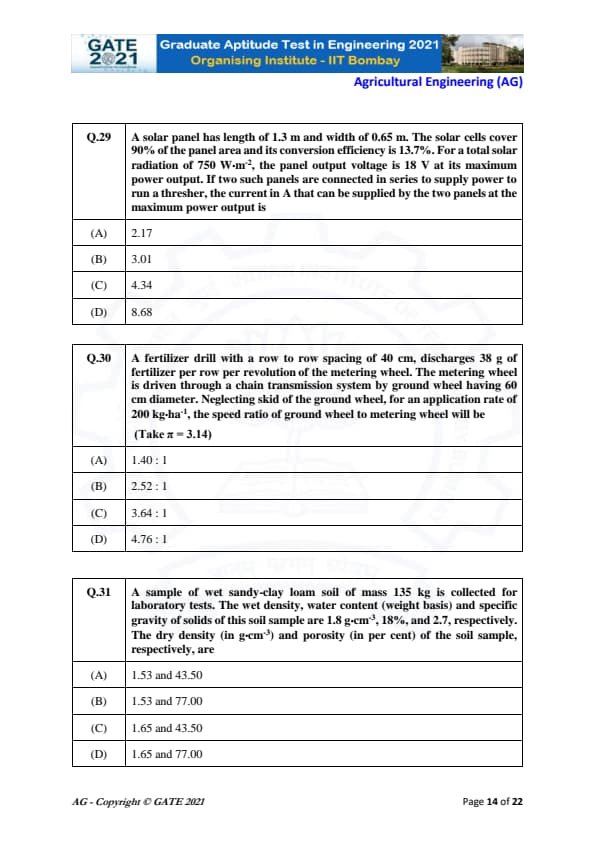
The current in A that can be supplied by the two panels at the maximum power output is
The speed ratio of ground wheel to metering wheel will be
The dry density (in g·cm\(^{-3}\)) and porosity (in per cent) of the soil sample, respectively, are:
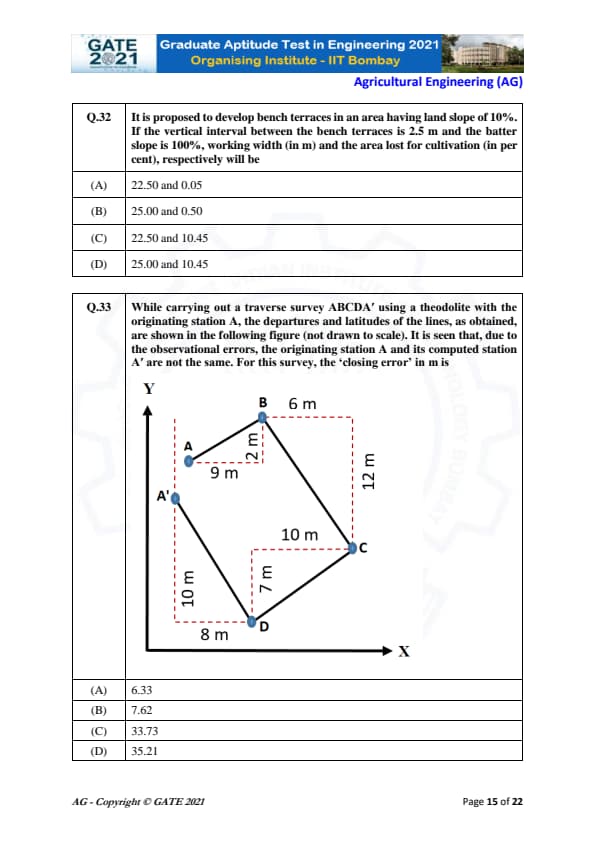
It is proposed to develop bench terraces in an area having land slope of 10%. If the vertical interval between the bench terraces is 2.5 m and the batter slope is 100%, working width (in m) and the area lost for cultivation (in percent), respectively will be
While carrying out a traverse survey ABCDA' using a theodolite with the originating station A, the departures and latitudes of the lines are shown in the figure. Due to observational errors, the computed closing point A' does not coincide with A. For this survey, the ‘closing error’ in m is:
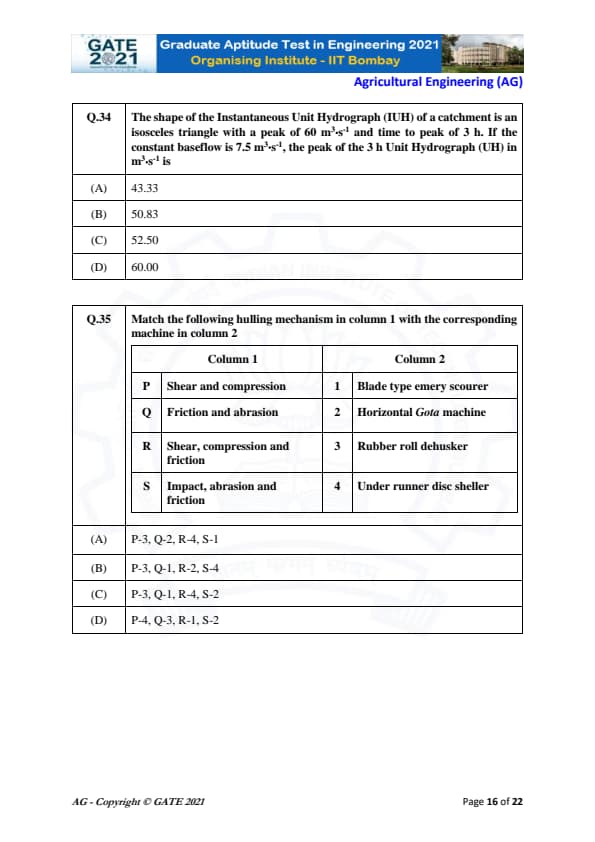
The shape of the Instantaneous Unit Hydrograph (IUH) of a catchment is an isosceles triangle with a peak of 60 m\(^3\)s\(^{-1}\) and time to peak of 3 h. If the constant baseflow is 7.5 m\(^3\)s\(^{-1}\), the peak of the 3-h Unit Hydrograph (UH) in m\(^3\)s\(^{-1}\) is
Match the following hulling mechanisms (Column 1) with the corresponding machines (Column 2).
\[ \begin{array}{c|c} \textbf{Column 1} & \textbf{Column 2}
\hline P: Shear and compression & 1: Blade type emery scourer
Q: Friction and abrasion & 2: Horizontal \emph{Gota machine}
R: Shear, compression and friction & 3: Rubber roll dehusker
S: Impact, abrasion and friction & 4: Under runner disc sheller
\end{array} \]
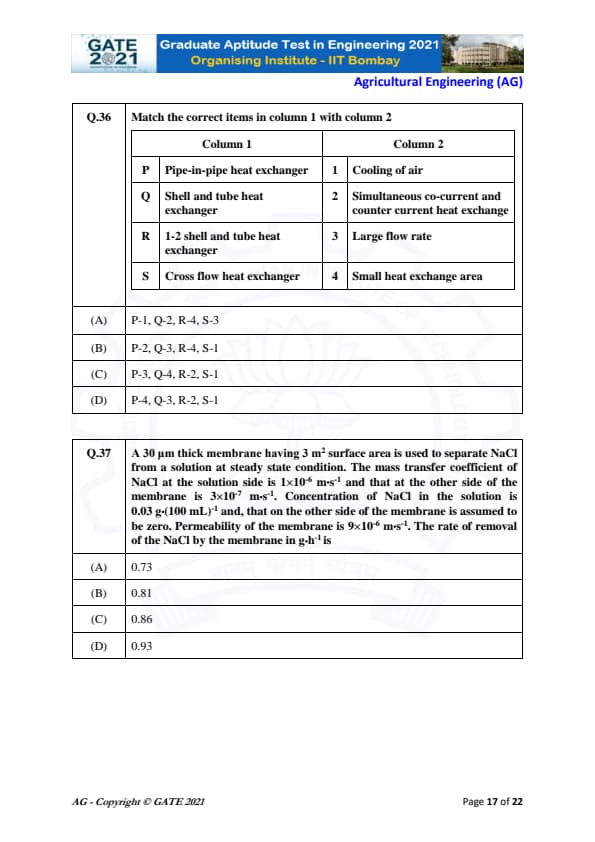
Match the correct items in Column 1 with Column 2:
\begin{tabular{|c|c|
\hline
Column 1 & Column 2
\hline
P: Pipe-in-pipe heat exchanger & 1: Cooling of air
Q: Shell and tube heat exchanger & 2: Simultaneous co-current and counter-current heat exchange
R: 1-2 shell and tube heat exchanger & 3: Large flow rate
S: Cross flow heat exchanger & 4: Small heat exchange area
\hline
\end{tabular
A 30 μm thick membrane having 3 m\(^2\) surface area is used to separate NaCl at steady state.
Mass transfer coefficient on solution side = \(1\times 10^{-6}\) m·s\(^{-1}\),
on membrane side = \(3\times 10^{-7}\) m·s\(^{-1}\).
NaCl concentration = 0.03 g·(100 mL)\(^{-1}\); concentration on permeate side = 0.
Permeability = \(9\times 10^{-6}\) m·s\(^{-1}\).
Find the rate of NaCl removal (g·h\(^{-1}\)).
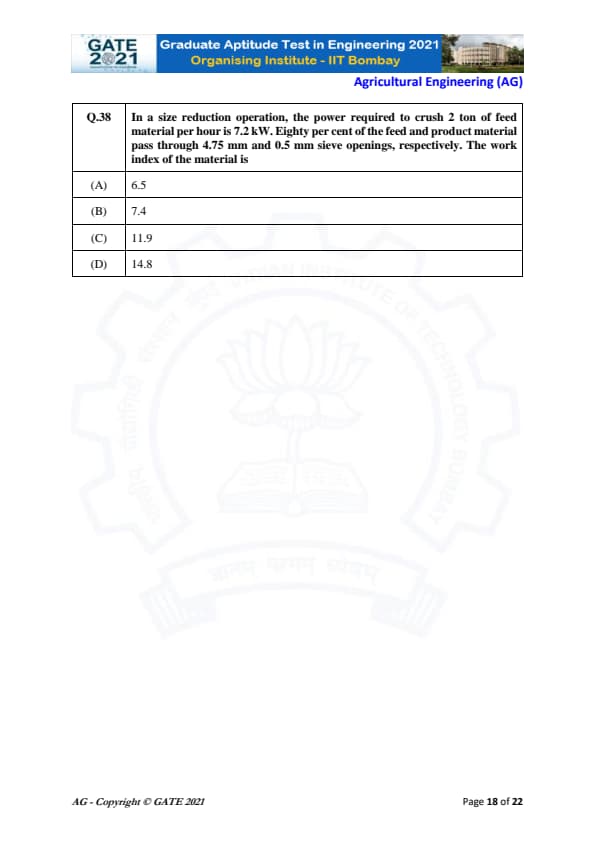
In a size reduction operation, the power required to crush 2 ton of feed material per hour is 7.2 kW.
Eighty per cent of the feed and product material pass through 4.75 mm and 0.5 mm sieve openings, respectively.
The work index of the material is:
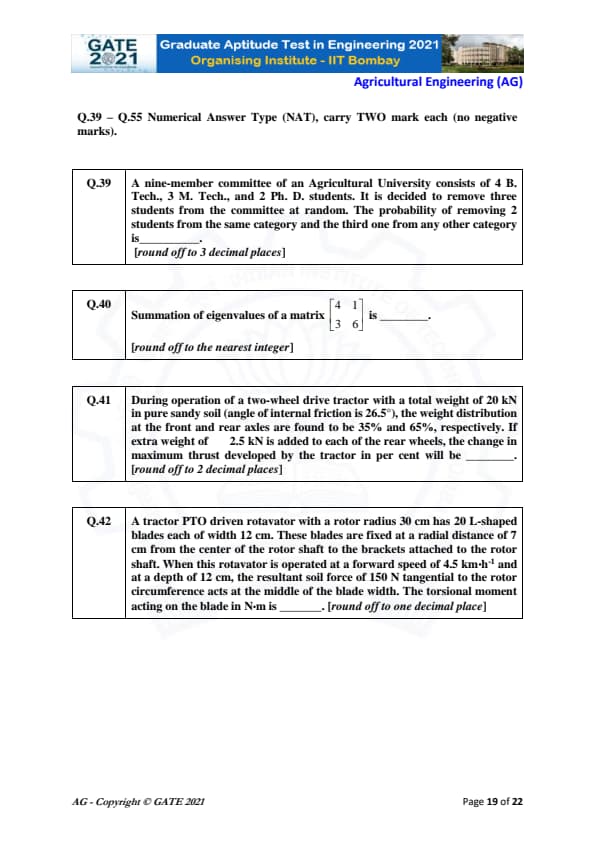
A committee consists of 4 B. Tech, 3 M. Tech, and 2 Ph.D. students. Find the probability of removing 2 students from the same category and the third one from any other category.
Find the sum of eigenvalues of the matrix:
\[ \begin{bmatrix} 4 & 1
3 & 6 \end{bmatrix} \]
Tractor weight = 20 kN, sandy soil, 26.5° angle of internal friction. Weight distribution at front and rear axles = 35% and 65%. An extra 2.5 kN is added to rear wheels. Find the change in maximum thrust in percentage.
PTO-driven rotavator with rotor radius 30 cm, speed = 4.5 km/h, working at 12 cm depth. Find the torsional moment on the blade.
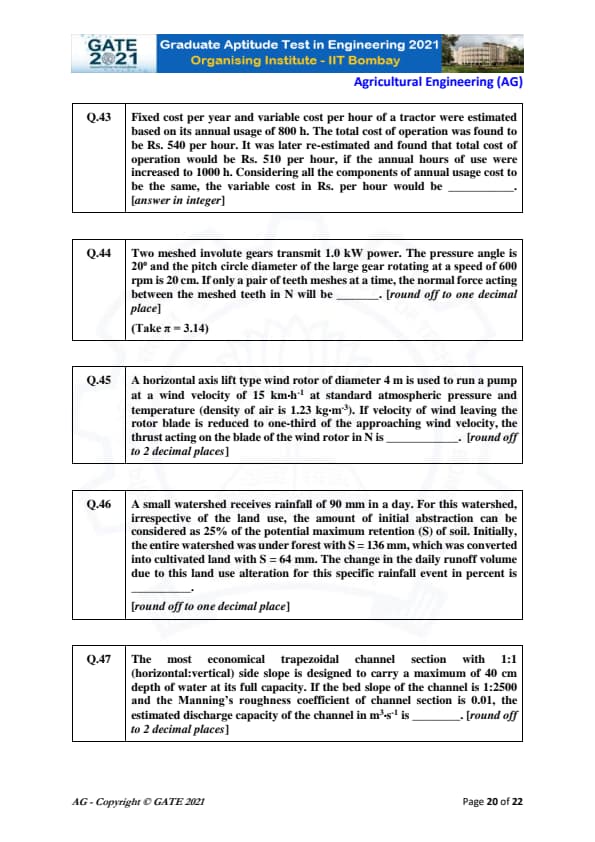
Fixed cost per year and variable cost per hour of a tractor were estimated based on its annual usage of 800 h. The total cost of operation was found to be Rs. 540 per hour. It was later re-estimated and found that the total cost of operation would be Rs. 510 per hour, if the annual hours of use were increased to 1000 h. Considering all the components of annual usage cost to be the same, the variable cost in Rs. per hour would be ______ (answer in integer).
Two meshed involute gears transmit 1.0 kW power. The pressure angle is \(20^\circ\) and the pitch circle diameter of the large gear is 20 cm. If only a pair of teeth meshes at a time, the normal force acting between the meshed teeth in N will be ______ (round off to one decimal place).
A horizontal axis lift type wind rotor of diameter 4 m is used to pump water at a wind velocity of 15 km/h at standard atmospheric pressure and temperature (density of air is 1.23 kg/m\(^3\)). If velocity of wind leaving the rotor blade is reduced to one-third of the approaching wind velocity, the thrust acting on the blade of the wind rotor in N is ______ (round off to two decimal places).
A small watershed receives 90 mm of rainfall in a day. If the initial abstraction is considered as 25% of the potential maximum retention of soil, and the land use changes from forest (with \(S = 136\) mm) to cultivated land (with \(S = 64\) mm), the change in daily runoff volume in percent is ______ (round off to one decimal place).
The most economical trapezoidal channel section with 1:1 (horizontal:vertical) side slope is designed to carry a maximum of 40 cm depth of water at its full capacity. The bed slope of the channel is 1:2500 and the Manning’s roughness coefficient of channel section is 0.01. The estimated discharge capacity of the channel in m\(^3\).s\(^{-1}\) is ______ (round off to 2 decimal places).
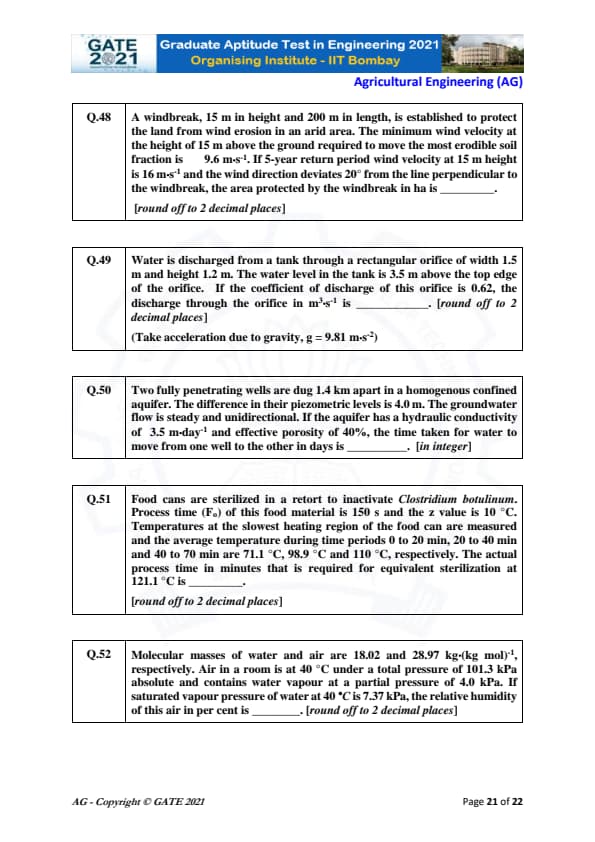
A windbreak of 15 m height and 200 m length is established to protect land from wind erosion. The minimum wind velocity at the height of 15 m above the ground required to move the most erodible soil fraction is 9.6 m/s. The wind direction deviates by 20° from the line perpendicular to the windbreak. The area protected by the windbreak is _______ ha.
Water is discharged from a tank through a rectangular orifice of width 1.5 m and height 1.2 m. The water level in the tank is 3.5 m above the top edge of the orifice. The coefficient of discharge is 0.62. Find the discharge through the orifice in m³·s⁻¹.
Two fully penetrating wells are dug 1.4 km apart in a confined aquifer. The difference in their piezometric levels is 4.0 m. The aquifer has a hydraulic conductivity of 3.5 m/day and effective porosity of 40%. The time taken for water to move from one well to the other in days is _______.
Food cans are sterilized in a retort to inactivate Clostridium botulinum. The process time \(F_0\) is 150 s and z value is 10°C. The temperatures at the slowest heating region are measured as 71.1°C, 98.9°C, and 110°C. Find the actual process time required for sterilization at 121.1°C.
Molecular masses of water and air are 18.02 kg/(mol·mol) and 28.97 kg/(mol·mol), respectively. The room temperature is 40°C under total pressure 101.3 kPa. The relative humidity at 40°C is 73.7 kPa. Find the relative humidity in percent.
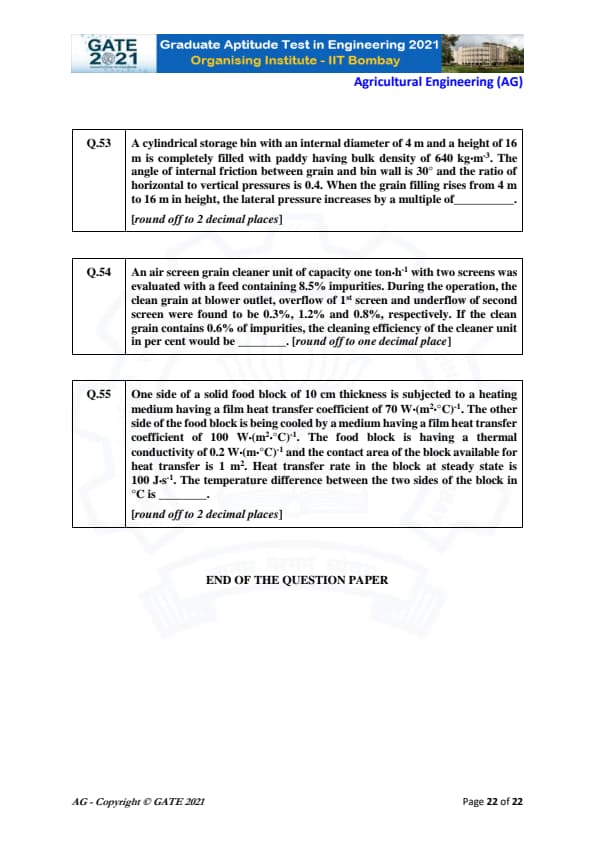
A cylindrical storage bin with an internal diameter of 4 m and a height of 16 m is completely filled with paddy having bulk density of 640 kg·m\(^3\). The angle of internal friction between grain and bin wall is \(30^\circ\) and the ratio of horizontal to vertical pressures is 0.4. When the grain filling rises from 4 m to 16 m in height, the lateral pressure increases by a multiple of ______.
An air screen grain cleaner unit of capacity one ton·h\(^{-1}\) with two screens was evaluated with a feed containing 8.5% impurities. During the operation, the clean grain at blower outlet, overflow of first screen, and underflow of second screen were found to be 0.3%, 1.2% and 0.8%, respectively. If the clean grain contains 0.6% impurities, the cleaning efficiency of the cleaner unit in percent would be ______ (round off to one decimal place).
One side of a solid food block of 10 cm thickness is subjected to a heating medium having a film heat transfer coefficient of 70 W·(m\(^2\)·°C)\(^{-1}\). The other side of the food block is being cooled by a medium having a film heat transfer coefficient of 100 W·(m\(^2\)·°C)\(^{-1}\). The food block has a thermal conductivity of 0.2 W·(m·°C)\(^{-1}\) and the contact area of the block available for heat transfer is 1 m\(^2\). Heat transfer rate in the block at steady state is 100 J·s\(^{-1}\). The temperature difference between the two sides of the block in °C is ______ (round off to 2 decimal places).
Quick Links:
GATE 2021 AG Paper Analysis
- Overall difficulty level of the exam was between moderate to easy.
- Difficulty level of AG section was moderate.
- Difficulty level of General aptitude section was easy to moderate.
- Number of good attempts was 40+.
- Maximum score was expected at 60 and above.
- GATE 2021 AG consisted 100 marks worth 65 questions.
- Negative marking used for MCQ questions, with 1/3rd for 1 mark questions and 2/3rd for 2 mark questions.
- The MSQ and NAT questions have no negative marking.
- The cut-off marks for GATE exam are determined by a number of factors, including the difficulty level of the exam and the number of candidates who appear.
- Refer to the previous year's cut-off marks when IIT Bombay releases GATE 2021 AG Cut-off Marks.
| Year | General | OBC (NCL) | SC/ ST/ PWD |
|---|---|---|---|
| 2020 | 26.3 | 23.6 | 17.5 |
| 2019 | 28.3 | 25.5 | 18.9 |
| 2018 | 25 | 22.5 | 16.6 |
Also Check:
GATE Previous Year Question Papers:
| GATE 2022 Question Papers | GATE 2021 Question Papers | GATE 2020 Question Papers |
| GATE 2019 Question Papers | GATE 2018 Question Papers | GATE 2017 Question Papers |




Comments