




GATE 2021 Biotechnology (BT) Question Paper with Solution is available for the GATE students. The overall difficulty level of GATE 2021 AR was rated moderate. Overall difficulty level of those sections dedicated to Biotechnology was moderate to difficult. Sections related to Biotechnology carried almost 70% in GATE 2021 BT. The rest of the 30% were distributed across Aptitude and Engineering Mathematics. The question paper was a combination of MCQs (Multiple Choice Questions), MSQs (Multiple Select Questions) and NAT (Numerical Answer Type).
Candidates aiming for GATE are highly suggested to download previous year GATE Question Papers and Answer Keys to keep an eye on the preparation level.
GATE 2021 Biotechnology (BT) Question Paper with Solutions
| GATE 2021 Biotechnology (BT) Question Paper |  Download Download |
Check Solutions |

The ratio of boys to girls in a class is 7 to 3. Among the options below, an acceptable value for the total number of students in the class is:
A polygon is convex if, for every pair of points inside the polygon, the line segment joining them lies completely inside or on the polygon. Which one of the following is NOT a convex polygon?

Consider the following sentences:
(i) Everybody in the class is prepared for the exam.
(ii) Babu invited Danish to his home because he enjoys playing chess.
Which of the following is the CORRECT observation about the above two sentences?
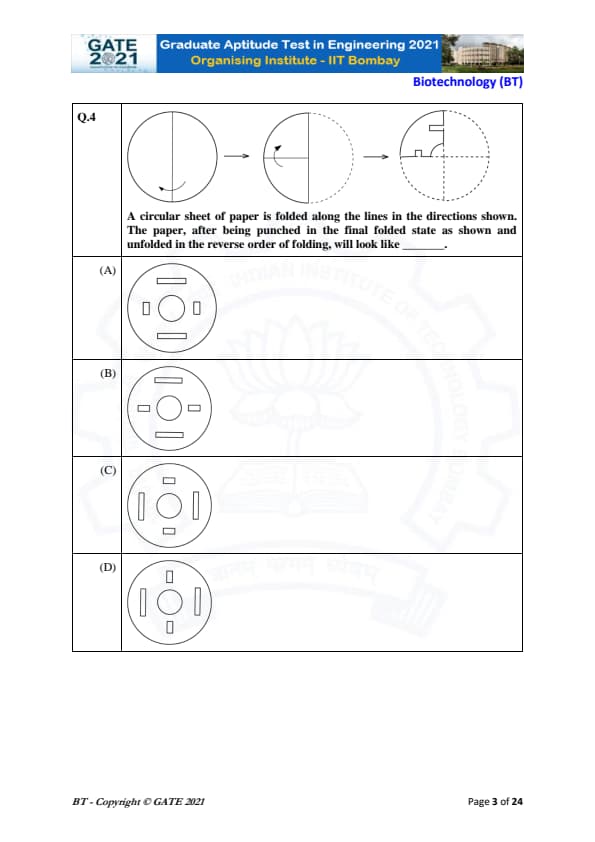
A circular sheet of paper is folded along the lines in the directions shown. The paper, after being punched in the final folded state as shown and unfolded in the reverse order of folding, will look like \hspace{2cm}.


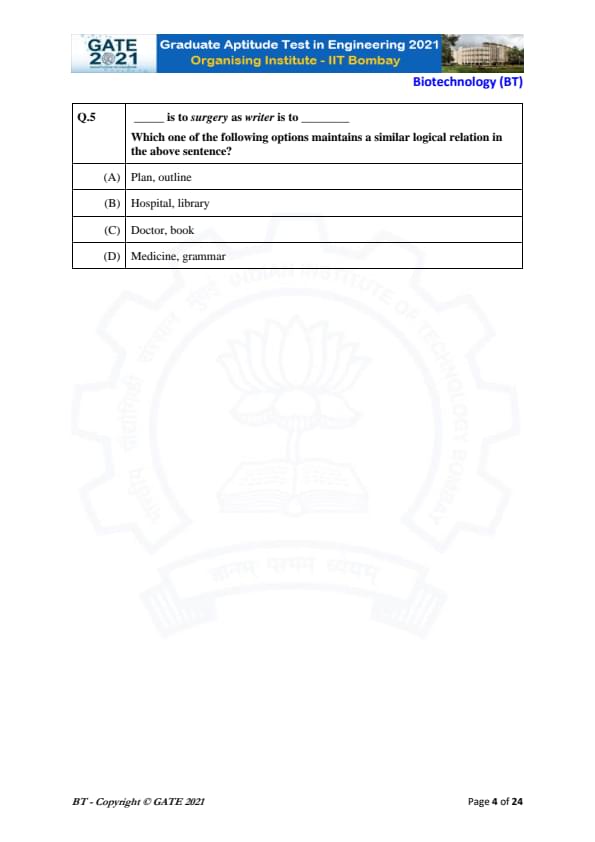
_____ is to surgery as writer is to _____
Which one of the following options maintains a similar logical relation in the above sentence?
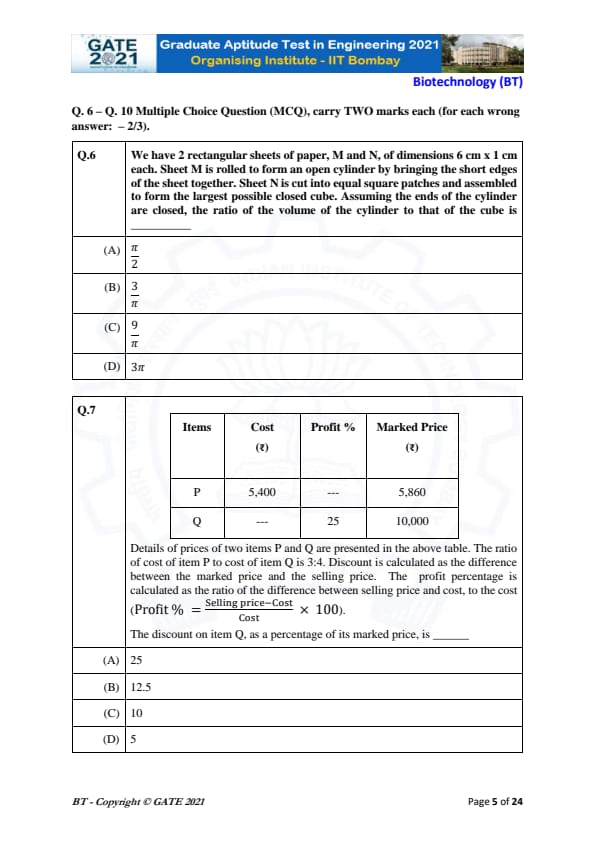
We have 2 rectangular sheets of paper, M and N, of dimensions 6 cm × 1 cm each. Sheet M is rolled to form an open cylinder by bringing the short edges of the sheet together. Sheet N is cut into equal square patches and assembled to form the largest possible closed cube. Assuming the ends of the cylinder are closed, the ratio of the volume of the cylinder to that of the cube is:
Details of prices of two items P and Q are presented in the above table. The ratio of cost of item P to cost of item Q is 3:4. Discount is calculated as the difference between the marked price and the selling price. The profit percentage is calculated as the ratio of the difference between selling price and cost, to the cost.

The formula for Profit Percentage is:
Profit % = \frac{Selling Price - Cost}{Cost} \times 100
The discount on item Q, as a percentage of its marked price, is:
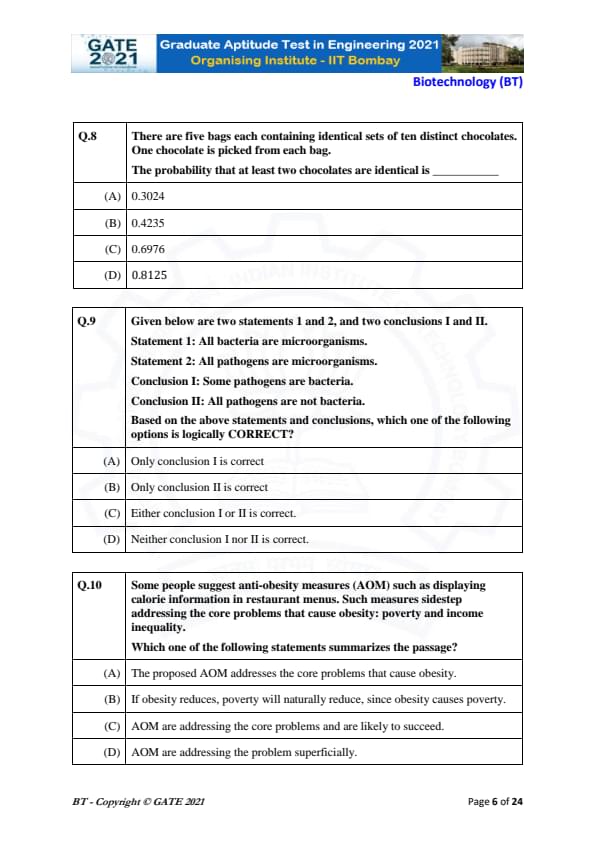
There are five bags each containing identical sets of ten distinct chocolates. One chocolate is picked from each bag. The probability that at least two chocolates are identical is:
Given below are two statements 1 and 2, and two conclusions I ans II.
Statement 1: All bacteria are microorganisms.
Statement 2: All pathogens are microorganisms.
Conclusion I: Some pathogens are bacteria.
Conclusion II: All pathogens are not bacteria.
Based on the given statements and conclusions, which option is logically correct?
Some people suggest anti-obesity measures (AOM) such as displaying calorie information in restaurant menus. Such measures sidestep addressing the core problems that cause obesity: poverty and income inequality. Which one of the following statements summarizes the passage?
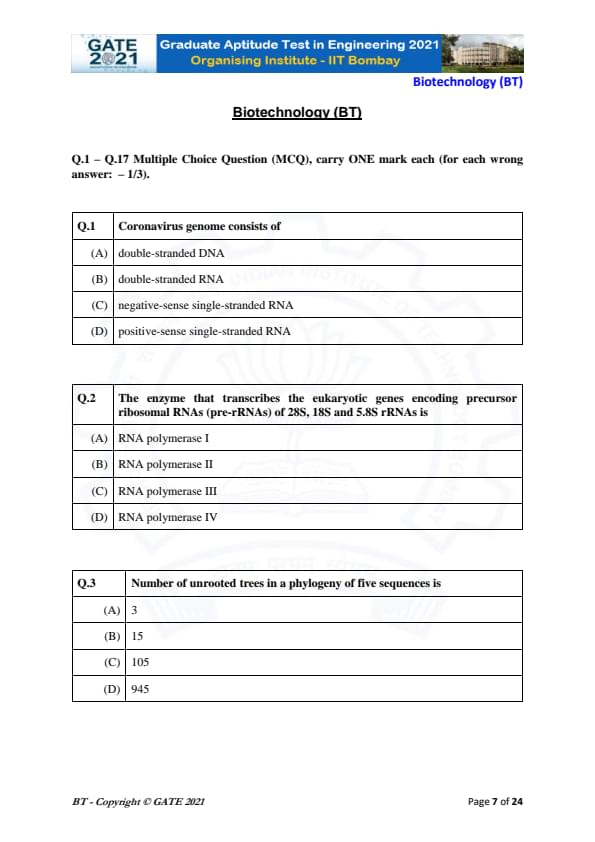
Coronavirus genome consists of
The enzyme that transcribes the eukaryotic genes encoding precursor ribosomal RNAs (pre-rRNAs) of 28S, 18S and 5.8S rRNAs is
Number of unrooted trees in a phylogeny of five sequences is
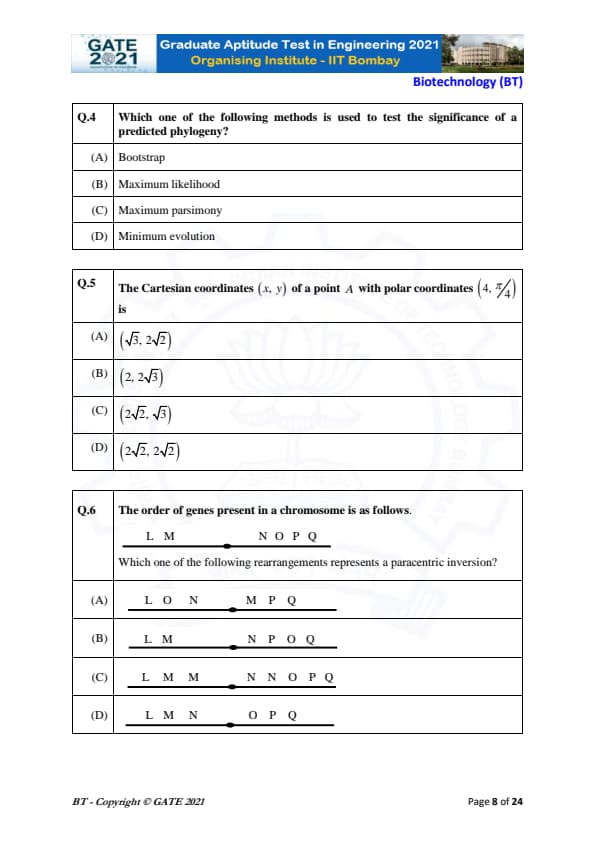
Which one of the following methods is used to test the significance of a predicted phylogeny?
The Cartesian coordinates \((x,y)\) of a point \(A\) with polar coordinates \((4,\pi/4)\) is
The order of genes present in a chromosome is as follows.
Which rearrangement represents a paracentric inversion?
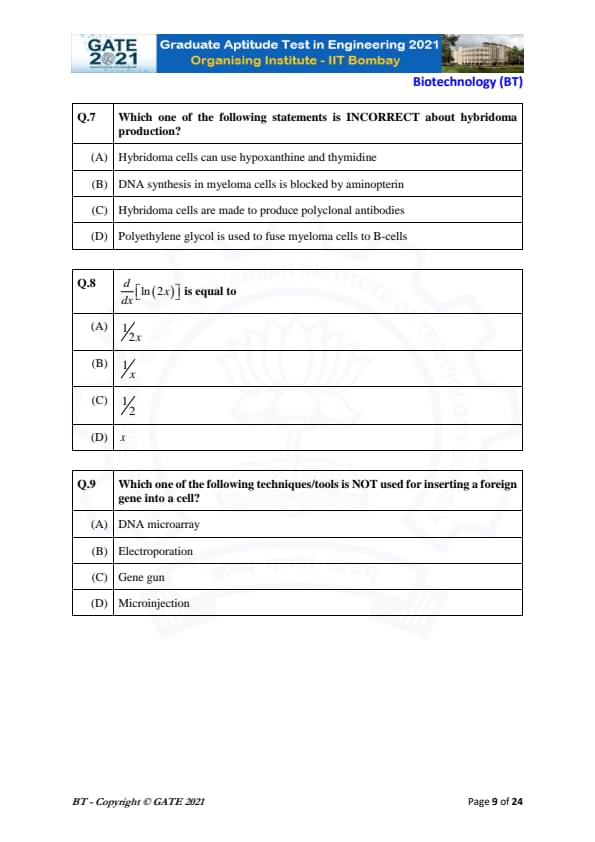
Which one of the following statements is INCORRECT about hybridoma production?
\(\frac{d}{dx}[\ln(2x)]\) is equal to
Which one of the following techniques/tools is NOT used for inserting a foreign gene into a cell?
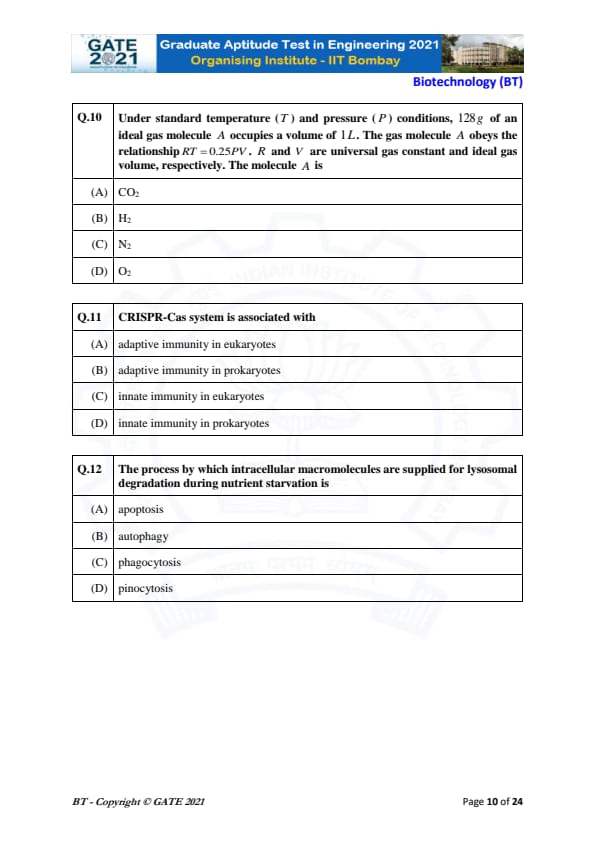
Under standard temperature (T) and pressure (P) conditions, 128 g of an ideal gas molecule A occupies a volume of 1 L. The gas molecule A obeys the relationship \(RT = 0.25PV\). R and V are universal gas constant and ideal gas volume, respectively. The molecule A is:
CRISPR-Cas system is associated with:
The process by which intracellular macromolecules are supplied for lysosomal degradation during nutrient starvation is:
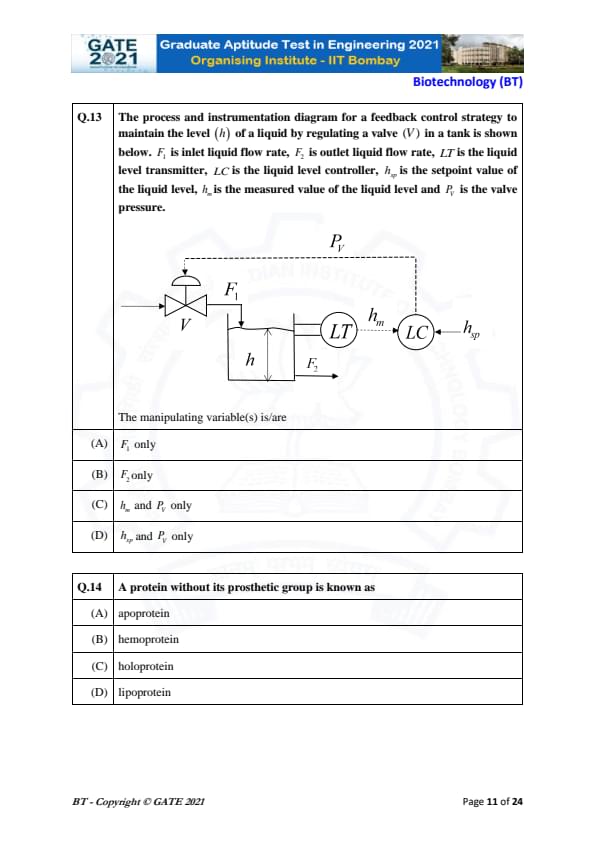
The process and instrumentation diagram for a feedback control strategy to maintain the level (h) of a liquid by regulating a valve (V) is shown. The manipulating variable(s) is/are:
A protein without its prosthetic group is known as:
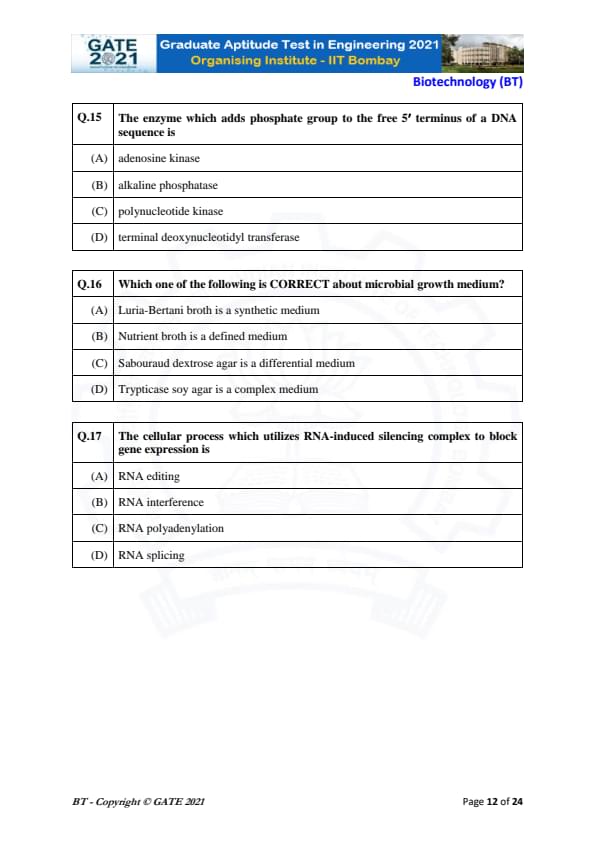
The enzyme which adds phosphate group to the free 5' terminus of a DNA sequence is
Which one of the following is CORRECT about microbial growth medium?
The cellular process which utilizes RNA-induced silencing complex to block gene expression is
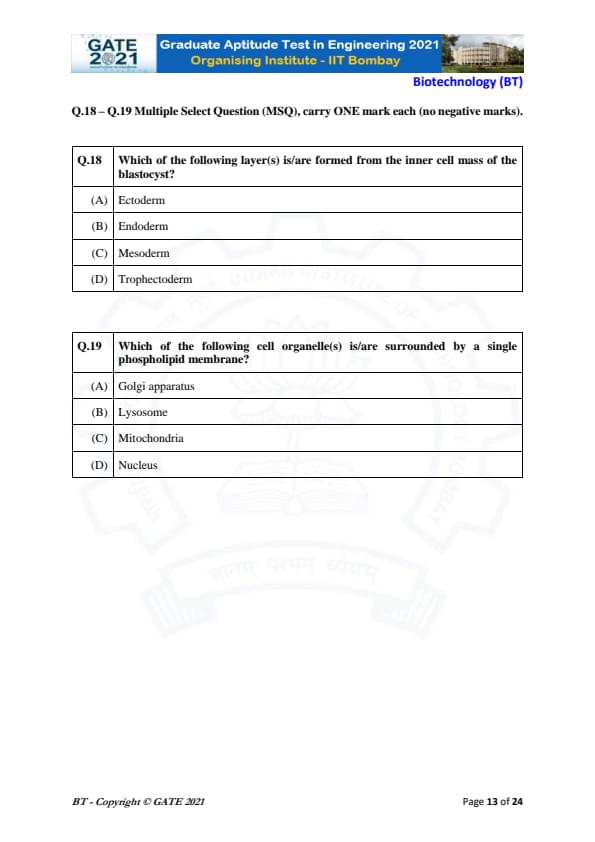
Which of the following layer(s) is/are formed from the inner cell mass of the blastocyst?
Which of the following cell organelle(s) is/are surrounded by a single phospholipid membrane?
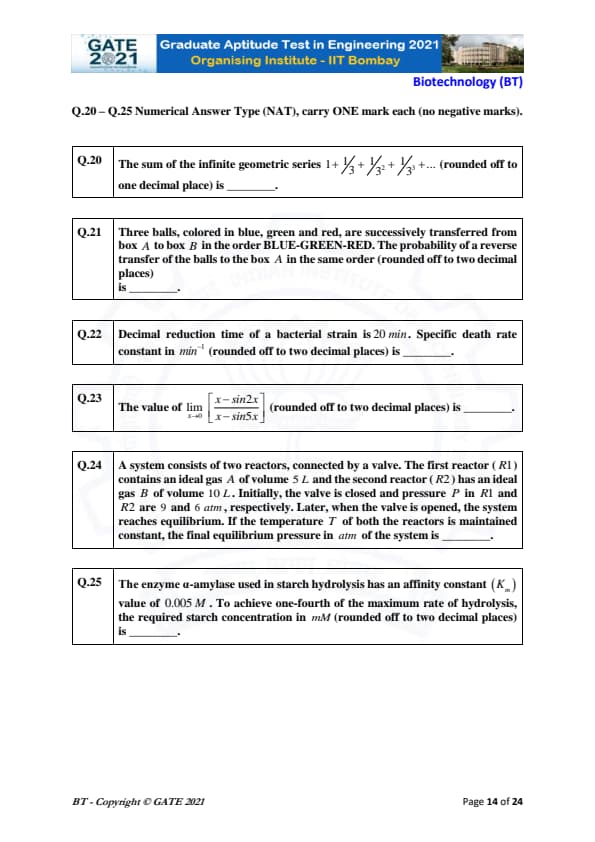
The sum of the infinite geometric series \( 1 + \frac{1}{3} + \frac{1}{3^2} + \frac{1}{3^3} + \ldots \) (rounded off to one decimal place) is _____.
Three balls colored blue, green and red are transferred from box A to box B in the order BLUE–GREEN–RED. The probability that they are transferred back from box B to box A in the same order (rounded off to two decimal places) is _____.
Decimal reduction time of a bacterial strain is 20 min. Specific death rate constant in min\(^{-1}\) (rounded off to two decimal places) is ____.
The value of \( \lim_{x \to 0} \frac{x - \sin 2x}{x - \sin 5x} \) (rounded off to two decimal places) is ____.
Two reactors of volumes 5 L and 10 L contain an ideal gas at 9 atm and 6 atm. When the valve is opened, the final equilibrium pressure (atm) of the system is ____.
For enzyme \(\alpha\)-amylase with \(K_m = 0.005\,M\), the substrate concentration for one-fourth of \(V_{\max}\) (rounded to two decimals, mM) is ____.
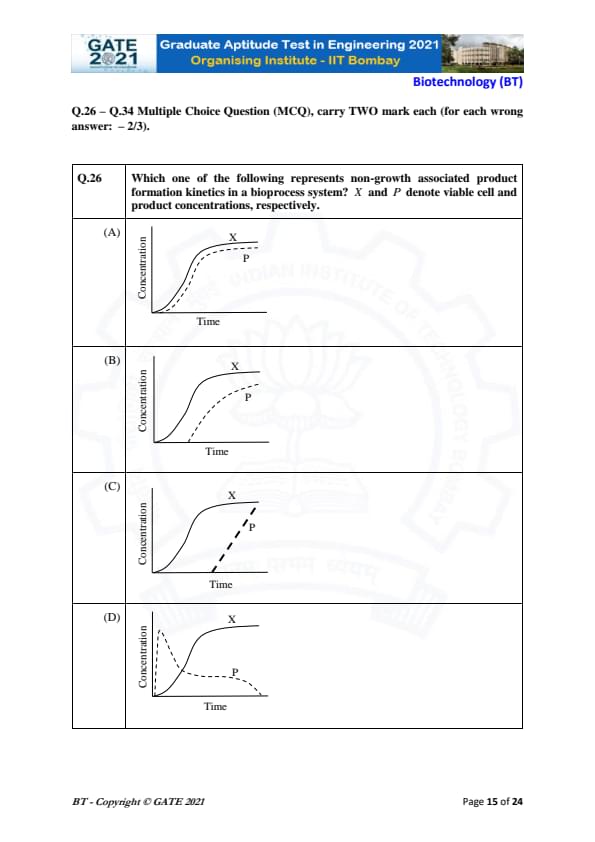
Which one of the following represents non-growth associated product formation kinetics in a bioprocess system? \(X\) and \(P\) denote viable cell and product concentrations, respectively.
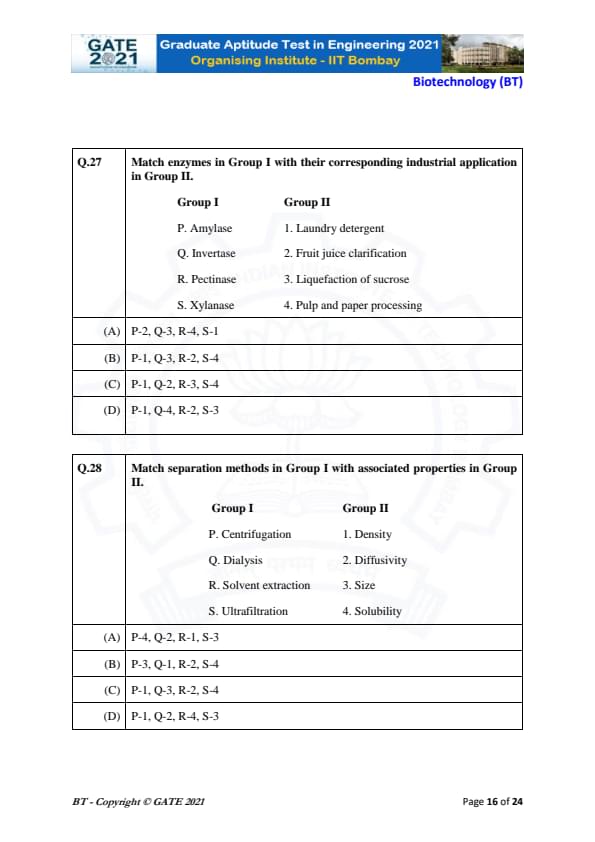
Match enzymes in Group I with their corresponding industrial application in Group II.
Group I \hspace{3cm} Group II
P. Amylase \hspace{3.8cm 1. Laundry detergent
Q. Invertase \hspace{3.5cm 2. Fruit juice clarification
R. Pectinase \hspace{3.4cm 3. Liquefaction of sucrose
S. Xylanase \hspace{3.5cm 4. Pulp and paper processing
Match separation methods in Group I with associated properties in Group II.
Group I \hspace{3cm} Group II
P. Centrifugation \hspace{3cm 1. Density
Q. Dialysis \hspace{3.5cm 2. Diffusivity
R. Solvent extraction \hspace{3cm 3. Size
S. Ultrafiltration \hspace{3cm 4. Solubility
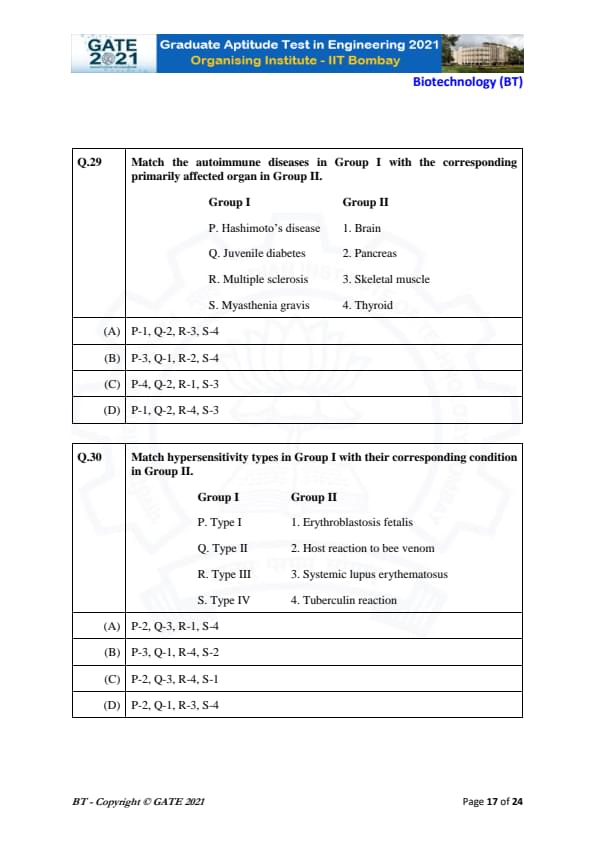
Match the autoimmune diseases in Group I with the corresponding primarily affected organ in Group II.
\begin{tabular{c c
Group I & Group II
P. Hashimoto’s disease & 1. Brain
Q. Juvenile diabetes & 2. Pancreas
R. Multiple sclerosis & 3. Skeletal muscle
S. Myasthenia gravis & 4. Thyroid
\end{tabular
Match hypersensitivity types in Group I with their corresponding condition in Group II.
\begin{tabular{c c
Group I & Group II
P. Type I & 1. Erythroblastosis fetalis
Q. Type II & 2. Host reaction to bee venom
R. Type III & 3. Systemic lupus erythematosus
S. Type IV & 4. Tuberculin reaction
\end{tabular
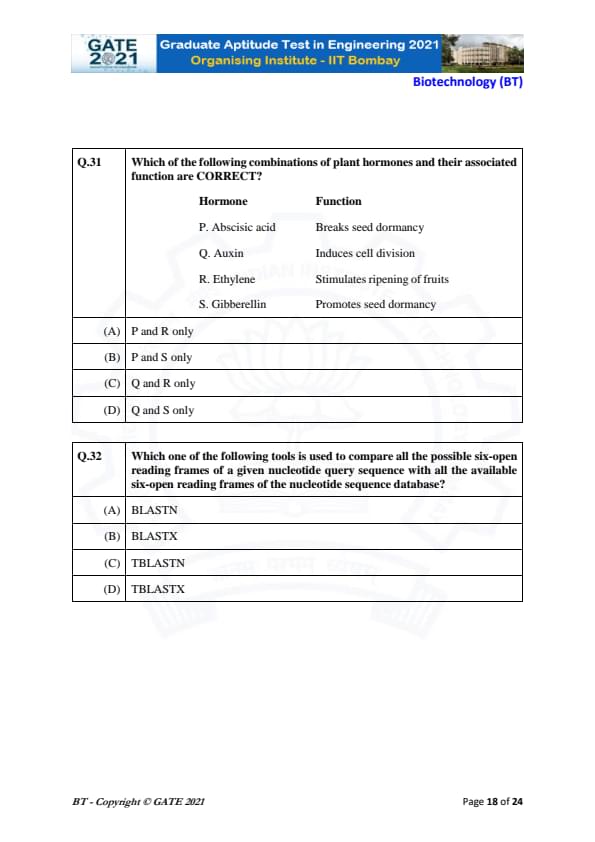
Which of the following combinations of plant hormones and their associated function are CORRECT?
\begin{tabular{c c
Hormone & Function
P. Abscisic acid & Breaks seed dormancy
Q. Auxin & Induces cell division
R. Ethylene & Stimulates ripening of fruits
S. Gibberellin & Promotes seed dormancy
\end{tabular
Which one of the following tools is used to compare all the possible six-open reading frames of a given nucleotide query sequence with all the available six-open reading frames of the nucleotide sequence database?
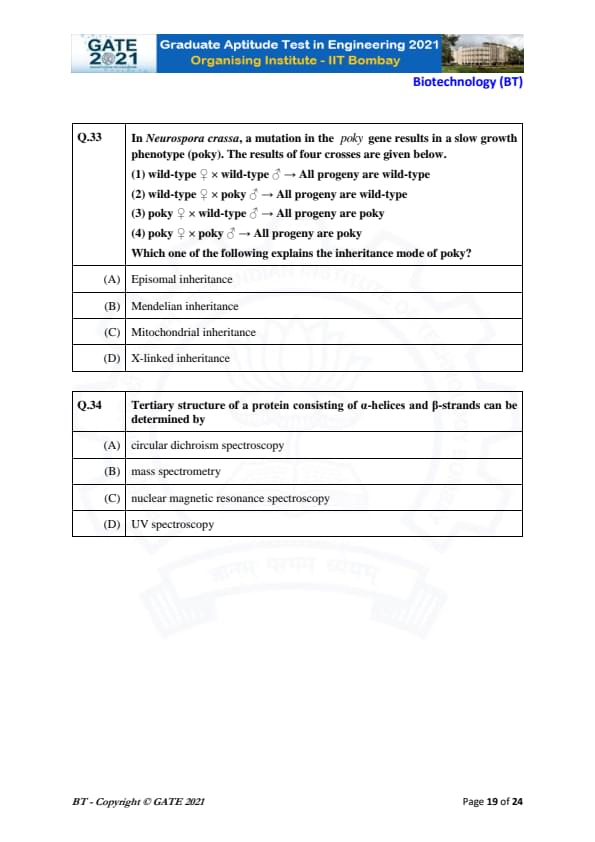
In Neurospora crassa, a mutation in the poky gene results in slow growth (poky). The results of four crosses are given:
(1) wild-type ♀ × wild-type ♂ → All progeny wild-type
(2) wild-type ♀ × poky ♂ → All progeny wild-type
(3) poky ♀ × wild-type ♂ → All progeny poky
(4) poky ♀ × poky ♂ → All progeny poky
Which one of the following explains the inheritance mode of poky?
Tertiary structure of a protein consisting of \(\alpha\)-helices and \(\beta\)-strands can be determined by:
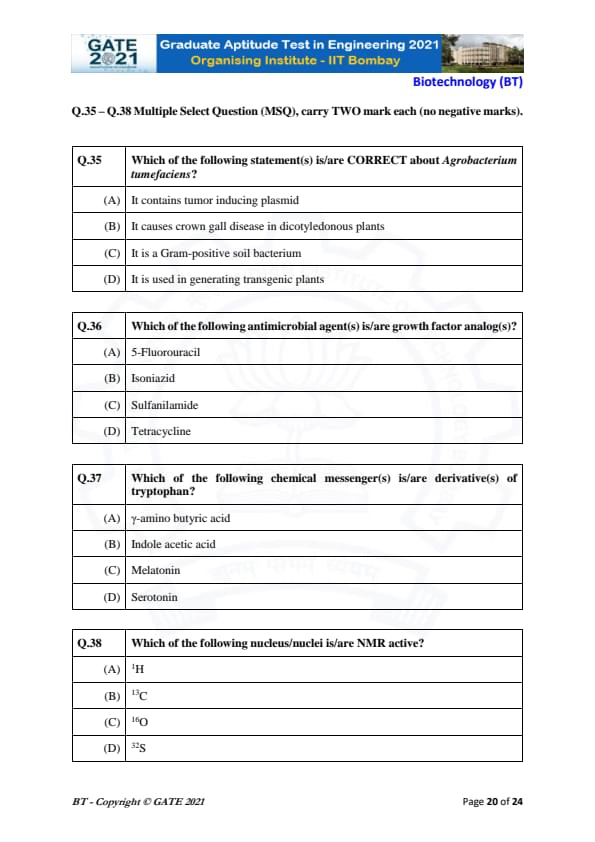
Which of the following statement(s) is/are CORRECT about Agrobacterium tumefaciens?
Which of the following antimicrobial agent(s) is/are growth factor analog(s)?
Which of the following chemical messenger(s) is/are derivative(s) of tryptophan?
Which of the following nucleus/nuclei is/are NMR active?
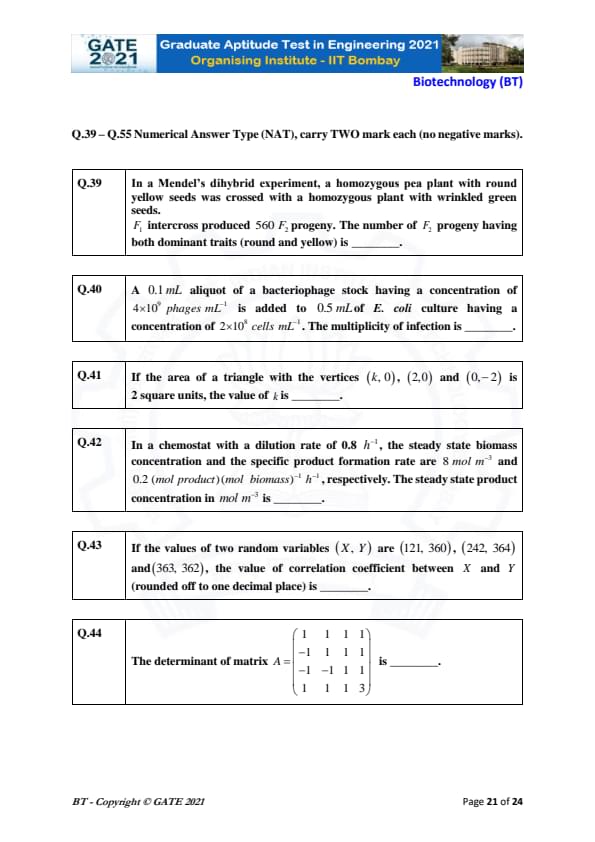
In a Mendel’s dihybrid experiment, a homozygous pea plant with round yellow seeds was crossed with a homozygous plant with wrinkled green seeds. F\(_1\) intercross produced 560 F\(_2\) progeny. The number of F\(_2\) progeny having both dominant traits (round and yellow) is _____.
A 0.1 mL aliquot of a bacteriophage stock having a concentration of \(4 \times 10^9\) phages mL\(^{-1}\) is added to 0.5 mL of E. coli culture having \(2 \times 10^8\) cells mL\(^{-1}\). The multiplicity of infection is ____.
If the area of a triangle with vertices \((k, 0)\), \((2, 0)\) and \((0, -2)\) is 2 square units, the value of \(k\) is ____.
In a chemostat with dilution rate 0.8 h\(^{-1}\), biomass concentration = 8 mol m\(^{-3}\), and specific product formation rate = 0.2 (mol product)(mol biomass)\(^{-1}\) h\(^{-1}\), the steady-state product concentration (mol m\(^{-3}\)) is ____.
If the values of random variables \(X,Y\) are (121,360), (242,364), (363,362), the correlation coefficient (rounded to one decimal place) is ____.
The determinant of matrix \[ A = \begin{pmatrix} 1 & 1 & 1 & 1
-1 & 1 & 1 & 1
-1 & -1 & 1 & 1
1 & 1 & 1 & 3 \end{pmatrix} \]
is ____.
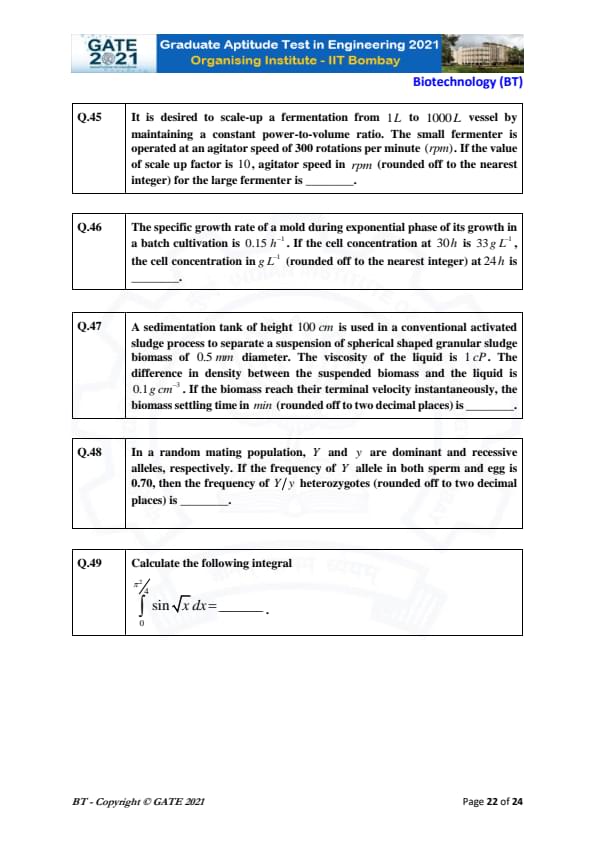
It is desired to scale-up a fermentation from 1 L to 1000 L vessel by maintaining a constant power-to-volume ratio. The small fermenter is operated at an agitator speed of 300 rpm. If the value of scale-up factor is 10, agitator speed in rpm (rounded off to the nearest integer) for the large fermenter is ______.
The specific growth rate of a mold is 0.15 h\(^{-1}\). If the cell concentration at 30 h is 33 g L\(^{-1}\), the concentration at 24 h (rounded to nearest integer) is _____.
A sedimentation tank of height 100 cm is used to separate granular biomass of 0.5 mm diameter. Viscosity = 1 cP; density difference = 0.1 g cm\(^{-3}\). Settling time in min (rounded to two decimals) is _____.
In a random mating population, the frequency of Y allele is 0.70. The frequency of Yy heterozygotes is _____.
Calculate the integral:
\[ \int_{0}^{\pi/4} \sin\sqrt{x}\ dx = \_\_\_\_\_ . \]
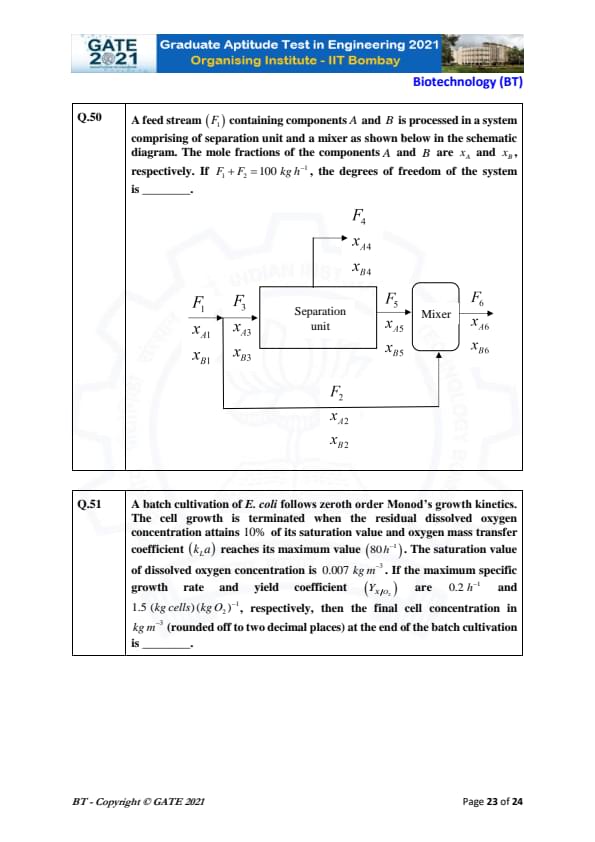
A feed stream \(F_1\) containing components A and B is processed in a separation–mixer system as shown. The mole fractions of A and B are \(x_A\) and \(x_B\). If \(F_1 + F_2 = 100\ kg h^{-1}\), the degrees of freedom of the system is _____.
A batch cultivation of E. coli follows zeroth order Monod kinetics. Growth stops when dissolved oxygen reaches 10% of saturation. The oxygen mass transfer coefficient is \(k_La = 80\ h^{-1}\). Saturation dissolved oxygen = 0.007 kg m\(^{-3}\). If maximum specific growth rate = 0.2 h\(^{-1}\) and yield coefficient \(Y_{X/O_2} = 1.5\ (kg cells)(kg O_2)^{-1}\), then the final biomass concentration (kg m\(^{-3}\)) is _____.
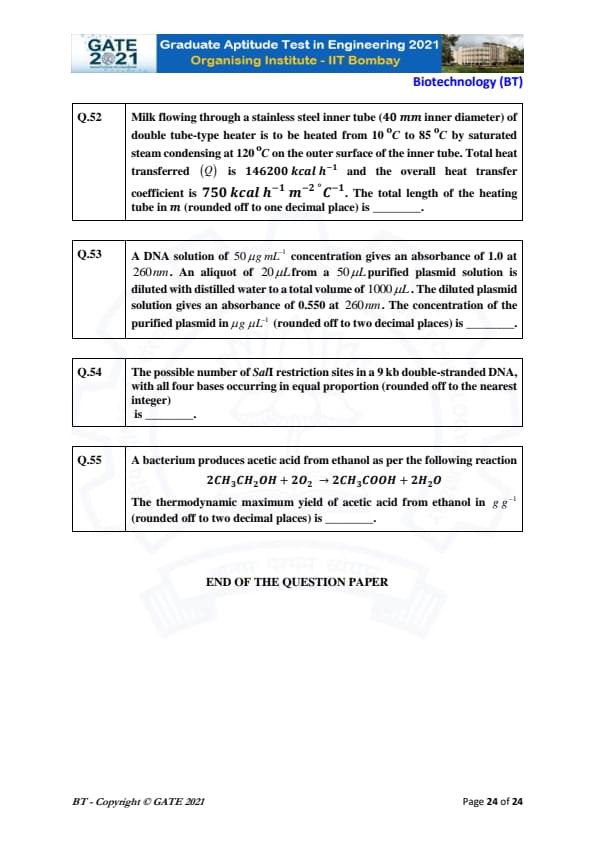
Milk flowing through a stainless steel inner tube (40 mm inner diameter) of a double tube-type heater is heated from 10\(^\circ\)C to 85\(^\circ\)C by steam condensing at 120\(^\circ\)C. Total heat transferred is 146200 kcal h\(^{-1}\), and overall heat transfer coefficient is 750 kcal h\(^{-1}\) m\(^{-2}\) \(^\circ\)C\(^{-1}\). The total length of the heating tube in m (rounded to one decimal place) is _____.
A DNA solution of 50 \(\mu\)g mL\(^{-1}\) gives absorbance of 1.0 at 260 nm. A 20 \(\mu\)L aliquot from a 50 \(\mu\)L purified plasmid solution is diluted to 1000 \(\mu\)L. The diluted solution gives absorbance 0.550 at 260 nm. The purified plasmid concentration in \(\mu\)g \(\mu\)L\(^{-1}\) (rounded to two decimals) is _____.
The possible number of SalI restriction sites in a 9 kb double-stranded DNA with equal base proportion (nearest integer) is ____.
A bacterium produces acetic acid from ethanol as per the following reaction \(2 CH_3CH_2OH + 2O_2 \rightarrow 2CH_3COOH + 2H_2O\).
The maximum thermodynamic yield of acetic acid from ethanol in g g\(^{-1}\) (rounded to two decimals) is ____.


Quick Links:
GATE 2021 BT Paper Analysis
Following the previous year GATE pattern, IIT Bombay listed 65 questions, carried 100 marks. Both easy, moderate, and difficult level questions were asked in GATE 2021 BT.
Please refer to the below-mentioned table to get a detailed analysis of the question pattern of GATE 2021 BT-
| Type of Questions | No. Of Questions | Carried Marks |
|---|---|---|
| No. Of 1 mark MCQs | 22 | 22 |
| No. Of 2 marks MCQs | 14 | 28 |
| No. Of 1 mark MSQ | 2 | 2 |
| No. Of 2 marks MSQs | 4 | 8 |
| No. Of 1 mark NATs | 6 | 6 |
| No. Of 2 marks NATs | 17 | 34 |
- In GATE 2021 BT, a significant number of questions were asked from the NAT section
- Exactly 40% of the total weightage was carried by NAT questions that were distributed across six 1 mark NATs and 17 questions holding 2 marks each question
- The number of MSQs was low, only 6 questions appeared from the NAT section that contributed 10% of the total weightage
- MCQs dominated the question paper of GATE 2021 BT, by holding 50% weightage.
| Subjects | GATE BT 2021- Weightage of Topics | |
|---|---|---|
| 1M | 2M | |
| Engineering Mathematics | 5 | 5 |
| Biochemistry | 2 | 1 |
| Microbiology | 2 | 2 |
| Cell Biology | 1 | 1 |
| Molecular Biology & Genetics | 6 | 2 |
| Analytical Techniques | 1 | 3 |
| Immunology | 1 | 2 |
| Bioinformatics | 1 | 1 |
| Recombinant Dna Technology | 1 | 1 |
| Plant Biotechnology | 1 | 3 |
| Animal Biotechnology | 3 | - |
| Bioprocess Engineering & Process Biotechnolgy | 3 | 12 |
Also Check:
This year, students faced a new type of question, MSQs that comes with one or more than one correct answers. A candidate has to choose all the correct answers in order to get the marks.
- Wrong MCQs would result in deduction of ⅓ marks and ⅔ marks for each incorrect answer respectively
- MSQs and NTAs are not in the list of negative marking scheme
- The cutoff goes up to 30 for General, 27 for OBSs, and 20 for SC/ST
- A student must attempt 40-43 questions to clear the cutoff
GATE Previous Year Question Papers:
| GATE 2022 Question Papers | GATE 2021 Question Papers | GATE 2020 Question Papers |
| GATE 2019 Question Papers | GATE 2018 Question Papers | GATE 2017 Question Papers |





Comments