




GATE 2021 Civil Engineering (CE, Set-2) Question Paper of the afternoon session held on February 6, 2021, was rated moderately difficult by the test-takers and experts alike. GATE 2021 CE question paper had a total of 65 questions out of which 55 questions were from the 7 sections of GATE Civil Engineering Syllabus while the remaining 10 questions were asked from the General Aptitude section. General Aptitude accounted for 15% of the paper while the least number of questions were asked from topics like Steel Structure, CMM, Environment, etc. Check GATE Exam Pattern
To prepare efficiently for the upcoming GATE 2023 exam can download GATE 2021 CE question paper with answer key PDFs given below:
GATE 2021 Civil Engineering (CE, Set-2) Question Paper with Solutions
| GATE 2021 Civil Engineering (CE, Set-2) Question Paper |  Download Download |
Check Solutions |

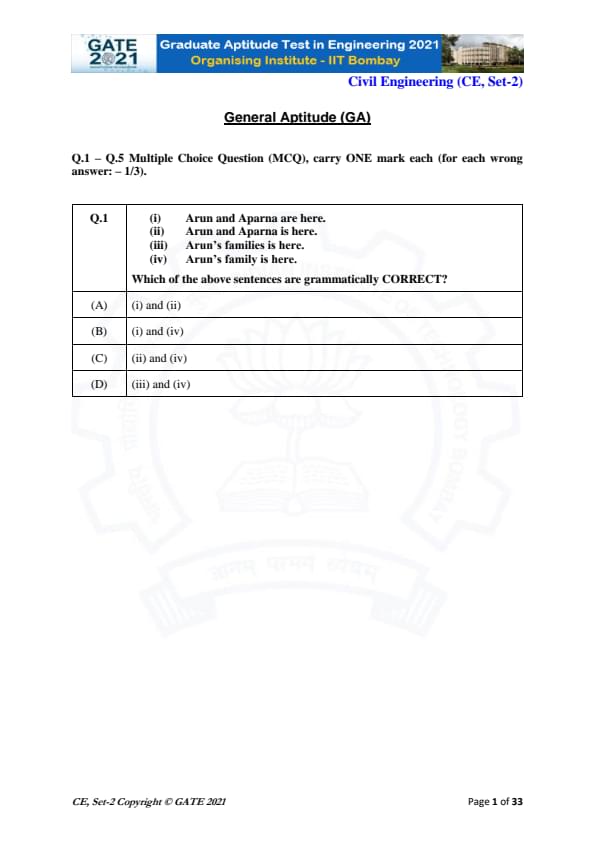
Which of the following sentences are grammatically correct?
(i) Arun and Aparna are here.
(ii) Arun and Aparna is here.
(iii) Arun’s families is here.
(iv) Arun’s family is here.
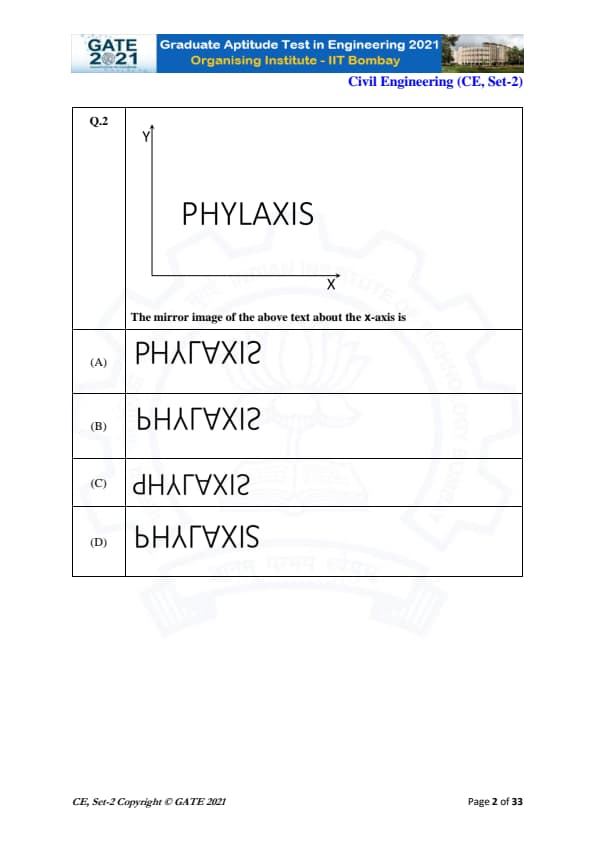
The mirror image of the above text about the x-axis is


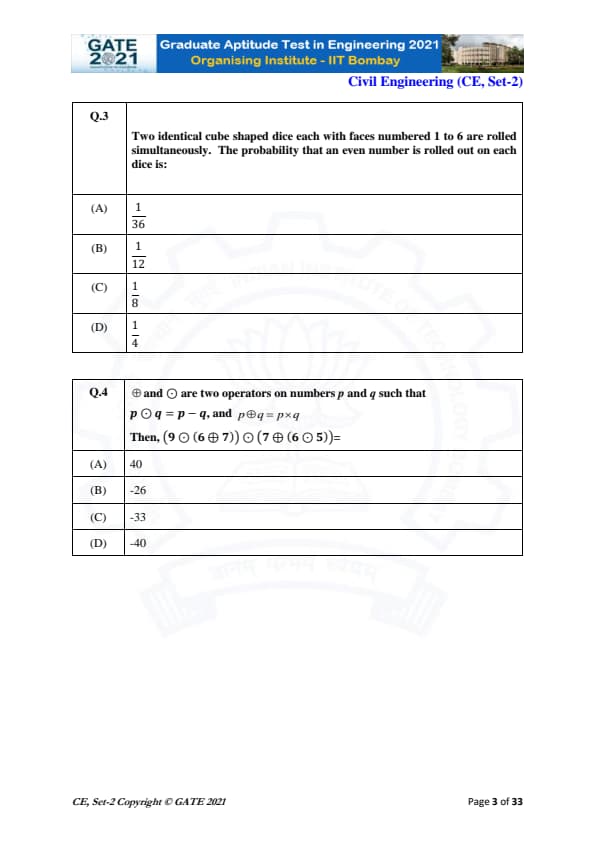
Two identical cube shaped dice each with faces numbered 1 to 6 are rolled simultaneously. The probability that an even number is rolled on each die is:
\( \oplus \) and \( \circ \) are two operators on numbers \( p \) and \( q \) such that \[ p \circ q = p - q, \quad and \quad p \oplus q = p \times q. \]
Then, \[ (9 \circ (6 \oplus 7)) \circ (7 \oplus (6 \circ 5)) = ?
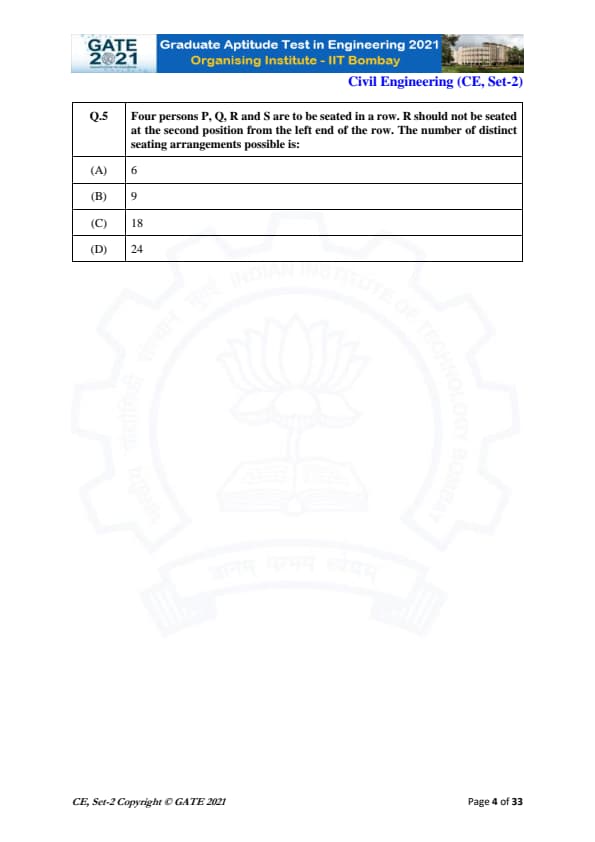
Four persons P, Q, R, and S are to be seated in a row. R should not be seated at the second position from the left end of the row. The number of distinct seating arrangements possible is:
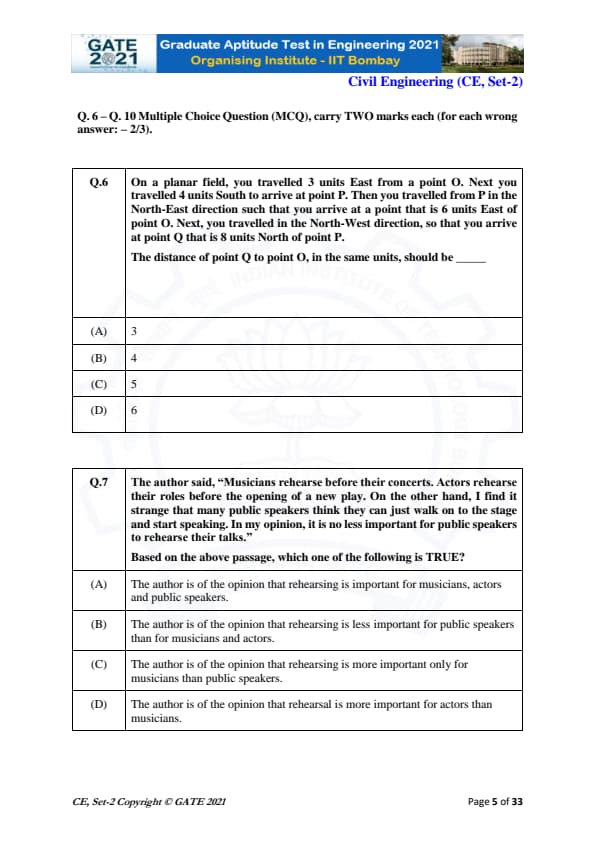
On a planar field, you travelled 3 units East from a point O. Next you travelled 4 units South to arrive at point P. Then you travelled from P in the North-East direction such that you arrive at a point that is 6 units East of point O. Next, you travelled in the North-West direction, so that you arrive at point Q that is 8 units North of point P.
The distance of point Q to point O, in the same units, should be ________
The author said, “Musicians rehearse before their concerts. Actors rehearse their roles before the opening of a new play. On the other hand, I find it strange that many public speakers think they can just walk on to the stage and start speaking. In my opinion, it is no less important for public speakers to rehearse their talks.”
Based on the above passage, which one of the following is TRUE?
1. Some football players play cricket.
2. All cricket players play hockey.
Among the options given below, the statement that logically follows from the two statements 1 and 2 above, is:
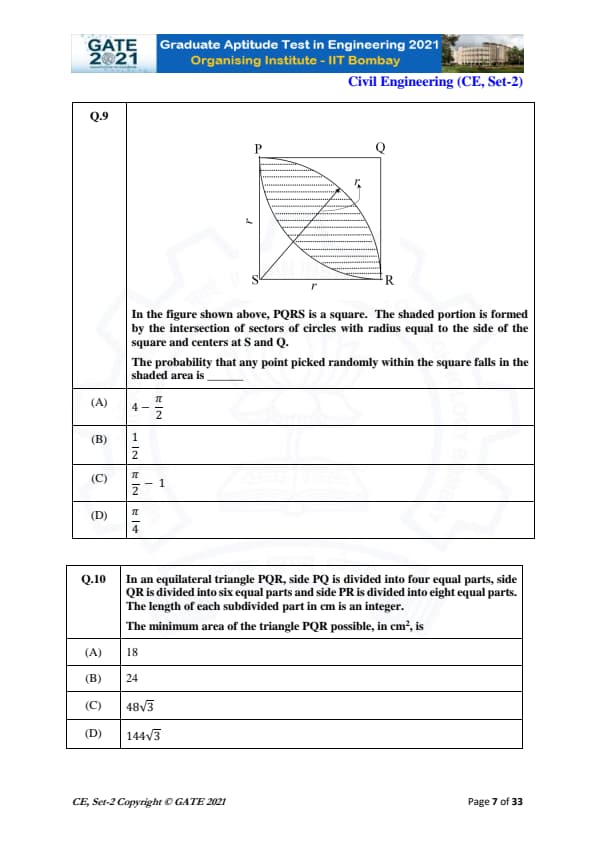
In the figure shown above, PQRS is a square. The shaded portion is formed by the intersection of sectors of circles with radius equal to the side of the square and centers at S and Q.
The probability that any point picked randomly within the square falls in the shaded area is

In an equilateral triangle PQR, side PQ is divided into four equal parts, side QR is divided into six equal parts and side PR is divided into eight equal parts. The length of each subdivided part in cm is an integer.
The minimum area of the triangle PQR possible, in cm², is
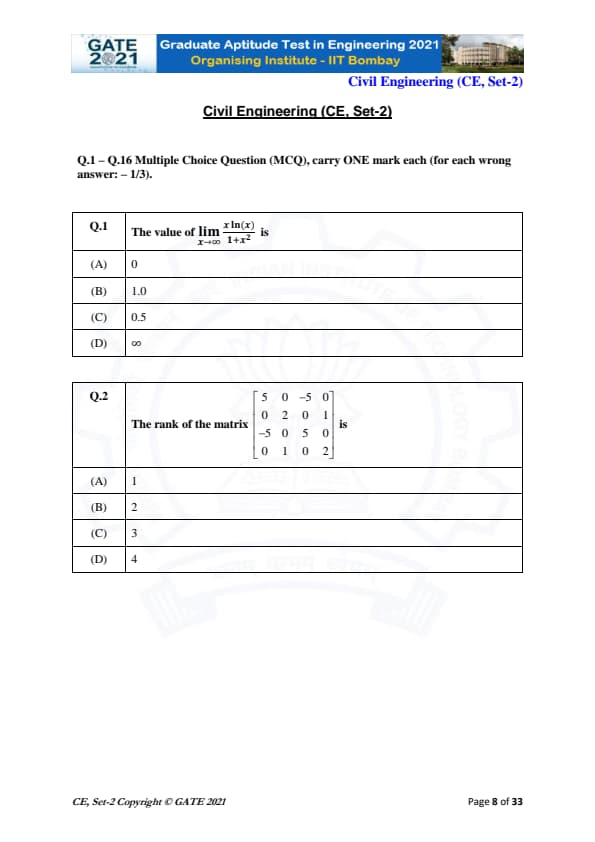
The value of \[ \lim_{x \to \infty} \frac{x \ln(x)}{1 + x^2} \]
\text{is:
The rank of the matrix \[ \begin{pmatrix} 5 & 0 & -5 & 0 \\
0 & 2 & 0 & 1 \\
-5 & 0 & 5 & 0 \\
0 & 1 & 0 & 2 \end{pmatrix} \]
\text{is:
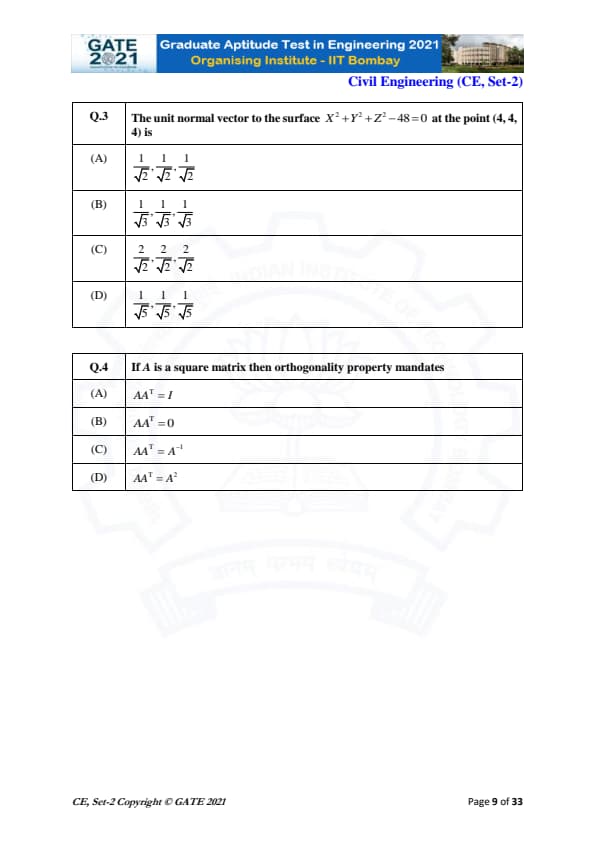
The unit normal vector to the surface \( X^2 + Y^2 + Z^2 - 48 = 0 \) at the point (4, 4, 4) is
If A is a square matrix then orthogonality property mandates
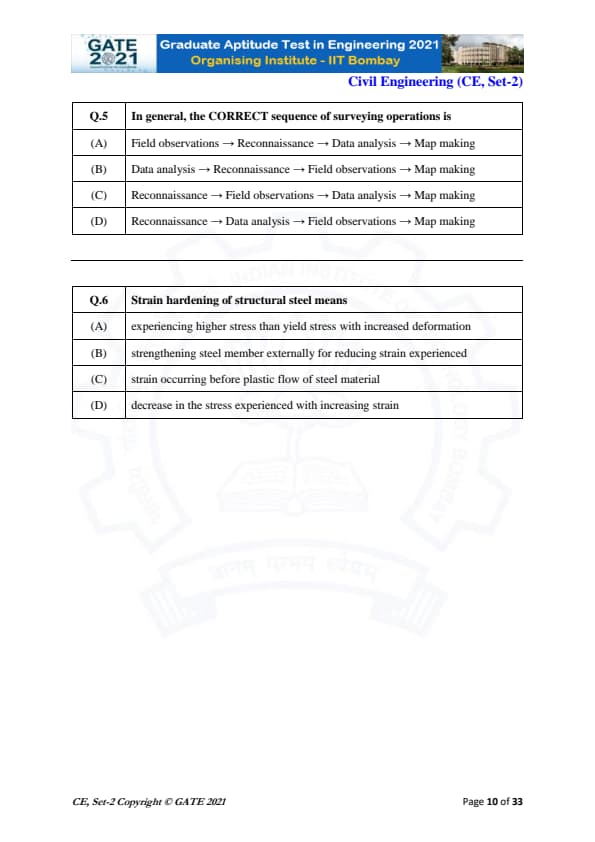
In general, the CORRECT sequence of surveying operations is
Strain hardening of structural steel means
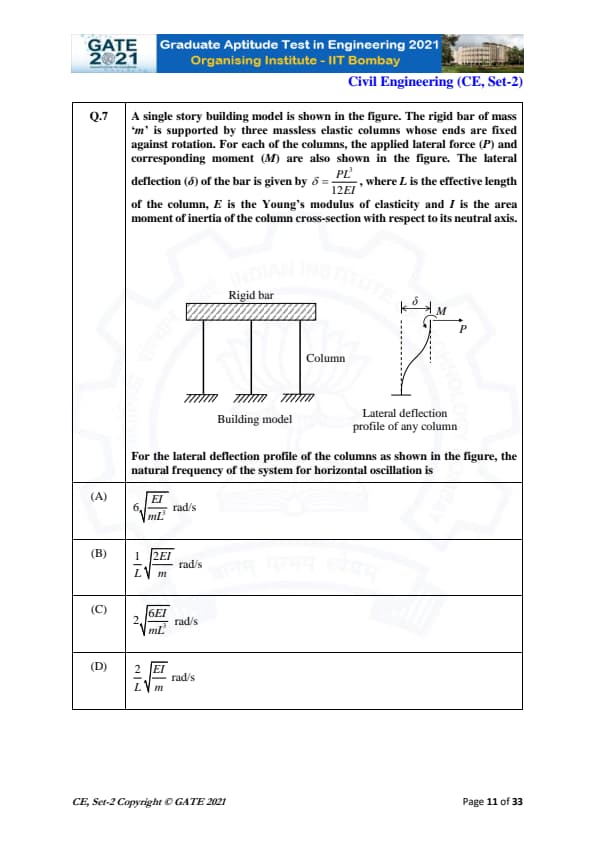
A single story building model is shown in the figure. The rigid bar of mass \( m \) is supported by three massless elastic columns whose ends are fixed against rotation. For each of the columns, the applied lateral force (P) and corresponding moment (M) are also shown in the figure. The lateral deflection (\( \delta \)) of the bar is given by \[ \delta = \frac{PL^3}{12EI} \]
where \( L \) is the effective length of the column, \( E \) is the Young’s modulus of elasticity and \( I \) is the area moment of inertia of the column cross-section with respect to its neutral axis.

For the lateral deflection profile of the columns as shown in the figure, the natural frequency of the system for horizontal oscillation is
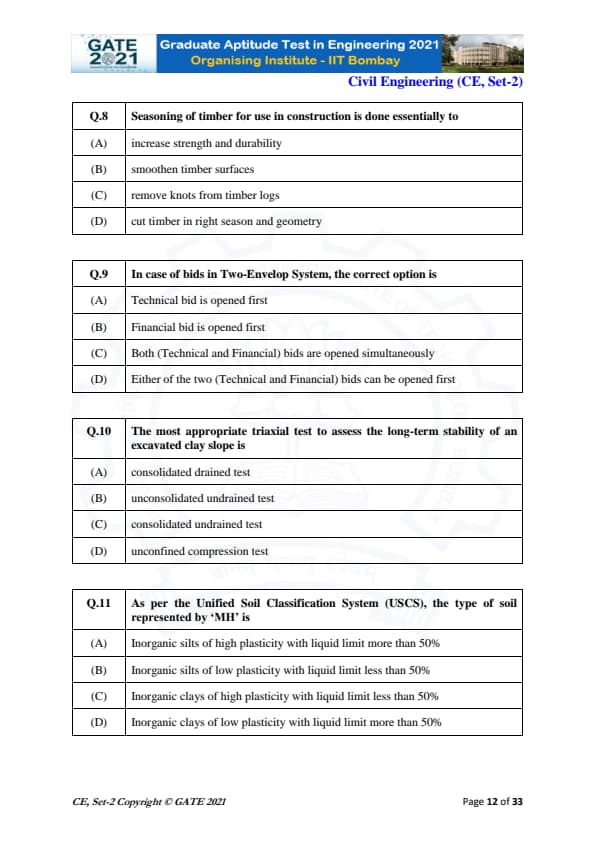
Seasoning of timber for use in construction is done essentially to
In case of bids in Two-Envelope System, the correct option is
The most appropriate triaxial test to assess the long-term stability of an excavated clay slope is
As per the Unified Soil Classification System (USCS), the type of soil represented by ‘MH’ is
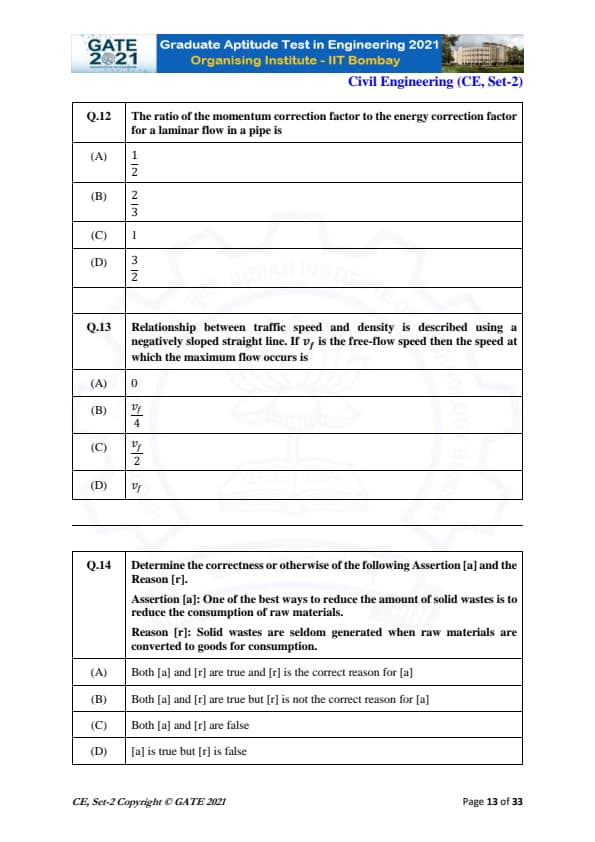
The ratio of the momentum correction factor to the energy correction factor for a laminar flow in a pipe is:
Relationship between traffic speed and density is described using a negatively sloped straight line. If \( v_f \) is the free-flow speed, then the speed at which the maximum flow occurs is:
Determine the correctness or otherwise of the following Assertion [a] and the Reason [r].
Assertion [a]: One of the best ways to reduce the amount of solid wastes is to reduce the consumption of raw materials.
Reason [r]: Solid wastes are seldom generated when raw materials are converted to goods for consumption.
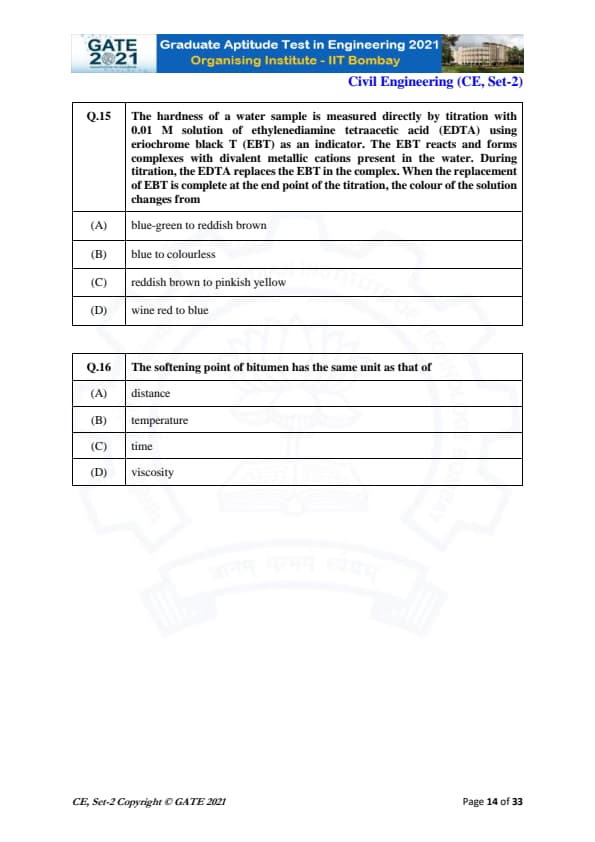
The hardness of a water sample is measured directly by titration with 0.01 M solution of ethylenediamine tetraacetic acid (EDTA) using eriochrome black T (EBT) as an indicator. The EBT reacts and forms complexes with divalent metallic cations present in the water. During titration, the EDTA replaces the EBT in the complex. When the replacement of EBT is complete at the end point of the titration, the colour of the solution changes from
The softening point of bitumen has the same unit as that of
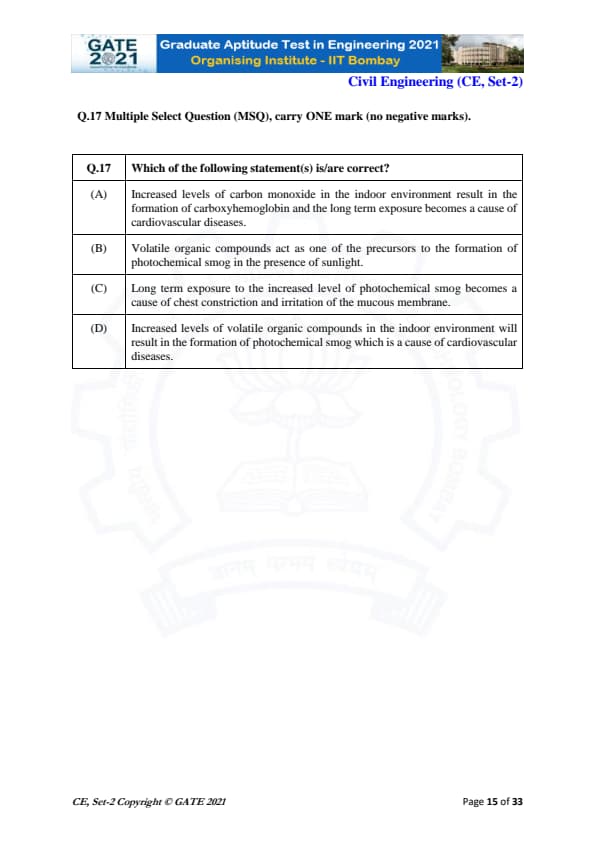
Which of the following statement(s) is/are correct?
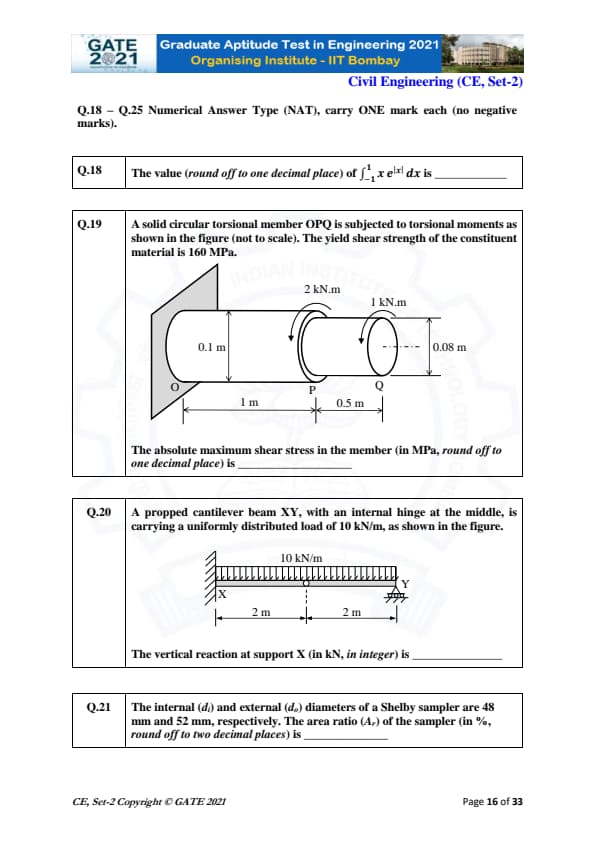
The value (round off to one decimal place) of \[ \int_{-1}^1 x e^{|x|} \, dx is \_\_\_\_\_. \]
A solid circular torsional member OPQ is subjected to torsional moments as shown in the figure (not to scale). The yield shear strength of the constituent material is 160 MPa.

The absolute maximum shear stress in the member (in MPa, round off to one decimal place) is \_\_\_\_\_.
A propped cantilever beam XY, with an internal hinge at the middle, is carrying a uniformly distributed load of 10 kN/m, as shown in the figure.

The vertical reaction at support X (in kN, in integer) is \_\_\_\_\_.
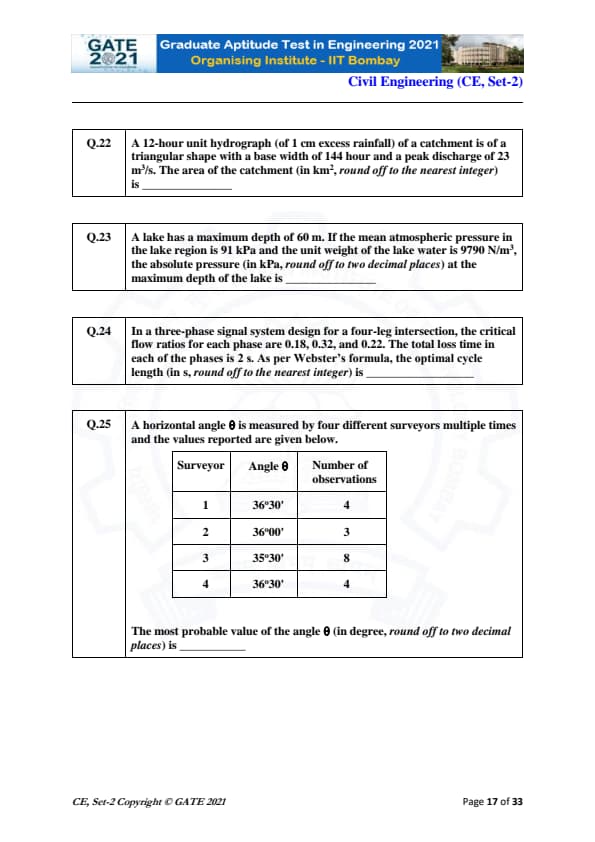
A 12-hour unit hydrograph (of 1 cm excess rainfall) of a catchment is of a triangular shape with a base width of 144 hour and a peak discharge of 23 m\(^3\)/s. The area of the catchment (in km\(^2\), round off to the nearest integer) is _______.
A lake has a maximum depth of 60 m. If the mean atmospheric pressure in the lake region is 91 kPa and the unit weight of the lake water is 9790 N/m\(^3\), the absolute pressure (in kPa, round off to two decimal places) at the maximum depth of the lake is _______.
In a three-phase signal system design for a four-leg intersection, the critical flow ratios for each phase are 0.18, 0.32, and 0.22. The total loss time in each of the phases is 2 s. As per Webster’s formula, the optimal cycle length (in s, round off to the nearest integer) is ______.
A horizontal angle \( \theta \) is measured by four different surveyors multiple times and the values reported are given below.

The most probable value of the angle \( \theta \) (in degree, round off to two decimal places) is ______.
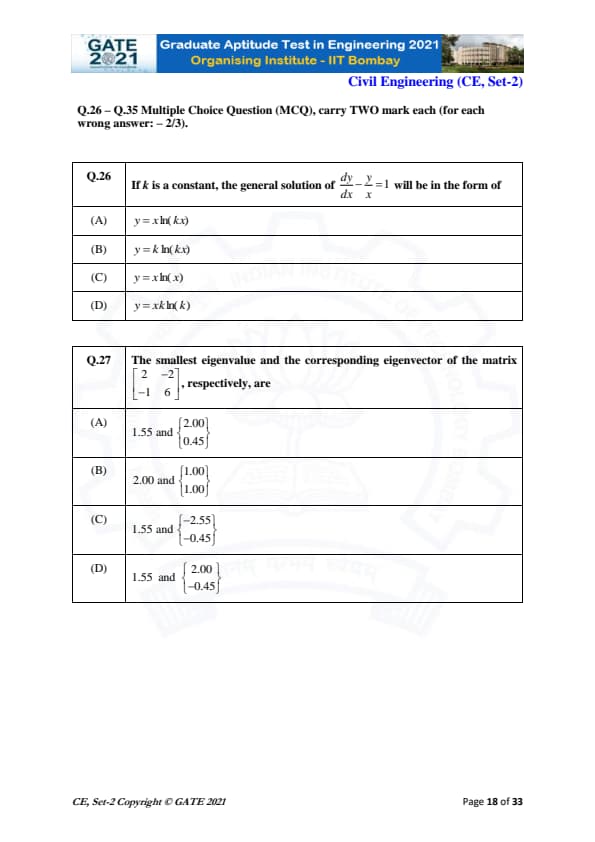
If \( k \) is a constant, the general solution of \[ \frac{dy}{dx} = \frac{y}{x} \]
will be in the form of
The smallest eigenvalue and the corresponding eigenvector of the matrix \[ \begin{bmatrix} 2 & -2 \\
-1 & 6 \end{bmatrix} \]
respectively are
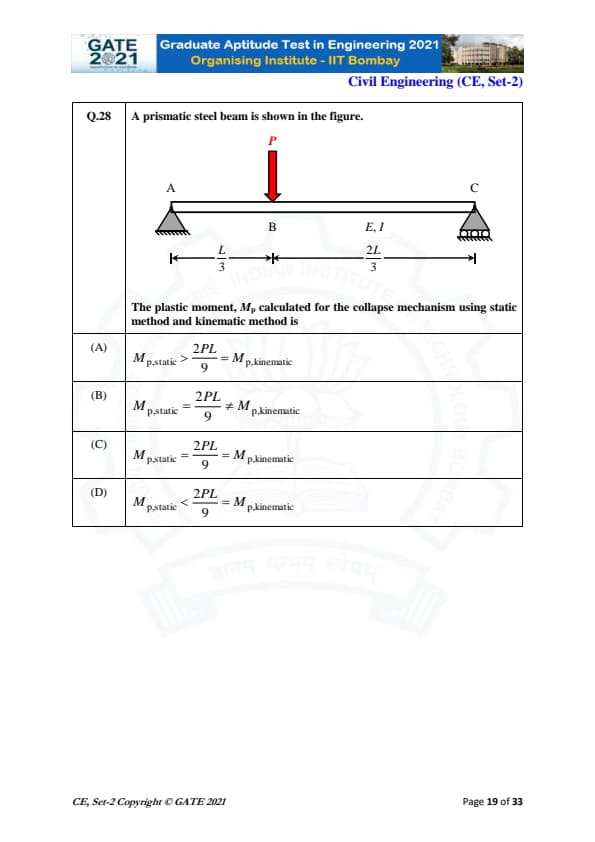
A prismatic steel beam is shown in the figure.

The plastic moment, \( M_p \) calculated for the collapse mechanism using static method and kinematic method is
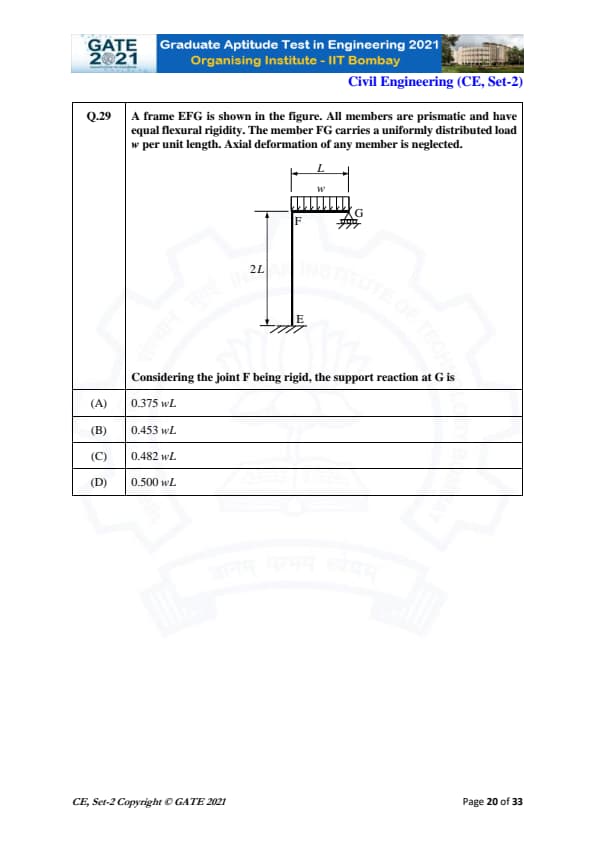
A frame EFG is shown in the figure. All members are prismatic and have equal flexural rigidity. The member FG carries a uniformly distributed load \( w \) per unit length. Axial deformation of any member is neglected.

Considering the joint F being rigid, the support reaction at G is:
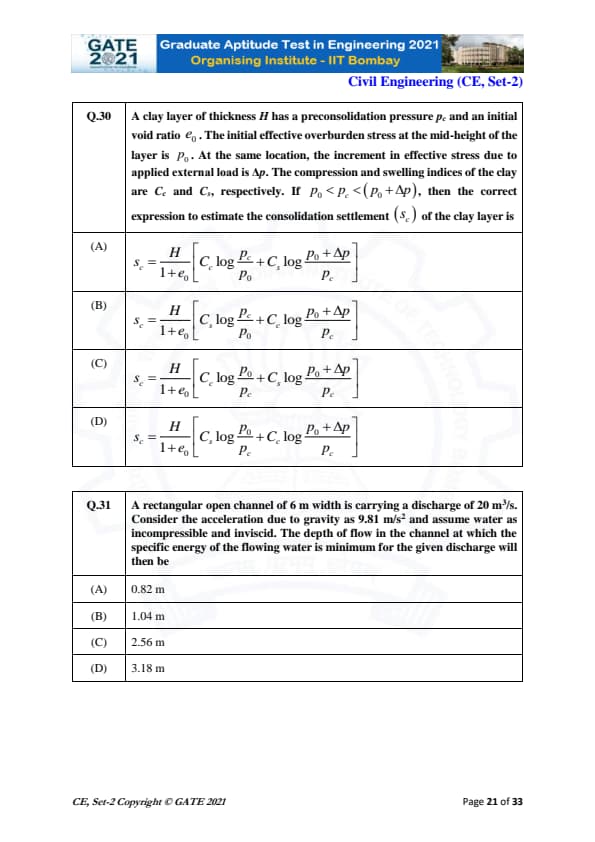
A clay layer of thickness \( H \) has a preconsolidation pressure \( p_c \) and an initial void ratio \( e_0 \). The initial effective overburden stress at the mid-height of the layer is \( p_0 \). At the same location, the increment in effective stress due to applied external load is \( \Delta p \). The compression and swelling indices of the clay are \( C_c \) and \( C_s \), respectively. If \( p_0 < p_c < (p_0 + \Delta p) \), then the correct expression to estimate the consolidation settlement \( s_c \) of the clay layer is
A rectangular open channel of 6 m width is carrying a discharge of 20 m³/s. Consider the acceleration due to gravity as 9.81 m/s² and assume water as incompressible and inviscid. The depth of flow in the channel at which the specific energy of the flowing water is minimum for the given discharge will then be
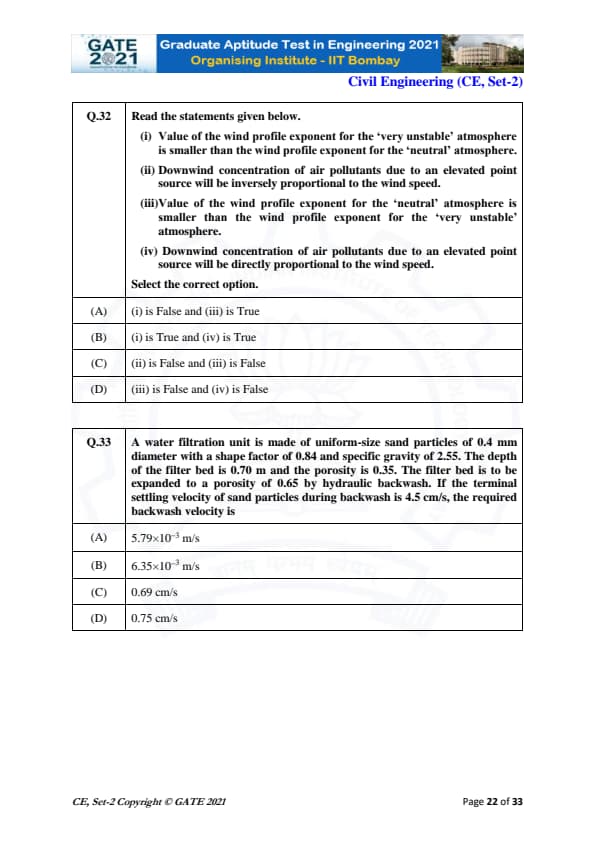
Read the statements given below.
(i) Value of the wind profile exponent for the 'very unstable' atmosphere is smaller than the wind profile exponent for the 'neutral' atmosphere.
(ii) Downwind concentration of air pollutants due to an elevated point source will be inversely proportional to the wind speed.
(iii) Value of the wind profile exponent for the 'neutral' atmosphere is smaller than the wind profile exponent for the 'very unstable' atmosphere.
(iv) Downwind concentration of air pollutants due to an elevated point source will be directly proportional to the wind speed.
Select the correct option.
A water filtration unit is made of uniform-size sand particles of 0.4 mm diameter with a shape factor of 0.84 and specific gravity of 2.55. The depth of the filter bed is 0.70 m and the porosity is 0.35. The filter bed is to be expanded to a porosity of 0.65 by hydraulic backwash. If the terminal settling velocity of sand particles during backwash is 4.5 cm/s, the required backwash velocity is
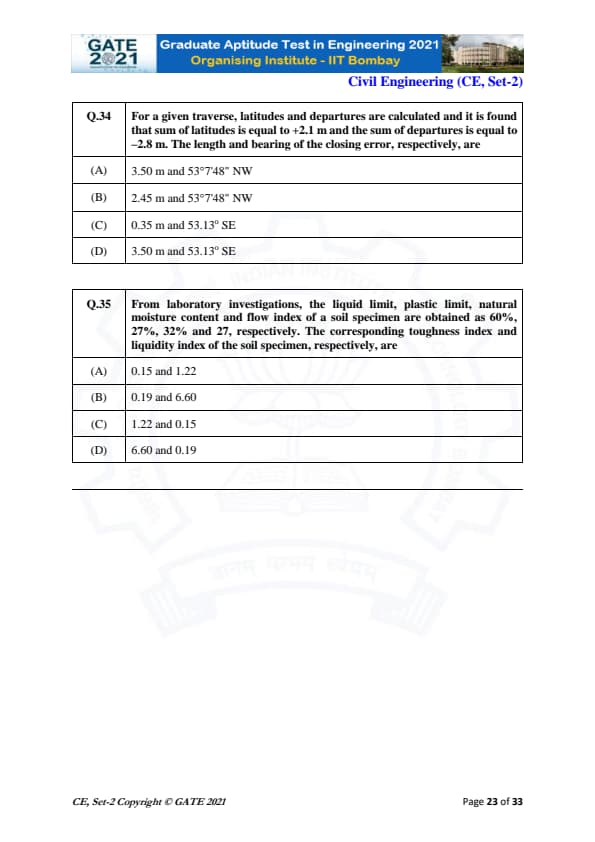
For a given traverse, latitudes and departures are calculated and it is found that sum of latitudes is equal to +2.1 m and the sum of departures is equal to -2.8 m. The length and bearing of the closing error, respectively, are
From laboratory investigations, the liquid limit, plastic limit, natural moisture content and flow index of a soil specimen are obtained as 60%, 27%, 32% and 27, respectively. The corresponding toughness index and liquidity index of the soil specimen, respectively, are
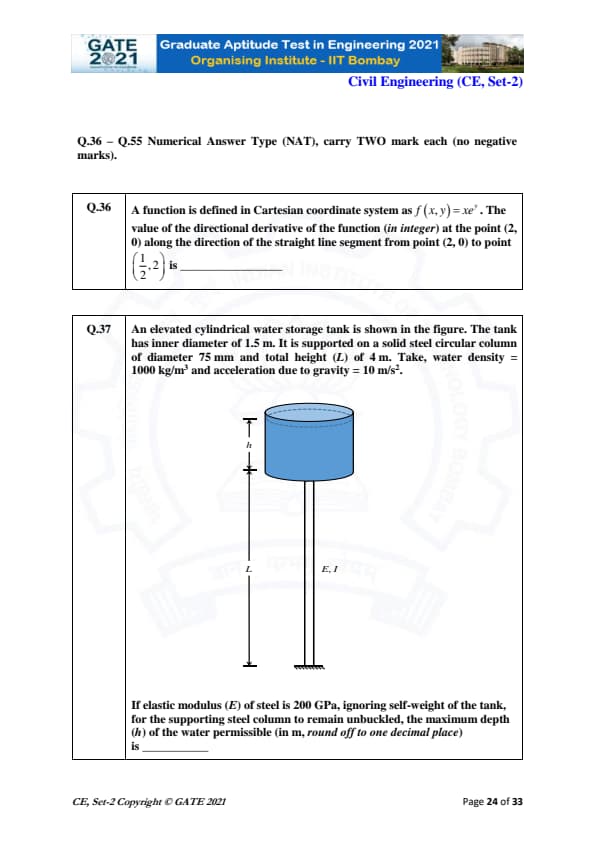
A function is defined in Cartesian coordinate system as \[ f(x, y) = x e^y. \]
The value of the directional derivative of the function (in integer) at the point \( (2, 0) \) along the direction of the straight line segment from point \( (2, 0) \) to point \( \left( \frac{1}{2}, 2 \right) \) is _____.
An elevated cylindrical water storage tank is shown in the figure. The tank has inner diameter of 1.5 m. It is supported on a solid steel circular column of diameter 75 mm and total height \( L \) of 4 m. Take, water density = 1000 kg/m\(^3\) and acceleration due to gravity = 10 m/s\(^2\).

If elastic modulus (E) of steel is 200 GPa, ignoring self-weight of the tank, for the supporting steel column to remain unbuckled, the maximum depth (h) of the water permissible (in m, round off to one decimal place) is \_\_\_\_\_.
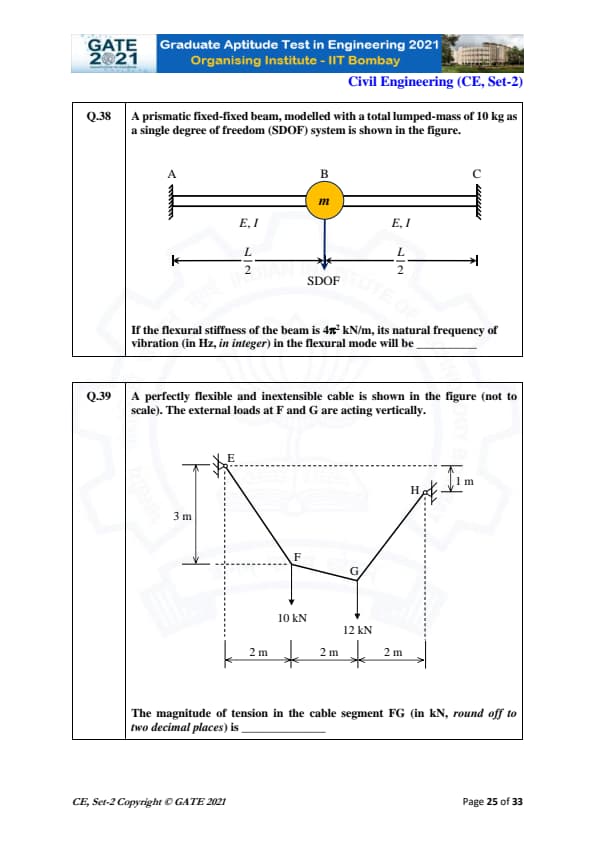
A prismatic fixed-fixed beam, modelled with a total lumped-mass of 10 kg as a single degree of freedom (SDOF) system is shown in the figure.

A perfectly flexible and inextensible cable is shown in the figure (not to scale). The external loads at F and G are acting vertically.

A fire hose nozzle directs a steady stream of water of velocity 50 m/s at an angle of 45° above the horizontal. The stream rises initially but then eventually falls to the ground. Assume water as incompressible and inviscid. Consider the density of air and the air friction as negligible, and assume the acceleration due to gravity as 9.81 m/s\(^2\). The maximum height (in m, round off to two decimal places) reached by the stream above the hose nozzle will then be _____.
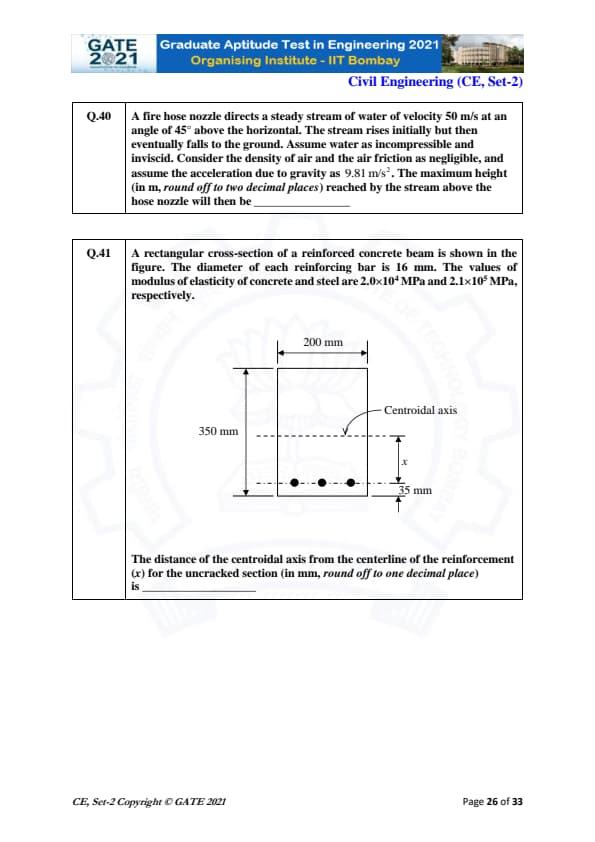
A rectangular cross-section of a reinforced concrete beam is shown in the figure. The diameter of each reinforcing bar is 16 mm. The values of modulus of elasticity of concrete and steel are \( 2.0 \times 10^4 \, MPa \) and \( 2.1 \times 10^5 \, MPa \), respectively.

The distance of the centroidal axis from the centerline of the reinforcement (in mm, round off to one decimal place) is \_\_\_\_\_.
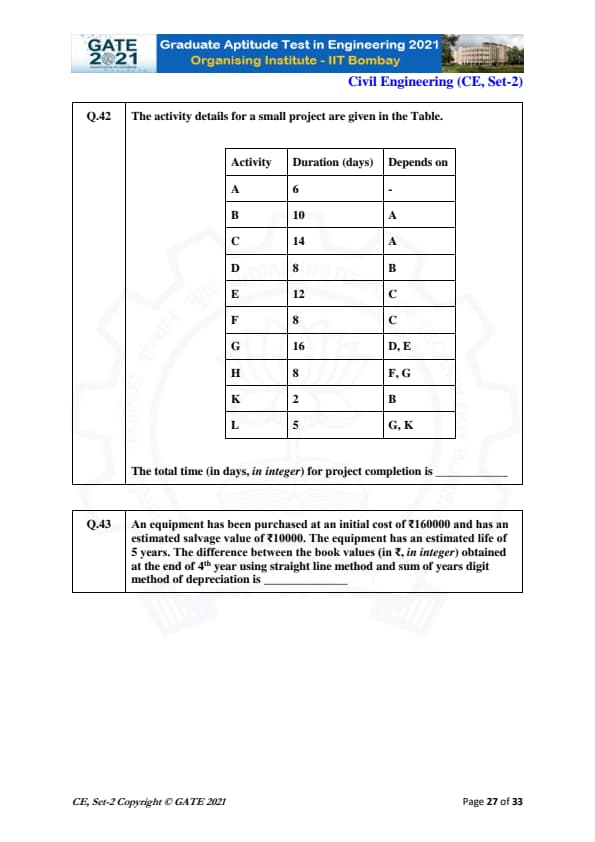
The activity details for a small project are given in the Table.

The total time (in days, in integer) for project completion is _______.
An equipment has been purchased at an initial cost of ₹160000 and has an estimated salvage value of ₹10000. The equipment has an estimated life of 5 years. The difference between the book values (in ₹, in integer) obtained at the end of the 4\(^th\) year using straight line method and sum of years digit method of depreciation is ______.
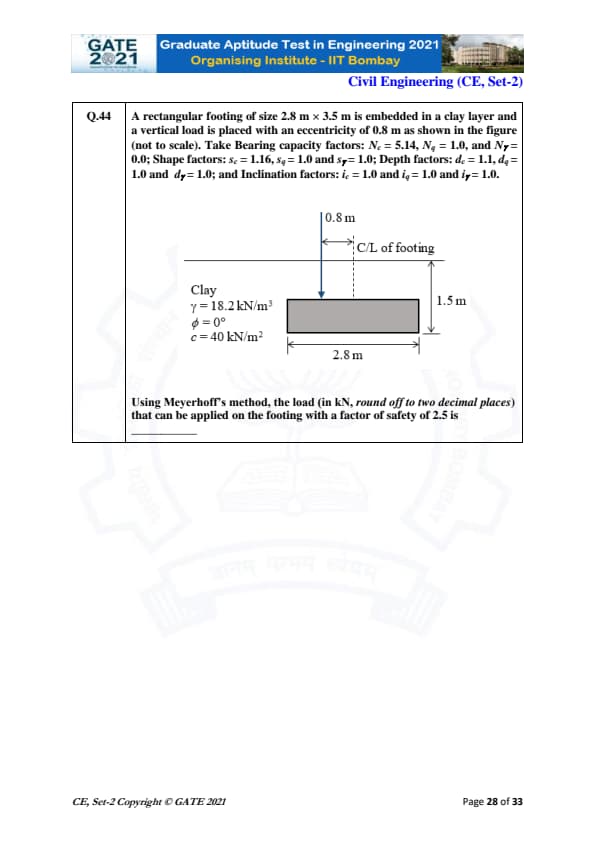
A rectangular footing of size 2.8 m \(\times\) 3.5 m is embedded in a clay layer and a vertical load is placed with an eccentricity of 0.8 m as shown in the figure (not to scale). Take Bearing capacity factors: \( N_c = 5.14 \), \( N_q = 1.0 \), and \( N_\gamma = 0.0 \); Shape factors: \( s_c = 1.16 \), \( s_q = 1.0 \) and \( s_\gamma = 1.0 \); Depth factors: \( d_c = 1.1 \), \( d_q = 1.0 \) and \( d_\gamma = 1.0 \); and Inclination factors: \( i_c = 1.0 \), \( i_q = 1.0 \) and \( i_\gamma = 1.0 \).

Using Meyerhoff’s method, the load (in kN, round off to two decimal places) that can be applied on the footing with a factor of safety of 2.5 is \_\_\_\_\_.
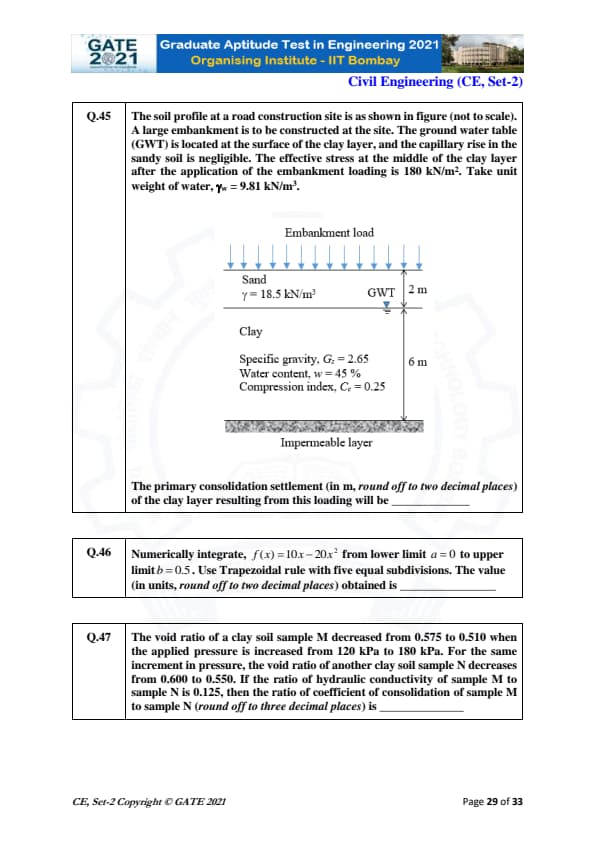
The soil profile at a road construction site is as shown in figure (not to scale). A large embankment is to be constructed at the site. The ground water table (GWT) is located at the surface of the clay layer, and the capillary rise in the sandy soil is negligible. The effective stress at the middle of the clay layer after the application of the embankment loading is 180 kN/m\(^2\). Take unit weight of water, \( \gamma_w = 9.81 \, kN/m^3 \).

Numerically integrate, \( f(x) = 10x - 20x^2 \) from lower limit \( a = 0 \) to upper limit \( b = 0.5 \). Use Trapezoidal rule with five equal subdivisions. The value (in units, round off to two decimal places) obtained is _______.
The void ratio of a clay soil sample M decreased from 0.575 to 0.510 when the applied pressure is increased from 120 kPa to 180 kPa. For the same increment in pressure, the void ratio of another clay soil sample N decreases from 0.600 to 0.550. If the ratio of hydraulic conductivity of sample M to sample N is 0.125, then the ratio of coefficient of consolidation of sample M to sample N (round off to three decimal places) is ______.
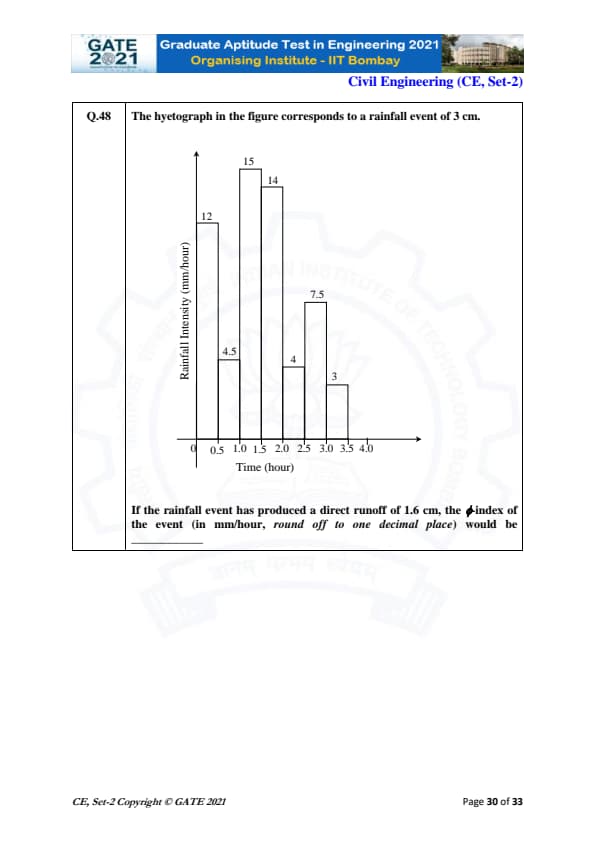
The hyetograph in the figure corresponds to a rainfall event of 3 cm.

If the rainfall event has produced a direct runoff of 1.6 cm, the \phi -index of the event (in mm/hour, round off to one decimal place) would be \_\_\_\_\_.
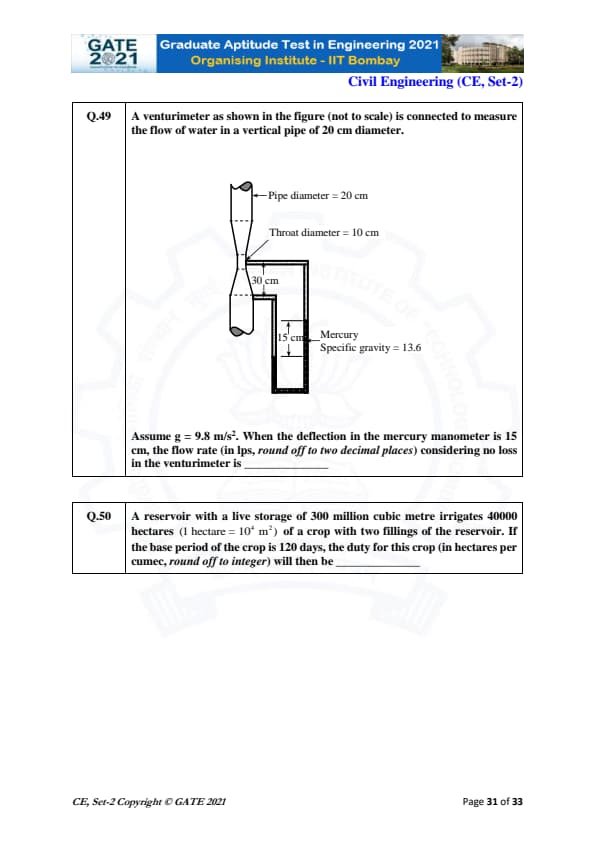
A venturimeter as shown in the figure (not to scale) is connected to measure the flow of water in a vertical pipe of 20 cm diameter.

A reservoir with a live storage of 300 million cubic meters (1 hectare = \(10^4 \, m^2\)) of a crop with two fillings of the reservoir. If the base period of the crop is 120 days, the duty for this crop (in hectares per cumec, round off to integer) will then be ______.
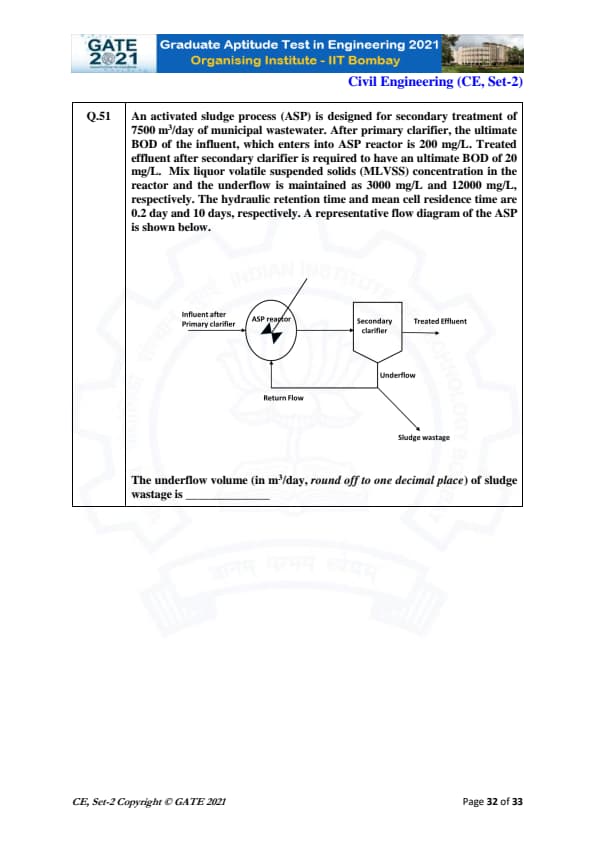
An activated sludge process (ASP) is designed for secondary treatment of 7500 m\(^3\)/day of municipal wastewater. After primary clarifier, the ultimate BOD of the influent, which enters into the ASP reactor, is 200 mg/L. Treated effluent after secondary clarifier is required to have an ultimate BOD of 20 mg/L. Mix liquor volatile suspended solids (MLVSS) concentration in the reactor and the underflow is maintained as 3000 mg/L and 12000 mg/L, respectively. The hydraulic retention time and mean cell residence time are 0.2 day and 10 days, respectively. A representative flow diagram of the ASP is shown below.

The underflow volume (in m^3/day, round off to one decimal place) of sludge wastage is \_\_\_\_\_.
A grit chamber of rectangular cross-section is to be designed to remove particles with diameter of 0.25 mm and specific gravity of 2.70. The terminal settling velocity of the particles is estimated as 2.5 cm/s. The chamber is having a width of 0.50 m and has to carry a peak wastewater flow of 9720 m\(^3\)/d giving the depth of flow as 0.75 m. If a flow-through velocity of 0.3 m/s has to be maintained using a proportional weir at the outlet end of the chamber, the minimum length of the chamber (in m, in integer) to remove 0.25 mm particles completely is _______.
In an aggregate mix, the proportions of coarse aggregate, fine aggregate and mineral filler are 55%, 40% and 5%, respectively. The values of bulk specific gravity of the coarse aggregate, fine aggregate and mineral filler are 2.55, 2.65 and 2.70, respectively. The bulk specific gravity of the aggregate mix (round off to two decimal places) is _______.
The stopping sight distance (SSD) for a level highway is 140 m for the design speed of 90 km/h. The acceleration due to gravity and deceleration rate are 9.81 m/s\(^2\) and 3.5 m/s\(^2\), respectively. The perception/reaction time (in s, round off to two decimal places) used in the SSD calculation is _______.
For a 2° curve on a high-speed Broad Gauge (BG) rail section, the maximum sanctioned speed is 100 km/h and the equilibrium speed is 80 km/h. Consider dynamic gauge of BG rail as 1750 mm. The degree of curve is defined as the angle subtended at its center by a 30.5 m arc. The cant deficiency for the curve (in mm, round off to integer) is ______.

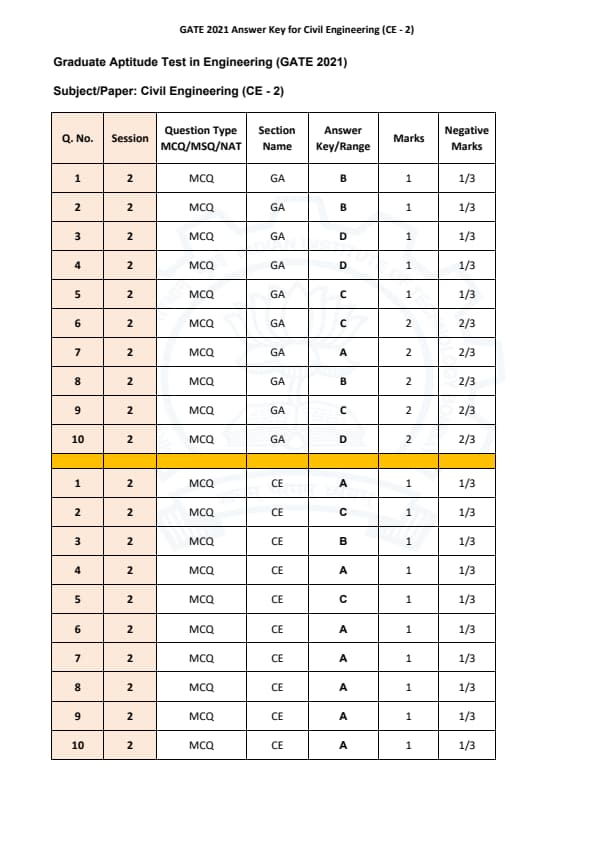
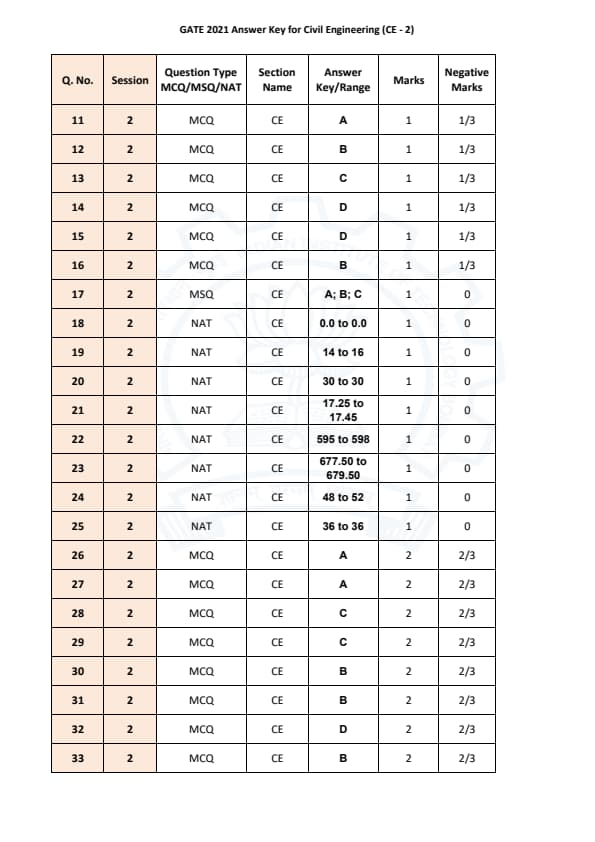
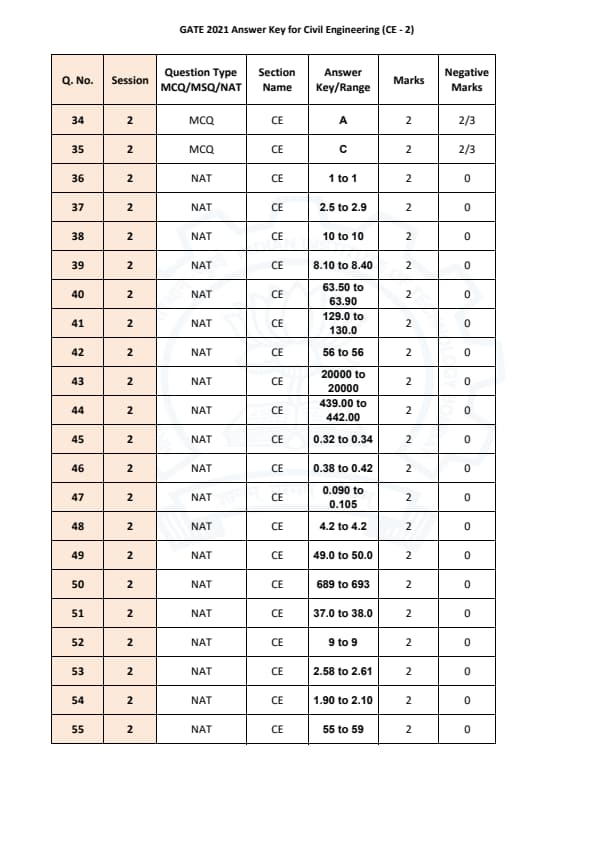
GATE 2021 CE February 6 (Afternoon Session): Sectional Analysis
GATE 2021 CE afternoon session was held on February 6, 2021. The timings of the afternoon shift was between 3 pm to 6 pm.
- Overall, the paper was moderate but calculation-intensive
- Many candidates found GA and Engineering Math easy
- MSQs were very few in the exam.
| Topic | % of Marks |
|---|---|
| General Aptitude | 15% |
| Engineering Maths | 13% |
| Engineering Mechanics | 5% |
| Geo Tech | 14% |
| Environment | 5% |
| Transportation | 11% |
GATE Previous Year Question Paper with Answer Key PDFs
GATE Previous Year Question Papers with Answer Key PDFs are available in the table below for download.
| GATE 2020 Question Papers | GATE 2019 Question Papers |
| GATE 2018 Question Papers | GATE 2017 Question Papers |





Comments