




GATE 2021 Geology and Geophysics (GG) was concluded on 7th February by IIT Bombay. Students can download the GATE 2021 (Geophysics) Question Paper and Answer Key from this page. This year, the number of questions appearing in GATE 2021 GG were the same as GATE 2020 GG. 65 questions appeared in the question paper as MCQs (Multiple Choice Questions) and NAT (Numerical Answer Types). The overall difficulty level of GATE 2021 GG (Geophysics) was easy to moderate.
Sections related to core Geophysics hold almost 65% of the total weightage. The rest of the 35% percent were distributed between different topics of the General Aptitude.
GATE 2021 Geology and Geophysics (GG) Question Paper with Solutions
| GATE 2021 Geology and Geophysics (GG) Question Paper |  Download Download |
Check Solutions |
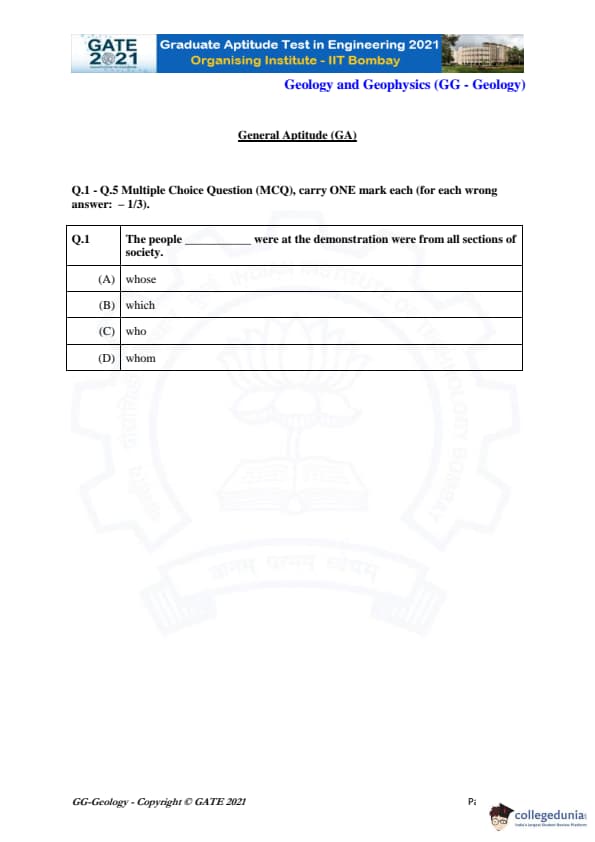
The people _______ were at the demonstration were from all sections of society.
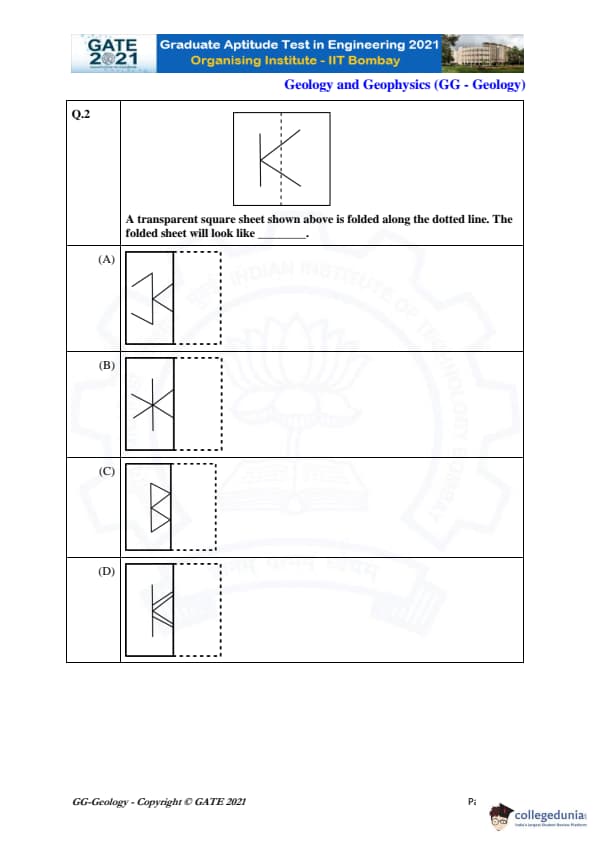
A transparent square sheet shown above is folded along the dotted line. The folded sheet will look like _______.


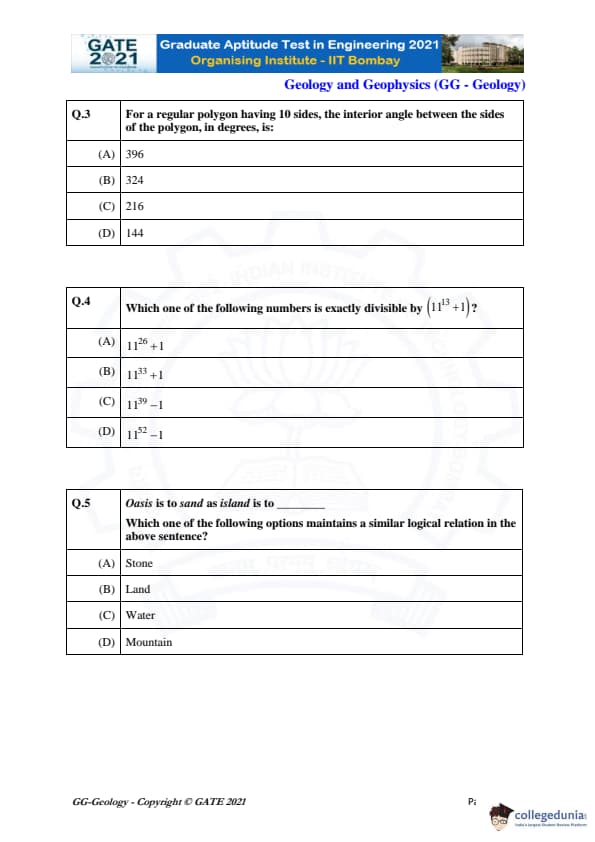
For a regular polygon having 10 sides, the interior angle between the sides of the polygon, in degrees, is:
Which one of the following numbers is exactly divisible by \(\left(11^{13}+1\right)\)?
Oasis is to sand as island is to _____. Which one of the following options maintains a similar logical relation in the above sentence?
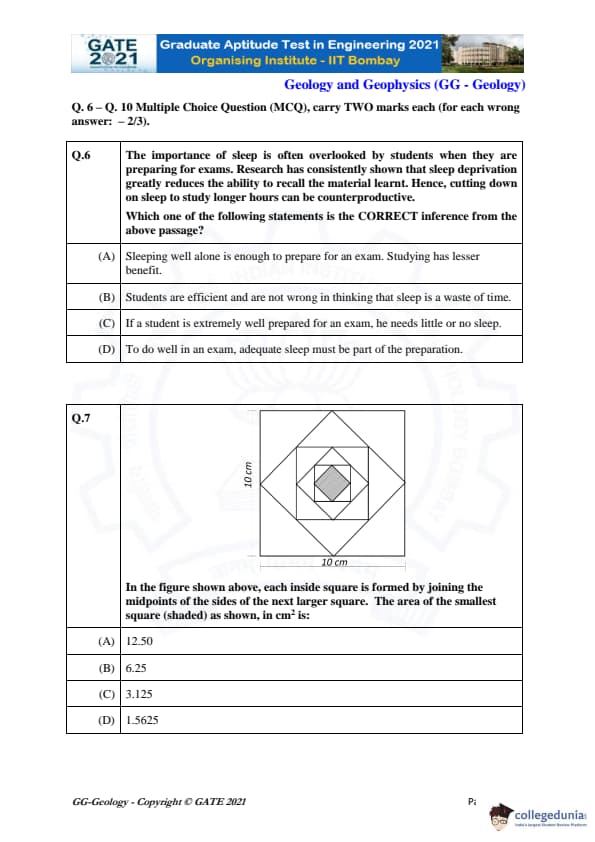
The importance of sleep is often overlooked by students when they are preparing for exams. Research has consistently shown that sleep deprivation greatly reduces the ability to recall the material learnt. Hence, cutting down on sleep to study longer hours can be counterproductive.
Which one of the following statements is the CORRECT inference from the above passage?
In the figure, each inside square is formed by joining the midpoints of the sides of the next larger square. The area of the smallest shaded square is to be found. The outermost square has a side length of 10 cm.

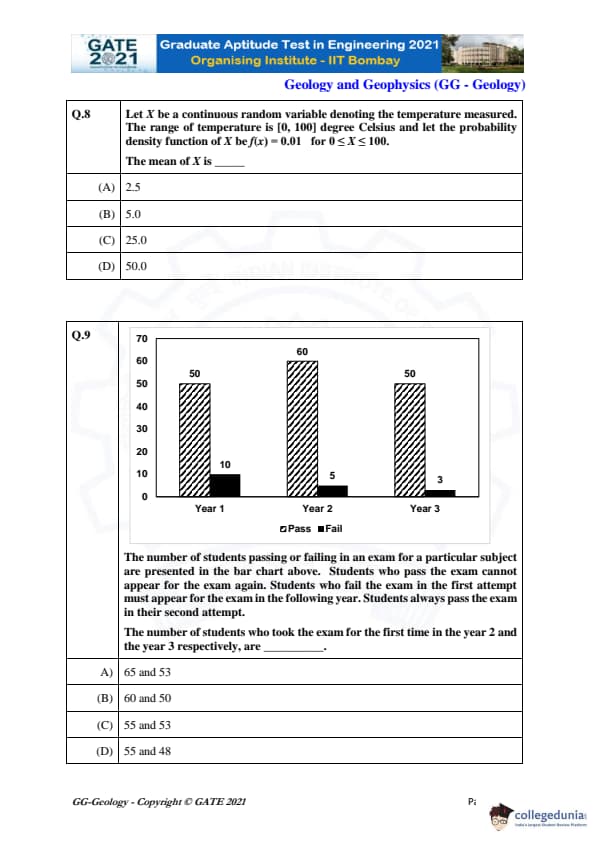
Let \(X\) be a continuous random variable denoting the temperature measured.
The range of temperature is \([0, 100]\) degree Celsius and the probability density function of \(X\) be \(f(x) = 0.01\) for \(0 \le X \le 100\).
The mean of \(X\) is _______
The number of students passing or failing in an exam are shown in the bar chart.
Students who pass do not appear again.
Students who fail must reappear the next year and always pass in their second attempt.
Find the number of students who took the exam for the first time in Year 2 and Year 3.

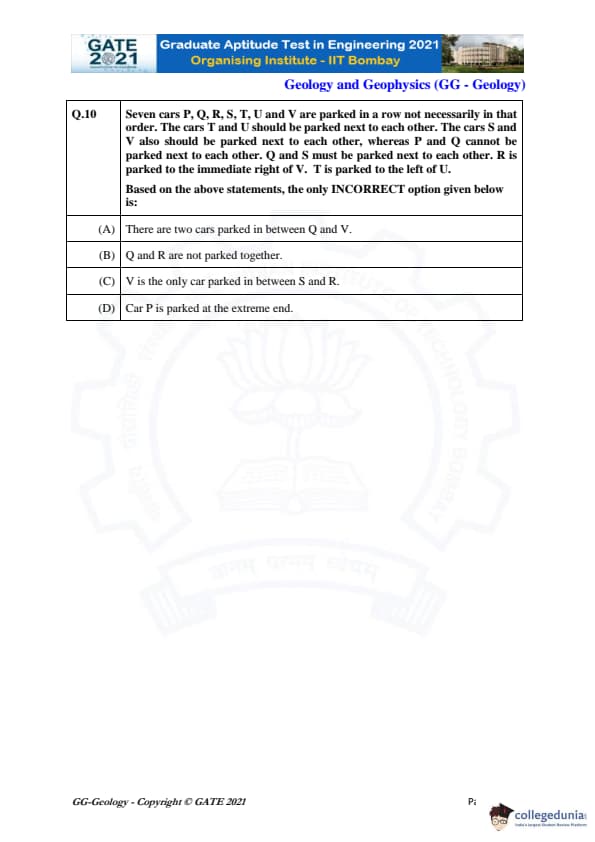
Seven cars P, Q, R, S, T, U and V are parked in a row not necessarily in that order.
The cars T and U should be parked next to each other.
The cars S and V also should be parked next to each other, whereas P and Q cannot be parked next to each other.
Q and S must be parked next to each other.
R is parked to the immediate right of V.
T is parked to the left of U.
Based on the above statements, the only INCORRECT option is:
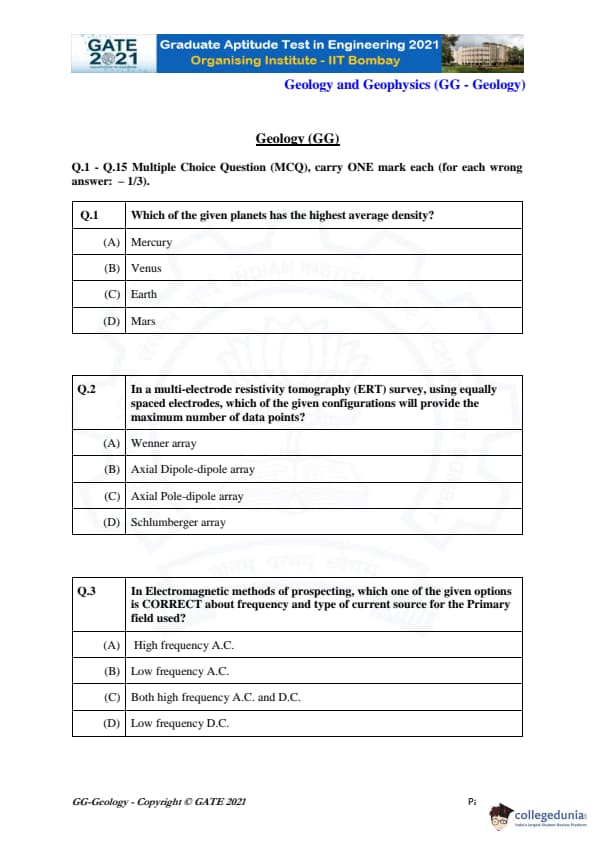
Which of the given planets has the highest average density?
In a multi-electrode resistivity tomography (ERT) survey, using equally spaced electrodes, which of the given configurations will provide the maximum number of data points?
In Electromagnetic methods of prospecting, which one of the given options is CORRECT about frequency and type of current source for the Primary field used?
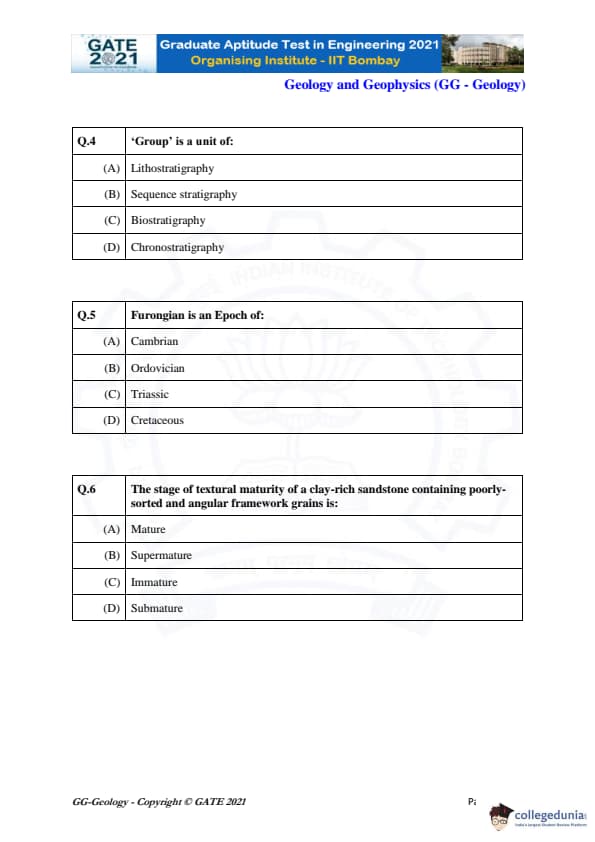
‘Group’ is a unit of:
Furongian is an Epoch of:
The stage of textual maturity of a clay-rich sandstone containing poorly sorted and angular framework grains is:
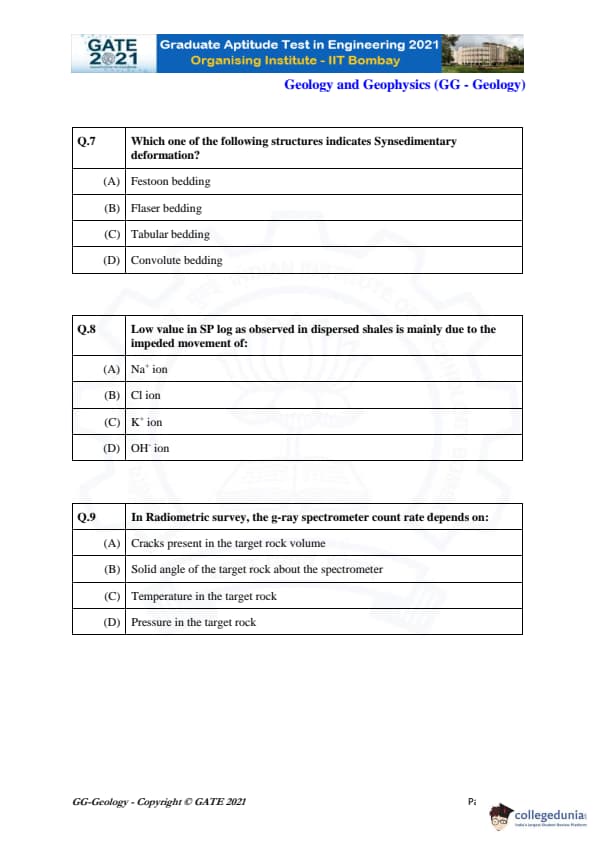
Which one of the following structures indicates Syndimentary deformation?
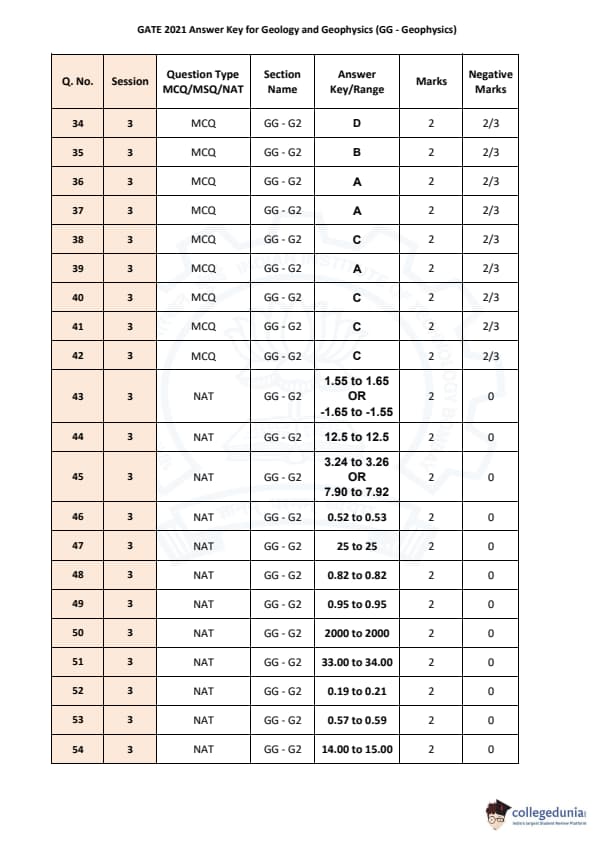
Low value in SP log as observed in dispersed shales is mainly due to the impeded movement of:
In Radiometric survey, the g-ray spectrometer count rate depends on:
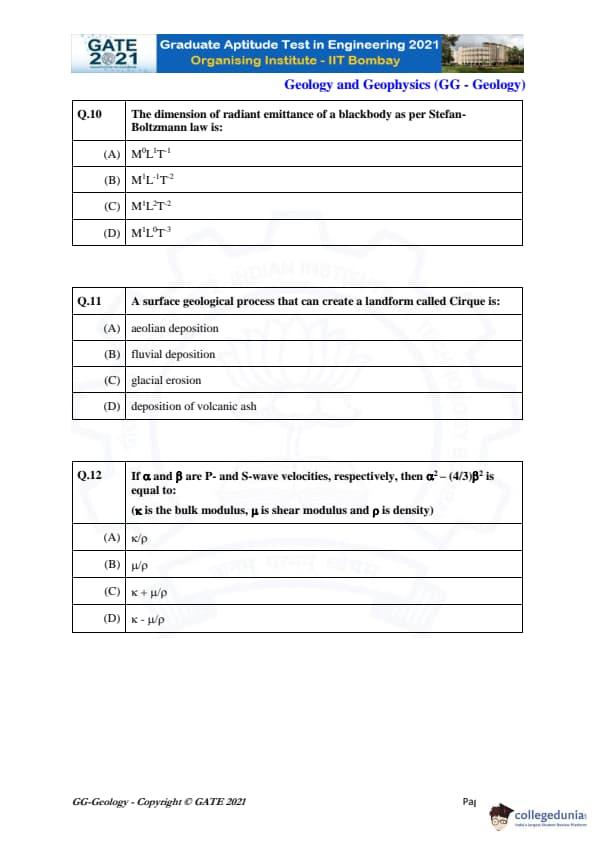
The dimension of radiant emittance of a blackbody as per Stefan-Boltzmann law is:
A surface geological process that can create a landform called Cirque is:
If \( \alpha \) and \( \beta \) are P- and S-wave velocities, respectively, then \( \alpha^2 - \frac{4}{3} \beta^2 \) is equal to: (\kappa is the bulk modulus, \mu is shear modulus, and \rho is density)
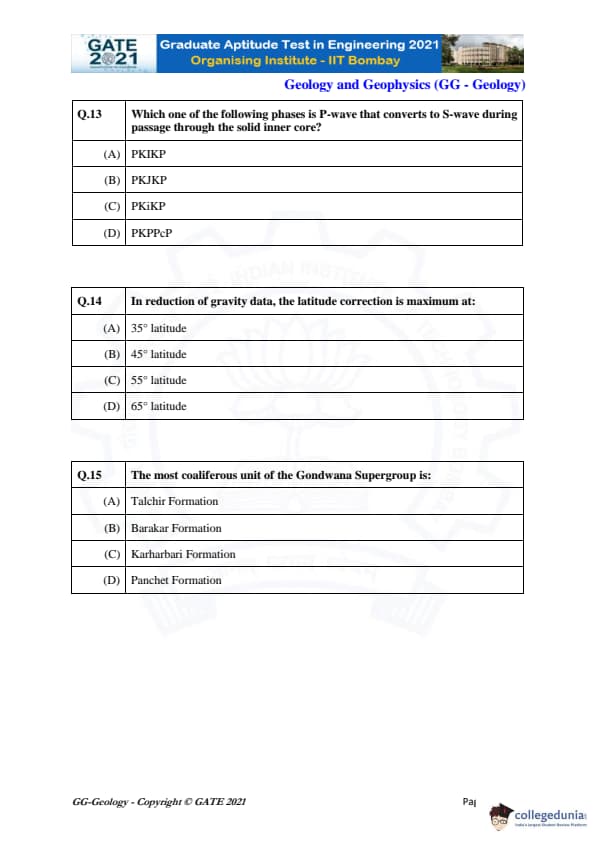
Which one of the following phases is a P-wave that converts to an S-wave during passage through the solid inner core?
In reduction of gravity data, the latitude correction is maximum at:
The most coaliferous unit of the Gondwana Supergroup is:
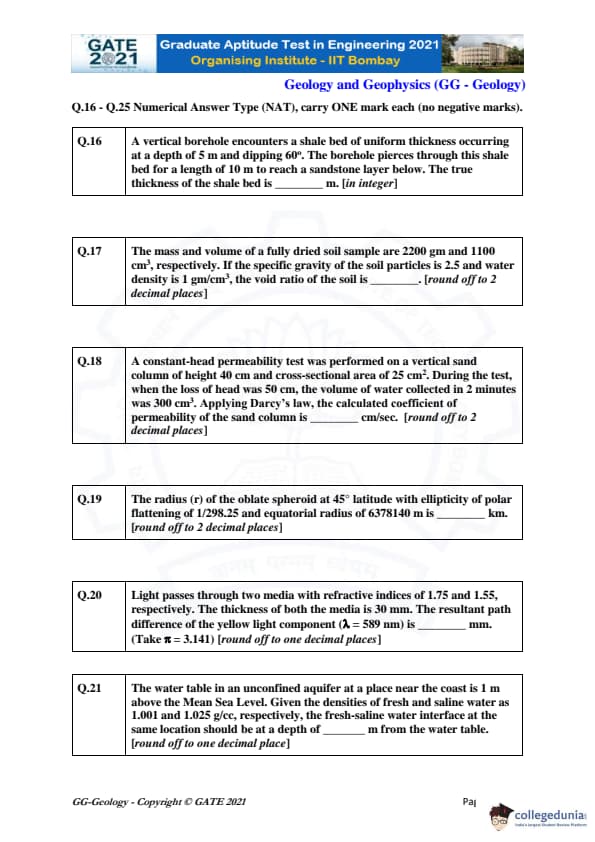
A vertical borehole encounters a shale bed of uniform thickness occurring at a depth of 5 m and dipping 60°. The borehole pierces through this shale bed for a length of 10 m to reach a sandstone layer below. The true thickness of the shale bed is ____ m.
The mass and volume of a fully dried soil sample are 2200 gm and 1100 cm³, respectively. If the specific gravity of the soil particles is 2.5 and water density is 1 gm/cm³, the void ratio of the soil is ____ (round off to 2 decimal places).
A constant-head permeability test was performed on a vertical sand column of height 40 cm and cross-sectional area of 25 cm². During the test, when the loss of head was 50 cm, the volume of water collected in 2 minutes was 300 cm³. Applying Darcy’s law, the calculated coefficient of permeability of the sand column is ___ cm/sec. (round off to 2 decimal places).
The radius \( r \) of the oblate spheroid at 45° latitude with ellipticity of polar flattening of 1/298.25 and equatorial radius of 6378140 m is ________ km.
Light passes through two media with refractive indices of 1.75 and 1.55, respectively. The thickness of both the media is 30 mm. The resultant path difference of the yellow light component \( \lambda = 589 \, nm \) is ______ mm.
The water table in an unconfined aquifer at a place near the coast is 1 m above the Mean Sea Level. Given the densities of fresh and saline water as 1.001 and 1.025 g/cc, respectively, the fresh-saline water interface at the same location should be at a depth of ____ m from the water table.
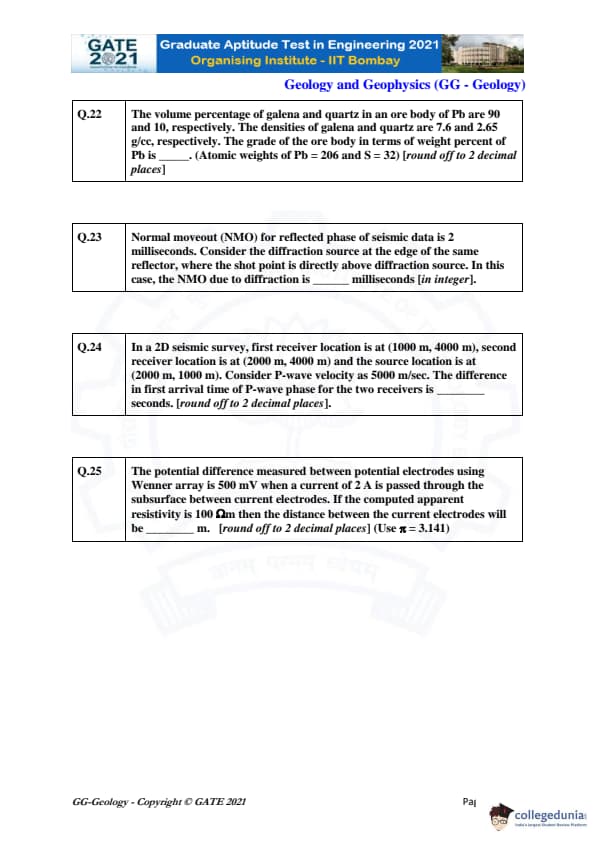
The volume percentage of galena and quartz in an ore body of Pb are 90 and 10, respectively. The densities of galena and quartz are 7.6 and 2.65 g/cc, respectively. The grade of the ore body in terms of weight percent of Pb is ________ (Atomic weights of Pb = 206 and S = 32).
Normal moveout (NMO) for reflected phase of seismic data is 2 milliseconds. Consider the diffraction source at the edge of the same reflector, where the shot point is directly above the diffraction source. In this case, the NMO due to diffraction is ____ milliseconds.
In a 2D seismic survey, first receiver location is at (1000 m, 4000 m), second receiver location is at (2000 m, 4000 m) and the source location is at (2000 m, 1000 m). Consider P-wave velocity as 5000 m/sec. The difference in first arrival time of P-wave phase for the two receivers is ____ seconds.
The potential difference measured between potential electrodes using Wenner array is 500 mV when a current of 2 A is passed through the subsurface between current electrodes. If the computed apparent resistivity is 100 Ωm then the distance between the current electrodes will be ____ meters.
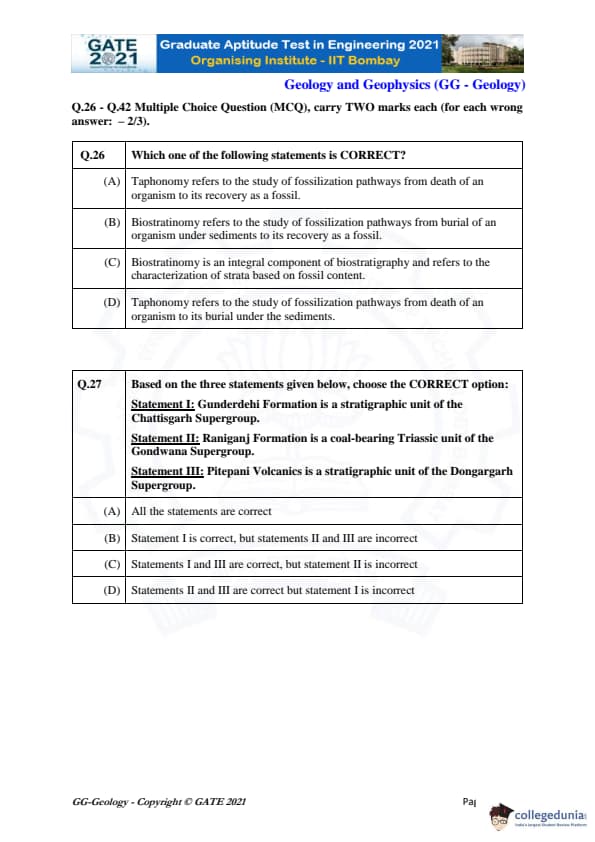
Which one of the following statements is CORRECT?
Based on the three statements given below, choose the CORRECT option:
Statement I: Gunderdehi Formation is a stratigraphic unit of the Chhattisgarh Supergroup.
Statement II: Raniganj Formation is a coal-bearing Triassic unit of the Gondwana Supergroup.
Statement III: Pitepani Volcanics is a stratigraphic unit of the Dongargarh Supergroup.
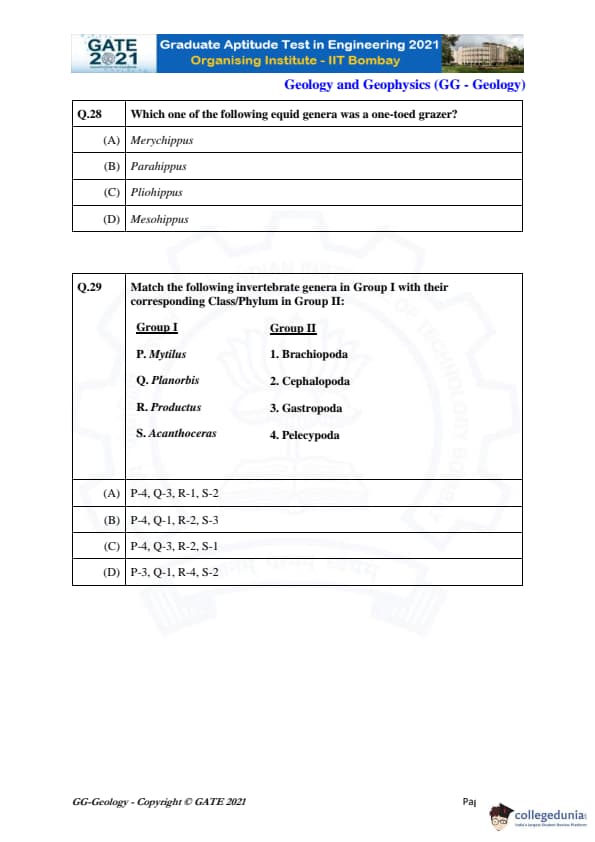
Which one of the following equid genera was a one-toed grazer?
Match the following invertebrate genera in Group I with their corresponding Class/Phylum in Group II:

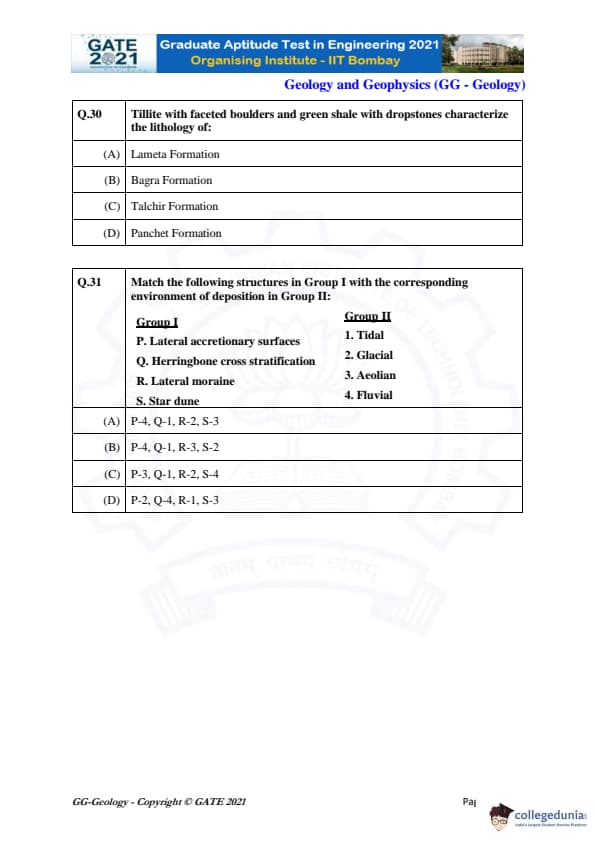
Tillite with faceted boulders and green shale with dropstones characterize the lithology of:
Match the following structures in Group I with the corresponding environment of deposition in Group II:

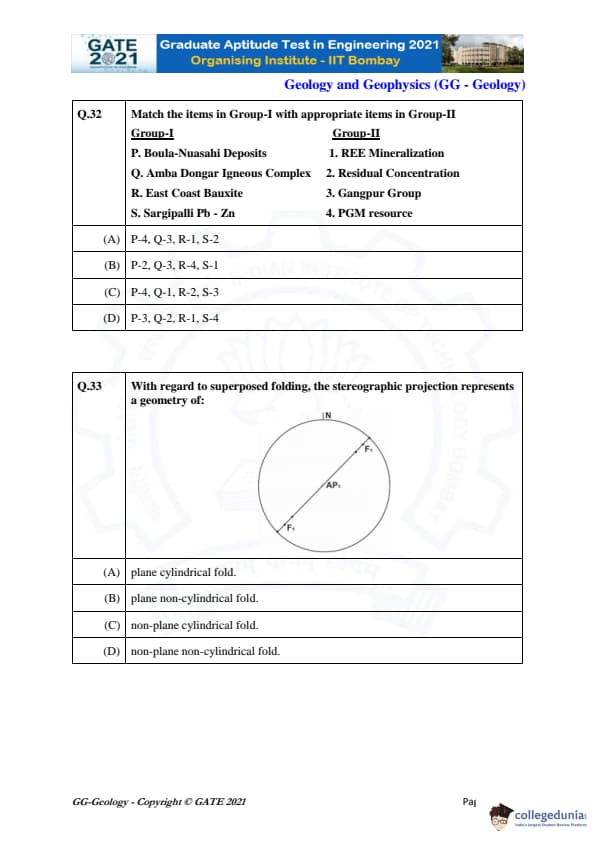
Match the items in Group-I with appropriate items in Group-II

With regard to superposed folding, the stereographic projection represents a geometry of:

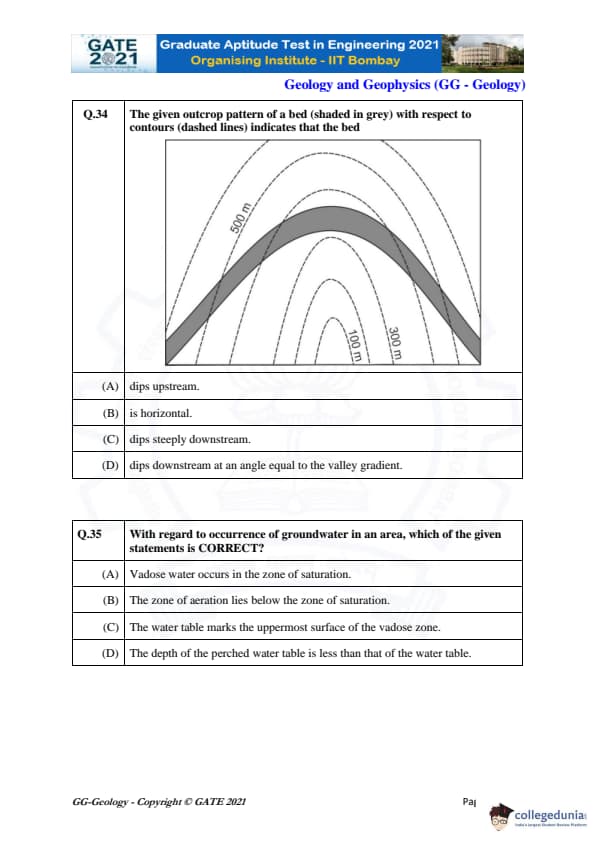
The given outcrop pattern of a bed (shaded in grey) with respect to contours (dashed lines) indicates that the bed

With regard to the occurrence of groundwater in an area, which of the given statements is CORRECT?
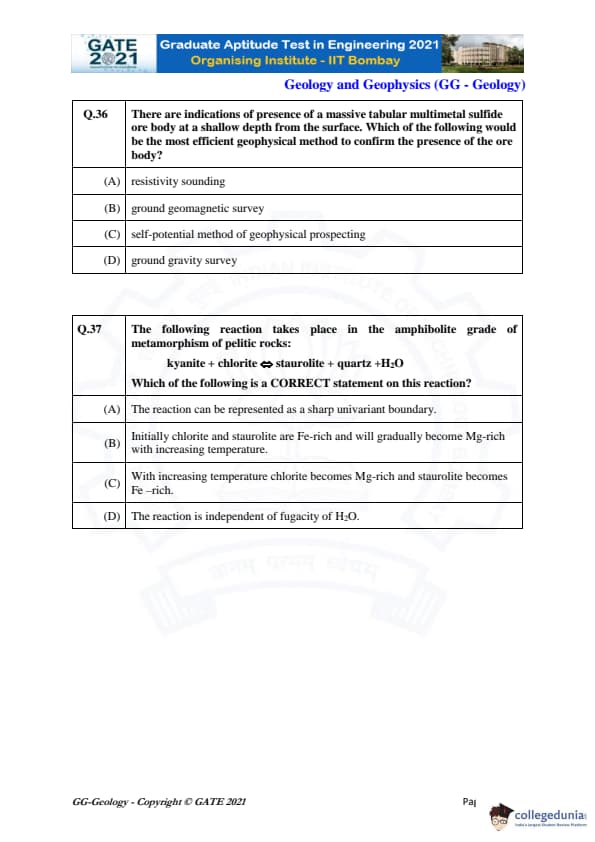
There are indications of presence of a massive tabular multimetal sulfide ore body at a shallow depth from the surface. Which of the following would be the most efficient geophysical method to confirm the presence of the ore body?
The following reaction takes place in the amphibolite grade of metamorphism of pelitic rocks:
kyanite + chlorite \leftrightarrow staurolite + quartz + H_2O
Which of the following is a CORRECT statement on this reaction?
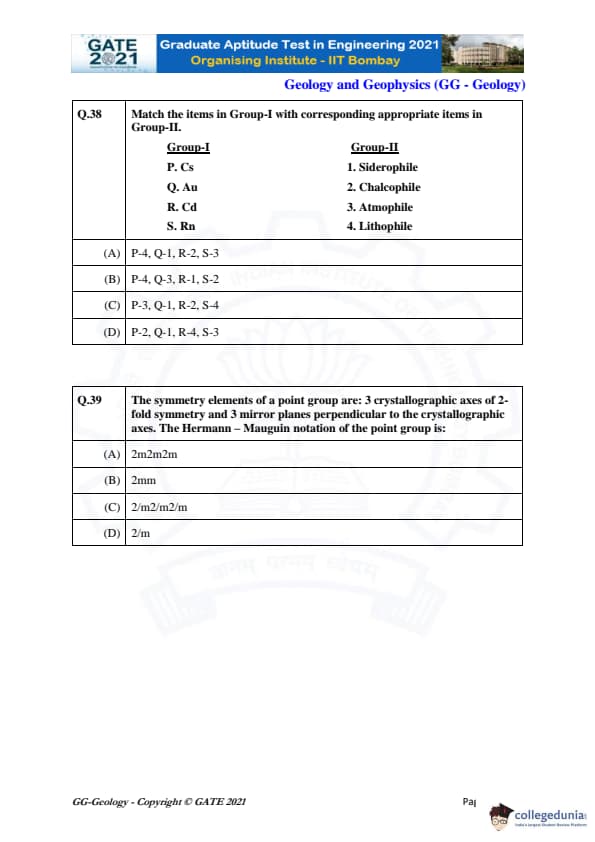
Match the items in Group-I with corresponding appropriate items in Group-II.

The symmetry elements of a point group are: 3 crystallographic axes of 2-fold symmetry and 3 mirror planes perpendicular to the crystallographic axes. The Hermann – Mauguin notation of the point group is:
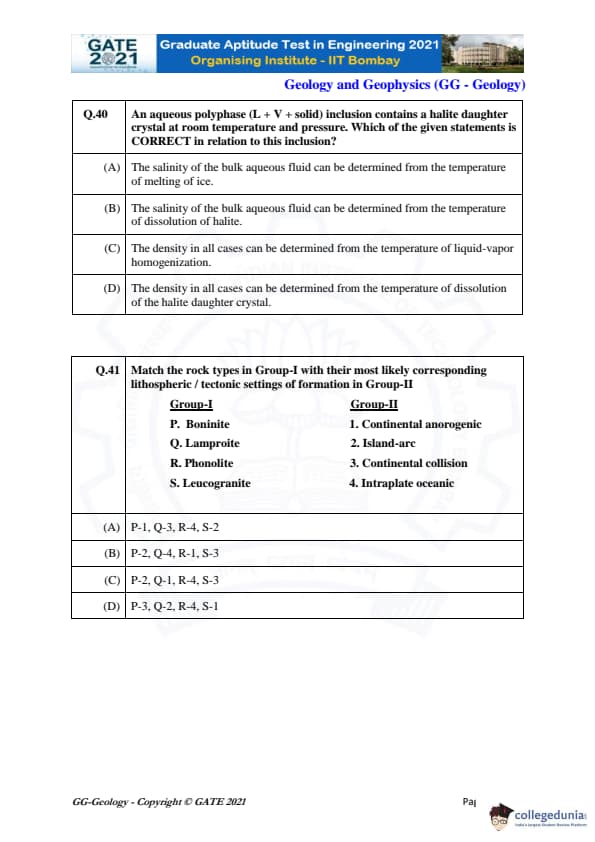
An aqueous polyphase (L + V + solid) inclusion contains a halite daughter crystal at room temperature and pressure. Which of the given statements is CORRECT in relation to this inclusion?
Match the rock types in Group-I with their most likely corresponding lithospheric / tectonic settings of formation in Group-II

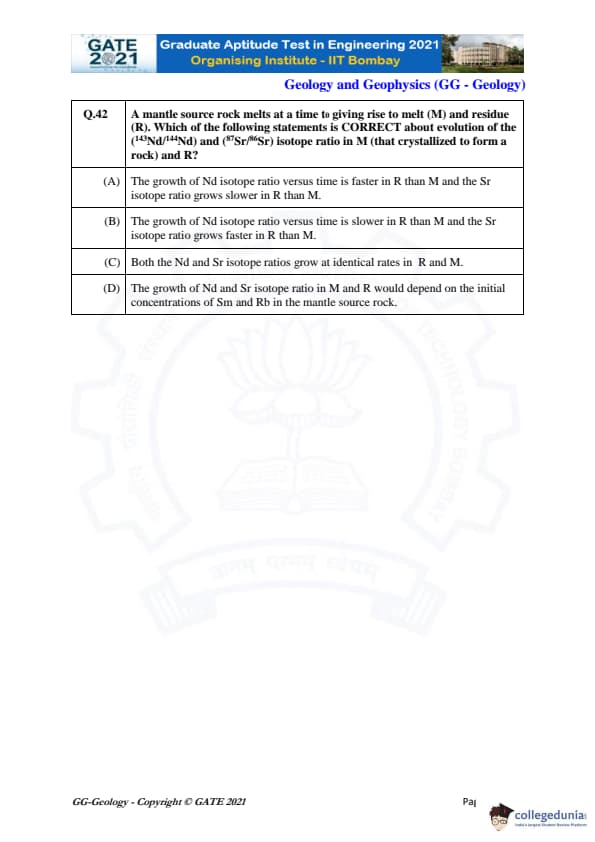
A mantle source rock melts at a time to giving rise to melt (M) and residue (R). Which of the following statements is CORRECT about evolution of the \( ^{143}Nd/^{144}Nd \) and \( ^{87}Sr/^{86}Sr \) isotope ratio in M (that crystallized to form a rock) and R?
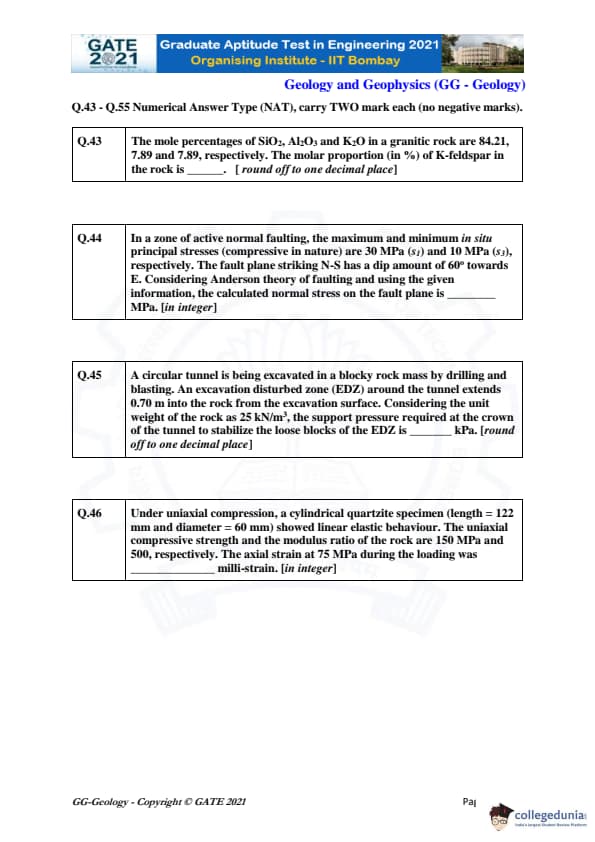
The mole percentages of SiO2, Al2O3, and K2O in a granitic rock are 84.21, 7.89 and 7.89, respectively. The molar proportion (in %) of K-feldspar in the rock is ___ . (round off to one decimal place)
In a zone of active normal faulting, the maximum and minimum in situ principal stresses (compressive in nature) are 30 MPa (\( \sigma_1 \)) and 10 MPa (\( \sigma_3 \)), respectively. The fault plane striking N-S has a dip amount of 60° towards E. Considering Anderson theory of faulting and using the given information, the calculated normal stress on the fault plane is ___ MPa. (in integer)
A circular tunnel is being excavated in a blocky rock mass by drilling and blasting. An excavation disturbed zone (EDZ) around the tunnel extends 0.70 m into the rock from the excavation surface. Considering the unit weight of the rock as 25 kN/m³, the support pressure required at the crown of the tunnel to stabilize the loose blocks of the EDZ is ___ kPa. (round off to one decimal place)
Under uniaxial compression, a cylindrical quartzite specimen (length = 122 mm and diameter = 60 mm) showed linear elastic behaviour. The uniaxial compressive strength and the modulus ratio of the rock are 150 MPa and 500, respectively. The axial strain at 75 MPa during the loading was ____ milli-strain. (in integer)
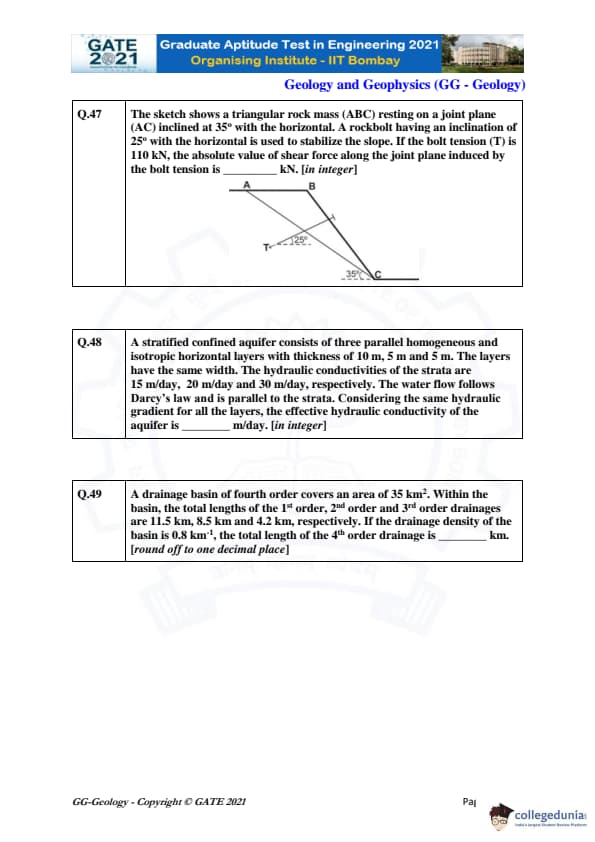
The sketch shows a triangular rock mass (ABC) resting on a joint plane (AC) inclined at 35° with the horizontal. A rockbolt having an inclination of 25° with the horizontal is used to stabilize the slope. If the bolt tension (T) is 110 kN, the absolute value of shear force along the joint plane induced by the bolt tension is ____ kN.

A stratified confined aquifer consists of three parallel homogeneous and isotropic horizontal layers with thickness of 10 m, 5 m, and 5 m. The layers have the same width. The hydraulic conductivities of the strata are 15 m/day, 20 m/day, and 30 m/day, respectively. The water flow follows Darcy’s law and is parallel to the strata. Considering the same hydraulic gradient for all the layers, the effective hydraulic conductivity of the aquifer is ____ m/day.
A drainage basin of fourth order covers an area of 35 km². Within the basin, the total lengths of the 1st order, 2nd order, and 3rd order drainages are 11.5 km, 8.5 km, and 4.2 km, respectively. If the drainage density of the basin is 0.8 km\(^{-1}\), the total length of the 4th order drainage is ____ km.
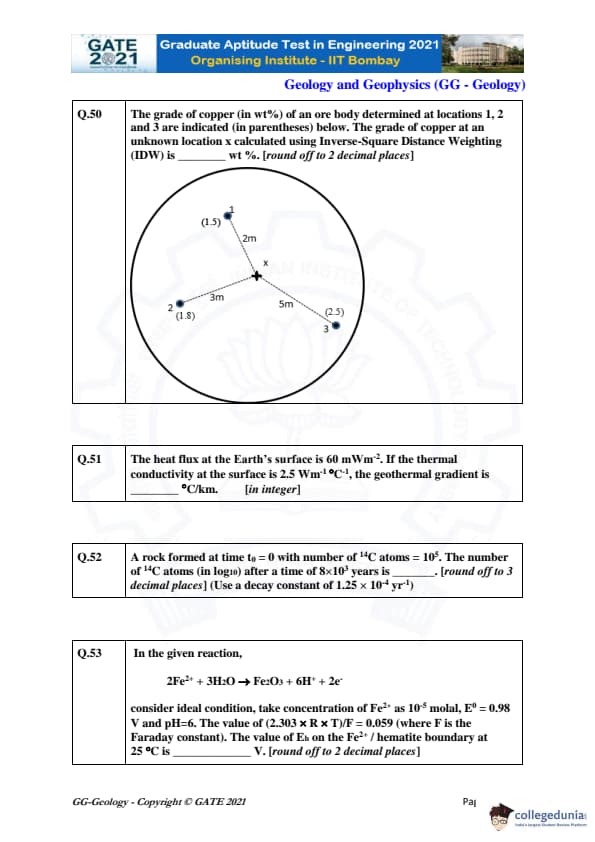
The grade of copper (in wt%) of an ore body determined at locations 1, 2 and 3 are indicated (in parentheses) below. The grade of copper at an unknown location x calculated using Inverse-Square Distance Weighting (IDW) is ____ wt %. (round off to 2 decimal places)

The heat flux at the Earth's surface is 60 mWm\(^2\). If the thermal conductivity at the surface is 2.5 Wm\(^{-1}\)°C\(^{-1}\), the geothermal gradient is ____ °C/km. (round off to integer)
A rock formed at time \( t_0 \) with number of \( ^{14}C \) atoms = \( 10^5 \). The number of \( ^{14}C \) atoms (in log10) after a time of \( 8 \times 10^3 \) years is ______ (round off to 3 decimal places). (Use a decay constant of \( 1.25 \times 10^{-4} \, yr^{-1} \))
In the given reaction, \[ 2Fe^{2+} + 3H_2O \rightarrow Fe_2O_3 + 6H^+ + 2e^- \]
consider ideal condition, take concentration of \( Fe^{2+} \) as \( 10^{-5} \) molal, \( E^0 = 0.98 \, V \) and pH = 6. The value of \( (2.303 \times R \times T / F) = 0.059 \) (where \( F \) is the Faraday constant). The value of \( E_h \) on the \( Fe^{2+} / \) hematite boundary at 25°C is ____ V (round off to 2 decimal places).
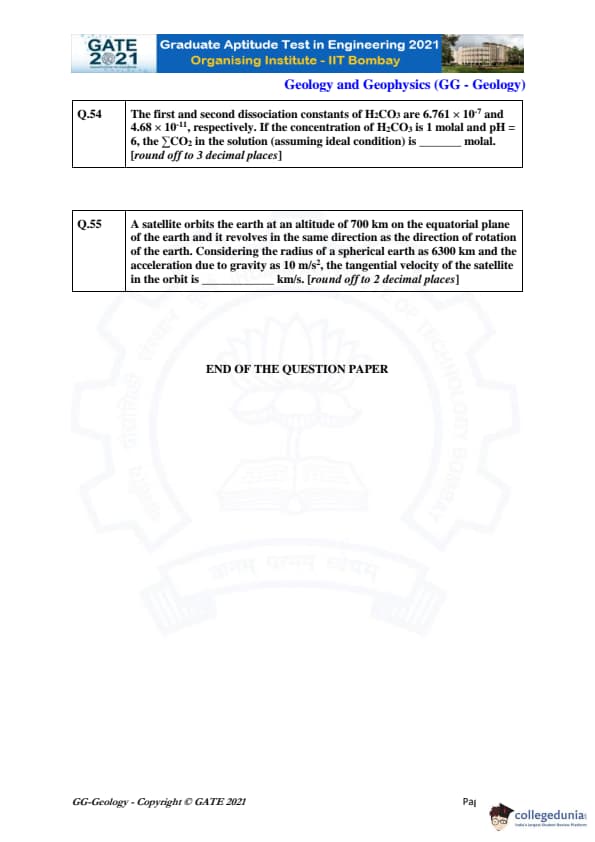
The first and second dissociation constants of \( H_2CO_3 \) are \( 6.761 \times 10^{-7} \) and \( 4.68 \times 10^{-11} \), respectively. If the concentration of \( H_2CO_3 \) is 1 molal and pH = 6, the \( \sum CO_2 \) in the solution (assuming ideal condition) is ___ molal. (round off to 3 decimal places)
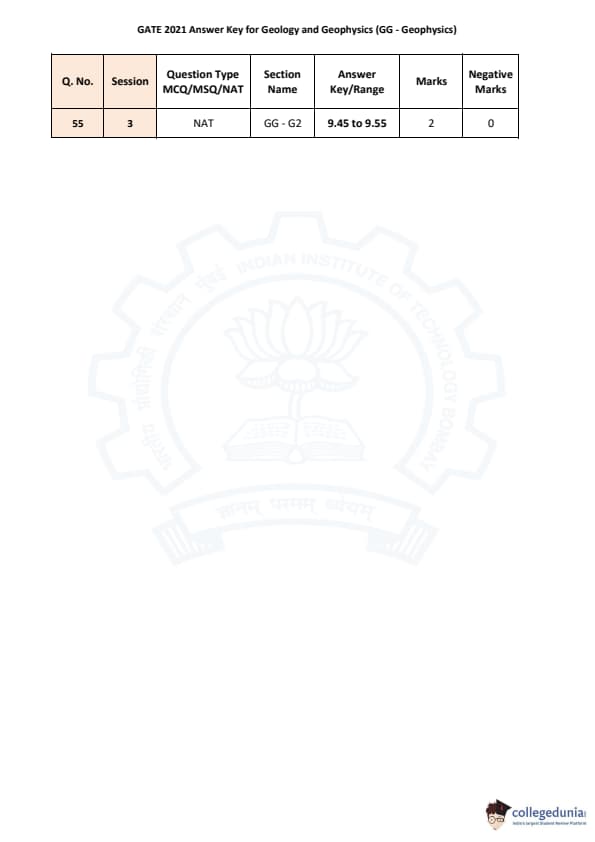
A satellite orbits the Earth at an altitude of 700 km on the equatorial plane of the earth and it revolves in the same direction as the direction of rotation of the earth. Considering the radius of a spherical earth as 6300 km and the acceleration due to gravity as 10 m/s², the tangential velocity of the satellite in the orbit is ____ km/s. (round off to 2 decimal places)
Quick Links:
GATE 2021 GG (Geophysics) Paper Analysis
This year, IIT Bombay introduced MSQs (Multiple Select Questions) to standardize the level of GATE 2021. There could be one or more than correct options in the MSQs. Students would be necessarily required to select all the correct options in order to get rewarded with the carried marks.
Refer to the below-mentioned table to get an overview of total number of NATs and MCQs in GATE 2021 GG (Geophysics)-
| Question Types | No. Of Listed Questions | Carried Marks |
|---|---|---|
| No. Of 1 mark MSQs | - | - |
| No. Of 2 marks MSQs | - | - |
| No. Of 1 mark NATs | 10 | 10 |
| No. Of 2 marks NATs | 13 | 26 |
| No. Of 1 mark MCQs | 20 | 20 |
| No. Of 2 marks MCQs | 22 | 44 |
- Despite the introduction MSQ, IIT Bombay exempted GATE 2021 GG from listing MSQs
- 23 questions appeared as NATs, carried 36 marks
- 42 questions appeared as MCQs, carried 64 marks
GATE 2021 GG (Geophysics) Sections wise Topics
The question paper was a mixture of easy and moderate level questions. Questions from both the sections hold both easy and moderate level questions.
Follow the below-mentioned table to get details of the important topics-
| Geophysics Section | Solid Earth, Geodesy, Earthquake, Seismology, Potential and Time Varying Fields, Gravity Methods, Magnetic Methods, Electric Methods, Electronic Methods, Seismic Methods, Radioactive Methods |
| General Aptitude Section | Analytical Reasoning, Seating Arrangement, English, Area of Square, Data Interpretation, Function, Probability |
Also Check:
GATE 2021 GG Question Pattern and Marking Scheme
- Each question carried either 1 or 2 marks. For an incorrect question ⅓ or ⅔ marks would be deducted, depending upon the carried marks
- Marks would be deducted only wrong MCQs, NATs and MSQs doesn't had the the risk factor of negative marking
GATE Previous Year Question Papers:
| GATE 2022 Question Papers | GATE 2021 Question Papers | GATE 2020 Question Papers |
| GATE 2019 Question Papers | GATE 2018 Question Papers | GATE 2017 Question Papers |





Comments