




GATE 2021 Humanities and Social Sciences (XH), Philosophy (XH-C4) Question Paper with Solutions is available now. GATE 2021 XH was conducted on 14th February by IIT Bombay. GATE 2021 XH comprises several optional subjects sections out of which one section is compulsory to attempt. The total marks of the exam was 100. The overall difficulty level of GATE 2021 XH-C4 was easy to moderate. Candidates would get 3 hours to solve the questions listed in the two sections of GATE 2021 XH.
GATE 2021 Humanities and Social Sciences (XH), Philosophy (XH-C4) Question Paper with Solutions
| GATE 2021 Humanities and Social Sciences (XH), Philosophy (XH-C4) Question Paper |  Download Download |
Check Solutions |

Consider the following sentences:
(i) After his surgery, Raja hardly could walk.
(ii) After his surgery, Raja could barely walk.
(iii) After his surgery, Raja barely could walk.
(iv) After his surgery, Raja could hardly walk.
Which of the above sentences are grammatically CORRECT?
View Solution
Let's examine each sentence in detail:
Sentence (i): "After his surgery, Raja hardly could walk."
- This sentence is incorrect. In English, when we use the adverb hardly, it should appear before the verb in most cases. The correct structure would be: "Raja could hardly walk." Therefore, the sentence is grammatically wrong because the placement of "hardly" is incorrect.
Sentence (ii): "After his surgery, Raja could barely walk."
- This sentence is correct. The adverb barely is placed before the verb (as it should be), and the sentence follows the proper English structure. The meaning of the sentence is clear, and it is grammatically sound.
Sentence (iii): "After his surgery, Raja barely could walk."
- This sentence is incorrect. Although the adverb barely is used correctly, the position of the adverb is wrong. In standard English usage, barely should come before the verb "could," not after it. The correct sentence would be: "Raja could barely walk."
Sentence (iv): "After his surgery, Raja could hardly walk."
- This sentence is correct. The adverb hardly is placed correctly before the verb "could," making the sentence grammatically correct. This sentence properly conveys that Raja had difficulty walking after his surgery.
Thus, the sentences (ii) and (iv) are grammatically correct. Hence, the correct answer is (D).
Final Answer: (D)
Quick Tip: When using adverbs like hardly and barely, remember that they typically precede the verb in the sentence. Be cautious of placing them after auxiliary verbs like "could" or "should."
Ms. X came out of a building through its front door to find her shadow due to the morning sun falling to her right side with the building to her back. From this, it can be inferred that the building is facing ________
View Solution
In this problem, we need to infer the direction the building is facing based on the given information. Let's break it down step by step:
Step 1: Understand the scenario
- Ms. X comes out of the building through its front door. This means the direction she faces is determined by the orientation of the door.
- The morning sun is falling on her right side. We know that the sun rises in the east in the morning. Therefore, if the sun is on Ms. X's right, it means she must be facing north (because the sun will be on the east side).
- The building is to her back. This means the building is positioned behind Ms. X, so the building must be facing in the opposite direction from where Ms. X is facing.
Step 2: Deduce the facing direction of the building
- Since Ms. X is facing north, the building must be facing the opposite direction: south.
Thus, the building is facing south. Hence, the correct answer is (D).
Final Answer: (D)
Quick Tip: In the morning, the sun rises in the east. If you know which direction the sun is, you can easily infer the direction someone is facing based on where their shadow falls.
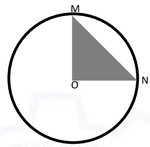
In the above figure, O is the center of the circle, and M and N lie on the circle.
The area of the right triangle MON is 50 cm².
What is the area of the circle in cm²?
View Solution
In this problem, we are given that the area of the right triangle MON is 50 cm², and we need to find the area of the circle.
Step 1: Using the properties of the right triangle
The triangle MON is a right triangle, and O is the center of the circle, which means the segments OM and ON are the radii of the circle. Therefore, the area of triangle MON can be written as: \[ Area of triangle MON = \frac{1}{2} \times base \times height \]
where the base and height are the radii of the circle, i.e., OM = ON = r.
Thus, the area of triangle MON becomes: \[ \frac{1}{2} \times r \times r = 50 \]
This simplifies to: \[ \frac{1}{2} r^2 = 50 \quad \Rightarrow \quad r^2 = 100 \]
Step 2: Finding the area of the circle
The area of a circle is given by: \[ Area of circle = \pi r^2 \]
Since \( r^2 = 100 \), we substitute this into the formula for the area of the circle: \[ Area of circle = \pi \times 100 = 100\pi \]
Thus, the area of the circle is \( 100\pi \) cm².
Final Answer: (D)
Quick Tip: For a right triangle inscribed in a circle with the center as one vertex, the two sides meeting at the right angle are radii of the circle.
“\( \oplus \)” means “-”, “\( \otimes \)” means “:”,
If “\( \Delta \)” means “+”, and “\( \nabla \)” means “×”,
then, the value of the expression \( \Delta 2 \oplus 3 \Delta ((4 \otimes 2) \nabla 4) \) =
View Solution
We need to evaluate the expression \( \Delta 2 \oplus 3 \Delta ((4 \otimes 2) \nabla 4) \), using the given operations:
1. Step 1: Break down the operations
- The symbol \( \oplus \) means subtraction (“-”).
- The symbol \( \otimes \) means multiplication (“:”), so \( 4 \otimes 2 = 4 \times 2 = 8 \).
- The symbol \( \nabla \) means multiplication (“×”), so \( 8 \nabla 4 = 8 \times 4 = 32 \).
- The symbol \( \Delta \) means addition (“+”).
2. Step 2: Evaluate the expression
We now substitute the values into the expression:
\[ \Delta 2 \oplus 3 \Delta (32) \]
This becomes:
\[ 2 + 3 - 32 = 7 \]
Thus, the value of the expression is 7.
Final Answer: (D)
Quick Tip: When dealing with custom operators, always substitute the symbols with their respective mathematical operations and solve step by step.
"The increased consumption of leafy vegetables in the recent months is a clear indication that the people in the state have begun to lead a healthy lifestyle."
Which of the following can be logically inferred from the information presented in the above statement?
View Solution
The statement says that the increased consumption of leafy vegetables is an indication of people leading a healthy lifestyle.
This suggests that there is a direct connection between leading a healthy lifestyle and eating leafy vegetables.
- (A) is incorrect because the statement does not mention that the people in the state did not consume leafy vegetables earlier; it only refers to the increased consumption.
- (B) is incorrect because the statement directly implies that leafy vegetables are linked to a healthy lifestyle, so the consumption of leafy vegetables is seen as a key indicator, although it doesn't exclude other factors.
- (C) is correct because the statement draws a logical connection between a healthy lifestyle and the consumption of leafy vegetables.
- (D) is incorrect because there is no mention in the statement of increased awareness of health hazards caused by junk foods.
Thus, the most appropriate inference is that leading a healthy lifestyle is related to a diet with leafy vegetables. Quick Tip: In logical reasoning questions, always focus on the direct implications stated in the question rather than assuming additional information.
Oxpeckers and rhinos manifest a symbiotic relationship in the wild. The oxpeckers warn the rhinos about approaching poachers, thus possibly saving the lives of the rhinos. Oxpeckers also feed on the parasitic ticks found on rhinos.
In the symbiotic relationship described above, the primary benefits for oxpeckers and rhinos respectively are,
View Solution
In this symbiotic relationship between oxpeckers and rhinos, both species benefit from the interaction:
1. Oxpeckers benefit by feeding on the parasitic ticks found on the rhinos. This provides the oxpeckers with a food source.
2. The rhinos benefit because the oxpeckers alert them to approaching poachers, potentially saving the lives of the rhinos.
Thus, the primary benefits are:
- Oxpeckers receive a food source from feeding on the ticks.
- Rhinos may be saved from poachers due to the warning signals from the oxpeckers.
Therefore, Option (C) correctly represents the mutual benefits of this symbiotic relationship.
Analysis of Other Options:
- Option (A): Incorrect because rhinos do receive a benefit (being warned about poachers), not just oxpeckers getting a food source.
- Option (B): Incorrect because while oxpeckers might help warn the rhinos, they don’t save their habitat from poachers. Rhinos benefit directly from the poacher warnings.
- Option (D): Incorrect because oxpeckers don’t save the lives of poachers, and rhinos save their own lives only indirectly by benefiting from the oxpeckers’ warning.
Thus, (C) is the most accurate answer.
Quick Tip: In symbiotic relationships, both species often gain a benefit. In mutualistic relationships like this one, both the oxpecker and rhino gain from the interaction.
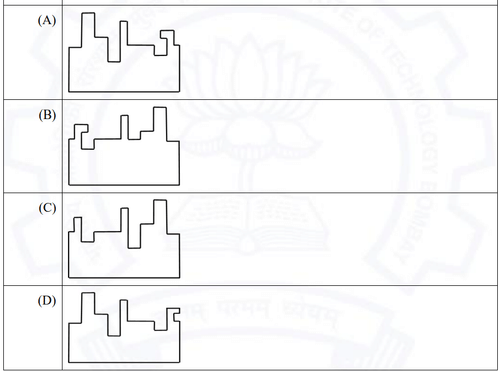
A jigsaw puzzle has 2 pieces. One of the pieces is shown above. Which one of the given options for the missing piece when assembled will form a rectangle? The piece can be moved, rotated, or flipped to assemble with the above piece.

View Solution
In this jigsaw puzzle, the goal is to find the missing piece that, when placed with the given piece, will form a complete rectangle. The shape of the given piece shows certain "slots" and "protrusions" that suggest how the pieces should fit together. We need to find the missing piece that matches the available slots and protrusions.
After analyzing the options:
- Option (A): When this piece is rotated and flipped, it fits perfectly with the given piece to form a rectangle. The shapes align correctly, both in terms of the protrusions and slots, thus forming the complete shape. This is the correct option.
- Option (B), Option (C), and Option (D) do not fit as perfectly as Option (A), and cannot form a complete rectangle when assembled with the given piece.
Thus, the correct answer is (A).
Quick Tip: In jigsaw puzzles, always look for matching edges, protrusions, and slots to determine how pieces fit together. Rotation and flipping can also help when assembling the pieces.
The number of hens, ducks and goats in farm P are 65, 91 and 169, respectively. The total number of hens, ducks and goats in a nearby farm Q is 416. The ratio of hens:ducks:goats in farm Q is 5:14:13. All the hens, ducks and goats are sent from farm Q to farm P.
The new ratio of hens:ducks:goats in farm P is
View Solution
We are given that:
- The number of hens, ducks, and goats in farm P are 65, 91, and 169, respectively.
- The total number of hens, ducks, and goats in farm Q is 416.
- The ratio of hens:ducks:goats in farm Q is 5:14:13.
Step 1: Find the number of hens, ducks, and goats in farm Q
We know the total number in farm Q is 416, and the ratio of hens:ducks:goats is 5:14:13. Let the number of hens, ducks, and goats in farm Q be represented by:
- Hens in Q: \( 5x \)
- Ducks in Q: \( 14x \)
- Goats in Q: \( 13x \)
Thus, the total is: \[ 5x + 14x + 13x = 416 \] \[ 32x = 416 \] \[ x = \frac{416}{32} = 13 \]
So, the number of hens, ducks, and goats in farm Q are:
- Hens in Q: \( 5 \times 13 = 65 \)
- Ducks in Q: \( 14 \times 13 = 182 \)
- Goats in Q: \( 13 \times 13 = 169 \)
Step 2: Add these to the numbers in farm P
Now, we transfer all the animals from farm Q to farm P:
- New hens in P: \( 65 + 65 = 130 \)
- New ducks in P: \( 91 + 182 = 273 \)
- New goats in P: \( 169 + 169 = 338 \)
Step 3: Find the new ratio
The new ratio of hens:ducks:goats in farm P is: \[ 130 : 273 : 338 \]
Simplifying this ratio by dividing each term by their greatest common divisor, which is 13: \[ \frac{130}{13} : \frac{273}{13} : \frac{338}{13} = 10 : 21 : 26 \]
Thus, the new ratio of hens:ducks:goats in farm P is 10:21:26, corresponding to Option (C).
Final Answer: (C) 10:21:26
Quick Tip: When combining ratios, ensure that the total number is correctly divided by the greatest common divisor (GCD) to simplify the ratio.
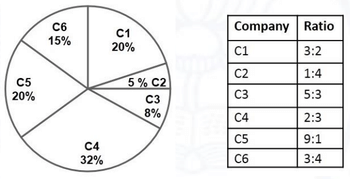
The distribution of employees at the rank of executives, across different companies C1, C2, …, C6 is presented in the chart given above. The ratio of executives with a management degree to those without a management degree in each of these companies is provided in the table above. The total number of executives across all companies is 10,000.
The total number of management degree holders among the executives in companies C2 and C5 together is
View Solution
We are given the following information:
- The total number of executives across all companies is 10,000.
- The percentage distribution of employees across the companies is:
- \( C1: 15% \)
- \( C2: 5% \)
- \( C3: 8% \)
- \( C4: 32% \)
- \( C5: 20% \)
- \( C6: 20% \)
Step 1: Calculate the number of executives in each company
The number of executives in each company is:
- Number of executives in \( C1 = 15% \times 10,000 = 1500 \)
- Number of executives in \( C2 = 5% \times 10,000 = 500 \)
- Number of executives in \( C3 = 8% \times 10,000 = 800 \)
- Number of executives in \( C4 = 32% \times 10,000 = 3200 \)
- Number of executives in \( C5 = 20% \times 10,000 = 2000 \)
- Number of executives in \( C6 = 20% \times 10,000 = 2000 \)
Step 2: Calculate the number of management degree holders in \( C2 \) and \( C5 \)
- For \( C2 \), the ratio of executives with a management degree is \( 1:4 \), meaning 1 out of every 5 executives has a management degree.
\[ Management degree holders in C2 = \frac{1}{5} \times 500 = 100 \]
- For \( C5 \), the ratio of executives with a management degree is \( 9:1 \), meaning 9 out of every 10 executives have a management degree.
\[ Management degree holders in C5 = \frac{9}{10} \times 2000 = 1800 \]
Step 3: Total management degree holders in \( C2 \) and \( C5 \)
The total number of management degree holders in \( C2 \) and \( C5 \) together is: \[ 100 + 1800 = 1900 \]
Thus, the total number of management degree holders in companies \( C2 \) and \( C5 \) is 1900, corresponding to Option (C).
Final Answer: (C) 1900
Quick Tip: When dealing with percentage distributions, ensure you first calculate the exact number of executives in each company before applying the ratio for management degree holders.
Five persons P, Q, R, S, and T are sitting in a row not necessarily in the same order. Q and R are separated by one person, and S should not be seated adjacent to Q.
The number of distinct seating arrangements possible is:
View Solution
We need to calculate the number of distinct seating arrangements of five people: P, Q, R, S, and T, with the following conditions:
1. Q and R are separated by one person.
2. S should not be seated adjacent to Q.
Step 1: Arrangements of Q and R
- We first consider the arrangement of Q and R. According to the problem, Q and R must be separated by exactly one person.
- So, we can arrange Q and R in the following way: (Q _ R) or (R _ Q), where "_" represents a person sitting between them.
- There are 2 possible arrangements for Q and R.
Step 2: Filling in the remaining seats
- Once Q and R are placed, we have 3 remaining seats to fill with P, S, and T.
- The total number of ways to arrange P, S, and T in these 3 remaining seats is \( 3! = 6 \).
Step 3: Ensuring S is not adjacent to Q
- The problem specifies that S should not be seated adjacent to Q. This restriction must be taken into account.
- Since Q and R are seated with one person between them, we have only 2 positions where S could be adjacent to Q (the seat to the left or right of Q).
- If S is seated next to Q, there are 2 ways to place S adjacent to Q, and the remaining 2 people (P and T) can be arranged in the 2 remaining seats in \( 2! = 2 \) ways.
Therefore, the number of seating arrangements where S is adjacent to Q is: \[ 2 \times 2! = 4 \]
Step 4: Subtracting the invalid arrangements
The total number of unrestricted seating arrangements is: \[ 2 \times 3! = 12 \]
However, we need to exclude the 4 arrangements where S is adjacent to Q. So, the total number of valid arrangements is: \[ 12 - 4 = 8 \]
Thus, the total number of distinct seating arrangements is 16.
Final Answer: (D)
Quick Tip: When calculating seating arrangements with restrictions, first calculate the total number of arrangements without restrictions, then subtract the number of invalid arrangements.
According to a recent article in a medical journal, consuming curcumin (from turmeric) significantly lowers the risk of COVID-19. The researchers draw this conclusion from a study that found that people who consumed one or more teaspoons of curcumin extract every day were half as likely to be diagnosed with the disease as people who did not consume curcumin.
Which of the following, if true, most weakens the argument in the article?
View Solution
The argument in the article suggests that curcumin consumption significantly lowers the risk of COVID-19. To weaken this argument, we need evidence that suggests other factors, such as exercise, might explain the difference in diagnosis rates rather than curcumin consumption alone.
Step 1: Evaluate each option.
- (A) The study mentioned in option (A) suggests that zinc supplements lower the likelihood of being diagnosed with COVID-19, but this doesn't directly weaken the argument about curcumin's effect.
- (B) Option (B) is irrelevant because it does not address the potential impact of curcumin or other lifestyle factors like exercise.
- (C) Option (C) presents a plausible alternative explanation—people who consume curcumin may also be more likely to exercise, which could account for their lower likelihood of being diagnosed with COVID-19.
- (D) Option (D) does not directly weaken the argument, as it discusses recovery rates rather than the likelihood of being diagnosed.
Step 2: Conclusion.
Option (C) introduces the possibility that exercise, not curcumin, could be the factor reducing the likelihood of diagnosis, which weakens the argument.
Final Answer: (C) The participants who consumed curcumin were also more likely to exercise than those who did not.
Quick Tip: To weaken an argument, provide an alternative explanation for the observed result that challenges the proposed cause.
Froot Inc. carried out an internet advertisement campaign for its new beverage CocoLoco. After the campaign, the director of the advertising company conducted a survey and found that the CocoLoco sales were higher than that of TenderJoos, a competing product from Joos Inc. The agency concluded that the internet advertising campaign is more effective than advertising through other media
Which of the following statements could strengthen the conclusion above by the agency?
View Solution
The agency concludes that the internet advertisement campaign was more effective than other media. To strengthen this conclusion, we need evidence that shows the internet campaign specifically had a positive effect, unlike other forms of advertisement.
Step 1: Evaluate each option.
- (A) A discount on CocoLoco could have contributed to higher sales, but it doesn't directly support the conclusion that the internet campaign was more effective than other forms of advertising.
- (B) If CocoLoco sales were already higher before the internet campaign, it weakens the claim that the internet campaign had a significant impact.
- (C) Option (C) provides useful evidence. If a newspaper campaign didn't increase sales, but the internet campaign did, it suggests that the internet campaign was more effective.
- (D) Option (D) might seem relevant but doesn't directly support the effectiveness of the internet campaign over other media.
Step 2: Conclusion.
Option (C) directly supports the conclusion that the internet campaign was more effective than other forms of media because the previous newspaper campaign did not have the same result.
Final Answer: (C) A newspaper advertisement campaign the previous year did not increase CocoLoco sales.
Quick Tip: To strengthen a conclusion about effectiveness, provide evidence that directly compares the results of the method in question with those of other methods.
An e-commerce site offered a deal last month conditional on the customer spending a minimum of ₹500. Any customer who buys 2 kg of fresh fruit will receive a hand mixer and any customer who buys 2 kg of fresh vegetables will receive a vegetable chopper.
Which of the following is NOT a possible outcome of the above?
View Solution
Step 1: Understand the Offer.
The customer must spend ₹500 to avail the offers. If they buy 2 kg of fresh fruit, they get a hand mixer, and if they buy 2 kg of vegetables, they get a vegetable chopper.
Step 2: Analyze the Options.
- (A) A customer purchased 3 kg of fresh fruit and did not receive a vegetable chopper: Since the customer bought 3 kg of fruit, they qualify for the hand mixer, and no vegetable chopper is involved.
- (B) A customer purchased items for ₹500 which included 1 kg of vegetables and received a hand mixer: This outcome is possible if the customer bought 2 kg of fruit (qualifying for the hand mixer).
- (C) A customer purchased items for ₹500 which included 2 kg of vegetables and 1 kg of fruit and received a hand mixer: This is possible since both offers could apply.
- (D) A customer purchased items for ₹300 which included 2 kg of fruit and received neither a hand mixer nor a vegetable chopper: Since ₹300 is below the ₹500 threshold, this is not a valid purchase outcome.
Step 3: Conclusion.
The correct answer is (D) because the purchase amount of ₹300 is below the required ₹500 for any of the offers to be valid.
Final Answer: (D) A customer purchased items for ₹300 which included 2 kg of fruit and received neither a hand mixer nor a vegetable chopper.
Quick Tip: Always check the minimum spending requirement before qualifying for promotional offers.
Writers of detective fiction often include an incompetent detective as a foil for the brilliant investigator-protagonist as they follow different paths in trying to solve the crime. In the individual accounts, the incompetent detective is frequently distracted by the culprit's careful plans, while the competent investigator solves the case after a final confrontation. Analysts of such fiction believe that the authors select this story-telling technique to provide readers with more complexities in the form of misleading clues, while figuring out the crime.
Which of the following statements most logically follows from the passage above?
View Solution
Step 1: Analyze the Passage.
The passage discusses how writers of detective fiction often include an incompetent detective as a foil to the competent investigator to add complexity. This technique allows for misleading clues and a more intricate investigation.
Step 2: Evaluate the Options.
- (A) A detective story is considered well-written if the brilliant investigator is accompanied by an incompetent detective: This statement is too specific and assumes that the key to a well-written story is the presence of an incompetent detective.
- (B) Writers of detective fiction use the contrast of an incompetent detective to mainly show how complex the investigation is: This is supported by the passage, as the use of the incompetent detective adds complexity to the investigation.
- (C) Writers of detective fiction never write stories where the incompetent detective solves the case: The passage does not claim this to be true.
- (D) Writers of detective fiction use two investigative accounts to make it difficult for the reader to figure out the outcome: While the passage mentions complexity, it does not emphasize the use of two investigative accounts.
Step 3: Conclusion.
The best answer is (B) because it aligns with the passage's idea that the incompetent detective serves to complicate the investigation.
Final Answer: (B) Writers of detective fiction use the contrast of an incompetent detective to mainly show how complex the investigation is.
Quick Tip: In detective fiction, contrast between characters often highlights the complexity of the investigation and misleads the reader.
The first (P1) and the last (P6) parts of a single sentence are given to you. The rest of the sentence is divided into four parts and labelled (L,M,N,O). Reorder these parts so that the sentence can be read through correctly and select one of the options given.
P1: Studies of several Sahitya Akademi award winners show that...
L: or encounter professional
M: and invariably develop a strained relationship with other literary figures
N: they often publish very little
O: after winning the prize
P6: ...envy and rivalry.
View Solution
We are given the first part (P1) and the last part (P6) of a sentence. We need to reorder the remaining parts to form a coherent sentence. The given parts are:
- P1: "Studies of several Sahitya Akademi award winners show that..."
- P6: "...envy and rivalry."
Now, we analyze the options:
Option (A) NOLM: This order does not form a meaningful sentence as it does not fit well with the context.
Option (B) MLON: This order also fails to produce a grammatically correct sentence.
Option (C) ONML: The correct sequence is obtained with this order. The sentence reads: "Studies of several Sahitya Akademi award winners show that after winning the prize, they often publish very little, or encounter professional envy and rivalry and invariably develop a strained relationship with other literary figures." This is logically and grammatically correct.
Option (D) MOLN: This order doesn't result in a meaningful sentence either.
Thus, the correct order is ONML.
Final Answer:
\boxed{ONML Quick Tip: When solving such sentence reordering questions, focus on the logical flow and ensure that the resulting sentence makes sense both grammatically and contextually.
Gerrymandering refers to the targeted redrawing of election constituencies so as to benefit a particular party. This is especially important where the electoral system is "first past the post" in each constituency (i.e. one winner is selected in each constituency based on a majority of votes won) and where there is no other provision for proportional representation (as for example in the German system). For a simple illustration of gerrymandering, if a region consists of districts 1, 2, 3, …, 9 with districts 1, 2, 3, 4, 5, 6 favouring party P and 7, 8, 9 favouring party Q, then grouping of districts to constituencies as {1,2,3}, {4,5,6}, {7,8,9} will give two seats to party P and one seat to party Q, whereas the grouping {1,2,7}, {3,4,8}, {5,6,9} will give all three seats to party P, as they will secure a majority in each constituency.
View Solution
We are given a situation describing gerrymandering, where the boundaries of constituencies are redrawn to favour a particular political party. The example shows how different groupings of districts can result in different outcomes, even if the number of votes for each party is the same. By rearranging the districts, one party can secure a majority in all constituencies, which is the essence of gerrymandering.
Step 1: Analyzing the question.
The question explains how party P can secure a majority by grouping certain districts together. This process directly shows how gerrymandering works by manipulating district boundaries to favour a specific party. Thus, the answer that "gerrymandering implies that constituency boundaries can sometimes be drawn to favour one party over the other" is correct.
Step 2: Discarding other options.
- (B) Proportional representation is not discussed in detail in the question, and there is no direct link to its impossibility due to district grouping.
- (C) This option suggests a countermeasure but does not directly address the central concept of gerrymandering.
- (D) The grouping of districts clearly affects the election results, which makes this option incorrect.
Final Answer:
(A) \textGerrymandering implies that constituency boundaries can sometimes be drawn to favour one party over the other. Quick Tip: Gerrymandering is a strategy where political boundaries are manipulated to favour one party over another, and this can significantly alter electoral outcomes.
X-ray examination of a recently discovered painting that some authorities judge to be a self-portrait by Michelangelo revealed an under-image of a woman’s face. Either Michelangelo or some other artist must have repainted over the first painting that had now been seen on the canvas. Because the woman’s face also appears on other paintings by Michelangelo, this painting is determined to indeed be an authentic painting by Michelangelo.
Which of the following assumptions must be made in reaching the conclusion above?
View Solution
Step 1: Understanding the Assumptions.
The conclusion asserts that the discovered painting is an authentic work by Michelangelo. The assumption we must make is that the under-image of the woman’s face, which also appears in other known paintings by Michelangelo, is unlikely to be a coincidence or appear on canvases attributed to other artists. This forms the basis for the authenticity of the painting.
Step 2: Analyzing the Options.
- (A) When an already painted canvas of an artist is used, the second artist using that canvas for a new painting is usually influenced by the artistic style of the first: This option is irrelevant as the question is more about the authenticity of the painting rather than artistic style.
- (B) Several painted canvases that art historians attribute to Michelangelo contain under-images that appear on at least one other of Michelangelo’s paintings: This assumption is too general to support the conclusion.
- (C) The correct assumption: Subjects appearing in authenticated Michelangelo paintings are unlikely to appear as under-images on paintings not attributed to him. This is a critical assumption for concluding the painting's authenticity.
- (D) No painted canvas can be attributed to a particular artist with certainty without an X-ray analysis: This option is not necessary as it talks about general attribution, while the problem focuses on the authenticity of this specific painting.
Step 3: Conclusion.
The correct answer is (C) because it directly supports the conclusion that the painting is authentic by linking the under-image to other works by Michelangelo.
Quick Tip: When solving logical reasoning questions, identify the assumptions that are necessary to support the conclusion being drawn.
This season ________ tourists visited Ladakh than last season; however, ________ to be the biggest tourist destination in India. The tourism department explains that the number of tourists to India has ________ relative to previous years, ________ have chosen to visit Ladakh.
Select the correct sequence of phrases to fill in the blanks to complete the passage above.
View Solution
Step 1: Understand the Context.
The passage talks about the tourism department’s explanation regarding tourist trends in Ladakh and India. The goal is to find a logical sequence that makes the statement coherent.
Step 2: Analyze the Phrases.
- (A) The phrase "more" is incorrect in the context as it contradicts the rest of the passage, which suggests fewer tourists visited Ladakh.
- (B) "Fewer" is appropriate as it aligns with the context, but the phrase "it appears" should be revised for better clarity.
- (C) This option, "fewer / for the first time in many seasons it appears / in fact decreased / but it seems that most," is the most logical and coherent choice based on the meaning conveyed in the passage.
- (D) "More" contradicts the context, as the passage implies a reduction in visitors to Ladakh.
Step 3: Conclusion.
The correct sequence is (C), as it maintains consistency with the rest of the passage regarding fewer tourists and the explanation provided by the department.
Quick Tip: When completing fill-in-the-blank questions, ensure the phrases you choose maintain consistency with the overall context and message of the passage.
Reorder the sentences in (1) – (5) such that they form a coherent
paragraph.
(1) In fact, dozens of languages today have only one native speaker still
living, and that person's death will mean the extinction of the language: It
will no longer be spoken, or known, by anyone on earth.
(2) Many languages are falling out of use and are being replaced by others
that are more widely used in the region or nation, such as English in
Australia or Portuguese in Brazil.
(3) Many other languages are no longer being learned by new generations
of children or by new adult speakers.
(4) An endangered language is one that is likely to become extinct in the
near future.
(5) Unless the trends are reversed, these endangered languages will become
extinct by the end of the century.
(Adapted from What is an Endangered Language by A. Woodbury.)
View Solution
We need to arrange the sentences in a logical order to form a coherent paragraph. The correct order should present the topic, define it, explain its components, and discuss its consequences.
Step 1: Analyze each sentence.
- (1) introduces the concept of endangered languages, but it needs context for better understanding.
- (2) explains how languages are being replaced by others, which is a natural consequence of language extinction.
- (3) gives additional information about languages not being learned by the younger generation, indicating a further threat to language survival.
- (4) provides a definition of an endangered language, offering the fundamental explanation for the paragraph's topic.
- (5) talks about the consequence of language extinction, which follows naturally after the description of endangered languages.
Step 2: Organize logically.
The paragraph starts by defining an endangered language (4). Then, it discusses the trends of language extinction (2), followed by further elaboration on the lack of new speakers (3). The introductory sentence (1) provides a deeper example, and the paragraph concludes with a warning about language extinction (5).
Step 3: Conclusion.
The correct order is: 4 2 3 1 5.
Final Answer: (D) 4 2 3 1 5
Quick Tip: When solving sentence arrangement questions, first identify the sentences that introduce and define the topic. Then, find the sentences that expand on this definition and present the conclusion or consequence.
The first (P1) and the last (P6) parts of a single sentence are given to you. The rest of the sentence is divided into four parts and labelled L, M, N, O. Reorder these parts so that the sentence can be read correctly and select one of the sequences below.
P1: For a little while…
L: it was a common belief
M: right after the treaty of Versailles
N: that Germany had caused World War I not just by her actions
O: held by analysts and politicians alike
P6: … but by also encouraging Italy in her own aggressions.
View Solution
Step 1: Analyze the sentence structure.
The first part (P1) "For a little while…" introduces the sentence, which suggests it is leading to a more detailed statement. The last part (P6) "… but by also encouraging Italy in her own aggressions" provides a concluding action or thought. We need to find a coherent order for the remaining parts: L, M, N, O.
Step 2: Examine the parts.
- (L) "it was a common belief" is a starting point that introduces the belief.
- (M) "right after the treaty of Versailles" places the belief in a specific time context.
- (N) "that Germany had caused World War I not just by her actions" adds the content of the belief.
- (O) "held by analysts and politicians alike" explains who held this belief.
Step 3: Form the correct sequence.
The sentence flows logically as follows:
- First, introduce the belief (L).
- Then, establish the time frame (M).
- Next, explain the belief about Germany (N).
- Finally, clarify who held this belief (O).
Step 4: Conclusion.
Thus, the correct sequence is (B) MLON.
Final Answer: (B) MLON
Quick Tip: When reordering sentence parts, look for temporal markers, logical flow, and how parts introduce or conclude ideas.
After Florentino Ariza saw her for the first time, his mother knew before he told her because he lost his voice and his appetite and spent the entire night tossing and turning in his bed. But when he began to wait for the answer to his first letter, his anguish was complicated by diarrhea and green vomit, he became disoriented and suffered from sudden fainting spells, and his mother was terrified because his condition did not resemble the turmoil of love so much as the devastation of cholera. Florentino Ariza’s godfather, an old homeopathic practitioner who had been Tránsito Ariza’s confidant ever since her days as a secret mistress, was also alarmed at first by the patient’s condition, because he had the weak pulse, the hoarse breathing, and the pale perspiration of a dying man. But his examination revealed that he had no fever, no pain anywhere, and that his only concrete feeling was an urgent desire to die. All that was needed was shrewd questioning, first of the patient and then of his mother, to conclude once again that the symptoms of love were the same as those of cholera. He prescribed infusions of linden blossoms to calm the nerves and suggested a change of air so he could find consolation in distance, but Florentino Ariza longed for just the opposite: to enjoy his martyrdom.
The author of the passage is implying that:
View Solution
The passage describes how Florentino Ariza, after falling in love, exhibits symptoms similar to those of cholera. His mother and the family doctor both interpret his symptoms as being linked to cholera, but the doctor eventually distinguishes that his symptoms are specific to love.
Step 1: Analyze the doctor's reasoning.
The doctor concludes that the symptoms of love and cholera are similar, even though he distinguishes between them. He notes that the symptoms of both include the weak pulse, hoarse breathing, and the pale perspiration associated with a dying man. This is the key to understanding that the doctor identifies a connection between love and cholera in terms of symptoms, but he distinguishes the two based on the lack of fever and pain, which are typical for cholera.
Step 2: Conclusion.
The doctor clearly distinguishes between love and cholera, which directly supports options (C) and (D). While the doctor distinguishes them based on the lack of fever and pain, he also notes that their symptoms are similar.
Thus, the correct answers are (C) and (D).
Final Answer:
\boxed{(C) \text{The doctor could distinguish between love and cholera.
\boxed{(D) \text{The symptoms of love and cholera are similar.
Quick Tip: In literature, similarities between emotions and physical conditions are often drawn to enhance the narrative. Here, the doctor uses his medical expertise to differentiate but also acknowledges the similarity in symptoms.
It is a pity that Caste even today has its defenders. The defences are many. It is defended on the grounds that the Caste System is but another name for division of labour, and if division of labour is a necessary feature of every civilised society, then it is argued that there is nothing wrong in the Caste System. Now the first thing to be urged against this view is that Caste System is not merely division of labour. It is also a division of labourers. Civilised society undoubtedly needs division of labour but nowhere is division of labour accompanied by this unnatural division of labourers into watertight compartments, grading them one above the other. This division of labour is not spontaneous or based on natural aptitudes. Social and individual efficiency requires us to develop the individual capacity and competency to choose and to make his own career. This principle is violated in so far as it involves an attempt to appoint tasks to individuals in advance, not on the basis of trained original capacities, but on that of birth. Industry undergoes rapid and abrupt changes and an individual must be free to change his occupation and adjust himself to changing circumstances, to gain his livelihood. (Adapted from Annihilation of Caste by Dr. B.R. Ambedkar.)
Which of the following observations substantiate the arguments found in the passage above?
View Solution
Step 1: Understanding the Passage.
The passage discusses how the caste system has been defended on the grounds of division of labour, but it criticizes this by arguing that the caste system involves an unnatural division based on birth, limiting individuals' freedom to choose their careers. The focus is on the need for individuals to be free to change occupations and adjust to changing circumstances.
Step 2: Analyze the Options.
- (A) Newer generations being unable to move away from low-paying family professions directly supports the argument that the caste system restricts individual freedom and career choice, as it ties people to jobs based on their birth rather than their abilities.
- (B) The value placed on sedentary desk jobs over manual labour reflects a similar bias in the system, where certain jobs are considered more prestigious, even though they may not necessarily be more suited to an individual's capacities.
- (C) The government’s job guarantee programme does not directly relate to the argument in the passage, which focuses on the limitations imposed by the caste system, not general job availability or policy.
- (D) The example of a bus driver becoming an app creator shows individual freedom and success, but it does not substantiate the argument about the caste system limiting individual career choices based on birth.
Step 3: Conclusion.
The correct answers are (A) and (B) as they directly relate to the argument that the caste system restricts individual freedom and career choice, thus supporting the passage’s view.
Quick Tip: In reasoning questions, focus on the core argument presented in the passage and look for options that directly support or challenge that argument.
Imagine that you’re in a game show and your host shows you three doors. Behind one of them is a shiny car and behind the others are goats. You pick one of the doors and get what lies within. After making your choice, your host chooses to open one of the other two doors, which inevitably reveals a goat. He then asks you if you want to stick with your original pick, or switch to the other remaining door. What do you do? Most people think that it doesn’t make a difference and they tend to stick with their first pick. With two doors left, you should have a 50% chance of selecting the one with the car. If you agree, then you have just fallen afoul of one of the most infamous mathematical problems – the Monty Hall Problem. In reality, you should switch every time which doubles your odds of getting the car. Over the years, the problem has ensnared countless people, but not, it seems, pigeons. The humble pigeon can learn with practice the best tactic for the Monty Hall Problem, switching from their initial choice almost every time. Amazingly, humans do not!
Which of the following conclusions follow from the passage above?
View Solution
The passage discusses the Monty Hall Problem and compares human behavior to pigeons when solving this problem. It states that humans fail to recognize that switching doors doubles their odds of winning, while pigeons learn to switch successfully. We now analyze the options.
Step 1: Evaluate each option.
- (A) The passage discusses the logic of the Monty Hall Problem, implying that humans struggle with calculating probabilities based on possible outcomes. This conclusion follows directly from the passage.
- (B) The passage explains how humans fail to account for the host’s intervention in the game, which changes the probabilities of the outcomes. This conclusion also follows from the passage.
- (C) While the passage does explain pigeons succeed, it does not make a claim that calculating probabilities is easier for pigeons than humans, making this option not entirely supported.
- (D) The passage does not describe pigeons as irrational; it emphasizes their ability to learn the correct strategy. This option does not follow from the passage.
Step 2: Conclusion.
Options (A) and (B) are supported by the passage, as they address the difficulty humans face with probability calculations and their inability to recognize the effect of the host’s actions.
Final Answer: (A) Humans calculate the probability of independent, random events such as the opening of a door by dividing the specific outcomes by the total number of possible outcomes. (B) Humans find it very difficult to learn to account for the host’s hand in making the event non-random and, thereby, changing the outcome of the event.
Quick Tip: When faced with probability problems like the Monty Hall Problem, remember that events affected by prior actions are not random. Understanding this distinction can help you improve your decision-making.
The truth is that, despite the recent success of car-makers P and Q, India’s automobile industry is in a state not that different from the bad old days of the license-permit quota raj when two carmakers dominated a captive domestic market with substandard vehicles and with very little, if any, research and development, and low to negligible productivity growth.
High tariff barriers have certainly induced foreign automobile makers to enter the Indian market by setting up local operations, but this so-called “tariff jumping” foreign investment has produced an industry that is inefficient, operating generally at a low scale, and whose products are not globally competitive either in terms of cost or of innovation.
It is noteworthy that the automobile parts industry, which has faced low tariffs (as low as 12.5%) and has been largely deregulated, has been characterised by higher productivity and much better export performance than the completely-built units’ sector in the years since liberalisation.
(Adapted from an Op-Ed in The Mint)
Which of the following statements can be inferred from the above?
View Solution
Step 1: Analyze the given information.
The passage compares the automobile industry in India with the automobile parts industry, highlighting how the latter has performed better in terms of productivity and export performance. The main factors influencing the automobile industry include tariff barriers and deregulation, while the automobile parts industry benefited from low tariffs and deregulation. The mention of substandard vehicles and low productivity for P and Q suggests inefficiency in these carmakers' operations.
Step 2: Evaluate the options.
- (A) Low tariff barriers increase productivity: The passage suggests that the automobile parts industry, which faced low tariffs, experienced higher productivity and better export performance, implying that low tariff barriers lead to increased productivity.
- (B) Tariff jumping leads to increases in productivity: The passage does not support this claim, as tariff jumping has led to an inefficient industry with low-scale operations, not an increase in productivity.
- (C) Deregulation has worked for the automotive parts industry and therefore should be applied to completely-built units: The passage mentions that the deregulated automobile parts industry has shown better productivity and export performance, suggesting that deregulation could work for the completely-built units’ sector as well.
- (D) P and Q do not invest enough in research and development: The passage indicates that the automobile industry, dominated by P and Q, had very little research and development, implying that they do not invest enough in this area.
Step 3: Conclusion.
The correct inferences are (A), (C), and (D) based on the passage's explanation of the issues with the automobile industry and the better performance of the automobile parts sector.
Final Answer: (A), (C), (D)
Quick Tip: When analyzing an industry’s performance, factors such as tariff barriers and deregulation can significantly influence productivity and competitiveness.
What is the mood of the following syllogistic argument?
All Professors are Academicians.
Some Academicians are Activists.
Therefore, Some Activists are Professors.
View Solution
Step 1: Recall what “mood” means in a categorical syllogism.
The mood of a syllogism is the sequence of the forms (A, E, I, O) of the major premise, minor premise, and conclusion.
Where:
A = Universal Affirmative (All S are P)
E = Universal Negative (No S are P)
I = Particular Affirmative (Some S are P)
O = Particular Negative (Some S are not P)
Step 2: Identify the form of each statement.
1) All Professors are Academicians.
This is of the form All S are P \(\Rightarrow\) A.
2) Some Academicians are Activists.
This is of the form Some S are P \(\Rightarrow\) I.
3) Therefore, Some Activists are Professors.
This is of the form Some S are P \(\Rightarrow\) I.
Step 3: Write the mood.
Major premise = A
Minor premise = I
Conclusion = I
So the mood is AII.
Final Answer: (A) AII
Quick Tip: To find the mood, convert each premise and the conclusion into A/E/I/O form and list them in the order: Major–Minor–Conclusion.
What is the formal fallacy committed in the following syllogistic argument?
No Students are tested Covid-positive.
Some Covid-positive cases are not Professors.
Therefore, Some Professors are not Students.
View Solution
Step 1: Translate each statement into A/E/I/O form.
1) No Students are tested Covid-positive.
Form: No S are P \(\Rightarrow\) E proposition.
2) Some Covid-positive cases are not Professors.
Form: Some P are not M \(\Rightarrow\) O proposition (particular negative).
3) Therefore, Some Professors are not Students.
Form: Some M are not S \(\Rightarrow\) O proposition.
Step 2: Identify the issue with the premises.
A valid categorical syllogism cannot have two negative premises.
Here, the first premise is negative (E-type), and the second premise is also negative (O-type).
When both premises are negative, they do not establish a link between the middle term and the other term that can support the conclusion.
Step 3: Name the fallacy.
The error of having two negative premises is called the Fallacy of Exclusive Premises.
Final Answer: (A) Fallacy of Exclusive Premises
Quick Tip: If both premises are negative (E or O), the syllogism commits the \textbf{Fallacy of Exclusive Premises} because no valid conclusion can be drawn.
The Philosophy of Aurobindo may aptly be identified as
View Solution
Step 1: Understanding Sri Aurobindo’s philosophy.
Sri Aurobindo’s thought is grounded in the idea that reality is fundamentally one, but it manifests itself in multiple forms, including matter, life, and consciousness.
Step 2: Explaining Integral Non-dualism.
Unlike classical non-dualism, which often dismisses the world as illusory, Aurobindo’s philosophy affirms the spiritual significance of the material world as part of an evolving divine reality.
Step 3: Eliminating other options.
Pure non-dualism does not account for evolutionary progression, while dualism and integral dualism posit an irreducible separation between spirit and matter, which Aurobindo rejects.
Step 4: Conclusion.
Hence, Sri Aurobindo’s philosophy is best described as Integral Non-dualism.
Final Answer: (A) Integral Non-dualism.
Quick Tip: Integral philosophies attempt to reconcile spiritual unity with material diversity.
Scientists in the Institute of Virology tested Influenza-affected patients in Wuhan for all known acute respiratory diseases but could not establish the cause for their influenza from the set of known causes. Hence, they inferred for the first time that a Novel Corona Virus is the cause of their disease.
Determine which of Mill’s methods matches with the above description?
View Solution
Step 1: Understanding the Method of Residues.
Mill’s Method of Residues involves subtracting known causes from a phenomenon so that the remaining unexplained effect is attributed to a new or unknown cause.
Step 2: Applying the method to the given case.
Scientists eliminated all known causes of respiratory disease. The remaining unexplained cause was inferred to be a novel virus.
Step 3: Eliminating other methods.
The Method of Difference and Agreement rely on direct comparison of cases, which is not the primary reasoning used here.
Step 4: Conclusion.
The reasoning process clearly follows the Method of Residues.
Final Answer: (A) Method of Residues
Quick Tip: The Method of Residues is commonly used in scientific discovery when known explanations are systematically ruled out.
In his Republic, Plato makes a four-fold classification of the possible objects of knowledge. Where does he place Mathematical Objects?
View Solution
Step 1: Explaining Plato’s divided line.
Plato divides knowledge into four levels: Eikasia, Pistis, Dianoia, and Noesis, ranging from illusion to pure intellectual insight.
Step 2: Locating mathematical knowledge.
Mathematics belongs to Dianoia because it involves abstract reasoning based on hypotheses rather than direct perception or ultimate forms.
Step 3: Distinguishing from Noesis.
Noesis is reserved for direct understanding of the Forms themselves, not for mathematical reasoning.
Step 4: Conclusion.
Therefore, Plato places mathematical objects in the realm of Dianoia.
Final Answer: (A) Dianoia [Thought]
Quick Tip: In Plato’s epistemology, mathematics bridges the sensory world and the realm of pure Forms.
According to Plato, which among the following is NOT a cardinal virtue?
View Solution
Step 1: Understanding Plato’s cardinal virtues.
In Plato’s philosophy, especially as discussed in The Republic, the four cardinal virtues are Wisdom, Courage, Temperance, and JusticeThese virtues correspond to different parts of the soul and the ideal state
Step 2: Evaluating the options.
Wisdom, Courage, and Justice are explicitly identified by Plato as cardinal virtuesHowever, Autonomy is not discussed by Plato as a virtue in his ethical frameworkIt is a much later concept associated with modern moral philosophy
Step 3: Final conclusion.
Since Autonomy is not included among Plato’s cardinal virtues, option (A) is correct
Quick Tip: Plato’s cardinal virtues form the ethical foundation of his ideal state and theory of the soul
In Plato’s \textbf{Republic}, the guardians of the ideal state reserve the right to govern because
View Solution
Step 1: Role of the guardians in Plato’s ideal state.
In The Republic, Plato describes the guardians as philosopher-rulers who possess knowledge of the GoodTheir authority is based on wisdom, not power or privilege
Step 2: Reason for their governance.
The guardians govern not for personal gain but out of a sense of obligation and responsibilityThey rule because it is their duty to ensure justice and harmony in the state
Step 3: Eliminating incorrect options.
Their authority is not hereditary, democratic, or based on military dominanceInstead, it is grounded in moral and intellectual duty
Step 4: Final conclusion.
Therefore, the correct answer is that the guardians govern because it is their duty
Quick Tip: Plato’s philosopher-kings rule reluctantly, motivated by duty rather than desire for power
What is true of Rāmānuja’s Viśiṣṭādvaita?
View Solution
Step 1: Understanding Viśiṣṭādvaita.
Rāmānuja’s Viśiṣṭādvaita philosophy is known as “qualified non-dualism”It holds that Brahman is one but is qualified by attributes, including the soul (cit) and matter (acit)
Step 2: Evaluating the options.
Unlike Śaṅkara’s Advaita, Viśiṣṭādvaita does not consider Brahman as attribute-lessBoth the individual soul and the world are real and form part of Brahman
Step 3: Eliminating incorrect options.
Options (B), (C), and (D) describe positions closer to Advaita Vedānta, not Viśiṣṭādvaita
Step 4: Final conclusion.
Hence, Viśiṣṭādvaita accepts the conception of a qualified Brahman
Quick Tip: Viśiṣṭādvaita affirms the reality of both the world and the soul as attributes of Brahman
In the Mīmāṃsā system, \textbf{apūrva} stands for a link/relation between
View Solution
Step 1: Understanding \textbf{apūrva}.
In the Mīmāṃsā philosophical system, apūrva refers to an unseen, imperceptible potency generated by ritual action.
Step 2: Function of \textbf{apūrva}.
This potency acts as a causal link between a performed action (karma) and its future result or fruit, especially when the result is temporally distant.
Step 3: Elimination of incorrect options.
Options (B), (C), and (D) do not correspond to the ritual–causal function that apūrva is meant to explain.
Step 4: Conclusion.
Hence, apūrva denotes the link between an action and its fruit.
Quick Tip: \textbf{Apūrva} explains how ritual actions yield results even after a long time gap.
The conception of \textbf{jīva} in Advaita stands for:
View Solution
Step 1: Understanding \textbf{jīva}.
In Advaita Vedānta, jīva refers to the individual self that appears distinct due to ignorance (avidyā).
Step 2: Relation between jīva and Brahman.
Although the jīva is ultimately identical with Brahman, it is experienced as an individual, embodied consciousness in empirical reality.
Step 3: Elimination of incorrect options.
The Universal Self corresponds to Brahman, not jīva. The liberated self is the jīva after realization, and “living beings” is a biological category, not a metaphysical one.
Step 4: Conclusion.
Therefore, jīva denotes the individual self.
Quick Tip: In Advaita, jīva and Brahman are ultimately one, though they appear different due to ignorance.
What among the following is in conformity with Leibniz’s metaphysical assertion of \textbf{Pre-established Harmony}?
View Solution
Step 1: Understanding Pre-established Harmony.
Leibniz proposed that mind and body do not causally interact but function in perfect coordination.
Step 2: Nature of coordination.
This harmony is established by God in advance, ensuring that mental and physical events correspond without direct causal influence.
Step 3: Evaluation of options.
Option (A) correctly captures this idea of non-causal coordination. Options (B) and (C) contradict Leibniz’s rejection of interactionism, while option (D) misrepresents mental causation in his system.
Step 4: Conclusion.
Thus, mutual coordination of mind and body aligns with Pre-established Harmony.
Quick Tip: In Pre-established Harmony, mind and body run in parallel like synchronized clocks.
In Edmund Husserl’s phenomenology, \textbf{eidetic reduction} is meant to provide access to the sphere of
View Solution
Step 1: Understand eidetic reduction.
In Husserlian phenomenology, eidetic reduction aims at grasping the essences (eidos) of phenomena by bracketing empirical contingencies.
Step 2: Identify the target of eidetic analysis.
This method seeks invariant and necessary structures underlying experiences, not accidental or merely subjective features.
Step 3: Eliminate incorrect options.
(B) refers to contingent features, not essences.
(C) describes phenomenological description in general, not eidetic reduction specifically.
(D) pertains more directly to transcendental reduction, not eidetic reduction.
Step 4: Conclusion.
Therefore, eidetic reduction provides access to the essential structures of pure psychic processes.
Quick Tip: Eidetic reduction answers the question: “What must this experience be in order to be what it is?”
In Jaina classification of knowledge, \textbf{Mati} includes
View Solution
Step 1: Recall Jaina epistemology.
Jaina philosophy classifies knowledge (jñāna) into several types, including Mati, Śruta, Avadhi, Manaḥparyāya, and Kevala.
Step 2: Define Mati-jñāna.
Mati refers to sensory-based knowledge, which includes both direct perception and inferential cognition arising from perception.
Step 3: Eliminate incorrect options.
(B) is incomplete because inference is also included.
(C) excludes perception and is therefore incorrect.
(D) wrongly includes śruta, which is a separate category.
Step 4: Conclusion.
Thus, Mati includes both perception and inference.
Quick Tip: In Jaina epistemology, \textbf{Mati} knowledge is grounded in sensory cognition and its inferential extensions.
Among the four \textbf{Brahmavihāras} of Buddhism, \hspace{2cm} evokes happiness at the joy and success of others.
View Solution
Step 1: Recall the four Brahmavihāras.
The four sublime states in Buddhism are Maitrī (loving-kindness), Karuṇā (compassion), Muditā (sympathetic joy), and Upekṣā (equanimity).
Step 2: Identify the relevant concept.
Muditā specifically refers to rejoicing in the happiness, success, and good fortune of others.
Step 3: Eliminate incorrect options.
(B) concerns goodwill toward all beings.
(C) relates to alleviating others’ suffering.
(D) denotes balanced detachment or equanimity.
Step 4: Conclusion.
Hence, the correct answer is Muditā.
Quick Tip: Muditā counters jealousy by cultivating joy in others’ happiness.
Read the following verse from \textbf{Bhagavadgītā} carefully.
Karmanyevādhikāraste mā phaleṣu kadācana;
Mā karmaphalaheturbhūrmā te saṅgo’stvakarmaṇi.
[Your right is for action alone, never for the results. Do not become the agent of the results of action. May you not have any inclination for inaction.] (Bhagavadgītā 2:47)
This above quoted verse is a standard reference to:
View Solution
Step 1: Understanding the verse.
The verse emphasizes performing one’s duty (karma) without attachment to the fruits of action and without falling into inaction.
Step 2: Interpreting the philosophical teaching.
Karma-yoga, as taught in the Bhagavadgītā, advocates selfless action performed as duty, renouncing attachment to outcomes while remaining fully engaged in action.
Step 3: Eliminating incorrect options.
(B) Bhakti-yoga focuses on devotion to God.
(C) Jñāna-yoga emphasizes knowledge and self-realization.
(D) Rāja-yoga centers on meditation and mental discipline.
Step 4: Conclusion.
Since the verse explicitly teaches action without desire for results, it is a foundational statement of Karma-yoga.
Final Answer: (A) Karma-yoga
Quick Tip: Karma-yoga teaches \textbf{niṣkāma karma}—action without attachment to results.
Which among the following is predominantly a non-dualistic philosophical system?
View Solution
Step 1: Understanding non-dualism.
Non-dualism (advaita) holds that ultimate reality is one, without a fundamental distinction between the divine and the individual self.
Step 2: Analysis of the options.
(A) Kāśmir Śaivism is explicitly non-dualistic, asserting the identity of Śiva (ultimate reality) and the individual consciousness.
(B) Śaiva-siddhānta is dualistic or qualified-dualistic, maintaining a distinction between God and the soul.
(C) Vīra-śaivism emphasizes devotion and ethical practice, not strict non-dual metaphysics.
(D) Vaiṣṇavism generally upholds a dualistic or qualified-dualistic view.
Step 3: Conclusion.
Among the given options, Kāśmir Śaivism alone is predominantly non-dualistic.
Final Answer: (A) Kāśmir Śaivism
Quick Tip: Kāśmir Śaivism teaches that the individual self is fundamentally identical with Śiva, the supreme consciousness.
Gandhi’s doctrine of Trusteeship establishes a normative relationship between labour and capital. Indicate which of the following is NOT in agreement with this doctrine?
View Solution
Step 1: Understanding the doctrine of Trusteeship.
Gandhi’s doctrine of Trusteeship rejects conflict between labour and capital and instead promotes moral responsibility, cooperation, and ethical management of wealth.
Step 2: Evaluating the options.
Options (B), (C), and (D) align with Trusteeship, as they emphasize moral accountability of capitalists, recognition of labour’s contribution, and the idea of wealth being held in trust for social welfare.
Step 3: Identifying the contradiction.
Option (A) emphasizes class struggle as the engine of social development, a view associated with Marxism and directly opposed to Gandhi’s non-violent, non-conflictual approach.
Step 4: Conclusion.
Hence, option (A) is NOT in agreement with Gandhi’s doctrine of Trusteeship.
Final Answer: (A)
Quick Tip: Gandhi’s economic thought stresses ethical reform over structural conflict.
Which of the following is NOT a pramāṇa in the Nyāya system?
View Solution
Step 1: Understanding pramāṇa in Nyāya.
The Nyāya system recognizes four valid means of knowledge: Pratyakṣa (perception), Anumāna (inference), Upamāna (comparison), and Śabda (verbal testimony).
Step 2: Evaluating the options.
Options (B), (C), and (D) are explicitly accepted pramāṇas in Nyāya epistemology.
Step 3: Identifying the incorrect pramāṇa.
Anupalabdhi (non-apprehension) is accepted as a pramāṇa in other systems such as Mīmāṃsā, but not in Nyāya.
Step 4: Conclusion.
Therefore, option (A) is NOT a pramāṇa in the Nyāya system.
Final Answer: (A)
Quick Tip: Different Indian philosophical systems accept different pramāṇas for valid knowledge.
In the Vaiśeṣika system, which of the following is a padārtha (category)?
View Solution
Step 1: Understanding padārthas in Vaiśeṣika.
Vaiśeṣika philosophy classifies reality into padārthas such as Dravya (substance), Guṇa (quality), Karma (action), Sāmānya (generality), Viśeṣa (particularity), and Samavāya (inherence).
Step 2: Evaluating the options.
Guṇa is explicitly one of the six classical padārthas.
Ātman, Tejas, and Vāyu are classified as substances (dravya), not categories themselves.
Step 3: Conclusion.
Hence, Guṇa is the correct example of a padārtha.
Final Answer: (A)
Quick Tip: Padārthas are ontological categories, while elements like fire and air fall under the category of substance.
Identify which among the following is NOT a characteristic of a simple idea according to John Locke.
View Solution
Step 1: Understanding John Locke’s concept of simple ideas.
According to John Locke, in his work An Essay Concerning Human Understanding, simple ideas are the most basic units of knowledgeThey are received passively by the mind through sensation or reflection and cannot be created, altered, or broken down by the intellect
Step 2: Examining the defining characteristics of simple ideas.
Simple ideas are uniform, clear, and unambiguousThey cannot be resolved into smaller components and remain the same in conception whenever they are apprehended
Step 3: Evaluating option (A).
The statement “varying in its appearance or conception” contradicts Locke’s viewSimple ideas do not vary in conceptionEach simple idea presents itself to the mind in a fixed and uniform manner
Step 4: Evaluating the remaining options.
Option (B) correctly states that simple ideas cannot be dividedOption (C) aligns with Locke’s claim that simple ideas are clear and definiteOption (D) is also consistent, as simple ideas do not admit ambiguity
Step 5: Final conclusion.
Since variation in appearance or conception is not a feature of simple ideas, option (A) is the correct answer
Quick Tip: For Locke, simple ideas are passive impressions of the mind and remain constant whenever experienced
Which of the following are in accordance to Democritus’ cosmology?
View Solution
Step 1: Core idea of Democritus’ cosmology.
Democritus proposed an atomistic view of reality, according to which the cosmos is governed by necessity and order rather than chance or divine intervention.
Step 2: Nature of atoms.
Atoms are the fundamental constituents of reality. They are eternal, indivisible, indestructible, and possess extension and shape.
Step 3: Evaluation of options.
Option (A) is correct as Democritus believed in a rationally ordered cosmos.
Option (B) is correct because atoms are the basic units of reality.
Option (C) is correct since atoms are extended yet indivisible and indestructible.
Option (D) is incorrect because atoms are not shapeless or at rest; they are in constant motion.
Step 4: Conclusion.
Thus, options (A), (B), and (C) are correct.
Quick Tip: Democritus explained change and plurality through the motion and rearrangement of atoms.
For Immanuel Kant, which of the following statements are appropriate examples of \textbf{synthetic a priori} judgment?
View Solution
Step 1: Understanding synthetic a priori judgments.
According to Kant, synthetic a priori judgments extend knowledge while being independent of experience.
Step 2: Analysis of examples.
Mathematical truths such as \(2 + 2 = 4\) and geometrical principles like the shortest distance between two points being a straight line are synthetic a priori.
Step 3: Scientific laws.
Kant regarded fundamental laws of nature, such as Newton’s third law, as synthetic a priori because they structure experience rather than arise from it.
Step 4: Elimination of incorrect option.
Option (D) is a metaphysical proposition and not a synthetic a priori judgment in Kant’s critical philosophy.
Step 5: Conclusion.
Therefore, options (A), (B), and (C) are correct.
Quick Tip: Synthetic a priori judgments are central to Kant’s attempt to explain how science and mathematics are possible.
In the Sāṅkhya system, which among the following are \textbf{antaḥkaraṇas}?
View Solution
Step 1: Understanding antaḥkaraṇa.
In the Sāṅkhya system, antaḥkaraṇa refers to the internal psychological apparatus responsible for cognition and self-awareness.
Step 2: Components of antaḥkaraṇa.
Buddhi (intellect) and Ahaṃkāra (ego) are integral parts of the internal organ.
Step 3: Distinction from sense and motor organs.
Jñānendriyas and Karmendriyas are external organs and do not belong to the antaḥkaraṇa.
Step 4: Conclusion.
Hence, options (A) and (B) are correct.
Quick Tip: Antaḥkaraṇa mediates between consciousness (\textbf{puruṣa}) and the external world.
Which of the following are meant by Kant’s notion of \textbf{autonomy of will}?
View Solution
Step 1: Understand Kant’s concept of autonomy.
For Kant, autonomy of the will means self-legislation according to moral law, rather than determination by external influences or inclinations.
Step 2: Evaluate the options.
Option (A) is correct because autonomy involves recognizing oneself as bound by duty derived from reason.
Option (B) is correct because an autonomous will is free from determination by empirical or natural laws.
Option (C) is correct because autonomy excludes dependence on desires and material ends.
Option (D) is incorrect because self-love represents heteronomy, not autonomy.
Step 3: Conclusion.
Thus, Kant’s notion of autonomy of will is captured by options (A), (B), and (C).
Quick Tip: For Kant, autonomy means obedience to a law one gives to oneself through pure practical reason.
On which of the following, Plato and Aristotle DISAGREE concerning the realm of the political?
View Solution
Step 1: Identify Plato’s views.
Plato allows women of the guardian class to participate in political life, supports philosopher-kings, and excludes producers from political rule.
Step 2: Identify Aristotle’s views.
Aristotle excludes women from political participation, prefers a mixed or constitutional government, and also restricts political power to free male citizens.
Step 3: Compare the positions.
They disagree on women’s political participation (A), the concentration of power (B), and the political eligibility of labouring classes (C).
They agree that ethics and politics are deeply connected, making (D) incorrect.
Step 4: Conclusion.
Hence, the correct answers are (A), (B), and (C).
Quick Tip: Plato’s politics is idealist and hierarchical, while Aristotle’s is more empirical and constitutional.
Which among the following are part of \textbf{yama} in Patañjali’s Aṣṭāṅga-Yoga?
View Solution
Step 1: Recall the components of yama.
In Patañjali’s Yoga Sūtras, yama consists of ethical restraints governing social conduct.
Step 2: List the five yamas.
The five yamas are Ahimsā, Satya, Asteya, Brahmacarya, and Aparigraha.
Step 3: Evaluate the options.
Options (A), (B), and (C) are explicitly included in yama.
Option (D) belongs to niyama, not yama.
Step 4: Conclusion.
Therefore, the correct answers are (A), (B), and (C).
Quick Tip: Yama focuses on ethical restraints, while niyama concerns personal observances and spiritual discipline.
Progress of the modern sciences and reflection on method have led to the development of new fields of analysis in Renaissance Philosophy. Which among the following correctly trace the influence of a particular science on a particular philosopher's thought?
View Solution
Step 1: Understanding what the question demands.
The question asks which pairings correctly show how developments in specific sciences influenced the philosophical method or ideas of particular thinkers.
Step 2: Evaluating each option.
(A) Mathematics on Rene Descartes:
Descartes’ philosophical method is deeply shaped by mathematics. He sought certainty and clarity similar to mathematical proofs, and his emphasis on deductive reasoning reflects mathematical influence. Hence, this pairing is correct.
(B) Mechanics on Thomas Hobbes:
Hobbes’ philosophy is strongly mechanistic. He explains nature, human behavior, and politics through motion, matter, and mechanical causation. This reflects the influence of mechanics and the new science of motion. Hence, this pairing is correct.
(C) Historical science on G.W.F. Hegel:
Hegel develops a philosophy of history where historical processes reveal the unfolding of Spirit and reason. His thought is inseparable from the systematic study of historical development, making this pairing correct.
(D) Biology and the evolutionary hypothesis on Francis Bacon:
Bacon’s work is mainly about inductive method and experimental science. The evolutionary hypothesis is much later and not a guiding scientific influence on Bacon’s philosophy. Hence, this pairing is incorrect.
Step 3: Conclusion.
The correct science–philosopher influence pairings are (A), (B), and (C).
Final Answer: (A), (B), (C)
Quick Tip: Match the philosopher with the scientific revolution context of their time: Descartes with mathematics, Hobbes with mechanics, and Hegel with philosophy of history.
Gottlob Frege, in his \textbf{Sense and Reference}, discusses the identity relation between the statements “a=a” and “a=b”. Which of the following are his conclusions?
View Solution
Step 1: Understanding Frege’s problem.
Frege asks why “a=a” and “a=b” can both be true identity statements, yet “a=b” can be informative while “a=a” is trivial. This leads him to distinguish sense (mode of presentation) and reference (the object).
Step 2: Evaluating option (A).
(A) Correct: Frege argues that identity cannot be a relation between objects themselves (since an object is identical with itself trivially). Instead, identity statements concern the names/signs that refer to the same object.
Step 3: Evaluating option (B).
(B) Correct: “a=a” and “a=b” differ in cognitive value. “a=b” may extend knowledge by linking two different senses to the same reference.
Step 4: Evaluating option (C).
(C) Correct: Since their cognitive values differ, the judgments formed by understanding them differ: “a=b” can be a genuine discovery, while “a=a” is merely a tautology-like recognition.
Step 5: Rejecting option (D).
(D) Incorrect: Frege’s key point is that the sense of “a” and “b” can be different even when the reference is the same. Therefore, the sense expressed in “a=a” and “a=b” is not the same.
Step 6: Conclusion.
Frege’s conclusions align with (A), (B), and (C).
Final Answer: (A), (B), (C)
Quick Tip: In Frege: same \textbf{reference} can come with different \textbf{sense}, which explains why “a=b” can be informative while “a=a” is trivial.
If Descartes' \textbf{Meditations} is credited for a modern version of mind-body dualism, which statements among the following hold true in accordance with it?
View Solution
Step 1: Recall Descartes’ mind-body dualism.
In Descartes’ philosophy, mind and body are two distinct substances:
Mind (res cogitans) = thinking substance.
Body (res extensa) = extended substance.
Step 2: Evaluate option (A).
(A) Correct: Descartes holds that mind and body are two different kinds of substances, which is precisely substance dualism.
Step 3: Evaluate option (B).
(B) Correct: Descartes defines the essence of mind as thinking. Even if one doubts everything else, the act of thinking remains certain.
Step 4: Reject option (C).
(C) Incorrect: For Descartes, the essential property of matter is extension (being spatially extended), not Aristotelian form. The idea that matter’s essence is determined by form belongs to Aristotelian/Scholastic metaphysics, which Descartes rejects.
Step 5: Reject option (D).
(D) Incorrect: Descartes claims the mind is indivisible (not made of parts), but the body is divisible because it is extended. Therefore, it is false that both are indivisible.
Step 6: Conclusion.
The correct statements consistent with Descartes’ dualism are (A) and (B).
Final Answer: (A), (B)
Quick Tip: Descartes: \textbf{mind = thinking and indivisible}, \textbf{body = extended and divisible}. Remember this contrast to eliminate wrong options quickly.
John Stuart Mill, in his Utilitarianism, proposes the conception of Utility or Happiness as the directive rule of human conduct. Which of the following are drawn from his conception of Happiness to form the utilitarian standard?
View Solution
Step 1: Understanding Mill’s utilitarian standard.
John Stuart Mill argues that actions are right in proportion as they tend to promote happiness, and wrong as they tend to produce the reverse of happiness. The focus is on overall happiness, not individual self-interest.
Step 2: Evaluating option (A).
Utilitarianism clearly prioritizes the happiness of all affected parties rather than privileging any one individual. Hence, the happiness of all concerned is overriding.
Step 3: Evaluating option (B).
Mill emphasizes impartiality, requiring the moral agent to consider pleasures and pains as a disinterested and impartial spectator. This aligns with utilitarian reasoning.
Step 4: Eliminating incorrect options.
Option (C) reflects ethical egoism, which Mill explicitly rejects.
Option (D) is incorrect because impartiality is central to the utilitarian standard.
Step 5: Conclusion.
Thus, the correct principles drawn from Mill’s conception of happiness are (A) and (B).
Final Answer: (A) and (B)
Quick Tip: Utilitarianism evaluates actions from an impartial standpoint, giving equal consideration to everyone’s happiness.
Which among the following statements does W.V.O. Quine REJECT in his work, Two Dogmas of Empiricism?
View Solution
Step 1: Identifying Quine’s target in Two Dogmas.
Quine famously criticizes two central assumptions of logical empiricism: the analytic–synthetic distinction and reductionism.
Step 2: Evaluating option (A).
Quine rejects the distinction between analytic truths (true by meaning) and synthetic truths (true by fact), arguing that no clear boundary exists.
Step 3: Evaluating option (B).
He also rejects reductionism—the idea that each meaningful statement can be translated into statements about immediate experience.
Step 4: Evaluating option (C).
Quine denies that truths grounded purely in meaning can be neatly separated from empirical truths, since our statements face experience as a holistic web of belief.
Step 5: Eliminating option (D).
Option (D) actually reflects Quine’s own position and therefore is not rejected by him.
Step 6: Conclusion.
Thus, Quine rejects statements (A), (B), and (C).
Final Answer: (A), (B), and (C)
Quick Tip: Quine’s holism argues that our beliefs are tested against experience collectively, not one by one.
Read the following statements carefully and answer the following question.
i. Greater welfare of others is to be valued more than the individual freedom.
ii. Only when the conception of justice is on hand, the ideas of respect and human dignity can be given a more definite meaning.
iii. Principles of justice are derived from the ideas of respect and human dignity.
iv. The loss of freedom for some is not made right by a greater welfare of others.
In light of the theory of \textbf{justice as fairness}, as proposed by John Rawls, which of the following pairs of statement DO NOT agree with Rawls’s position?
View Solution
Step 1: Understanding Rawls’s core principle.
John Rawls’s theory of justice as fairness prioritizes equal basic liberties for all individualsThese liberties cannot be overridden by considerations of overall social welfare
Step 2: Evaluating statement (i).
Statement (i) suggests a utilitarian view where collective welfare can outweigh individual freedomThis directly contradicts Rawls’s first principle of justiceHence, statement (i) does not agree with Rawls
Step 3: Evaluating statement (iii).
Rawls argues that ideas such as respect and dignity flow from principles of justice, not the other way aroundStatement (iii) reverses this relationship and is therefore inconsistent with Rawls’s position
Step 4: Evaluating statements (ii) and (iv).
Statement (ii) aligns with Rawls’s view that justice provides the framework for understanding dignityStatement (iv) also aligns with Rawls’s rejection of sacrificing liberty for greater welfare
Step 5: Final conclusion.
Thus, statements (i) and (iii) do not agree with Rawls’s theory of justice as fairness
Quick Tip: Rawls sharply distinguishes his theory from utilitarianism by giving priority to individual liberties
George Berkeley, in his \textbf{Principles of Human Knowledge}, reflects on the nature of thought and attacks abstract ideas. Which among the following hold true to his view?
View Solution
Step 1: Berkeley’s central thesis.
George Berkeley famously argues that existence is dependent on perceptionHis principle esse est percipi means “to be is to be perceived”
Step 2: Evaluating option (A).
Berkeley denies the possibility of ideas existing independently of a perceiving mindThus, option (A) directly reflects his position
Step 3: Evaluating option (B).
According to Berkeley, it is impossible to conceive of something that is entirely unperceived, since conceiving itself is a form of perceptionTherefore, option (B) is also correct
Step 4: Eliminating incorrect options.
Options (C) and (D) contradict Berkeley’s idealism, as they assume the independence of ideas from perception
Step 5: Final conclusion.
The statements that correctly represent Berkeley’s view are (A) and (B)
Quick Tip: Berkeley’s critique of abstract ideas challenges the notion of mind-independent existence
In his \textbf{An Enquiry Concerning Human Understanding}, Hume relies on a basic distinction between two forms of perception. Which among the following are true about it?
View Solution
Step 1: Hume’s concept of perception.
Hume uses the term perceptions to refer to all the contents of the human mind, making option (A) correct.
Step 2: Division of perceptions.
Hume classifies perceptions into two kinds: impressions and ideas, depending on their force and vivacity. This validates option (B).
Step 3: Origin of ideas.
According to Hume’s empiricism, ideas are faint copies of impressions, and therefore are derived from them. Hence, option (C) is correct.
Step 4: Evaluation of option (D).
Although impressions do include sensations and passions, Hume distinguishes impressions of sensation from impressions of reflection. The statement in (D) is incomplete and imprecise in this context.
Step 5: Conclusion.
Thus, options (A), (B), and (C) are correct.
Quick Tip: For Hume, all ideas ultimately trace back to sensory impressions.
In Martin Heidegger’s \textbf{Being and Time}, which among the following correctly describe \textbf{Dasein}?
View Solution
Step 1: Meaning of Dasein.
In Being and Time, Heidegger uses Dasein to refer to the being for whom Being is an issue.
Step 2: Inquiring as a possibility.
Questioning and inquiry are existential possibilities of Dasein, making option (A) correct.
Step 3: Understanding of Being.
Dasein is distinguished by its pre-ontological understanding of Being, validating option (B).
Step 4: Self-understanding.
Dasein understands itself in terms of its existence and possibilities, not as a fixed essence. Hence, option (C) is correct.
Step 5: Evaluation of option (D).
Heidegger explicitly states that Dasein is ourselves, not something external to us, making option (D) incorrect.
Step 6: Conclusion.
Therefore, options (A), (B), and (C) correctly describe Dasein.
Quick Tip: Dasein is defined by existence, possibility, and understanding rather than essence.
Read the passage carefully and answer the question.
“There is … a subtler domination exercised in the sphere of ideas by one culture on another, a domination all the more serious in the consequence, because it is not ordinarily felt… Slavery begins when one ceases to feel the evil and it deepens when the evil is accepted as a good. Cultural subjection is ordinarily of an unconscious character and it implies slavery from the very start. When I speak of cultural subjection, I do not mean the assimilation of an alien culture. That assimilation need not be an evil; it may be positively necessary for healthy progress and in any case it does not mean a lapse of freedom. There is cultural subjection only when one's traditional cast of ideas and sentiments is superseded without comparison or competition by a new cast representing an alien culture which possesses one like a ghost.”
(K.C. Bhattacharyya, Swaraj in Ideas, p.13)
In the light of the passage above, \textbf{cultural subjection} amounts to
View Solution
Step 1: Identify the core idea of cultural subjection.
The passage defines cultural subjection as an unconscious domination where a society accepts alien ideas without reflection, comparison, or critical engagement. This results in a loss of intellectual freedom.
Step 2: Examine option (A).
Bhattacharyya explicitly distinguishes healthy assimilation from cultural subjection. Cultural subjection occurs when assimilation is uncritical. Hence, option (A) correctly captures this idea.
Step 3: Examine option (B).
The passage states that slavery begins when one ceases to feel the evil and accepts it as good. This clearly implies an inability to distinguish between good and evil, validating option (B).
Step 4: Examine option (C).
Cultural subjection involves one’s traditional ideas being superseded without comparison or competition. This reflects an uncritical abandonment of one’s own tradition, making option (C) correct.
Step 5: Eliminate option (D).
The author does not advocate a rejection of foreign ideas; rather, he allows for critical and conscious assimilation. Therefore, option (D) is incorrect.
Step 6: Conclusion.
Cultural subjection, as described in the passage, amounts to uncritical assimilation, moral confusion, and unreflective abandonment of tradition.
Quick Tip: Bhattacharyya’s idea of cultural freedom lies in critical comparison, not blind acceptance or total rejection of alien cultures.
Read the following statements carefully and answer the following question.
i. \quad Rahul is not what he is and is what he is not.
ii. \quad The book is a book and can be nothing more.
iii. \quad Of course, a book is a book, but it can always be something more.
iv. \quad Rahul is what he is and must always be so.
Which of the following pairs of statements given below is NOT compatible with Jean-Paul Sartre’s Existential Philosophy?
View Solution
Step 1: Recall Sartre’s core existential claims.
Jean-Paul Sartre argues that existence precedes essence. Human beings are not fixed by a predetermined nature and are always in the process of becoming. Freedom, negation, and transcendence are central to his philosophy.
Step 2: Evaluate the individual statements.
(i) Compatible: This reflects Sartre’s idea of negation and transcendence—human beings are not identical with any fixed essence.
(ii) Not compatible: This treats a being as having a fixed essence with no possibility of transcendence, which Sartre rejects.
(iii) Compatible: This captures Sartre’s view that entities (especially humans) can always become more than what they presently are.
(iv) Not compatible: This asserts essentialism and determinism, directly contradicting Sartre’s emphasis on freedom and becoming.
Step 3: Identify incompatible pairs.
(A) iii and iv → iv is incompatible → pair rejected
(B) i and iii → both compatible → but the question asks for NOT compatible; hence rejected as a valid existential pair
(C) ii and iv → both incompatible → rejected
Step 4: Conclusion.
The pairs that are NOT compatible with Sartre’s existential philosophy are (A), (B), and (C).
Final Answer: (A), (B), (C)
Quick Tip: For Sartre, any statement that fixes human nature permanently or denies freedom and becoming is incompatible with existentialism.
Which of the following philosophical tenets are admissible in Cārvāka philosophy?
View Solution
Step 1: Understanding Cārvāka philosophy.
Cārvāka (Lokāyata) is a materialist school of Indian philosophy. It rejects metaphysics, the soul as a separate substance, rebirth, karma, and liberation beyond death.
Step 2: Analysis of options.
(A) Correct: Cārvāka holds that the soul is identical with the body and ceases with bodily death.
(B) Correct: Consciousness is seen as an emergent property of material elements, not a separate substance.
(C) Correct: Since there is no afterlife, death itself marks the end of suffering and is effectively liberation.
(D) Incorrect: Cārvāka accepts only four elements—earth, water, fire, and air—and rejects ether (ākāśa) because it is imperceptible.
Step 3: Conclusion.
The admissible tenets in Cārvāka philosophy are (A), (B), and (C).
Final Answer: (A), (B), (C)
Quick Tip: Cārvāka philosophy is strictly empirical and materialist—only what is perceived is accepted as real.
Read the passage carefully and answer the following question.
‘While I condemn a religion of rules, I must not be understood to hold the opinion that there is no necessity for a religion. On the contrary, I agree with Burke when he says that “True religion is the foundation of society, the basis on which all true Civil Government rests, and both their sanction.” Consequently, when I urge that these ancient rules of life be annulled, I am anxious that their place shall be taken by a religion of principles, which alone can lay claim to being a true religion.’
(B. R. Ambedkar, Annihilation of Caste, 24.1)
From the above passage, which among the following accurately represents Ambedkar’s view on foundation of society?
View Solution
Step 1: Identifying Ambedkar’s critique.
Ambedkar clearly condemns a “religion of rules,” referring to rigid, oppressive religious practices rooted in tradition and hierarchy.
Step 2: Understanding his positive proposal.
He does not reject religion altogether; instead, he emphasizes the necessity of a “religion of principles” grounded in ethical values such as liberty, equality, and fraternity.
Step 3: Eliminating incorrect options.
Options (B) and (C) contradict Ambedkar’s explicit rejection of traditional rule-based religion. Option (D) is incorrect because Ambedkar affirms the necessity of religion, albeit redefined.
Step 4: Conclusion.
Thus, Ambedkar holds that society should be founded on a religion of principles.
Final Answer: (A)
Quick Tip: Ambedkar distinguishes between oppressive religious practices and ethical religion grounded in moral principles.
Which among the following statements are justifiably held from Thomas Hobbes’ political theory on the social contract, in his book \textbf{Leviathan}?
View Solution
Step 1: Understanding Hobbes’ State of Nature.
Hobbes begins with a hypothetical State of Nature where all individuals are naturally equal and live in a condition of insecurity and conflict.
Step 2: Equality and political authority.
Because all are naturally equal, no one has an inherent right to rule over others; political authority must arise from consent.
Step 3: Role of the sovereign.
To escape the chaos of the State of Nature, individuals collectively submit their rights to an absolute sovereign, whose authority must not be divided or challenged.
Step 4: Eliminating option (D).
Option (D) reflects Rousseau’s concept of the “general will,” not Hobbes’ theory. Hobbes emphasizes submission to a sovereign, not to a collective will.
Step 5: Conclusion.
Therefore, statements (A), (B), and (C) correctly reflect Hobbes’ political theory.
Final Answer: (A), (B), and (C)
Quick Tip: Hobbes prioritizes security and order over liberty, advocating absolute sovereignty as a solution to political chaos.

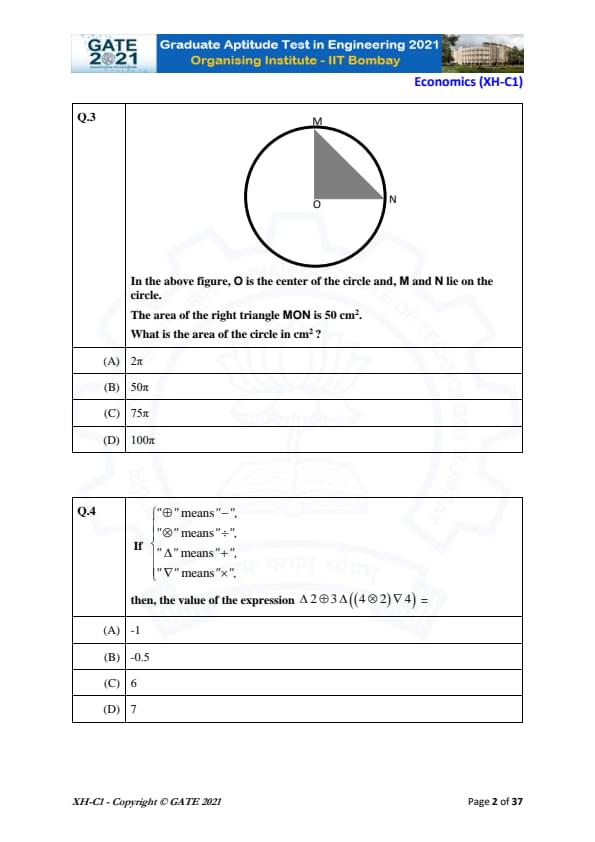

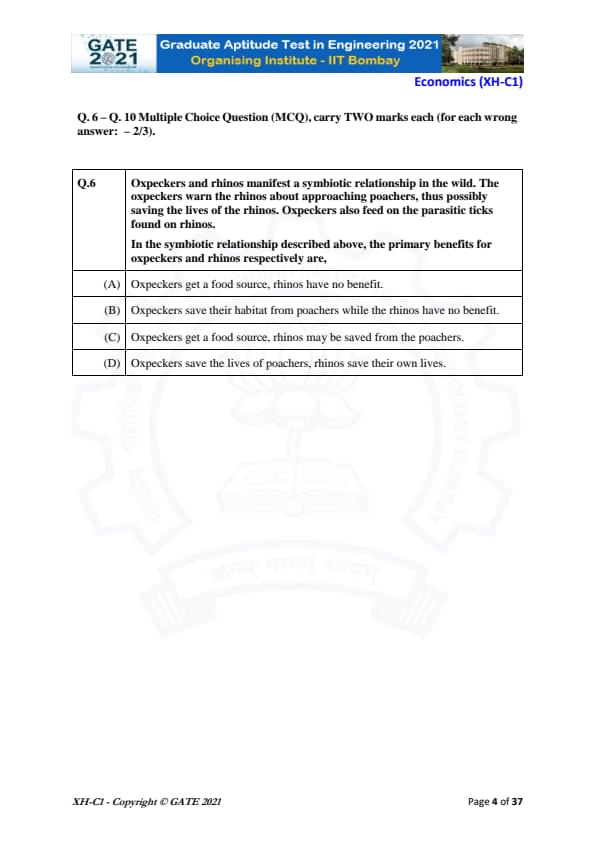
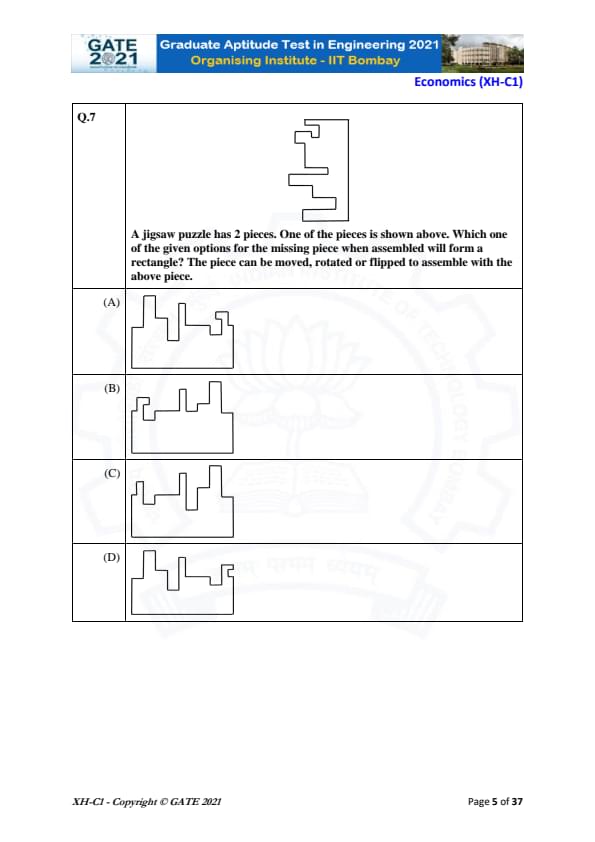
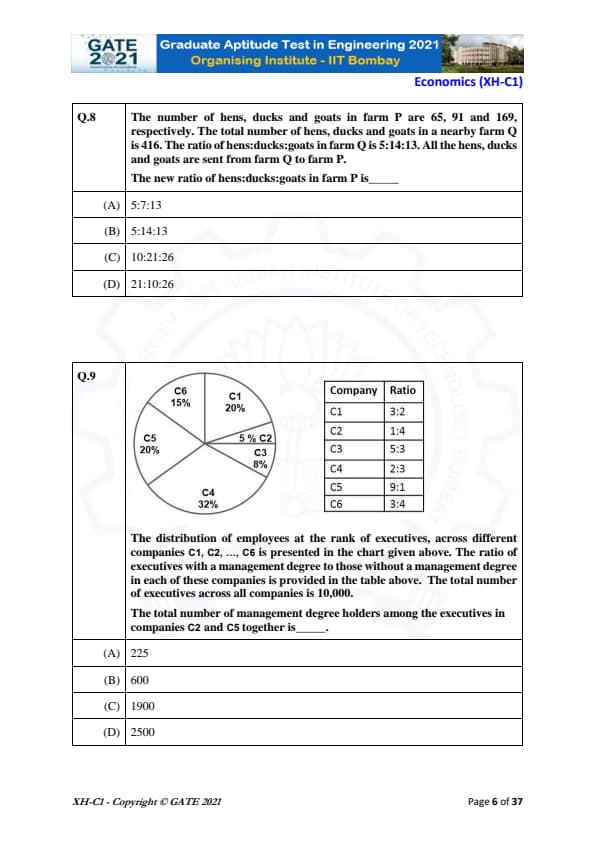

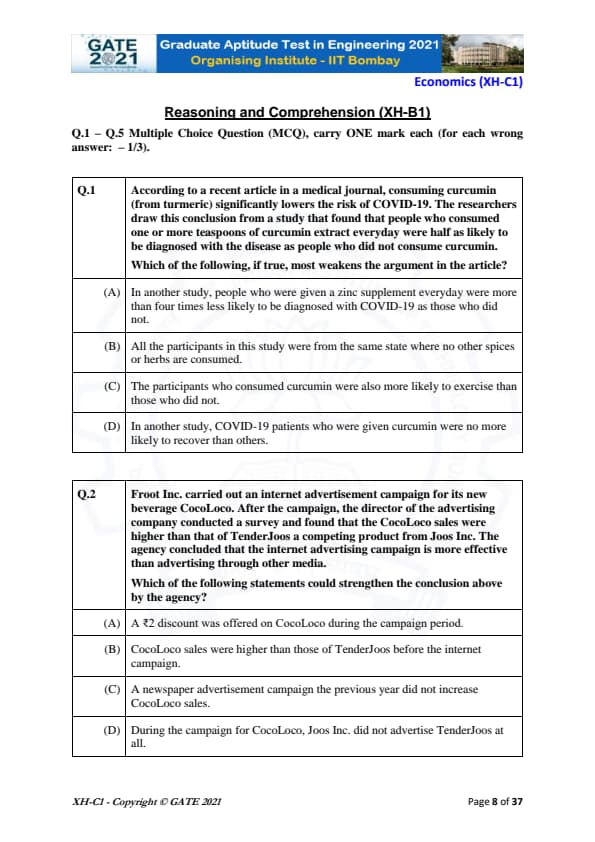

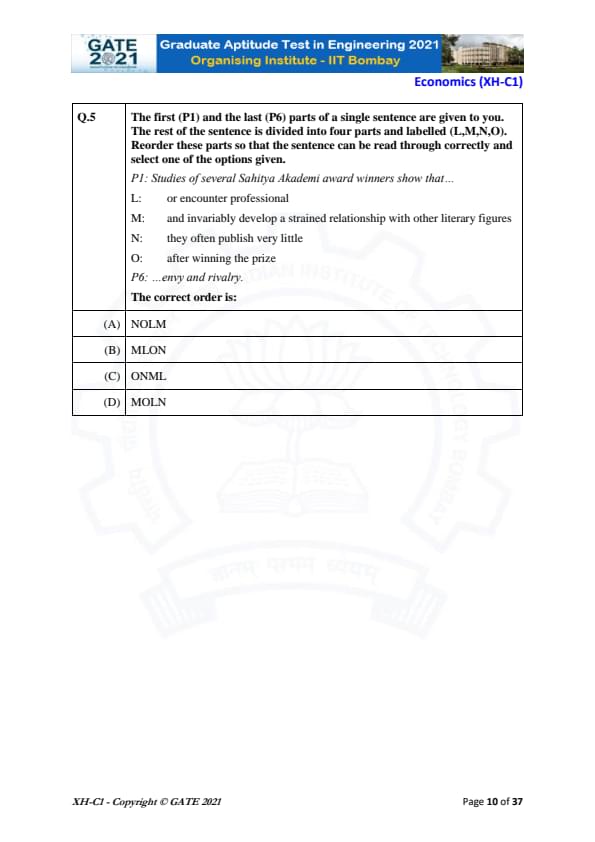
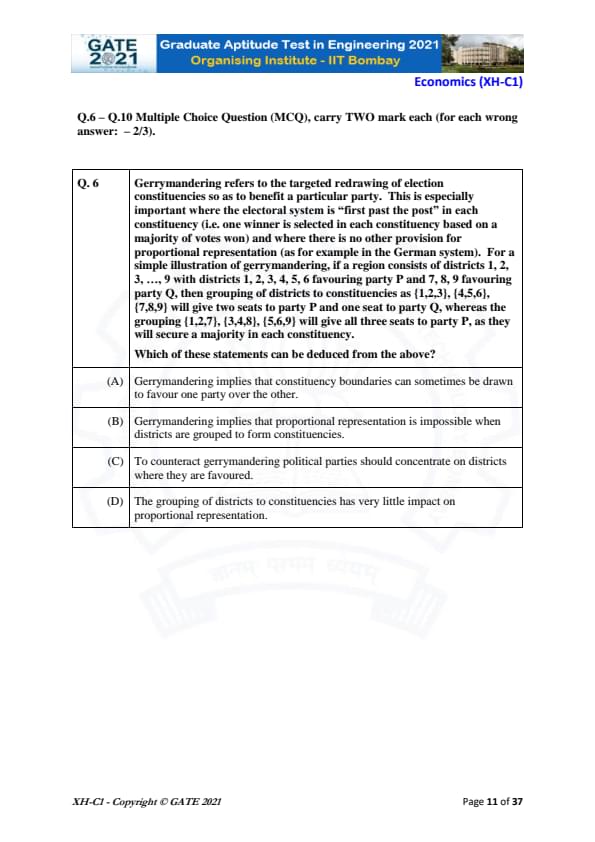
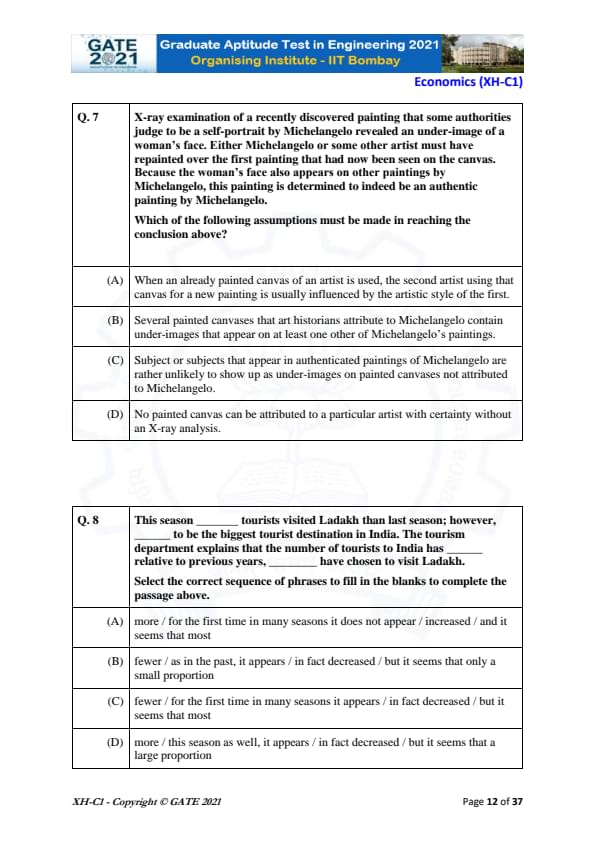
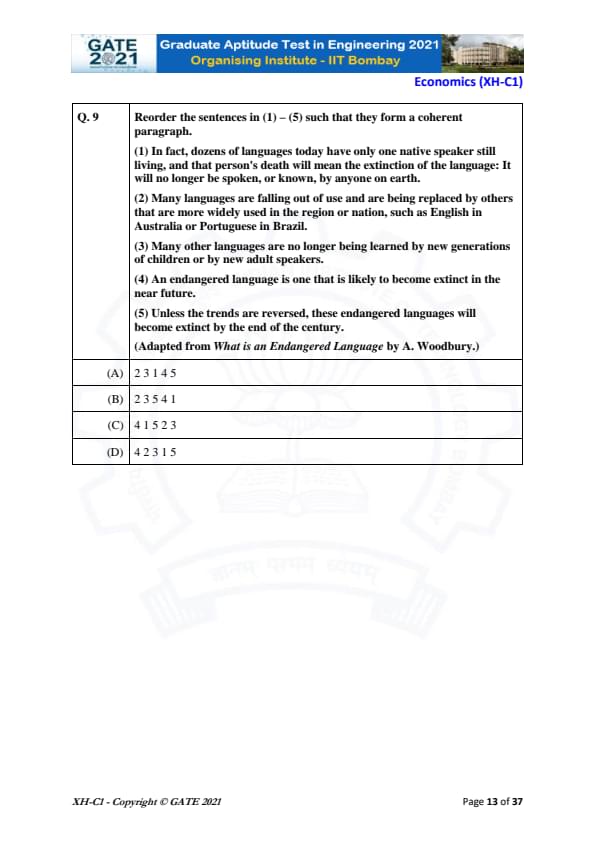

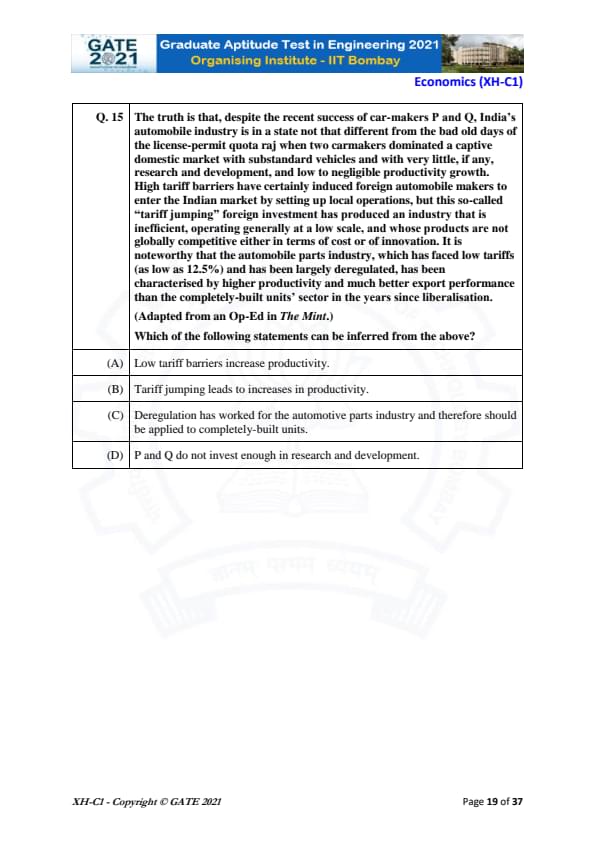
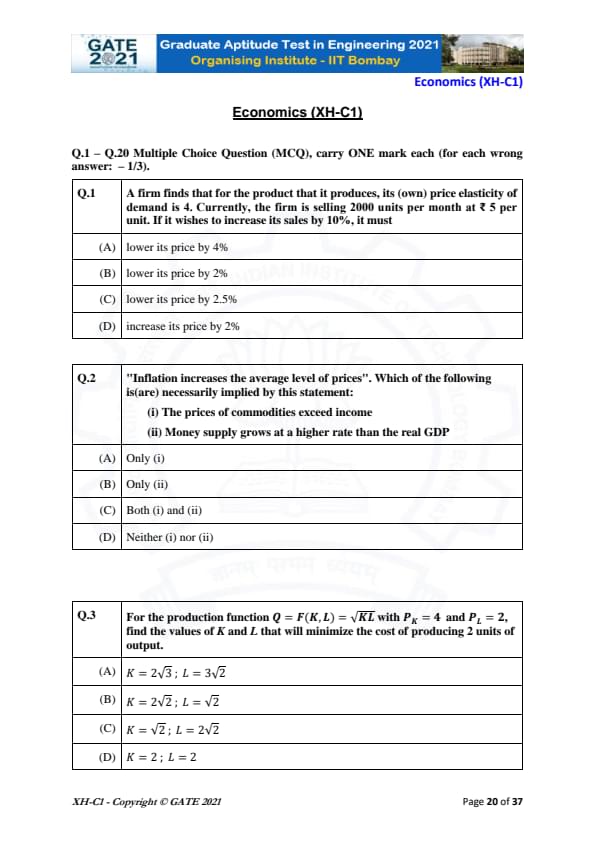
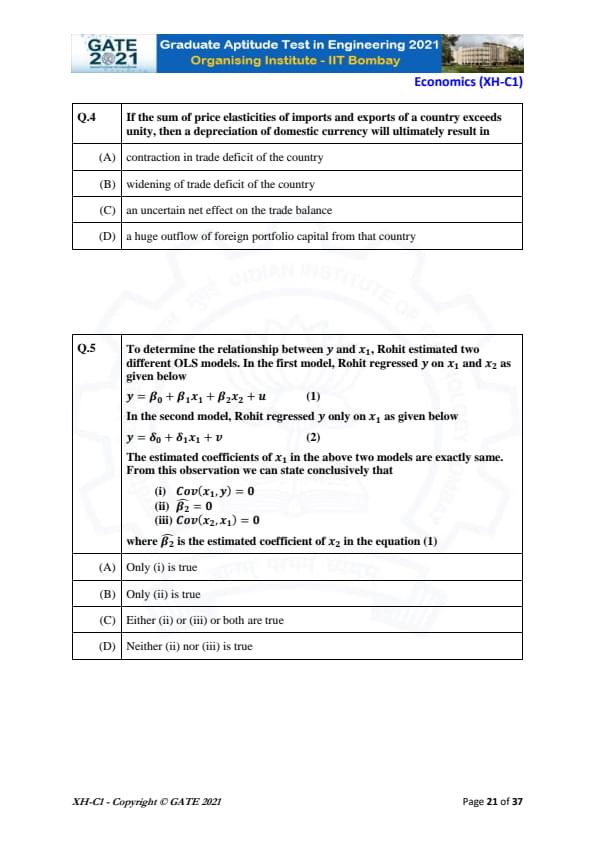
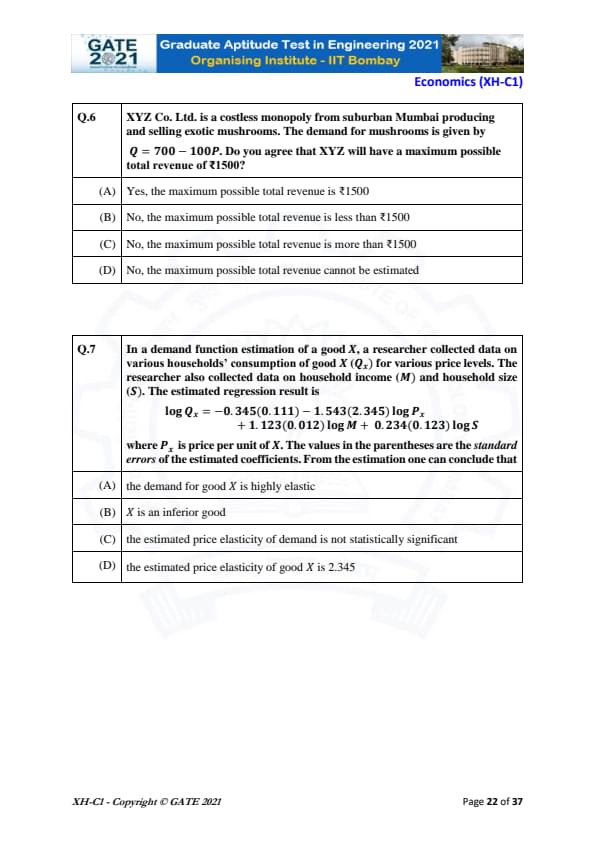


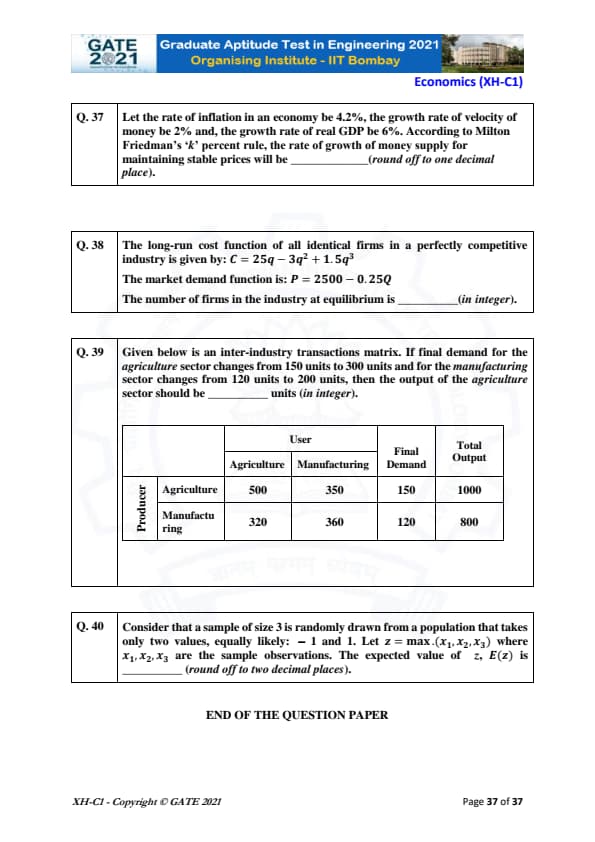

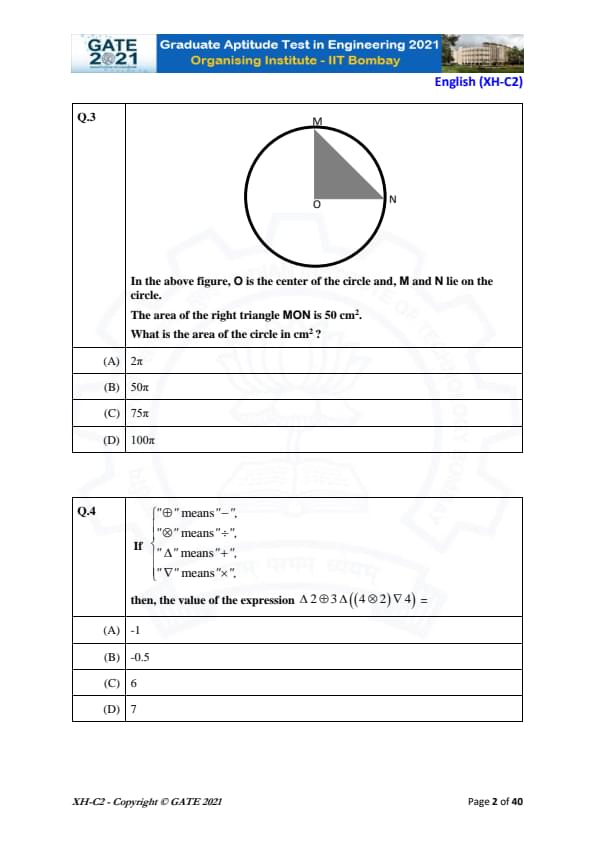


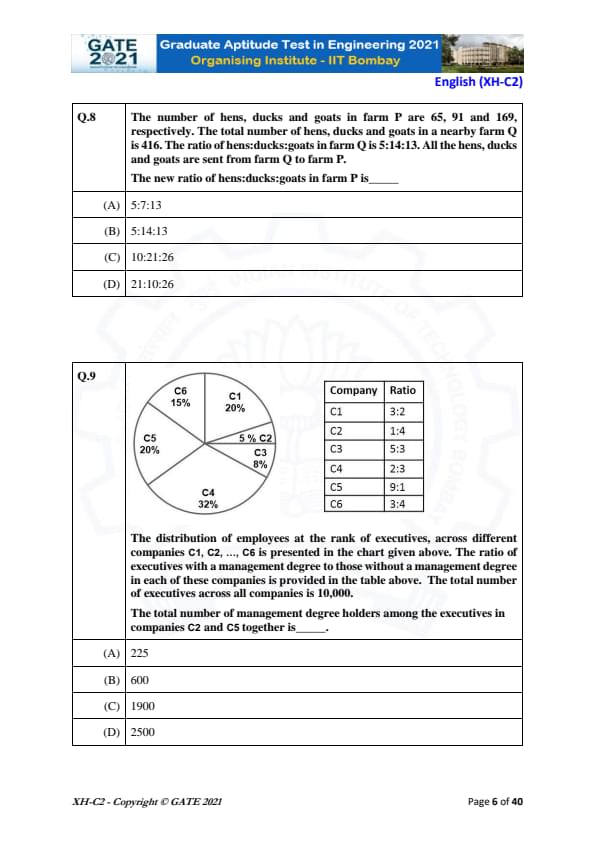

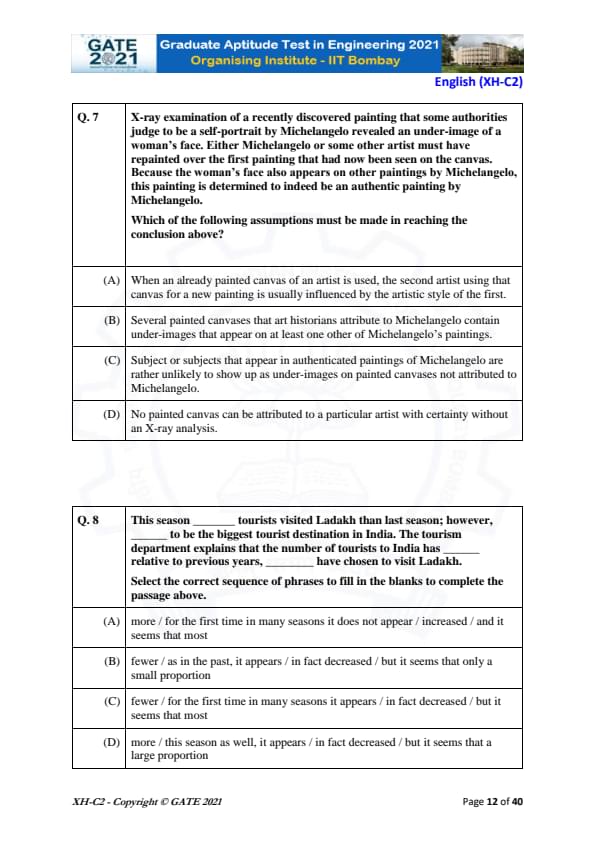
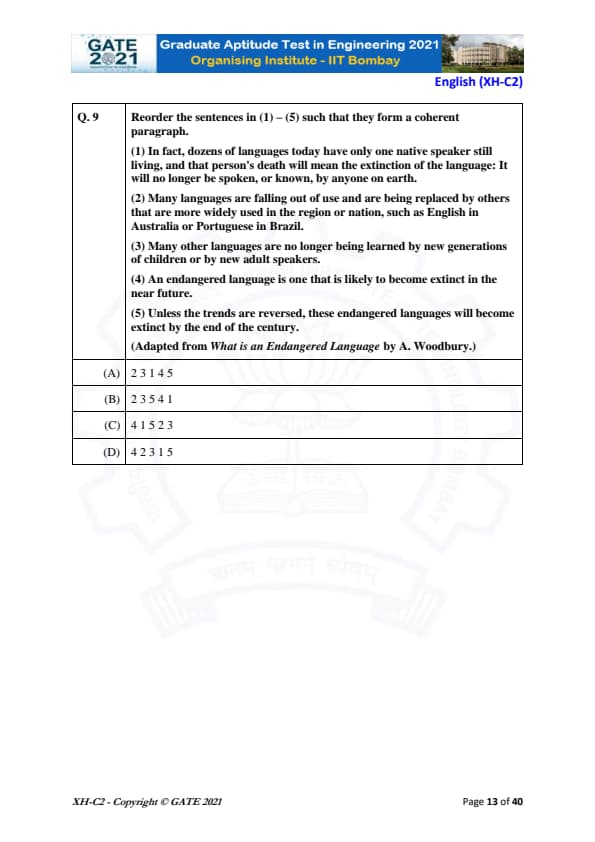
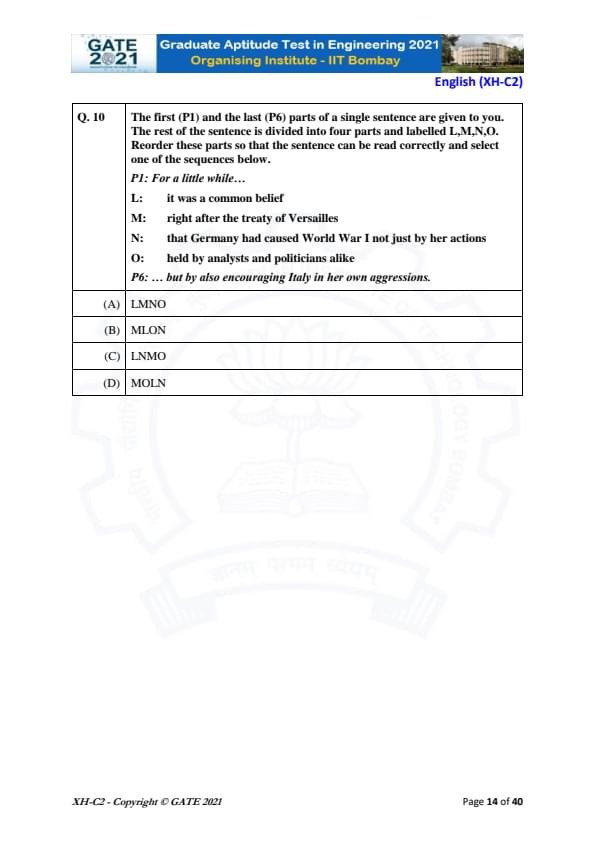
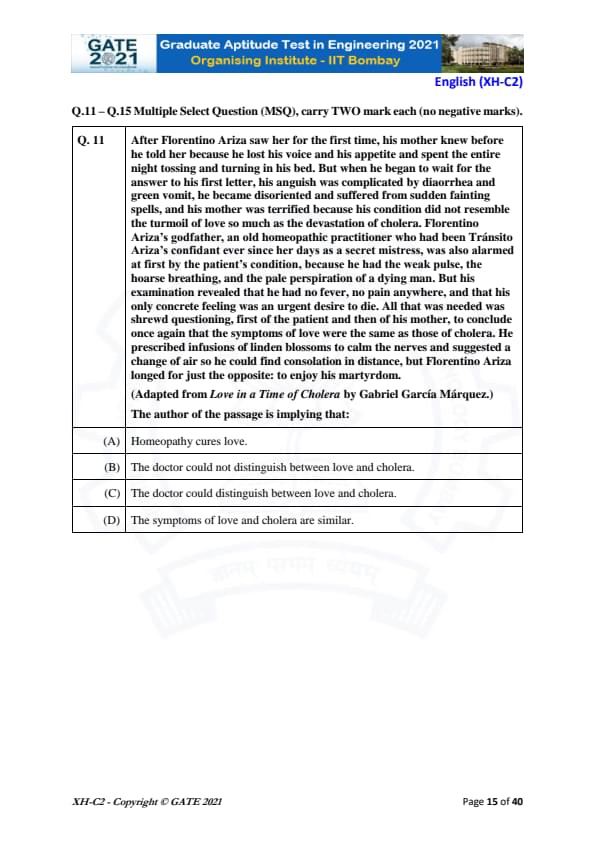
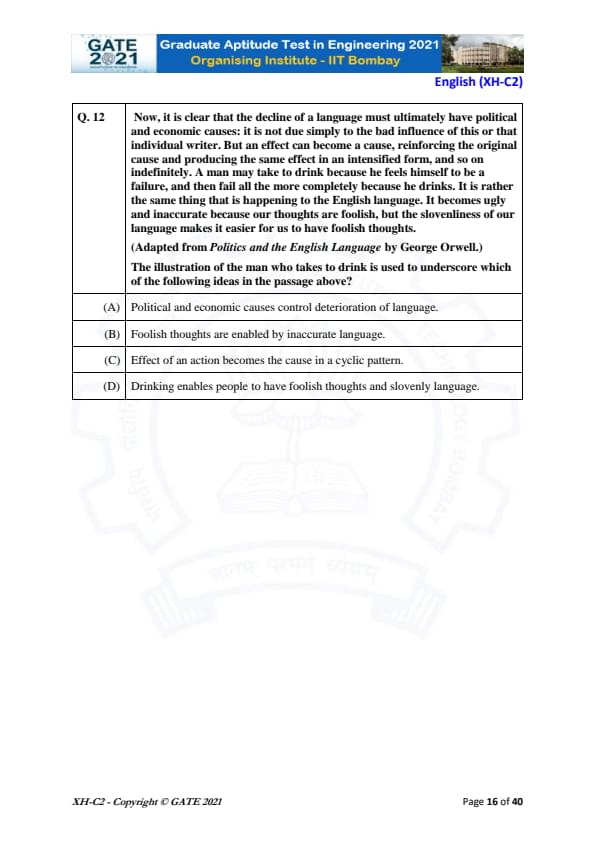
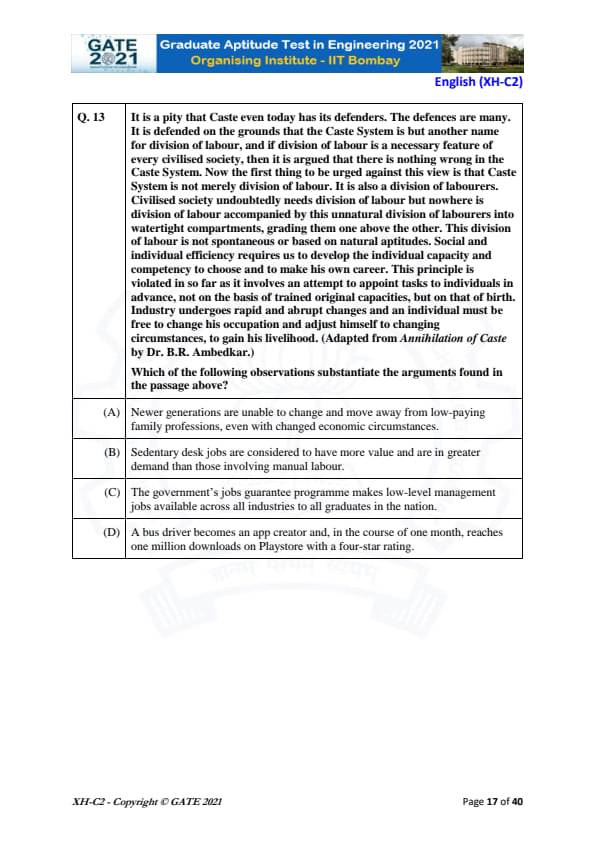
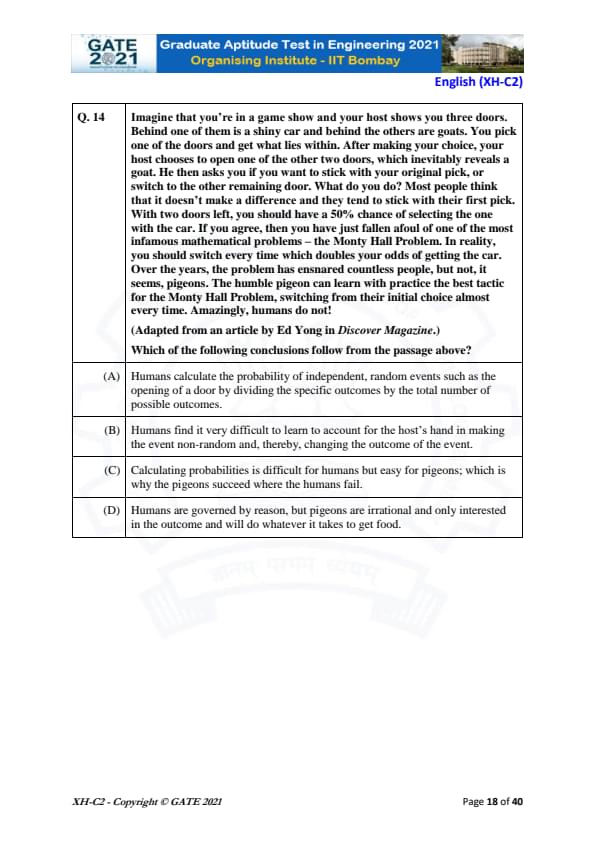




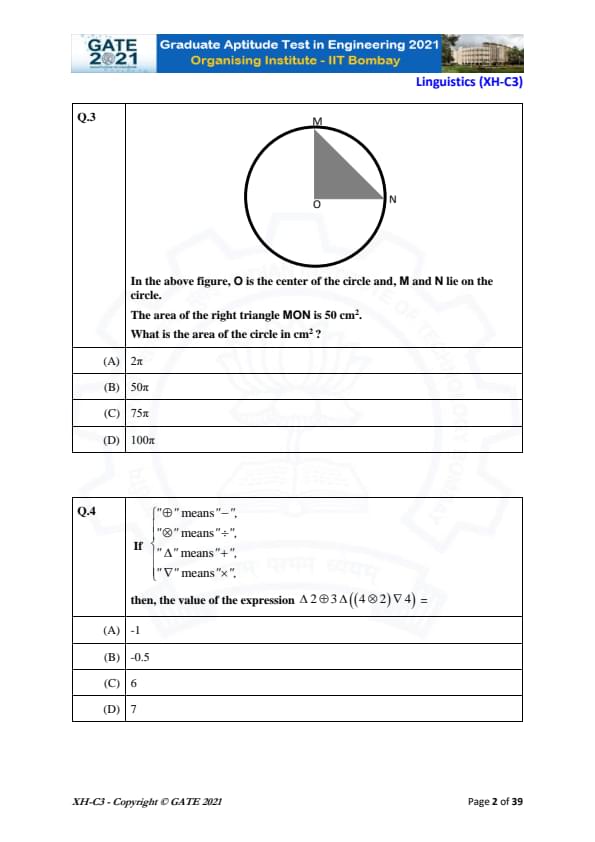

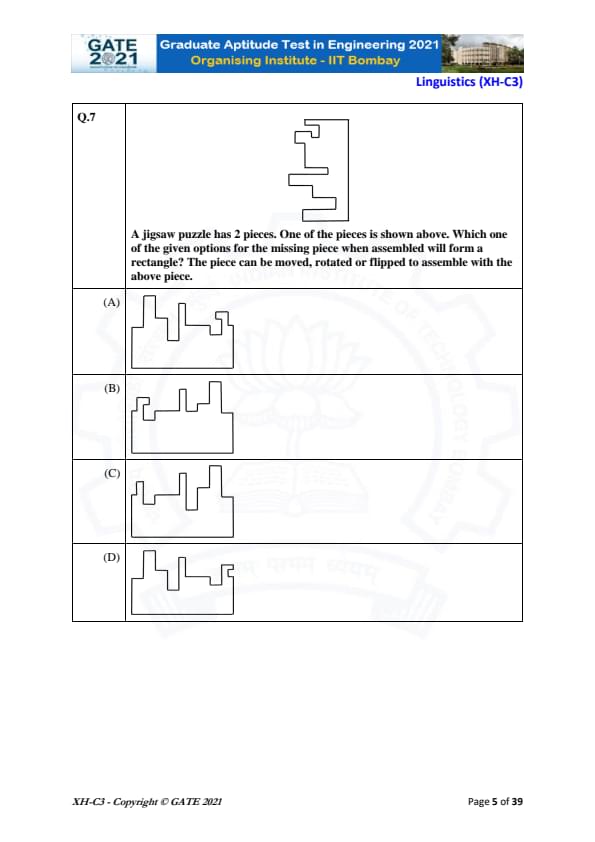
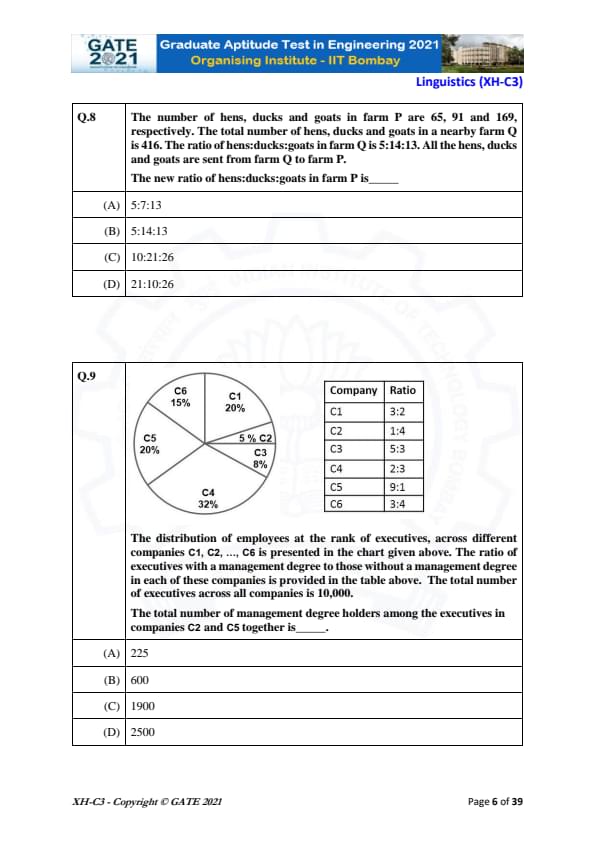
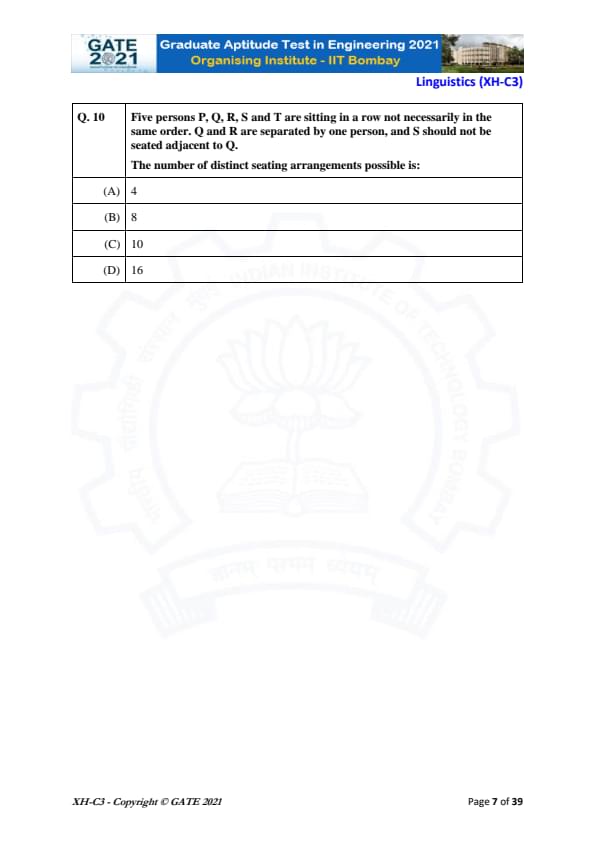
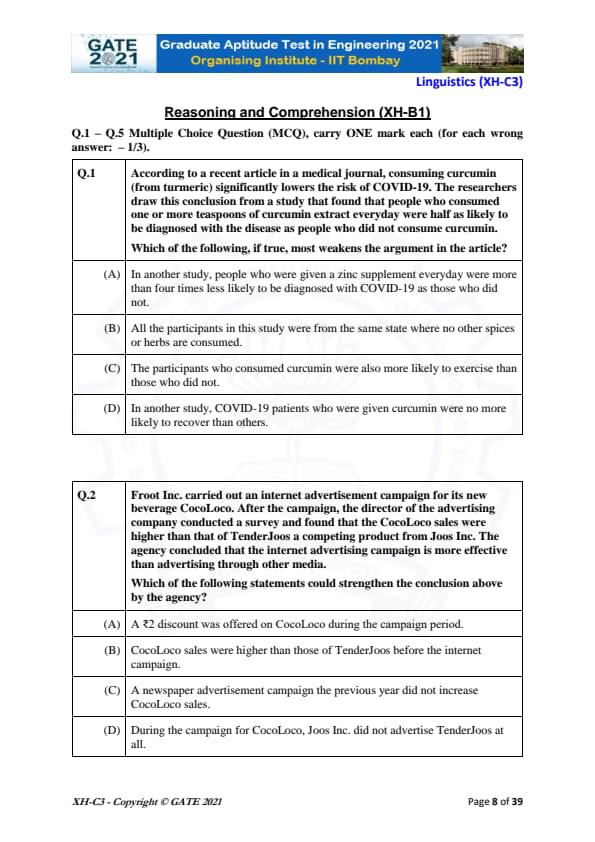

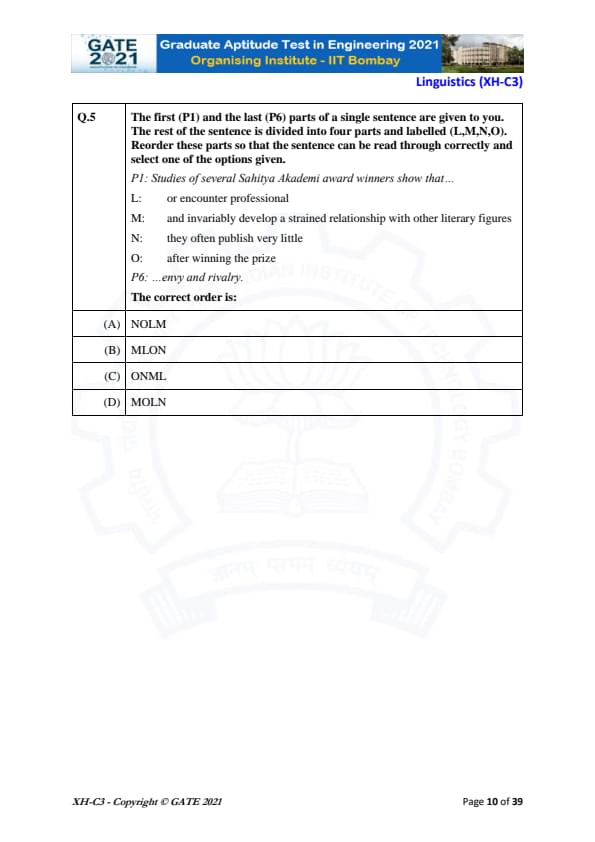
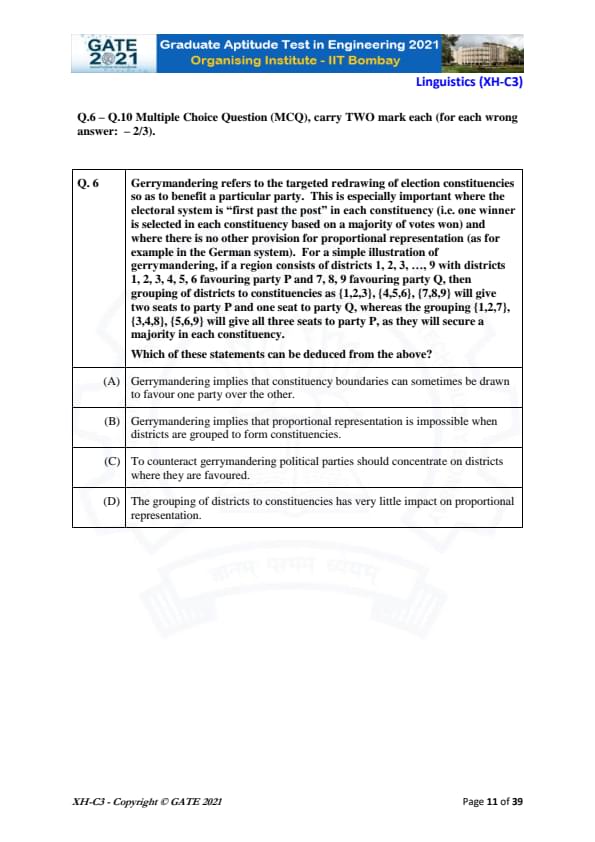
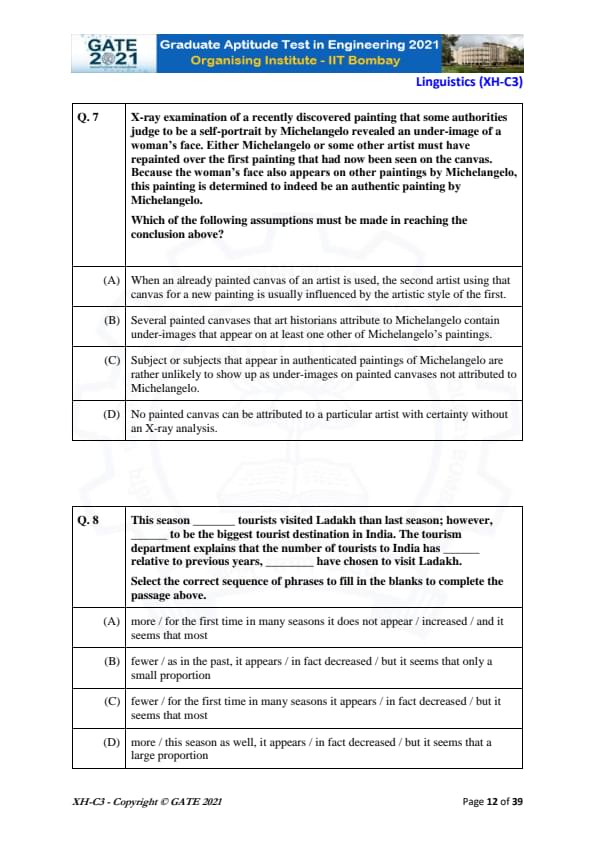
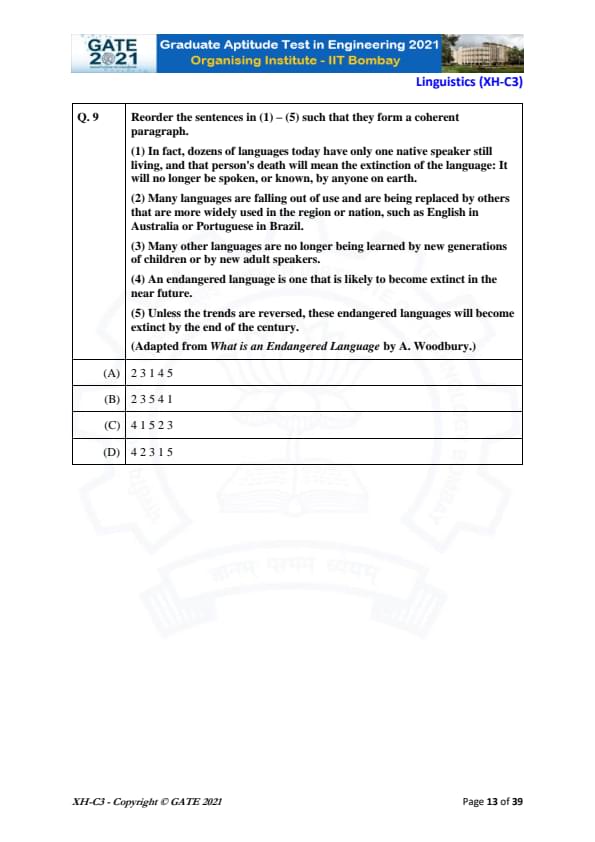
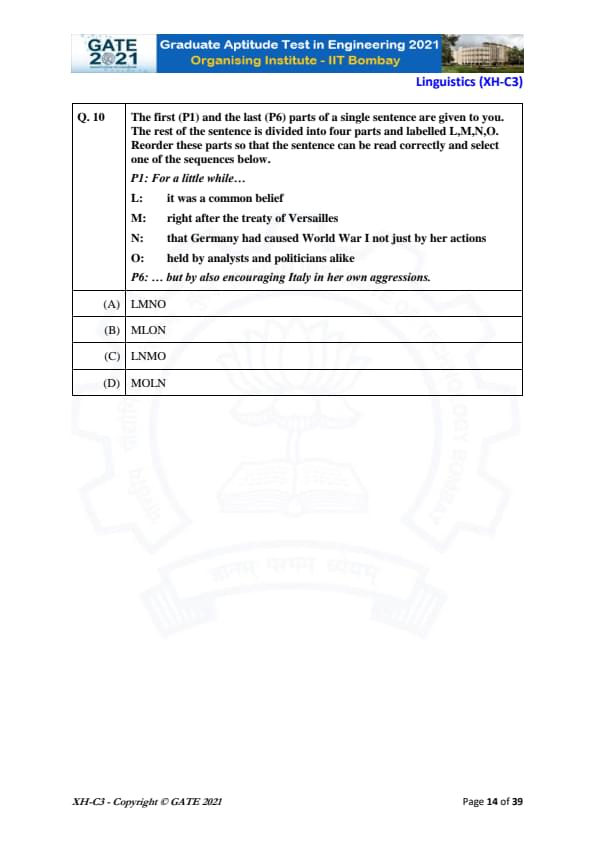
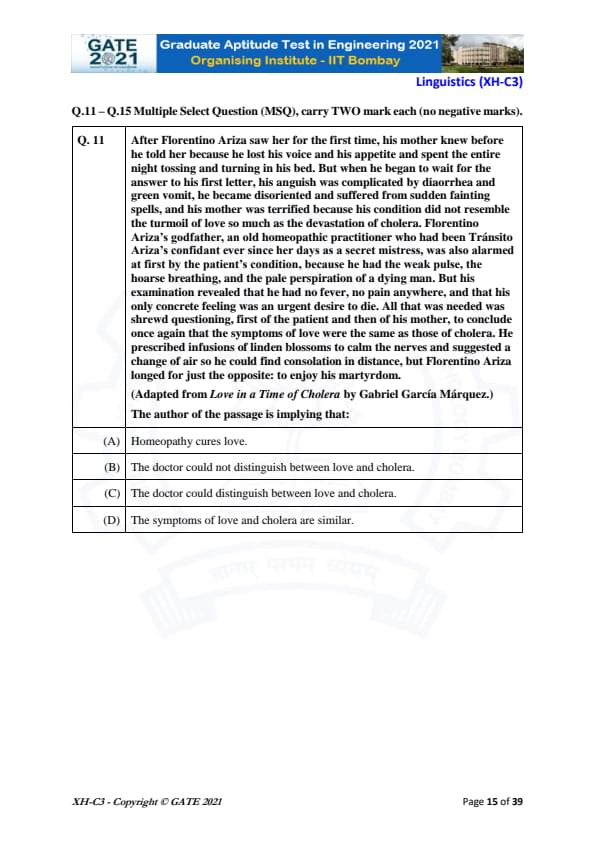
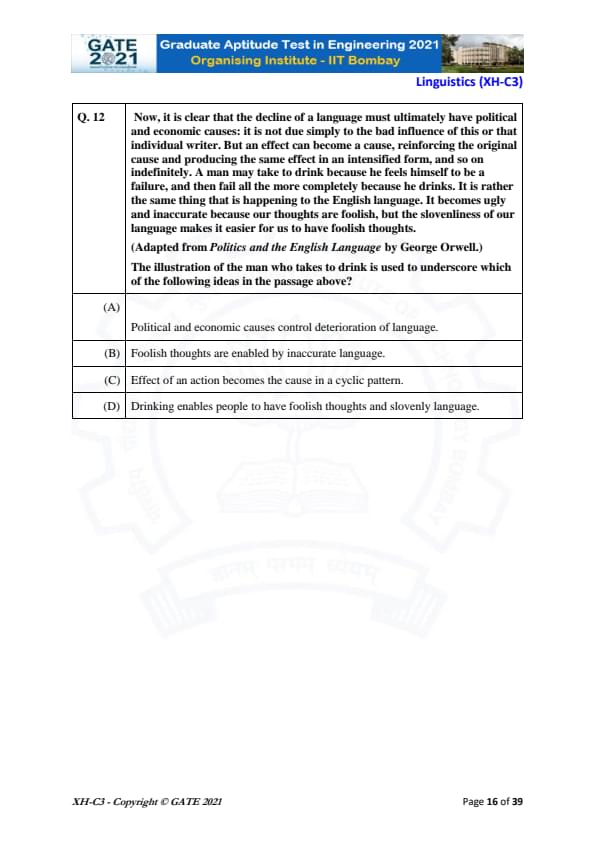
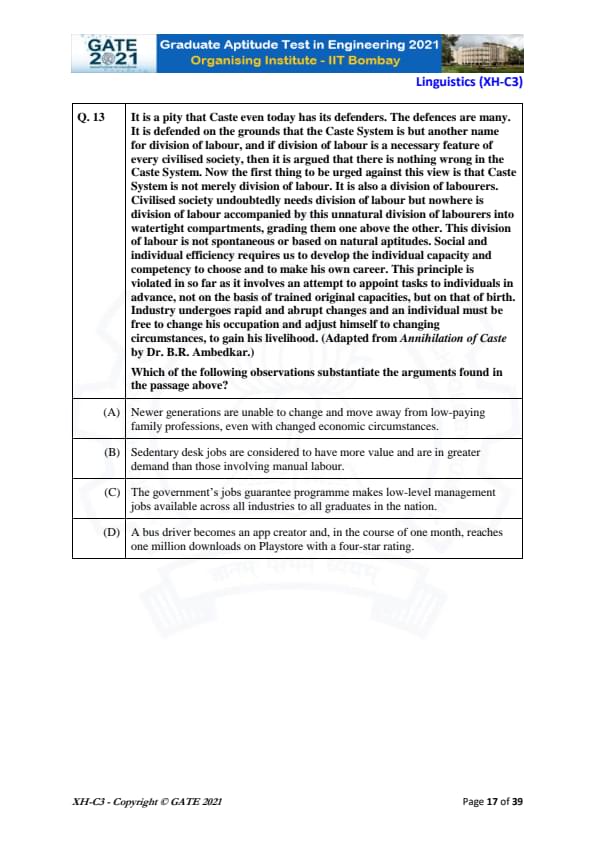
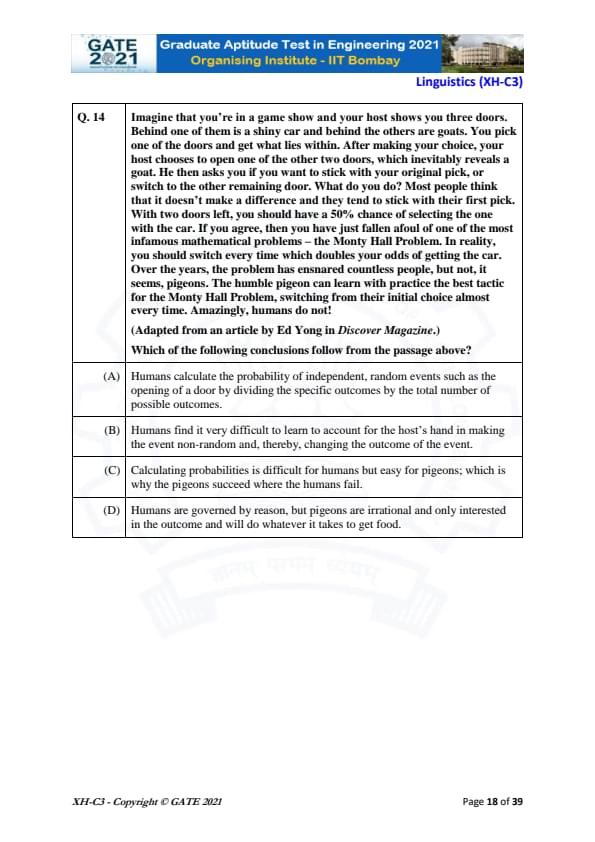
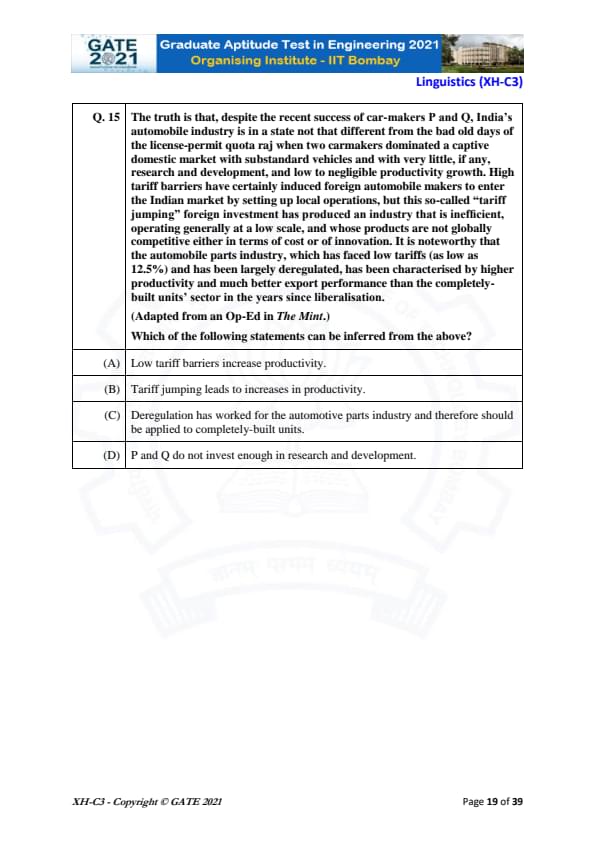
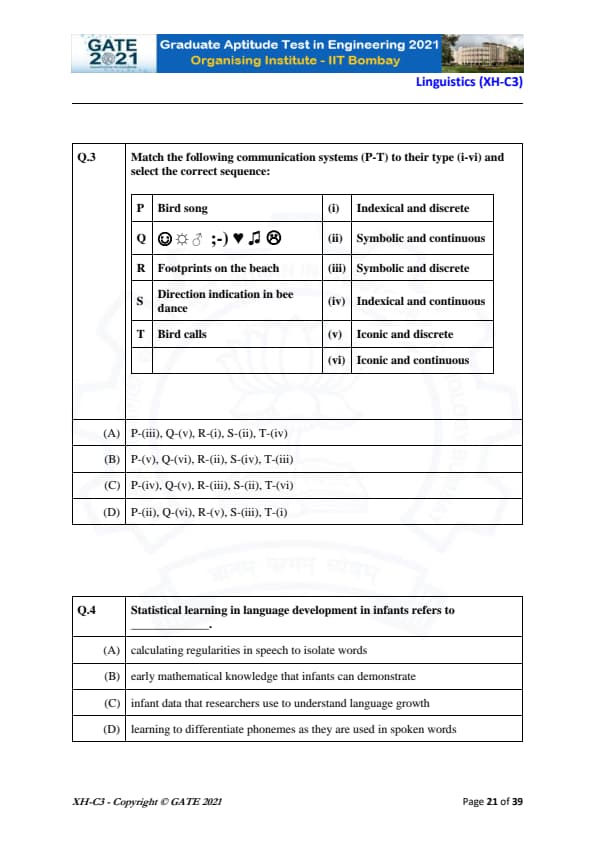

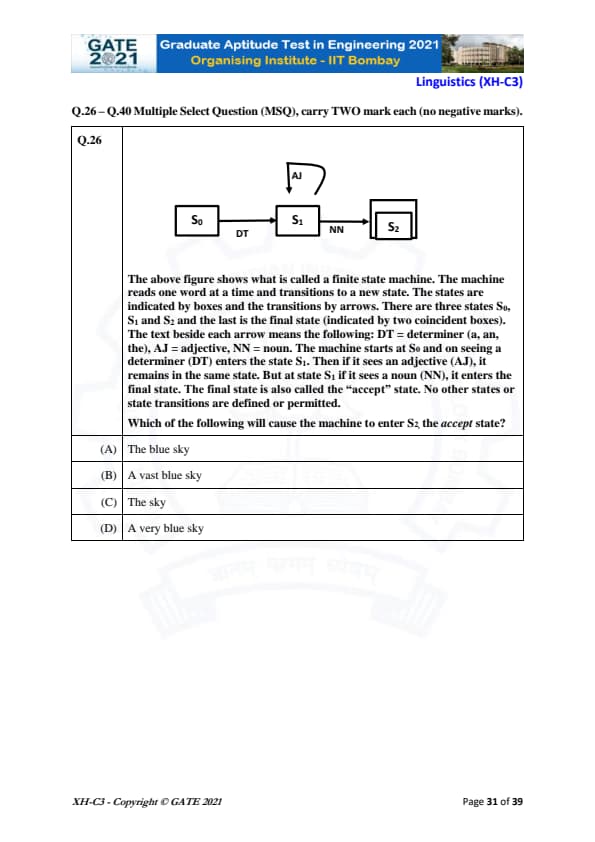
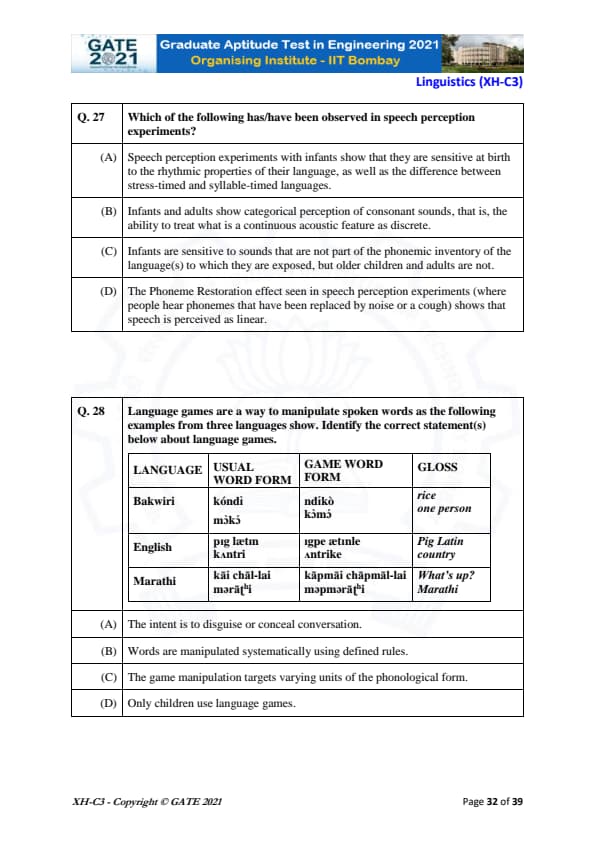
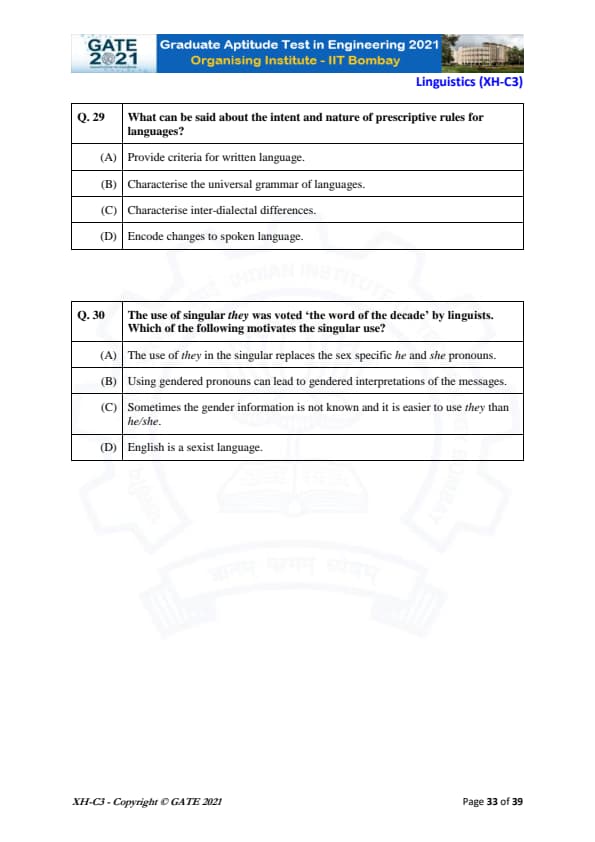

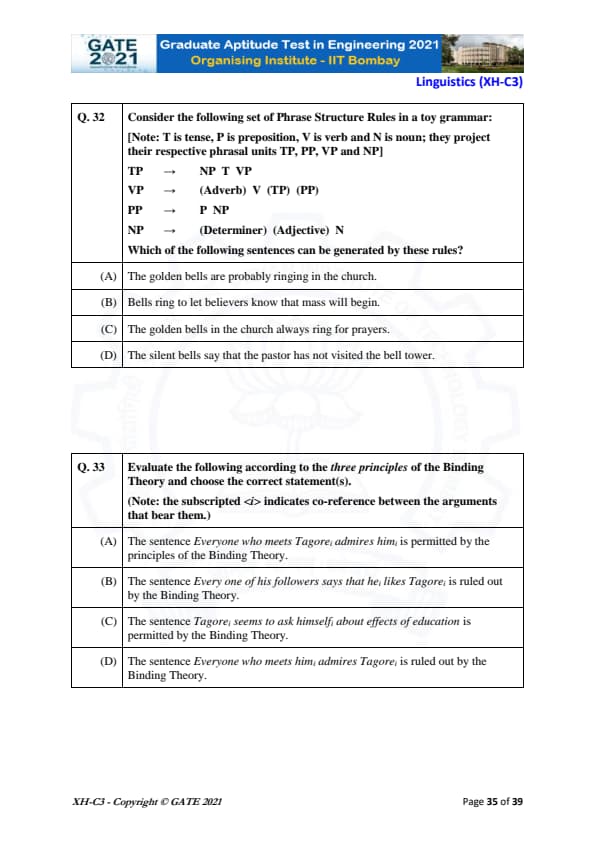
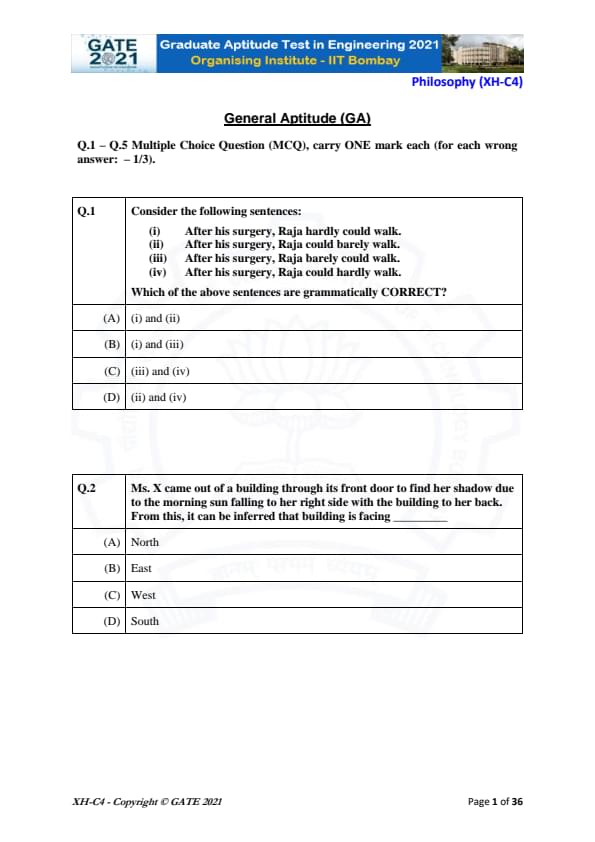
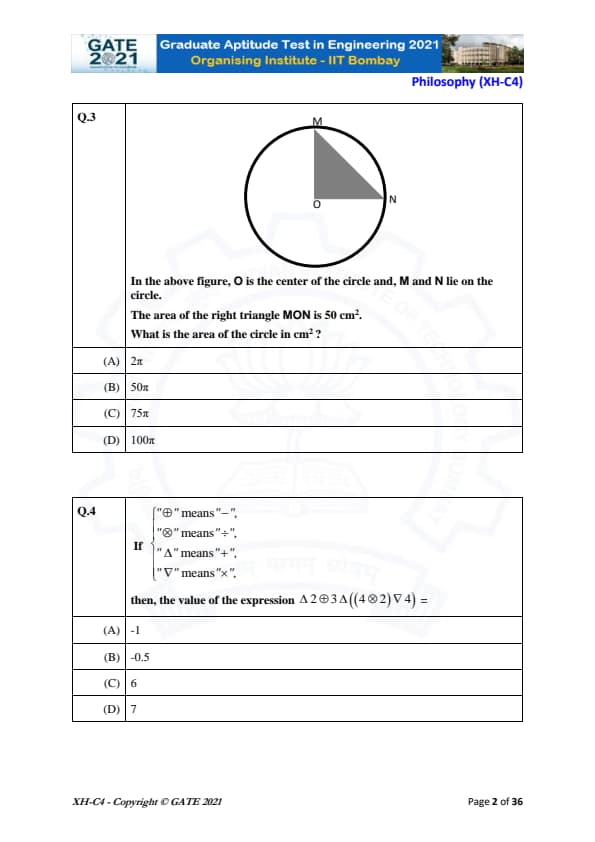

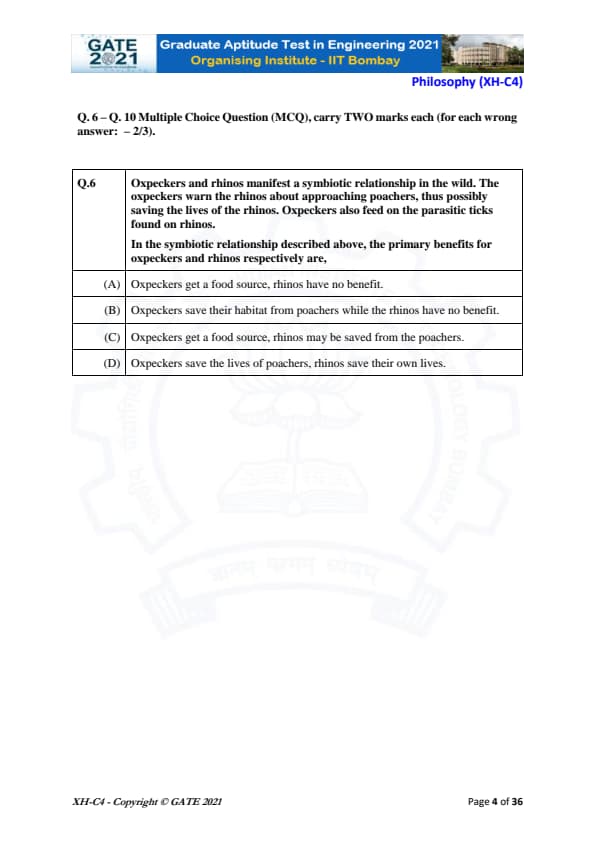
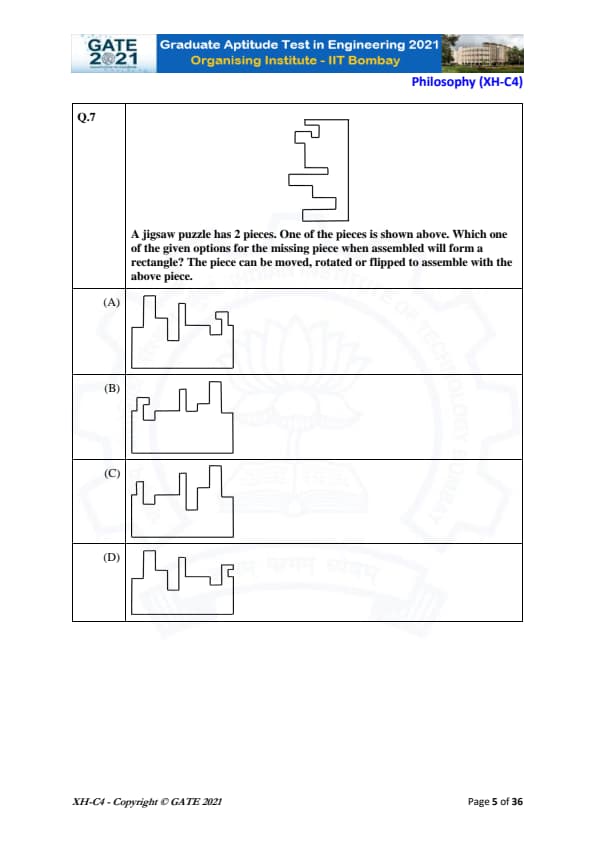
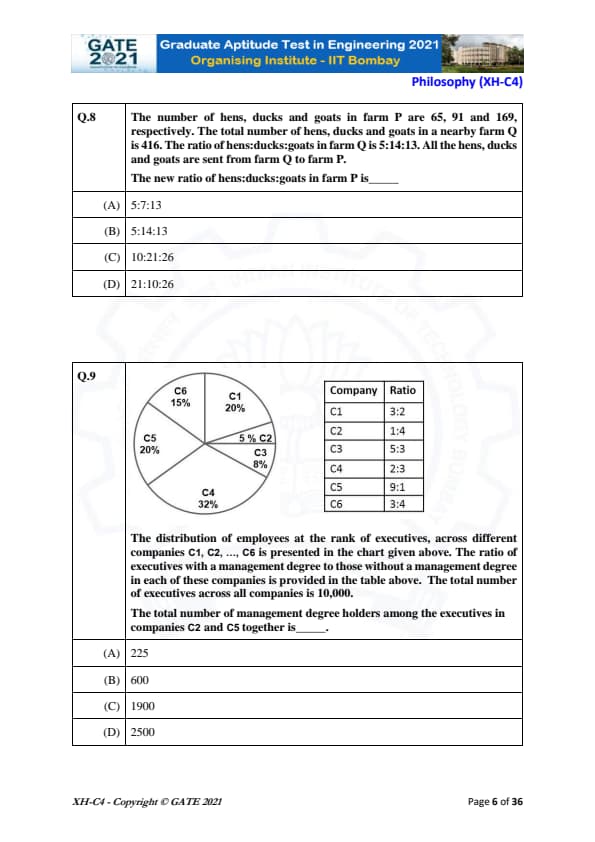
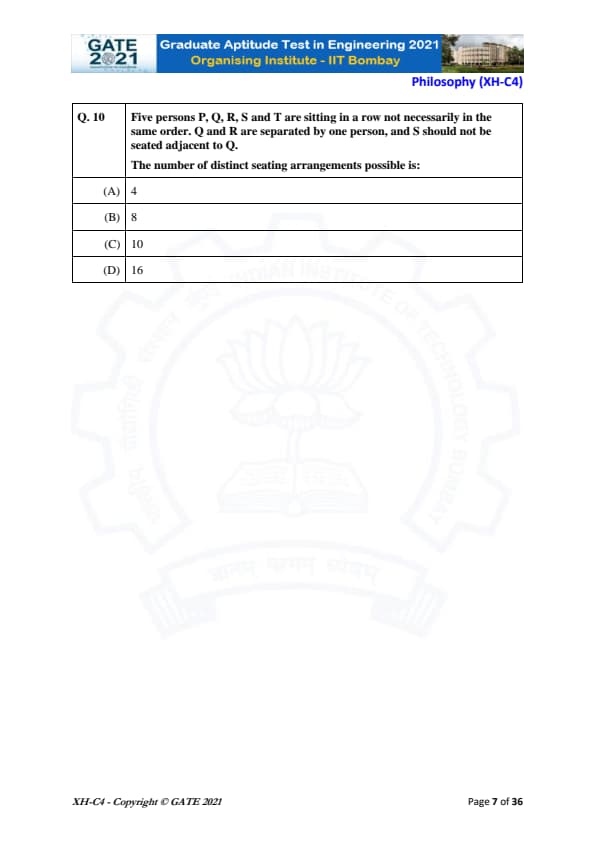
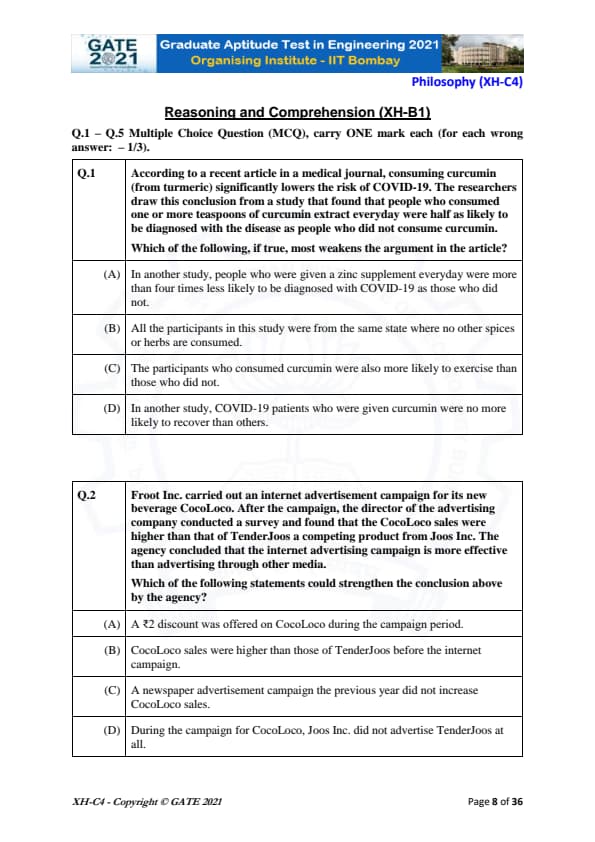

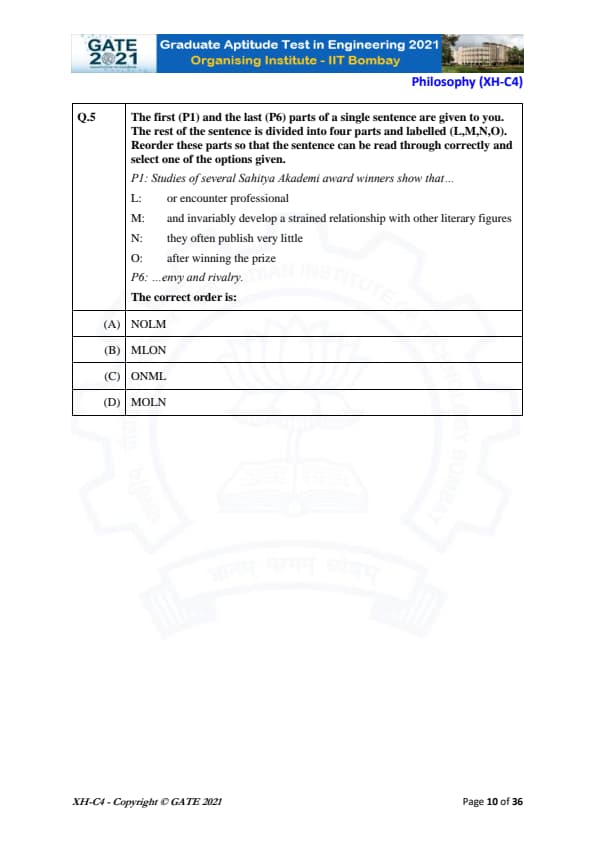
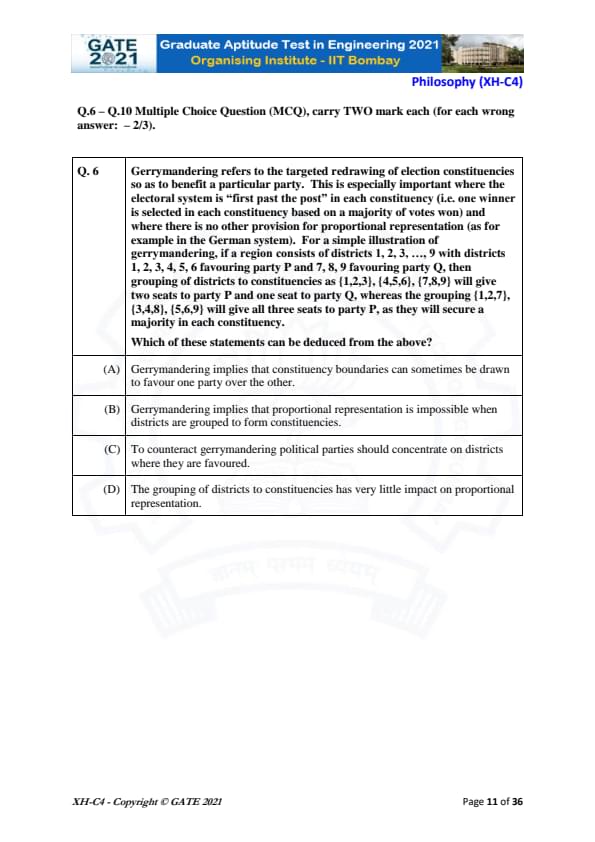
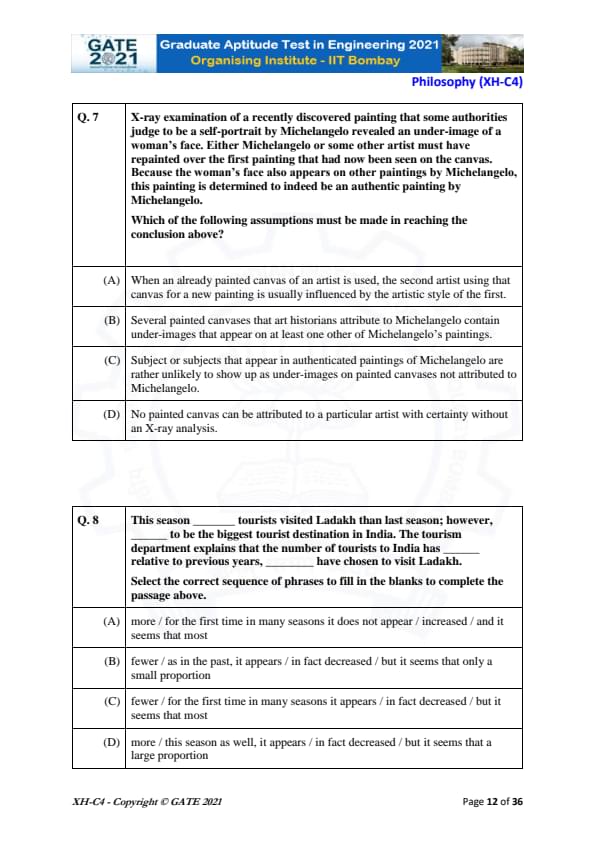
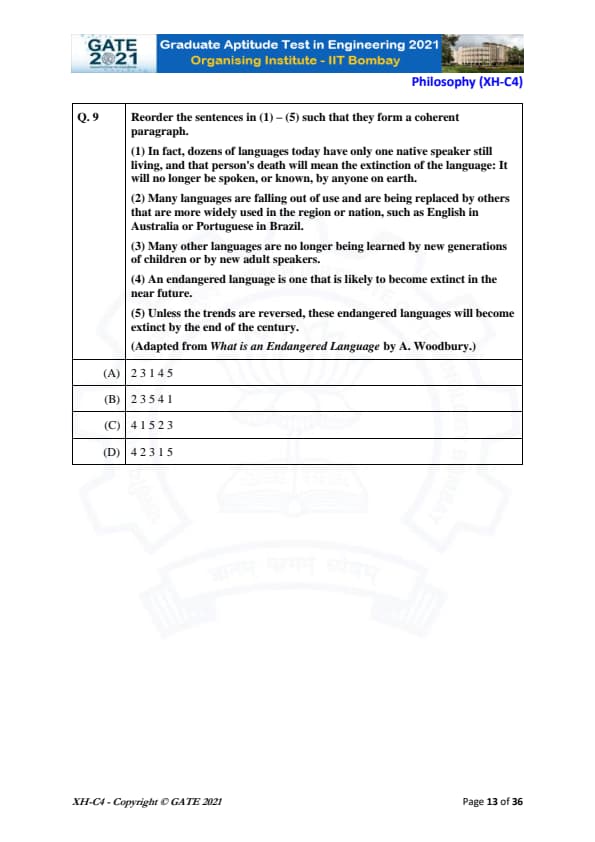
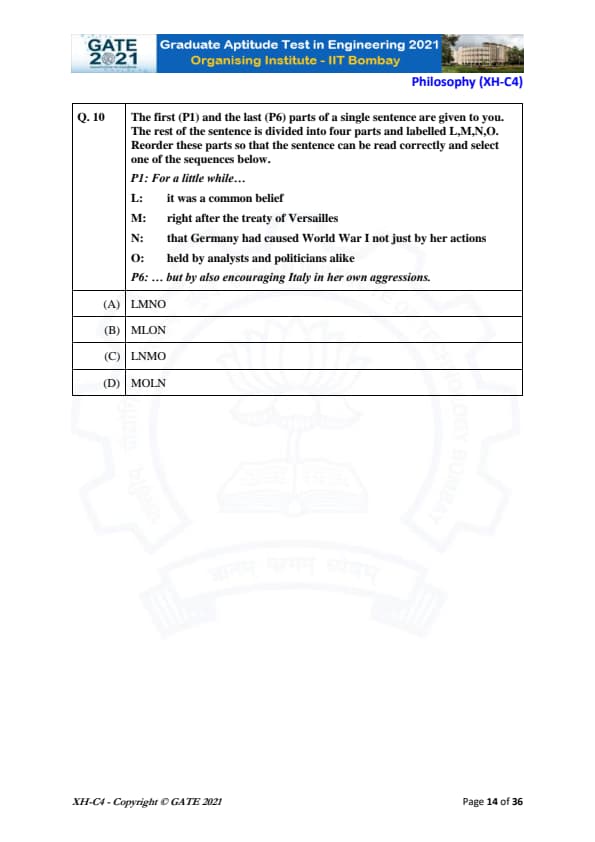
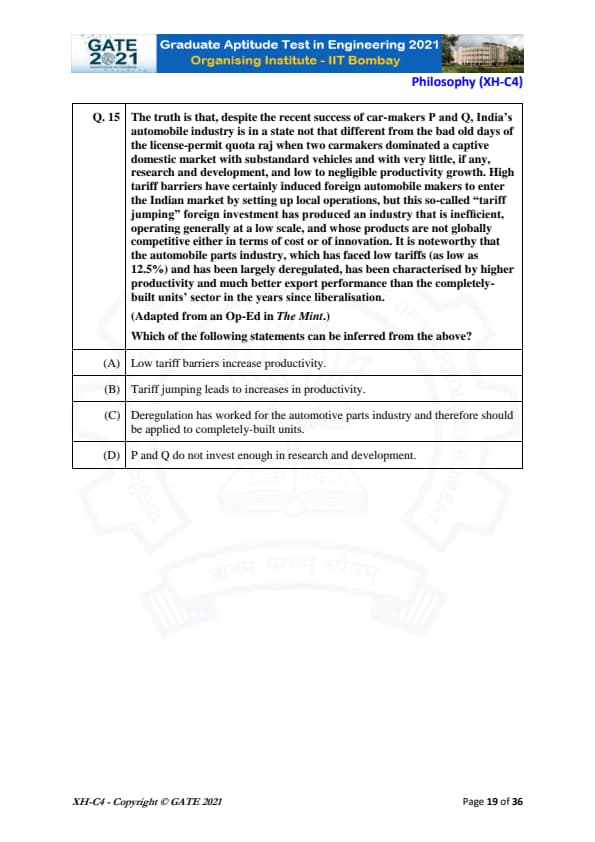
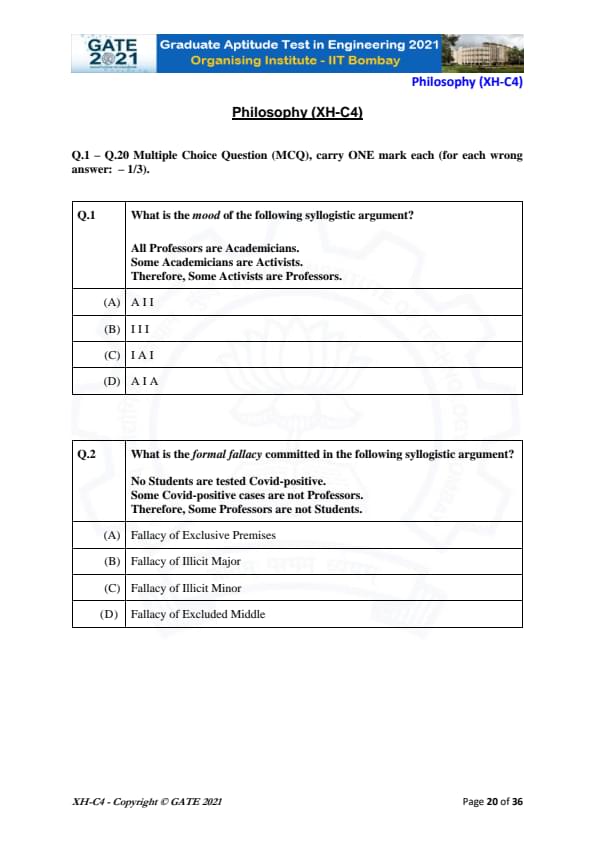
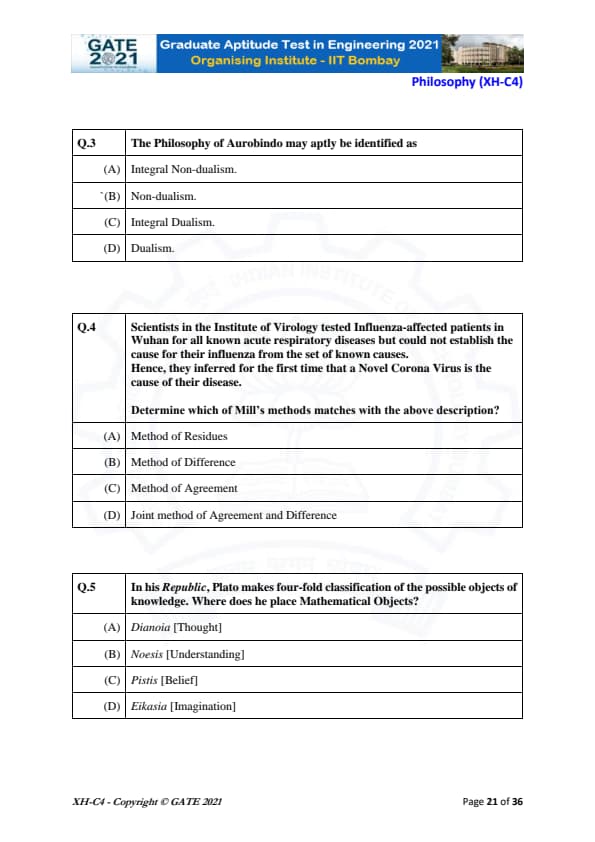
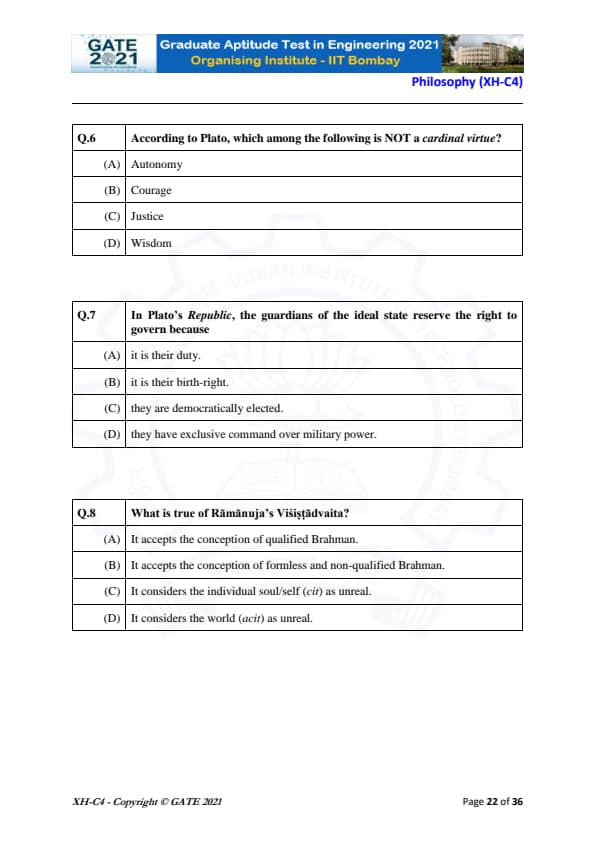
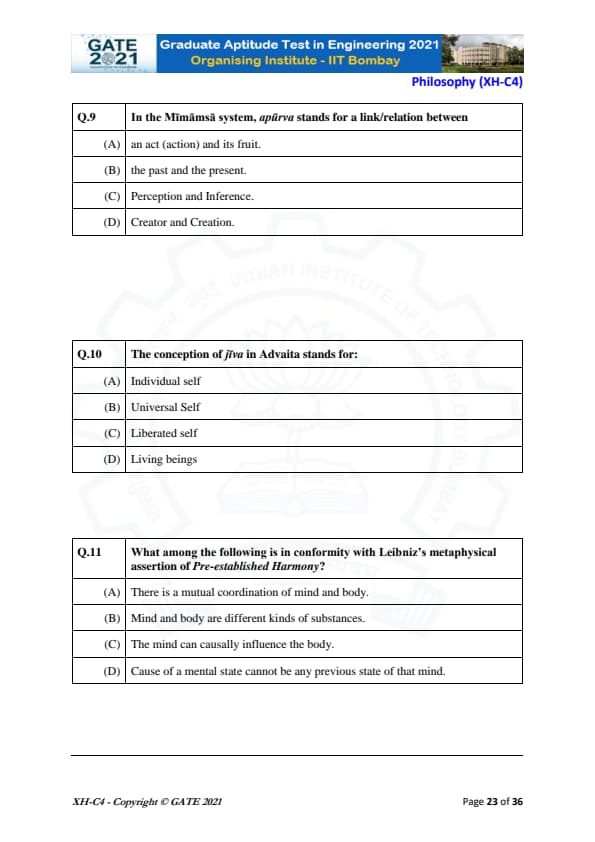
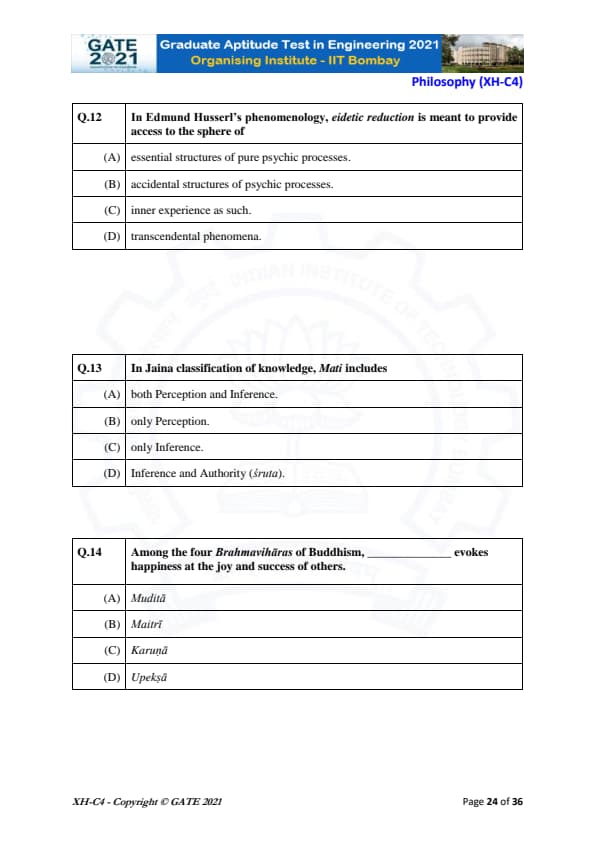
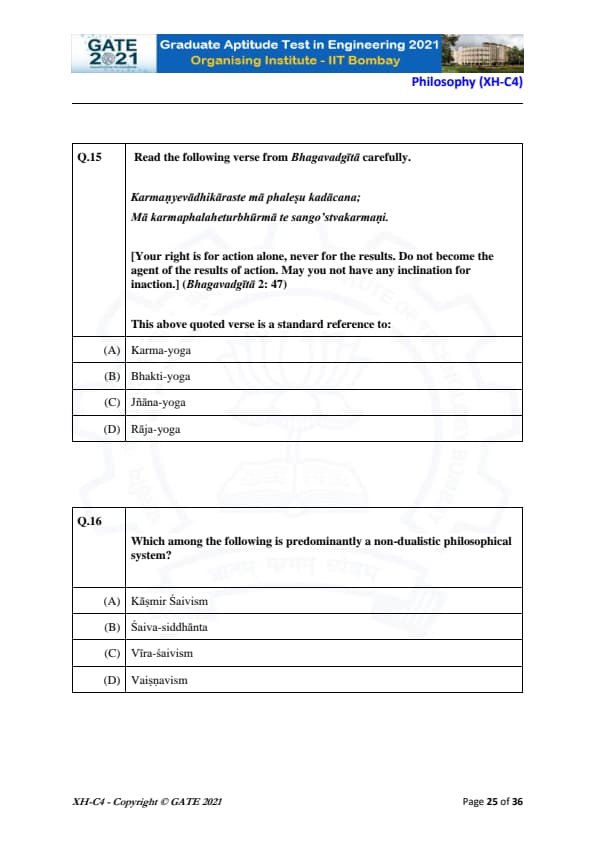
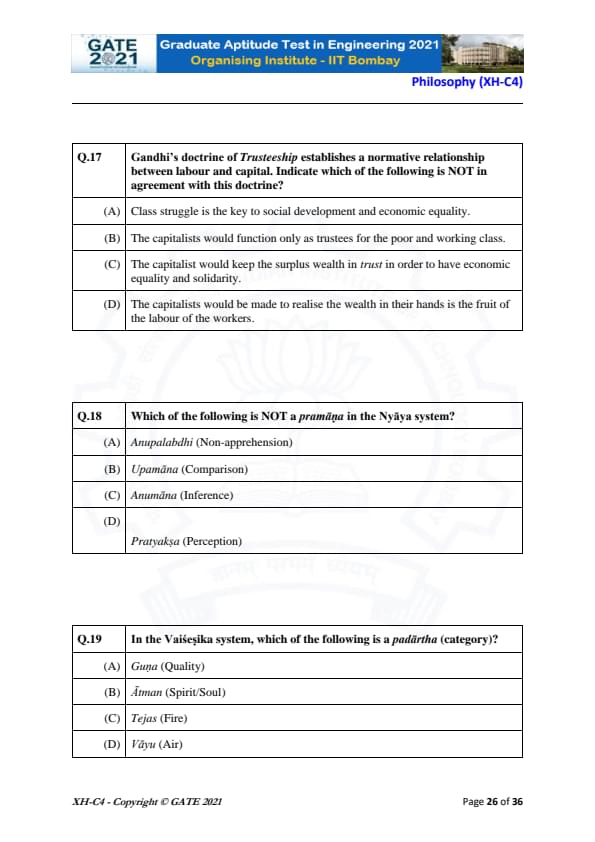

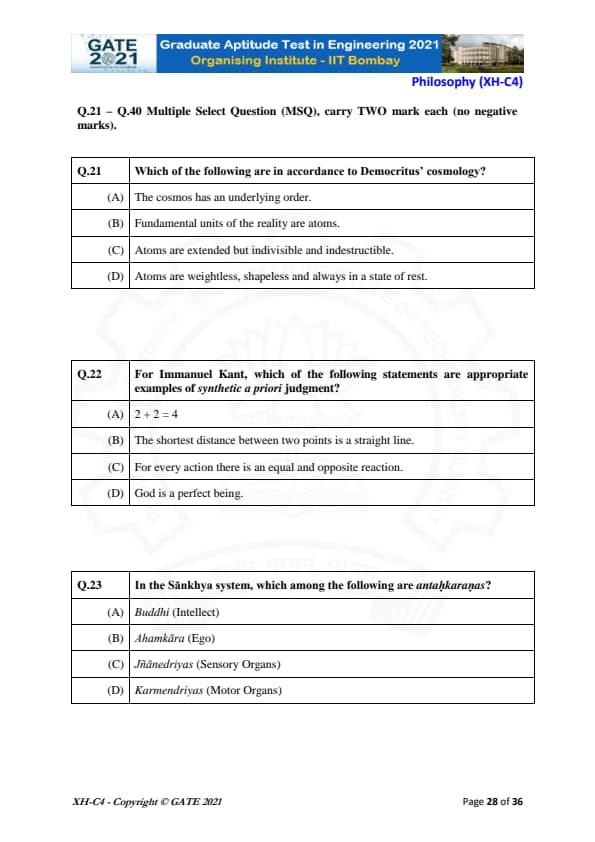
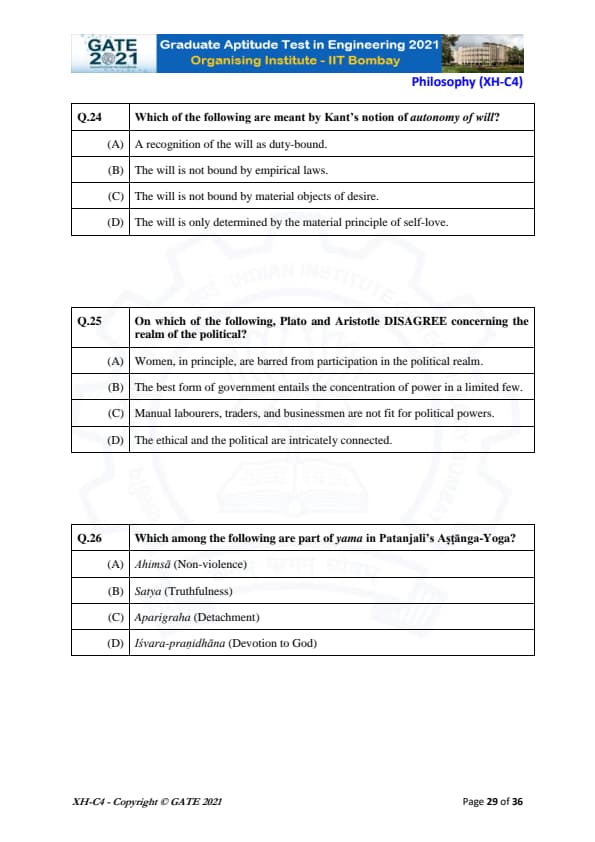
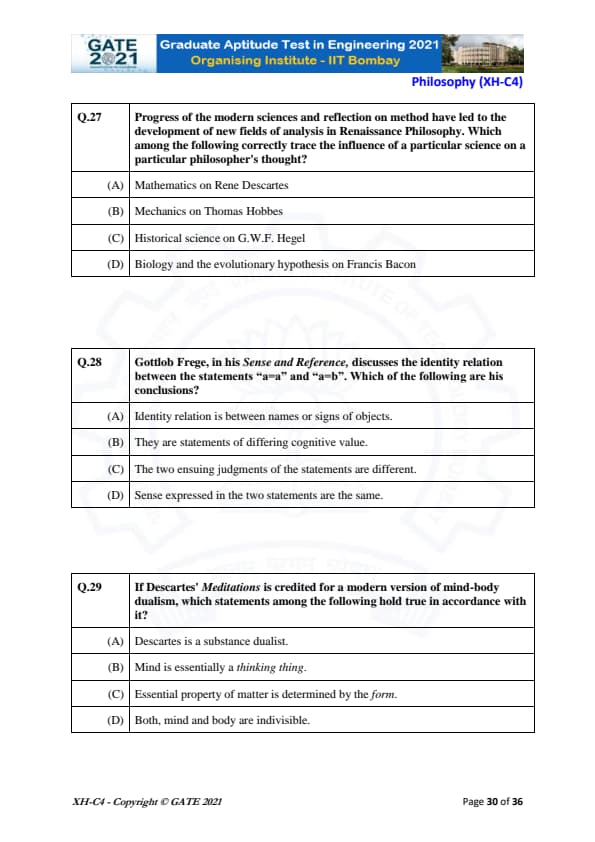
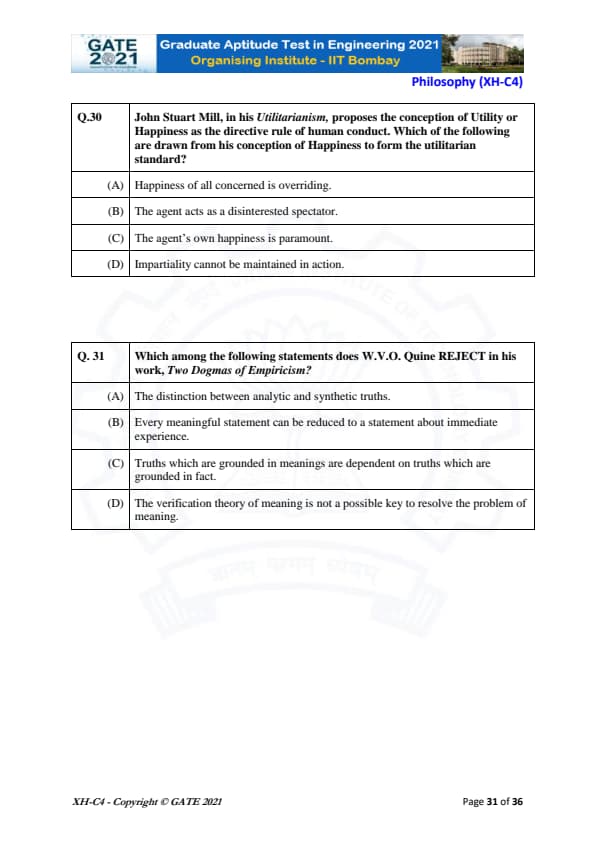
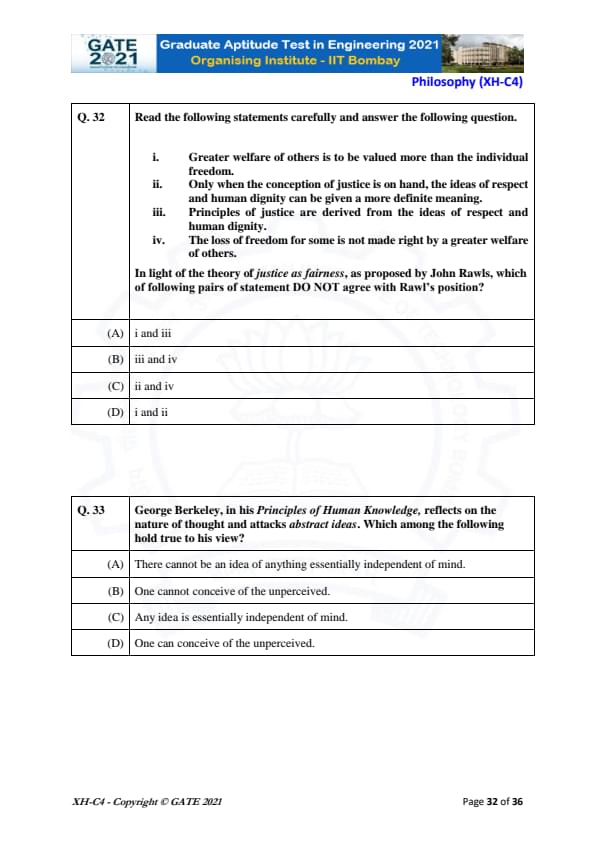
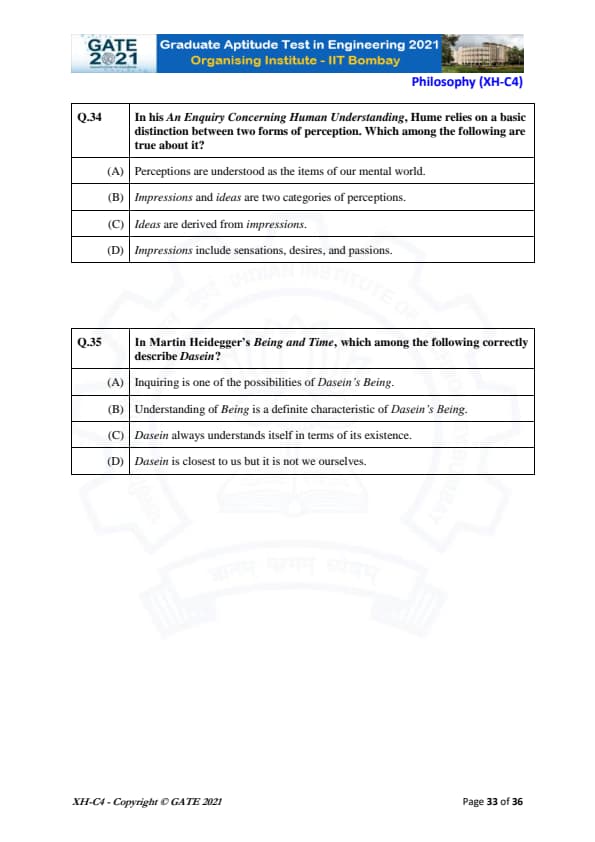
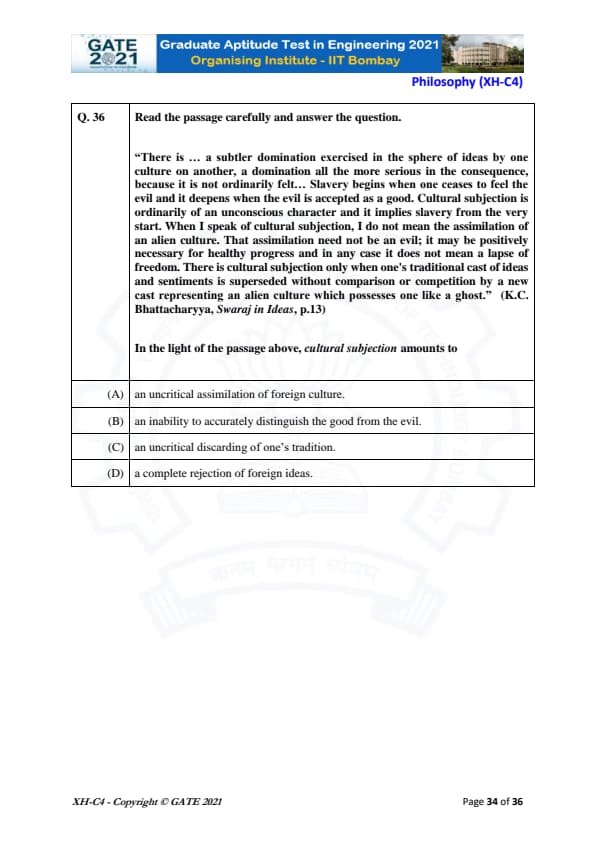
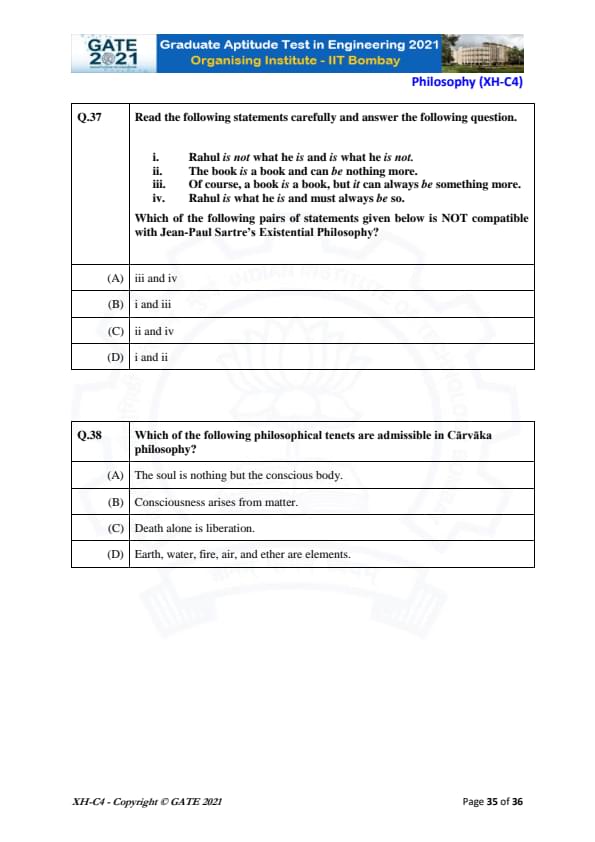
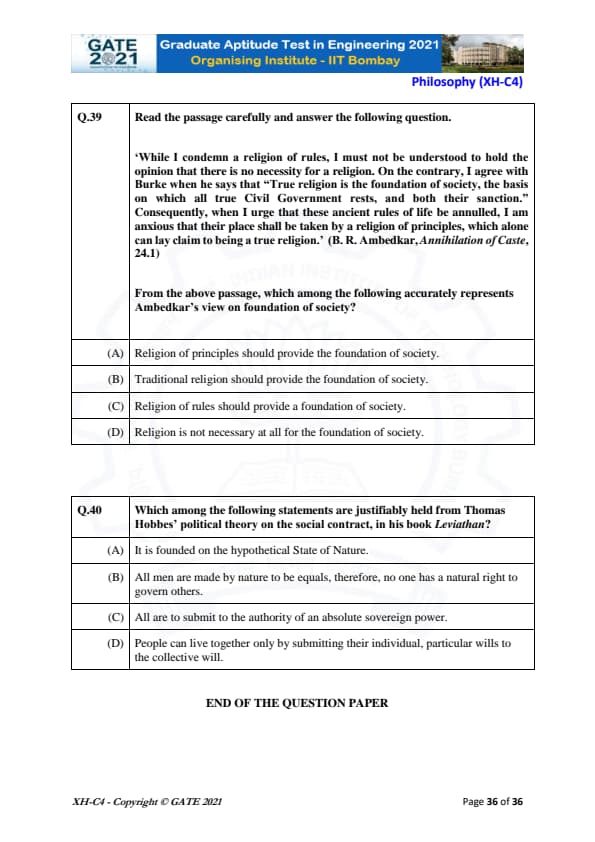
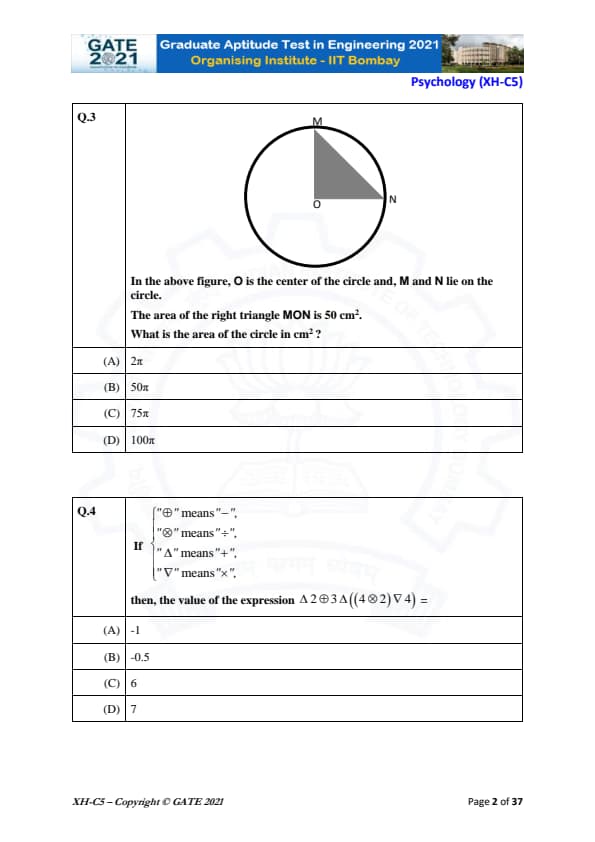

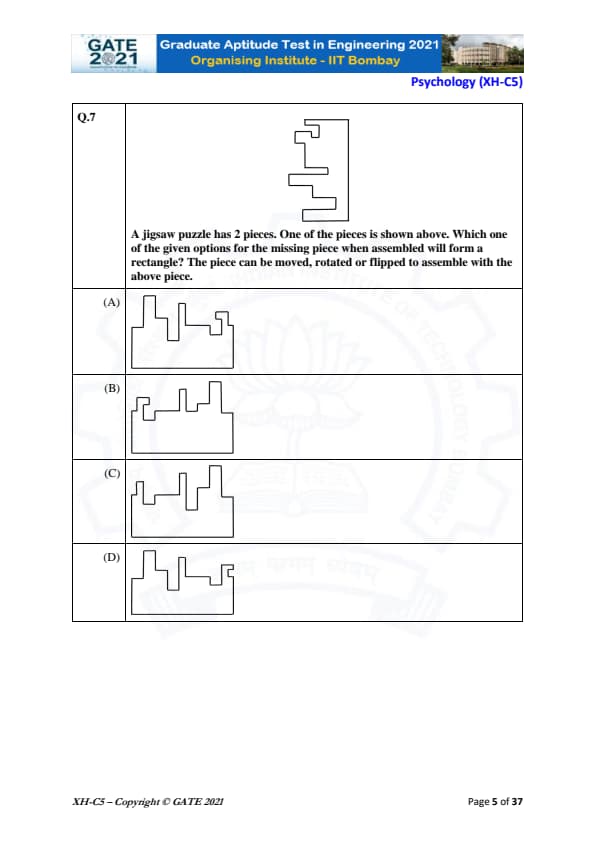
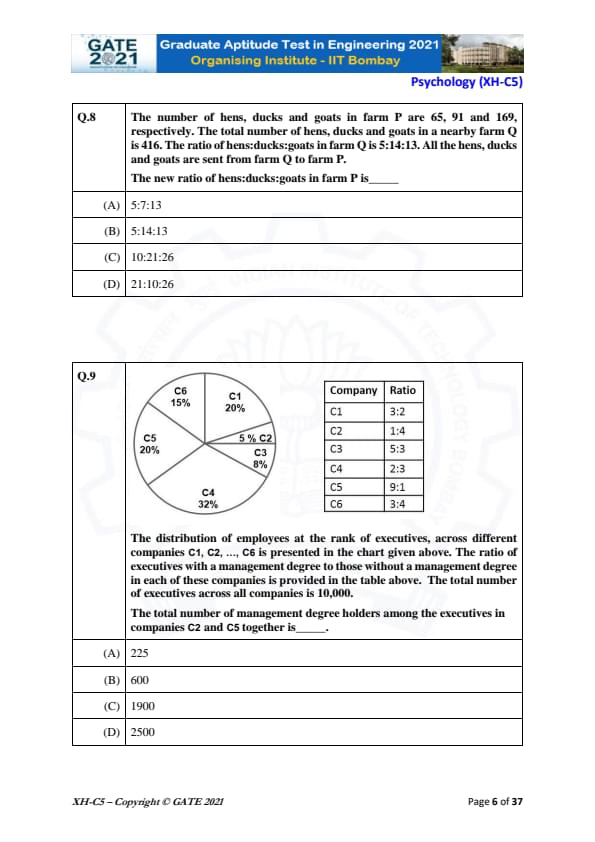
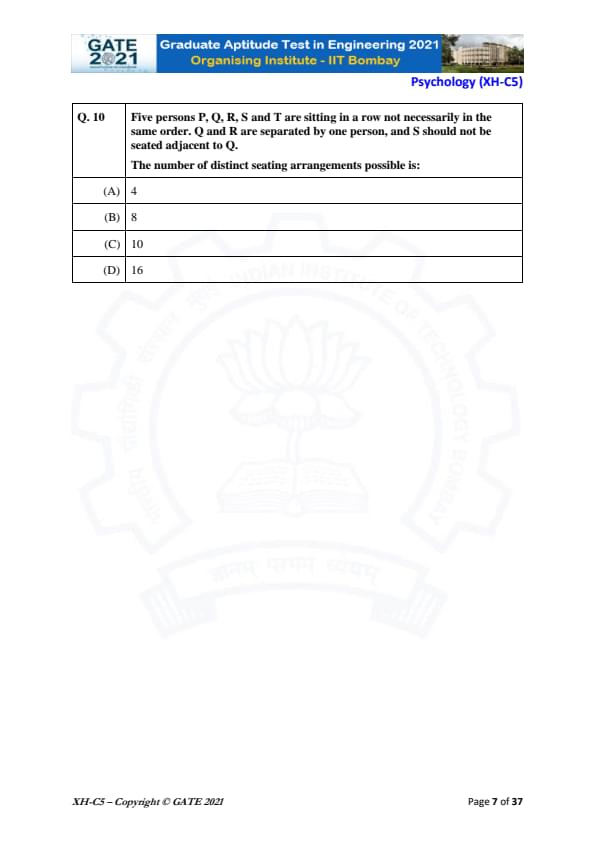
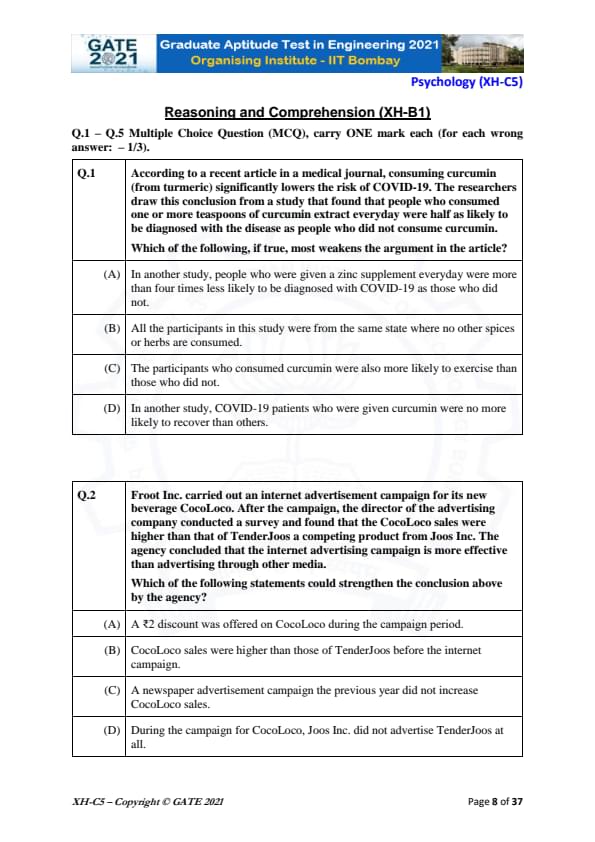

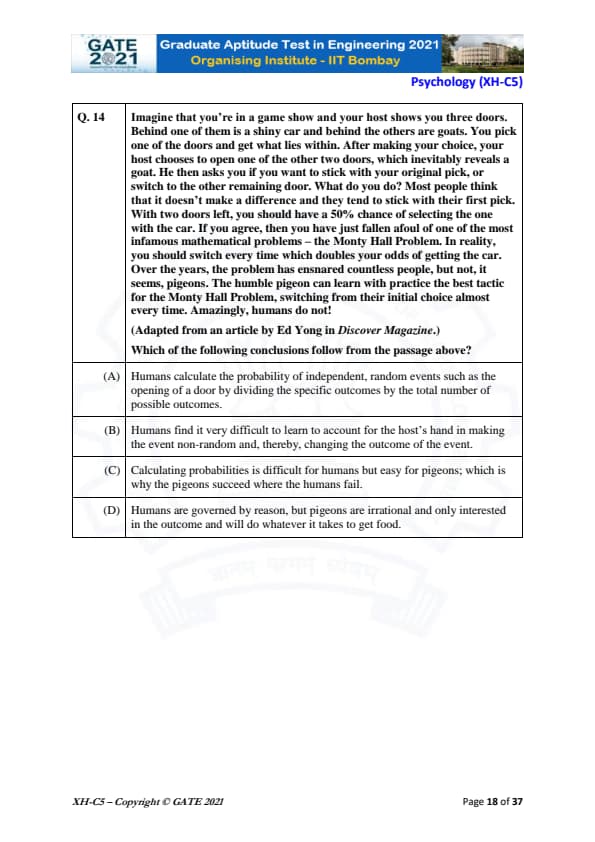
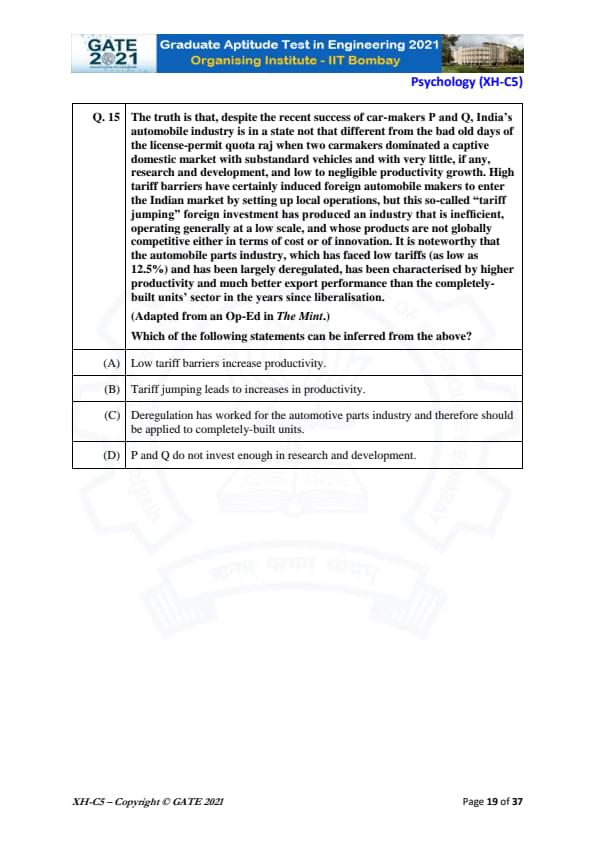
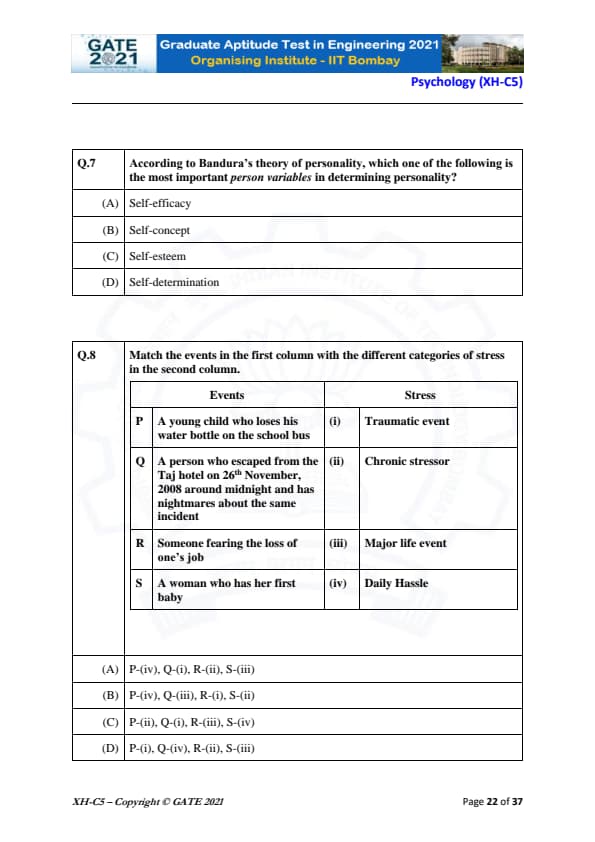
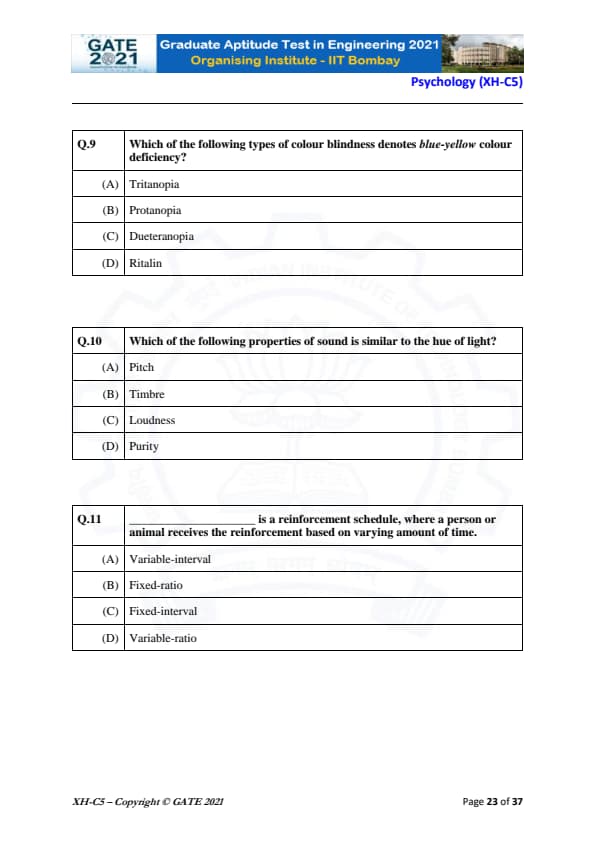
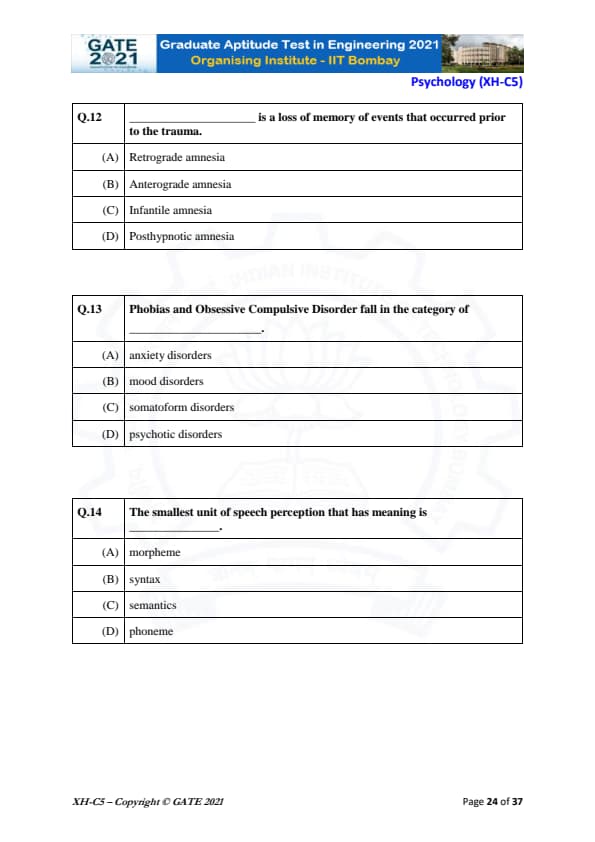
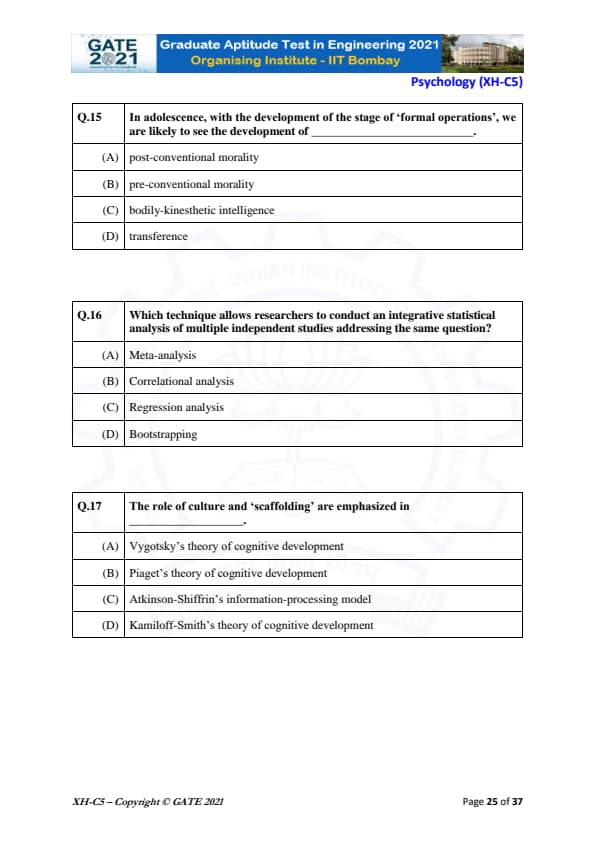
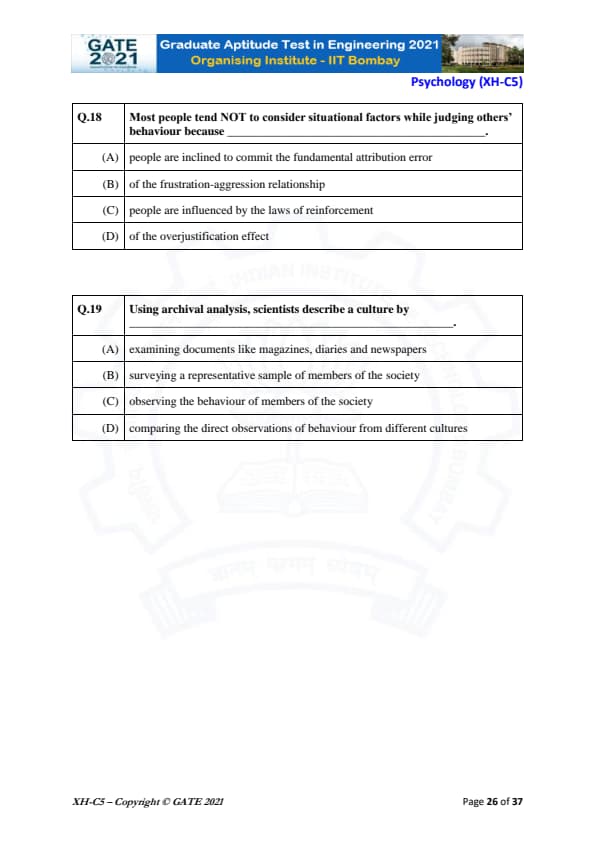

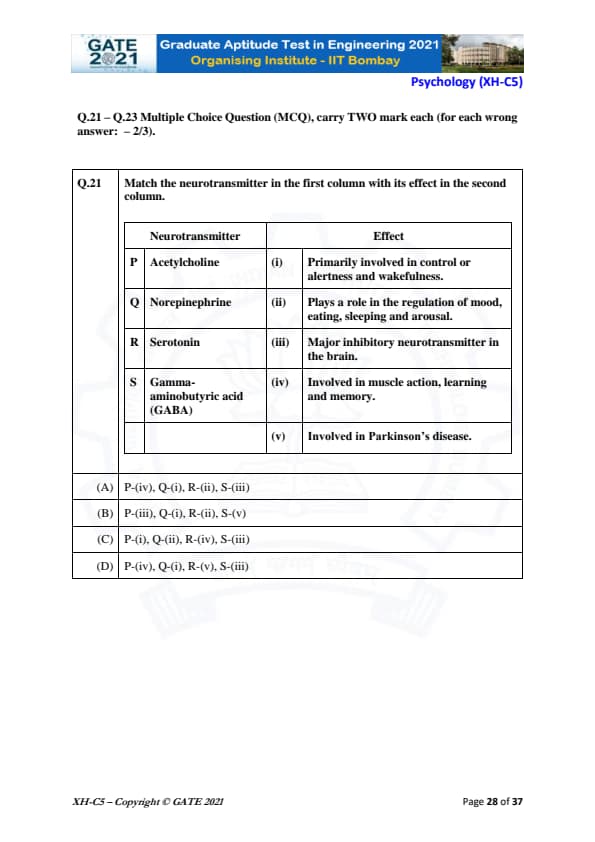
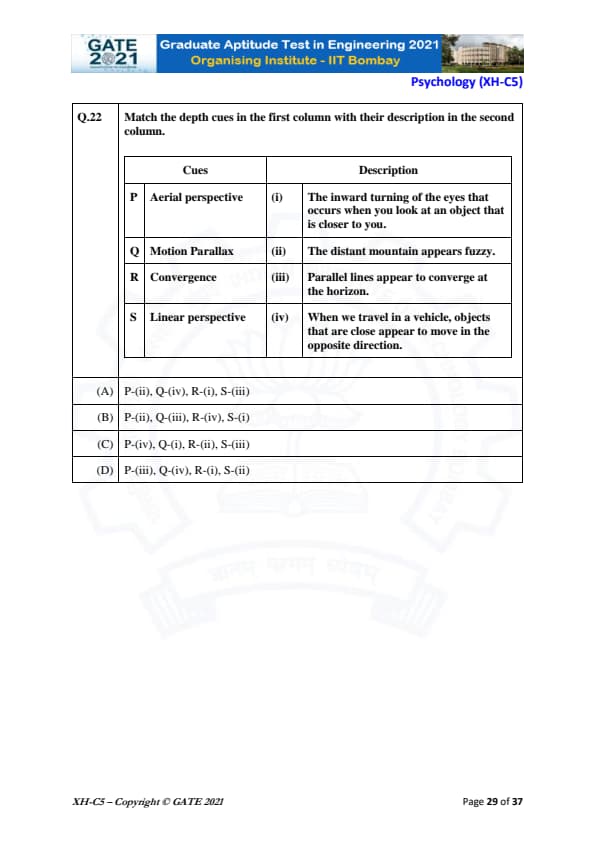
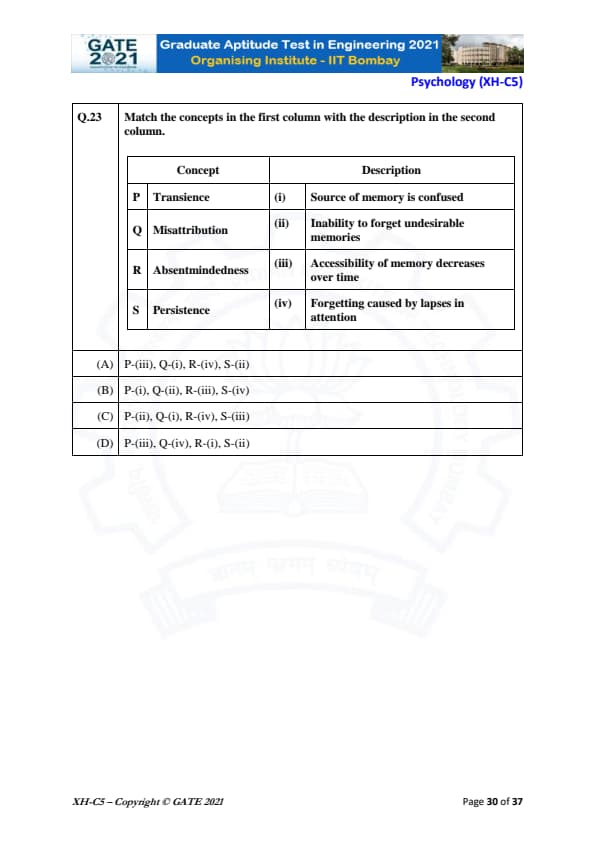
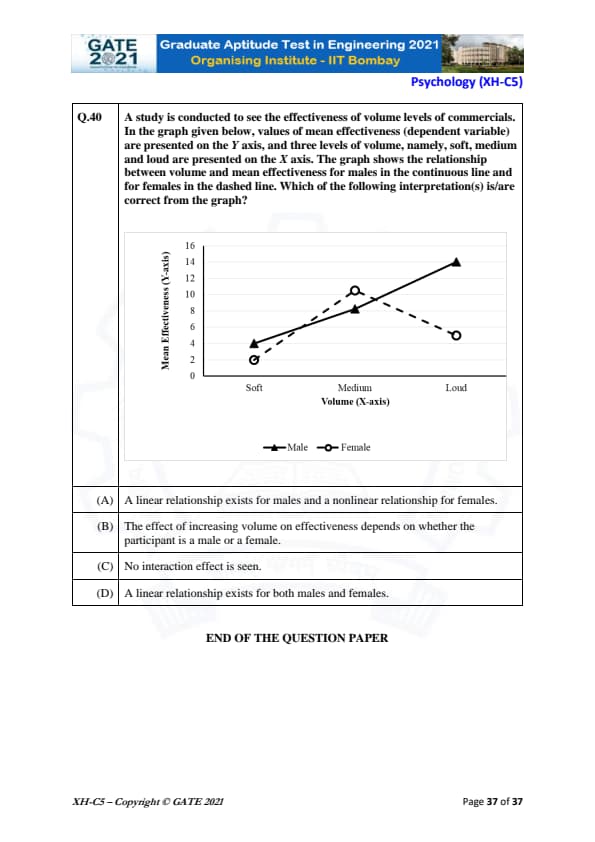
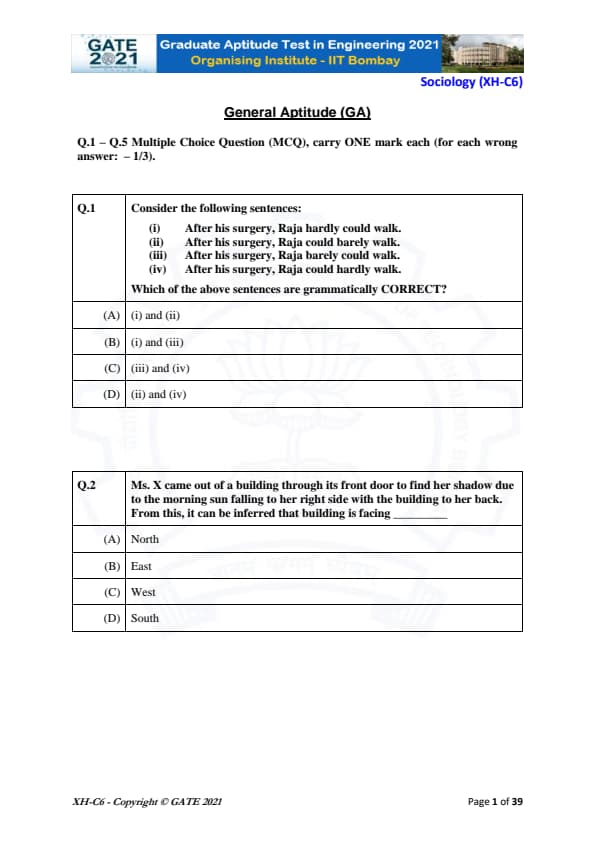
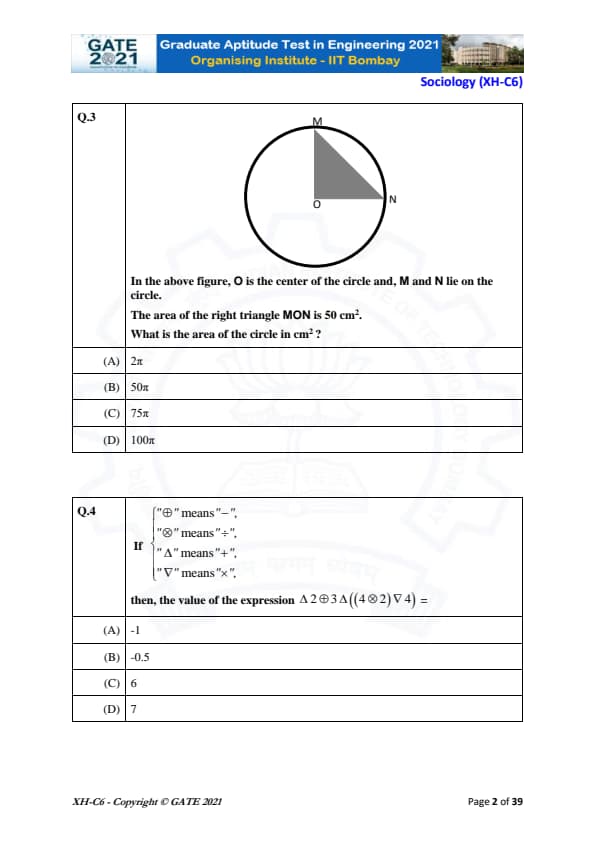

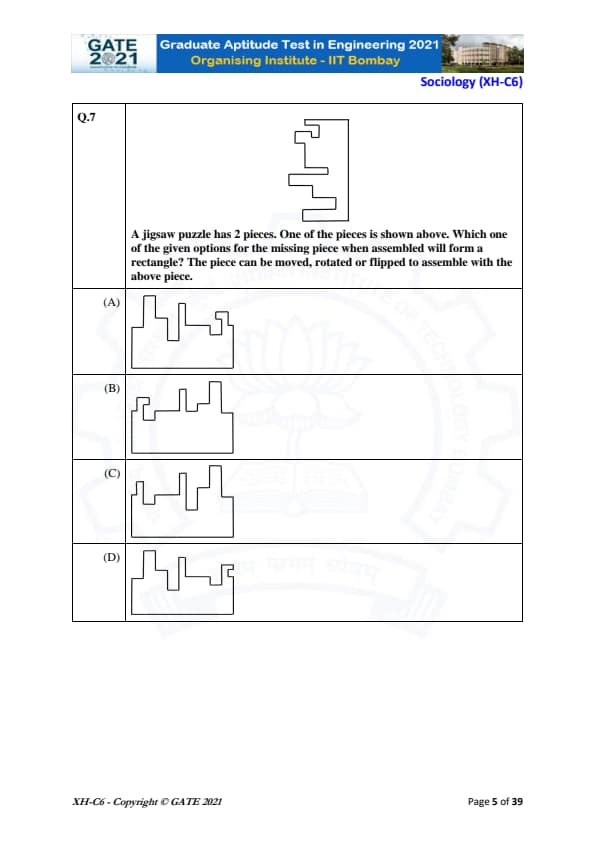
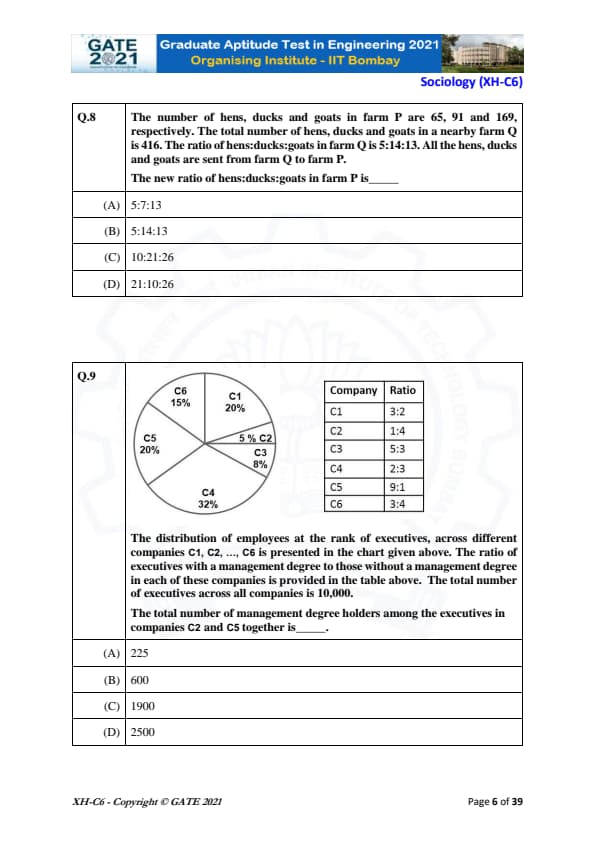
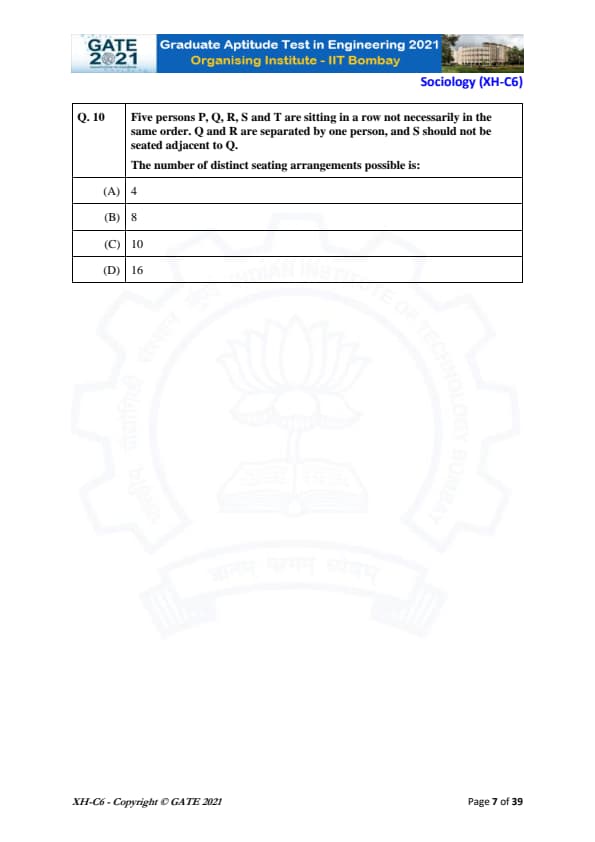
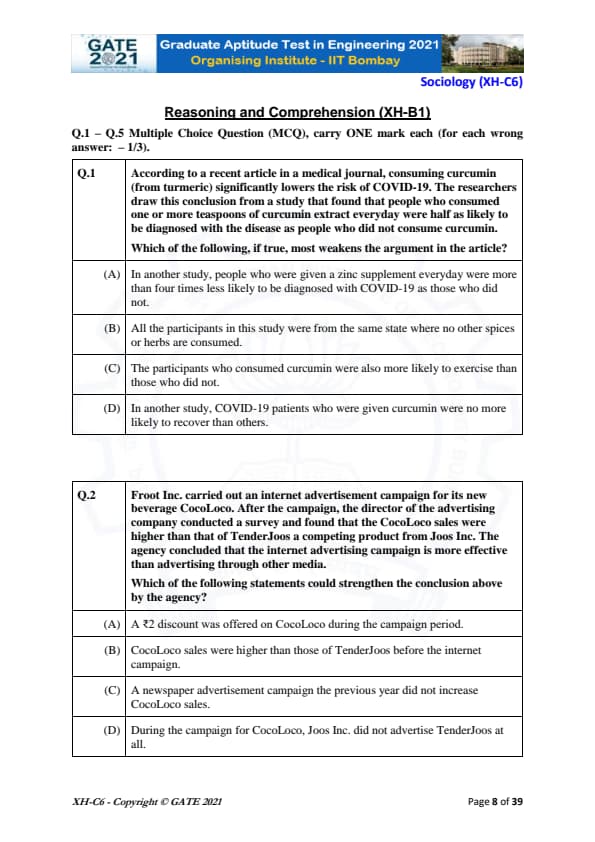

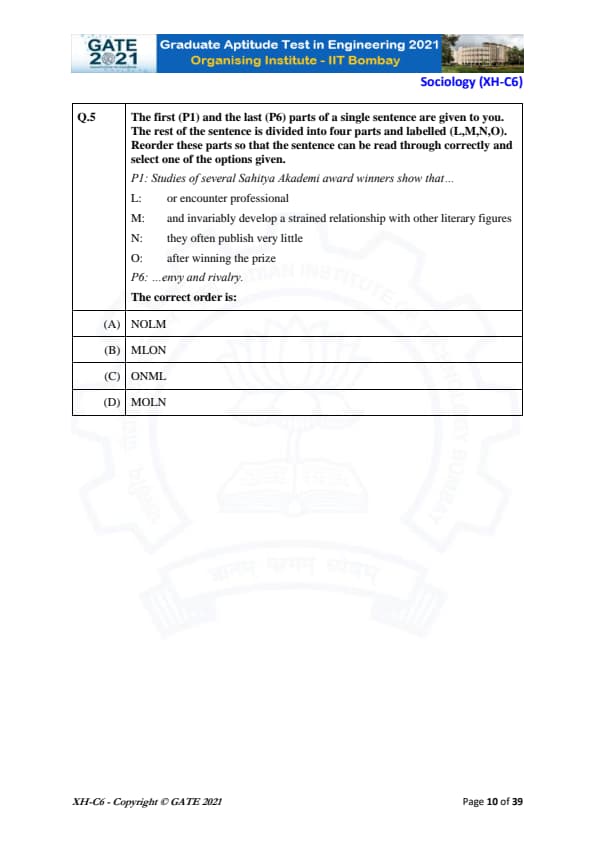
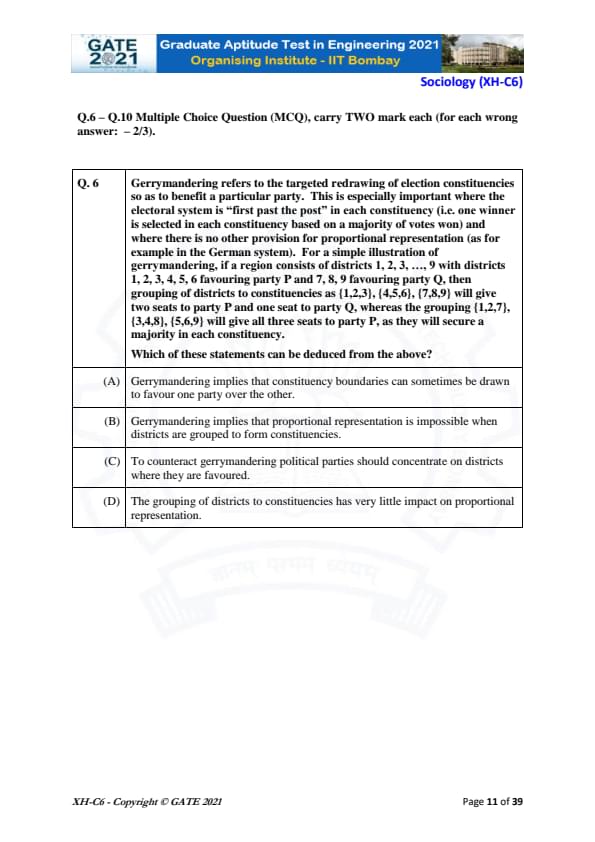
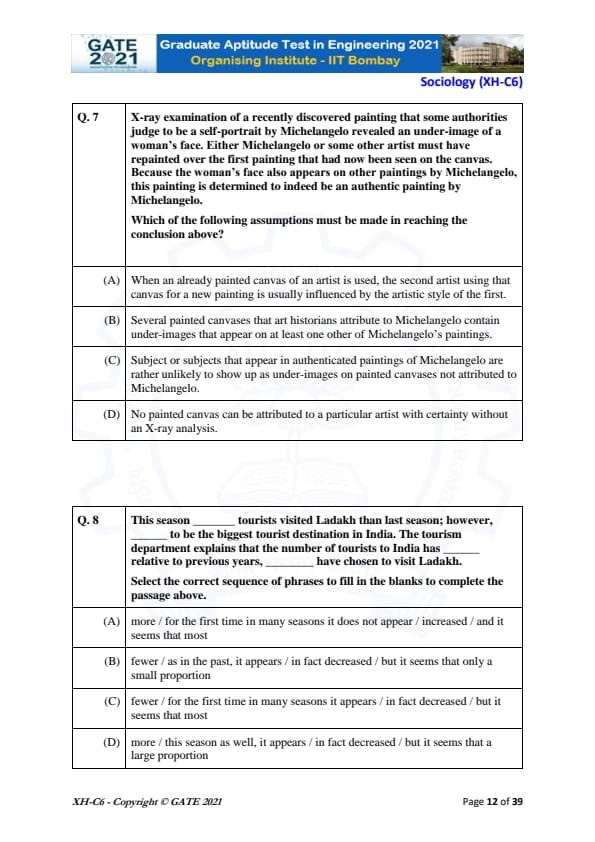
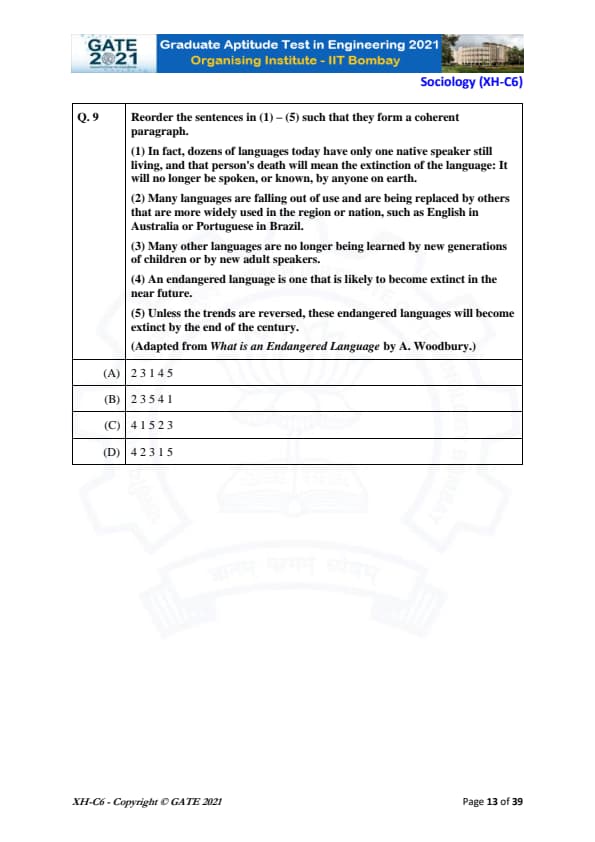
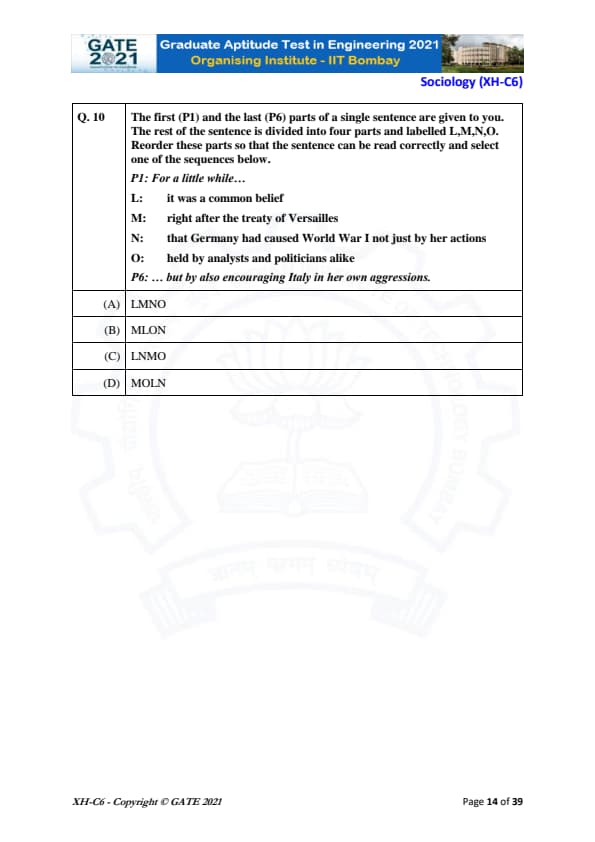
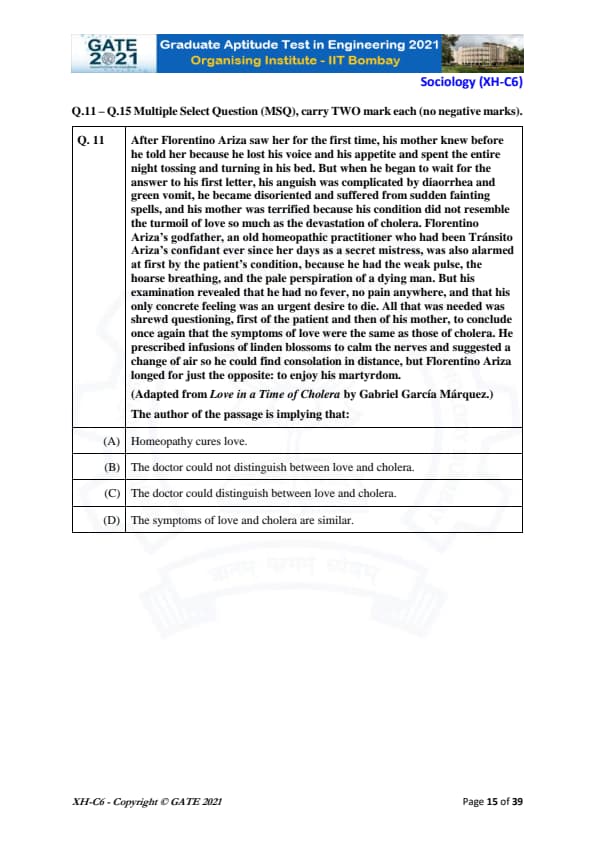

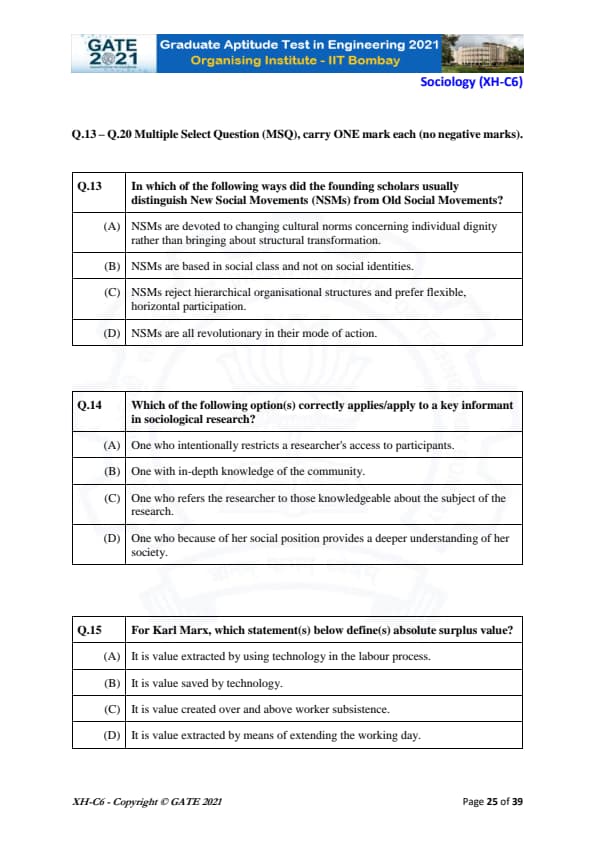
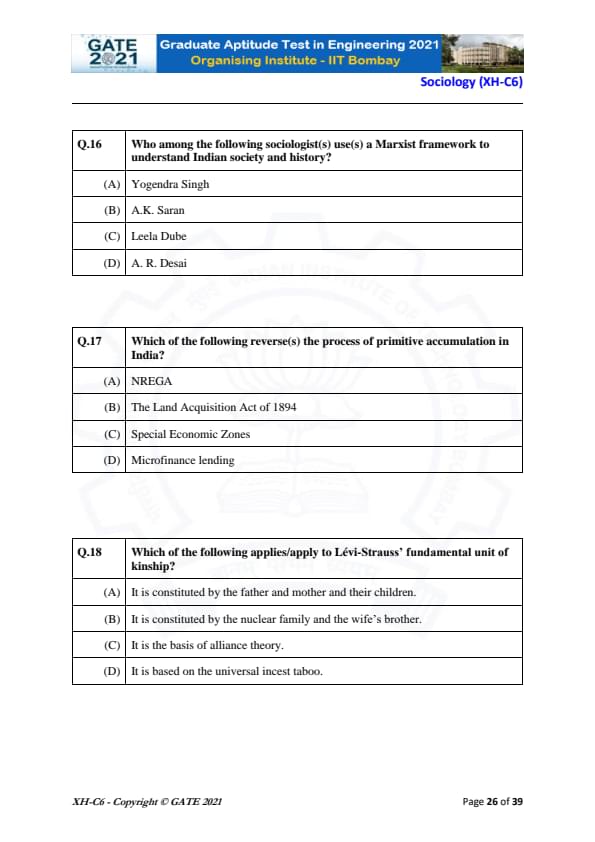
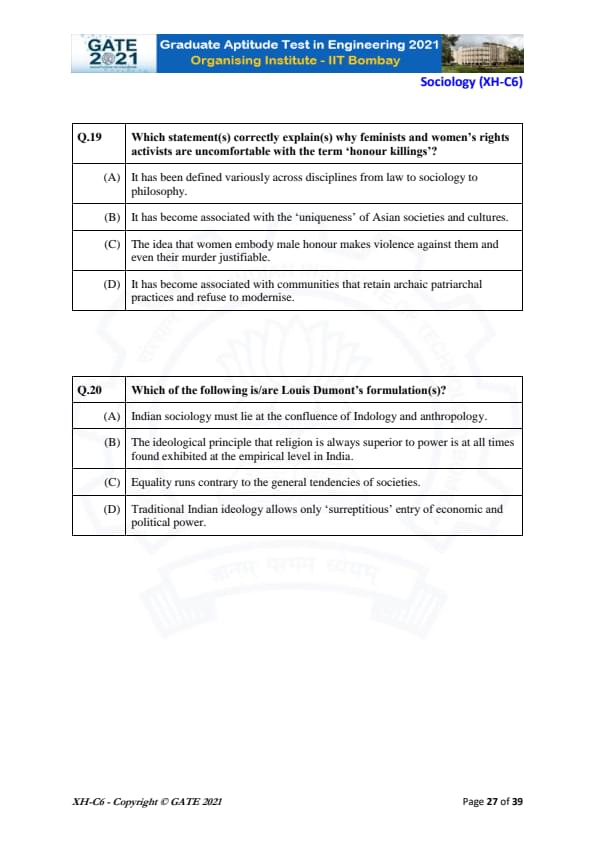
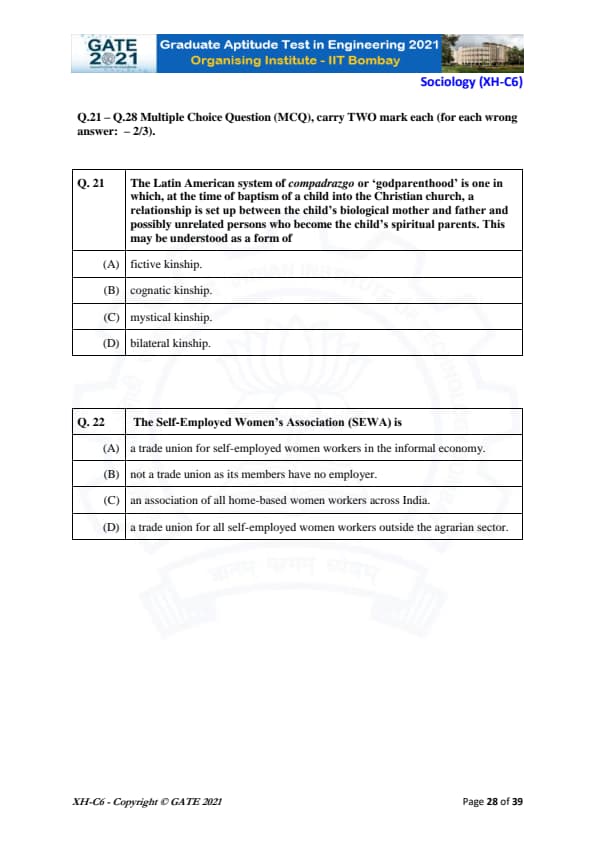
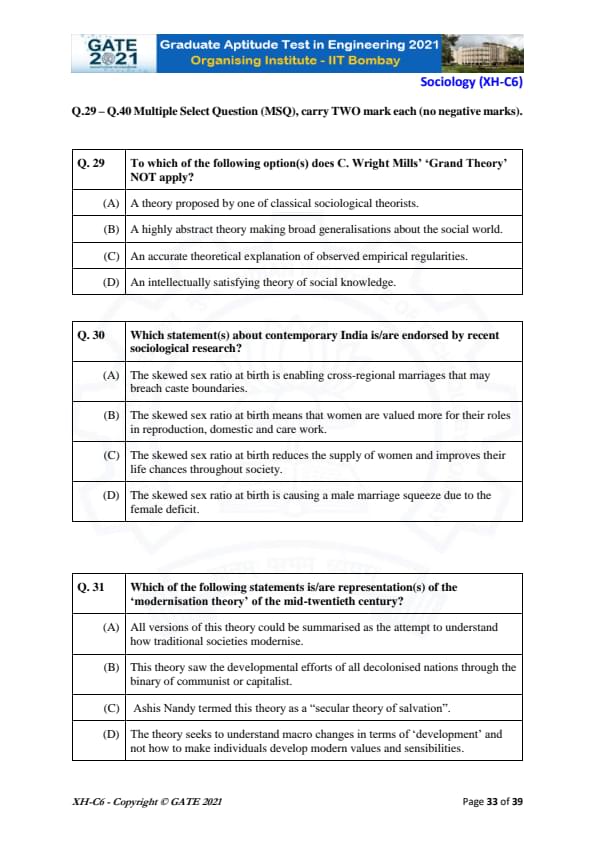
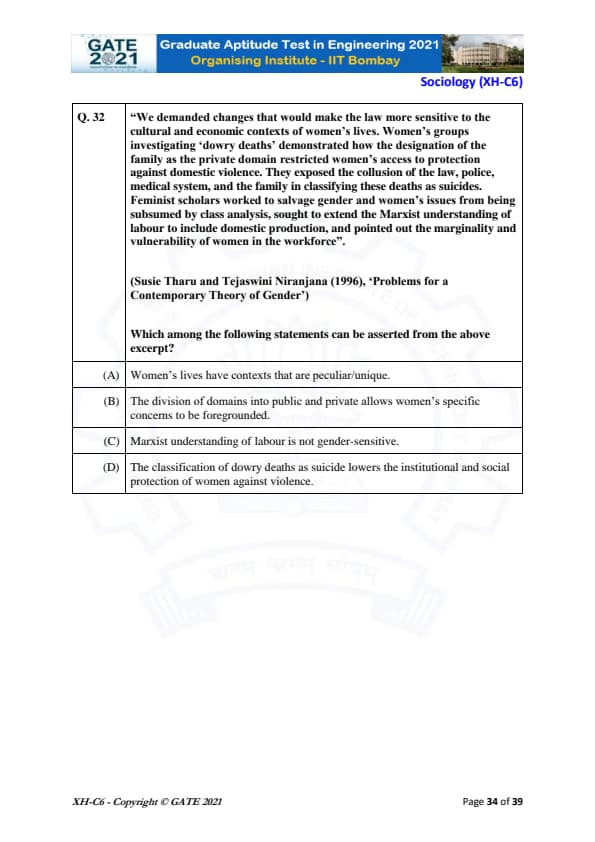
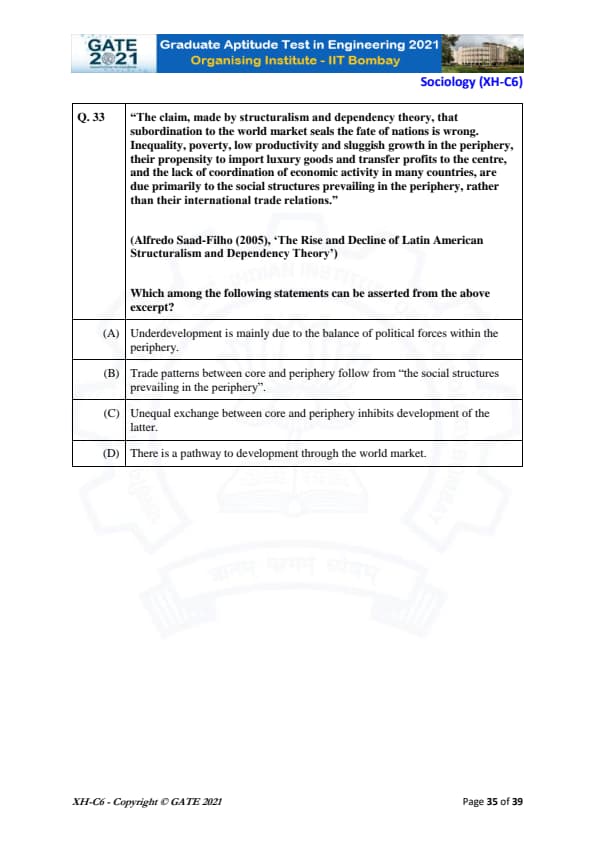
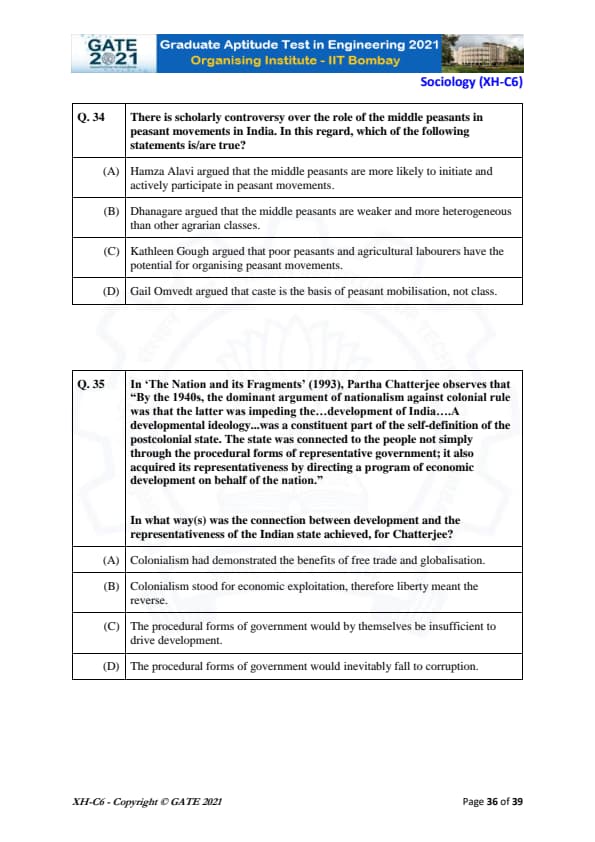
Quick Links:
GATE 2021 XH Detailed Paper Analysis
The paper was divided into three parts. The first part was dedicated to the General Aptitude. The second and third part were dedicated to reasoning and comprehension, and optional subject respectively
- The General Aptitude section carried 15 marks, distributed between 10 MCQs (each 5 questions carrying 1 mark and 2 marks respectively)
- The reasoning and comprehension section (XH-B1) carried 25 marks, comprises of 15 questions, 10 MCQs and 5 MSQs
- The MCQs carried 15 marks (5 questions carrying 1 mark and 5 questions carrying 2 marks)
- The MSQs carried 10 marks, distributed between 5 questions (2 marks each question)
- The remaining 40 questions, carrying 60 marks were related to the core optional subject
GATE 2021 XH Exam Pattern and Marking Scheme
- Candidates would require to solve 65 questions in 3 hours in GATE 2021 XH
- All the papers comprises of 65 questions (10 from General Aptitude and the other 55 from the optional subject)
- Every incorrect MCQ will cost 1 mark reduction out of the final score
- ⅓ marks would be deducted for every wrong MCQ carrying 1 mark, and ⅔ marks would be deducted for every wrong MCQ carrying 2 marks
- NATs (Numerical Answer Types) and MSQs (Multiple Select Questions) don't follow any negative marking scheme
Also Check:
GATE Previous Year Question Papers:
| GATE 2022 Question Papers | GATE 2021 Question Papers | GATE 2020 Question Papers |
| GATE 2019 Question Papers | GATE 2018 Question Papers | GATE 2017 Question Papers |





Comments