




GATE 2021 Humanities and Social Sciences (XH), Sociology (XH-C6) Question Paper with Solutions is available now. GATE 2021 XH was conducted on 14th February by IIT Bombay. GATE 2021 XH comprises several optional subjects sections out of which one section is compulsory to attempt. The total marks of the exam was 100. The overall difficulty level of GATE 2021 XH-C6 was easy to moderate. Candidates would get 3 hours to solve the questions listed in the two sections of GATE 2021 XH.
GATE 2021 Humanities and Social Sciences (XH), Sociology (XH-C6) Question Paper with Solutions
| GATE 2021 Humanities and Social Sciences (XH), Sociology (XH-C6) Question Paper |  Download Download |
Check Solutions |

Consider the following sentences:
(i) After his surgery, Raja hardly could walk.
(ii) After his surgery, Raja could barely walk.
(iii) After his surgery, Raja barely could walk.
(iv) After his surgery, Raja could hardly walk.
Which of the above sentences are grammatically CORRECT?
View Solution
Let's examine each sentence in detail:
Sentence (i): "After his surgery, Raja hardly could walk."
- This sentence is incorrect. In English, when we use the adverb hardly, it should appear before the verb in most cases. The correct structure would be: "Raja could hardly walk." Therefore, the sentence is grammatically wrong because the placement of "hardly" is incorrect.
Sentence (ii): "After his surgery, Raja could barely walk."
- This sentence is correct. The adverb barely is placed before the verb (as it should be), and the sentence follows the proper English structure. The meaning of the sentence is clear, and it is grammatically sound.
Sentence (iii): "After his surgery, Raja barely could walk."
- This sentence is incorrect. Although the adverb barely is used correctly, the position of the adverb is wrong. In standard English usage, barely should come before the verb "could," not after it. The correct sentence would be: "Raja could barely walk."
Sentence (iv): "After his surgery, Raja could hardly walk."
- This sentence is correct. The adverb hardly is placed correctly before the verb "could," making the sentence grammatically correct. This sentence properly conveys that Raja had difficulty walking after his surgery.
Thus, the sentences (ii) and (iv) are grammatically correct. Hence, the correct answer is (D).
Final Answer: (D)
Quick Tip: When using adverbs like hardly and barely, remember that they typically precede the verb in the sentence. Be cautious of placing them after auxiliary verbs like "could" or "should."
Ms. X came out of a building through its front door to find her shadow due to the morning sun falling to her right side with the building to her back. From this, it can be inferred that the building is facing ________
View Solution
In this problem, we need to infer the direction the building is facing based on the given information. Let's break it down step by step:
Step 1: Understand the scenario
- Ms. X comes out of the building through its front door. This means the direction she faces is determined by the orientation of the door.
- The morning sun is falling on her right side. We know that the sun rises in the east in the morning. Therefore, if the sun is on Ms. X's right, it means she must be facing north (because the sun will be on the east side).
- The building is to her back. This means the building is positioned behind Ms. X, so the building must be facing in the opposite direction from where Ms. X is facing.
Step 2: Deduce the facing direction of the building
- Since Ms. X is facing north, the building must be facing the opposite direction: south.
Thus, the building is facing south. Hence, the correct answer is (D).
Final Answer: (D)
Quick Tip: In the morning, the sun rises in the east. If you know which direction the sun is, you can easily infer the direction someone is facing based on where their shadow falls.
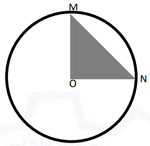
In the above figure, O is the center of the circle, and M and N lie on the circle.
The area of the right triangle MON is 50 cm².
What is the area of the circle in cm²?
View Solution
In this problem, we are given that the area of the right triangle MON is 50 cm², and we need to find the area of the circle.
Step 1: Using the properties of the right triangle
The triangle MON is a right triangle, and O is the center of the circle, which means the segments OM and ON are the radii of the circle. Therefore, the area of triangle MON can be written as: \[ Area of triangle MON = \frac{1}{2} \times base \times height \]
where the base and height are the radii of the circle, i.e., OM = ON = r.
Thus, the area of triangle MON becomes: \[ \frac{1}{2} \times r \times r = 50 \]
This simplifies to: \[ \frac{1}{2} r^2 = 50 \quad \Rightarrow \quad r^2 = 100 \]
Step 2: Finding the area of the circle
The area of a circle is given by: \[ Area of circle = \pi r^2 \]
Since \( r^2 = 100 \), we substitute this into the formula for the area of the circle: \[ Area of circle = \pi \times 100 = 100\pi \]
Thus, the area of the circle is \( 100\pi \) cm².
Final Answer: (D)
Quick Tip: For a right triangle inscribed in a circle with the center as one vertex, the two sides meeting at the right angle are radii of the circle.
“\( \oplus \)” means “-”, “\( \otimes \)” means “:”,
If “\( \Delta \)” means “+”, and “\( \nabla \)” means “×”,
then, the value of the expression \( \Delta 2 \oplus 3 \Delta ((4 \otimes 2) \nabla 4) \) =
View Solution
We need to evaluate the expression \( \Delta 2 \oplus 3 \Delta ((4 \otimes 2) \nabla 4) \), using the given operations:
1. Step 1: Break down the operations
- The symbol \( \oplus \) means subtraction (“-”).
- The symbol \( \otimes \) means multiplication (“:”), so \( 4 \otimes 2 = 4 \times 2 = 8 \).
- The symbol \( \nabla \) means multiplication (“×”), so \( 8 \nabla 4 = 8 \times 4 = 32 \).
- The symbol \( \Delta \) means addition (“+”).
2. Step 2: Evaluate the expression
We now substitute the values into the expression:
\[ \Delta 2 \oplus 3 \Delta (32) \]
This becomes:
\[ 2 + 3 - 32 = 7 \]
Thus, the value of the expression is 7.
Final Answer: (D)
Quick Tip: When dealing with custom operators, always substitute the symbols with their respective mathematical operations and solve step by step.
"The increased consumption of leafy vegetables in the recent months is a clear indication that the people in the state have begun to lead a healthy lifestyle."
Which of the following can be logically inferred from the information presented in the above statement?
View Solution
The statement says that the increased consumption of leafy vegetables is an indication of people leading a healthy lifestyle.
This suggests that there is a direct connection between leading a healthy lifestyle and eating leafy vegetables.
- (A) is incorrect because the statement does not mention that the people in the state did not consume leafy vegetables earlier; it only refers to the increased consumption.
- (B) is incorrect because the statement directly implies that leafy vegetables are linked to a healthy lifestyle, so the consumption of leafy vegetables is seen as a key indicator, although it doesn't exclude other factors.
- (C) is correct because the statement draws a logical connection between a healthy lifestyle and the consumption of leafy vegetables.
- (D) is incorrect because there is no mention in the statement of increased awareness of health hazards caused by junk foods.
Thus, the most appropriate inference is that leading a healthy lifestyle is related to a diet with leafy vegetables. Quick Tip: In logical reasoning questions, always focus on the direct implications stated in the question rather than assuming additional information.
Oxpeckers and rhinos manifest a symbiotic relationship in the wild. The oxpeckers warn the rhinos about approaching poachers, thus possibly saving the lives of the rhinos. Oxpeckers also feed on the parasitic ticks found on rhinos.
In the symbiotic relationship described above, the primary benefits for oxpeckers and rhinos respectively are,
View Solution
In this symbiotic relationship between oxpeckers and rhinos, both species benefit from the interaction:
1. Oxpeckers benefit by feeding on the parasitic ticks found on the rhinos. This provides the oxpeckers with a food source.
2. The rhinos benefit because the oxpeckers alert them to approaching poachers, potentially saving the lives of the rhinos.
Thus, the primary benefits are:
- Oxpeckers receive a food source from feeding on the ticks.
- Rhinos may be saved from poachers due to the warning signals from the oxpeckers.
Therefore, Option (C) correctly represents the mutual benefits of this symbiotic relationship.
Analysis of Other Options:
- Option (A): Incorrect because rhinos do receive a benefit (being warned about poachers), not just oxpeckers getting a food source.
- Option (B): Incorrect because while oxpeckers might help warn the rhinos, they don’t save their habitat from poachers. Rhinos benefit directly from the poacher warnings.
- Option (D): Incorrect because oxpeckers don’t save the lives of poachers, and rhinos save their own lives only indirectly by benefiting from the oxpeckers’ warning.
Thus, (C) is the most accurate answer.
Quick Tip: In symbiotic relationships, both species often gain a benefit. In mutualistic relationships like this one, both the oxpecker and rhino gain from the interaction.
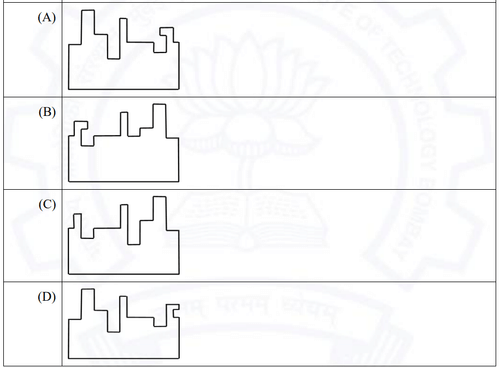
A jigsaw puzzle has 2 pieces. One of the pieces is shown above. Which one of the given options for the missing piece when assembled will form a rectangle? The piece can be moved, rotated, or flipped to assemble with the above piece.

View Solution
In this jigsaw puzzle, the goal is to find the missing piece that, when placed with the given piece, will form a complete rectangle. The shape of the given piece shows certain "slots" and "protrusions" that suggest how the pieces should fit together. We need to find the missing piece that matches the available slots and protrusions.
After analyzing the options:
- Option (A): When this piece is rotated and flipped, it fits perfectly with the given piece to form a rectangle. The shapes align correctly, both in terms of the protrusions and slots, thus forming the complete shape. This is the correct option.
- Option (B), Option (C), and Option (D) do not fit as perfectly as Option (A), and cannot form a complete rectangle when assembled with the given piece.
Thus, the correct answer is (A).
Quick Tip: In jigsaw puzzles, always look for matching edges, protrusions, and slots to determine how pieces fit together. Rotation and flipping can also help when assembling the pieces.
The number of hens, ducks and goats in farm P are 65, 91 and 169, respectively. The total number of hens, ducks and goats in a nearby farm Q is 416. The ratio of hens:ducks:goats in farm Q is 5:14:13. All the hens, ducks and goats are sent from farm Q to farm P.
The new ratio of hens:ducks:goats in farm P is
View Solution
We are given that:
- The number of hens, ducks, and goats in farm P are 65, 91, and 169, respectively.
- The total number of hens, ducks, and goats in farm Q is 416.
- The ratio of hens:ducks:goats in farm Q is 5:14:13.
Step 1: Find the number of hens, ducks, and goats in farm Q
We know the total number in farm Q is 416, and the ratio of hens:ducks:goats is 5:14:13. Let the number of hens, ducks, and goats in farm Q be represented by:
- Hens in Q: \( 5x \)
- Ducks in Q: \( 14x \)
- Goats in Q: \( 13x \)
Thus, the total is: \[ 5x + 14x + 13x = 416 \] \[ 32x = 416 \] \[ x = \frac{416}{32} = 13 \]
So, the number of hens, ducks, and goats in farm Q are:
- Hens in Q: \( 5 \times 13 = 65 \)
- Ducks in Q: \( 14 \times 13 = 182 \)
- Goats in Q: \( 13 \times 13 = 169 \)
Step 2: Add these to the numbers in farm P
Now, we transfer all the animals from farm Q to farm P:
- New hens in P: \( 65 + 65 = 130 \)
- New ducks in P: \( 91 + 182 = 273 \)
- New goats in P: \( 169 + 169 = 338 \)
Step 3: Find the new ratio
The new ratio of hens:ducks:goats in farm P is: \[ 130 : 273 : 338 \]
Simplifying this ratio by dividing each term by their greatest common divisor, which is 13: \[ \frac{130}{13} : \frac{273}{13} : \frac{338}{13} = 10 : 21 : 26 \]
Thus, the new ratio of hens:ducks:goats in farm P is 10:21:26, corresponding to Option (C).
Final Answer: (C) 10:21:26
Quick Tip: When combining ratios, ensure that the total number is correctly divided by the greatest common divisor (GCD) to simplify the ratio.
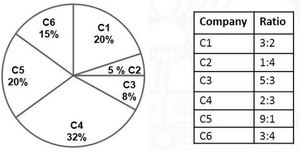
The distribution of employees at the rank of executives, across different companies C1, C2, …, C6 is presented in the chart given above. The ratio of executives with a management degree to those without a management degree in each of these companies is provided in the table above. The total number of executives across all companies is 10,000.
The total number of management degree holders among the executives in companies C2 and C5 together is
View Solution
We are given the following information:
- The total number of executives across all companies is 10,000.
- The percentage distribution of employees across the companies is:
- \( C1: 15% \)
- \( C2: 5% \)
- \( C3: 8% \)
- \( C4: 32% \)
- \( C5: 20% \)
- \( C6: 20% \)
Step 1: Calculate the number of executives in each company
The number of executives in each company is:
- Number of executives in \( C1 = 15% \times 10,000 = 1500 \)
- Number of executives in \( C2 = 5% \times 10,000 = 500 \)
- Number of executives in \( C3 = 8% \times 10,000 = 800 \)
- Number of executives in \( C4 = 32% \times 10,000 = 3200 \)
- Number of executives in \( C5 = 20% \times 10,000 = 2000 \)
- Number of executives in \( C6 = 20% \times 10,000 = 2000 \)
Step 2: Calculate the number of management degree holders in \( C2 \) and \( C5 \)
- For \( C2 \), the ratio of executives with a management degree is \( 1:4 \), meaning 1 out of every 5 executives has a management degree.
\[ Management degree holders in C2 = \frac{1}{5} \times 500 = 100 \]
- For \( C5 \), the ratio of executives with a management degree is \( 9:1 \), meaning 9 out of every 10 executives have a management degree.
\[ Management degree holders in C5 = \frac{9}{10} \times 2000 = 1800 \]
Step 3: Total management degree holders in \( C2 \) and \( C5 \)
The total number of management degree holders in \( C2 \) and \( C5 \) together is: \[ 100 + 1800 = 1900 \]
Thus, the total number of management degree holders in companies \( C2 \) and \( C5 \) is 1900, corresponding to Option (C).
Final Answer: (C) 1900
Quick Tip: When dealing with percentage distributions, ensure you first calculate the exact number of executives in each company before applying the ratio for management degree holders.
Five persons P, Q, R, S, and T are sitting in a row not necessarily in the same order. Q and R are separated by one person, and S should not be seated adjacent to Q.
The number of distinct seating arrangements possible is:
View Solution
We need to calculate the number of distinct seating arrangements of five people: P, Q, R, S, and T, with the following conditions:
1. Q and R are separated by one person.
2. S should not be seated adjacent to Q.
Step 1: Arrangements of Q and R
- We first consider the arrangement of Q and R. According to the problem, Q and R must be separated by exactly one person.
- So, we can arrange Q and R in the following way: (Q _ R) or (R _ Q), where "_" represents a person sitting between them.
- There are 2 possible arrangements for Q and R.
Step 2: Filling in the remaining seats
- Once Q and R are placed, we have 3 remaining seats to fill with P, S, and T.
- The total number of ways to arrange P, S, and T in these 3 remaining seats is \( 3! = 6 \).
Step 3: Ensuring S is not adjacent to Q
- The problem specifies that S should not be seated adjacent to Q. This restriction must be taken into account.
- Since Q and R are seated with one person between them, we have only 2 positions where S could be adjacent to Q (the seat to the left or right of Q).
- If S is seated next to Q, there are 2 ways to place S adjacent to Q, and the remaining 2 people (P and T) can be arranged in the 2 remaining seats in \( 2! = 2 \) ways.
Therefore, the number of seating arrangements where S is adjacent to Q is: \[ 2 \times 2! = 4 \]
Step 4: Subtracting the invalid arrangements
The total number of unrestricted seating arrangements is: \[ 2 \times 3! = 12 \]
However, we need to exclude the 4 arrangements where S is adjacent to Q. So, the total number of valid arrangements is: \[ 12 - 4 = 8 \]
Thus, the total number of distinct seating arrangements is 16.
Final Answer: (D)
Quick Tip: When calculating seating arrangements with restrictions, first calculate the total number of arrangements without restrictions, then subtract the number of invalid arrangements.
According to a recent article in a medical journal, consuming curcumin (from turmeric) significantly lowers the risk of COVID-19. The researchers draw this conclusion from a study that found that people who consumed one or more teaspoons of curcumin extract every day were half as likely to be diagnosed with the disease as people who did not consume curcumin.
Which of the following, if true, most weakens the argument in the article?
View Solution
The argument in the article suggests that curcumin consumption significantly lowers the risk of COVID-19. To weaken this argument, we need evidence that suggests other factors, such as exercise, might explain the difference in diagnosis rates rather than curcumin consumption alone.
Step 1: Evaluate each option.
- (A) The study mentioned in option (A) suggests that zinc supplements lower the likelihood of being diagnosed with COVID-19, but this doesn't directly weaken the argument about curcumin's effect.
- (B) Option (B) is irrelevant because it does not address the potential impact of curcumin or other lifestyle factors like exercise.
- (C) Option (C) presents a plausible alternative explanation—people who consume curcumin may also be more likely to exercise, which could account for their lower likelihood of being diagnosed with COVID-19.
- (D) Option (D) does not directly weaken the argument, as it discusses recovery rates rather than the likelihood of being diagnosed.
Step 2: Conclusion.
Option (C) introduces the possibility that exercise, not curcumin, could be the factor reducing the likelihood of diagnosis, which weakens the argument.
Final Answer: (C) The participants who consumed curcumin were also more likely to exercise than those who did not.
Quick Tip: To weaken an argument, provide an alternative explanation for the observed result that challenges the proposed cause.
Froot Inc. carried out an internet advertisement campaign for its new beverage CocoLoco. After the campaign, the director of the advertising company conducted a survey and found that the CocoLoco sales were higher than that of TenderJoos, a competing product from Joos Inc. The agency concluded that the internet advertising campaign is more effective than advertising through other media.
Which of the following statements could strengthen the conclusion above by the agency?
View Solution
The agency concludes that the internet advertisement campaign was more effective than other media. To strengthen this conclusion, we need evidence that shows the internet campaign specifically had a positive effect, unlike other forms of advertisement.
Step 1: Evaluate each option.
- (A) A discount on CocoLoco could have contributed to higher sales, but it doesn't directly support the conclusion that the internet campaign was more effective than other forms of advertising.
- (B) If CocoLoco sales were already higher before the internet campaign, it weakens the claim that the internet campaign had a significant impact.
- (C) Option (C) provides useful evidence. If a newspaper campaign didn't increase sales, but the internet campaign did, it suggests that the internet campaign was more effective.
- (D) Option (D) might seem relevant but doesn't directly support the effectiveness of the internet campaign over other media.
Step 2: Conclusion.
Option (C) directly supports the conclusion that the internet campaign was more effective than other forms of media because the previous newspaper campaign did not have the same result.
Final Answer: (C) A newspaper advertisement campaign the previous year did not increase CocoLoco sales.
Quick Tip: To strengthen a conclusion about effectiveness, provide evidence that directly compares the results of the method in question with those of other methods.
An e-commerce site offered a deal last month conditional on the customer spending a minimum of ₹500. Any customer who buys 2 kg of fresh fruit will receive a hand mixer and any customer who buys 2 kg of fresh vegetables will receive a vegetable chopper.
Which of the following is NOT a possible outcome of the above?
View Solution
Step 1: Understand the Offer.
The customer must spend ₹500 to avail the offers. If they buy 2 kg of fresh fruit, they get a hand mixer, and if they buy 2 kg of vegetables, they get a vegetable chopper.
Step 2: Analyze the Options.
- (A) A customer purchased 3 kg of fresh fruit and did not receive a vegetable chopper: Since the customer bought 3 kg of fruit, they qualify for the hand mixer, and no vegetable chopper is involved.
- (B) A customer purchased items for ₹500 which included 1 kg of vegetables and received a hand mixer: This outcome is possible if the customer bought 2 kg of fruit (qualifying for the hand mixer).
- (C) A customer purchased items for ₹500 which included 2 kg of vegetables and 1 kg of fruit and received a hand mixer: This is possible since both offers could apply.
- (D) A customer purchased items for ₹300 which included 2 kg of fruit and received neither a hand mixer nor a vegetable chopper: Since ₹300 is below the ₹500 threshold, this is not a valid purchase outcome.
Step 3: Conclusion.
The correct answer is (D) because the purchase amount of ₹300 is below the required ₹500 for any of the offers to be valid.
Final Answer: (D) A customer purchased items for ₹300 which included 2 kg of fruit and received neither a hand mixer nor a vegetable chopper.
Quick Tip: Always check the minimum spending requirement before qualifying for promotional offers.
Writers of detective fiction often include an incompetent detective as a foil for the brilliant investigator-protagonist as they follow different paths in trying to solve the crime. In the individual accounts, the incompetent detective is frequently distracted by the culprit's careful plans, while the competent investigator solves the case after a final confrontation. Analysts of such fiction believe that the authors select this story-telling technique to provide readers with more complexities in the form of misleading clues, while figuring out the crime.
Which of the following statements most logically follows from the passage above?
View Solution
Step 1: Analyze the Passage.
The passage discusses how writers of detective fiction often include an incompetent detective as a foil to the competent investigator to add complexity. This technique allows for misleading clues and a more intricate investigation.
Step 2: Evaluate the Options.
- (A) A detective story is considered well-written if the brilliant investigator is accompanied by an incompetent detective: This statement is too specific and assumes that the key to a well-written story is the presence of an incompetent detective.
- (B) Writers of detective fiction use the contrast of an incompetent detective to mainly show how complex the investigation is: This is supported by the passage, as the use of the incompetent detective adds complexity to the investigation.
- (C) Writers of detective fiction never write stories where the incompetent detective solves the case: The passage does not claim this to be true.
- (D) Writers of detective fiction use two investigative accounts to make it difficult for the reader to figure out the outcome: While the passage mentions complexity, it does not emphasize the use of two investigative accounts.
Step 3: Conclusion.
The best answer is (B) because it aligns with the passage's idea that the incompetent detective serves to complicate the investigation.
Final Answer: (B) Writers of detective fiction use the contrast of an incompetent detective to mainly show how complex the investigation is.
Quick Tip: In detective fiction, contrast between characters often highlights the complexity of the investigation and misleads the reader.
The first (P1) and the last (P6) parts of a single sentence are given to you. The rest of the sentence is divided into four parts and labelled (L,M,N,O). Reorder these parts so that the sentence can be read through correctly and select one of the options given.
P1: Studies of several Sahitya Akademi award winners show that...
L: or encounter professional
M: and invariably develop a strained relationship with other literary figures
N: they often publish very little
O: after winning the prize
P6: ...envy and rivalry.
View Solution
We are given the first part (P1) and the last part (P6) of a sentence. We need to reorder the remaining parts to form a coherent sentence. The given parts are:
- P1: "Studies of several Sahitya Akademi award winners show that..."
- P6: "...envy and rivalry."
Now, we analyze the options:
Option (A) NOLM: This order does not form a meaningful sentence as it does not fit well with the context.
Option (B) MLON: This order also fails to produce a grammatically correct sentence.
Option (C) ONML: The correct sequence is obtained with this order. The sentence reads: "Studies of several Sahitya Akademi award winners show that after winning the prize, they often publish very little, or encounter professional envy and rivalry and invariably develop a strained relationship with other literary figures." This is logically and grammatically correct.
Option (D) MOLN: This order doesn't result in a meaningful sentence either.
Thus, the correct order is ONML.
Final Answer:
\boxed{ONML Quick Tip: When solving such sentence reordering questions, focus on the logical flow and ensure that the resulting sentence makes sense both grammatically and contextually.
Gerrymandering refers to the targeted redrawing of election constituencies so as to benefit a particular party. This is especially important where the electoral system is "first past the post" in each constituency (i.e. one winner is selected in each constituency based on a majority of votes won) and where there is no other provision for proportional representation (as for example in the German system). For a simple illustration of gerrymandering, if a region consists of districts 1, 2, 3, …, 9 with districts 1, 2, 3, 4, 5, 6 favouring party P and 7, 8, 9 favouring party Q, then grouping of districts to constituencies as {1,2,3}, {4,5,6}, {7,8,9} will give two seats to party P and one seat to party Q, whereas the grouping {1,2,7}, {3,4,8}, {5,6,9} will give all three seats to party P, as they will secure a majority in each constituency.
View Solution
We are given a situation describing gerrymandering, where the boundaries of constituencies are redrawn to favour a particular political party. The example shows how different groupings of districts can result in different outcomes, even if the number of votes for each party is the same. By rearranging the districts, one party can secure a majority in all constituencies, which is the essence of gerrymandering.
Step 1: Analyzing the question.
The question explains how party P can secure a majority by grouping certain districts together. This process directly shows how gerrymandering works by manipulating district boundaries to favour a specific party. Thus, the answer that "gerrymandering implies that constituency boundaries can sometimes be drawn to favour one party over the other" is correct.
Step 2: Discarding other options.
- (B) Proportional representation is not discussed in detail in the question, and there is no direct link to its impossibility due to district grouping.
- (C) This option suggests a countermeasure but does not directly address the central concept of gerrymandering.
- (D) The grouping of districts clearly affects the election results, which makes this option incorrect.
Final Answer:
(A) \textGerrymandering implies that constituency boundaries can sometimes be drawn to favour one party over the other. Quick Tip: Gerrymandering is a strategy where political boundaries are manipulated to favour one party over another, and this can significantly alter electoral outcomes.
X-ray examination of a recently discovered painting that some authorities judge to be a self-portrait by Michelangelo revealed an under-image of a woman’s face. Either Michelangelo or some other artist must have repainted over the first painting that had now been seen on the canvas. Because the woman’s face also appears on other paintings by Michelangelo, this painting is determined to indeed be an authentic painting by Michelangelo.
Which of the following assumptions must be made in reaching the conclusion above?
View Solution
Step 1: Understanding the Assumptions.
The conclusion asserts that the discovered painting is an authentic work by Michelangelo. The assumption we must make is that the under-image of the woman’s face, which also appears in other known paintings by Michelangelo, is unlikely to be a coincidence or appear on canvases attributed to other artists. This forms the basis for the authenticity of the painting.
Step 2: Analyzing the Options.
- (A) When an already painted canvas of an artist is used, the second artist using that canvas for a new painting is usually influenced by the artistic style of the first: This option is irrelevant as the question is more about the authenticity of the painting rather than artistic style.
- (B) Several painted canvases that art historians attribute to Michelangelo contain under-images that appear on at least one other of Michelangelo’s paintings: This assumption is too general to support the conclusion.
- (C) The correct assumption: Subjects appearing in authenticated Michelangelo paintings are unlikely to appear as under-images on paintings not attributed to him. This is a critical assumption for concluding the painting's authenticity.
- (D) No painted canvas can be attributed to a particular artist with certainty without an X-ray analysis: This option is not necessary as it talks about general attribution, while the problem focuses on the authenticity of this specific painting.
Step 3: Conclusion.
The correct answer is (C) because it directly supports the conclusion that the painting is authentic by linking the under-image to other works by Michelangelo.
Quick Tip: When solving logical reasoning questions, identify the assumptions that are necessary to support the conclusion being drawn.
This season ________ tourists visited Ladakh than last season; however, ________ to be the biggest tourist destination in India. The tourism department explains that the number of tourists to India has ________ relative to previous years, ________ have chosen to visit Ladakh.
Select the correct sequence of phrases to fill in the blanks to complete the passage above.
View Solution
Step 1: Understand the Context.
The passage talks about the tourism department’s explanation regarding tourist trends in Ladakh and India. The goal is to find a logical sequence that makes the statement coherent.
Step 2: Analyze the Phrases.
- (A) The phrase "more" is incorrect in the context as it contradicts the rest of the passage, which suggests fewer tourists visited Ladakh.
- (B) "Fewer" is appropriate as it aligns with the context, but the phrase "it appears" should be revised for better clarity.
- (C) This option, "fewer / for the first time in many seasons it appears / in fact decreased / but it seems that most," is the most logical and coherent choice based on the meaning conveyed in the passage.
- (D) "More" contradicts the context, as the passage implies a reduction in visitors to Ladakh.
Step 3: Conclusion.
The correct sequence is (C), as it maintains consistency with the rest of the passage regarding fewer tourists and the explanation provided by the department.
Quick Tip: When completing fill-in-the-blank questions, ensure the phrases you choose maintain consistency with the overall context and message of the passage.
Reorder the sentences in (1) – (5) such that they form a coherent
paragraph.
(1) In fact, dozens of languages today have only one native speaker still
living, and that person's death will mean the extinction of the language: It
will no longer be spoken, or known, by anyone on earth.
(2) Many languages are falling out of use and are being replaced by others
that are more widely used in the region or nation, such as English in
Australia or Portuguese in Brazil.
(3) Many other languages are no longer being learned by new generations
of children or by new adult speakers.
(4) An endangered language is one that is likely to become extinct in the
near future.
(5) Unless the trends are reversed, these endangered languages will become
extinct by the end of the century.
(Adapted from What is an Endangered Language by A. Woodbury.)
View Solution
We need to arrange the sentences in a logical order to form a coherent paragraph. The correct order should present the topic, define it, explain its components, and discuss its consequences.
Step 1: Analyze each sentence.
- (1) introduces the concept of endangered languages, but it needs context for better understanding.
- (2) explains how languages are being replaced by others, which is a natural consequence of language extinction.
- (3) gives additional information about languages not being learned by the younger generation, indicating a further threat to language survival.
- (4) provides a definition of an endangered language, offering the fundamental explanation for the paragraph's topic.
- (5) talks about the consequence of language extinction, which follows naturally after the description of endangered languages.
Step 2: Organize logically.
The paragraph starts by defining an endangered language (4). Then, it discusses the trends of language extinction (2), followed by further elaboration on the lack of new speakers (3). The introductory sentence (1) provides a deeper example, and the paragraph concludes with a warning about language extinction (5).
Step 3: Conclusion.
The correct order is: 4 2 3 1 5.
Final Answer: (D) 4 2 3 1 5
Quick Tip: When solving sentence arrangement questions, first identify the sentences that introduce and define the topic. Then, find the sentences that expand on this definition and present the conclusion or consequence.
The first (P1) and the last (P6) parts of a single sentence are given to you. The rest of the sentence is divided into four parts and labelled L, M, N, O. Reorder these parts so that the sentence can be read correctly and select one of the sequences below.
P1: For a little while…
L: it was a common belief
M: right after the treaty of Versailles
N: that Germany had caused World War I not just by her actions
O: held by analysts and politicians alike
P6: … but by also encouraging Italy in her own aggressions.
View Solution
Step 1: Analyze the sentence structure.
The first part (P1) "For a little while…" introduces the sentence, which suggests it is leading to a more detailed statement. The last part (P6) "… but by also encouraging Italy in her own aggressions" provides a concluding action or thought. We need to find a coherent order for the remaining parts: L, M, N, O.
Step 2: Examine the parts.
- (L) "it was a common belief" is a starting point that introduces the belief.
- (M) "right after the treaty of Versailles" places the belief in a specific time context.
- (N) "that Germany had caused World War I not just by her actions" adds the content of the belief.
- (O) "held by analysts and politicians alike" explains who held this belief.
Step 3: Form the correct sequence.
The sentence flows logically as follows:
- First, introduce the belief (L).
- Then, establish the time frame (M).
- Next, explain the belief about Germany (N).
- Finally, clarify who held this belief (O).
Step 4: Conclusion.
Thus, the correct sequence is (B) MLON.
Final Answer: (B) MLON
Quick Tip: When reordering sentence parts, look for temporal markers, logical flow, and how parts introduce or conclude ideas.
After Florentino Ariza saw her for the first time, his mother knew before he told her because he lost his voice and his appetite and spent the entire night tossing and turning in his bed. But when he began to wait for the answer to his first letter, his anguish was complicated by diarrhea and green vomit, he became disoriented and suffered from sudden fainting spells, and his mother was terrified because his condition did not resemble the turmoil of love so much as the devastation of cholera. Florentino Ariza’s godfather, an old homeopathic practitioner who had been Tránsito Ariza’s confidant ever since her days as a secret mistress, was also alarmed at first by the patient’s condition, because he had the weak pulse, the hoarse breathing, and the pale perspiration of a dying man. But his examination revealed that he had no fever, no pain anywhere, and that his only concrete feeling was an urgent desire to die. All that was needed was shrewd questioning, first of the patient and then of his mother, to conclude once again that the symptoms of love were the same as those of cholera. He prescribed infusions of linden blossoms to calm the nerves and suggested a change of air so he could find consolation in distance, but Florentino Ariza longed for just the opposite: to enjoy his martyrdom.
The author of the passage is implying that:
View Solution
The passage describes how Florentino Ariza, after falling in love, exhibits symptoms similar to those of cholera. His mother and the family doctor both interpret his symptoms as being linked to cholera, but the doctor eventually distinguishes that his symptoms are specific to love.
Step 1: Analyze the doctor's reasoning.
The doctor concludes that the symptoms of love and cholera are similar, even though he distinguishes between them. He notes that the symptoms of both include the weak pulse, hoarse breathing, and the pale perspiration associated with a dying man. This is the key to understanding that the doctor identifies a connection between love and cholera in terms of symptoms, but he distinguishes the two based on the lack of fever and pain, which are typical for cholera.
Step 2: Conclusion.
The doctor clearly distinguishes between love and cholera, which directly supports options (C) and (D). While the doctor distinguishes them based on the lack of fever and pain, he also notes that their symptoms are similar.
Thus, the correct answers are (C) and (D).
Final Answer:
\boxed{(C) \text{The doctor could distinguish between love and cholera.
\boxed{(D) \text{The symptoms of love and cholera are similar.
Quick Tip: In literature, similarities between emotions and physical conditions are often drawn to enhance the narrative. Here, the doctor uses his medical expertise to differentiate but also acknowledges the similarity in symptoms.
It is a pity that Caste even today has its defenders. The defences are many. It is defended on the grounds that the Caste System is but another name for division of labour, and if division of labour is a necessary feature of every civilised society, then it is argued that there is nothing wrong in the Caste System. Now the first thing to be urged against this view is that Caste System is not merely division of labour. It is also a division of labourers. Civilised society undoubtedly needs division of labour but nowhere is division of labour accompanied by this unnatural division of labourers into watertight compartments, grading them one above the other. This division of labour is not spontaneous or based on natural aptitudes. Social and individual efficiency requires us to develop the individual capacity and competency to choose and to make his own career. This principle is violated in so far as it involves an attempt to appoint tasks to individuals in advance, not on the basis of trained original capacities, but on that of birth. Industry undergoes rapid and abrupt changes and an individual must be free to change his occupation and adjust himself to changing circumstances, to gain his livelihood. (Adapted from Annihilation of Caste by Dr. B.R. Ambedkar.)
Which of the following observations substantiate the arguments found in the passage above?
View Solution
Step 1: Understanding the Passage.
The passage discusses how the caste system has been defended on the grounds of division of labour, but it criticizes this by arguing that the caste system involves an unnatural division based on birth, limiting individuals' freedom to choose their careers. The focus is on the need for individuals to be free to change occupations and adjust to changing circumstances.
Step 2: Analyze the Options.
- (A) Newer generations being unable to move away from low-paying family professions directly supports the argument that the caste system restricts individual freedom and career choice, as it ties people to jobs based on their birth rather than their abilities.
- (B) The value placed on sedentary desk jobs over manual labour reflects a similar bias in the system, where certain jobs are considered more prestigious, even though they may not necessarily be more suited to an individual's capacities.
- (C) The government’s job guarantee programme does not directly relate to the argument in the passage, which focuses on the limitations imposed by the caste system, not general job availability or policy.
- (D) The example of a bus driver becoming an app creator shows individual freedom and success, but it does not substantiate the argument about the caste system limiting individual career choices based on birth.
Step 3: Conclusion.
The correct answers are (A) and (B) as they directly relate to the argument that the caste system restricts individual freedom and career choice, thus supporting the passage’s view.
Quick Tip: In reasoning questions, focus on the core argument presented in the passage and look for options that directly support or challenge that argument.
Imagine that you’re in a game show and your host shows you three doors. Behind one of them is a shiny car and behind the others are goats. You pick one of the doors and get what lies within. After making your choice, your host chooses to open one of the other two doors, which inevitably reveals a goat. He then asks you if you want to stick with your original pick, or switch to the other remaining door. What do you do? Most people think that it doesn’t make a difference and they tend to stick with their first pick. With two doors left, you should have a 50% chance of selecting the one with the car. If you agree, then you have just fallen afoul of one of the most infamous mathematical problems – the Monty Hall Problem. In reality, you should switch every time which doubles your odds of getting the car. Over the years, the problem has ensnared countless people, but not, it seems, pigeons. The humble pigeon can learn with practice the best tactic for the Monty Hall Problem, switching from their initial choice almost every time. Amazingly, humans do not!
Which of the following conclusions follow from the passage above?
View Solution
The passage discusses the Monty Hall Problem and compares human behavior to pigeons when solving this problem. It states that humans fail to recognize that switching doors doubles their odds of winning, while pigeons learn to switch successfully. We now analyze the options.
Step 1: Evaluate each option.
- (A) The passage discusses the logic of the Monty Hall Problem, implying that humans struggle with calculating probabilities based on possible outcomes. This conclusion follows directly from the passage.
- (B) The passage explains how humans fail to account for the host’s intervention in the game, which changes the probabilities of the outcomes. This conclusion also follows from the passage.
- (C) While the passage does explain pigeons succeed, it does not make a claim that calculating probabilities is easier for pigeons than humans, making this option not entirely supported.
- (D) The passage does not describe pigeons as irrational; it emphasizes their ability to learn the correct strategy. This option does not follow from the passage.
Step 2: Conclusion.
Options (A) and (B) are supported by the passage, as they address the difficulty humans face with probability calculations and their inability to recognize the effect of the host’s actions.
Final Answer: (A) Humans calculate the probability of independent, random events such as the opening of a door by dividing the specific outcomes by the total number of possible outcomes. (B) Humans find it very difficult to learn to account for the host’s hand in making the event non-random and, thereby, changing the outcome of the event.
Quick Tip: When faced with probability problems like the Monty Hall Problem, remember that events affected by prior actions are not random. Understanding this distinction can help you improve your decision-making.
The truth is that, despite the recent success of car-makers P and Q, India’s automobile industry is in a state not that different from the bad old days of the license-permit quota raj when two carmakers dominated a captive domestic market with substandard vehicles and with very little, if any, research and development, and low to negligible productivity growth.
High tariff barriers have certainly induced foreign automobile makers to enter the Indian market by setting up local operations, but this so-called “tariff jumping” foreign investment has produced an industry that is inefficient, operating generally at a low scale, and whose products are not globally competitive either in terms of cost or of innovation.
It is noteworthy that the automobile parts industry, which has faced low tariffs (as low as 12.5%) and has been largely deregulated, has been characterised by higher productivity and much better export performance than the completely-built units’ sector in the years since liberalisation.
(Adapted from an Op-Ed in The Mint)
Which of the following statements can be inferred from the above?
View Solution
Step 1: Analyze the given information.
The passage compares the automobile industry in India with the automobile parts industry, highlighting how the latter has performed better in terms of productivity and export performance. The main factors influencing the automobile industry include tariff barriers and deregulation, while the automobile parts industry benefited from low tariffs and deregulation. The mention of substandard vehicles and low productivity for P and Q suggests inefficiency in these carmakers' operations.
Step 2: Evaluate the options.
- (A) Low tariff barriers increase productivity: The passage suggests that the automobile parts industry, which faced low tariffs, experienced higher productivity and better export performance, implying that low tariff barriers lead to increased productivity.
- (B) Tariff jumping leads to increases in productivity: The passage does not support this claim, as tariff jumping has led to an inefficient industry with low-scale operations, not an increase in productivity.
- (C) Deregulation has worked for the automotive parts industry and therefore should be applied to completely-built units: The passage mentions that the deregulated automobile parts industry has shown better productivity and export performance, suggesting that deregulation could work for the completely-built units’ sector as well.
- (D) P and Q do not invest enough in research and development: The passage indicates that the automobile industry, dominated by P and Q, had very little research and development, implying that they do not invest enough in this area.
Step 3: Conclusion.
The correct inferences are (A), (C), and (D) based on the passage's explanation of the issues with the automobile industry and the better performance of the automobile parts sector.
Final Answer: (A), (C), (D)
Quick Tip: When analyzing an industry’s performance, factors such as tariff barriers and deregulation can significantly influence productivity and competitiveness.
The term \textbf{kulak} refers to
View Solution
Step 1: Understanding the term.
The word kulak originated in Russia and was used during the late Tsarist and early Soviet periods.
Step 2: Historical context.
Kulaks were relatively wealthy peasants who owned more land, livestock, or resources compared to other peasants and often employed hired labor.
Step 3: Eliminating incorrect options.
It does not refer to an agricultural tool, a legal right, or a peasant uprising.
Step 4: Conclusion.
Thus, the correct meaning of the term kulak is a rich farmer.
Final Answer: (C) a rich farmer Quick Tip: Kulaks were targeted during Soviet collectivization policies because they were considered economically powerful peasants.
M. N. Srinivas’ principal work was built around the method of
View Solution
Step 1: Identifying the scholar.
M. N. Srinivas was a prominent Indian sociologist and anthropologist.
Step 2: Methodological approach.
His studies, including concepts like Sanskritization and dominant caste, were based on intensive village studies.
Step 3: Nature of his research.
These studies required direct observation, interaction with communities, and long-term engagement in villages.
Step 4: Conclusion.
Hence, his principal method was fieldwork.
Final Answer: (C) fieldwork Quick Tip: Fieldwork is central to sociology and anthropology as it allows direct observation of social practices.
In an experimental design, the dependent variable is
View Solution
Step 1: Understanding experimental design.
An experiment studies the relationship between variables by controlling conditions.
Step 2: Role of variables.
The independent variable is manipulated, while the dependent variable responds to that manipulation.
Step 3: Observation of outcomes.
Changes in the dependent variable are measured to assess the effect of the independent variable.
Step 4: Conclusion.
Therefore, the dependent variable is the one that is not manipulated and is observed for changes.
Final Answer: (A) the one that is not manipulated and in which any changes are observed Quick Tip: Always remember: independent variable causes the change, dependent variable shows the change.
The avunculate refers to the relationship between
View Solution
Step 1: Meaning of avunculate.
In anthropology, the term avunculate specifically refers to a social relationship in which the mother’s brother plays an important role in the life of his sister’s children.
Step 2: Elimination of incorrect options.
Option (A) refers to types of residence patterns, not kinship relations.
Option (B) refers to cousin relationships, not avunculate ties.
Option (C) refers to household membership, not a specific kinship role.
Step 3: Correct identification.
Option (D) correctly identifies the avunculate as the relationship between a mother’s brother and her sister’s son.
Quick Tip: Avunculate is always associated with the special social role of the maternal uncle in kinship systems.
Who among the following Indian sociologists argued against Verrier Elwin’s proposal of preserving the ‘tribal way of life’ on the grounds that the Indian tribes are not ‘aborigines’ but are ‘imperfectly integrated classes of Hindu society’ or are ‘Backward Hindus’?
View Solution
Step 1: Context of the debate.
Verrier Elwin supported the idea of preserving tribal culture by protecting tribes from excessive external influence. This view was challenged by several Indian sociologists.
Step 2: G.S. Ghurye’s argument.
G.S. Ghurye argued that Indian tribes were not isolated aboriginal groups but were historically connected to Hindu society. He described them as “Backward Hindus” or imperfectly integrated sections of Hindu society.
Step 3: Conclusion.
Thus, G.S. Ghurye strongly opposed Elwin’s proposal and supported the integration of tribes into mainstream Indian society.
Quick Tip: G.S. Ghurye is closely associated with the assimilationist view of tribes in Indian sociology.
M.N. Srinivas called his work on Rampura ‘The Remembered Village’ because
View Solution
Step 1: Background of the book.
M.N. Srinivas conducted extensive fieldwork in the village of Rampura while studying Indian rural society.
Step 2: Reason for the title.
Unfortunately, Srinivas lost all his original field notes in a fire. As a result, he reconstructed the ethnography entirely from memory.
Step 3: Interpretation of the title.
Because the village was recreated from memory rather than written records, he named the book The Remembered Village.
Quick Tip: The title highlights the importance of memory in ethnographic reconstruction when primary data is lost.
“An ideal society should be mobile, should be full of channels for conveying a change taking place in one part to other parts. In an ideal society there should be many interests consciously communicated and shared. There should be varied and free points of contact with other modes of association. In other words there must be social endosmosis.”
On the basis of the above statement, which one of the following can be asserted?
View Solution
Step 1: Understanding the core idea of the statement.
The statement emphasizes mobility in society, free interaction among social groups, sharing of interests, and continuous communication. The use of the term “social endosmosis” highlights the idea of social mixing and mutual influence among different sections of society.
Step 2: Linking the idea to a thinker and text.
The concept of social endosmosis is a key idea used by B.R. Ambedkar to explain fraternity. Ambedkar believed that democracy is not merely a form of government but a mode of associated living based on liberty, equality, and fraternity.
Step 3: Elimination of other options.
M.K. Gandhi focused on moral self-rule and village-centric society, not social endosmosis.
V.D. Savarkar discussed cultural nationalism, not fraternity through social interaction.
Jawaharlal Nehru emphasized socialism and modernity but did not use the concept of social endosmosis in this context.
Step 4: Conclusion.
The statement clearly reflects Ambedkar’s idea of fraternity and social democracy as discussed in ‘The Annihilation of Caste’.
Quick Tip: The term “social endosmosis” is strongly associated with B.R. Ambedkar and his idea of fraternity as the foundation of a democratic society.
‘The City and the Grassroots’ authored by \hspace{3cm} is among the most important books published on urban social movements.
View Solution
Step 1: Identifying the theme of the book.
‘The City and the Grassroots’ deals with urban social movements, collective action, and the role of cities in shaping social change.
Step 2: Associating the theme with the author.
Manuel Castells is a renowned sociologist known for his work on urban sociology, social movements, and the network society. This book is one of his most influential contributions to the study of urban social movements.
Step 3: Elimination of other options.
Michel Foucault focused on power, discourse, and knowledge.
Charles Tilly is known for theories of collective action and social movements, but not this book.
Veena Das is associated with anthropology and sociology of violence and everyday life.
Step 4: Conclusion.
Therefore, the correct author of ‘The City and the Grassroots’ is Manuel Castells.
Quick Tip: Manuel Castells is a key thinker in urban sociology and is widely known for his analysis of cities and social movements.
A fisherman in southwest Sri Lanka has received a warning that a cyclone may hit his coastal region and he has to decide whether to evacuate or stay put. He knows that the probability of the cyclone striking is 70%. He has the means to evacuate and his property is worth three times the cost of evacuation. He calculates accurately that his best chance to protect himself and his assets lies in evacuation. At a later meeting of the whole community, the village elders decide that no one will evacuate because the village shrines cannot be left unattended indefinitely. Hence in deference to the elders, the fisherman decides to stay put.
In Max Weber’s terms, his decision is closest to
View Solution
Step 1: Understanding Weber’s types of social action.
Max Weber classified social action into four types: instrumental rational action, value rational action, traditional action, and affective action. Traditional action is guided by long-established customs, traditions, and social norms rather than calculated reasoning or emotions.
Step 2: Analyzing the fisherman’s initial reasoning.
Initially, the fisherman makes a rational calculation based on probability, cost, and benefit. This reflects instrumental rational action, as he logically concludes that evacuation best protects his life and property.
Step 3: Examining the final decision.
Despite knowing that evacuation is the best rational option, the fisherman decides to stay put out of respect for the elders’ decision and the traditional importance of guarding village shrines. His final action is guided by customary authority and tradition rather than rational calculation.
Step 4: Conclusion.
Since the fisherman ultimately acts in accordance with long-standing social customs and deference to traditional authority, his decision best fits Weber’s category of traditional action.
Final Answer: (C) traditional action
Quick Tip: In Weber’s theory, when an individual follows customs or social traditions even against rational self-interest, the action is classified as traditional action.
The Jonestown massacre of 1978 in the United States saw the death of 900 persons including children. Reverend Jones, leader of an American cult, ordered his followers ‘The Peoples Temple’ to kill a US Congressman and several journalists and then commit mass suicide by drinking fruit punch laced with cyanide. In Durkheim’s view, this would be a case of
View Solution
Step 1: Understanding Durkheim’s types of suicide.
Émile Durkheim classified suicide into four types: egoistic, altruistic, anomic, and fatalistic. Altruistic suicide occurs when individuals are excessively integrated into a social group and sacrifice their lives for the group’s perceived ideals or commands.
Step 2: Analyzing the Jonestown incident.
In the Jonestown massacre, followers of Reverend Jones were deeply committed to the cult and obeyed the leader’s command to end their lives. Their actions were driven by extreme group loyalty and submission to collective authority.
Step 3: Eliminating other options.
Anomic suicide arises from normlessness, egoistic suicide from weak social integration, and fatalistic suicide from excessive regulation. None of these fully explain the mass suicide carried out in the name of collective belief and devotion.
Step 4: Conclusion.
Since the deaths occurred due to excessive social integration and devotion to the group’s ideology, Durkheim would classify the Jonestown massacre as altruistic suicide.
Final Answer: (B) altruistic suicide
Quick Tip: According to Durkheim, suicide committed for the sake of a group, ideology, or collective belief system is classified as altruistic suicide.
Pierre Bourdieu defined \hspace{3cm} as “Systems of durable dispositions, structured structures predisposed to function as structuring structures … collectively orchestrated without being the product of the orchestrating action of a conductor.”
Which of the following completes the above sentence?
View Solution
Step 1: Understanding Pierre Bourdieu’s concept.
Pierre Bourdieu introduced several key sociological concepts such as field, capital, and habitus. Among these, habitus refers to a system of durable and transposable dispositions that guide perceptions, thoughts, and actions of individuals in society.
Step 2: Interpreting the definition given in the question.
The definition highlights characteristics such as durability, structured dispositions, and collective orchestration without a central controller. These features directly correspond to Bourdieu’s notion of habitus, which operates beneath conscious intention and shapes social practices.
Step 3: Eliminating incorrect options.
Social capital refers to networks and social relations, culture is a broader concept, and field denotes structured social spaces. None of these match the precise definition provided.
Step 4: Conclusion.
Thus, the correct completion of the sentence is habitus.
Quick Tip: In Bourdieu’s theory, \textbf{habitus} explains how social structures are internalised and reproduced through everyday practices.
Read the following statements:
(1) Throughout the developing world, poverty rates among households headed by women are higher than those headed by men.
(2) The greater ‘investment value’ associated with the survival of boys in a household in comparison with girls leads to discrimination against girl children and adult women.
(3) The unequal allocation of resources within households results in differential allotments of nutrition and healthcare that reflect the perceived inferior short-term and long-term value of females.
(4) In all transitional economies, an increase in prostitution and trafficking of women has been observed.
The above statements are all examples of
View Solution
Step 1: Understanding the core idea behind the statements.
All four statements focus on gender-based disadvantages faced by women, particularly in terms of poverty, resource allocation, survival, and exploitation in transitional economies.
Step 2: Explanation of the ‘feminisation of poverty’ thesis.
The feminisation of poverty thesis argues that women disproportionately experience poverty due to structural inequalities such as unequal access to resources, discrimination within households, labour market inequalities, and increased vulnerability during economic transitions.
Step 3: Matching statements with the concept.
Higher poverty among female-headed households, preference for male children, unequal nutrition and healthcare, and increased trafficking are all well-documented outcomes discussed under the feminisation of poverty framework.
Step 4: Conclusion.
Therefore, all the given statements are best explained by the feminisation of poverty thesis.
Quick Tip: The feminisation of poverty highlights how economic and social structures systematically place women at a higher risk of poverty than men.
In which of the following ways did the founding scholars usually distinguish New Social Movements (NSMs) from Old Social Movements?
View Solution
Step 1: Understanding New Social Movements.
New Social Movements focus on issues such as identity, culture, lifestyle, gender, environment, and human rights rather than purely economic or class-based struggles.
Step 2: Distinction from Old Social Movements.
Old Social Movements were primarily class-based and aimed at structural or economic transformation, while NSMs emphasize cultural change and individual dignity.
Step 3: Organisational structure.
Founding scholars observed that NSMs generally reject rigid hierarchies and instead promote decentralized, participatory, and horizontal forms of organisation.
Step 4: Elimination of incorrect options.
NSMs are not based solely on social class and are not necessarily revolutionary in their methods.
Final Answer: (A), (C) Quick Tip: New Social Movements emphasize identity, culture, and participation rather than class struggle and centralized leadership.
Which of the following option(s) correctly applies/apply to a key informant in sociological research?
View Solution
Step 1: Meaning of a key informant.
A key informant is a person who possesses extensive and reliable knowledge about a community or social setting.
Step 2: Role in sociological research.
Such individuals help researchers understand social norms, practices, power relations, and cultural meanings from within the society.
Step 3: Evaluation of options.
Restricting access is not a defining role of a key informant, while deep community knowledge and social position are essential characteristics.
Step 4: Conclusion.
Hence, options referring to in-depth knowledge and socially informed understanding are correct.
Final Answer: (B), (D) Quick Tip: Key informants act as bridges between researchers and the social world being studied.
For Karl Marx, which statement(s) below define(s) absolute surplus value?
View Solution
Step 1: Understanding surplus value.
In Marxist theory, surplus value is the difference between the value produced by labor and the wages paid to workers.
Step 2: Absolute surplus value.
Absolute surplus value is generated by increasing the total working hours without increasing wages.
Step 3: Distinction from relative surplus value.
Relative surplus value arises from productivity gains through technology, not by extending the working day.
Step 4: Conclusion.
Thus, absolute surplus value is specifically extracted by extending the length of the working day.
Final Answer: (D) Quick Tip: Absolute surplus value comes from longer working hours, while relative surplus value comes from higher productivity.
Who among the following sociologist(s) use(s) a Marxist framework to understand Indian society and history?
View Solution
Step 1: Understanding the Marxist framework.
A Marxist framework focuses on class relations, modes of production, historical materialism, and the role of the state in sustaining class domination.
Step 2: Analysis of options.
Yogendra Singh is associated with modernization and civilizational analysis.
A.K. Saran focuses on interpretive and civilizational sociology.
Leela Dube is known for feminist anthropology and kinship studies.
A.R. Desai applied Marxist historical materialism to analyze Indian nationalism, state formation, and class structure.
Step 3: Conclusion.
Therefore, A.R. Desai is the sociologist who used a Marxist framework to understand Indian society and history.
Quick Tip: A.R. Desai’s work links Indian nationalism and state formation with class struggle and capitalism.
Which of the following reverse(s) the process of primitive accumulation in India?
View Solution
Step 1: Meaning of primitive accumulation.
Primitive accumulation refers to the historical process of dispossessing people of land and resources to create a labor force for capitalism.
Step 2: Evaluation of options.
The Land Acquisition Act of 1894 and Special Economic Zones facilitate dispossession and therefore promote primitive accumulation.
NREGA provides wage employment and livelihood security, helping reduce dispossession.
Microfinance lending supports small-scale economic activity and financial inclusion among the poor.
Step 3: Conclusion.
Thus, NREGA and microfinance lending act against or reverse the process of primitive accumulation.
Quick Tip: Policies that enhance livelihood security and economic inclusion counter primitive accumulation.
Which of the following applies/apply to Lévi-Strauss’ fundamental unit of kinship?
View Solution
Step 1: Lévi-Strauss’ concept.
Lévi-Strauss proposed that the fundamental unit of kinship is not merely the nuclear family but a structure created through marriage alliances.
Step 2: Key components.
This unit includes the husband, wife, wife’s brother, and their relationships of exchange.
It forms the basis of alliance theory, emphasizing marriage as an exchange between groups.
The universal incest taboo necessitates exogamy, which leads to alliance formation.
Step 3: Conclusion.
Hence, options (B), (C), and (D) correctly describe Lévi-Strauss’ fundamental unit of kinship.
Quick Tip: For Lévi-Strauss, kinship begins with exchange, not descent.
Which statement(s) correctly explain(s) why feminists and women’s rights activists are uncomfortable with the term ‘honour killings’?
View Solution
Step 1: Understanding the critique of the term ‘honour killings’.
Feminists and women’s rights activists argue that the term ‘honour killings’ is problematic because it implicitly legitimises violence by associating murder with the notion of honour.
Step 2: Explanation of correct statements.
Option (B): The term has increasingly been framed as a cultural peculiarity of Asian or non-Western societies. This culturalisation stereotypes societies and obscures the fact that gender-based violence exists globally.
Option (C): The idea that women embody male or family honour directly legitimises violence against them. This framing makes extreme violence, including murder, appear socially justified.
Option (D): The term is often used to portray certain communities as backward or resistant to modernity, reinforcing stereotypes rather than addressing structural patriarchy.
Step 3: Elimination of incorrect option.
Option (A): While the term may be defined differently across disciplines, this is not the primary reason for feminist discomfort with the term.
Step 4: Conclusion.
Therefore, statements (B), (C), and (D) correctly explain feminist critiques of the term ‘honour killings’.
Quick Tip: Feminist critiques focus on how language can legitimise violence and reinforce cultural stereotypes rather than challenge patriarchal power.
Which of the following is/are Louis Dumont’s formulation(s)?
View Solution
Step 1: Understanding Louis Dumont’s theoretical framework.
Louis Dumont’s work focused on hierarchy, holism, and ideology in Indian society, particularly as opposed to modern egalitarian individualism.
Step 2: Explanation of correct statements.
Option (A): Dumont argued that Indian sociology must combine Indology and anthropology to properly understand Indian social structures and values.
Option (C): Dumont maintained that equality is not a universal social principle and runs counter to the hierarchical tendencies present in most societies.
Option (D): According to Dumont, traditional Indian ideology permits economic and political power only indirectly or ‘surreptitiously’, while ritual hierarchy remains dominant.
Step 3: Elimination of incorrect option.
Option (B): Dumont acknowledged a distinction between ideology and empirical reality. He did not claim that the ideological superiority of religion is always empirically visible.
Step 4: Conclusion.
Hence, statements (A), (C), and (D) correctly represent Louis Dumont’s formulations.
Quick Tip: Louis Dumont is best known for contrasting hierarchy and holism with modern ideas of equality and individualism.
The Latin American system of \textbf{compadrazgo} or ‘godparenthood’ is one in which, at the time of baptism of a child into the Christian church, a relationship is set up between the child’s biological mother and father and possibly unrelated persons who become the child’s spiritual parents. This may be understood as a form of
View Solution
Step 1: Understanding the concept of kinship.
Kinship systems are social relationships that define family connections. These may be based on blood relations, marriage, or socially constructed ties that resemble family relations.
Step 2: Explaining fictive kinship.
Fictive kinship refers to social relationships that are treated as kinship even though they are not based on blood or marriage. Examples include godparents, ritual relatives, or socially recognized parental roles.
Step 3: Applying the concept to \textbf{compadrazgo}.
In the system of compadrazgo, godparents are often unrelated by blood to the child but are socially recognized as spiritual parents. This creates kin-like obligations and relationships through religious and social rituals.
Step 4: Conclusion.
Since the relationship is socially created and not based on biological descent or marriage, it is best classified as fictive kinship.
Final Answer: (A) fictive kinship
Quick Tip: Kinship ties created through rituals, religion, or social customs rather than blood or marriage are described as fictive kinship.
The Self-Employed Women’s Association (SEWA) is
View Solution
Step 1: Understanding SEWA.
The Self-Employed Women’s Association (SEWA) was founded in 1972 to organize women workers who are self-employed and work primarily in the informal sector of the economy.
Step 2: Nature of SEWA as a trade union.
Although SEWA’s members do not have a single employer, it functions as a registered trade union that represents the collective interests of self-employed women workers.
Step 3: Eliminating incorrect options.
SEWA is not limited only to home-based workers, nor is it restricted to non-agrarian sectors. It also recognizes self-employed women as workers deserving union representation.
Step 4: Conclusion.
Therefore, SEWA is best described as a trade union for self-employed women workers in the informal economy.
Final Answer: (A) a trade union for self-employed women workers in the informal economy
Quick Tip: SEWA is a unique example of a trade union that organizes self-employed and informal sector workers, especially women.
Match statements (P), (Q), (R), (S) to names (1), (2), (3), (4):
(P) “Today, Indians no longer idealise hierarchy. What they … idealise is equality.”
(Q) “[We] do not argue that non-dalit feminists can ‘speak as’ or ‘for the’ dalit women but they can ‘reinvent themselves as dalit feminists’.”
(R) “[From] the point of view of people at the lowest end of the scale, caste has functioned (and continues to function) as a very effective system of economic exploitation.”
(S) “The pure hierarchy that Louis Dumont wrote so compellingly about a few decades ago … now stands bereft of empirical support from practically every quarter of Hindu India.”
(1) Dipankar Gupta
(2) Sharmila Rege
(3) André Béteille
(4) Joan P. Mencher
View Solution
Step 1: Statement (P).
The idea that Indians no longer idealise hierarchy but instead idealise equality is strongly associated with André Béteille, who critically examined changing values in Indian society and questioned the continuing dominance of hierarchical models. Hence, (P) matches with (3).
Step 2: Statement (Q).
This statement directly reflects the work of Sharmila Rege, a prominent scholar of Dalit feminism. She argued that non-Dalit feminists cannot speak for Dalit women but must transform themselves through engagement with Dalit feminist perspectives. Thus, (Q) matches with (2).
Step 3: Statement (R).
The analysis of caste as a system of economic exploitation from the perspective of those at the bottom of the hierarchy is a key argument made by Joan P. Mencher. Therefore, (R) corresponds to (4).
Step 4: Statement (S).
The critique of Louis Dumont’s theory of pure hierarchy and the claim that it lacks empirical support in contemporary India is associated with Dipankar Gupta, who emphasised social mobility and the weakening of rigid hierarchies. Hence, (S) matches with (1).
Step 5: Final matching.
Combining all correct pairings, we get: \[ (P)-(3),\ (Q)-(2),\ (R)-(4),\ (S)-(1). \]
Quick Tip: In sociological matching questions, focus on identifying distinctive themes and arguments closely associated with each thinker rather than memorising quotations.
Match statements (P), (Q), (R), (S) to names (1), (2), (3), (4):
(P) ``The executive of the modern state is but a committee for managing the common affairs of the whole bourgeoisie.''
(Q) The state is ``an institutional association of rule, which within a given territory has succeeded in gaining a monopoly of legitimate physical force as a means of ruling.''
(R) ``It is only through the State that individualism is possible, although it cannot be the means of making it a reality, except in certain precise conditions. We might say that in the State we have
the prime mover. It is the State that has rescued the child from
patriarchal domination and from family tyranny; it is the State that
has freed the citizen from feudal groups and later from communal
groups; it is the State that has liberated the craftsman and his master
from guild tyranny.”
''
(S) “The family is indeed a fiction, a social artefact, an illusion in the most
ordinary sense of the word, but a ‘well-founded illusion’, because, being
produced and reproduced with the guarantee of the state, it receives from
the state at every moment the means to exist and persist.”
(1) Pierre Bourdieu
(2) Emile Durkheim
(3) Karl Marx and Friedrich Engels
(4) Max Weber
View Solution
Step 1: Identifying statement (P).
The statement describing the state as an instrument managing the common affairs of the bourgeoisie directly comes from Marxist theory. Hence, (P) corresponds to Karl Marx and Friedrich Engels (3).
Step 2: Identifying statement (Q).
The definition of the state as holding a monopoly over the legitimate use of physical force is the classic definition given by Max Weber. Therefore, (Q) matches with Max Weber (4).
Step 3: Identifying statement (R).
The emphasis on the state enabling individualism and liberating individuals from traditional forms of domination reflects Emile Durkheim’s understanding of the moral and integrative role of the state. Thus, (R) corresponds to Emile Durkheim (2).
Step 4: Identifying statement (S).
The idea of the family as a social artefact and a well-founded illusion produced and reproduced through the state is associated with Pierre Bourdieu’s sociological analysis. Hence, (S) matches with Pierre Bourdieu (1).
Step 5: Final matching.
Combining all correct pairings gives:
(P)-(3), (Q)-(4), (R)-(2), (S)-(1).
Final Answer: (A) Quick Tip: Key thinkers can often be identified by their signature concepts: Marx with class and the bourgeois state, Weber with legitimate force, Durkheim with moral integration, and Bourdieu with social constructions and symbolic power.
Read the abstract of the article titled “‘Taming’ Arab social movements: Exporting neoliberal governmentality” (2013).
“In the wake of the recent Arab revolutions, the European Union (EU) has sought to provide genuine and substantial support to a range of Arab social movements in the region’s emerging polities. We argue, however, that the EU’s attempts at democracy promotion in the Middle East and North Africa (MENA) region may be understood through a governmentality framework, despite the limitations of such an approach. Specifically, the EU is actively promoting neoliberal policies in the aftermath of the Arab Spring in order to foster a mode of subjectivity that is conducive to the EU’s own norms and interests. What we observe are not just innocent attempts at democracy promotion, but a form of politics and economics that seeks to subject the agency on the ‘Arab street’ to EU standards. We conclude by going over the radical plurality of the Arab street, and show how it was in fact earlier neoliberal reforms by their former regimes that created the conditions of possibility for the recent revolutions in Tunisia and Egypt.”
On the basis of the above statement, which of the following can be asserted?
(1) Social movements can no longer be understood as a purely intra-national phenomenon.
(2) Local social movements for democratisation have little to do with the transnationalisation of the practices of neoliberal governmentality.
View Solution
Step 1: Understanding the core argument of the passage.
The passage argues that the European Union’s involvement in Arab social movements after the Arab Spring should be understood through the lens of neoliberal governmentality. This implies that social movements are influenced by transnational actors, policies, and norms rather than being confined within national boundaries.
Step 2: Evaluation of Statement (1).
Statement (1) claims that social movements can no longer be understood as purely intra-national phenomena. This is consistent with the passage, which highlights the role of the EU and transnational neoliberal policies in shaping social movements in the MENA region. Hence, statement (1) is correct.
Step 3: Evaluation of Statement (2).
Statement (2 suggests that local social movements for democratisation have little to do with transnational neoliberal governmentality. This directly contradicts the passage, which emphasizes how neoliberal governmentality exported by external actors like the EU actively shapes and conditions local social movements. Therefore, statement (2) is incorrect.
Step 4: Conclusion.
Since only statement (1) is supported by the argument of the passage, the correct answer is option (C).
Quick Tip: In passage-based questions, always test each statement directly against the author’s core theoretical framework and argument.
According to Karl Marx, the socially necessary labour time to produce a commodity will directly vary with
View Solution
Step 1: Understanding socially necessary labour time.
Karl Marx defined socially necessary labour time as the labour time required to produce a commodity under normal conditions of production, with average skill and intensity prevailing in a given society.
Step 2: Role of historical and social conditions.
Marx emphasised that labour time is not absolute but socially determined. It varies according to historical context, technological development, and social organisation, which differ across time and place.
Step 3: Elimination of incorrect options.
Annual rainfall and natural resource output may affect production indirectly but do not define socially necessary labour time.
Average productivity affects labour time inversely, not directly.
Step 4: Conclusion.
Therefore, socially necessary labour time directly varies with the specific time period and place in which production occurs.
Quick Tip: In Marxist theory, value is socially determined and depends on historically specific conditions of production.
Imagine there is a spiritual leader from any religion who has a huge estate, organisation, publications etc. In Weberian terms, this could be considered an example of
View Solution
Step 1: Identifying the source of authority.
Max Weber described charismatic authority as based on devotion to the exceptional sanctity, heroism, or exemplary character of an individual leader.
Step 2: Understanding routinisation of charisma.
When charismatic authority becomes institutionalised through organisations, administrative structures, and formal roles, it transforms into bureaucratised charisma.
Step 3: Application to the given case.
A spiritual leader with a large estate, organisation, and publications reflects the routinisation and bureaucratic management of originally charismatic authority.
Step 4: Conclusion.
Thus, in Weberian terms, this is best described as bureaucratised charismatic power.
Quick Tip: Charisma often becomes bureaucratised over time to ensure continuity beyond the individual leader.
Which of the following is a proposed explanation for a group of facts or phenomena that provides the basis for empirical testing?
View Solution
Step 1: Defining a hypothesis.
A hypothesis is a tentative explanation or proposition formulated to explain observed facts or phenomena.
Step 2: Link with empirical testing.
Hypotheses are specifically designed to be tested through observation, experimentation, or empirical data collection.
Step 3: Distinguishing from other options.
An ideal type is an analytical construct, not directly testable.
A logical framework matrix is a planning tool.
A sampling procedure concerns data collection, not explanation.
Step 4: Conclusion.
Hence, a hypothesis provides the explanatory basis for empirical testing.
Quick Tip: A hypothesis bridges theory and empirical research by offering a testable explanation.
To which of the following option(s) does C. Wright Mills’ ‘Grand Theory’ NOT apply?
View Solution
Step 1: Understanding C. Wright Mills’ critique of Grand Theory.
C. Wright Mills used the term ‘Grand Theory’ critically to describe highly abstract sociological theorising that is detached from empirical reality and concrete social problems. He was particularly critical of its lack of empirical grounding and practical relevance.
Step 2: Evaluating the options.
Option (A) is incorrect because Mills was not referring specifically to classical sociological theorists, but rather critiquing contemporary abstract theorising, especially associated with Talcott Parsons.
Option (B) correctly describes Grand Theory, as it involves high levels of abstraction and broad generalisations, so it DOES apply and is excluded from the answer.
Option (C) does not apply because Mills argued that Grand Theory fails to explain observed empirical regularities accurately.
Option (D) does not apply because Mills found Grand Theory intellectually sterile rather than satisfying.
Step 3: Conclusion.
Thus, Grand Theory does NOT apply to options (A), (C), and (D).
Final Answer: (A), (C), (D)
Quick Tip: C. Wright Mills criticised Grand Theory for being overly abstract and disconnected from empirical social realities.
Which statement(s) about contemporary India is/are endorsed by recent sociological research?
View Solution
Step 1: Understanding the sociological context.
Recent sociological research in India has examined the consequences of a skewed sex ratio, particularly its effects on marriage patterns, gender roles, and social structures.
Step 2: Evaluating the options.
Option (A) is supported by research showing that shortage of women has led to cross-regional marriages, sometimes crossing caste boundaries.
Option (B) is endorsed as women are increasingly valued instrumentally for reproductive and care roles rather than empowerment.
Option (C) is incorrect because reduced female numbers have not improved women’s life chances; instead, vulnerabilities and exploitation often increase.
Option (D) is supported as sociologists note a male marriage squeeze due to the deficit of women.
Step 3: Conclusion.
Hence, statements (A), (B), and (D) are endorsed by recent sociological research.
Final Answer: (A), (B), (D)
Quick Tip: A skewed sex ratio does not automatically empower women; it often intensifies patriarchal controls and social inequalities.
Which of the following statements is/are representation(s) of the ‘modernisation theory’ of the mid-twentieth century?
View Solution
Step 1: Understanding modernisation theory.
Modernisation theory emerged in the mid-twentieth century to explain how ‘traditional’ societies could develop along the lines of Western industrial nations through economic growth, political change, and cultural transformation.
Step 2: Evaluating the options.
Option (A) correctly reflects the core concern of modernisation theory.
Option (B) aligns with Cold War thinking, where development paths were viewed through capitalist or communist frameworks.
Option (C) is correct, as Ashis Nandy critically described modernisation theory as a “secular theory of salvation”.
Option (D) is incorrect because modernisation theory explicitly focused on transforming individual values and attitudes toward modernity.
Step 3: Conclusion.
Therefore, statements (A), (B), and (C) correctly represent modernisation theory.
Final Answer: (A), (B), (C)
Quick Tip: Modernisation theory often assumed Western development as the universal model for social progress.
“We demanded changes that would make the law more sensitive to the cultural and economic contexts of women’s lives. Women’s groups investigating ‘dowry deaths’ demonstrated how the designation of the family as the private domain restricted women’s access to protection against domestic violence. They exposed the collusion of the law, police, medical system, and the family in classifying these deaths as suicides. Feminist scholars worked to salvage gender and women’s issues from being subsumed by class analysis, sought to extend the Marxist understanding of labour to include domestic production, and pointed out the marginality and vulnerability of women in the workforce.”
(Susie Tharu and Tejaswini Niranjana (1996), Problems for a Contemporary Theory of Gender)
Which among the following statements can be asserted from the above excerpt?
View Solution
Step 1: Understanding the core argument of the passage.
The passage highlights feminist critiques of law, state institutions, and classical Marxist theory for failing to adequately account for women’s lived realities. It emphasizes the cultural, economic, and social specificity of women’s experiences and exposes how institutional practices marginalize women.
Step 2: Evaluating Option (A).
The excerpt explicitly argues that women’s lives are shaped by distinct cultural and economic contexts. This clearly supports the assertion that women’s lives have peculiar or unique contexts. Hence, (A) can be asserted.
Step 3: Evaluating Option (B).
The passage criticizes the division of public and private domains, showing that treating the family as a private sphere restricts women’s access to legal and social protection. Therefore, this division does not foreground women’s concerns; instead, it marginalizes them. Hence, (B) cannot be asserted.
Step 4: Evaluating Option (C).
The text states that feminist scholars sought to extend the Marxist understanding of labour to include domestic production. This implies that traditional Marxist theory ignored or undervalued women’s domestic labour and was therefore not gender-sensitive. Thus, (C) is correct.
Step 5: Evaluating Option (D).
By exposing how dowry deaths are classified as suicides through institutional collusion, the passage shows that such classification weakens legal and social protection for women facing violence. Hence, (D) is also supported by the excerpt.
Step 6: Final conclusion.
The statements that can be asserted from the excerpt are (A), (C), and (D).
Quick Tip: When answering passage-based questions, focus on what the text explicitly critiques or supports, and eliminate options that contradict the author’s central argument.
``The claim, made by structuralism and dependency theory, that subordination to the world market seals the fate of nations is wrong. Inequality, poverty, low productivity and sluggish growth in the periphery, their propensity to import luxury goods and transfer profits to the centre, and the lack of coordination of economic activity in many countries, are due primarily to the social structures prevailing in the periphery, rather than their international trade relations.''
(Alfredo Saad-Filho (2005), `The Rise and Decline of Latin American Structuralism and Dependency Theory')
Which among the following statements can be asserted from the above excerpt?
View Solution
Step 1: Understanding the central argument of the excerpt.
The excerpt explicitly rejects the deterministic claim of dependency theory that mere subordination to the world market permanently condemns peripheral nations to underdevelopment. Instead, it emphasizes internal social structures as the primary cause of inequality and stagnation.
Step 2: Interpreting the causes of underdevelopment.
According to the passage, factors such as poverty, inequality, and lack of coordination arise mainly from social and political arrangements within peripheral societies. Hence, underdevelopment is linked to internal balances of power rather than only external trade relations, supporting option (A).
Step 3: Understanding trade relations.
The excerpt states that international trade relations are shaped by the social structures prevailing in the periphery. Therefore, trade patterns between core and periphery follow from internal social structures, validating option (B).
Step 4: Evaluating unequal exchange.
The passage argues against the idea that unequal exchange alone inhibits development. Instead, it downplays external trade relations as the main determinant. Hence, option (C) cannot be asserted from the excerpt.
Step 5: Possibility of development through the world market.
By rejecting the claim that world market participation seals a nation’s fate, the excerpt implies that development through engagement with the world market remains possible under suitable internal conditions. This supports option (D).
Final Answer: (A), (B), (D) Quick Tip: When an argument shifts emphasis from external constraints to internal structures, it usually allows for multiple development paths, including engagement with global markets.
There is scholarly controversy over the role of the middle peasants in peasant movements in India. In this regard, which of the following statements is/are true?
View Solution
Step 1: Hamza Alavi’s argument.
Hamza Alavi emphasized the revolutionary potential of middle peasants, arguing that they possess both economic independence and political consciousness, making them more likely to initiate and sustain peasant movements. Hence, statement (A) is correct.
Step 2: Dhanagare’s critique.
Dhanagare pointed out that middle peasants are internally differentiated and relatively weaker as a cohesive class when compared to rich peasants or landlords. This supports statement (B).
Step 3: Kathleen Gough’s perspective.
Kathleen Gough highlighted the mobilisational potential of poor peasants and agricultural labourers, especially in situations of severe exploitation. Therefore, statement (C) is correct.
Step 4: Evaluation of statement (D).
Gail Omvedt did not reject class analysis entirely; rather, she emphasized the intersection of caste and class. Hence, statement (D) is incorrect.
Quick Tip: Debates on peasant movements revolve around which agrarian class has the greatest revolutionary potential.
In ‘The Nation and its Fragments’ (1993), Partha Chatterjee observes that nationalism linked the legitimacy of the postcolonial Indian state with economic development. In what way(s) was this connection achieved, for Chatterjee?
View Solution
Step 1: Chatterjee’s core argument.
Partha Chatterjee argues that Indian nationalism framed colonial rule as economically exploitative, and therefore imagined independence as enabling national development through state intervention.
Step 2: Evaluation of statement (B).
Statement (B) correctly reflects this logic: freedom from colonialism implied reversing economic exploitation through planned development.
Step 3: Evaluation of statement (C).
Chatterjee emphasizes that procedural democracy alone was insufficient; the state had to actively direct economic development to gain representativeness. Hence, statement (C) is correct.
Step 4: Rejection of incorrect options.
Statement (A) contradicts nationalist critiques of colonialism, while statement (D) is not central to Chatterjee’s argument.
Quick Tip: For Chatterjee, development—not just democracy—gave the postcolonial state its legitimacy.
Which of the following statement(s) correctly represent(s) A.M. Shah’s views in his ‘The Household Dimension of the Family in India’?
View Solution
Step 1: Core concern of A.M. Shah.
A.M. Shah critically examined the dominance of Indological notions of the Indian joint family and argued that such ideas often obscure empirical sociological analysis of actual living arrangements.
Step 2: Explanation of correct statements.
Option (A): Shah explicitly argued that Indological constructions of the joint family hinder sociological investigation of family change and diversity.
Option (B): He made a clear analytical distinction between household (a residential unit) and family (a kinship unit), while acknowledging their interrelationship.
Step 3: Elimination of incorrect statements.
Option (C): Shah rejected the deterministic view that modernisation necessarily leads to the breakdown of joint families into nuclear families.
Option (D): While Shah proposed classifications of households, he did not claim that the simple–complex typology fully resolves earlier conceptual confusions.
Step 4: Conclusion.
Thus, statements (A) and (B) correctly represent A.M. Shah’s views.
Quick Tip: A.M. Shah emphasised empirical study of households rather than relying solely on normative ideas of the ‘Indian joint family’.
See the diagram and identify which option(s) below applies/apply to it.
View Solution
Step 1: Identifying the marriage pattern.
The diagram represents cross-cousin marriage, where marriage occurs between the children of a brother and a sister, rather than parallel cousins.
Step 2: Type of exchange involved.
Cross-cousin marriage is associated with generalised exchange, where women circulate in a unidirectional manner across kin groups over generations.
Step 3: Social implications of this marriage system.
Option (C): Generalised exchange establishes enduring asymmetrical relations between bride-givers and bride-takers.
Option (D): This pattern aligns with the ideal of kanyadana, where the bride-giver holds ritual superiority over the bride-taker.
Step 4: Elimination of incorrect option.
Option (A): Parallel cousin marriage corresponds to restricted exchange, which is not depicted in the diagram.
Step 5: Conclusion.
Therefore, options (B), (C), and (D) correctly apply to the diagram.
Quick Tip: Cross-cousin marriage is central to Lévi-Strauss’s theory of alliance and generalised exchange.
Which of the following statement(s) correctly applies/apply to reflexivity in sociological research?
View Solution
Step 1: Understanding reflexivity in sociological research.
Reflexivity refers to the practice by which researchers critically examine their own role, social position, assumptions, and values, and how these influence the research process, data collection, and interpretation.
Step 2: Evaluating the options.
Option (A) is incorrect because reflexivity rejects the idea of a completely detached or ‘bird’s eye’ perspective.
Option (B) correctly reflects reflexivity, as it involves examining how the researcher’s social location affects research outcomes.
Option (C) is also correct, since reflexivity requires awareness of personal biases and values shaping analysis.
Option (D) relates more to ethical engagement or activism, not directly to reflexivity as a methodological principle.
Step 3: Conclusion.
Therefore, statements (B) and (C) correctly apply to reflexivity in sociological research.
Final Answer: (B), (C)
Quick Tip: Reflexivity involves turning the analytical lens back on the researcher to examine how knowledge is produced.
“If we make abstraction from its use value, we make abstraction at the same time from the material elements and shapes that make the product a use value; we see in it no longer a table, a house, yarn, or any other useful thing. Its existence as a material thing is put out of sight. Neither can it any longer be regarded as the product of the labour of the joiner, the mason, the spinner, or of any other definite kind of productive labour. Along with the useful qualities of the products themselves, we put out of sight both the useful character of the various kinds of labour embodied in them, and the concrete forms of that labour; there is nothing left but what is common to them all; all are reduced to one and the same sort of labour, human labour in the abstract.” (Karl Marx, ‘Capital’)
Which statement(s) can be asserted from the above excerpt?
View Solution
Step 1: Understanding Marx’s use of abstraction.
In the given excerpt, Marx describes abstraction as a process of analysis in which the concrete, material, and specific qualities of products and labour are set aside to focus on what they share in common.
Step 2: Interpreting abstraction as an analytical operation.
Option (B) is correct because abstraction here is a conceptual or analytical operation carried out in thought, not a physical process occurring in production itself.
Step 3: Identifying the reduction to a common element.
Option (C) is correct as Marx explains that abstraction reduces diverse products and labours to their common element—abstract human labour.
Step 4: Eliminating incorrect options.
Option (A) is incorrect because abstraction does not occur materially in production.
Option (D) is incorrect as the abstraction discussed is philosophical and analytical, not mathematical.
Step 5: Conclusion.
Thus, statements (B) and (C) can be asserted from the excerpt.
Final Answer: (B), (C)
Quick Tip: In Marx’s analysis, abstraction is a theoretical tool used to reveal what is common across different concrete forms of labour.
“The capitalistic economy of the present day is an immense cosmos into which the individual is born, and which presents itself to him, at least as an individual, as an unalterable order of things in which he must live. … In order that a manner of life so well adapted to the peculiarities of capitalism could be selected at all, i.e. should come to dominate others, it had to originate somewhere, and not in isolated individuals alone, but as a way of life common to whole groups of men. This origin is what really needs explanation. … The question of the motive forces in the expansion of modern capitalism is not in the first instance a question of the origin of the capital sums which were available for capitalistic uses, but, above all, of the development of the spirit of capitalism. Where it appears and is able to work itself out, it produces its own capital and monetary supplies as the means to its ends, but the reverse is not true.”
(Max Weber, The Protestant Ethic and the Spirit of Capitalism)
Which among the following is/are Weber’s argument(s) in the above excerpt?
View Solution
Step 1: Core idea of Weber’s argument.
Weber argues that capitalism should not be understood merely as an economic system based on capital accumulation. Instead, its emergence must be explained through the development of a specific “spirit of capitalism”, that is, a set of ethical values and ways of life shared collectively by social groups.
Step 2: Analysis of Option (A).
The passage clearly states that the expansion of modern capitalism is not primarily about the availability of capital sums, but about the development of a particular spirit. This directly supports the claim that capitalism’s origins cannot be explained through purely material or economic factors. Hence, (A) is correct.
Step 3: Analysis of Option (B).
Weber describes capitalism as a system that later appears as an “unalterable order” into which individuals are born. This implies that before capitalism became mature and dominant, it did not automatically shape individual behaviour; rather, a supporting way of life had to emerge first. Therefore, (B) is a valid inference.
Step 4: Analysis of Option (C).
The emphasis on the “spirit of capitalism” shows that capitalism required an ethical foundation to develop and function effectively. Only once this ethic was established could capitalism generate its own capital and monetary means. Thus, (C) is clearly supported by the excerpt.
Step 5: Analysis of Option (D).
Weber does not describe capitalism as based on greed alone. Instead, he highlights disciplined conduct, rational work orientation, and ethical motivation. Therefore, reducing capitalism to universal greed misrepresents Weber’s argument, making (D) incorrect.
Step 6: Final conclusion.
The arguments that can be attributed to Weber in the given excerpt are (A), (B), and (C).
Quick Tip: Max Weber’s key contribution lies in showing how cultural values and ethics shape economic systems, rather than viewing economic change as driven only by material conditions.
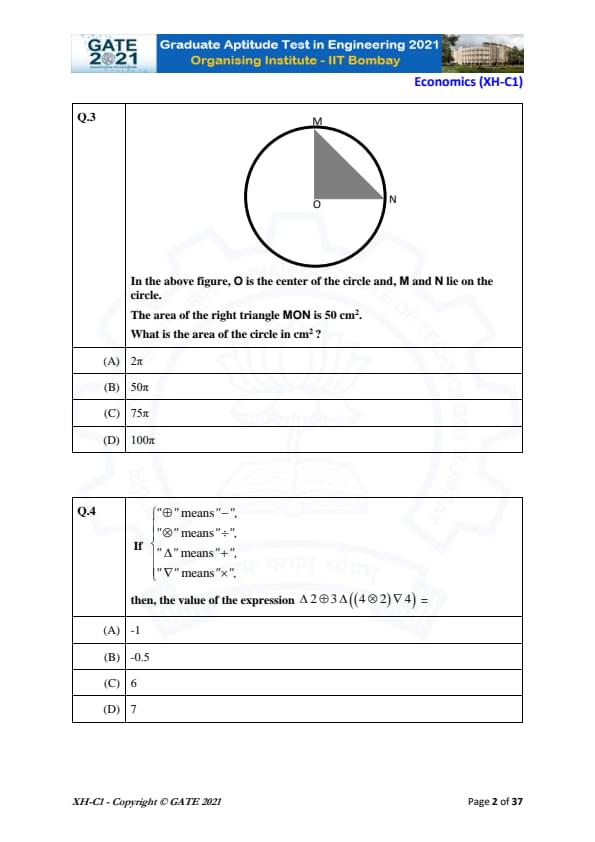
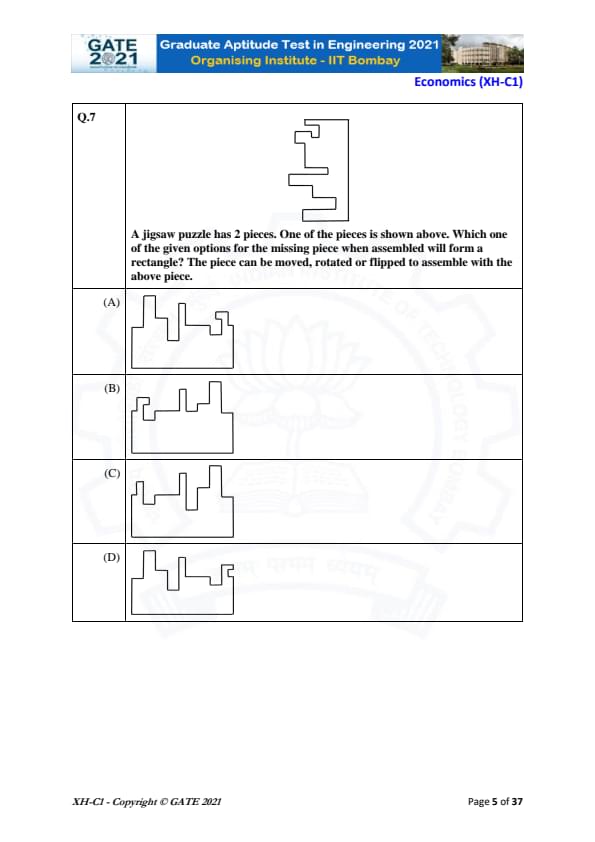
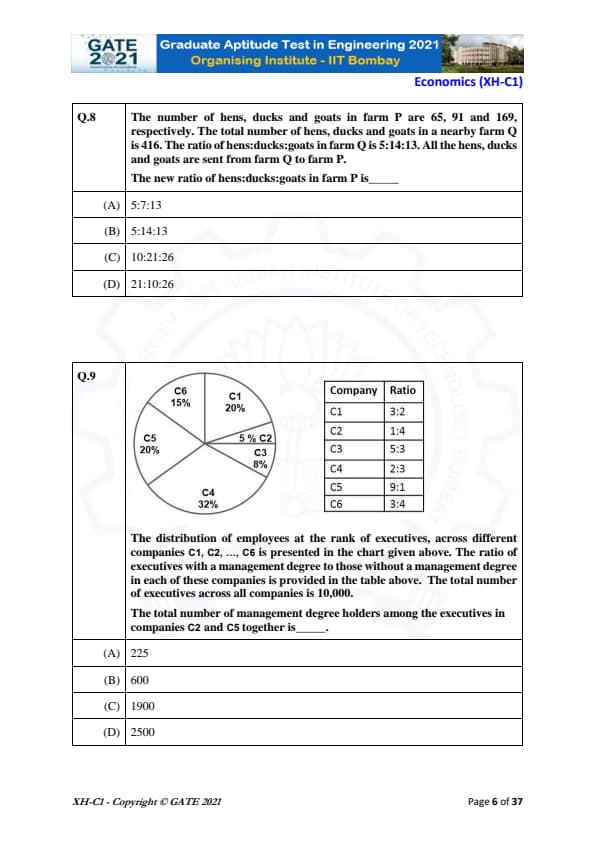
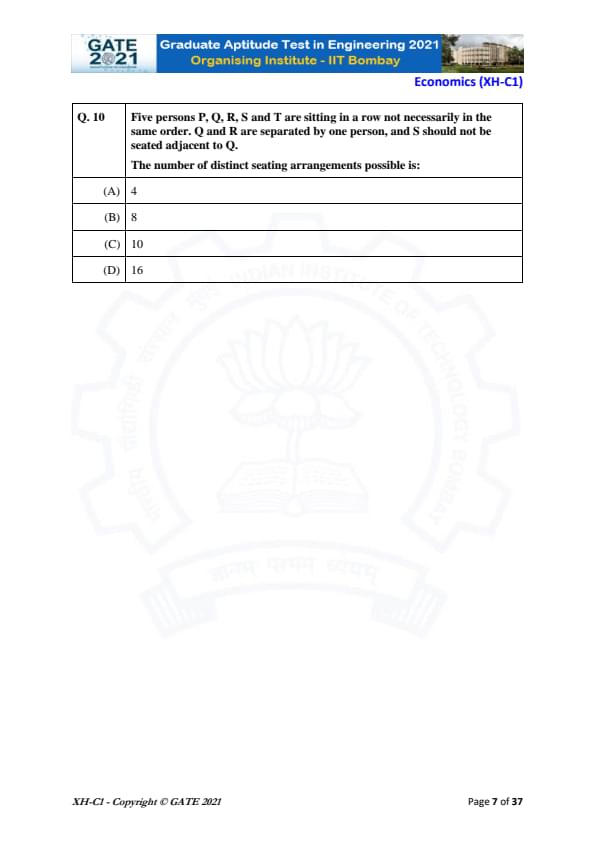
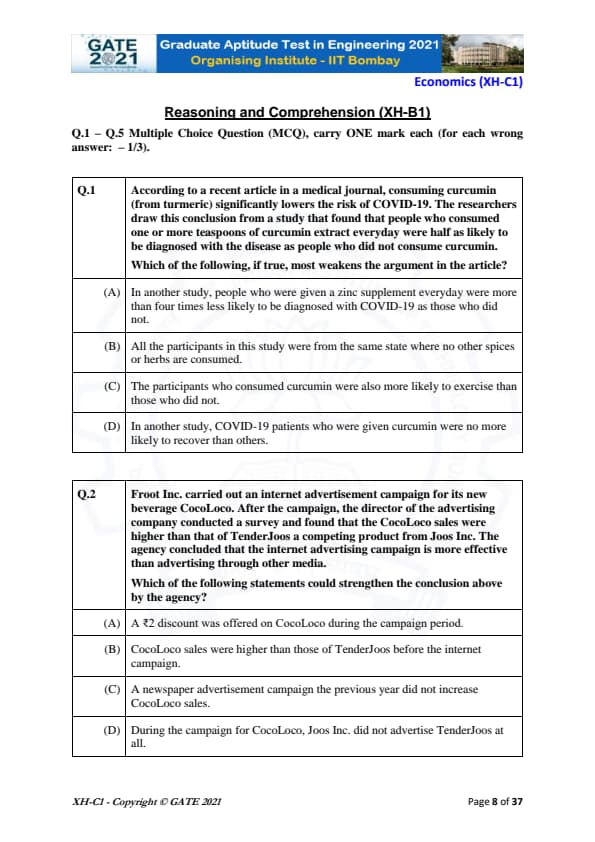
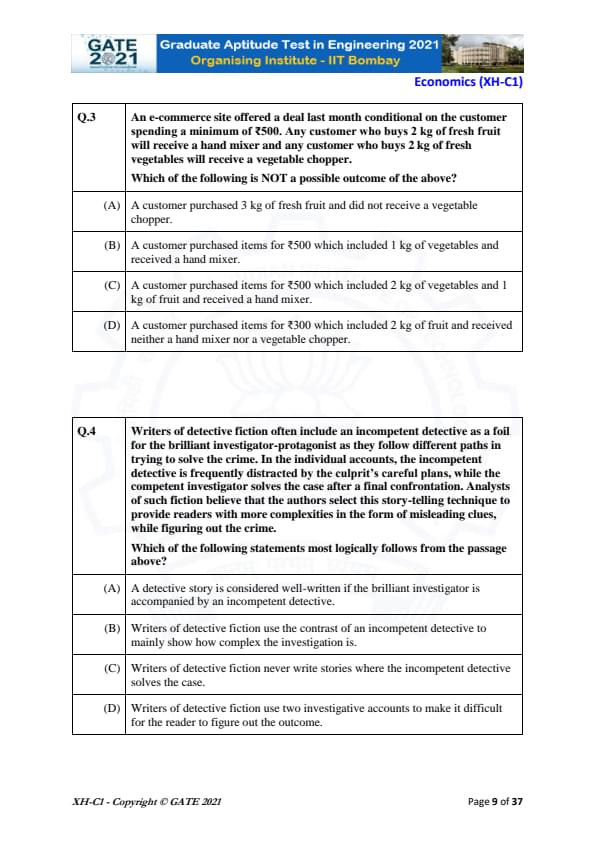
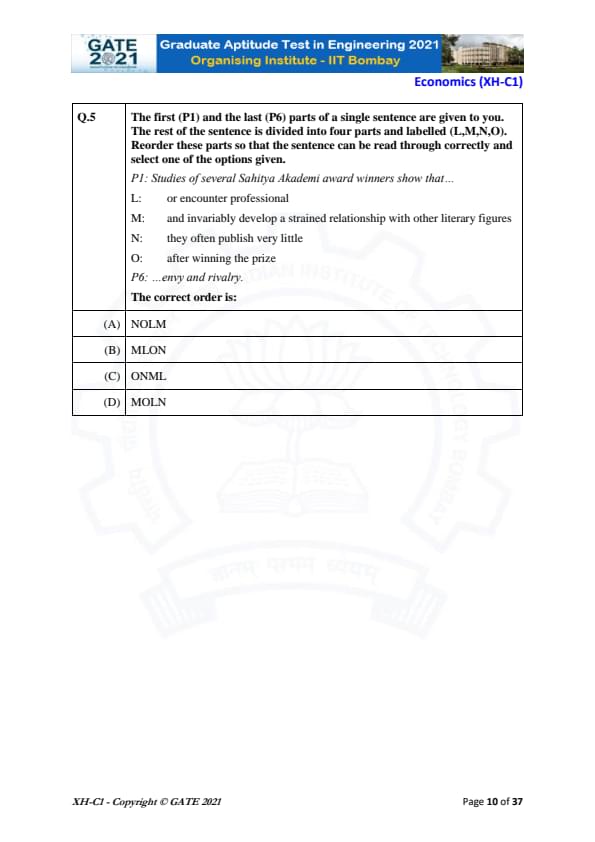
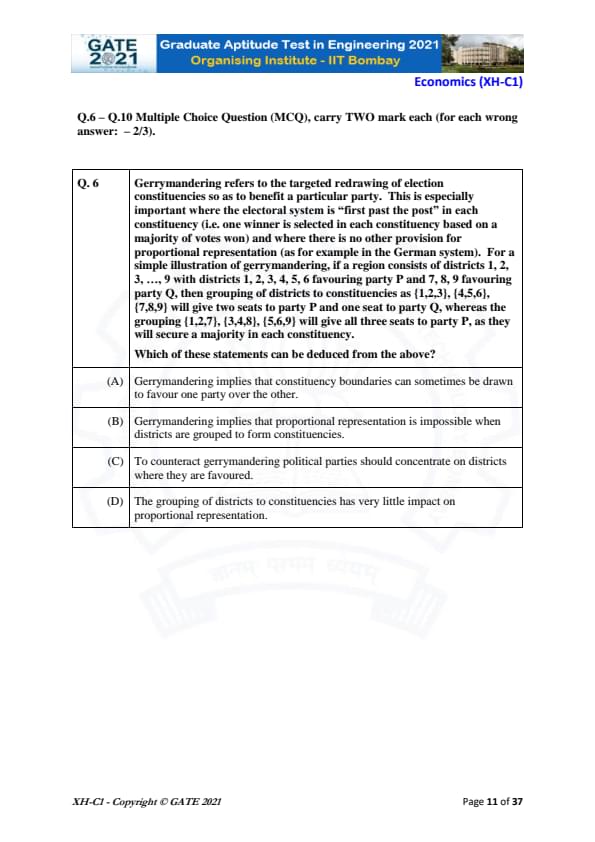
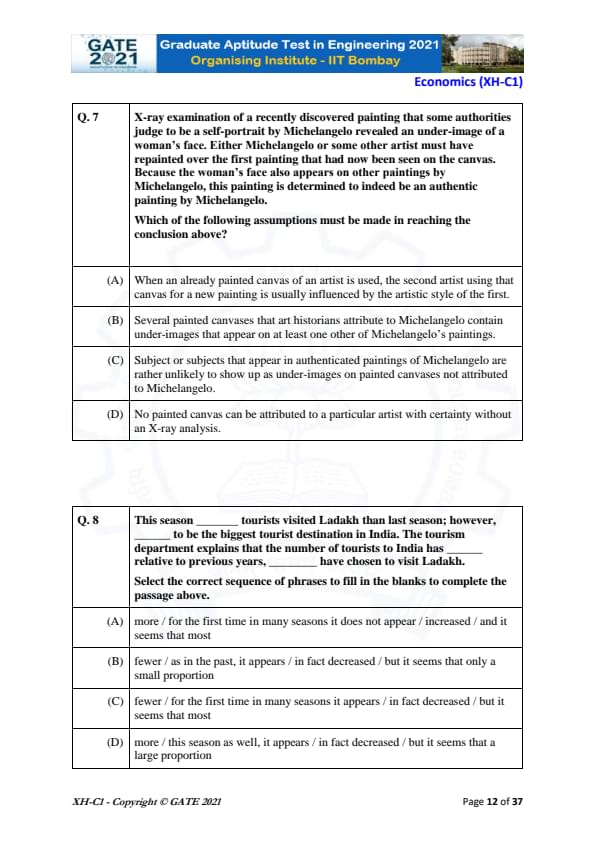
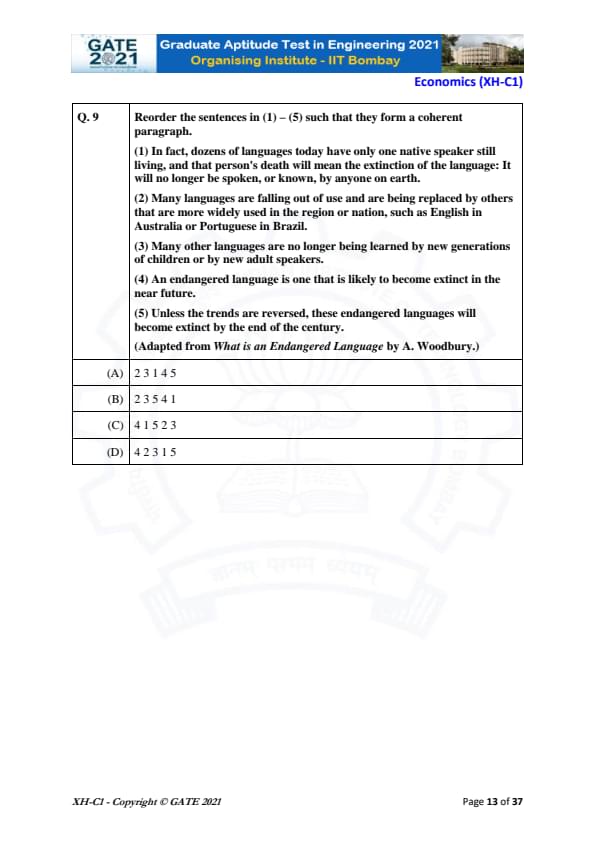
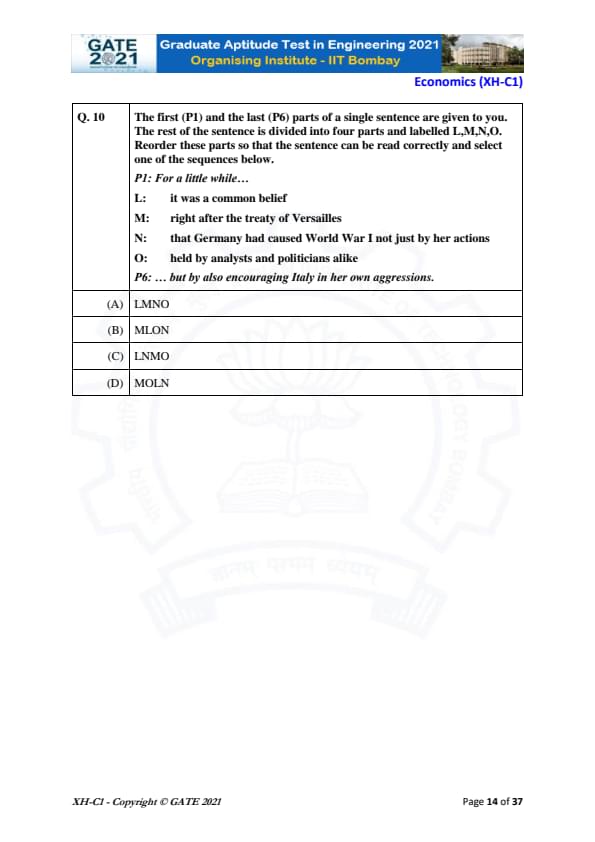
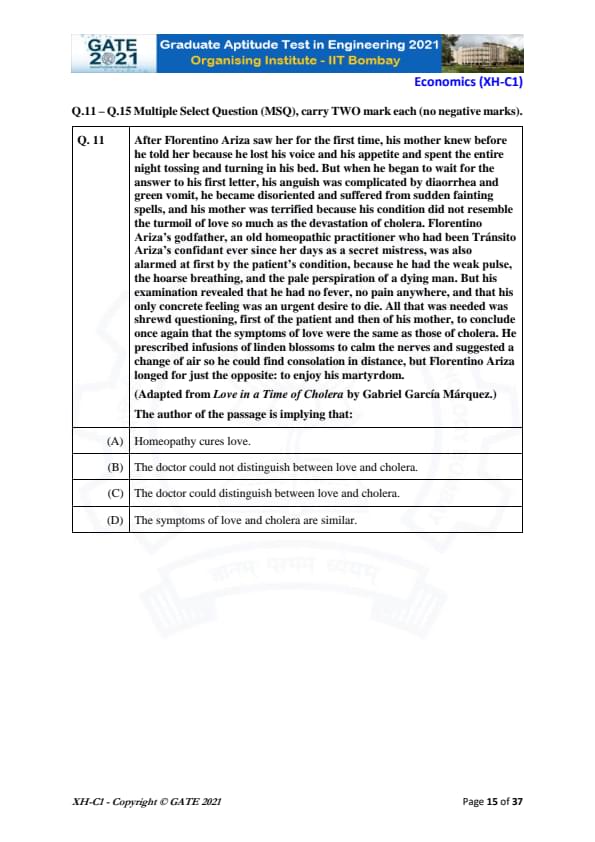
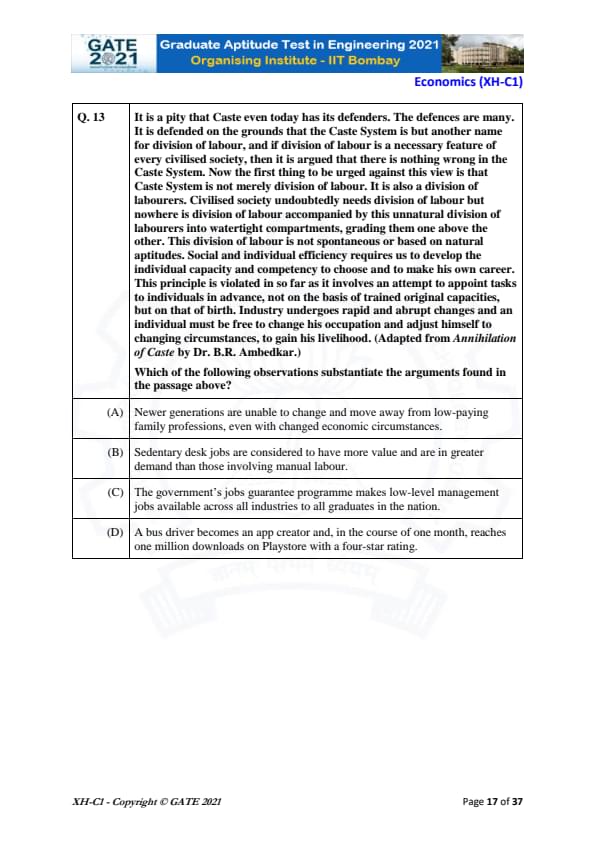
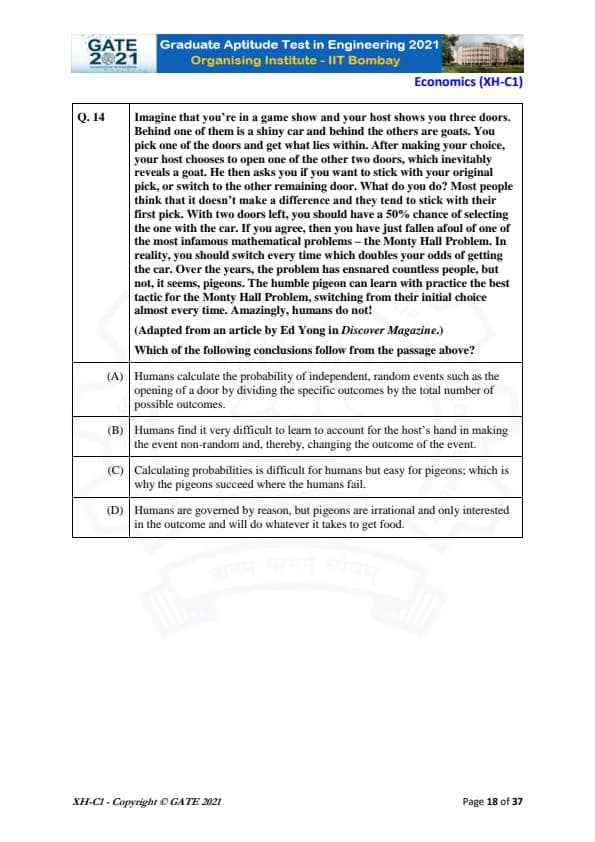

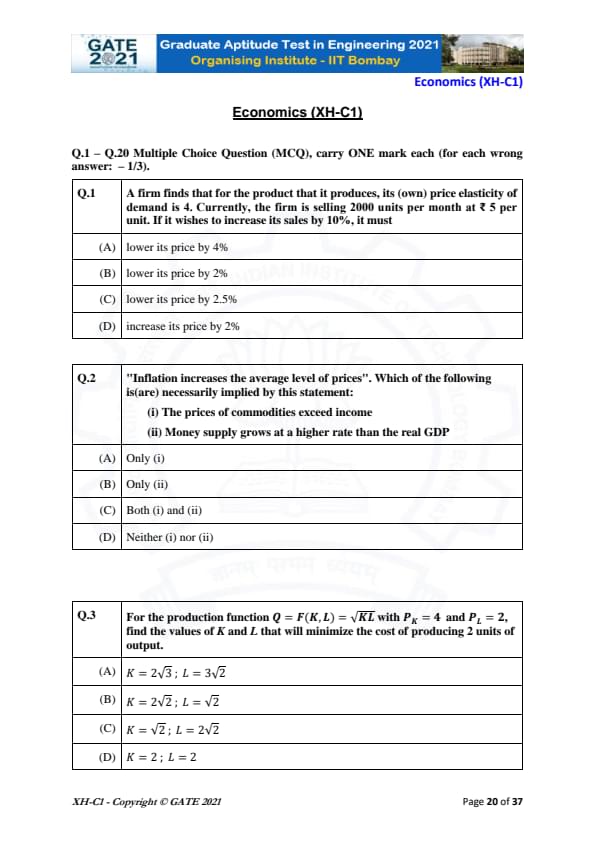
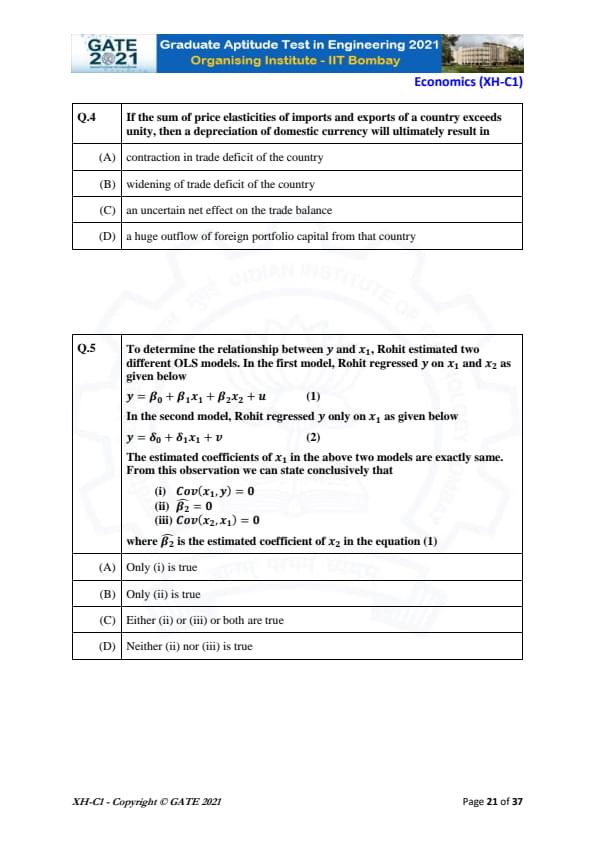
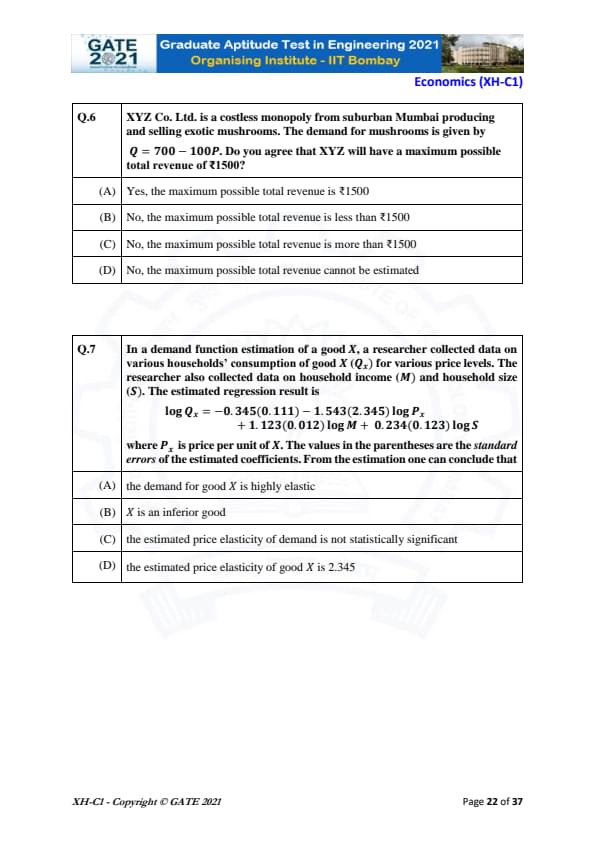


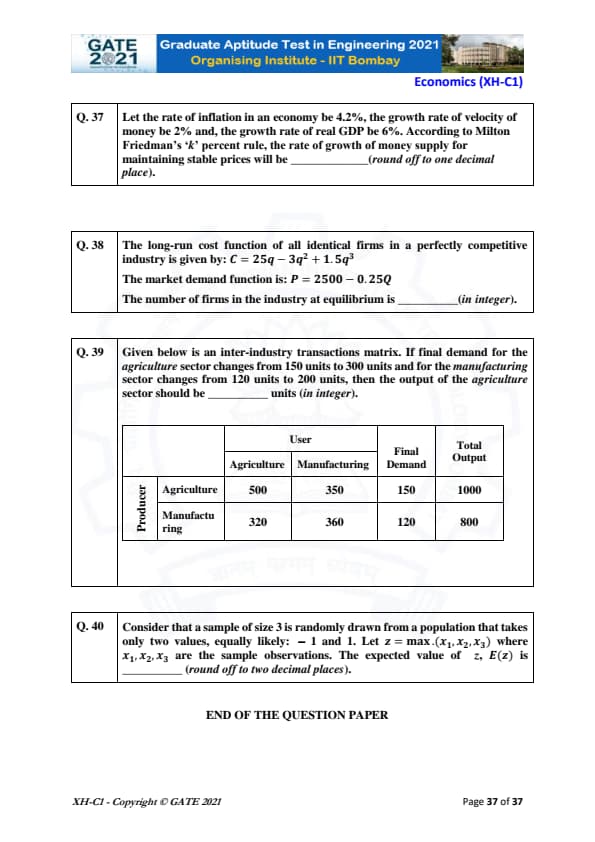
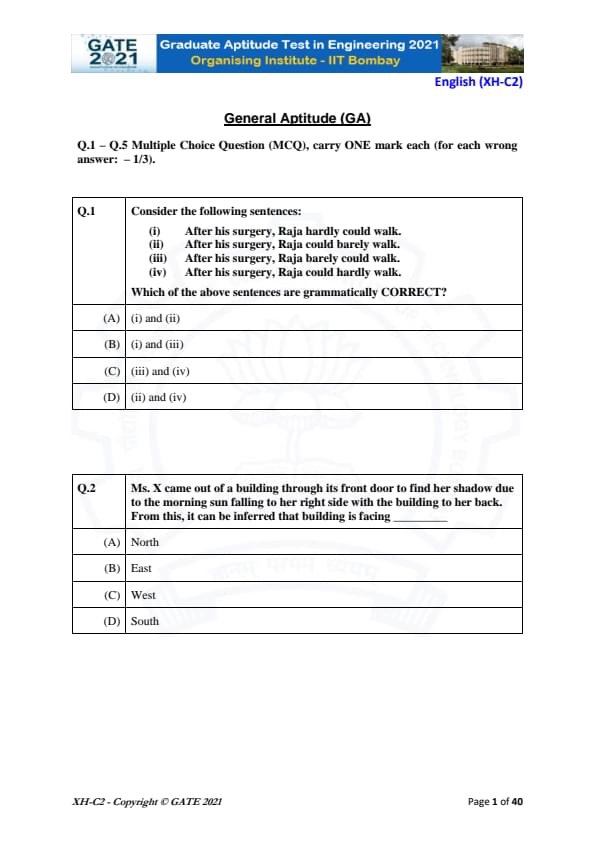
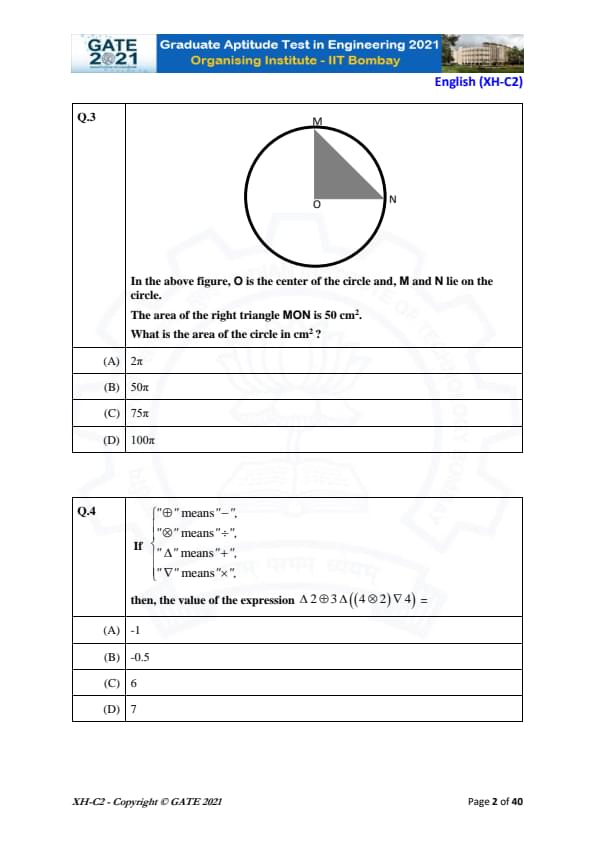

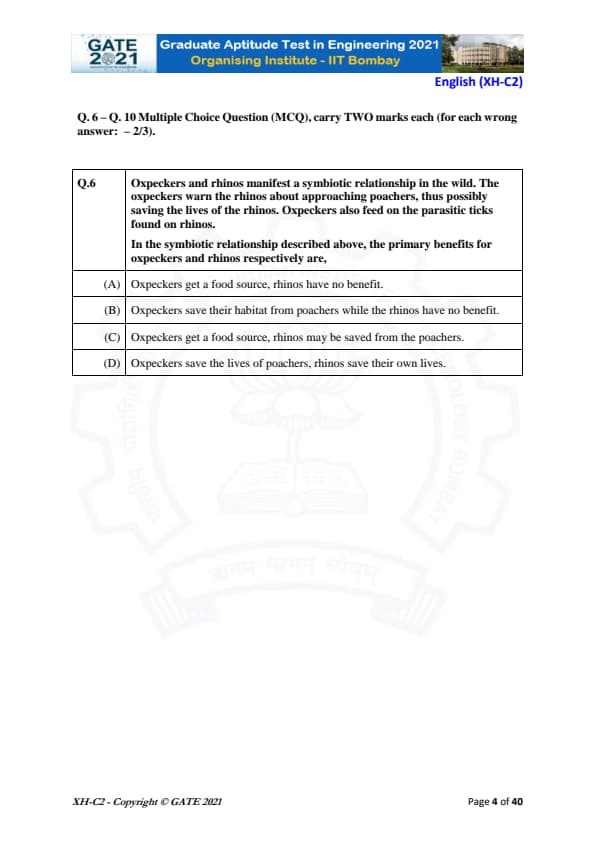
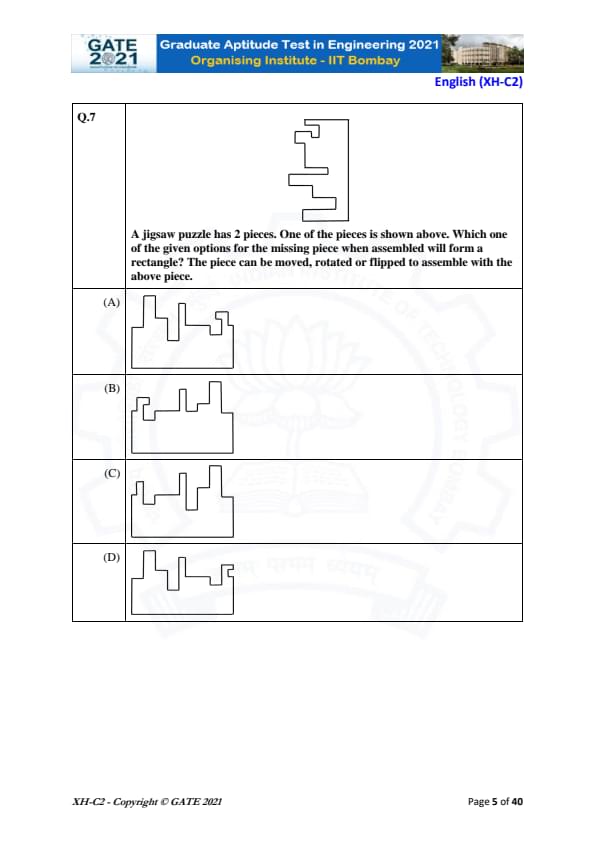
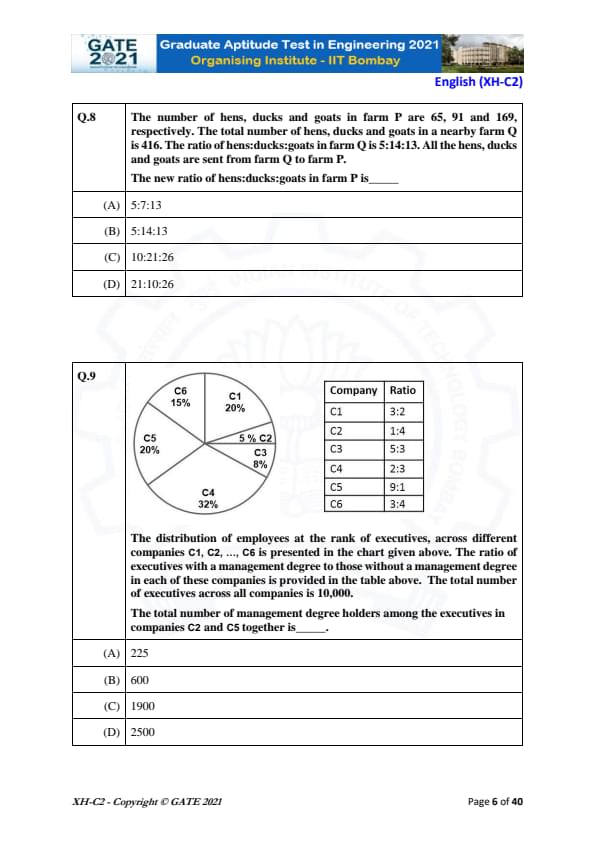
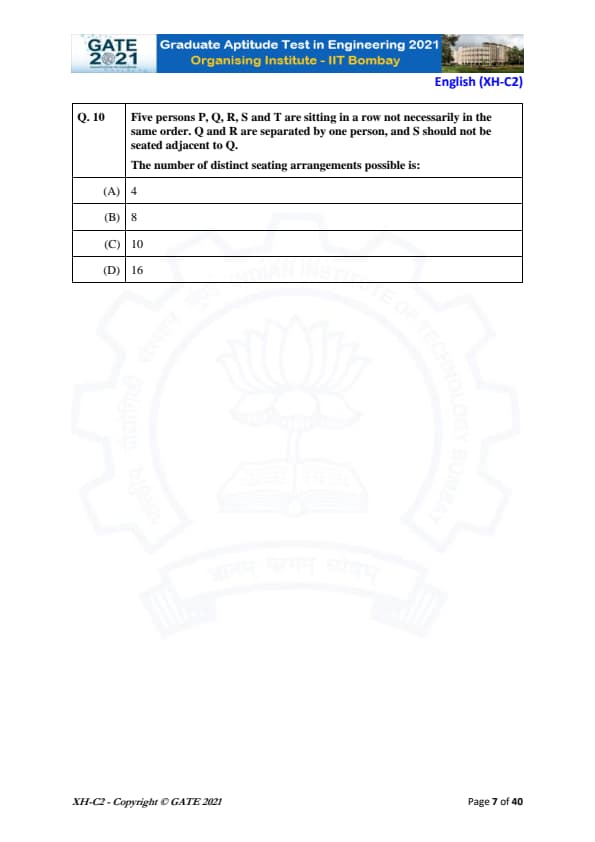
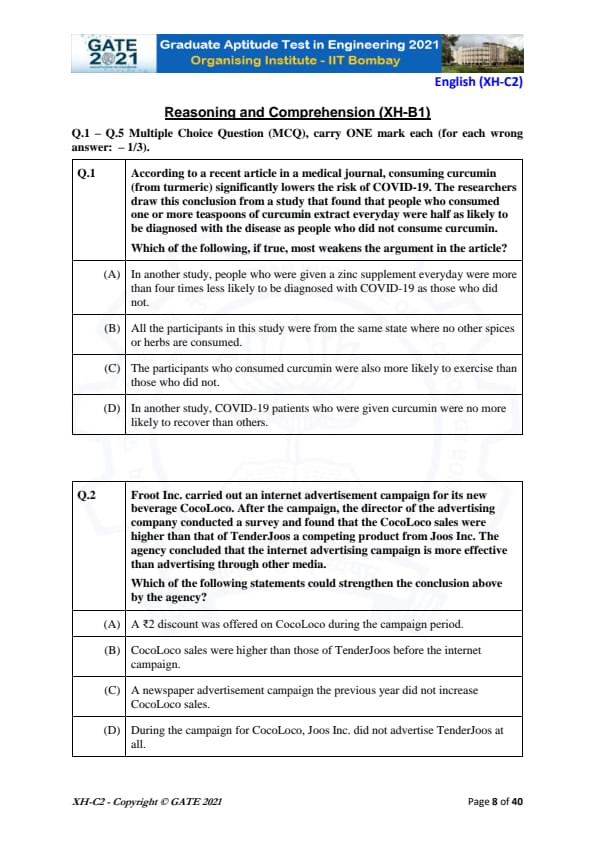
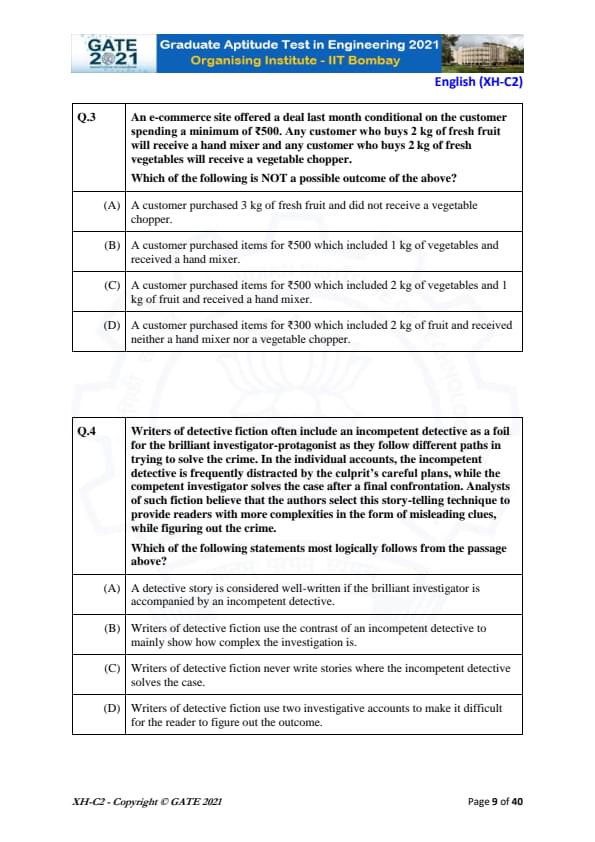
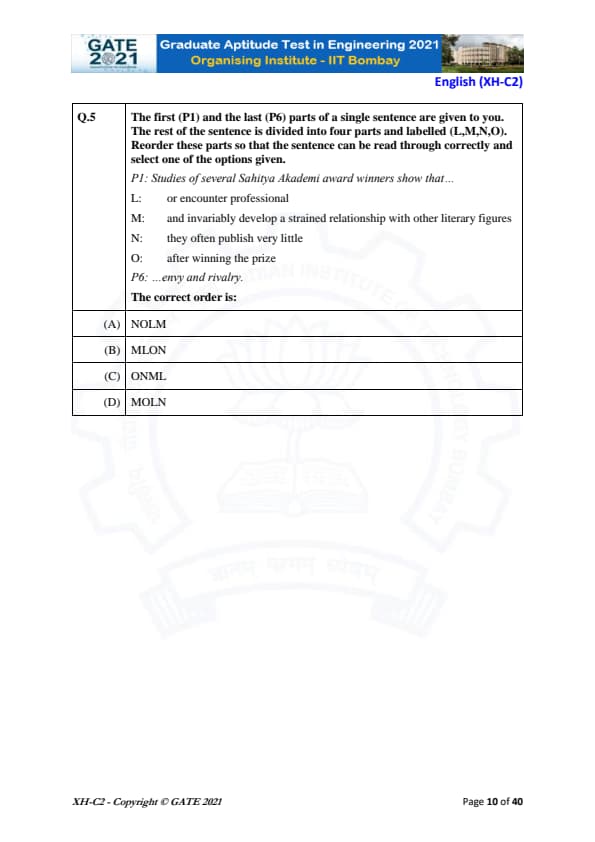
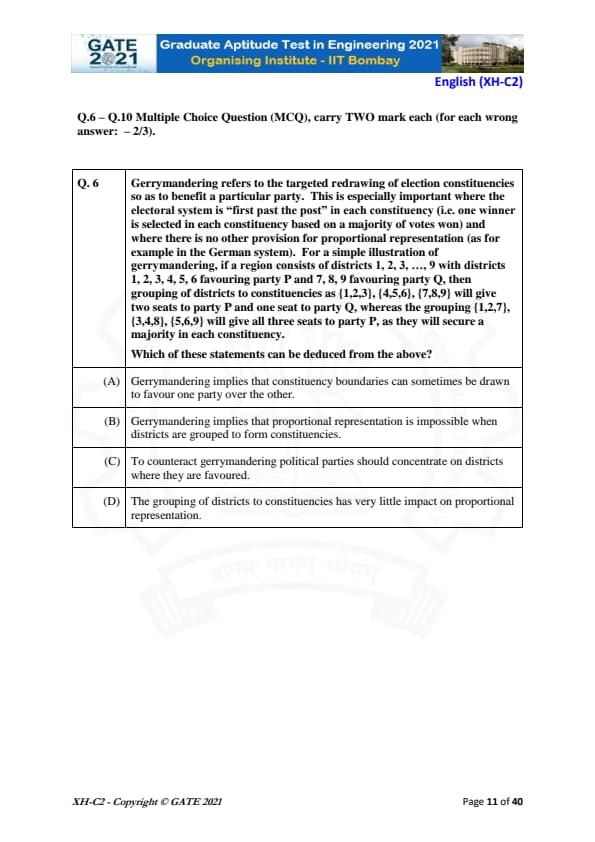
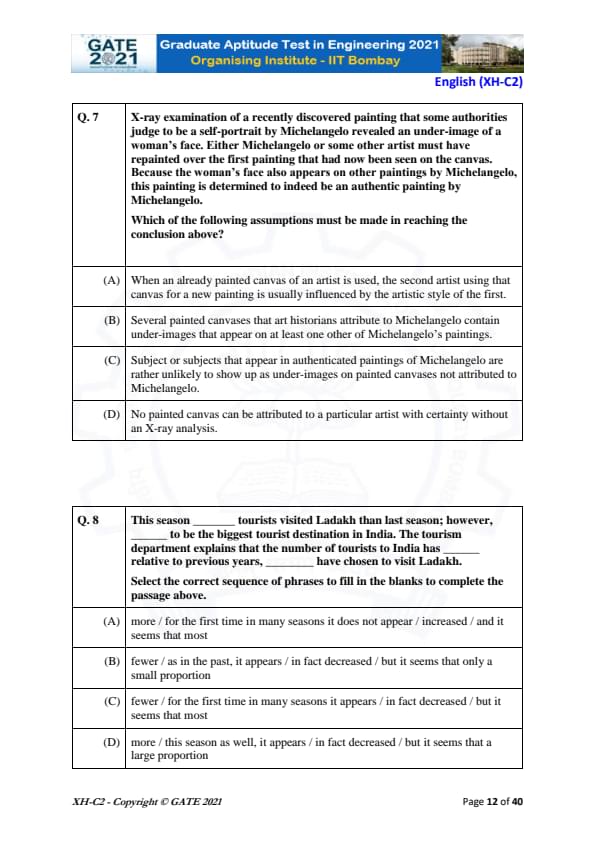
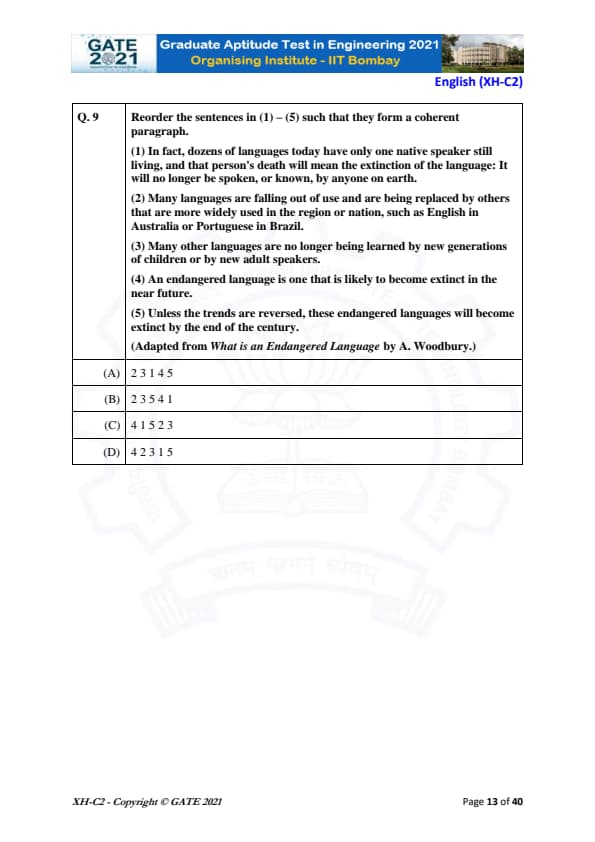
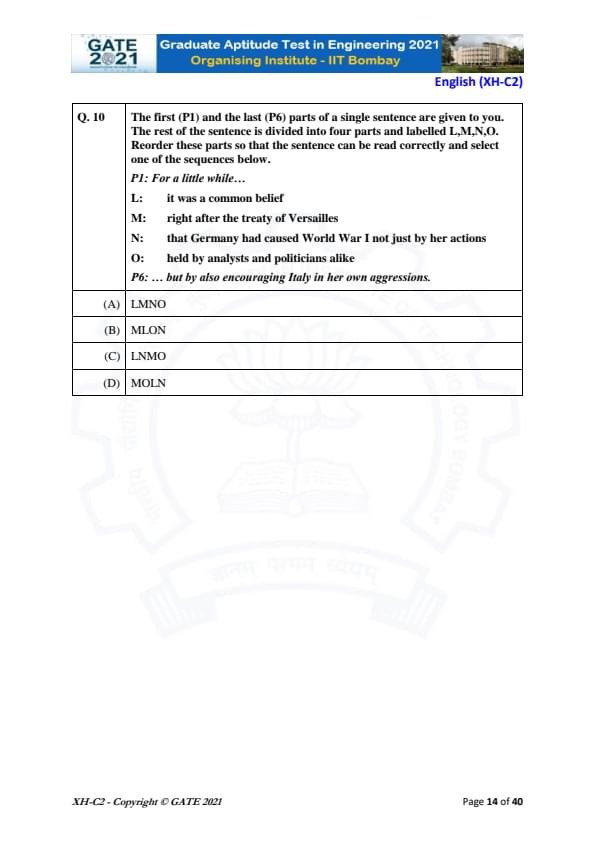
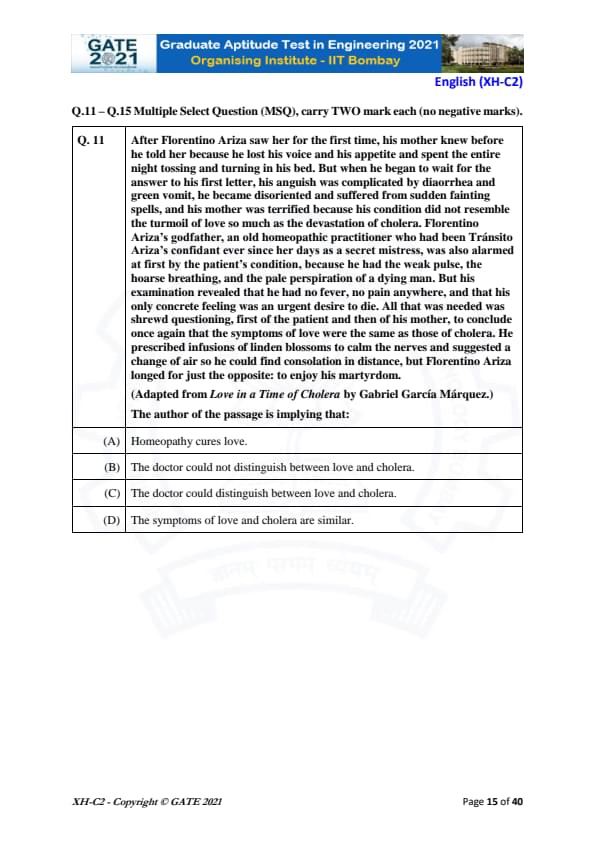
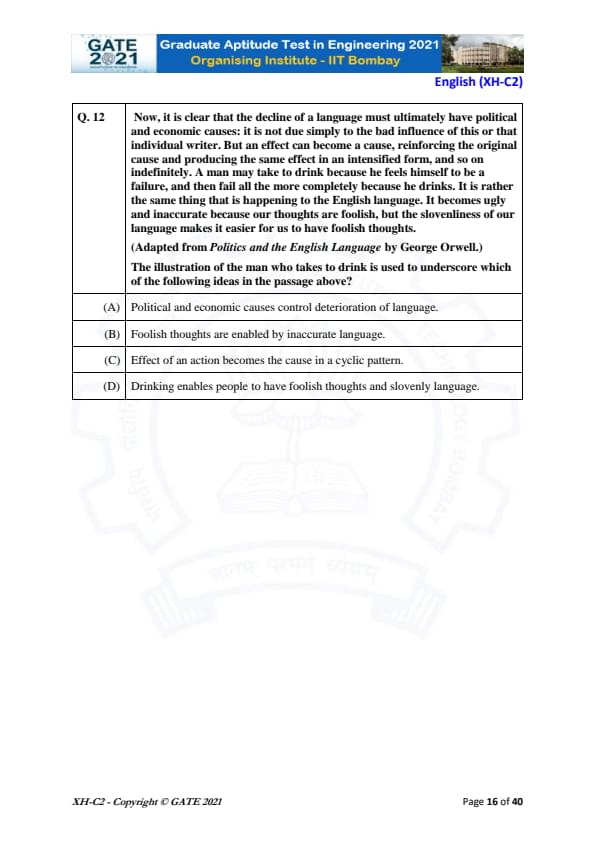
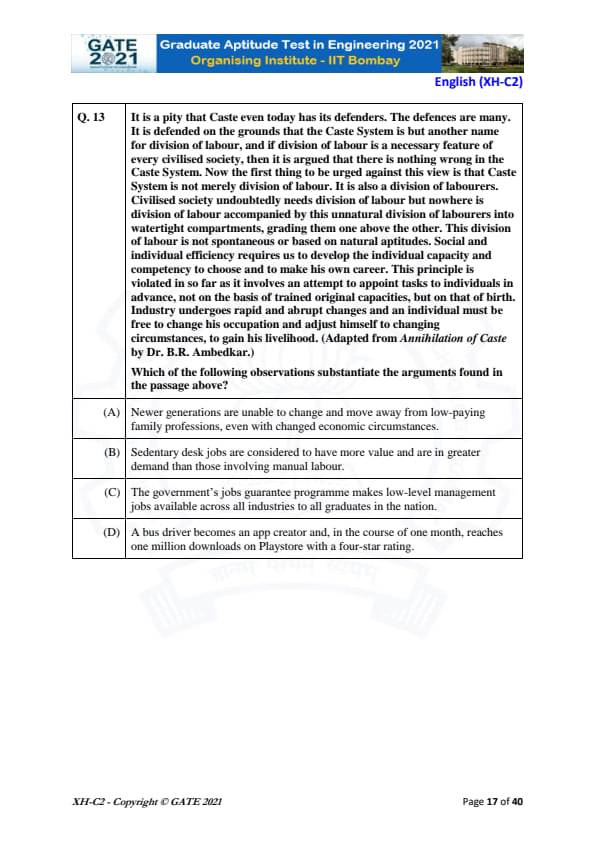
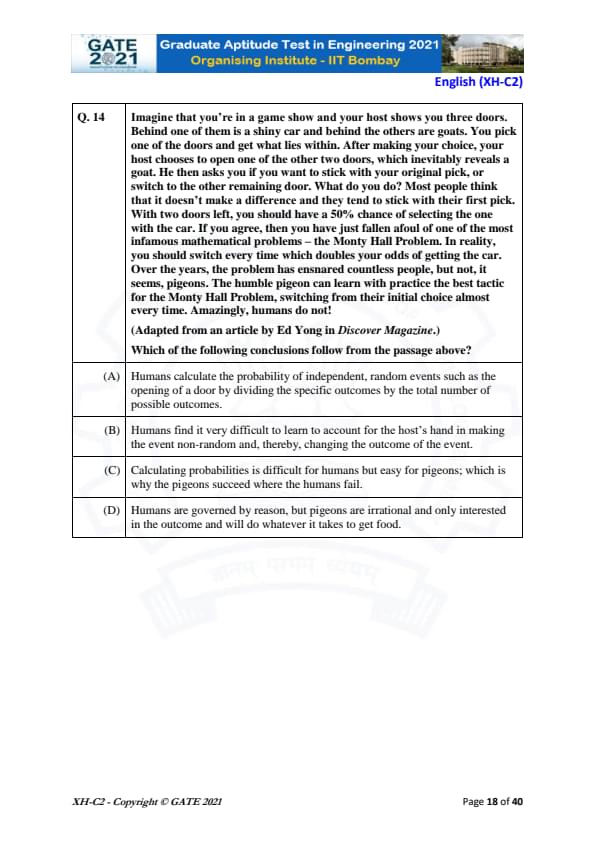
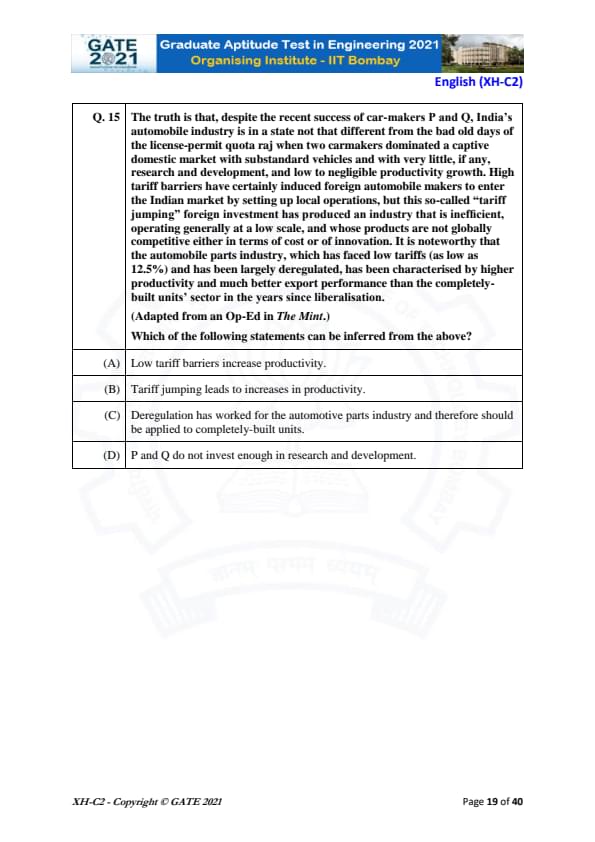
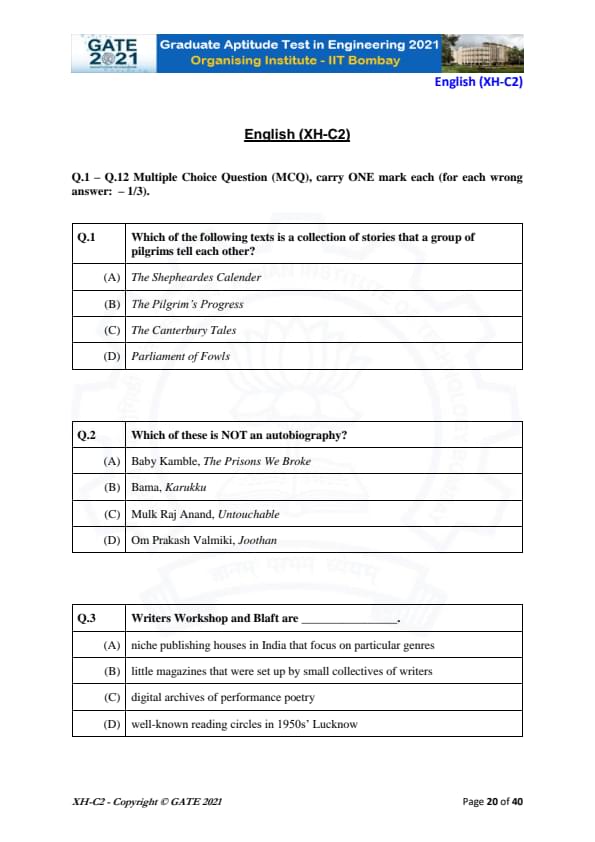



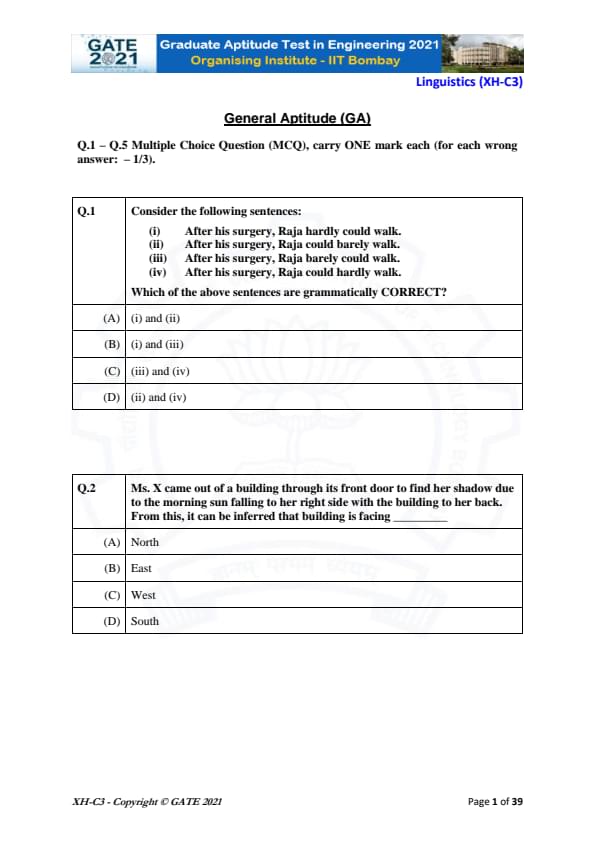
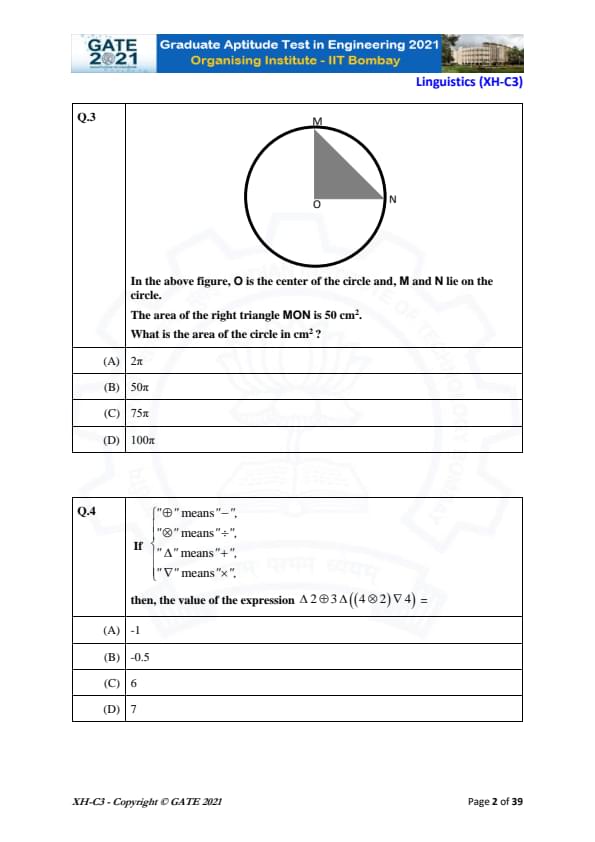
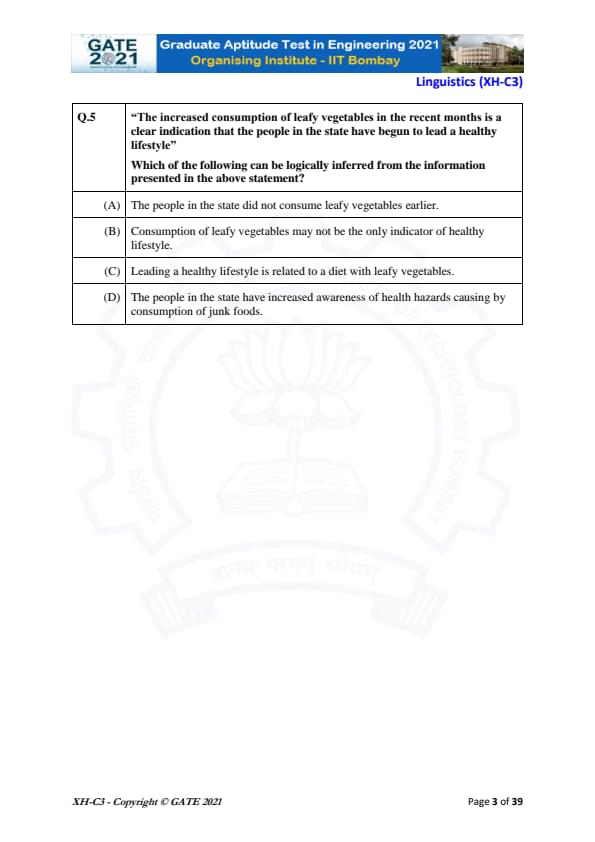
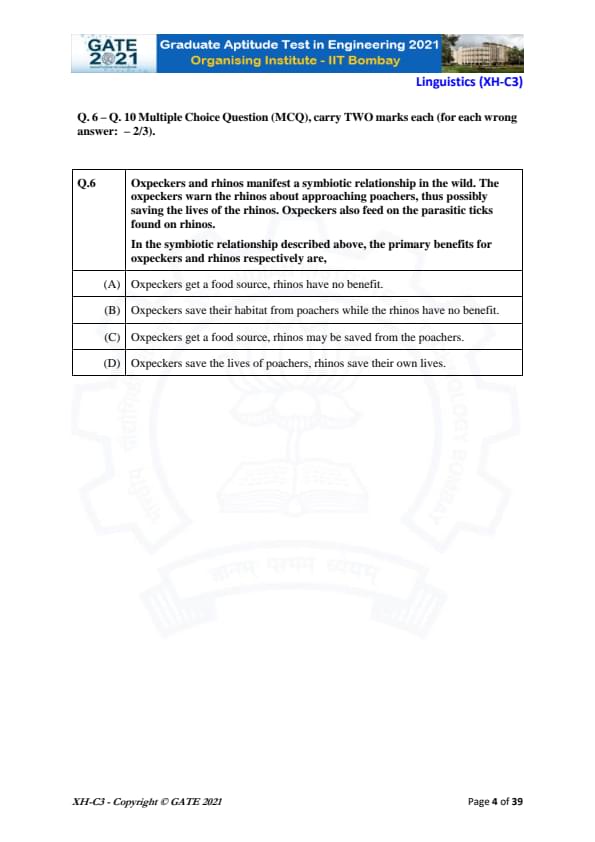
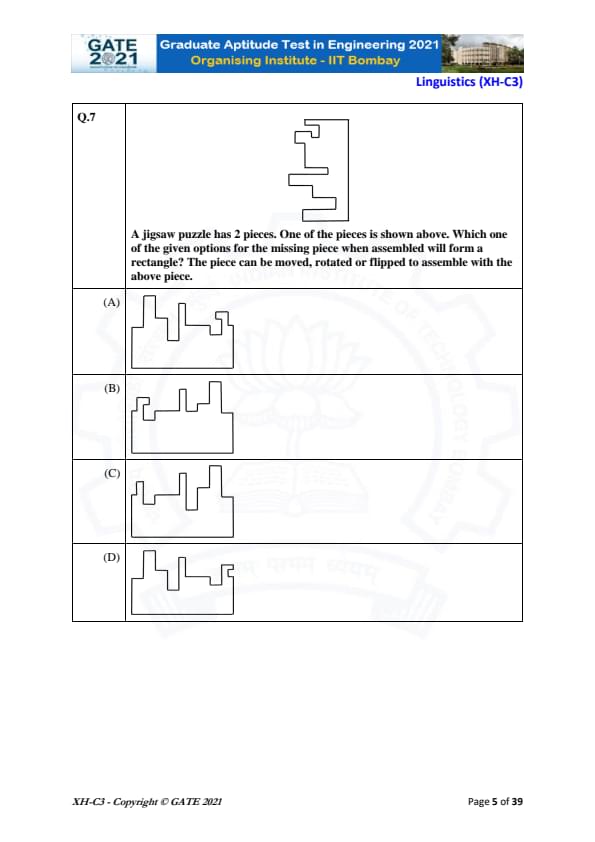
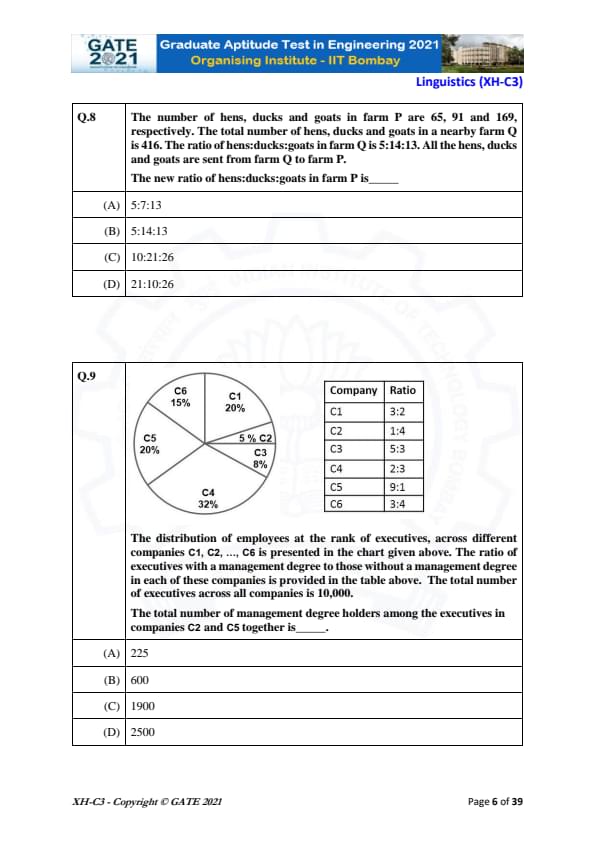
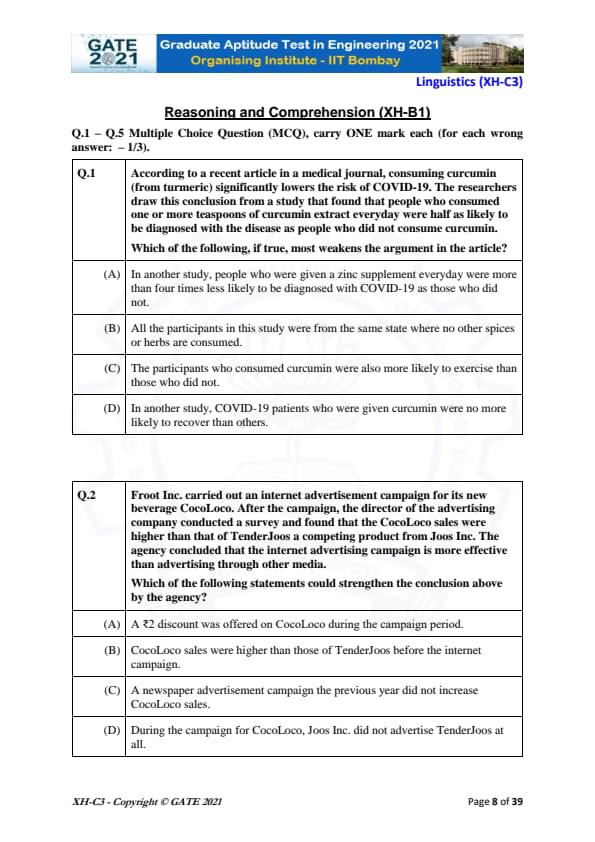
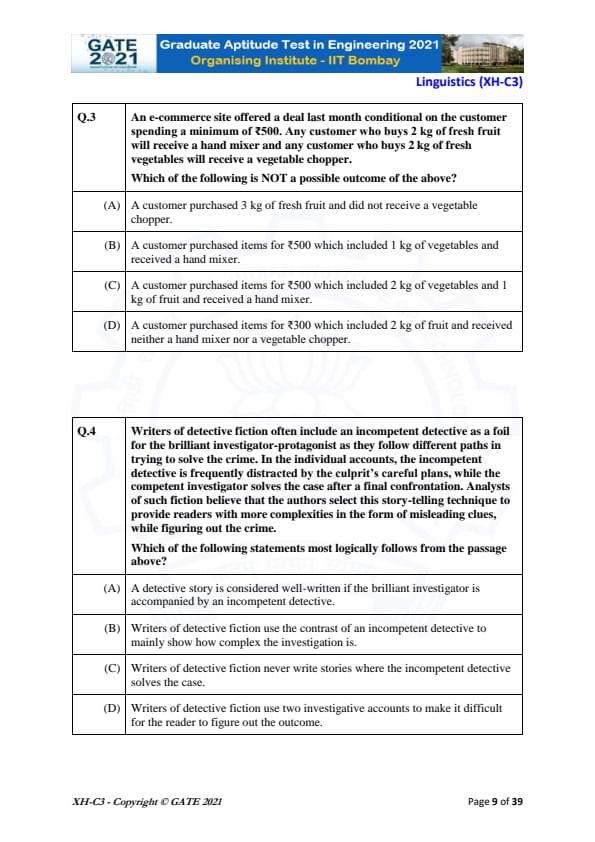
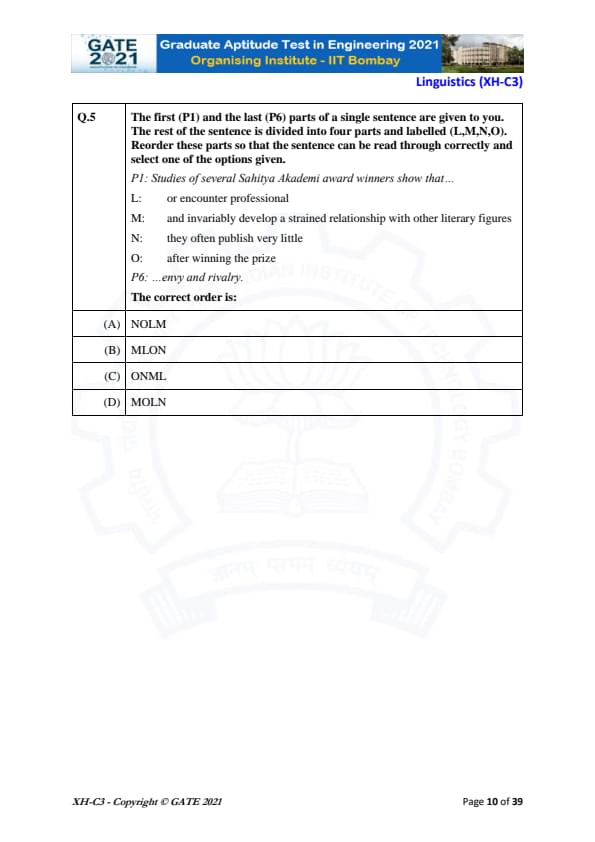
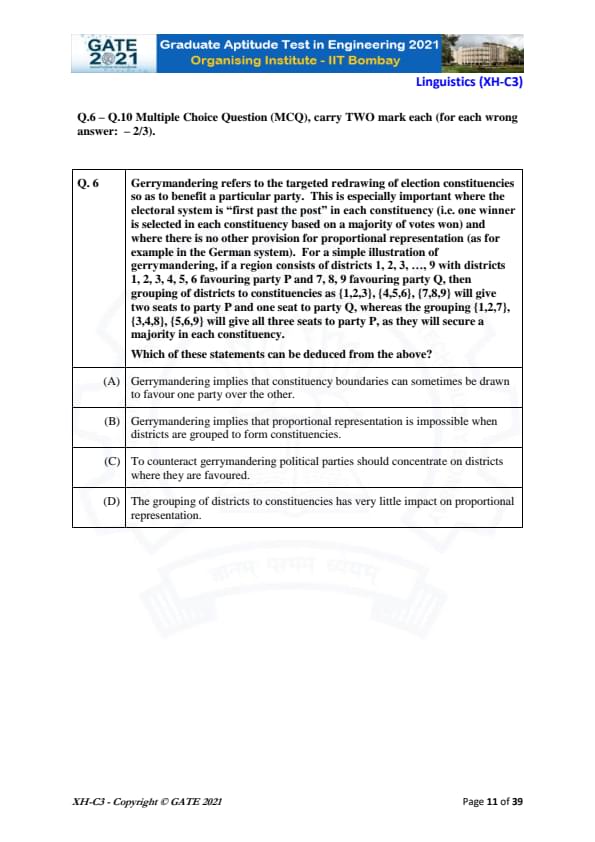
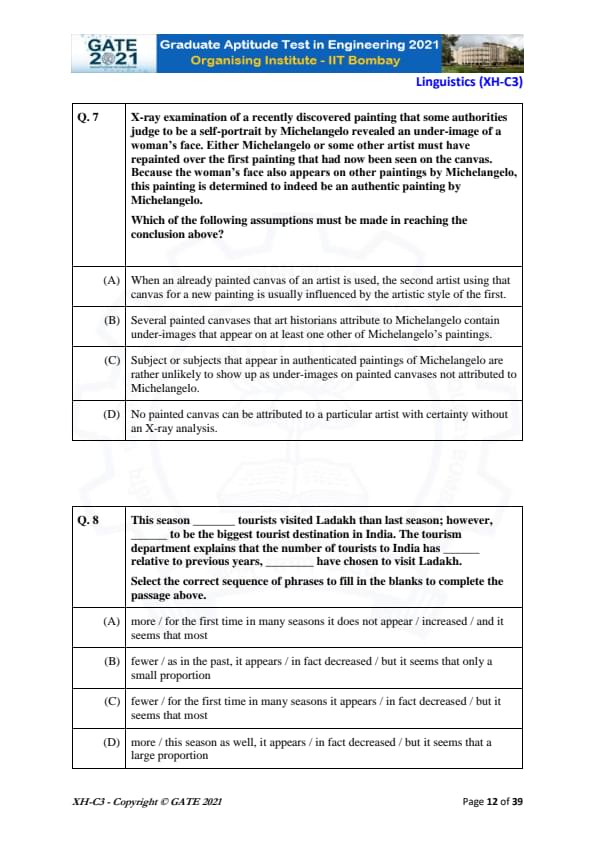
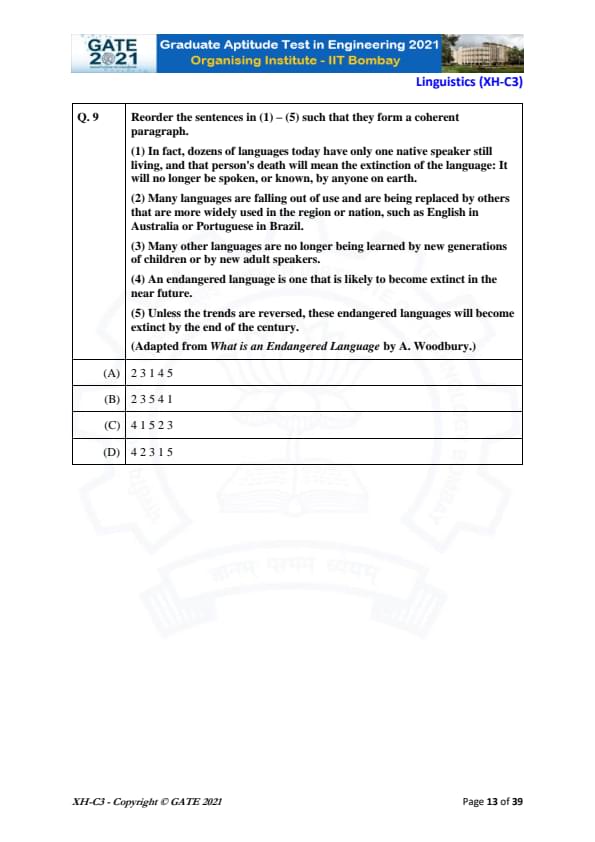
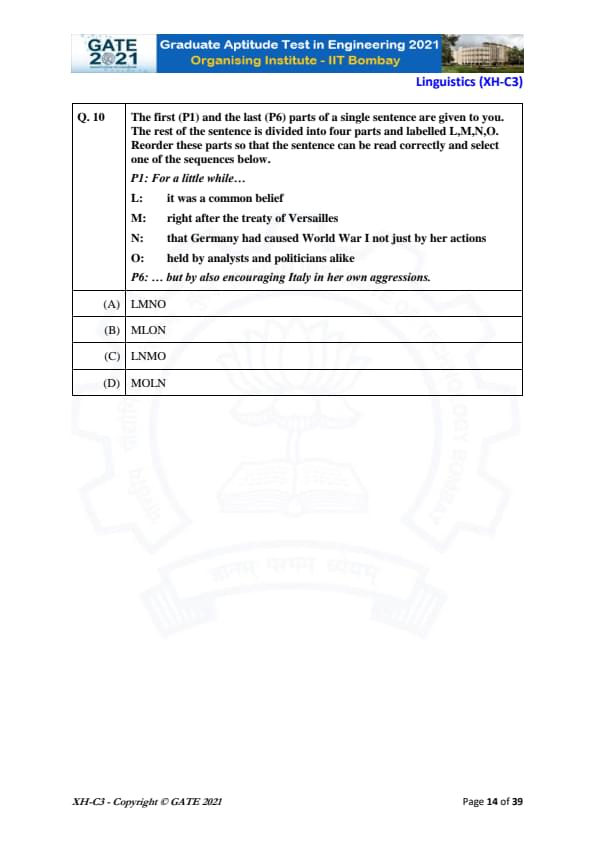
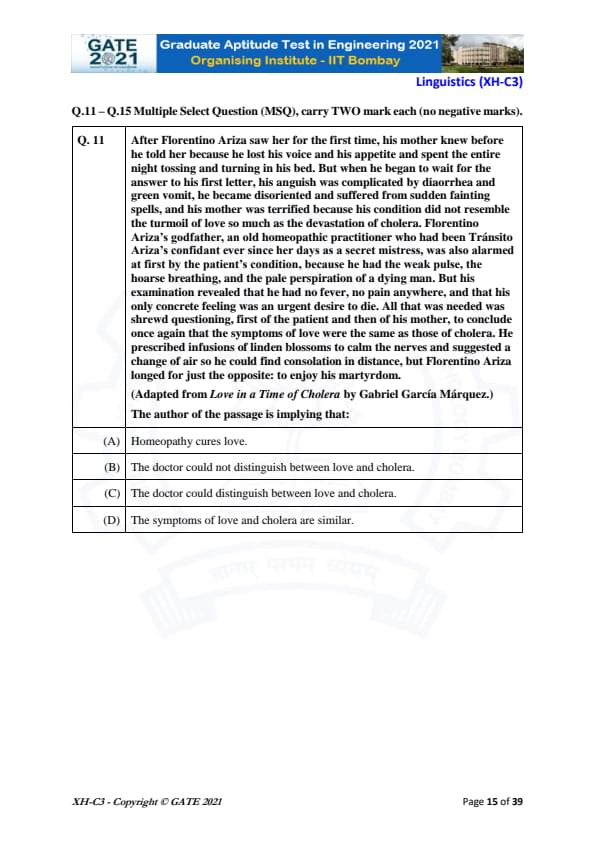


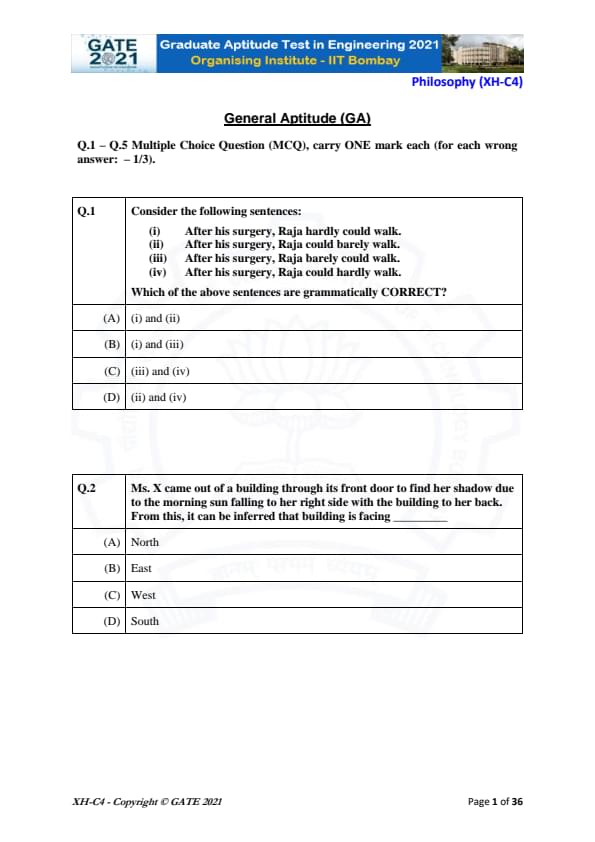
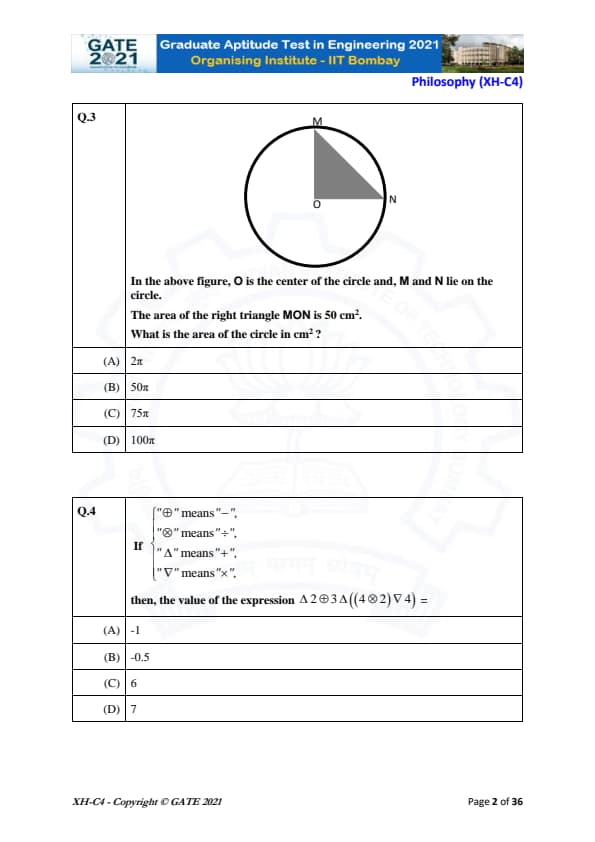
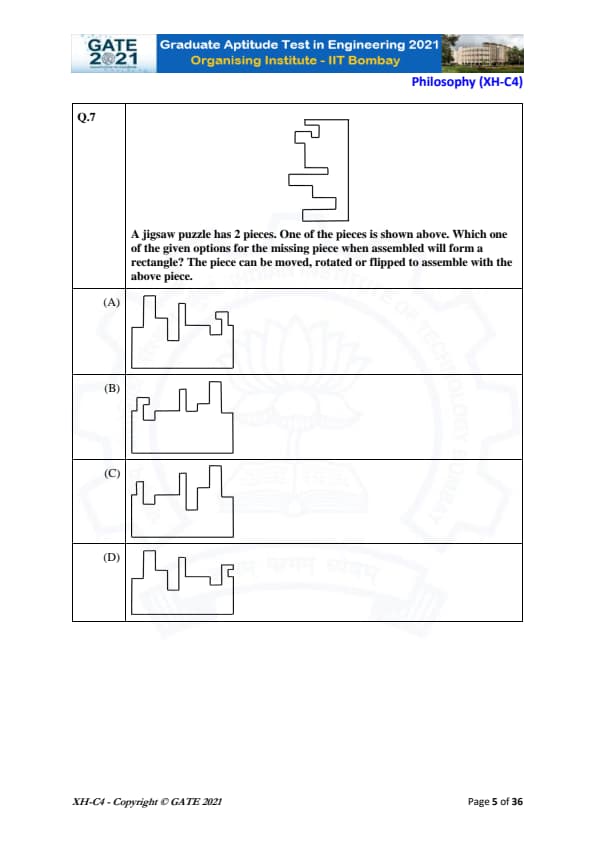
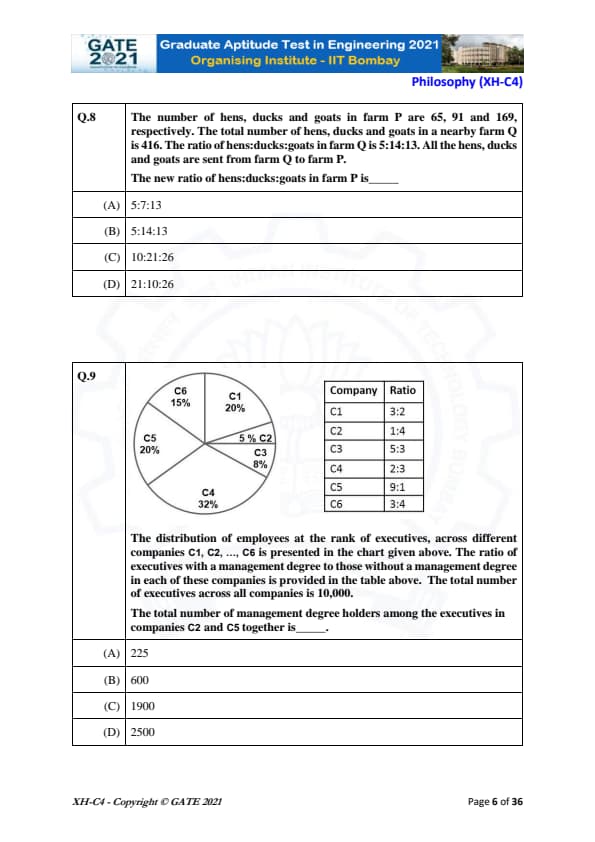
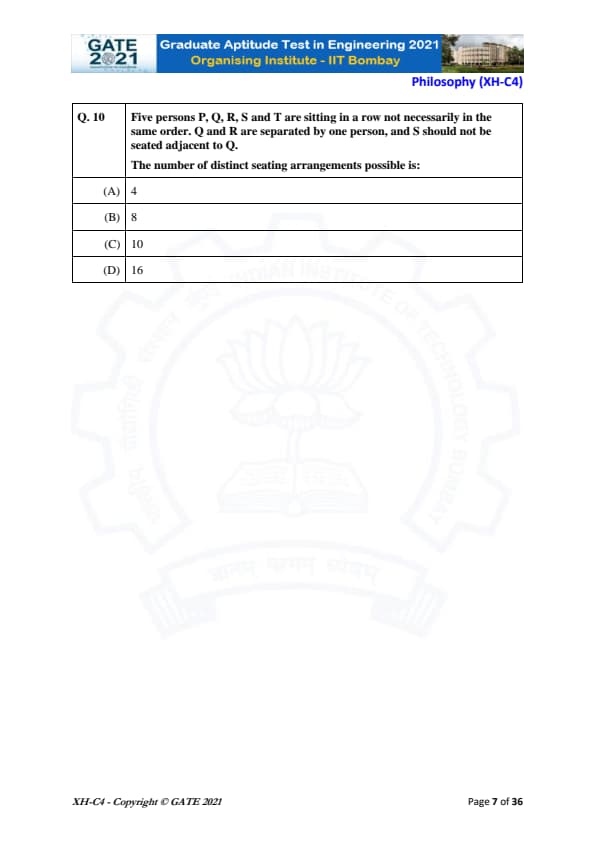
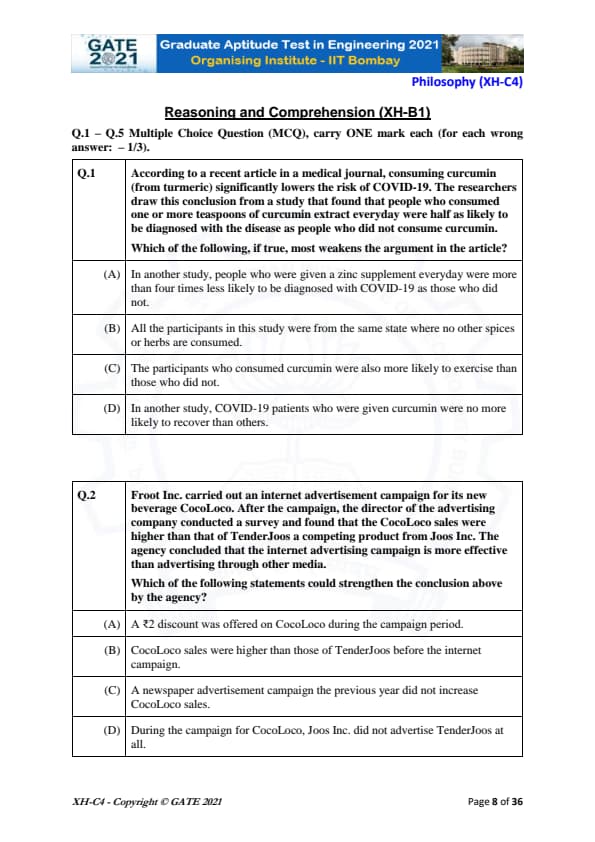
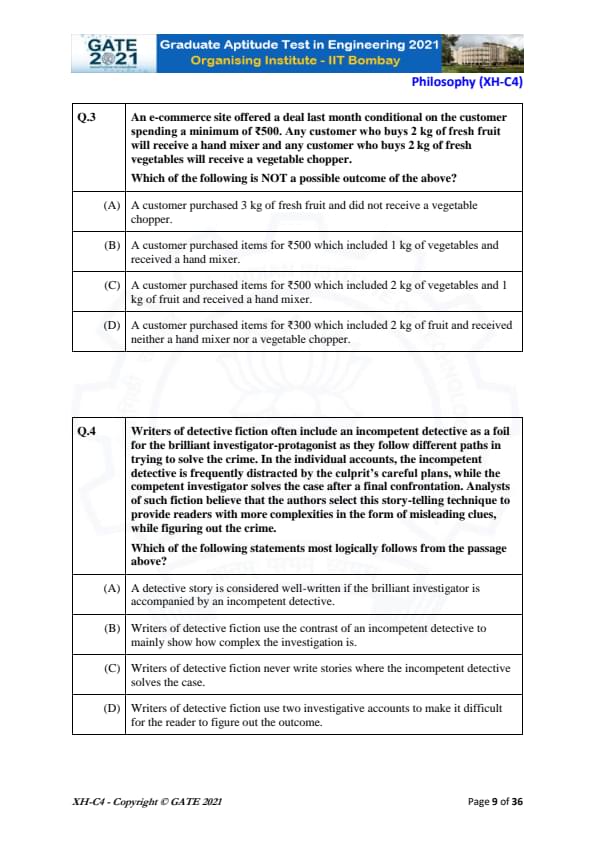
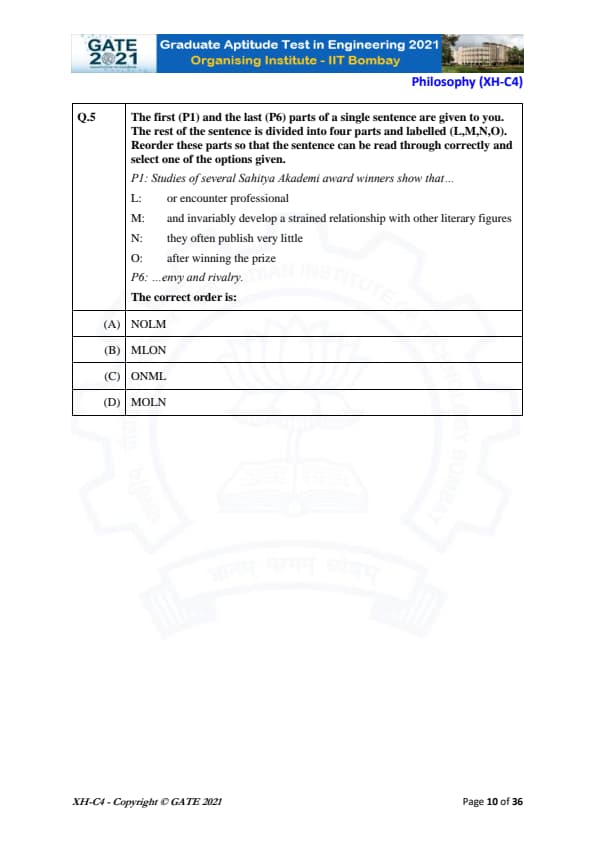
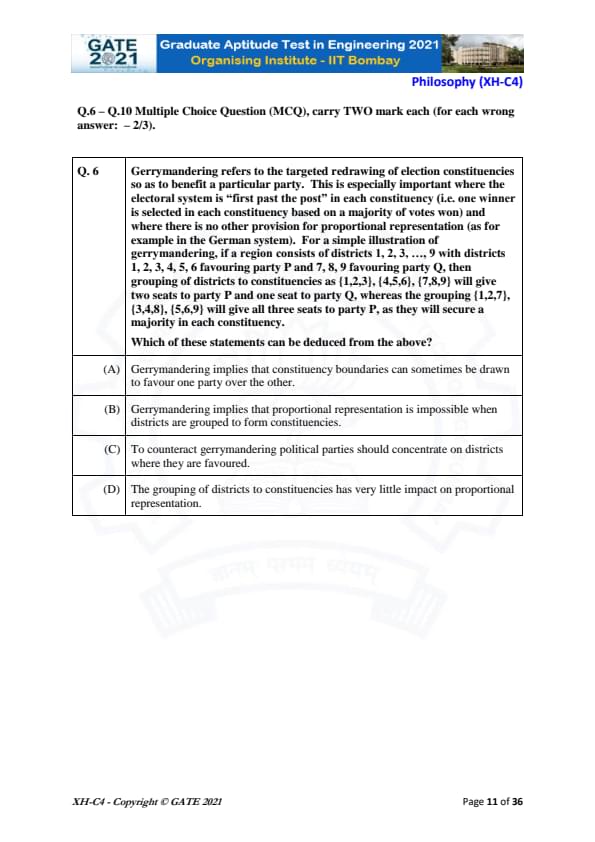
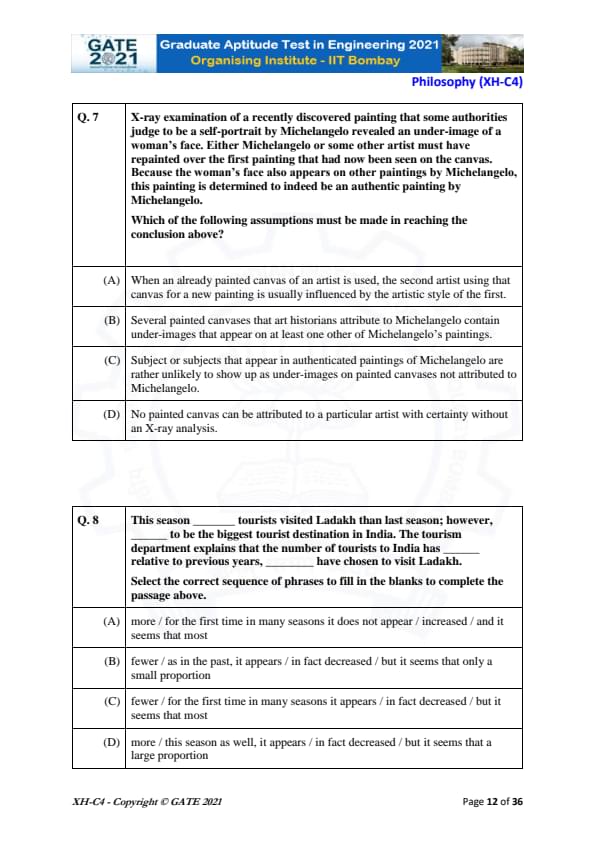
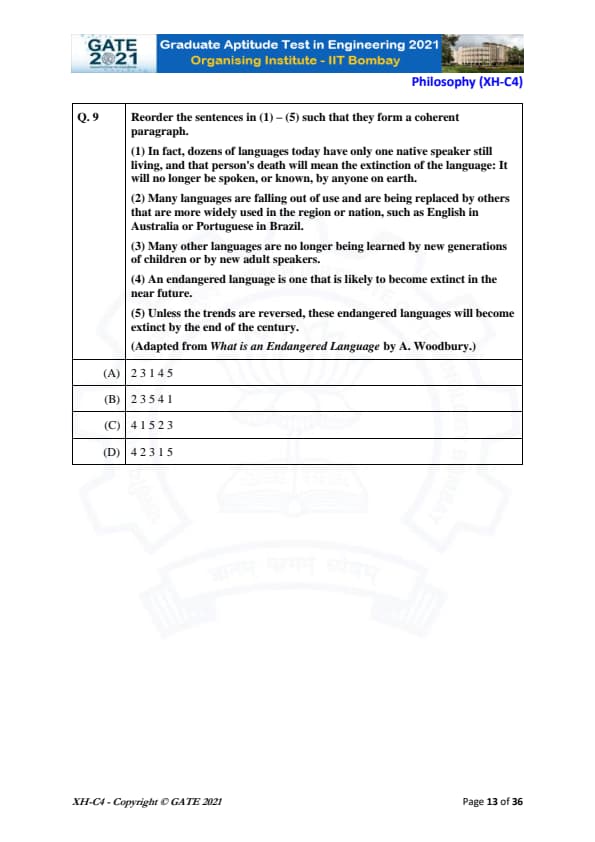
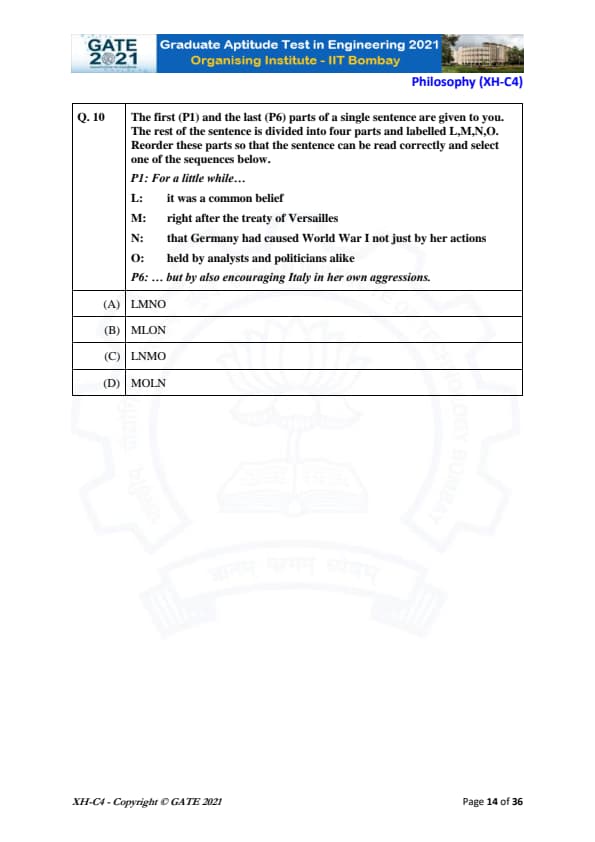
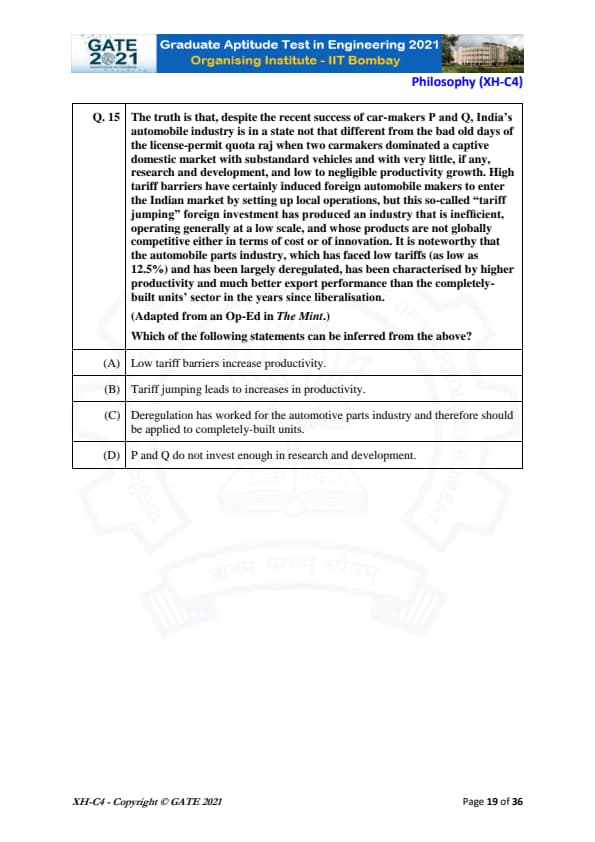
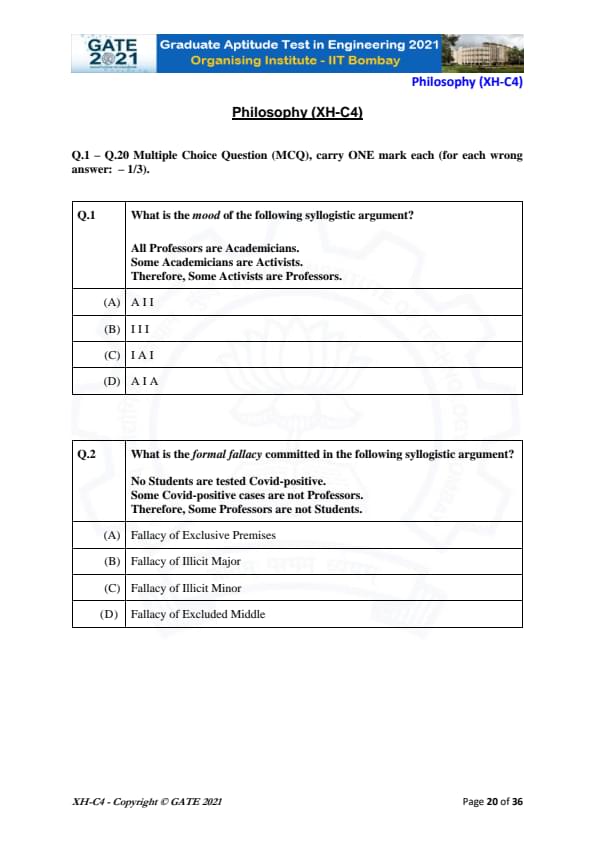
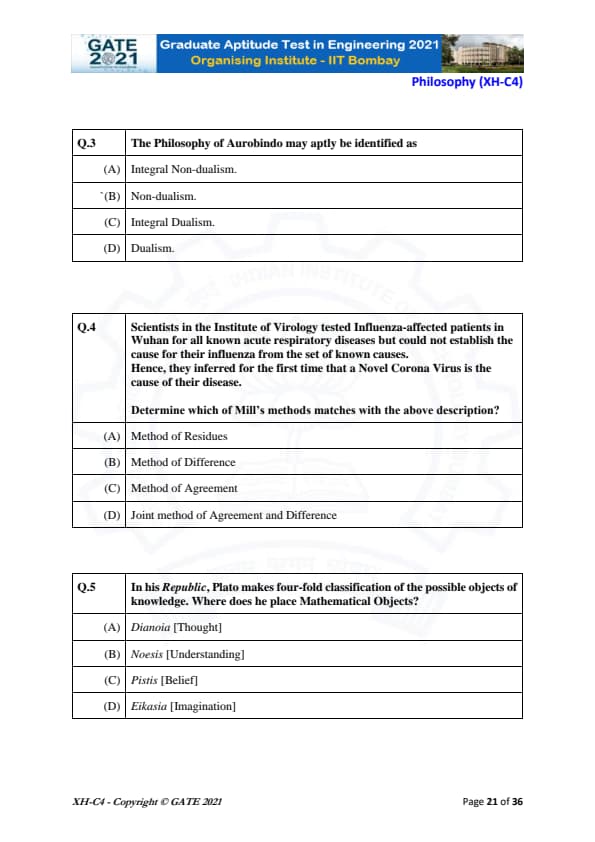
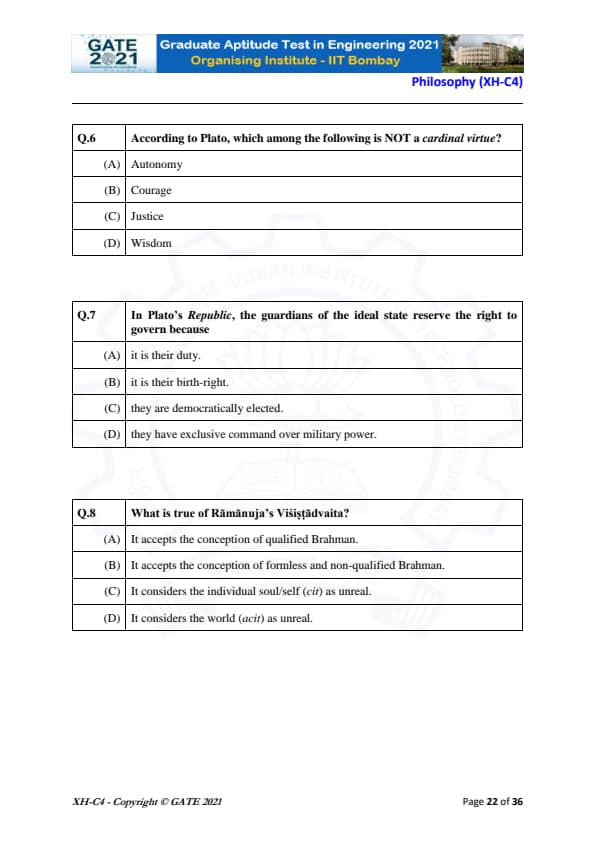



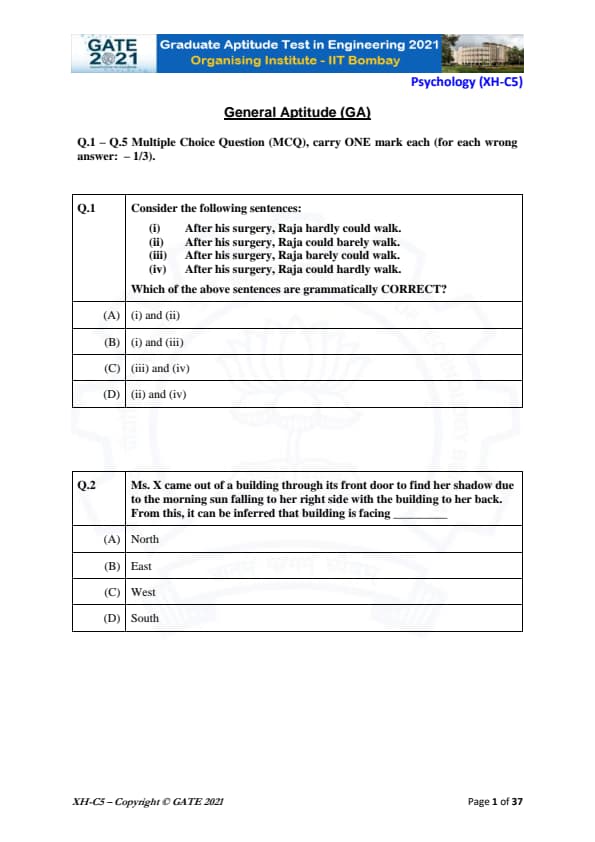
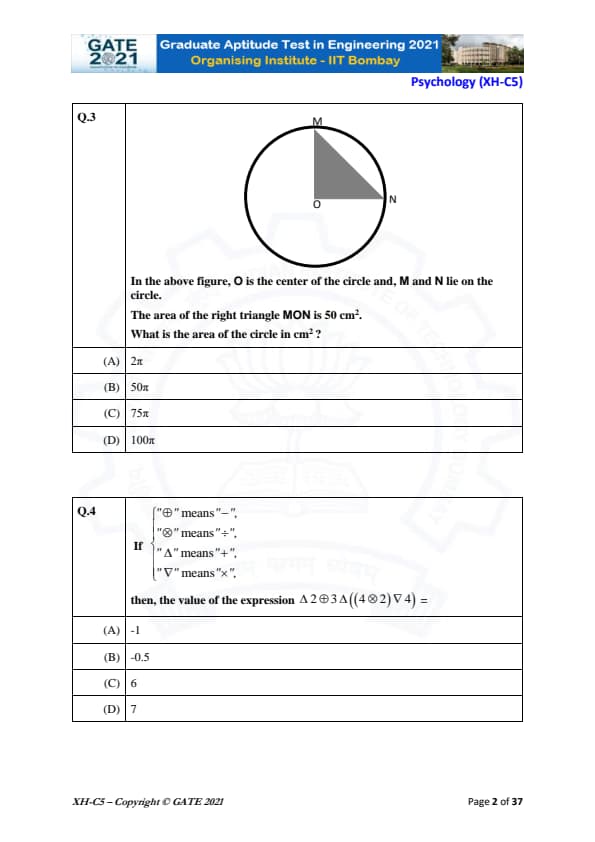
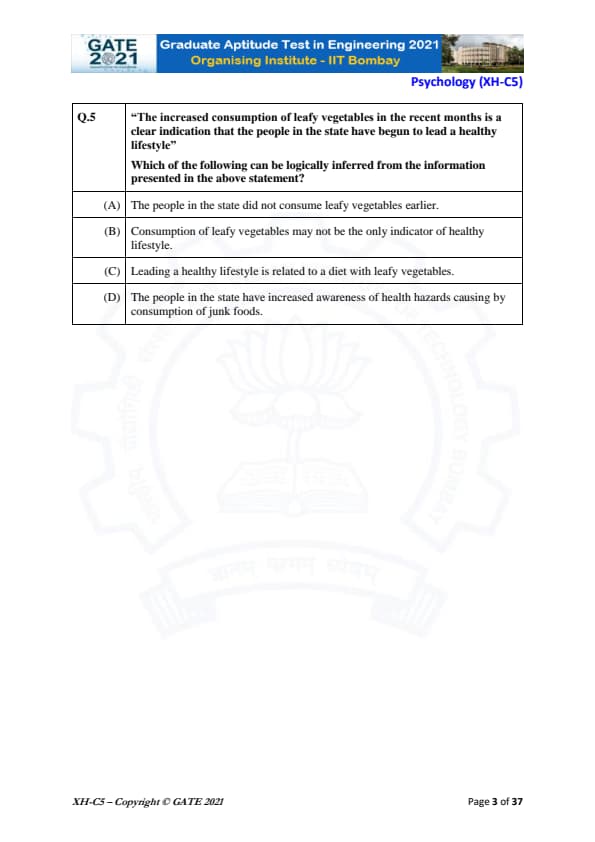
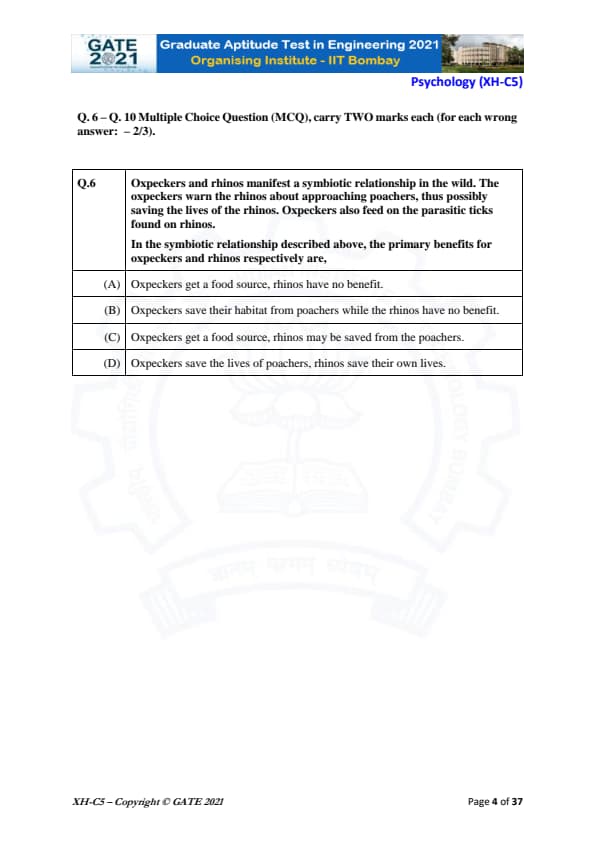
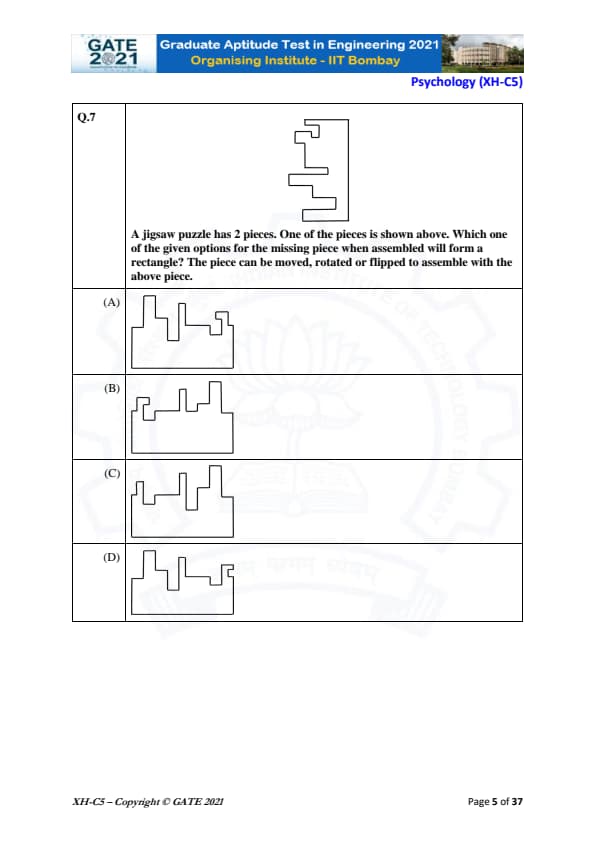
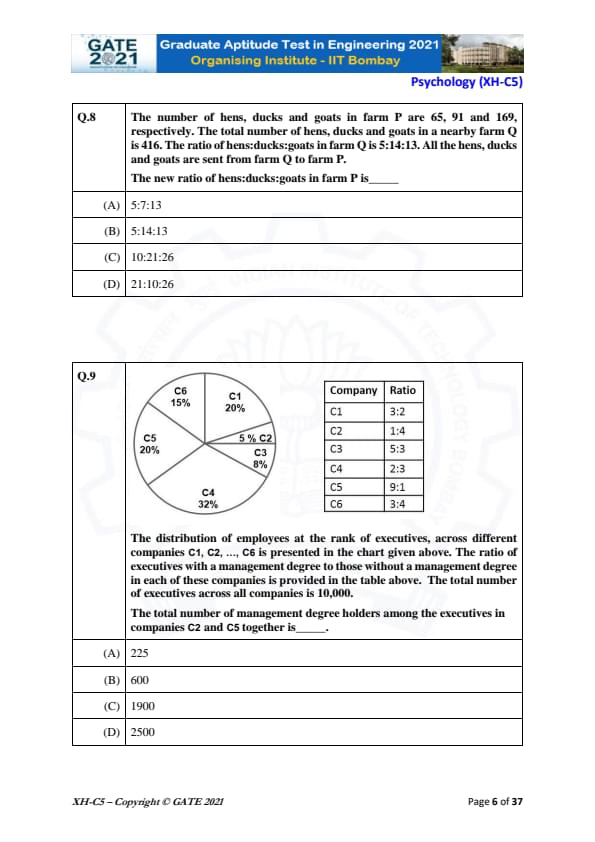
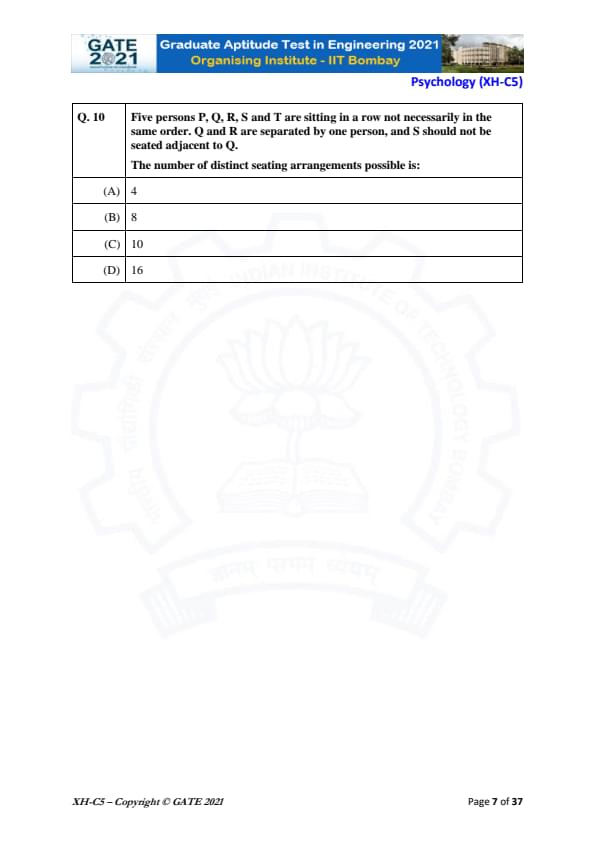
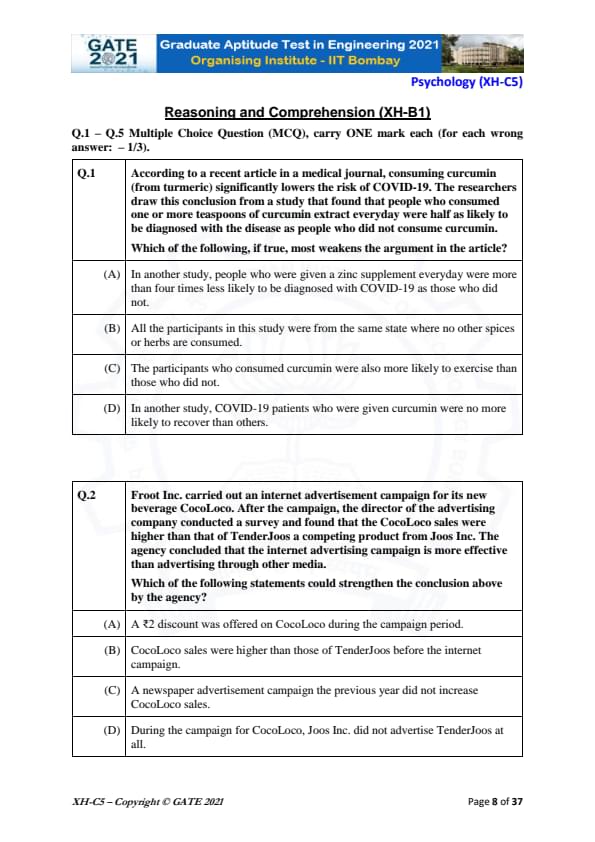
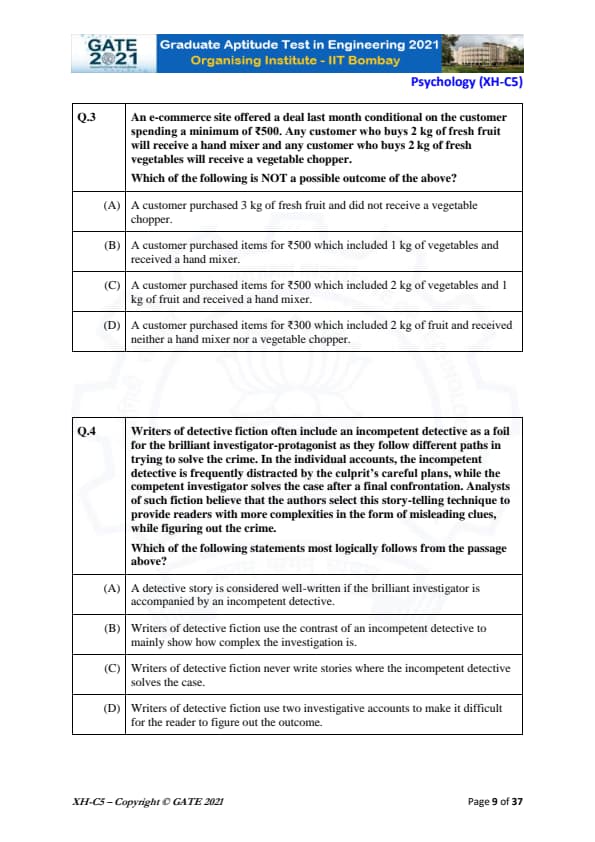
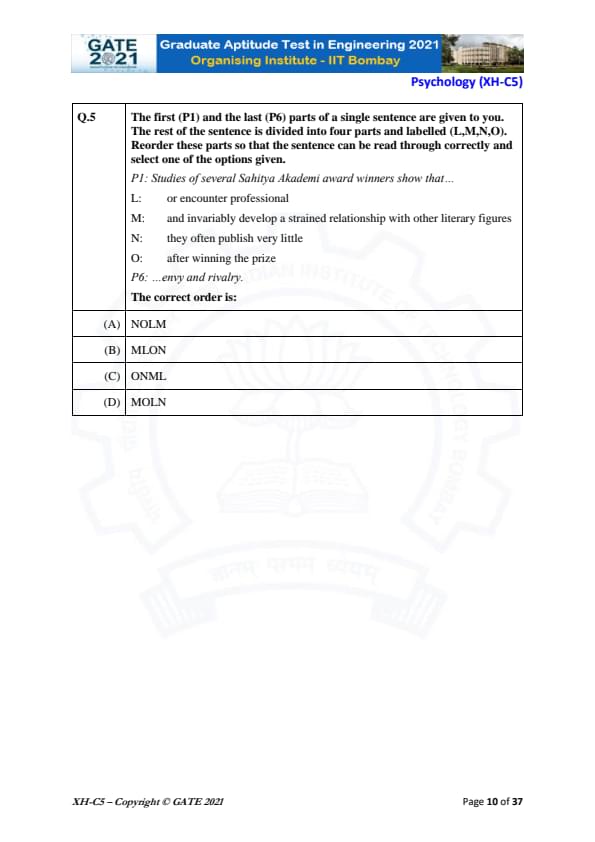
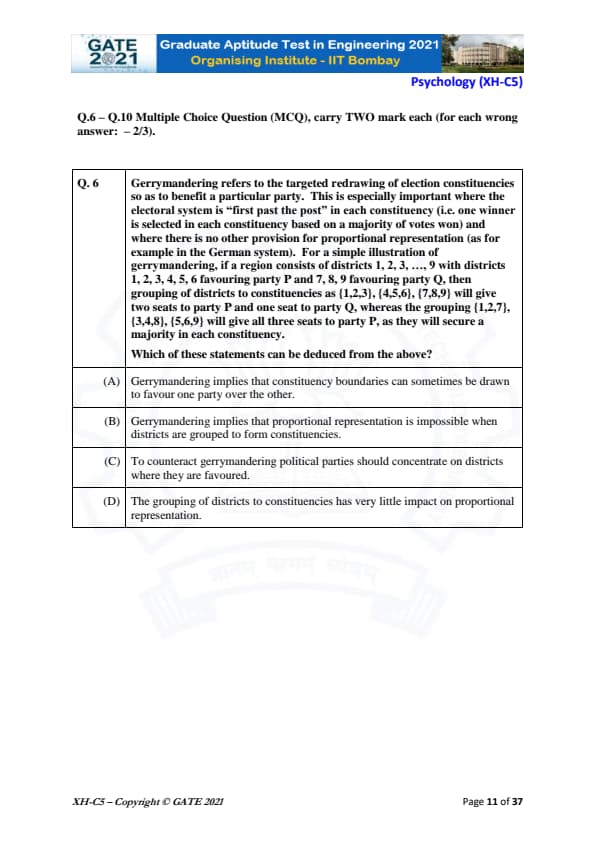
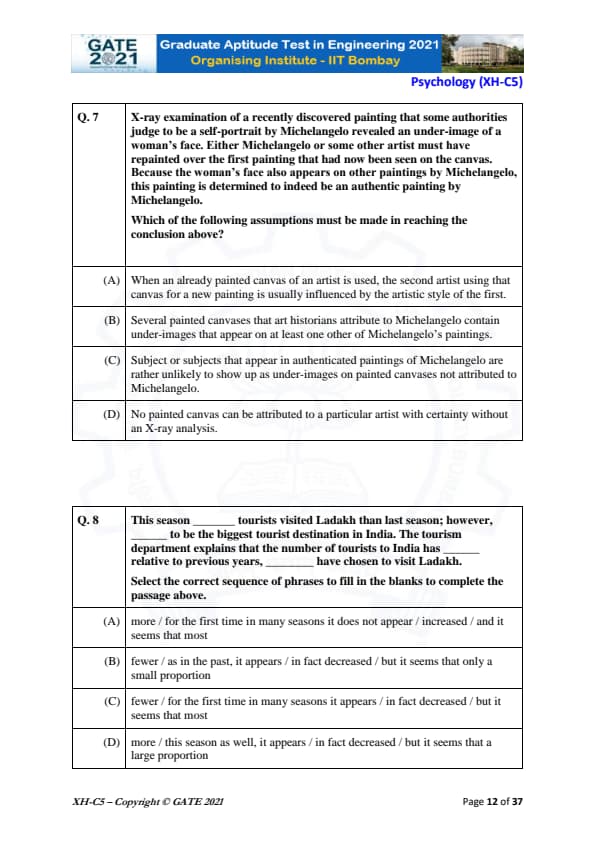
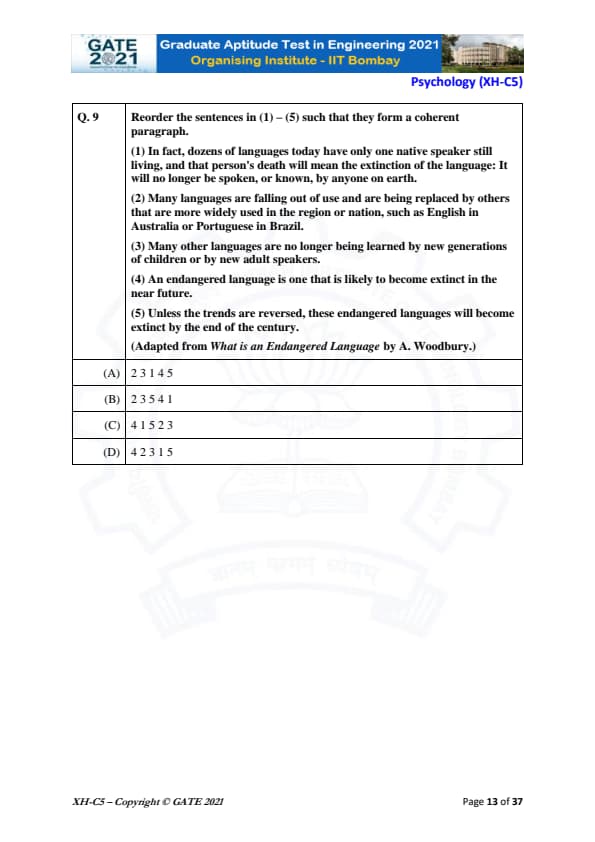
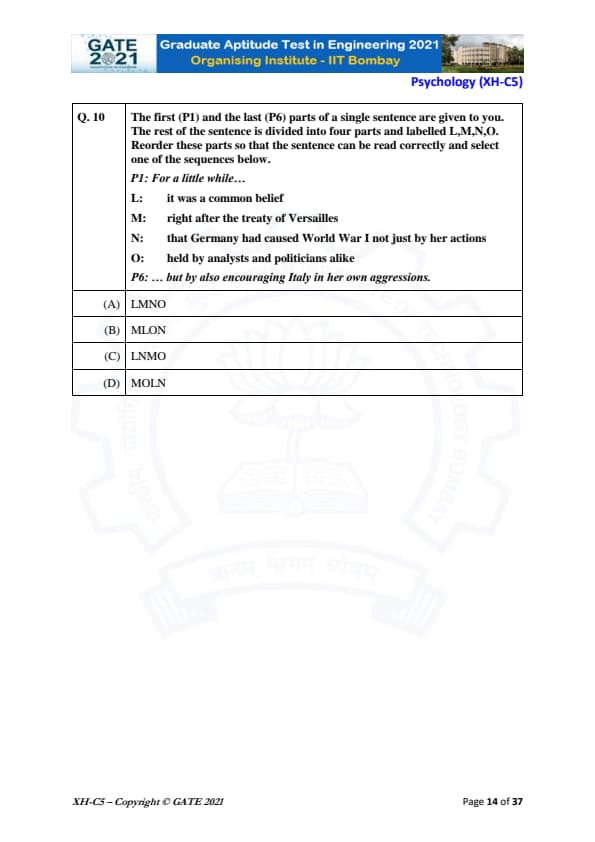
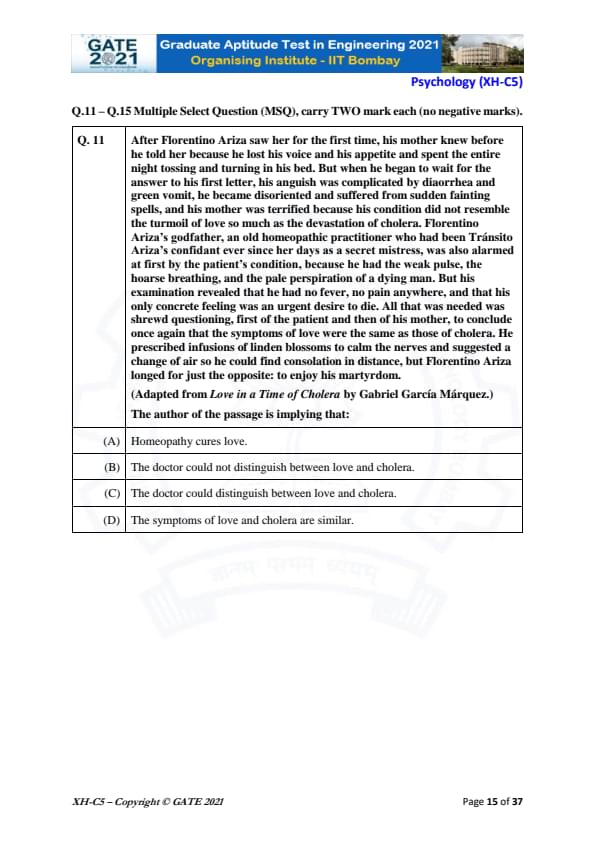
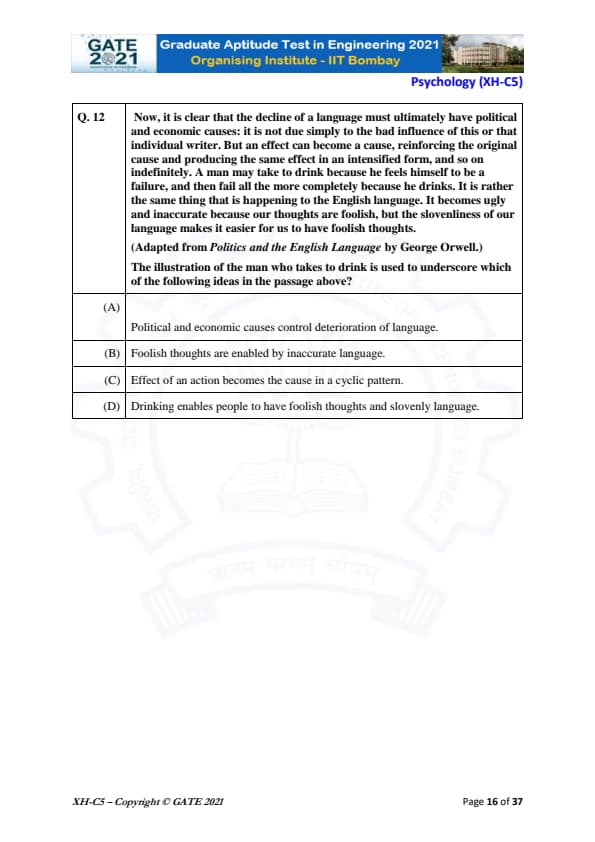
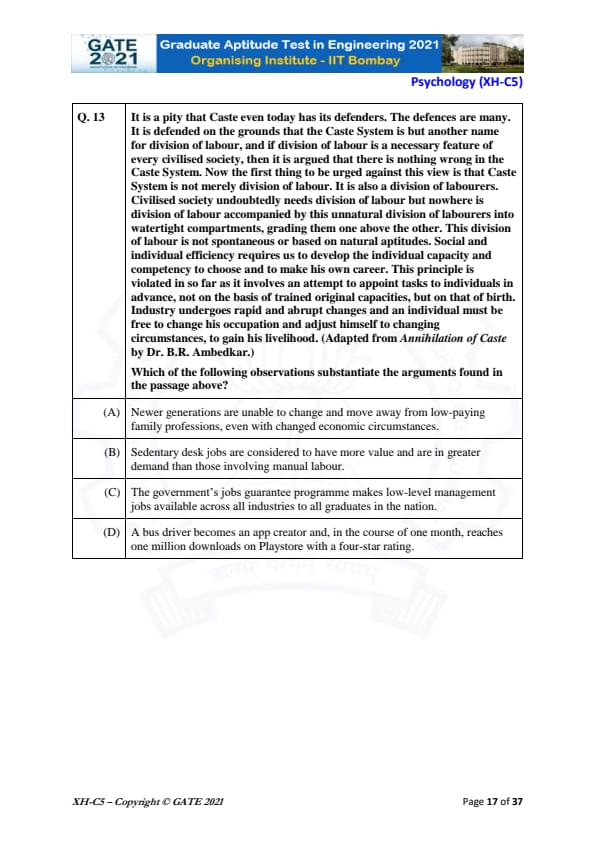
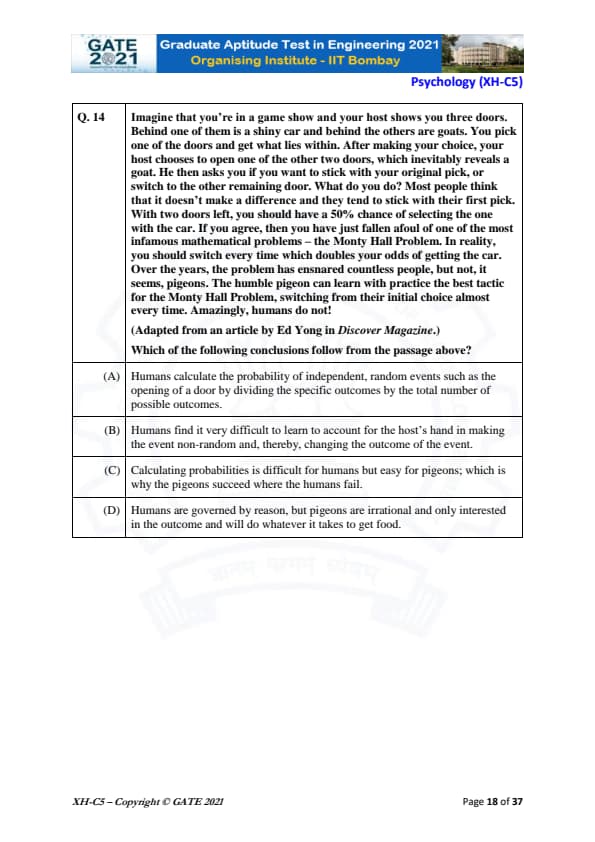
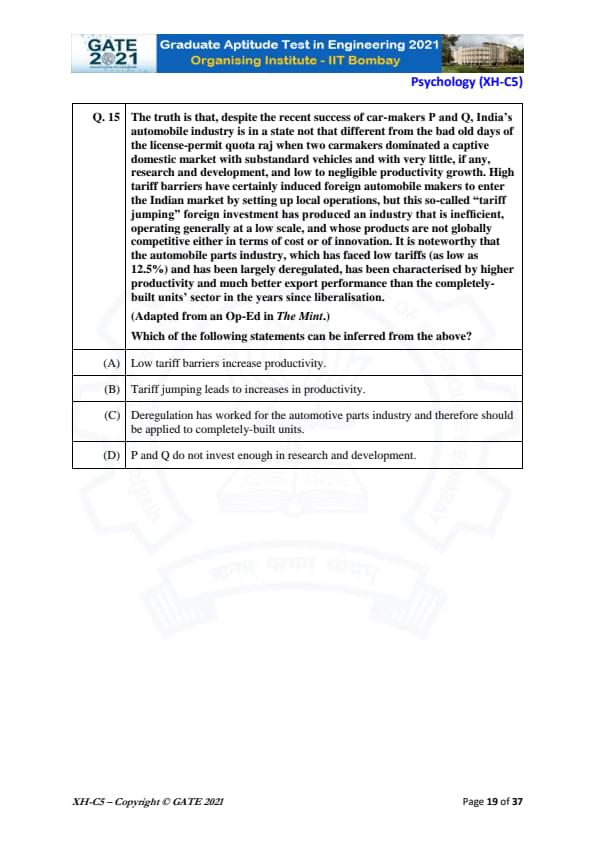
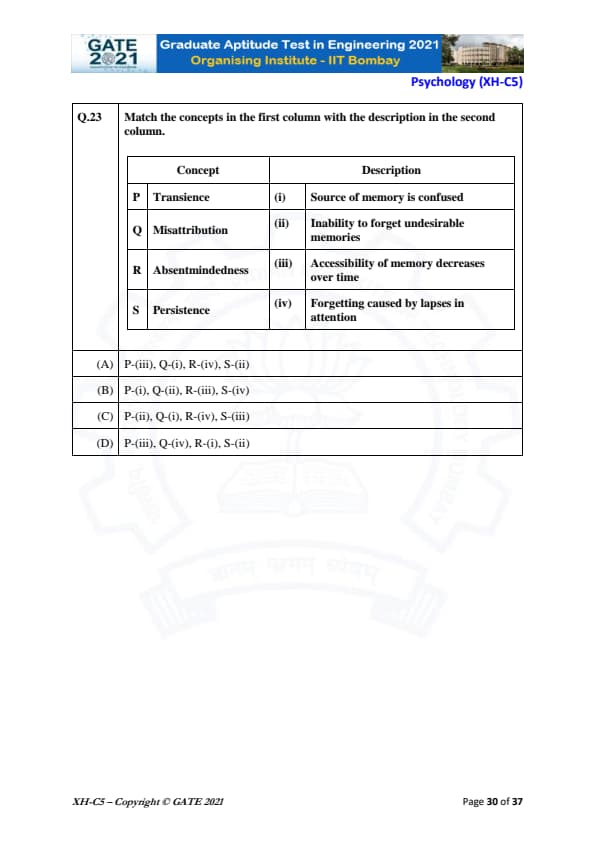
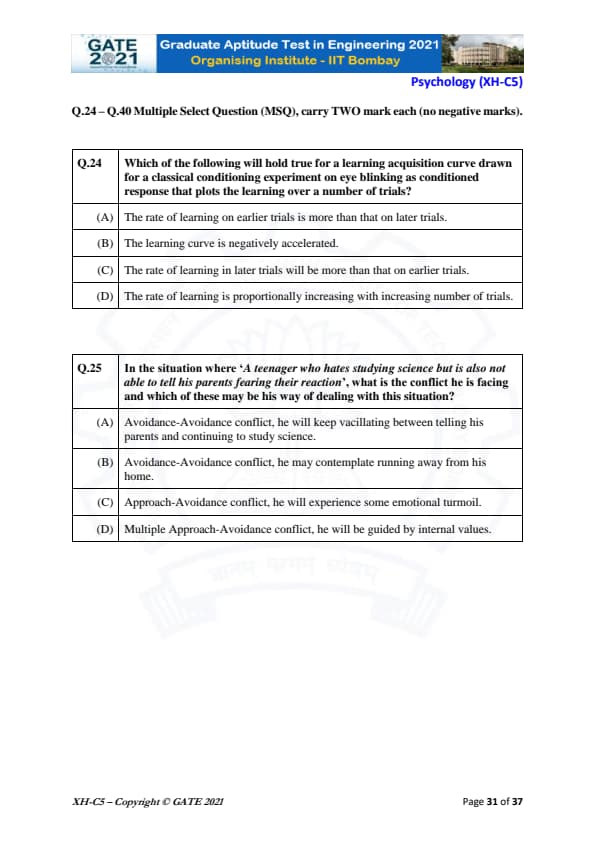
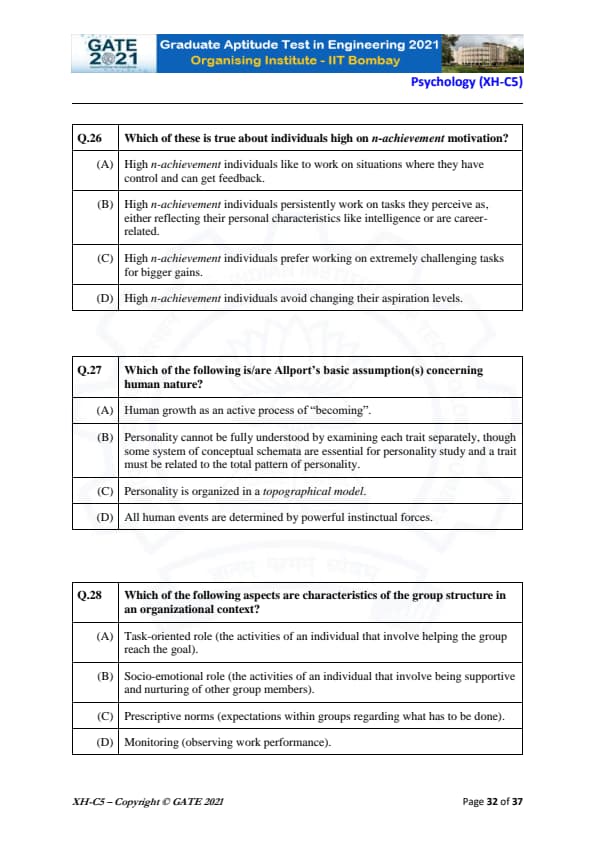
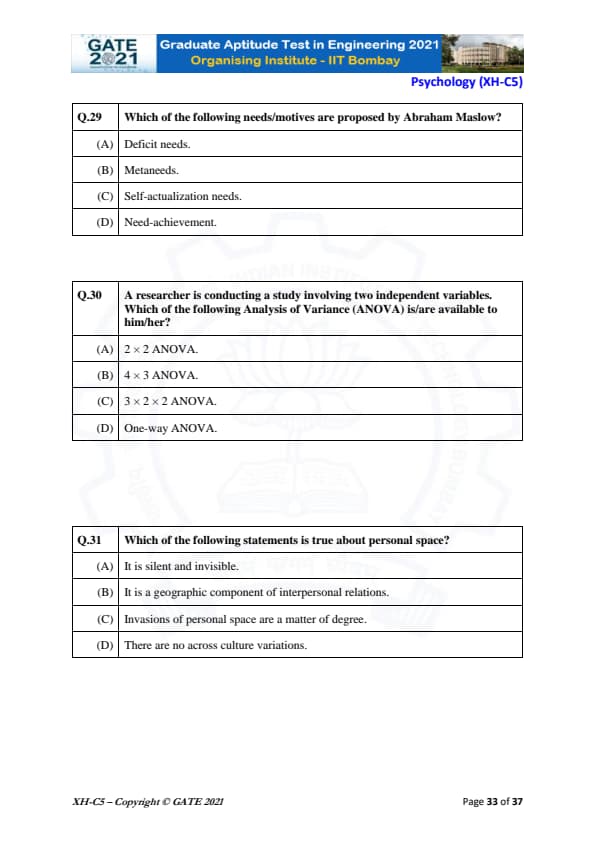

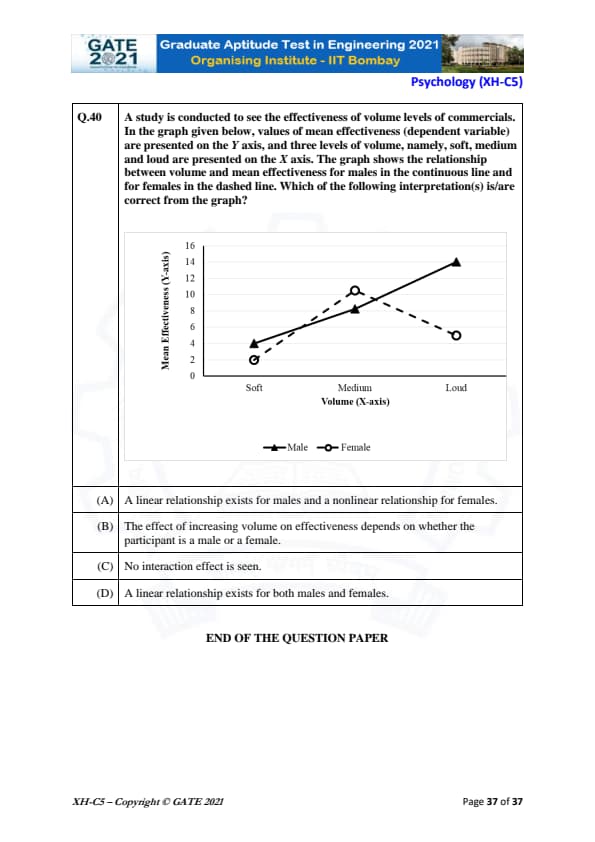
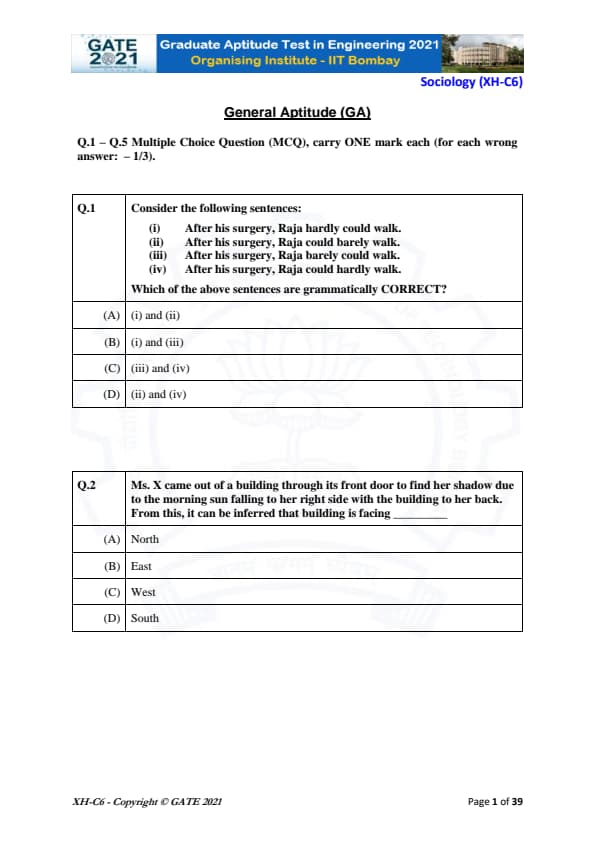
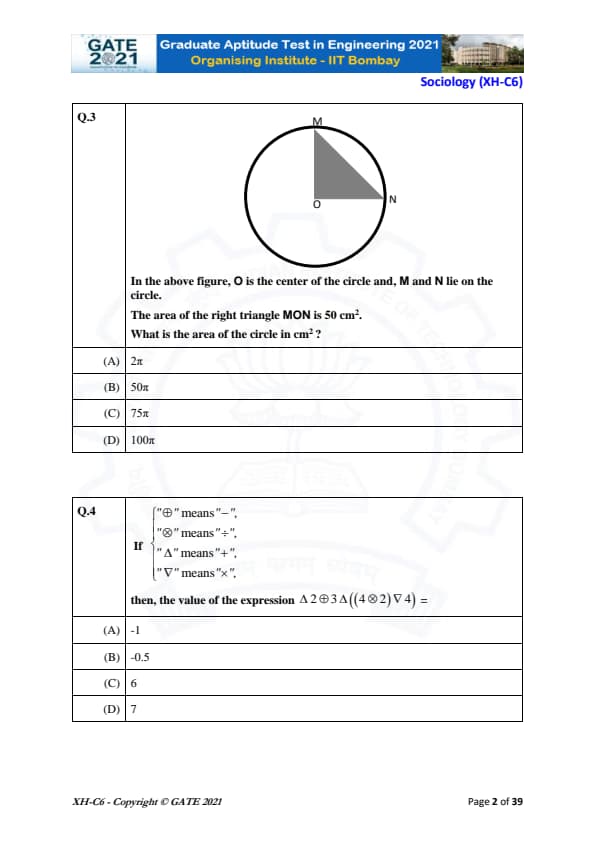
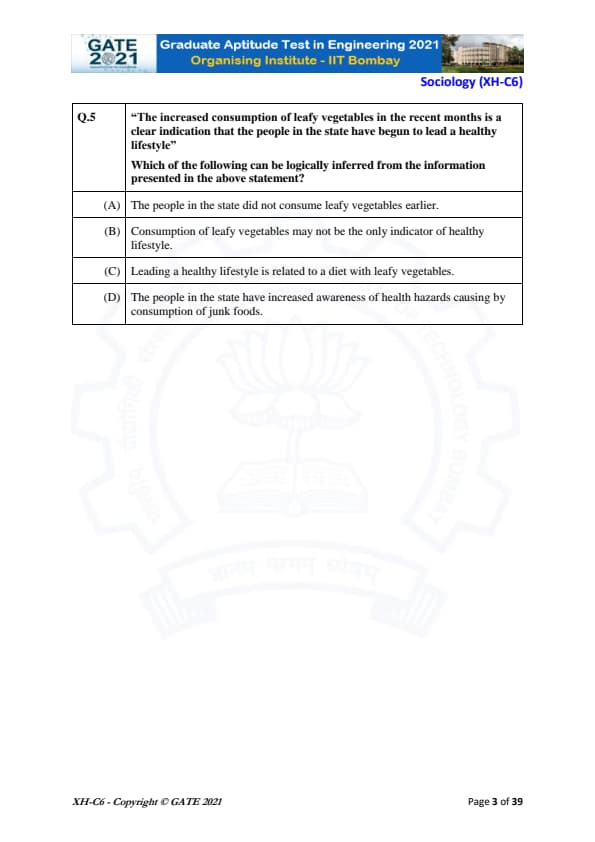
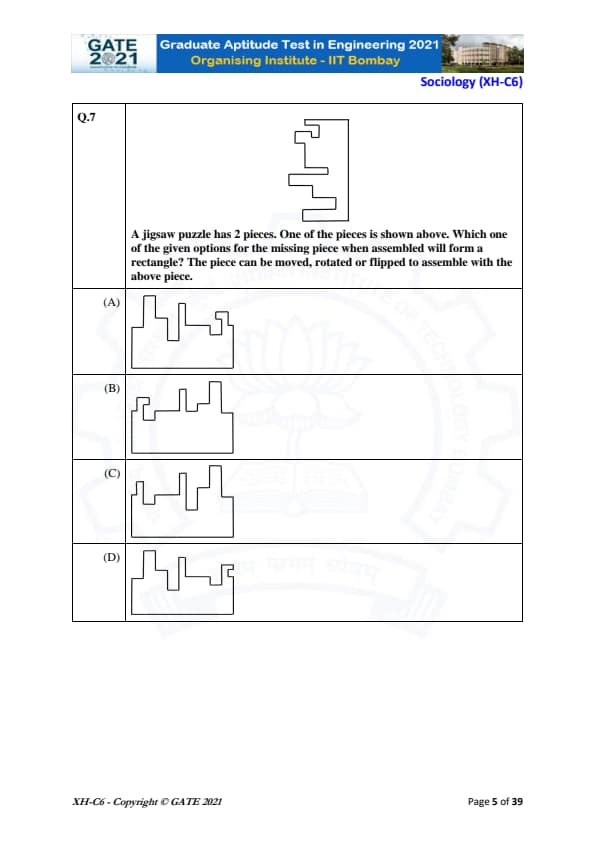
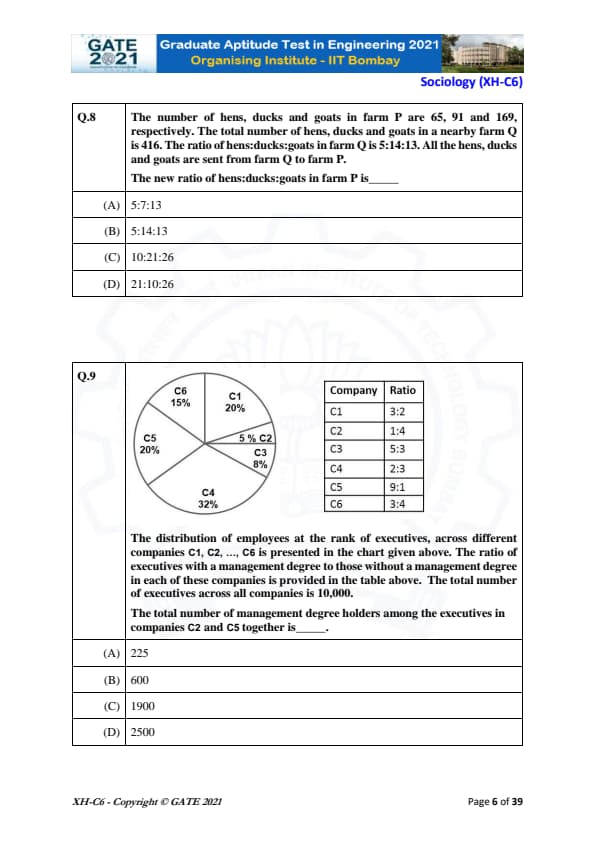
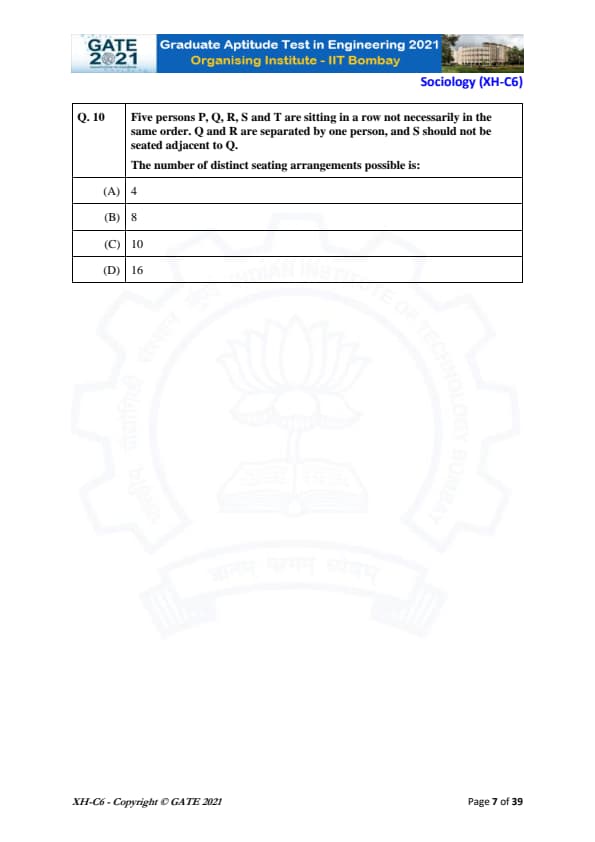
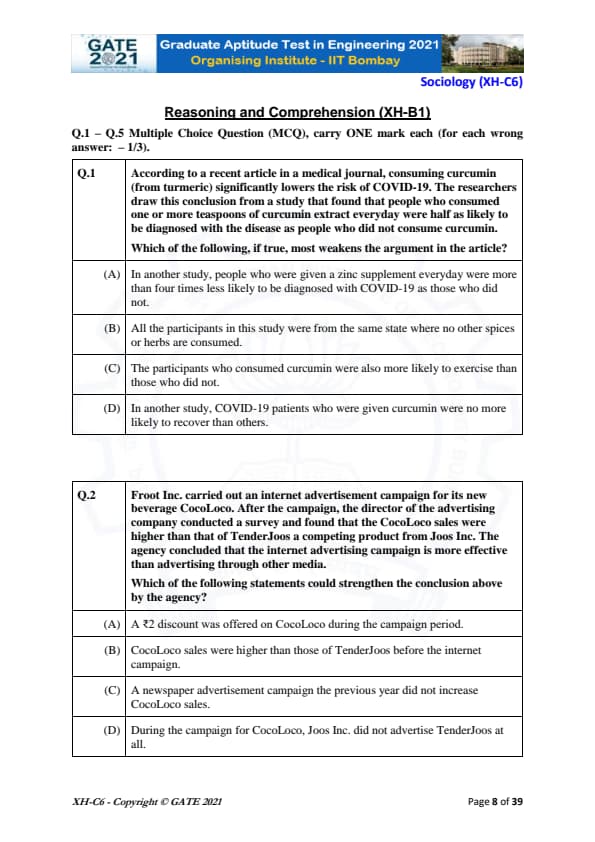
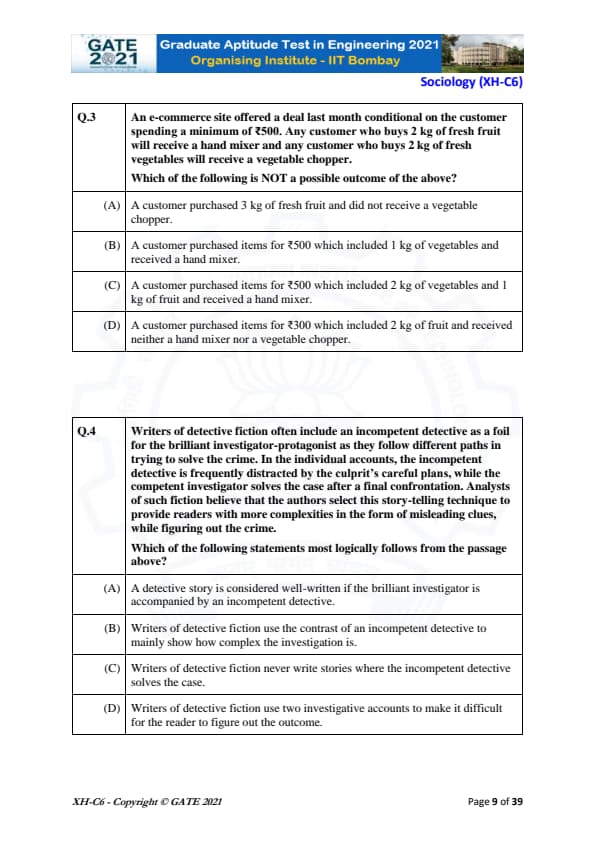
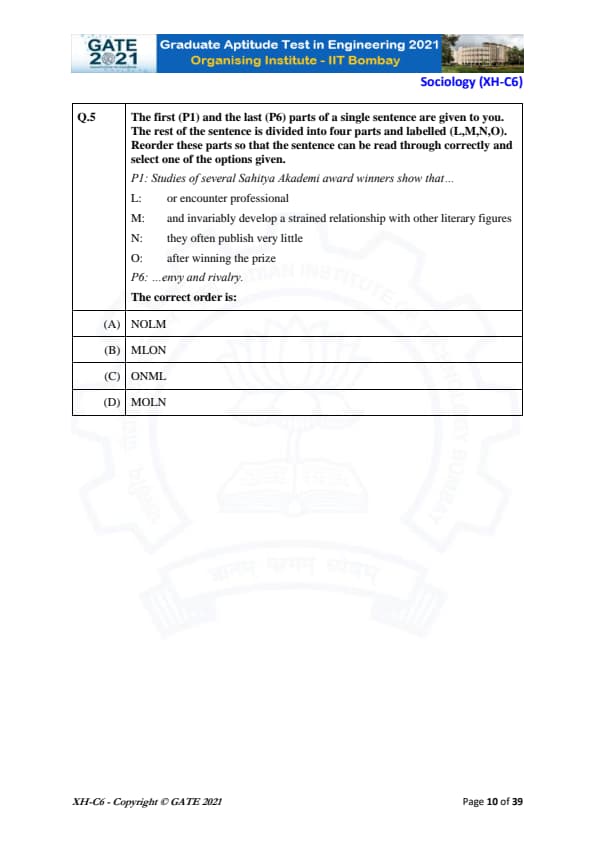
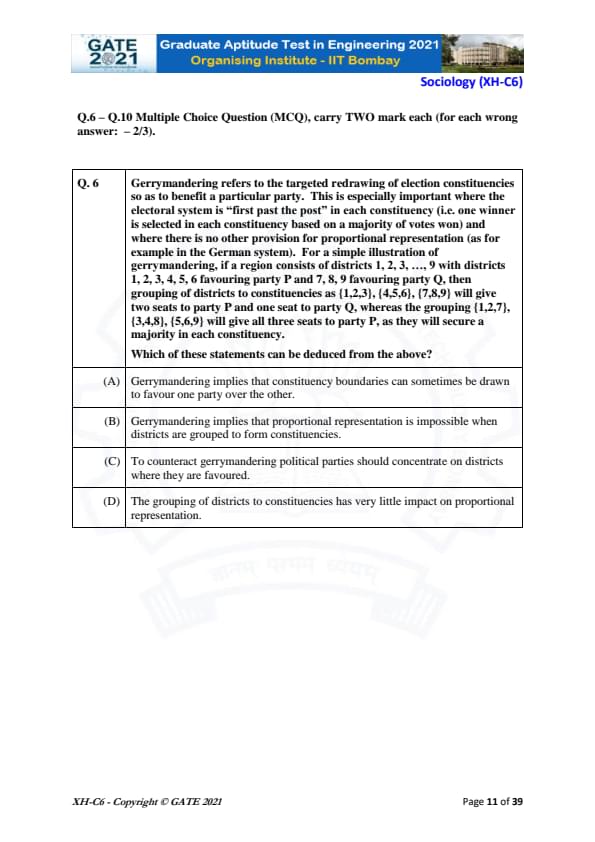
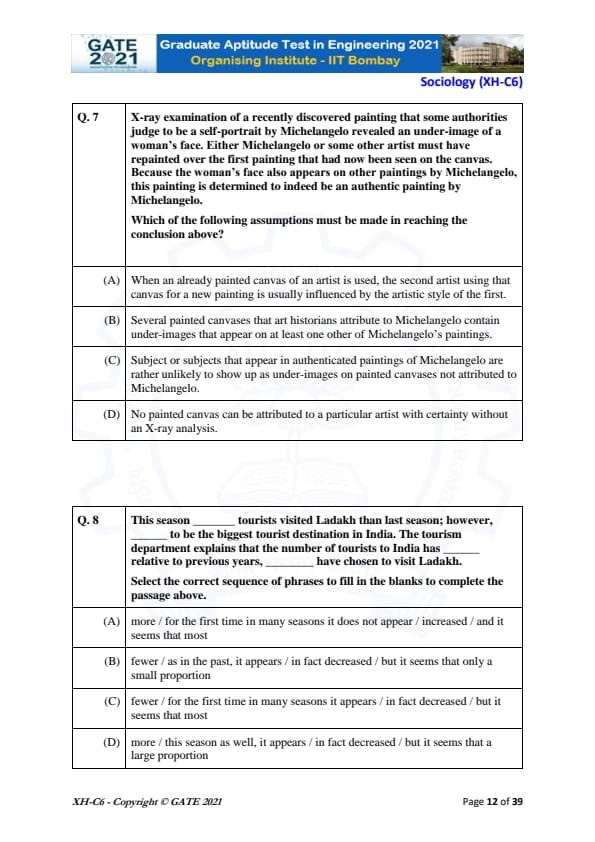
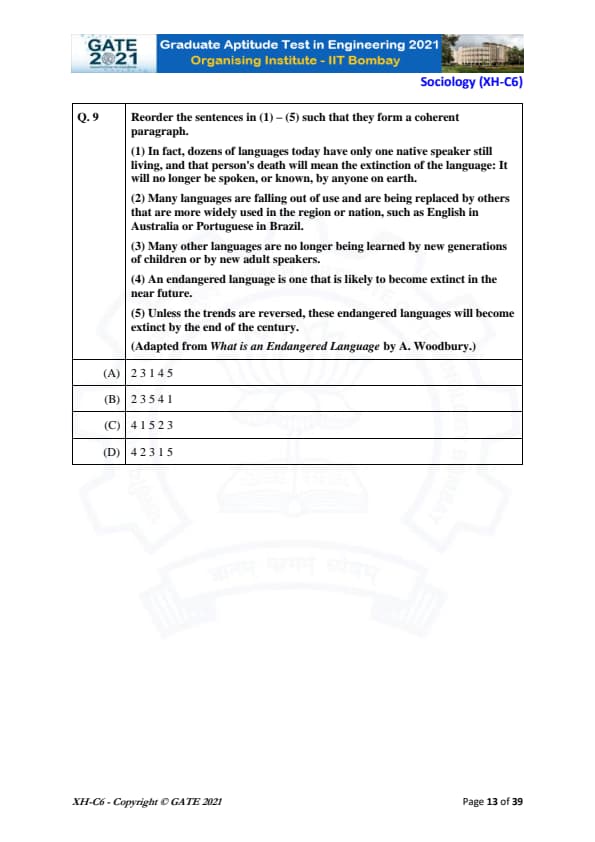
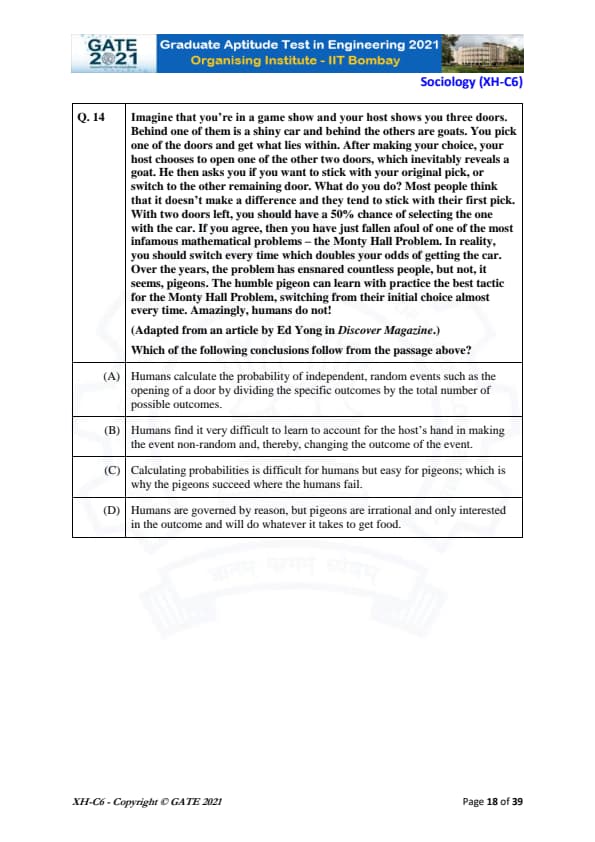
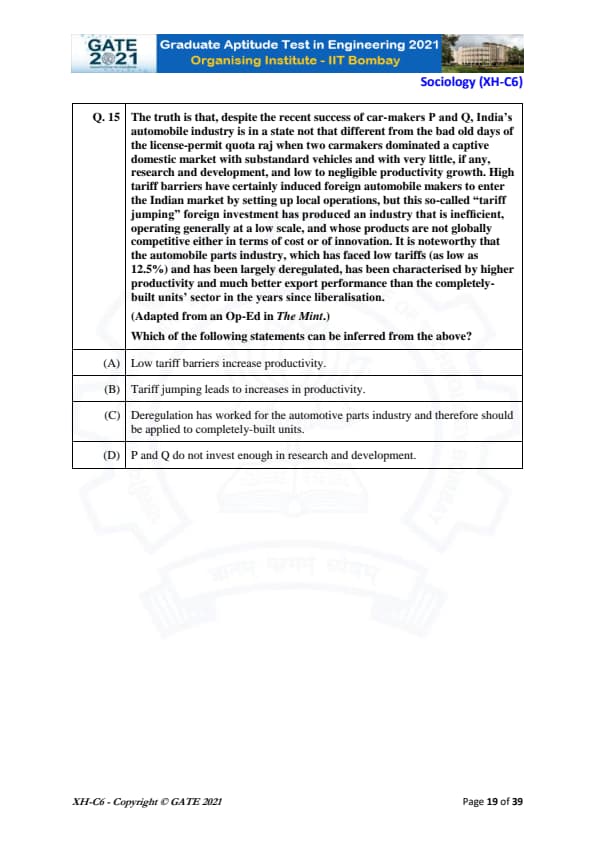

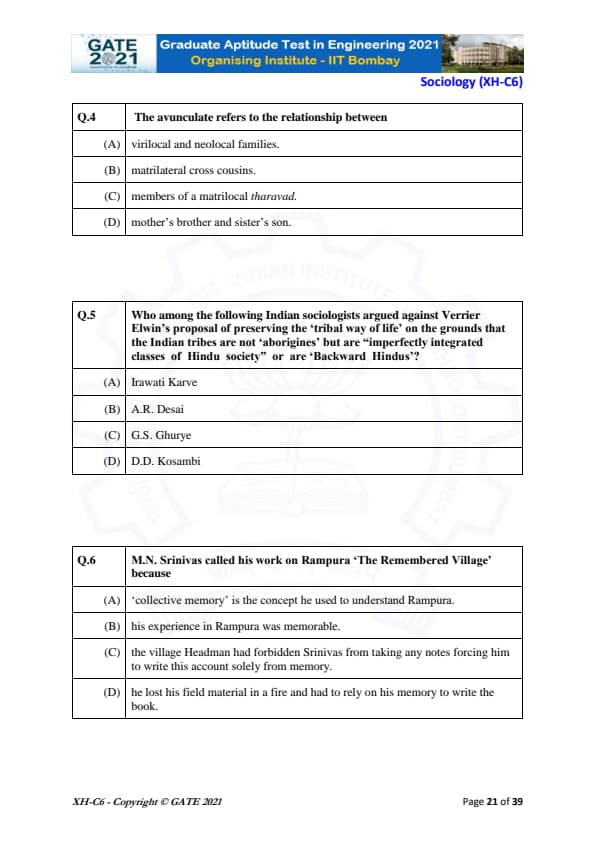
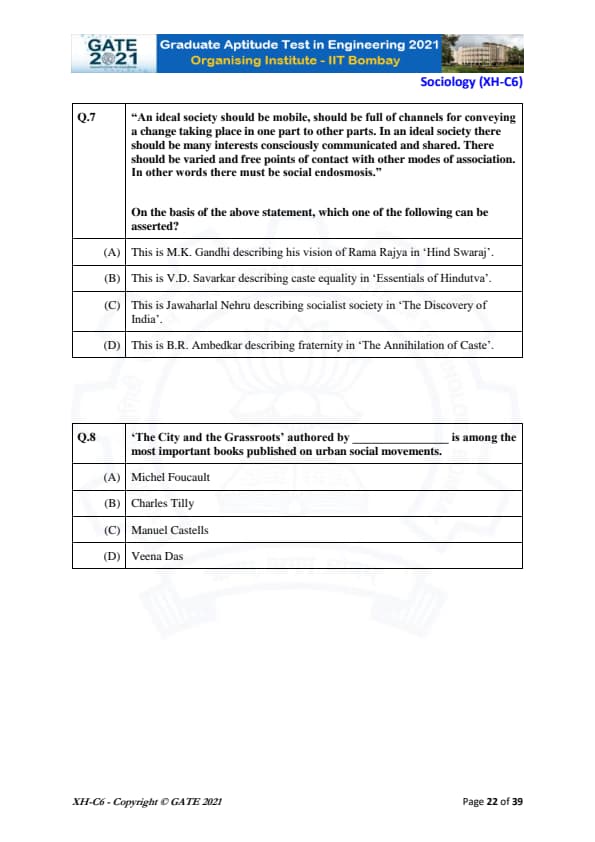
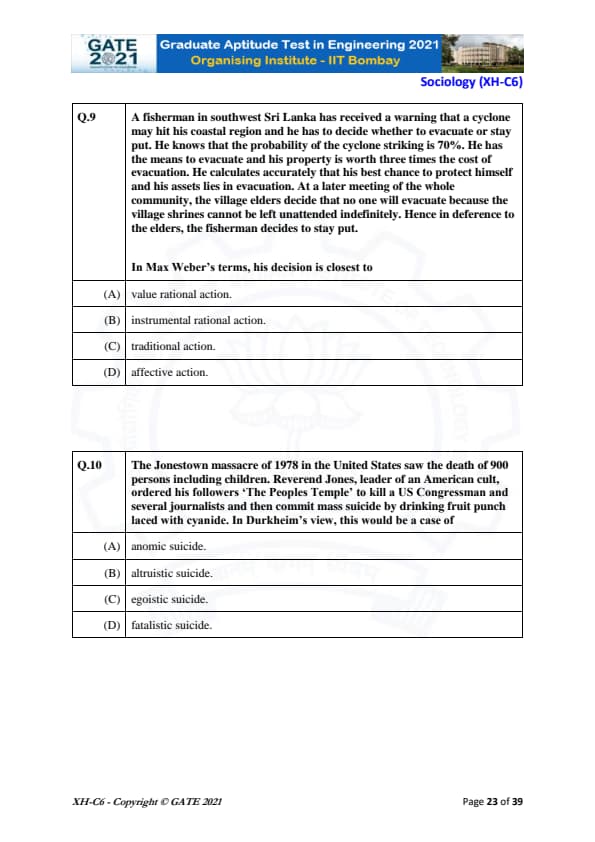
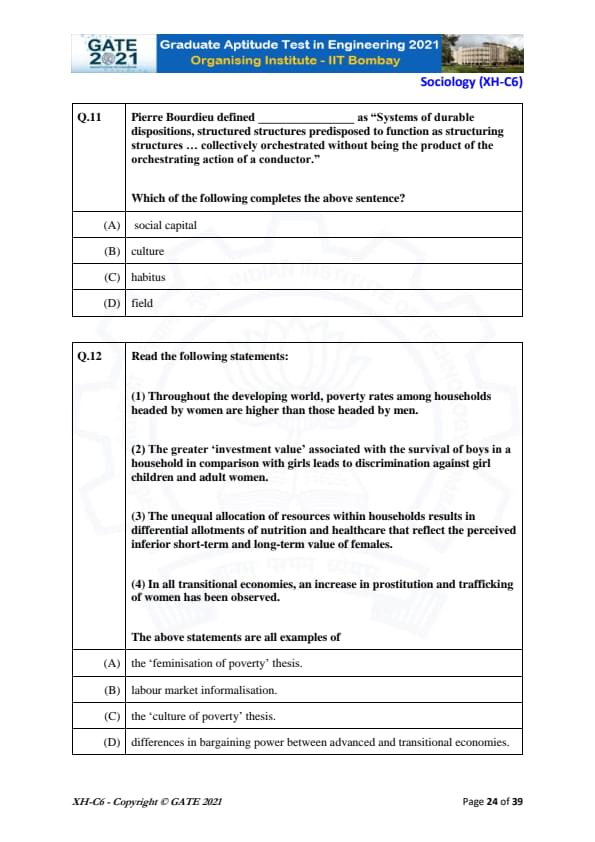
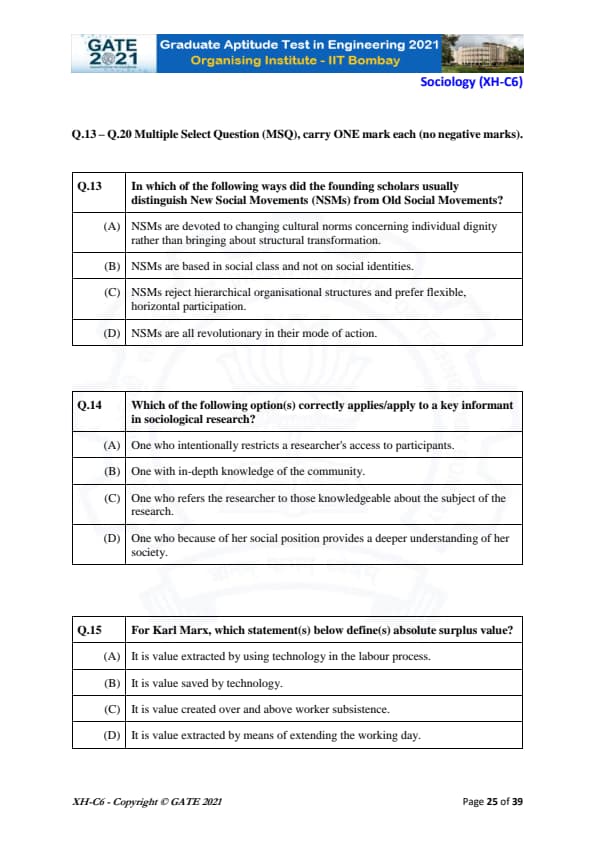
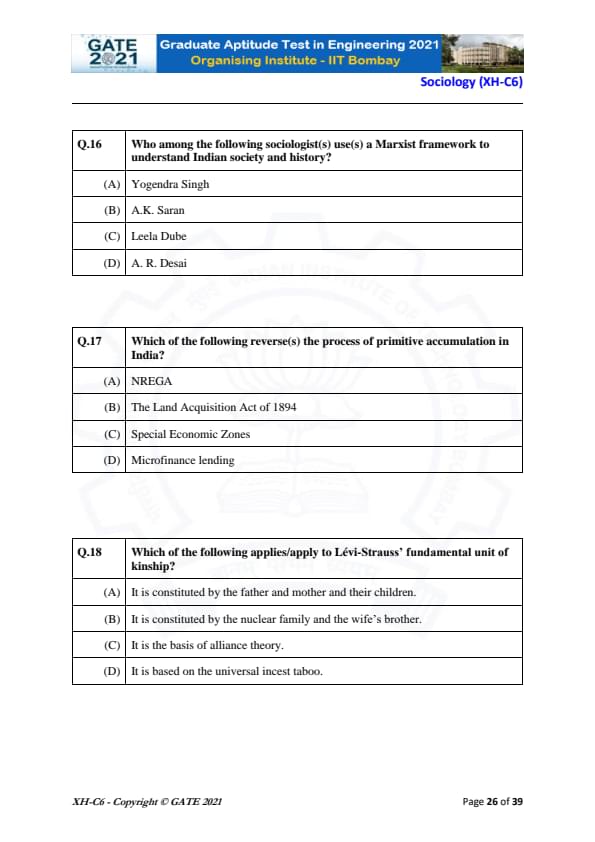
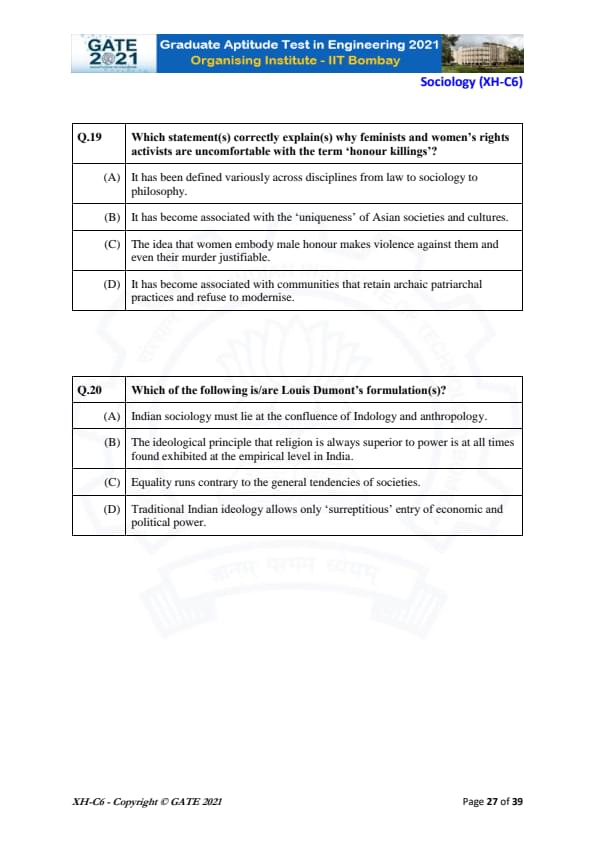
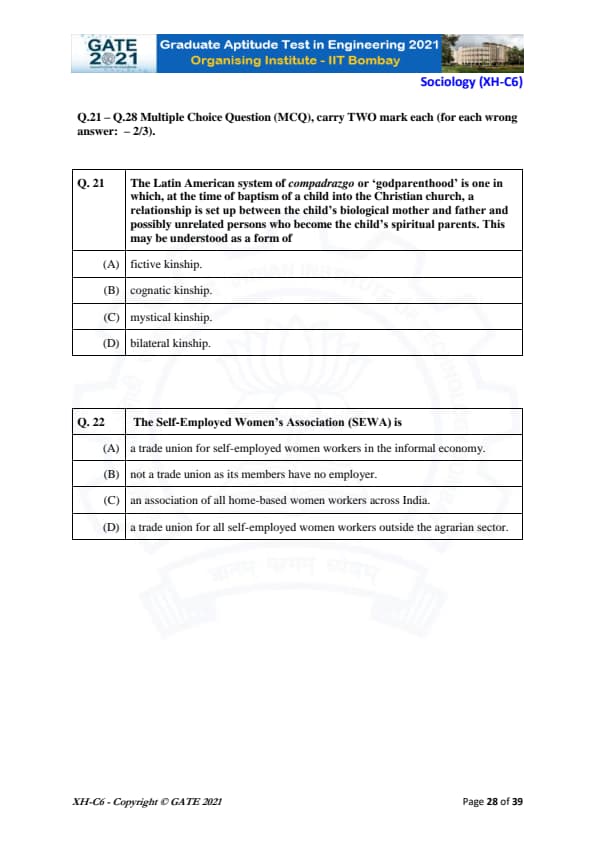
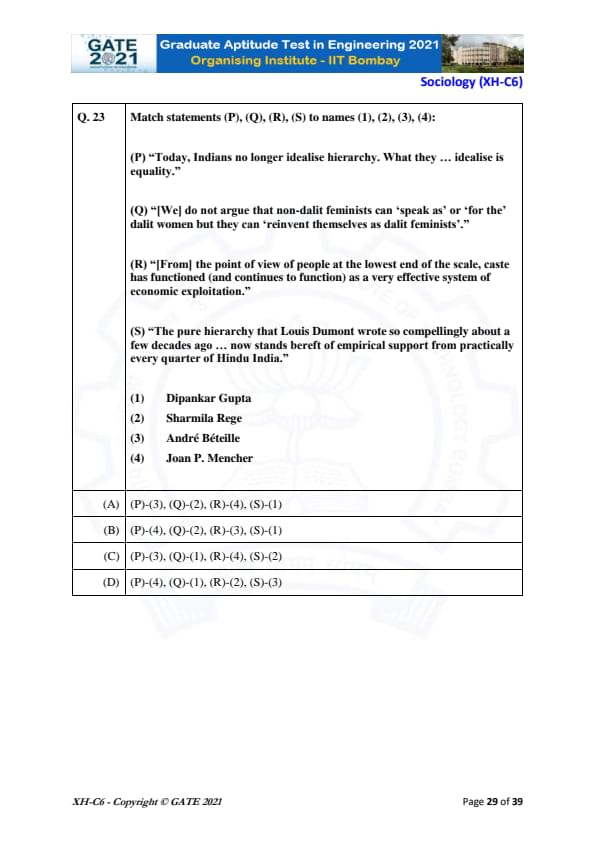
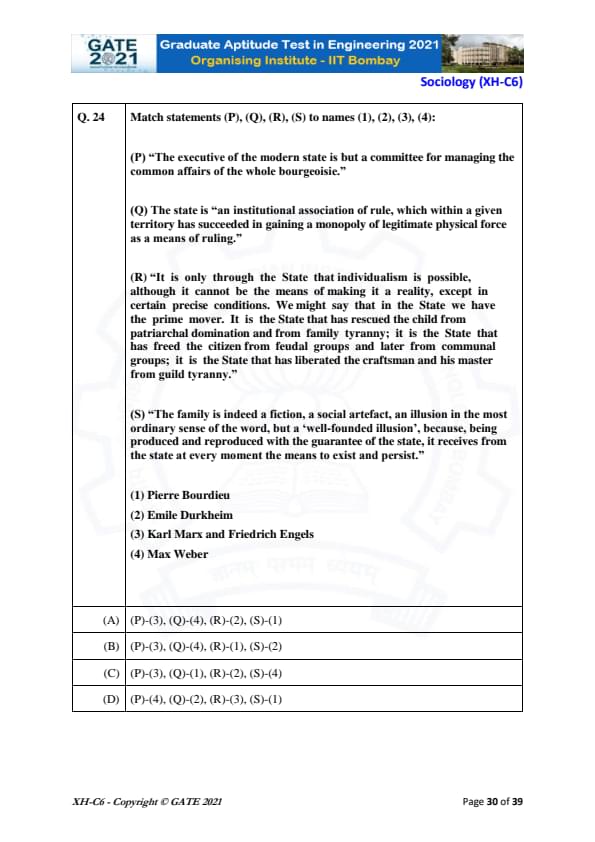
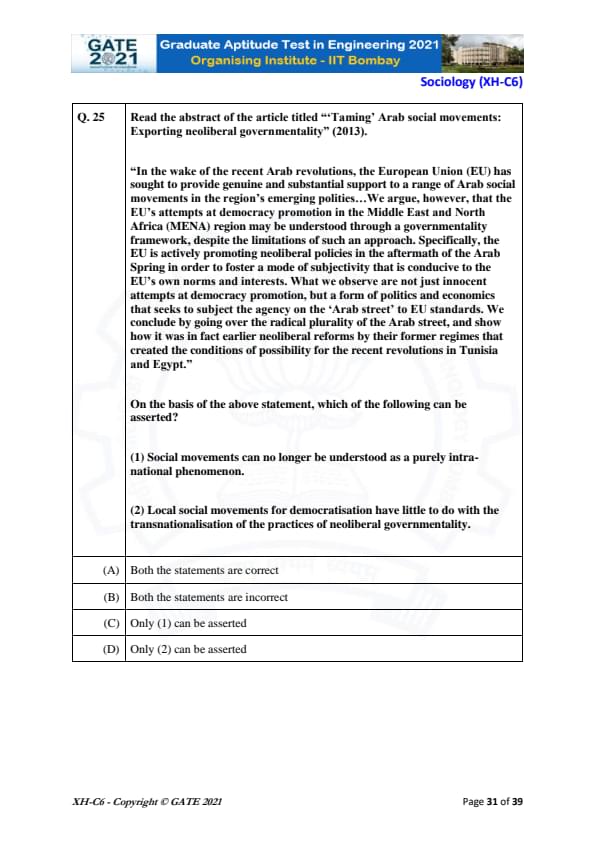
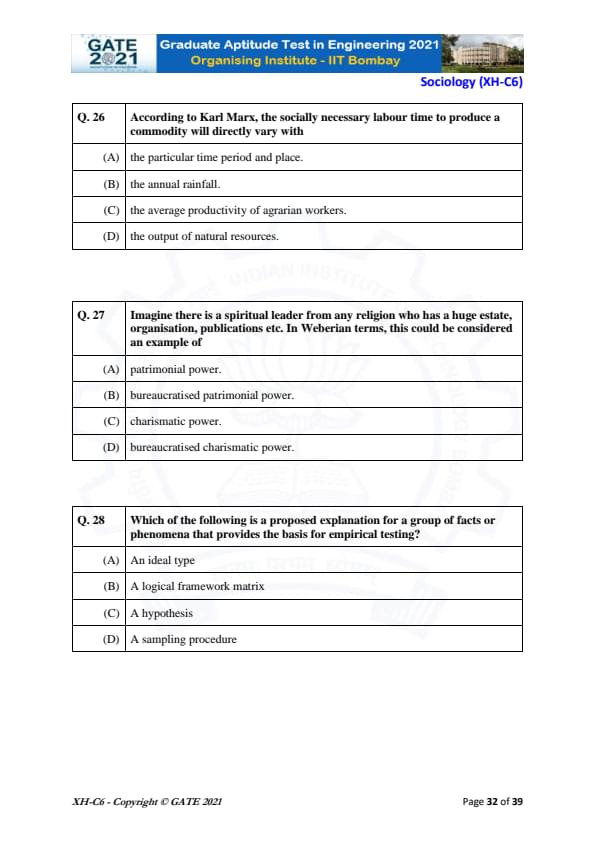
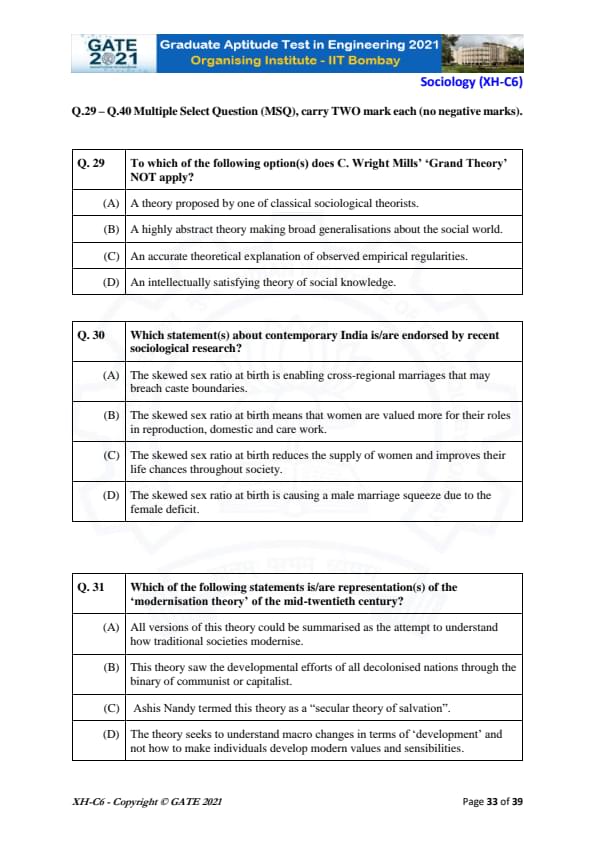
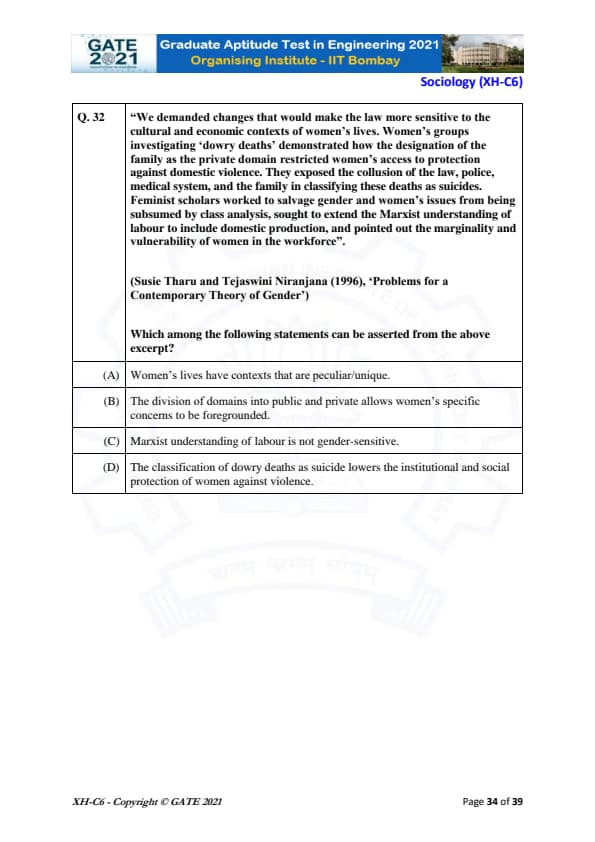
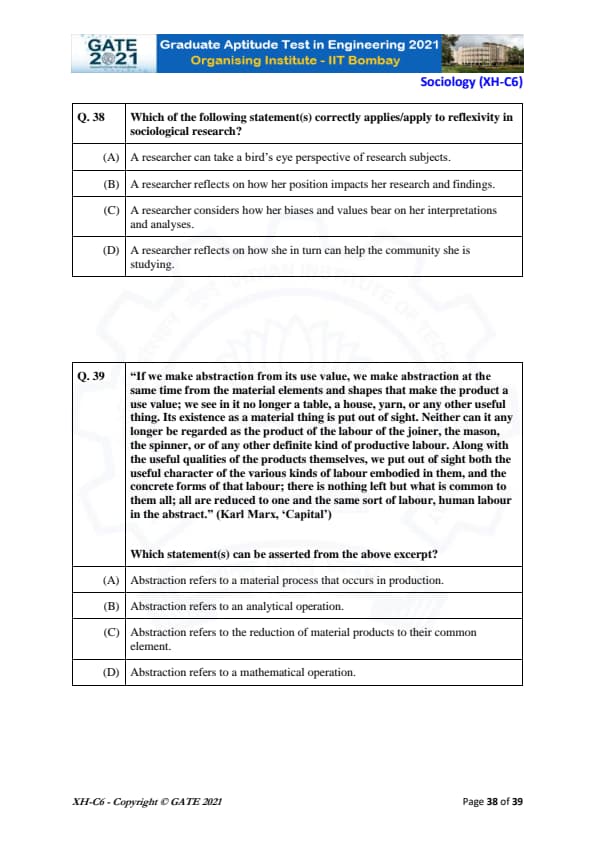
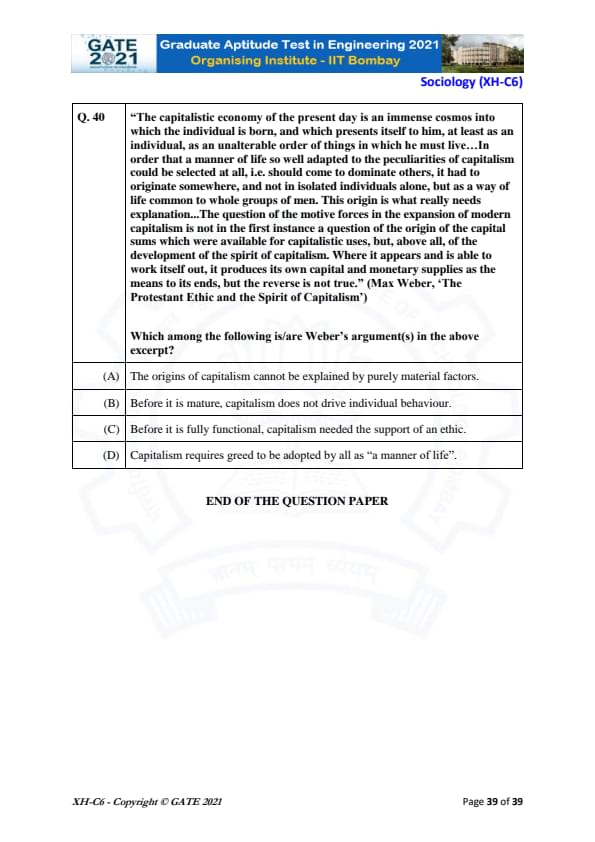
Quick Links:
GATE 2021 XH Detailed Paper Analysis
The paper was divided into three parts. The first part was dedicated to the General Aptitude. The second and third part were dedicated to reasoning and comprehension, and optional subject respectively
- The General Aptitude section carried 15 marks, distributed between 10 MCQs (each 5 questions carrying 1 mark and 2 marks respectively)
- The reasoning and comprehension section (XH-B1) carried 25 marks, comprises of 15 questions, 10 MCQs and 5 MSQs
- The MCQs carried 15 marks (5 questions carrying 1 mark and 5 questions carrying 2 marks)
- The MSQs carried 10 marks, distributed between 5 questions (2 marks each question)
- The remaining 40 questions, carrying 60 marks were related to the core optional subject
GATE 2021 XH Exam Pattern and Marking Scheme
- Candidates would require to solve 65 questions in 3 hours in GATE 2021 XH
- All the papers comprises of 65 questions (10 from General Aptitude and the other 55 from the optional subject)
- Every incorrect MCQ will cost 1 mark reduction out of the final score
- ⅓ marks would be deducted for every wrong MCQ carrying 1 mark, and ⅔ marks would be deducted for every wrong MCQ carrying 2 marks
- NATs (Numerical Answer Types) and MSQs (Multiple Select Questions) don't follow any negative marking scheme
Also Check:
GATE Previous Year Question Papers:
| GATE 2022 Question Papers | GATE 2021 Question Papers | GATE 2020 Question Papers |
| GATE 2019 Question Papers | GATE 2018 Question Papers | GATE 2017 Question Papers |





Comments