




GATE 2021 Petroleum Engineering (PE) is one of the most popular exam that is held by IIT Bombay. GATE PE 2021 exam was conducted on February 7, in afternoon slot between 3 to 6 PM. GATE PE 2021 question paper with answer key PDF is now available. GATE PE 2021 paper was overall of 100 marks. The difficulty of exam can be ranged between moderate to tough.
Highest number of questions were grabbed from reservoir engineering worth of 19 marks whereas only 1 question was asked from Health Safety and Environment in PE. Students should thoroughly go through previous year paper to have better understanding of format and questions asked in GATE PE 2021 exam.
GATE 2021 Petroleum Engineering (PE) Question Paper with Solutions
| GATE 2021 Petroleum Engineering (PE) Question Paper |  Download Download |
Check Solutions |

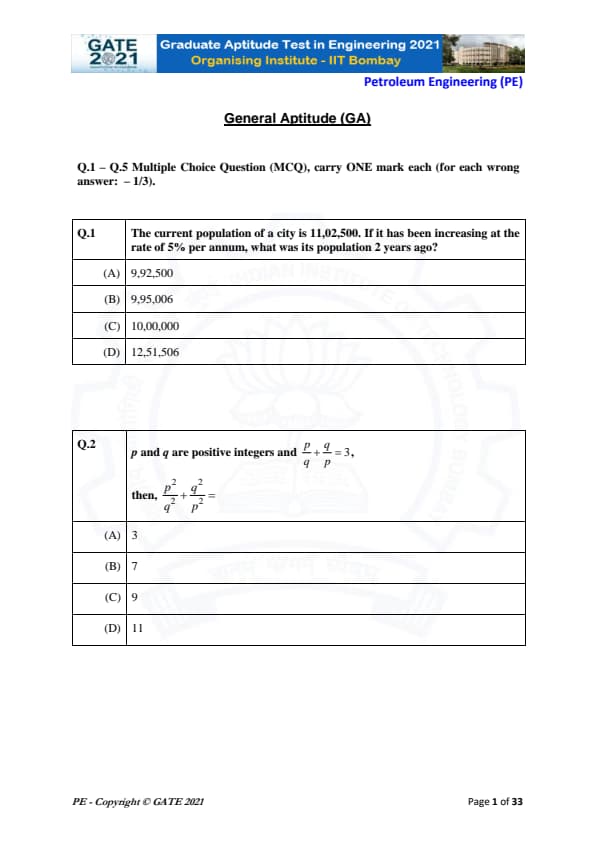
The current population of a city is 11,02,500. If it has been increasing at the rate of 5% per annum, what was its population 2 years ago?
p and q are positive integers and p/q + q/p = 3,
then, p2/q2 + q2/p2 =
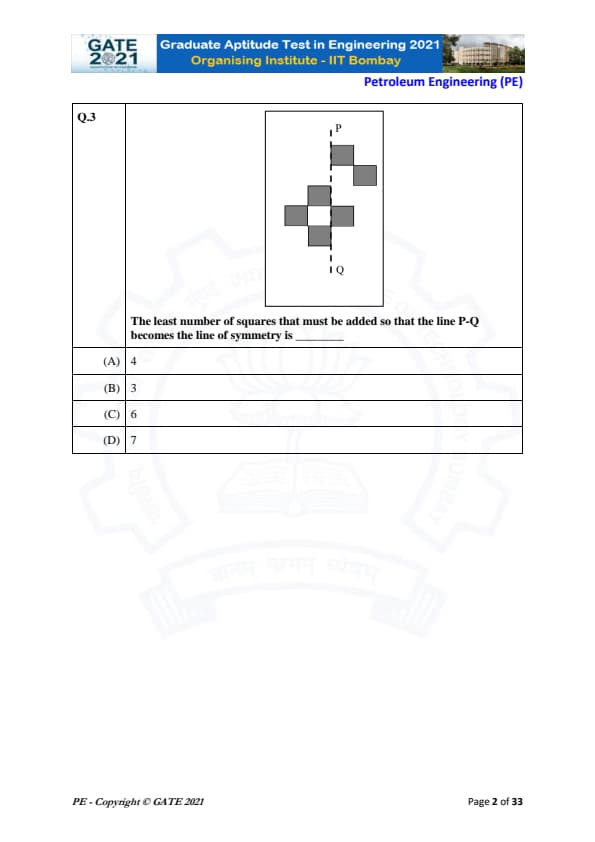
The least number of squares that must be added so that the line P-Q becomes the line of symmetry is

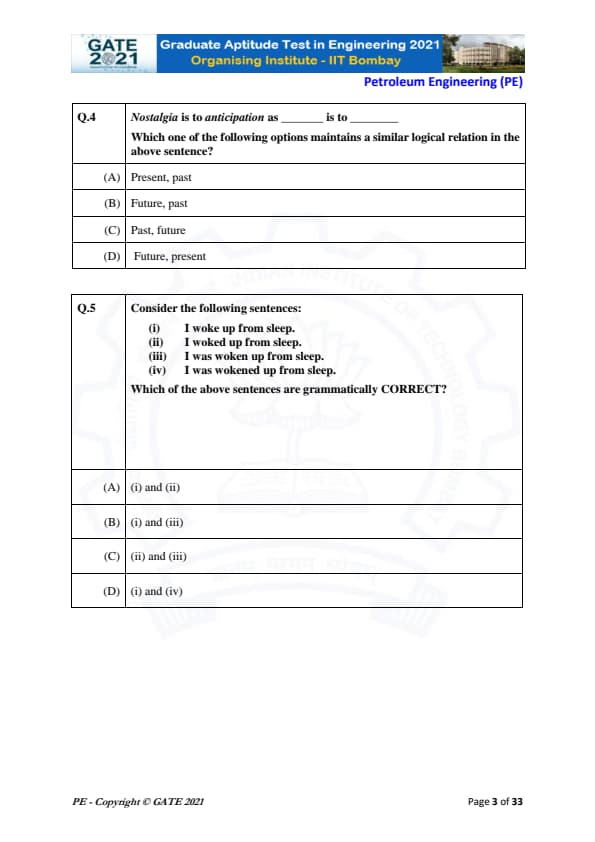
Nostalgia is to anticipation as _______ is to _______.
Which one of the following options maintains a similar logical relation in the above sentence?
Consider the following sentences:
(i) I woke up from sleep.
(ii) I wok up from sleep.
(iii) I was woken up from sleep.
(iv) I was wokened up from sleep.
Which of the above sentences are grammatically CORRECT?
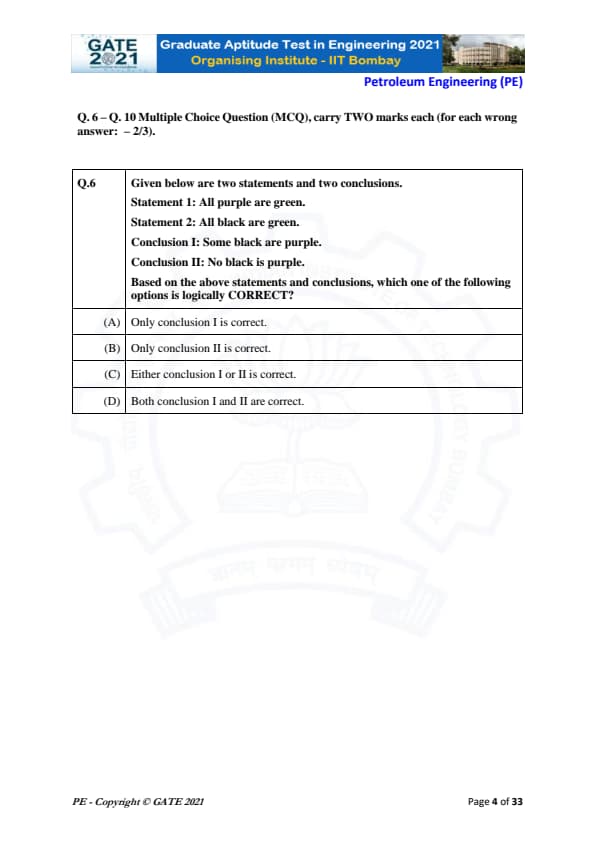
Given below are two statements and two conclusions.
Statement 1: All purple are green.
Statement 2: All black are green.
Conclusion I: Some black are purple.
Conclusion II: No black is purple.
Based on the above statements and conclusions, which one of the following options is logically CORRECT?
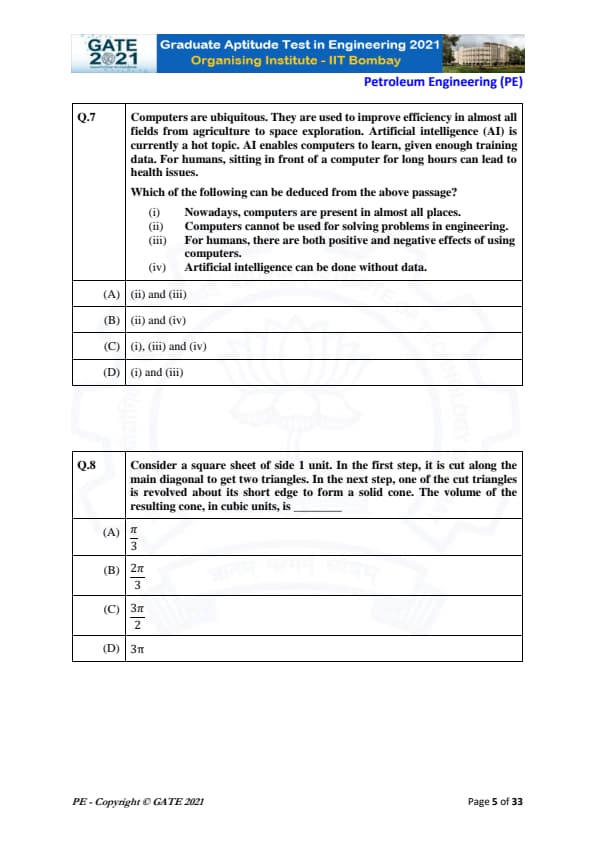
Computers are ubiquitous. They are used to improve efficiency in almost all fields from agriculture to space exploration. Artificial intelligence (AI) is currently a hot topic. AI enables computers to learn, given enough training data. For humans, sitting in front of a computer for long hours can lead to health issues.
Which of the following can be deduced from the above passage?
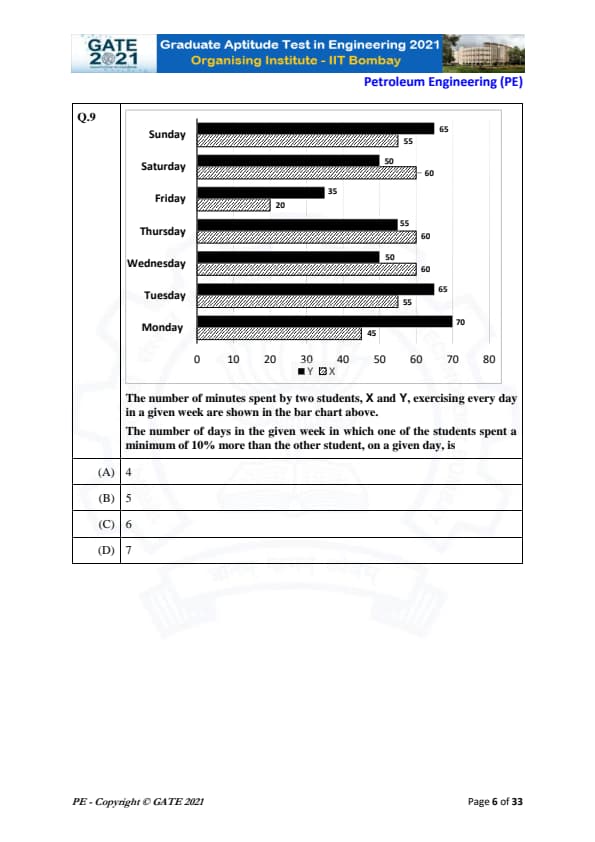
Consider a square sheet of side 1 unit. In the first step, it is cut along the main diagonal to get two triangles. In the next step, one of the cut triangles is revolved about its short edge to form a solid cone. The volume of the resulting cone, in cubic units, is _______
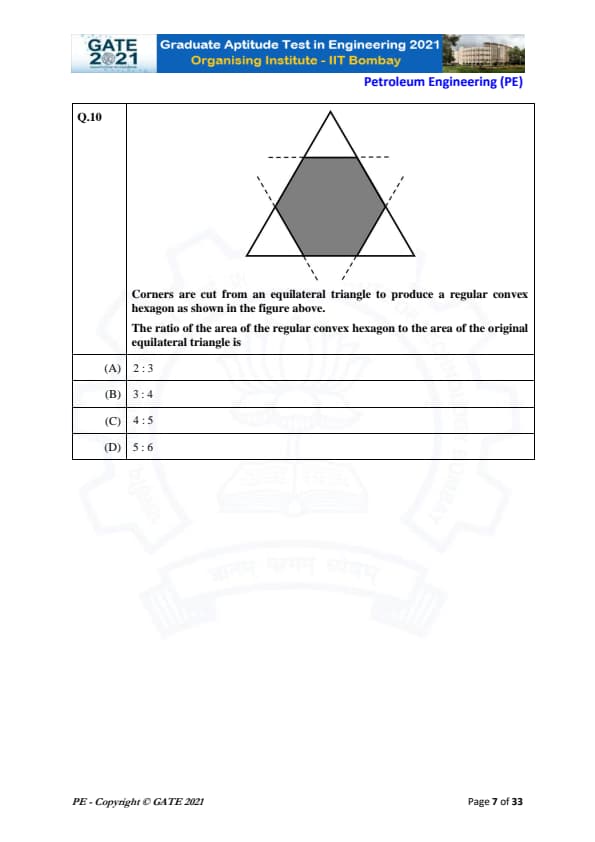
The number of minutes spent by two students, X and Y, exercising every day in a given week are shown in the bar chart above.
The number of days in the given week in which one of the students spent a minimum of 10% more than the other student, on a given day, is

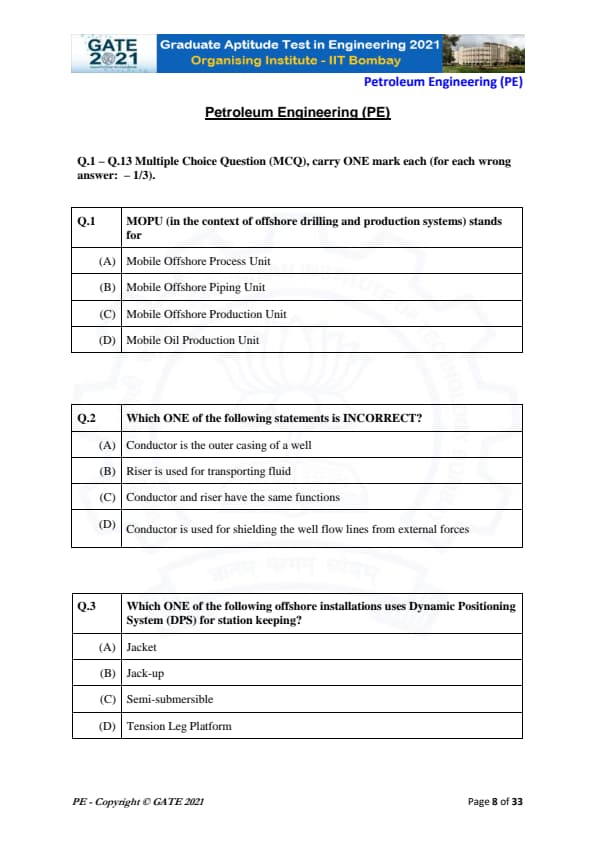
Corners are cut from an equilateral triangle to produce a regular convex hexagon as shown in the figure above.
The ratio of the area of the regular convex hexagon to the area of the original equilateral triangle is

MOPU (in the context of offshore drilling and production systems) stands for
Which ONE of the following statements is INCORRECT?
Which ONE of the following offshore installations uses Dynamic Positioning System (DPS) for station keeping?
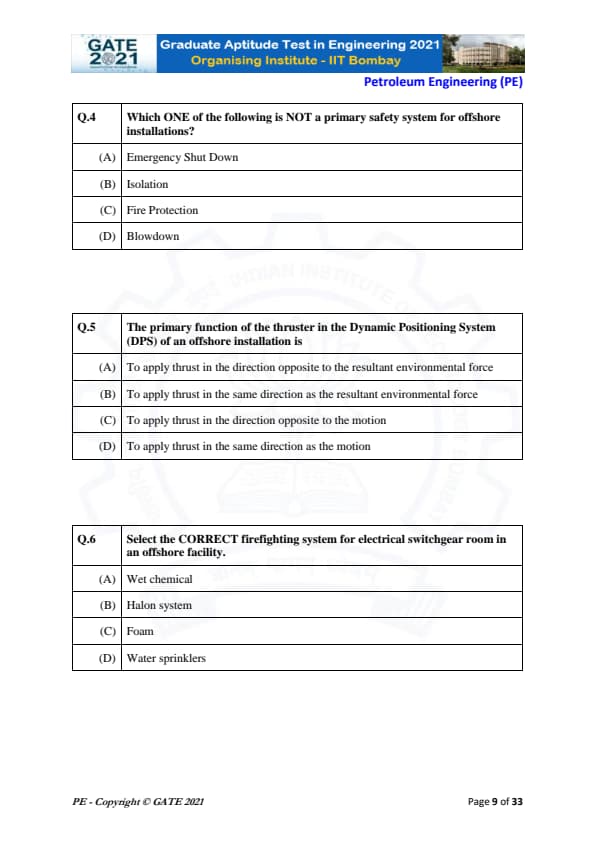
Which ONE of the following is NOT a primary safety system for offshore installations?
The primary function of the thruster in the Dynamic Positioning System (DPS) of an offshore installation is
Select the CORRECT firefighting system for electrical switchgear room in an offshore facility.
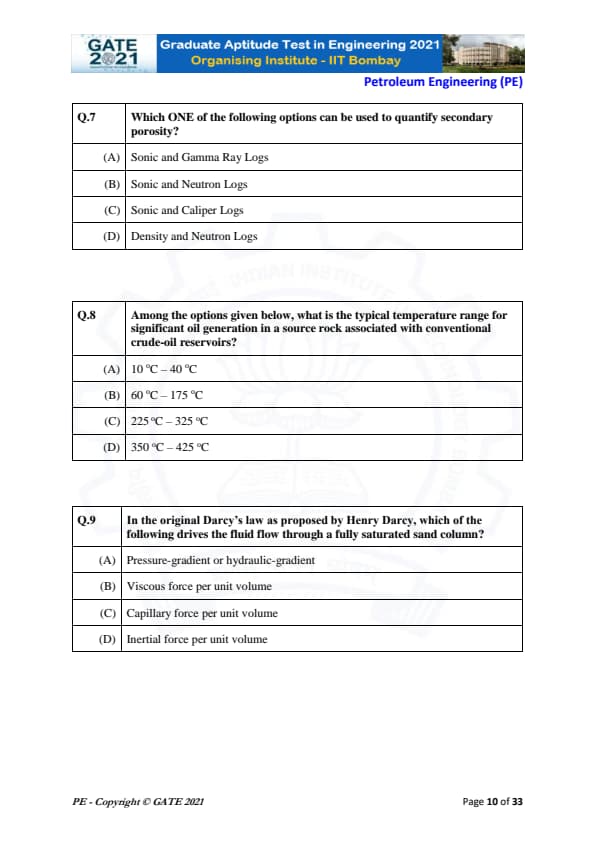
Which ONE of the following options can be used to quantify secondary porosity?
Among the options given below, what is the typical temperature range for significant oil generation in a source rock associated with conventional crude-oil reservoirs?
In the original Darcy’s law as proposed by Henry Darcy, which of the following drives the fluid flow through a fully saturated sand column?
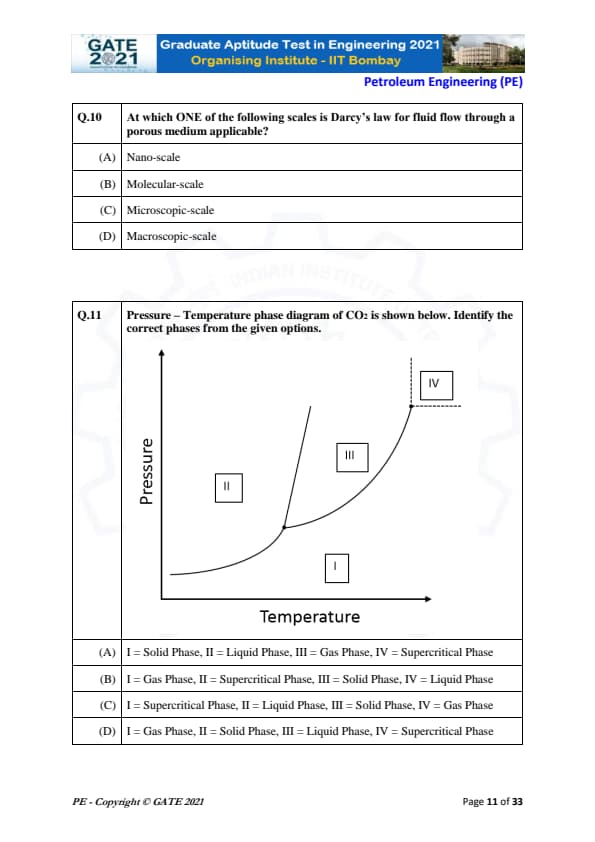
At which ONE of the following scales is Darcy’s law for fluid flow through a porous medium applicable?
Pressure – Temperature phase diagram of CO\(_2\) is shown below. Identify the correct phases from the given options.

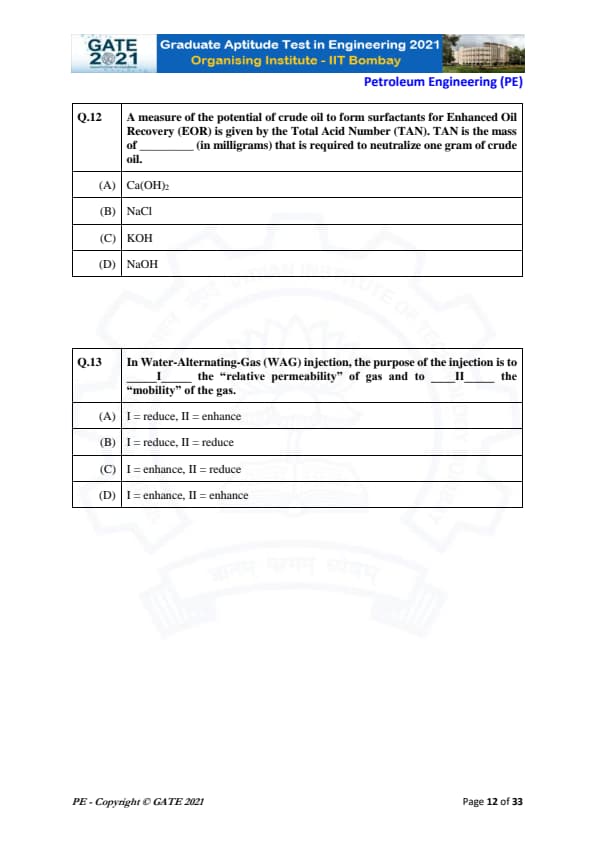
A measure of the potential of crude oil to form surfactants for Enhanced Oil Recovery (EOR) is given by the Total Acid Number (TAN). TAN is the mass of _______ (in milligrams) that is required to neutralize one gram of crude oil.
In Water-Alternating-Gas (WAG) injection, the purpose of the injection is to I _______ the “relative permeability” of gas and to II _______ the “mobility” of the gas.
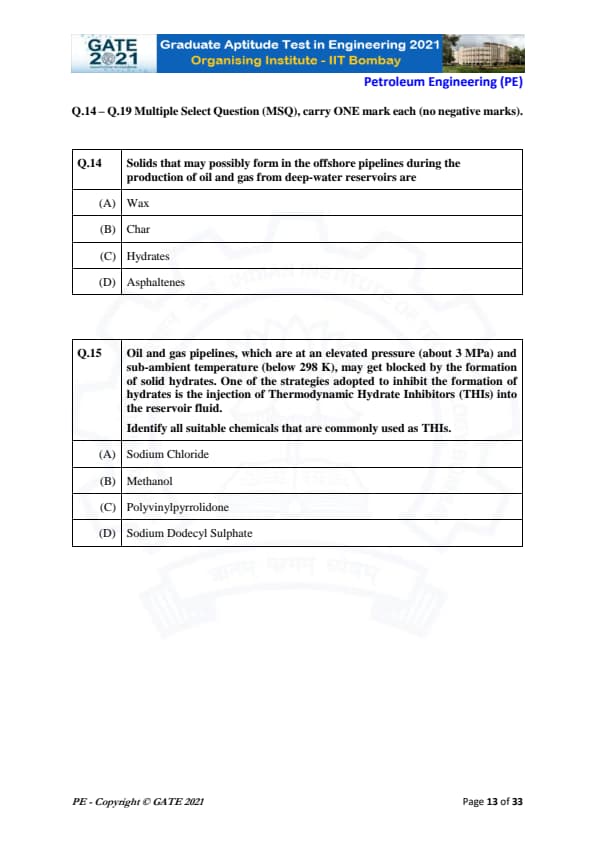
Solids that may possibly form in the offshore pipelines during the production of oil and gas from deep-water reservoirs are
Oil and gas pipelines, which are at an elevated pressure (about 3 MPa) and sub-ambient temperature (below 298 K), may get blocked by the formation of solid hydrates. One of the strategies adopted to inhibit the formation of hydrates is the injection of Thermodynamic Hydrate Inhibitors (THIs) into the reservoir fluid.
Identify all suitable chemicals that are commonly used as THIs.
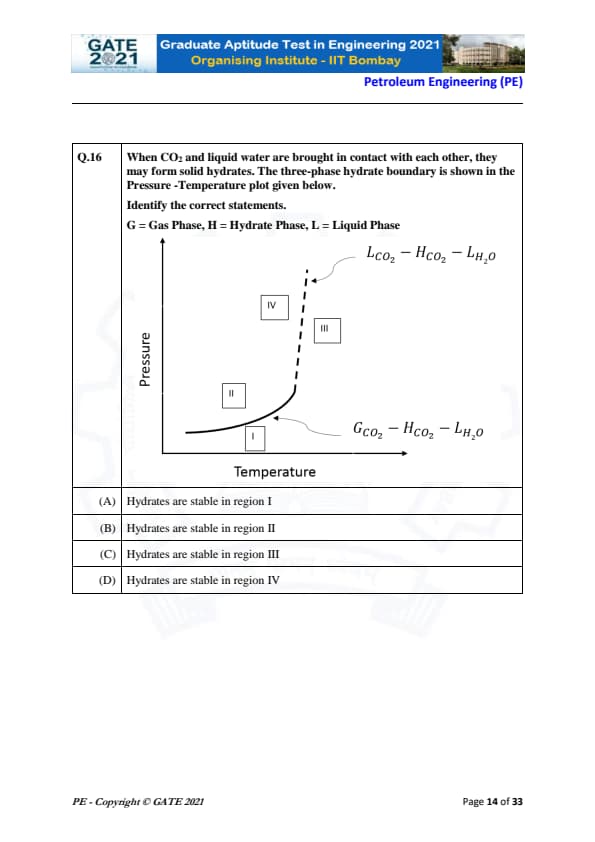
When CO\(_2\) and liquid water are brought in contact with each other, they may form solid hydrates. The three-phase hydrate boundary is shown in the Pressure-Temperature plot given below. Identify the correct statements.

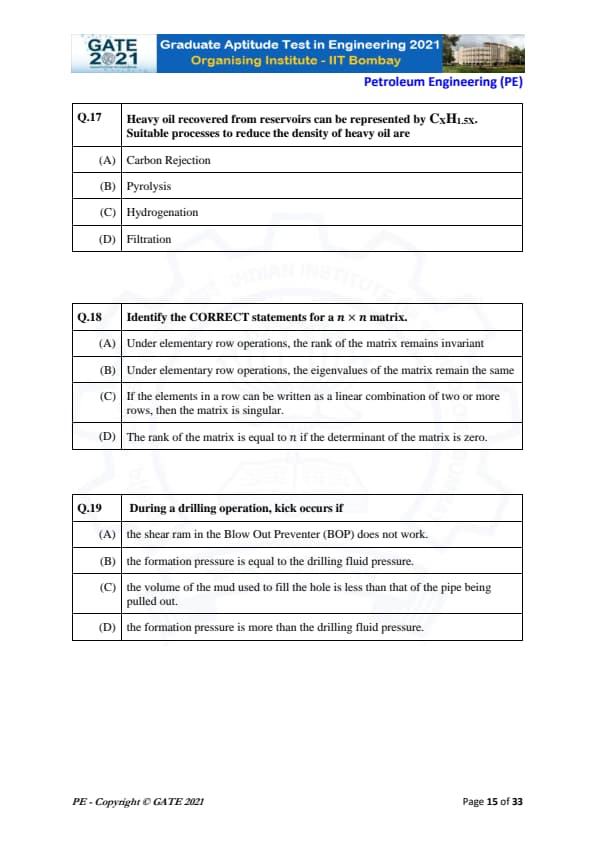
Heavy oil recovered from reservoirs can be represented by \(C_xH_{1.5x}\). Suitable processes to reduce the density of heavy oil are
Identify the CORRECT statements for a \(n \times n\) matrix.
During a drilling operation, kick occurs if
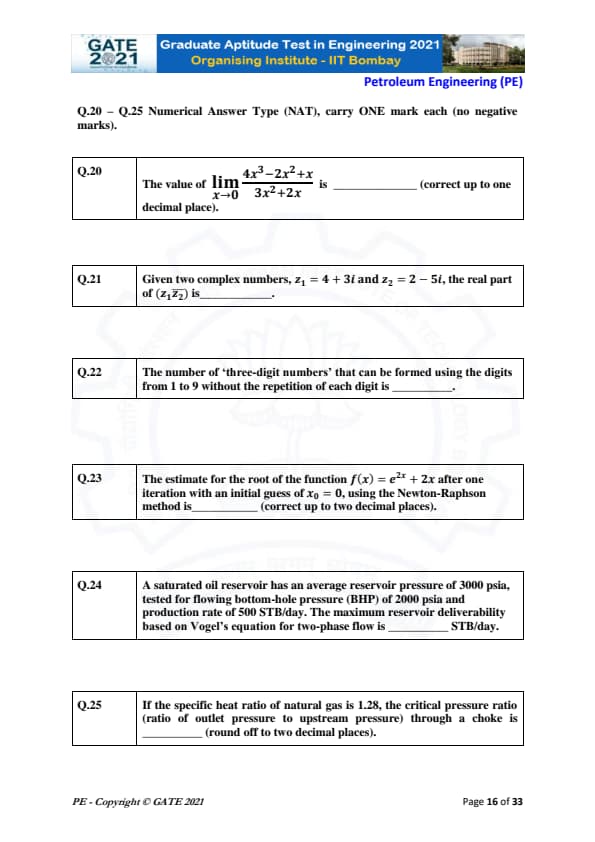
The value of \( \lim_{x \to 0} \frac{4x^3 - 2x^2 + x}{3x^2 + 2x} \) is ________ (correct up to one decimal place).
Given two complex numbers, \( z_1 = 4 + 3i \) and \( z_2 = 2 - 5i \), the real part of \( z_1z_2 \) is ________.
The number of ‘three-digit numbers’ that can be formed using the digits from 1 to 9 without the repetition of each digit is ________.
The estimate for the root of the function \( f(x) = e^{2x} + 2x \) after one iteration with an initial guess of \( x_0 = 0 \), using the Newton-Raphson method is ________ (correct up to two decimal places).
A saturated oil reservoir has an average reservoir pressure of 3000 psia, tested for flowing bottom-hole pressure (BHP) of 2000 psia and production rate of 500 STB/day. The maximum reservoir deliverability based on Vogel’s equation for two-phase flow is ________ STB/day.
If the specific heat ratio of natural gas is 1.28, the critical pressure ratio (ratio of outlet pressure to upstream pressure) through a choke is ________ (round off to two decimal places).
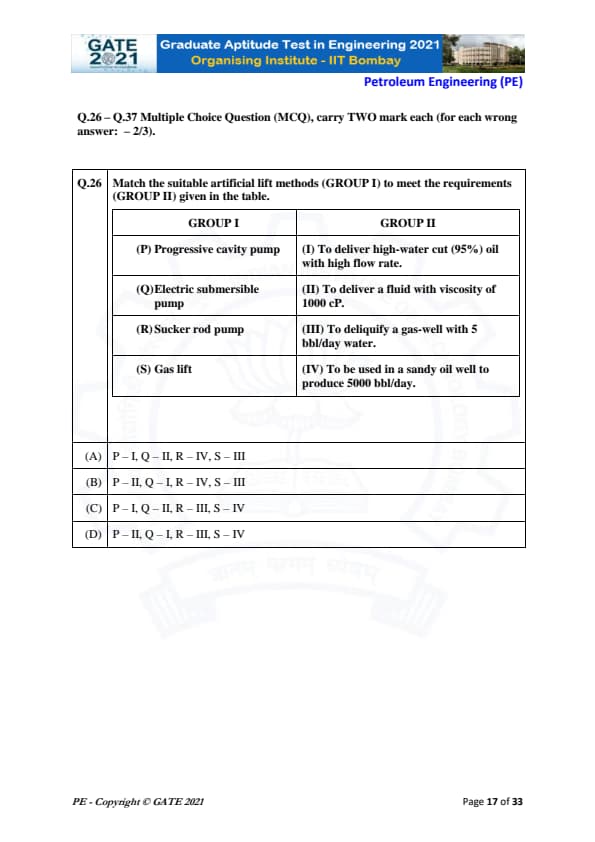
Match the suitable artificial lift methods (GROUP I) to meet the requirements (GROUP II) given in the table.

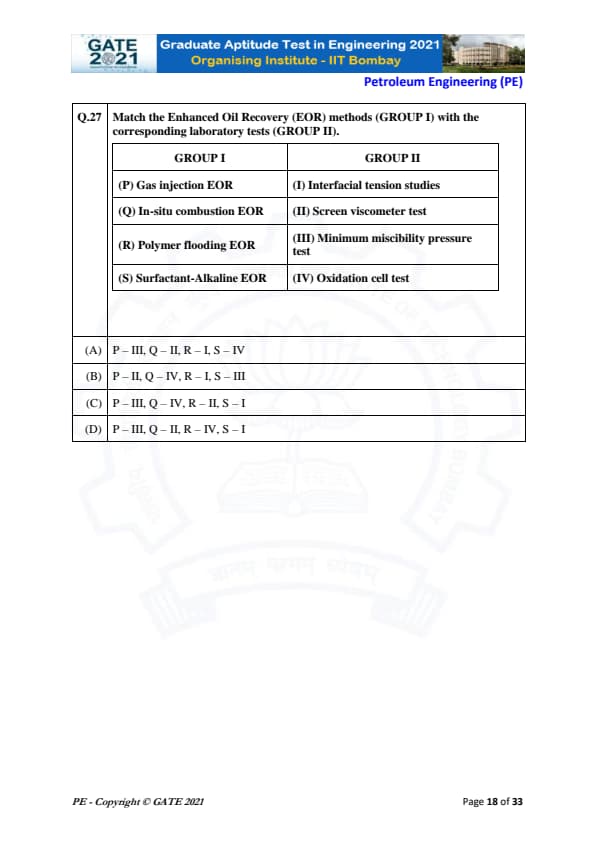
Match the Enhanced Oil Recovery (EOR) methods (GROUP I) with the corresponding laboratory tests (GROUP II).

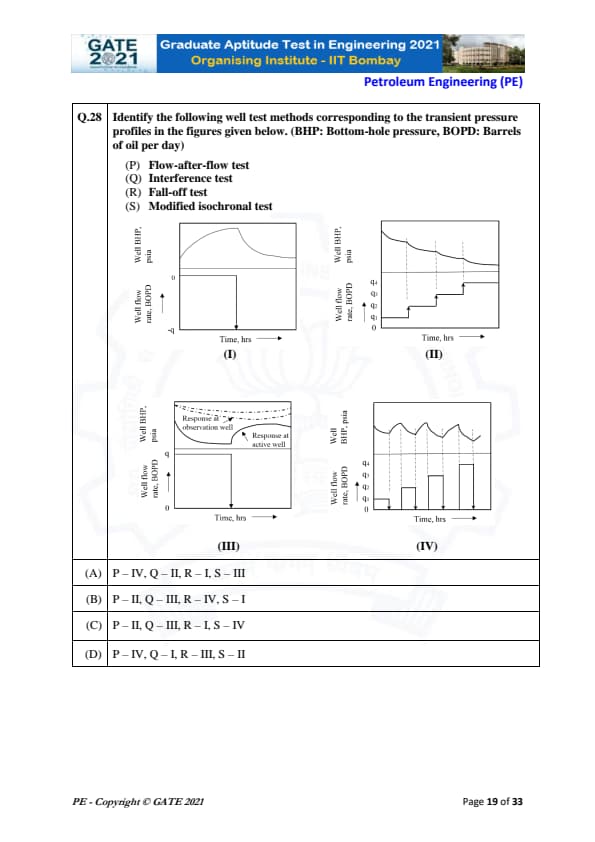
Identify the following well test methods corresponding to the transient pressure profiles in the figures given below. (BHP: Bottom-hole pressure, BOPD: Barrels of oil per day)

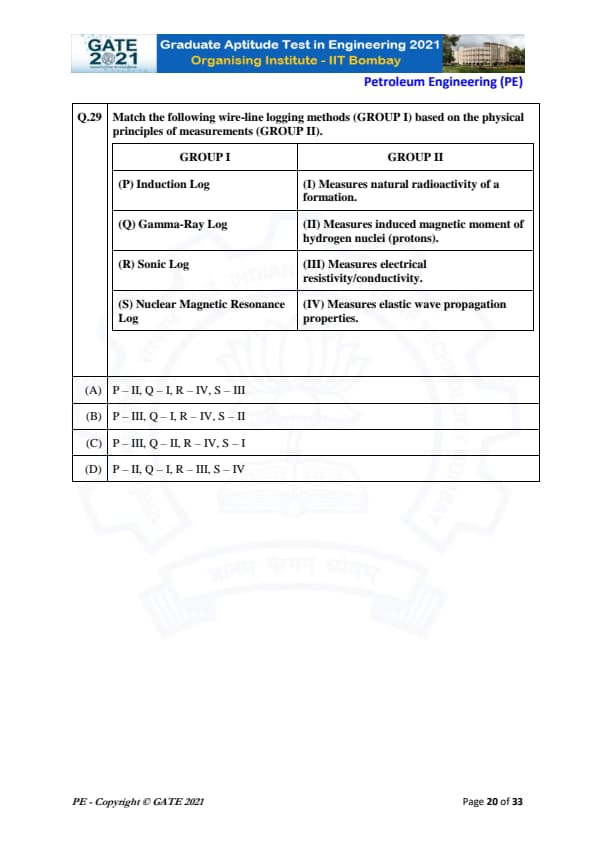
Match the following wire-line logging methods (GROUP I) based on the physical principles of measurements (GROUP II).

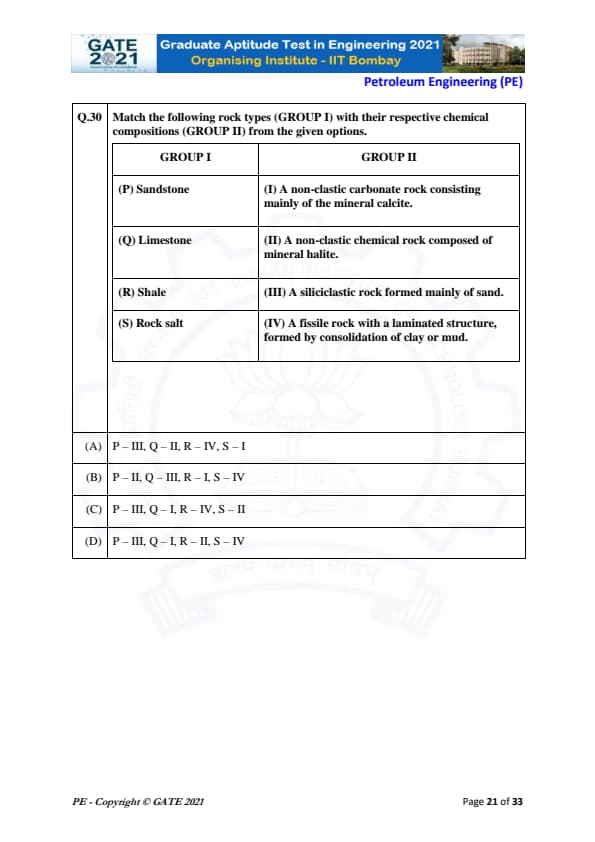
Match the following rock types (GROUP I) with their respective chemical compositions (GROUP II) from the given options.

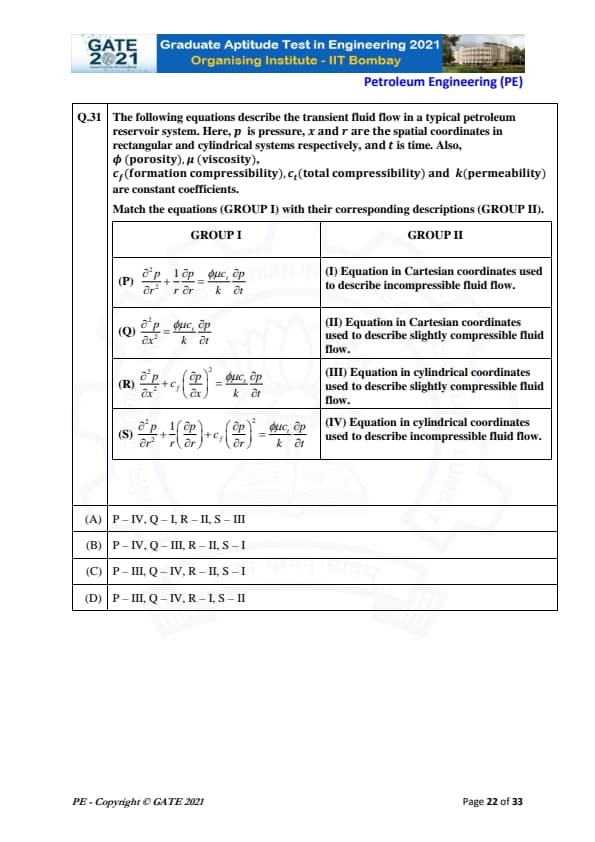
The following equations describe the transient fluid flow in a typical petroleum reservoir system. Here, \( p \) is pressure, \( x \) and \( r \) are the spatial coordinates in rectangular and cylindrical systems respectively, and \( t \) is time. Also, \( \phi \) (porosity), \( \mu \) (viscosity), \( c_f \) (formation compressibility), \( c_t \) (total compressibility) and \( k \) (permeability) are constant coefficients.
Match the equations (GROUP I) with their corresponding descriptions (GROUP II).

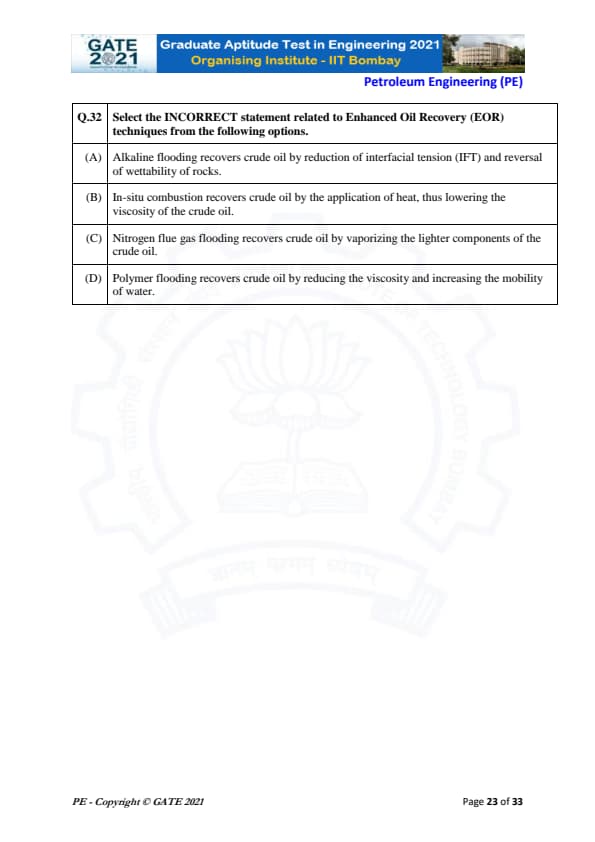
Select the INCORRECT statement related to Enhanced Oil Recovery (EOR) techniques from the following options.
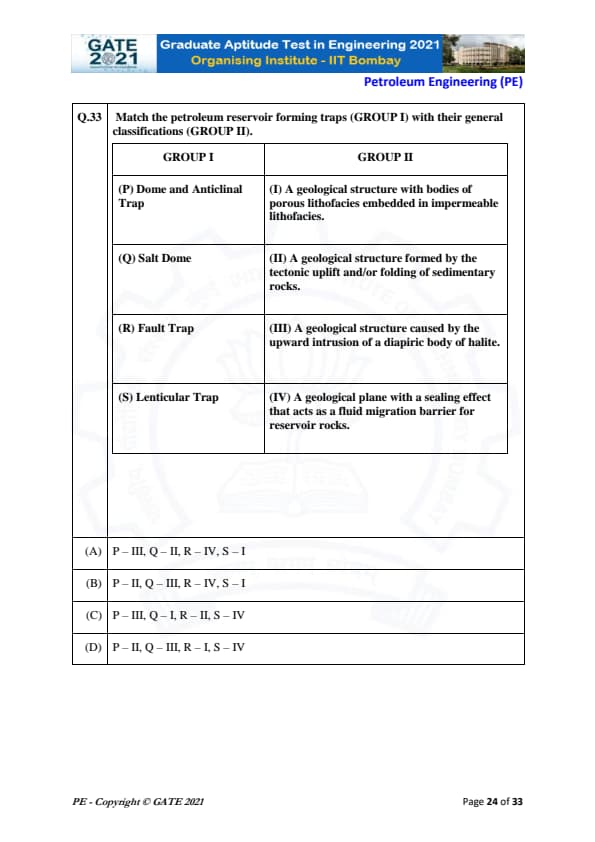
Match the petroleum reservoir forming traps (GROUP I) with their general classifications (GROUP II).

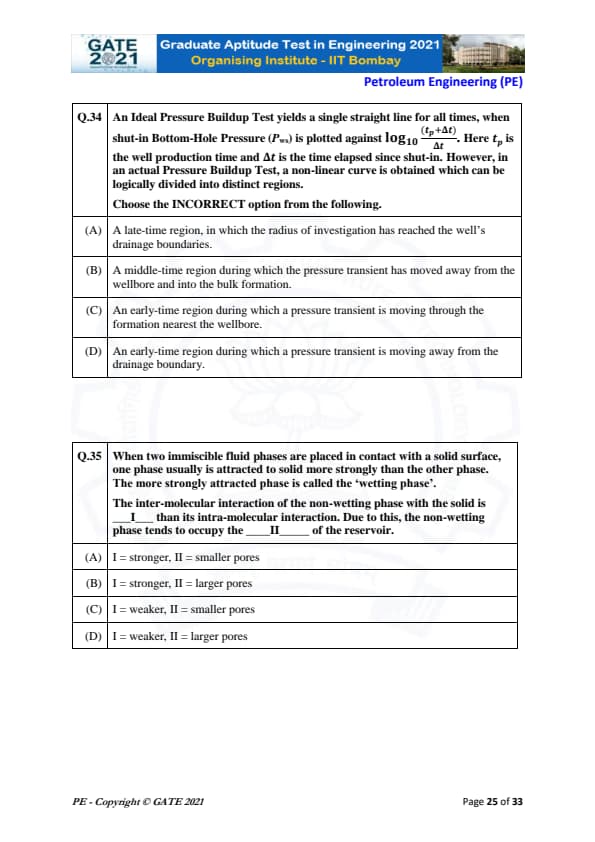
An Ideal Pressure Buildup Test yields a single straight line for all times, when shut-in Bottom-Hole Pressure (\(P_{ws}\)) is plotted against \(\log_{10} \left( \frac{t_p + \Delta t}{\Delta t} \right)\). Here \( t_p \) is the well production time and \(\Delta t\) is the time elapsed since shut-in. However, in an actual Pressure Buildup Test, a non-linear curve is obtained which can be logically divided into distinct regions. Choose the INCOMPLETE option from the following.
When two immiscible fluid phases are placed in contact with a solid surface, one phase usually is attracted to solid more strongly than the other phase. The more strongly attracted phase is called the ‘wetting phase’. The inter-molecular interaction of the non-wetting phase with the solid is _______I_______ than its intra-molecular interaction. Due to this, the non-wetting phase tends to occupy the _______II_______ of the reservoir.
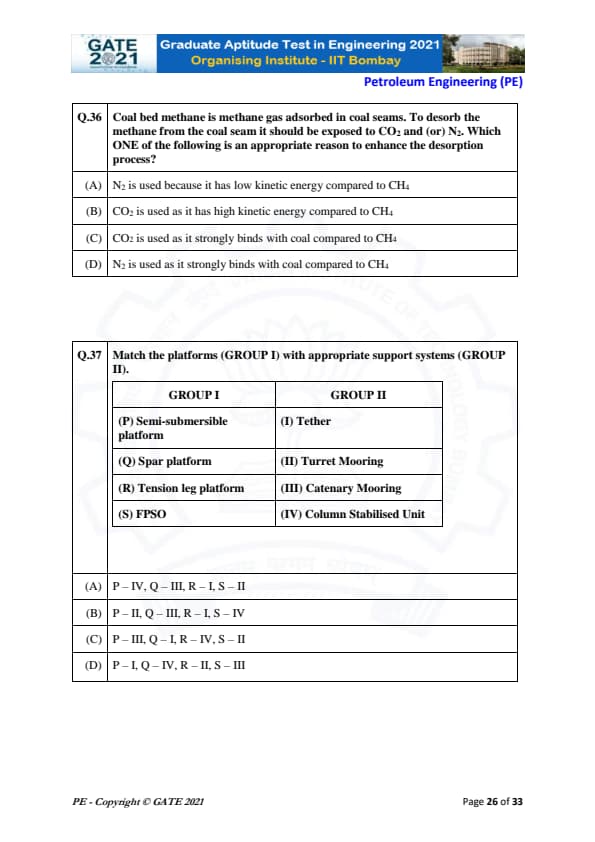
Coal bed methane is methane gas adsorbed in coal seams. To desorb the methane from the coal seam it should be exposed to CO\(_2\) and/or N\(_2\). Which ONE of the following is an appropriate reason to enhance the desorption process?
Match the platforms (GROUP I) with appropriate support systems (GROUP II).

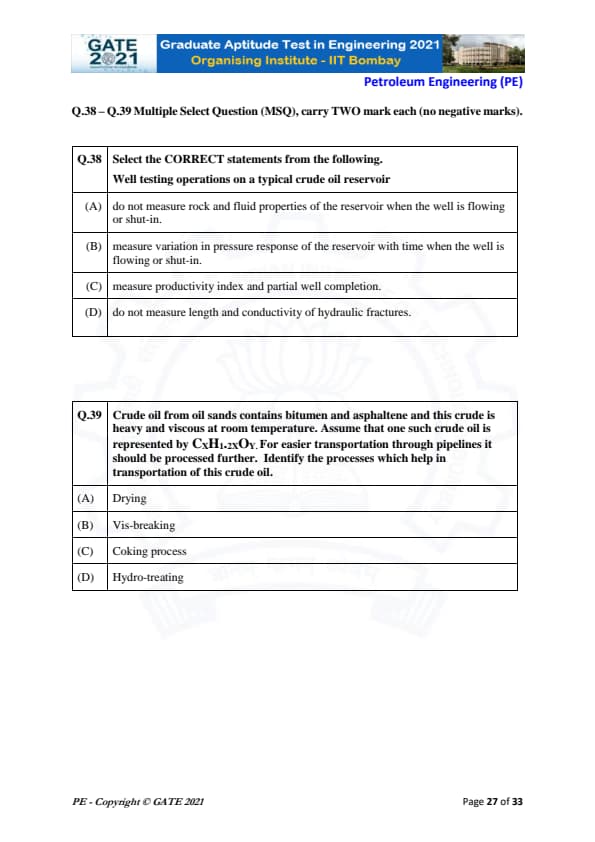
Select the CORRECT statements from the following.
Well testing operations on a typical crude oil reservoir
Crude oil from oil sands contains bitumen and asphaltene, and this crude is heavy and viscous at room temperature. Assume that one such crude oil is represented by \( C_xH_{1.2x}O_y \). For easier transportation through pipelines, it should be processed further. Identify the processes which help in transportation of this crude oil.
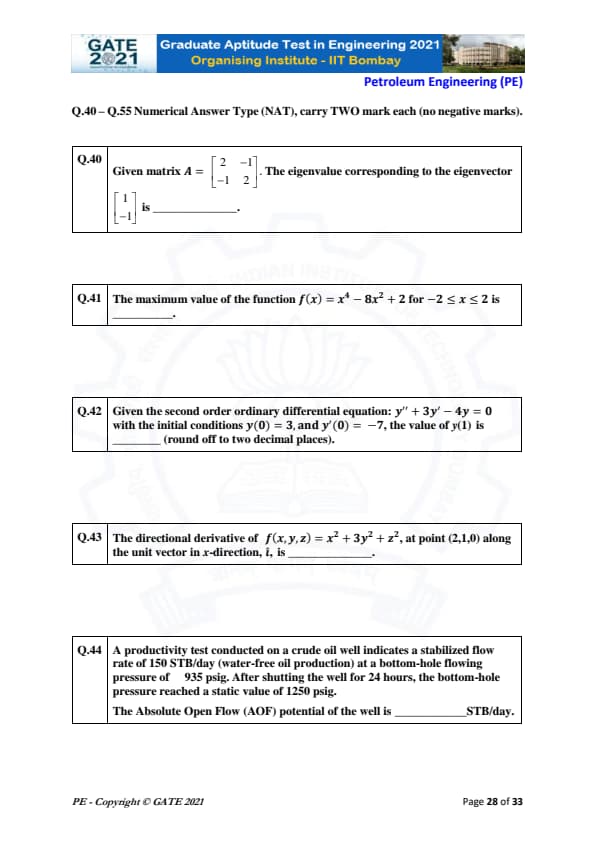
Given matrix \( A = \begin{bmatrix} 2 & -1 \\
-1 & 2 \end{bmatrix} \), the eigenvalue corresponding to the eigenvector \( \begin{bmatrix} 1 \\
-1 \end{bmatrix} \) is ________.
The maximum value of the function \( f(x) = x^4 - 8x^2 + 2 \) for \( -2 \leq x \leq 2 \) is ________.
Given the second-order ordinary differential equation: \( y'' + 3y' - 4y = 0 \) with the initial conditions \( y(0) = 3 \), and \( y'(0) = -7 \), the value of \( y(1) \) is ________ (round off to two decimal places).
The directional derivative of \( f(x, y, z) = x^2 + 3y^2 + z^2 \), at point \( (2, 1, 0) \) along the unit vector in \( x \)-direction, \( \hat{i} \), is ________.
A productivity test conducted on a crude oil well indicates a stabilized flow rate of 150 STB/day (water-free oil production) at a bottom-hole flowing pressure of 935 psig. After shutting the well for 24 hours, the bottom-hole pressure reached a static value of 1250 psig. The Absolute Open Flow (AOF) potential of the well is ________ STB/day.
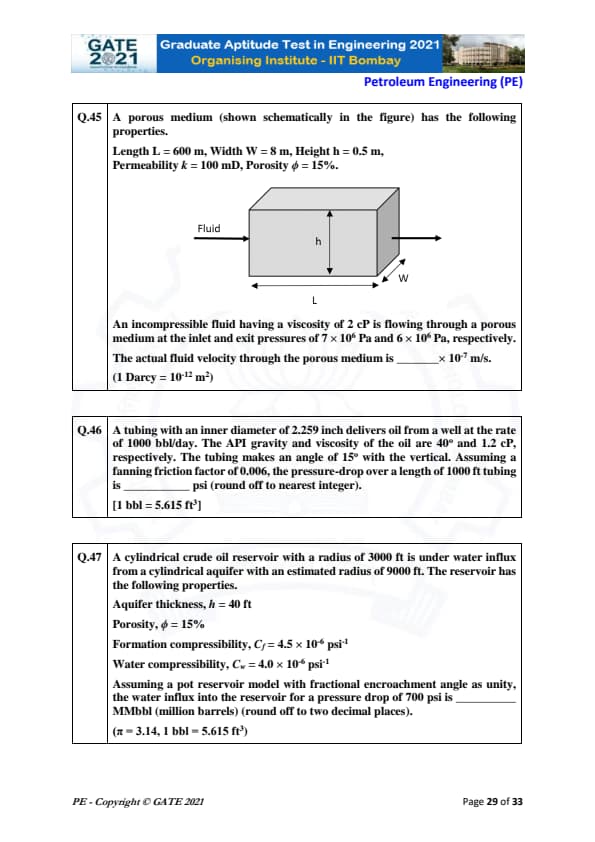
A porous medium (shown schematically in the figure) has the following properties.

Length L = 600 \, \text{m, Width W = 8 \, m, Height h = 0.5 \, m, Permeability k = 100 \, mD, Porosity \phi = 15%.
An incompressible fluid having a viscosity of 2 cP is flowing through a porous medium at the inlet and exit pressures of 7 \times 10^6 \, \text{Pa and 6 \times 10^6 \, Pa, respectively.
The actual fluid velocity through the porous medium is ________ \times 10^{-7}, m/s.
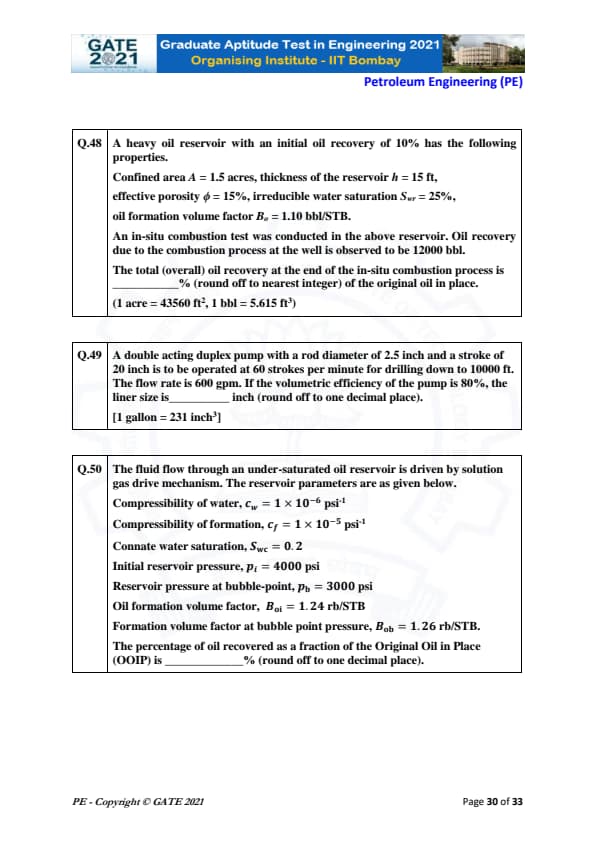
A tubing with an inner diameter of 2.259 inch delivers oil from a well at the rate of 1000 bbl/day. The API gravity and viscosity of the oil are 40° and 1.2 cP, respectively. The tubing makes an angle of 15° with the vertical. Assuming a fanning friction factor of 0.006, the pressure-drop over a length of 1000 ft tubing is ________ psi (round off to nearest integer).
A cylindrical crude oil reservoir with a radius of 3000 ft is under water influx from a cylindrical aquifer with an estimated radius of 9000 ft. The reservoir has the following properties.
Aquifer thickness, h = 40, ft, Porosity, \phi = 15%, Formation compressibility, C_f = 4.5 \times 10^{-6}, psi^{-1}, Water compressibility, C_w = 4.0 \times 10^{-6}, psi1.
Assuming a pot reservoir model with fractional encroachment angle as unity, the water influx into the reservoir for a pressure drop of 700 psi is _____ MMbbl (million barrels) (round off to two decimal places).
A heavy oil reservoir with an initial oil recovery of 10% has the following properties.
Confined area A = 1.5 \, acres, thickness of the reservoir h = 15 \, ft, effective porosity \phi = 15%, irreducible water saturation S_{wr = 25%, oil formation volume factor B_o = 1.10 \, bbl/STB.
An in-situ combustion test was conducted in the above reservoir. Oil recovery due to the combustion process at the well is observed to be 12000 bbl.
The total (overall) oil recovery at the end of the in-situ combustion process is _______% (round off to nearest integer) of the original oil in place.
A double acting duplex pump with a rod diameter of 2.5 inch and a stroke of 20 inch is to be operated at 60 strokes per minute for drilling down to 10000 ft. The flow rate is 600 gpm. If the volumetric efficiency of the pump is 80%, the liner size is ________ inch (round off to one decimal place).
The fluid flow through an under-saturated oil reservoir is driven by solution gas drive mechanism. The reservoir parameters are as given below.
Compressibility of water, c_w = 1 \times 10^{-6}, psi^{-1}, Compressibility of formation, c_f = 1 \times 10^{-5}, psi^{-1}, Connate water saturation, S_{wc} = 0.2, Initial reservoir pressure, p_i = 4000, psi,
Reservoir pressure at bubble-point, p_b = 3000 \, psi, Oil formation volume factor, B_{oi = 1.24 \, rb/STB, Formation volume factor at bubble point pressure, B_{ob} = 1.26 , rb/STB.
The percentage of oil recovered as a fraction of the Original Oil in Place (OOIP) is _______% (round off to one decimal place).
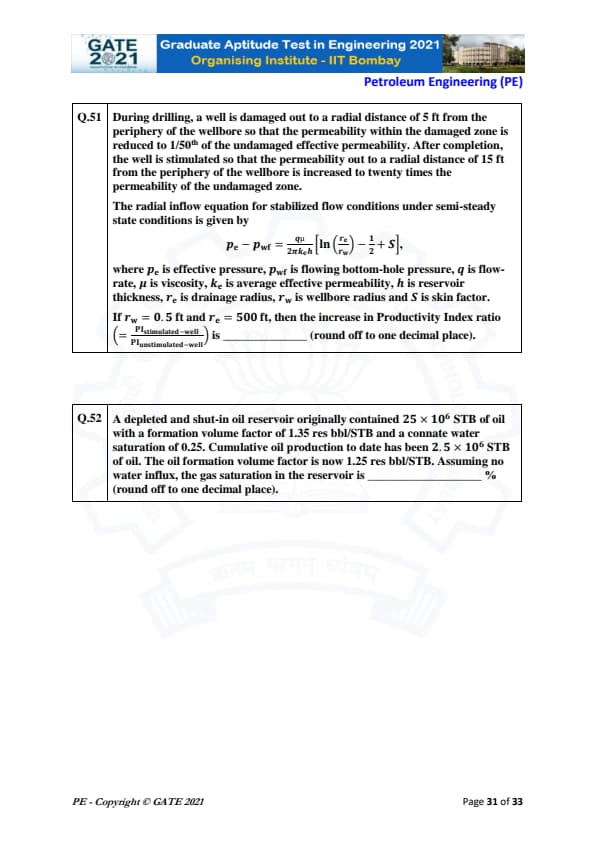
During drilling, a well is damaged out to a radial distance of 5 ft from the periphery of the wellbore so that the permeability within the damaged zone is reduced to \( \frac{1}{50} \) of the undamaged effective permeability. After completion, the well is stimulated so that the permeability out to a radial distance of 15 ft from the periphery of the wellbore is increased to twenty times the permeability of the undamaged zone.
The radial inflow equation for stabilized flow conditions under semi-steady state conditions is given by:
\[ p_e - p_{wf} = \frac{q \mu}{2 \pi k_e h} \left[ \ln \left( \frac{r_e}{r_w} \right) - \frac{1}{2} + S \right] \]
Where \( p_e \) is effective pressure, \( p_{wf} \) is flowing bottom-hole pressure, \( q \) is flow rate, \( \mu \) is viscosity, \( k_e \) is average effective permeability, \( h \) is reservoir thickness, \( r_e \) is drainage radius, \( r_w \) is wellbore radius, and \( S \) is skin factor.
If \( r_w = 0.5 \, ft \) and \( r_e = 500 \, ft \), then the increase in Productivity Index ratio \( \left( \frac{P_{stimulated} - P_{well}}{P_{unstimulated} - P_{well}} \right) \) is ________ (round off to one decimal place).
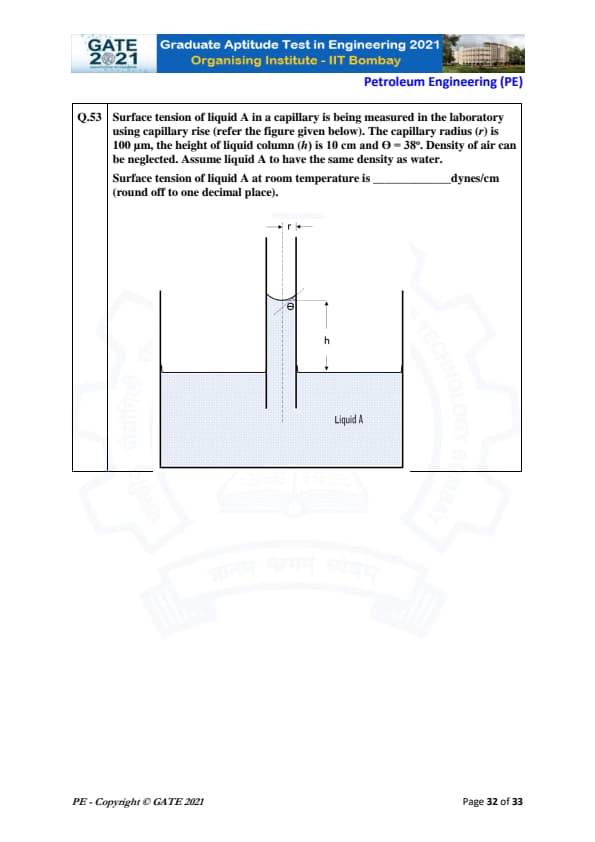
Surface tension of liquid A in a capillary is being measured in the laboratory using capillary rise (refer the figure given below). The capillary radius \( r \) is 100 \(\mu\)m, the height of liquid column \( h \) is 10 cm and \( \Theta = 38^\circ \). Density of air can be neglected. Assume liquid A to have the same density as water.
Surface tension of liquid A at room temperature is ________ dyne/cm (round off to one decimal place).

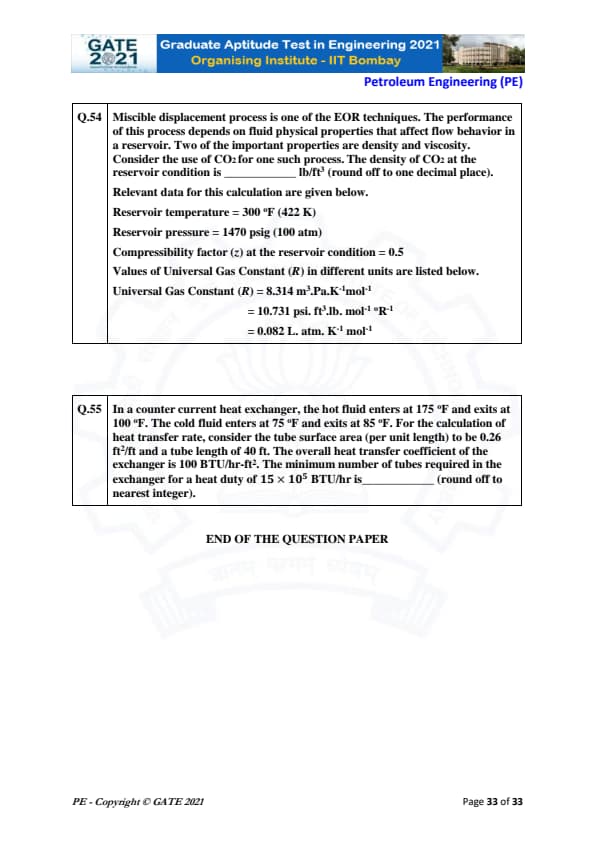
Miscible displacement process is one of the EOR techniques. The performance of this process depends on fluid physical properties that affect flow behavior in a reservoir. Two of the important properties are density and viscosity. Consider the use of CO\(_2\) for one such process. The density of CO\(_2\) at the reservoir condition is ________ lb/ft\(^3\) (round off to one decimal place).
Relevant data for this calculation are given below.
- Reservoir temperature = 300 ºF (422 K)
- Reservoir pressure = 1470 psig (100 atm)
- Compressibility factor (\(z\)) at the reservoir condition = 0.5
- Values of Universal Gas Constant (\(R\)) in different units are listed below:
- \( R = 8.314 \, m^3 \, Pa.K^{-1} \, mol^{-1} \)
- \( R = 10.731 \, psi.ft^3 \, lb.mol^{-1} \, ºR^{-1} \)
- \( R = 0.082 \, L \, atm.K^{-1} \, mol^{-1} \)
In a counter current heat exchanger, the hot fluid enters at 175 °F and exits at 100 °F. The cold fluid enters at 75 °F and exits at 85 °F. For the calculation of heat transfer rate, consider the tube surface area (per unit length) to be 0.26 ft²/ft and a tube length of 40 ft. The overall heat transfer coefficient of the exchanger is 100 BTU/hr-ft². The minimum number of tubes required in the exchanger for a heat duty of \( 15 \times 10^5 \) BTU/hr is ________ (round off to nearest integer).
Quick Links:
GATE 2021 PE Paper Analysis
- GATE 2021 PE paper contained 65 (multiple choice and numerical answer type) questions worth a total of 100 points containing 30 questions of 1 mark and 35 questions of 2marks. Let's look at some of the highlights from GATE 2021 PE paper analysis:
- Most of the questions for GATE PE 2021 paper was conceptual-based.
- There were 3 sections – General aptitude, Engineering Mathematics and Subject-specific questions.
- Topic wise distribution for GATE PE 2021 question are;
| TOPIC | 1-mark | 2-mark |
|---|---|---|
| Engineering Mathematics | 5 | 4 |
| General Aptitude | 5 | 5 |
| Petroleum Exploration | 1 | 2 |
| Oil and Gas Well Drilling Technology | 1 | 1 |
| Reservoir Engineering | 3 | 8 |
| Petroleum Production Operations | 2 | 6 |
| Offshore Drilling and Production Practices | 5 | 1 |
| Oil and Gas Well Testing | 1 | 0 |
| Petroleum Formation Evaluation | 2 | 2 |
| HSE | 1 | 0 |
| Enhanced Oil Recovery Technique | 2 | 2 |
| 4 Latest trends in Petroleum Engineering | 4 | 1 |
Comparison between MCQ/MSQ/NAT in Petroleum Engineering Paper of GATE-2021
| Comparison | No. of 1-mark questions | No. of 2 marks questions | Total marks | % weightage |
|---|---|---|---|---|
| MCQ | 13 | 12 | 37 | 43.5 |
| MSQ | 6 | 2 | 10 | 11.8 |
| NAT | 6 | 16 | 38 | 44.7 |
Also Check:
GATE Previous Year Question Papers:
| GATE 2022 Question Papers | GATE 2021 Question Papers | GATE 2020 Question Papers |
| GATE 2019 Question Papers | GATE 2018 Question Papers | GATE 2017 Question Papers |




Comments