




GATE 2021 Physics (PH) exam was conducted on Feb 6, 2021 in the afternoon session. Overall difficulty level of exam was found to be Moderate to difficult. Number of good attempts for GATE PH 2021 was around 40-42.
The problems were usually formula based, which consisted little calculation. Candidates should have thorough understanding of GATE PH 2021 examination that will be better for candidates to prepare for future success since they will be familiar with the types of questions and paper patterns that will occur in future GATE tests.
GATE 2021 Physics (PH) Question Paper with Solutions
| GATE 2021 Physics (PH) Question Paper |  Download Download |
Check Solutions |

Which of the following sentences are grammatically CORRECT?
(i) Arun and Aparna are here.
(ii) Arun and Aparna is here.
(iii) Arun's families is here.
(iv) Arun's family is here.
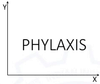
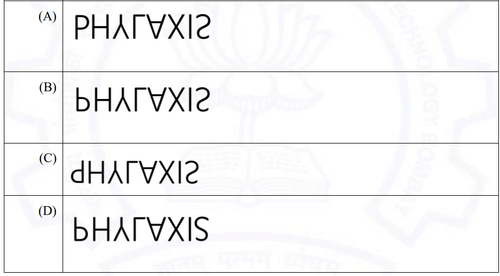
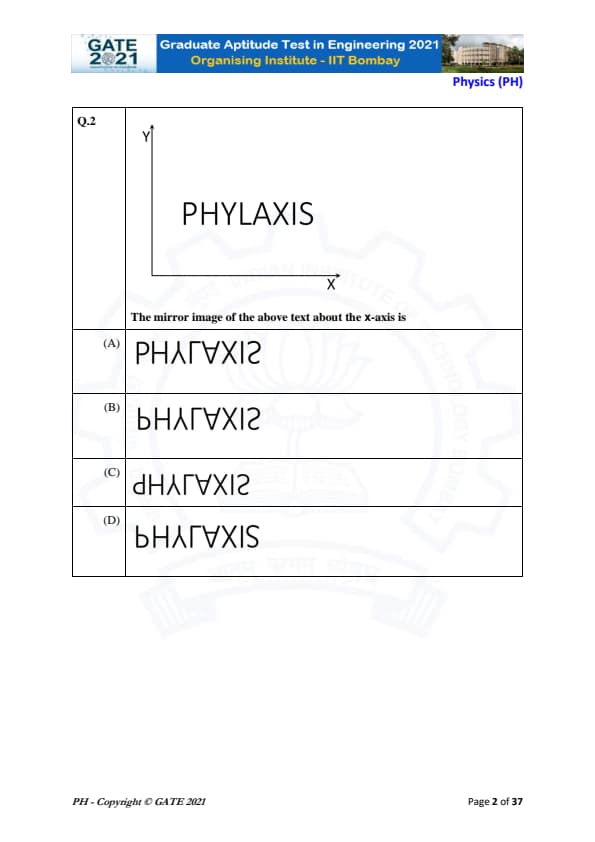
The mirror image of the above text about the x-axis is
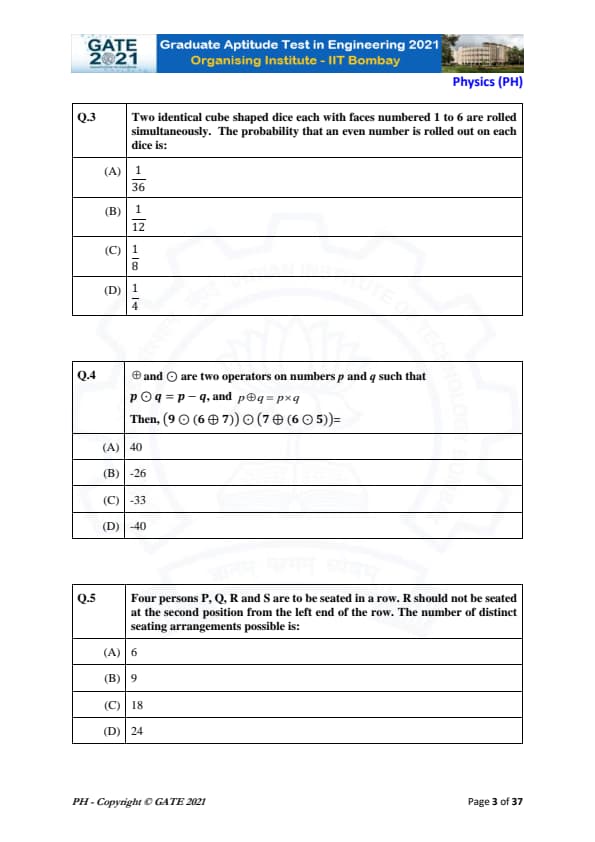
Two identical cube-shaped dice each with faces numbered 1 to 6 are rolled simultaneously. The probability that an even number is rolled out on each dice is:
\(\oplus\) and \(\odot\) are two operators on numbers \(p\) and \(q\) such that \(p \odot q = p - q\) and \(p \oplus q = p \times q\). Find the value of \((9 \odot (6 \oplus 7)) \odot (7 \oplus (6 \odot 5))\).
Four persons P, Q, R and S are to be seated in a row. R should not be seated at the second position from the left end. The number of distinct seating arrangements possible is:
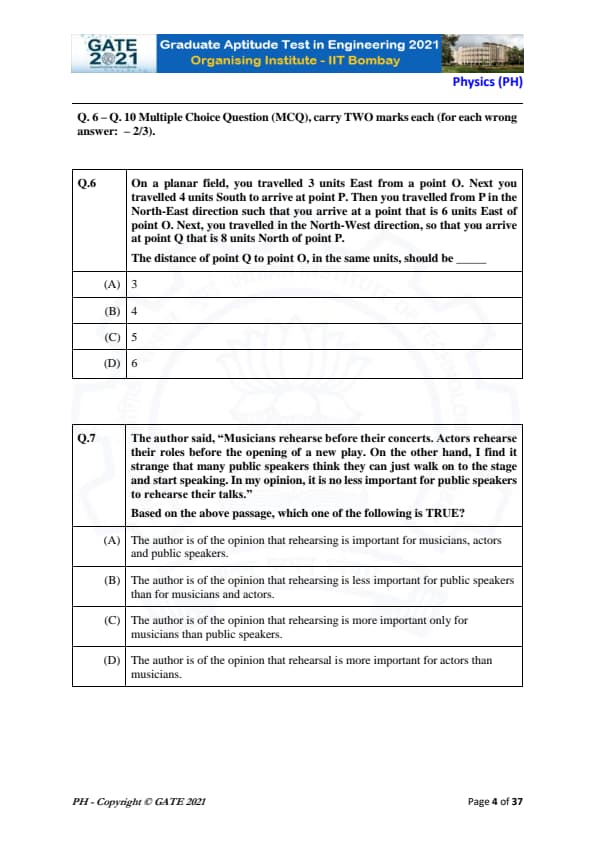
On a planar field, you travelled 3 units East from a point O. Next you travelled 4 units South to arrive at point P. Then you travelled from P in the North-East direction such that you arrive at a point that is 6 units East of point O. Next, you travelled in the North-West direction, so that you arrive at point Q that is 8 units North of point P. The distance of point Q to point O, in the same units, should be ________
Based on the author's statement about musicians, actors and public speakers rehearsing, which one of the following is TRUE?
1. Some football players play cricket.
2. All cricket players play hockey.
Among the options given below, the statement that logically follows from the two statements 1 and 2 above, is:
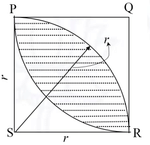
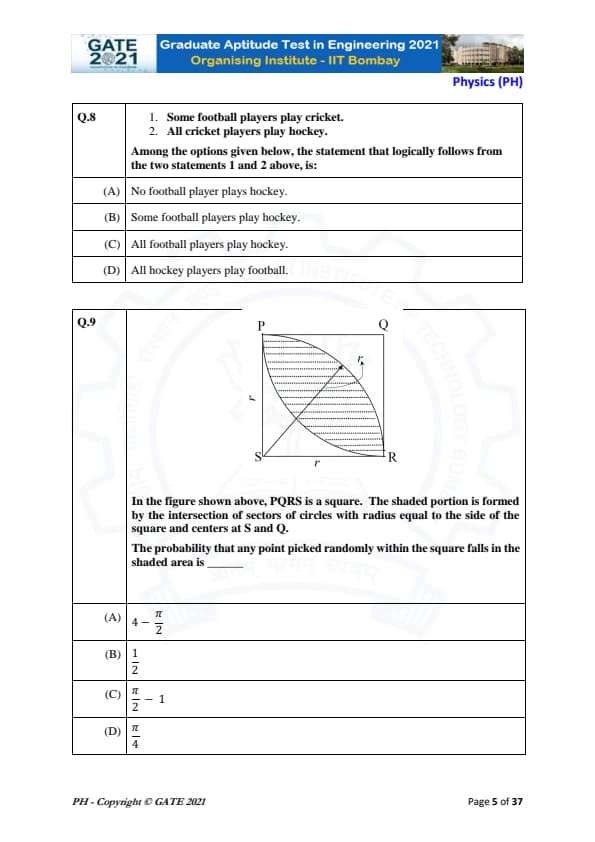
In the figure, PQRS is a square. The shaded part is formed by the intersection of sectors of two circles of radius equal to the side of the square and centers at S and Q.
The probability that a random point inside the square lies in the shaded region is:
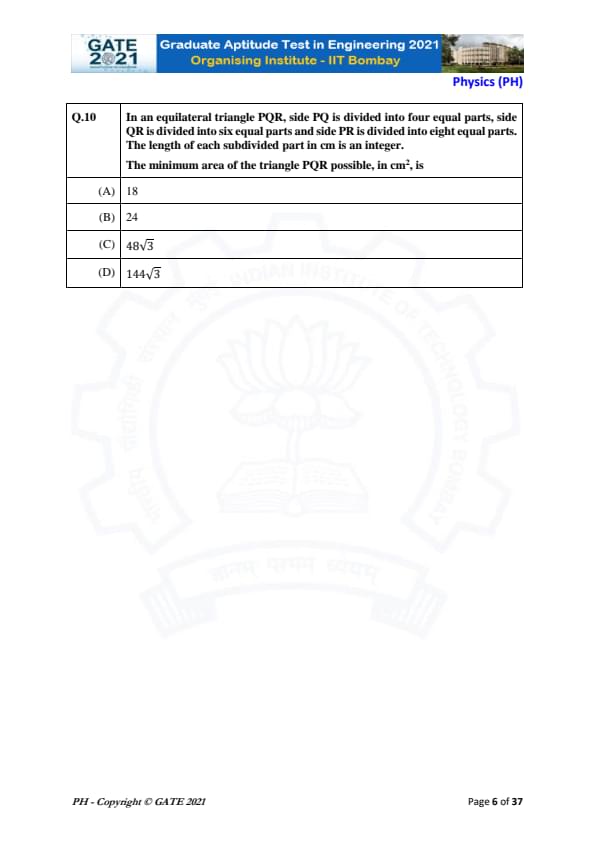
In an equilateral triangle PQR, side PQ is divided into four equal parts, side QR is divided into six equal parts and side PR is divided into eight equal parts.
The length of each subdivided part in cm is an integer.
The minimum area of the triangle PQR possible, in cm\(^2\), is:
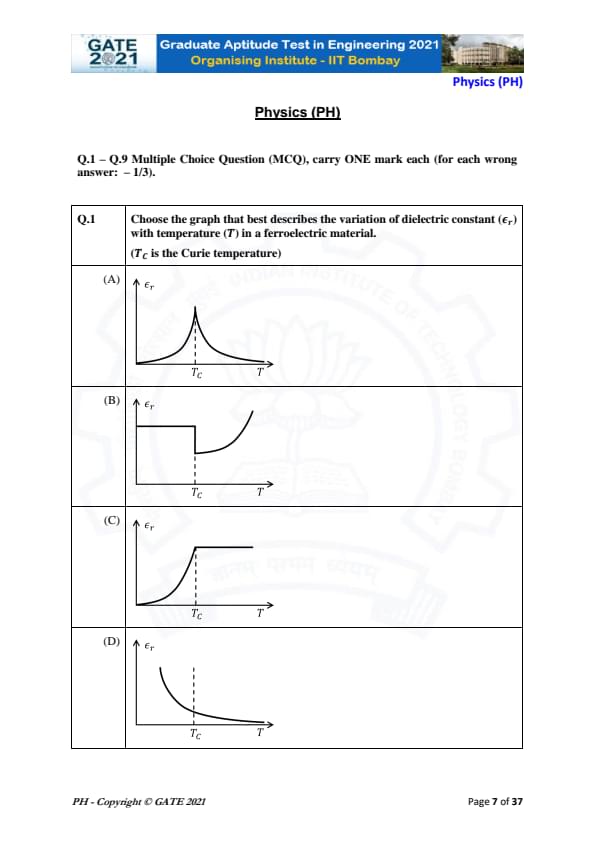
Choose the graph that best describes the variation of dielectric constant (\( \epsilon_r \)) with temperature (\( T \)) in a ferroelectric material.
(T\(_C\) is the Curie temperature)

A matter wave is represented by the wave function \[ \Psi(x, y, z, t) = A e^{i(4x+3y+5z-10\pi t)}, \]
\text{where A is a constant. The unit vector representing the direction of propagation of this matter wave is
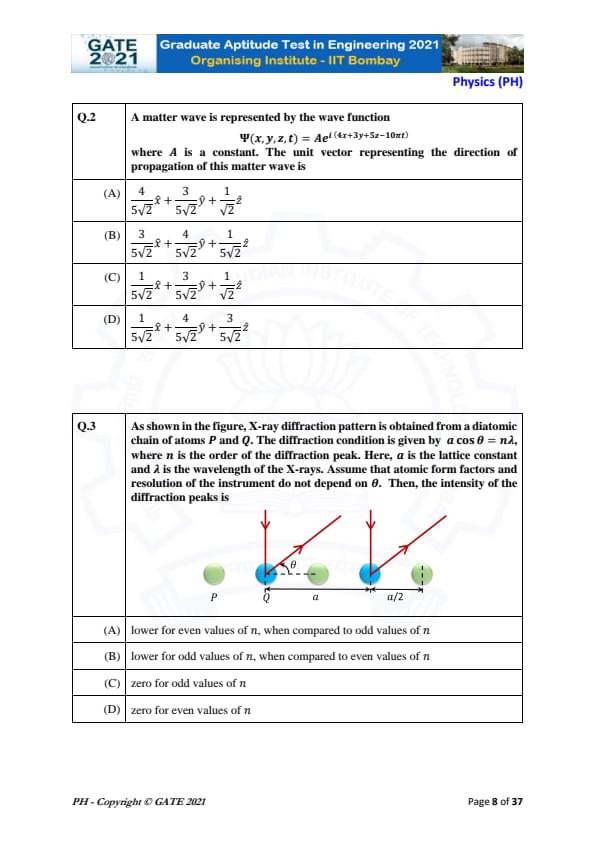
As shown in the figure, X-ray diffraction pattern is obtained from a diatomic chain of atoms P and Q. The diffraction condition is given by \( a \cos \theta = n\lambda \), where \( n \) is the order of the diffraction peak. Here, \( a \) is the lattice constant and \( \lambda \) is the wavelength of the X-rays. Assume that atomic form factors and resolution of the instrument do not depend on \( \theta \). Then, the intensity of the diffraction peaks is

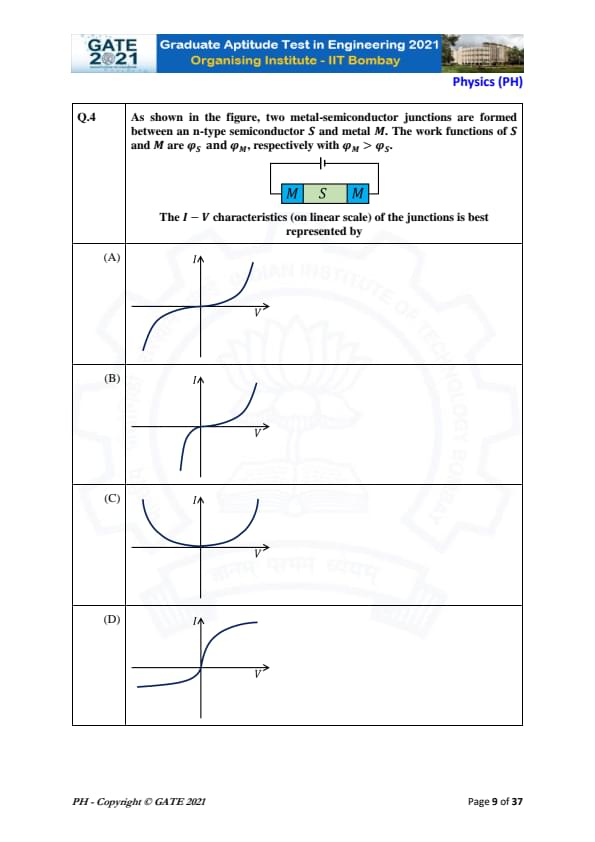
As shown in the figure, two metal-semiconductor junctions are formed between an n-type semiconductor S and metal M. The work functions of S and M are \(\phi_S\) and \(\phi_M\), respectively, with \(\phi_M > \phi_S\). The I-V characteristics (on linear scale) of the junctions is best represented by


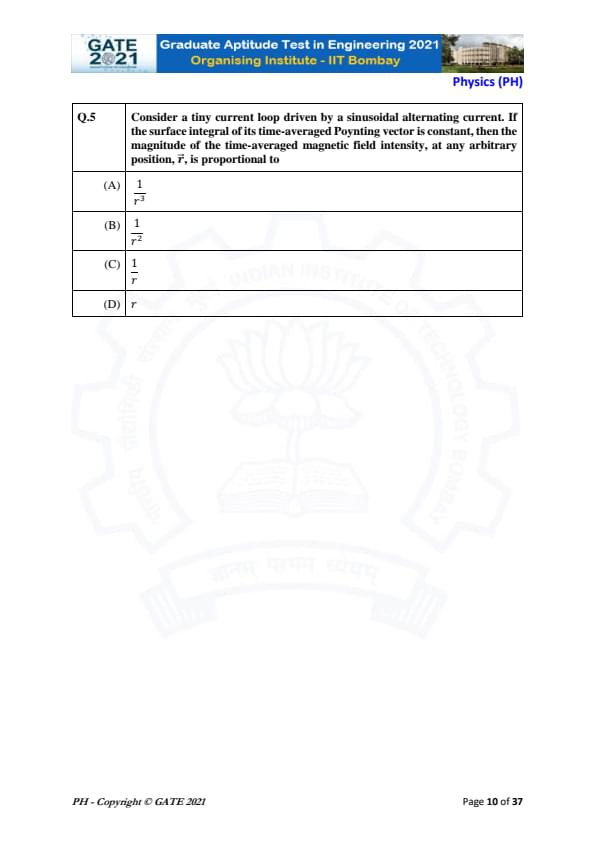
Consider a tiny current loop driven by a sinusoidal alternating current. If the surface integral of its time-averaged Poynting vector is constant, then the magnitude of the time-averaged magnetic field intensity, at any arbitrary position, \(\mathbf{r}\), is proportional to
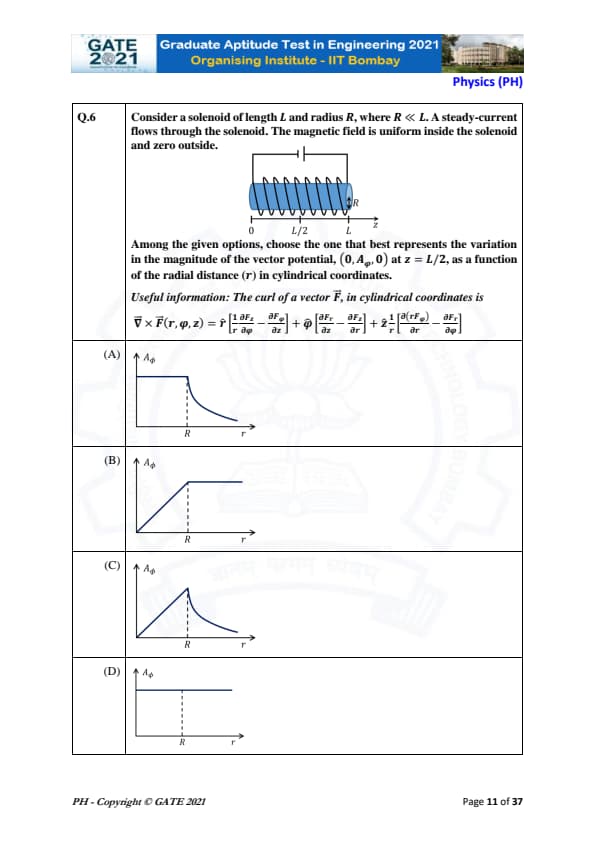
Consider a solenoid of length \( L \) and radius \( R \), where \( R \ll L \). A steady current flows through the solenoid. The magnetic field is uniform inside the solenoid and zero outside.

Among the given options, choose the one that best represents the variation in the magnitude of the vector potential, \( (0, A_\phi, 0) \) at \( z = L/2 \), as a function of the radial distance \( r \) in cylindrical coordinates.
Useful information: The curl of a vector \( \mathbf{F} \), in cylindrical coordinates is \[ \nabla \times \mathbf{F}(r, \phi, z) = \hat{r} \left[ \frac{1}{r} \frac{\partial F_z}{\partial \phi} - \frac{\partial F_\phi}{\partial z} \right] + \hat{\phi} \left[ \frac{\partial F_r}{\partial z} - \frac{\partial F_z}{\partial r} \right] + \hat{z} \left[ \frac{1}{r} \left( \frac{\partial}{\partial r} (r F_\phi) \right) - \frac{1}{r} \frac{\partial F_r}{\partial \phi} \right] \]

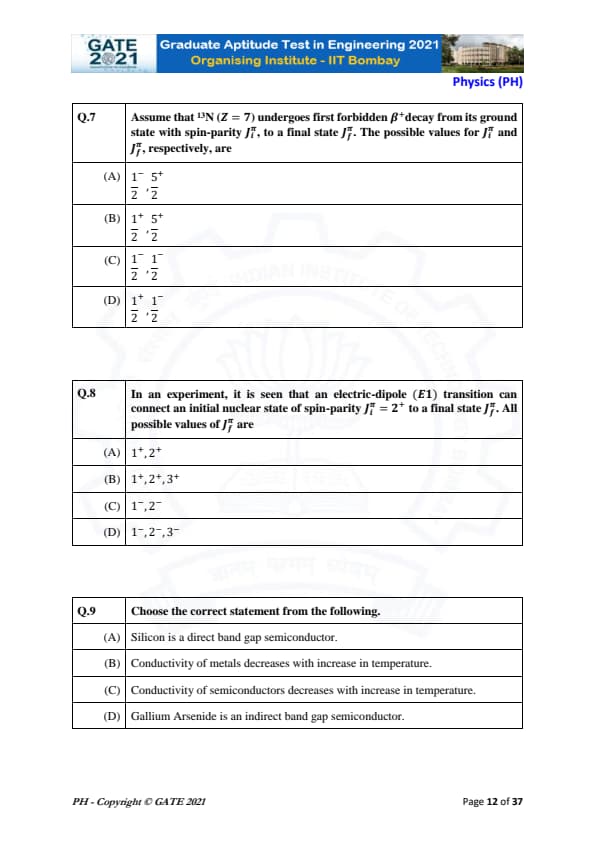
Assume that \(^{13}N (Z = 7)\) undergoes first forbidden \( \beta^+ \) decay from its ground state with spin-parity \( J_i^\pi \), to a final state \( J_f^\pi \). The possible values for \( J_i^\pi \) and \( J_f^\pi \), respectively are
In an experiment, it is seen that an electric-dipole (E1) transition can connect an initial nuclear state of spin-parity \( J_i^\pi = 2^+ \) to a final state \( J_f^\pi \). All possible values of \( J_f^\pi \) are
Choose the correct statement from the following.
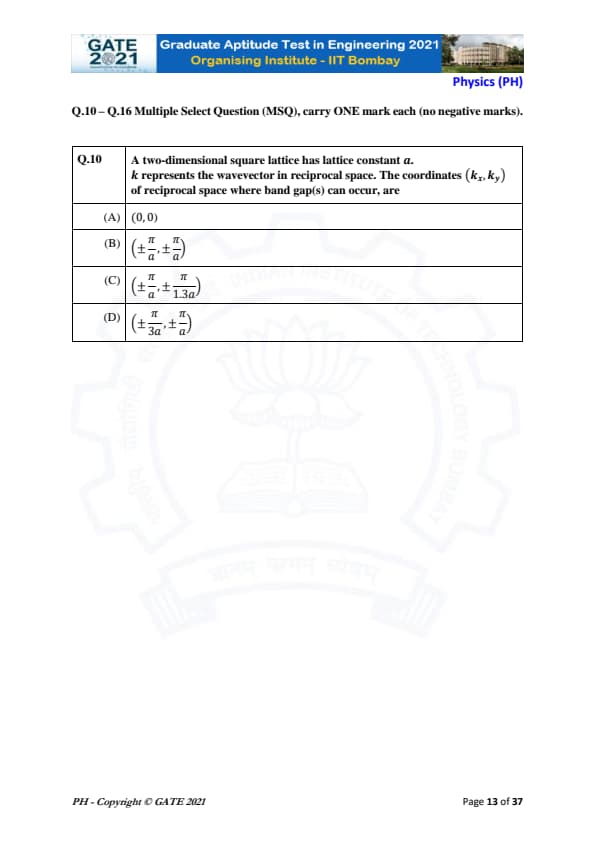
A two-dimensional square lattice has lattice constant \(a\). \(k\) represents the wavevector in reciprocal space. The coordinates \((k_x, k_y)\) of reciprocal space where band gap(s) can occur, are
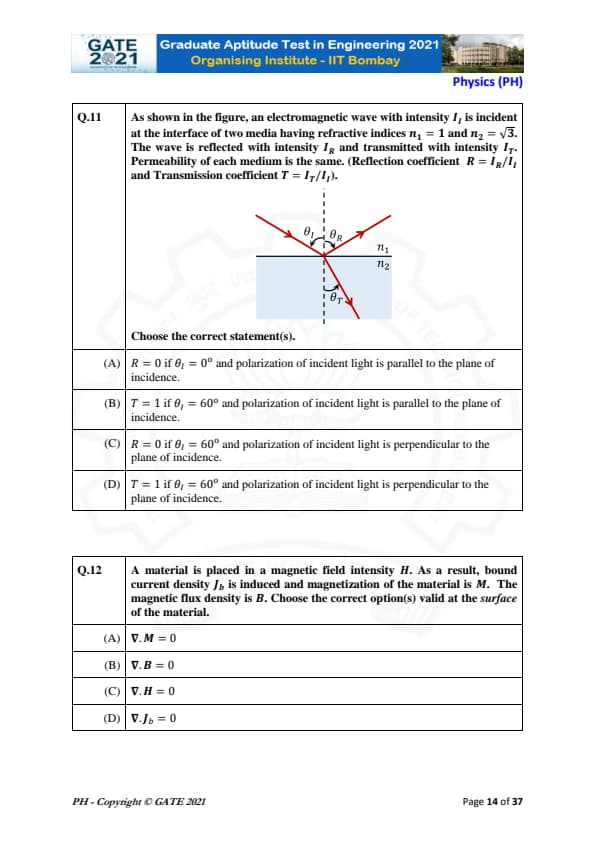
As shown in the figure, an electromagnetic wave with intensity \(I_I\) is incident at the interface of two media having refractive indices \(n_1 = 1\) and \(n_2 = \sqrt{3}\). The wave is reflected with intensity \(I_R\) and transmitted with intensity \(I_T\). Permeability of each medium is the same. (Reflection coefficient \(R = \frac{I_R}{I_I}\) and Transmission coefficient \(T = \frac{I_T}{I_I}\)). Choose the correct statement(s).

A material is placed in a magnetic field intensity \(H\). As a result, bound current density \(J_b\) is induced and magnetization of the material is \(M\). The magnetic flux density is \(B\). Choose the correct option(s) valid at the surface of the material.
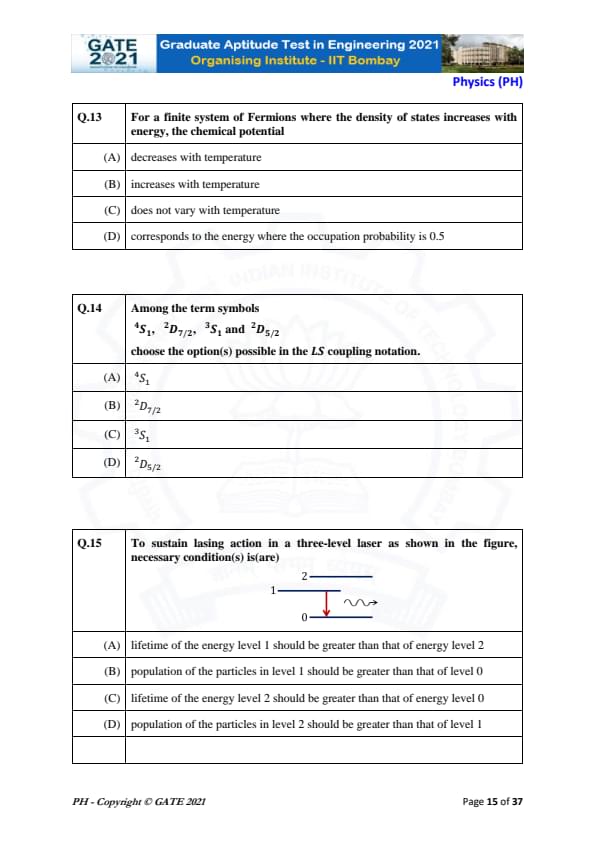
For a finite system of Fermions where the density of states increases with energy, the chemical potential
Among the term symbols \(4S_1\), \(2D_{7/2}\), \(3S_1\), and \(2D_{5/2}\), choose the option(s) possible in the LS coupling notation.
To sustain lasing action in a three-level laser as shown in the figure, necessary condition(s) is(are)

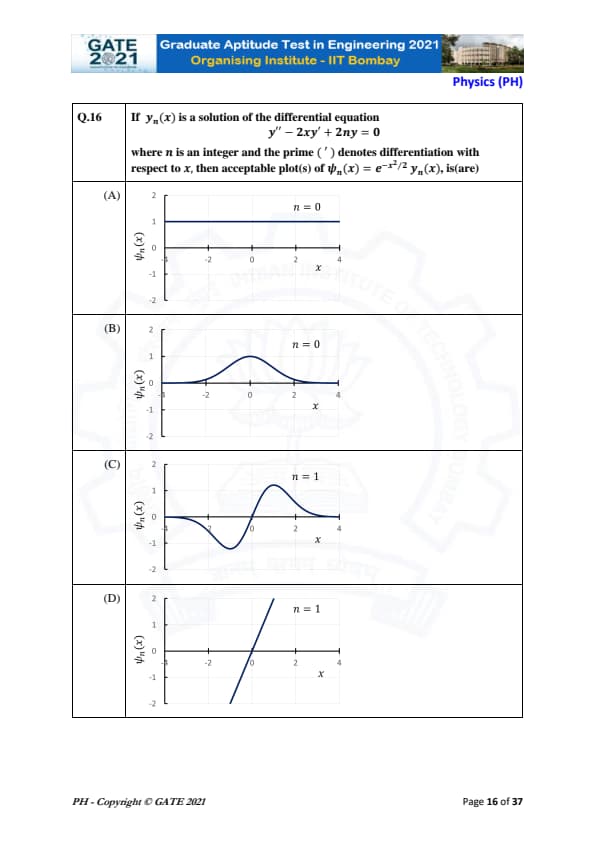
If \( y_n(x) \) is a solution of the differential equation \[ y'' - 2xy' + 2ny = 0 \]
where \( n \) is an integer and the prime (\( ' \)) denotes differentiation with respect to \( x \), then acceptable plot(s) of \( \psi_n(x) = e^{-x^2/2} y_n(x) \), is(are)

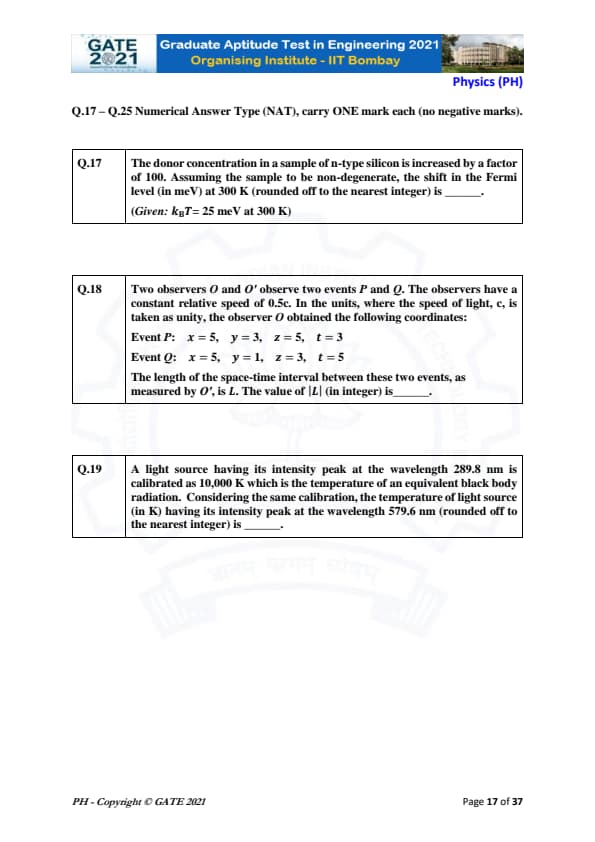
The donor concentration in a sample of n-type silicon is increased by a factor of 100. Assuming the sample to be non-degenerate, the shift in the Fermi level (in meV) at 300 K (rounded off to the nearest integer) is ________.
\text{(Given: k_B T = 25 \, \text{meV at 300 K).
Two observers \( O \) and \( O' \) observe two events \( P \) and \( Q \). The observers have a constant relative speed of 0.5c. In the units, where the speed of light, \( c \), is taken as unity, the observer \( O \) obtained the following coordinates:
Event P: x = 5, y = 3, z = 5, t = 3
Event Q: x = 5, y = 1, z = 3, t = 5
The length of the space-time interval between these two events, as measured by \( O' \), is \( L \). The value of \( |L| \) (in integer) is ________.
A light source having its intensity peak at the wavelength 289.8 nm is calibrated as 10,000 K which is the temperature of an equivalent black body radiation. Considering the same calibration, the temperature of light source (in K) having its intensity peak at the wavelength 579.6 nm (rounded off to the nearest integer) is ________.
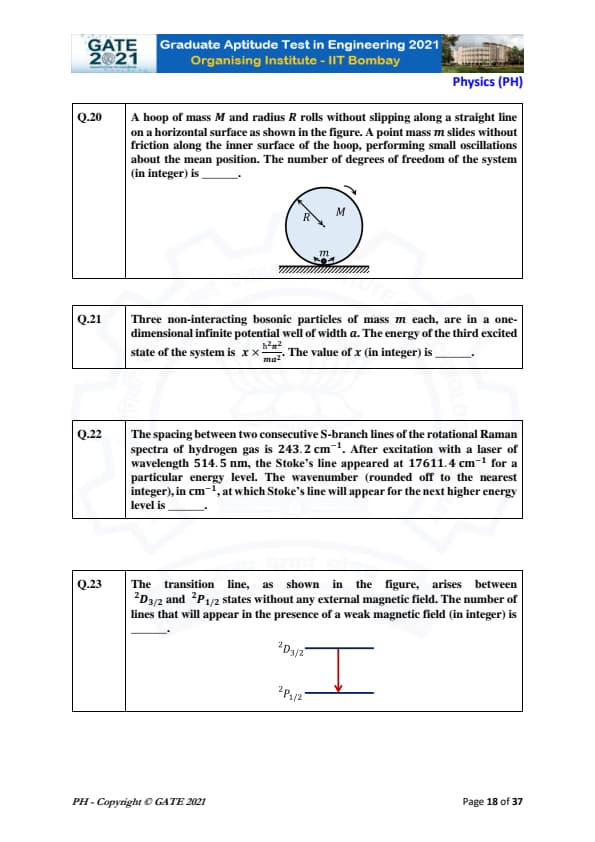
A hoop of mass \( M \) and radius \( R \) rolls without slipping along a straight line on a horizontal surface as shown in the figure. A point mass \( m \) slides without friction along the inner surface of the hoop, performing small oscillations about the mean position. The number of degrees of freedom of the system (in integer) is ________.

Three non-interacting bosonic particles of mass \( m \) each, are in a one-dimensional infinite potential well of width \( a \). The energy of the third excited state of the system is \( x \times \frac{h^2 \pi^2}{ma^2} \). The value of \( x \) (in integer) is ________.
The spacing between two consecutive S-branch lines of the rotational Raman spectra of hydrogen gas is 243.2 cm\(^{-1}\). After excitation with a laser of wavelength 514.5 nm, the Stoke's line appeared at 17611.4 cm\(^{-1}\) for a particular energy level. The wavenumber (rounded off to the nearest integer), in cm\(^{-1}\), at which Stoke's line will appear for the next higher energy level is ________.
The transition line, as shown in the figure, arises between \( 2D_{3/2} \) and \( 2P_{1/2} \) states without any external magnetic field. The number of lines that will appear in the presence of a weak magnetic field (in integer) is ________.

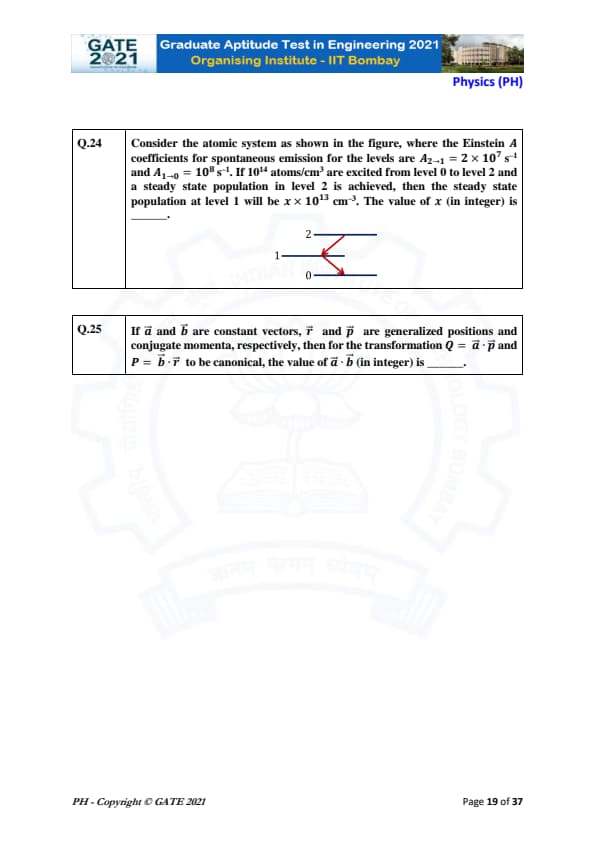
Consider the atomic system as shown in the figure, where the Einstein A coefficients for spontaneous emission for the levels are \( A_{2 \to 1} = 2 \times 10^7 \, s^{-1} \) and \( A_{1 \to 0} = 10^8 \, s^{-1} \). If \( 10^{14} \, atoms/cm^3 \) are excited from level 0 to level 2 and a steady state population in level 2 is achieved, then the steady state population at level 1 will be \( x \times 10^{13} \, cm^{-3} \). The value of \( x \) (in integer) is ________.

If \( \vec{a} \) and \( \vec{b} \) are constant vectors, \( \vec{r} \) and \( \vec{p} \) are generalized positions and conjugate momenta, respectively, then for the transformation \( Q = \vec{a} \cdot \vec{r} \) and \( P = \vec{b} \cdot \vec{r} \) to be canonical, the value of \( \vec{a} \cdot \vec{b} \) (in integer) is ________.
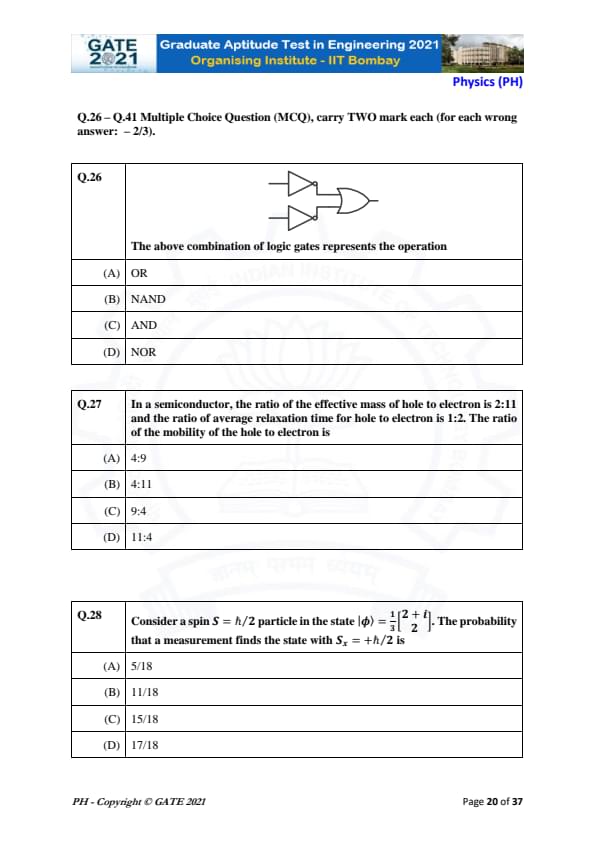
The above combination of logic gates represents the operation

In a semiconductor, the ratio of the effective mass of hole to electron is 2:11 and the ratio of average relaxation time for hole to electron is 1:2. The ratio of the mobility of the hole to electron is
Consider a spin \( S = \hbar/2 \) particle in the state \( | \phi \rangle = \frac{1}{\sqrt{3}} | 2 \rangle + i | 2 \rangle \). The probability that a measurement finds the state with \( S_x = + \hbar/2 \) is
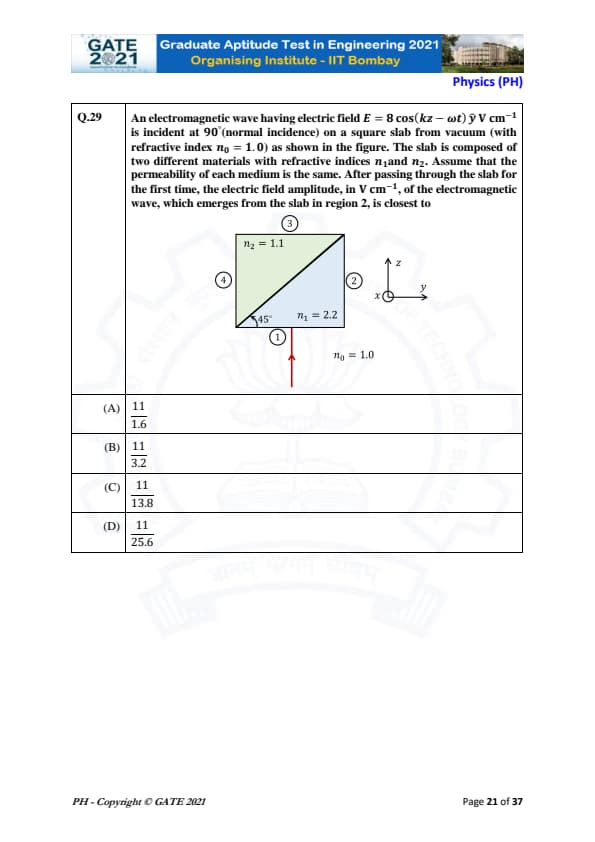
An electromagnetic wave having electric field \[ E = 8 \cos(kz - \omega t) \hat{y} \, V cm^{-1} \]
is incident at \(90^\circ\) (normal incidence) on a square slab from vacuum (with refractive index \( n_0 = 1.0 \)) as shown in the figure. The slab is composed of two different materials with refractive indices \( n_1 \) and \( n_2 \). Assume that the permeability of each medium is the same. After passing through the slab for the first time, the electric field amplitude, in V cm\(^{-1\), of the electromagnetic wave, which emerges from the slab in region 2, is closest to

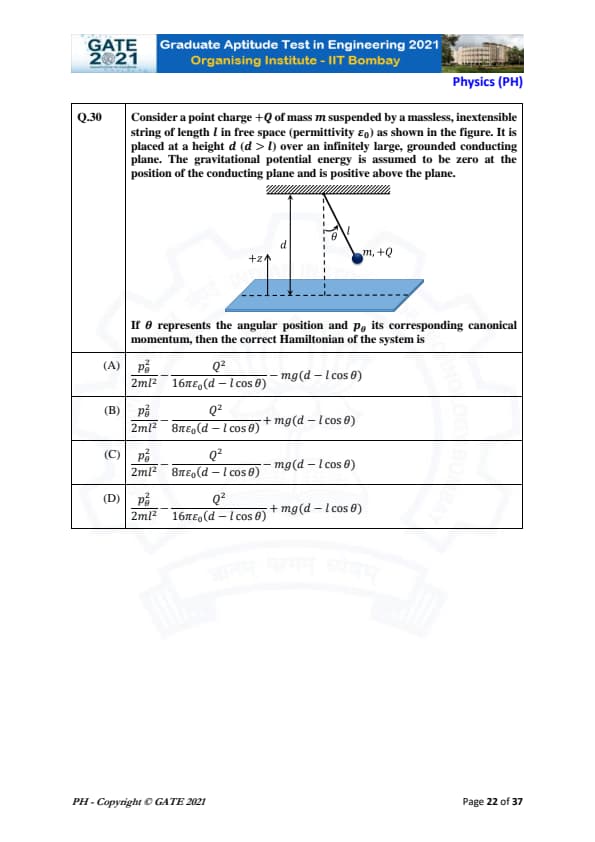
Consider a point charge +Q of mass m suspended by a massless, inextensible string of length l in free space (permittivity \( \epsilon_0 \)) as shown in the figure. It is placed at a height \( d \) (\( d > l \)) over an infinitely large, grounded conducting plane. The gravitational potential energy is assumed to be zero at the position of the conducting plane and is positive above the plane.

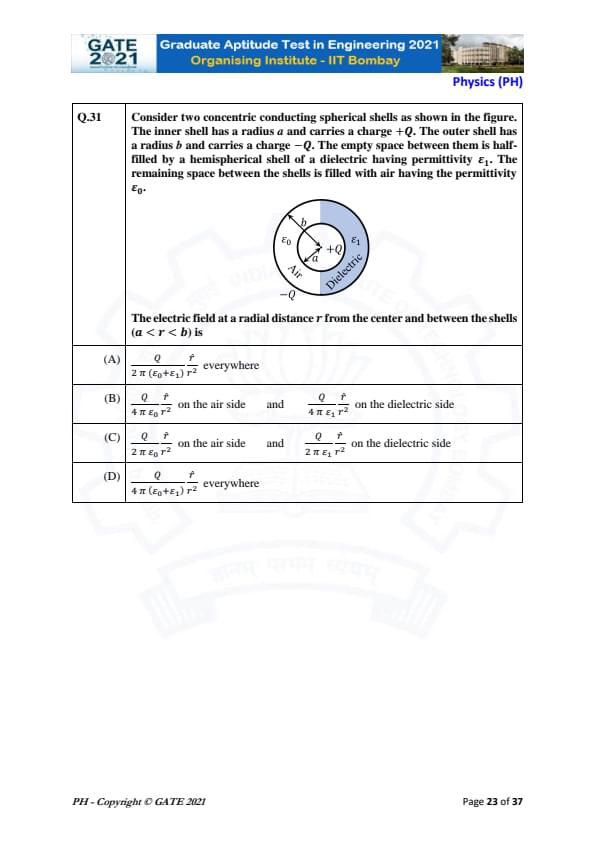
Consider two concentric conducting spherical shells as shown in the figure. The inner shell has a radius \(a\) and carries a charge \(+Q\). The outer shell has a radius \(b\) and carries a charge \(-Q\). The empty space between them is half-filled by a hemispherical shell of a dielectric having permittivity \(\epsilon_1\). The remaining space between the shells is filled with air having the permittivity \(\epsilon_0\).

The electric field at a radial distance \(r\) from the center and between the shells \((a < r < b)\) is
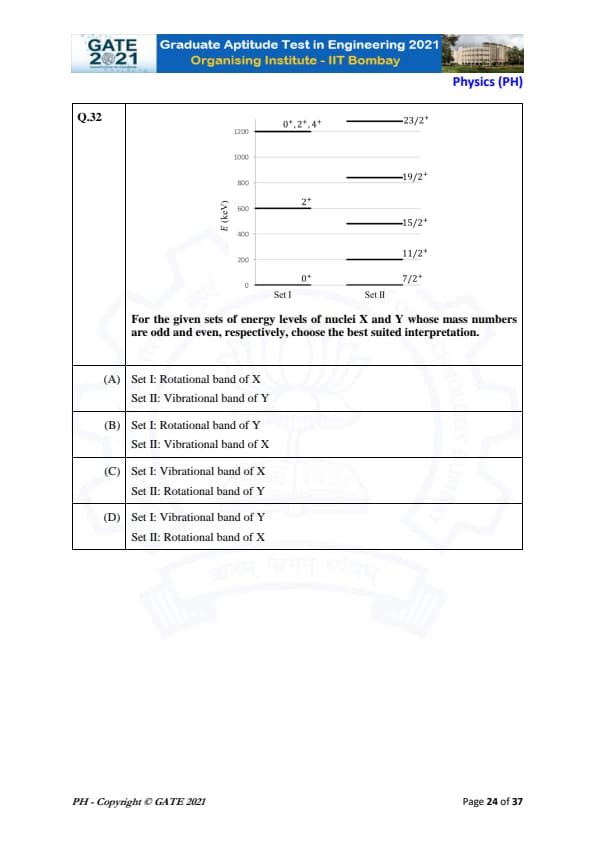
For the given sets of energy levels of nuclei X and Y whose mass numbers are odd and even, respectively, choose the best suited interpretation.

Consider a system of three distinguishable particles, each having spin \( S = \frac{1}{2} \) such that \( S_z = \pm \frac{1}{2} \) with corresponding magnetic moments \( \mu_z = \pm \mu \). When the system is placed in an external magnetic field \( H \) pointing along the z-axis, the total energy of the system is \( \mu H \). Let \( x \) be the state where the first spin has \( S_z = \frac{1}{2} \). The probability of having the state \( x \) and the mean magnetic moment (in the +z direction) of the system in state \( x \) are
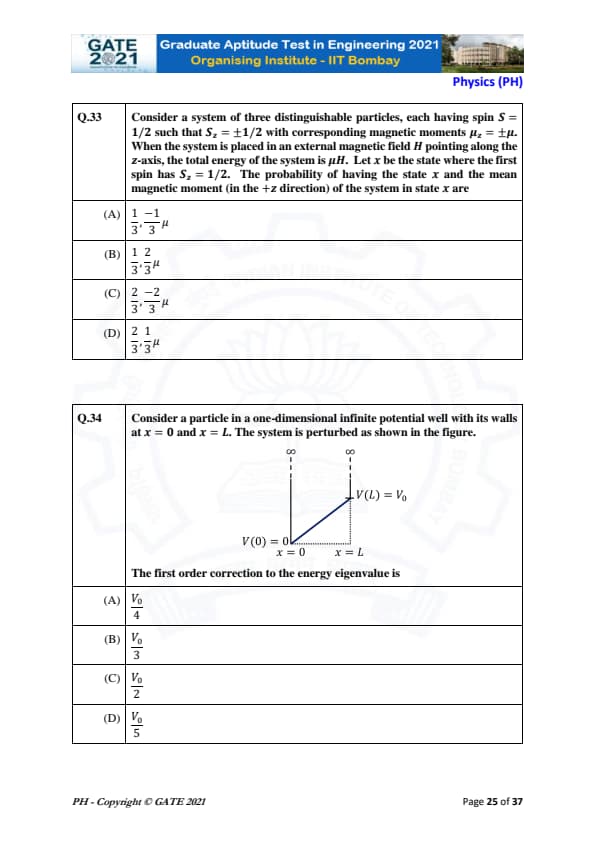
Consider a particle in a one-dimensional infinite potential well with its walls at \( x = 0 \) and \( x = L \). The system is perturbed as shown in the figure. The first order correction to the energy eigenvalue is

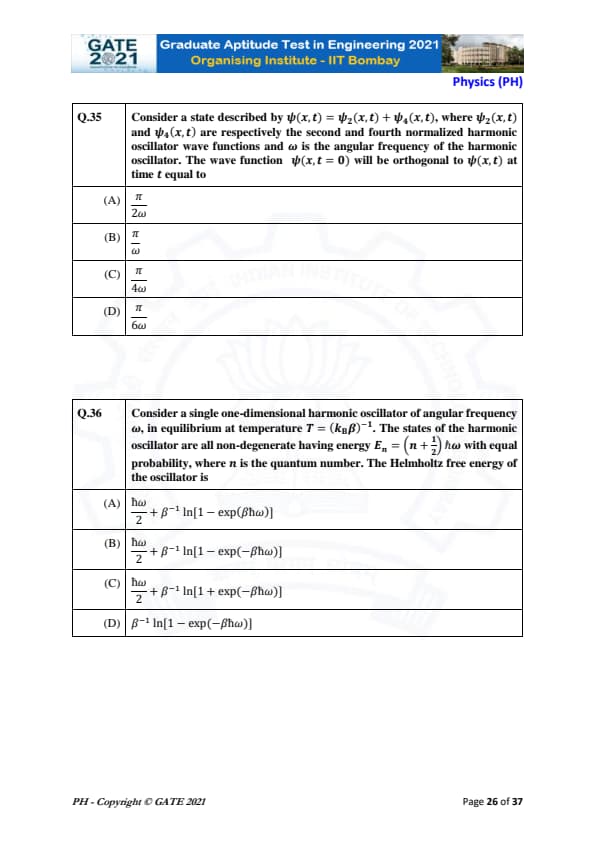
Consider a state described by \[ \psi(x, t) = \psi_2(x, t) + \psi_4(x, t), \]
\text{where \( \psi_2(x, t) \) and \( \psi_4(x, t) \) are respectively the second and fourth normalized harmonic oscillator wave functions and \( \omega \) is the angular frequency of the harmonic oscillator. The wave function \( \psi(x, t = 0) \) \text{will be orthogonal to \( \psi(x, t) \) \text{at time \( t \) equal to
Consider a single one-dimensional harmonic oscillator of angular frequency \( \omega \), in equilibrium at temperature \( T = \left( k_B \beta \right)^{-1} \). The states of the harmonic oscillator are all non-degenerate having energy \( E_n = \left( n + \frac{1}{2} \right) \hbar \omega \) with equal probability, where \( n \) is the quantum number. The Helmholtz free energy of the oscillator is
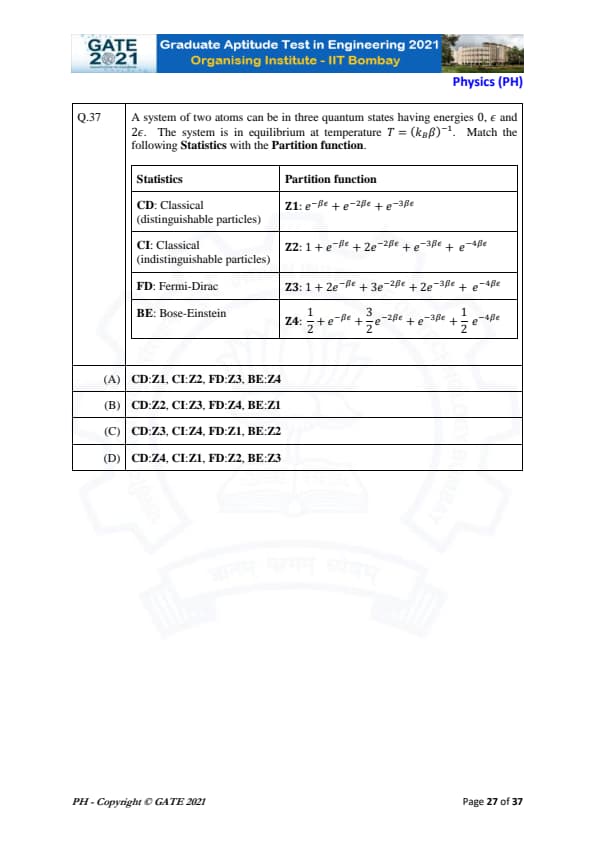
A system of two atoms can be in three quantum states having energies 0, \(\epsilon\) and \(2\epsilon\). The system is in equilibrium at temperature \( T = (k_B\beta)^{-1} \). Match the following Statistics with the Partition function.

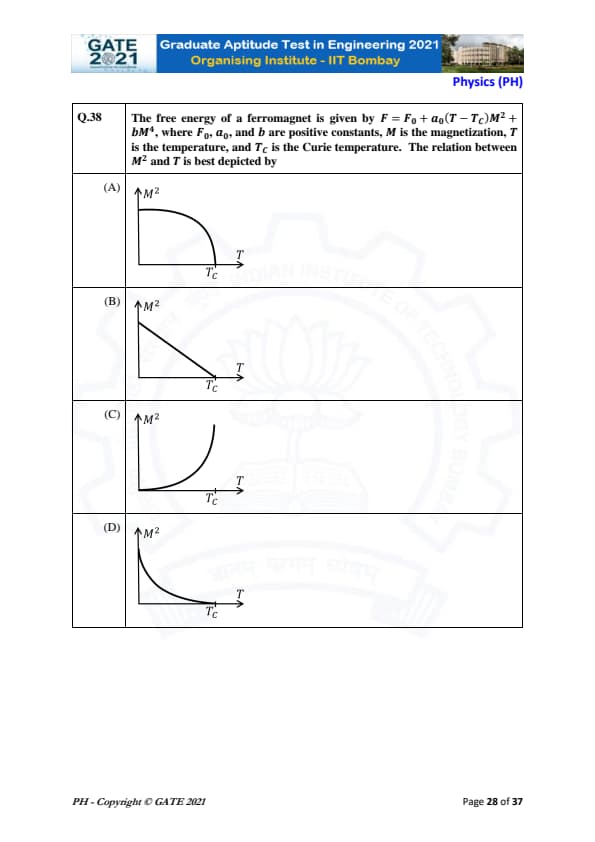
The free energy of a ferromagnet is given by \[ F = F_0 + a_0 (T - T_C) M^2 + b M^4, \]
where \(F_0\), \(a_0\), and \(b\) are positive constants, \(M\) is the magnetization, \(T\) is the temperature, and \(T_C\) is the Curie temperature. The relation between \(M^2\) and \(T\) is best depicted by

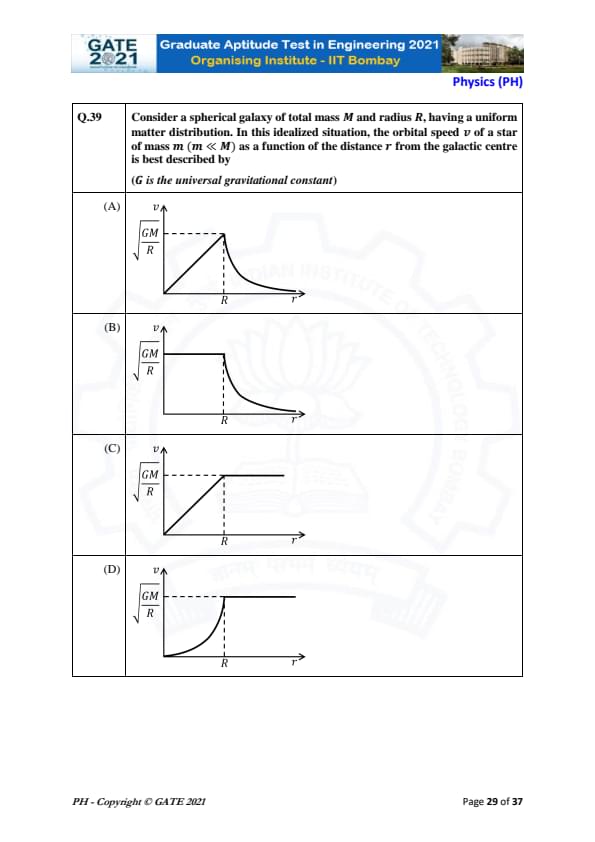
Consider a spherical galaxy of total mass \( M \) and radius \( R \), having a uniform matter distribution. In this idealized situation, the orbital speed \( v \) of a star of mass \( m \ll M \) as a function of the distance \( r \) from the galactic centre is best described by \[ (G is the universal gravitational constant) \]

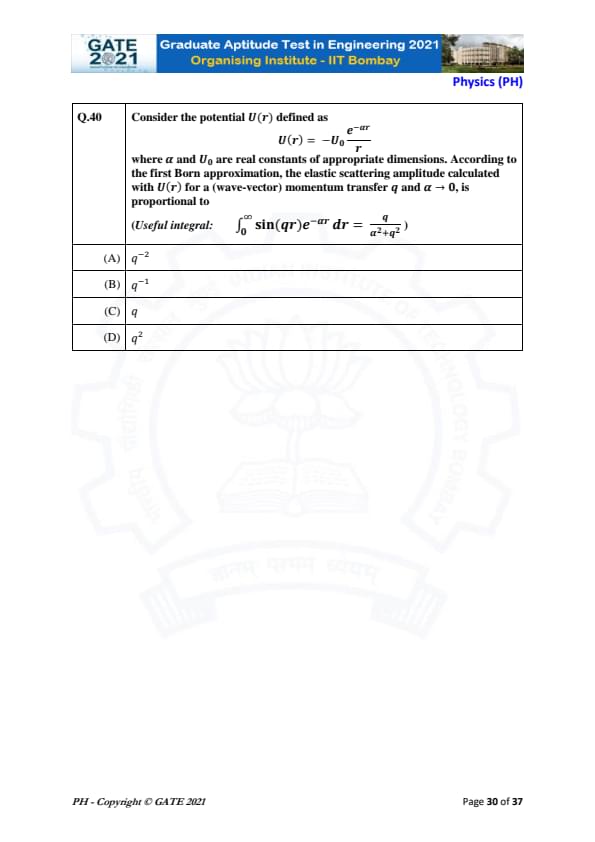
Consider the potential \( U(r) \) defined as
\[ U(r) = -U_0 \frac{e^{-\alpha r}}{r} \]
where \( \alpha \) and \( U_0 \) are real constants of appropriate dimensions. According to the first Born approximation, the elastic scattering amplitude calculated with \( U(r) \) for a (wave-vector) momentum transfer \( q \) and \( \alpha \to 0 \), is proportional to
(Useful integral: \[ \int_0^\infty \sin(qr) e^{-\alpha r} \, dr = \frac{q}{\alpha^2 + q^2} \textbf{)} \]
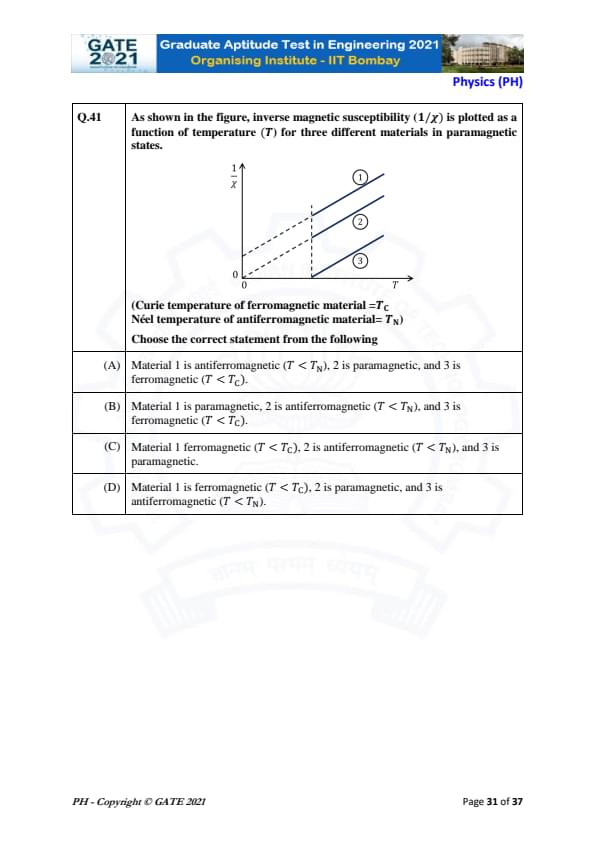
As shown in the figure, inverse magnetic susceptibility \( \frac{1}{\chi} \) is plotted as a function of temperature (T) for three different materials in paramagnetic states.

\text{(Curie temperature of ferromagnetic material = \( T_C \), Néel temperature of antiferromagnetic material = \( T_N \))
Choose the correct statement from the following
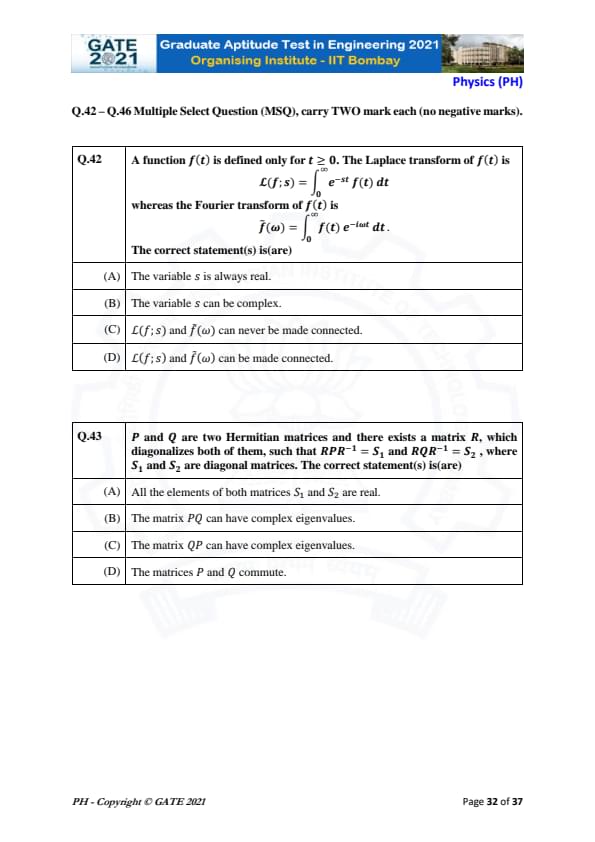
A function \( f(t) \) is defined only for \( t \geq 0 \). The Laplace transform of \( f(t) \) is \[ \mathcal{L}(f; s) = \int_0^\infty e^{-st} f(t) \, dt \]
whereas the Fourier transform of \( f(t) \) is \[ \tilde{f}(\omega) = \int_0^\infty f(t) e^{-i\omega t} \, dt. \]
The correct statement(s) is(are)
P and Q are two Hermitian matrices and there exists a matrix \( R \), which diagonalizes both of them, such that \( RPR^{-1} = S_1 \) and \( RQR^{-1} = S_2 \), where \( S_1 \) and \( S_2 \) are diagonal matrices. The correct statement(s) is(are)
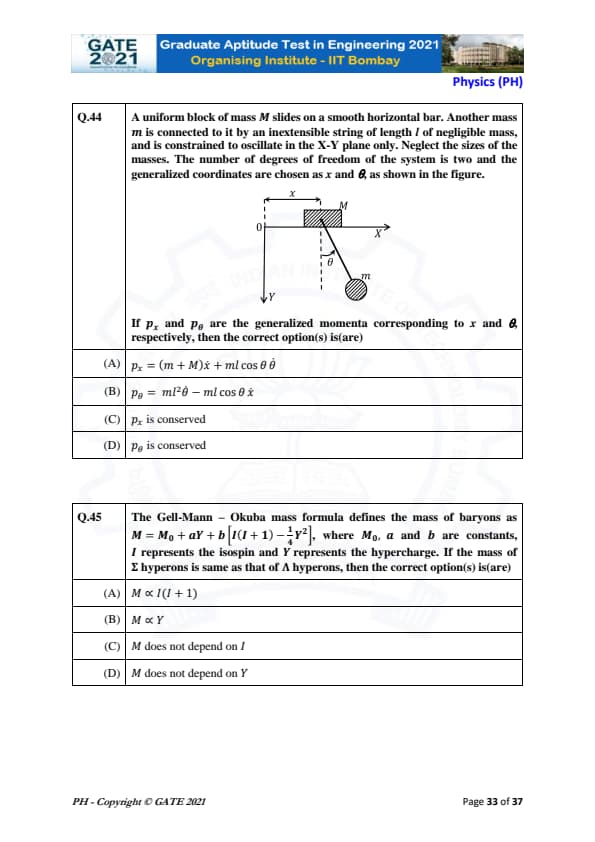
A uniform block of mass \(M\) slides on a smooth horizontal bar. Another mass \(m\) is connected to it by an inextensible string of length \(l\) of negligible mass, and is constrained to oscillate in the X-Y plane only. Neglect the sizes of the masses. The number of degrees of freedom of the system is two and the generalized coordinates are chosen as \(x\) and \(\theta\), as shown in the figure.

If \(p_x\) and \(p_\theta\) are the generalized momenta corresponding to \(x\) and \(\theta\), respectively, then the correct option(s) is(are)
The Gell-Mann – Okuba mass formula defines the mass of baryons as \[ M = M_0 + aY + b \left[ (I + 1) - \frac{1}{4} Y^2 \right], \]
where \(M_0\), \(a\), and \(b\) are constants, \(I\) represents the isospin and \(Y\) represents the hypercharge. If the mass of \(\Sigma\) hyperons is the same as that of \(\Lambda\) hyperons, then the correct option(s) is(are)
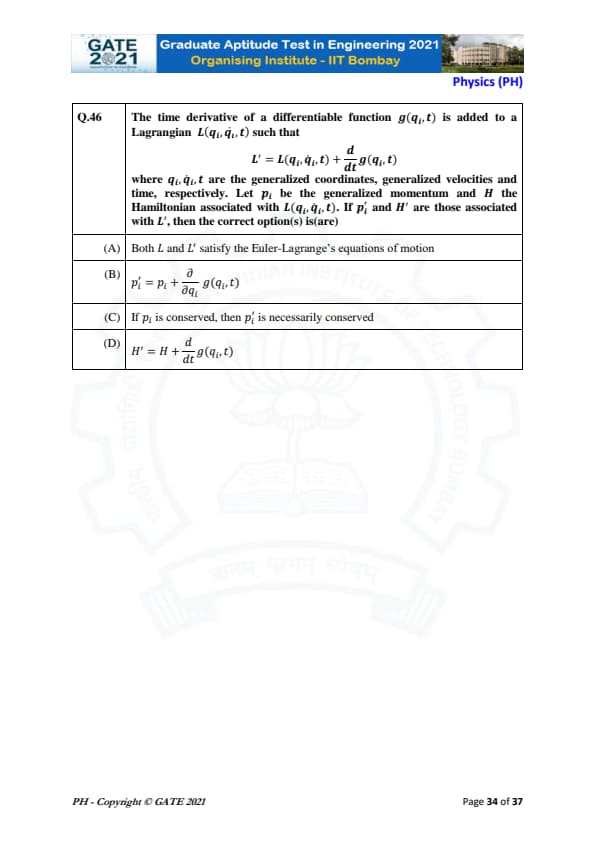
The time derivative of a differentiable function \( g(q_i, t) \) is added to a Lagrangian \( L(q_i, \dot{q}_i, t) \) such that \[ L' = L(q_i, \dot{q}_i, t) + \frac{d}{dt} g(q_i, t) \]
where \( q_i \), \( \dot{q}_i \), \( t \) are the generalized coordinates, generalized velocities, and time, respectively. Let \( p_i \) be the generalized momentum and \( H \) the Hamiltonian associated with \( L(q_i, \dot{q}_i, t) \). If \( p_i' \) and \( H' \) are those associated with \( L' \), then the correct option(s) is(are):
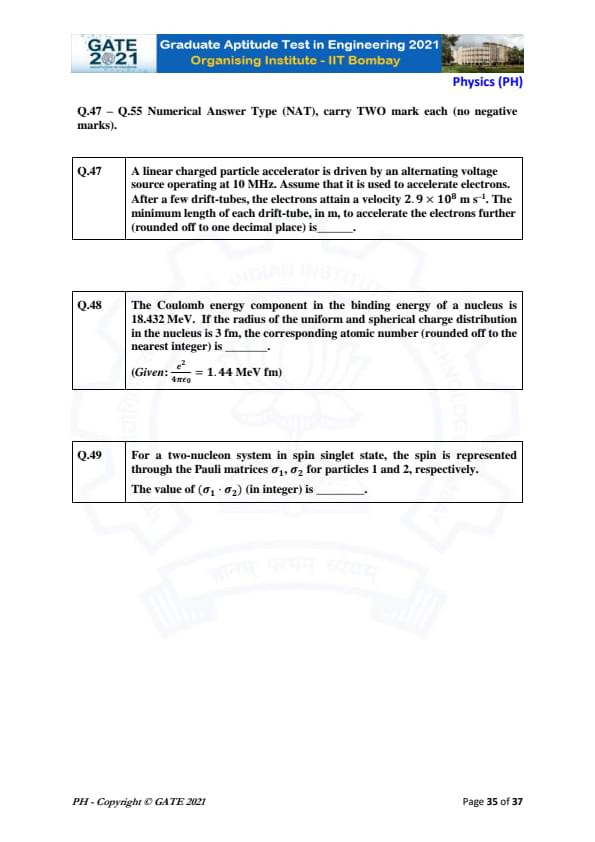
A linear charged particle accelerator is driven by an alternating voltage source operating at 10 MHz. Assume that it is used to accelerate electrons. After a few drift-tubes, the electrons attain a velocity \( 2.9 \times 10^8 \, m/s \). The minimum length of each drift-tube, in m, to accelerate the electrons further (rounded off to one decimal place) is ________.
The Coulomb energy component in the binding energy of a nucleus is 18.432 MeV. If the radius of the uniform and spherical charge distribution in the nucleus is 3 fm, the corresponding atomic number (rounded off to the nearest integer) is ________.
(Given: \frac{e^2{4 \pi \epsilon_0 = 1.44 \, \text{MeV fm).
For a two-nucleon system in spin singlet state, the spin is represented through the Pauli matrices \( \sigma_1, \sigma_2 \) for particles 1 and 2, respectively. The value of \( \sigma_1 \cdot \sigma_2 \) (in integer) is ________.
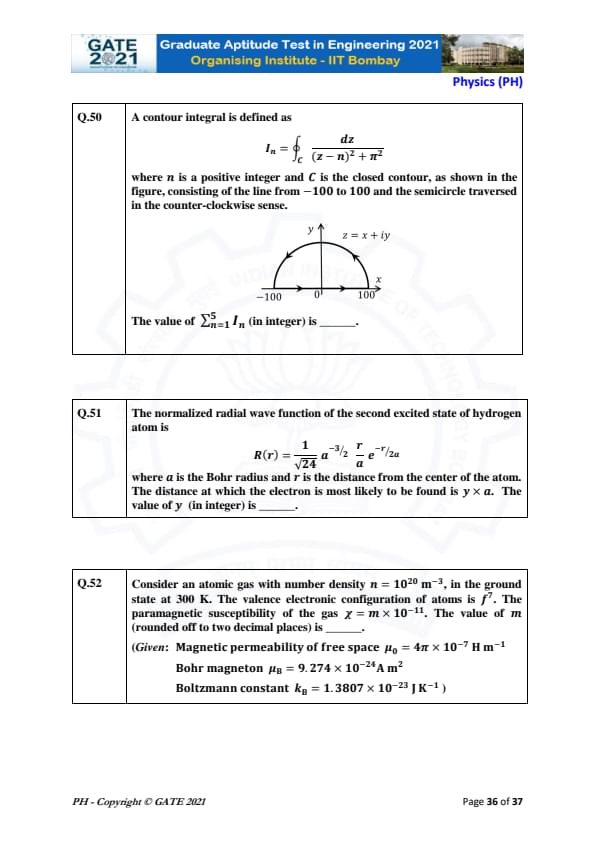
A contour integral is defined as \[ I_n = \oint_C \frac{dz}{(z - n)^2 + \pi^2} \]
where \( n \) is a positive integer and \( C \) is the closed contour, as shown in the figure, consisting of the line from \( -100 \) to \( 100 \) and the semicircle traversed in the counter-clockwise sense.

The value of \( \sum_{n=1^5 I_n \) (in integer) is ________.
The normalized radial wave function of the second excited state of hydrogen atom is \[ R(r) = \frac{1}{\sqrt{24}} \left( \frac{a^{-3/2}}{r} \right) e^{-r/2a} \]
\text{where \( a \) is the Bohr radius and \( r \) is the distance from the center of the atom. The distance at which the electron is most likely to be found is \( y \times a \). The value of \( y \) (in integer) is ________.
Consider an atomic gas with number density \( n = 10^{20} \, m^{-3} \), in the ground state at 300 K. The valence electronic configuration of atoms is \( f^7 \). The paramagnetic susceptibility of the gas \( \chi = m \times 10^{-11} \). The value of \( m \) (rounded off to two decimal places) is ________.
(Given: Magnetic permeability of free space \( \mu_0 = 4\pi \times 10^{-7 \, H m^{-1} \), Bohr magneton \( \mu_B = 9.274 \times 10^{-24} \, A m^2 \), Boltzmann constant \( k_B = 1.3807 \times 10^{-23} \, K^{-1} \))
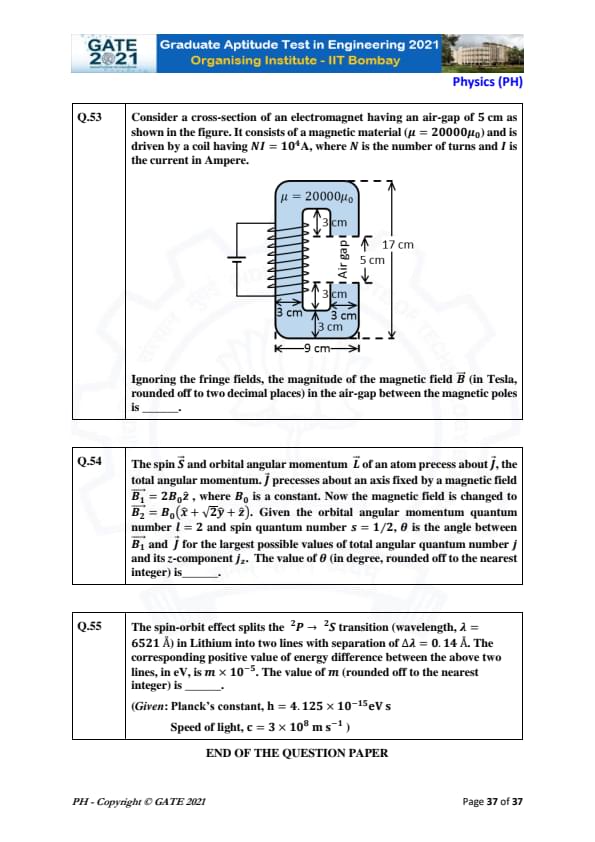
Consider a cross-section of an electromagnet having an air-gap of 5 cm as shown in the figure. It consists of a magnetic material \( \mu = 20000 \mu_0 \) and is driven by a coil having \( NI = 10^4 \), where \( N \) is the number of turns and \( I \) is the current in Ampere.

Ignoring the fringe fields, the magnitude of the magnetic field \( \vec{B \) (in Tesla, rounded off to two decimal places) in the air-gap between the magnetic poles is ________.
The spin \( \vec{S} \) and orbital angular momentum \( \vec{L} \) of an atom precess about \( \vec{J} \), the total angular momentum. \( \vec{J} \) precesses about an axis fixed by a magnetic field \( \vec{B_1} = 2B_0 \hat{z} \), where \( B_0 \) is a constant. Now the magnetic field is changed to \( \vec{B_2} = B_0 (\hat{x} + \sqrt{2} \hat{y} + \hat{z}) \). Given the orbital angular momentum quantum number \( l = 2 \) and spin quantum number \( s = 1/2 \), \( \theta \) is the angle between \( \vec{B_1} \) and \( \vec{J} \) for the largest possible values of total angular quantum number \( j \) and its z-component \( j_z \). The value of \( \theta \) (in degree, rounded off to the nearest integer) is ________.
The spin-orbit effect splits the \( 2p \rightarrow 2s \) transition (wavelength, \( \lambda = 6521 \, Å \)) in Lithium into two lines with separation of \( \Delta \lambda = 0.14 \, Å \). The corresponding positive value of energy difference between the above two lines, in eV, is \( m \times 10^{-5} \). The value of \( m \) (rounded off to the nearest integer) is ________.
(Given: Planck’s constant, \( h = 4.125 \times 10^{-15 \, eV s \), speed of light, \( c = 3 \times 10^8 \, m/s \))
Cut Off for GATE Physics (PH) 2021
The subject-by-subject cut-off is also provided together with the result. The cut-off is the minimum qualifying score that candidates must achieve in order to be admitted to their desired course and college. GATE 2021 cut-off is determined by a number of factors, including the total number of candidates who took the exam, the difficulty level of the exam, the applicant category, and so on.
GATE Physics (PH) cut-off from the previous year 2020 is summarised as below;
| Paper | General | OBC (NCL) | SC / ST / PwD |
|---|---|---|---|
| Physics – PH | 37.2 | 33.4 | 24.8 |
Quick Links:
GATE 2021 PH Paper Analysis
- Overall difficulty level of GATE PH 2021 paper was moderate to difficult.
- General aptitude questions were easy to solve
- Good score was expected to be 65 and above.
- Numerical Type does not have any negative markings. However, every incorrect response will result in a 1/3rd negative marking for 1 marks and 2/3rd negative marking for 2 mark MCQ questions.
- Paper consists of 65 questions containing 100 maximum marks
Also Check:
GATE Previous Year Question Papers:
| GATE 2022 Question Papers | GATE 2021 Question Papers | GATE 2020 Question Papers |
| GATE 2019 Question Papers | GATE 2018 Question Papers | GATE 2017 Question Papers |




Comments