




Students can download the GATE 2021 Statistics (ST) Question Paper with Solutions from here. On 7th February, 2021 IIT Bombay concluded GATE 2021 ST in the Afternoon Session (3:00 PM to 6:00 PM). 85% of the questions were related to core Statistics in GATE 2021 ST. Nearly 1199 candidates appeared in GATE 2021 ST, while the qualifying percentage of candidates lied at just 8.42%. As observed by the students, the question paper maintained a moderate level of difficulty. The highest marks scored in GATE 2021 ST was 51.67.
GATE 2021 Statistics (ST) Question Paper with Solutions
All the GATE candidates are strongly recommended to go through the previous year GATE question papers to boost their preparation level. Students can download the GATE Question Papers and Answer Key PDFs.
| GATE 2021 Statistics (ST) Question Paper |  Download Download |
Check Solutions |

The current population of a city is 11,02,500. If it has been increasing at the rate of 5% per annum, what was its population 2 years ago?
p and q are positive integers and p/q + q/p = 3,
then, p2/q2 + q2/p2 =
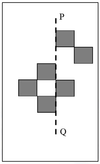
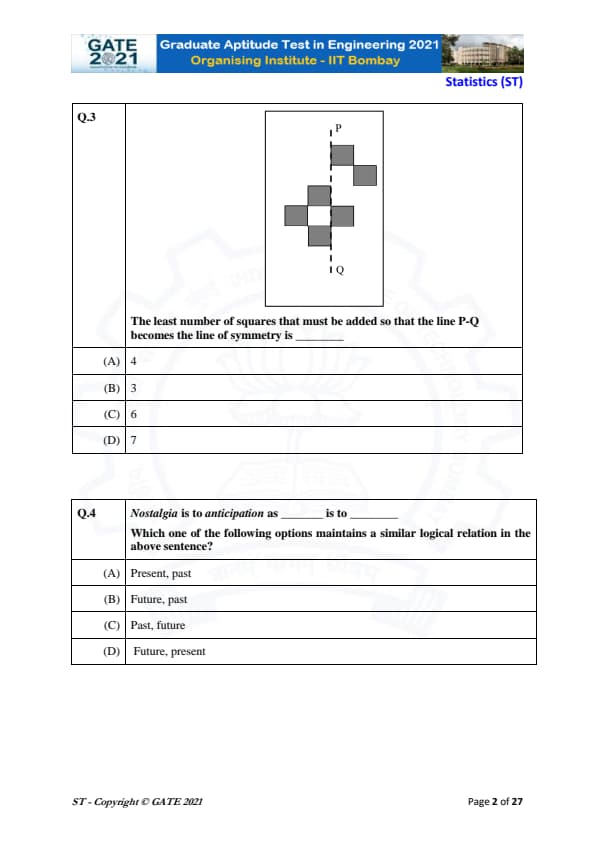
The least number of squares that must be added so that the line P-Q becomes the line of symmetry is
Nostalgia is to anticipation as _______ is to _______.
Which one of the following options maintains a similar logical relation in the above sentence?
Consider the following sentences:
(i) I woke up from sleep.
(ii) I wok up from sleep.
(iii) I was woken up from sleep.
(iv) I was wokened up from sleep.
Which of the above sentences are grammatically CORRECT?
Given below are two statements and two conclusions.
Statement 1: All purple are green.
Statement 2: All black are green.
Conclusion I: Some black are purple.
Conclusion II: No black is purple.
Based on the above statements and conclusions, which one of the following options is logically CORRECT?
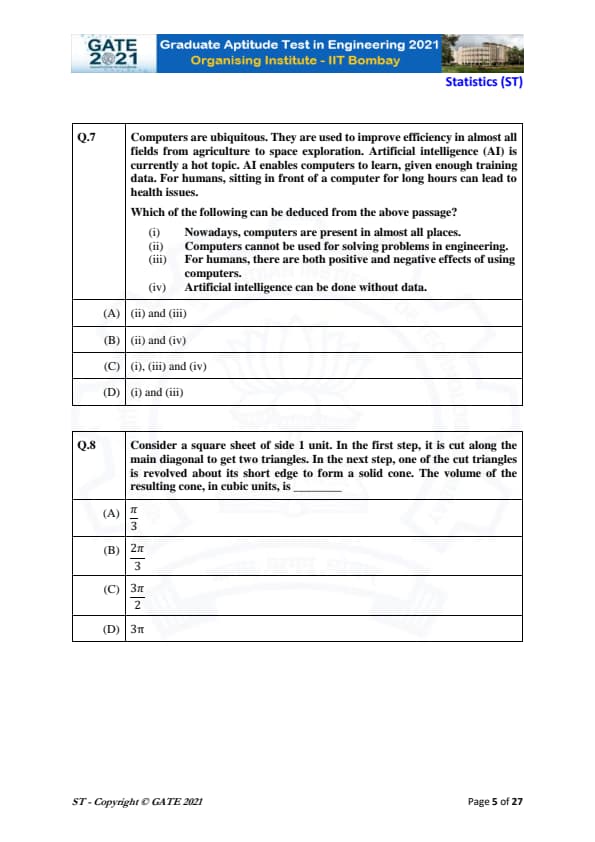
Computers are ubiquitous. They are used to improve efficiency in almost all fields from agriculture to space exploration. Artificial intelligence (AI) is currently a hot topic. AI enables computers to learn, given enough training data. For humans, sitting in front of a computer for long hours can lead to health issues.
Which of the following can be deduced from the above passage?
Consider a square sheet of side 1 unit. In the first step, it is cut along the main diagonal to get two triangles. In the next step, one of the cut triangles is revolved about its short edge to form a solid cone. The volume of the resulting cone, in cubic units, is _______
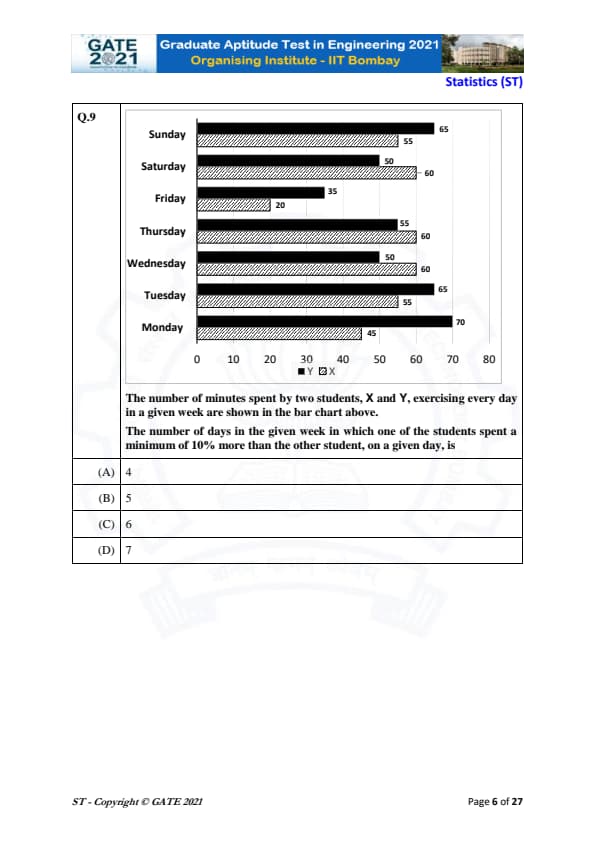
The number of minutes spent by two students, X and Y, exercising every day in a given week are shown in the bar chart above.
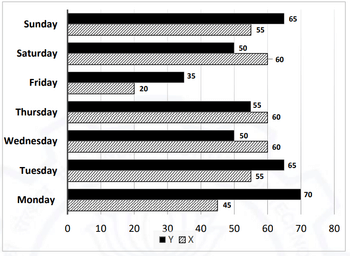
The number of days in the given week in which one of the students spent a minimum of 10% more than the other student, on a given day, is
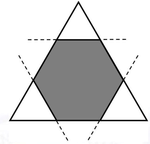
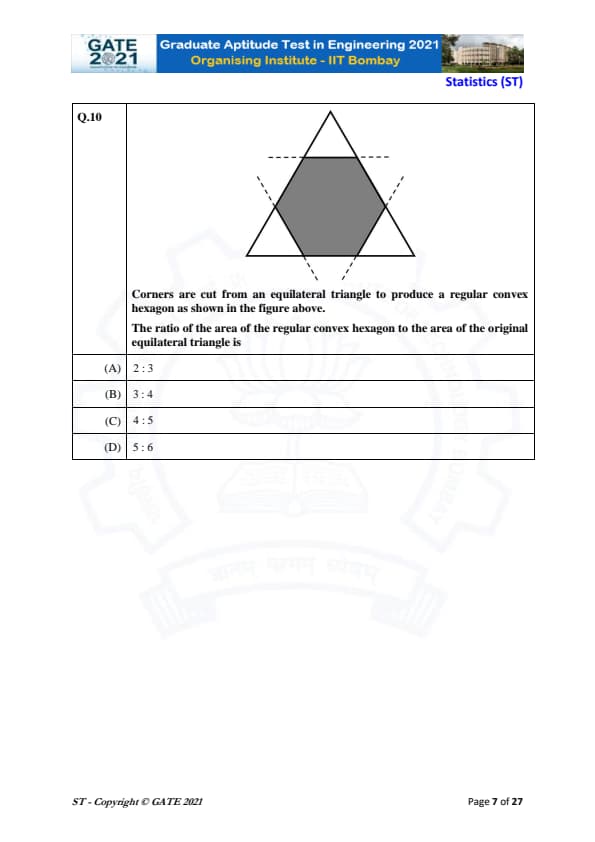
Corners are cut from an equilateral triangle to produce a regular convex hexagon as shown in the figure above.
The ratio of the area of the regular convex hexagon to the area of the original equilateral triangle is
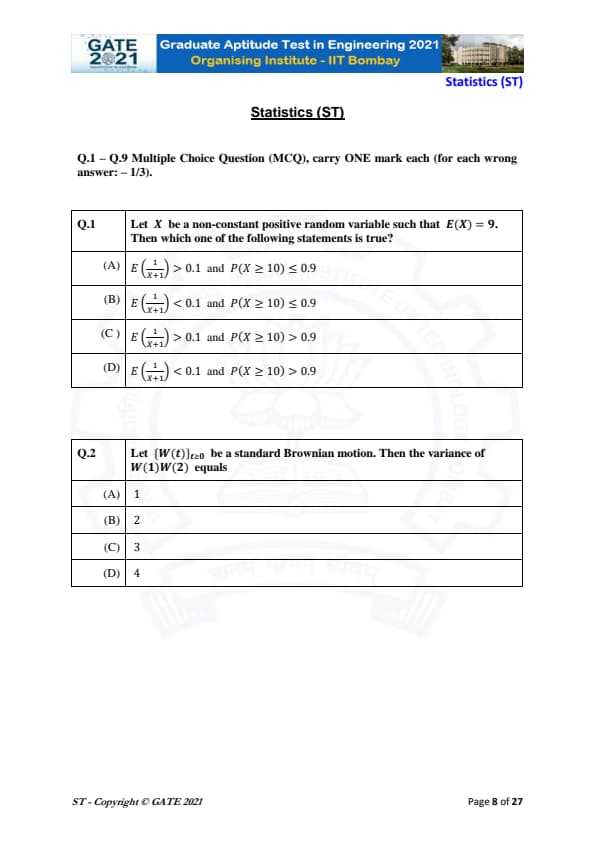
Let \( X \) be a non-constant positive random variable such that \( E(X) = 9 \). Then which one of the following statements is true?
Let \( W(t) \) be a standard Brownian motion. Then the variance of \( W(1)W(2) \) equals
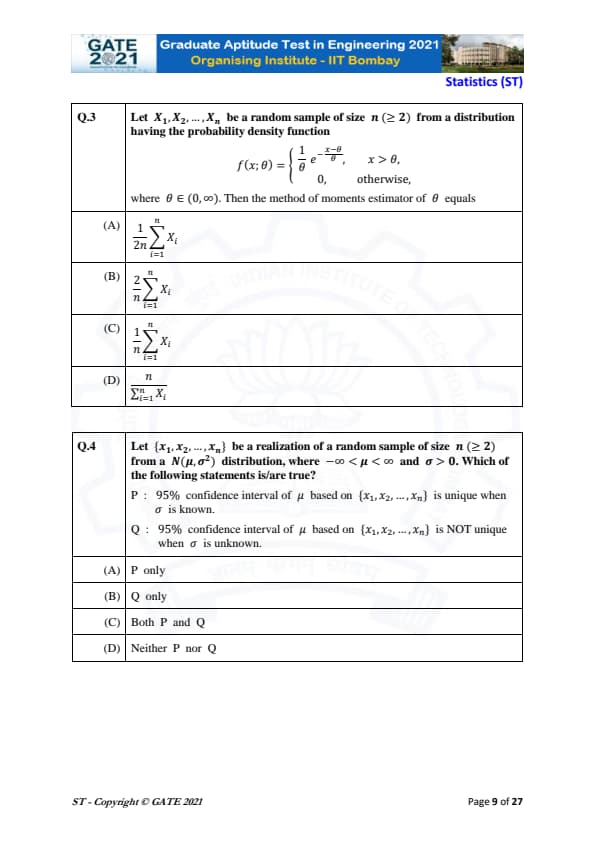
Let \( X_1, X_2, \dots, X_n \) be a random sample of size \( n \geq 2 \) from a distribution having the probability density function \[ f(x; \theta) = \begin{cases} \frac{1}{\theta} e^{-\frac{x-\theta}{\theta}}, & x > \theta,
0, & otherwise, \end{cases} \]
where \( \theta \in (0, \infty) \). Then the method of moments estimator of \( \theta \) equals
Let \( \{x_1, x_2, \dots, x_n\} \) be a realization of a random sample of size \( n (\geq 2) \) from a \( N(\mu, \sigma^2) \) distribution, where \( -\infty < \mu < \infty \) and \( \sigma > 0 \). Which of the following statements is/are true?
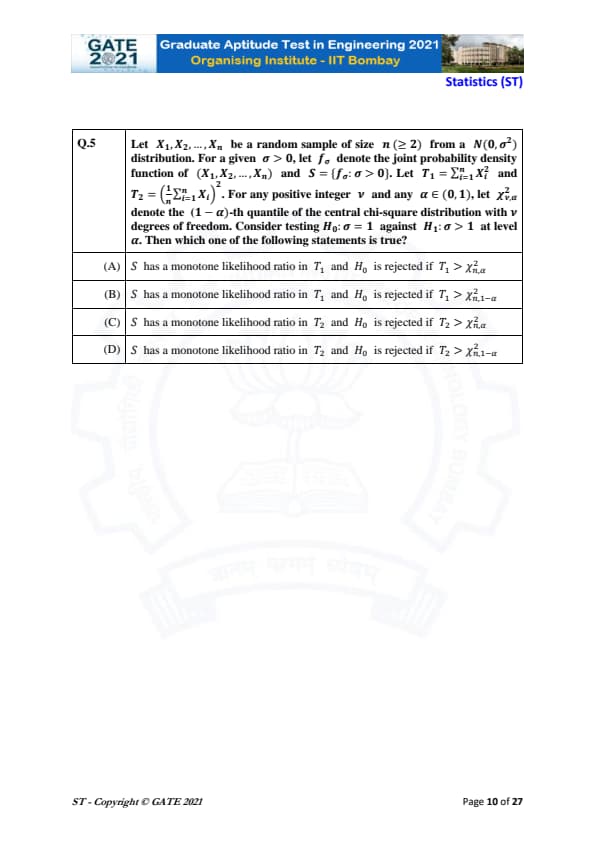
Let \( X_1, X_2, \dots, X_n \) be a random sample of size \( n (\geq 2) \) from a \( N(0, \sigma^2) \) distribution. For a given \( \sigma > 0 \), let \( f_\sigma \) denote the joint probability density function of \( (X_1, X_2, \dots, X_n) \) and \( S = \{ f_\sigma : \sigma > 0 \} \). Let \( T_1 = \sum_{i=1}^{n} X_i^2 \) and \( T_2 = \left( \frac{1}{n} \sum_{i=1}^n X_i \right)^2 \). For any positive integer \( v \) and any \( \alpha \in (0, 1) \), let \( \chi^2_{v, \alpha} \) denote the \( (1 - \alpha) \)-th quantile of the central chi-square distribution with \( v \) degrees of freedom. Consider testing \( H_0: \sigma = 1 \) against \( H_1: \sigma > 1 \) at level \( \alpha \). Then which one of the following statements is true?
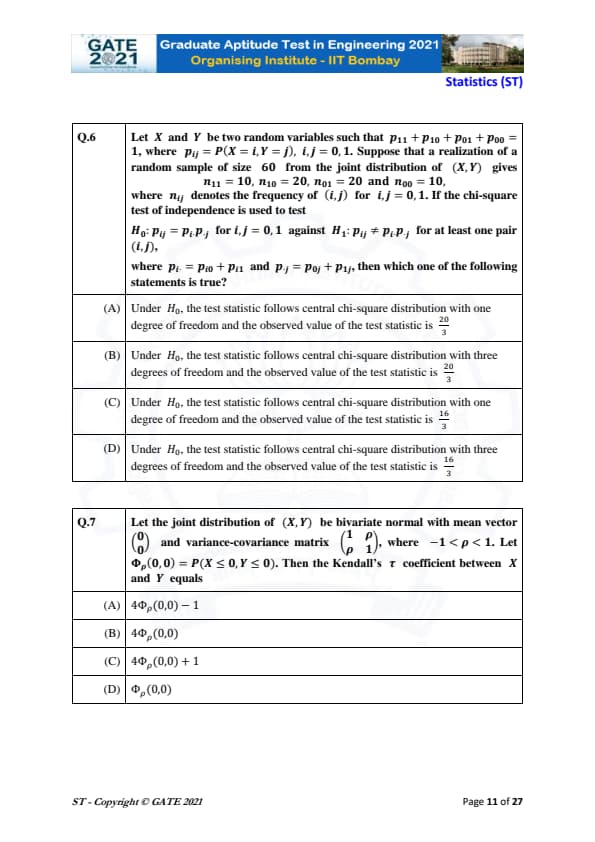
Let \( X \) and \( Y \) be two random variables such that \( p_{11} + p_{10} + p_{01} + p_{00} = 1 \), where \( p_{ij} = P(X = i, Y = j) \), \( i, j = 0, 1 \). Suppose that a realization of a random sample of size 60 from the joint distribution of \( (X,Y) \) gives \( n_{11} = 10 \), \( n_{10} = 20 \), \( n_{01} = 20 \), \( n_{00} = 10 \), where \( n_{ij} \) denotes the frequency of \( (i,j) \) for \( i,j = 0,1 \). If the chi-square test of independence is used to test \[ H_0: p_{ij} = p_i p_j for i,j = 0,1 \quad against \quad H_1: p_{ij} \neq p_i p_j for at least one pair (i,j), \]
where \( p_i = p_{i0} + p_{i1} \) and \( p_j = p_{0j} + p_{1j} \), then which one of the following statements is true?
Let the joint distribution of \( (X,Y) \) be bivariate normal with mean vector \( \begin{pmatrix} 0
0 \end{pmatrix} \) and variance-covariance matrix \( \begin{pmatrix} 1 & \rho
\rho & 1 \end{pmatrix} \), where \( -1 < \rho < 1 \). Let \( \Phi_\rho(0,0) = P(X \leq 0, Y \leq 0) \). Then the Kendall’s \( \tau \) coefficient between \( X \) and \( Y \) equals
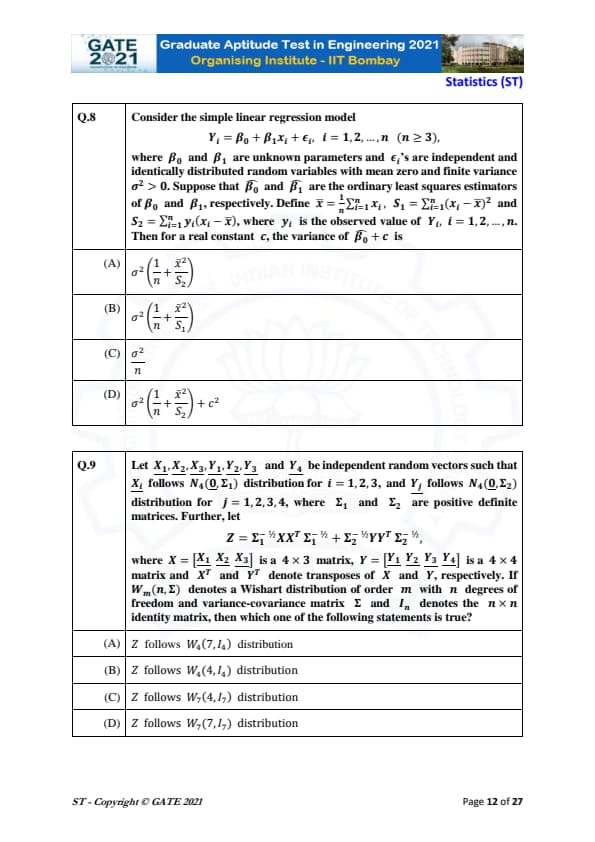
Consider the simple linear regression model \[ Y_i = \beta_0 + \beta_1 x_i + \epsilon_i, \quad i = 1, 2, \dots, n \quad (n \geq 3), \]
where \( \beta_0 \) and \( \beta_1 \) are unknown parameters and \( \epsilon_i \)'s are independent and identically distributed random variables with mean zero and finite variance \( \sigma^2 > 0 \). Suppose that \( \hat{\beta}_0 \) and \( \hat{\beta}_1 \) are the ordinary least squares estimators of \( \beta_0 \) and \( \beta_1 \), respectively. Define \( \bar{x} = \frac{1}{n} \sum_{i=1}^n x_i \), \( S_1 = \sum_{i=1}^n (x_i - \bar{x})^2 \), where \( y_i \) is the observed value of \( Y_i, i = 1, 2, \dots, n \). Then for a real constant \( c \), the variance of \( \hat{\beta}_0 + c \) is
Let \( X_1, X_2, X_3, Y_1, Y_2, Y_3, Y_4 \) be independent random vectors such that \( X_i \) follows \( N_4(0, \Sigma_1) \) distribution for \( i = 1, 2, 3 \), and \( Y_j \) follows \( N_4(0, \Sigma_2) \) distribution for \( j = 1, 2, 3, 4 \), where \( \Sigma_1 \) and \( \Sigma_2 \) are positive definite matrices. Further, let \[ Z = \Sigma_1^{-1/2} X X^T \Sigma_1^{-1/2} + \Sigma_2^{-1/2} Y Y^T \Sigma_2^{-1/2}, \]
where \( X = [X_1 \, X_2 \, X_3] \) is a \( 4 \times 3 \) matrix, \( Y = [Y_1 \, Y_2 \, Y_3 \, Y_4] \) is a \( 4 \times 4 \) matrix and \( X^T \) and \( Y^T \) denote transposes of \( X \) and \( Y \), respectively. If \( W_m(n, \Sigma) \) denotes a Wishart distribution of order \( m \) with \( n \) degrees of freedom and variance-covariance matrix \( \Sigma \), then which one of the following statements is true?
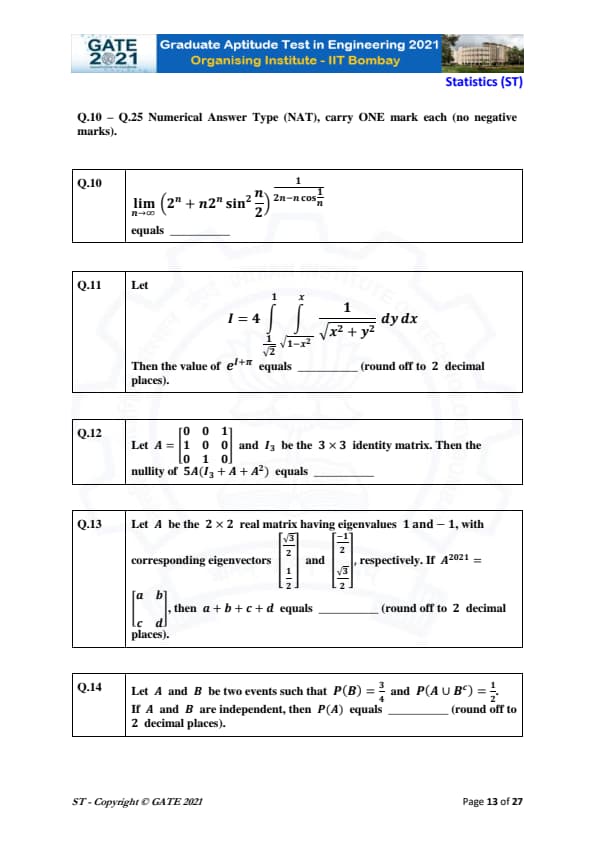
Evaluate the limit: \[ \lim_{n \to \infty} \frac{(2^n + n 2^n \sin^2 \frac{n}{2})}{(2n - n \cos \frac{1}{n})} \]
The value of the limit is ________ (round off to 2 decimal places).
Let \[ I = 4 \int_0^{\frac{1}{\sqrt{2}}} \int_0^x \frac{1}{\sqrt{x^2 + y^2}} \, dy \, dx \]
Then the value of \( e^{l+\pi} \) is ________ (round off to 2 decimal places).
Let \( A = \left[ \begin{array}{ccc} 0 & 0 & 1 \\
1 & 0 & 0 \\
0 & 1 & 0 \end{array} \right] \) and \( I_3 \) be the 3 × 3 identity matrix. Then the nullity of \( 5A(I_3 + A + A^2) \) equals ________
Let \( A \) be the 2 × 2 real matrix having eigenvalues 1 and -1, with corresponding eigenvectors \( \left[ \begin{array}{c} \frac{\sqrt{3}}{2} \\
\frac{1}{2} \end{array} \right] \) and \( \left[ \begin{array}{c} \frac{-1}{2} \\
\frac{\sqrt{3}}{2} \end{array} \right] \), respectively. If \( A^{2021} = \left[ \begin{array}{cc} a & b \\
c & d \end{array} \right] \), then \( a + b + c + d \) equals ________ (round off to 2 decimal places).
Let \( A \) and \( B \) be two events such that \( P(B) = \frac{3}{4} \) and \( P(A \cup B^C) = \frac{1}{2} \). If \( A \) and \( B \) are independent, then \( P(A) \) equals ________ (round off to 2 decimal places).
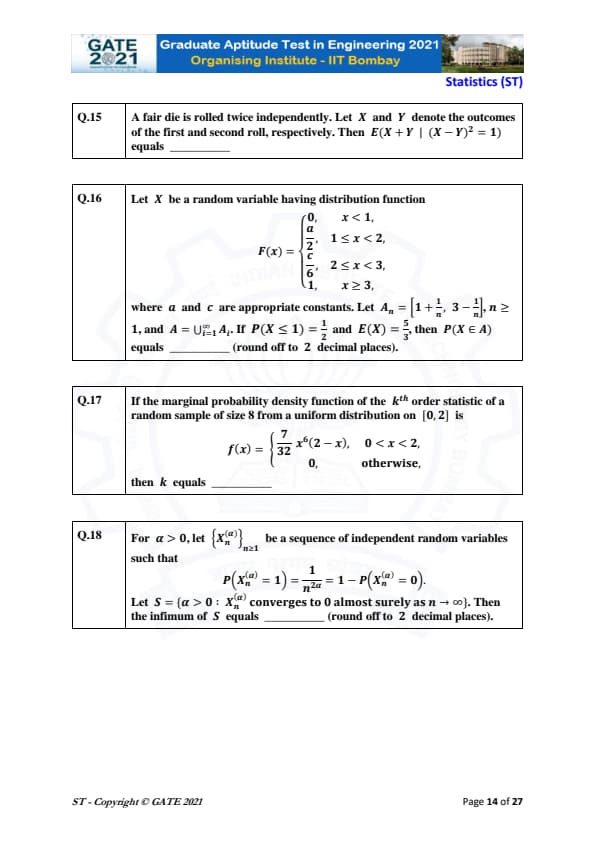
A fair die is rolled twice independently. Let \( X \) and \( Y \) denote the outcomes of the first and second roll, respectively. Then \[ E(X + Y \mid (X - Y)^2 = 1) \]
The value of \( E(X + Y \mid (X - Y)^2 = 1) \) is ________ (round off to 2 decimal places).
Let \( X \) be a random variable having distribution function \[ F(x) = \begin{cases} 0, & x < 1,
a, & 1 \leq x < 2,
\frac{c}{2}, & 2 \leq x < 3,
\frac{6}{6}, & x \geq 3,
\end{cases} \]
where \( a \) and \( c \) are appropriate constants. Let \( A_n = \left[ 1 + \frac{1{n, 3 - \frac{1{n \right], n \geq 1, \text{ and A = \bigcup_{i=1^{\infty A_i. If P(X \leq 1) = \frac{1{2 \text{ and E(X) = \frac{5{3, \text{ then P(X \in A) \text{ equals ________ \text{ (round off to 2 decimal places).
If the marginal probability density function of the kth order statistic of a random sample of size 8 from a uniform distribution on [0, 2] is \[ f(x) = \begin{cases} \frac{7}{32} x^6 (2 - x), & 0 < x < 2,
0, & otherwise, \end{cases} \]
then \( k \) equals ________ (round off to 2 decimal places).
For \( \alpha > 0 \), let \[ \{ X^{(\alpha)}_n \}_{n \geq 1} be a sequence of independent random variables such that \quad P(X^{(\alpha)}_n = 1) = \frac{1}{n^{2\alpha}} = 1 - P(X^{(\alpha)}_n = 0). \]
Let \( S = \{ \alpha > 0 : X^{(\alpha)}_n converges to 0 almost surely as n \to \infty \}. \) \text{Then the infimum of \( S \) equals ________ \text{ (round off to 2 decimal places).
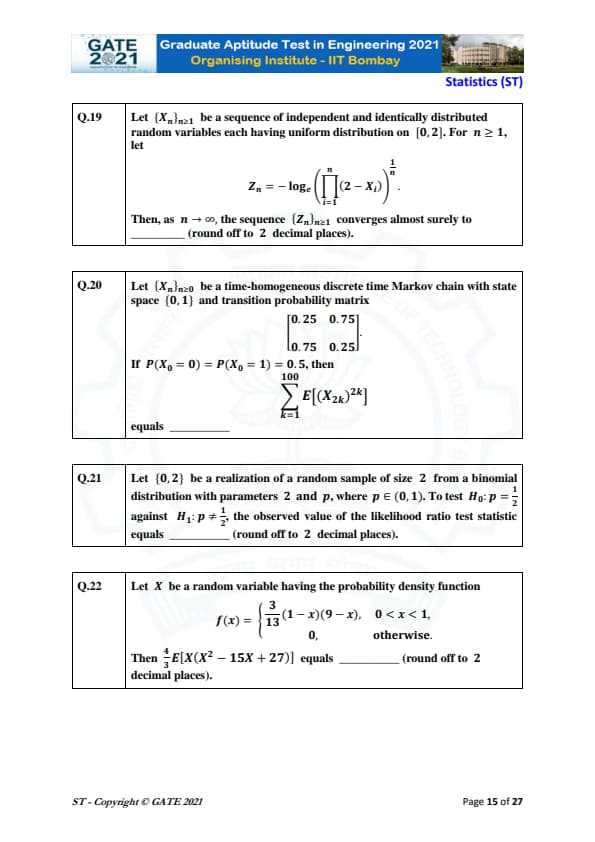
Let \( \{X_n\}_{n \geq 1} \) be a sequence of independent and identically distributed random variables each having uniform distribution on \( [0, 2] \). For \( n \geq 1 \), let \[ Z_n = - \log \left( \prod_{i=1}^{n} \left( 2 - X_i \right) \right)^{\frac{1}{n}}. \]
Then, as \( n \to \infty \), the sequence \( \{Z_n\}_{n \geq 1} \) converges almost surely to ________ (round off to 2 decimal places).
Let \( \{X_n\}_{n \geq 0} \) be a time-homogeneous discrete time Markov chain with state space \( \{0, 1\} \) and transition probability matrix \[ P = \begin{bmatrix} 0.25 & 0.75
0.75 & 0.25 \end{bmatrix}. \]
If \( P(X_0 = 0) = P(X_0 = 1) = 0.5 \), then \[ \sum_{k=1}^{100} E[(X_{2k})^2] equals \, \_\_\_\_\_\_\_\_ (round off to 2 decimal places). \]
Let \( \{0, 2\} \) be a realization of a random sample of size 2 from a binomial distribution with parameters 2 and \( p \), where \( p \in (0, 1) \). To test \( H_0: p = \frac{1}{2} \), the observed value of the likelihood ratio test statistic equals ________ (round off to 2 decimal places).
Let \( X \) be a random variable having the probability density function \[ f(x) = \begin{cases} \frac{3}{13} (1 - x)(9 - x), & 0 < x < 1,
0, & otherwise. \end{cases} \]
Then \[ \frac{4}{3} E[(X^2 - 15X + 27)] equals \_\_\_\_\_\_\_\_ (round off to 2 decimal places). \]
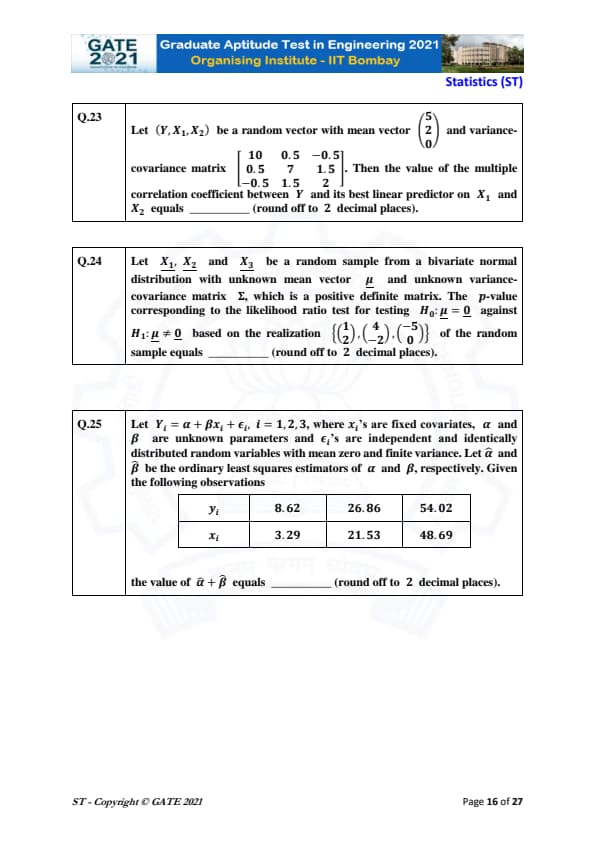
Let \( (Y, X_1, X_2) \) be a random vector with mean vector \[ \begin{pmatrix} 5 \\
2 \\
0 \end{pmatrix} \]
and covariance matrix \[ \begin{pmatrix} 10 & 0.5 & -0.5 \\
0.5 & 7 & 1.5 \\
-0.5 & 1.5 & 2 \end{pmatrix} \]
Then the value of the multiple correlation coefficient between \( Y \) and its best linear predictor on \( X_1 \) and \( X_2 \) equals ________ (round off to 2 decimal places).
Let \( X_1, X_2, X_3 \) be a random sample from a bivariate normal distribution with unknown mean vector \( \mu \) and unknown variance-covariance matrix \( \Sigma \), which is a positive definite matrix. The p-value corresponding to the likelihood ratio test for testing \[ H_0: \mu = 0 \quad against \quad H_1: \mu \neq 0 \]
based on the realization \[ \left\{ \left( 1, 2 \right), \left( 4, -2 \right), \left( -5, 0 \right) \right\} \]
of the random sample equals ________ (round off to 2 decimal places).
Let \( Y_i = \alpha + \beta x_i + \epsilon_i \), where \( x_i \)'s are fixed covariates, \( \alpha \) and \( \beta \) are unknown parameters, and \( \epsilon_i \)'s are independent and identically distributed random variables with mean zero and finite variance. Let \( \hat{\alpha} \) and \( \hat{\beta} \) be the ordinary least squares estimators of \( \alpha \) and \( \beta \), respectively. Given the following observations:

The value of \( \hat{\alpha} + \hat{\beta} \) equals ________ (round off to 2 decimal places).
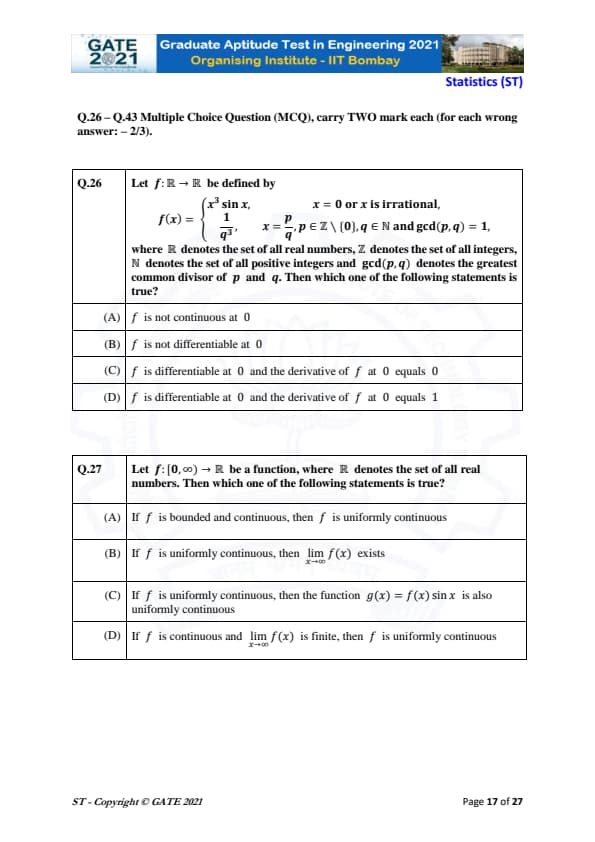
Let \( f: \mathbb{R} \to \mathbb{R} \) be defined by \[ f(x) = \begin{cases} x^3 \sin x, & if x = 0 or x is irrational,
\frac{1}{q^3}, & if x = \frac{p}{q}, p \in \mathbb{Z} \setminus \{0\}, q \in \mathbb{N}, and \gcd(p,q) = 1, \end{cases} \]
where \( \mathbb{R} \) denotes the set of all real numbers, \( \mathbb{Z} \) denotes the set of all integers, \( \mathbb{N} \) denotes the set of all positive integers, and \( \gcd(p,q) \) denotes the greatest common divisor of \( p \) and \( q \). Then which one of the following statements is true?
Let \( f: [0, \infty) \to \mathbb{R} \) be a function, where \( \mathbb{R} \) denotes the set of all real numbers. Then which one of the following statements is true?
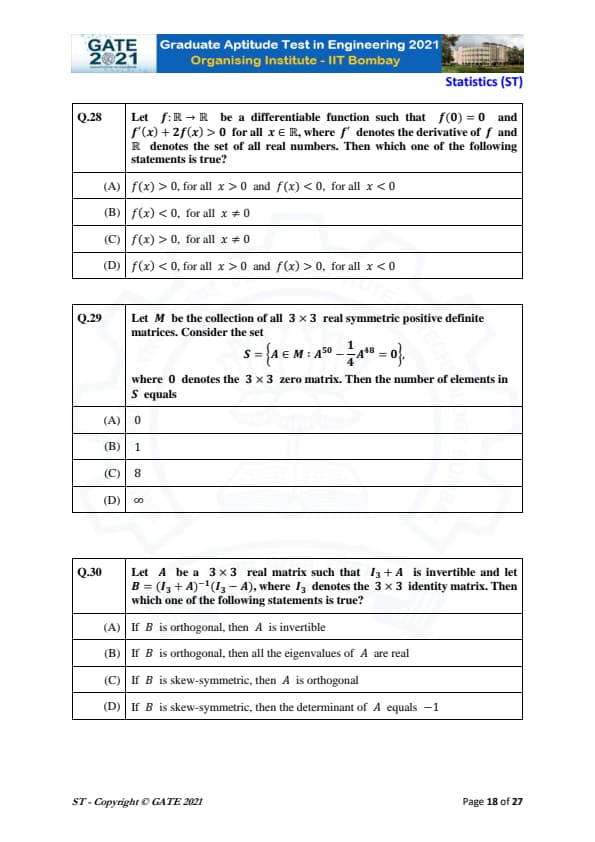
Let \( f: \mathbb{R} \to \mathbb{R} \) be a differentiable function such that \( f(0) = 0 \) and \( f'(x) + 2f(x) > 0 \) for all \( x \in \mathbb{R} \), where \( f' \) denotes the derivative of \( f \) and \( \mathbb{R} \) denotes the set of all real numbers. Then which one of the following statements is true?
Let \( M \) be the collection of all \( 3 \times 3 \) real symmetric positive definite matrices. Consider the set \[ S = \left\{ A \in M : A^{50} - \frac{1}{4} A^{48} = 0 \right\}, \]
where \( 0 \) denotes the \( 3 \times 3 \) zero matrix. Then the number of elements in \( S \) equals
Let \( A \) be a \( 3 \times 3 \) real matrix such that \( I_3 + A \) is invertible and let \[ B = (I_3 + A)^{-1}(I_3 - A), \]
where \( I_3 \) denotes the \( 3 \times 3 \) identity matrix. Then which one of the following statements is true?
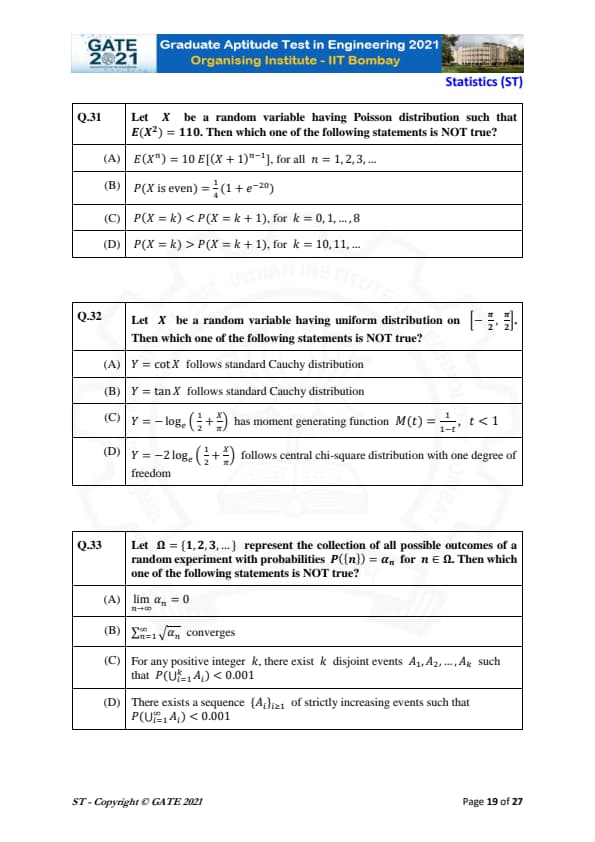
Let \( X \) be a random variable having Poisson distribution such that \( E(X^2) = 110 \). Then which one of the following statements is NOT true?
Let \( X \) be a random variable having uniform distribution on \( \left[ -\frac{\pi}{2}, \frac{\pi}{2} \right] \). Then which one of the following statements is NOT true?
Let \( \Omega = \{1, 2, 3, \dots \} \) represent the collection of all possible outcomes of a random experiment with probabilities \( P(\{n\}) = a_n \) for \( n \in \Omega \). Then which one of the following statements is NOT true?
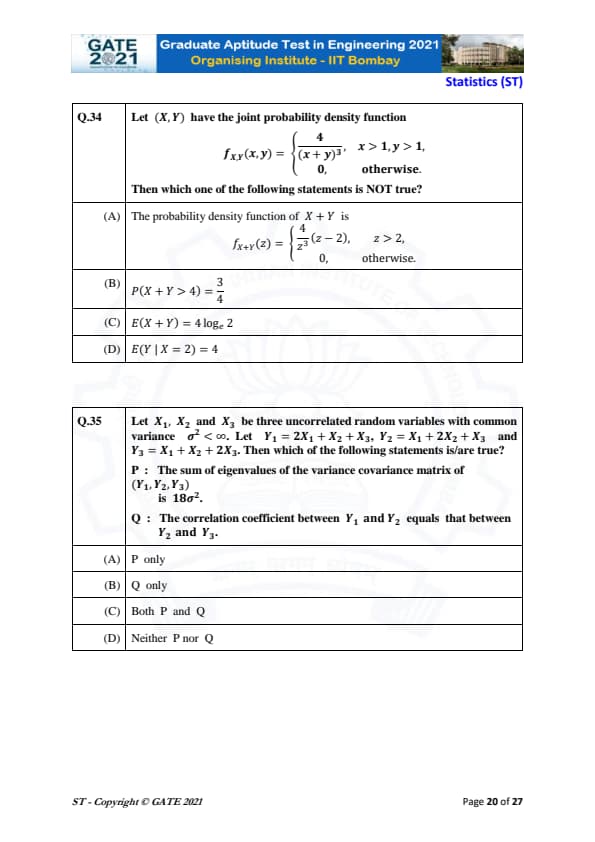
Let \( (X, Y) \) have the joint probability density function \[ f_{X,Y}(x,y) = \begin{cases} \frac{4}{(x + y)^3}, & x > 1, y > 1,
0, & otherwise. \end{cases} \]
Then which one of the following statements is NOT true?
Let \( X_1, X_2, X_3 \) be three uncorrelated random variables with common variance \( \sigma^2 < \infty \). Let \( Y_1 = 2X_1 + X_2 + X_3 \), \( Y_2 = X_1 + 2X_2 + X_3 \), and \( Y_3 = X_1 + X_2 + 2X_3 \). Then which of the following statements is/are true?
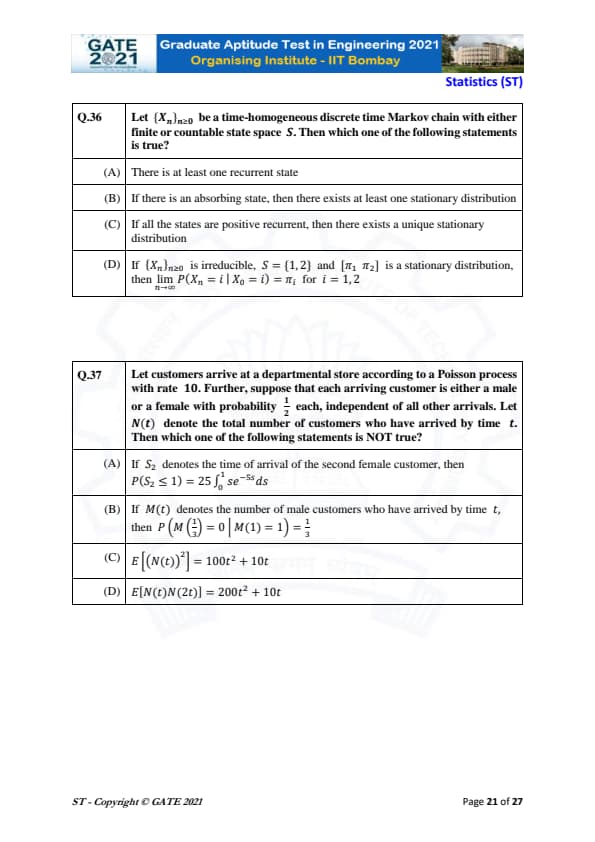
Let \( \{X_n\}_{n \geq 0} \) be a time-homogeneous discrete time Markov chain with either finite or countable state space \( S \). Then which one of the following statements is true?
Let customers arrive at a departmental store according to a Poisson process with rate 10. Further, suppose that each arriving customer is either a male or a female with probability \( \frac{1}{2} \) each, independent of all other arrivals. Let \( N(t) \) denote the total number of customers who have arrived by time \( t \). Then which one of the following statements is NOT true?
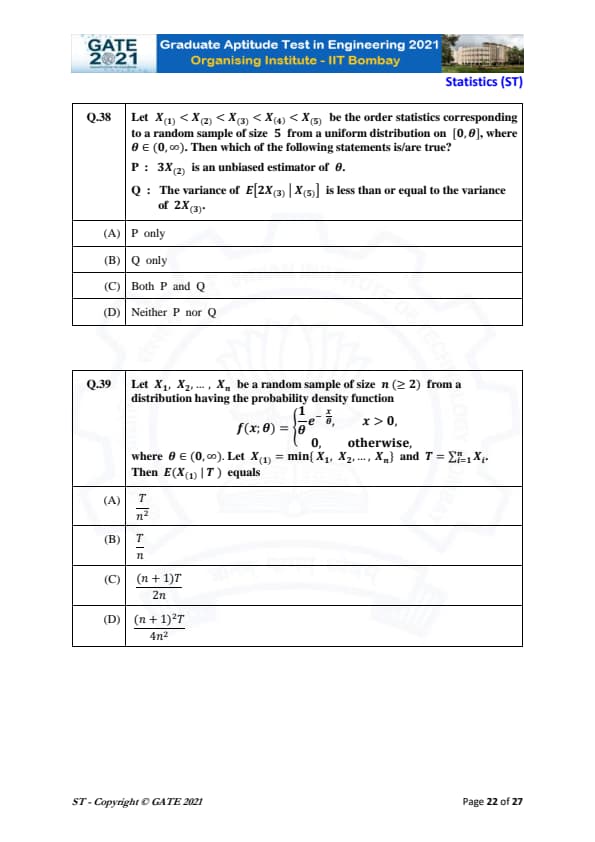
Let \( X_{(1)} < X_{(2)} < X_{(3)} < X_{(4)} < X_{(5)} \) be the order statistics corresponding to a random sample of size 5 from a uniform distribution on \( [0, \theta] \), where \( \theta \in (0, \infty) \). Then which of the following statements is/are true?
P: \( 3X_{(2)} \) is an unbiased estimator of \( \theta \).
Q: The variance of \( E[2X_{(3)} \mid X_{(5)}] \) is less than or equal to the variance of \( 2X_{(3)} \).
Let \( X_1, X_2, \dots, X_n \) be a random sample of size \( n \geq 2 \) from a distribution having the probability density function \[ f(x; \theta) = \begin{cases} \frac{1}{\theta} e^{-\frac{x}{\theta}}, & x > 0,
0, & otherwise, \end{cases} \]
where \( \theta \in (0, \infty) \). Let \( X_{(1)} = \min\{ X_1, X_2, \dots, X_n \} \) and \( T = \sum_{i=1}^{n} X_i \). Then \( E(X_{(1)} \mid T) \) equals
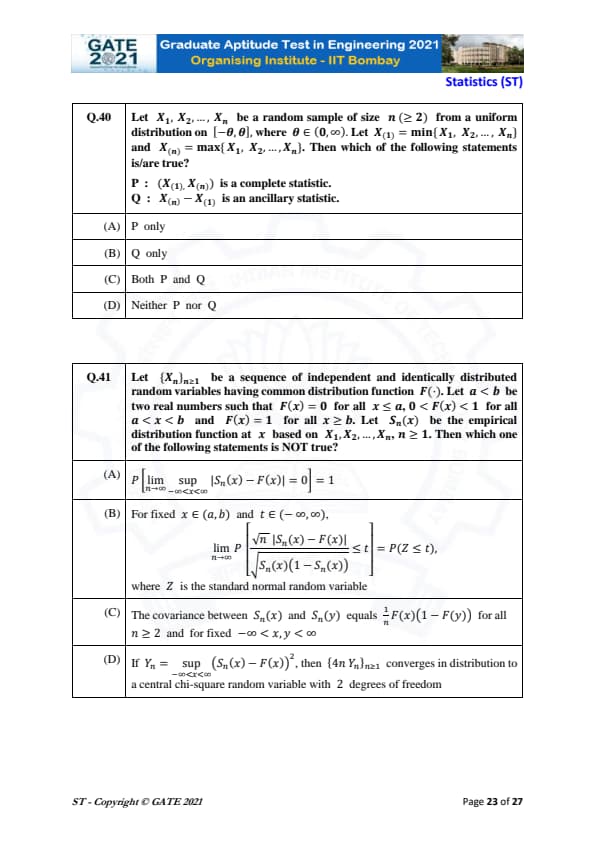
Let \( X_1, X_2, \dots, X_n \) be a random sample of size \( n (\geq 2) \) from a uniform distribution on \( [-\theta, \theta] \), where \( \theta \in (0, \infty) \). Let \( X_{(1)} = \min\{ X_1, X_2, \dots, X_n \} \) and \( X_{(n)} = \max\{ X_1, X_2, \dots, X_n \} \). Then which of the following statements is/are true?
Let \( \{X_n\}_{n \geq 1} \) be a sequence of independent and identically distributed random variables having common distribution function \( F(x) \). Let \( a < b \) be two real numbers such that \( F(x) = 0 \) for all \( x \leq a \), \( 0 < F(x) < 1 \) for all \( a < x < b \), and \( F(x) = 1 \) for all \( x \geq b \). Let \( S_n(x) \) be the empirical distribution function at \( x \) based on \( X_1, X_2, \dots, X_n \), \( n \geq 1 \). Then which one of the following statements is NOT true?
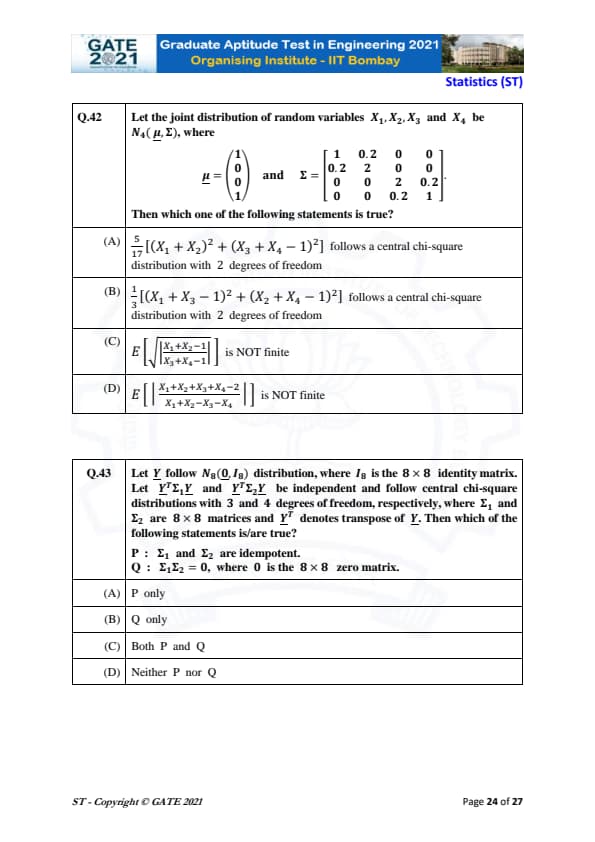
Let the joint distribution of random variables \( X_1, X_2, X_3 \) and \( X_4 \) be \( N_4(\mu, \Sigma) \), where \[ \mu = \begin{pmatrix} 1 \\
0 \\
0 \\
1 \end{pmatrix} \quad and \quad \Sigma = \begin{pmatrix} 1 & 0.2 & 0 & 0 \\
0.2 & 2 & 0 & 0 \\
0 & 0 & 2 & 0.2 \\
0 & 0 & 0.2 & 1 \end{pmatrix}. \]
Then which one of the following statements is true?
Let \( Y \) follow \( N_8(0, I_8) \) distribution, where \( I_8 \) is the \( 8 \times 8 \) identity matrix. Let \( Y^T \Sigma_1 Y \) and \( Y^T \Sigma_2 Y \) be independent and follow central chi-square distributions with 3 and 4 degrees of freedom, respectively, where \( \Sigma_1 \) and \( \Sigma_2 \) are \( 8 \times 8 \) matrices and \( Y^T \) denotes transpose of \( Y \). Then which of the following statements is/are true? \[ P: \Sigma_1 \, and \, \Sigma_2 \, are idempotent. \quad Q: \Sigma_1 \Sigma_2 = 0, \, where \, 0 \, is the \, 8 \times 8 \, zero matrix. \]
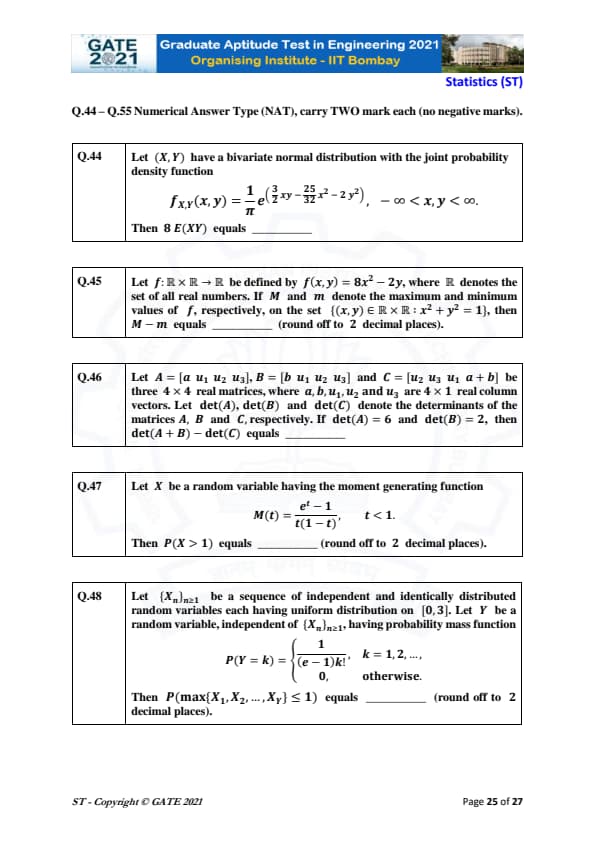
Let \( (X, Y) \) have a bivariate normal distribution with the joint probability density function \[ f_{X,Y}(x,y) = \frac{1}{\pi} e^{\left( \frac{3}{2} xy - \frac{25}{32} x^2 - 2 y^2 \right)} \]
Then \[ E(XY) = \_\_\_\_\_\_\_\_ (round off to 2 decimal places). \]
Let \( f: \mathbb{R} \times \mathbb{R} \to \mathbb{R} \) be defined by \[ f(x, y) = 8x^2 - 2y, where \mathbb{R} denotes the set of all real numbers. \]
If \( M \) and \( m \) denote the maximum and minimum values of \( f \), respectively, on the set \[ \{(x, y) \in \mathbb{R}^2 : x^2 + y^2 = 1\}, \]
then \[ M - m = \_\_\_\_\_\_\_\_ (round off to 2 decimal places). \]
Let \[ A = \begin{bmatrix} a & u_1 & u_2 & u_3 \end{bmatrix}, \quad B = \begin{bmatrix} b & u_1 & u_2 & u_3 \end{bmatrix}, \quad C = \begin{bmatrix} u_2 & u_3 & u_1 & a + b \end{bmatrix}. \]
Let \( \det(A), \det(B), \det(C) \) denote the determinants of the matrices \( A \), \( B \), and \( C \), respectively. If \[ \det(A) = 6, \quad \det(B) = 2, \quad then \det(A + B) - \det(C) = \_\_\_\_\_\_\_\_. \]
Let \( X \) be a random variable having the moment generating function \[ M(t) = \frac{e^t - 1}{t(1 - t)}, \quad t < 1. \]
Then \[ P(X > 1) = \_\_\_\_\_\_\_\_ (round off to 2 decimal places). \]
Let \( \{X_n\}_{n \geq 1} \) be a sequence of independent and identically distributed random variables each having uniform distribution on [0, 3]. Let \( Y \) be a random variable, independent of \( \{X_n\}_{n \geq 1} \), having probability mass function \[ P(Y = k) = \frac{1}{(e - 1) k!}, \quad k = 1, 2, \dots \]
Then \[ P(\max(X_1, X_2, \dots, X_Y) \leq 1) = \_\_\_\_\_\_\_\_ (round off to 2 decimal places). \]
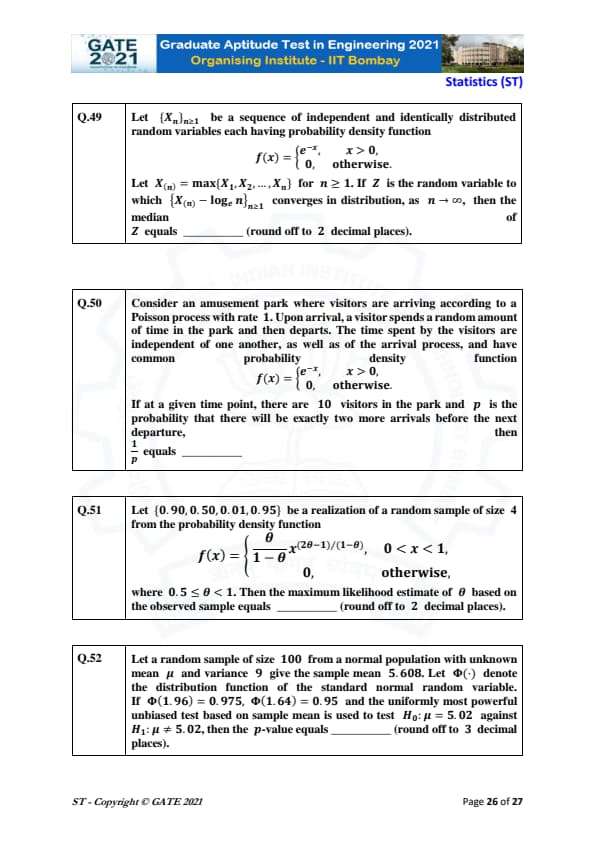
Let \( \{X_n\}_{n \geq 1} \) be a sequence of independent and identically distributed random variables each having probability density function \[ f(x) = \begin{cases} e^{-x}, & x > 0,
0, & otherwise. \end{cases} \]
Let \( X_{(n)} = \max\{ X_1, X_2, \dots, X_n \} \) for \( n \geq 1 \). If \( Z \) is the random variable to which \{ X_{(n)} - \log n \}_{n \geq 1} converges in distribution, as n \to \infty, then the median of Z equals \_\_\_\_\_\_\_\_ (round off to 2 decimal places).
Consider an amusement park where visitors are arriving according to a Poisson process with rate 1. Upon arrival, a visitor spends a random amount of time in the park and then departs. The time spent by the visitors are independent of one another, as well as of the arrival process, and have common probability density function \[ f(x) = \begin{cases} e^{-x}, & x > 0,
0, & otherwise. \end{cases} \]
If at a given time point, there are 10 visitors in the park and \( p \) is the probability that there will be exactly two more visitors before the next departure, then \[ p = \_\_\_\_\_\_\_\_ (round off to 2 decimal places). \]
Let \( \{0.90, 0.50, 0.01, 0.95\} \) be a realization of a random sample of size 4 from the probability density function \[ f(x) = \begin{cases} \frac{\theta}{(1-\theta)} x^{(2\theta-1)/(1-\theta)}, & 0 < x < 1,
0, & otherwise, \end{cases} \]
where \( 0.5 \leq \theta < 1 \). Then the maximum likelihood estimate of \( \theta \) based on the observed sample equals \[ \_\_\_\_\_\_\_\_ (round off to 2 decimal places). \]
Let a random sample of size 100 from a normal population with unknown mean \( \mu \) and variance 9 give the sample mean 5.608. Let \( \Phi(\cdot) \) denote the distribution function of the standard normal random variable. If \( \Phi(1.96) = 0.975 \), \( \Phi(1.64) = 0.95 \), and the uniformly most powerful unbiased test based on sample mean is used to test \[ H_0: \mu = 5.02 \quad against \quad H_1: \mu \neq 5.02, \]
then the p-value equals \[ \_\_\_\_\_\_\_\_ (round off to 3 decimal places). \]
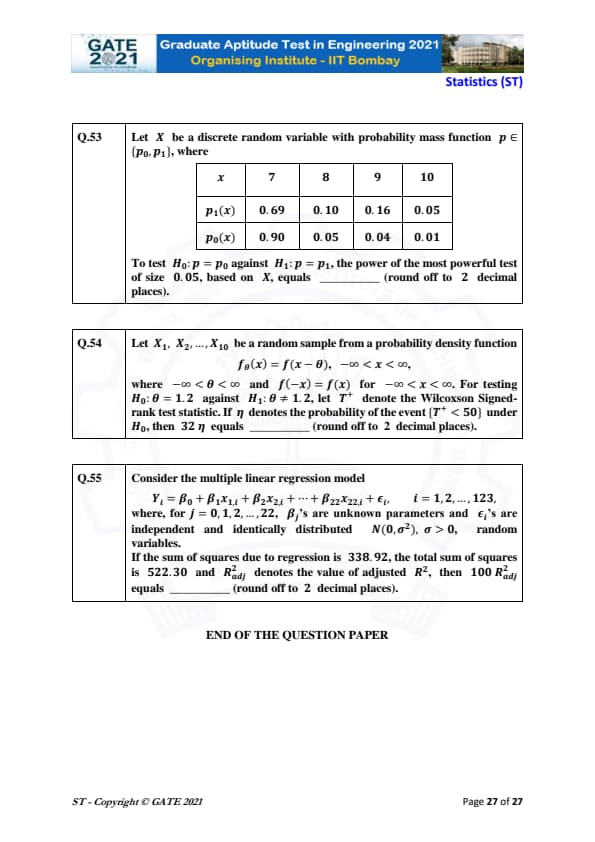
Let \( X \) be a discrete random variable with probability mass function \( p \in \{p_0, p_1\} \), where

To test \( H_0 : p = p_0 \) against \( H_1 : p = p_1 \), the power of the most powerful test of size 0.05, based on \( X \), equals ________ \text{ (round off to 2 decimal places).
Let \( X_1, X_2, \dots, X_{10} \) be a random sample from a probability density function \[ f_\theta(x) = f(x - \theta), \quad -\infty < x < \infty, \]
where \( -\infty < \theta < \infty \) and \( f(-x) = f(x) \) for \( -\infty < x < \infty \). For testing
\[
H_0: \theta = 1.2 \quad against \quad H_1: \theta \neq 1.2, \quad \text{let \quad T^+ \text{ denote the Wilcoxon Signed-rank test statistic. If \( \eta \) denotes the probability of the event \( \{T^+ < 50\ \) under \( H_0 \), then 32 \eta \text{ equals ________ \text{ (round off to 2 decimal places).
Consider the multiple linear regression model \[ Y_i = \beta_0 + \beta_1 x_{1,i} + \beta_2 x_{2,i} + \dots + \beta_{22} x_{22,i} + \epsilon_i, \quad i = 1, 2, \dots, 123, \]
where, for \( j = 0, 1, 2, \dots, 22 \), \( \beta_j \)'s are unknown parameters and \( \epsilon_i \)'s are independent and identically distributed \( N(0, \sigma^2) \), \( \sigma > 0 \), random variables. If the sum of squares due to regression is 338.92, the total sum of squares is 522.30 and \( R^2_{adj} \) denotes the value of adjusted \( R^2 \), then \[ 100 R^2_{adj} = \_\_\_\_\_\_\_\_ (round off to 2 decimal places). \]


Quick Links:
GATE 2021 ST Paper Analysis
From 2021, IIT Bombay introduced MSQs. In MSQs, one or more than one correct answers would be mentioned in the question. A candidate is required to choose all the correct answers in MSQs to get the marks.
GATE 2021 ST was a combination of MCQs (Multiple Choice Questions), NAT (Numerical Answer Type) and MSQ (Multiple Select Questions). The full marks of the GATE 2021 ST stands at 100. All the questions carried either 1 or 2 marks. 180 minutes were allotted to solve 65 questions.
The table below shows the frequency of NATs, MSQs and MCQs carrying 1 and 2 marks, asked in GATE 2021 ST paper-
| Question Type | Question Frequency | Carried Marks |
|---|---|---|
| No of 1 mark MCQs/MSQs | 14 | 14 |
| No of 2 marks MCQs/MSQs | 23 | 46 |
| No of 1 mark NATs | 16 | 16 |
| No of 2 marks NATs | 12 | 24 |
Also Check:
GATE 2021 ST: Exam Pattern and Marking Scheme
- IIT Bombay concluded the exam in CBT mode
- Marks would be deducted only if MCQs were wrong. No marks would be deducted if any NATs and MSQs were proven to be wrong
- For every wrong MCQ carried 1 and 2 marks, ⅓ marks and ⅔ marks would be deducted respectively
- The qualifying cutoff goes up to 25 for Unreserved, 21.5 for OBCs, and 16.6 for SC/ST candidates
GATE Previous Year Question Papers
| GATE 2022 Question Papers | GATE 2021 Question Papers | GATE 2020 Question Papers |
| GATE 2019 Question Papers | GATE 2018 Question Papers | GATE 2017 Question Papers |




Comments