




Candidates can view GATE 2021 Textile Engineering and Fiber Science (TF) Question Paper with Solutions GATE Exam Pattern for PI PDFs 2021 which was held in forenoon session from 9:30 AM to 12.30 PM. GATE 2021 TF question paper with solution key contains the correct answers to all of the exam's questions. Students can determine their likely score using the answer key and the exam's marking scheme.
It is critical to become familiar with previous years' GATE question papers in order to gain a thorough understanding of the exam format and syllabus. Although, detailed analysis of GATE TF 2021 question paper with answer key PDF is not available at the moment, according to the reports by students, estimated analysis was done.
GATE 2021 Textile Engineering and Fiber Science (TF) Question Paper with Solutions
| GATE 2021 Textile Engineering and Fiber Science (TF) Question Paper |  Download Download |
Check Solutions |

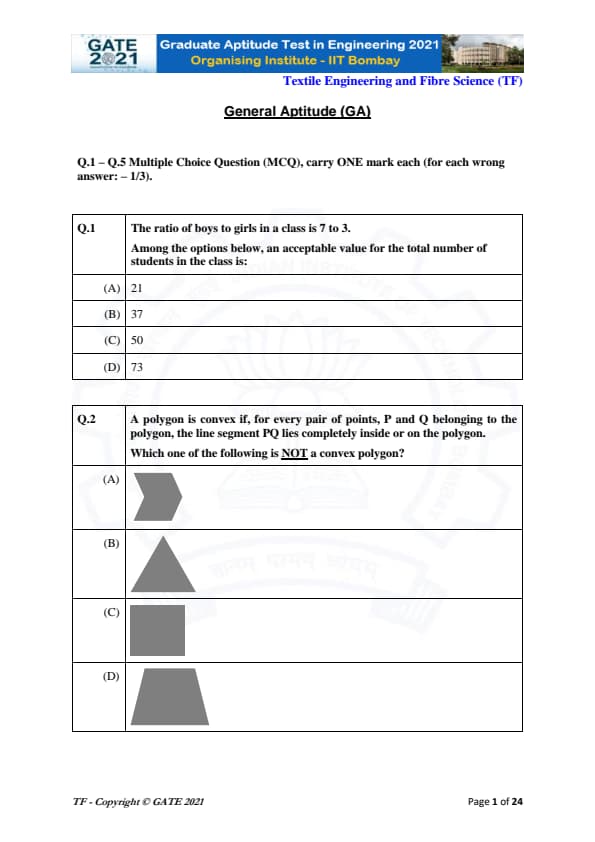
The ratio of boys to girls in a class is 7 to 3. Among the options below, an acceptable value for the total number of students in the class is:
A polygon is convex if, for every pair of points inside the polygon, the line segment joining them lies completely inside or on the polygon. Which one of the following is NOT a convex polygon?
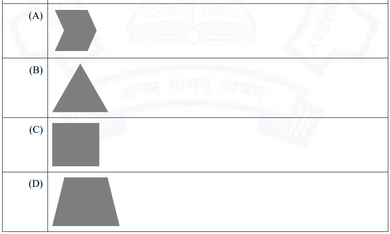
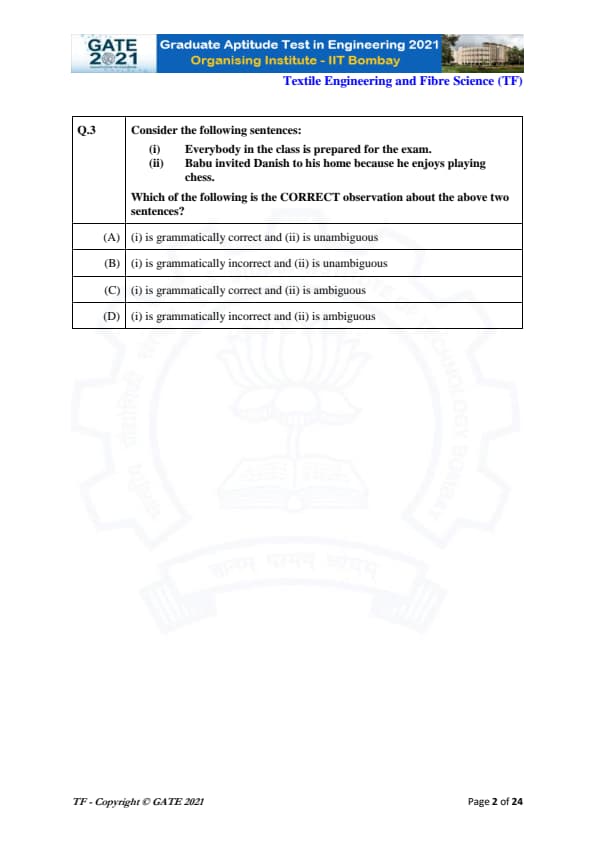
Consider the following sentences:
(i) Everybody in the class is prepared for the exam.
(ii) Babu invited Danish to his home because he enjoys playing chess.
Which of the following is the CORRECT observation about the above two sentences?
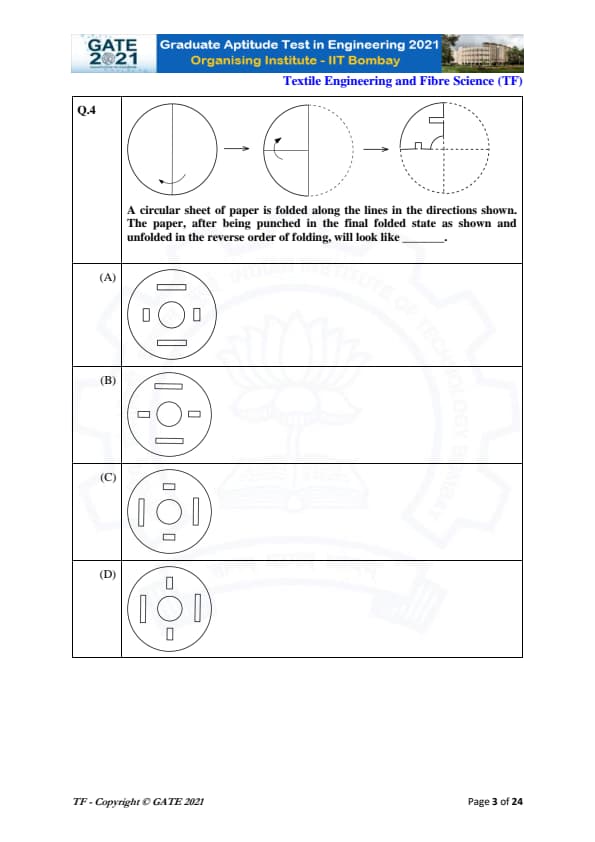
A circular sheet of paper is folded along the lines in the directions shown. The paper, after being punched in the final folded state as shown and unfolded in the reverse order of folding, will look like \hspace{2cm}.
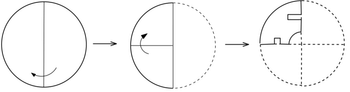
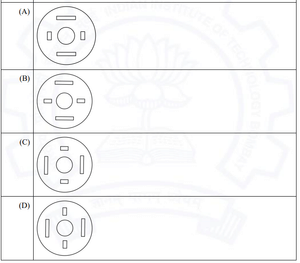
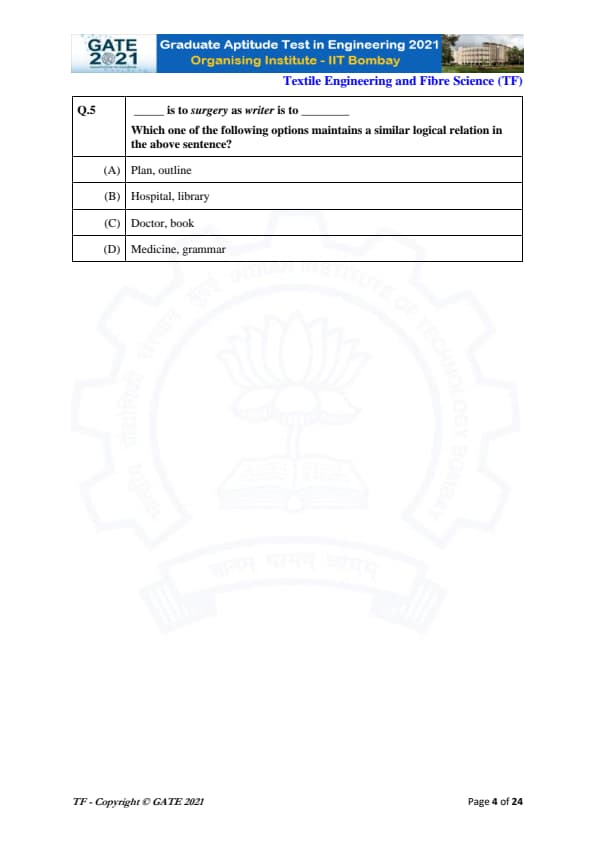
_____ is to surgery as writer is to _____
Which one of the following options maintains a similar logical relation in the above sentence?
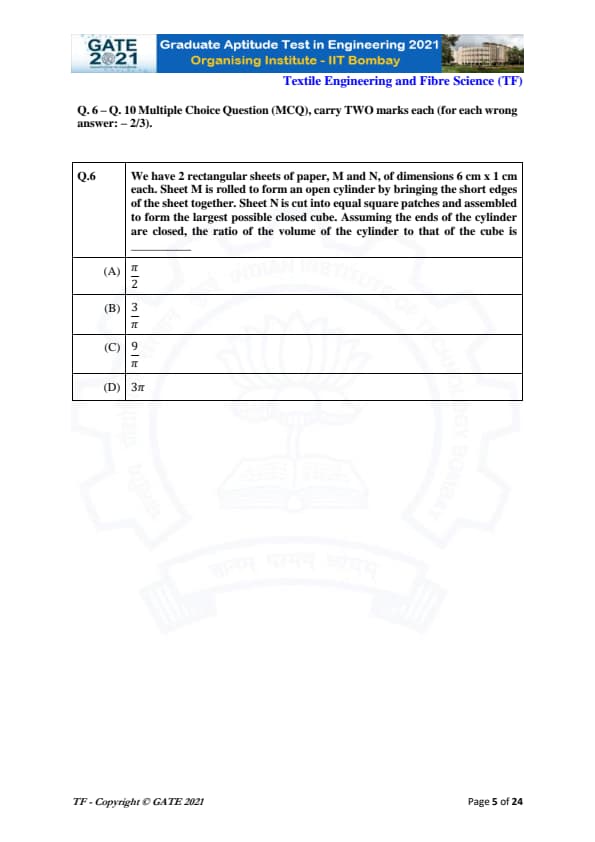
We have 2 rectangular sheets of paper, M and N, of dimensions 6 cm × 1 cm each. Sheet M is rolled to form an open cylinder by bringing the short edges of the sheet together. Sheet N is cut into equal square patches and assembled to form the largest possible closed cube. Assuming the ends of the cylinder are closed, the ratio of the volume of the cylinder to that of the cube is:
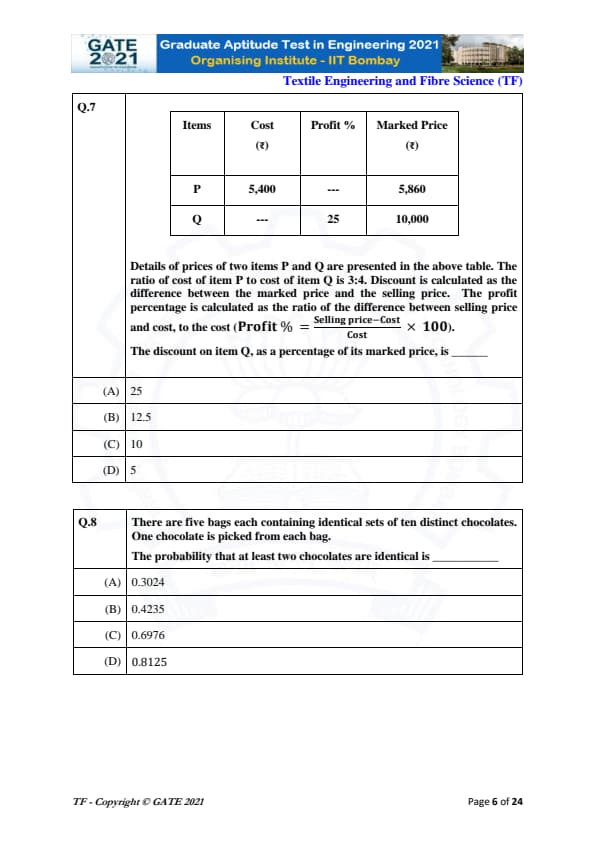
Details of prices of two items P and Q are presented in the above table. The ratio of cost of item P to cost of item Q is 3:4. Discount is calculated as the difference between the marked price and the selling price. The profit percentage is calculated as the ratio of the difference between selling price and cost, to the cost.
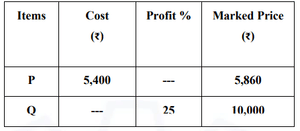
The formula for Profit Percentage is:
Profit % = \frac{Selling Price - Cost}{Cost} \times 100
The discount on item Q, as a percentage of its marked price, is:
There are five bags each containing identical sets of ten distinct chocolates. One chocolate is picked from each bag. The probability that at least two chocolates are identical is:
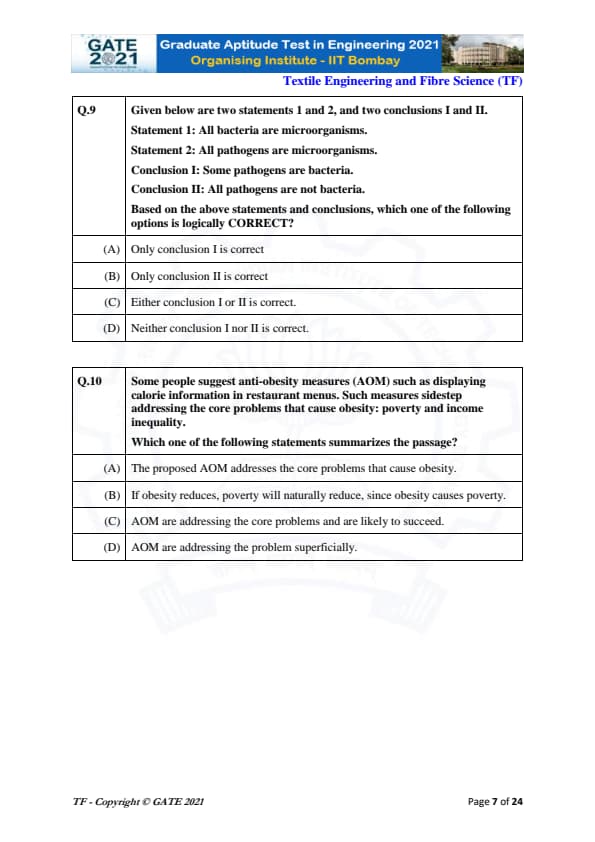
Given below are two statements 1 and 2, and two conclusions I ans II.
Statement 1: All bacteria are microorganisms.
Statement 2: All pathogens are microorganisms.
Conclusion I: Some pathogens are bacteria.
Conclusion II: All pathogens are not bacteria.
Based on the given statements and conclusions, which option is logically correct?
Some people suggest anti-obesity measures (AOM) such as displaying calorie information in restaurant menus. Such measures sidestep addressing the core problems that cause obesity: poverty and income inequality. Which one of the following statements summarizes the passage?
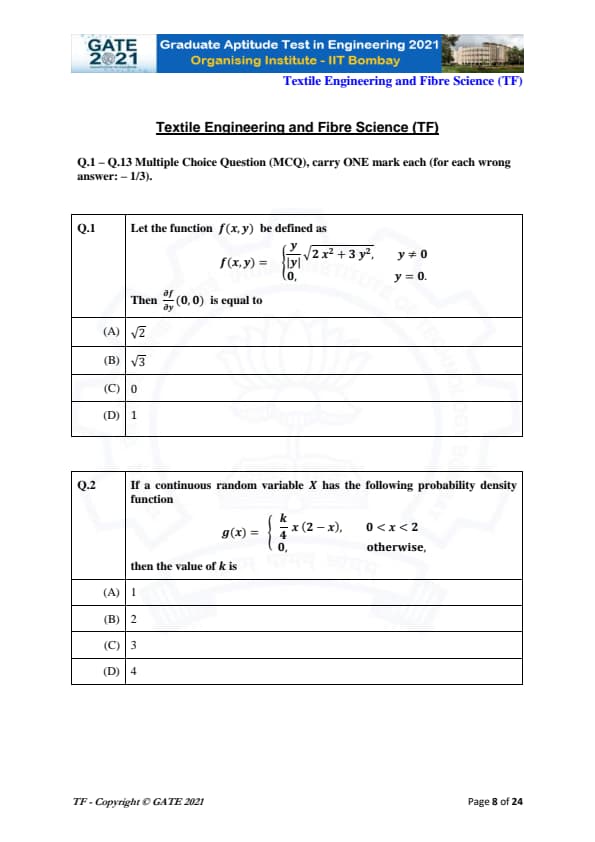
Let the function \( f(x, y) \) be defined as \[ f(x, y) = \begin{cases} \frac{y}{|y|} \sqrt{2x^2 + 3y^2}, & y \neq 0
0, & y = 0 \end{cases} \]
Then \( \frac{\partial f}{\partial y} (0, 0) \) is equal to
If a continuous random variable \( X \) has the following probability density function \[ g(x) = \begin{cases} \frac{k}{4} x(2 - x), & 0 < x < 2
0, & otherwise \end{cases} \]
then the value of \( k \) is
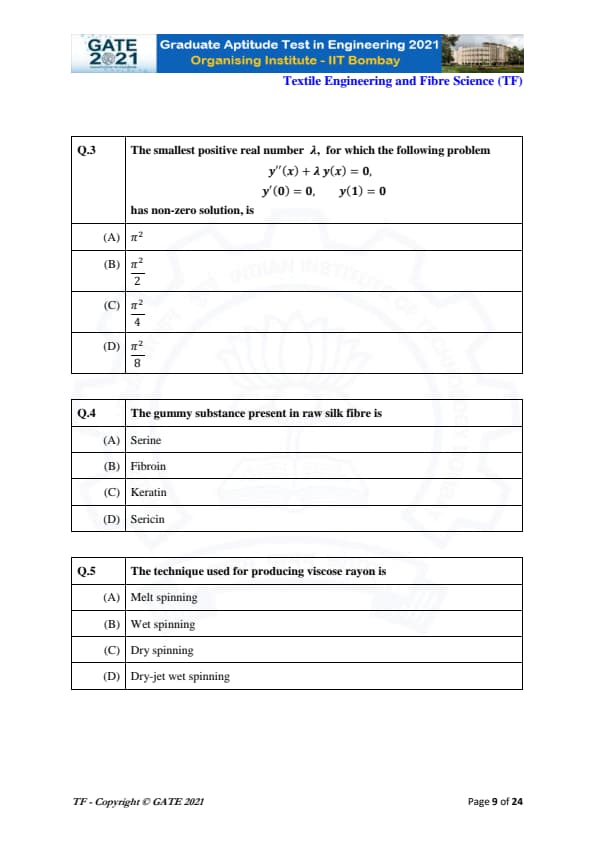
The smallest positive real number \( \lambda \), for which the following problem \[ y''(x) + \lambda y(x) = 0, \quad y'(0) = 0, \quad y(1) = 0 \]
has a non-zero solution, is
The gummy substance present in raw silk fibre is
The technique used for producing viscose rayon is
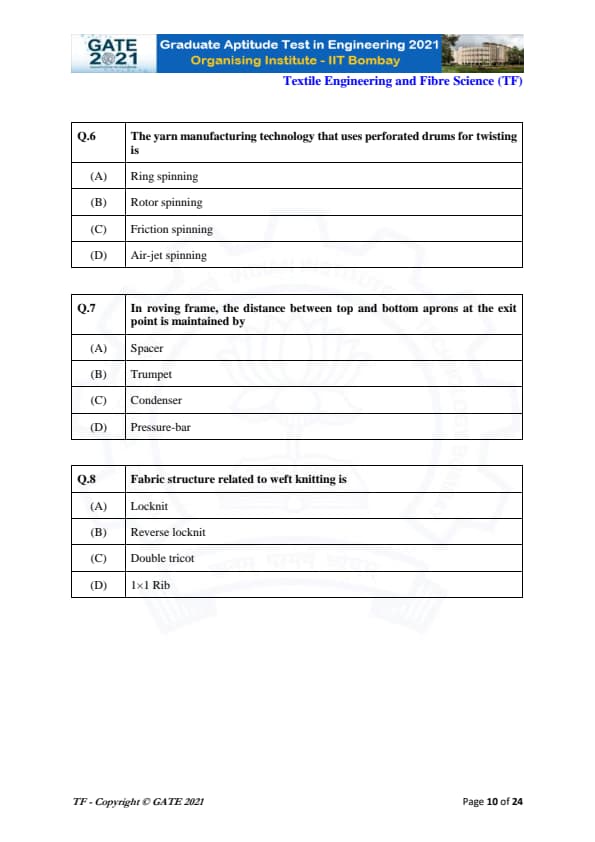
The yarn manufacturing technology that uses perforated drums for twisting is
In roving frame, the distance between top and bottom aprons at the exit point is maintained by
Fabric structure related to weft knitting is
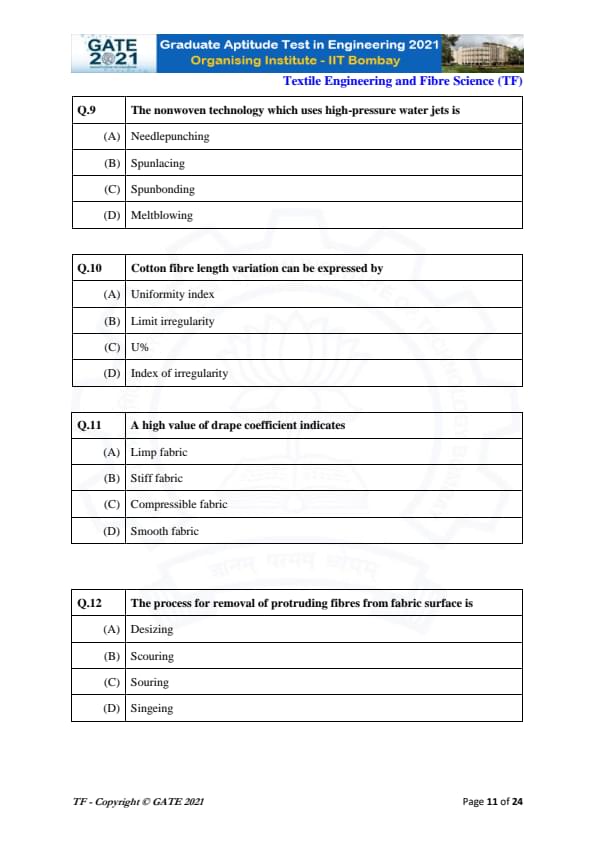
The nonwoven technology which uses high-pressure water jets is
Cotton fibre length variation can be expressed by
A high value of drape coefficient indicates
The process for removal of protruding fibres from fabric surface is
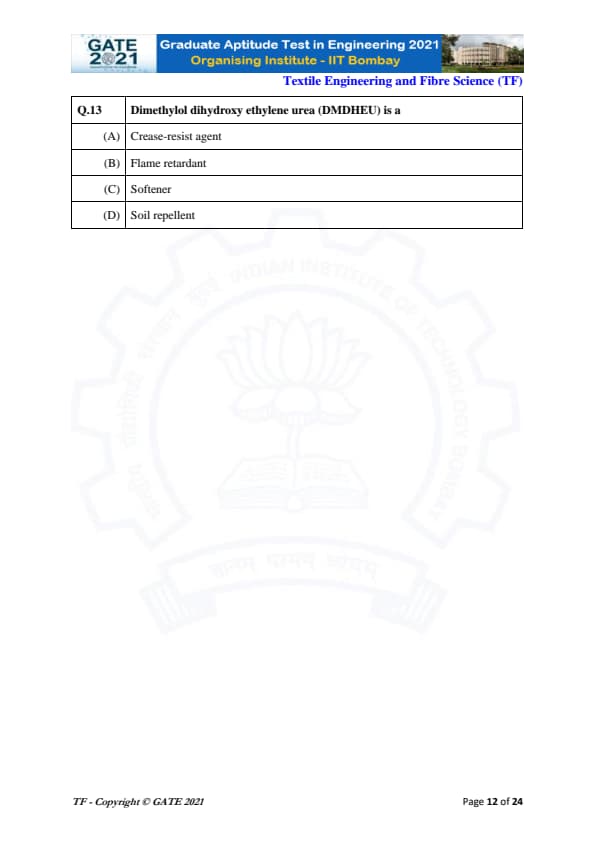
Dimethylol dihydroxy ethylene urea (DMDHEU) is a
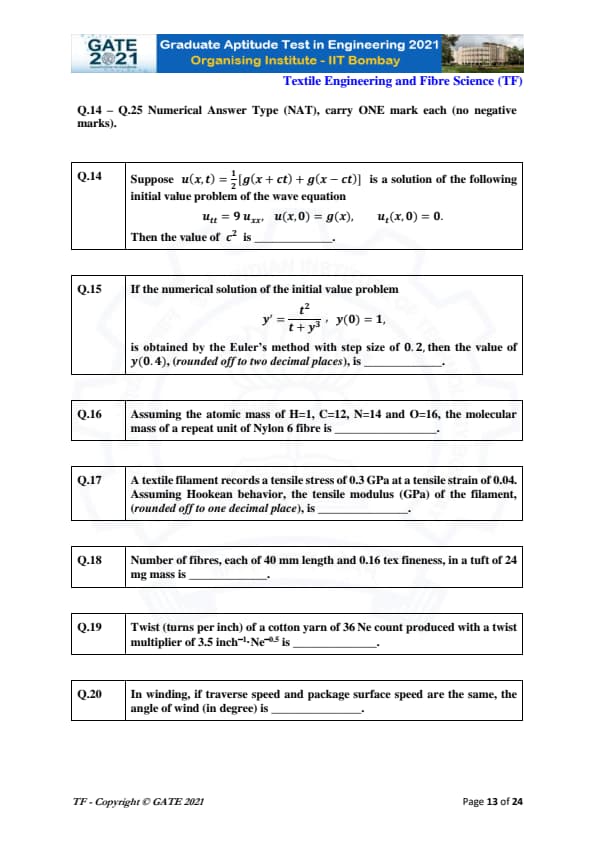
Suppose \[ u(x, t) = \frac{1}{2} \left[ g(x + ct) + g(x - ct) \right] \]
is a solution of the following initial value problem of the wave equation \[ u_{tt} = 9 u_{xx}, \quad u(x, 0) = g(x), \quad u_t(x, 0) = 0. \]
Then the value of \( c^2 \) is ________ (round off to 2 decimal places).
If the numerical solution of the initial value problem \[ y' = \frac{t^2}{t + y^3}, \quad y(0) = 1, \]
is obtained by the Euler's method with step size of 0.2, then the value of \( y(0.4) \), (rounded off to two decimal places), is ________.
Assuming the atomic mass of H = 1, C = 12, N = 14, and O = 16, the molecular mass of a repeat unit of Nylon 6 fibre is ________.
A textile filament records a tensile stress of 0.3 GPa at a tensile strain of 0.04. Assuming Hookean behavior, the tensile modulus (GPa) of the filament, (rounded off to one decimal place), is ________.
Number of fibres, each of 40 mm length and 0.16 tex fineness, in a tuft of 24 mg mass is ________.
Twist (turns per inch) of a cotton yarn of 36 Ne count produced with a twist multiplier of 3.5 inch\(^{-1}\).Ne\(^{-0.5}\) is ________.
In winding, if traverse speed and package surface speed are the same, the angle of wind (in degree) is ________.
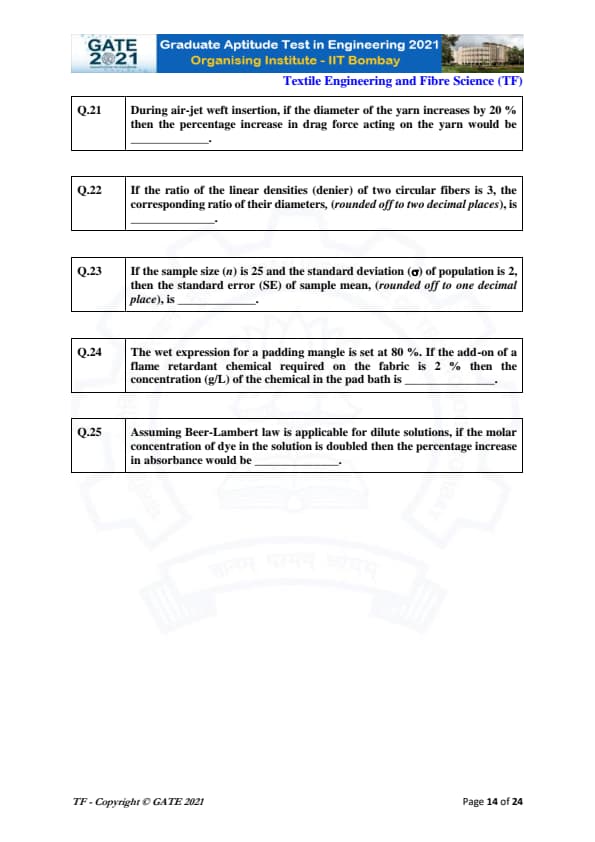
During air-jet weft insertion, if the diameter of the yarn increases by 20%, then the percentage increase in drag force acting on the yarn would be ________.
If the ratio of the linear densities (denier) of two circular fibers is 3, the corresponding ratio of their diameters, (rounded off to two decimal places), is ________.
If the sample size (n) is 25 and the standard deviation (σ) of population is 2, then the standard error (SE) of sample mean, (rounded off to one decimal place), is ________.
The wet expression for a padding mangle is set at 80 %. If the add-on of a flame retardant chemical required on the fabric is 2 %, then the concentration (g/L) of the chemical in the pad bath is ________.
Assuming Beer-Lambert law is applicable for dilute solutions, if the molar concentration of dye in the solution is doubled then the percentage increase in absorbance would be ________.
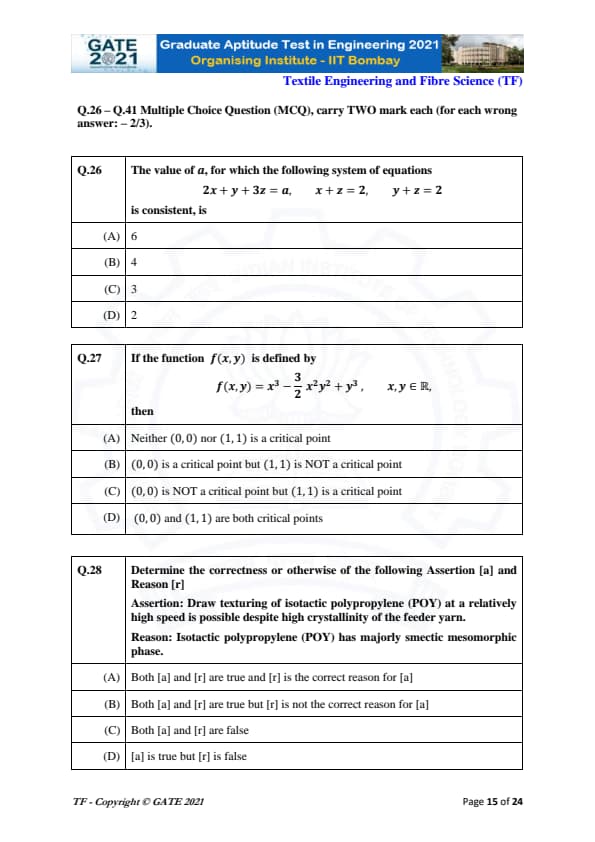
The value of \( a \), for which the following system of equations \[ 2x + y + 3z = a, \quad x + z = 2, \quad y + z = 2, \]
is consistent, is
If the function \( f(x, y) \) is defined by \[ f(x, y) = x^3 - \frac{3}{2} x^2 y^2 + y^3, \quad x, y \in \mathbb{R}, \]
then
Determine the correctness or otherwise of the following Assertion [a] and Reason [r]:
Assertion: Draw texturing of isotactic polypropylene (POY) at a relatively high speed is possible despite high crystallinity of the feeder yarn.
Reason: Isotactic polypropylene (POY) has majorly smectic mesomorphic phase.
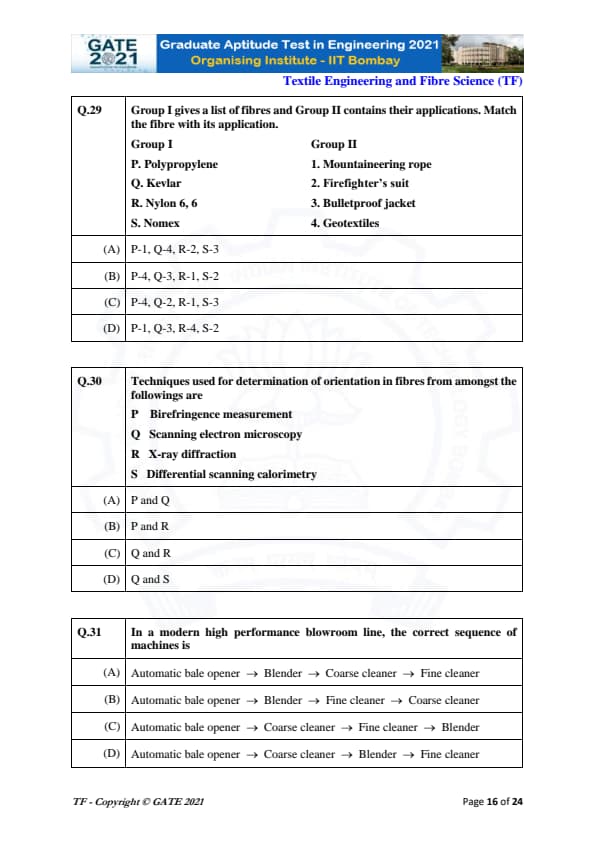
Group I gives a list of fibres and Group II contains their applications. Match the fibre with its application.
Techniques used for determination of orientation in fibres from amongst the followings are
P. Birefringence measurement
Q. Scanning electron microscopy
R. X-ray diffraction
S. Differential scanning calorimetry
In a modern high-performance blowroom line, the correct sequence of machines is
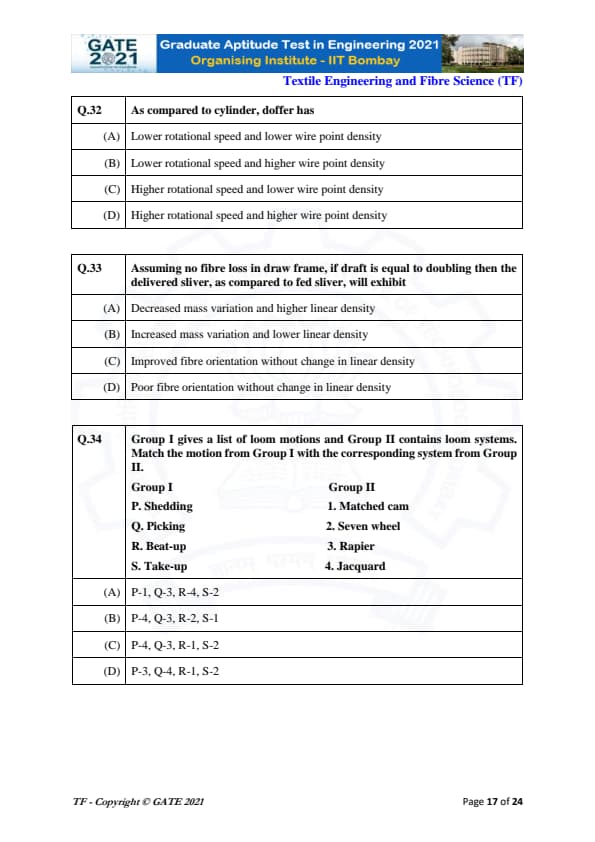
As compared to cylinder, doffer has
Assuming no fibre loss in draw frame, if draft is equal to doubling then the delivered sliver, as compared to fed sliver, will exhibit
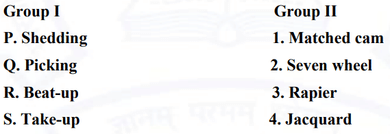
Group I gives a list of loom motions and Group II contains loom systems. Match the motion from Group I with the corresponding system from Group II.
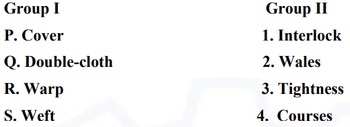
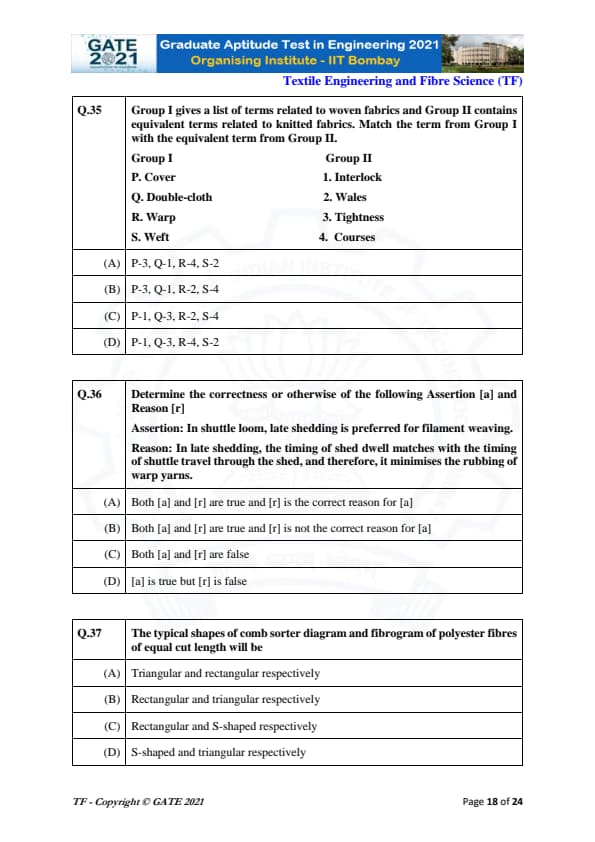
Group I gives a list of terms related to woven fabrics and Group II contains equivalent terms related to knitted fabrics. Match the term from Group I with the equivalent term from Group II.
Determine the correctness or otherwise of the following Assertion [a] and Reason [r]
Assertion: In shuttle loom, late shedding is preferred for filament weaving.
Reason: In late shedding, the timing of shed dwell matches with the timing of shuttle travel through the shed, and therefore, it minimizes the rubbing of warp yarns.
The typical shapes of comb sorter diagram and fibrogram of polyester fibres of equal cut length will be
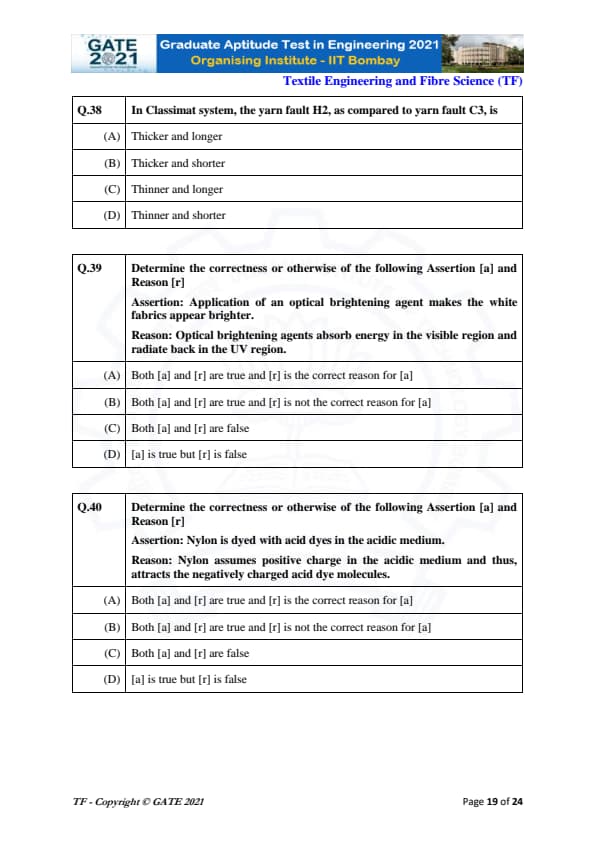
In Classimat system, the yarn fault H2, as compared to yarn fault C3, is
Determine the correctness or otherwise of the following Assertion [a] and Reason [r]
Assertion: Application of an optical brightening agent makes the white fabrics appear brighter.
Reason: Optical brightening agents absorb energy in the visible region and radiate back in the UV region.
Determine the correctness or otherwise of the following Assertion [a] and Reason [r]
Assertion: Nylon is dyed with acid dyes in the acidic medium.
Reason: Nylon assumes positive charge in the acidic medium and thus attracts the negatively charged acid dye molecules.
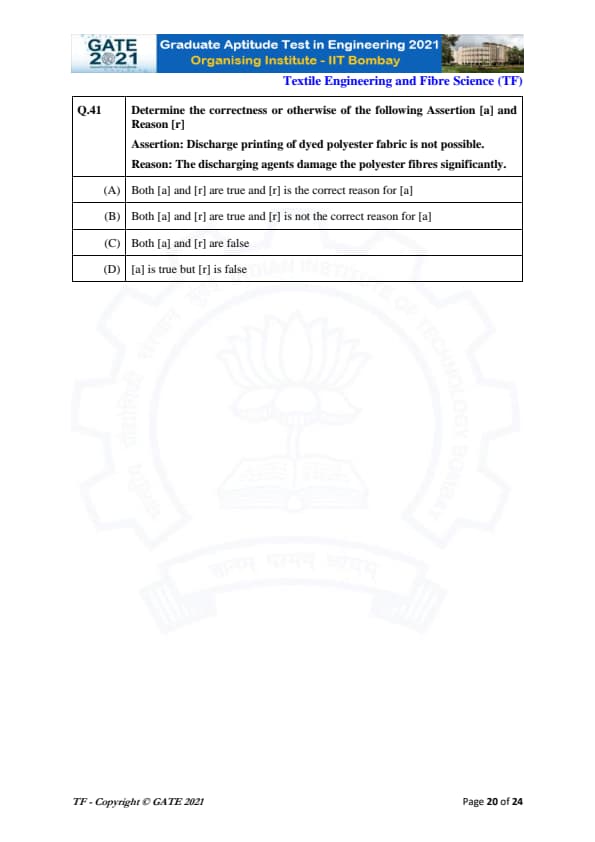
Determine the correctness or otherwise of the following Assertion [a] and Reason [r]:
Assertion: Discharge printing of dyed polyester fabric is not possible.
Reason: The discharging agents damage the polyester fibers significantly.
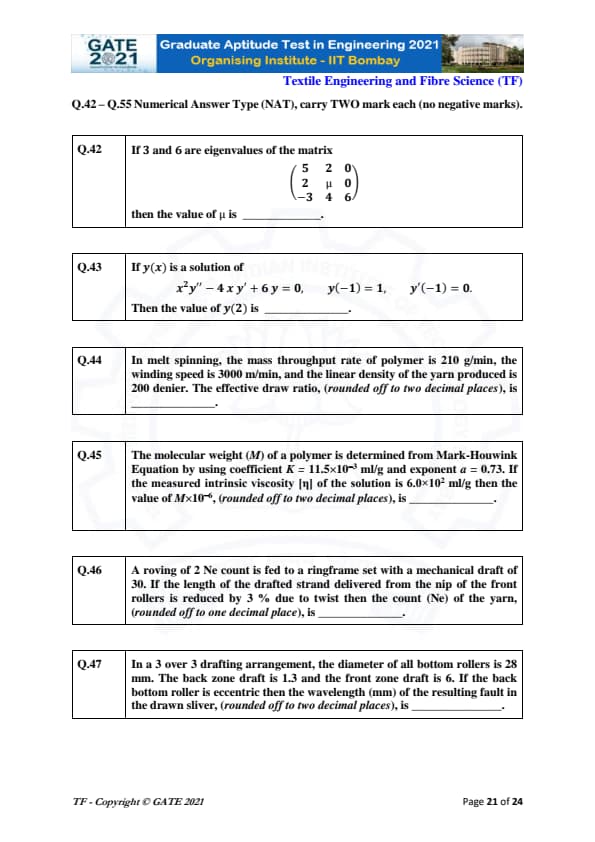
If 3 and 6 are eigenvalues of the matrix \[ \begin{pmatrix} 5 & 2 & 0 \\
2 & \mu & 0 \\
-3 & 4 & 6 \end{pmatrix} \]
then the value of \( \mu \) is ________.
If \( y(x) \) is a solution of \[ x^2 y'' - 4 x y' + 6 y = 0, \quad y(-1) = 1, \quad y'(-1) = 0, \]
then the value of \( y(2) \) is ________.
In melt spinning, the mass throughput rate of polymer is 210 g/min, the winding speed is 3000 m/min, and the linear density of the yarn produced is 200 denier. The effective draw ratio, (rounded off to two decimal places), is ________.
The molecular weight (M) of a polymer is determined from Mark-Houwink equation by using coefficient \( K = 11.5 \times 10^{-3} \) ml/g and exponent \( a = 0.73 \). If the measured intrinsic viscosity \( [\eta] \) of the solution is \( 6.0 \times 10^2 \) ml/g then the value of \( M \times 10^{-6} \), (rounded off to two decimal places), is ________.
A roving of 2 Ne count is fed to a ringframe set with a mechanical draft of 30. If the length of the drafted strand delivered from the nip of the front rollers is reduced by 3% due to twist then the count (Ne) of the yarn, (rounded off to one decimal place), is ________.
In a 3 over 3 drafting arrangement, the diameter of all bottom rollers is 28 mm. The back zone draft is 1.3 and the front zone draft is 6. If the back bottom roller is eccentric then the wavelength (mm) of the resulting fault in the drawn sliver, (rounded off to two decimal places), is ________.
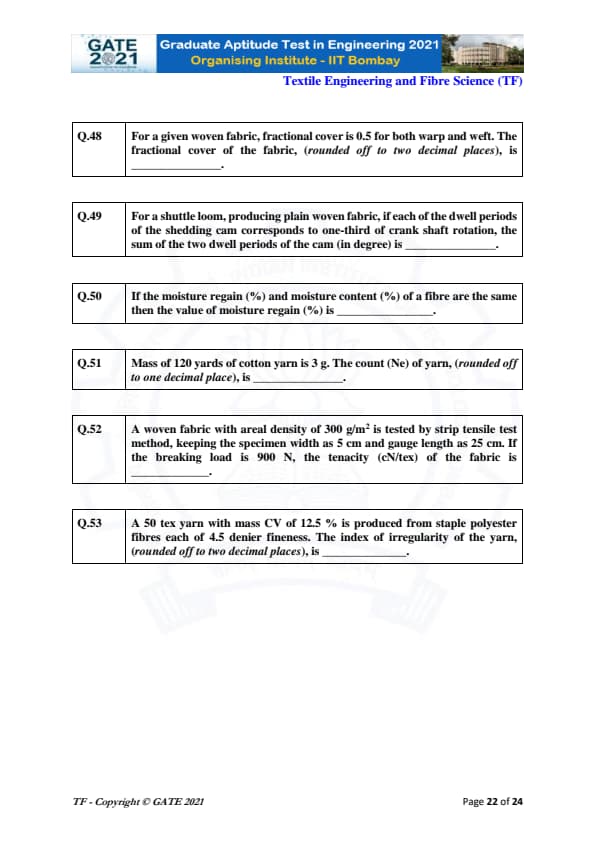
For a given woven fabric, fractional cover is 0.5 for both warp and weft. The fractional cover of the fabric, (rounded off to two decimal places), is ________.
For a shuttle loom, producing plain woven fabric, if each of the dwell periods of the shedding cam corresponds to one-third of crank shaft rotation, the sum of the two dwell periods of the cam (in degree) is ________.
If the moisture regain (%) and moisture content (%) of a fibre are the same then the value of moisture regain (%) is ________.
Mass of 120 yards of cotton yarn is 3 g. The count (Ne) of yarn, (rounded off to one decimal place), is ________.
A woven fabric with areal density of 300 g/m\(^2\) is tested by strip tensile test method, keeping the specimen width as 5 cm and gauge length as 25 cm. If the breaking load is 900 N, the tenacity (cN/tex) of the fabric is ________.
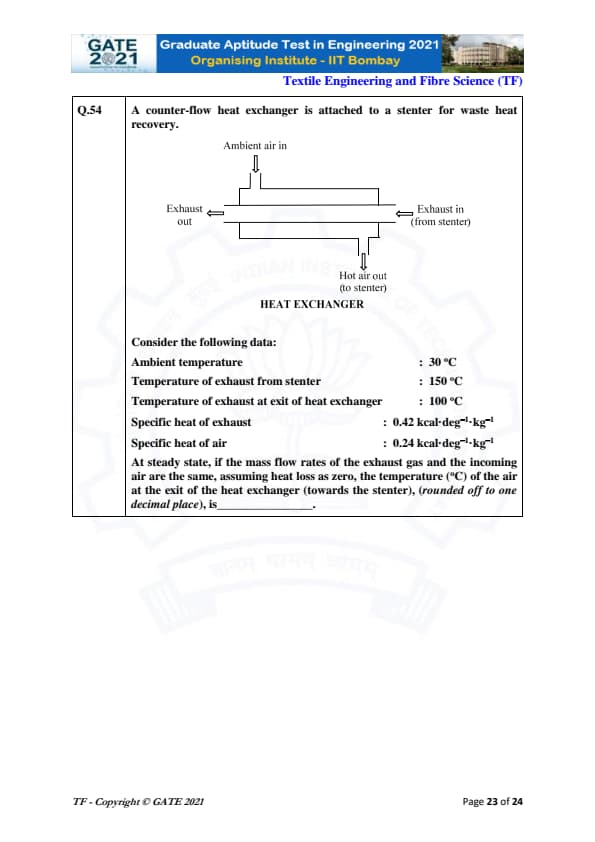
A counter-flow heat exchanger is attached to a stenter for waste heat recovery.
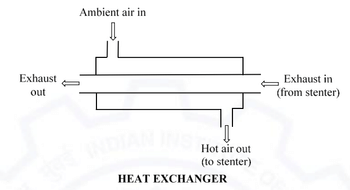
Given data:
Ambient temperature, \( T_1 = 30^\circ C \)
Temperature of exhaust from stenter, \( T_2 = 150^\circ C \)
Temperature of exhaust at exit of heat exchanger, \( T_3 = 100^\circ C \)
Specific heat of exhaust gas, \( C_p = 0.42 \, kcal \cdot deg^{-1} \cdot kg^{-1} \)
Specific heat of air, \( C_a = 0.24 \, kcal \cdot deg^{-1} \cdot kg^{-1} \)
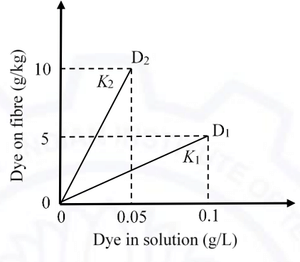
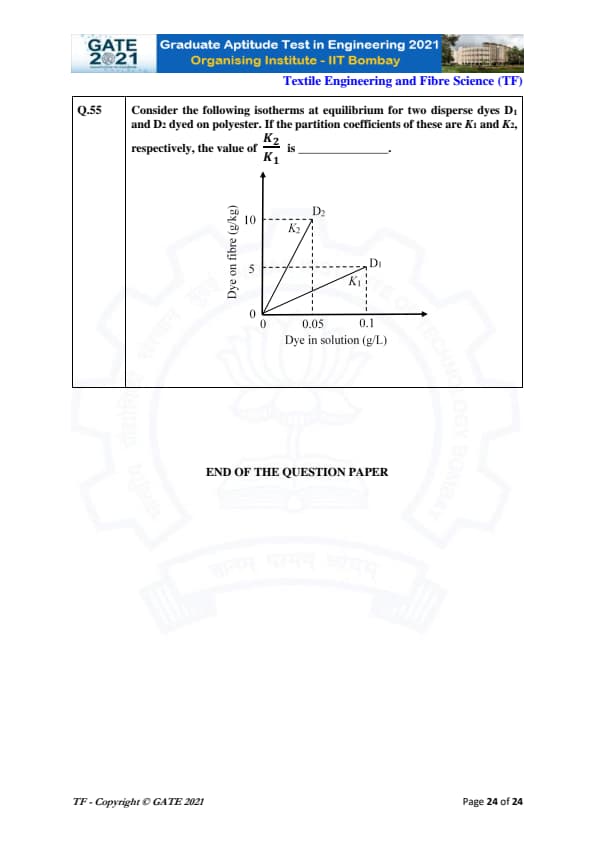
Consider the following isotherms at equilibrium for two disperse dyes \( D_1 \) and \( D_2 \) dyed on polyester. If the partition coefficients of these are \( K_1 \) and \( K_2 \), respectively, the value of \[ \frac{K_2}{K_1} is \_\_\_\_\_\_\_\_. \]
Quick Links:
GATE 2021 TF Paper Analysis
- GATE TF 2021, 13 February exam consists pattern of questions which includessomeMultiple Choice Questions (MCQ),Multiple Select Questions (MSQ),and/orNumerical Answer Type (NAT)questions.
- GATE TF 2021 paper was conducted for 100 marks, out of which 70 queestions were subjects specific and remaining 30 marks consisted Engineering mathematics and general aptitude.
- Numerical Type does not have any negative markings. However, every incorrect response will result in a 1/3rd negative marking for 1 marks and 2/3rd negative marking for 2 mark MCQ questions.
- As per the reports it was found that GATE TF 2021 paper was moderate to difficult in nature. Students were able to answer 50-60 questions.
Also Check:
GATE Previous Year Question Papers:
| GATE 2022 Question Papers | GATE 2021 Question Papers | GATE 2020 Question Papers |
| GATE 2019 Question Papers | GATE 2018 Question Papers | GATE 2017 Question Papers |





Comments