




GATE 2022 Civil Engineering (CE) Slot-2 Question Paper with Solutions PDFs Slot 2 is available for download. GATE 2022 CE was conducted in 2 slots. GATE 2022 CE Slot 2 was conducted in the afternoon session (2:30 PM to 5:30 PM) by IIT Kharagpur. The overall difficulty level was the same as Slot 1, i.e. moderate to difficult. The General Aptitude section held the highest weightage followed by Engineering Mathematics in GATE 2022 CE question paper slot 2.
Candidates preparing for GATE 2023 can download GATE 2022 CE Question Paper with Answer Key PDFs Slot 2 from the links given below.
GATE 2022 Civil Engineering (CE) Slot-2 Question Paper with Solutions
| GATE 2022 Civil Engineering (CE) Slot-2 Question Paper |  Download Download |
Check Solutions |

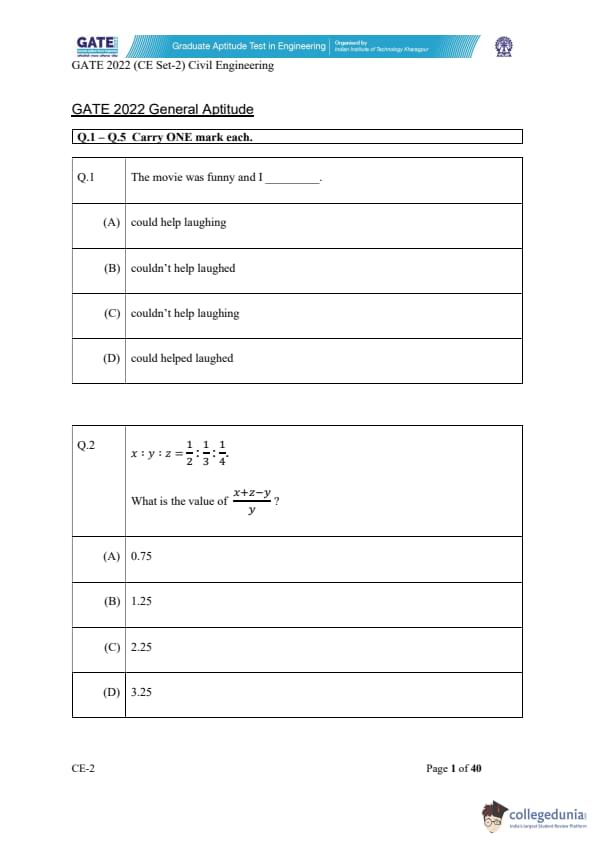
The movie was funny and I _________.
If \( x : y : z = \frac{1}{2} : \frac{1}{3} : \frac{1}{4} \), what is the value of \( \frac{x + z - y}{y} \)?
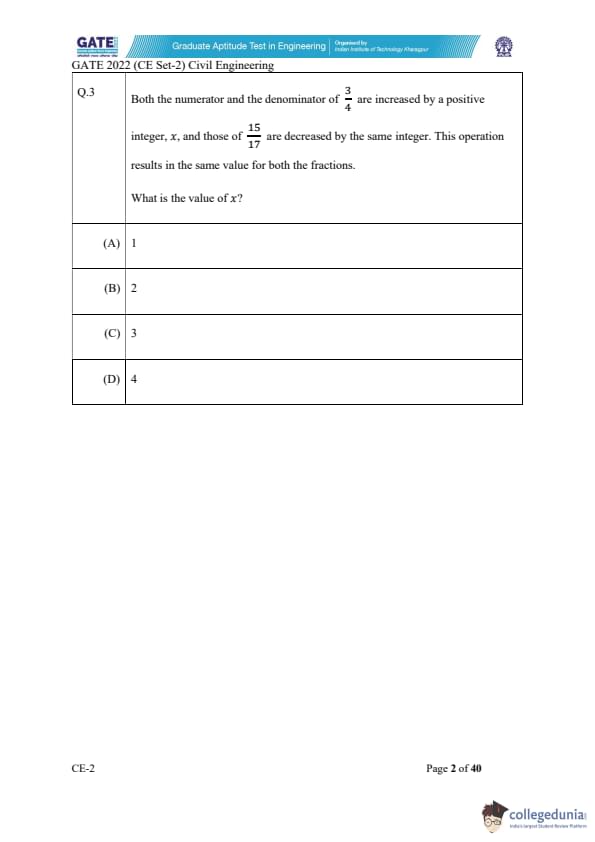
Both the numerator and the denominator of \( \frac{3}{4} \) are increased by a positive integer, \( x \), and those of \( \frac{15}{17} \) are decreased by the same integer. This operation results in the same value for both the fractions. What is the value of \( x \)?
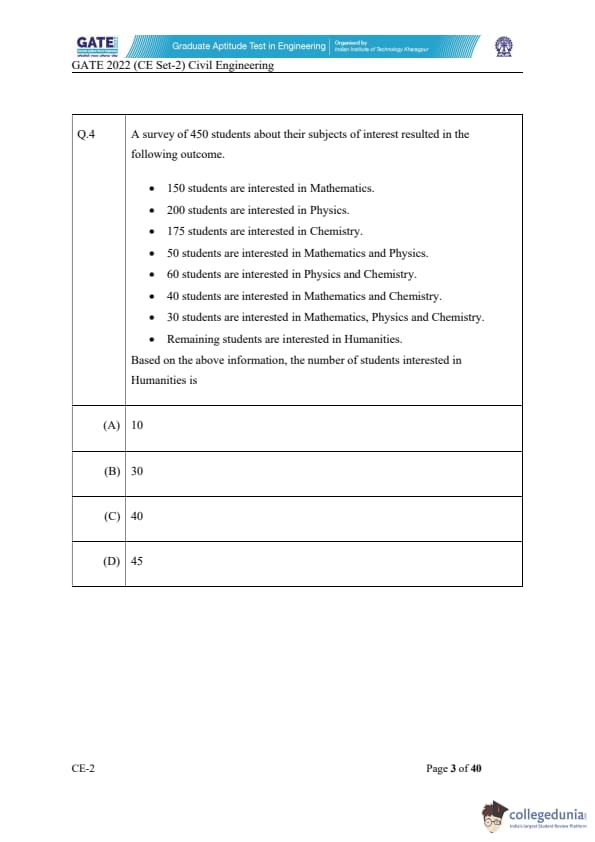
A survey of 450 students about their subjects of interest resulted in the following outcome.
150 students are interested in Mathematics.
200 students are interested in Physics.
175 students are interested in Chemistry.
50 students are interested in Mathematics and Physics.
60 students are interested in Physics and Chemistry.
40 students are interested in Mathematics and Chemistry.
30 students are interested in Mathematics, Physics and Chemistry.
Remaining students are interested in Humanities.
Based on the above information, the number of students interested in Humanities is:
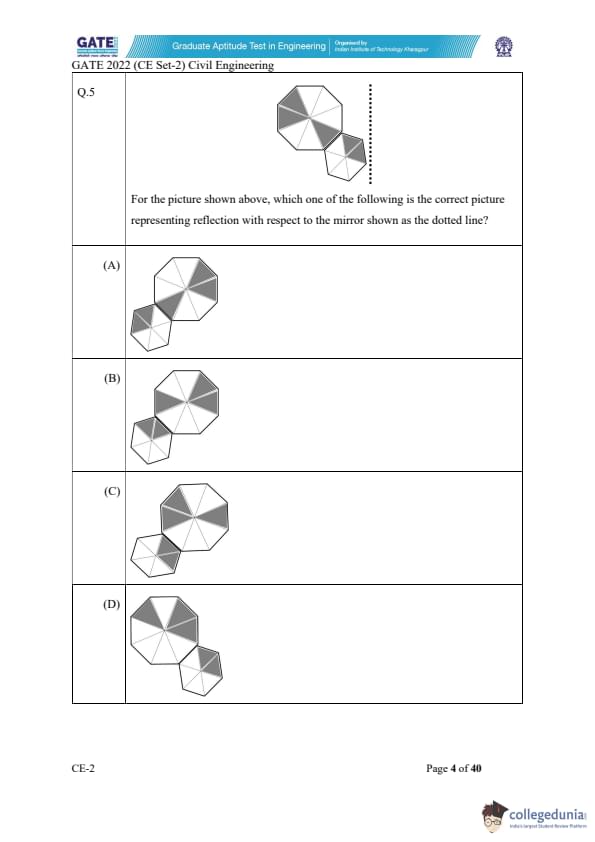
For the picture shown above, which one of the following is the correct picture representing reflection with respect to the mirror shown as the dotted line?


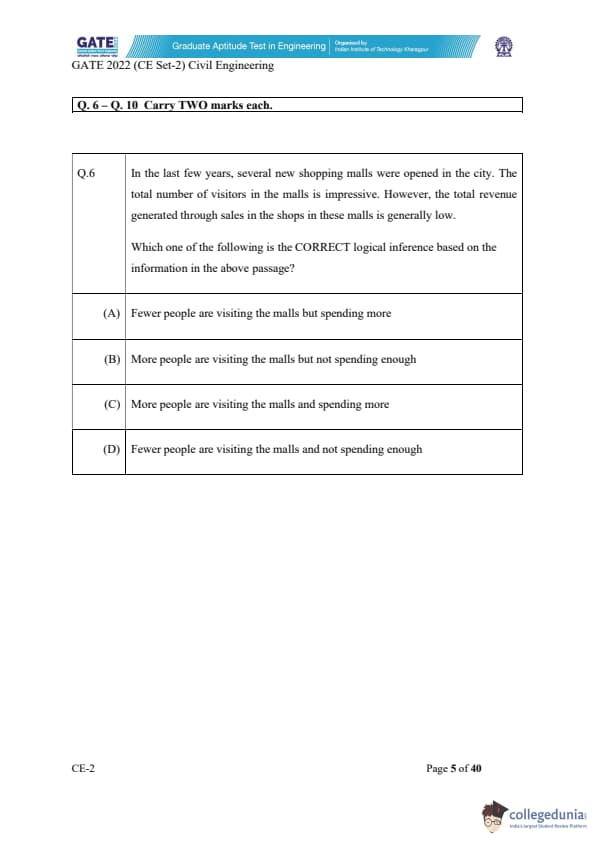
In the last few years, several new shopping malls were opened in the city. The total number of visitors in the malls is impressive. However, the total revenue generated through sales in the shops in these malls is generally low. Which one of the following is the CORRECT logical inference based on the information in the above passage?
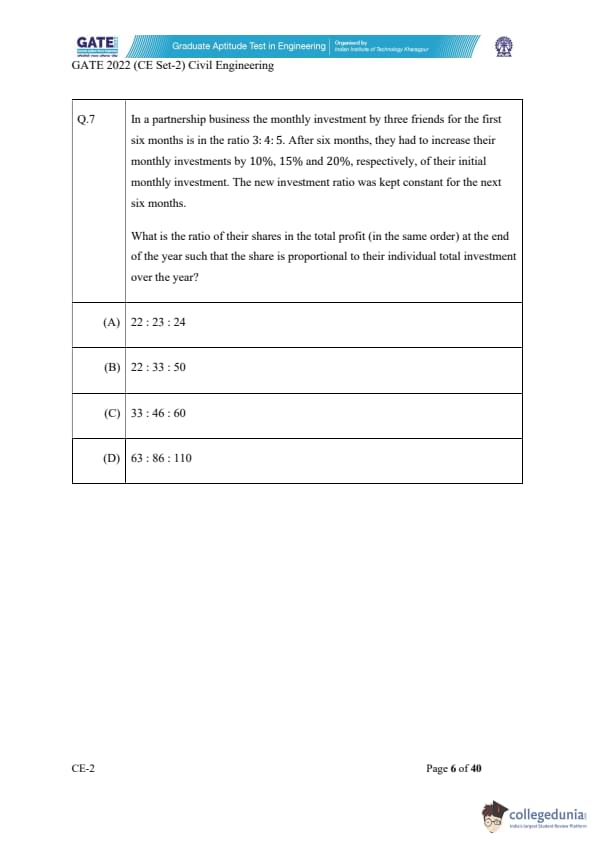
In a partnership business, the monthly investment by three friends for the first six months is in the ratio 3: 4: 5. After six months, they had to increase their monthly investments by 10%, 15%, and 20%, respectively, of their initial monthly investment. The new investment ratio was kept constant for the next six months. What is the ratio of their shares in the total profit (in the same order) at the end of the year such that the share is proportional to their individual total investment over the year?
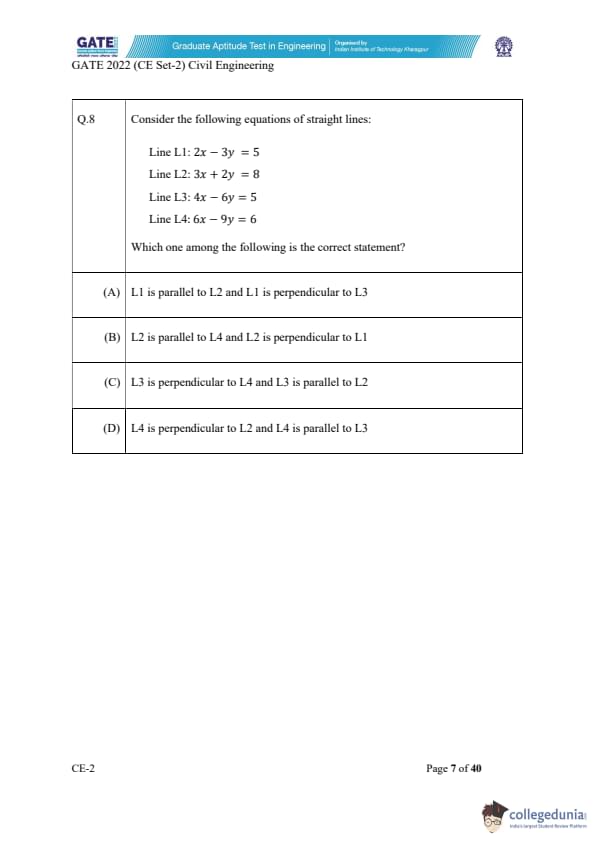
Consider the following equations of straight lines:
Line L1: \( 2x - 3y = 5 \)
Line L2: \( 3x + 2y = 8 \)
Line L3: \( 4x - 6y = 5 \)
Line L4: \( 6x - 9y = 6 \)
Which one among the following is the correct statement?
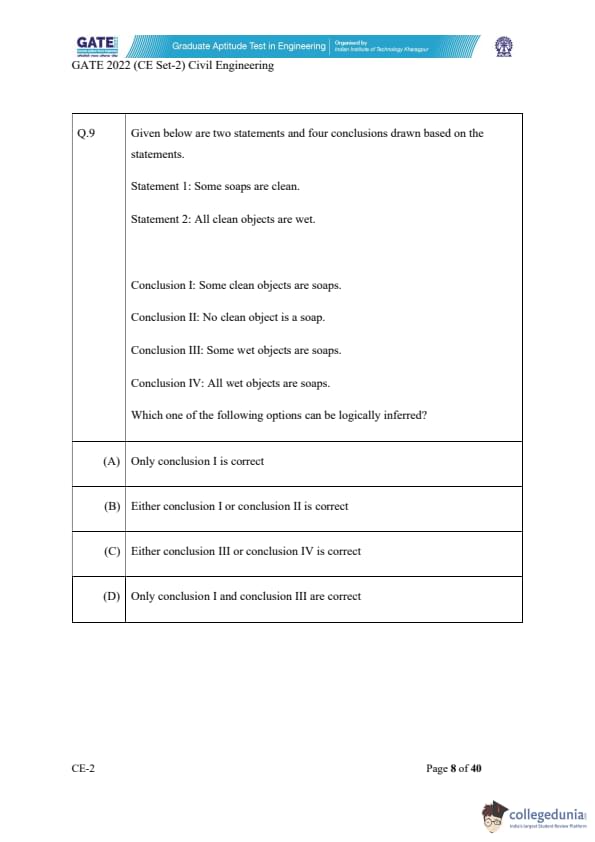
Given below are two statements and four conclusions drawn based on the statements.
Statement 1: Some soaps are clean.
Statement 2: All clean objects are wet.
Conclusion I: Some clean objects are soaps.
Conclusion II: No clean object is a soap.
Conclusion III: Some wet objects are soaps.
Conclusion IV: All wet objects are soaps.
Which one of the following options can be logically inferred?
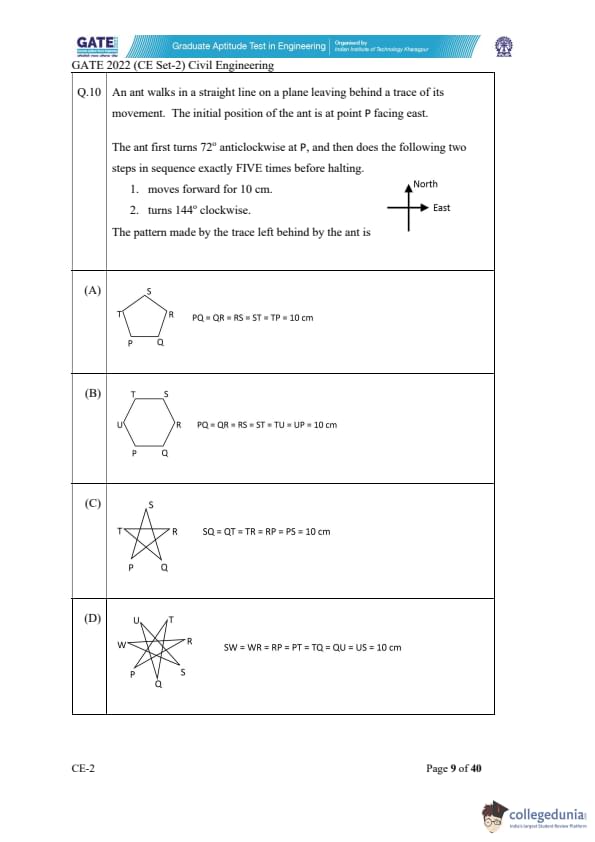
An ant walks in a straight line on a plane leaving behind a trace of its movement. The initial position of the ant is at point P facing east.
The ant first turns 72º anticlockwise at P, and then does the following two steps in sequence exactly FIVE times before halting.
1. Moves forward by 10 cm.
2. Turns 144º clockwise.
The pattern made by the trace left behind by the ant is:


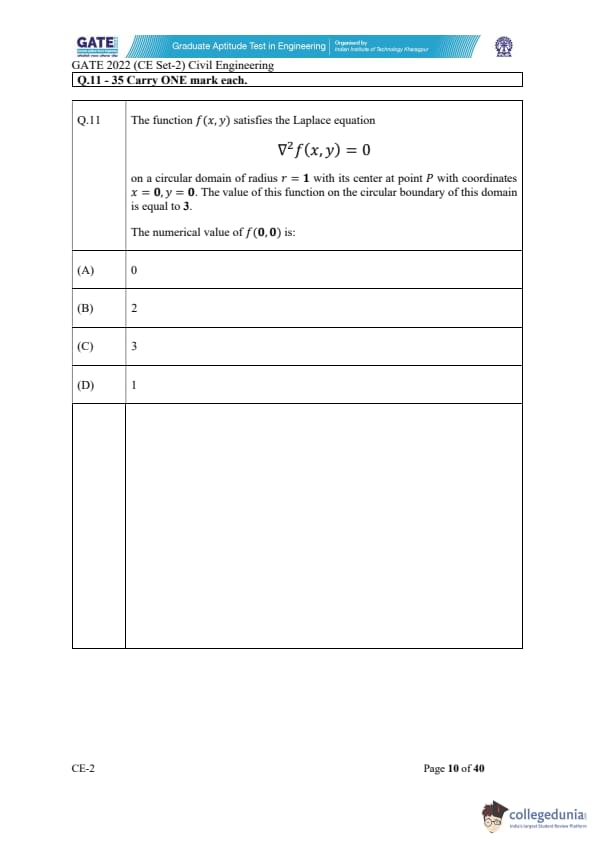
The function \( f(x, y) \) satisfies the Laplace equation \[ \nabla^2 f(x, y) = 0 \]
on a circular domain of radius \( r = 1 \) with its center at point \( P \) with coordinates \( x = 0, y = 0 \). The value of this function on the circular boundary of this domain is equal to 3.
The numerical value of \( f(0, 0) \) is:
The integral \[ \int \left( x - \frac{x^2}{2} + \frac{x^3}{3} - \frac{x^4}{4} + \cdots \right) dx \]
is equal to
For a linear elastic and isotropic material, the correct relationship among Young’s modulus of elasticity (E), Poisson’s ratio (\( \nu \)), and shear modulus (G) is
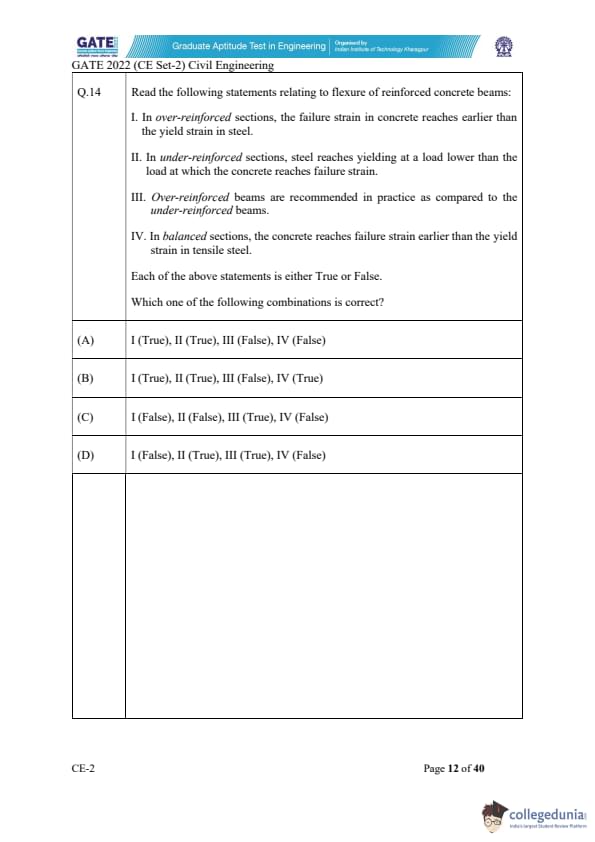
Read the following statements relating to flexure of reinforced concrete beams:
I. In over-reinforced sections, the failure strain in concrete reaches earlier than the yield strain in steel.
II. In under-reinforced sections, steel reaches yielding at a load lower than the load at which the concrete reaches failure strain.
III. Over-reinforced beams are recommended in practice as compared to the under-reinforced beams.
IV. In balanced sections, the concrete reaches failure strain earlier than the yield strain in tensile steel.
Each of the above statements is either True or False.
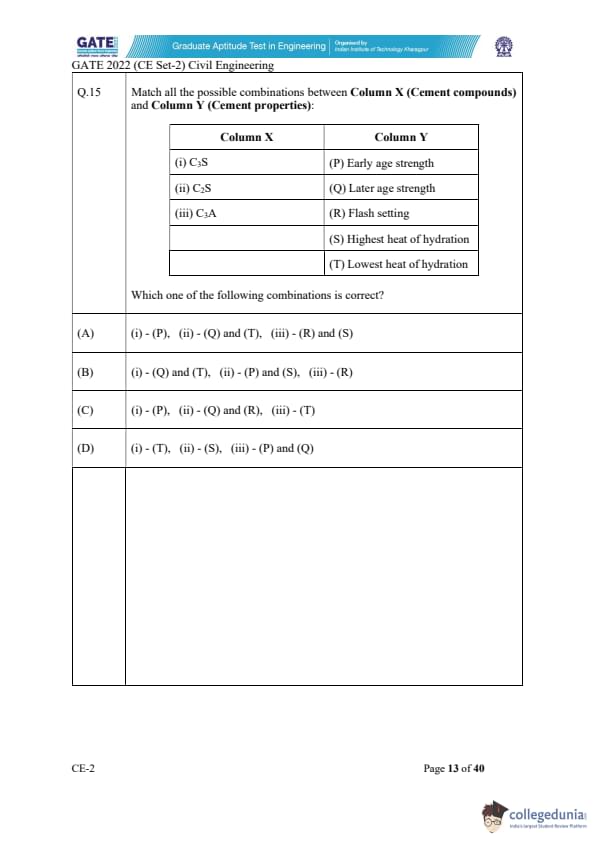
Match all the possible combinations between Column X (Cement compounds) and Column Y (Cement properties):

Consider a beam PQ fixed at P, hinged at Q, and subjected to a load \( F \) as shown in figure (not drawn to scale). The static and kinematic degrees of indeterminacy, respectively, are

Read the following statements:
(P) While designing a shallow footing in sandy soil, monsoon season is considered for critical design in terms of bearing capacity.
(Q) For slope stability of an earthen dam, sudden drawdown is never a critical condition.
(R) In a sandy sea beach, quicksand condition can arise only if the critical hydraulic gradient exceeds the existing hydraulic gradient.
(S) The active earth thrust on a rigid retaining wall supporting homogeneous cohesionless backfill will reduce with the lowering of water table in the backfill.
Which one of the following combinations is correct?
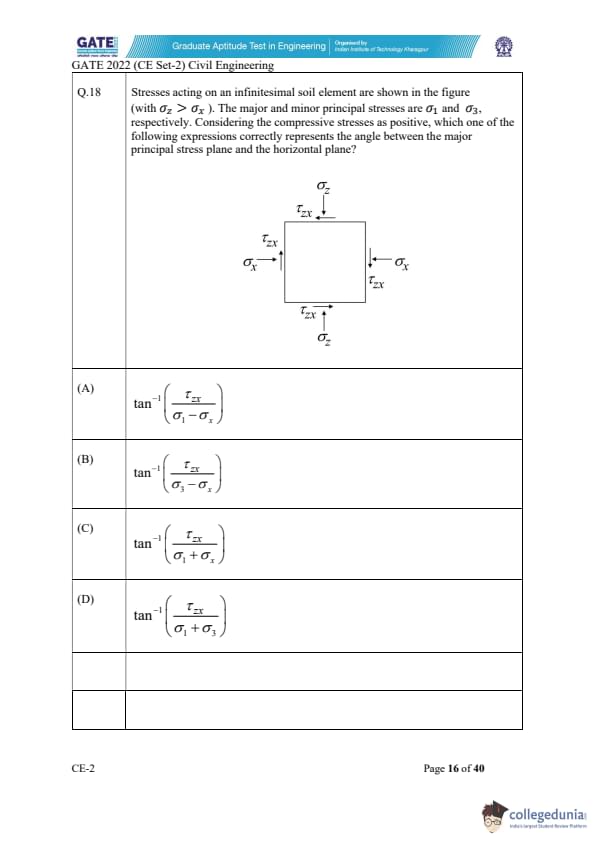
Stresses acting on an infinitesimal soil element are shown in the figure (with \( \sigma_z > \sigma_x \)). The major and minor principal stresses are \( \sigma_1 \) and \( \sigma_3 \), respectively. Considering the compressive stresses as positive, which one of the following expressions correctly represents the angle between the major principal stress plane and the horizontal plane?

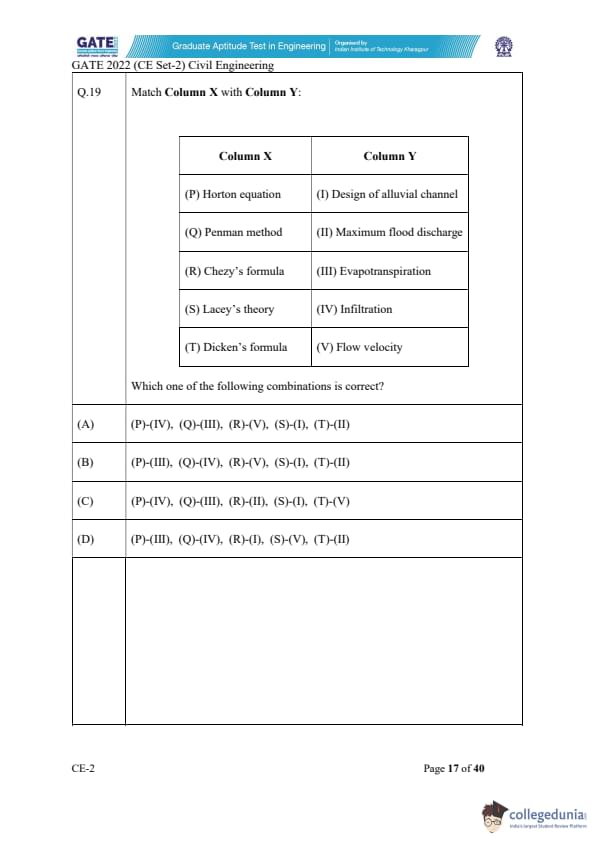
Match Column X with Column Y:

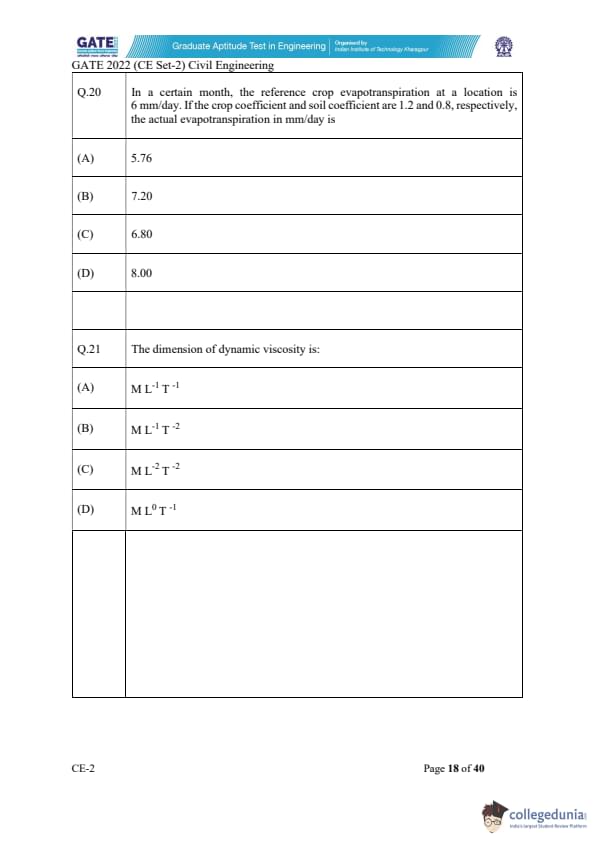
In a certain month, the reference crop evapotranspiration at a location is 6 mm/day. If the crop coefficient and soil coefficient are 1.2 and 0.8, respectively, the actual evapotranspiration in mm/day is
The dimension of dynamic viscosity is:
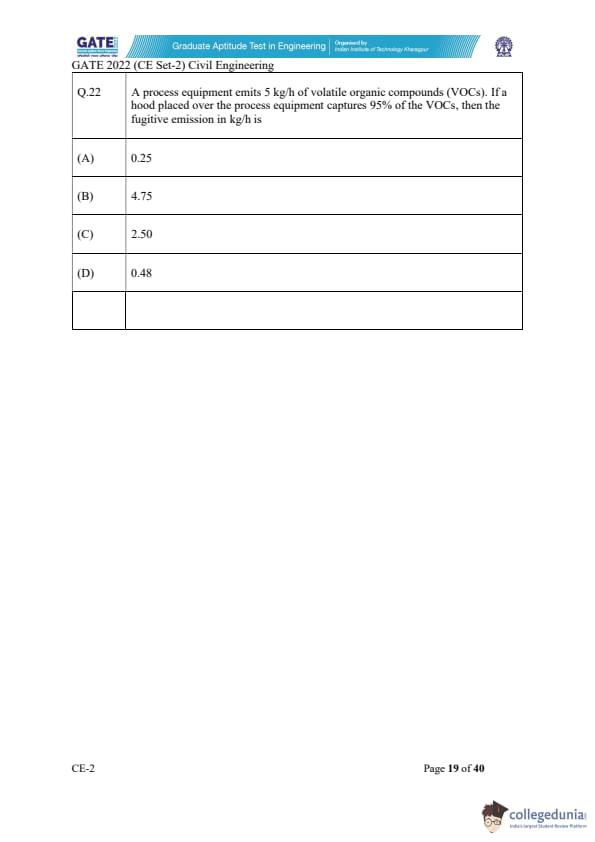
A process equipment emits 5 kg/h of volatile organic compounds (VOCs). If a hood placed over the process equipment captures 95% of the VOCs, then the fugitive emission in kg/h is
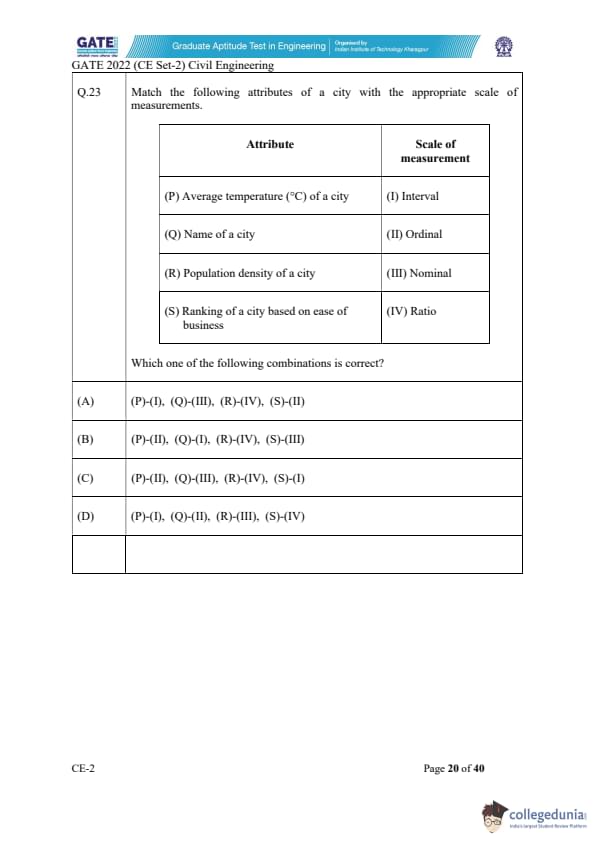
Match the following attributes of a city with the appropriate scale of measurements.

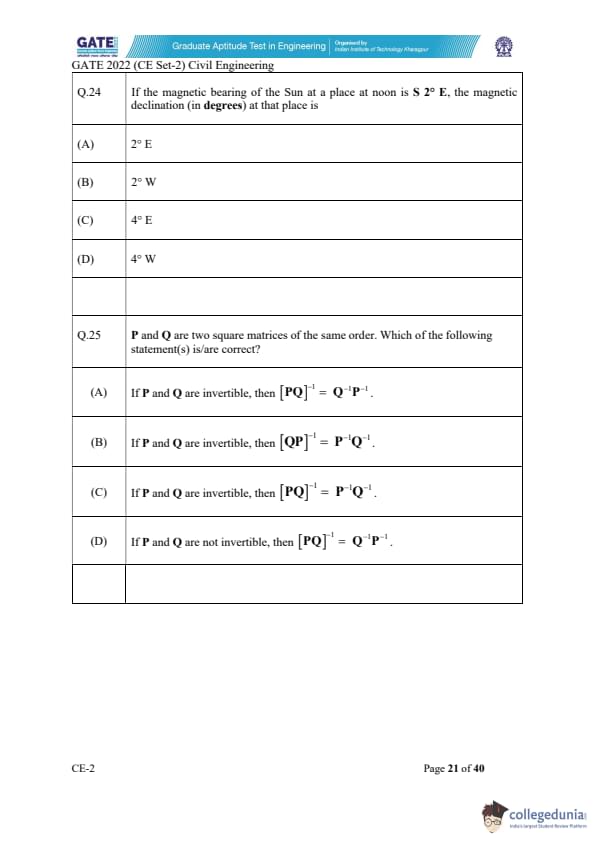
If the magnetic bearing of the Sun at a place at noon is \( S 2^\circ E \), the magnetic declination (in degrees) at that place is
P and Q are two square matrices of the same order. Which of the following statement(s) is/are correct?
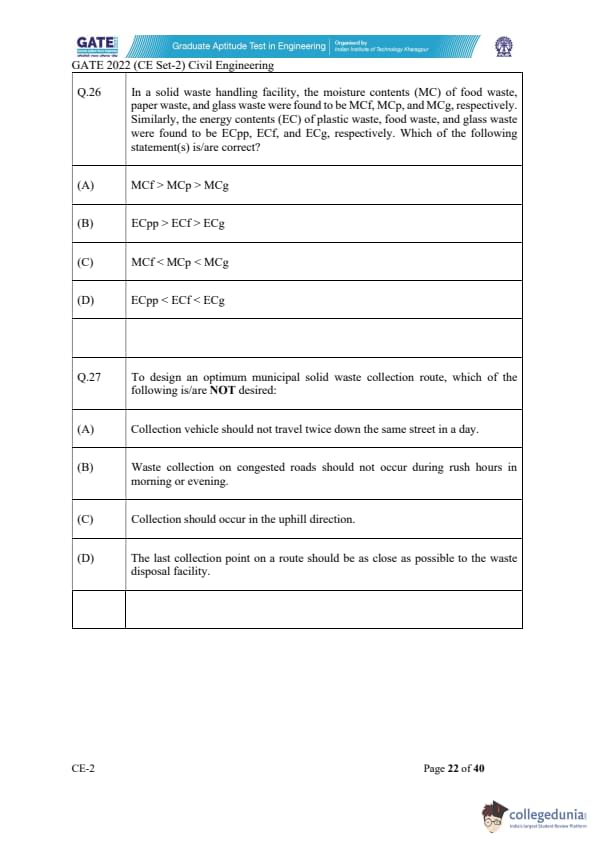
In a solid waste handling facility, the moisture contents (MC) of food waste, paper waste, and glass waste were found to be \( MC_f \), \( MC_p \), and \( MC_g \), respectively. Similarly, the energy contents (EC) of plastic waste, food waste, and glass waste were found to be \( EC_{pp} \), \( EC_f \), and \( EC_g \), respectively. Which of the following statement(s) is/are correct?
To design an optimum municipal solid waste collection route, which of the following is/are NOT desired:
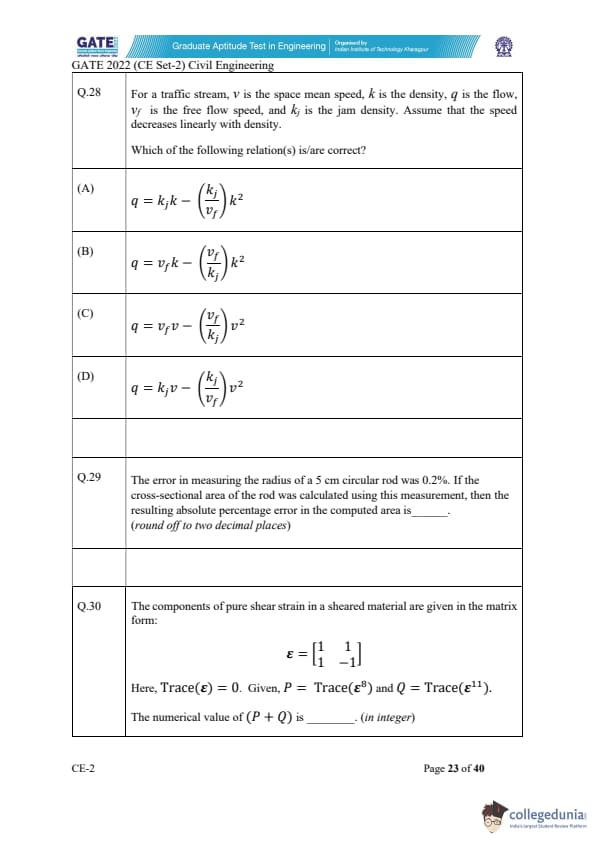
For a traffic stream, \( v \) is the space mean speed, \( k \) is the density, \( q \) is the flow, \( v_f \) is the free flow speed, and \( k_j \) is the jam density. Assume that the speed decreases linearly with density.
The error in measuring the radius of a 5 cm circular rod was 0.2%. If the cross-sectional area of the rod was calculated using this measurement, then the resulting absolute percentage error in the computed area is _______.
The components of pure shear strain in a sheared material are given in the matrix form:
\[ \epsilon = \begin{bmatrix} 1 & 1
1 & -1 \end{bmatrix} \]
Here, \( Trace(\epsilon) = 0 \). Given, \(P = Trace(\epsilon^8)\) and \(Q = Trace(\epsilon^{11})\). The numerical value of \(P + Q\) is _______ (in integer).
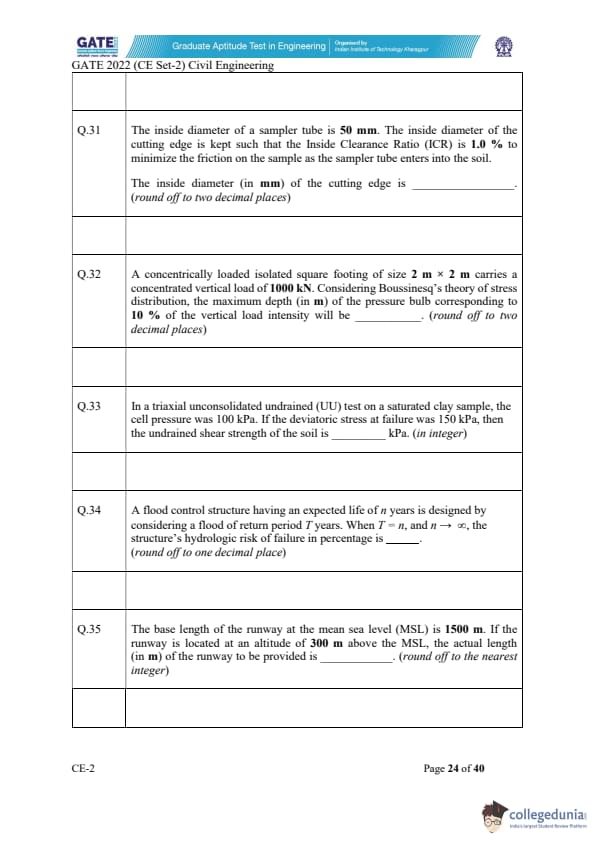
The inside diameter of a sampler tube is 50 mm. The inside diameter of the cutting edge is kept such that the Inside Clearance Ratio (ICR) is 1.0% to minimize the friction on the sample as the sampler tube enters into the soil.
The inside diameter (in mm) of the cutting edge is ________ (round off to two decimal places).
A concentrically loaded isolated square footing of size 2 m \(\times\) 2 m carries a concentrated vertical load of 1000 kN. Considering Boussinesq’s theory of stress distribution, the maximum depth (in m) of the pressure bulb corresponding to 10% of the vertical load intensity will be ________ (round off to two decimal places).
In a triaxial unconsolidated undrained (UU) test on a saturated clay sample, the cell pressure was 100 kPa. If the deviator stress at failure was 150 kPa, then the undrained shear strength of the soil is ________ kPa (in integer).
A flood control structure having an expected life of n years is designed by considering a flood of return period T years. When \(T = n\), and \(n \rightarrow \infty\), the structure's hydrologic risk of failure in percentage is _____ (round off to one decimal place).
The base length of the runway at the mean sea level (MSL) is 1500 m. If the runway is located at an altitude of 300 m above the MSL, the actual length (in m) of the runway to be provided is ________ (round off to the nearest integer).
Consider the polynomial \( f(x) = x^{3} - 6x^{2} + 11x - 6 \) on the domain \( S \) given by \( 1 \leq x \leq 3 \). The first and second derivatives are \( f'(x) \) and \( f''(x) \).
Consider the following statements:
I. The given polynomial is zero at the boundary points \( x = 1 \) and \( x = 3 \).
II. There exists one local maxima of \( f(x) \) within the domain \( S \).
III. The second derivative \( f''(x) > 0 \) throughout the domain \( S \).
IV. There exists one local minima of \( f(x) \) within the domain \( S \).
The correct option is:
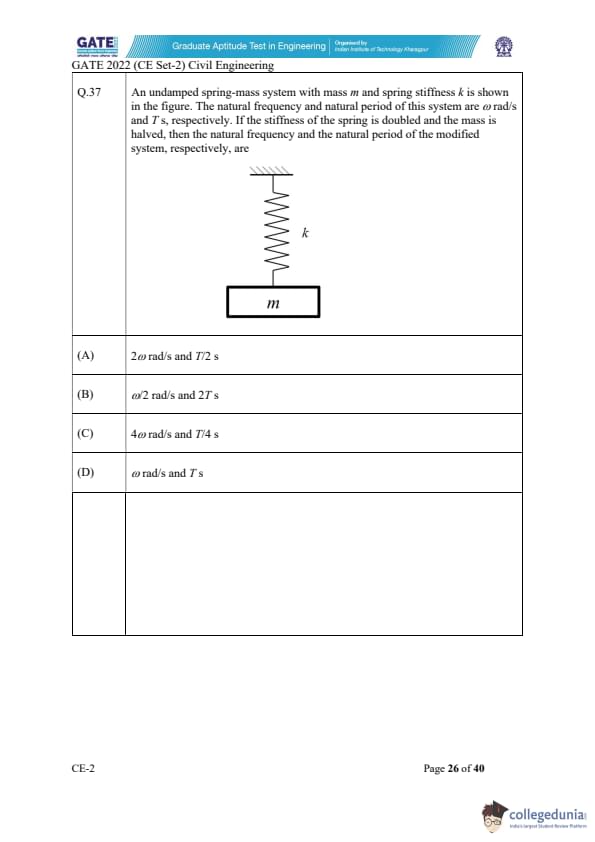
An undamped spring–mass system with mass \(m\) and spring stiffness \(k\) is shown in the figure.
The natural frequency and natural period of this system are \(\omega\) rad/s and \(T\) s, respectively.
If the stiffness of the spring is doubled and the mass is halved, then the natural frequency and the natural period of the modified system, respectively, are

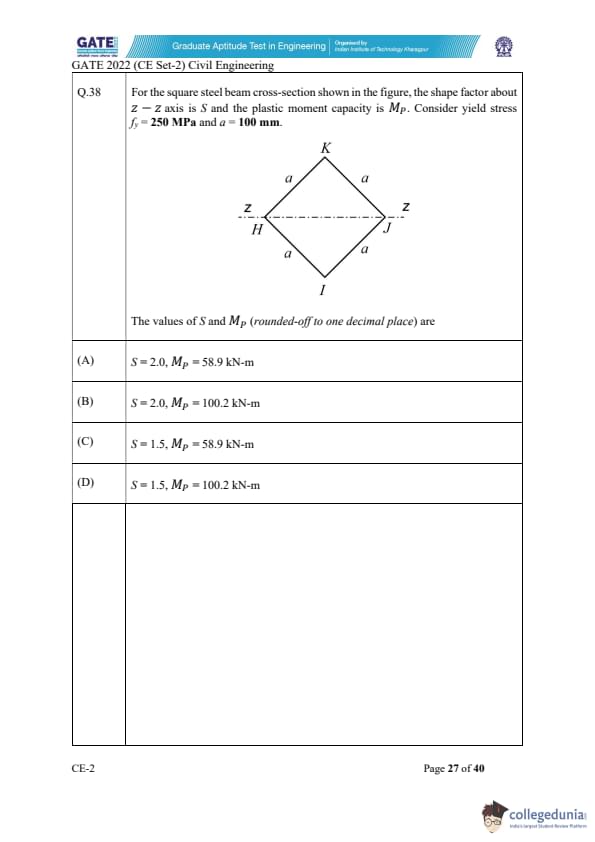
For the square steel beam cross-section shown in the figure, the shape factor about the \(Z-Z\) axis is \(S\) and the plastic moment capacity is \(M_P\).
Consider yield stress \(f_y = 250\ MPa\) and \(a = 100\ mm\).

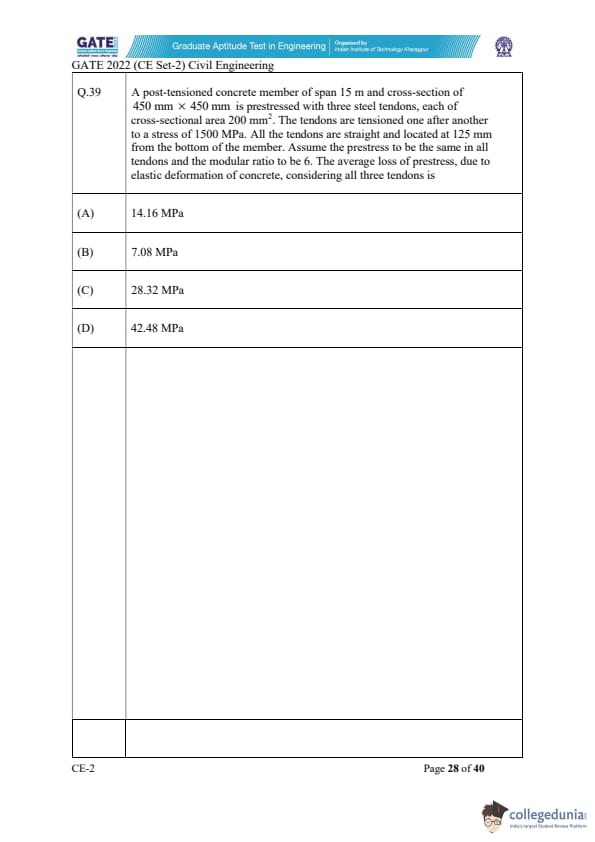
A post-tensioned concrete member of span 15 m and cross-section of 450 mm × 450 mm is prestressed with three steel tendons, each of cross-sectional area 200 mm\(^2\). The tendons are tensioned one after another to a stress of 1500 MPa. All the tendons are straight and located at 125 mm from the bottom of the member. Assume the prestress to be the same in all tendons and the modular ratio to be 6. The average loss of prestress, due to elastic deformation of concrete, considering all three tendons is
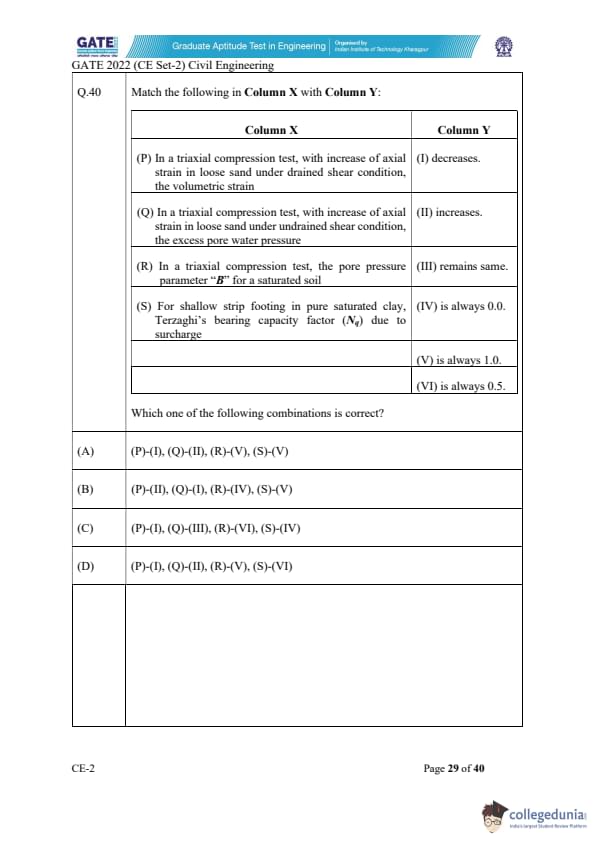
Match the following in Column X with Column Y:

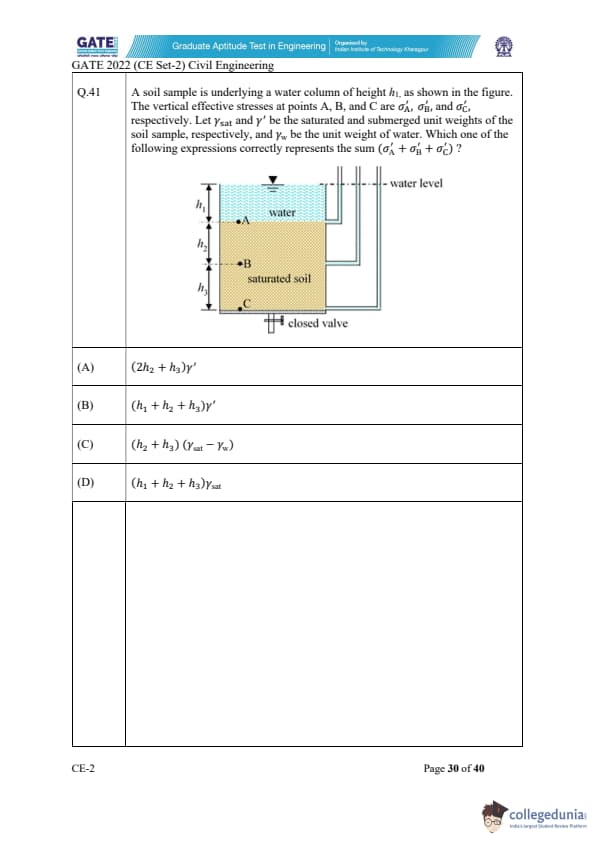
A soil sample is underlying a water column of height \( h_{1} \), as shown in the figure.
The vertical effective stresses at points A, B, and C are \( \sigma'_{A} \), \( \sigma'_{B} \), and \( \sigma'_{C} \), respectively.
Let \( \gamma_{sat} \) and \( \gamma' \) be the saturated and submerged unit weights of the soil sample, respectively, and \( \gamma_{w} \) be the unit weight of water.
Which one of the following expressions correctly represents the sum \[ (\sigma'_{A} + \sigma'_{B} + \sigma'_{C}) ? \]

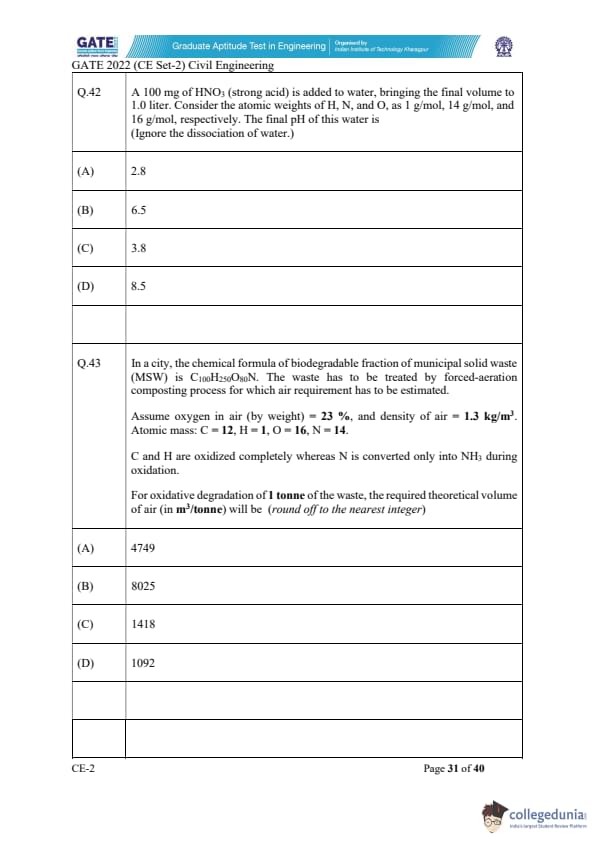
A 100 mg of HNO\(_3\) (strong acid) is added to water, bringing the final volume to 1.0 liter.
Consider the atomic weights of H, N, and O as 1 g/mol, 14 g/mol, and 16 g/mol, respectively.
The final pH of this water is (Ignore the dissociation of water.)
In a city, the chemical formula of biodegradable fraction of municipal solid waste (MSW) is C\(_{100}\)H\(_{250}\)O\(_{80}\)N.
The waste has to be treated by forced-aeration composting for which air requirement must be estimated.
Assume oxygen in air (by weight) = 23%, density of air = 1.3 kg/m\(^3\).
Atomic masses: C = 12, H = 1, O = 16, N = 14.
C and H oxidize completely; N converts to NH\(_3\).
For oxidative degradation of 1 tonne of waste, the theoretical volume of air (in m\(^3\)/tonne) is (round to nearest integer).
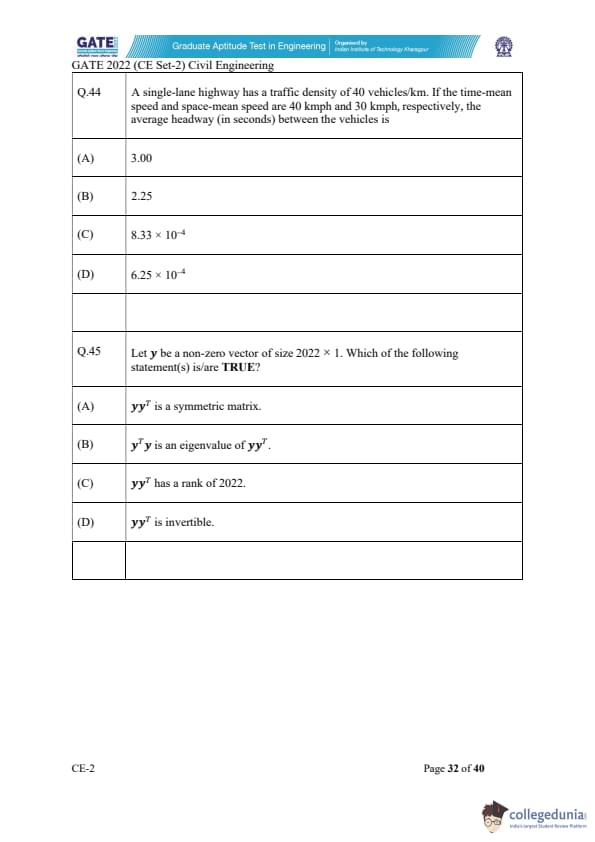
A single-lane highway has a traffic density of 40 vehicles/km.
If the time-mean speed and space-mean speed are 40 kmph and 30 kmph, respectively,
the average headway (in seconds) between the vehicles is
Let \(y\) be a non-zero vector of size \(2022 \times 1\).
Which of the following statement(s) is/are TRUE?
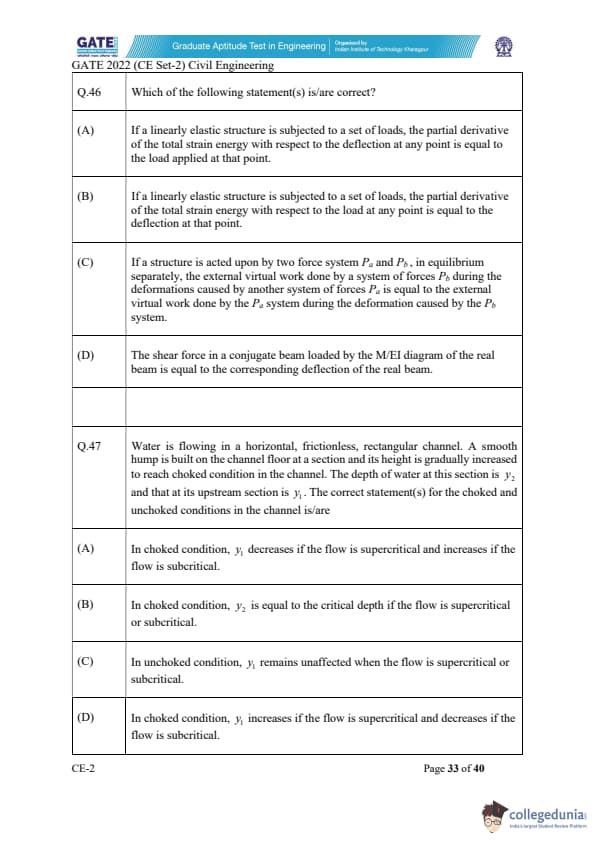
Which of the following statement(s) is/are correct?
Water is flowing in a horizontal, frictionless, rectangular channel. A smooth hump is gradually increased to reach choked condition. If the depth at the hump is \(y_2\) and upstream depth is \(y_1\), the correct statement(s) for choked and unchoked flow is/are:
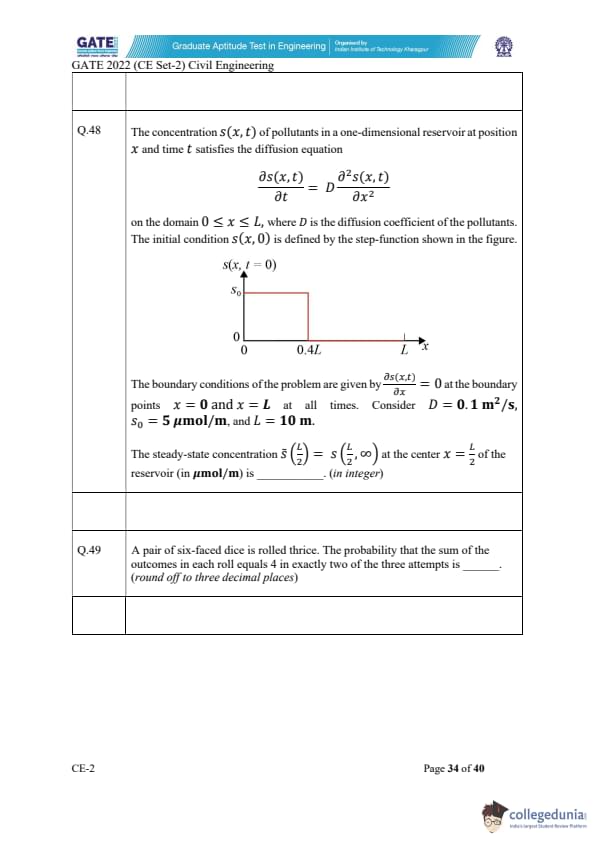
The concentration \(s(x,t)\) of pollutants satisfies the diffusion equation \[ \frac{\partial s(x,t)}{\partial t} = D \frac{\partial^2 s(x,t)}{\partial x^2} \]
on \(0 \le x \le L\). The initial condition is a step function with \(s_0 = 5 \, \mu mol/m\), \(L = 10\,m\), \(D = 0.1\,m^2/s\).
The steady-state concentration at the center \[ \tilde{s}\left(\frac{L}{2}\right)=s\left(\frac{L}{2},\infty\right) \]
is ________ (in integer).

A pair of dice is rolled thrice. The probability that the sum equals 4 in exactly two out of three attempts is _____ (round off to three decimals).
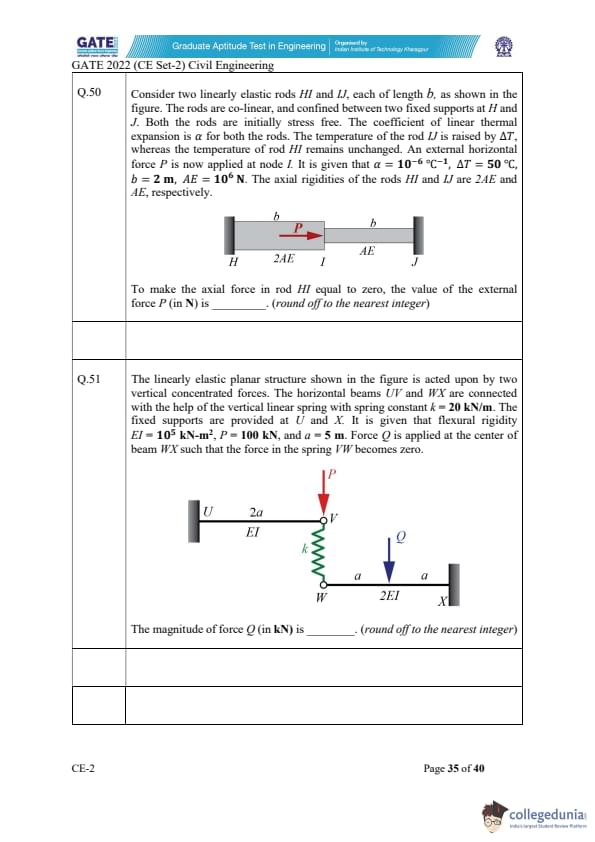
Consider two linearly elastic rods HI and IJ, each of length b. The rod IJ undergoes a temperature rise of \(\Delta T = 50^\circ C\), while HI remains at the initial temperature. Both rods have thermal expansion coefficient \(\alpha = 10^{-6}~^\circ C^{-1}\). The axial rigidities are \(2AE\) for HI and \(AE\) for IJ. Each rod is of length \(b = 2\,m\). An external horizontal force \(P\) is applied at node I such that the axial force in rod HI becomes zero. Find the value of \(P\) (in N), rounded off to the nearest integer.

A linearly elastic frame is shown with beams UV and WX connected by a vertical spring of stiffness \(k = 20\ kN/m\). Beam UV has flexural rigidity \(EI\) and length \(2a\). Beam WX has flexural rigidity \(2EI\) and length \(2a\). A vertical load \(P = 100\ kN\) acts at V. Another force \(Q\) is applied at the center of WX such that the force in the spring becomes zero. Given \(EI = 10^5\ kN·m^2\) and \(a = 5\ m\), determine \(Q\) (in kN), rounded to nearest integer.

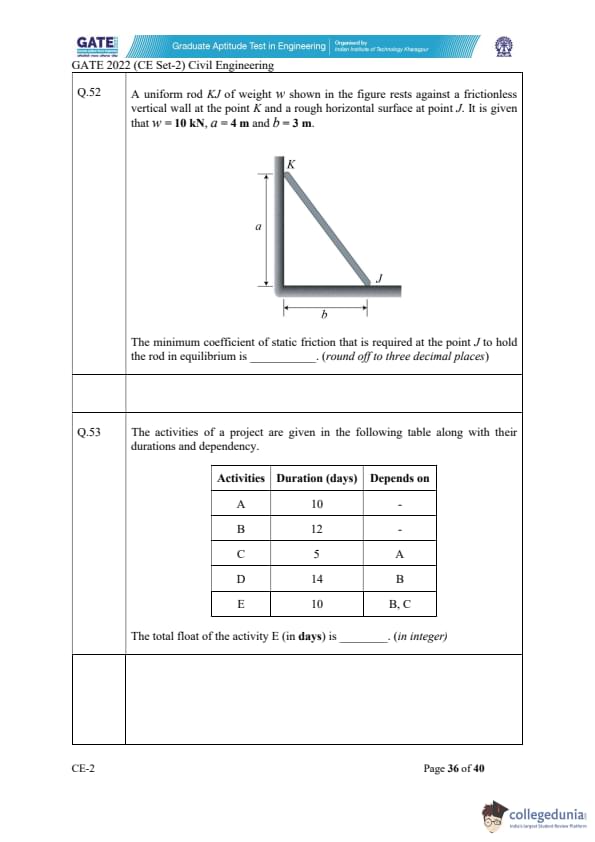
A uniform rod KJ of weight \(w\) rests against a frictionless vertical wall at K and a rough horizontal surface at J. Given \(w = 10\,kN\), \(a = 4\,m\), and \(b = 3\,m\), the minimum coefficient of static friction required at J to hold the rod in equilibrium is _________. (round off to three decimal places)

The project network has the following activities:
A (10 days), B (12 days), C (5 days, depends on A), D (14 days, depends on B),
E (10 days, depends on B and C).
The total float of activity E is ______. (in integer)

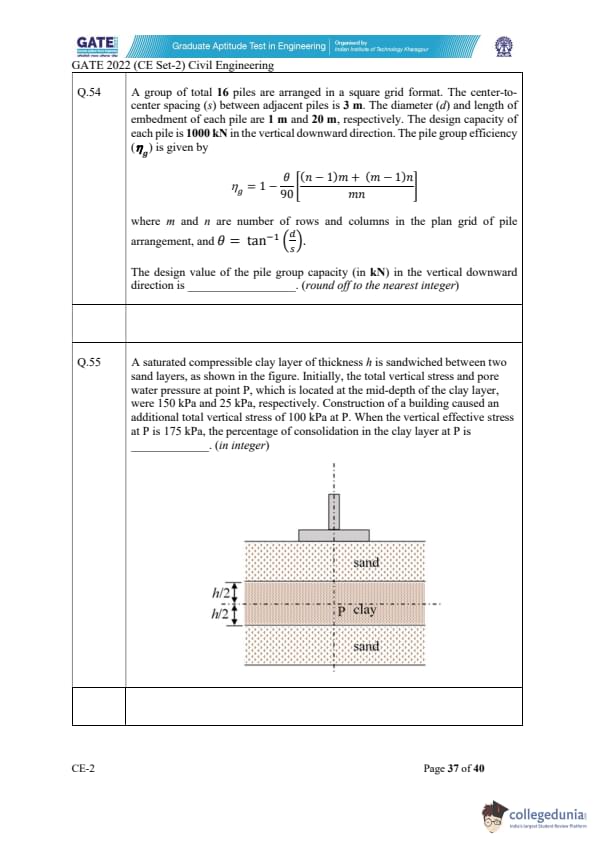
A group of 16 piles is arranged in a square grid with spacing \(s = 3\ m\). Diameter and length of each pile are \(d = 1\ m\) and \(20\ m\), respectively. The design capacity of each pile is \(1000\ kN\). The pile group efficiency is \[ \eta_g = 1 - \frac{\theta}{90}\left[\frac{(n-1)m + (m-1)n}{mn}\right] \]
where \(m\) and \(n\) are number of rows and columns, and \(\theta = \tan^{-1}(d/s)\). Determine the design value of the pile group capacity (in kN), rounded to the nearest integer.
A compressible clay layer of thickness \(h\) lies between sand layers. At mid-depth point P, the initial vertical stress was \(150\ kPa\) and pore pressure was \(25\ kPa\). A building adds \(100\ kPa\) extra total stress. When the effective stress at P becomes \(175\ kPa\), find the percentage of consolidation (in integer).

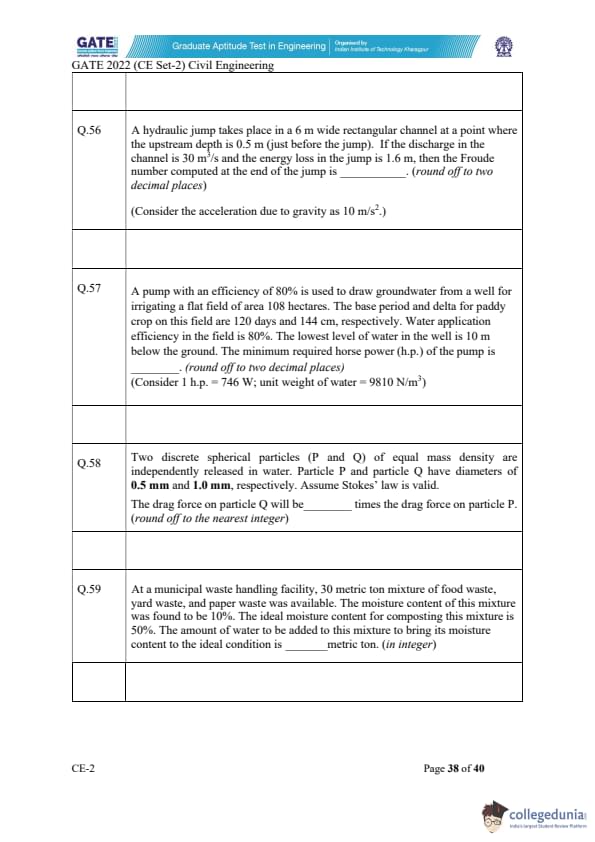
A hydraulic jump occurs in a 6 m wide rectangular channel where the upstream depth is 0.5 m. The discharge is 30 m\(^3\)/s and the energy loss in the jump is 1.6 m. Using \(g = 10\) m/s\(^2\), the Froude number at the end of the jump is ______ (round off to two decimal places).
A pump (efficiency 80%) draws groundwater to irrigate 108 hectares of paddy. Base period = 120 days, delta = 144 cm, application efficiency = 80%. Water level is 10 m below ground. Determine minimum horse power (h.p.) required. (Round off to two decimals).
Two spherical particles P and Q of equal mass density are released independently in water. Their diameters are \(0.5\ mm\) (P) and \(1.0\ mm\) (Q). Drag follows Stokes’ law. Find how many times the drag force on Q is the drag force on P (round to nearest integer).
A 30-ton waste mixture has 10% moisture content. Ideal composting moisture content is 50%. Determine the amount of water to be added (in metric tons).
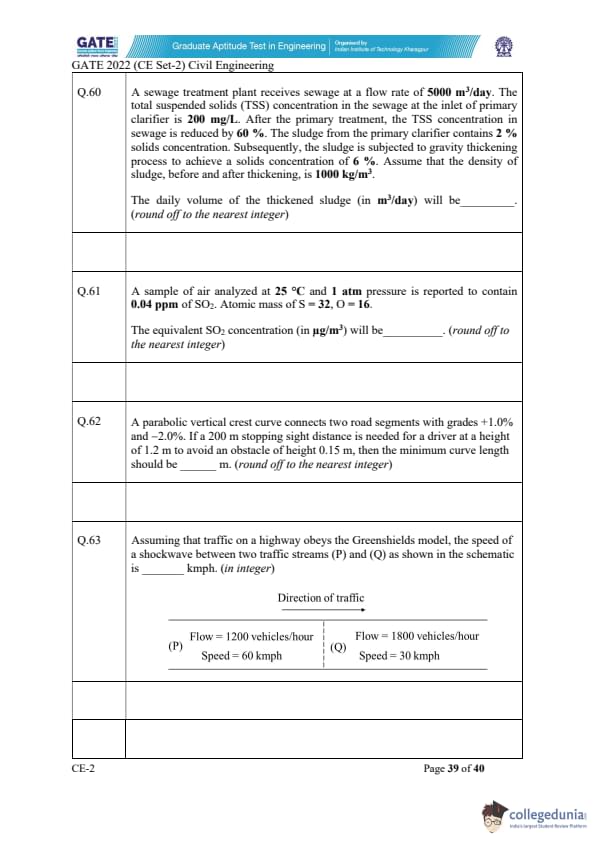
A sewage treatment plant receives 5000 m\(^3\)/day of sewage with a TSS concentration of 200 mg/L. After primary treatment, TSS is reduced by 60%. The primary clarifier sludge contains 2% solids, and after thickening, the solids concentration becomes 6%. Density of sludge is 1000 kg/m\(^3\).
The daily volume of thickened sludge (in m\(^3\)/day) is ______. (round off to nearest integer)
A sample of air at 25°C and 1 atm contains 0.04 ppm of SO\(_2\). Atomic masses: S = 32, O = 16.
Find the equivalent SO\(_2\) concentration in μg/m\(^3\). (round off to nearest integer)
A parabolic vertical crest curve connects grades \(+1.0%\) and \(-2.0%\). If the required stopping sight distance is 200 m for a driver eye height of 1.2 m and obstacle height of 0.15 m, find the minimum curve length (round off to nearest integer).
Two traffic streams (P) and (Q) follow Greenshields’ model. Stream P has flow 1200 veh/hr and speed 60 kmph. Stream Q has flow 1800 veh/hr and speed 30 kmph. Determine the shockwave speed (in kmph).

View Solution
Step 1: Convert flow–speed to density using \[ q = u\, k \Rightarrow k = \frac{q}{u} \]
For stream P: \[ k_P = \frac{1200}{60} = 20\ veh/km \]
For stream Q: \[ k_Q = \frac{1800}{30} = 60\ veh/km \]
Step 2: Shockwave speed formula.
\[ w = \frac{q_Q - q_P}{k_Q - k_P} \]
\[ w = \frac{1800 - 1200}{60 - 20} = \frac{600}{40} = 15\ kmph \]
\[ \boxed{15} \] Quick Tip: Shockwave speed equals the slope of the line connecting two states on the flow–density diagram.
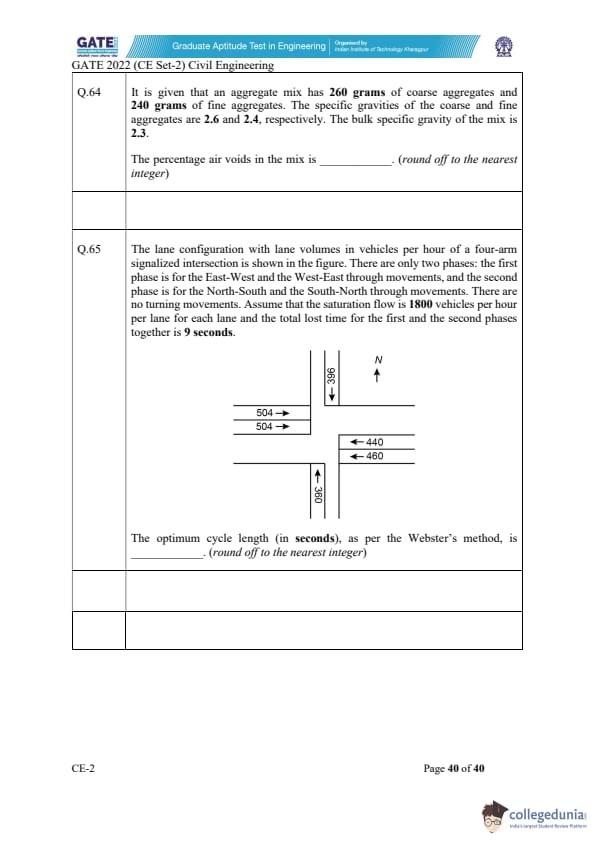
An aggregate mix contains 260 g of coarse aggregates and 240 g of fine aggregates.
Specific gravities: coarse = 2.6, fine = 2.4.
Bulk specific gravity of mix = 2.3.
The percentage air voids in the mix is ________. (round off to nearest integer)
A four-arm signalized intersection has two phases:
Phase 1 – East-West and West-East;
Phase 2 – North-South and South-North.
Lane volumes are shown in the figure. Saturation flow = 1800 veh/hr/lane.
Total lost time = 9 s.
Find the optimum cycle length (in seconds) as per Webster's method.
(round off to nearest integer)





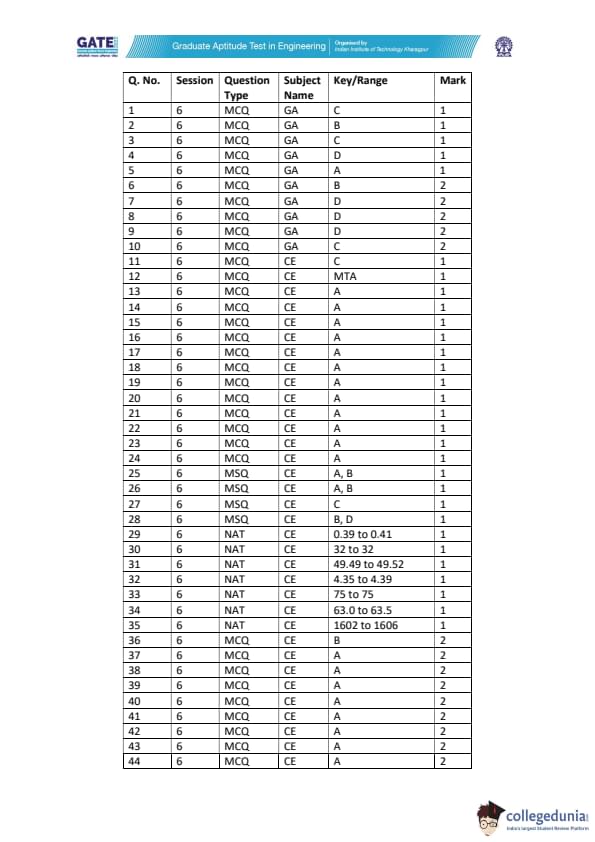
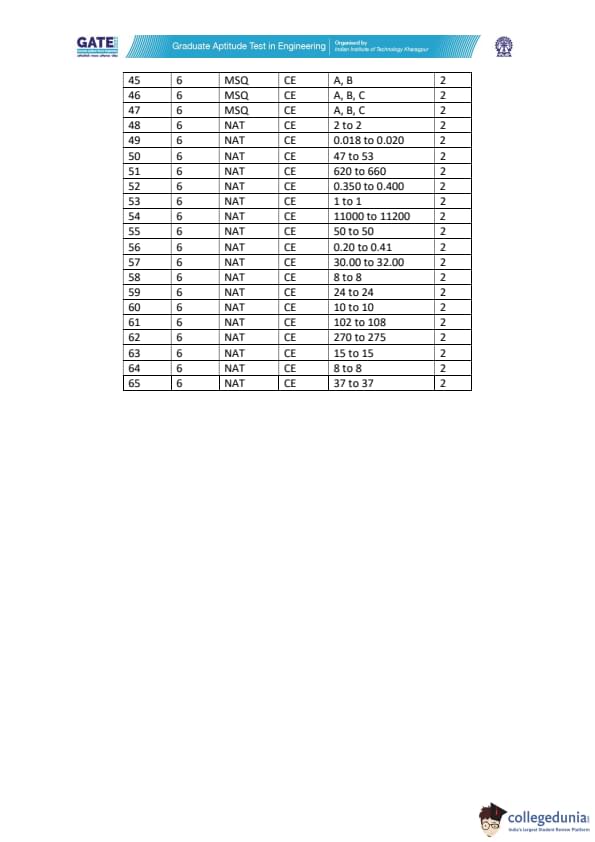
Also Check:
Quick Links:
GATE 2022 CE Slot 2 Detailed Paper Analysis
The question paper was a combination of 34 MCQs (Multiple Select Questions), 7 MSQs (Multiple Select Questions), and 24 NATs (Numerical Answer Type). All the questions were for either 1 or 2 marks.
- GATE 2022 CE question paper for slot 2 comprised three main parts- General Aptitude, Engineering Mathematics, and topics related to the core subject of Civil Engineering
- 72% of the total weightage carried by Civil Engineering (core subject) was distributed between 13 topics.
- Geotechnical Engineering and Environmental Engineering carried 11% weightage each.
Tabulated below is the detailed distribution of questions as per the related topics along with the marks allotted:
| Sections/Topics | 1 Mark Questions | 2 Marks Questions | Carried Marks |
|---|---|---|---|
| General Aptitude | 5 | 5 | 15 |
| Engineering Mathematics | 3 | 5 | 13 |
| Engineering Mechanics | - | - | - |
| Strength of Materials | 1 | 1 | 3 |
| Structural Analysis | 0 | 3 | 6 |
| RCC | 2 | 3 | 8 |
| Steel Structure | 0 | 1 | 2 |
| Geotechnical Engineering | 5 | 3 | 11 |
| Environmental Engineering | 5 | 3 | 11 |
| Fluid Mechanics | 2 | 3 | 8 |
| Irrigation | 1 | 1 | 3 |
| Hydrology | 0 | 1 | 2 |
| Surveying | 2 | 2 | 6 |
| Transportation Engineering | 2 | 3 | 8 |
| Building Materials and CPM | 2 | 1 | 4 |
| Total | 30 | 35 | 100 |
Also Check:
GATE Previous Year Question Papers
| GATE 2022 Question Papers | GATE 2021 Question Papers | GATE 2020 Question Papers |
| GATE 2019 Question Papers | GATE 2018 Question Papers | GATE 2017 Question Paper |




Comments