




GATE 2022 Petroleum Engineering (PE) Question Paper with Solutions PDFs are now available. IIT Kharagpur successfully concluded GATE 2022 PE (Petroleum Engineering) on 13th February, 2022 in the Forenoon Session (9:00 AM to 12:00 PM). The overall difficulty level was rated difficult. The question paper was divided into two sections. The first section belongs to General Aptitude, while the second section carries subject specific questions. The General Aptitude questions were rated moderate to tough, while the subject specific questions were of difficulty level.
GATE 2022 Petroleum Engineering (PE) Question Paper with Solutions
| GATE 2022 Petroleum Engineering (PE) Question Paper |  Download Download |
Check Solutions |

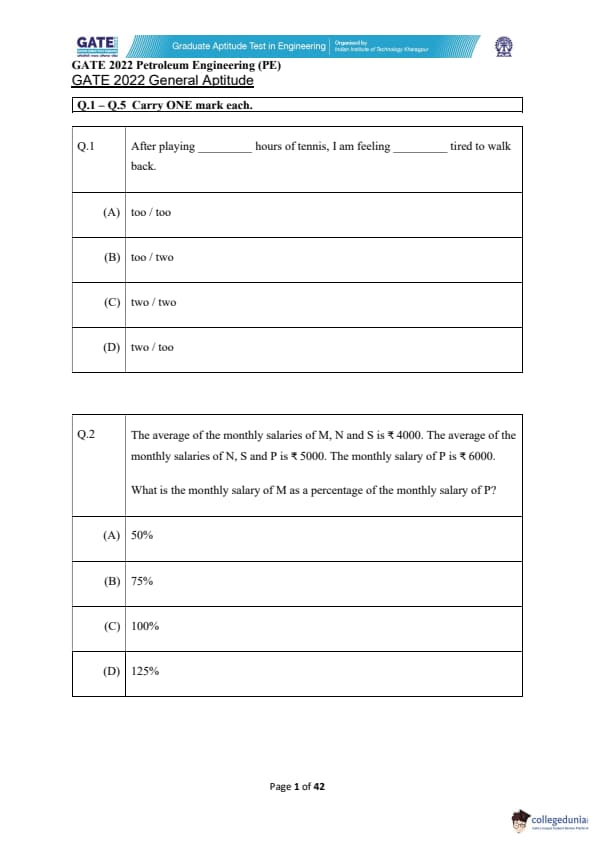
After playing ________ hours of tennis, I am feeling ________ tired to walk back.
The average of the monthly salaries of M, N and S is ₹4000. The average of the monthly salaries of N, S and P is ₹5000. The monthly salary of P is ₹6000.
What is the monthly salary of M as a percentage of the monthly salary of P?
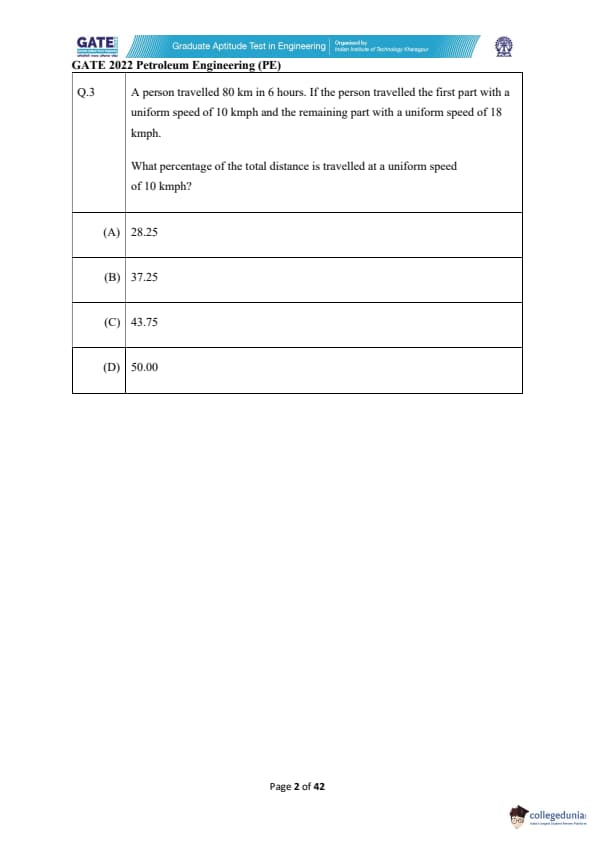
A person travelled 80 km in 6 hours. If the person travelled the first part with a uniform speed of 10 kmph and the remaining part with a uniform speed of 18 kmph.
What percentage of the total distance is travelled at a uniform speed of 10 kmph?
Four girls P, Q, R, and S are studying languages in a University. P is learning French and Dutch. Q is learning Chinese and Japanese. R is learning Spanish and French. S is learning Dutch and Japanese.
Given that: French is easier than Dutch; Chinese is harder than Japanese; Dutch is easier than Japanese, and Spanish is easier than French.
Based on the above information, which girl is learning the most difficult pair of languages?
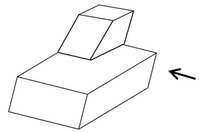
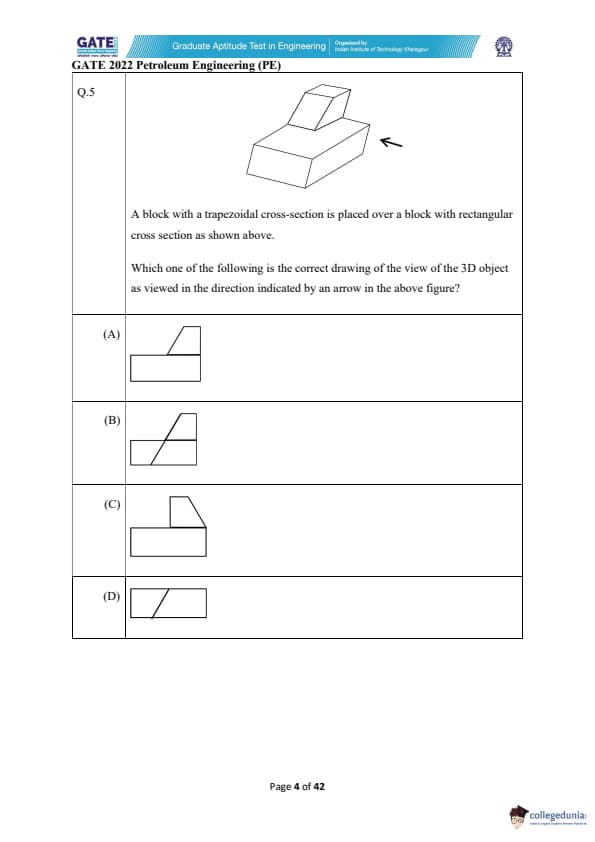
A block with a trapezoidal cross-section is placed over a block with a rectangular cross-section as shown above.
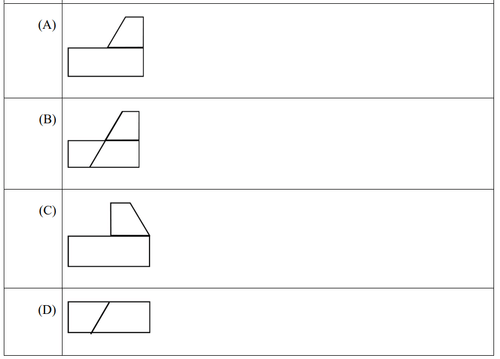
Which one of the following is the correct drawing of the view of the 3D object as viewed in the direction indicated by the arrow in the above figure?
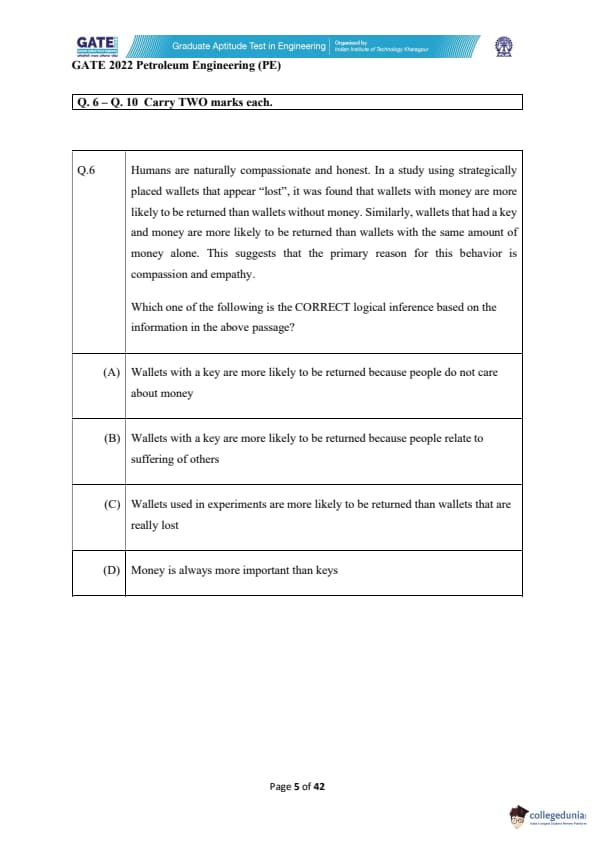
Humans are naturally compassionate and honest. In a study using strategically placed wallets that appear “lost”, it was found that wallets with money are more likely to be returned than wallets without money. Similarly, wallets that had a key and money are more likely to be returned than wallets with the same amount of money alone. This suggests that the primary reason for this behavior is compassion and empathy.
Which one of the following is the CORRECT logical inference based on the information in the above passage?
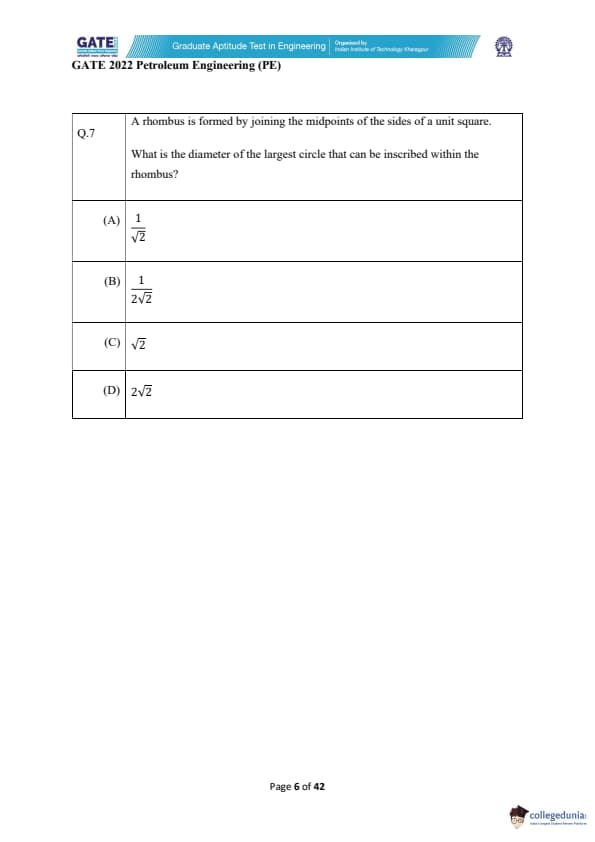
A rhombus is formed by joining the midpoints of the sides of a unit square. What is the diameter of the largest circle that can be inscribed within the rhombus?
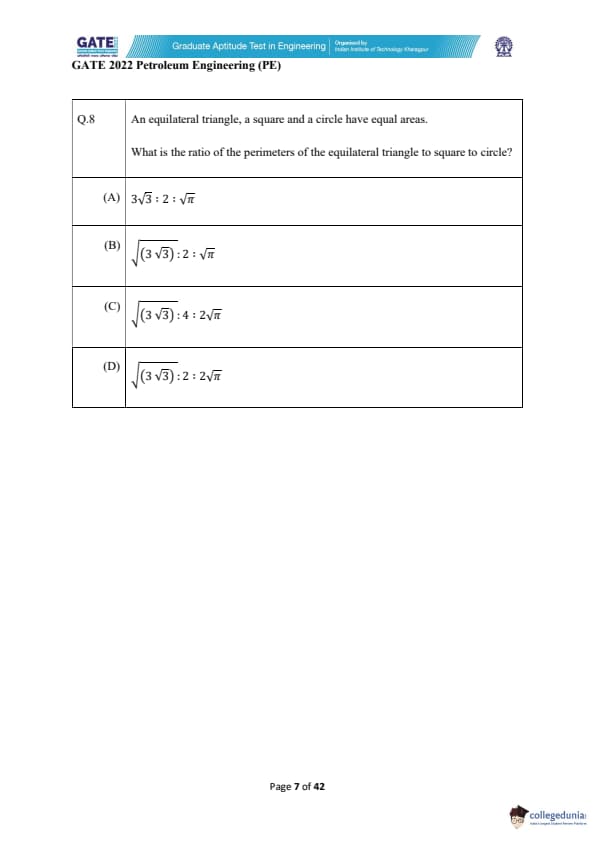
An equilateral triangle, a square and a circle have equal areas.
What is the ratio of the perimeters of the equilateral triangle to square to circle?
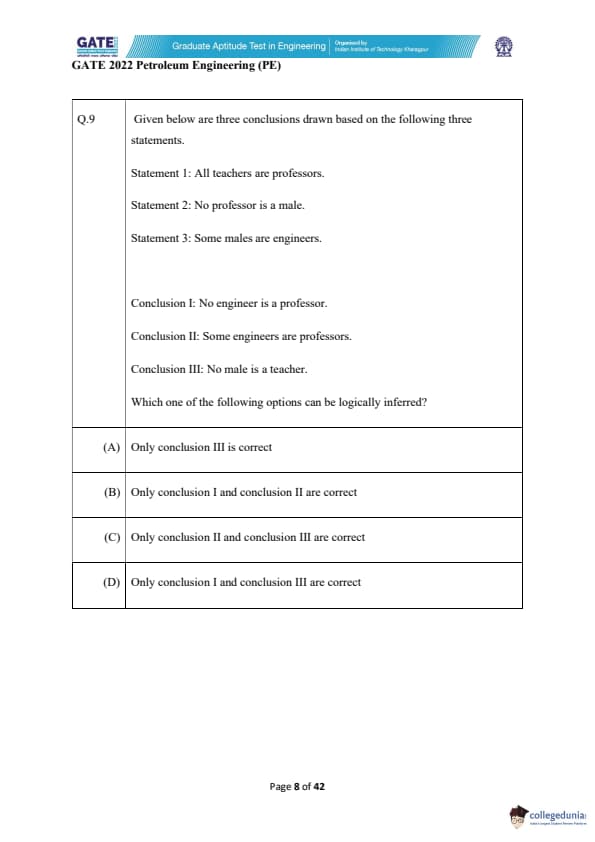
Given below are three conclusions drawn based on the following three statements.
Statement 1: All teachers are professors.
Statement 2: No professor is a male.
Statement 3: Some males are engineers.
Conclusion I: No engineer is a professor.
Conclusion II: Some engineers are professors.
Conclusion III: No male is a teacher.
Which one of the following options can be logically inferred?
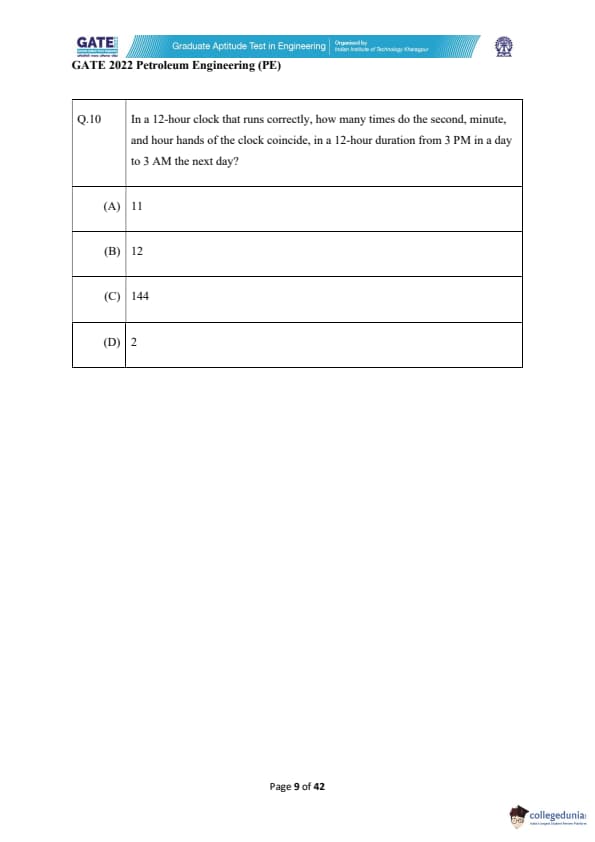
In a 12-hour clock that runs correctly, how many times do the second, minute, and hour hands of the clock coincide, in a 12-hour duration from 3 PM in a day to 3 AM the next day?
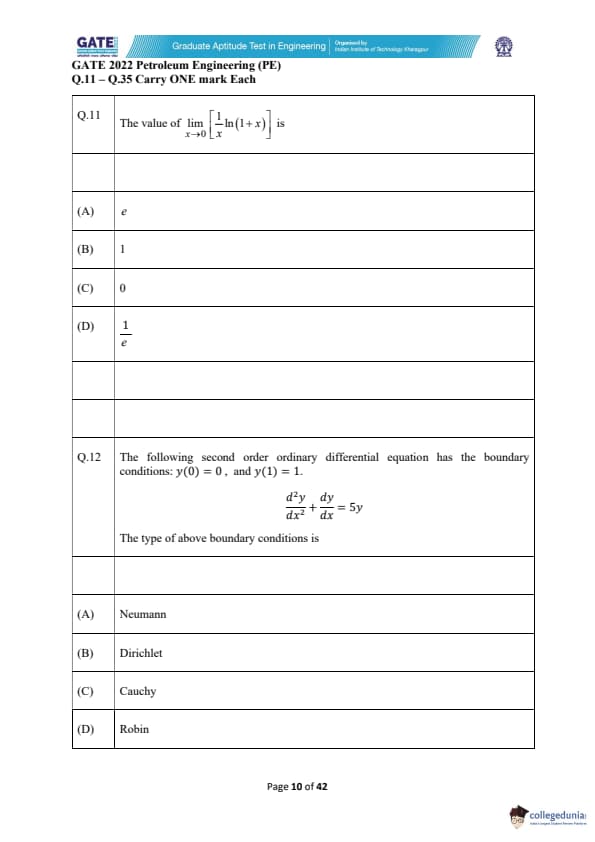
The value of \[ \lim_{x \to 0} \left[ \frac{1}{x} \ln(1+x) \right] \]
is:
The following second order ordinary differential equation has the boundary conditions: \[ y(0) = 0, \quad y(1) = 1 \]
The type of the above boundary conditions is:
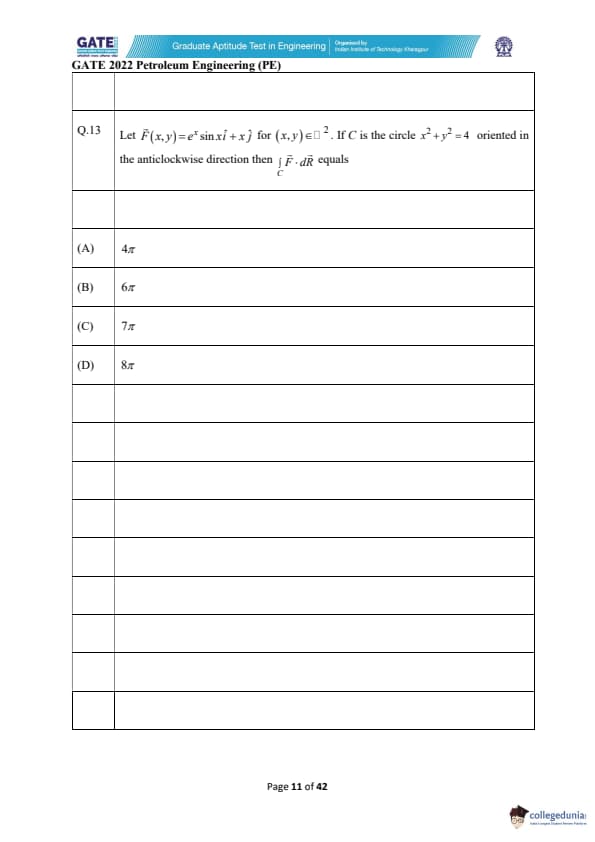
Let \( \vec{F}(x,y) = e^x \sin x\, \hat{i} + x\, \hat{j} \) for \((x,y)\in \mathbb{R}^2\). If \(C\) is the circle \(x^2 + y^2 = 4\) oriented anticlockwise, then \[ \oint_C \vec{F} \cdot d\vec{R} \]
equals:
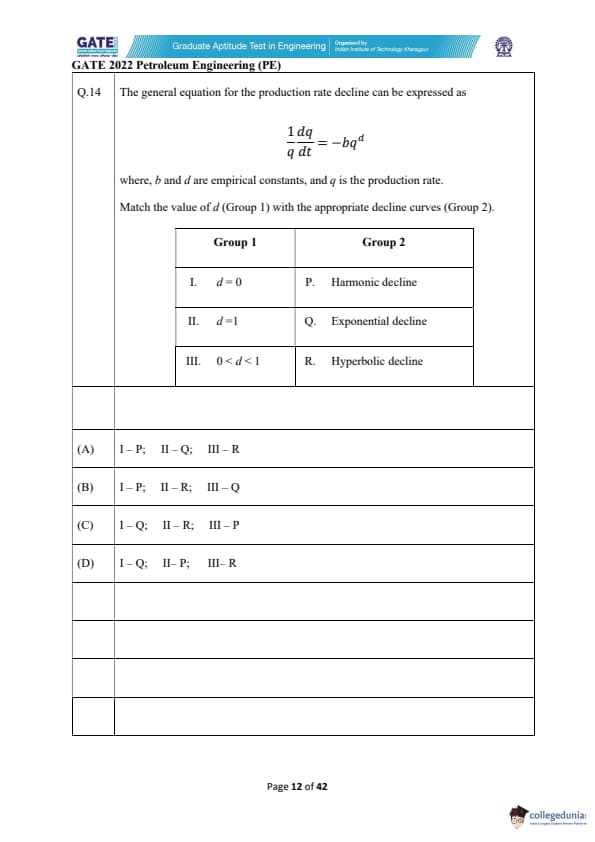
The general equation for the production rate decline can be expressed as \[ \frac{1}{q} \frac{dq}{dt} = -bq^d \]
where, b and d are empirical constants, and q is the production rate.
Match the value of \(d\) (Group 1) with the appropriate decline curves (Group 2).

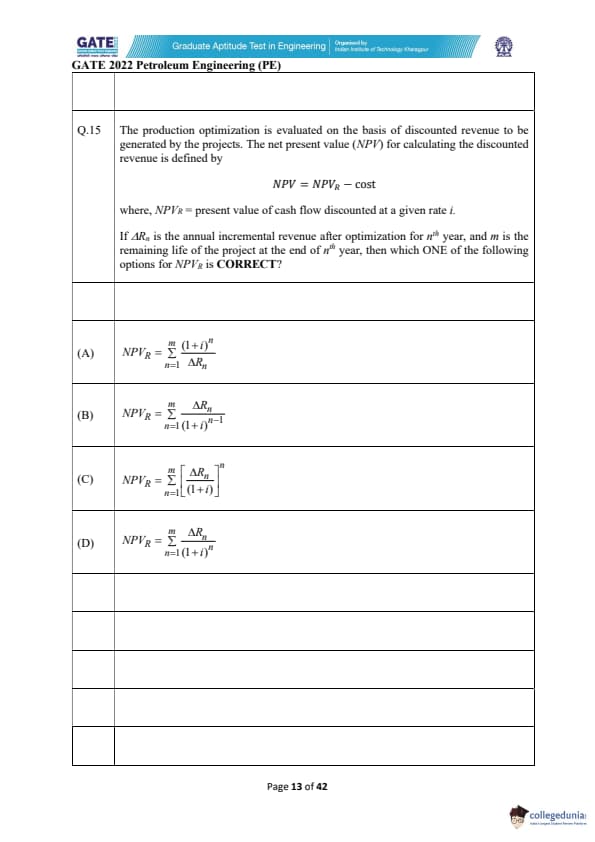
The production optimization is evaluated on the basis of discounted revenue to be generated by the projects. The net present value (NPV) for calculating the discounted revenue is defined by
\[ NPV = NPV_R - cost \]
where, \(NPV_R\) = present value of cash flow discounted at a given rate \(i\).
If \(\Delta R_n\) is the annual incremental revenue after optimization for the \(n^{th}\) year, and \(m\) is the remaining life of the project at the end of \(n^{th}\) year, then which ONE of the following options for \(NPV_R\) is CORRECT?
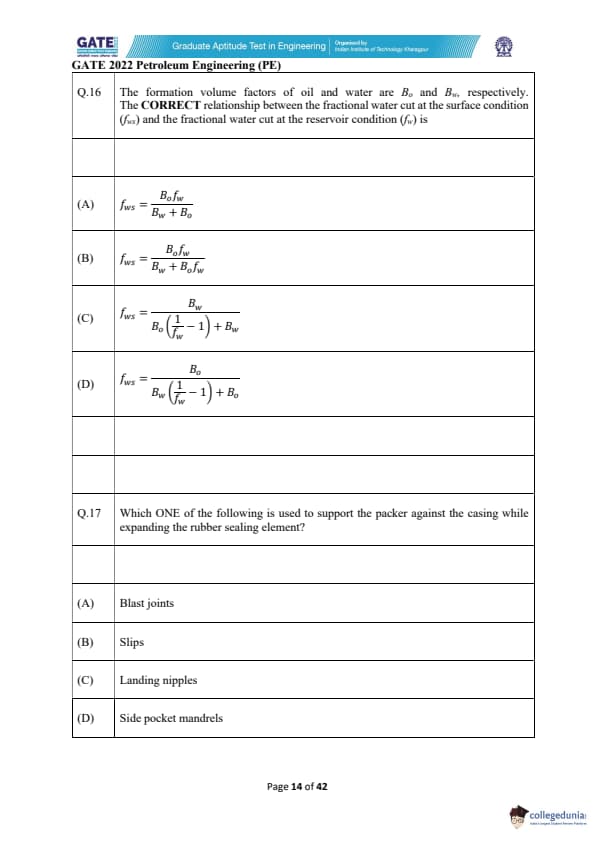
The formation volume factors of oil and water are \(B_o\) and \(B_w\), respectively. The CORRECT relationship between the fractional water cut at the surface condition \(f_{ws}\) and the fractional water cut at the reservoir condition \(f_w\) is:
Which ONE of the following is used to support the packer against the casing while expanding the rubber sealing element?
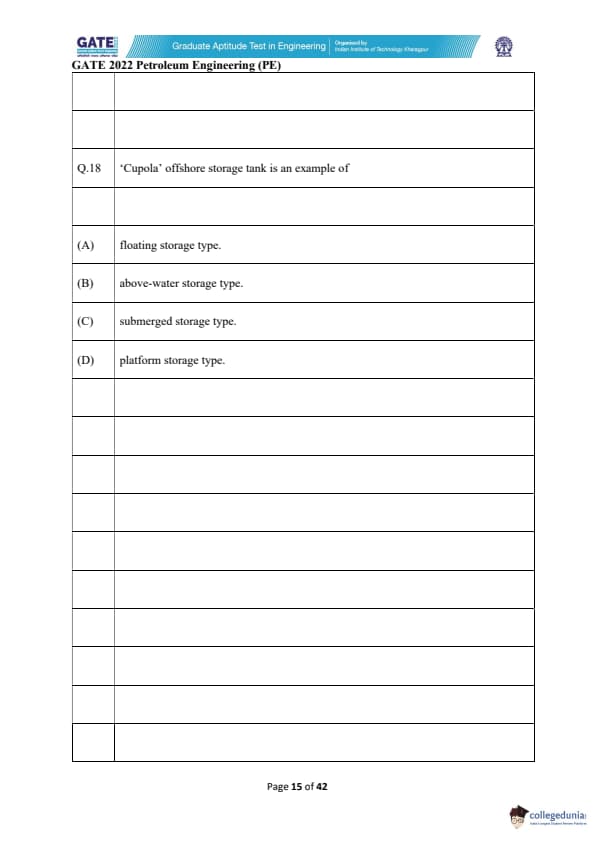
‘Cupola’ offshore storage tank is an example of:
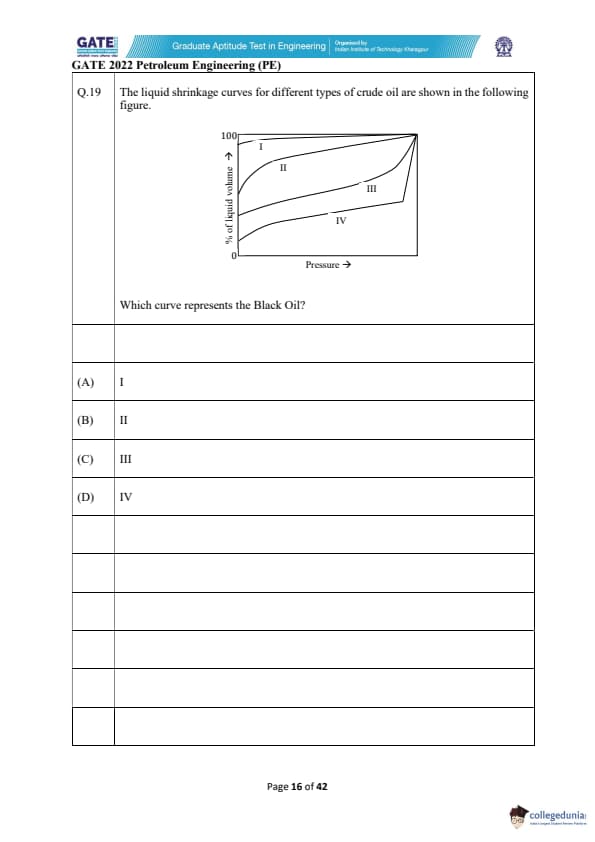
The liquid shrinkage curves for different types of crude oil are shown in the following figure.
Which curve represents the Black Oil?

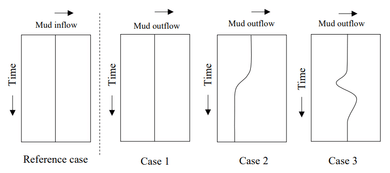
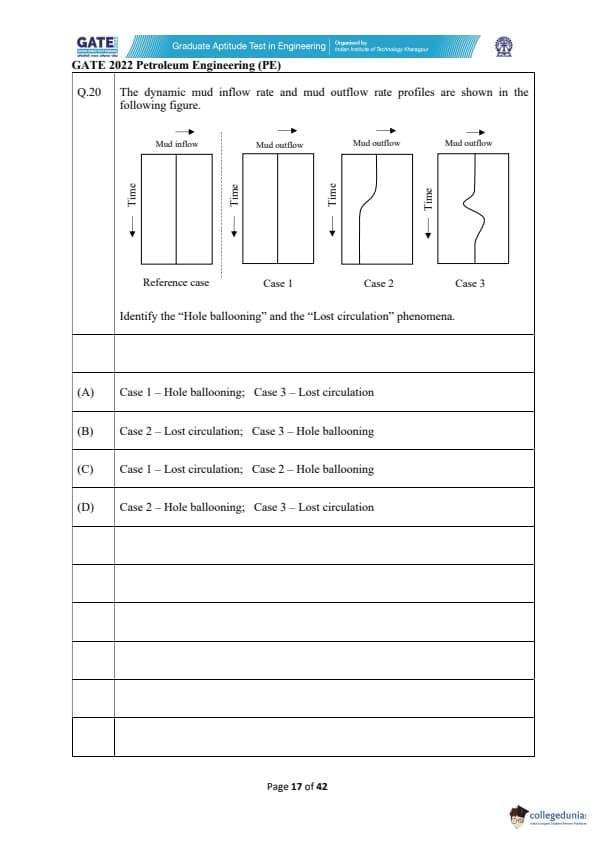
The dynamic mud inflow rate and mud outflow rate profiles are shown in the following figure.
Identify the ``Hole ballooning’’ and the ``Lost circulation’’ phenomena.
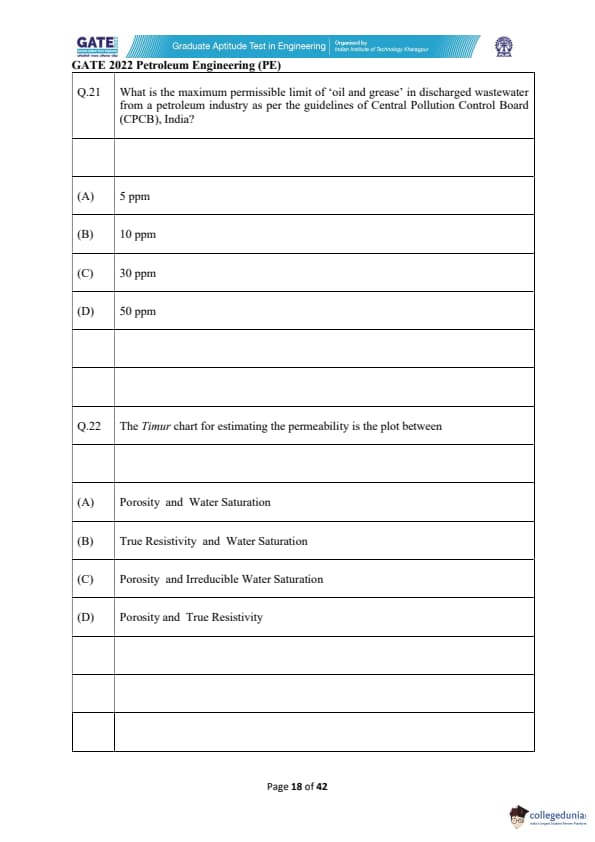
What is the maximum permissible limit of 'oil and grease' in discharged wastewater from a petroleum industry as per the guidelines of Central Pollution Control Board (CPCB), India?
The Timur chart for estimating the permeability is the plot between
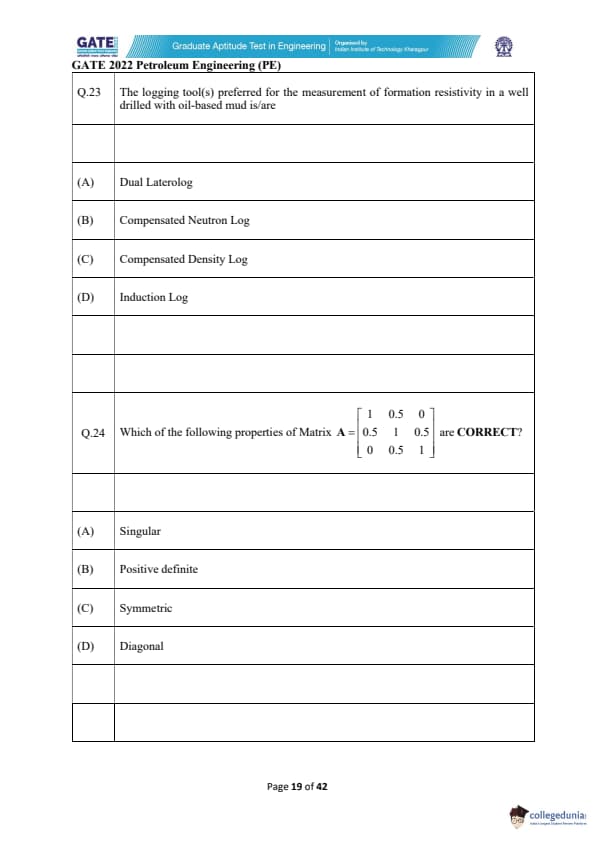
The logging tool(s) preferred for the measurement of formation resistivity in a well drilled with oil-based mud is/are:
Which of the following properties of Matrix \(A = \begin{bmatrix} 1 & 0.5 & 0
0.5 & 1 & 0.5
0 & 0.5 & 1 \end{bmatrix}\) are CORRECT?
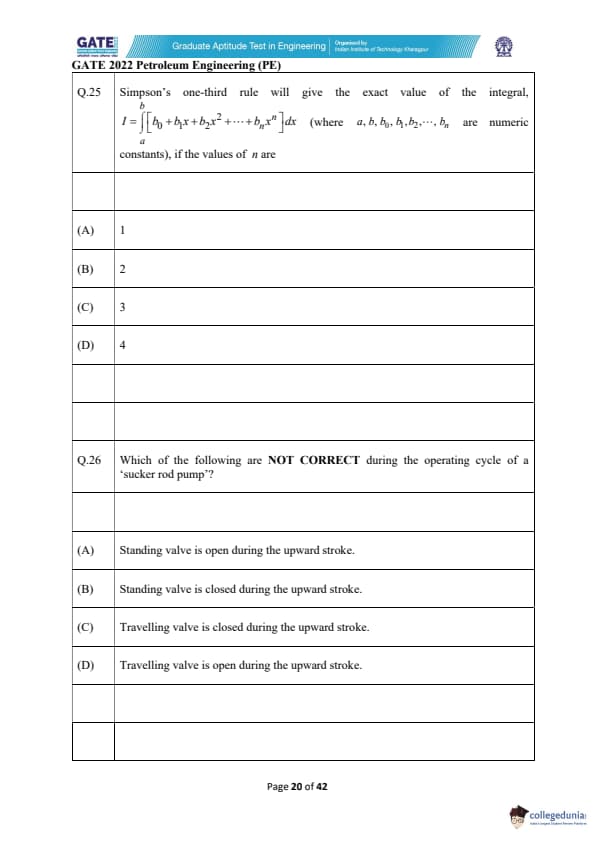
Simpson’s one-third rule will give the exact value of the integral \[ I=\int_a^b \left[ b_0 + b_1 x + b_2 x^2 + \cdots + b_n x^n \right] dx \]
(where \(a, b, b_0, b_1, b_2, \ldots, b_n\) are numeric constants), if the values of \(n\) are:
Which of the following are NOT CORRECT during the operating cycle of a ‘sucker rod pump’?
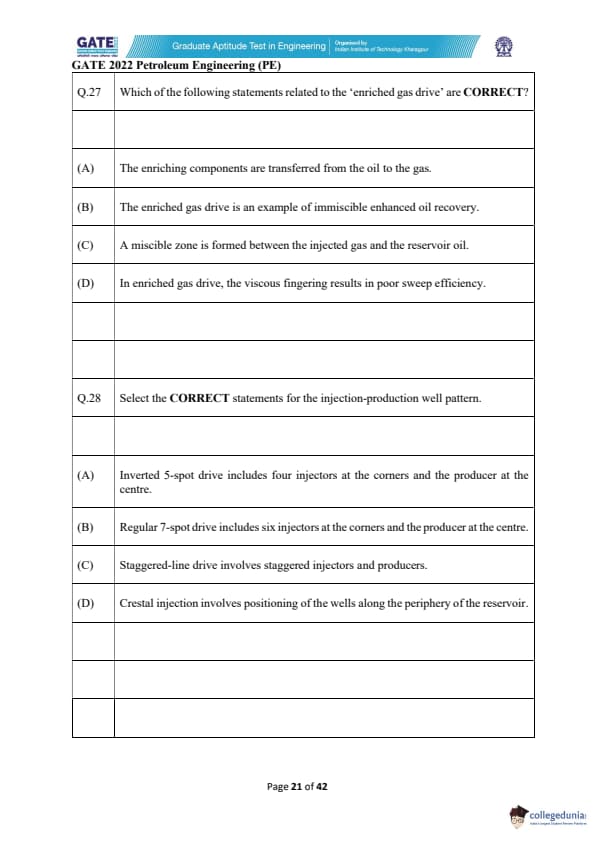
Which of the following statements related to the 'enriched gas drive' are CORRECT?
Select the CORRECT statements for the injection-production well pattern.
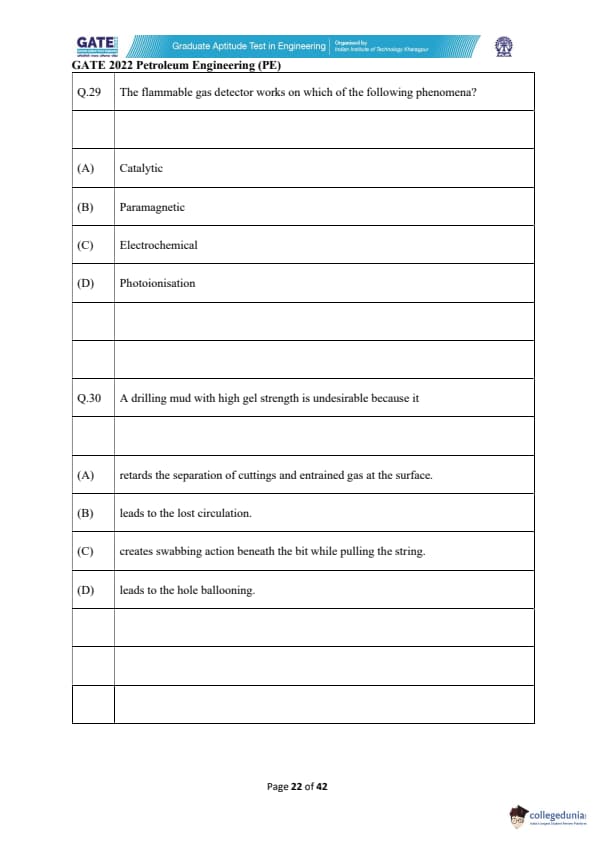
The flammable gas detector works on which of the following phenomena?
A drilling mud with high gel strength is undesirable because it
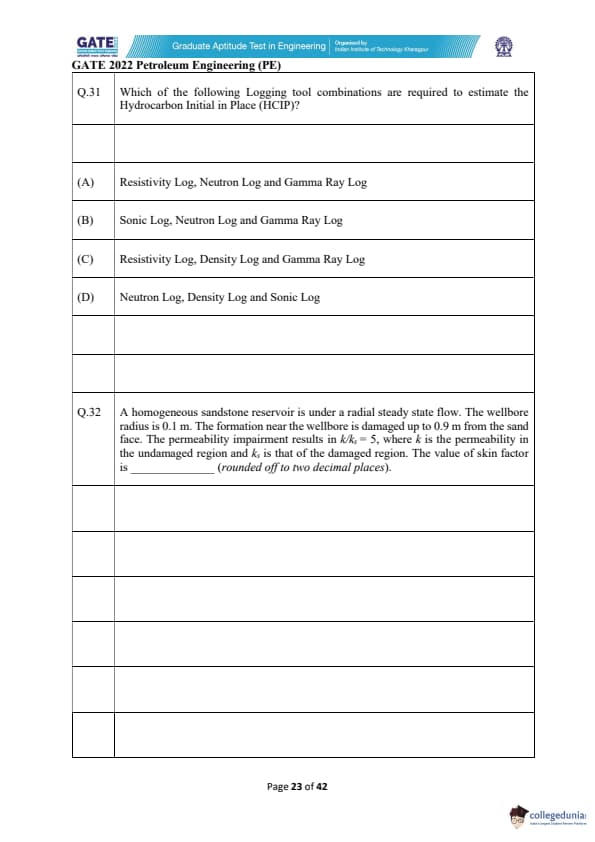
Which of the following Logging tool combinations are required to estimate the Hydrocarbon Initial in Place (HCIP)?
A homogeneous sandstone reservoir is under a radial steady state flow. The wellbore radius is 0.1 m. The formation near the wellbore is damaged up to 0.9 m from the sand face. The permeability impairment results in \( k/k_s = 5 \), where \( k \) is the permeability in the undamaged region and \( k_s \) is that of the damaged region. The value of skin factor is (rounded off to two decimal places) _______.
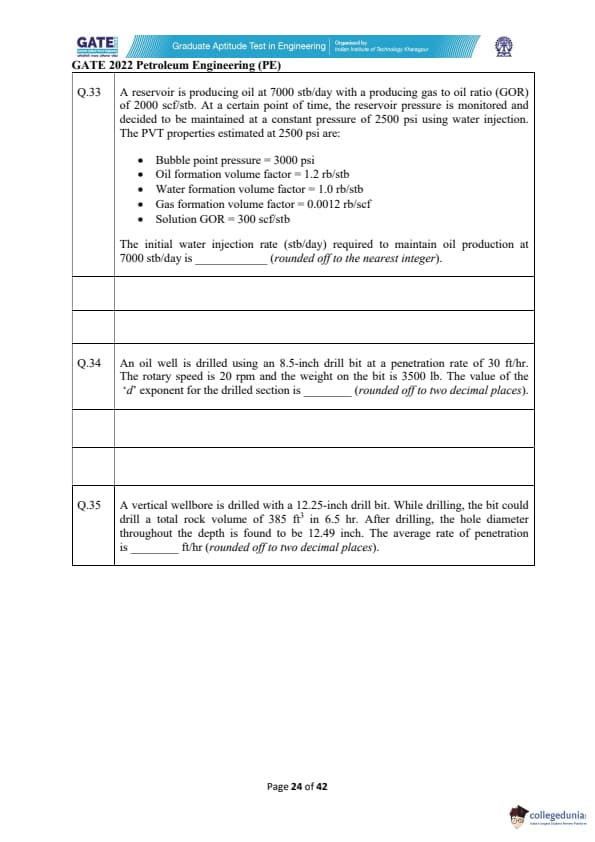
A reservoir is producing oil at 7000 stb/day with a producing gas to oil ratio (GOR) of 2000 scf/stb. At a certain point of time, the reservoir pressure is monitored and decided to be maintained at a constant pressure of 2500 psi using water injection. The PVT properties estimated at 2500 psi are:
Bubble point pressure = 3000 psi
Oil formation volume factor = 1.2 rb/stb
Water formation volume factor = 1.0 rb/stb
Gas formation volume factor = 0.0012 rb/scf
Solution GOR = 300 scf/stb
The initial water injection rate (stb/day) required to maintain oil production at 7000 stb/day is ________ (rounded off to the nearest integer).
An oil well is drilled using an 8.5-inch drill bit at a penetration rate of 30 ft/hr. The rotary speed is 20 rpm and the weight on the bit is 3500 lb. The value of the ‘d’ exponent for the drilled section is ________ (rounded off to two decimal places).
A vertical wellbore is drilled with a 12.25-inch drill bit. While drilling, the bit could drill a total rock volume of 385 ft\(^3\) in 6.5 hr. After drilling, the hole diameter throughout the depth is found to be 12.49 inch. The average rate of penetration is ______ ft/hr (rounded off to two decimal places).
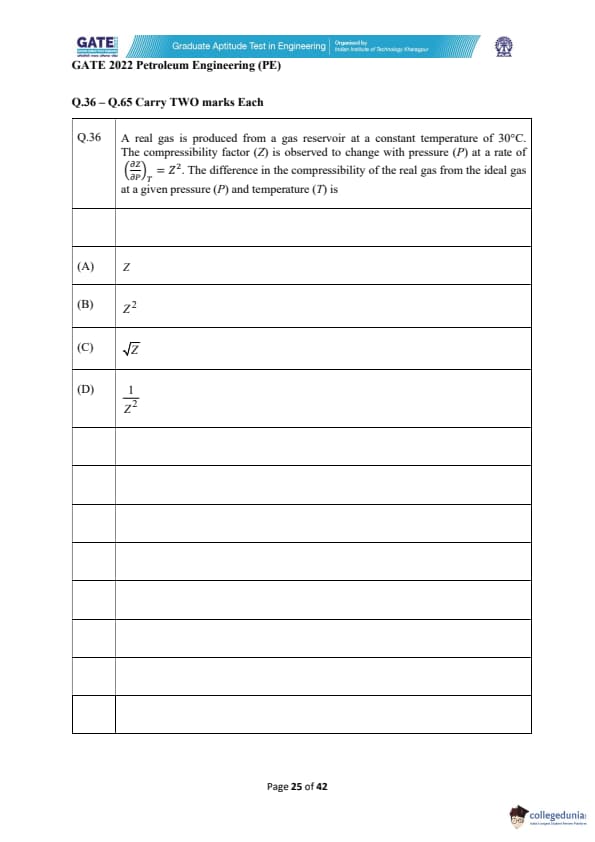
A real gas is produced from a gas reservoir at a constant temperature of 30°C. The compressibility factor (\(Z\)) is observed to change with pressure (\(P\)) at a rate of \[ \left( \frac{\partial Z}{\partial P} \right)_T = Z^2 \]
The difference in the compressibility of the real gas from the ideal gas at a given pressure (\(P\)) and temperature (\(T\)) is:
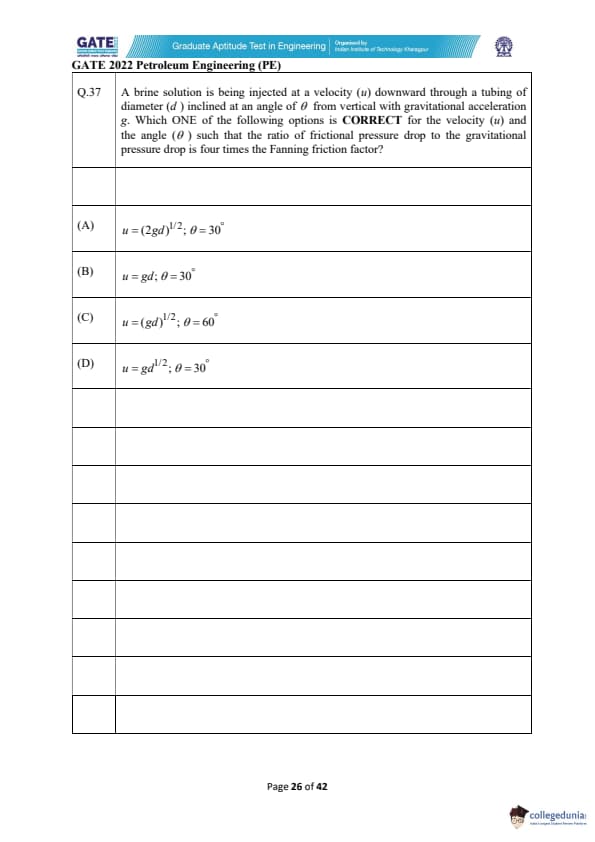
A brine solution is being injected at a velocity \( u \) downward through a tubing of diameter \( d \) inclined at an angle of \( \theta \) from vertical with gravitational acceleration \( g \). Which ONE of the following options is CORRECT for the velocity \( u \) and the angle \( \theta \) such that the ratio of frictional pressure drop to the gravitational pressure drop is four times the Fanning friction factor?
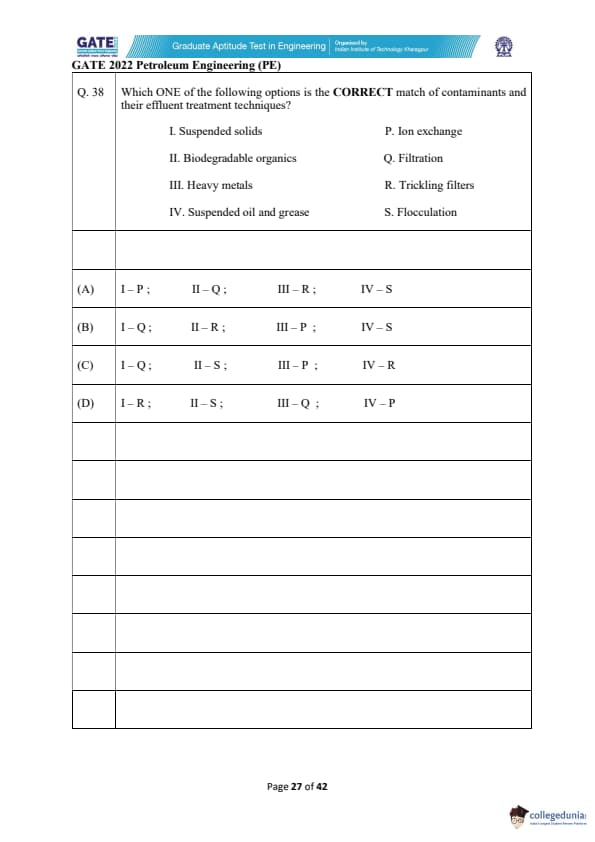
Which ONE of the following options is the CORRECT match of contaminants and their effluent treatment techniques?

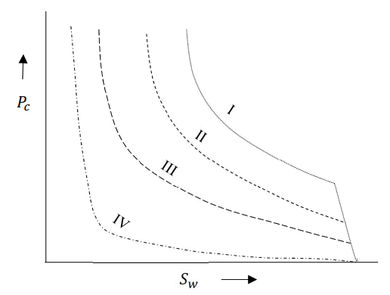
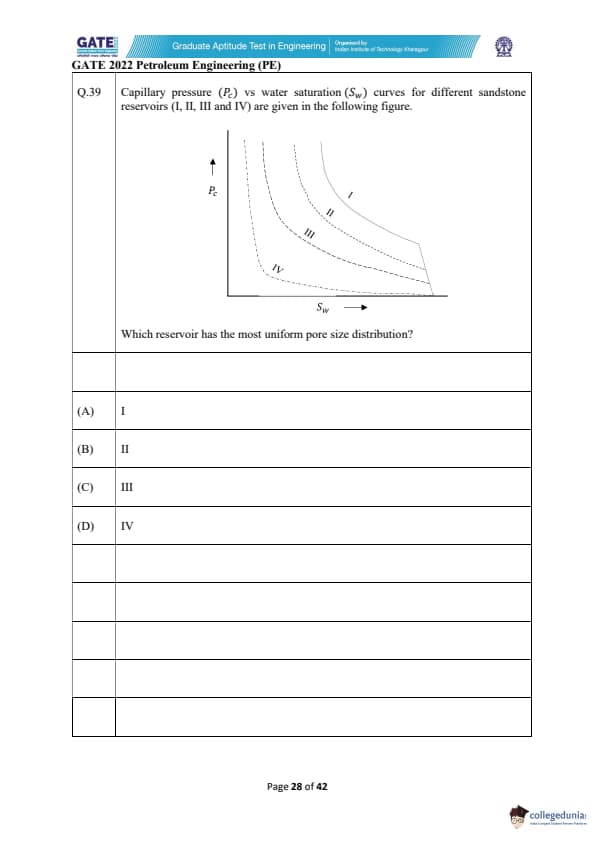
Capillary pressure (\(P_c\)) vs water saturation (\(S_w\)) curves for different sandstone reservoirs (I, II, III and IV) are given in the following figure.
Which reservoir has the most uniform pore size distribution?
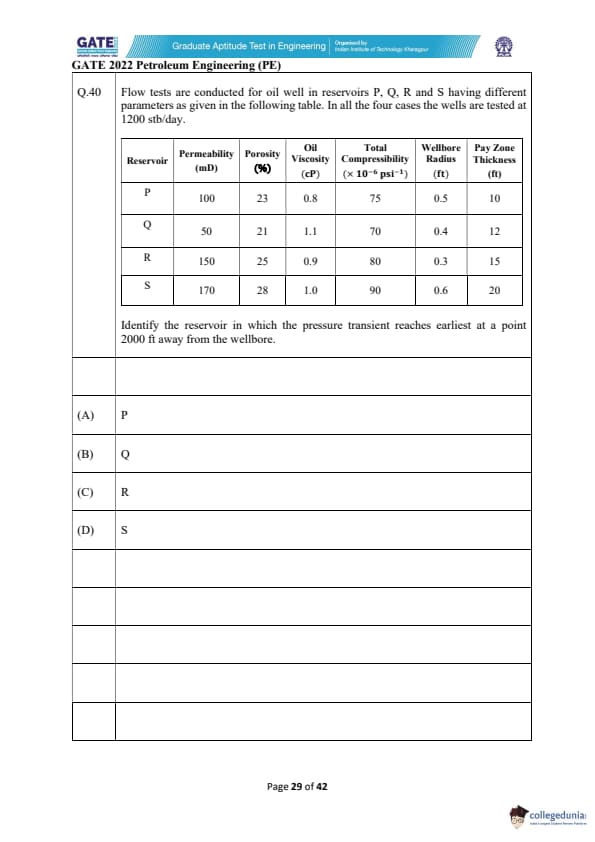
Flow tests are conducted for oil well in reservoirs P, Q, R and S having different parameters as given in the following table. In all the four cases the wells are tested at 1200 stb/day.
Identify the reservoir in which the pressure transient reaches earliest at a point 2000 ft away from the wellbore.

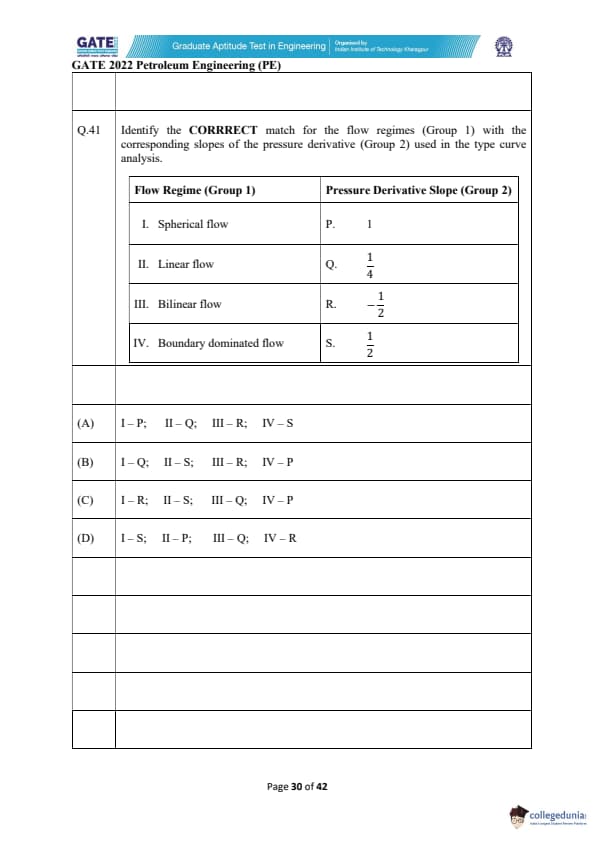
Identify the CORRECT match for the flow regimes (Group 1) with the corresponding slopes of the pressure derivative (Group 2) used in the type curve analysis.

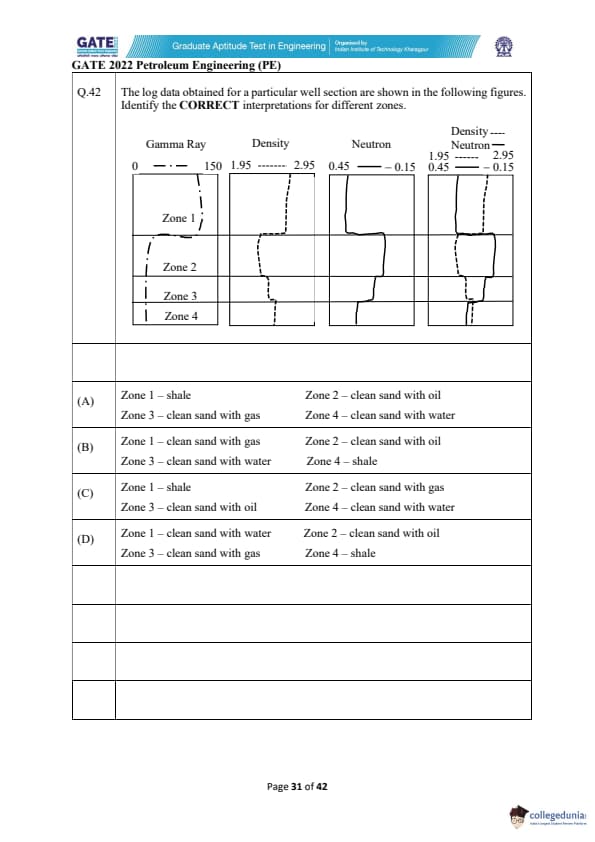
The log data obtained for a particular well section are shown in the following figures.
Identify the CORRECT interpretations for different zones.

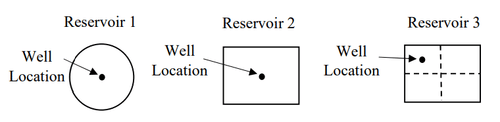
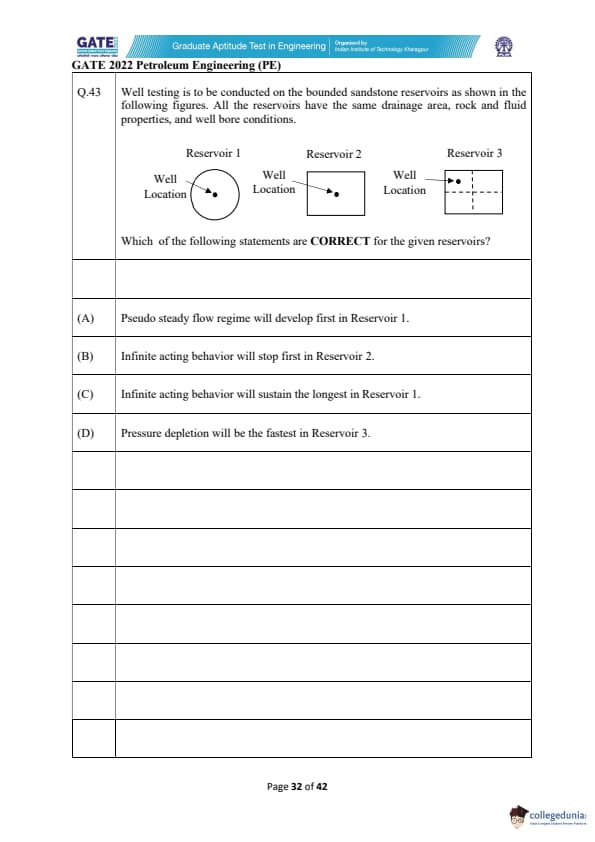
Well testing is to be conducted on the bounded sandstone reservoirs as shown in the figures. All the reservoirs have the same drainage area, rock and fluid properties, and well bore conditions. Which of the following statements are CORRECT for the given reservoirs?
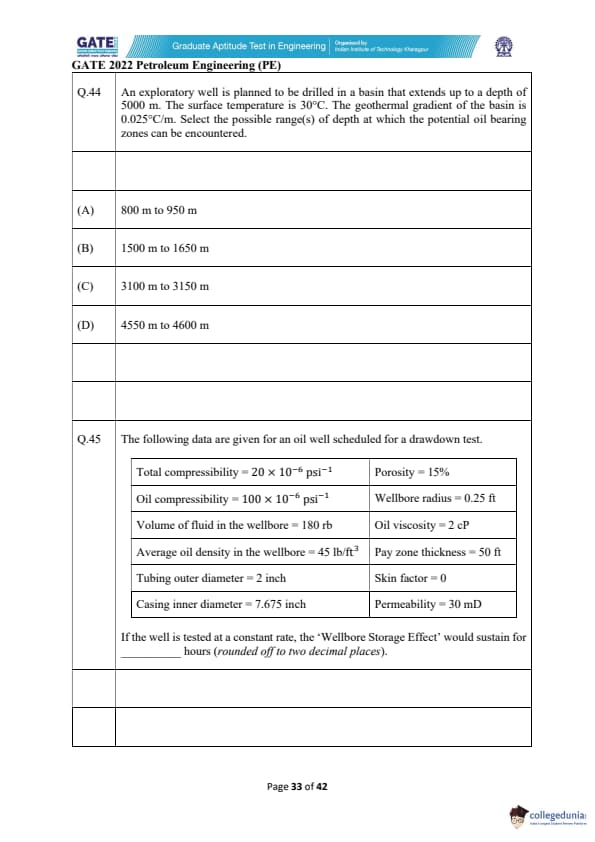
An exploratory well is planned to be drilled in a basin that extends up to a depth of 5000 m. The surface temperature is 30°C. The geothermal gradient of the basin is 0.025°C/m. Select the possible range(s) of depth at which the potential oil-bearing zones can be encountered.
The following data are given for an oil well scheduled for a drawdown test.
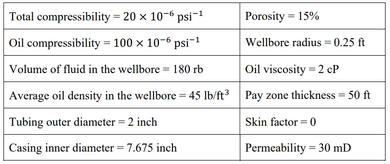
If the well is tested at a constant rate, the ‘Wellbore Storage Effect’ would sustain for _______ hours (rounded off to two decimal places).
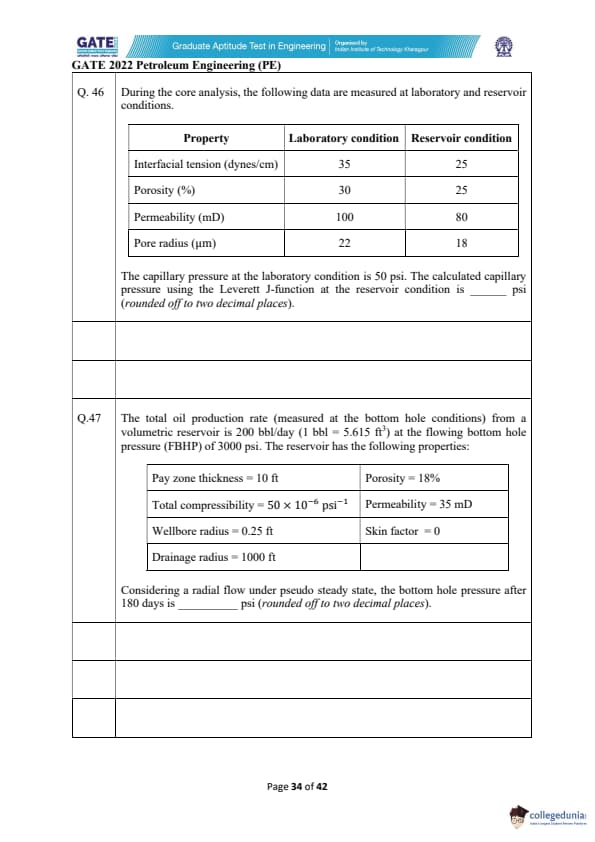
During the core analysis, the following data are measured at laboratory and reservoir conditions.
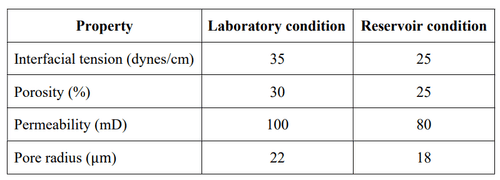
The capillary pressure at the laboratory condition is 50 psi. The calculated capillary pressure using the Leverett J-function at the reservoir condition is ________ psi (rounded off to two decimal places).
The total oil production rate (measured at the bottom hole conditions) from a volumetric reservoir is 200 bbl/day (1 bbl = 5.615 ft\(^3\)) at the flowing bottom hole pressure (FBHP) of 3000 psi. The reservoir has the following properties:

Considering a radial flow under pseudo steady state, the bottom hole pressure after 180 days is ________ psi (rounded off to two decimal places).
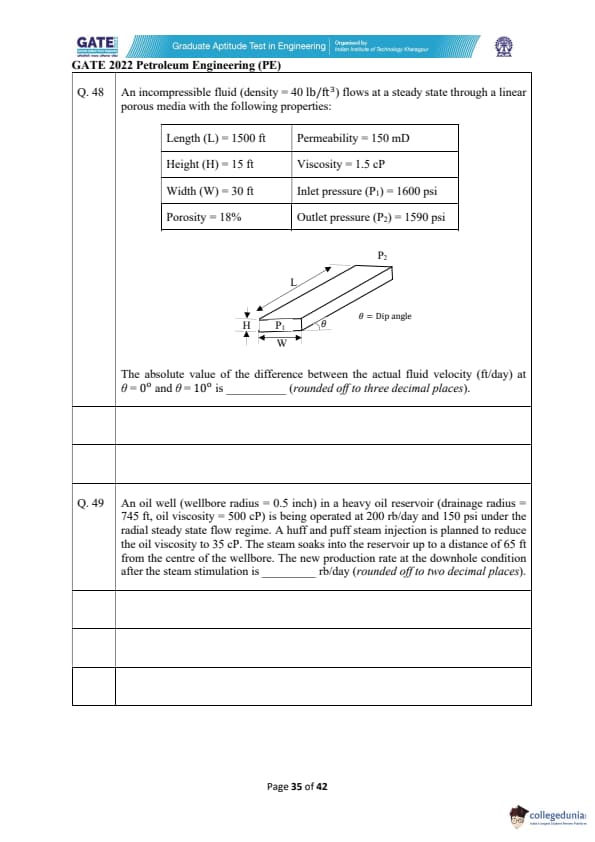
An incompressible fluid (density = 40 lb/ft\(^3\)) flows at a steady state through a linear porous media with the following properties:

The absolute value of the difference between the actual fluid velocity (ft/day) at \( \theta = 0^\circ \) and \( \theta = 10^\circ \) is _______ (rounded off to three decimal places).
An oil well (wellbore radius = 0.5 inch) in a heavy oil reservoir (drainage radius = 745 ft, oil viscosity = 500 cP) is being operated at 200 rb/day and 150 psi under the radial steady state flow regime. A huff and puff steam injection is planned to reduce the oil viscosity to 35 cP. The steam soaks into the reservoir up to a distance of 65 ft from the centre of the wellbore. The new production rate at the downhole condition after the steam stimulation is ______ rb/day (rounded off to two decimal places).
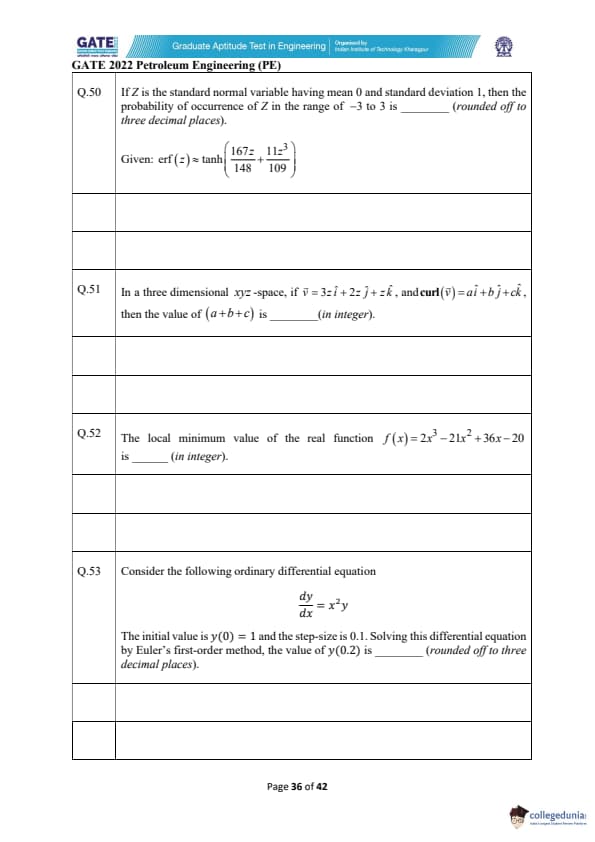
If Z is the standard normal variable having mean 0 and standard deviation 1, then the probability of occurrence of Z in the range of –3 to 3 is ________ (rounded off to three decimal places).
Given: \[ erf(z) \approx \tanh \left( \frac{167z}{148} + \frac{11z^3}{109} \right) \]
In a three-dimensional \( xyz \)-space, if \( \vec{v} = 3z \hat{i} + 2z \hat{j} + z \hat{k} \), and \( curl(\vec{v}) = a \hat{i} + b \hat{j} + c \hat{k} \), then the value of \( (a + b + c) \) is ________ (in integer).
The local minimum value of the real function \[ f(x) = 2x^3 - 21x^2 + 36x - 20 \]
is _____ (in integer).
Consider the following ordinary differential equation: \[ \frac{dy}{dx} = x^2y \]
The initial value is \( y(0) = 1 \) and the step-size is 0.1. Solving this differential equation by Euler’s first-order method, the value of \( y(0.2) \) is ______ (rounded off to three decimal places).
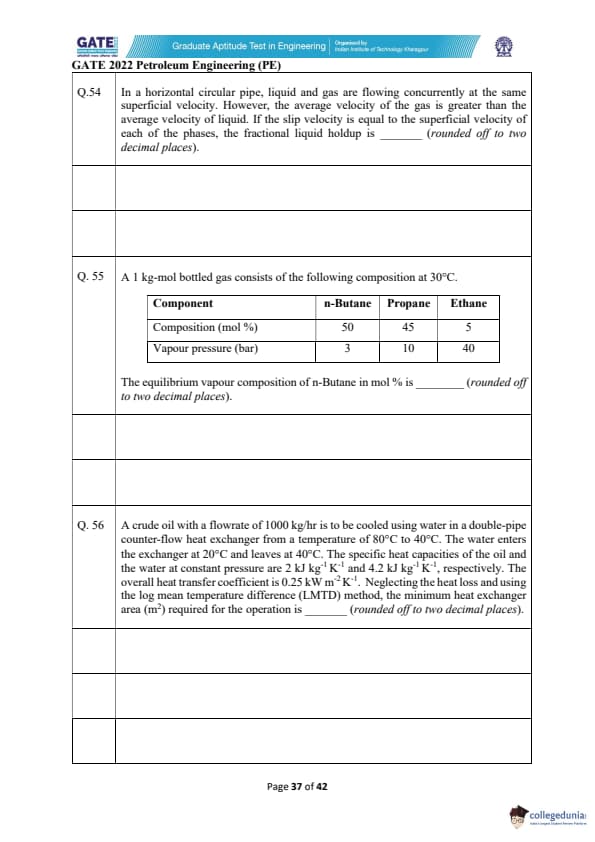
In a horizontal circular pipe, liquid and gas are flowing concurrently at the same superficial velocity. However, the average velocity of the gas is greater than the average velocity of liquid. If the slip velocity is equal to the superficial velocity of each of the phases, the fractional liquid holdup is ______ (rounded off to two decimal places).
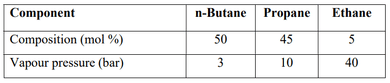
A 1 kg-mol bottled gas consists of the following composition at 30\(^\circ\)C. The equilibrium vapour composition of n-Butane in mol % is ______ (rounded off to two decimal places).
A crude oil with a flowrate of 1000 kg/hr is to be cooled using water in a double-pipe counter-flow heat exchanger from a temperature of 80\(^\circ\)C to 40\(^\circ\)C. The water enters the exchanger at 20\(^\circ\)C and leaves at 40\(^\circ\)C. The specific heat capacities of the oil and the water at constant pressure are 2 kJ kg\(^{-1}\) K\(^{-1}\) and 4.2 kJ kg\(^{-1}\) K\(^{-1}\), respectively. The overall heat transfer coefficient is 0.25 kW m\(^{-2}\) K\(^{-1}\). Neglecting the heat loss and using the log mean temperature difference (LMTD) method, the minimum heat exchanger area (m\(^2\)) required for the operation is ______ (rounded off to two decimal places).
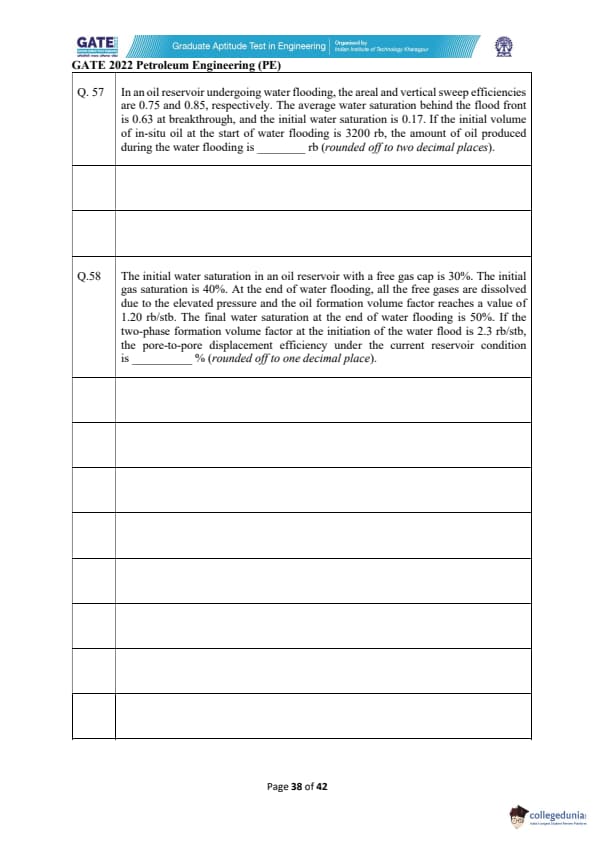
In an oil reservoir undergoing water flooding, the areal and vertical sweep efficiencies are 0.75 and 0.85, respectively. The average water saturation behind the flood front is 0.63 at breakthrough, and the initial water saturation is 0.17. If the initial volume of in-situ oil at the start of water flooding is 3200 rb, the amount of oil produced during the water flooding is ______ rb (rounded off to two decimal places).
The initial water saturation in an oil reservoir with a free gas cap is 30%. The initial gas saturation is 40%. At the end of water flooding, all the free gases are dissolved due to the elevated pressure and the oil formation volume factor reaches a value of 1.20 rb/stb. The final water saturation at the end of water flooding is 50%. If the two-phase formation volume factor at the initiation of the water flood is 2.3 rb/stb, the pore-to-pore displacement efficiency under the current reservoir condition is ______ % (rounded off to one decimal place).
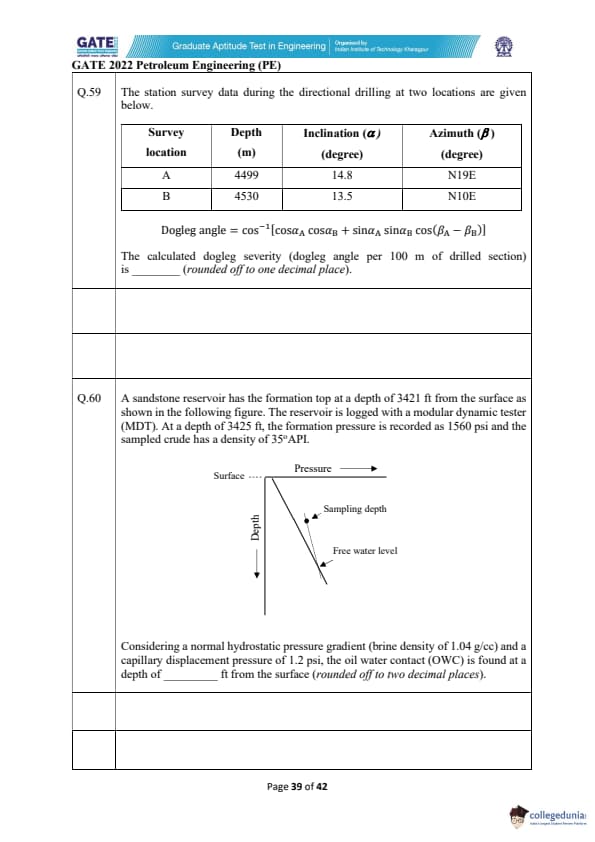
The station survey data during the directional drilling at two locations are given below.
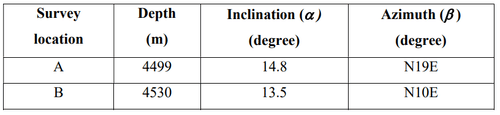
\[ Dogleg angle = \cos^{-1}[\cos\alpha_A \cos\alpha_B + \sin\alpha_A \sin\alpha_B \cos(\beta_A - \beta_B)] \]
The calculated dogleg severity (dogleg angle per 100 m drilled section) is ________ (rounded off to one decimal place).
A sandstone reservoir has the formation top at a depth of 3421 ft from the surface. The MDT tool records a pressure of 1560 psi at 3425 ft depth, and the sampled crude has a density of 35\(^\circ\)API. Considering a normal hydrostatic gradient (brine density 1.04 g/cc) and capillary displacement pressure of 1.2 psi, find the depth of the oil-water contact (OWC) from the surface (rounded off to two decimal places).

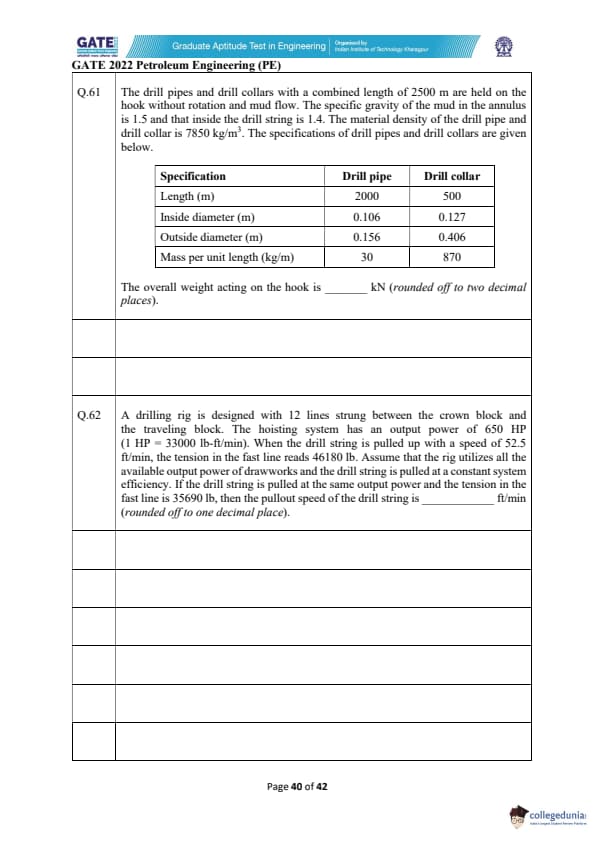
The drill pipes and drill collars with a combined length of 2500 m are held on the hook without rotation and mud flow. The specific gravity of the mud in the annulus is 1.5 and that inside the drill string is 1.4. The material density of the drill pipe and drill collar is 7850 kg/m\(^3\). The specifications are given below.

The overall weight acting on the hook is ______ kN (rounded off to two decimal places).
A drilling rig is designed with 12 lines strung between the crown block and traveling block. The hoisting system has an output power of 650 HP. When the drill string is pulled up at 52.5 ft/min, the fast line tension is 46180 lb. If the drill string is pulled at the same power and the fast line tension becomes 35690 lb, compute the new pullout speed (rounded off to one decimal place).
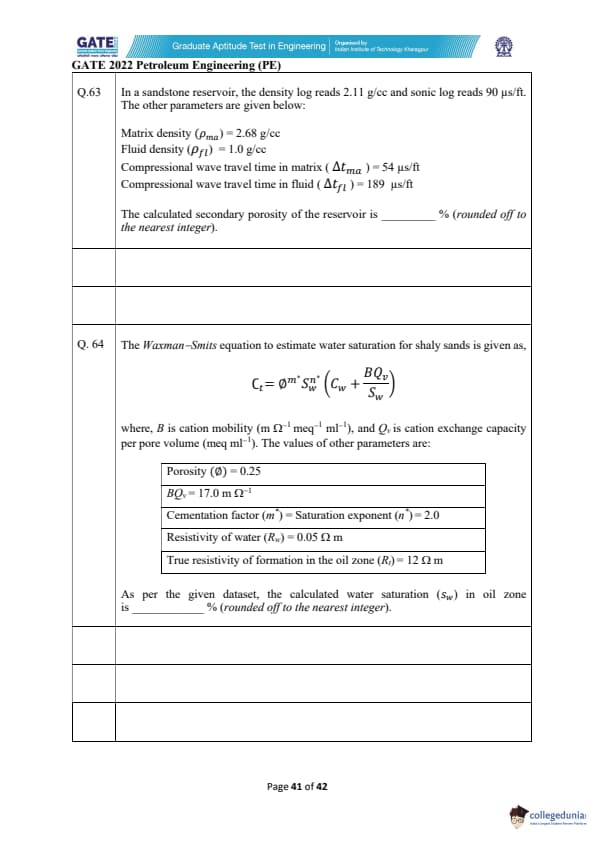
In a sandstone reservoir, the density log reads 2.11 g/cc and sonic log reads 90 μs/ft. The other parameters are given below:
Matrix density (\(\rho_{ma}\)) = 2.68 g/cc
Fluid density (\(\rho_{fl}\)) = 1.0 g/cc
Compressional wave travel time in matrix (\(\Delta t_{ma}\)) = 54 μs/ft
Compressional wave travel time in fluid (\(\Delta t_{fl}\)) = 189 μs/ft
The calculated secondary porosity of the reservoir is ________ % (rounded off to the nearest integer).
The Waxman–Smits equation to estimate water saturation for shaly sands is given as,
\[ C_t = \phi^{m^} S_w^{n^} \left( C_w + \frac{B Q_v}{S_w} \right) \]
where \( B \) is cation mobility and \( Q_v \) is cation exchange capacity per pore volume.
Given parameters:
Porosity (\(\phi\)) = 0.25
\(B Q_v = 17.0\ \Omega^{-1}\)
Cementation factor (\(m^\)) = 2.0
Resistivity of water (\(R_w\)) = 0.05 \(\Omega\cdot m\)
True formation resistivity (\(R_t\)) = 12 \(\Omega\cdot m\)
As per the dataset, the calculated water saturation (\(S_w\)) in oil zone is ________ % (rounded off to the nearest integer).
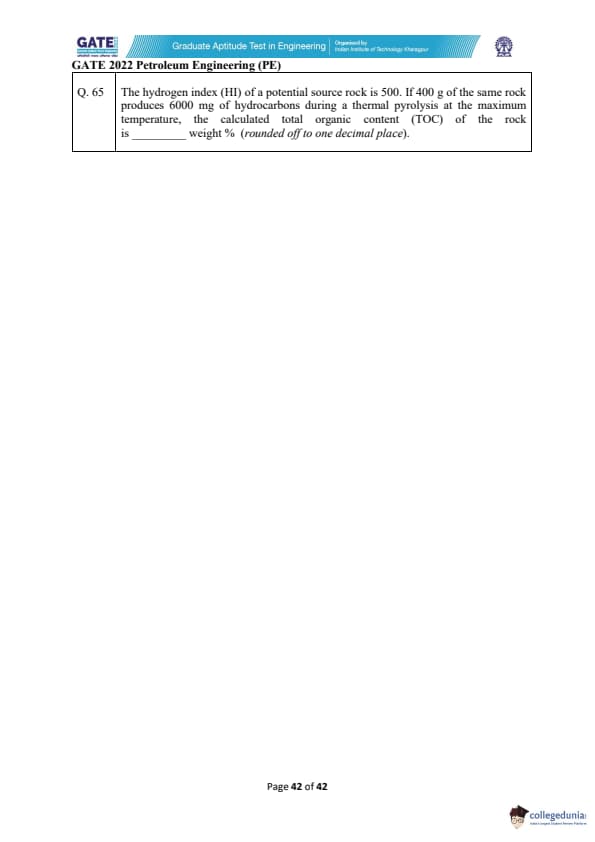
The hydrogen index (HI) of a potential source rock is 500. If 400 g of the same rock produces 6000 mg of hydrocarbons during a thermal pyrolysis at the maximum temperature, the calculated total organic content (TOC) of the rock is ______ weight % (rounded off to one decimal place).

Quick Links:
GATE 2022 PE Detailed Paper Analysis
The question paper was a combination of 65 questions. Out of 65 questions, 10 questions were related to General Aptitude. The remaining 55 questions were subject related questions. The question paper carried questions carrying 1 or 2 marks. The below-mentioned table shows the details of the questions as per the carried marks-
| Question Types | Question Frequency | Carried Marks |
|---|---|---|
| No. Of 1 mark MCQs | 17 | 17 |
| No. Of 2 mark MCQs | 12 | 24 |
| No. Of 1 mark MSQs | 9 | 9 |
| No. Of 2 marks MSQs | 2 | 4 |
| No. Of 1 mark NATs | 4 | 4 |
| No. Of 2 marks NATs | 21 | 42 |
| Total | 65 | 100 |
- This year, maximum weightage was carrying by NATs (Numerical Answer Type) questions
- NATs carried 46% of the total weightage
- MSQs (Multiple Select Questions) carried the least weightage of 8% in exam
Also Check:
GATE 2022 PE: Exam Pattern and Marking Scheme
- GATE 2022 PE asked both MCQs and NATs. It was held online via CBT mode
- As per the specified marking scheme by IIT Delhi, from the final score, ⅓ and ⅔ marks would be reduced for each wrong MCQ carried 1 and 2 marks
- Wrong attempted NATs were not supposed to bring any kind of deduction in the final achieved marks
GATE Previous Year Question Papers
| GATE 2022 Question Papers | GATE 2021 Question Papers | GATE 2020 Question Papers |
| GATE 2019 Question Papers | GATE 2018 Question Papers | GATE 2017 Question Papers |





Comments