




GATE 2022 Humanities and Social Sciences - Linguistics (XH-C3) Question Paper with Solutions PDFs are available to download for preparation purposes. The exam took place on February 6, 2022 in the Afternoon Session (2:30 PM to 5:30 PM). The question paper of GATE 2022 XH- C3 (Linguistics) comprised of a total of 65 questions with 38 MCQs, 3 NATs and 24 MSQs. The question paper was divided into three sections- Section GA (General Aptitude), Section B1 (Reasoning Comprehension) and Section XH- C3 (Linguistics).
GATE 2022 Humanities and Social Sciences - Linguistics (XH-C3)
Question Paper with Solutions
| GATE 2022 Humanities and Social Sciences - Linguistics (XH-C3) Question Paper |  Download Download |
Check Solutions |

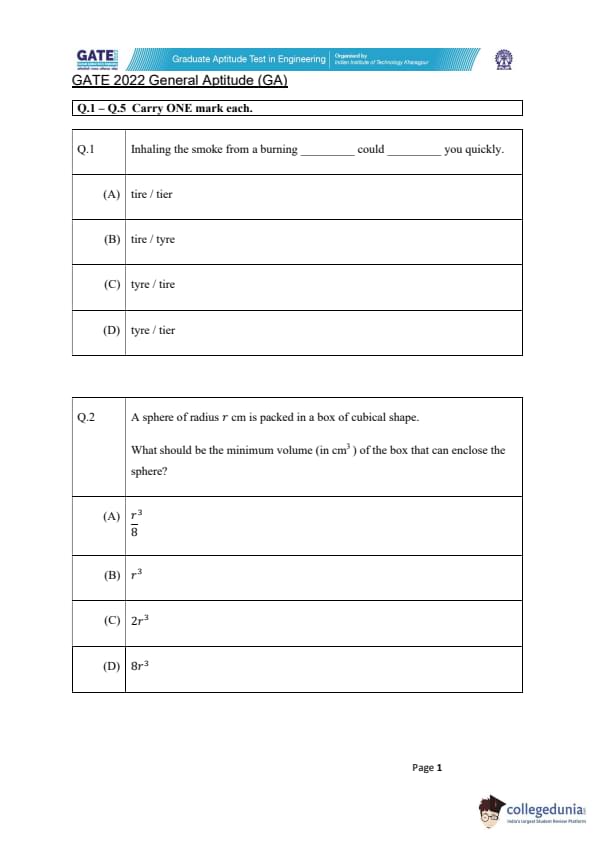
Inhaling the smoke from a burning __________ could __________ you quickly.
A sphere of radius \(r\) cm is packed in a box of cubical shape.
What should be the minimum volume (in cm\(^3\)) of the box that can enclose the sphere?
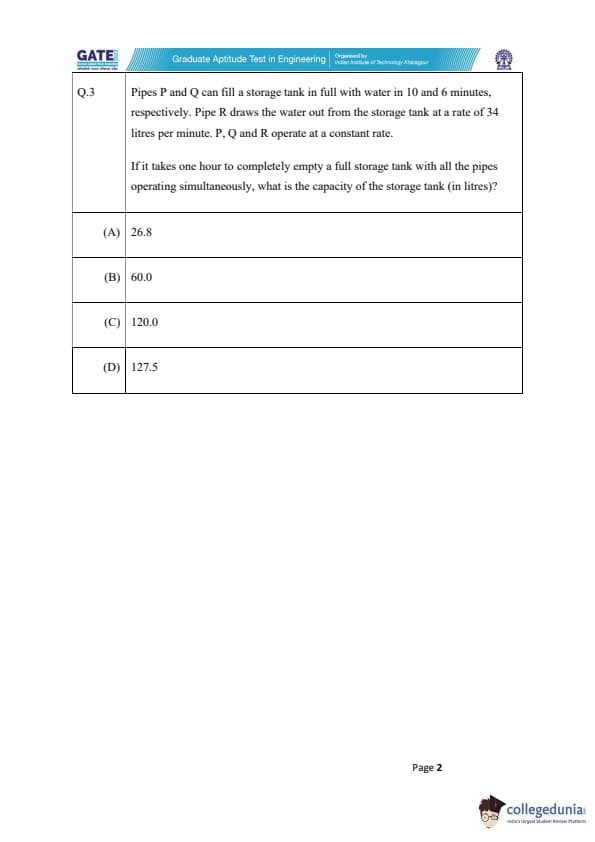
Pipes P and Q can fill a storage tank in full with water in 10 and 6 minutes, respectively. Pipe R draws the water out from the storage tank at a rate of 34 litres per minute. P, Q and R operate at a constant rate.
If it takes one hour to completely empty a full storage tank with all the pipes operating simultaneously, what is the capacity of the storage tank (in litres)?
Six persons P, Q, R, S, T, and U are sitting around a circular table facing the center not necessarily in the same order. Consider the following statements:
P sits next to S and T.
Q sits diametrically opposite to P.
The shortest distance between S and R is equal to the shortest distance between T and U.
Based on the above statements, Q is a neighbor of
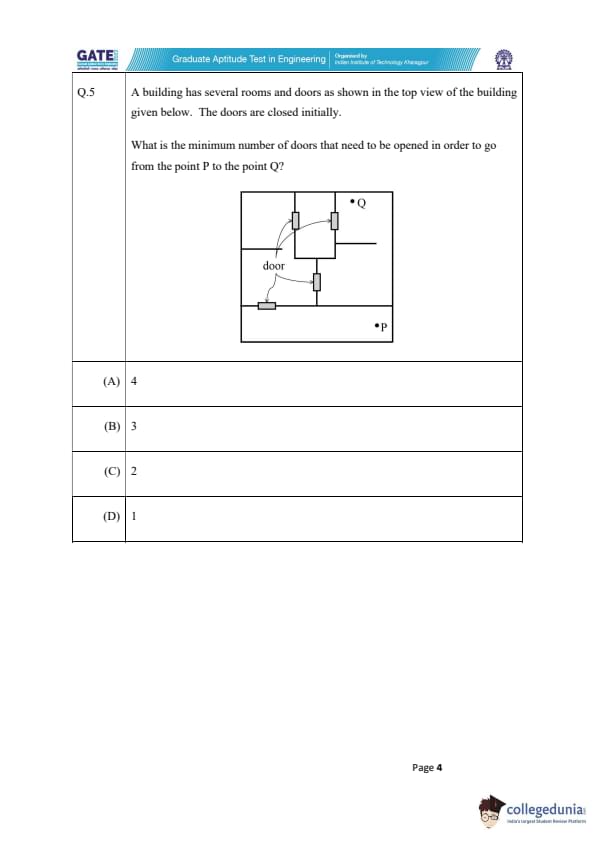
A building has several rooms and doors as shown in the top view of the building given below. The doors are closed initially.
What is the minimum number of doors that need to be opened in order to go from the point P to the point Q?

Rice, a versatile and inexpensive source of carbohydrate, is a critical component of diet worldwide. Climate change, causing extreme weather, poses a threat to sustained availability of rice. Scientists are working on developing Green Super Rice (GSR), which is resilient under extreme weather conditions yet gives higher yields sustainably.
Which one of the following is the CORRECT logical inference based on the information given in the above passage?
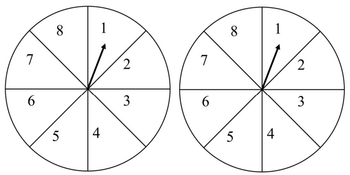
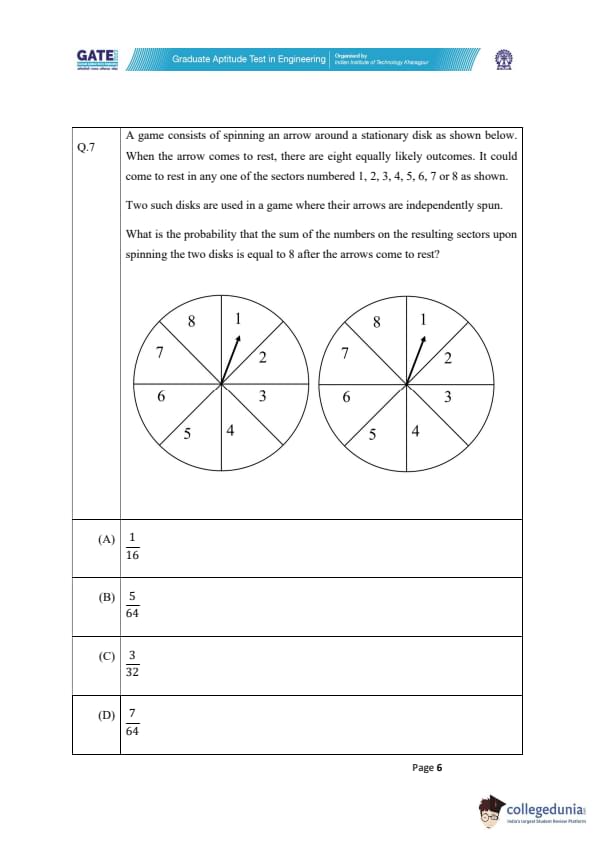
A game consists of spinning an arrow around a stationary disk as shown below.
When the arrow comes to rest, there are eight equally likely outcomes. It could come to rest in any one of the sectors numbered 1, 2, 3, 4, 5, 6, 7, or 8 as shown.
Two such disks are used in a game where their arrows are independently spun.
What is the probability that the sum of the numbers on the resulting sectors upon spinning the two disks is equal to 8 after the arrows come to rest?
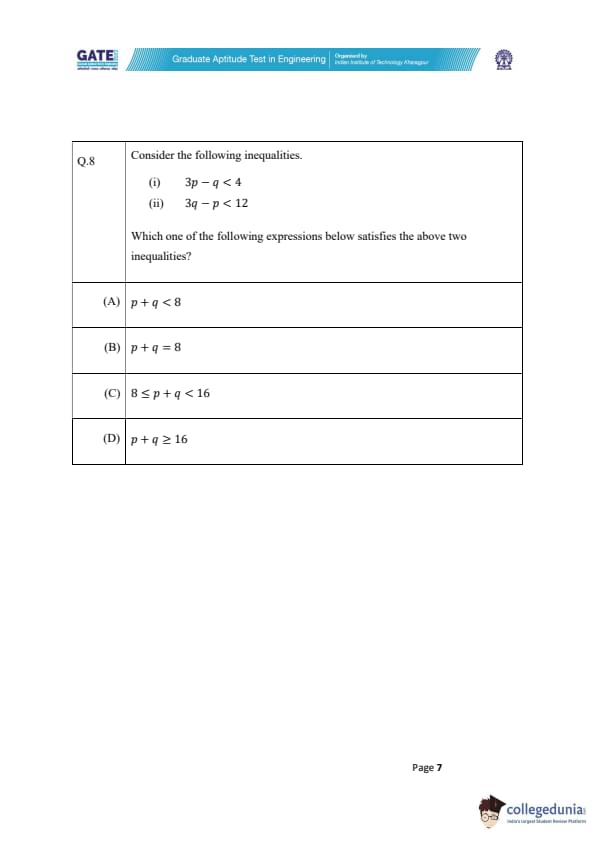
Consider the following inequalities.
(i) \( 3p - q < 4 \)
(ii) \( 3q - p < 12 \)
Which one of the following expressions below satisfies the above two inequalities?
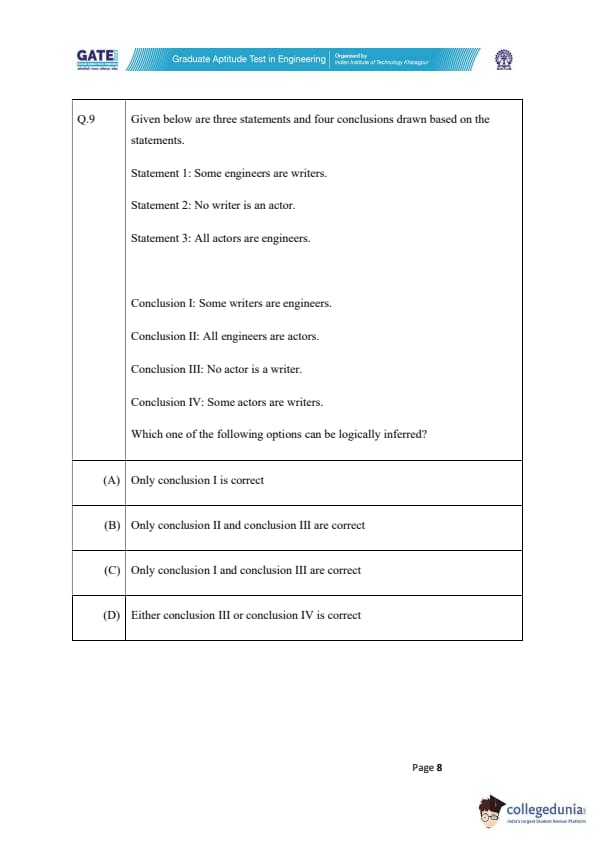
Given below are three statements and four conclusions drawn based on the statements.
Statement 1: Some engineers are writers.
Statement 2: No writer is an actor.
Statement 3: All actors are engineers.
Conclusion I: Some writers are engineers.
Conclusion II: All engineers are actors.
Conclusion III: No actor is a writer.
Conclusion IV: Some actors are writers.
Which one of the following options can be logically inferred?
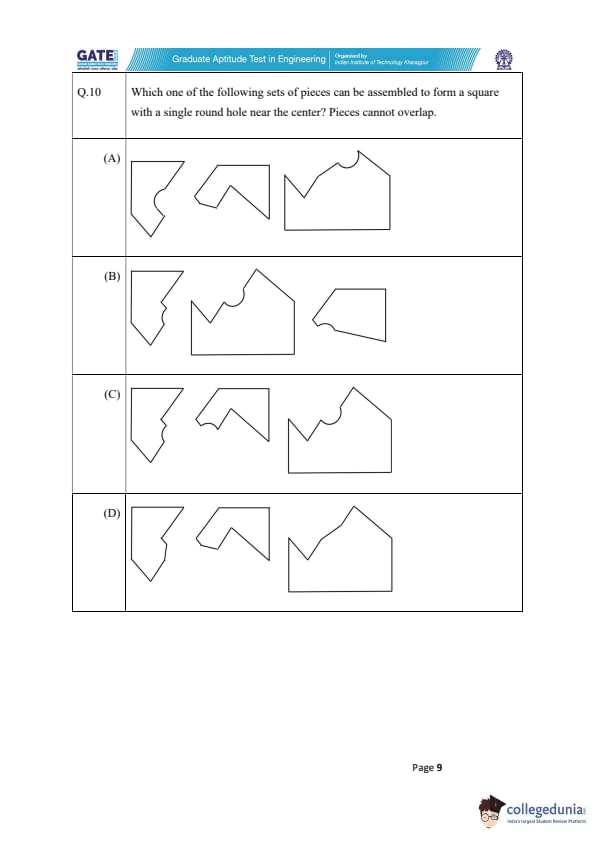
Which one of the following sets of pieces can be assembled to form a square with a single round hole near the center? Pieces cannot overlap.

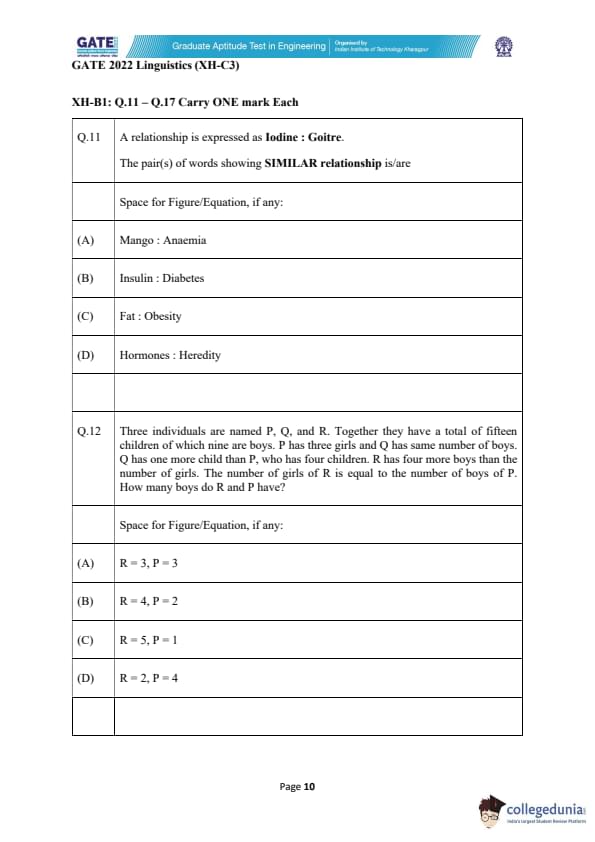
A relationship is expressed as Iodine : Goitre.
The pair(s) of words showing SIMILAR relationship is/are
Three individuals are named P, Q, and R. Together they have a total of fifteen children, of which nine are boys. P has three girls and Q has the same number of boys. Q has one more child than P, who has four children. R has four more boys than the number of girls of P. The number of girls of R is equal to the number of boys of P. How many boys do R and P have?
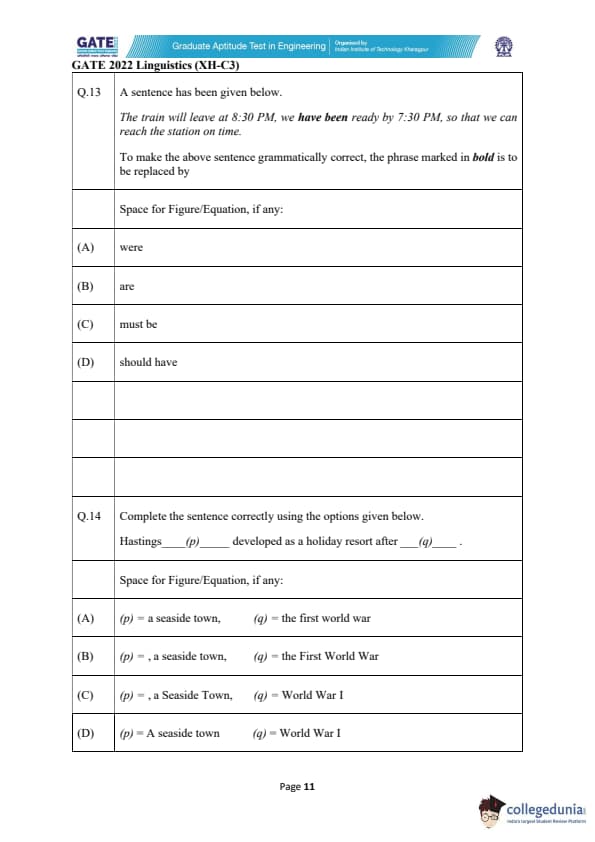
A sentence has been given below.
The train will leave at 8:30 PM, we \underline{have been ready by 7:30 PM, so that we can reach the station on time.
To make the above sentence grammatically correct, the phrase marked in bold is to be replaced by
Complete the sentence correctly using the options given below.
Hastings (p) (q) developed as a holiday resort after (q).
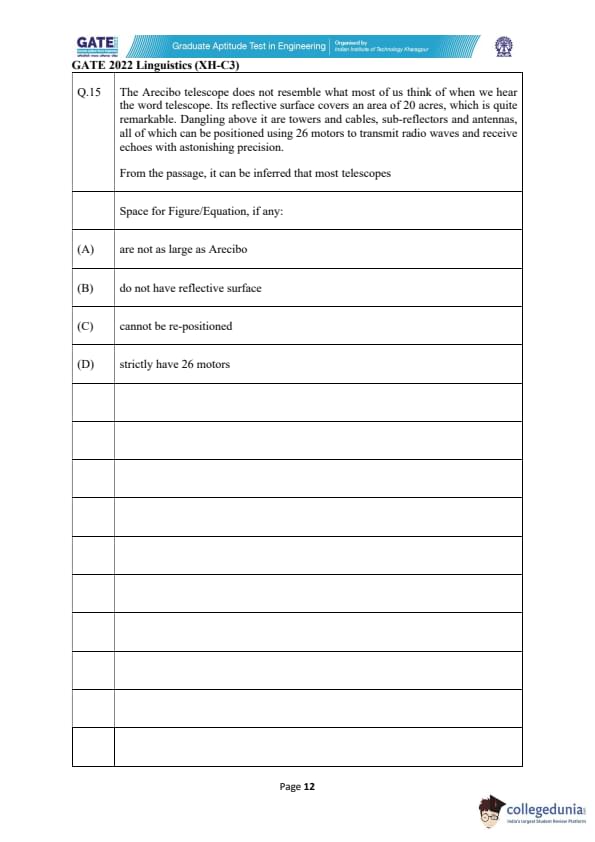
The Arecibo telescope does not resemble what most of us think of when we hear the word telescope. Its reflective surface covers an area of 20 acres, which is quite remarkable. Dangling above it are towers and cables, sub-reflectors and antennas, all of which can be positioned using 26 motors to transmit radio waves and receive echoes with astonishing precision.
From the passage, it can be inferred that most telescopes
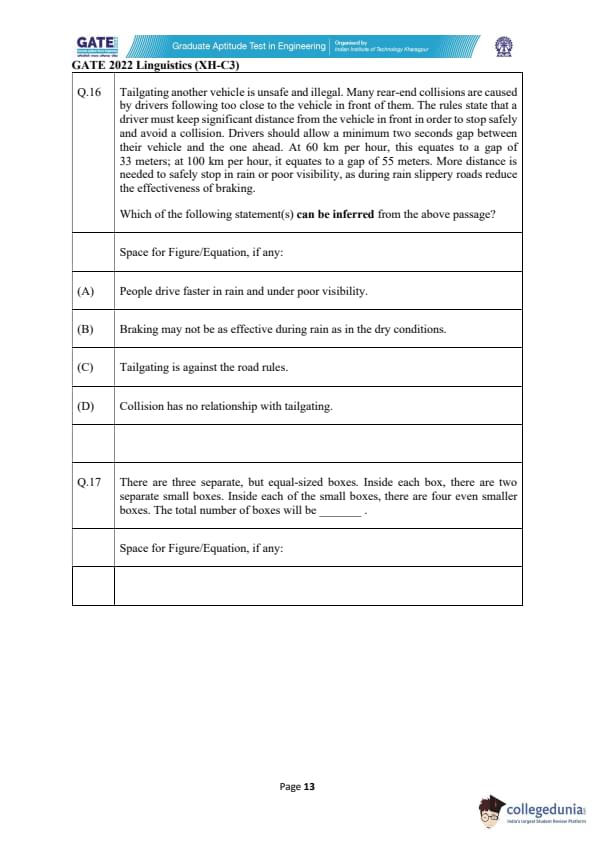
Tailgating another vehicle is unsafe and illegal. Many rear-end collisions are caused by drivers following too closely to the vehicle in front of them. The rules state that a driver must keep significant distance from the vehicle in front in order to stop safely and avoid a collision. Drivers should allow a minimum two seconds gap between their vehicle and the one ahead. At 60 km per hour, this equates to a gap of 33 meters; at 100 km per hour, it equates to a gap of 55 meters. More distance is needed to safely stop in rain or poor visibility, as during rain slippery roads reduce the effectiveness of braking.
Which of the following statement(s) can be inferred from the above passage?
There are three separate, but equal-sized boxes. Inside each box, there are two separate small boxes. Inside each of the small boxes, there are four even smaller boxes. The total number of boxes will be _________.
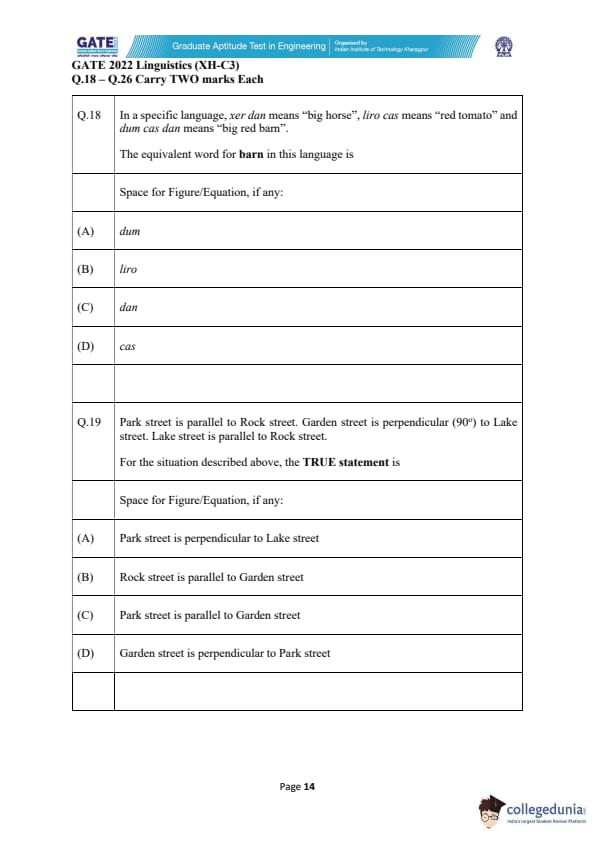
In a specific language, \( xer dan \) means "big horse", \( liro cas \) means "red tomato", and \( dum cas dan \) means "big red barn".
The equivalent word for \textit{barn in this language is
Park street is parallel to Rock street. Garden street is perpendicular (90°) to Lake street. Lake street is parallel to Rock street. For the situation described above, the TRUE statement is
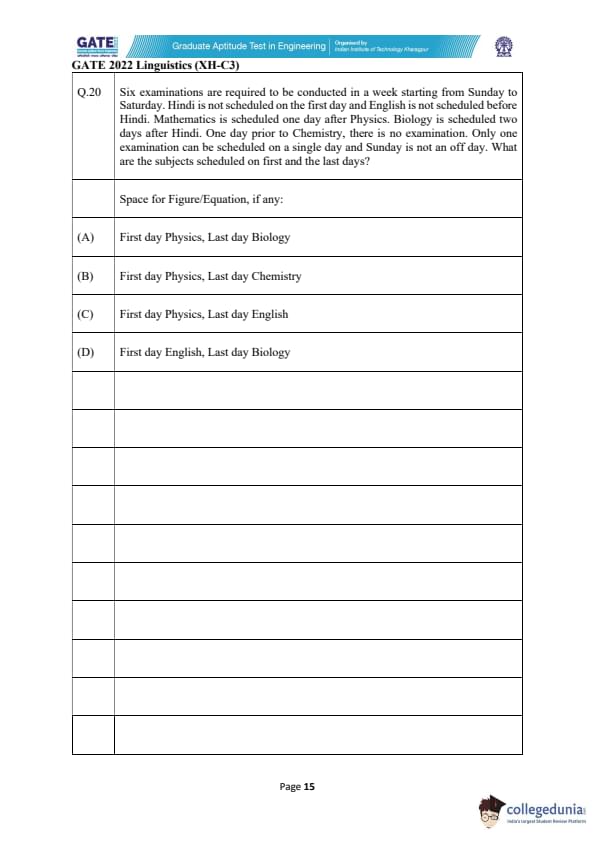
Six examinations are required to be conducted in a week starting from Sunday to Saturday. Hindi is not scheduled on the first day and English is not scheduled before Hindi. Mathematics is scheduled one day after Physics. Biology is scheduled two days after Hindi. One day prior to Chemistry, there is no examination. Only one examination can be scheduled on a single day and Sunday is not an off day. What are the subjects scheduled on first and the last days?
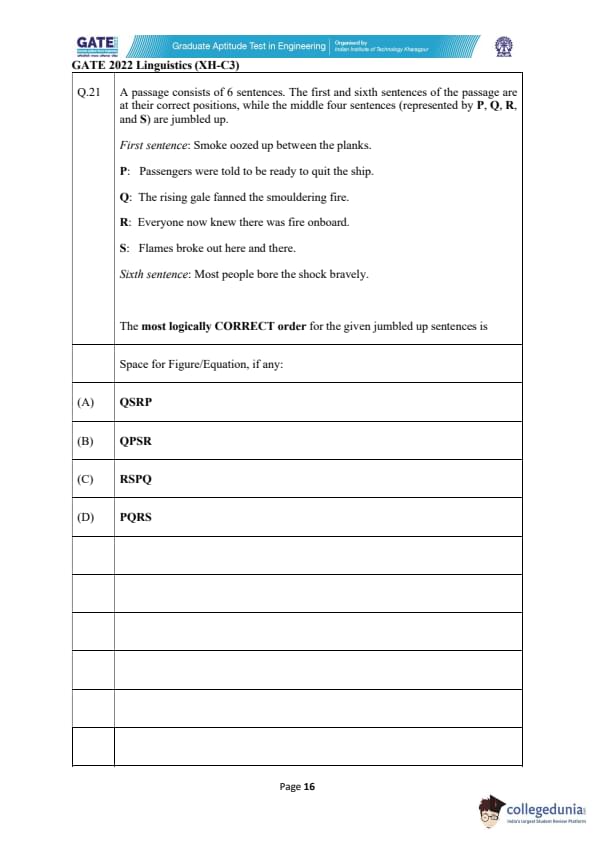
A passage consists of 6 sentences. The first and sixth sentences of the passage are at their correct positions, while the middle four sentences (represented by P, Q, R, and S) are jumbled up.
First sentence: Smoke oozed up between the planks.
P: Passengers were told to be ready to quit the ship.
Q: The rising gale fanned the smouldering fire.
R: Everyone now knew there was fire onboard.
S: Flames broke out here and there.
Sixth sentence: Most people bore the shock bravely.
The most logically CORRECT order for the given jumbled up sentences is
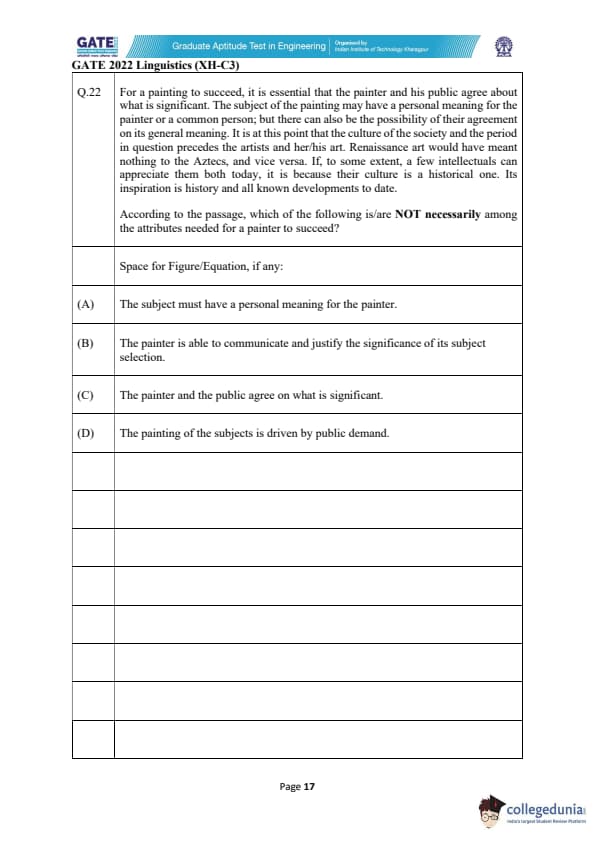
For a painting to succeed, it is essential that the painter and his public agree about what is significant. The subject of the painting may have a personal meaning for the painter or a common person; but there can also be the possibility of their agreement on its general meaning. It is at this point that the culture of the society and the period in question precedes the artists and her/his art. Renaissance art would have meant nothing to the Aztecs, and vice versa. If, to some extent, a few intellectuals can appreciate them both today, it is because their culture is a historical one. Its inspiration is history and all known developments to date.
According to the passage, which of the following is/are NOT necessarily among the attributes needed for a painter to succeed?
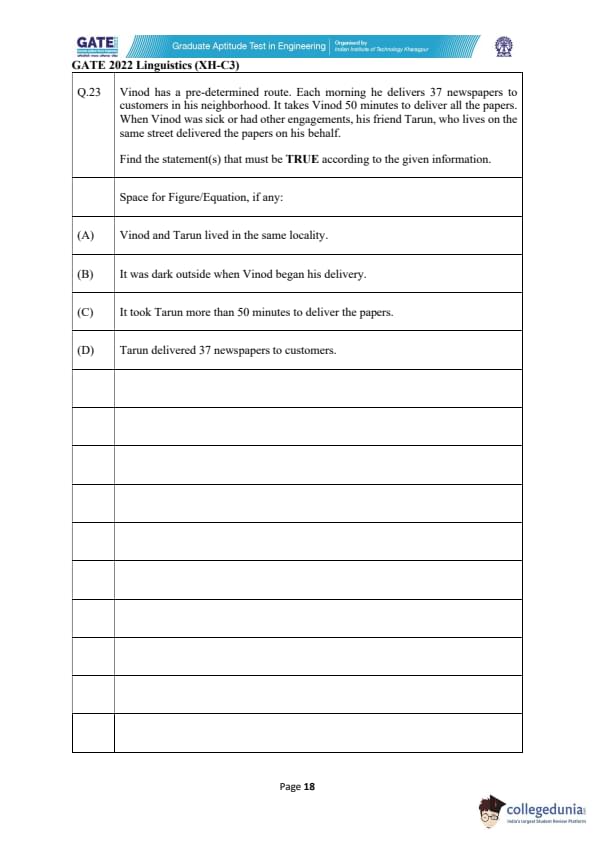
Vinod has a pre-determined route. Each morning he delivers 37 newspapers to customers in his neighborhood. It takes Vinod 50 minutes to deliver all the papers. When Vinod was sick or had other engagements, his friend Tarun, who lives on the same street delivered the papers on his behalf.
Find the statement(s) that must be TRUE according to the given information.
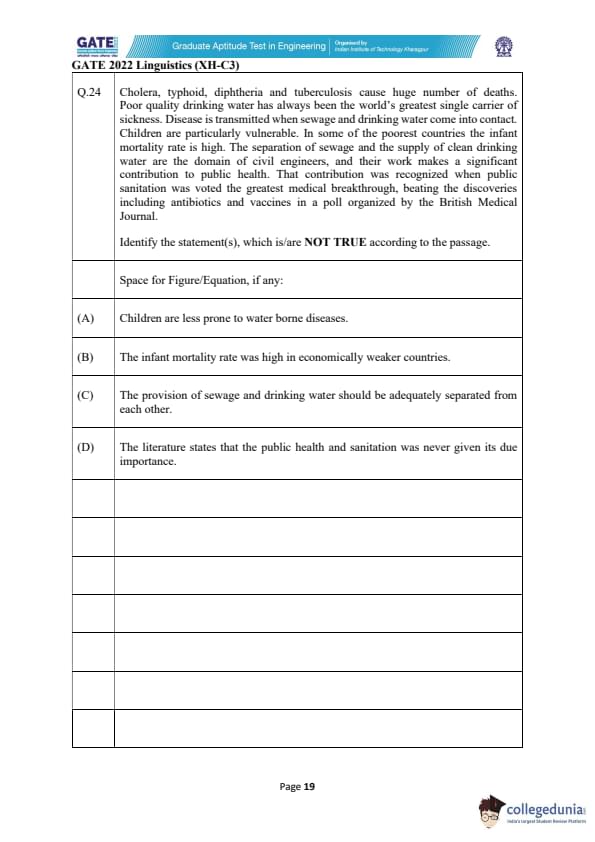
Cholera, typhoid, diphtheria and tuberculosis cause huge number of deaths. Poor quality drinking water has always been the world’s greatest single carrier of sickness. Disease is transmitted when sewage and drinking water come into contact. Children are particularly vulnerable. In some of the poorest countries the infant mortality rate is high. The separation of sewage and the supply of clean drinking water are the domain of civil engineers, and their work makes a significant contribution to public health. That contribution was recognized when public sanitation was voted the greatest medical breakthrough, beating the discoveries including antibiotics and vaccines in a poll organized by the British Medical Journal.
Identify the statement(s), which is/are NOT TRUE according to the passage.
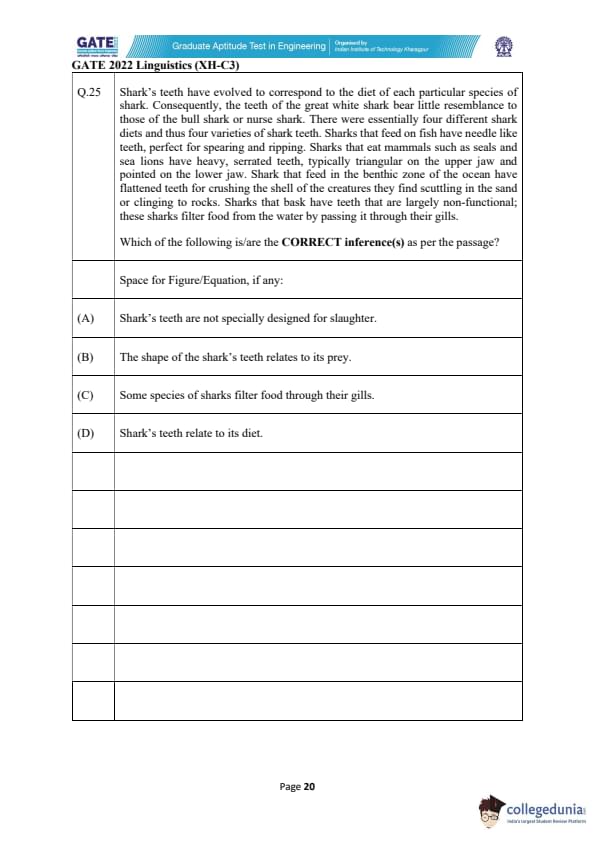
Shark’s teeth have evolved to correspond to the diet of each particular species of shark. Consequently, the teeth of the great white shark bear little resemblance to those of the bull shark or nurse shark. There were essentially four different shark diets and thus four varieties of shark teeth. Sharks that feed on fish have needle-like teeth, perfect for spearing and ripping. Sharks that eat mammals such as seals and sea lions have heavy, serrated teeth, typically triangular on the upper jaw and pointed on the lower jaw. Shark that feed in the benthic zone of the ocean have flattened teeth for crushing the shell of the creatures they find scuttling in the sand or clinging to rocks. Sharks that bask have teeth that are largely non-functional; these sharks filter food from the water by passing it through their gills.
Which of the following is/are the CORRECT inference(s) as per the passage?
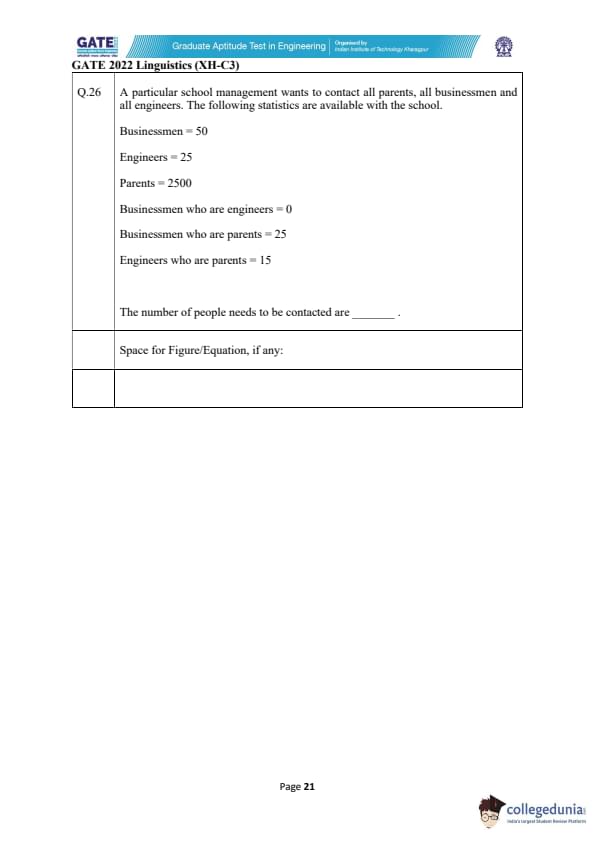
A particular school management wants to contact all parents, all businessmen and all engineers. The following statistics are available with the school.
Businessmen = 50
Engineers = 25
Parents = 2500
Businessmen who are engineers = 0
Businessmen who are parents = 25
Engineers who are parents = 15
The number of people who need to be contacted are _________.
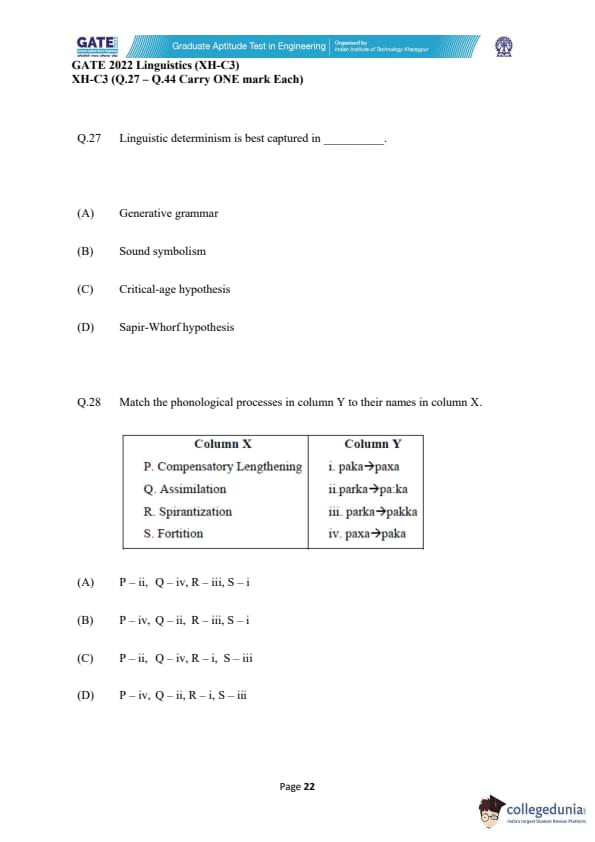
Linguistic determinism is best captured in _________.
Match the phonological processes in column Y to their names in column X.

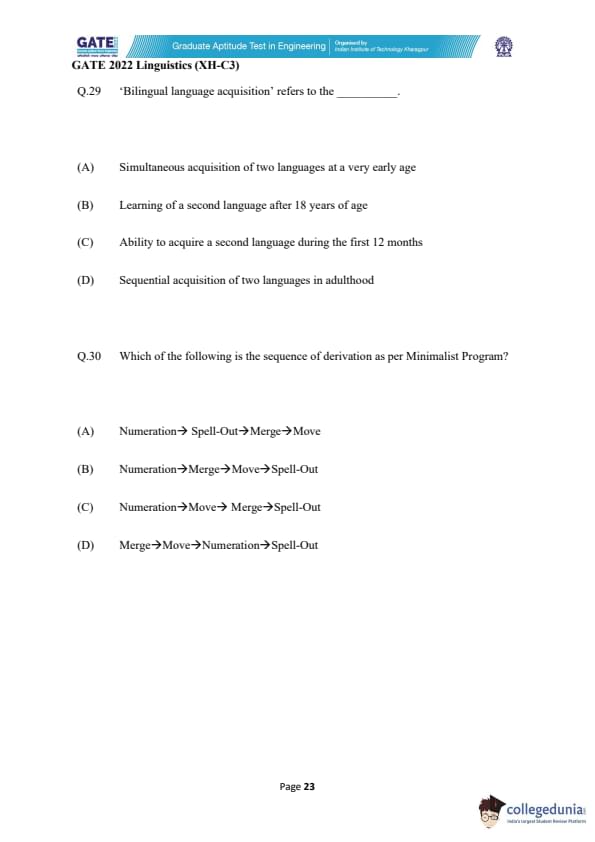
‘Bilingual language acquisition’ refers to the _________.
Which of the following is the sequence of derivation as per Minimalist Program?
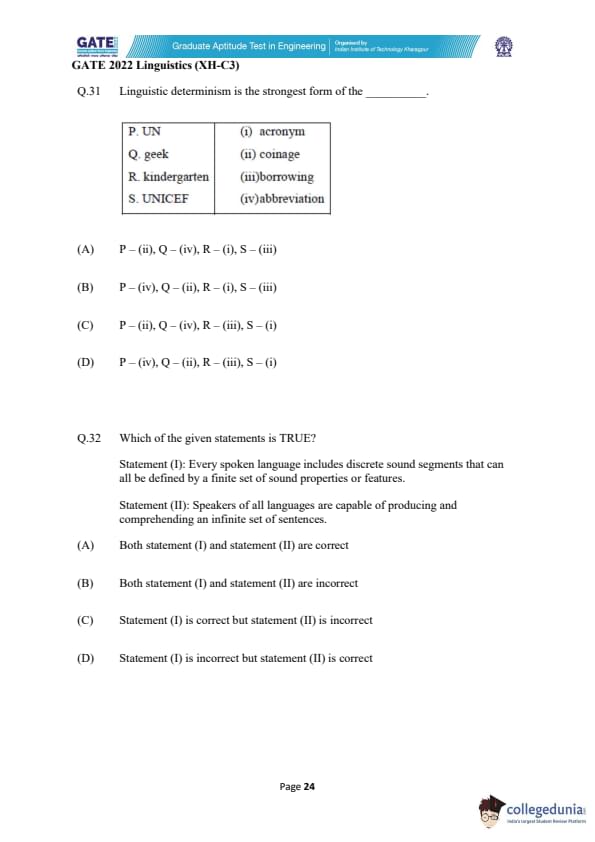
Linguistic determinism is the strongest form of the _________.

Which of the given statements is TRUE?
Statement (I): Every spoken language includes discrete sound segments that can all be defined by a finite set of sound properties or features.
Statement (II): Speakers of all languages are capable of producing and comprehending an infinite set of sentences.
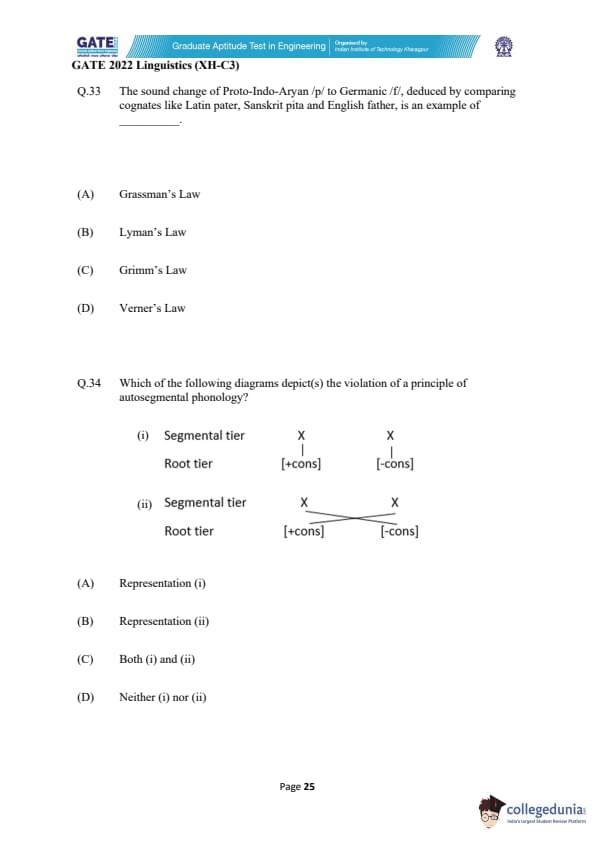
The sound change of Proto-Indo-Aryan /p/ to Germanic /f/, deduced by comparing cognates like Latin pater, Sanskrit pita and English father, is an example of _________.
Which of the following diagrams depict(s) the violation of a principle of autosegmental phonology?

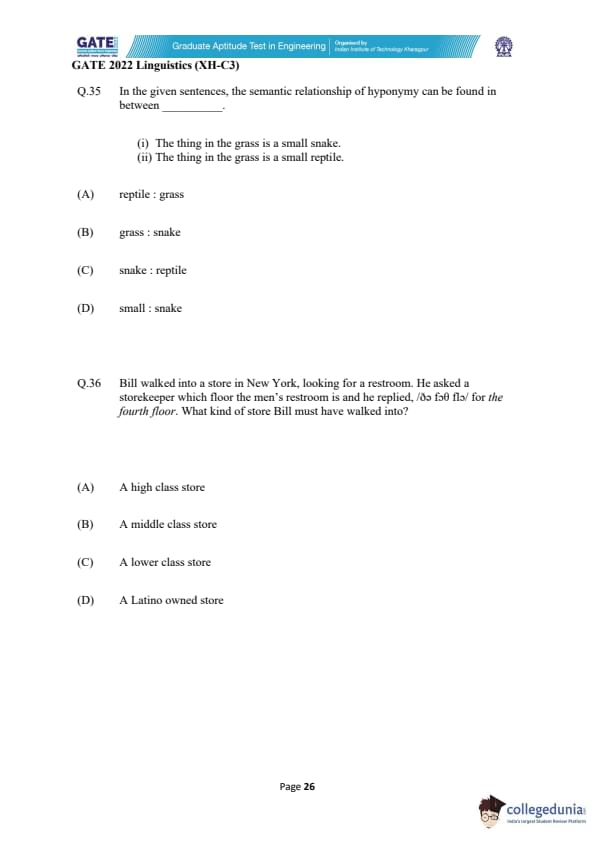
In the given sentences, the semantic relationship of hyponymy can be found in between _________.
(i) The thing in the grass is a small snake.
(ii) The thing in the grass is a small reptile.
Bill walked into a store in New York, looking for a restroom. He asked a storekeeper which floor the men’s restroom is and he replied, /ðə fəʊθ flɔː/ for the fourth floor. What kind of store Bill must have walked into?
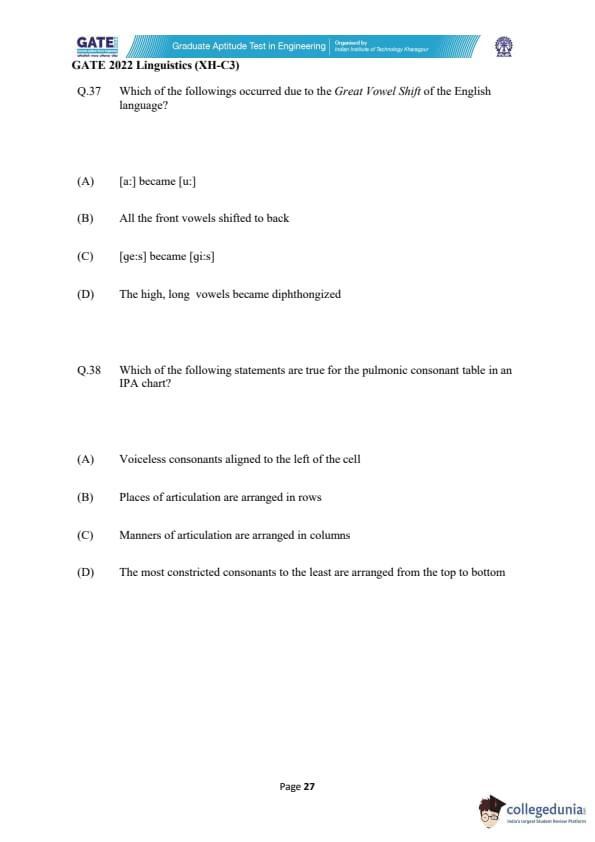
Which of the followings occurred due to the Great Vowel Shift of the English language?
Which of the following statements are true for the pulmonic consonant table in an IPA chart?
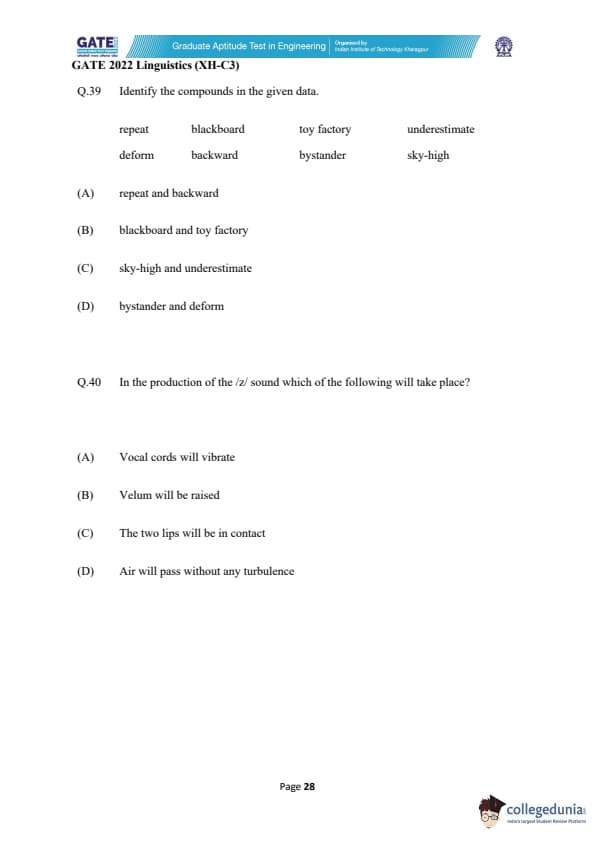
Identify the compounds in the given data.

In the production of the /z/ sound which of the following will take place?
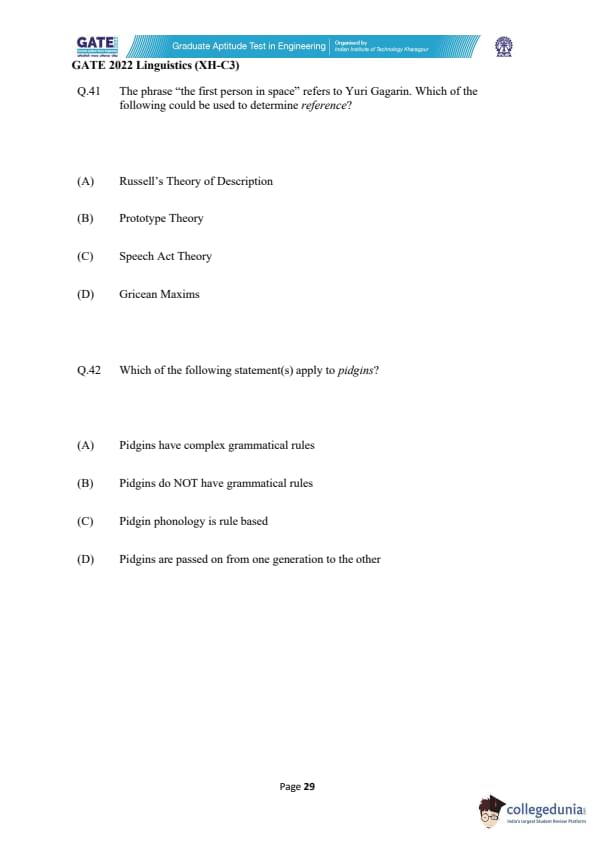
The phrase “the first person in space” refers to Yuri Gagarin. Which of the following could be used to determine reference?
Which of the following statement(s) apply to pidgins?
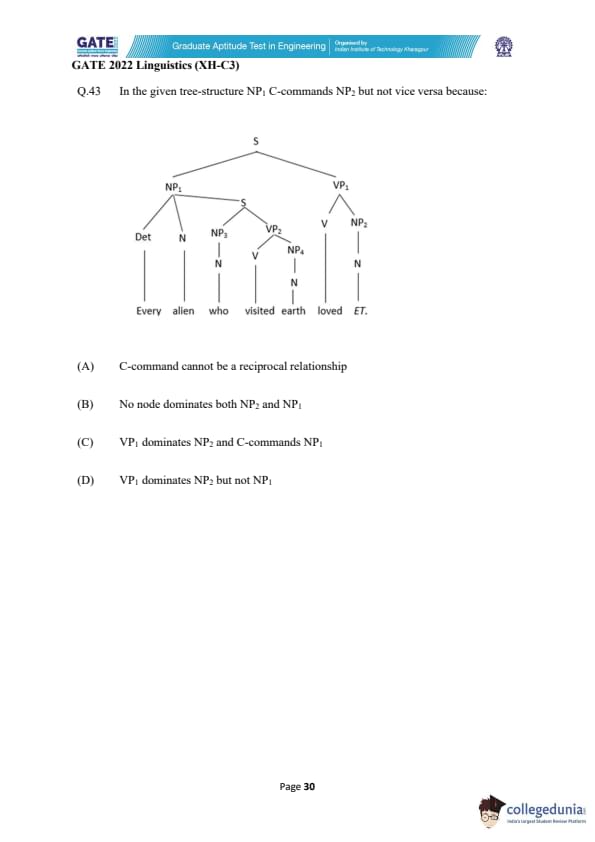
In the given tree-structure NP1 C-commands NP2 but not vice versa because:

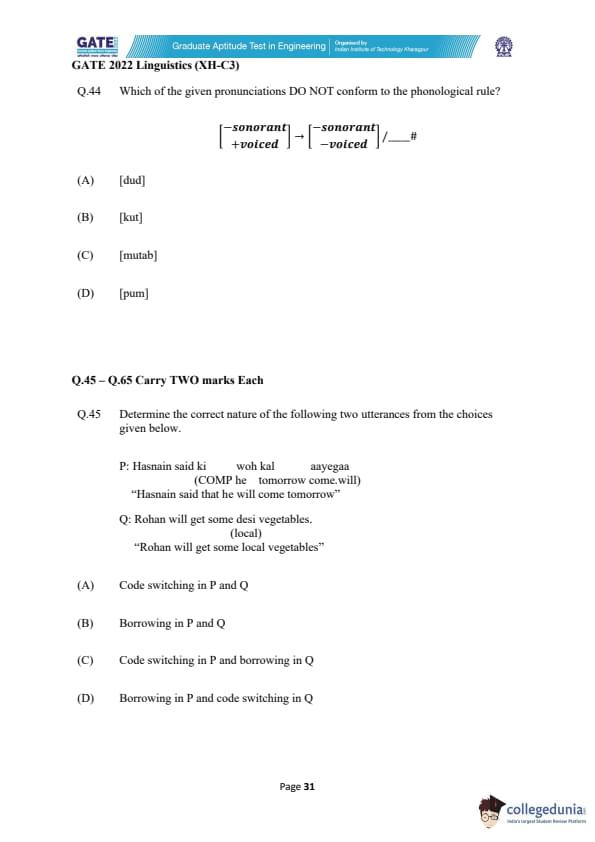
Which of the given pronunciations DO NOT conform to the phonological rule?

Determine the correct nature of the following two utterances from the choices given below.
P: Hasnain said ki woh kal aayegaa
(COMP he tomorrow come.will)
“Hasnain said that he will come tomorrow”
Q: Rohan will get some desi vegetables.
(local)
“Rohan will get some local vegetables”
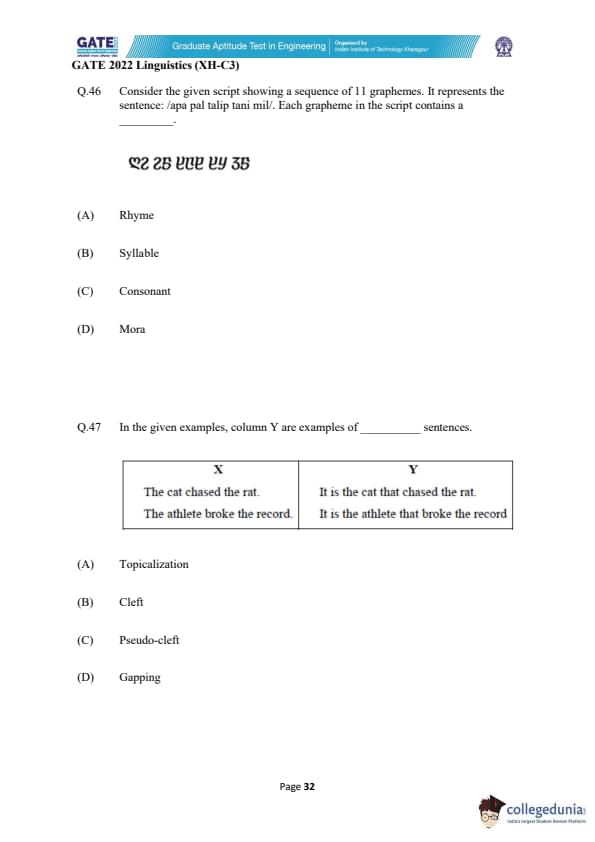
Consider the given script showing a sequence of 11 graphemes. It represents the sentence: /apa pal talip tani mil/. Each grapheme in the script contains a _________.

In the given examples, column Y are examples of _________ sentences.

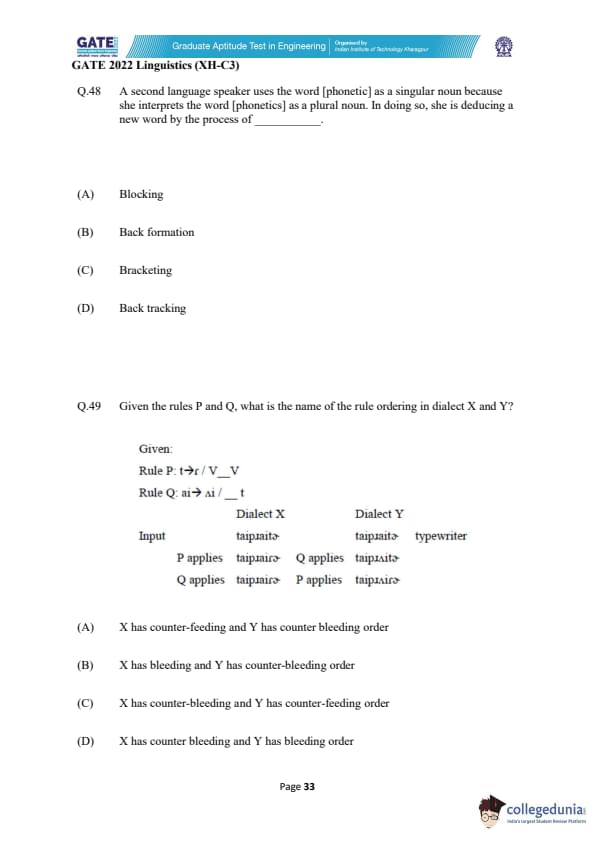
A second language speaker uses the word [phonetic] as a singular noun because she interprets the word [phonetics] as a plural noun. In doing so, she is deducing a new word by the process of _________.
Given the rules P and Q, what is the name of the rule ordering in dialect X and Y?

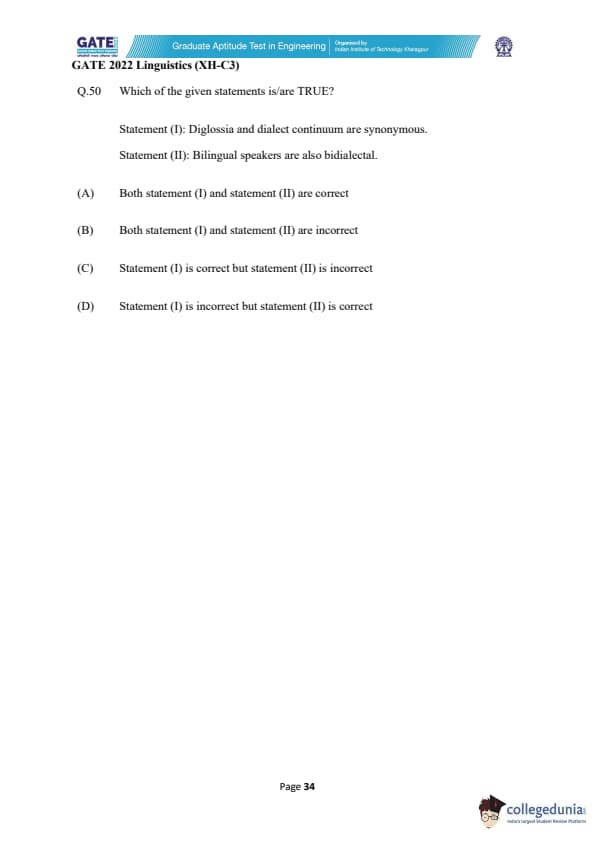
Which of the given statements is/are TRUE?
Statement (I): Diglossia and dialect continuum are synonymous.
Statement (II): Bilingual speakers are also bidialectal.
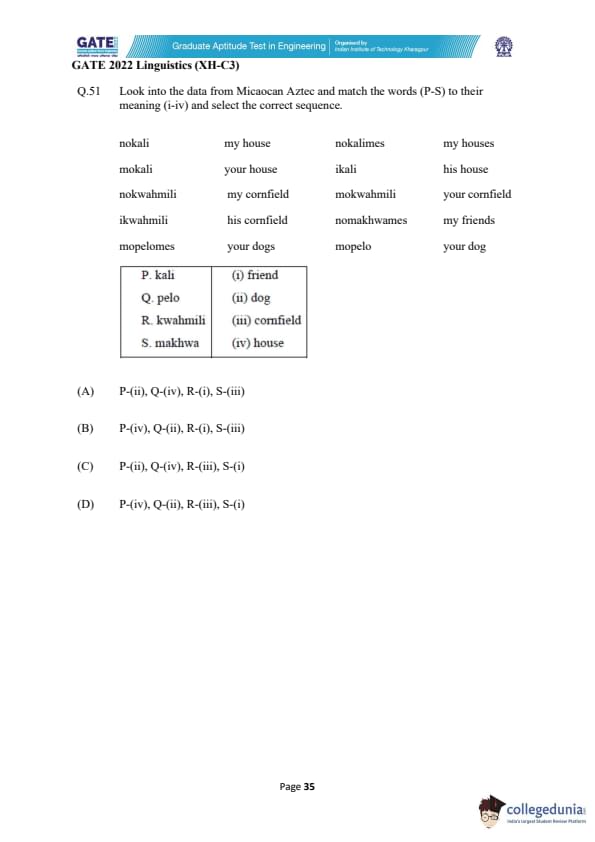
Look into the data from Micoacan Aztec and match the words (P-S) to their meaning (i-iv) and select the correct sequence.

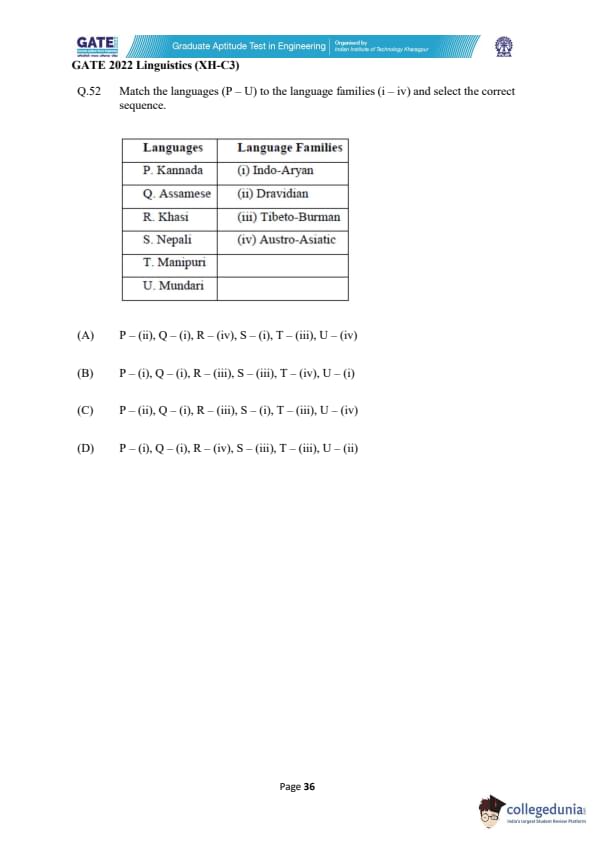
Match the languages (P – U) to the language families (i – iv) and select the correct sequence.

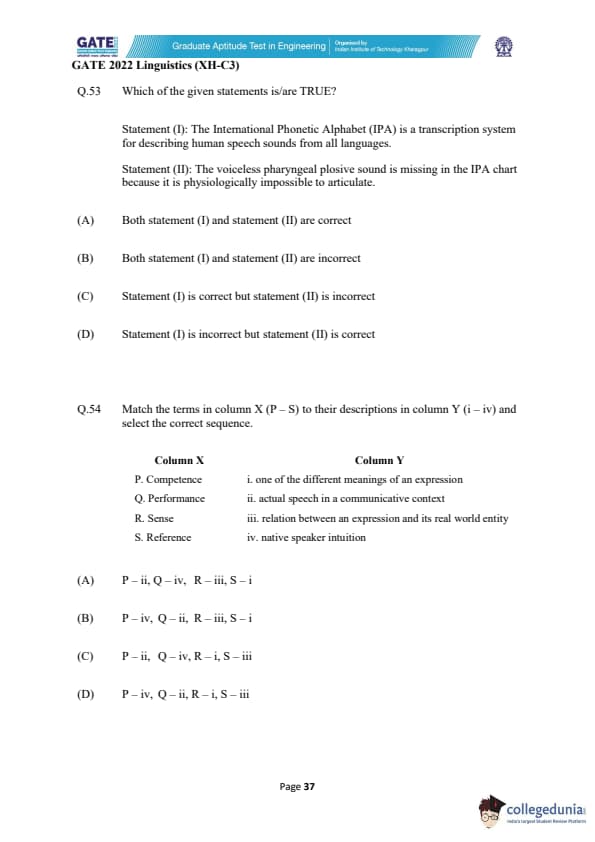
Which of the given statements is/are TRUE?
Statement (I): The International Phonetic Alphabet (IPA) is a transcription system for describing human speech sounds from all languages.
Statement (II): The voiceless pharyngeal plosive sound is missing in the IPA chart because it is physiologically impossible to articulate.
Match the terms in column X (P – S) to their descriptions in column Y (i – iv) and select the correct sequence.

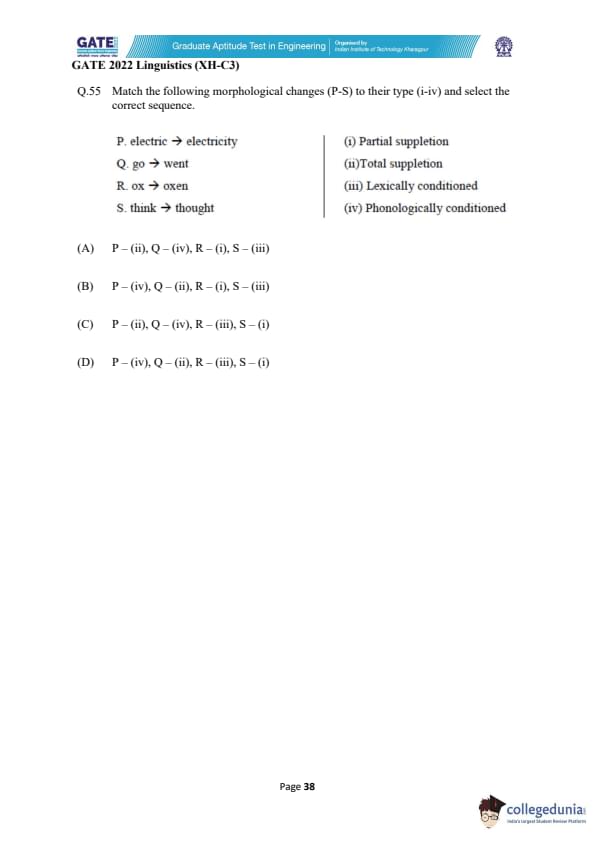
Match the following morphological changes (P-S) to their type (i-iv) and select the correct sequence.
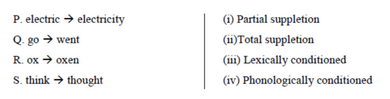
Which of the given statements is/are TRUE?

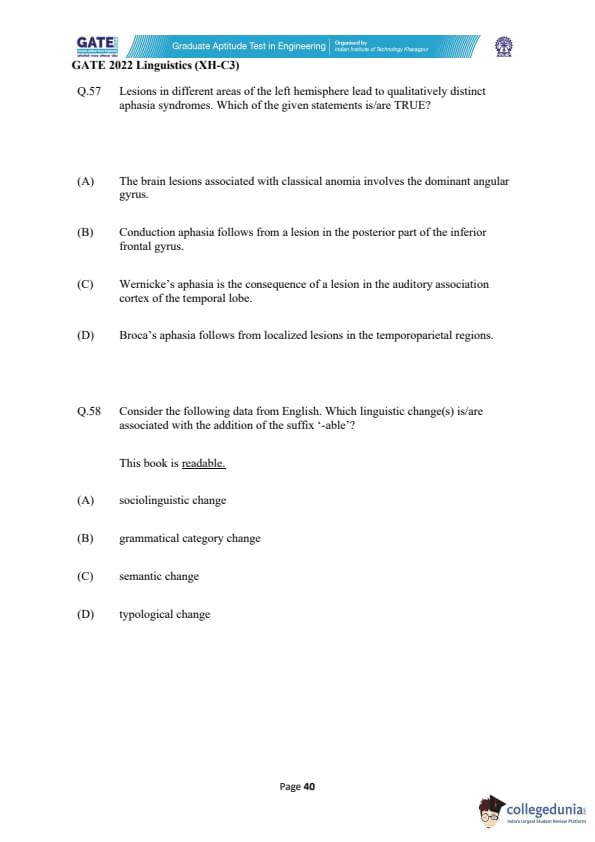
Lesions in different areas of the left hemisphere lead to qualitatively distinct aphasia syndromes. Which of the given statements is/are TRUE?
Consider the following data from English. Which linguistic change(s) is/are associated with the addition of the suffix ‘-able’?
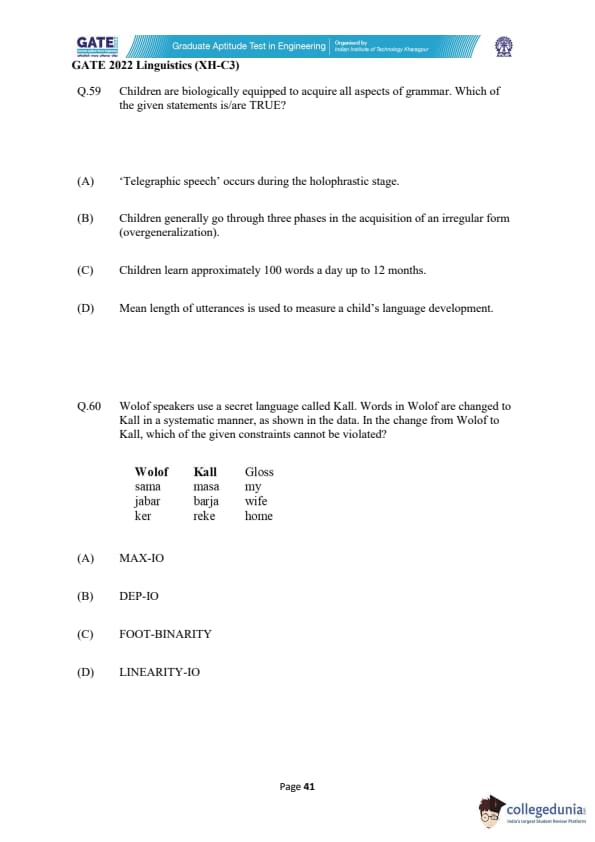
Children are biologically equipped to acquire all aspects of grammar. Which of the given statements is/are TRUE?
Wolof speakers use a secret language called Kall. Words in Wolof are changed to Kall in a systematic manner, as shown in the data. In the change from Wolof to Kall, which of the given constraints cannot be violated?

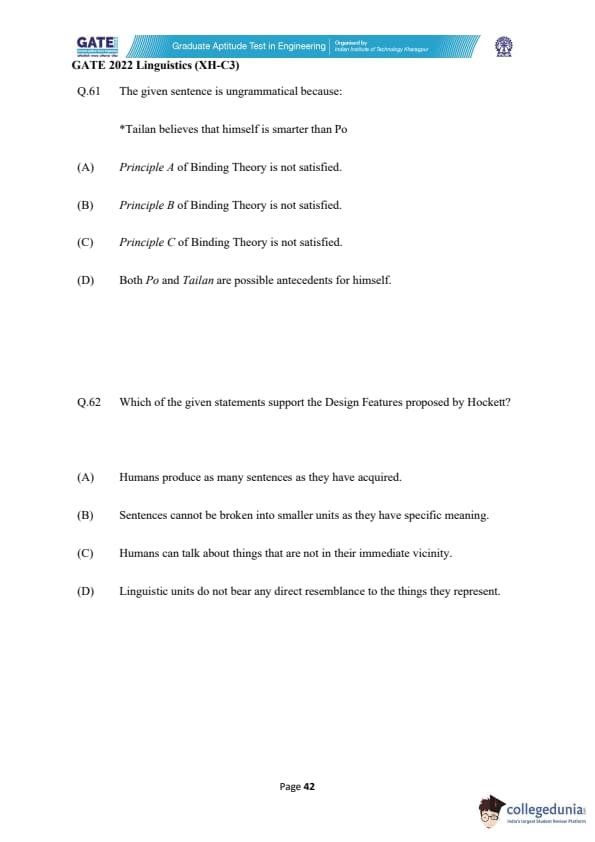
The given sentence is ungrammatical because:
Tailan believes that himself is smarter than Po
Which of the given statements support the Design Features proposed by Hockett?
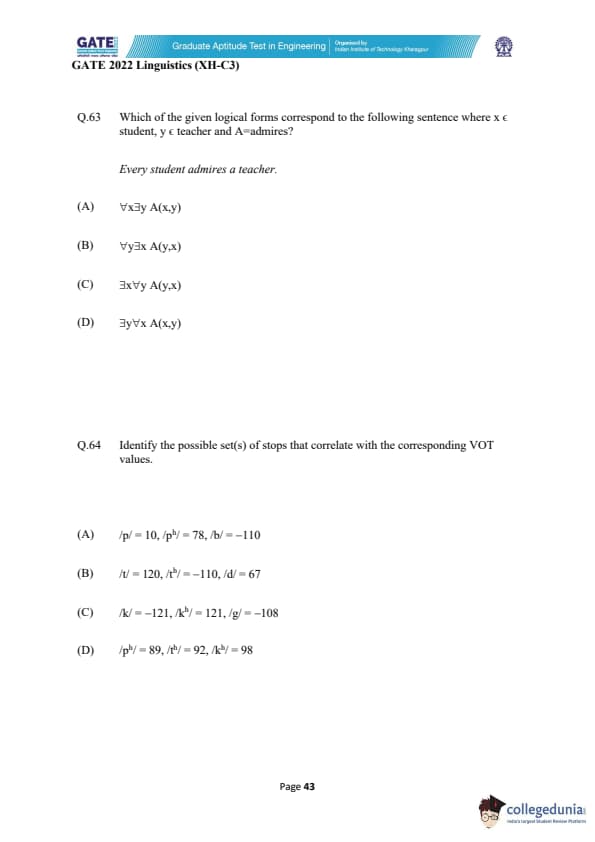
Which of the given logical forms correspond to the following sentence where \( x \in \) student, \( y \) teacher and \( A = \) admires?
Every student admires a teacher.
Identify the possible set(s) of stops that correlate with the corresponding VOT values.
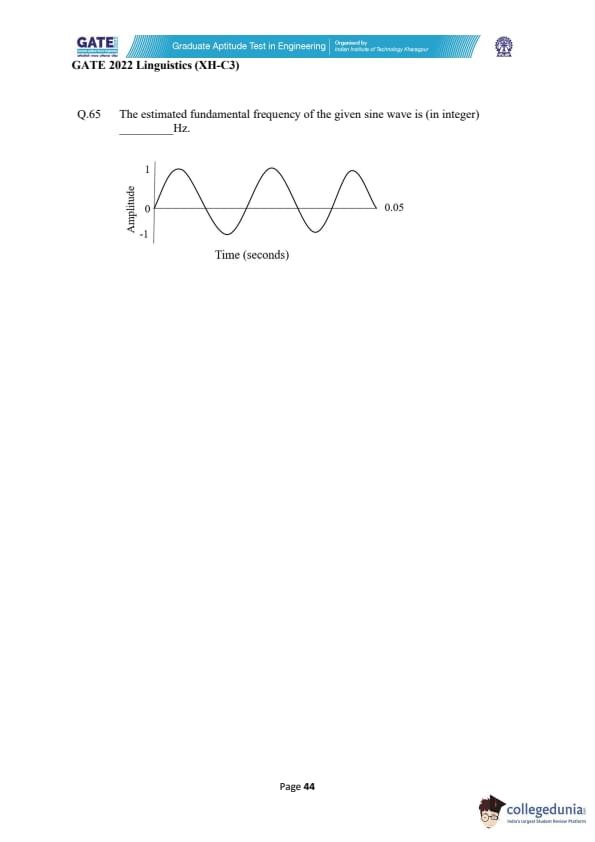
The estimated fundamental frequency of the given sine wave is (in integer) _________ Hz.

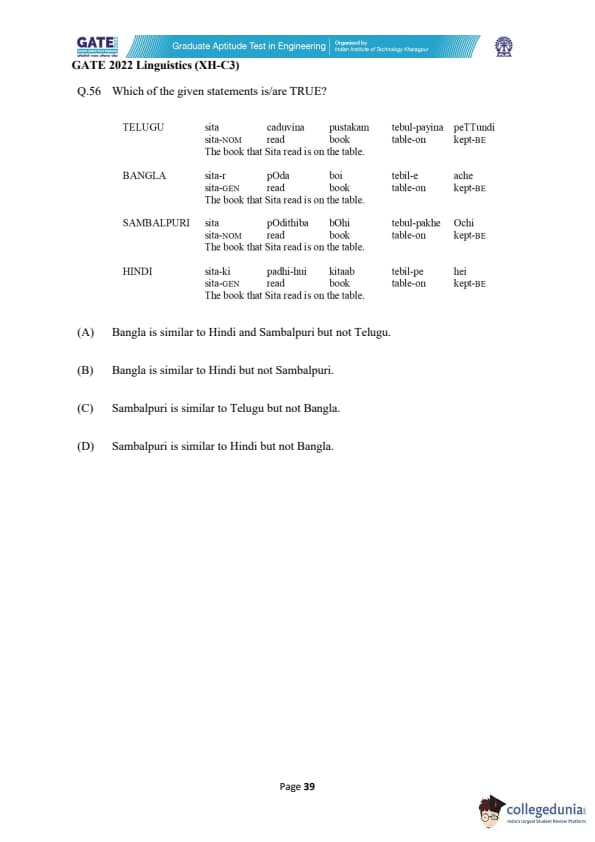
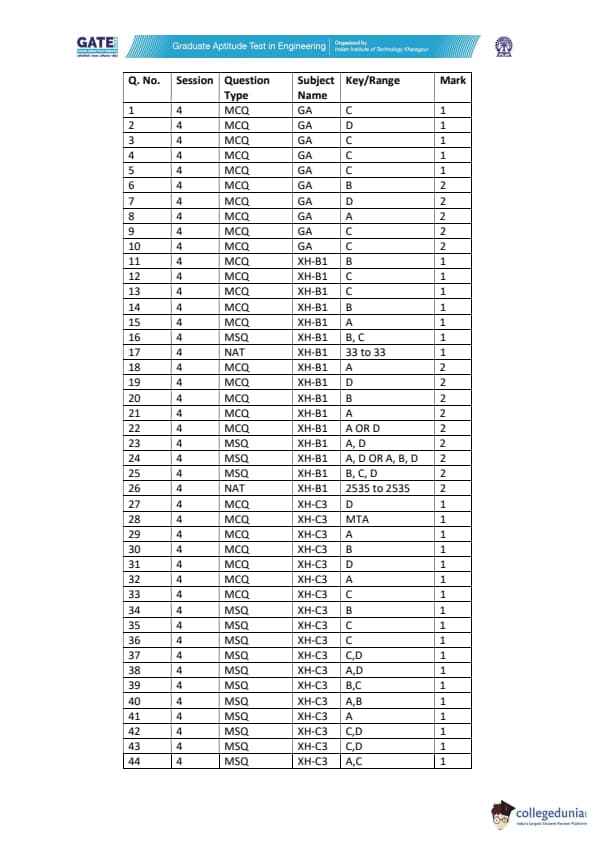
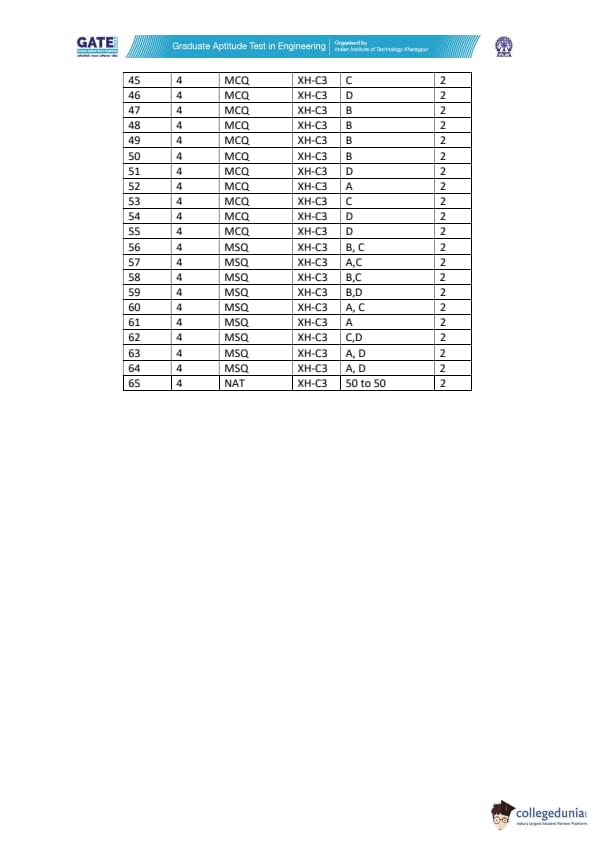
GATE 2022 XH- C3 (Linguistics) Question Paper: Paper Analysis
Section GA and B1 in GATE 2022 XH- Linguistics Question Paper were the same as the other five papers for GATE XH paper. The table below shows the number of 1 mark and 2 marks questions in GATE 2022 XH- Linguistics Question Paper:
| Type of Questions | General Aptitude (GA) | Reasoning Comprehension (B1) | Linguistics (XH- C3) | |||
|---|---|---|---|---|---|---|
| Number of Questions | Marks | Number of Questions | Marks | Number of Questions | Marks | |
| No. of 1 mark MCQs | 5 | 5 | 5 | 5 | 7 | 7 |
| No. of 2 marks MCQs | 5 | 10 | 5 | 10 | 11 | 22 |
| No. of 1 mark NATs | 0 | 0 | 1 | 1 | 0 | 0 |
| No. of 2 marks NATs | 0 | 0 | 1 | 2 | 1 | 2 |
| No. of 1 mark MSQs | 0 | 0 | 1 | 1 | 11 | 11 |
| No. of 2 marks MSQs | 0 | 0 | 3 | 6 | 9 | 18 |
Also Check:
GATE Previous Year Question Papers:
| GATE 2022 Question Papers | GATE 2021 Question Papers | GATE 2020 Question Papers |
| GATE 2019 Question Papers | GATE 2018 Question Papers | GATE 2017 Question Papers |




Comments